DQS-ULManagementSystemsSolutions©
1
DIS ISO9001:2015 Overview
Welcome
Sections 1-5
Revisions & Impact
DQS-ULManagementSystemsSolutions©
2
Jawaid.Mansour@us.dqs-ul.com
Joe Mansour
ISO9001:2015 Program Manager
Lead Auditor
BSEE, MSEE, MBA
760-458-3879 (office/cell)
DQS-ULManagementSystemsSolutions©
3
www.ul-dqsusa.com
http://ul-dqsusa.com/iso-90012015/
DQS-ULManagementSystemsSolutions©
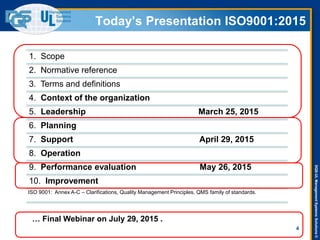
Today’s Presentation ISO9001:2015
1. Scope
2. Normative reference
3. Terms and definitions
4. Context of the organization
5. Leadership March 25, 2015
6. Planning
7. Support April 29, 2015
8. Operation
9. Performance evaluation May 26, 2015
10. Improvement
ISO 9001: Annex A-C – Clarifications, Quality Management Principles, QMS family of standards.
4
… Final Webinar on July 29, 2015 .
DQS-ULManagementSystemsSolutions©
Questions?
5
ISO9001_2015_Questions@us.dqs-ul.com
Please send your questions to:
Next Webinar: April 29, 2015
DQS-ULManagementSystemsSolutions©
Questions From The Last Webinar
6
Q1 What is the current
difference between element
approach and process approach?
Explanation of Process Approach was
included in slides 30-49. ISO9001:2015
requires all Processes (value-added
activities of the organization) be
identified and managed as a process.
Element-based standards just outline
the requirements.
DQS-ULManagementSystemsSolutions©
Questions From The Last Webinar
7
Q2 What do you mean by the standard
now requires min 17 "documented
information"
“Retain Documented Information“ appears 17
times in the Standard. Namely, in sections 4.4,
6.2.1, 7.1.5, 7.2, 8.1.e), 8.2.3, 8.3.5, 8.3.6, 8.4.1,
8.5.2, 8.5.6, 8.6, 8.7, 9.1.1, 9.2.2, 9.3.2 and
10.2.2.
This is equivalent to the current Quality Records requirement,
where the information can be in any media or format. For
clarification, please note that “Maintain documented information“
is equivalent to the current “Documented Procedure“ requirement.
DQS-ULManagementSystemsSolutions©
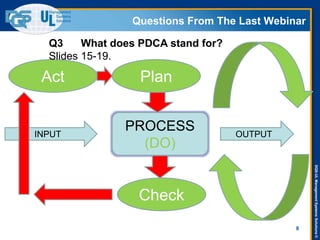
8
PROCESS
(DO)
INPUT OUTPUT
Plan
Check
Act
Questions From The Last Webinar
Q3 What does PDCA stand for?
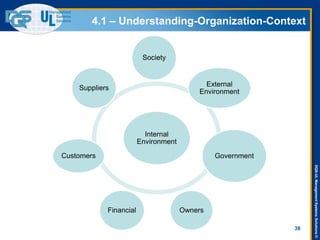
Slides 15-19.
DQS-ULManagementSystemsSolutions©
Questions From The Last Webinar
9
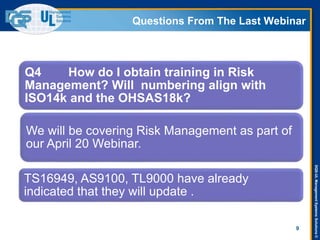
Q4 How do I obtain training in Risk
Management? Will numbering align with
ISO14k and the OHSAS18k?
We will be covering Risk Management as part of
our April 20 Webinar.
TS16949, AS9100, TL9000 have already
indicated that they will update .
DQS-ULManagementSystemsSolutions©
Questions From The Last Webinar
10
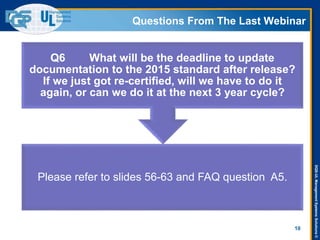
Please refer to slides 56-63 and FAQ question A5.
Q6 What will be the deadline to update
documentation to the 2015 standard after release?
If we just got re-certified, will we have to do it
again, or can we do it at the next 3 year cycle?
DQS-ULManagementSystemsSolutions©
Questions From The Last Webinar
11
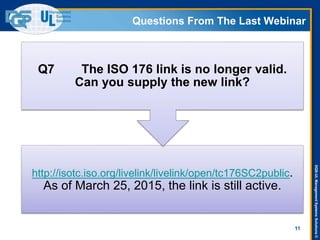
http://isotc.iso.org/livelink/livelink/open/tc176SC2public.
As of March 25, 2015, the link is still active.
Q7 The ISO 176 link is no longer valid.
Can you supply the new link?
DQS-ULManagementSystemsSolutions©
Questions From The Last Webinar
12
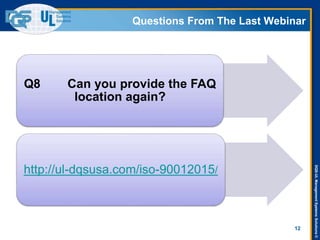
Q8 Can you provide the FAQ
location again?
http://ul-dqsusa.com/iso-90012015/
DQS-ULManagementSystemsSolutions©
Questions From The Last Webinar
13
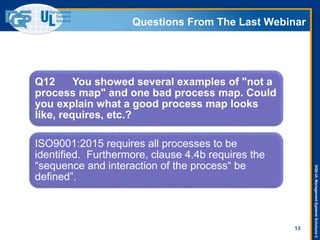
Q12 You showed several examples of "not a
process map" and one bad process map. Could
you explain what a good process map looks
like, requires, etc.?
ISO9001:2015 requires all processes to be
identified. Furthermore, clause 4.4b requires the
“sequence and interaction of the process“ be
defined”.
DQS-ULManagementSystemsSolutions©
Questions From The Last Webinar
14
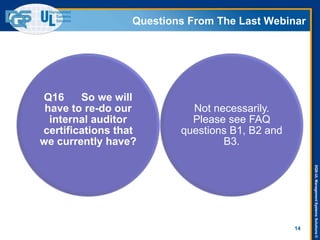
Q16 So we will
have to re-do our
internal auditor
certifications that
we currently have?
Not necessarily.
Please see FAQ
questions B1, B2 and
B3.
DQS-ULManagementSystemsSolutions©
Questions From The Last Webinar
15
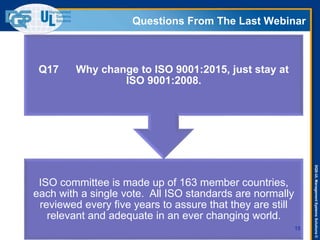
ISO committee is made up of 163 member countries,
each with a single vote. All ISO standards are normally
reviewed every five years to assure that they are still
relevant and adequate in an ever changing world.
Q17 Why change to ISO 9001:2015, just stay at
ISO 9001:2008.
DQS-ULManagementSystemsSolutions©
Questions From The Last Webinar
16
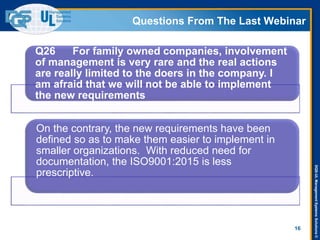
Q26 For family owned companies, involvement
of management is very rare and the real actions
are really limited to the doers in the company. I
am afraid that we will not be able to implement
the new requirements
On the contrary, the new requirements have been
defined so as to make them easier to implement in
smaller organizations. With reduced need for
documentation, the ISO9001:2015 is less
prescriptive.
DQS-ULManagementSystemsSolutions©
Sections 1-5
17
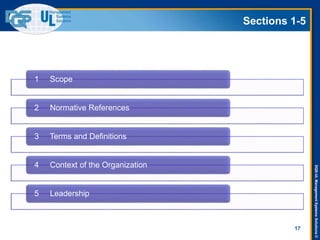
1 Scope
2 Normative References
3 Terms and Definitions
4 Context of the Organization
5 Leadership
DQS-ULManagementSystemsSolutions©
Sections 1-5
18
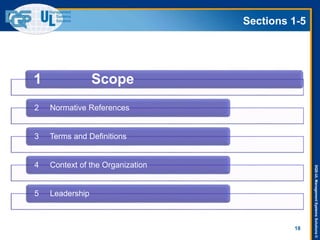
1 Scope
2 Normative References
3 Terms and Definitions
4 Context of the Organization
5 Leadership
DQS-ULManagementSystemsSolutions©
Section 1- Scope
19
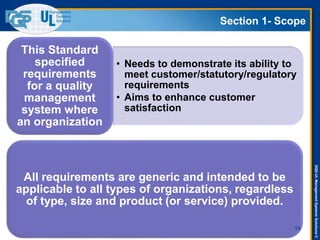
• Needs to demonstrate its ability to
meet customer/statutory/regulatory
requirements
• Aims to enhance customer
satisfaction
This Standard
specified
requirements
for a quality
management
system where
an organization
All requirements are generic and intended to be
applicable to all types of organizations, regardless
of type, size and product (or service) provided.
DQS-ULManagementSystemsSolutions©
Sections 1-5
20
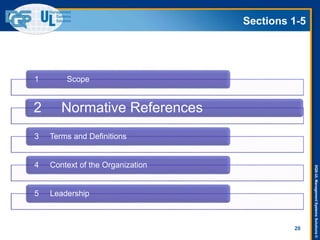
1 Scope
2 Normative References
3 Terms and Definitions
4 Context of the Organization
5 Leadership
DQS-ULManagementSystemsSolutions©
Section 2
21
2 Normative References.
There are no normative references for DIS
ISO9001:2015.
This section is included to maintain clause
numbering alignment with other ISO
management system standards.
DQS-ULManagementSystemsSolutions©
Sections 1-5
22
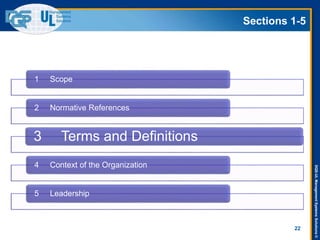
1 Scope
2 Normative References
3 Terms and Definitions
4 Context of the Organization
5 Leadership
DQS-ULManagementSystemsSolutions©
Section 3 – Terms & Definitions
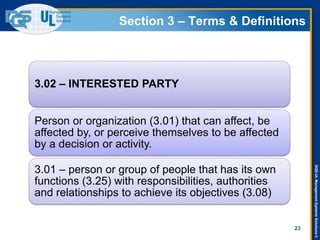
3.02 – INTERESTED PARTY
Person or organization (3.01) that can affect, be
affected by, or perceive themselves to be affected
by a decision or activity.
3.01 – person or group of people that has its own
functions (3.25) with responsibilities, authorities
and relationships to achieve its objectives (3.08)
23
DQS-ULManagementSystemsSolutions©
Section 3 – Terms & Definitions
3.06 - EFFECTIVENESS
Extent to which planned activities are
realized and planned results achieved.
24
DQS-ULManagementSystemsSolutions©
Section 3 – Terms & Definitions
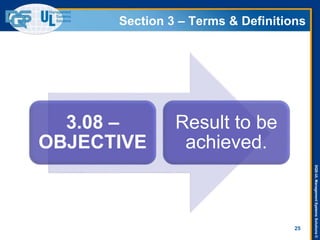
3.08 –
OBJECTIVE
Result to be
achieved.
25
DQS-ULManagementSystemsSolutions©
Section 3 – Terms & Definitions
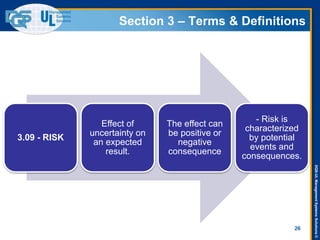
3.09 - RISK
Effect of
uncertainty on
an expected
result.
The effect can
be positive or
negative
consequence
- Risk is
characterized
by potential
events and
consequences.
26
DQS-ULManagementSystemsSolutions©
Section 3 – Terms & Definitions
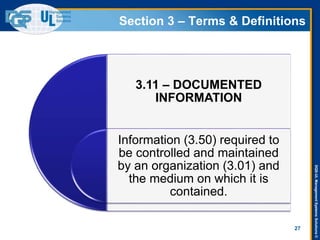
3.11 – DOCUMENTED
INFORMATION
Information (3.50) required to
be controlled and maintained
by an organization (3.01) and
the medium on which it is
contained.
27
DQS-ULManagementSystemsSolutions©
Section 3 – Terms & Definitions
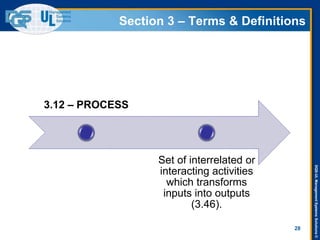
3.12 – PROCESS
Set of interrelated or
interacting activities
which transforms
inputs into outputs
(3.46).
28
DQS-ULManagementSystemsSolutions©
Section 3 – Terms & Definitions
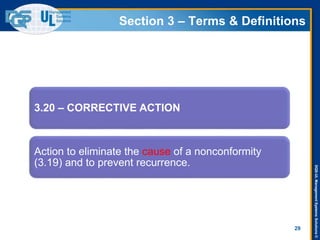
3.20 – CORRECTIVE ACTION
Action to eliminate the cause of a nonconformity
(3.19) and to prevent recurrence.
29
DQS-ULManagementSystemsSolutions©
Section 3 – Terms & Definitions
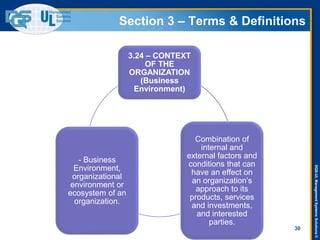
3.24 – CONTEXT
OF THE
ORGANIZATION
(Business
Environment)
Combination of
internal and
external factors and
conditions that can
have an effect on
an organization’s
approach to its
products, services
and investments,
and interested
parties.
- Business
Environment,
organizational
environment or
ecosystem of an
organization.
30
DQS-ULManagementSystemsSolutions©
Section 4 - Context Of The Organization
31
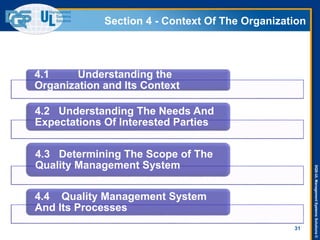
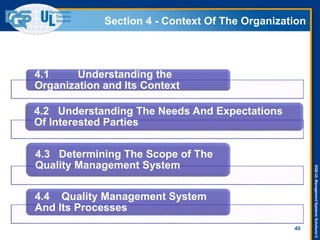
4.1 Understanding the
Organization and Its Context
4.2 Understanding The Needs And
Expectations Of Interested Parties
4.3 Determining The Scope of The
Quality Management System
4.4 Quality Management System
And Its Processes
DQS-ULManagementSystemsSolutions©
Section 4 - Context Of The Organization
32
4.1 Understanding the Organization
and Its Context
4.2 Understanding The Needs And
Expectations Of Interested Parties
4.3 Determining The Scope of The
Quality Management System
4.4 Quality Management System
And Its Processes
DQS-ULManagementSystemsSolutions©
4.1 – Understanding-Organization-Context
33
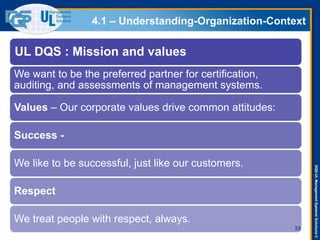
UL DQS : Mission and values
We want to be the preferred partner for certification,
auditing, and assessments of management systems.
Values – Our corporate values drive common attitudes:
Success -
We like to be successful, just like our customers.
Respect
We treat people with respect, always.
DQS-ULManagementSystemsSolutions©
4.1 – Understanding-Organization-Context
34
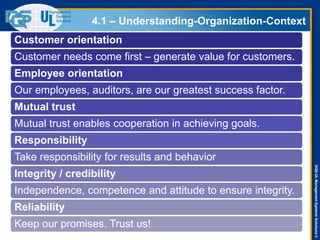
Customer orientation
Customer needs come first – generate value for customers.
Employee orientation
Our employees, auditors, are our greatest success factor.
Mutual trust
Mutual trust enables cooperation in achieving goals.
Responsibility
Take responsibility for results and behavior
Integrity / credibility
Independence, competence and attitude to ensure integrity.
Reliability
Keep our promises. Trust us!
DQS-ULManagementSystemsSolutions©
4.1 – Understanding-Organization-Context
35
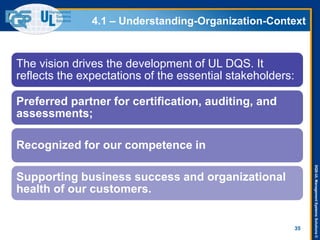
The vision drives the development of UL DQS. It
reflects the expectations of the essential stakeholders:
Preferred partner for certification, auditing, and
assessments;
Recognized for our competence in
Supporting business success and organizational
health of our customers.
DQS-ULManagementSystemsSolutions©
4.1 – Understanding-Organization-Context
36
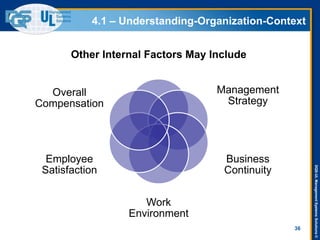
Other Internal Factors May Include
Management
Strategy
Business
Continuity
Work
Environment
Employee
Satisfaction
Overall
Compensation
DQS-ULManagementSystemsSolutions©
4.1 – Understanding-Organization-Context
37
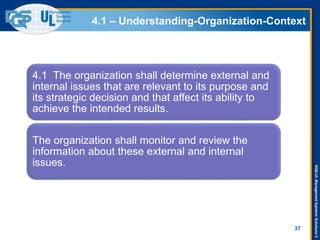
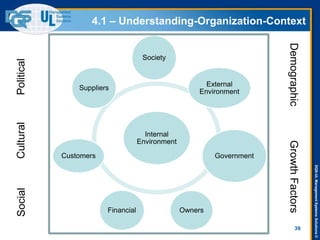
4.1 The organization shall determine external and
internal issues that are relevant to its purpose and
its strategic decision and that affect its ability to
achieve the intended results.
The organization shall monitor and review the
information about these external and internal
issues.
DQS-ULManagementSystemsSolutions©
4.1 – Understanding-Organization-Context
38
Internal
Environment
Society
External
Environment
Government
OwnersFinancial
Customers
Suppliers
DQS-ULManagementSystemsSolutions©
4.1 – Understanding-Organization-Context
39
Internal
Environment
Society
External
Environment
Government
OwnersFinancial
Customers
Suppliers
SocialCulturalPolitical
DemographicGrowthFactors
DQS-ULManagementSystemsSolutions©
Section 4 - Context Of The Organization
40
4.1 Understanding the
Organization and Its Context
4.2 Understanding The Needs And Expectations
Of Interested Parties
4.3 Determining The Scope of The
Quality Management System
4.4 Quality Management System
And Its Processes
DQS-ULManagementSystemsSolutions©
4.2 – Understanding Needs and Expectations
41
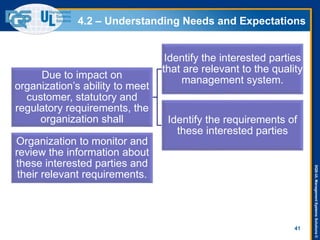
Due to impact on
organization’s ability to meet
customer, statutory and
regulatory requirements, the
organization shall
Identify the interested parties
that are relevant to the quality
management system.
Identify the requirements of
these interested parties
Organization to monitor and
review the information about
these interested parties and
their relevant requirements.
DQS-ULManagementSystemsSolutions©
4.2 – Understanding Needs and Expectations
42
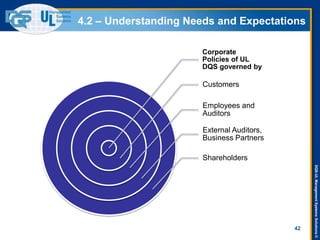
Corporate
Policies of UL
DQS governed by
Customers
Employees and
Auditors
External Auditors,
Business Partners
Shareholders
DQS-ULManagementSystemsSolutions©
4.2 – Understanding Needs and Expectations
43
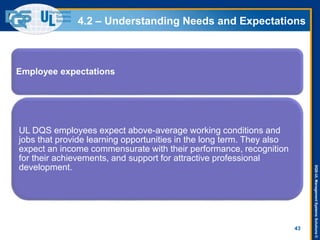
Employee expectations
UL DQS employees expect above-average working conditions and
jobs that provide learning opportunities in the long term. They also
expect an income commensurate with their performance, recognition
for their achievements, and support for attractive professional
development.
DQS-ULManagementSystemsSolutions©
4.2 – Understanding Needs and Expectations
44
Employee Policy - Example
Employee commitment and competence is an essential principle of
success for business activities. With attractive working conditions,
performance-oriented culture, and respectful interaction with each
other, the goal is to be an organization preferred by employees..
DQS-ULManagementSystemsSolutions©
Section 4 - Context Of The Organization
45
4.1 Understanding the
Organization and Its Context
4.2 Understanding The Needs And
Expectations Of Interested Parties
4.3 Determining The Scope of The Quality
Management System
4.4 Quality Management System
And Its Processes
DQS-ULManagementSystemsSolutions©
4.3 - Determining Scope of QMS
46
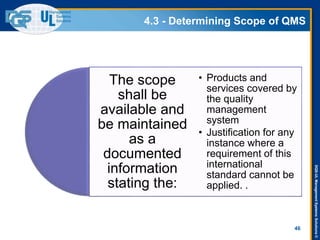
The scope
shall be
available and
be maintained
as a
documented
information
stating the:
• Products and
services covered by
the quality
management
system
• Justification for any
instance where a
requirement of this
international
standard cannot be
applied. .
DQS-ULManagementSystemsSolutions©
Section 4 - Context Of The Organization
47
4.1 Understanding the
Organization and Its Context
4.2 Understanding The Needs And
Expectations Of Interested Parties
4.3 Determining The Scope of The
Quality Management System
4.4 Quality Management System And Its
Processes
DQS-ULManagementSystemsSolutions©
4.4 - QMS and its Processes
48
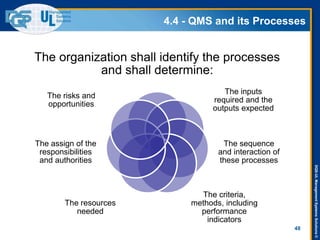
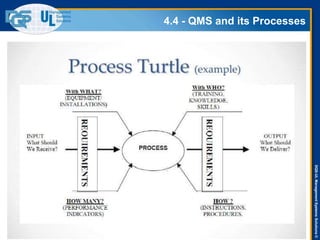
The organization shall identify the processes
and shall determine:
The inputs
required and the
outputs expected
The sequence
and interaction of
these processes
The criteria,
methods, including
performance
indicators
The resources
needed
The assign of the
responsibilities
and authorities
The risks and
opportunities
DQS-ULManagementSystemsSolutions©
4.4 - QMS and its Processes
49
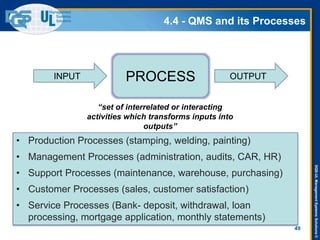
PROCESSINPUT OUTPUT
• Production Processes (stamping, welding, painting)
• Management Processes (administration, audits, CAR, HR)
• Support Processes (maintenance, warehouse, purchasing)
• Customer Processes (sales, customer satisfaction)
• Service Processes (Bank- deposit, withdrawal, loan
processing, mortgage application, monthly statements)
“set of interrelated or interacting
activities which transforms inputs into
outputs”
DQS-ULManagementSystemsSolutions©
50
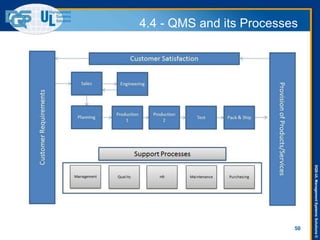
4.4 - QMS and its Processes
DQS-ULManagementSystemsSolutions©
51
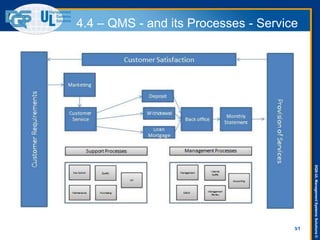
4.4 – QMS - and its Processes - Service
DQS-ULManagementSystemsSolutions©
52
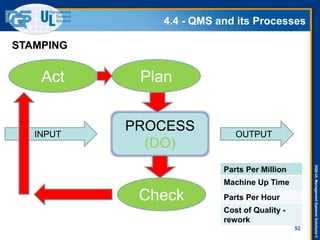
PROCESS
(DO)
INPUT OUTPUT
Plan
Check
Act
4.4 - QMS and its Processes
Parts Per Million
Machine Up Time
Parts Per Hour
Cost of Quality -
rework
STAMPING
DQS-ULManagementSystemsSolutions©
4.4 – STAMPING Process Map
53
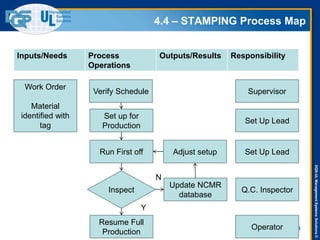
Inputs/Needs Process
Operations
Outputs/Results Responsibility
Work Order
Material
identified with
tag
Verify Schedule
Adjust setup
Supervisor
Set up for
Production
Run First off Set Up Lead
Inspect Q.C. Inspector
Set Up Lead
Update NCMR
database
Resume Full
Production
Operator
N
Y
DQS-ULManagementSystemsSolutions©
4.4 – STAMPING Process Map
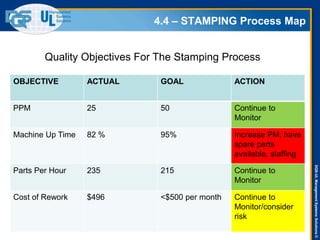
OBJECTIVE ACTUAL GOAL ACTION
PPM 25 50 Continue to
Monitor
Machine Up Time 82 % 95% Increase PM, have
spare parts
available, staffing
Parts Per Hour 235 215 Continue to
Monitor
Cost of Rework $496 <$500 per month Continue to
Monitor/consider
risk
Quality Objectives For The Stamping Process
DQS-ULManagementSystemsSolutions©
4.4 - QMS and its Processes
55
DQS-ULManagementSystemsSolutions©
4.4 - QMS and its Processes
56
The organization shall maintain
documented information to the
extent necessary to support the
operation of processes and
retain documented information to
the extent necessary to have
confidence that the processes
are being carried out as planned.
DQS-ULManagementSystemsSolutions©
Sections 1-5
57
1 Scope
2 Normative References
3 Terms and Definitions
4 Context of the Organization
5 Leadership
DQS-ULManagementSystemsSolutions©
5 - Leadership
58
• 5.1.1 Leadership and commitment for the QMS
• 5.1.2 Customer Focus
5.1 Leadership and Commitment
5.2 Quality Policy
5.3 Organizational roles, responsibilities
and authorities
DQS-ULManagementSystemsSolutions©
5 - Leadership
59
• 5.1.1 Leadership and commitment for the QMS
• 5.1.2 Customer Focus
5.1 Leadership and Commitment
5.2 Quality Policy
5.3 Organizational roles, responsibilities
and authorities
DQS-ULManagementSystemsSolutions©
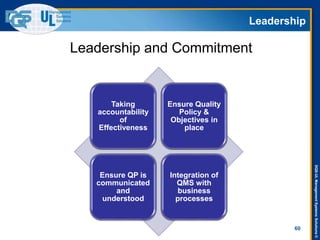
Leadership
60
Taking
accountability
of
Effectiveness
Ensure Quality
Policy &
Objectives in
place
Ensure QP is
communicated
and
understood
Integration of
QMS with
business
processes
Leadership and Commitment
DQS-ULManagementSystemsSolutions©
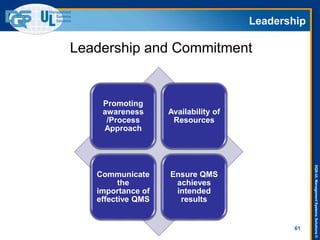
Leadership
61
Promoting
awareness
/Process
Approach
Availability of
Resources
Communicate
the
importance of
effective QMS
Ensure QMS
achieves
intended
results
Leadership and Commitment
DQS-ULManagementSystemsSolutions©
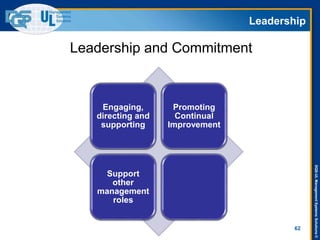
Leadership
62
Engaging,
directing and
supporting
Promoting
Continual
Improvement
Support
other
management
roles
Leadership and Commitment
DQS-ULManagementSystemsSolutions©
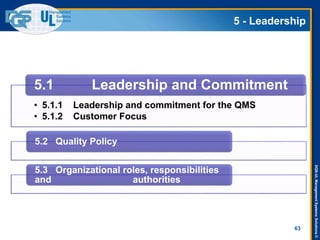
5 - Leadership
63
• 5.1.1 Leadership and commitment for the QMS
• 5.1.2 Customer Focus
5.1 Leadership and Commitment
5.2 Quality Policy
5.3 Organizational roles, responsibilities
and authorities
DQS-ULManagementSystemsSolutions©
5 - Leadership
64
• 5.1.1 Leadership and commitment for the QMS
• 5.1.2 Customer Focus
5.1 Leadership and Commitment
5.2 Quality Policy
5.3 Organizational roles, responsibilities
and authorities
DQS-ULManagementSystemsSolutions©
5 - Leadership
65
• 5.1.1 Leadership and commitment for the QMS
• 5.1.2 Customer Focus
5.1 Leadership and Commitment
5.2 Quality Policy
5.3 Organizational roles, responsibilities
and authorities
DQS-ULManagementSystemsSolutions©
5 - Leadership
66
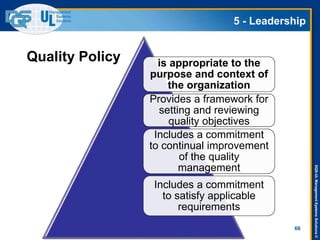
is appropriate to the
purpose and context of
the organization
Provides a framework for
setting and reviewing
quality objectives
Includes a commitment
to continual improvement
of the quality
management
Includes a commitment
to satisfy applicable
requirements
Quality Policy
DQS-ULManagementSystemsSolutions©
5 - Leadership
67
• 5.1.1 Leadership and commitment for
the QMS
• 5.1.2 Customer Focus
5.1 Leadership and
Commitment
5.2 Quality Policy
5.3 Organizational roles,
responsibilities / authorities
DQS-ULManagementSystemsSolutions©
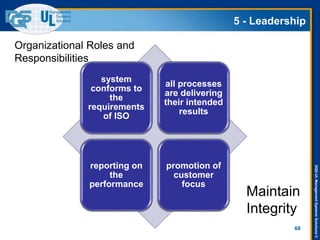
5 - Leadership
68
system
conforms to
the
requirements
of ISO
all processes
are delivering
their intended
results
reporting on
the
performance
promotion of
customer
focus
Organizational Roles and
Responsibilities
Maintain
Integrity
DQS-ULManagementSystemsSolutions©
Questions?
69
ISO9001_2015_Questions@us.dqs-ul.com
Please send your questions to:
Next Webinar: April 29, 2015
DQS-ULManagementSystemsSolutions©
Questions?
Contact me:
Joe Mansour
ISO9001:2015 Program Manager
70
ISO9001_2015_Questions@us.dqs-ul.com
Please send your questions to:
Next Webinar: April 29, 2015

ISO 9001:2015 Revision Overview: part 2