Introduction to Digital Signal
Processing
-Overview
Outline
 Signals
 Classification of Signals
 System (Processing)
 Digital Signal Processing
 Advantages and Applications
 Conclusion
Signals
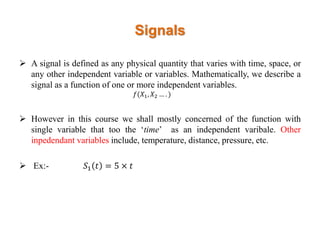
 A signal is defined as any physical quantity that varies with time, space, or
any other independent variable or variables. Mathematically, we describe a
signal as a function of one or more independent variables.
𝑓(𝑋1, 𝑋2 … . )
 However in this course we shall mostly concerned of the function with
single variable that too the ‘time’ as an independent varibale. Other
inpedendant variables include, temperature, distance, pressure, etc.
 Ex:- 𝑆1 𝑡 = 5 × 𝑡
Classification of Signals
 Signals can be further classified in to four different categories depending
on the characteristics of the time (independent) variable and the values they
take.
 Continuous time signals where the signals can be defined at any time
instant.
 Discrete time signals- signal is defined only at sampling instants.
 Continuous valued signals where the amplitude variation is continuous.
 Discrete valued signals- The signals can take only discrete amplitude
values.
 So the Digital Signal is the resultant of Sampling, quantization and A to D
Converter. There we have bits as an output. Those can be stored in
memories.
 Memories-> Registers->flipflops->logic gates->Transistors.
 Deterministic Signals- A signal that is completely described by a
mathematical model and the contradiction are the random signals.
Classification of Signals
Multi Channel and Multi Dimensional
Signals
 If the signal is a function of one independent variable it is one dimensional
signal instead if it is depending on M independent variables it is M
dimensional signal or multi dimensional signal.
 ECG Signal Doctors are interested in PQRST signals peaks and deeps.
However there the time durations and peaks amplitudes are useful to
determine the problem identification after observing the heart from various
view points. These view points are the resultant of 3-lead or 12-lead multi
channel signals.
12 lead and 3 lead ECG models
ECG Signal
System
 So the processing is to get the given signal in the more desired form.
 A system may be defined as a physical device that performs an operation
on a signal.
 For example, a filter (System) used to reduce the noise and interference
corrupting a desired information bearing signal.
 Thus when we pass a signal through a system, we can get processed output
signal (noise and interference less signal). Such operations usually referred
to as signal processing.
 Given Signal
 If the operation is linear the system is said to be linear and if it is non linear
the system is said to be non linear. In this course most of the systems are
linear.
 Even Sampling and Quantization are also Signal Processing Techniques.
System
Processed output signal
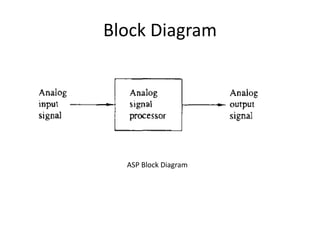
Block Diagram
ASP Block Diagram
Contd..
DSP Block Diagram
Contd..
 All the natural signals are Speech, ECG, EEG are analog signals.
 The output of DAC consists of staircases, there is a level of the signal and
to the next level it rises abruptly, and stays at that level for some time.
Which is equivalent to high frequencies in the signal. Hence an analog low
pass filter is needed.
Digital Signal Processing over Analog Signal
Processing
 Flexible
 The system can be reconfigured for some other applications by simply
changing the software program.
 High Pass Digital Filter can be changed to low pass filter by simply changing
the software, for this no change in the hardware required. The digital filter is
designed based on number of samples collected per second and frequency per
sample.
 Accuracy
 Accuracy depends on the resolution of the A/D Converter, number of bits.
 Easy storage
 Mathematical Operations are accurately performed
 Performance can be repeatable- For example the low pass
filtering operation performed by digital filer today will be
exactly same even after 10 years.
Applications of DSP
 Voice and speech- Speech recognition, speech to text, voice mail etc..
 Telecommunications- Fax, Cellular phone, Video conferencing, echo
cancellation, and data encryption etc.
 Consumer Applications- Digital audio, video, music synthesizer etc..
 Graphics and Imaging- animation, image enhancement, 3-D and 2–D
visualization etc.
 Military/ Defence- RADAR processing, Navigation, missile guidance etc.
 Biomedical Engineering- ECG/EEG analysis, CT scanning
 Industrial Applications
 Automotive Applications.
Conclusion
 The rapid developments in integrated circuit technology, starting with MSI,
LSI, VLSI of electronic circuits has spurred the development of powerful,
smaller, faster, and cheaper digital computers and special purpose digital
hardware.
 These inexpensive and relatively fast digital circuits have made it possible
to construct highly sophisticated digital systems capable of performing
complex digital signal processing functions and tasks, which are usually
too difficult and/or too expensive to be performed by analog circuitry or
analog signal processing systems.
Contd..
 We don’t wish to imply that digital signal processing is the proper solution for
all signal processing problems. However, where digital circuits are available
and have sufficient speed to perform (Sampling frequency) the signal
processing, they are usually preferable. Also the selection is done on the basis
of cost complexity and performance (power dissipation).
 The basic operations that the DSP will do are addition, multiplication and
calling of old data. In practice, we have an interest in devising algorithms that
are computationally efficient, fast, and easily implemented .
 The a major topic in our study of digital signal processing is the discussion of
efficient algorithms for performing such operations as filtering, correlation, and
spectral analysis.
 It is to be noted that all the mathematical techniques to handle the Discrete
Time Signal Processing and Digital Signal Processing are same.
Dsp class 1

Dsp class 1

  • 1.
    Introduction to DigitalSignal Processing -Overview
  • 2.
    Outline  Signals  Classificationof Signals  System (Processing)  Digital Signal Processing  Advantages and Applications  Conclusion
  • 3.
    Signals  A signalis defined as any physical quantity that varies with time, space, or any other independent variable or variables. Mathematically, we describe a signal as a function of one or more independent variables. 𝑓(𝑋1, 𝑋2 … . )  However in this course we shall mostly concerned of the function with single variable that too the ‘time’ as an independent varibale. Other inpedendant variables include, temperature, distance, pressure, etc.  Ex:- 𝑆1 𝑡 = 5 × 𝑡
  • 4.
    Classification of Signals Signals can be further classified in to four different categories depending on the characteristics of the time (independent) variable and the values they take.  Continuous time signals where the signals can be defined at any time instant.  Discrete time signals- signal is defined only at sampling instants.  Continuous valued signals where the amplitude variation is continuous.  Discrete valued signals- The signals can take only discrete amplitude values.  So the Digital Signal is the resultant of Sampling, quantization and A to D Converter. There we have bits as an output. Those can be stored in memories.  Memories-> Registers->flipflops->logic gates->Transistors.  Deterministic Signals- A signal that is completely described by a mathematical model and the contradiction are the random signals.
  • 5.
  • 6.
    Multi Channel andMulti Dimensional Signals  If the signal is a function of one independent variable it is one dimensional signal instead if it is depending on M independent variables it is M dimensional signal or multi dimensional signal.  ECG Signal Doctors are interested in PQRST signals peaks and deeps. However there the time durations and peaks amplitudes are useful to determine the problem identification after observing the heart from various view points. These view points are the resultant of 3-lead or 12-lead multi channel signals.
  • 7.
    12 lead and3 lead ECG models
  • 8.
  • 9.
    System  So theprocessing is to get the given signal in the more desired form.  A system may be defined as a physical device that performs an operation on a signal.  For example, a filter (System) used to reduce the noise and interference corrupting a desired information bearing signal.  Thus when we pass a signal through a system, we can get processed output signal (noise and interference less signal). Such operations usually referred to as signal processing.  Given Signal  If the operation is linear the system is said to be linear and if it is non linear the system is said to be non linear. In this course most of the systems are linear.  Even Sampling and Quantization are also Signal Processing Techniques. System Processed output signal
  • 10.
  • 11.
  • 12.
    Contd..  All thenatural signals are Speech, ECG, EEG are analog signals.  The output of DAC consists of staircases, there is a level of the signal and to the next level it rises abruptly, and stays at that level for some time. Which is equivalent to high frequencies in the signal. Hence an analog low pass filter is needed.
  • 13.
    Digital Signal Processingover Analog Signal Processing  Flexible  The system can be reconfigured for some other applications by simply changing the software program.  High Pass Digital Filter can be changed to low pass filter by simply changing the software, for this no change in the hardware required. The digital filter is designed based on number of samples collected per second and frequency per sample.  Accuracy  Accuracy depends on the resolution of the A/D Converter, number of bits.  Easy storage  Mathematical Operations are accurately performed  Performance can be repeatable- For example the low pass filtering operation performed by digital filer today will be exactly same even after 10 years.
  • 14.
    Applications of DSP Voice and speech- Speech recognition, speech to text, voice mail etc..  Telecommunications- Fax, Cellular phone, Video conferencing, echo cancellation, and data encryption etc.  Consumer Applications- Digital audio, video, music synthesizer etc..  Graphics and Imaging- animation, image enhancement, 3-D and 2–D visualization etc.  Military/ Defence- RADAR processing, Navigation, missile guidance etc.  Biomedical Engineering- ECG/EEG analysis, CT scanning  Industrial Applications  Automotive Applications.
  • 15.
    Conclusion  The rapiddevelopments in integrated circuit technology, starting with MSI, LSI, VLSI of electronic circuits has spurred the development of powerful, smaller, faster, and cheaper digital computers and special purpose digital hardware.  These inexpensive and relatively fast digital circuits have made it possible to construct highly sophisticated digital systems capable of performing complex digital signal processing functions and tasks, which are usually too difficult and/or too expensive to be performed by analog circuitry or analog signal processing systems.
  • 16.
    Contd..  We don’twish to imply that digital signal processing is the proper solution for all signal processing problems. However, where digital circuits are available and have sufficient speed to perform (Sampling frequency) the signal processing, they are usually preferable. Also the selection is done on the basis of cost complexity and performance (power dissipation).  The basic operations that the DSP will do are addition, multiplication and calling of old data. In practice, we have an interest in devising algorithms that are computationally efficient, fast, and easily implemented .  The a major topic in our study of digital signal processing is the discussion of efficient algorithms for performing such operations as filtering, correlation, and spectral analysis.  It is to be noted that all the mathematical techniques to handle the Discrete Time Signal Processing and Digital Signal Processing are same.