Presented by,
G.Sushmitha
&
G.Prabhavathi
 Overview
 Meaning
 Objectives
 Goals
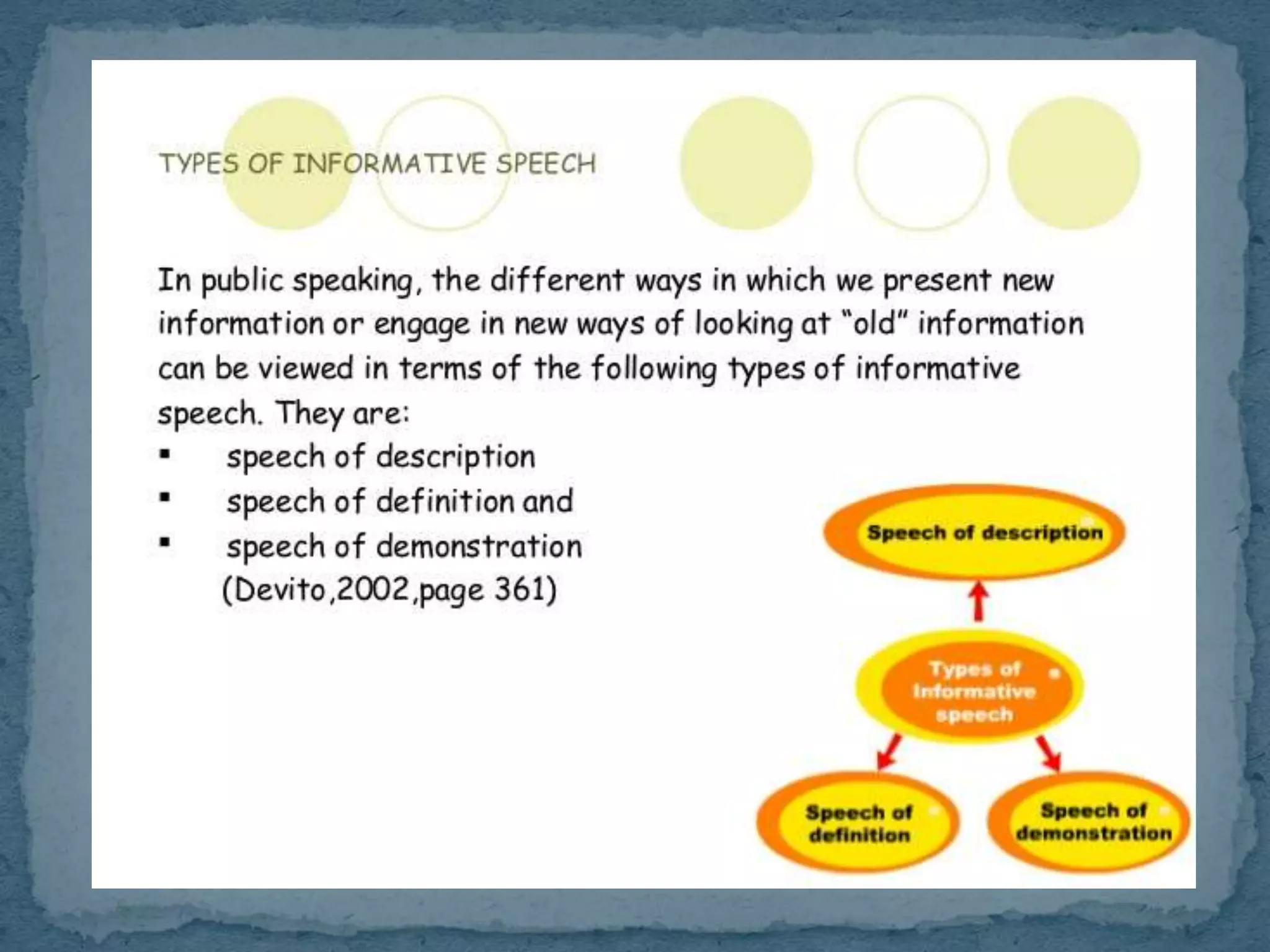
 Types of Informative Presentation
 Hints to enhance Informative Presentation
 Example of Informative Presentation
Informative Speaking is a speech meant to inform
the audience. This speech can take on topics ranging
from the newest, high-tech inventions from around
the world that hope to cure cancer, to more light-
hearted topics. The topic should be one that is timely
and interesting.
Informative Presentations:
The purpose of informative presentations is to
promote understanding of an idea or to convey
information. They are often used to provide people
with information about a concept or idea that is new
 Apply knowledge of your audience when composing
your speech
 Choose a topic that is relevant to your audience
 One of the goals of an informative speech is to
enhance the understanding of the audience.
 Another goal of an informative speech is to maintain
the interest of the audience.
 A final goal of an informative speech is for the
audience to remember the speech.
Key Terms
 Goal: A result that one is attempting to achieve.
 Inform: To communicate knowledge to others.
 Make connections among your ideas and with audience
interests; use transitions, signposts, internal previews, and
summaries when speaking.
Key points:
 Connection: The point at which two or more things are
connected; a feeling of understanding and ease of
communication between two or more people.
 Signpost: A particular type of transition in the form of a brief
statement that indicates where the speaker is in the speech, such
as “first” and “finally,” or that calls attention to a key idea, such as
“now remember this.”
 Transitions: Words or phrases that allow the reader to
understand how adjacent parts of a communication are
connected.
 Making your speech memorable is a way to improve its
ability to inform the audience.
Key points
 Use visual aids to help make your speech memorable.
 Repeat key points of your speech to make it more
memorable.
 Making your speech memorable is important because
it increases the likelihood that the audience will walk
away informed.
 Visual aids, microphones, video screens, and/or a podium can help
enhance audience understanding.
Example:
 Visual aids such as graphs, handouts, slide show presentations, and objects can
help audiences understand complicated subjects. Many people learn visually
and need information provided in this context, as well as orally, to enhance
learning.
 A podium can help the presenter provide the audience with necessary
information on a topic by offering a place for the speaker to have cue cards or
scripts.
 A microphone is a good way to make sure that everyone in the audience hears
the presentation properly. Wireless headsets allow the speaker to amplify the
presentation while moving about the audience or reviewing visual aids.
 A video screen is a good way to make sure the audience can see the entire
presentation in a large venue.
Amplification is important to make sure that the
entire audience can hear the speech properly. Some
large auditoriums and amphitheaters are designed to
assist acoustics. Still, a microphone is a beneficial
addition to a speaker’s toolkit. With the advancements
in wireless technology, a headset can also be used,
enabling the speaker to move about during the
presentation, go over visual aids, or enter the audience
during the question and answer session.
 Video screens are beneficial for an audience, especially
those who are seated in a large venue. The screens can help
the audience see the speaker and the visual aids better,
especially if they are in the back of the room or off to the
far right or far left of the stage. Video screens are often
available at modern conference centers and auditoriums
that can be synced with presentation devices.
 With the addition of visual aids, podiums, microphones,
and video screens, a presenter can ensure that the audience
is able to see, hear, and understand the material properly.
When determining the type of visual aids needed for a
speech, the speaker needs to consider the subject matter,
audience, and venue so that the right materials are used to
enhance audience understanding.
North Sentinel Island is one of the Andaman
Islands, an archipelago in the Bay of Bengal which also
includes South Sentinel Island. It is home to
the Sentinels, a tribe who have rejected, often violently,
any contact with the outside world. They are among the
last uncontacted people to remain virtually untouched by
modern civilization.
It is an prohibited area under Indian Navy Surveillance.
The mentioned is an best example for Informative
Presentation, because it creates some interest to the
audience/ students to know about the unknown.
 https://courses.lumenlearning.com/boundless-
communications/chapter/effective-informative-speaking/
 https://www.google.com/search?ei=bGCEXaS1KtS0mgeRwpmY
Dw&q=informative+presentations+benefits&oq=informative+pr
esentations+benefits&gs_l=psy-
ab.3...1407.3923..4547...0.2..0.162.1136.0j9......0....1..gws-
wiz.......0i71j0i67j0i22i30j33i160j33i21.ktOVlGGOXkQ&ved=0ahU
KEwikm8rC0t7kAhVUmuYKHRFhBvMQ4dUDCAs&uact=5
 https://en.wikipedia.org/wiki/North_Sentinel_Island
 https://www.google.com/search?q=What+are+the+5+principles
+of+effective+informative+speeches%3F&source=lnms&tbm=isc
h&sa=X&ved=0ahUKEwja15e5097kAhXC4HMBHRh7B_8Q_AUI
EygC&biw=1024&bih=608#imgrc=MH9beQFmr8zErM:
Informative presentation

Informative presentation

  • 1.
  • 2.
     Overview  Meaning Objectives  Goals  Types of Informative Presentation  Hints to enhance Informative Presentation  Example of Informative Presentation
  • 3.
    Informative Speaking isa speech meant to inform the audience. This speech can take on topics ranging from the newest, high-tech inventions from around the world that hope to cure cancer, to more light- hearted topics. The topic should be one that is timely and interesting.
  • 4.
    Informative Presentations: The purposeof informative presentations is to promote understanding of an idea or to convey information. They are often used to provide people with information about a concept or idea that is new
  • 6.
     Apply knowledgeof your audience when composing your speech  Choose a topic that is relevant to your audience
  • 7.
     One ofthe goals of an informative speech is to enhance the understanding of the audience.  Another goal of an informative speech is to maintain the interest of the audience.  A final goal of an informative speech is for the audience to remember the speech. Key Terms  Goal: A result that one is attempting to achieve.  Inform: To communicate knowledge to others.
  • 9.
     Make connectionsamong your ideas and with audience interests; use transitions, signposts, internal previews, and summaries when speaking. Key points:  Connection: The point at which two or more things are connected; a feeling of understanding and ease of communication between two or more people.  Signpost: A particular type of transition in the form of a brief statement that indicates where the speaker is in the speech, such as “first” and “finally,” or that calls attention to a key idea, such as “now remember this.”  Transitions: Words or phrases that allow the reader to understand how adjacent parts of a communication are connected.
  • 10.
     Making yourspeech memorable is a way to improve its ability to inform the audience. Key points  Use visual aids to help make your speech memorable.  Repeat key points of your speech to make it more memorable.  Making your speech memorable is important because it increases the likelihood that the audience will walk away informed.
  • 11.
     Visual aids,microphones, video screens, and/or a podium can help enhance audience understanding. Example:  Visual aids such as graphs, handouts, slide show presentations, and objects can help audiences understand complicated subjects. Many people learn visually and need information provided in this context, as well as orally, to enhance learning.  A podium can help the presenter provide the audience with necessary information on a topic by offering a place for the speaker to have cue cards or scripts.  A microphone is a good way to make sure that everyone in the audience hears the presentation properly. Wireless headsets allow the speaker to amplify the presentation while moving about the audience or reviewing visual aids.  A video screen is a good way to make sure the audience can see the entire presentation in a large venue.
  • 12.
    Amplification is importantto make sure that the entire audience can hear the speech properly. Some large auditoriums and amphitheaters are designed to assist acoustics. Still, a microphone is a beneficial addition to a speaker’s toolkit. With the advancements in wireless technology, a headset can also be used, enabling the speaker to move about during the presentation, go over visual aids, or enter the audience during the question and answer session.
  • 13.
     Video screensare beneficial for an audience, especially those who are seated in a large venue. The screens can help the audience see the speaker and the visual aids better, especially if they are in the back of the room or off to the far right or far left of the stage. Video screens are often available at modern conference centers and auditoriums that can be synced with presentation devices.  With the addition of visual aids, podiums, microphones, and video screens, a presenter can ensure that the audience is able to see, hear, and understand the material properly. When determining the type of visual aids needed for a speech, the speaker needs to consider the subject matter, audience, and venue so that the right materials are used to enhance audience understanding.
  • 14.
    North Sentinel Islandis one of the Andaman Islands, an archipelago in the Bay of Bengal which also includes South Sentinel Island. It is home to the Sentinels, a tribe who have rejected, often violently, any contact with the outside world. They are among the last uncontacted people to remain virtually untouched by modern civilization. It is an prohibited area under Indian Navy Surveillance. The mentioned is an best example for Informative Presentation, because it creates some interest to the audience/ students to know about the unknown.
  • 15.