MANAGERIAL COMMUNICATION
S1 MBA
Communication
Communication is the process of exchanging information, ideas, or
opinions between two or more people, with the goal of ensuring that
the message is understood by everyone involved.
Business Communication
Business communication is the process of sharing information between people
within and outside a company.
Why business communication?
• Exchange of ideas
• Achieve targets
• Avoid duplication
• Grievance and problems management
• Crisis management
COMMUNICATION: DEFINITION
 The process involves exchange of ideas.
 The ideas should be accurately replicated.(
 The sender should be assured of the exact
replication.
 The purpose is to call forth desired action.
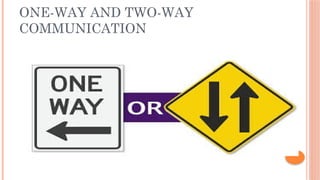
ONE-WAY AND TWO-WAY
COMMUNICATION
7 Cs/ Principles of Communication
• Clear or Complete
• Clarity
• Concise
Courtesy
• Correctness
• Concrete
• Consideration
Clear
When writing or speaking to someone, be clear about your goal or
message. What is your purpose in communicating with this person? If
you're not sure, then your audience won't be sure either. To be clear,
try to minimize the number of ideas in each sentence. Make sure that
it's easy for your reader to understand your meaning.
CLARITY
Clarity implies emphasizing()on a specific message or goal at a time, rather than
trying to achieve too much at once.
CONCISE
Conciseness means wordiness, i.e, communicating what you want to convey in
least possible words When you're concise) in your communication, you stick to
the point and keep it brief
COURTESY
Courtesy in message implies the message should show the sender’s expression
as well as should respect the receiver. The sender of the message should be
sincerely polite, judicious, reflective and enthusiastic.
CORRECT
Correctness in communication implies that there are no grammatical errors in
communication.
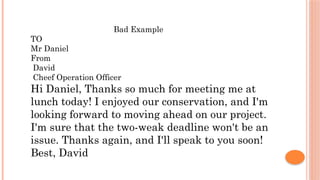
Bad Example
TO
Mr Daniel
From
David
Cheef Operation Officer
Hi Daniel, Thanks so much for meeting me at
lunch today! I enjoyed our conservation, and I'm
looking forward to moving ahead on our project.
I'm sure that the two-weak deadline won't be an
issue. Thanks again, and I'll speak to you soon!
Best, David
CONCRETE
When your message is concrete, then your audience has a clear picture of what
you're telling them..
CONSIDERATION
Effective communication must take the audience into consideration, i.e, the
audience’s view points, background, mind-set, education level, etc. Make an
attempt to envisage your audience, their requirements, emotions as well as
problems. Ensure that the self-respect of the audience is maintained and their
emotions are not at harm. Modify your words in message to suit the audience’s
needs while making your message complete.
PROCESS OF COMMUNICATION
 Process of Communication consists of the following eight
components which are inter-related
1. Idea
2. Sender
3. Encoding
4. Message
5. Channel & Medium.
6. Receiver/ Decoder
7. Decoding
8. Feedback
IDEA
 1. Every message, whether oral or written, has
its origin in an idea that germinates in the mind
of the sender of the message. Every idea refers to
some context. Thus the idea or information that
the sender wants to convey to the receiver is the
source of the message in the communication
process.
2. SENDER/ ENCODER
 The person who initiates the communication process
is referred to as the encoder. The process of
communication begins with the sender who identifies
the need to communicate. The sender must have a
clear picture in his mind about what he wants to
communicate and should accordingly select symbols,
words, images, etc. The sender must identify his
audience and formulate the message in such a way
that the receiver understands fully what he intends to
convey and interprets it within the same context.
3.ENCODING
 Encoding is the process of turning thoughts into
communication. It involves using symbols to
express an idea, and the encoder must consider
how the message will be received by the audience
4. MESSAGE
 A message is an idea transformed into words. It
can be expressed in different ways depending
upon the subject-matter, purpose, audience
personal style and cultural background of the
sender.
5. CHANNEL AND MEDIUM
 An appropriate medium chosen to send the
message is known as channel. It is the vehicle
which facilitates the sender to convey the message
to the receiver. Channel is a system used to
transmit a message, whereas medium is one of the
forms/ types used under that system. For example
oral communication is a channel and telephone
conversation is a medium. There are three broad
channels of communication and there are several
media under each. These are listed below:

Classification of channels of communication:
 Visual channel: Facialexpression, body language, posture, gestures, pictures & written
words, electronic mails, massmedia, cinema, television, video-tapes, video
conferences, video chat, etc.
• Auditory channel: Spoken words, sounds, telephone or mobile communications,
delivering audio content (radio, voicemail), etc.
 Written letters, memos, reports, manuals, notices,
circulars, cuestionareis, minutes, emails, faxes, etc.
• Tactile channel: T
ouchsensations, therapeutic touch, etc.
• Combined channel: Audiovisual media, consoling a person with touch & spoken
words.
6. RECEIVER/ DECODER
 The person who receives the encoded message is
referred to as receiver. The receiver may be an
individual or a group of individuals. As
communication is a two-way process, the receiver
is as important as the sender of the message. A
receiver may be a listener or a reader or a viewer
of the message. He not only receives the message
but also tries to understand, interpret and
perceive the total meaning of the message.
7. DECODING
 It is a process by which the receiver interprets
the message and translates it into meaningful
information. The meaning of the message is the
sum total of the meanings of the words ( symbols)
together with the tone and the attitude of the
sender as reflected by his choice of words and the
structure of the message.
8. FEEDBACK
 Feedback is the response given by the receiver of the
message to the sender of the message. When the encoder
receives feedback, he gets to know that communication
has been accomplished. Feedback can be immediate,
later, can be positive or negative. It can be verbal or non
verbal. In communication feedback plays an important
role. It ensures that the receiver has received the
message and understood it just as it was intended by the
sender. Feedback is the most important component of
communication. Without feedback, the communication
process is incomplete.
 Example: A student, who lives in a hostel, wants some money. She writes a letter to her
father asking him to send her money. The father sends money, along with a letter. In both
cases (sending money and sending the letter), the father is responding to the communication
initiated by his child.
 Encoder: the student/ child
 Message: needs money
 Channel: written communication
 Medium: a letter
 Decoder: the father
 Feedback: sends money and letter
o Message conceived:- is to form or develop in the mind
o Message perceived: the way the receiver senses the message either by hearing or watching.
o Message decoded: The receiver has to understand the message that the sender has just sent.
This could be misunderstood easily by interpreting words differently.
o Message understood: At this stage the message is understood, if not the cycle has to start
again.
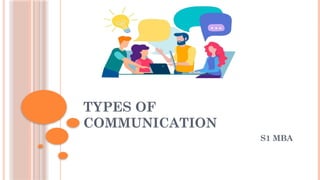
TYPES OF
COMMUNICATION
S1 MBA
TYPES OF COMMUNICATION
Types of Communication
Verbal
TYPES OF COMMUNICATION
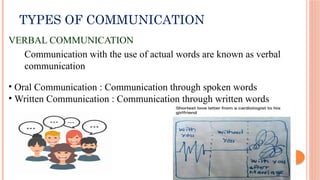
VERBAL COMMUNICATION
• Oral Communication : Communication through spoken words
• Written Communication : Communication through written words
Communication with the use of actual words are known as verbal
communication
TYPES OF COMMUNICATION
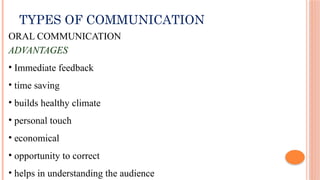
ORAL COMMUNICATION
ADVANTAGES
• Immediate feedback
• time saving
• builds healthy climate
• personal touch
• economical
• opportunity to correct
• helps in understanding the audience
TYPES OF COMMUNICATION
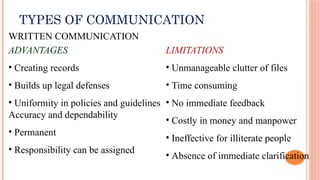
WRITTEN COMMUNICATION
ADVANTAGES
• Creating records
• Builds up legal defenses
• Uniformity in policies and guidelines
Accuracy and dependability
• Permanent
• Responsibility can be assigned
LIMITATIONS
• Unmanageable clutter of files
• Time consuming
• No immediate feedback
• Costly in money and manpower
• Ineffective for illiterate people
• Absence of immediate clarification
TYPES OF COMMUNICATION
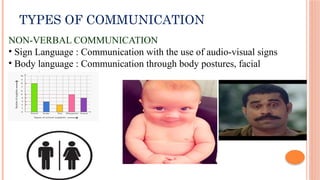
NON-VERBAL COMMUNICATION
• Sign Language : Communication with the use of audio-visual signs
• Body language : Communication through body postures, facial
expressions etc…
TYPES OF COMMUNICATION
SIGN LANGUAGE
ADVANTAGES
• Easy conveyance of message
• interesting and motivating
•useful for illiterate workers
• effective way of advertising
LIMITATIONS
• elementary or simple communication
• requires skill to make the message
•chance of misunderstanding
• spot correction not possible
TYPES OF COMMUNICATION
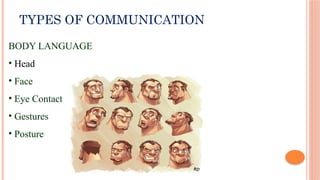
BODY LANGUAGE
• Head
• Face
• Eye Contact
• Gestures
• Posture
ROLE OF FEEDBACK IN
COMMUNICATION
 Communication is the exchange and flow of information and ideas
from one person to another. It involves a sender transmitting an idea,
information, or feeling to a receiver. Effective communication occurs
only if the receiver understands the exact information or idea that the
sender intended to transmit. Feedback is essential in communication
so as to know whether the recipient has understood the message in
the same terms as intended by the sender and whether he agrees to
that message or not. Receivers are not just passive absorbers of
messages. They receive the message and respond to about the subject
matter about what they have understood. This response of a receiver
to sender’s message is called Feedback. Sometimes a feedback could
be a non-verbal, smiles, sighs and other times, it is oral. It can also be
written like replying to an e-mail, etc.
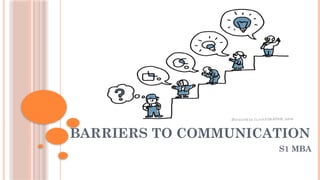
BARRIERS TO COMMUNICATION
S1 MBA
BARRIERS TO COMMUNICATION
PHYSIOLOGICAL BARRIER
• Poor retention due to memory problem(
• Lackof attention(
• Discomfort due to illness
• Hearing problems
• Poor listening skills
• Information overload
• Gender physiological differences()
BARRIERS TO COMMUNICATION
OVERCOMING PHYSIOLOGICAL BARRIER
• Keepin each other’s retention & recollection abilities.
• Pay attention during the sharing of information
• Ensure each other comfort.()
. The limitation of hearing abilities must keep in mind.(
• Active listening.
• Information overload must avoid.
BARRIERS TO COMMUNICATION
ENVIRONMENTAL BARRIER
• Loud background noise
• Poor lighting
• Uncomfortable setting
• Unhygienic surrounding & bad odour(
• V
eryhot or cold room
• Distance
BARRIERS TO COMMUNICATION
OVERCOMING ENVIRONMENTAL BARRIER
• Good lighting must be ensured to facilitate nonverbal communication.
• A comfortable seating arrangement.
• Ahygienic & odour-free environment.
BARRIERS TO COMMUNICATION
PSYCHOLOGICAL BARRIER
• Misperception& misunderstanding(
• Distrust & unhappy emotions(
• Emotional disturbances(
• Psychotic or neurotic illness(
• Worry & emotional disturbances(,
• Fear, anxiety & confused thinking(
BARRIERS TO COMMUNICATION
OVERCOMING PSYCHOLOGICAL BARRIER
• Happy& trustworthy manner()
• Should not harbor negative emotions(
• Avoid feeling of prejudice,resentment & antagonism.(
• Freefrom fear, anxiety & confusion(
BARRIERS TO COMMUNICATION
SOCIAL BARRIER
• Diffidence in social norms, values& behavior
• Social taboos(
• Different social strata(
CULTURAL BARRIER
• Ethnic, religious & cultural differences
• Cultural tradition, values& behavior
BARRIERS TO COMMUNICATION
OVERCOMING SOCIAL BARRIER
• The difference in social norms, values & behavior must be takeninto
consideration.
• Social beliefs must be kept in mind.
OVERCOMING CULTURAL BARRIER
• Consider cultural differences
• Consider cultural traditions, values & behavior.
BARRIERS TO COMMUNICATION
SEMANTIC BARRIER(language or logic)
• Language barriers
• Faulty language translation
• Individual differences in expression & perception
BARRIERS TO COMMUNICATION
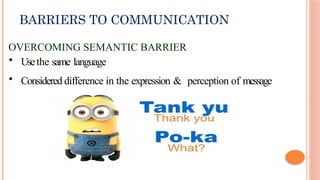
OVERCOMING SEMANTIC BARRIER
• Usethe same language
• Considered difference in the expression & perception of message
BARRIERS TO COMMUNICATION
ORGANIZATIONAL BARRIER
• Organizational policy, rules & regulation(
• Technical failure
• Time pressure documentsubmissiintime...Worktimeetc..
• Complexity of organization structure due to hierarchy
• Sizeof the organization
BARRIERS TO COMMUNICATION
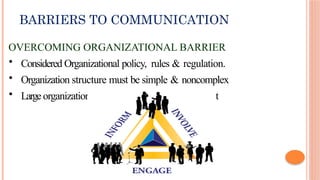
OVERCOMING ORGANIZATIONAL BARRIER
• Considered Organizational policy, rules & regulation.
• Organization structure must be simple & noncomplex
• Large organization must divided into smaller subset
BARRIERS TO COMMUNICATION
COMMUNICATION PROCESS RELATED BARRIER
• Unclear & conflicting message
• Stereotypical approach(
• Inappropriate channels(
• Lackof or poor feedback(
BARRIERS TO COMMUNICATION
OVERCOMING COMMUNICATION PROCESS RELATED
BARRIER
• An appropriate channel must be used.
• A stereotypical approach must be avoided in communication.
• The messagemust be clear & non-conflicting
• Proper feedback must beensured by the recipient.
IMPROMPTU COMMUNICATION
Impromptu communication is speaking without much or any preparation,
An impromptu speech is given with little or no preparation, yet almost always with some advance knowledge
on the topic.
This is sometimes referred to as “off the cuff” or “spur of the moment”.
For example, in class, a teacher may ask a student to give a short impromptu speech about
a topic that was in the assigned readings. Business meetings may also start with everyone
talking briefly about what they have done recently on the project.
TIPS ON GIVING AN IMPROMPTU SPEECH
1. Make some quick notes
The first thing you should do when asked to speak is
to grab a pen and a piece of paper (or napkin –
whatever you can find to write on). Jot down a few
initial ideas, or even just a few words that you can
expand upon during your speech.
If you don’t write anything else, make sure you’ve
written down your starting and ending sentences, as
these are the most important.
2. DECIDE ON THE TONE
NEXT, THINK ABOUT WHAT TONE TO SPEAK IN. THIS WILL DEPEND ON THE TYPE OF EVENT YOU’RE AT. FOR
EXAMPLE, AT A WEDDING, YOU WOULD SPEAK INFORMALLY, AND YOU CAN HAVE FUN WITH THE SPEECH, WHEREAS
AT A BUSINESS CONFERENCE YOU WOULD SPEAK MORE FORMALLY AND STICK TO A PROFESSIONAL TONE.
WHY MANAGERS NEED TO COMMUNICATE
EFFECTIVELY?
 To give and receive information
 To provide advice
 To provide counselling
 To issue orders and instructions
 To impart education and training
 To convince and persuade people
 To issue warnings and notices
 To motivate people
 To receive suggestions
SEVEN CARDINAL MISTAKES MANAGERS
MAKE WHILE COMMUNICATING
 Communicating without knowing the problem
properly.
 Underestimating the intelligence of others.
 Using inappropriate channels of communication
 Believing that words speak louder than action
SEVEN CARDINAL MISTAKES MANAGERS
MAKE WHILE COMMUNICATING
 Listening only to good news
 Playing guessing games with employees
 Rarely talking to employees
WHAT SHOULD A MANAGER DO WHILE
COMMUNICATING?
 He should stay focused. Should subdue his inner
thoughts.
 He should not dominate conversations.
 He should not plan responses.
 He should not interrupt the speaker.
 He should take mental notes while listening.
 He should not jump to conclusions.
CONTD….
 He should engage in open-ended questions.
 He should indicate his engagement by correct
gesture and proper eye contact.
 He should occasionally nod his head to show his
understanding.
 He should jot down the key points while
listening.
CONTD….
 He should clarify points that he does not
understand.
 Ignore distractions.
 Build Rapport with the clients.
 Build humor into the talk.
 Repeat the key points frequently to reinforce.
 Use ample illustrations, graphics, examples
to appeal to all kind of customers
SEVEN CARDINAL MISTAKES MANAGERS
MAKE WHILE COMMUNICATING
 Listening only to good news
 Playing guessing games with employees
 Rarely talking to employees
Thank You

Communication 1ssdsddsdsdsdsdsdasdasdasdada

  • 1.
  • 2.
    Communication Communication is theprocess of exchanging information, ideas, or opinions between two or more people, with the goal of ensuring that the message is understood by everyone involved. Business Communication Business communication is the process of sharing information between people within and outside a company. Why business communication? • Exchange of ideas • Achieve targets • Avoid duplication • Grievance and problems management • Crisis management
  • 3.
    COMMUNICATION: DEFINITION  Theprocess involves exchange of ideas.  The ideas should be accurately replicated.(  The sender should be assured of the exact replication.  The purpose is to call forth desired action.
  • 4.
  • 5.
    7 Cs/ Principlesof Communication • Clear or Complete • Clarity • Concise Courtesy • Correctness • Concrete • Consideration
  • 6.
    Clear When writing orspeaking to someone, be clear about your goal or message. What is your purpose in communicating with this person? If you're not sure, then your audience won't be sure either. To be clear, try to minimize the number of ideas in each sentence. Make sure that it's easy for your reader to understand your meaning.
  • 7.
    CLARITY Clarity implies emphasizing()ona specific message or goal at a time, rather than trying to achieve too much at once.
  • 8.
    CONCISE Conciseness means wordiness,i.e, communicating what you want to convey in least possible words When you're concise) in your communication, you stick to the point and keep it brief
  • 9.
    COURTESY Courtesy in messageimplies the message should show the sender’s expression as well as should respect the receiver. The sender of the message should be sincerely polite, judicious, reflective and enthusiastic.
  • 10.
    CORRECT Correctness in communicationimplies that there are no grammatical errors in communication.
  • 11.
    Bad Example TO Mr Daniel From David CheefOperation Officer Hi Daniel, Thanks so much for meeting me at lunch today! I enjoyed our conservation, and I'm looking forward to moving ahead on our project. I'm sure that the two-weak deadline won't be an issue. Thanks again, and I'll speak to you soon! Best, David
  • 12.
    CONCRETE When your messageis concrete, then your audience has a clear picture of what you're telling them..
  • 13.
    CONSIDERATION Effective communication musttake the audience into consideration, i.e, the audience’s view points, background, mind-set, education level, etc. Make an attempt to envisage your audience, their requirements, emotions as well as problems. Ensure that the self-respect of the audience is maintained and their emotions are not at harm. Modify your words in message to suit the audience’s needs while making your message complete.
  • 14.
    PROCESS OF COMMUNICATION Process of Communication consists of the following eight components which are inter-related 1. Idea 2. Sender 3. Encoding 4. Message 5. Channel & Medium. 6. Receiver/ Decoder 7. Decoding 8. Feedback
  • 15.
    IDEA  1. Everymessage, whether oral or written, has its origin in an idea that germinates in the mind of the sender of the message. Every idea refers to some context. Thus the idea or information that the sender wants to convey to the receiver is the source of the message in the communication process.
  • 16.
    2. SENDER/ ENCODER The person who initiates the communication process is referred to as the encoder. The process of communication begins with the sender who identifies the need to communicate. The sender must have a clear picture in his mind about what he wants to communicate and should accordingly select symbols, words, images, etc. The sender must identify his audience and formulate the message in such a way that the receiver understands fully what he intends to convey and interprets it within the same context.
  • 17.
    3.ENCODING  Encoding isthe process of turning thoughts into communication. It involves using symbols to express an idea, and the encoder must consider how the message will be received by the audience
  • 18.
    4. MESSAGE  Amessage is an idea transformed into words. It can be expressed in different ways depending upon the subject-matter, purpose, audience personal style and cultural background of the sender.
  • 19.
    5. CHANNEL ANDMEDIUM  An appropriate medium chosen to send the message is known as channel. It is the vehicle which facilitates the sender to convey the message to the receiver. Channel is a system used to transmit a message, whereas medium is one of the forms/ types used under that system. For example oral communication is a channel and telephone conversation is a medium. There are three broad channels of communication and there are several media under each. These are listed below:
  • 20.
     Classification of channelsof communication:  Visual channel: Facialexpression, body language, posture, gestures, pictures & written words, electronic mails, massmedia, cinema, television, video-tapes, video conferences, video chat, etc. • Auditory channel: Spoken words, sounds, telephone or mobile communications, delivering audio content (radio, voicemail), etc.  Written letters, memos, reports, manuals, notices, circulars, cuestionareis, minutes, emails, faxes, etc. • Tactile channel: T ouchsensations, therapeutic touch, etc. • Combined channel: Audiovisual media, consoling a person with touch & spoken words.
  • 21.
    6. RECEIVER/ DECODER The person who receives the encoded message is referred to as receiver. The receiver may be an individual or a group of individuals. As communication is a two-way process, the receiver is as important as the sender of the message. A receiver may be a listener or a reader or a viewer of the message. He not only receives the message but also tries to understand, interpret and perceive the total meaning of the message.
  • 22.
    7. DECODING  Itis a process by which the receiver interprets the message and translates it into meaningful information. The meaning of the message is the sum total of the meanings of the words ( symbols) together with the tone and the attitude of the sender as reflected by his choice of words and the structure of the message.
  • 23.
    8. FEEDBACK  Feedbackis the response given by the receiver of the message to the sender of the message. When the encoder receives feedback, he gets to know that communication has been accomplished. Feedback can be immediate, later, can be positive or negative. It can be verbal or non verbal. In communication feedback plays an important role. It ensures that the receiver has received the message and understood it just as it was intended by the sender. Feedback is the most important component of communication. Without feedback, the communication process is incomplete.
  • 24.
     Example: Astudent, who lives in a hostel, wants some money. She writes a letter to her father asking him to send her money. The father sends money, along with a letter. In both cases (sending money and sending the letter), the father is responding to the communication initiated by his child.  Encoder: the student/ child  Message: needs money  Channel: written communication  Medium: a letter  Decoder: the father  Feedback: sends money and letter o Message conceived:- is to form or develop in the mind o Message perceived: the way the receiver senses the message either by hearing or watching. o Message decoded: The receiver has to understand the message that the sender has just sent. This could be misunderstood easily by interpreting words differently. o Message understood: At this stage the message is understood, if not the cycle has to start again.
  • 25.
  • 26.
    TYPES OF COMMUNICATION Typesof Communication Verbal
  • 27.
    TYPES OF COMMUNICATION VERBALCOMMUNICATION • Oral Communication : Communication through spoken words • Written Communication : Communication through written words Communication with the use of actual words are known as verbal communication
  • 28.
    TYPES OF COMMUNICATION ORALCOMMUNICATION ADVANTAGES • Immediate feedback • time saving • builds healthy climate • personal touch • economical • opportunity to correct • helps in understanding the audience
  • 29.
    TYPES OF COMMUNICATION WRITTENCOMMUNICATION ADVANTAGES • Creating records • Builds up legal defenses • Uniformity in policies and guidelines Accuracy and dependability • Permanent • Responsibility can be assigned LIMITATIONS • Unmanageable clutter of files • Time consuming • No immediate feedback • Costly in money and manpower • Ineffective for illiterate people • Absence of immediate clarification
  • 30.
    TYPES OF COMMUNICATION NON-VERBALCOMMUNICATION • Sign Language : Communication with the use of audio-visual signs • Body language : Communication through body postures, facial expressions etc…
  • 31.
    TYPES OF COMMUNICATION SIGNLANGUAGE ADVANTAGES • Easy conveyance of message • interesting and motivating •useful for illiterate workers • effective way of advertising LIMITATIONS • elementary or simple communication • requires skill to make the message •chance of misunderstanding • spot correction not possible
  • 32.
    TYPES OF COMMUNICATION BODYLANGUAGE • Head • Face • Eye Contact • Gestures • Posture
  • 33.
    ROLE OF FEEDBACKIN COMMUNICATION  Communication is the exchange and flow of information and ideas from one person to another. It involves a sender transmitting an idea, information, or feeling to a receiver. Effective communication occurs only if the receiver understands the exact information or idea that the sender intended to transmit. Feedback is essential in communication so as to know whether the recipient has understood the message in the same terms as intended by the sender and whether he agrees to that message or not. Receivers are not just passive absorbers of messages. They receive the message and respond to about the subject matter about what they have understood. This response of a receiver to sender’s message is called Feedback. Sometimes a feedback could be a non-verbal, smiles, sighs and other times, it is oral. It can also be written like replying to an e-mail, etc.
  • 34.
  • 35.
    BARRIERS TO COMMUNICATION PHYSIOLOGICALBARRIER • Poor retention due to memory problem( • Lackof attention( • Discomfort due to illness • Hearing problems • Poor listening skills • Information overload • Gender physiological differences()
  • 36.
    BARRIERS TO COMMUNICATION OVERCOMINGPHYSIOLOGICAL BARRIER • Keepin each other’s retention & recollection abilities. • Pay attention during the sharing of information • Ensure each other comfort.() . The limitation of hearing abilities must keep in mind.( • Active listening. • Information overload must avoid.
  • 37.
    BARRIERS TO COMMUNICATION ENVIRONMENTALBARRIER • Loud background noise • Poor lighting • Uncomfortable setting • Unhygienic surrounding & bad odour( • V eryhot or cold room • Distance
  • 38.
    BARRIERS TO COMMUNICATION OVERCOMINGENVIRONMENTAL BARRIER • Good lighting must be ensured to facilitate nonverbal communication. • A comfortable seating arrangement. • Ahygienic & odour-free environment.
  • 39.
    BARRIERS TO COMMUNICATION PSYCHOLOGICALBARRIER • Misperception& misunderstanding( • Distrust & unhappy emotions( • Emotional disturbances( • Psychotic or neurotic illness( • Worry & emotional disturbances(, • Fear, anxiety & confused thinking(
  • 40.
    BARRIERS TO COMMUNICATION OVERCOMINGPSYCHOLOGICAL BARRIER • Happy& trustworthy manner() • Should not harbor negative emotions( • Avoid feeling of prejudice,resentment & antagonism.( • Freefrom fear, anxiety & confusion(
  • 41.
    BARRIERS TO COMMUNICATION SOCIALBARRIER • Diffidence in social norms, values& behavior • Social taboos( • Different social strata( CULTURAL BARRIER • Ethnic, religious & cultural differences • Cultural tradition, values& behavior
  • 42.
    BARRIERS TO COMMUNICATION OVERCOMINGSOCIAL BARRIER • The difference in social norms, values & behavior must be takeninto consideration. • Social beliefs must be kept in mind. OVERCOMING CULTURAL BARRIER • Consider cultural differences • Consider cultural traditions, values & behavior.
  • 43.
    BARRIERS TO COMMUNICATION SEMANTICBARRIER(language or logic) • Language barriers • Faulty language translation • Individual differences in expression & perception
  • 44.
    BARRIERS TO COMMUNICATION OVERCOMINGSEMANTIC BARRIER • Usethe same language • Considered difference in the expression & perception of message
  • 45.
    BARRIERS TO COMMUNICATION ORGANIZATIONALBARRIER • Organizational policy, rules & regulation( • Technical failure • Time pressure documentsubmissiintime...Worktimeetc.. • Complexity of organization structure due to hierarchy • Sizeof the organization
  • 46.
    BARRIERS TO COMMUNICATION OVERCOMINGORGANIZATIONAL BARRIER • Considered Organizational policy, rules & regulation. • Organization structure must be simple & noncomplex • Large organization must divided into smaller subset
  • 47.
    BARRIERS TO COMMUNICATION COMMUNICATIONPROCESS RELATED BARRIER • Unclear & conflicting message • Stereotypical approach( • Inappropriate channels( • Lackof or poor feedback(
  • 48.
    BARRIERS TO COMMUNICATION OVERCOMINGCOMMUNICATION PROCESS RELATED BARRIER • An appropriate channel must be used. • A stereotypical approach must be avoided in communication. • The messagemust be clear & non-conflicting • Proper feedback must beensured by the recipient.
  • 49.
    IMPROMPTU COMMUNICATION Impromptu communicationis speaking without much or any preparation, An impromptu speech is given with little or no preparation, yet almost always with some advance knowledge on the topic. This is sometimes referred to as “off the cuff” or “spur of the moment”. For example, in class, a teacher may ask a student to give a short impromptu speech about a topic that was in the assigned readings. Business meetings may also start with everyone talking briefly about what they have done recently on the project.
  • 50.
    TIPS ON GIVINGAN IMPROMPTU SPEECH 1. Make some quick notes The first thing you should do when asked to speak is to grab a pen and a piece of paper (or napkin – whatever you can find to write on). Jot down a few initial ideas, or even just a few words that you can expand upon during your speech. If you don’t write anything else, make sure you’ve written down your starting and ending sentences, as these are the most important.
  • 51.
    2. DECIDE ONTHE TONE NEXT, THINK ABOUT WHAT TONE TO SPEAK IN. THIS WILL DEPEND ON THE TYPE OF EVENT YOU’RE AT. FOR EXAMPLE, AT A WEDDING, YOU WOULD SPEAK INFORMALLY, AND YOU CAN HAVE FUN WITH THE SPEECH, WHEREAS AT A BUSINESS CONFERENCE YOU WOULD SPEAK MORE FORMALLY AND STICK TO A PROFESSIONAL TONE.
  • 52.
    WHY MANAGERS NEEDTO COMMUNICATE EFFECTIVELY?  To give and receive information  To provide advice  To provide counselling  To issue orders and instructions  To impart education and training  To convince and persuade people  To issue warnings and notices  To motivate people  To receive suggestions
  • 53.
    SEVEN CARDINAL MISTAKESMANAGERS MAKE WHILE COMMUNICATING  Communicating without knowing the problem properly.  Underestimating the intelligence of others.  Using inappropriate channels of communication  Believing that words speak louder than action
  • 54.
    SEVEN CARDINAL MISTAKESMANAGERS MAKE WHILE COMMUNICATING  Listening only to good news  Playing guessing games with employees  Rarely talking to employees
  • 55.
    WHAT SHOULD AMANAGER DO WHILE COMMUNICATING?  He should stay focused. Should subdue his inner thoughts.  He should not dominate conversations.  He should not plan responses.  He should not interrupt the speaker.  He should take mental notes while listening.  He should not jump to conclusions.
  • 56.
    CONTD….  He shouldengage in open-ended questions.  He should indicate his engagement by correct gesture and proper eye contact.  He should occasionally nod his head to show his understanding.  He should jot down the key points while listening.
  • 57.
    CONTD….  He shouldclarify points that he does not understand.  Ignore distractions.  Build Rapport with the clients.  Build humor into the talk.  Repeat the key points frequently to reinforce.  Use ample illustrations, graphics, examples to appeal to all kind of customers
  • 58.
    SEVEN CARDINAL MISTAKESMANAGERS MAKE WHILE COMMUNICATING  Listening only to good news  Playing guessing games with employees  Rarely talking to employees
  • 59.