

Mechanical Ventilation
David Marcus, MD
@EMIMDoc – EMIMDoc.org
Emergency Medicine/Internal Medicine/Medical Ethics, LIJ Medical Center
Nassau University Medical Center – 1/272016
Goals
General principles
What to use when
Basic settings and modifications
Monitoring
Trouble Shooting
To vent or not to vent?
85 y/o M c CHF, rales on physical exam,
breathing comfortably, O2 sat 90%
45 yr old F, morbidly obese c OSA in
extreme respiratory distress
20 y/o F c h/o asthma, multiple intubations in
the past, audible wheeze, RR 22
94 y/o F, minimally responsive c HR 32, BP
60/palp, RR 10, O2 sat 95% ORA
On two things the world stands
Ventilation Oxygenation
RR
Vt
FiO2
V/Q
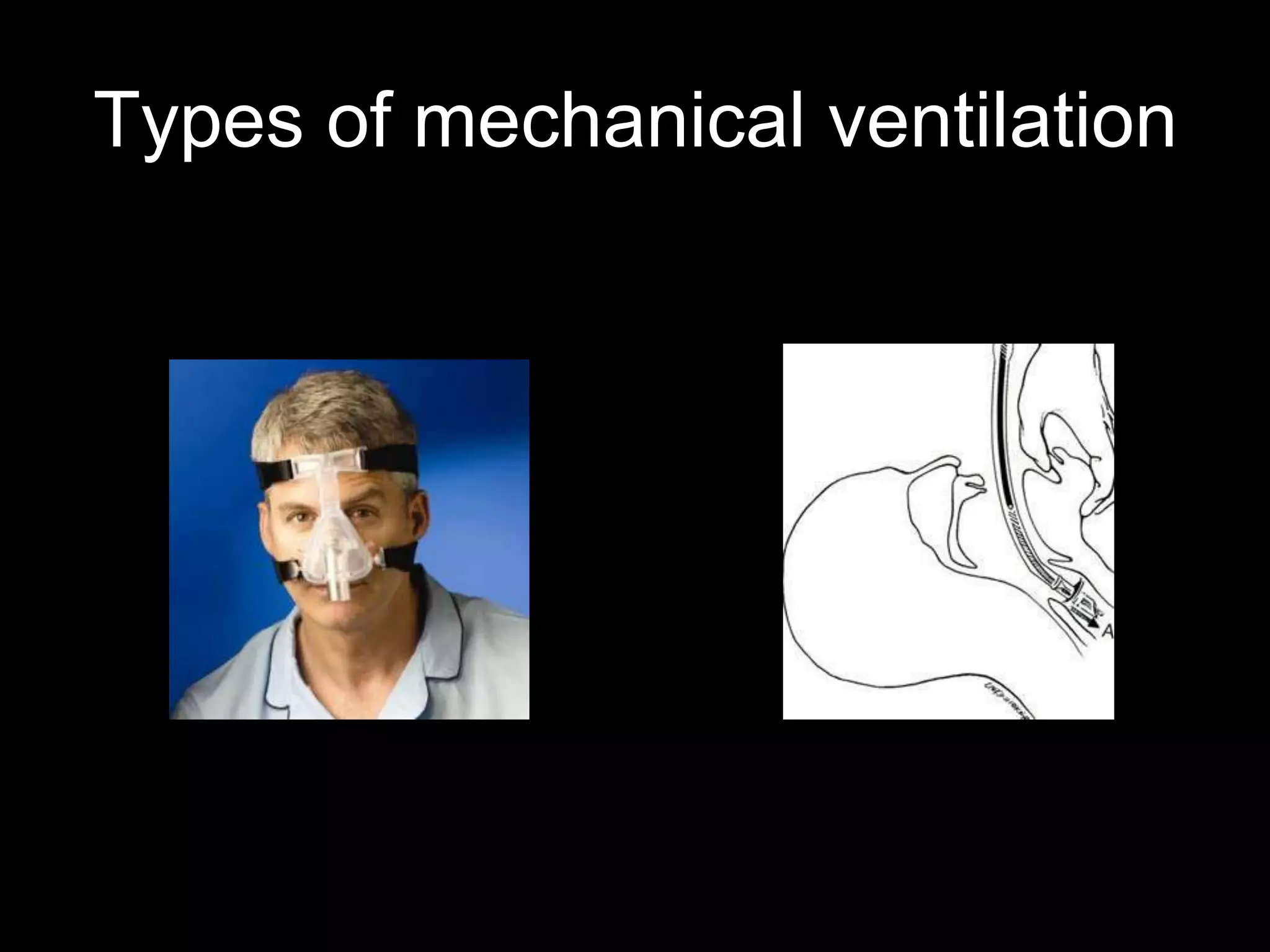
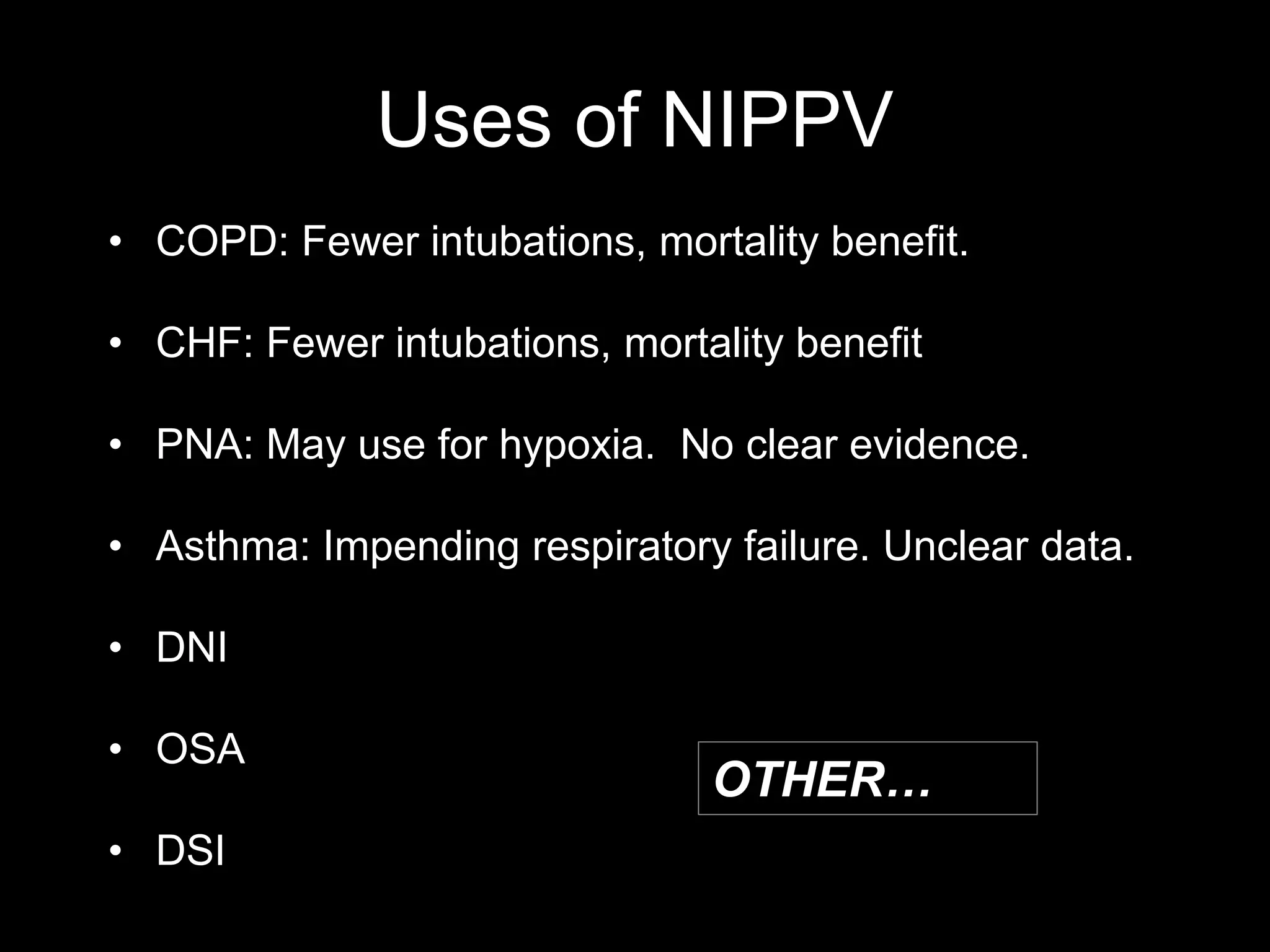
Types of mechanical ventilation
Uses of NIPPV
• COPD: Fewer intubations, mortality benefit.
• CHF: Fewer intubations, mortality benefit
• PNA: May use for hypoxia. No clear evidence.
• Asthma: Impending respiratory failure. Unclear data.
• DNI
• OSA
• DSI
OTHER…
Modes
CPAP
When CO2 OK, but cannot oxygenate
BiPAP
For CO2 help (+/- O2 problem)
To decrease CO2, increase delta
To increase O2, increase i/ePAP
Running the Numbers
• Initial BiPAP setting: 10/5 cmH2O
• Max iPAP 20-25 cmH2O
• Max ePAP 10-15 cmH2O
• Start FiO2 at 1.0 and titrate
• Back up rate 12-16 / min
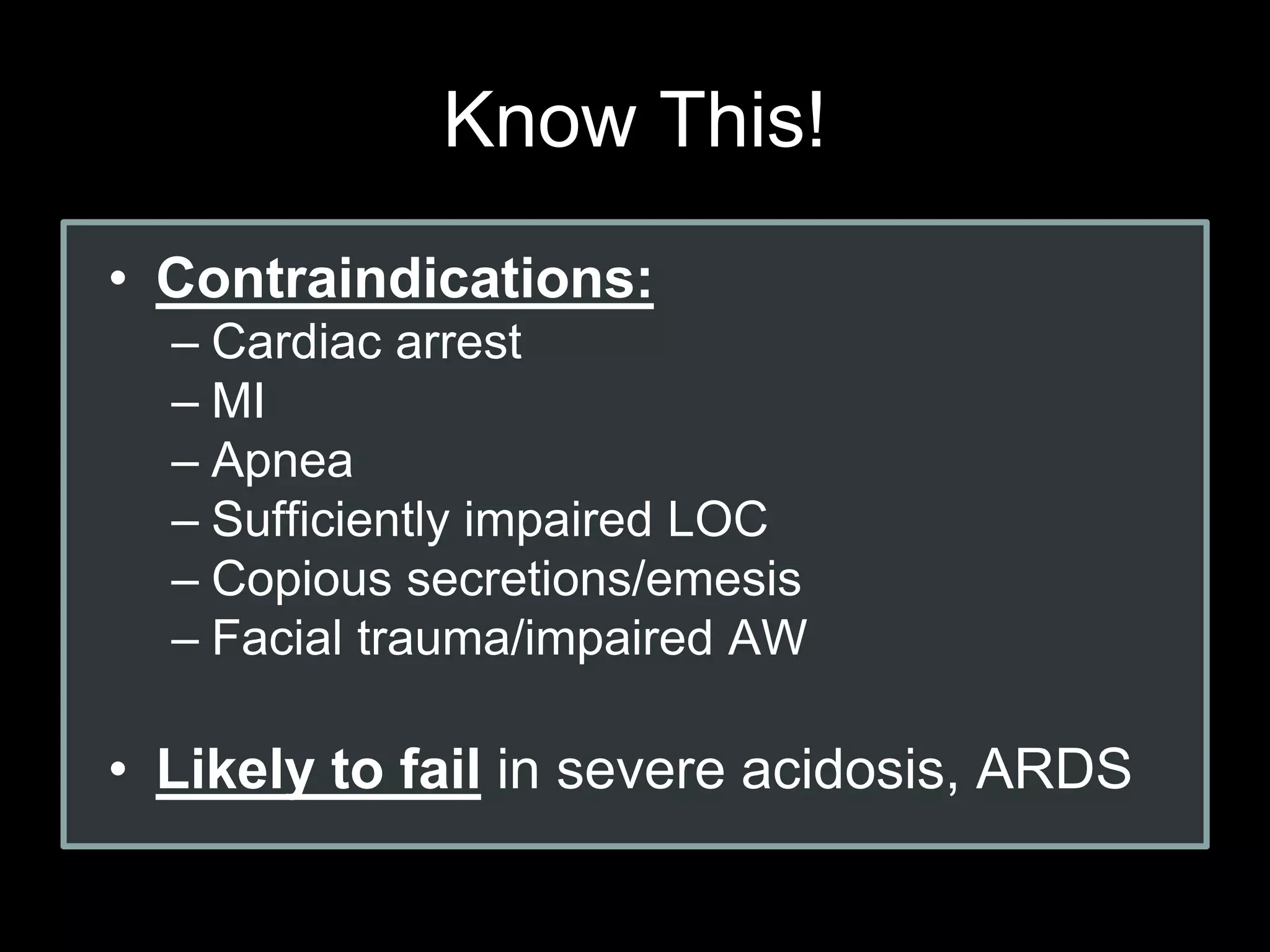
Know This!
• Contraindications:
– Cardiac arrest
– MI
– Apnea
– Sufficiently impaired LOC
– Copious secretions/emesis
– Facial trauma/impaired AW
• Likely to fail in severe acidosis, ARDS
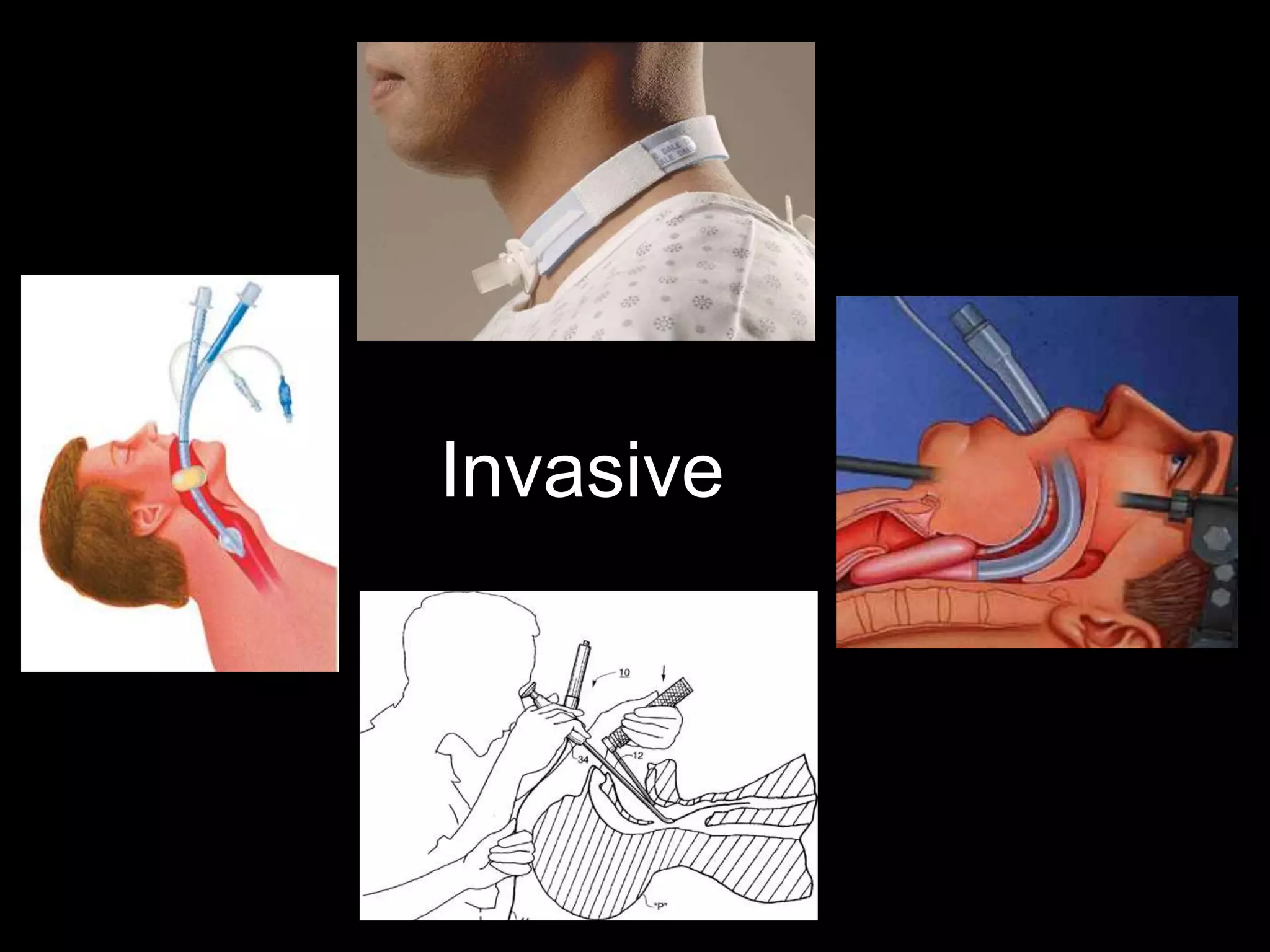
Invasive
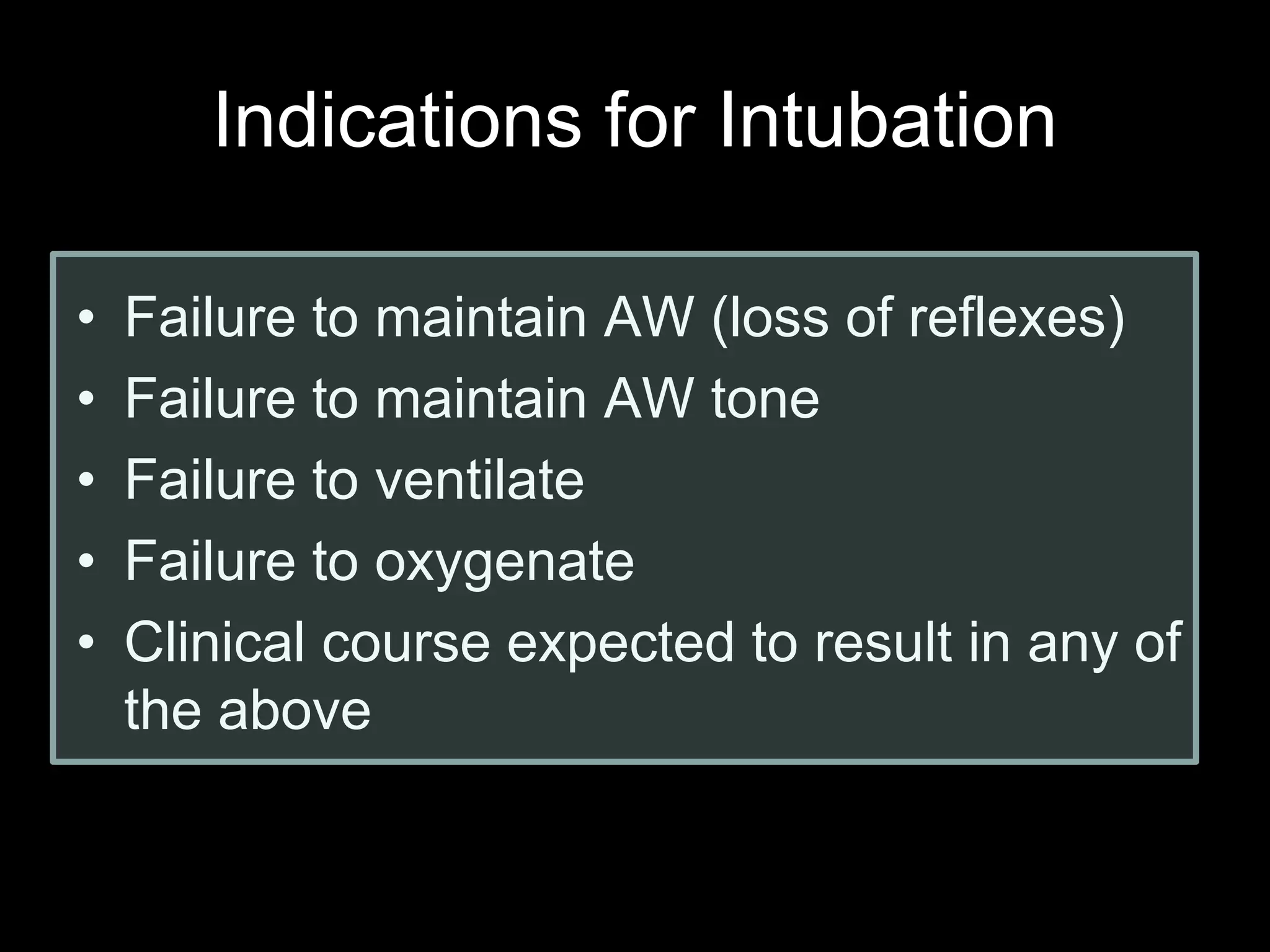
Indications for Intubation
• Failure to maintain AW (loss of reflexes)
• Failure to maintain AW tone
• Failure to ventilate
• Failure to oxygenate
• Clinical course expected to result in any of
the above
Contraindications
Loss of upper AW anatomy
Total upper AW obstruction
Relative contraindication:
Anticipated difficult AW
Vents
• Control mechanisms
1. VCV (fixed volume)
2. PCV (fixed pressure)
• Variables:
– Trigger (what starts a breath): flow, pressure,
time
– Limit: Pressure, Flow
– Cycle (what ends a breath): Time, flow,
Pressure, Volume
Modes
1. CMV – Machine breaths only
2. AC – fixed number of machine breaths + pt
triggered breaths at fixed volume.
3. SIMV – fixed rate/volume machine breaths +
pt triggered breaths limited by pt effort
4. May use pressure support (PSV) in SIMV or
CPAP – provides additional support during
spontaneous inspiration (to overcome
resistance of system).
Other modes
• APRV (airway pressure release ventilation)
• PAV (proportional assist ventilation)
• Prone positioning
• IRV (inverse ratio ventilation)
• Permissive hypercapnia (goal = decreased
peak AW pressure, i.e. in asthmatics) Via
lower RR, lower Vt.
Settings
Rate
FiO2
Vt
PEEP (Pressures)
i:e ratio
PEEP
– Uses
– Risks
• Decreased venous return
• Barotrauma
• Increased ICP
• GI Ulceration
• Fluid retention (increased ADH vs decreased ANP)
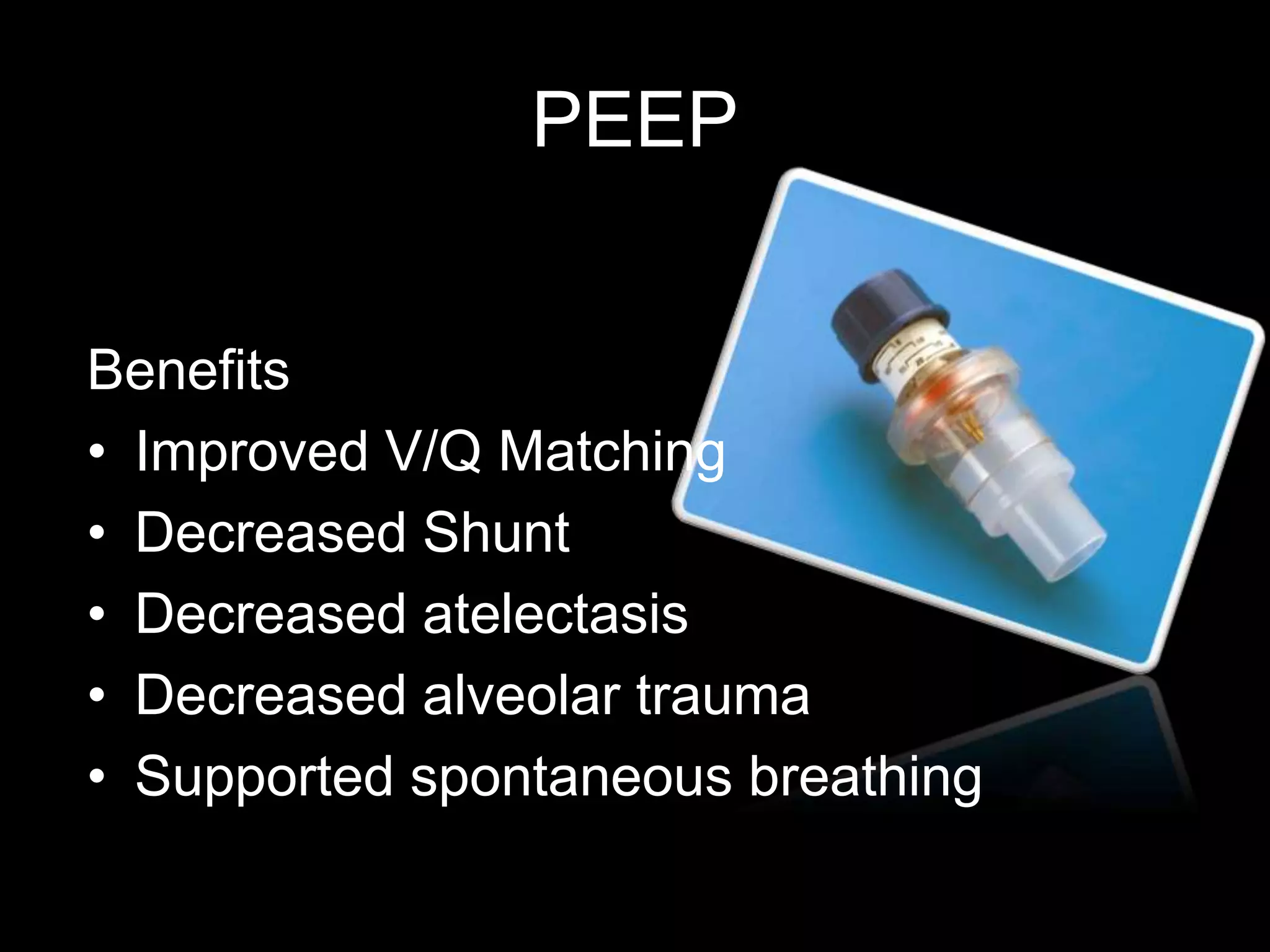
PEEP
Benefits
• Improved V/Q Matching
• Decreased Shunt
• Decreased atelectasis
• Decreased alveolar trauma
• Supported spontaneous breathing
Doctor, what settings would you like?
• Mode
• Rate (12-14)
• FiO2 (Start at 1.0 and titrate down)
• PEEP (~5 cmH2O)
• Vt (6-8 ml/kg)
• (I:E ratio)
Patient Specific Management
• 56 yr old M, traumatic PTX/rib fractures
• 28 yr old obese F, severe influenza, ARDS
• 76 year old M, subarachnoid hemorrhage
• 18 yr old F, severe asthma, now intubated
• 82 yr old M, septic shock
Monitoring
• Clinical Observation
• Pulse Oximetry
• ABG/VBG
• Capnometry (End Tidal CO2)
• BMP
• Peak and Plateau pressures, Auto-PEEP
• Volumes/Air Leak
You’re Doing Great!
• Your intubated patient is doing well.
• Sats are good, he appears comfortable.
• And then…
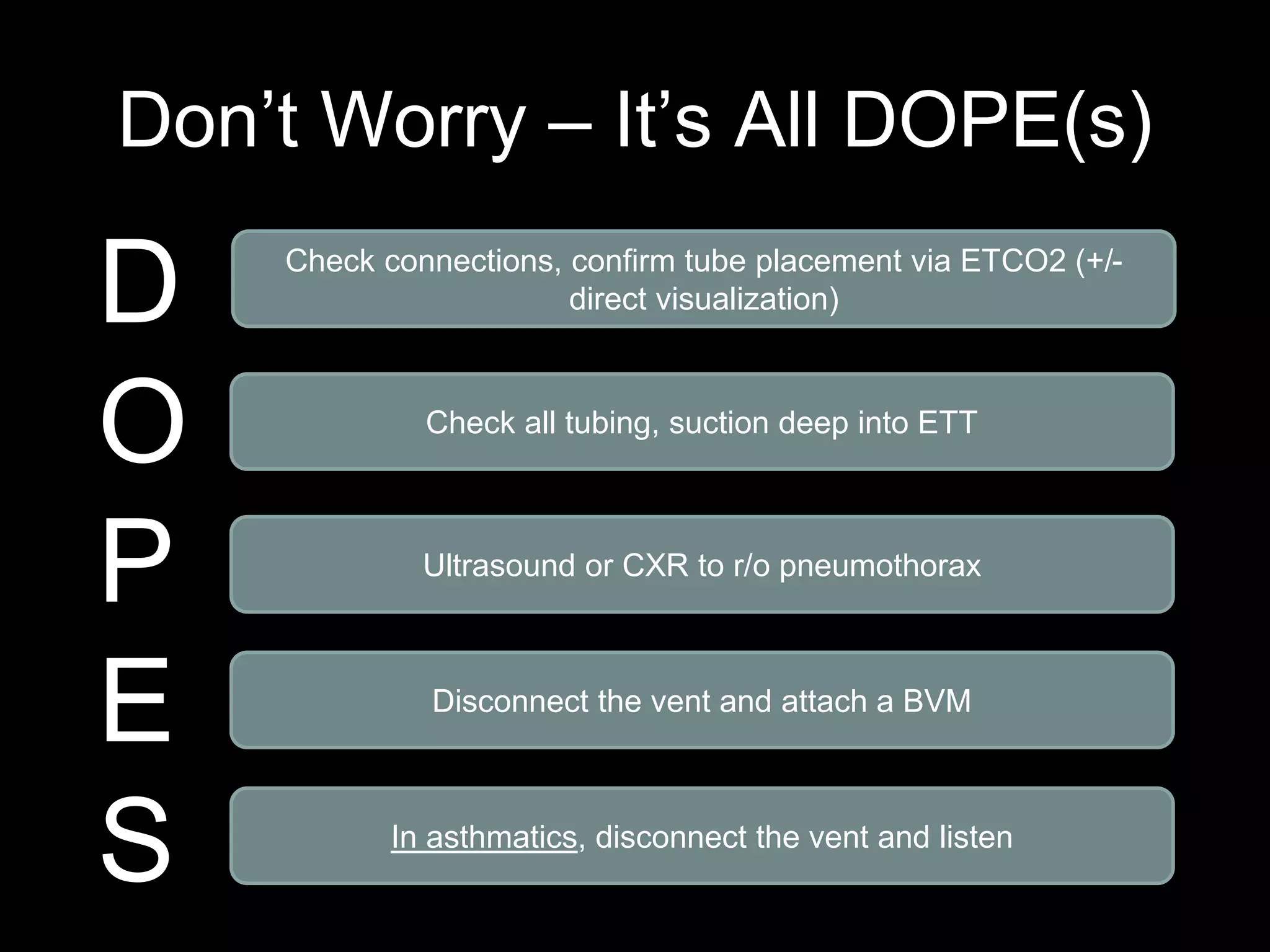
Don’t Worry – It’s All DOPE(s)
Why is the patient is hypoxic?
• D – Dislodged Tube/Disconnect
• O – Obstructed system
• P - Pneumothorax
• E – Equipment Failure
• (S – Stacked breaths, if asthmatic)
Don’t Worry – It’s All DOPE(s)
D
O
P
E
S
Check connections, confirm tube placement via ETCO2 (+/-
direct visualization)
Check all tubing, suction deep into ETT
Ultrasound or CXR to r/o pneumothorax
Disconnect the vent and attach a BVM
In asthmatics, disconnect the vent and listen
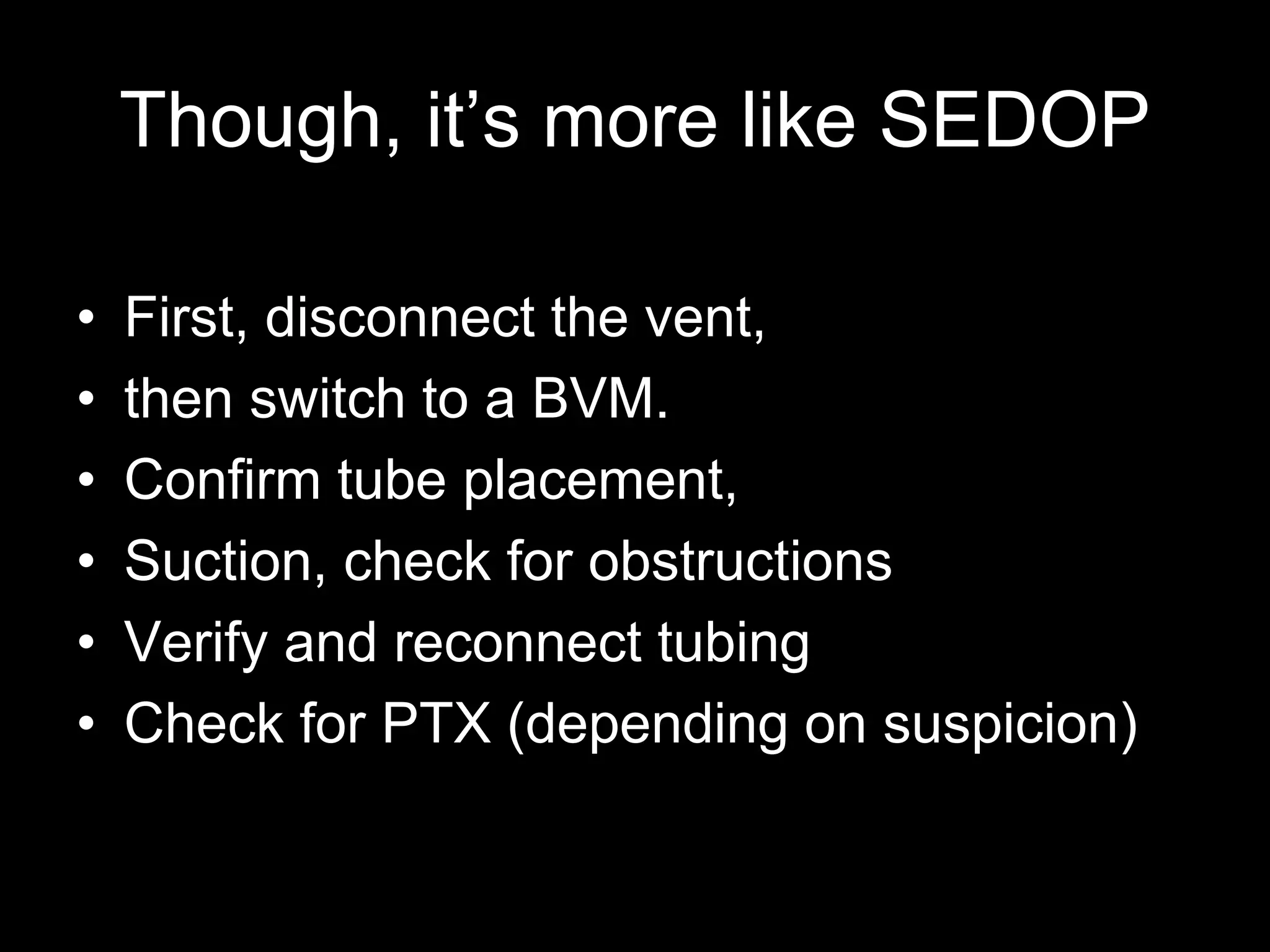
Though, it’s more like SEDOP
• First, disconnect the vent,
• then switch to a BVM.
• Confirm tube placement,
• Suction, check for obstructions
• Verify and reconnect tubing
• Check for PTX (depending on suspicion)
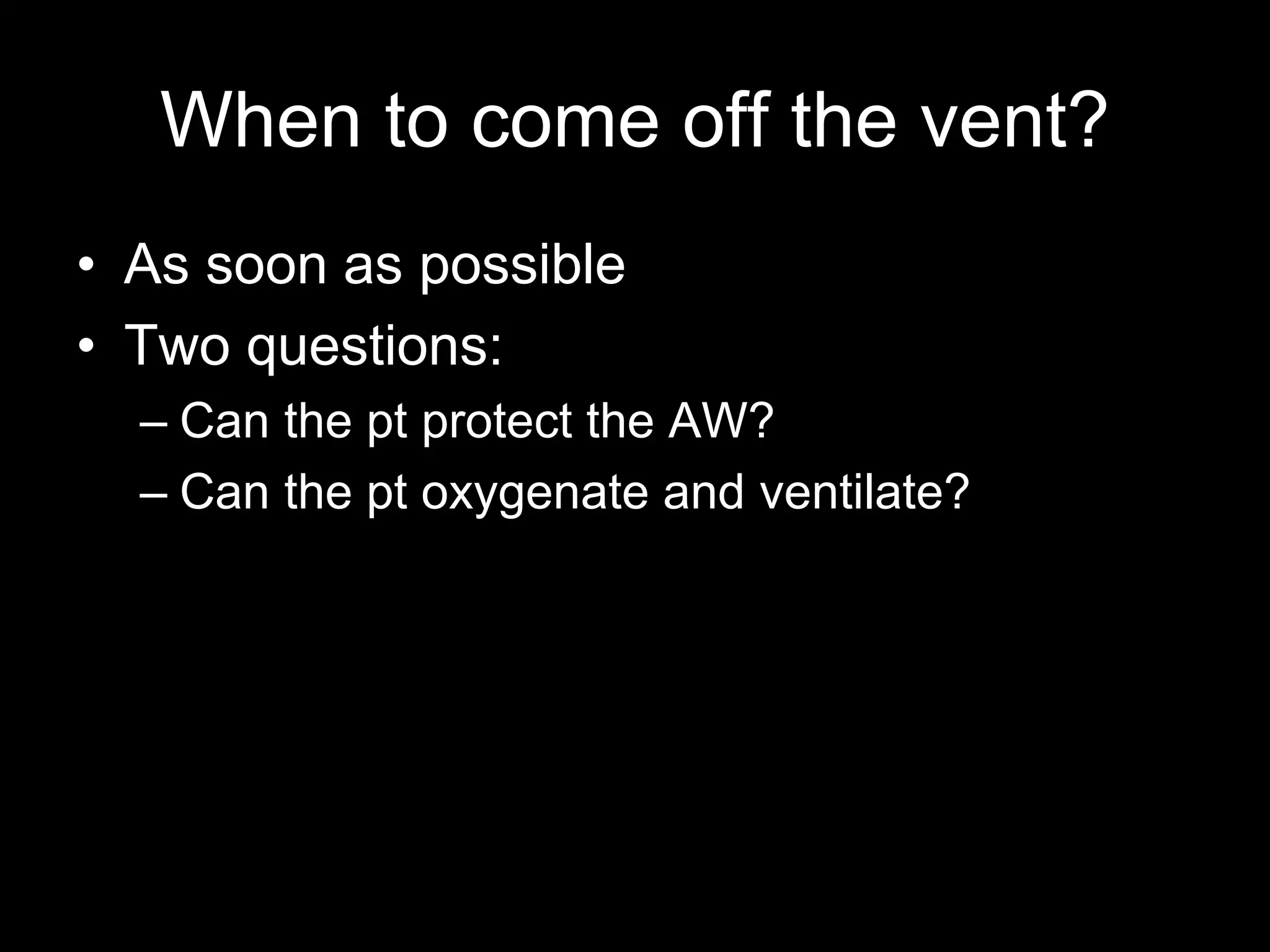
When to come off the vent?
• As soon as possible
• Two questions:
– Can the pt protect the AW?
– Can the pt oxygenate and ventilate?
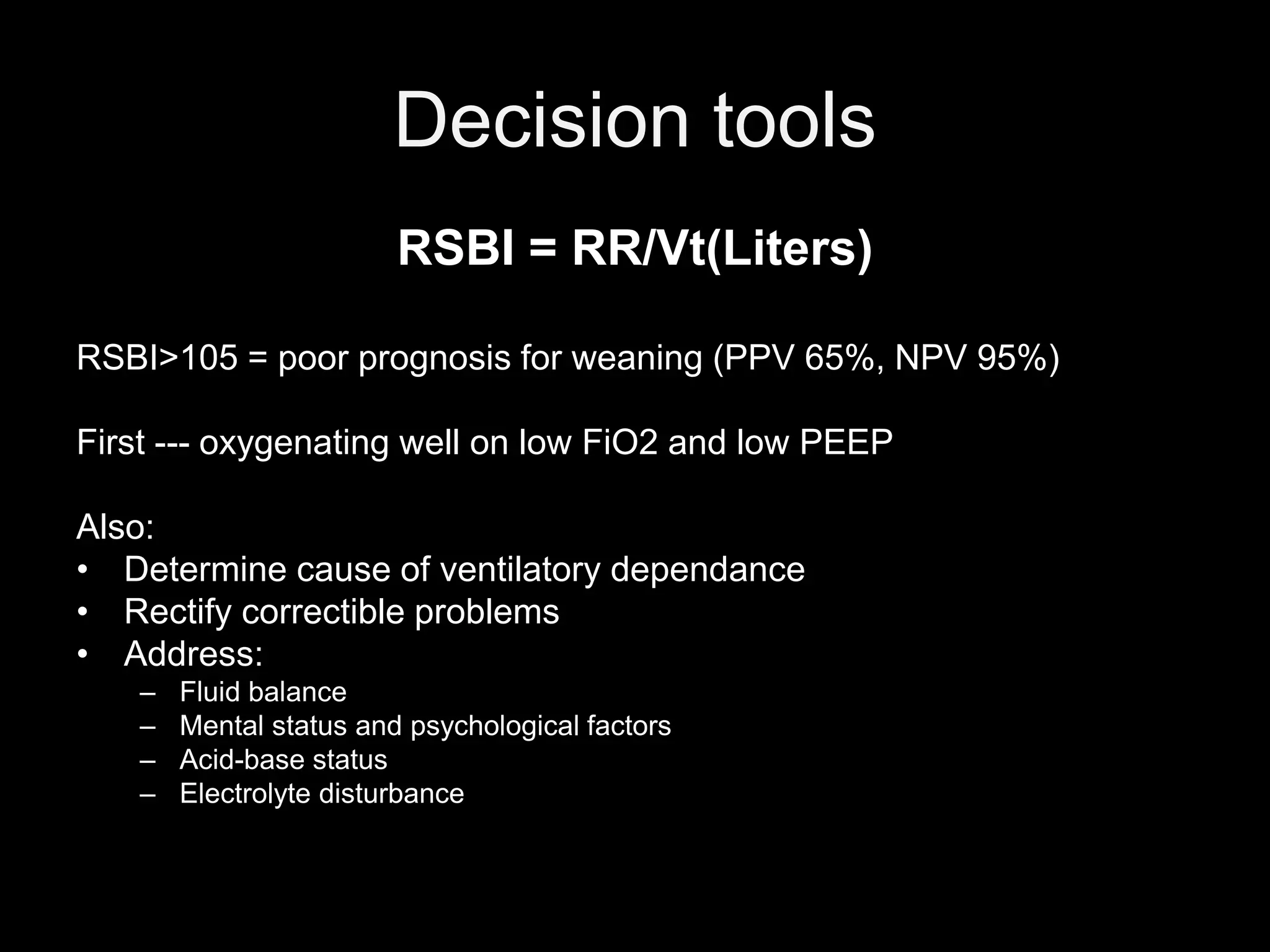
Decision tools
RSBI = RR/Vt(Liters)
RSBI>105 = poor prognosis for weaning (PPV 65%, NPV 95%)
First --- oxygenating well on low FiO2 and low PEEP
Also:
• Determine cause of ventilatory dependance
• Rectify correctible problems
• Address:
– Fluid balance
– Mental status and psychological factors
– Acid-base status
– Electrolyte disturbance
Weaning Methods
• T tube trial
• IMV
• PSV
• NPPV
Vent complications
• PTX
• Biotrauma (the injury formerly known as
barotrauma): overdistention or rupture,
alveolar hypoperfusion, and repetitive
shear stresses across alveolar walls
• Hemodynamic compromise
• VAP
Summary
• What’s the patient’s problem?
– CO2/O2/AW
• NIPPV
– Know settings, contraindications!
• IPPV
– Modes, General vent settings
– DOPE(s)
• Further reading: Vent strategies for
restrictive vs obstructive lung disease
Summary
• 45 yr old F, morbidly obese c OSA in
extreme respiratory distress?
– NIPPV?
– IPPV?
– No mechanical ventilation?
NIPPV may be used in all of the
following, except:
1. COPD
2. CHF
3. CPR
4. Pneumonia
5. Asthma
6. Myesthenia gravis
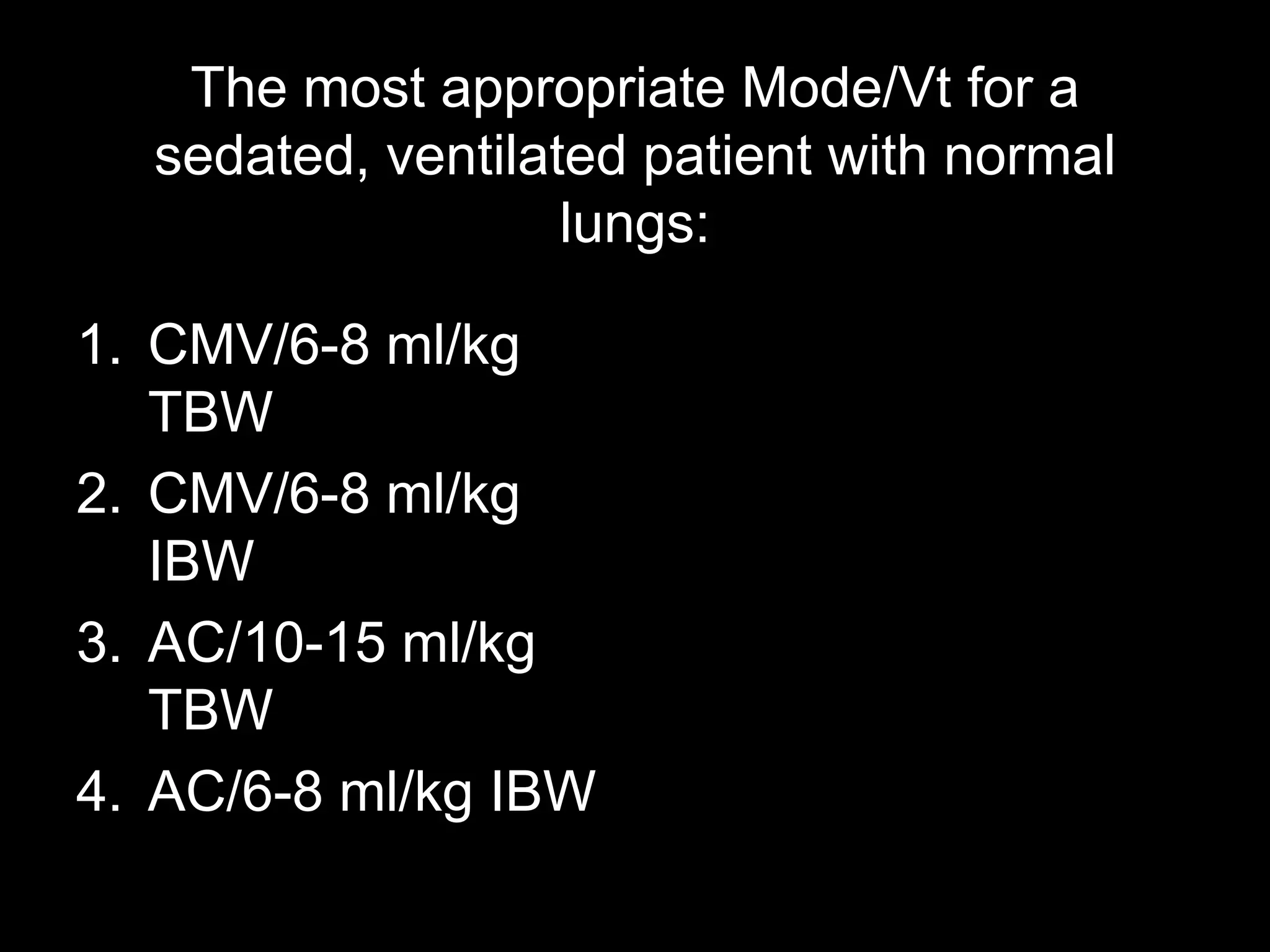
The most appropriate Mode/Vt for a
sedated, ventilated patient with normal
lungs:
1. CMV/6-8 ml/kg
TBW
2. CMV/6-8 ml/kg
IBW
3. AC/10-15 ml/kg
TBW
4. AC/6-8 ml/kg IBW
THANK YOU!
The slideset is now available at:
www.EMIMDoc.org

Intro to Mechanical Ventilation for Residents

  • 1.
    Mechanical Ventilation David Marcus,MD @EMIMDoc – EMIMDoc.org Emergency Medicine/Internal Medicine/Medical Ethics, LIJ Medical Center Nassau University Medical Center – 1/272016
  • 2.
    Goals General principles What touse when Basic settings and modifications Monitoring Trouble Shooting
  • 3.
    To vent ornot to vent? 85 y/o M c CHF, rales on physical exam, breathing comfortably, O2 sat 90% 45 yr old F, morbidly obese c OSA in extreme respiratory distress 20 y/o F c h/o asthma, multiple intubations in the past, audible wheeze, RR 22 94 y/o F, minimally responsive c HR 32, BP 60/palp, RR 10, O2 sat 95% ORA
  • 4.
    On two thingsthe world stands Ventilation Oxygenation RR Vt FiO2 V/Q
  • 5.
  • 6.
    Uses of NIPPV •COPD: Fewer intubations, mortality benefit. • CHF: Fewer intubations, mortality benefit • PNA: May use for hypoxia. No clear evidence. • Asthma: Impending respiratory failure. Unclear data. • DNI • OSA • DSI OTHER…
  • 7.
    Modes CPAP When CO2 OK,but cannot oxygenate BiPAP For CO2 help (+/- O2 problem) To decrease CO2, increase delta To increase O2, increase i/ePAP
  • 8.
    Running the Numbers •Initial BiPAP setting: 10/5 cmH2O • Max iPAP 20-25 cmH2O • Max ePAP 10-15 cmH2O • Start FiO2 at 1.0 and titrate • Back up rate 12-16 / min
  • 9.
    Know This! • Contraindications: –Cardiac arrest – MI – Apnea – Sufficiently impaired LOC – Copious secretions/emesis – Facial trauma/impaired AW • Likely to fail in severe acidosis, ARDS
  • 11.
  • 12.
    Indications for Intubation •Failure to maintain AW (loss of reflexes) • Failure to maintain AW tone • Failure to ventilate • Failure to oxygenate • Clinical course expected to result in any of the above
  • 13.
    Contraindications Loss of upperAW anatomy Total upper AW obstruction Relative contraindication: Anticipated difficult AW
  • 14.
    Vents • Control mechanisms 1.VCV (fixed volume) 2. PCV (fixed pressure) • Variables: – Trigger (what starts a breath): flow, pressure, time – Limit: Pressure, Flow – Cycle (what ends a breath): Time, flow, Pressure, Volume
  • 15.
    Modes 1. CMV –Machine breaths only 2. AC – fixed number of machine breaths + pt triggered breaths at fixed volume. 3. SIMV – fixed rate/volume machine breaths + pt triggered breaths limited by pt effort 4. May use pressure support (PSV) in SIMV or CPAP – provides additional support during spontaneous inspiration (to overcome resistance of system).
  • 16.
    Other modes • APRV(airway pressure release ventilation) • PAV (proportional assist ventilation) • Prone positioning • IRV (inverse ratio ventilation) • Permissive hypercapnia (goal = decreased peak AW pressure, i.e. in asthmatics) Via lower RR, lower Vt.
  • 17.
  • 18.
    PEEP – Uses – Risks •Decreased venous return • Barotrauma • Increased ICP • GI Ulceration • Fluid retention (increased ADH vs decreased ANP)
  • 19.
    PEEP Benefits • Improved V/QMatching • Decreased Shunt • Decreased atelectasis • Decreased alveolar trauma • Supported spontaneous breathing
  • 20.
    Doctor, what settingswould you like? • Mode • Rate (12-14) • FiO2 (Start at 1.0 and titrate down) • PEEP (~5 cmH2O) • Vt (6-8 ml/kg) • (I:E ratio)
  • 21.
    Patient Specific Management •56 yr old M, traumatic PTX/rib fractures • 28 yr old obese F, severe influenza, ARDS • 76 year old M, subarachnoid hemorrhage • 18 yr old F, severe asthma, now intubated • 82 yr old M, septic shock
  • 22.
    Monitoring • Clinical Observation •Pulse Oximetry • ABG/VBG • Capnometry (End Tidal CO2) • BMP • Peak and Plateau pressures, Auto-PEEP • Volumes/Air Leak
  • 24.
    You’re Doing Great! •Your intubated patient is doing well. • Sats are good, he appears comfortable. • And then…
  • 25.
    Don’t Worry –It’s All DOPE(s) Why is the patient is hypoxic? • D – Dislodged Tube/Disconnect • O – Obstructed system • P - Pneumothorax • E – Equipment Failure • (S – Stacked breaths, if asthmatic)
  • 26.
    Don’t Worry –It’s All DOPE(s) D O P E S Check connections, confirm tube placement via ETCO2 (+/- direct visualization) Check all tubing, suction deep into ETT Ultrasound or CXR to r/o pneumothorax Disconnect the vent and attach a BVM In asthmatics, disconnect the vent and listen
  • 27.
    Though, it’s morelike SEDOP • First, disconnect the vent, • then switch to a BVM. • Confirm tube placement, • Suction, check for obstructions • Verify and reconnect tubing • Check for PTX (depending on suspicion)
  • 28.
    When to comeoff the vent? • As soon as possible • Two questions: – Can the pt protect the AW? – Can the pt oxygenate and ventilate?
  • 29.
    Decision tools RSBI =RR/Vt(Liters) RSBI>105 = poor prognosis for weaning (PPV 65%, NPV 95%) First --- oxygenating well on low FiO2 and low PEEP Also: • Determine cause of ventilatory dependance • Rectify correctible problems • Address: – Fluid balance – Mental status and psychological factors – Acid-base status – Electrolyte disturbance
  • 30.
    Weaning Methods • Ttube trial • IMV • PSV • NPPV
  • 31.
    Vent complications • PTX •Biotrauma (the injury formerly known as barotrauma): overdistention or rupture, alveolar hypoperfusion, and repetitive shear stresses across alveolar walls • Hemodynamic compromise • VAP
  • 32.
    Summary • What’s thepatient’s problem? – CO2/O2/AW • NIPPV – Know settings, contraindications! • IPPV – Modes, General vent settings – DOPE(s) • Further reading: Vent strategies for restrictive vs obstructive lung disease
  • 33.
    Summary • 45 yrold F, morbidly obese c OSA in extreme respiratory distress? – NIPPV? – IPPV? – No mechanical ventilation?
  • 34.
    NIPPV may beused in all of the following, except: 1. COPD 2. CHF 3. CPR 4. Pneumonia 5. Asthma 6. Myesthenia gravis
  • 35.
    The most appropriateMode/Vt for a sedated, ventilated patient with normal lungs: 1. CMV/6-8 ml/kg TBW 2. CMV/6-8 ml/kg IBW 3. AC/10-15 ml/kg TBW 4. AC/6-8 ml/kg IBW
  • 36.
    THANK YOU! The slidesetis now available at: www.EMIMDoc.org

Editor's Notes

  • #4 Straightforward no. But may need (what type?) if desatting or getting tired Straightforward yes, but to intubate or not? Discussion of weaning difficulty. Straightforward no. But special case of asthmatics – give mm a rest, deal with auto-PEEP, permissive hypercapnia, etc. Yes, needs intubation for AW protection. Also, possible case of ingestion, may need GI irrigation, etc.
  • #5 DRAW AW’S DOWN TO ALVEOLI Ventilation – Essentially, elimination of CO2. Determined by minute ventilation – dependant upon respiratory rate and Vt. Ventilatory needs change based on physiology (i.e. infections increase CO2 production due to increased metabolic rate, acidosis, chronic retainers have higher tolerance, etc) Oxygenation – Like it sounds - ability to equilibrate the O2 in the blood with O2 in alveolar air. Dependant primarily on V/Q (affected by pressures) matching and FiO2 NOT rate or Vt 3) Dead space: Vdead/Vtidal~ 0.35 (35% deadspace) – if higher, inefficient ventilation. If Vd/Vt>0.6 may have trouble weaning.
  • #6 Describe practical differences between IPPV and NIPPV
  • #7 COPD: reduces work of breathing and splints airways open, improving ventilation-perfusion matching. CHF: reduces work of breathing, improves cardiac output by decreasing preload and afterload, redistributes lung water, and improves ventilation-perfusion matching thereby reducing shunt. OTHER: Neuromuscular Dz, CF, ARDS, decompensated OSA
  • #8 CPAP: May be better for Acute Pulmonary Edema (CHF, etc), fear of increased risk of MI c BiPAP in CHF, but recent data sheds doubt. OSA. BiPAP: May be used always, question of risk of MI in CHF. Preferred mode for COPD.
  • #9 Titrate FiO2 as low as possible c O2 sat > 90%
  • #13 Not hard and fast indications, much room for clinical decision
  • #15 Control: VCV - most common mode of ventilation in adults in US but does not take variable lung compliance and AW resistance into acct. – results in varying and sometimes high pressures. PCV - var. volume, lung chest compliance dependant, pressures. But, accurate pressure control to minimize risk of alveolar injury. Mode used sometimes in transport vents. Cheaper. More common in peds. Compliance = delta P/delta V Variables: Any or all of these parameters are controlled by the vent and can be modified, depending on the mode of operation
  • #16 CMV (cont mechanical ventilation): for the apneic pt AC (assist control): based on pt generated negative pressure below PEEP, but Vt is determined by machine SIMV (synchronized intermittent mechanical venti): Vt of extra breaths determined by pt. Usually done c Pressure support
  • #17 APRV - high CPAP mode c intermittent drop in pressure. Use for refractory hypoxemia… Prone - (recruitment for pulm edema, decrease hyperinflation. Triangular chest prob benefits more – more posterior lung to be recruited) IRV - for hypoxemic resp failure PH - Allows longer exp for clearing of auto PEEP, reduces cardiovascular complications, alveolar injury. However, increases cerebral vasodilation----ICP, shifts O2 dissociation to RIGHT so HgB unloads early and other results of acidosis
  • #18 NL i:e = 1:2-3 Based on discussion from the previous slide
  • #19 IMPROVES OXYGENATION Reduce atelectasis thus improving V/Q matching Shifts fluid out of alveolar space Decrease venous return, beneficial in CHF. Like taking NTG. RISKS: Decreased venous return Barotrauma
  • #26 Mnemonic for desaturating vented patient
  • #30 Rapid shallow breathing index
  • #31 In one trial, 109 mechanically ventilated patients who could not sustain two hours of spontaneous breathing were randomly assigned to wean by T tube trials, IMV, or PSV. The duration of weaning was shorter with PSV (mean 5.7 days) than either T tube trials (mean 8.5 days) or IMV (mean 9.9 days). In a similar trial, 130 mechanically ventilated patients who had respiratory distress during a two hour trial of spontaneous breathing were randomly assigned to one of four weaning methods: T tube trials at least twice daily, T tube trials once daily, IMV, or PSV. T tube trials led to extubation approximately three times more quickly than IMV and twice as quickly as PSV. There was no difference in the rate of weaning when once daily T tube trials were compared to more frequent T tube trials, or when IMV and PSV were compared.
  • #34 Straightforward yes, NIPPV. Not to be intubated unless have to. Discussion of weaning difficulty.
  • #35 CPR: Patient must be breathing in order for NIPPV to work.
  • #36 AC/6-8 ml/kg IBW. Lung volume proportional to height not total mass. AC good for practically all sedated patients. CMV would require paralysis of many patients, otherwise increased work of breathing, stress, etc.