Project: Ghana Emergency Medicine Collaborative
Document Title: Meningitis and Other CNS Infections
Author(s): Frank Madore, MD
License: Unless otherwise noted, this material is made available under the
terms of the Creative Commons Attribution Share Alike-3.0 License:
http://creativecommons.org/licenses/by-sa/3.0/

We have reviewed this material in accordance with U.S. Copyright Law and have tried to maximize your
ability to use, share, and adapt it. These lectures have been modified in the process of making a publicly
shareable version. The citation key on the following slide provides information about how you may share and
adapt this material.
Copyright holders of content included in this material should contact open.michigan@umich.edu with any
questions, corrections, or clarification regarding the use of content.
For more information about how to cite these materials visit http://open.umich.edu/privacy-and-terms-use.
Any medical information in this material is intended to inform and educate and is not a tool for self-diagnosis
or a replacement for medical evaluation, advice, diagnosis or treatment by a healthcare professional. Please
speak to your physician if you have questions about your medical condition.
Viewer discretion is advised: Some medical content is graphic and may not be suitable for all viewers.

1
Attribution Key
for more information see: http://open.umich.edu/wiki/AttributionPolicy

Use + Share + Adapt
{ Content the copyright holder, author, or law permits you to use, share and adapt. }
Public Domain – Government: Works that are produced by the U.S. Government. (17 USC § 105)
Public Domain – Expired: Works that are no longer protected due to an expired copyright term.
Public Domain – Self Dedicated: Works that a copyright holder has dedicated to the public domain.
Creative Commons – Zero Waiver
Creative Commons – Attribution License
Creative Commons – Attribution Share Alike License
Creative Commons – Attribution Noncommercial License
Creative Commons – Attribution Noncommercial Share Alike License
GNU – Free Documentation License

Make Your Own Assessment
{ Content Open.Michigan believes can be used, shared, and adapted because it is ineligible for copyright. }
Public Domain – Ineligible: Works that are ineligible for copyright protection in the U.S. (17 USC § 102(b)) *laws in
your jurisdiction may differ

{ Content Open.Michigan has used under a Fair Use determination. }
Fair Use: Use of works that is determined to be Fair consistent with the U.S. Copyright Act. (17 USC § 107) *laws in your
jurisdiction may differ
Our determination DOES NOT mean that all uses of this 3rd-party content are Fair Uses and we DO NOT guarantee that
your use of the content is Fair.
2
To use this content you should do your own independent analysis to determine whether or not your use will be Fair.
Meningitis

and other CNS infections

Frank Madore, MD
Hennepin County Medical Center
Minneapolis, MN, USA
3
BACKGROUND

4
history
n 

first described by Viesseux in 1805

n 

Flexner developed antiserum in 1913

n 

antibiotic use began in 1930s-40s

n 

high morbidity and mortality to this day
–  20-40% depending on organism
–  30% with residual deficits

n 

changing landscape of causative organisms
based on vaccination patterns
5
definitions
n 
n 

n 

meningitis – inflammation of the meninges
encephalitis – inflammation of brain
parenchymaa
myelitis – inflammation of spinal cord

6
epidemiology
n 

meningitis endemic in parts of Africa

n 

occurs in epidemics in US
–  incidence is 5-10/100,000 per year, winter
–  80% are Neisseria and Strep pneumo
–  viral meningitis twice as common, summer

n 

n 

encephalitis less common but incidence rising
due to West Nile Virus
rare brain abscesses due to sinusitis, otitis
media, immunocompromised
7
MENINGITIS

8
etiology

n 

streptococcus pneumoniae

n 

neisseria meningitidis (<45 yo)

n 

listeria monocytogenes

n 

aseptic
viral – HSV, enteroviruses, etc.
–  fungal – crypto, histo, blasto, coccidioides
–  parasites – toxo, neurocyster. trichinosis
–  rickettsiae – RMSF, typhus
–  non-infectious – post inf, drugs, systemic dz
9
pathophysiology
n 

n 

n 

nasopharyngeal colonization → mucosal
invasion → enter blood stream → evade
immune destruction → cross blood brain barrier
into CSF
meningeal inflammation → increased
permeability of BBB, vasculitis, edema,
increased ICP
decreased cerebral perfusion, decreased CSF
glucose, increased CSF protein
10
risk factors
n 

age <5 or >60

n 

male

n 

african descent

n 

crowding

n 

sickle cell disease

n 

malignancy

n 

etoh, DM

n 

recent ENT surgery or head injury
11
clinical presentation
n 

headache

n 

fever

n 

nausea/vomiting

n 

seizures

n 

altered mental status

n 

nuchal rigidity

n 

photophobia

n 

many present atypically (old, young, immune
compromised, aseptic)

12
clinical presentation

n 

n 

n 

n 

often have a primary source of infection on
exam (PNA, UTI, sinusitis, OM, etc.)
purpuric rash with menincococcemia
Kernig Sign – can't extend knee to 180 while
laying supine with hip in flexion
Brudzinski Sign – 5 described, 2 used now
–  contralateral – flexion of one hip causes flexion
of the other hip
–  neck – flexion of neck causes hip flexion

n 

jolt acceleration of headache
13
complications
n 

n 

n 

acute – coma, seizure, loss of airway reflexes,
respiratory arrest, cerebral edema, DIC,
dehydration, death
delayed – seizures, paralysis, cognitive deficits,
hydrocephalus, hearing loss, ataxia, blindness,
death
complications from viral meningitis are rare

14
ENCEPHALITIS

15
etiology
n 

n 

usually viral – HSV, HHV, west nile virus,
arbovirus, VZV, EBV
occasionally idiopathic, post infectious, or
bacterial (mycoplasma pneumoniae)

16
pathophysiology
n 

n 

n 

innoculation occurs via various mechanisms
depending on the virus
viremia, proliferation within neurons, or invasion
via nasal mucosa
CSF invasion similar to meningitis but less of an
immune response if viral → fewer neurologic
sequelae in most patients

17
clinical presentation
n 

symptoms similar to meningitis, except:

n 

almost all have AMS

n 

personality changes

n 

focal neurologic signs

n 

higher incidence of seizure

n 

hallucinations, bizarre behavior
–  may precede other signs → psych dx
18
complications
n 
n 

n 

n 

dependent on etiologic agent
Japanese, Eastern equine, and St. Louis
encephalitis have high M&M
West Nile Virus infects few but has significant
mortality
HSV mortality dropped from 70% to 30% with
acyclovir
–  survivors: seizure, motor/cognitive deficits

n 

n 

TB M&M vary based on duration
fungal mortality high, morbidity low

19
CNS ABSCESS

20
etiology
n 

n 
n 

usually invasion from more common ENT
infections (otitis media, sinusitis, dental
infections, etc.)
streptococcus milleri most common
also bacterioides, staph aureus,
propionbacterium, enterobacteriae

21
clinical presentation
n 

n 

n 

n 

n 

similar to encephalitis, often difficult to
differentiate clinically
usually subacute (>2 weeks onset) course of
illness
often have papilledema
acute worsening can occur with rupture of
abscess into ventricles or with uncal herniaton
can mimic intracranial hemorrhage
22
complications
n 

mortality >50% without aggressive care
–  <20% with surgical aspiration + abx

n 

80% develop seizure disorder

n 

cognitive deficits, focal neuro deficits common

n 

epidural abscess → paralysis, motor & sensory
deficits, bowel/bladder dysfunction

23
DIAGNOSIS

24
CT before LP?
n 

unnecessary in most patients with suspected
meningitis, except:
–  focal neuro deficits
–  altered mental status/coma
–  papilledema
–  seizures
–  trauma

n 

CT and LP should not delay treatment

n 

abx → CT if needed → LP
25
lumbar puncture
n 

collect at least 3 tubes of 1 mL each

n 

opening pressure = 5-20 cm H2O

n 

cell count <5 WBC/mm3

n 

differential <1 PMN/mm3

n 

protein = 15-45 mg/dL

n 

glucose = 60% blood glucose

n 

gram stain/AFB

n 

culture, specific antigen tests
26
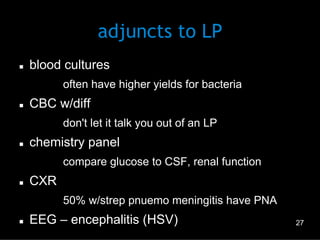
adjuncts to LP
n 

blood cultures
–  often have higher yields for bacteria

n 

CBC w/diff
–  don't let it talk you out of an LP

n 

chemistry panel
–  compare glucose to CSF, renal function

n 

CXR
–  50% w/strep pnuemo meningitis have PNA

n 

EEG – encephalitis (HSV)

27
MANAGEMENT

28
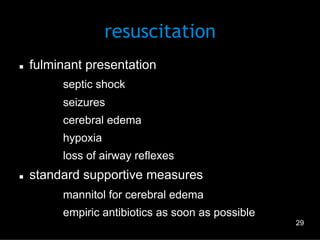
resuscitation
n 

fulminant presentation
–  septic shock
–  seizures
–  cerebral edema
–  hypoxia
–  loss of airway reflexes

n 

standard supportive measures
–  mannitol for cerebral edema
–  empiric antibiotics as soon as possible
29
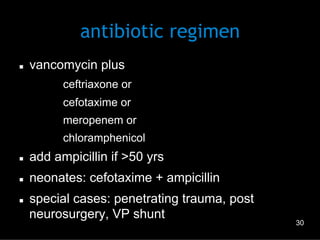
antibiotic regimen
n 

vancomycin plus
–  ceftriaxone or
–  cefotaxime or
–  meropenem or
–  chloramphenicol

n 

add ampicillin if >50 yrs

n 

neonates: cefotaxime + ampicillin

n 

special cases: penetrating trauma, post
neurosurgery, VP shunt

30
other medications
n 

acyclovir for suspected HSV

n 

INH, rifampin, etc. for TB

n 

amphotericin B for fungal (not in ED)

n 

flagyl for CNS abscess
–  also early neurosurgical consultation

31
steroids in meningitis
n 

n 

n 

n 

dexamethasone has been shown to reduce
cerebral edema, ICP, CSF lactate
past studies with variable results
randomized controlled study in sub-Saharan
Africa showed no benefit in children
randomized controlled study in Vietnam showed
reduction of long-term neurologic sequelae with
dexamethasone >14 yo
–  dexamethasone for strep pneumoniae
32
chemoprophylaxis
n 

n 

rifampin 600 mg x4 doses in household
contacts
ciprofloxacin 500 mg x1 dose in HCW with
direct contact (intubation, suctioning)

33
disposition
n 
n 

admit
can consider d/c if symptoms are classic for
viral meningitis and follow up within 24 hours
can be ensured
–  often viral meningitis is admitted on abx until
bacterial causes can be excluded

34
SUMMARY

35
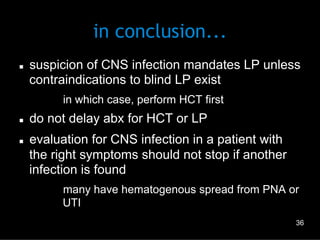
in conclusion...
n 

suspicion of CNS infection mandates LP unless
contraindications to blind LP exist
–  in which case, perform HCT first

n 

n 

do not delay abx for HCT or LP
evaluation for CNS infection in a patient with
the right symptoms should not stop if another
infection is found
–  many have hematogenous spread from PNA or
UTI
36
QUESTIONS

37

GEMC: Meningitis and Other CNS Infections: Resident Training

  • 1.
    Project: Ghana EmergencyMedicine Collaborative Document Title: Meningitis and Other CNS Infections Author(s): Frank Madore, MD License: Unless otherwise noted, this material is made available under the terms of the Creative Commons Attribution Share Alike-3.0 License: http://creativecommons.org/licenses/by-sa/3.0/ We have reviewed this material in accordance with U.S. Copyright Law and have tried to maximize your ability to use, share, and adapt it. These lectures have been modified in the process of making a publicly shareable version. The citation key on the following slide provides information about how you may share and adapt this material. Copyright holders of content included in this material should contact open.michigan@umich.edu with any questions, corrections, or clarification regarding the use of content. For more information about how to cite these materials visit http://open.umich.edu/privacy-and-terms-use. Any medical information in this material is intended to inform and educate and is not a tool for self-diagnosis or a replacement for medical evaluation, advice, diagnosis or treatment by a healthcare professional. Please speak to your physician if you have questions about your medical condition. Viewer discretion is advised: Some medical content is graphic and may not be suitable for all viewers. 1
  • 2.
    Attribution Key for moreinformation see: http://open.umich.edu/wiki/AttributionPolicy Use + Share + Adapt { Content the copyright holder, author, or law permits you to use, share and adapt. } Public Domain – Government: Works that are produced by the U.S. Government. (17 USC § 105) Public Domain – Expired: Works that are no longer protected due to an expired copyright term. Public Domain – Self Dedicated: Works that a copyright holder has dedicated to the public domain. Creative Commons – Zero Waiver Creative Commons – Attribution License Creative Commons – Attribution Share Alike License Creative Commons – Attribution Noncommercial License Creative Commons – Attribution Noncommercial Share Alike License GNU – Free Documentation License Make Your Own Assessment { Content Open.Michigan believes can be used, shared, and adapted because it is ineligible for copyright. } Public Domain – Ineligible: Works that are ineligible for copyright protection in the U.S. (17 USC § 102(b)) *laws in your jurisdiction may differ { Content Open.Michigan has used under a Fair Use determination. } Fair Use: Use of works that is determined to be Fair consistent with the U.S. Copyright Act. (17 USC § 107) *laws in your jurisdiction may differ Our determination DOES NOT mean that all uses of this 3rd-party content are Fair Uses and we DO NOT guarantee that your use of the content is Fair. 2 To use this content you should do your own independent analysis to determine whether or not your use will be Fair.
  • 3.
    Meningitis and other CNSinfections Frank Madore, MD Hennepin County Medical Center Minneapolis, MN, USA 3
  • 4.
  • 5.
    history n  first described byViesseux in 1805 n  Flexner developed antiserum in 1913 n  antibiotic use began in 1930s-40s n  high morbidity and mortality to this day –  20-40% depending on organism –  30% with residual deficits n  changing landscape of causative organisms based on vaccination patterns 5
  • 6.
    definitions n  n  n  meningitis – inflammationof the meninges encephalitis – inflammation of brain parenchymaa myelitis – inflammation of spinal cord 6
  • 7.
    epidemiology n  meningitis endemic inparts of Africa n  occurs in epidemics in US –  incidence is 5-10/100,000 per year, winter –  80% are Neisseria and Strep pneumo –  viral meningitis twice as common, summer n  n  encephalitis less common but incidence rising due to West Nile Virus rare brain abscesses due to sinusitis, otitis media, immunocompromised 7
  • 8.
  • 9.
    etiology n  streptococcus pneumoniae n  neisseria meningitidis(<45 yo) n  listeria monocytogenes n  aseptic viral – HSV, enteroviruses, etc. –  fungal – crypto, histo, blasto, coccidioides –  parasites – toxo, neurocyster. trichinosis –  rickettsiae – RMSF, typhus –  non-infectious – post inf, drugs, systemic dz 9
  • 10.
    pathophysiology n  n  n  nasopharyngeal colonization →mucosal invasion → enter blood stream → evade immune destruction → cross blood brain barrier into CSF meningeal inflammation → increased permeability of BBB, vasculitis, edema, increased ICP decreased cerebral perfusion, decreased CSF glucose, increased CSF protein 10
  • 11.
    risk factors n  age <5or >60 n  male n  african descent n  crowding n  sickle cell disease n  malignancy n  etoh, DM n  recent ENT surgery or head injury 11
  • 12.
    clinical presentation n  headache n  fever n  nausea/vomiting n  seizures n  altered mentalstatus n  nuchal rigidity n  photophobia n  many present atypically (old, young, immune compromised, aseptic) 12
  • 13.
    clinical presentation n  n  n  n  often havea primary source of infection on exam (PNA, UTI, sinusitis, OM, etc.) purpuric rash with menincococcemia Kernig Sign – can't extend knee to 180 while laying supine with hip in flexion Brudzinski Sign – 5 described, 2 used now –  contralateral – flexion of one hip causes flexion of the other hip –  neck – flexion of neck causes hip flexion n  jolt acceleration of headache 13
  • 14.
    complications n  n  n  acute – coma,seizure, loss of airway reflexes, respiratory arrest, cerebral edema, DIC, dehydration, death delayed – seizures, paralysis, cognitive deficits, hydrocephalus, hearing loss, ataxia, blindness, death complications from viral meningitis are rare 14
  • 15.
  • 16.
    etiology n  n  usually viral –HSV, HHV, west nile virus, arbovirus, VZV, EBV occasionally idiopathic, post infectious, or bacterial (mycoplasma pneumoniae) 16
  • 17.
    pathophysiology n  n  n  innoculation occurs viavarious mechanisms depending on the virus viremia, proliferation within neurons, or invasion via nasal mucosa CSF invasion similar to meningitis but less of an immune response if viral → fewer neurologic sequelae in most patients 17
  • 18.
    clinical presentation n  symptoms similarto meningitis, except: n  almost all have AMS n  personality changes n  focal neurologic signs n  higher incidence of seizure n  hallucinations, bizarre behavior –  may precede other signs → psych dx 18
  • 19.
    complications n  n  n  n  dependent on etiologicagent Japanese, Eastern equine, and St. Louis encephalitis have high M&M West Nile Virus infects few but has significant mortality HSV mortality dropped from 70% to 30% with acyclovir –  survivors: seizure, motor/cognitive deficits n  n  TB M&M vary based on duration fungal mortality high, morbidity low 19
  • 20.
  • 21.
    etiology n  n  n  usually invasion frommore common ENT infections (otitis media, sinusitis, dental infections, etc.) streptococcus milleri most common also bacterioides, staph aureus, propionbacterium, enterobacteriae 21
  • 22.
    clinical presentation n  n  n  n  n  similar toencephalitis, often difficult to differentiate clinically usually subacute (>2 weeks onset) course of illness often have papilledema acute worsening can occur with rupture of abscess into ventricles or with uncal herniaton can mimic intracranial hemorrhage 22
  • 23.
    complications n  mortality >50% withoutaggressive care –  <20% with surgical aspiration + abx n  80% develop seizure disorder n  cognitive deficits, focal neuro deficits common n  epidural abscess → paralysis, motor & sensory deficits, bowel/bladder dysfunction 23
  • 24.
  • 25.
    CT before LP? n  unnecessaryin most patients with suspected meningitis, except: –  focal neuro deficits –  altered mental status/coma –  papilledema –  seizures –  trauma n  CT and LP should not delay treatment n  abx → CT if needed → LP 25
  • 26.
    lumbar puncture n  collect atleast 3 tubes of 1 mL each n  opening pressure = 5-20 cm H2O n  cell count <5 WBC/mm3 n  differential <1 PMN/mm3 n  protein = 15-45 mg/dL n  glucose = 60% blood glucose n  gram stain/AFB n  culture, specific antigen tests 26
  • 27.
    adjuncts to LP n  bloodcultures –  often have higher yields for bacteria n  CBC w/diff –  don't let it talk you out of an LP n  chemistry panel –  compare glucose to CSF, renal function n  CXR –  50% w/strep pnuemo meningitis have PNA n  EEG – encephalitis (HSV) 27
  • 28.
  • 29.
    resuscitation n  fulminant presentation –  septicshock –  seizures –  cerebral edema –  hypoxia –  loss of airway reflexes n  standard supportive measures –  mannitol for cerebral edema –  empiric antibiotics as soon as possible 29
  • 30.
    antibiotic regimen n  vancomycin plus – ceftriaxone or –  cefotaxime or –  meropenem or –  chloramphenicol n  add ampicillin if >50 yrs n  neonates: cefotaxime + ampicillin n  special cases: penetrating trauma, post neurosurgery, VP shunt 30
  • 31.
    other medications n  acyclovir forsuspected HSV n  INH, rifampin, etc. for TB n  amphotericin B for fungal (not in ED) n  flagyl for CNS abscess –  also early neurosurgical consultation 31
  • 32.
    steroids in meningitis n  n  n  n  dexamethasonehas been shown to reduce cerebral edema, ICP, CSF lactate past studies with variable results randomized controlled study in sub-Saharan Africa showed no benefit in children randomized controlled study in Vietnam showed reduction of long-term neurologic sequelae with dexamethasone >14 yo –  dexamethasone for strep pneumoniae 32
  • 33.
    chemoprophylaxis n  n  rifampin 600 mgx4 doses in household contacts ciprofloxacin 500 mg x1 dose in HCW with direct contact (intubation, suctioning) 33
  • 34.
    disposition n  n  admit can consider d/cif symptoms are classic for viral meningitis and follow up within 24 hours can be ensured –  often viral meningitis is admitted on abx until bacterial causes can be excluded 34
  • 35.
  • 36.
    in conclusion... n  suspicion ofCNS infection mandates LP unless contraindications to blind LP exist –  in which case, perform HCT first n  n  do not delay abx for HCT or LP evaluation for CNS infection in a patient with the right symptoms should not stop if another infection is found –  many have hematogenous spread from PNA or UTI 36
  • 37.