Edi Brata
                                     Mathla’ul Anwar University


Psycholinguistics 2: Language Acquisition
            (16th Session of Introduction to Linguistics)
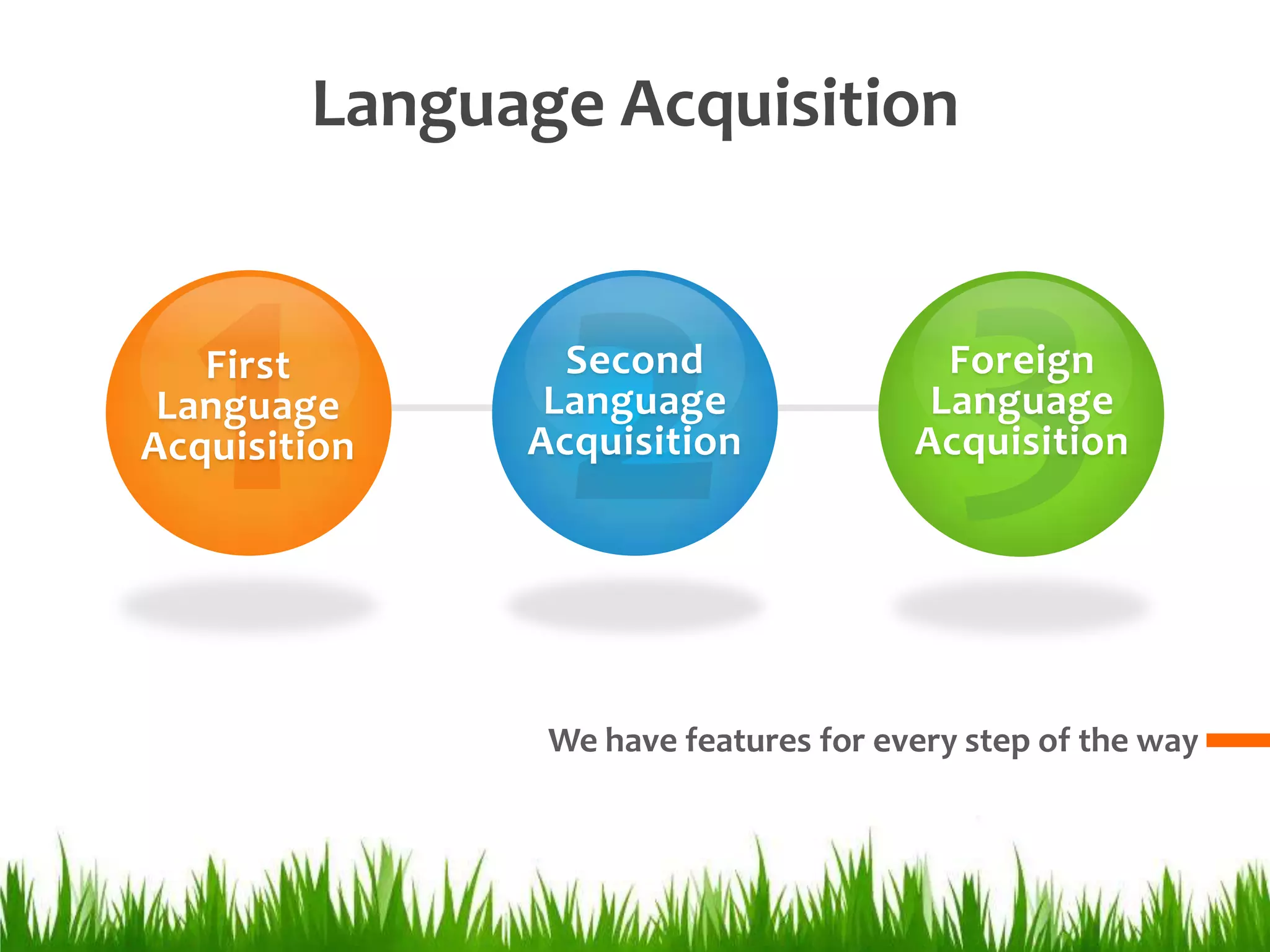
Language Acquisition


   First        Second                  Foreign
 Language      Language                Language
Acquisition   Acquisition             Acquisition


               We have features for every step of the way
First Language
       Acquisition


The process of how children acquire their native language
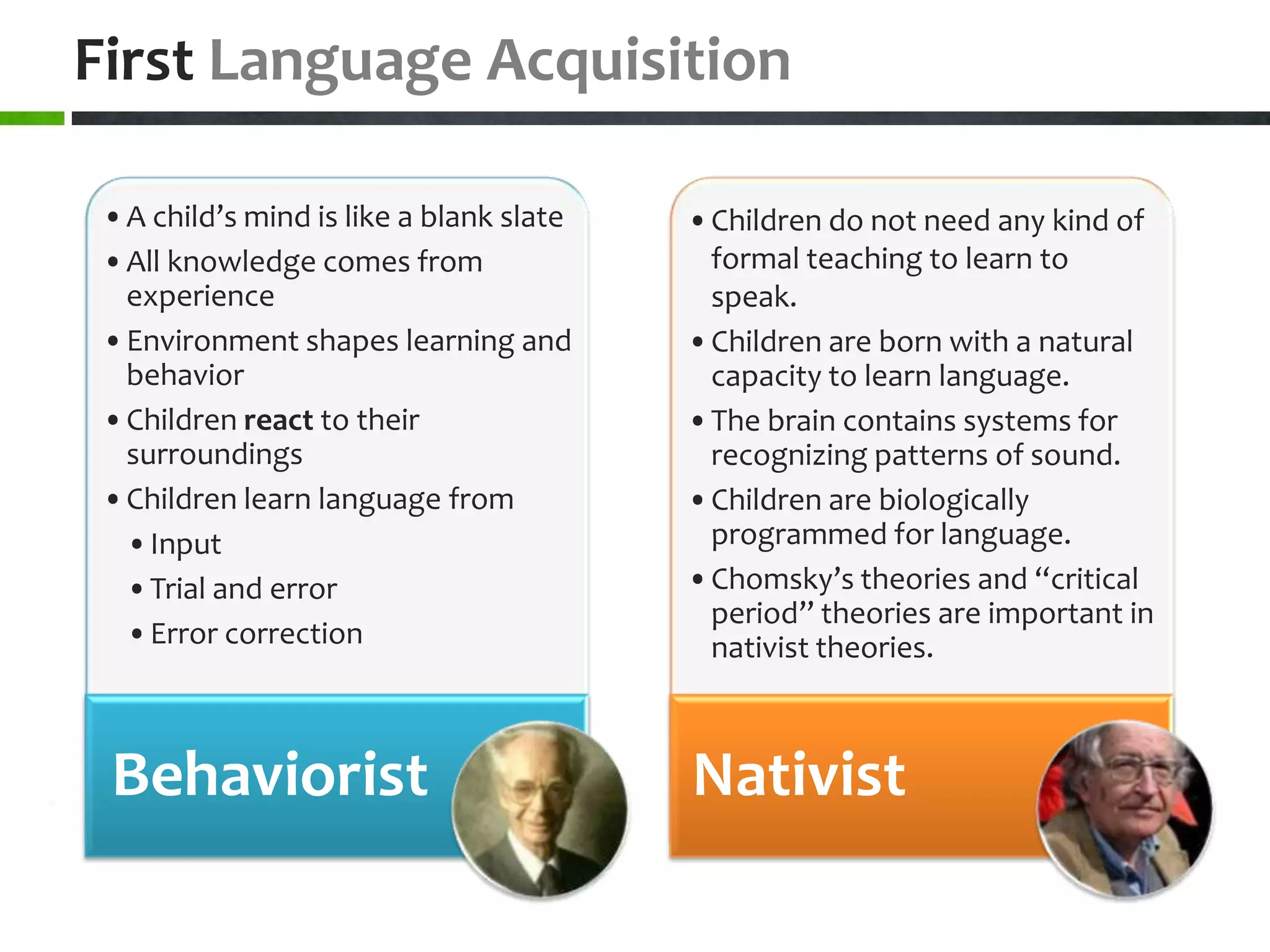
First Language Acquisition

 •A child’s mind is like a blank slate   •Children do not need any kind of
 •All knowledge comes from                formal teaching to learn to
  experience                              speak.
 •Environment shapes learning and        •Children are born with a natural
  behavior                                capacity to learn language.
 •Children react to their                •The brain contains systems for
  surroundings                            recognizing patterns of sound.
 •Children learn language from           •Children are biologically
  •Input                                  programmed for language.
  •Trial and error                       •Chomsky’s theories and “critical
                                          period” theories are important in
  •Error correction                       nativist theories.


 Behaviorist                             Nativist
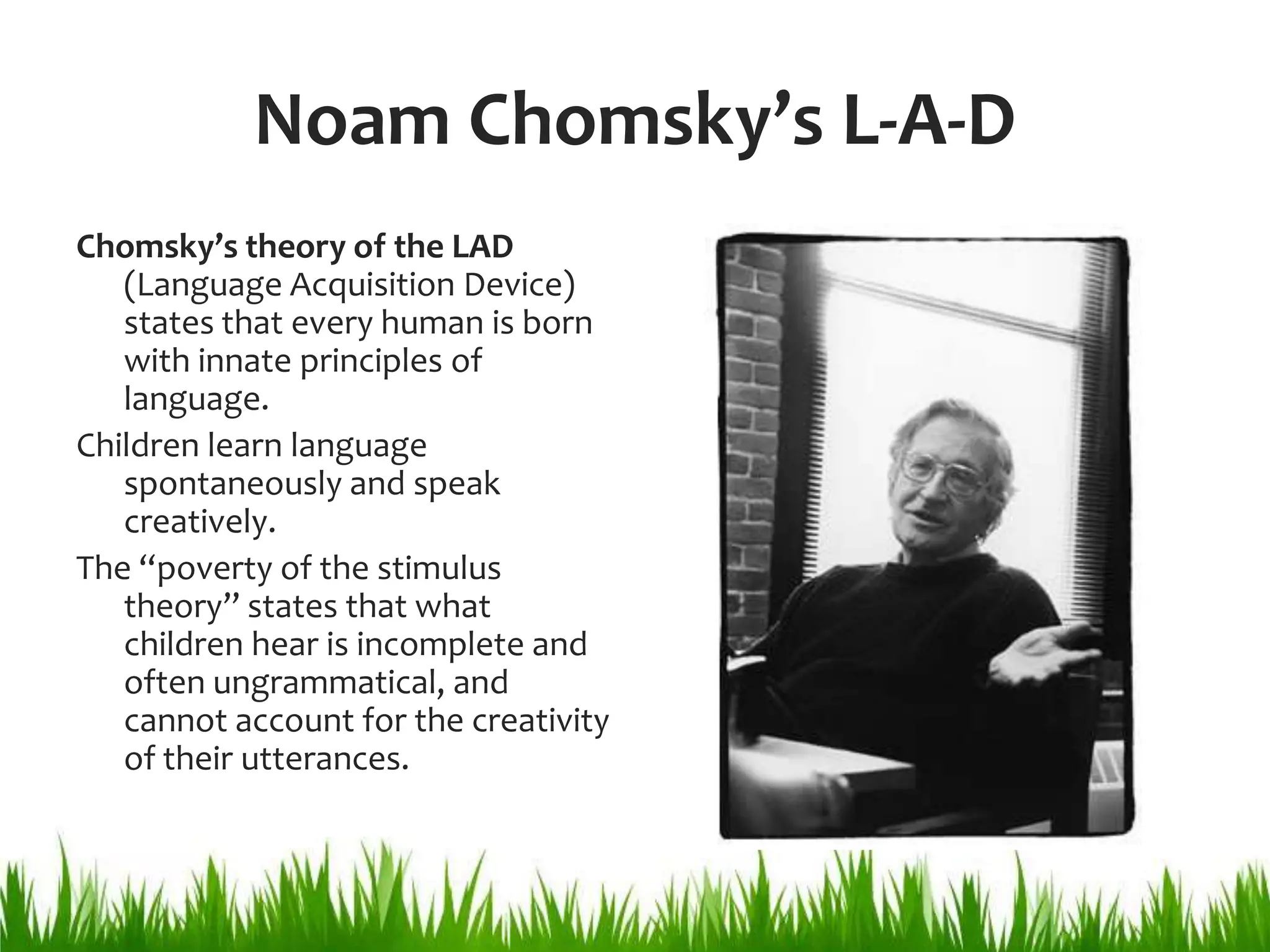
Noam Chomsky’s L-A-D
Chomsky’s theory of the LAD
   (Language Acquisition Device)
   states that every human is born
   with innate principles of
   language.
Children learn language
   spontaneously and speak
   creatively.
The “poverty of the stimulus
   theory” states that what
   children hear is incomplete and
   often ungrammatical, and
   cannot account for the creativity
   of their utterances.
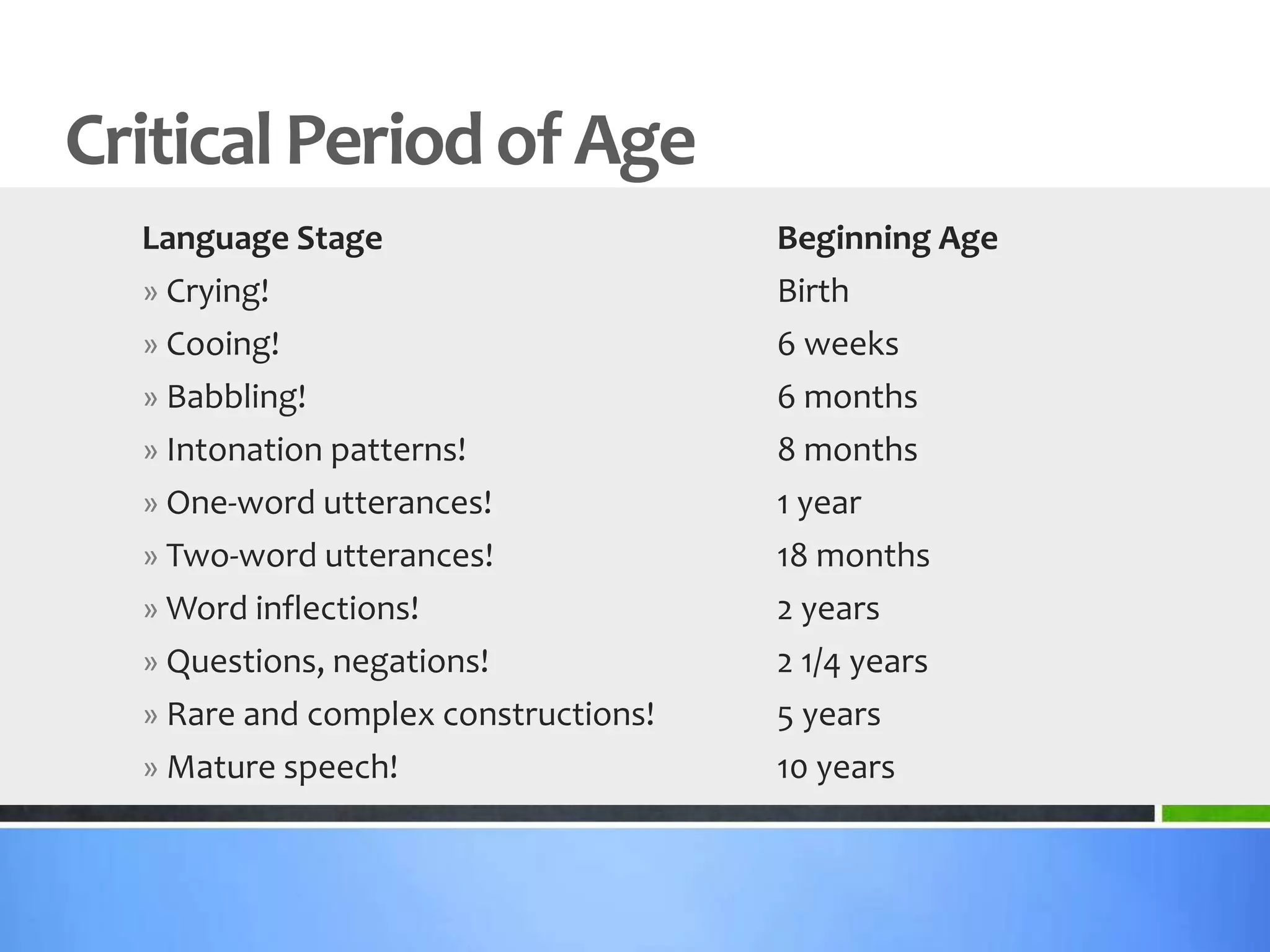
Critical Period of Age
  Language Stage                      Beginning Age
  » Crying!                           Birth
  » Cooing!                           6 weeks
  » Babbling!                         6 months
  » Intonation patterns!              8 months
  » One-word utterances!              1 year
  » Two-word utterances!              18 months
  » Word inflections!                 2 years
  » Questions, negations!             2 1/4 years
  » Rare and complex constructions!   5 years
  » Mature speech!                    10 years
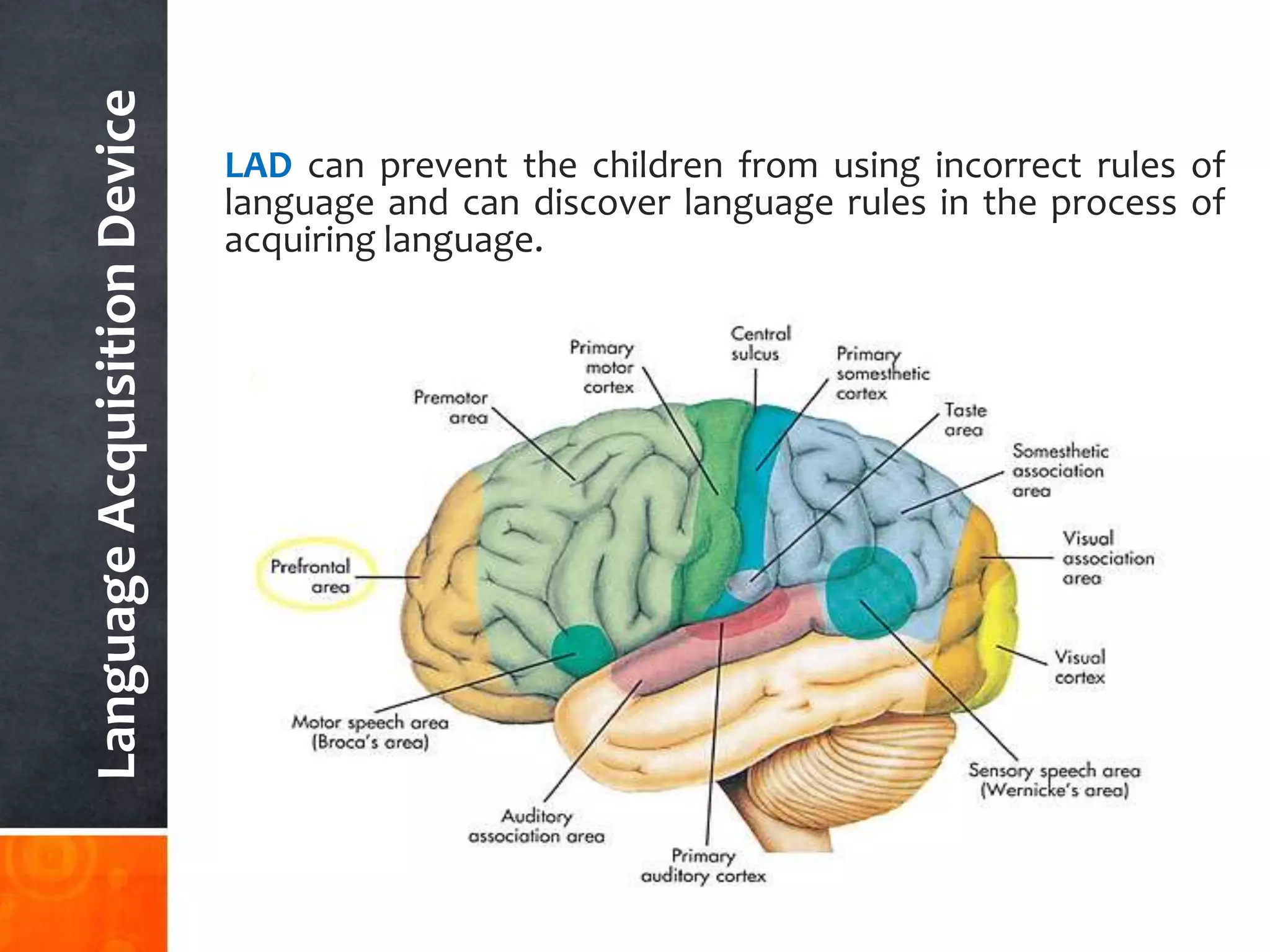
Language Acquisition Device
                              LAD can prevent the children from using incorrect rules of
                              language and can discover language rules in the process of
                              acquiring language.
Autonomous
  Learner
Second Language
Acquisition
o Similar to first language acquisition (L1)
o Hypotheses maker
o Sufficient exposure and opportunities to
  use the language
o Native language interference in second
  language learning (L2)
Foreign Language
Acquisition
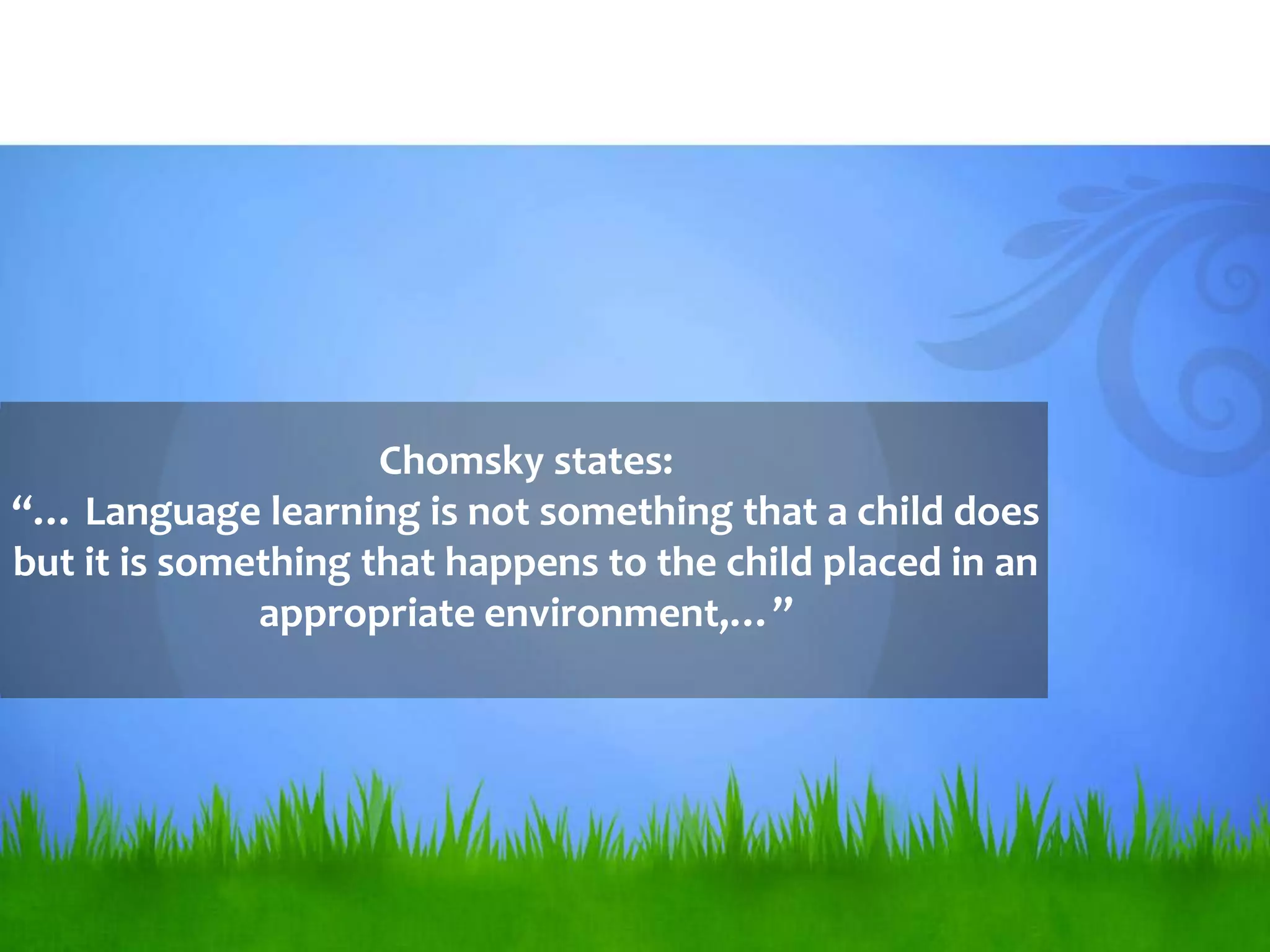
Chomsky states:
“… Language learning is not something that a child does
but it is something that happens to the child placed in an
              appropriate environment,…”
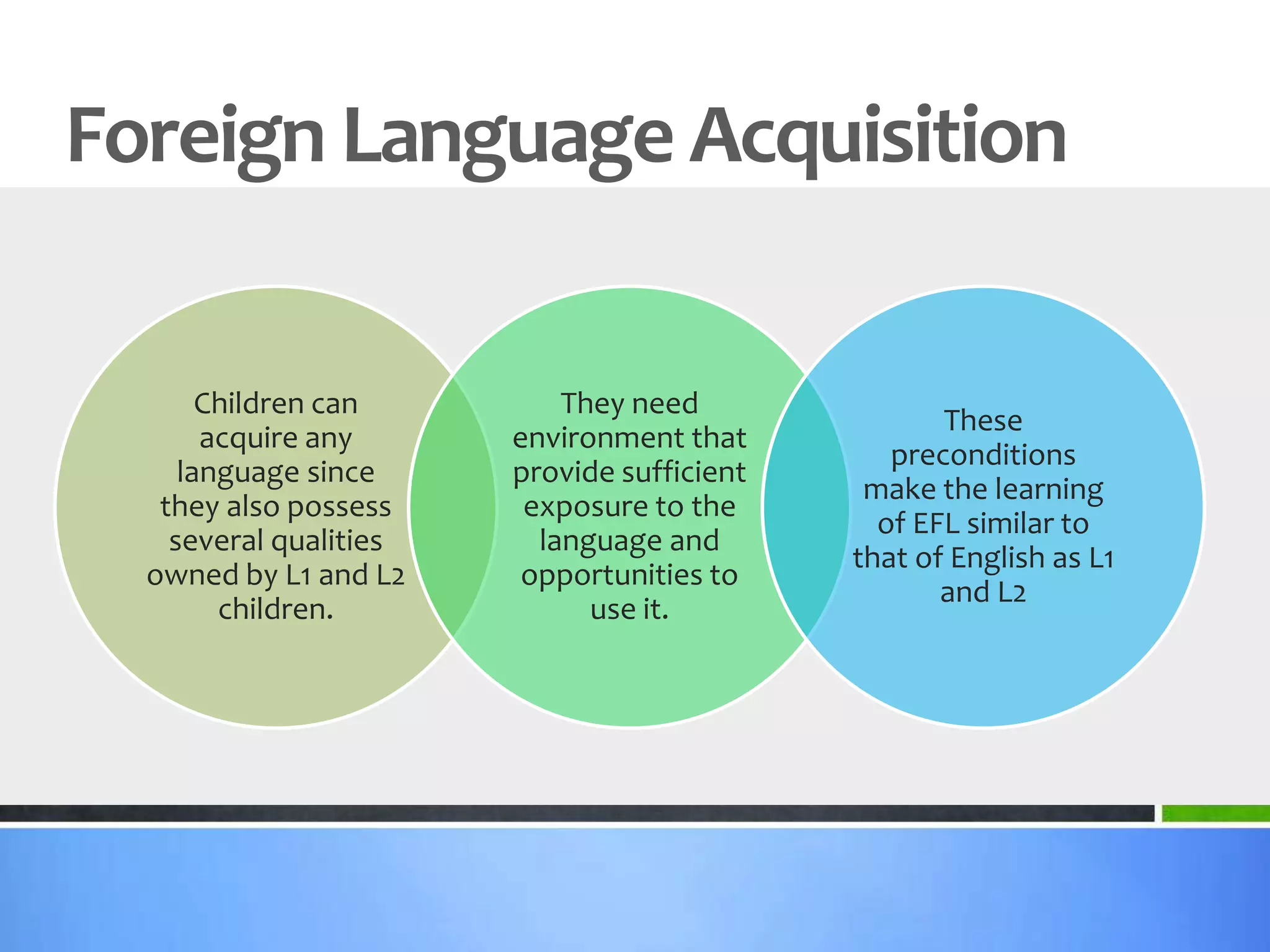
Foreign Language Acquisition

       Children can         They need
                                                    These
       acquire any      environment that
                                                preconditions
     language since     provide sufficient
                                              make the learning
   they also possess     exposure to the
                                               of EFL similar to
    several qualities     language and
                                             that of English as L1
  owned by L1 and L2     opportunities to
                                                    and L2
        children.             use it.
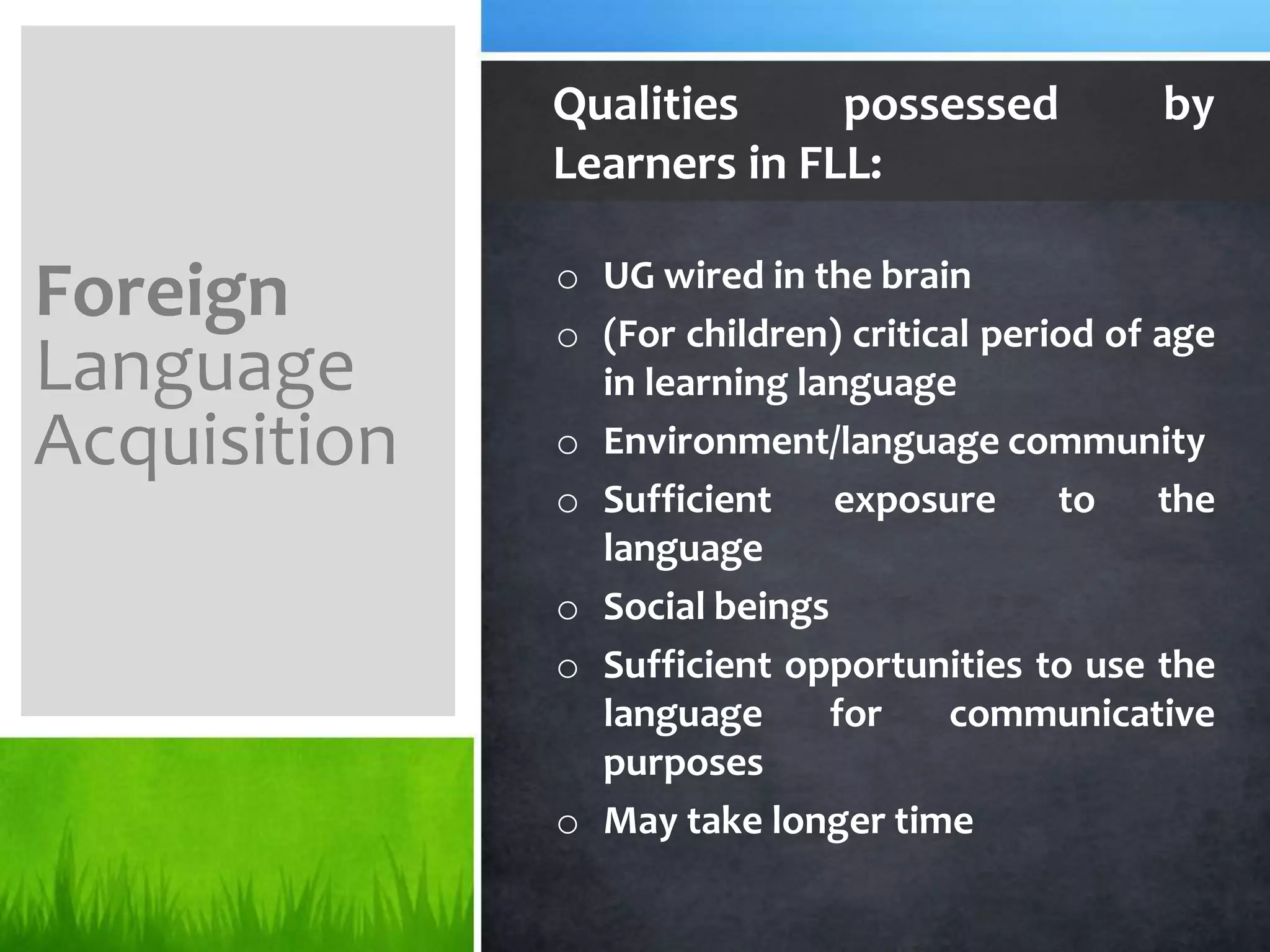
Qualities     possessed            by
              Learners in FLL:

              o UG wired in the brain
Foreign       o (For children) critical period of age
Language        in learning language
Acquisition   o Environment/language community
              o Sufficient    exposure      to    the
                language
              o Social beings
              o Sufficient opportunities to use the
                language      for    communicative
                purposes
              o May take longer time
Second and Foreign Language Acquisition


Fundamental difference between L1 and L2/FL Acquisition:
• All children learn their first language easily and well
  whereas adults vary in their ultimate mastery of a second
  language.
• Children do not need to be taught their first language
  whereas adults benefit from formal instruction.
• Children are intrinsically motivated to learn their native
  language whereas adult mastery of a second language is
  dependent upon attitude, motivation, and aptitude.
Second and Foreign Language Acquisition


Despite the disadvantages of learning a second language in
  adulthood, adults are naturally endowed with important L2
  learning abilities:
• mature problem-solving abilities
• general understanding about the nature of human
  interaction
• competence in native language
Adult Learners


» Analytical learners
» Language inhibition, self-
  esteem/confidence
» Insufficient time in learning
» Insufficient exposure
» Insufficient opportunities to use
  the language
» Motivation
» Way of learning at school
» UG?
» Critical period?
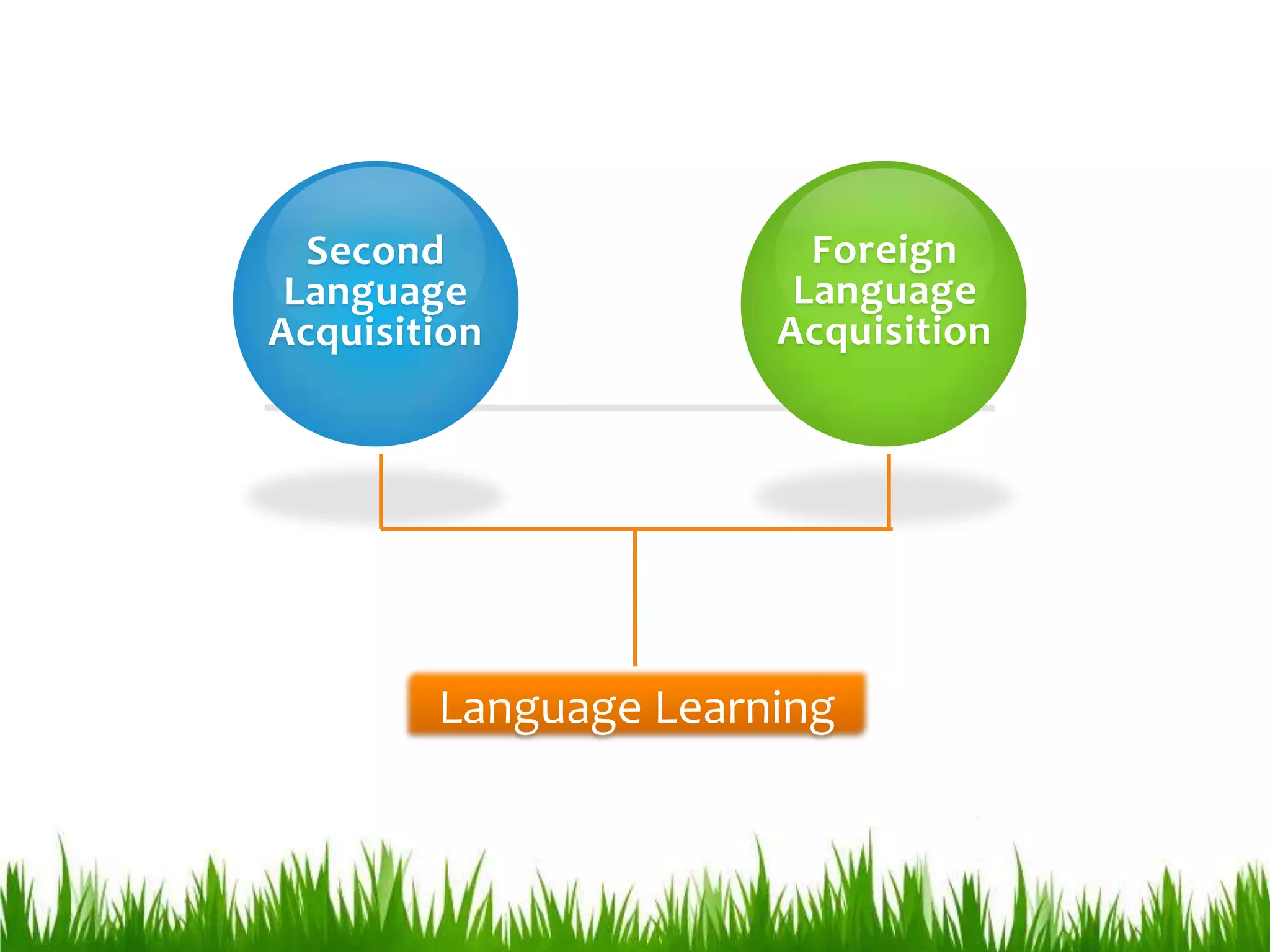
Second                Foreign
 Language              Language
Acquisition           Acquisition


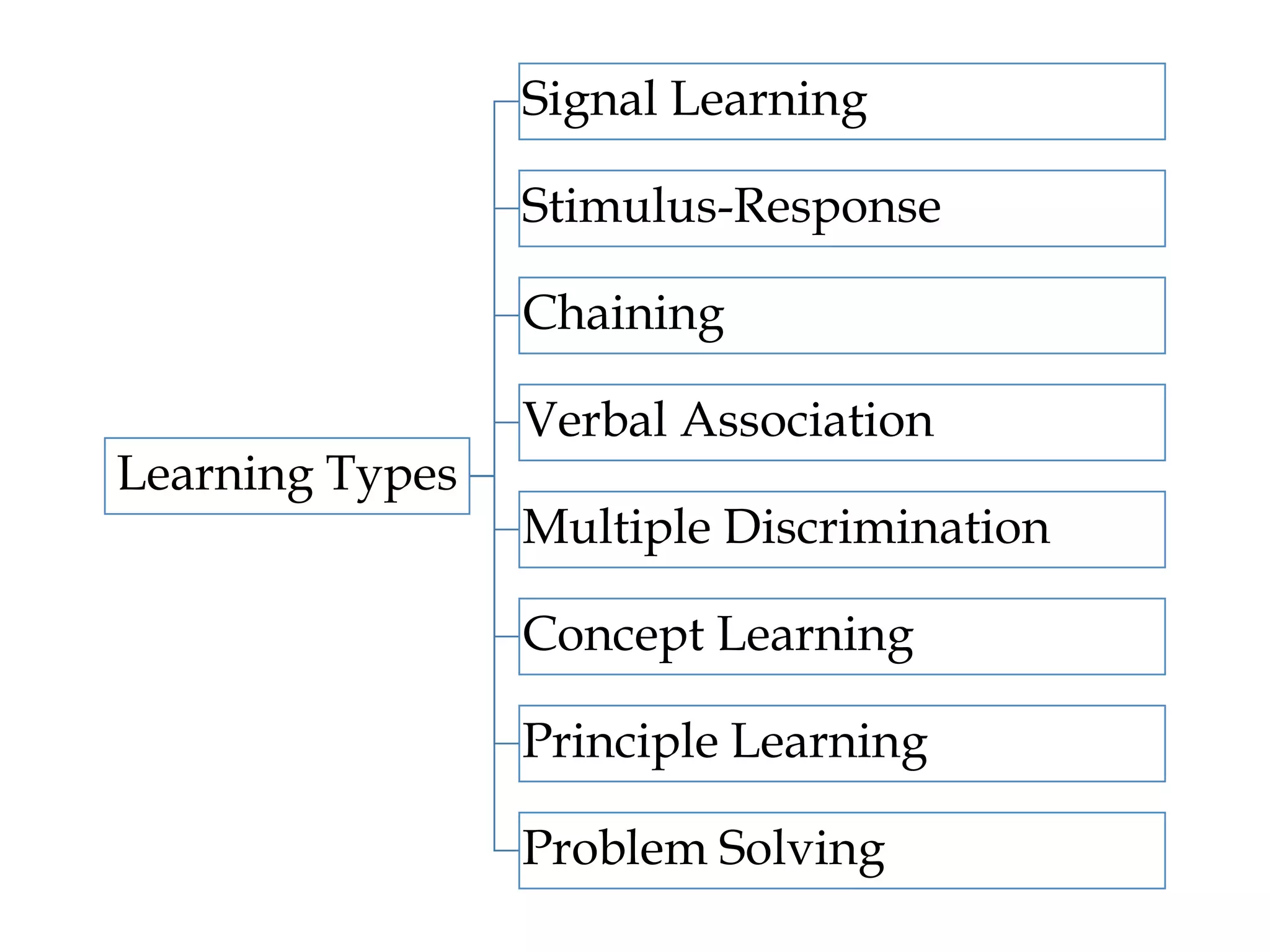
        Language Learning
Signal Learning

                 Stimulus-Response

                 Chaining

                 Verbal Association
Learning Types
                 Multiple Discrimination

                 Concept Learning

                 Principle Learning

                 Problem Solving
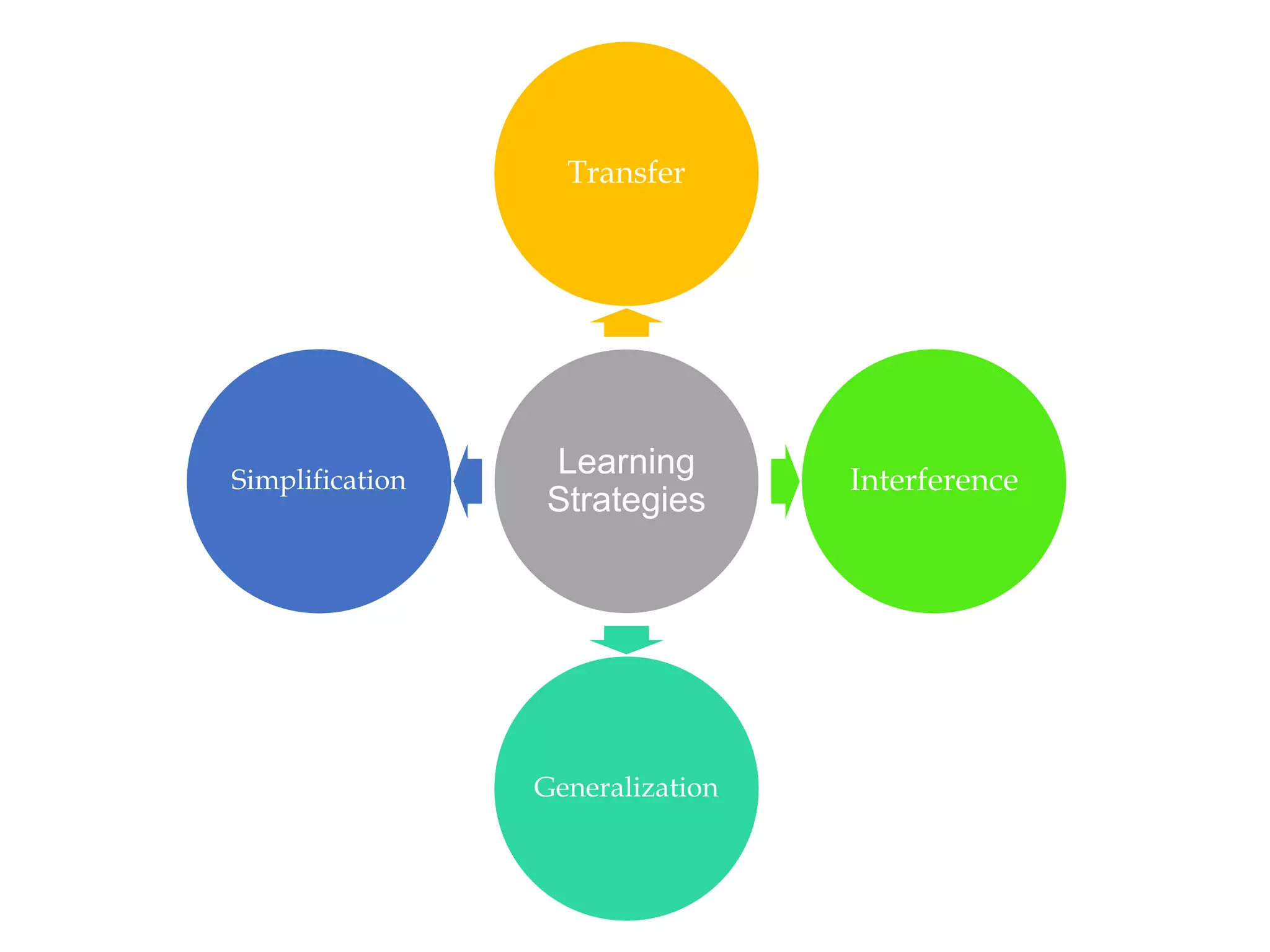
Transfer


Simplification
                 Learning         Interference
                 Strategies


                 Generalization
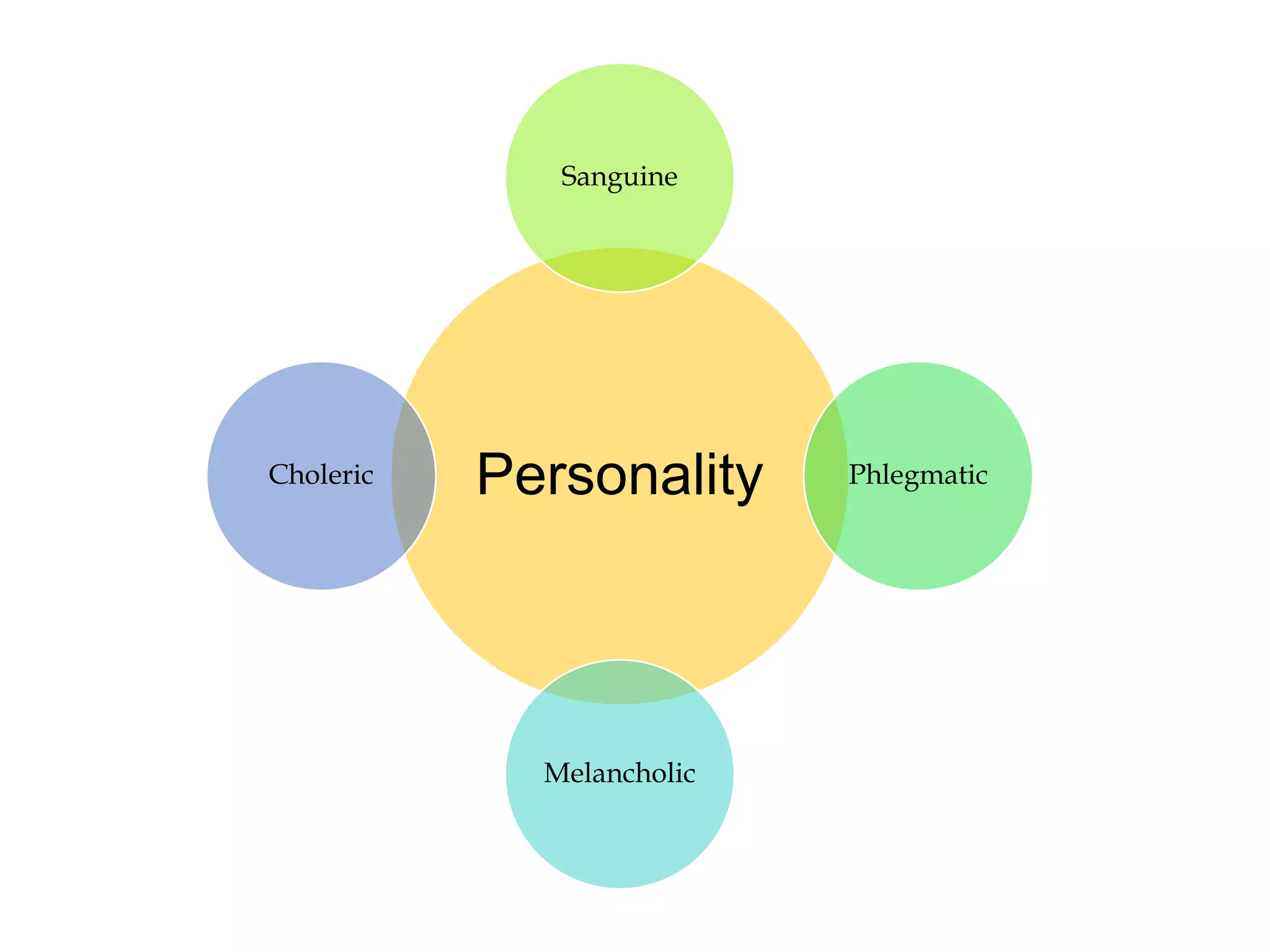
Sanguine


Choleric   Personality     Phlegmatic


             Melancholic
Thank You
See You!!!

Intro. to Linguistics_16 Psycholinguistics 2 (Language Acquisition)

  • 1.
    Edi Brata Mathla’ul Anwar University Psycholinguistics 2: Language Acquisition (16th Session of Introduction to Linguistics)
  • 2.
    Language Acquisition First Second Foreign Language Language Language Acquisition Acquisition Acquisition We have features for every step of the way
  • 3.
    First Language Acquisition The process of how children acquire their native language
  • 4.
    First Language Acquisition •A child’s mind is like a blank slate •Children do not need any kind of •All knowledge comes from formal teaching to learn to experience speak. •Environment shapes learning and •Children are born with a natural behavior capacity to learn language. •Children react to their •The brain contains systems for surroundings recognizing patterns of sound. •Children learn language from •Children are biologically •Input programmed for language. •Trial and error •Chomsky’s theories and “critical period” theories are important in •Error correction nativist theories. Behaviorist Nativist
  • 5.
    Noam Chomsky’s L-A-D Chomsky’stheory of the LAD (Language Acquisition Device) states that every human is born with innate principles of language. Children learn language spontaneously and speak creatively. The “poverty of the stimulus theory” states that what children hear is incomplete and often ungrammatical, and cannot account for the creativity of their utterances.
  • 6.
    Critical Period ofAge Language Stage Beginning Age » Crying! Birth » Cooing! 6 weeks » Babbling! 6 months » Intonation patterns! 8 months » One-word utterances! 1 year » Two-word utterances! 18 months » Word inflections! 2 years » Questions, negations! 2 1/4 years » Rare and complex constructions! 5 years » Mature speech! 10 years
  • 7.
    Language Acquisition Device LAD can prevent the children from using incorrect rules of language and can discover language rules in the process of acquiring language.
  • 8.
  • 9.
  • 10.
    o Similar tofirst language acquisition (L1) o Hypotheses maker o Sufficient exposure and opportunities to use the language o Native language interference in second language learning (L2)
  • 11.
  • 12.
    Chomsky states: “… Languagelearning is not something that a child does but it is something that happens to the child placed in an appropriate environment,…”
  • 13.
    Foreign Language Acquisition Children can They need These acquire any environment that preconditions language since provide sufficient make the learning they also possess exposure to the of EFL similar to several qualities language and that of English as L1 owned by L1 and L2 opportunities to and L2 children. use it.
  • 14.
    Qualities possessed by Learners in FLL: o UG wired in the brain Foreign o (For children) critical period of age Language in learning language Acquisition o Environment/language community o Sufficient exposure to the language o Social beings o Sufficient opportunities to use the language for communicative purposes o May take longer time
  • 15.
    Second and ForeignLanguage Acquisition Fundamental difference between L1 and L2/FL Acquisition: • All children learn their first language easily and well whereas adults vary in their ultimate mastery of a second language. • Children do not need to be taught their first language whereas adults benefit from formal instruction. • Children are intrinsically motivated to learn their native language whereas adult mastery of a second language is dependent upon attitude, motivation, and aptitude.
  • 16.
    Second and ForeignLanguage Acquisition Despite the disadvantages of learning a second language in adulthood, adults are naturally endowed with important L2 learning abilities: • mature problem-solving abilities • general understanding about the nature of human interaction • competence in native language
  • 17.
    Adult Learners » Analyticallearners » Language inhibition, self- esteem/confidence » Insufficient time in learning » Insufficient exposure » Insufficient opportunities to use the language » Motivation » Way of learning at school » UG? » Critical period?
  • 18.
    Second Foreign Language Language Acquisition Acquisition Language Learning
  • 19.
    Signal Learning Stimulus-Response Chaining Verbal Association Learning Types Multiple Discrimination Concept Learning Principle Learning Problem Solving
  • 20.
    Transfer Simplification Learning Interference Strategies Generalization
  • 21.
    Sanguine Choleric Personality Phlegmatic Melancholic
  • 23.

Editor's Notes

  • #2 This presentation demonstrates the new capabilities of PowerPoint and it is best viewed in Slide Show. These slides are designed to give you great ideas for the presentations you’ll create in PowerPoint 2010!For more sample templates, click the File tab, and then on the New tab, click Sample Templates.