What is Essay?
An essay is a group of paragraphs written
about single topic and a central main idea. It
must have at least three paragraphs, but a
five paragraphs essay is a common length for
academic writing. (Zemach, 2005:56)
The Structure of an Essay
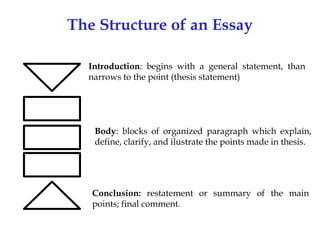
Introduction: begins with a general statement, than
narrows to the point (thesis statement)

Body: blocks of organized paragraph which explain,
define, clarify, and ilustrate the points made in thesis.

Conclusion: restatement or summary of the main
points; final comment.
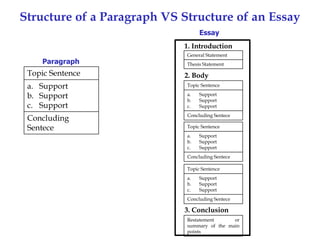
Structure of a Paragraph VS Structure of an Essay
Essay
1. Introduction
Paragraph

Topic Sentence

General Statement
Thesis Statement

2. Body

a. Support
b. Support
c. Support

Topic Sentence

Concluding
Sentece

Concluding Sentece

a.
b.
c.

Support
Support
Support

Topic Sentence
a.
b.
c.

Support
Support
Support

Concluding Sentece
Topic Sentence
a.
b.
c.

Support
Support
Support

Concluding Sentece

3. Conclusion
Restatement
or
summary of the main
points
How to write an essay?
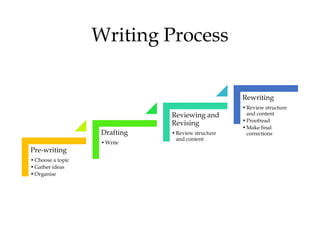
Writing Process
Rewriting
Reviewing and
Revising
Drafting
Pre-writing
• Choose a topic
• Gather ideas
• Organise

• Write

• Review structure
and content

• Review structure
and content
• Proofread
• Make final
corrections
How to Write an Essay?
Pre-writing
• Deciding on a Topic
• Decide the Title
• Determine the Thesis Statement
• Outlining
Deciding on a Topic
 Decide the topic that is not too narrow
(limited/ brief). A narrow topic will not
have enough idea to write about.
 Decide the topic that is not to broad
(general). A broad topic will have too
many ideas to be covered in single essay.
 Decide on a topic which is up-to-date.
Deciding on a Topic
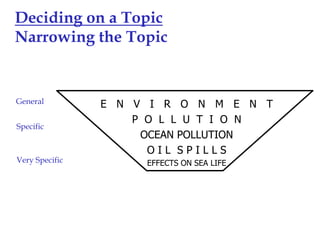
Narrowing the Topic

General
Specific

Very Specific

E N V I R O N M E N T
P O L L U T I O N
OCEAN POLLUTION
OIL SPILLS
EFFECTS ON SEA LIFE
Deciding on a Topic
Abstract and Concrete Topic
The more abstract your topic is, the more
difficult it is to support, and the more difficult it
is to keep your audience’s interest. For that
reason abstract topics are usually not as
sucessful as concrete topic
Deciding on a Topic
Abstract and Concrete Topic

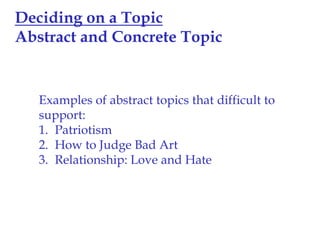
Examples of abstract topics that difficult to
support:
1. Patriotism
2. How to Judge Bad Art
3. Relationship: Love and Hate
Deciding on a Topic
Abstract and Concrete Topic

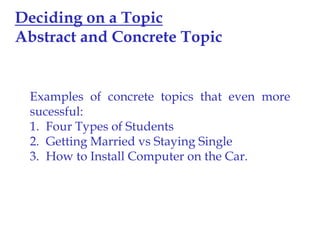
Examples of concrete topics that even more
sucessful:
1. Four Types of Students
2. Getting Married vs Staying Single
3. How to Install Computer on the Car.
Deciding on a Topic
Abstract and Concrete Topic

Exercise:
Make a narrow topic from these general topics:
1. School
2. Friends
3. My Country
Decide the Title

The purpose of the title are to attract the
reader, to give the reader an idea of what
the essay about, and provide focus for the
essay.
Decide the Title

 Title should be brief, clear, concise, and precise.
Examples:
a. Your Prayers Never Change God’s Decisions
b. The Root of Religious Conflicts in Indonesia

 A title must be interesting to attract the readers.
Examples:
a. Students Hate Punctual Teachers (controversial)
b. Why Are Indonesians Not Perfect in English?
(arouses curiousity)
Decide the Title
 Title must be active and powerful.
Examples:
a. Smoking May Cause Cancer (not powerful)
b. Smoking Cause Cancer (powerful)

 It can be phrase or a group of phrase, not a complete
sentence. However, some titles are in the form of
questions and must be ended by question mark.
Examples:
a. TV Programs Spoil Children
b. Should Abortion in Indonesia be Legalized?
Decide the Title

 The initials of words are written in capital letter, or
all letters may be in capitals.
Examples:
a. CORRUPTION HABITS IN OUR COUNTRY
b. Raising Students’ Gender Awarness through
the Use of Films in Speaking Class

 It is relevant with the content of the essay.
Thesis Statement
• The thesis statement tells the main idea of the whole
essay.

• The thesis should be strong and clear; it should
contain no ambiguities.
• The thesis should come at the beginning of the
essay, ussually at the end of the introductory
paragraph.
• The thesis sentence must not be a simple statement
of fact that requires no elaboration.
Thesis Statement
• The thesis must not be expressed as a question. The
answer to the question is the thesis statement.
• The thesis will contain controlling ideas that will be
used in the topic sentences of the body paragraphs
of the essay.
Example:
A successful soccer coach has four qualities.
• The thesis may contain an opinion or a judgement
that can be explained, clarified, and illustrated in
the body paragraphs of the essay.
Outlining
What is an outline?
o A method of organizing material that shows the order
of the topics in essays. (Reid, 1982:55)
o A list of the information you will put in your essay.
(Zemach and Rumisek, 2005:63)
The purpose of an outline?
(Zemach and Rumisek, 2005:63)

o Show you what to write before you actually begin
writing.
o Help make your essay well organised and clearly
focused.
o Keep you from forgetting any important points.
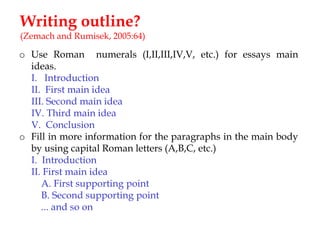
Writing outline?
(Zemach and Rumisek, 2005:64)

o Use Roman numerals (I,II,III,IV,V, etc.) for essays main
ideas.
I. Introduction
II. First main idea
III. Second main idea
IV. Third main idea
V. Conclusion
o Fill in more information for the paragraphs in the main body
by using capital Roman letters (A,B,C, etc.)
I. Introduction
II. First main idea
A. First supporting point
B. Second supporting point
... and so on
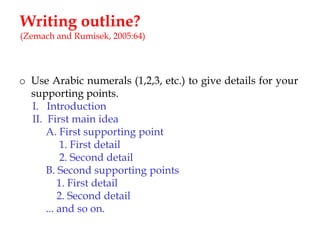
Writing outline?
(Zemach and Rumisek, 2005:64)

o Use Arabic numerals (1,2,3, etc.) to give details for your
supporting points.
I. Introduction
II. First main idea
A. First supporting point
1. First detail
2. Second detail
B. Second supporting points
1. First detail
2. Second detail
... and so on.
Writing outline?
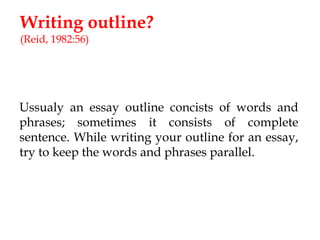
(Reid, 1982:56)

Ussualy an essay outline concists of words and
phrases; sometimes it consists of complete
sentence. While writing your outline for an essay,
try to keep the words and phrases parallel.
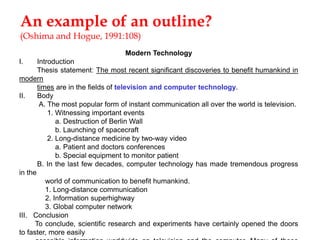
An example of an outline?
(Oshima and Hogue, 1991:108)
Modern Technology
I.

Introduction
Thesis statement: The most recent significant discoveries to benefit humankind in
modern
times are in the fields of television and computer technology.
II.
Body
A. The most popular form of instant communication all over the world is television.
1. Witnessing important events
a. Destruction of Berlin Wall
b. Launching of spacecraft
2. Long-distance medicine by two-way video
a. Patient and doctors conferences
b. Special equipment to monitor patient
B. In the last few decades, computer technology has made tremendous progress
in the
world of communication to benefit humankind.
1. Long-distance communication
2. Information superhighway
3. Global computer network
III. Conclusion
To conclude, scientific research and experiments have certainly opened the doors
to faster, more easily
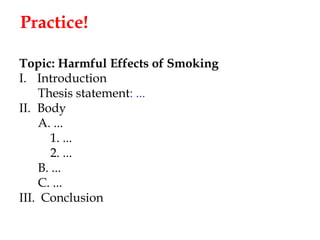
Practice!
Topic: Harmful Effects of Smoking
I. Introduction
Thesis statement: ...
II. Body
A. ...
1. ...
2. ...
B. ...
C. ...
III. Conclusion

Essay an Overview

  • 1.
    What is Essay? Anessay is a group of paragraphs written about single topic and a central main idea. It must have at least three paragraphs, but a five paragraphs essay is a common length for academic writing. (Zemach, 2005:56)
  • 2.
    The Structure ofan Essay Introduction: begins with a general statement, than narrows to the point (thesis statement) Body: blocks of organized paragraph which explain, define, clarify, and ilustrate the points made in thesis. Conclusion: restatement or summary of the main points; final comment.
  • 3.
    Structure of aParagraph VS Structure of an Essay Essay 1. Introduction Paragraph Topic Sentence General Statement Thesis Statement 2. Body a. Support b. Support c. Support Topic Sentence Concluding Sentece Concluding Sentece a. b. c. Support Support Support Topic Sentence a. b. c. Support Support Support Concluding Sentece Topic Sentence a. b. c. Support Support Support Concluding Sentece 3. Conclusion Restatement or summary of the main points
  • 4.
    How to writean essay?
  • 5.
    Writing Process Rewriting Reviewing and Revising Drafting Pre-writing •Choose a topic • Gather ideas • Organise • Write • Review structure and content • Review structure and content • Proofread • Make final corrections
  • 6.
    How to Writean Essay? Pre-writing • Deciding on a Topic • Decide the Title • Determine the Thesis Statement • Outlining
  • 7.
    Deciding on aTopic  Decide the topic that is not too narrow (limited/ brief). A narrow topic will not have enough idea to write about.  Decide the topic that is not to broad (general). A broad topic will have too many ideas to be covered in single essay.  Decide on a topic which is up-to-date.
  • 8.
    Deciding on aTopic Narrowing the Topic General Specific Very Specific E N V I R O N M E N T P O L L U T I O N OCEAN POLLUTION OIL SPILLS EFFECTS ON SEA LIFE
  • 9.
    Deciding on aTopic Abstract and Concrete Topic The more abstract your topic is, the more difficult it is to support, and the more difficult it is to keep your audience’s interest. For that reason abstract topics are usually not as sucessful as concrete topic
  • 10.
    Deciding on aTopic Abstract and Concrete Topic Examples of abstract topics that difficult to support: 1. Patriotism 2. How to Judge Bad Art 3. Relationship: Love and Hate
  • 11.
    Deciding on aTopic Abstract and Concrete Topic Examples of concrete topics that even more sucessful: 1. Four Types of Students 2. Getting Married vs Staying Single 3. How to Install Computer on the Car.
  • 12.
    Deciding on aTopic Abstract and Concrete Topic Exercise: Make a narrow topic from these general topics: 1. School 2. Friends 3. My Country
  • 13.
    Decide the Title Thepurpose of the title are to attract the reader, to give the reader an idea of what the essay about, and provide focus for the essay.
  • 14.
    Decide the Title Title should be brief, clear, concise, and precise. Examples: a. Your Prayers Never Change God’s Decisions b. The Root of Religious Conflicts in Indonesia  A title must be interesting to attract the readers. Examples: a. Students Hate Punctual Teachers (controversial) b. Why Are Indonesians Not Perfect in English? (arouses curiousity)
  • 15.
    Decide the Title Title must be active and powerful. Examples: a. Smoking May Cause Cancer (not powerful) b. Smoking Cause Cancer (powerful)  It can be phrase or a group of phrase, not a complete sentence. However, some titles are in the form of questions and must be ended by question mark. Examples: a. TV Programs Spoil Children b. Should Abortion in Indonesia be Legalized?
  • 16.
    Decide the Title The initials of words are written in capital letter, or all letters may be in capitals. Examples: a. CORRUPTION HABITS IN OUR COUNTRY b. Raising Students’ Gender Awarness through the Use of Films in Speaking Class  It is relevant with the content of the essay.
  • 17.
    Thesis Statement • Thethesis statement tells the main idea of the whole essay. • The thesis should be strong and clear; it should contain no ambiguities. • The thesis should come at the beginning of the essay, ussually at the end of the introductory paragraph. • The thesis sentence must not be a simple statement of fact that requires no elaboration.
  • 18.
    Thesis Statement • Thethesis must not be expressed as a question. The answer to the question is the thesis statement. • The thesis will contain controlling ideas that will be used in the topic sentences of the body paragraphs of the essay. Example: A successful soccer coach has four qualities. • The thesis may contain an opinion or a judgement that can be explained, clarified, and illustrated in the body paragraphs of the essay.
  • 19.
  • 20.
    What is anoutline? o A method of organizing material that shows the order of the topics in essays. (Reid, 1982:55) o A list of the information you will put in your essay. (Zemach and Rumisek, 2005:63)
  • 21.
    The purpose ofan outline? (Zemach and Rumisek, 2005:63) o Show you what to write before you actually begin writing. o Help make your essay well organised and clearly focused. o Keep you from forgetting any important points.
  • 22.
    Writing outline? (Zemach andRumisek, 2005:64) o Use Roman numerals (I,II,III,IV,V, etc.) for essays main ideas. I. Introduction II. First main idea III. Second main idea IV. Third main idea V. Conclusion o Fill in more information for the paragraphs in the main body by using capital Roman letters (A,B,C, etc.) I. Introduction II. First main idea A. First supporting point B. Second supporting point ... and so on
  • 23.
    Writing outline? (Zemach andRumisek, 2005:64) o Use Arabic numerals (1,2,3, etc.) to give details for your supporting points. I. Introduction II. First main idea A. First supporting point 1. First detail 2. Second detail B. Second supporting points 1. First detail 2. Second detail ... and so on.
  • 24.
    Writing outline? (Reid, 1982:56) Ussualyan essay outline concists of words and phrases; sometimes it consists of complete sentence. While writing your outline for an essay, try to keep the words and phrases parallel.
  • 25.
    An example ofan outline? (Oshima and Hogue, 1991:108) Modern Technology I. Introduction Thesis statement: The most recent significant discoveries to benefit humankind in modern times are in the fields of television and computer technology. II. Body A. The most popular form of instant communication all over the world is television. 1. Witnessing important events a. Destruction of Berlin Wall b. Launching of spacecraft 2. Long-distance medicine by two-way video a. Patient and doctors conferences b. Special equipment to monitor patient B. In the last few decades, computer technology has made tremendous progress in the world of communication to benefit humankind. 1. Long-distance communication 2. Information superhighway 3. Global computer network III. Conclusion To conclude, scientific research and experiments have certainly opened the doors to faster, more easily
  • 26.
    Practice! Topic: Harmful Effectsof Smoking I. Introduction Thesis statement: ... II. Body A. ... 1. ... 2. ... B. ... C. ... III. Conclusion