CHAPTER
13 A
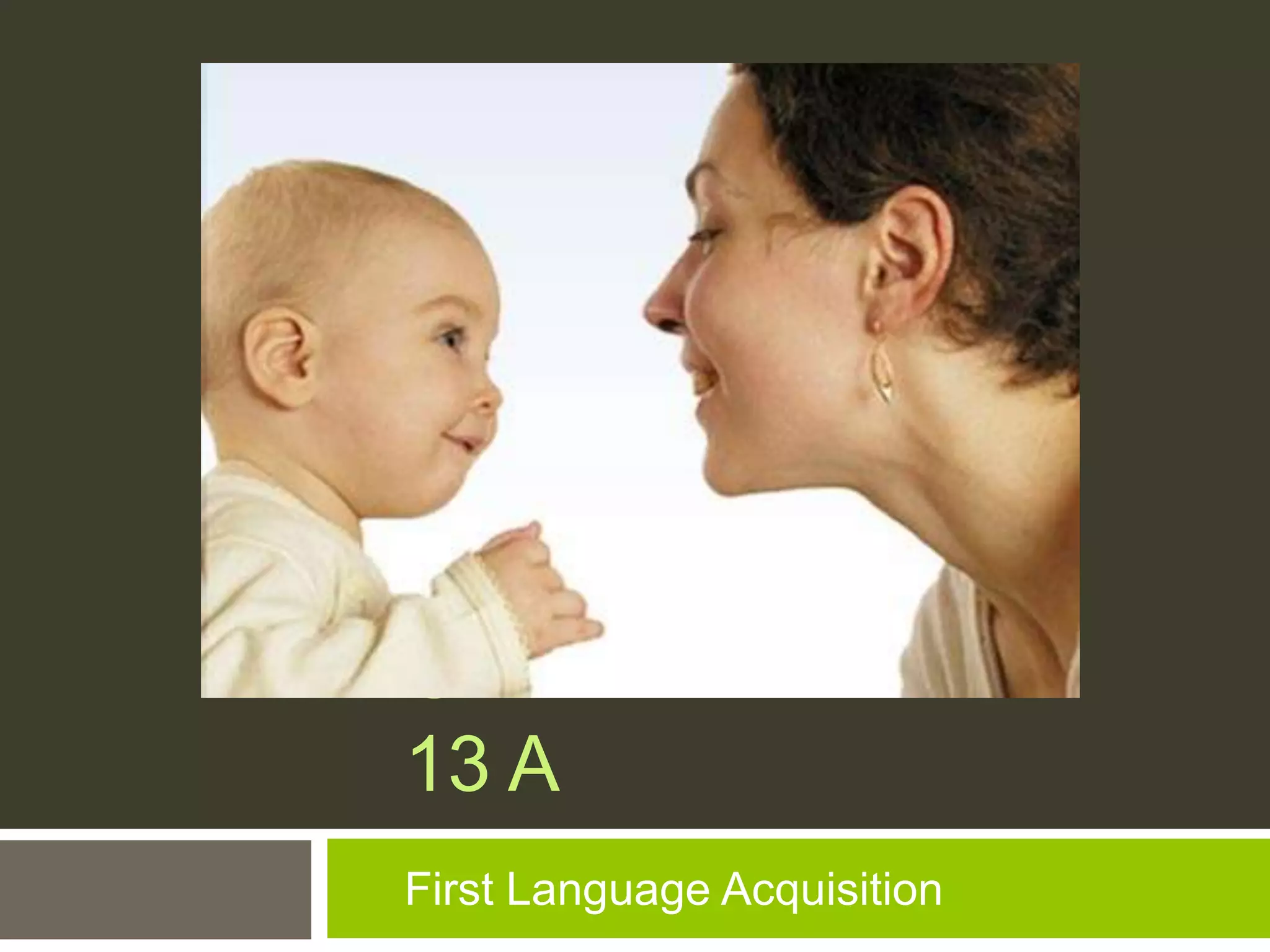
First Language Acquisition
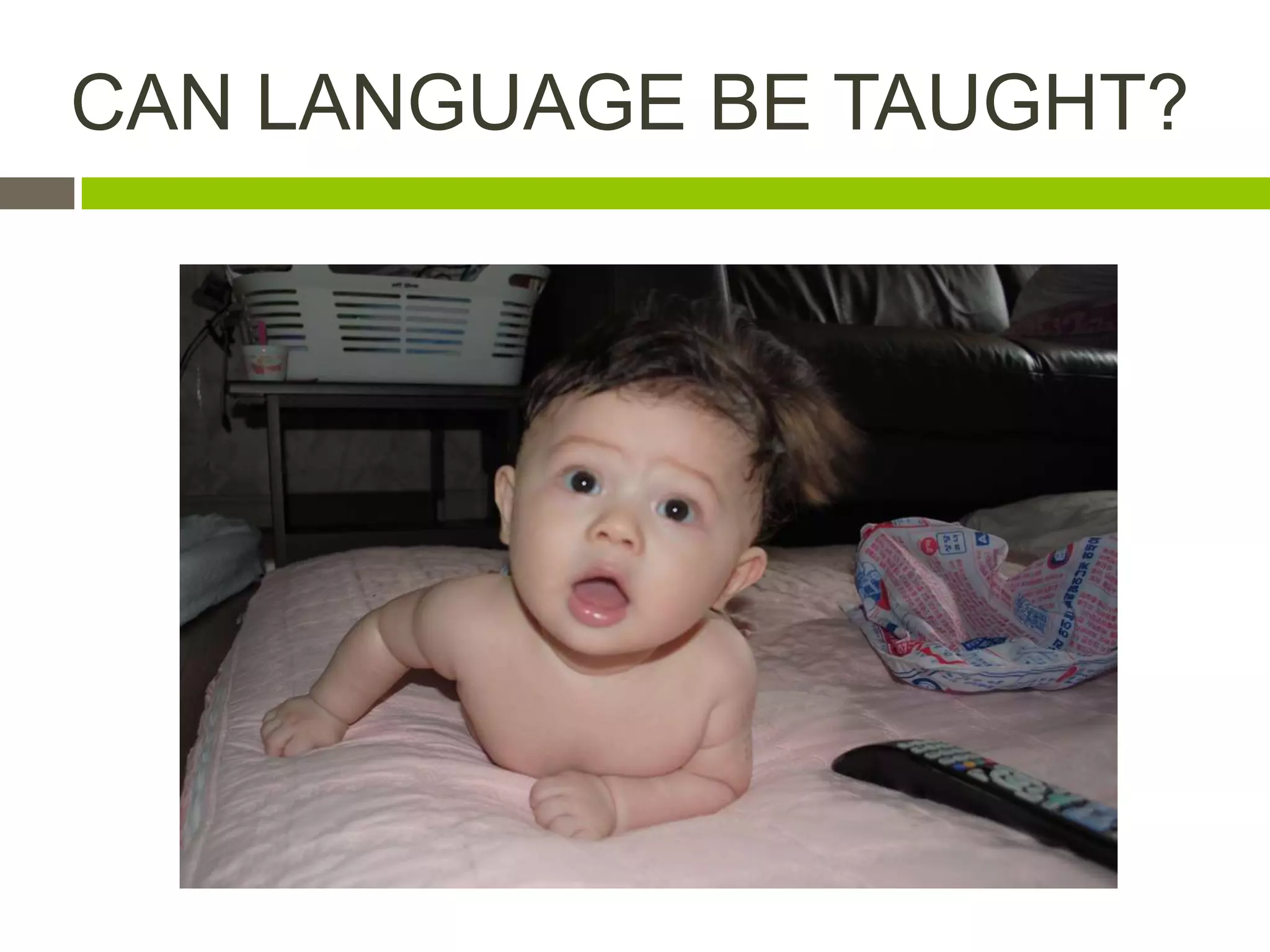
CAN LANGUAGE BE TAUGHT?
Theories on Language Acquisition
 Behaviorist Theory (Skinner)
 Innatist Theory (Chomsky)
 Cognitive Development Theory (Piaget,
Vygotsky)
 Social Interactionist Theory (Elizabeth Bates,
Brian MacWhinney, Jerome Bruner, Catherine
Snow)
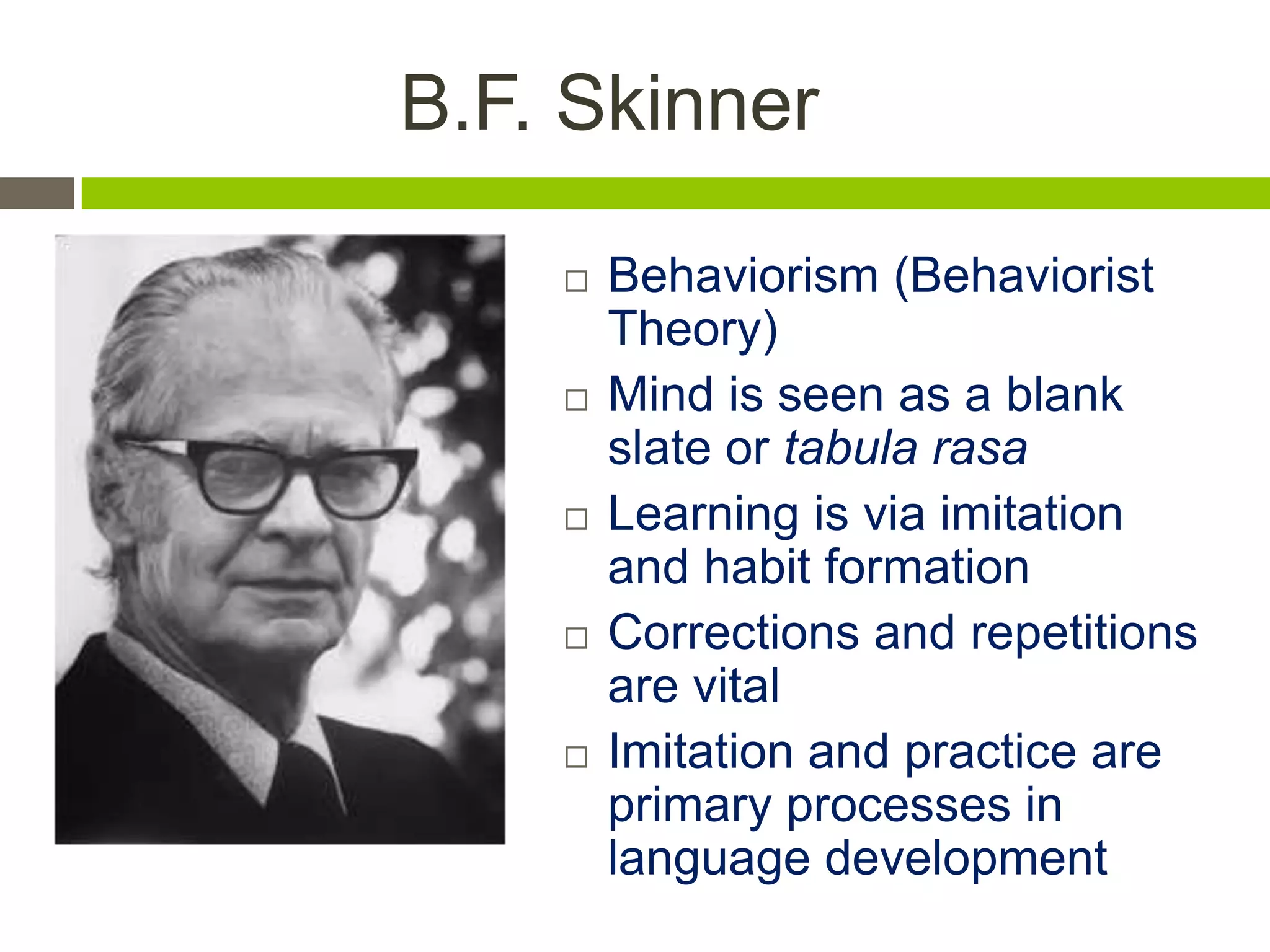
B.F. Skinner
 Behaviorism (Behaviorist
Theory)
 Mind is seen as a blank
slate or tabula rasa
 Learning is via imitation
and habit formation
 Corrections and repetitions
are vital
 Imitation and practice are
primary processes in
language development
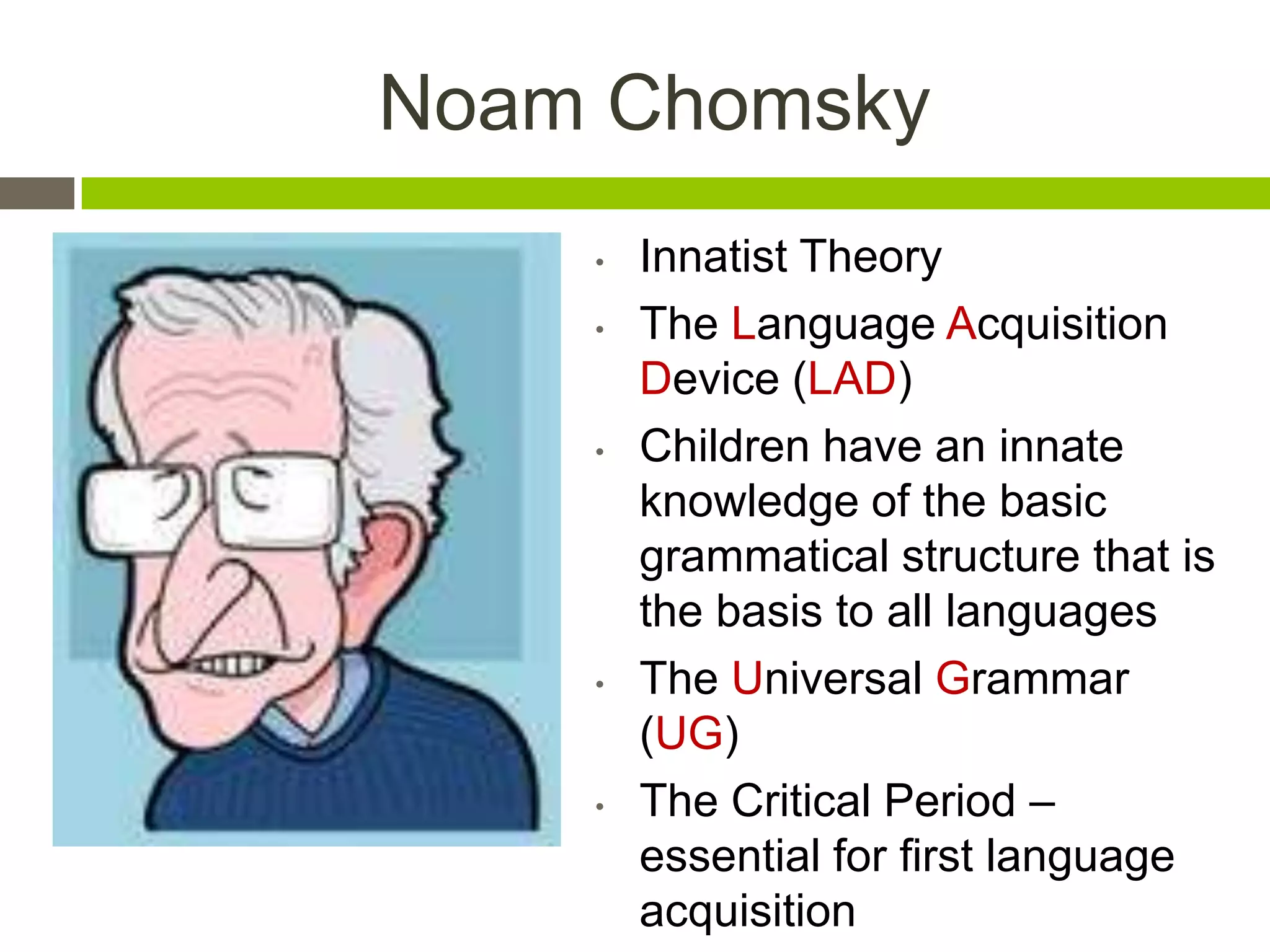
Noam Chomsky
 • Innatist Theory
• The Language Acquisition
Device (LAD)
• Children have an innate
knowledge of the basic
grammatical structure that is
the basis to all languages
• The Universal Grammar
(UG)
• The Critical Period –
essential for first language
acquisition
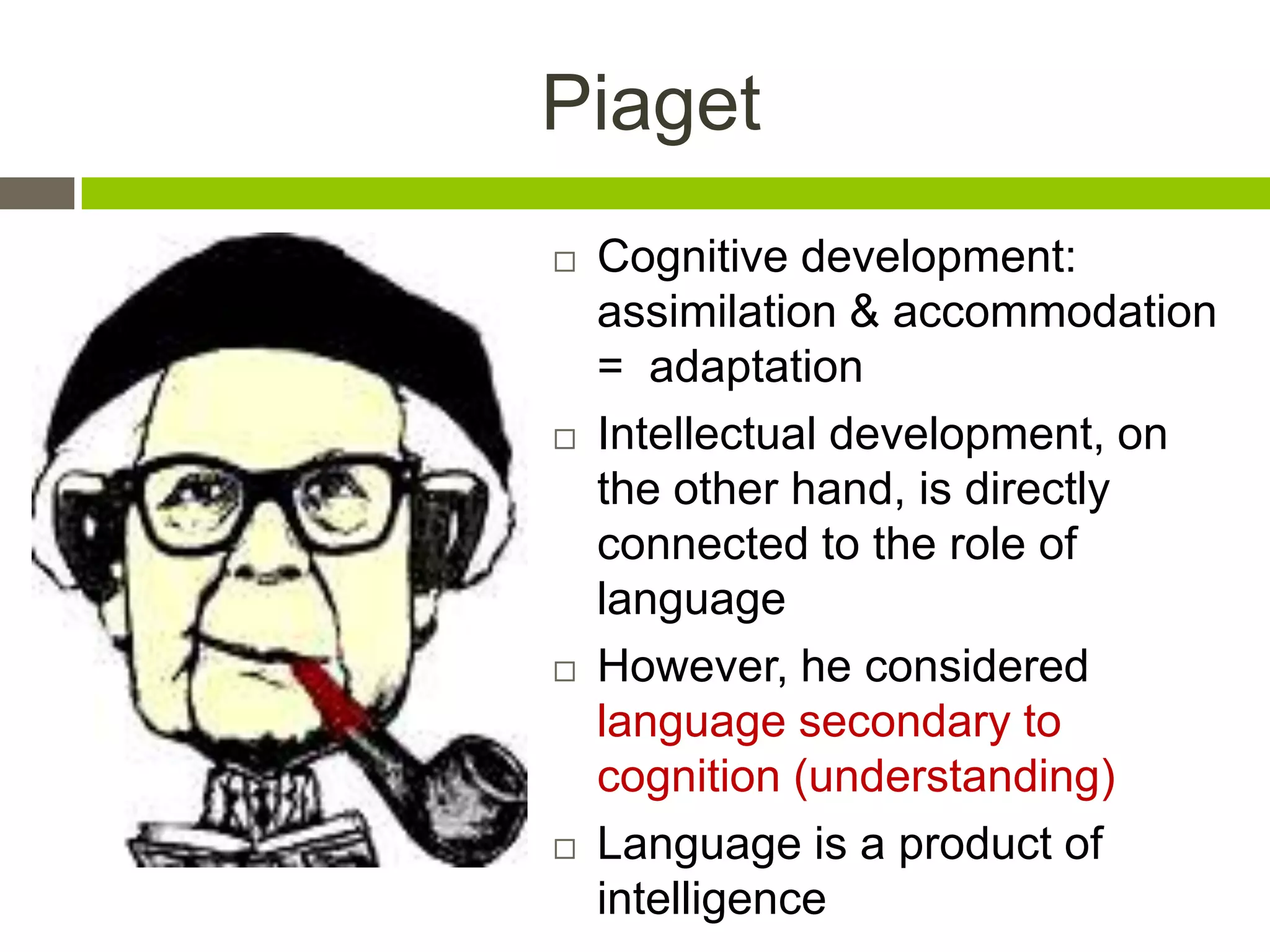
Piaget
 Cognitive development:
assimilation & accommodation
= adaptation
 Intellectual development, on
the other hand, is directly
connected to the role of
language
 However, he considered
language secondary to
cognition (understanding)
 Language is a product of
intelligence
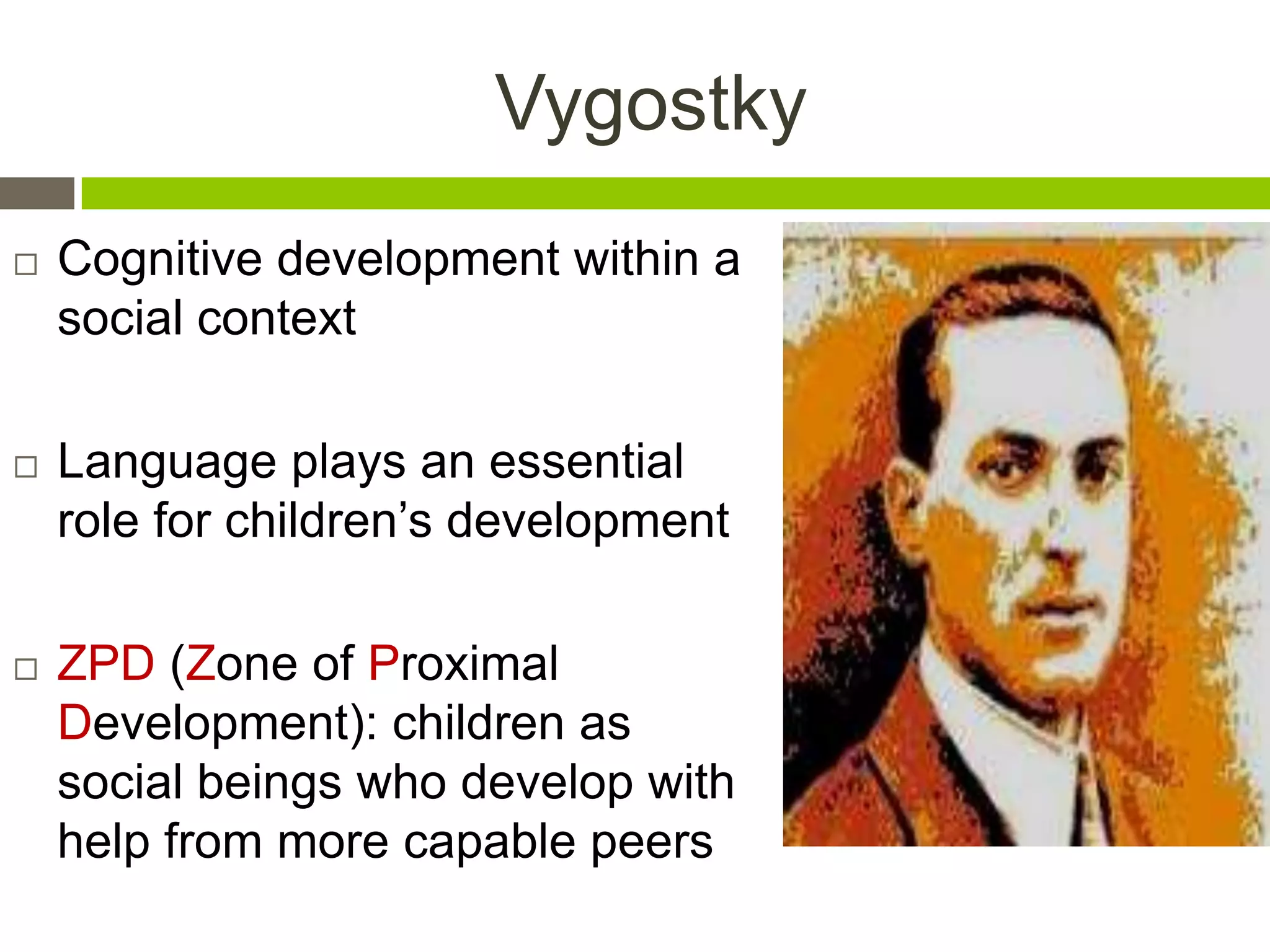
Vygostky
 Cognitive development within a
social context
 Language plays an essential
role for children‟s development
 ZPD (Zone of Proximal
Development): children as
social beings who develop with
help from more capable peers
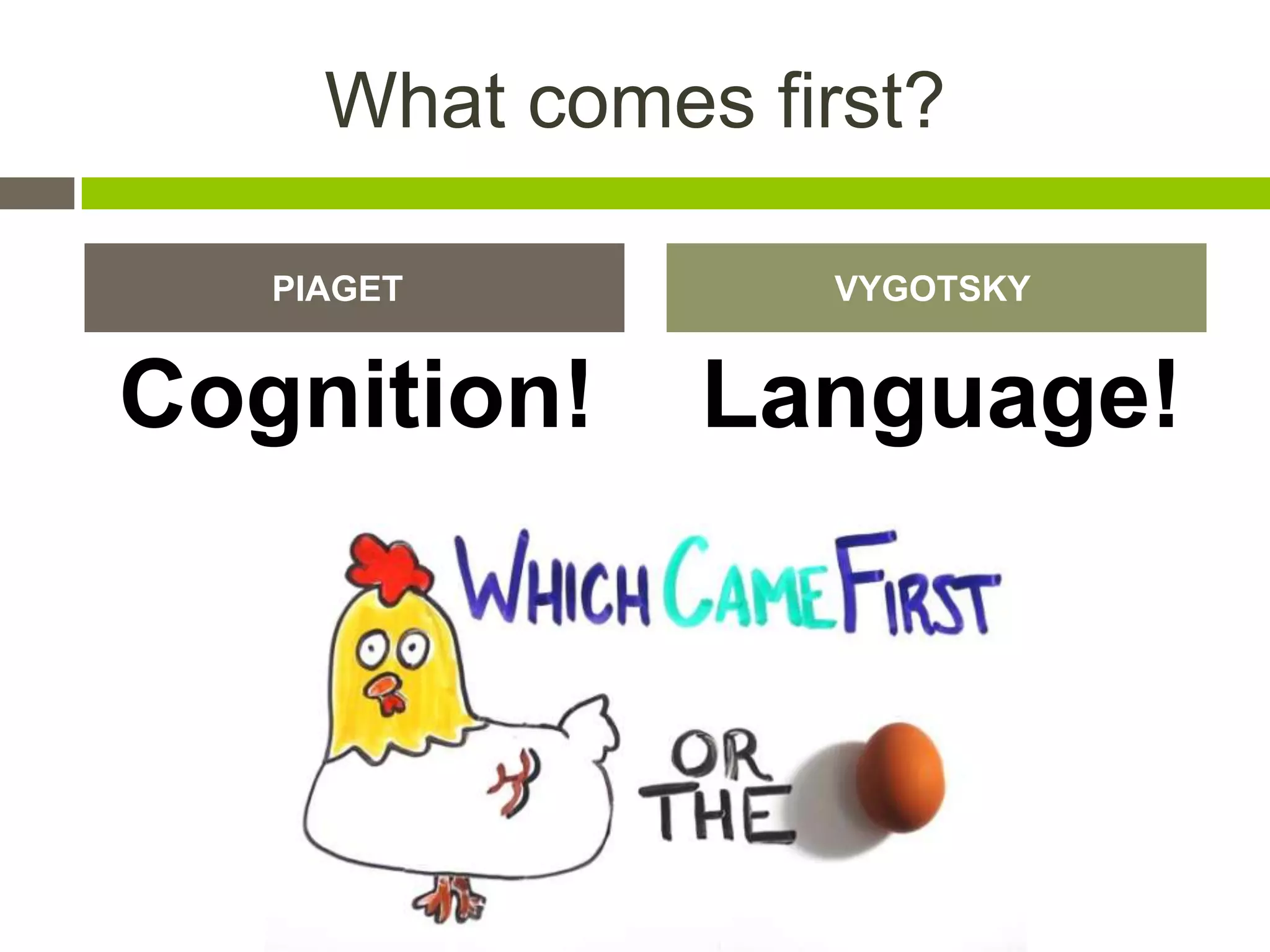
What comes first?
PIAGET VYGOTSKY
Cognition! Language!
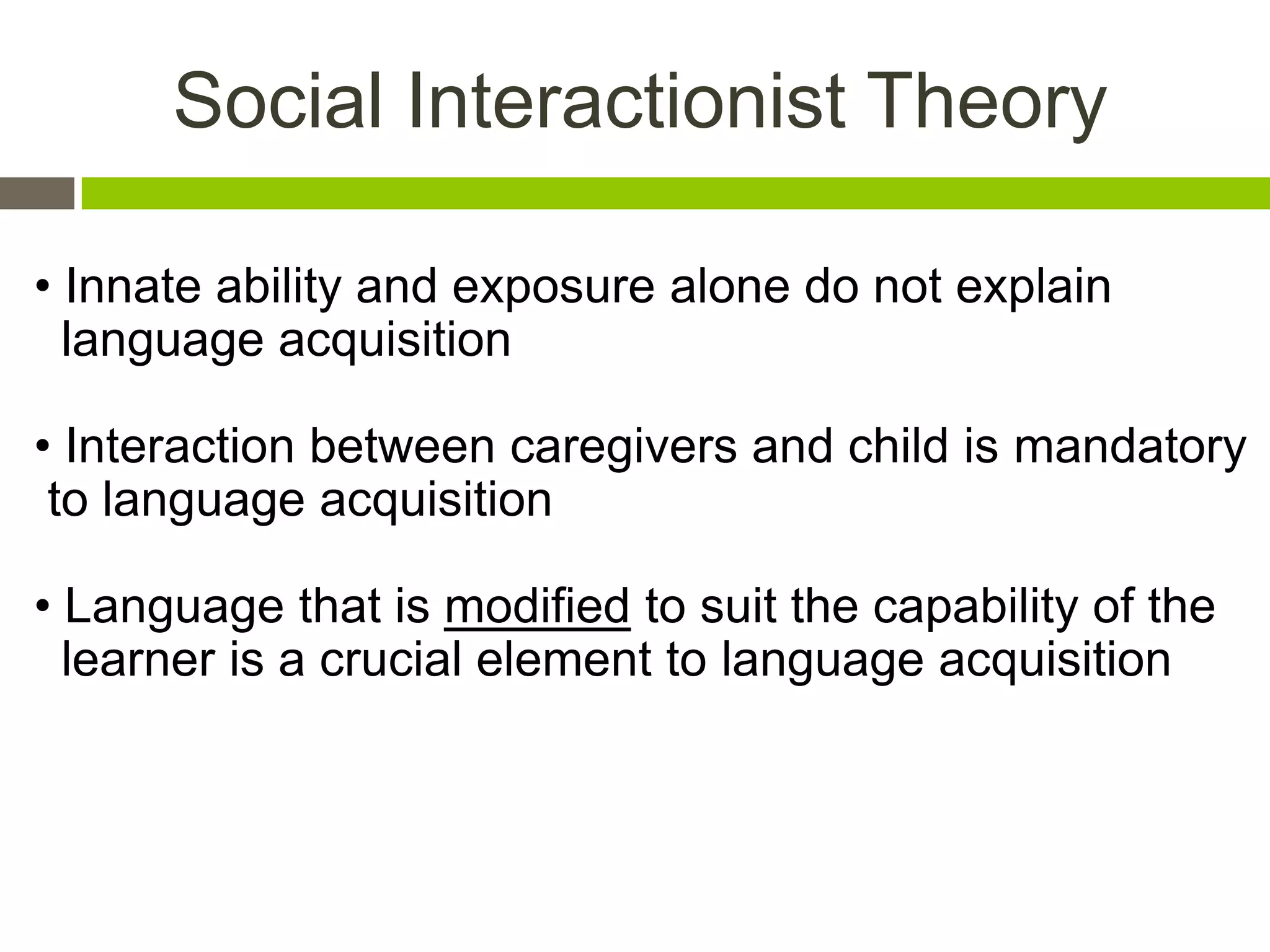
Social Interactionist Theory
• Innate ability and exposure alone do not explain
language acquisition
• Interaction between caregivers and child is mandatory
to language acquisition
• Language that is modified to suit the capability of the
learner is a crucial element to language acquisition
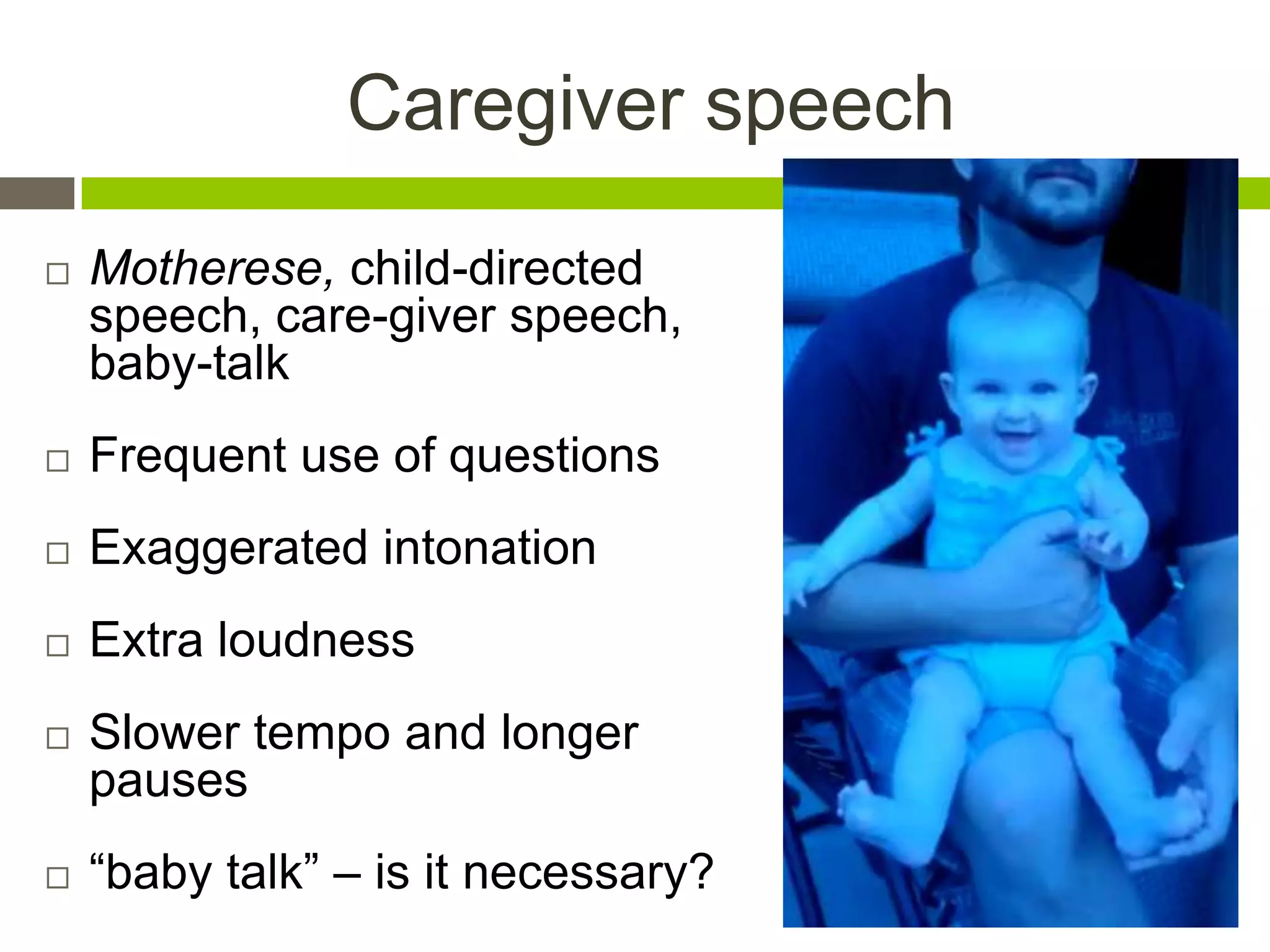
Caregiver speech
 Motherese, child-directed
speech, care-giver speech,
baby-talk
 Frequent use of questions
 Exaggerated intonation
 Extra loudness
 Slower tempo and longer
pauses
 “baby talk” – is it necessary?
The Productivity of Language
 With a limited set of grammar rules and a finite set
of terms, it is possible to create an infinite number
of utterances
 According to Chomsky, only an innate capacity
could explain how fast a child acquires language
 This only applies if there is no impairment, and if
the circumstances are adequate
Acquisition
 The identification and application of regularities
 Linguistic input being differentiated by the child:
Child can tell the difference between sounds like
[ba] and [pa]
 Output: child can create sounds like [ba] and [pa]
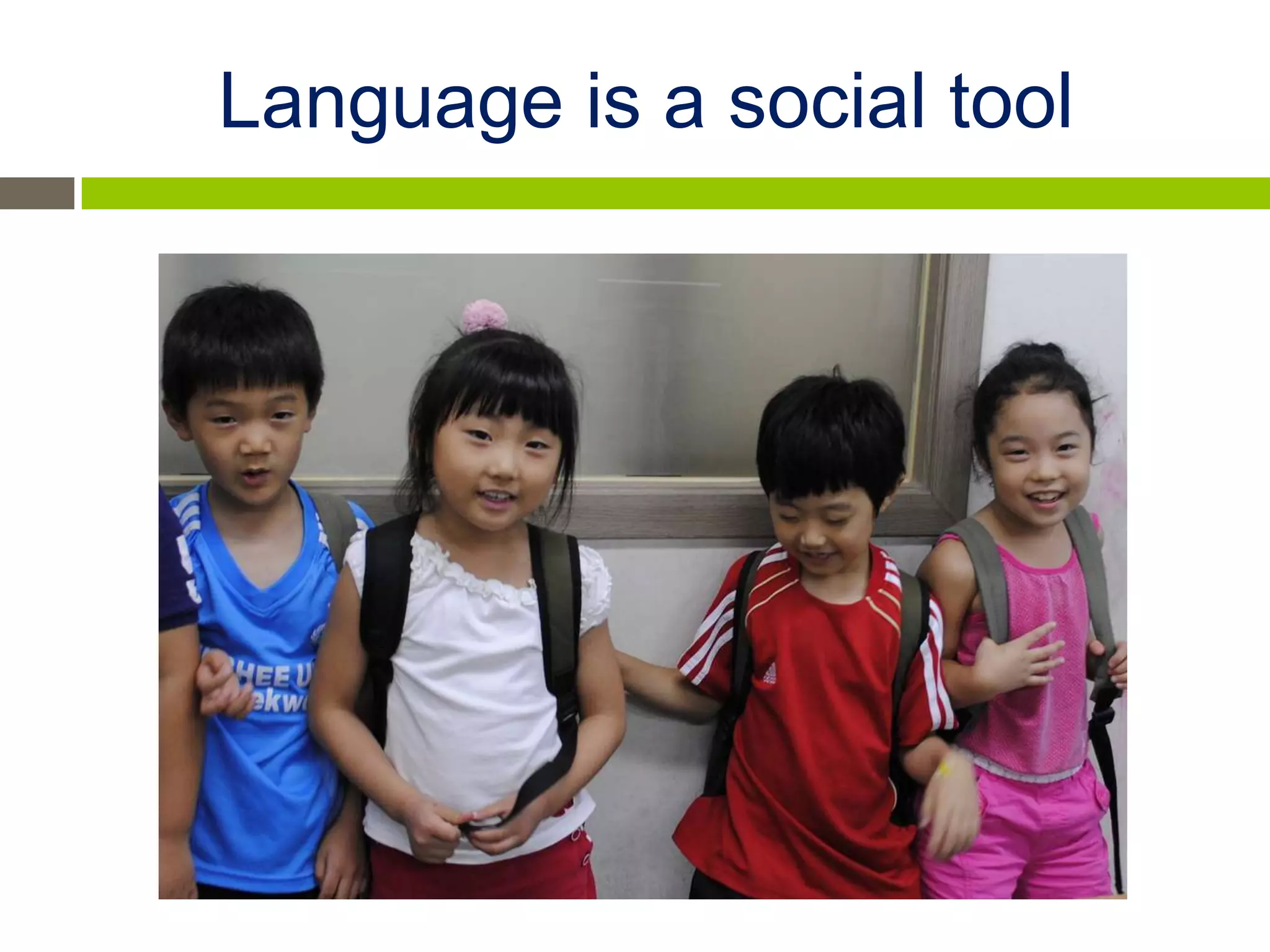
Language is a social tool
More Information
B.F. Skinner: http://www.simplypsychology.org/operant-
conditioning.html
Noam Chomsky:
http://www.simplypsychology.org/language.html
Jean Piaget:
http://www.simplypsychology.org/piaget.html
Lev Vygotsky:
http://www.simplypsychology.org/vygotsky.html
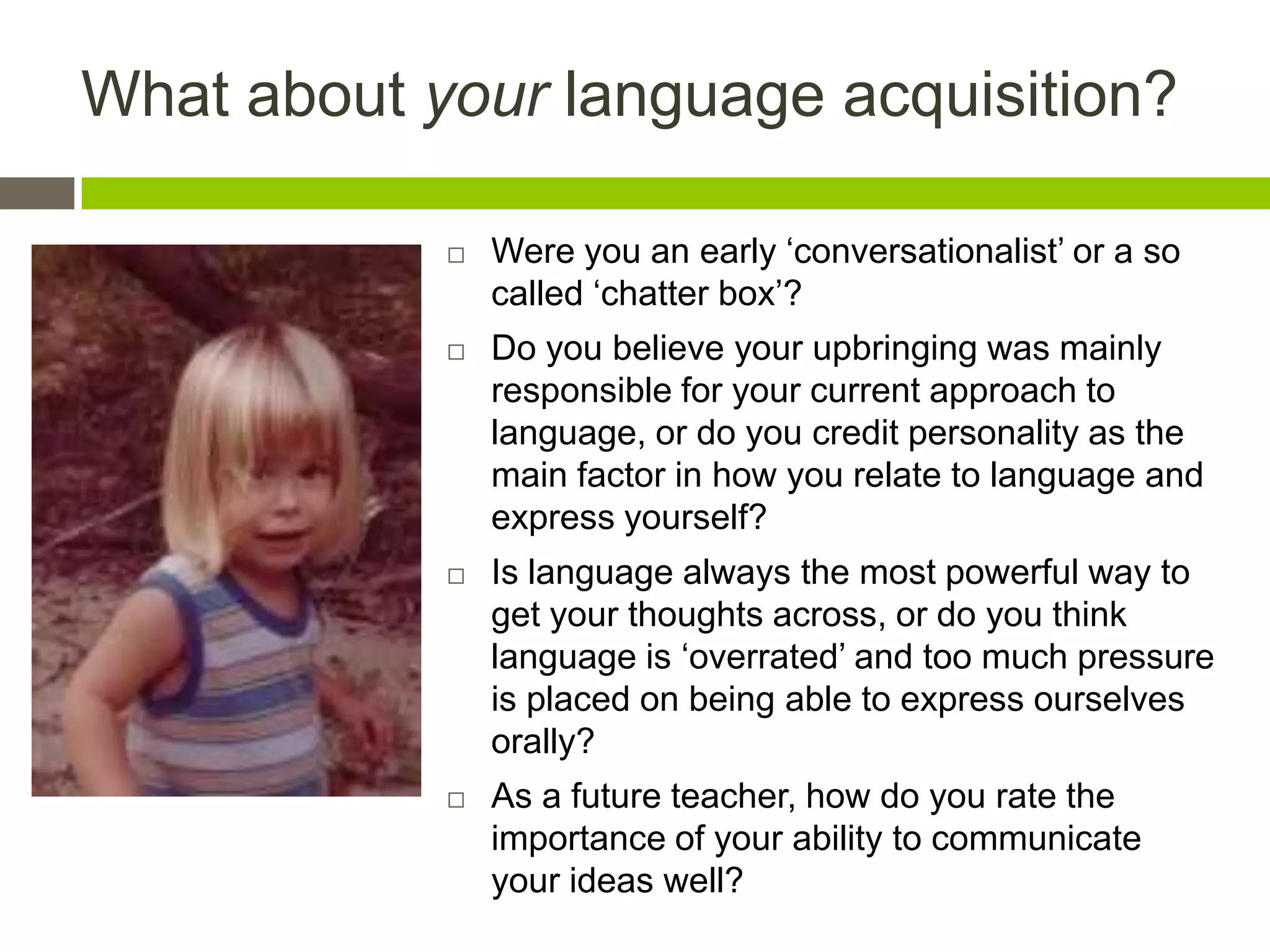
What about your language acquisition?
 Were you an early „conversationalist‟ or a so
called „chatter box‟?
 Do you believe your upbringing was mainly
responsible for your current approach to
language, or do you credit personality as the
main factor in how you relate to language and
express yourself?
 Is language always the most powerful way to
get your thoughts across, or do you think
language is „overrated‟ and too much pressure
is placed on being able to express ourselves
orally?
 As a future teacher, how do you rate the
importance of your ability to communicate
your ideas well?

First Language Acquisition Part 1

  • 1.
  • 2.
  • 3.
    Theories on LanguageAcquisition  Behaviorist Theory (Skinner)  Innatist Theory (Chomsky)  Cognitive Development Theory (Piaget, Vygotsky)  Social Interactionist Theory (Elizabeth Bates, Brian MacWhinney, Jerome Bruner, Catherine Snow)
  • 4.
    B.F. Skinner  Behaviorism(Behaviorist Theory)  Mind is seen as a blank slate or tabula rasa  Learning is via imitation and habit formation  Corrections and repetitions are vital  Imitation and practice are primary processes in language development
  • 5.
    Noam Chomsky  •Innatist Theory • The Language Acquisition Device (LAD) • Children have an innate knowledge of the basic grammatical structure that is the basis to all languages • The Universal Grammar (UG) • The Critical Period – essential for first language acquisition
  • 6.
    Piaget  Cognitive development: assimilation& accommodation = adaptation  Intellectual development, on the other hand, is directly connected to the role of language  However, he considered language secondary to cognition (understanding)  Language is a product of intelligence
  • 7.
    Vygostky  Cognitive developmentwithin a social context  Language plays an essential role for children‟s development  ZPD (Zone of Proximal Development): children as social beings who develop with help from more capable peers
  • 8.
    What comes first? PIAGETVYGOTSKY Cognition! Language!
  • 9.
    Social Interactionist Theory •Innate ability and exposure alone do not explain language acquisition • Interaction between caregivers and child is mandatory to language acquisition • Language that is modified to suit the capability of the learner is a crucial element to language acquisition
  • 10.
    Caregiver speech  Motherese,child-directed speech, care-giver speech, baby-talk  Frequent use of questions  Exaggerated intonation  Extra loudness  Slower tempo and longer pauses  “baby talk” – is it necessary?
  • 11.
    The Productivity ofLanguage  With a limited set of grammar rules and a finite set of terms, it is possible to create an infinite number of utterances  According to Chomsky, only an innate capacity could explain how fast a child acquires language  This only applies if there is no impairment, and if the circumstances are adequate
  • 12.
    Acquisition  The identificationand application of regularities  Linguistic input being differentiated by the child: Child can tell the difference between sounds like [ba] and [pa]  Output: child can create sounds like [ba] and [pa]
  • 13.
    Language is asocial tool
  • 14.
    More Information B.F. Skinner:http://www.simplypsychology.org/operant- conditioning.html Noam Chomsky: http://www.simplypsychology.org/language.html Jean Piaget: http://www.simplypsychology.org/piaget.html Lev Vygotsky: http://www.simplypsychology.org/vygotsky.html
  • 15.
    What about yourlanguage acquisition?  Were you an early „conversationalist‟ or a so called „chatter box‟?  Do you believe your upbringing was mainly responsible for your current approach to language, or do you credit personality as the main factor in how you relate to language and express yourself?  Is language always the most powerful way to get your thoughts across, or do you think language is „overrated‟ and too much pressure is placed on being able to express ourselves orally?  As a future teacher, how do you rate the importance of your ability to communicate your ideas well?

Editor's Notes