
EDUC. 564 Applied Linguistics
Dr. Philip Murray Finley
 Similar among children all over the world
(predicable patterns in the L1 development)
1.Pretalking Stage (0-6 months) :
crying, cooing, grunts, laughter
 Example: http://
www.youtube.com/watch?v=3kuOt4kZUn0
2.Babbling (6-8
 yells, squeals, repeated consonant + vowel sequences
(bababa, nanana)
http://www.youtube.com/watch?v=QJzVZvMPkAI
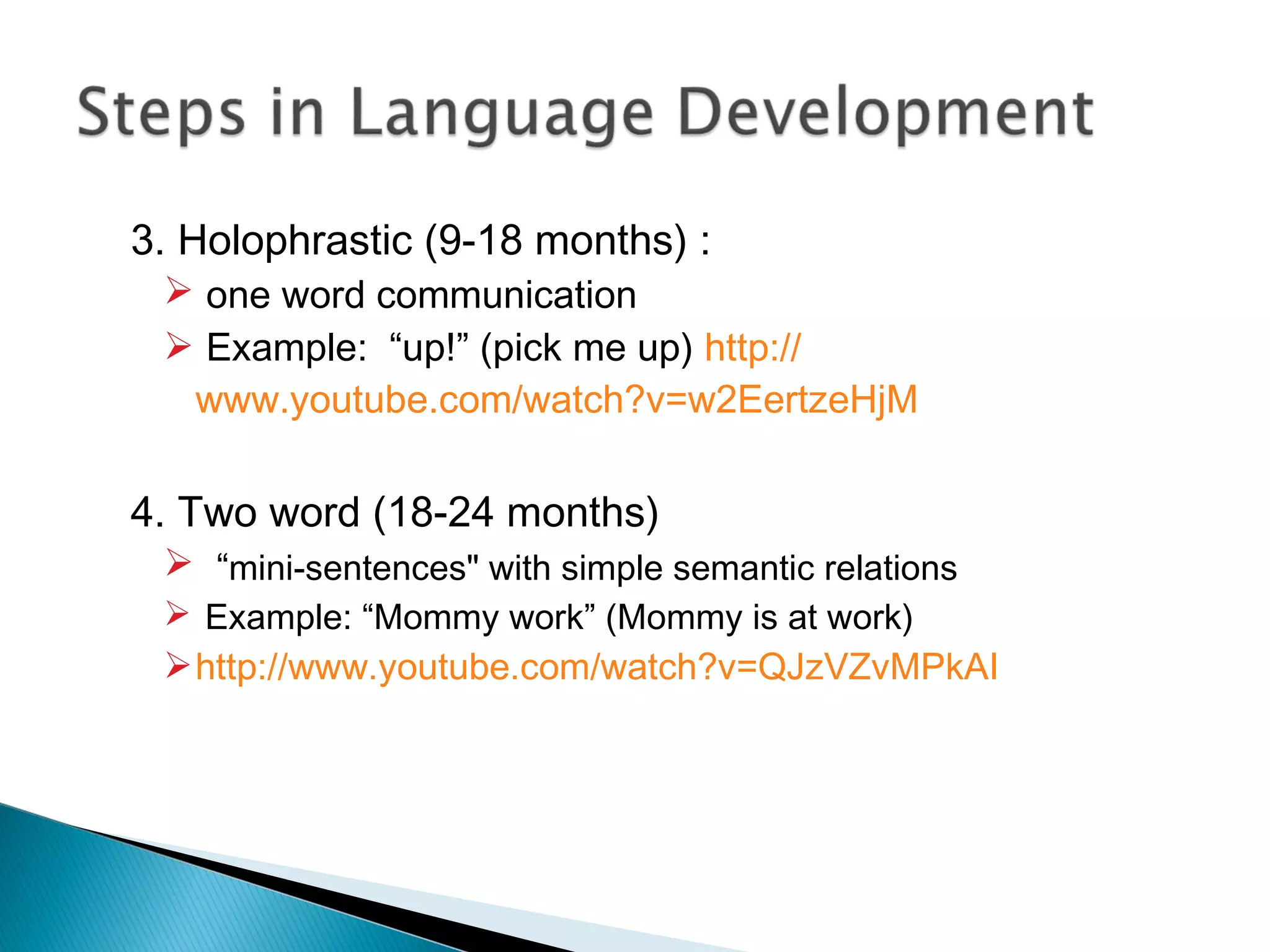
3. Holophrastic (9-18 months) :
 one word communication
 Example: “up!” (pick me up) http://
www.youtube.com/watch?v=w2EertzeHjM
4. Two word (18-24 months)
 “mini-sentences" with simple semantic relations
 Example: “Mommy work” (Mommy is at work)
http://www.youtube.com/watch?v=QJzVZvMPkAI
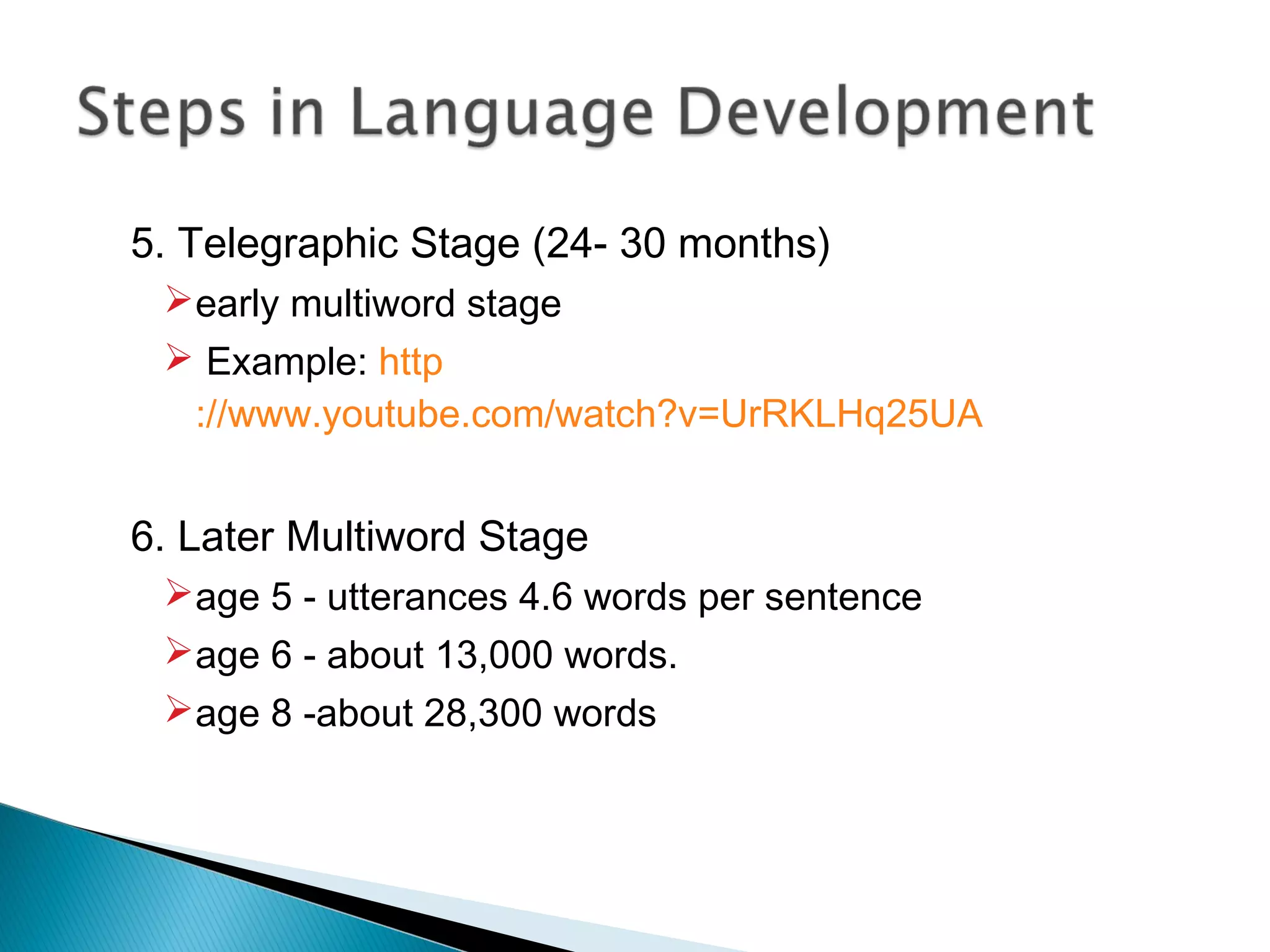
5. Telegraphic Stage (24- 30 months)
early multiword stage
 Example: http
://www.youtube.com/watch?v=UrRKLHq25UA
6. Later Multiword Stage
age 5 - utterances 4.6 words per sentence
age 6 - about 13,000 words.
age 8 -about 28,300 words
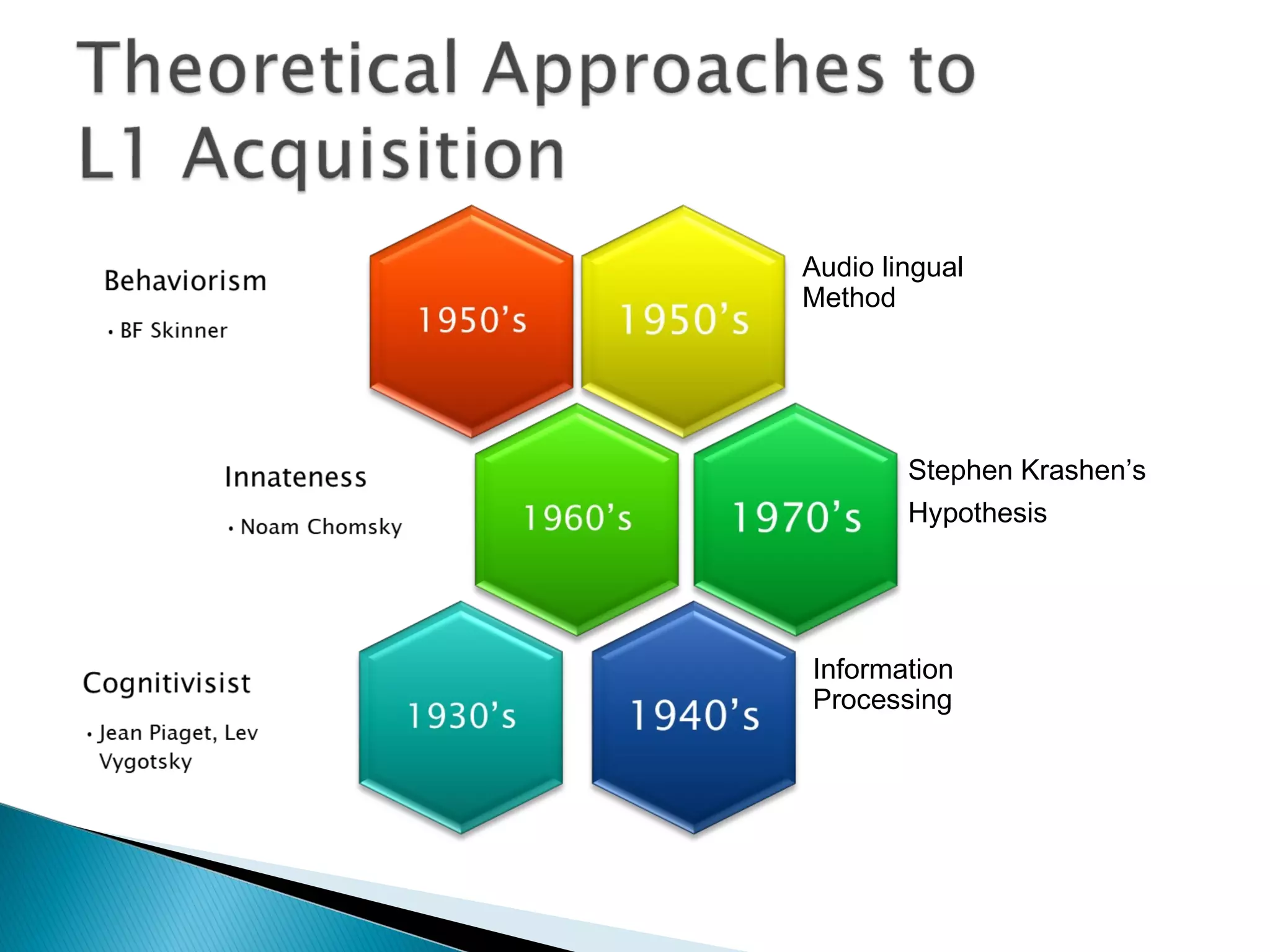
Audio lingual
Method
Information
Processing
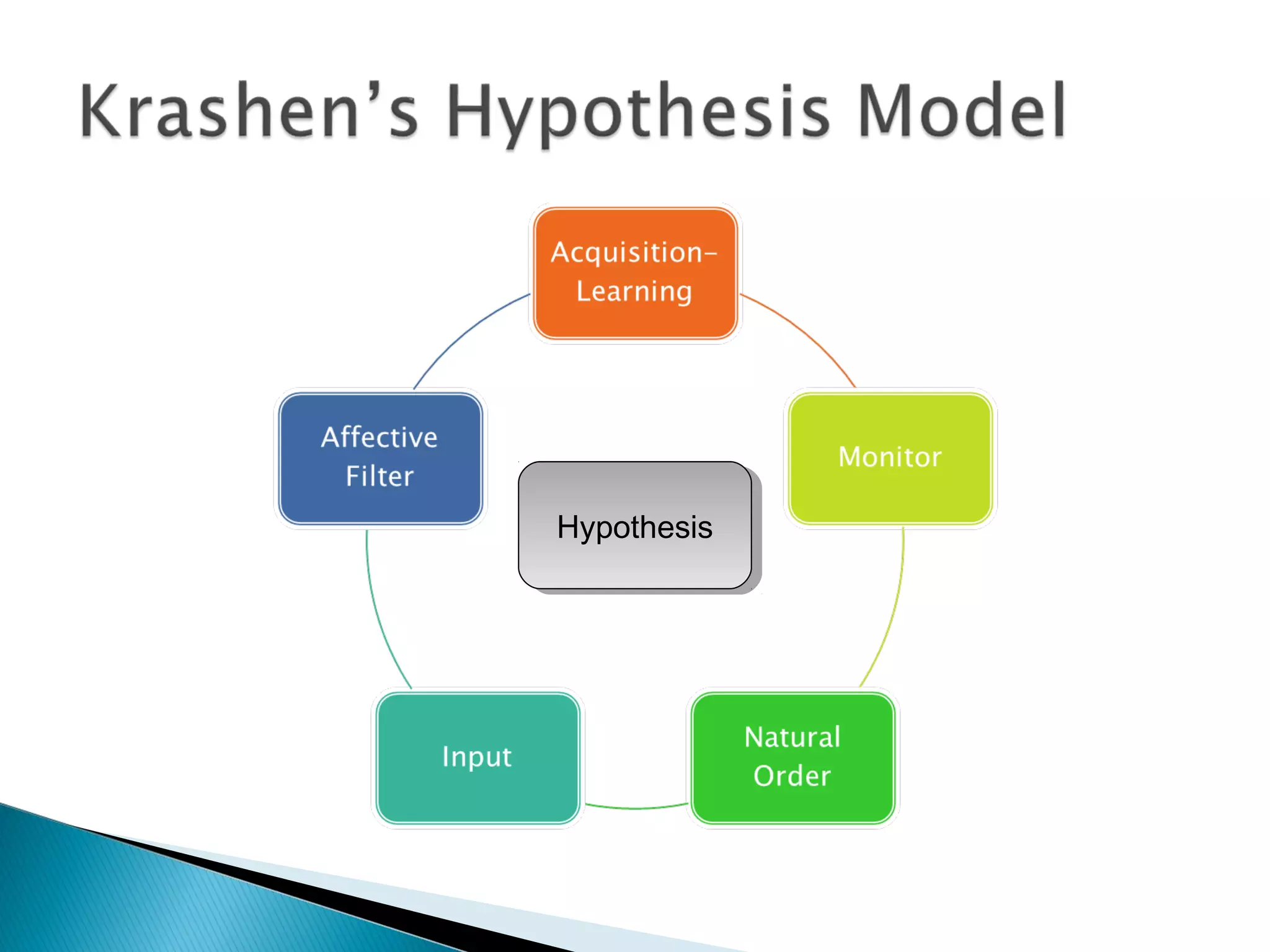
Stephen Krashen’s
Hypothesis
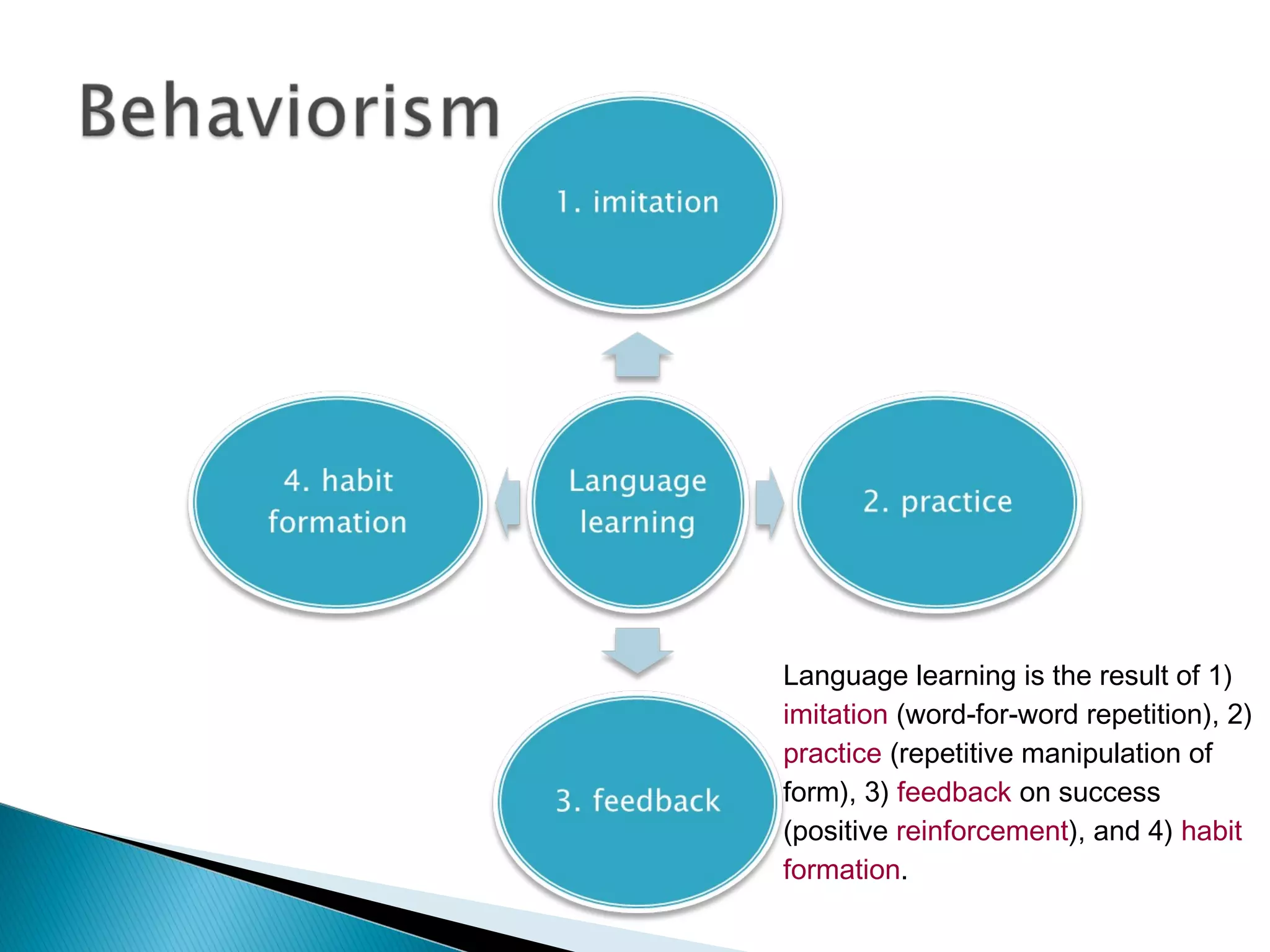
Language learning is the result of 1)
imitation (word-for-word repetition), 2)
practice (repetitive manipulation of
form), 3) feedback on success
(positive reinforcement), and 4) habit
formation.
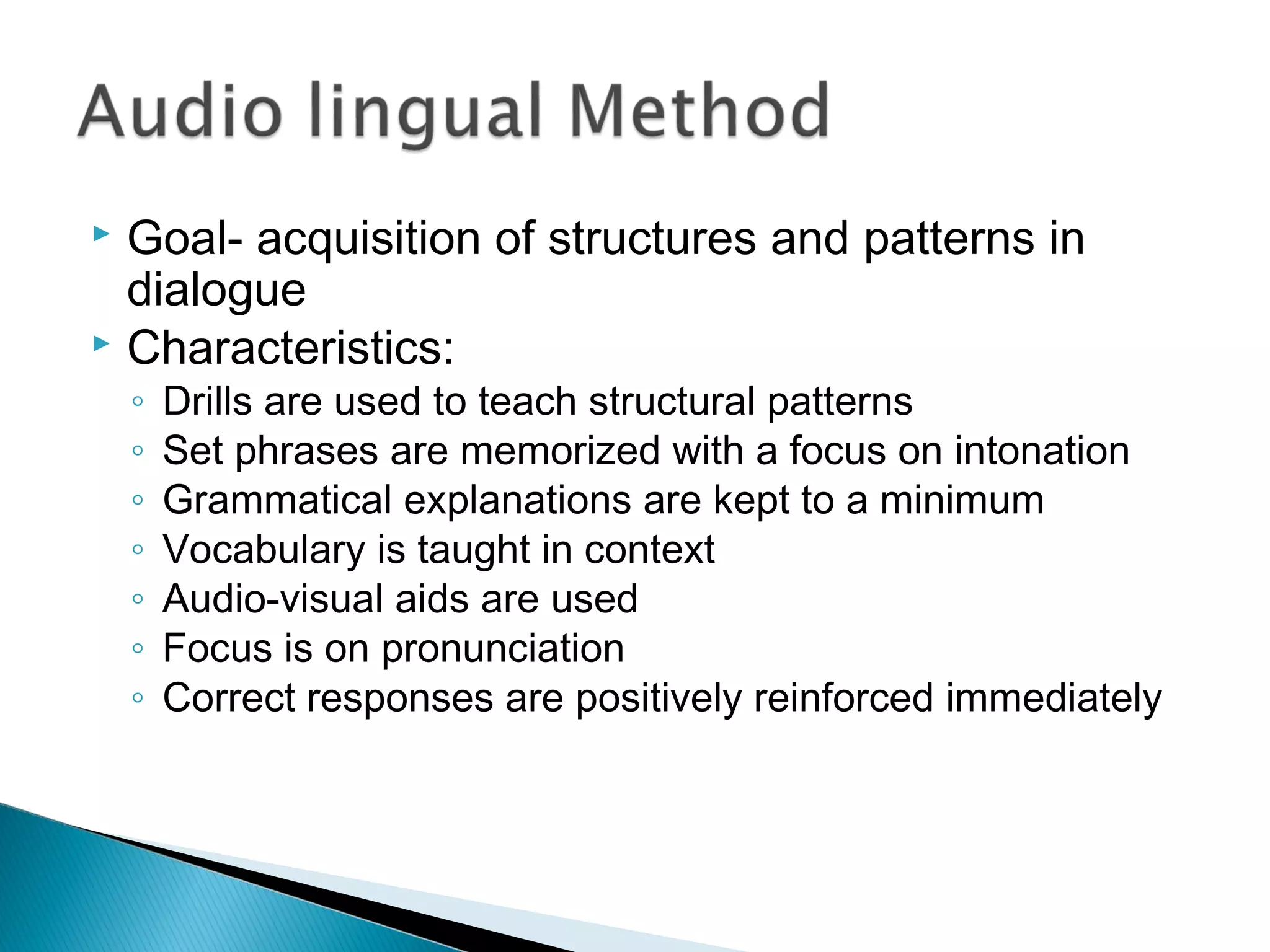
 Goal- acquisition of structures and patterns in
dialogue
 Characteristics:
◦ Drills are used to teach structural patterns
◦ Set phrases are memorized with a focus on intonation
◦ Grammatical explanations are kept to a minimum
◦ Vocabulary is taught in context
◦ Audio-visual aids are used
◦ Focus is on pronunciation
◦ Correct responses are positively reinforced immediately
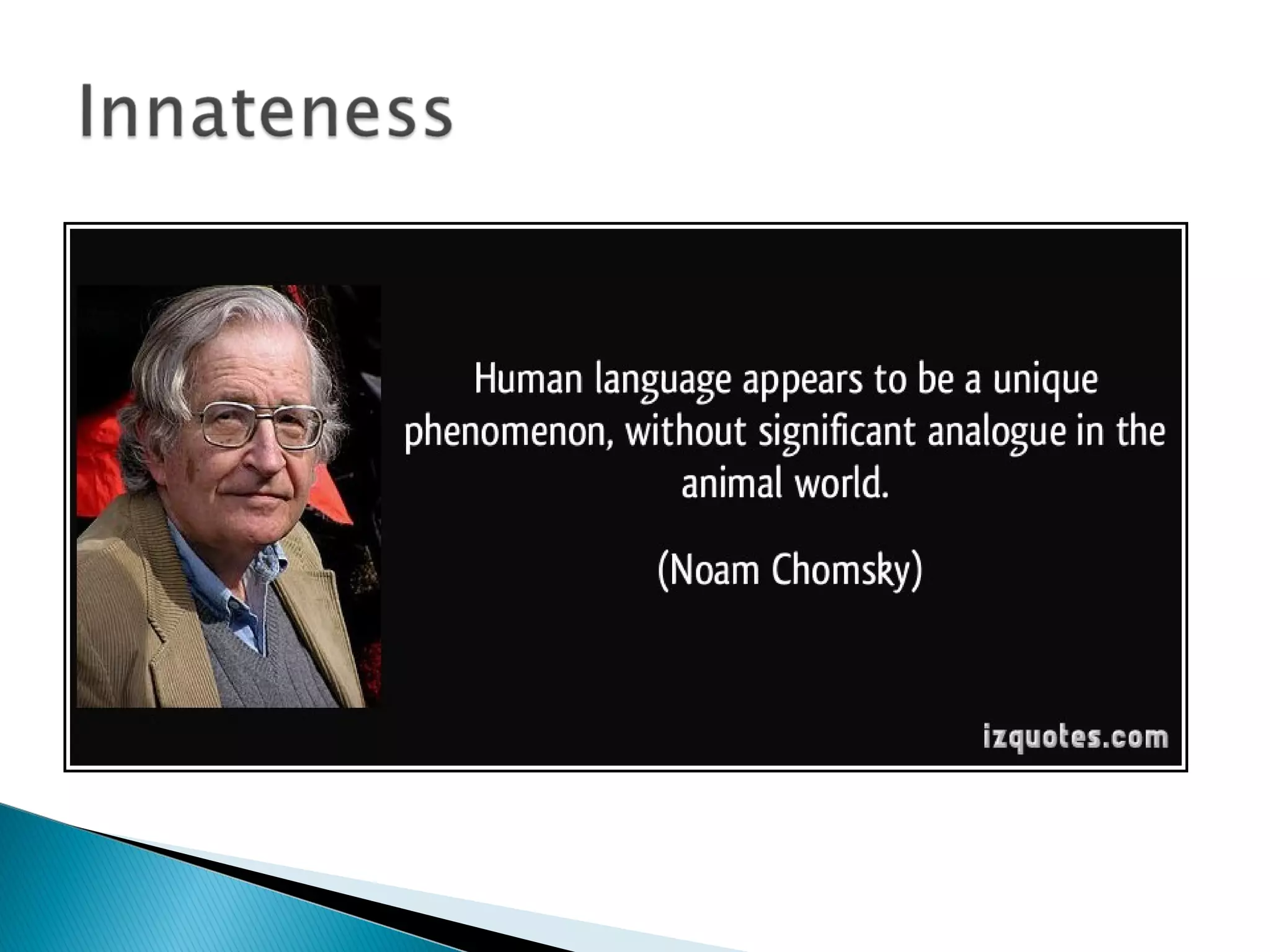
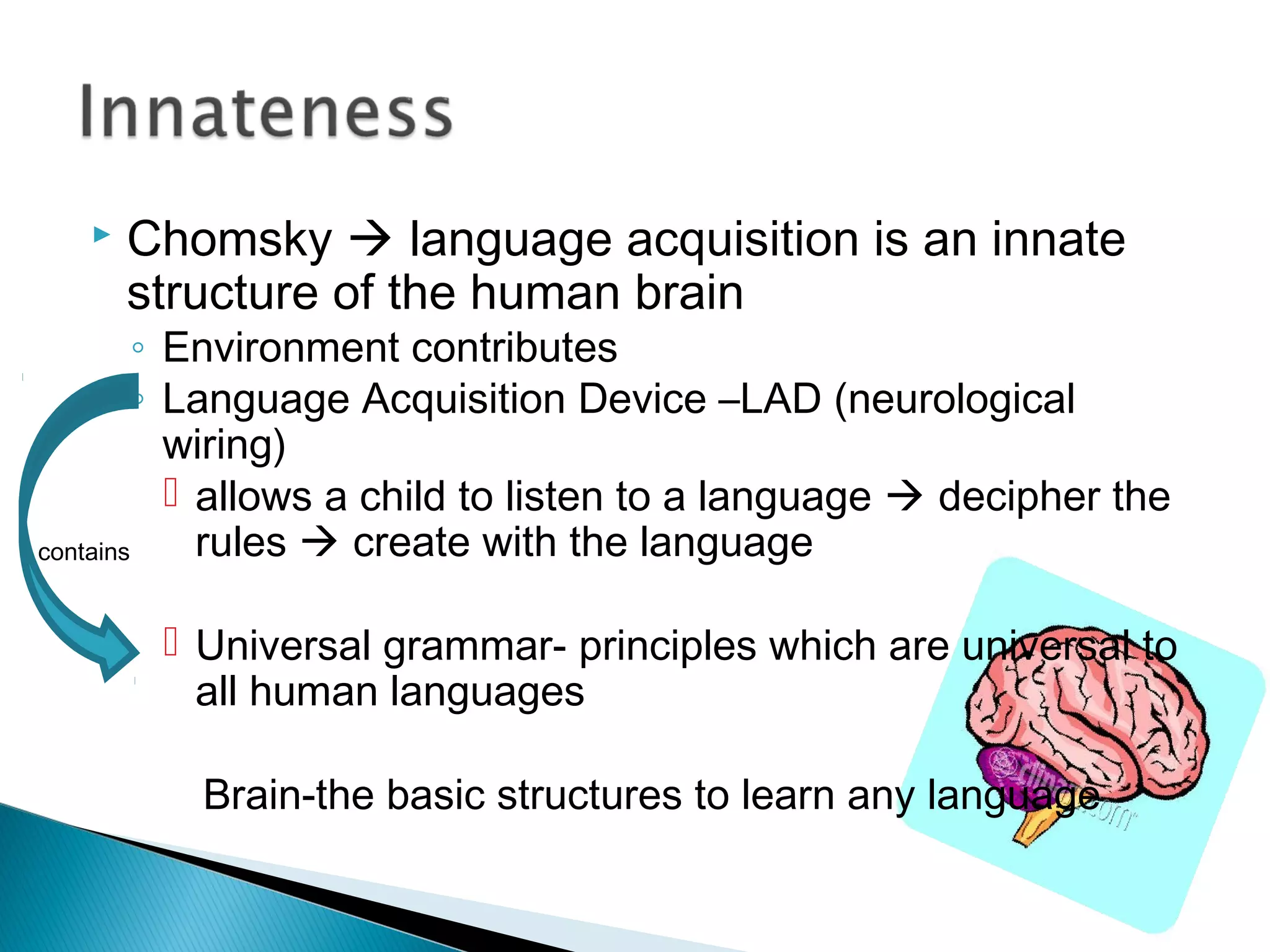
 Chomsky  language acquisition is an innate
structure of the human brain
◦ Environment contributes
◦ Language Acquisition Device –LAD (neurological
wiring)
 allows a child to listen to a language  decipher the
rules  create with the language
 Universal grammar- principles which are universal to
all human languages
Brain-the basic structures to learn any language
contains
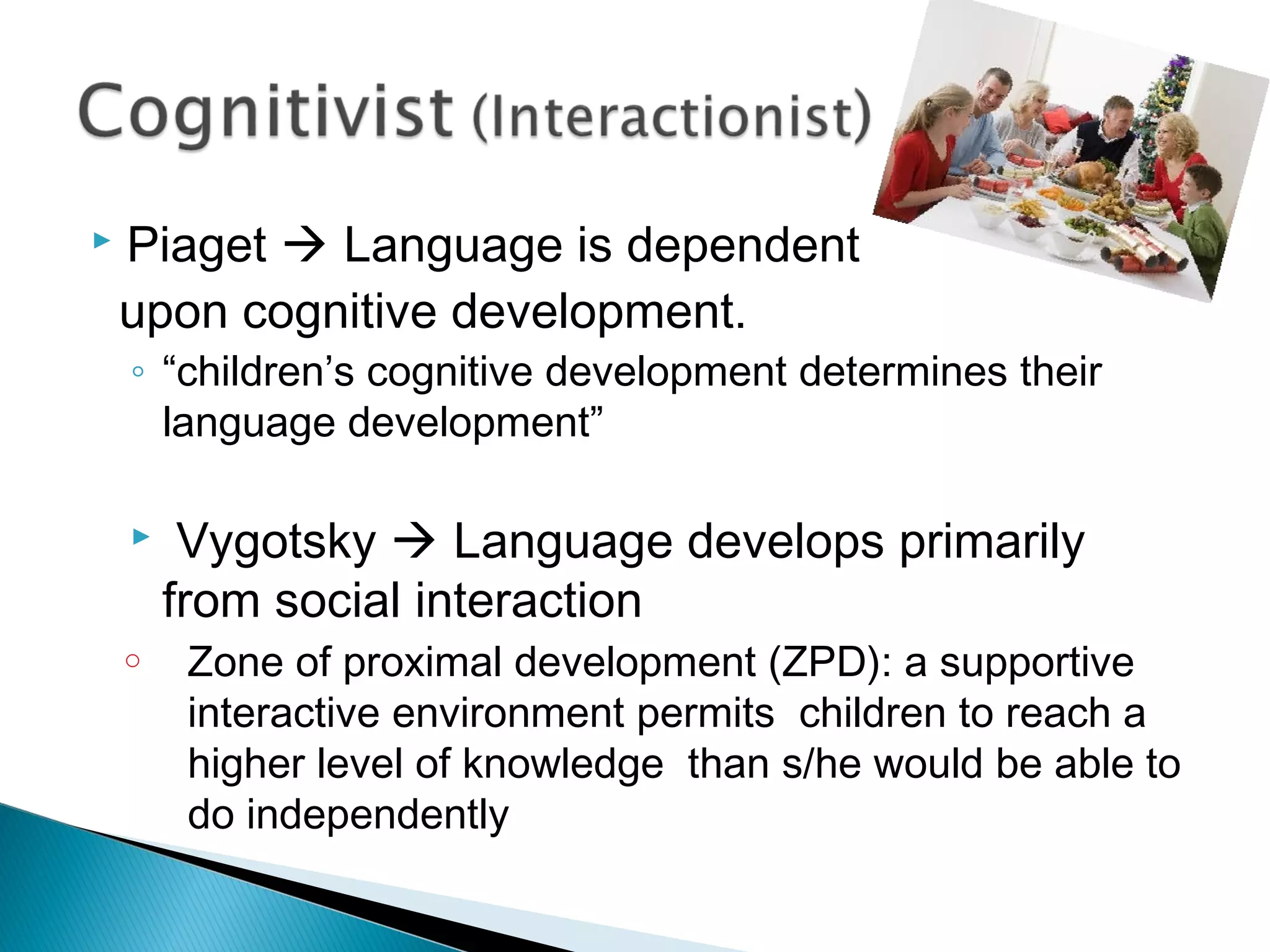
 Piaget  Language is dependent
upon cognitive development.
◦ “children’s cognitive development determines their
language development”
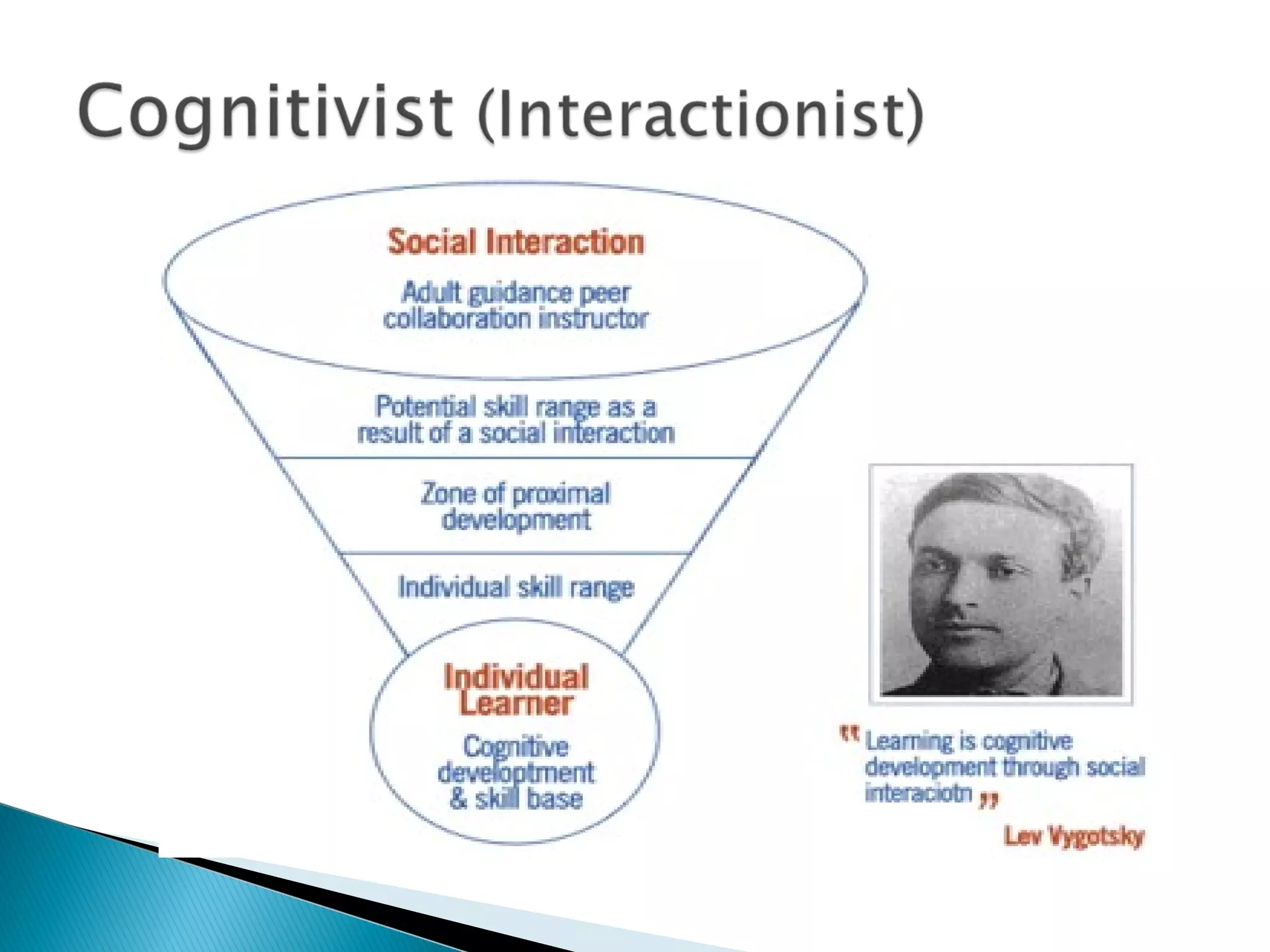
 Vygotsky  Language develops primarily
from social interaction
o Zone of proximal development (ZPD): a supportive
interactive environment permits children to reach a
higher level of knowledge than s/he would be able to
do independently
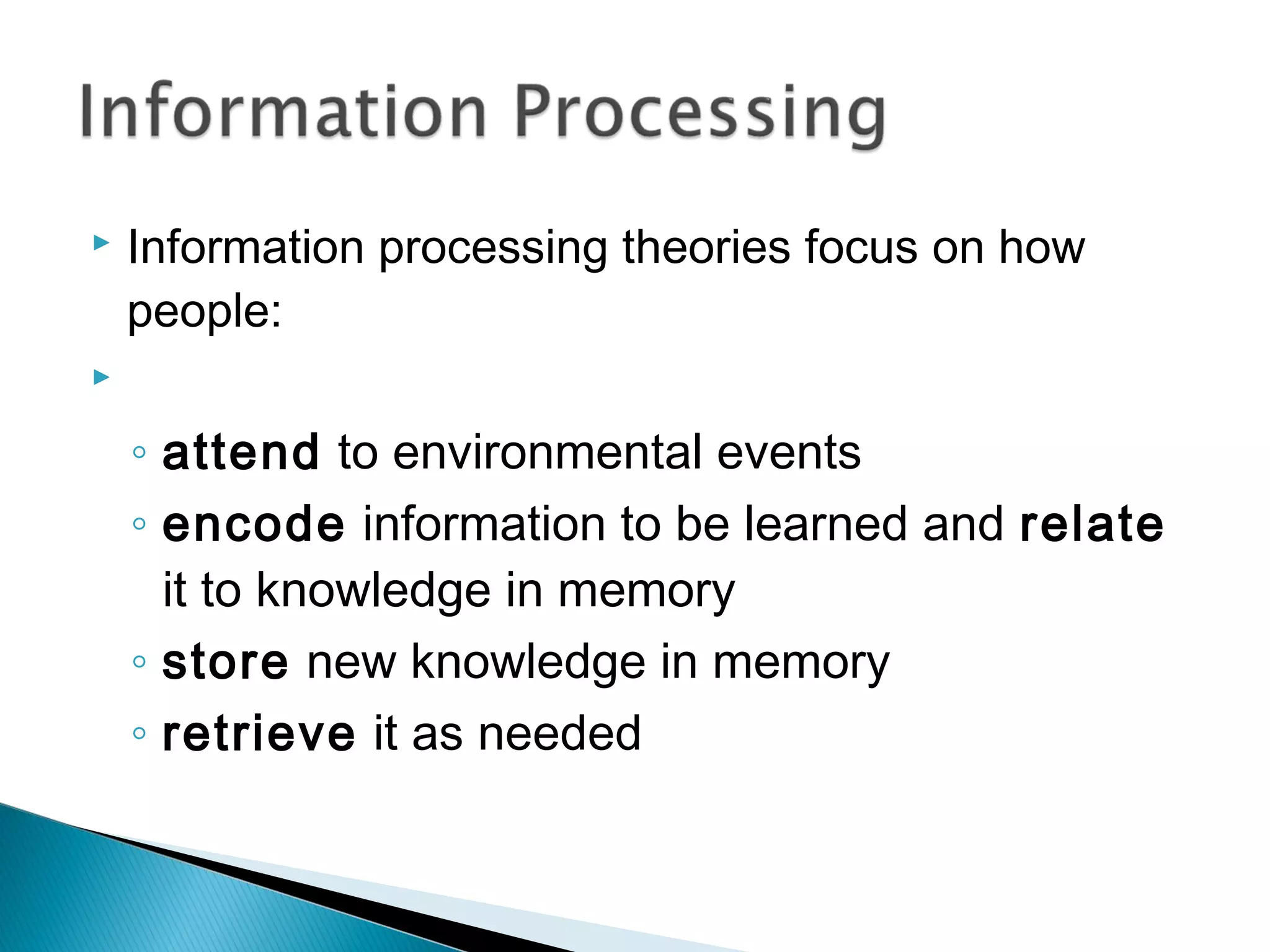
 Information processing theories focus on how
people:

◦ attend to environmental events
◦ encode information to be learned and relate
it to knowledge in memory
◦ store new knowledge in memory
◦ retrieve it as needed
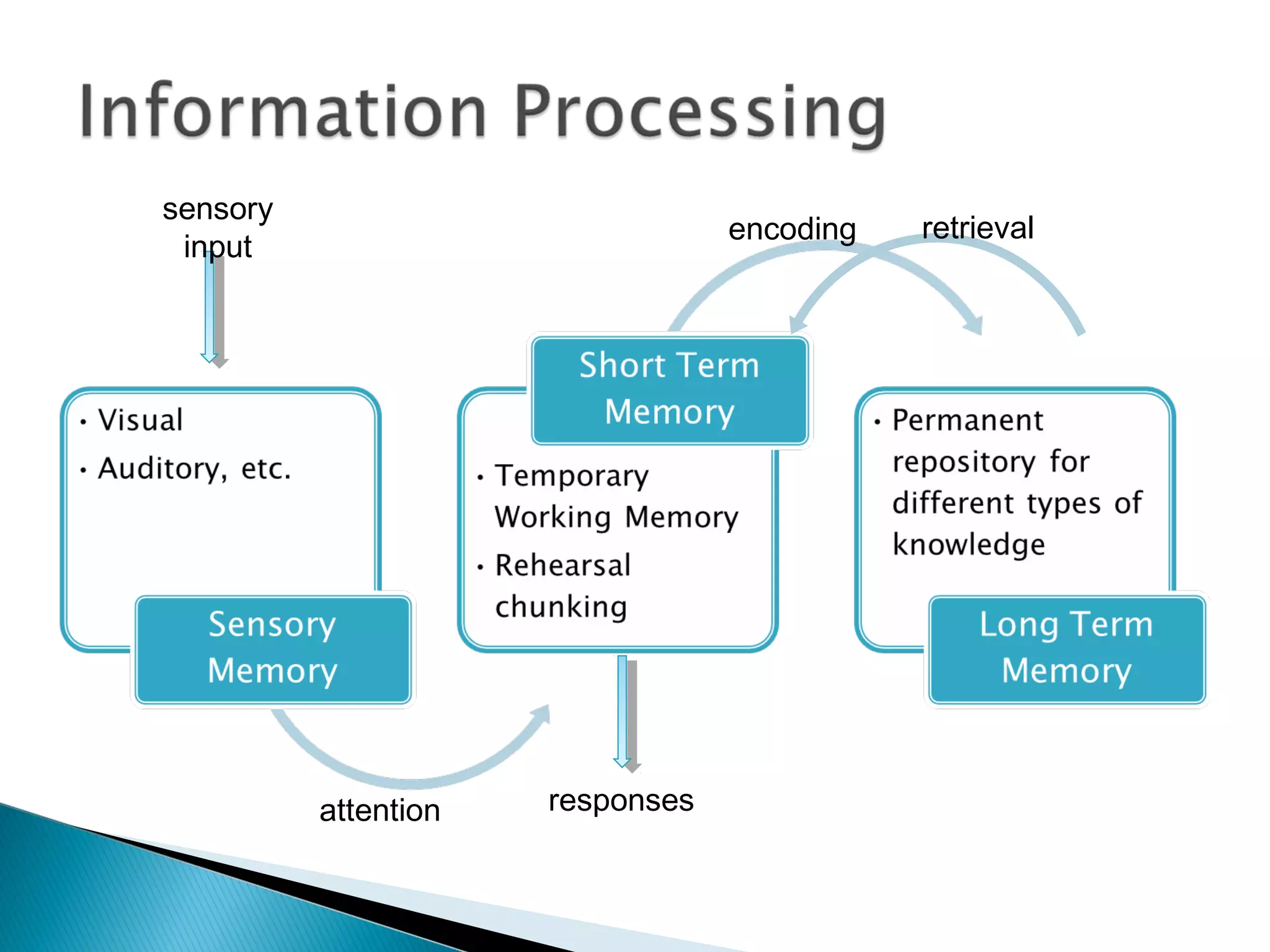
retrievalencoding
attention
sensory
input
responses
HypothesisHypothesis
 Language Learning in Early Childhood
◦ www2.nkfust.edu.tw/.../SLA/ppt/1_Learning_a_First_Language
_new.ppt
 Module 5 Lesson 5.3 First Language Acquisition
◦ http://
emedia.leeward.hawaii.edu/hurley/Ling102web/mod5_Llearnin
 Escamilla, Kathy & Grassi, Elizabeth. A Brief
Description of Second Language Acquisition
(2000).
◦ http://
www.wce.wwu.edu/Resources/CIRCLE/Articles/SLA
%20Escamilla%2BGrassi.pdf

Applied linguistics first language acquisition

  • 1.
    EDUC. 564 AppliedLinguistics Dr. Philip Murray Finley
  • 3.
     Similar amongchildren all over the world (predicable patterns in the L1 development) 1.Pretalking Stage (0-6 months) : crying, cooing, grunts, laughter  Example: http:// www.youtube.com/watch?v=3kuOt4kZUn0 2.Babbling (6-8  yells, squeals, repeated consonant + vowel sequences (bababa, nanana) http://www.youtube.com/watch?v=QJzVZvMPkAI
  • 4.
    3. Holophrastic (9-18months) :  one word communication  Example: “up!” (pick me up) http:// www.youtube.com/watch?v=w2EertzeHjM 4. Two word (18-24 months)  “mini-sentences" with simple semantic relations  Example: “Mommy work” (Mommy is at work) http://www.youtube.com/watch?v=QJzVZvMPkAI
  • 5.
    5. Telegraphic Stage(24- 30 months) early multiword stage  Example: http ://www.youtube.com/watch?v=UrRKLHq25UA 6. Later Multiword Stage age 5 - utterances 4.6 words per sentence age 6 - about 13,000 words. age 8 -about 28,300 words
  • 6.
  • 8.
    Language learning isthe result of 1) imitation (word-for-word repetition), 2) practice (repetitive manipulation of form), 3) feedback on success (positive reinforcement), and 4) habit formation.
  • 9.
     Goal- acquisitionof structures and patterns in dialogue  Characteristics: ◦ Drills are used to teach structural patterns ◦ Set phrases are memorized with a focus on intonation ◦ Grammatical explanations are kept to a minimum ◦ Vocabulary is taught in context ◦ Audio-visual aids are used ◦ Focus is on pronunciation ◦ Correct responses are positively reinforced immediately
  • 11.
     Chomsky language acquisition is an innate structure of the human brain ◦ Environment contributes ◦ Language Acquisition Device –LAD (neurological wiring)  allows a child to listen to a language  decipher the rules  create with the language  Universal grammar- principles which are universal to all human languages Brain-the basic structures to learn any language contains
  • 12.
     Piaget Language is dependent upon cognitive development. ◦ “children’s cognitive development determines their language development”  Vygotsky  Language develops primarily from social interaction o Zone of proximal development (ZPD): a supportive interactive environment permits children to reach a higher level of knowledge than s/he would be able to do independently
  • 15.
     Information processingtheories focus on how people:  ◦ attend to environmental events ◦ encode information to be learned and relate it to knowledge in memory ◦ store new knowledge in memory ◦ retrieve it as needed
  • 16.
  • 17.
  • 18.
     Language Learningin Early Childhood ◦ www2.nkfust.edu.tw/.../SLA/ppt/1_Learning_a_First_Language _new.ppt  Module 5 Lesson 5.3 First Language Acquisition ◦ http:// emedia.leeward.hawaii.edu/hurley/Ling102web/mod5_Llearnin  Escamilla, Kathy & Grassi, Elizabeth. A Brief Description of Second Language Acquisition (2000). ◦ http:// www.wce.wwu.edu/Resources/CIRCLE/Articles/SLA %20Escamilla%2BGrassi.pdf