CHEMISTRY AND FUNCTIONS OF
CARBOHYDRATE
PREPARED BY-
SK AZIZ IKBAL
DEFINITION
Poly hydroxy Aldehyde or poly
hydroxy ketones & the substances
that will yield such substances on
hydrolysis.
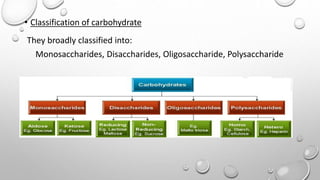
• Classification of carbohydrate
They broadly classified into:
Monosaccharides, Disaccharides, Oligosaccharide, Polysaccharide
I. Monosaccharides
Simplest group of carbohydrate and are often referred to as simple
sugars
Can’t be further hydrolysed
Monosaccharides are further divided into different categories based
on the functional group and number of carbon atoms
BASED ON FUNCTIONAL GROUPS
• ALDOSES— CHO e.g. Glyceraldehyde, Glucose
• KETOSES— C=O e.g. Dihydroxyacetone, Fructose
Based on the number of carbon atom
Trioses(3C), Tetroses(4c), Pentoses(5c) Hexoses(6c) and Heptoses(7c)
II. Oligosaccharides
Oligosaccharide contain 2-10 monosaccharide molecule which are
liberated on hydrolysis.
Based on number of monosaccharide they are further subdivided
into Disaccharides, Trisaccharides etc
III. Polysaccharides
Polysaccharides are polymers of monosaccharide unit
They have high molecular weight(up to a million)
They are usually tasteless(non-sugars) and form colloids with water
Polysaccharides are two types homopolysaccharides and
heteropolysaccharides
ISOMERISM
compounds that have the same chemical
formula but different structures are called
isomers. e.g. fructose, glucose, mannose,
and galactose are isomers of each other
having formula C6H12O6
Structural isomerism
Stereoisomerism
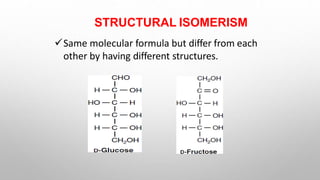
STRUCTURAL ISOMERISM
Same molecular formula but differ from each
other by having different structures.
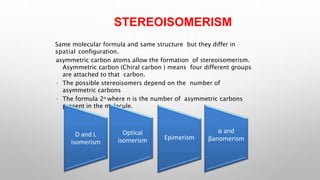
STEREOISOMERISM
Same molecular formula and same structure but they differ in
spatial configuration.
asymmetric carbon atoms allow the formation of stereoisomerism.
Asymmetric carbon (Chiral carbon ) means four different groups
are attached to that carbon.
The possible stereoisomers depend on the number of
asymmetric carbons
The formula 2n where n is the number of asymmetric carbons
present in the molecule.
D and L
isomerism
Optical
isomerism Epimerism
α and
βanomerism
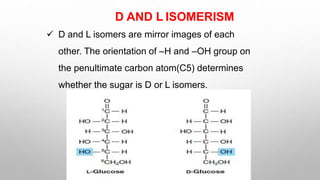
D AND L ISOMERISM
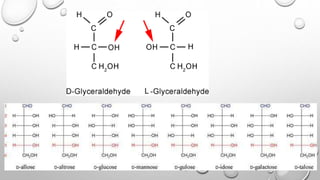
 D and L isomers are mirror images of each
other. The orientation of –H and –OH group on
the penultimate carbon atom(C5) determines
whether the sugar is D or L isomers.
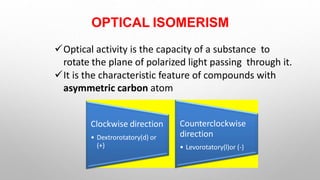
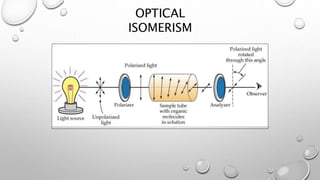
OPTICAL ISOMERISM
Optical activity is the capacity of a substance to
rotate the plane of polarized light passing through it.
It is the characteristic feature of compounds with
asymmetric carbon atom
Clockwise direction
• Dextrorotatory(d) or
(+)
Counterclockwise
direction
• Levorotatory(l)or (-)
OPTICAL
ISOMERISM
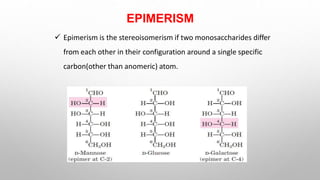
EPIMERISM
 Epimerism is the stereoisomerism if two monosaccharides differ
from each other in their configuration around a single specific
carbon(other than anomeric) atom.
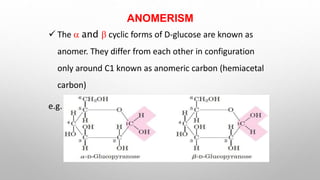
ANOMERISM
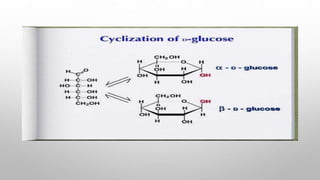
 The  and  cyclic forms of D-glucose are known as
anomer. They differ from each other in configuration
only around C1 known as anomeric carbon (hemiacetal
carbon)
e.g.  and  glucose,  and  fructose.
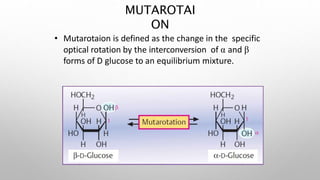
• Mutarotaion is defined as the change in the specific
optical rotation by the interconversion of α and β
forms of D glucose to an equilibrium mixture.
MUTAROTAI
ON
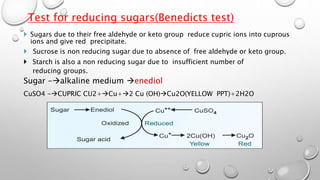
 Sugars due to their free aldehyde or keto group reduce cupric ions into cuprous
ions and give red precipitate.
 Sucrose is non reducing sugar due to absence of free aldehyde or keto group.
 Starch is also a non reducing sugar due to insufficient number of
reducing groups.
Sugar -alkaline medium enediol
CuSO4 -CUPRIC CU2+Cu+2 Cu (OH)Cu2O(YELLOW PPT)+2H2O
Test for reducing sugars(Benedicts test)
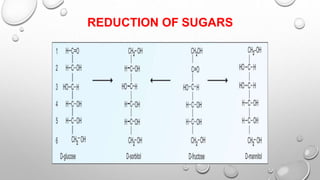
REDUCTION OF SUGARS
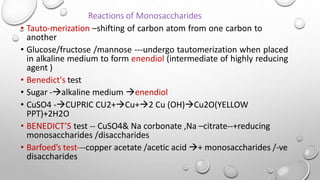
Reactions of Monosaccharides
• Tauto-merization –shifting of carbon atom from one carbon to
another
• Glucose/fructose /mannose ---undergo tautomerization when placed
in alkaline medium to form enendiol (intermediate of highly reducing
agent )
• Benedict's test
• Sugar -alkaline medium enendiol
• CuSO4 -CUPRIC CU2+Cu+2 Cu (OH)Cu2O(YELLOW
PPT)+2H2O
• BENEDICT’S test -- CuSO4& Na corbonate ,Na –citrate--+reducing
monosaccharides /disaccharides
• Barfoed’s test---copper acetate /acetic acid + monosaccharides /-ve
disaccharides
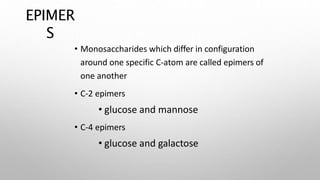
EPIMER
S
• Monosaccharides which differ in configuration
around one specific C-atom are called epimers of
one another
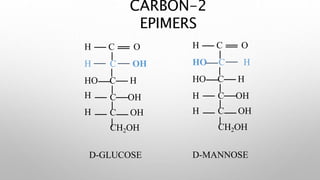
• C-2 epimers
• glucose and mannose
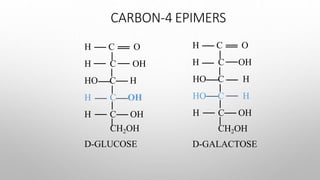
• C-4 epimers
• glucose and galactose
H C
H
O
C OH
HO C H
C OHH
H C OH
CH2OH
D-GLUCOSE
H C O
HO C H
HO C H
H C OH
H C OH
CH2OH
D-MANNOSE
CARBON-2
EPIMERS
CARBON-4 EPIMERS
H C
H
O
C OH
HO C H
H C OH
H C OH
CH2OH
D-GLUCOSE
H C
H
O
C OH
HO C H
HO C H
H C OH
CH2OH
D-GALACTOSE
STEREOISOMERS OF
MONASACCHARIDES• SAME STRUCTURAL FORMULA DIFFER IN THEIR SPACIAL
ARRANGEMENT/ CONFIGURATION
• Asymmetrical carbon atoms –attached to four different groups
• Number of possible isomers of given compound 2 n (n =number of
asymmetric carbon atoms within molecule )
• Glucose 4 asymmetric carbon atoms –2 4 =16 isomers
• D-Glucose –OH GROUP on penultimate carbon atoms is on right side
• L- Glucose –OH GROUP on penultimate carbon atoms is on LEFT side
• Glyceraldehyde is simplest reference carbohydrate -D & L ISOMERS
USED FOR COMPARISION
• Naturally occurring monosaccharide in mammalian tissue –D
configuration
• Enzymes present to metabolise D isomer =dextro -rotatory
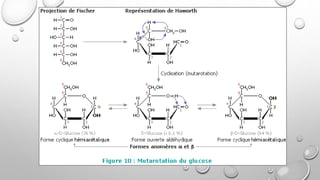
MUTAROTA
TION
• Alpha ,beta have diffirent optical activity
• GLUCOSE CRYSTALLIZED FROM WATER & ALCOHOLALPHA D –GLUCOSE(+112.2
ο ))
• GLUCOSE CRYSTALLIZED FROM WATER ABOVE 98ο & PYRIDINEBETA D
GLUCOSE (+18.8 ο )
• In aqueous solution the beta form of D glucose is more stable & predominant
• Definition –change in the specific optical rotation representing the
interconversion of alpha & beta form of D glucose to specific equilibrium
mixture.( 52.7% ).This conversion takes place through straight chain /linear form.
• Inter conversion is faster in alkaline form.
• equilibrium mixture-has 63% of beta form,36% of alpha form& 1% 0pen chain
form.
MUTAROTATION OF FRUCTOSE
• PYRANOSE (SIX MEMBER RING ) FUNAROSE (FIVE MEMBER RING )
• CHAIR & BOAT CONFIRMATION OF FRUCTOSE
BOAT CHAIR
(LESS STABLE ) (MORE STABLE )
AXIAL EQUATORIALARRANGEMENT
PARALLEL HEAVY GROUPS PERPENDICULAR HEAVY GROUPS
INVERSION OF SUGAR
ο ο
SUCROSE (+66.5 )+ SUCRASE /HCL α D-GLUCOPYRINOSE (+52.5 )
+
β D-FRUCTO FUNAROSE (-92
ο
)
DEXTRO –ROTATORY (SUCROSE )  LAEVO ROTATORY HYDROLYSATE (-39.5)
NON- REDUCING (BENEDICT’S NEGATIVE ) REDUCING (BENEDICT’S POSITIVE)
• SUCROSE –INVERT SUGAR ,SUCRASE –INVERTASE
• SWEETNER
• MAJOR CARBOHYDRATE– PHOTOSYNTHESIS
• STORAGE & TRANSPORT FORM IN PLANTS ,ROOTS ,TUBERS
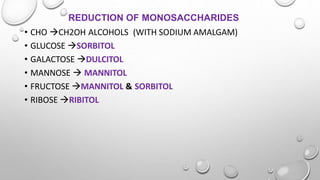
REDUCTION OF MONOSACCHARIDES
• CHO CH2OH ALCOHOLS (WITH SODIUM AMALGAM)
• GLUCOSE SORBITOL
• GALACTOSE DULCITOL
• MANNOSE  MANNITOL
• FRUCTOSE MANNITOL & SORBITOL
• RIBOSE RIBITOL
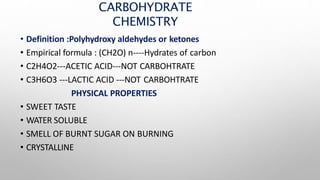
CARBOHYDRATE
CHEMISTRY
• Definition :Polyhydroxy aldehydes or ketones
• Empirical formula : (CH2O) n----Hydrates of carbon
• C2H4O2---ACETIC ACID---NOT CARBOHTRATE
• C3H6O3 ---LACTIC ACID ---NOT CARBOHTRATE
PHYSICAL PROPERTIES
• SWEET TASTE
• WATER SOLUBLE
• SMELL OF BURNT SUGAR ON BURNING
• CRYSTALLINE
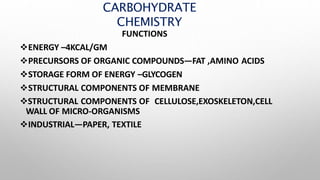
CARBOHYDRATE
CHEMISTRY
FUNCTIONS
ENERGY –4KCAL/GM
PRECURSORS OF ORGANIC COMPOUNDS—FAT ,AMINO ACIDS
STORAGE FORM OF ENERGY –GLYCOGEN
STRUCTURAL COMPONENTS OF MEMBRANE
STRUCTURAL COMPONENTS OF CELLULOSE,EXOSKELETON,CELL
WALL OF MICRO-ORGANISMS
INDUSTRIAL—PAPER, TEXTILE
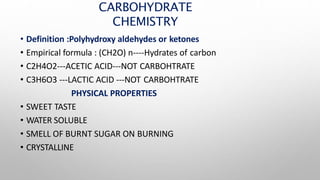
CARBOHYDRATE
CHEMISTRY
• Definition :Polyhydroxy aldehydes or ketones
• Empirical formula : (CH2O) n----Hydrates of carbon
• C2H4O2---ACETIC ACID---NOT CARBOHTRATE
• C3H6O3 ---LACTIC ACID ---NOT CARBOHTRATE
PHYSICAL PROPERTIES
• SWEET TASTE
• WATER SOLUBLE
• SMELL OF BURNT SUGAR ON BURNING
• CRYSTALLINE
CARBOHYDRATE
CHEMISTRY
FUNCTIONS
ENERGY –4KCAL/GM
PRECURSORS OF ORGANIC COMPOUNDS—FAT ,AMINO ACIDS
STORAGE FORM OF ENERGY –GLYCOGEN
STRUCTURAL COMPONENTS OF MEMBRANE
STRUCTURAL COMPONENTS OF CELLULOSE,EXOSKELETON,CELL
WALL OF MICRO-ORGANISMS
INDUSTRIAL—PAPER, TEXTILE
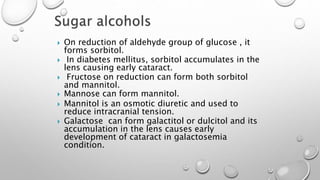
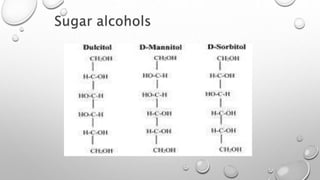
 On reduction of aldehyde group of glucose , it
forms sorbitol.
 In diabetes mellitus, sorbitol accumulates in the
lens causing early cataract.
 Fructose on reduction can form both sorbitol
and mannitol.
 Mannose can form mannitol.
 Mannitol is an osmotic diuretic and used to
reduce intracranial tension.
 Galactose can form galactitol or dulcitol and its
accumulation in the lens causes early
development of cataract in galactosemia
condition.
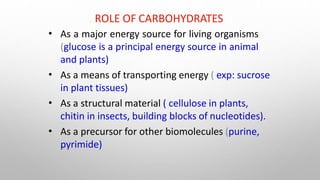
. ROLE OF CARBOHYDRATES
•
•
•
•
As a major energy source for living organisms
(glucose is a principal energy source in animal
and plants)
As a means of transporting energy ( exp: sucrose
in plant tissues)
As a structural material ( cellulose in plants,
chitin in insects, building blocks of nucleotides).
As a precursor for other biomolecules (purine,
pyrimide)
IMPORTANCE OF MONOSACCHARIDES: GLUCOSE
THE STORAGE FORM OF GLUCOSE IN HUMANS IS
GLYCOGEN
IN PLANTS IT IS STORED MAINLY IN THE FORM
OF STARCH.
DIETARY SOURCES: FRUITS, VEGETABLES(IN THE
FORM OF STARCH), HONEY
BIOLOGICAL SIGNIFICANCE
BRAIN CELLS, RBCS AND THE GROWING
EMBRYO ONLY UTILIZE GLUCOSE AS A SOURCE
OF ENERGY.
 ENERGY SOURCE FOR CELLS IN THE BODY.
BUILDING BLOCK OF DISACCHARIDES AND
POLYSACHHARIDES
 IT IS THE SUGAR PRESENT IN BLOOD
IMPORTANT MONOSACCHARIDES
•
•
•
GLUCOSE
FRUCTOSE
GALACTOSE
D-Glucose:
D-glucose (dextrose) is the primary fuel in living cells
especially in brain cells that have few or no
mitochondria.
Cells such as eyeballs have limited oxygen supply and
use large amount of glucose to generate energy
Dietary sources include plant starch, and the
disaccharides lactose, maltose, and sucrose
GALACTOSE: IMPORTANCE AND BIOLOGICAL
SIGNIFICANCE
DIETARY SOURCE: DIARY PRODUCTS
 LESS SWEET THAN GLUCOSE
USED IN THE SYNTHESIS OF MILK SUGAR IN
MAMMARY GLANDS
IT IS A CONSTITUENT OF GLYCOLIPIDS AND
GLYCOPROTEINS
IT IS REQUIRED FOR THE DEVELOPMENT OF
BRAIN AND NERVOUS TISSUE IN INFANTS.
MANNOSE
 IT DOES NOT OCCUR FREE IN NATURE
IN THE HUMAN BODY, IT IS FOUND AS A
CONSITUENT OF GLYCOPROTEINS
ITS REDUCTION PRODUCT THAT IS MANNITOL
IS IMPORTANT CLINICALLY IN CEREBRAL
EDEMA.
CARBOHYDRATE EFFECT ON
BRAIN FUNCTION
41
•
•
When carbohydrate intake is high, comprising 70% to 80% of
total kcal, the brain produces more serotonin.
When produced in excess, serotonin causes a carving for
carbohydrate and therefore increased consumption of
carbohydrate, which in turn stimulates the production of yet
more excess serotonin.
This make a person sleepy and sluggish.
SOME ASPECTS OF THE ROLE OF
CARBOHYDRATE
42
•
•
•
•
•
•
Protein Sparing Action of Carbohydrates
The Need for Carbohydrates for the Oxidation of Fats
Carbohydrates as a Source of Energy for Muscular Work
Special Functions of Carbohydrates in Liver
Synthesis of Ribose from Glucose
Carbohydrate and Dental Health
. ROLE OF CARBOHYDRATES
•
•
•
•
As a major energy source for living organisms
(glucose is a principal energy source in animal
and plants)
As a means of transporting energy ( exp: sucrose
in plant tissues)
As a structural material ( cellulose in plants,
chitin in insects, building blocks of nucleotides).
As a precursor for other biomolecules (purine,
pyrimide)
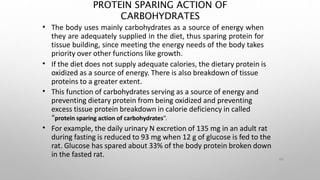
PROTEIN SPARING ACTION OF
CARBOHYDRATES
44
•
•
•
•
The body uses mainly carbohydrates as a source of energy when
they are adequately supplied in the diet, thus sparing protein for
tissue building, since meeting the energy needs of the body takes
priority over other functions like growth.
If the diet does not supply adequate calories, the dietary protein is
oxidized as a source of energy. There is also breakdown of tissue
proteins to a greater extent.
This function of carbohydrates serving as a source of energy and
preventing dietary protein from being oxidized and preventing
excess tissue protein breakdown in calorie deficiency in called
“protein sparing action of carbohydrates”.
For example, the daily urinary N excretion of 135 mg in an adult rat
during fasting is reduced to 93 mg when 12 g of glucose is fed to the
rat. Glucose has spared about 33% of the body protein broken down
in the fasted rat.
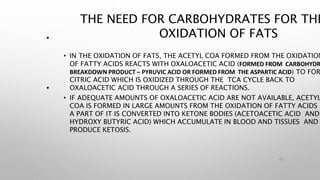
THE NEED FOR CARBOHYDRATES FOR THE
OXIDATION OF FATS
• IN THE OXIDATION OF FATS, THE ACETYL COA FORMED FROM THE OXIDATION
OF FATTY ACIDS REACTS WITH OXALOACETIC ACID (FORMED FROM CARBOHYDR
BREAKDOWN PRODUCT – PYRUVIC ACID OR FORMED FROM THE ASPARTIC ACID) TO FOR
CITRIC ACID WHICH IS OXIDIZED THROUGH THE TCA CYCLE BACK TO
OXALOACETIC ACID THROUGH A SERIES OF REACTIONS.
• IF ADEQUATE AMOUNTS OF OXALOACETIC ACID ARE NOT AVAILABLE, ACETYL
COA IS FORMED IN LARGE AMOUNTS FROM THE OXIDATION OF FATTY ACIDS
A PART OF IT IS CONVERTED INTO KETONE BODIES (ACETOACETIC ACID AND
HYDROXY BUTYRIC ACID) WHICH ACCUMULATE IN BLOOD AND TISSUES AND
PRODUCE KETOSIS.
45
•
•
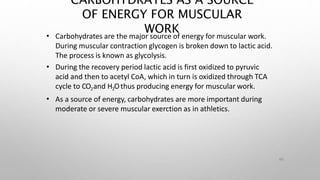
CARBOHYDRATES AS A SOURCE
OF ENERGY FOR MUSCULAR
WORK
46
•
•
•
Carbohydrates are the major source of energy for muscular work.
During muscular contraction glycogen is broken down to lactic acid.
The process is known as glycolysis.
During the recovery period lactic acid is first oxidized to pyruvic
acid and then to acetyl CoA, which in turn is oxidized through TCA
cycle to CO2and H2Othus producing energy for muscular work.
As a source of energy, carbohydrates are more important during
moderate or severe muscular exerction as in athletics.
CARBOHYDRATE AND
DENTAL CARIES
• DIETARY CARBOHYDRATE IS IMPLICATED AS A MAJOR CAUSE OF DENTAL
CARIES, OR TOOTH DECAY.
• HIGH INTAKE OF DIETARY SUGARS  MULTIPLICATION OF ORAL BACTERIA 
PRODUCTION OF ACID  LOW ORAL PH  DEMINERALIZATION OF TEETH 
DENTAL CARIES.
• CARBOHYDRATE AS GLYCOPROTEINS
• CARBOHYDRATES ARE FOUND IN THE FORM OF POLYSACCHARIDE CHAINS
ATTACHED TO PROTEINS SUCH AS GLYCOPROTEINS. AS SUCH THEY ARE
IMPORTANT CONSTITUENTS OF TISSUE ANTIGENS (IN THE CELL MEMBRANE)
AND SECRETED PROTEINS.
47
•
•
•
•

Carbohydrate: Chemistry & Function

  • 1.
    CHEMISTRY AND FUNCTIONSOF CARBOHYDRATE PREPARED BY- SK AZIZ IKBAL
  • 2.
    DEFINITION Poly hydroxy Aldehydeor poly hydroxy ketones & the substances that will yield such substances on hydrolysis.
  • 3.
    • Classification ofcarbohydrate They broadly classified into: Monosaccharides, Disaccharides, Oligosaccharide, Polysaccharide
  • 4.
    I. Monosaccharides Simplest groupof carbohydrate and are often referred to as simple sugars Can’t be further hydrolysed Monosaccharides are further divided into different categories based on the functional group and number of carbon atoms BASED ON FUNCTIONAL GROUPS • ALDOSES— CHO e.g. Glyceraldehyde, Glucose • KETOSES— C=O e.g. Dihydroxyacetone, Fructose Based on the number of carbon atom Trioses(3C), Tetroses(4c), Pentoses(5c) Hexoses(6c) and Heptoses(7c)
  • 5.
    II. Oligosaccharides Oligosaccharide contain2-10 monosaccharide molecule which are liberated on hydrolysis. Based on number of monosaccharide they are further subdivided into Disaccharides, Trisaccharides etc III. Polysaccharides Polysaccharides are polymers of monosaccharide unit They have high molecular weight(up to a million) They are usually tasteless(non-sugars) and form colloids with water Polysaccharides are two types homopolysaccharides and heteropolysaccharides
  • 6.
    ISOMERISM compounds that havethe same chemical formula but different structures are called isomers. e.g. fructose, glucose, mannose, and galactose are isomers of each other having formula C6H12O6 Structural isomerism Stereoisomerism
  • 7.
    STRUCTURAL ISOMERISM Same molecularformula but differ from each other by having different structures.
  • 8.
    STEREOISOMERISM Same molecular formulaand same structure but they differ in spatial configuration. asymmetric carbon atoms allow the formation of stereoisomerism. Asymmetric carbon (Chiral carbon ) means four different groups are attached to that carbon. The possible stereoisomers depend on the number of asymmetric carbons The formula 2n where n is the number of asymmetric carbons present in the molecule. D and L isomerism Optical isomerism Epimerism α and βanomerism
  • 10.
    D AND LISOMERISM  D and L isomers are mirror images of each other. The orientation of –H and –OH group on the penultimate carbon atom(C5) determines whether the sugar is D or L isomers.
  • 11.
    OPTICAL ISOMERISM Optical activityis the capacity of a substance to rotate the plane of polarized light passing through it. It is the characteristic feature of compounds with asymmetric carbon atom Clockwise direction • Dextrorotatory(d) or (+) Counterclockwise direction • Levorotatory(l)or (-)
  • 12.
  • 13.
    EPIMERISM  Epimerism isthe stereoisomerism if two monosaccharides differ from each other in their configuration around a single specific carbon(other than anomeric) atom.
  • 14.
    ANOMERISM  The and  cyclic forms of D-glucose are known as anomer. They differ from each other in configuration only around C1 known as anomeric carbon (hemiacetal carbon) e.g.  and  glucose,  and  fructose.
  • 16.
    • Mutarotaion isdefined as the change in the specific optical rotation by the interconversion of α and β forms of D glucose to an equilibrium mixture. MUTAROTAI ON
  • 18.
     Sugars dueto their free aldehyde or keto group reduce cupric ions into cuprous ions and give red precipitate.  Sucrose is non reducing sugar due to absence of free aldehyde or keto group.  Starch is also a non reducing sugar due to insufficient number of reducing groups. Sugar -alkaline medium enediol CuSO4 -CUPRIC CU2+Cu+2 Cu (OH)Cu2O(YELLOW PPT)+2H2O Test for reducing sugars(Benedicts test)
  • 19.
  • 20.
    Reactions of Monosaccharides •Tauto-merization –shifting of carbon atom from one carbon to another • Glucose/fructose /mannose ---undergo tautomerization when placed in alkaline medium to form enendiol (intermediate of highly reducing agent ) • Benedict's test • Sugar -alkaline medium enendiol • CuSO4 -CUPRIC CU2+Cu+2 Cu (OH)Cu2O(YELLOW PPT)+2H2O • BENEDICT’S test -- CuSO4& Na corbonate ,Na –citrate--+reducing monosaccharides /disaccharides • Barfoed’s test---copper acetate /acetic acid + monosaccharides /-ve disaccharides
  • 21.
    EPIMER S • Monosaccharides whichdiffer in configuration around one specific C-atom are called epimers of one another • C-2 epimers • glucose and mannose • C-4 epimers • glucose and galactose
  • 22.
    H C H O C OH HOC H C OHH H C OH CH2OH D-GLUCOSE H C O HO C H HO C H H C OH H C OH CH2OH D-MANNOSE CARBON-2 EPIMERS
  • 23.
    CARBON-4 EPIMERS H C H O COH HO C H H C OH H C OH CH2OH D-GLUCOSE H C H O C OH HO C H HO C H H C OH CH2OH D-GALACTOSE
  • 24.
    STEREOISOMERS OF MONASACCHARIDES• SAMESTRUCTURAL FORMULA DIFFER IN THEIR SPACIAL ARRANGEMENT/ CONFIGURATION • Asymmetrical carbon atoms –attached to four different groups • Number of possible isomers of given compound 2 n (n =number of asymmetric carbon atoms within molecule ) • Glucose 4 asymmetric carbon atoms –2 4 =16 isomers • D-Glucose –OH GROUP on penultimate carbon atoms is on right side • L- Glucose –OH GROUP on penultimate carbon atoms is on LEFT side • Glyceraldehyde is simplest reference carbohydrate -D & L ISOMERS USED FOR COMPARISION • Naturally occurring monosaccharide in mammalian tissue –D configuration • Enzymes present to metabolise D isomer =dextro -rotatory
  • 25.
    MUTAROTA TION • Alpha ,betahave diffirent optical activity • GLUCOSE CRYSTALLIZED FROM WATER & ALCOHOLALPHA D –GLUCOSE(+112.2 ο )) • GLUCOSE CRYSTALLIZED FROM WATER ABOVE 98ο & PYRIDINEBETA D GLUCOSE (+18.8 ο ) • In aqueous solution the beta form of D glucose is more stable & predominant • Definition –change in the specific optical rotation representing the interconversion of alpha & beta form of D glucose to specific equilibrium mixture.( 52.7% ).This conversion takes place through straight chain /linear form. • Inter conversion is faster in alkaline form. • equilibrium mixture-has 63% of beta form,36% of alpha form& 1% 0pen chain form.
  • 26.
    MUTAROTATION OF FRUCTOSE •PYRANOSE (SIX MEMBER RING ) FUNAROSE (FIVE MEMBER RING ) • CHAIR & BOAT CONFIRMATION OF FRUCTOSE BOAT CHAIR (LESS STABLE ) (MORE STABLE ) AXIAL EQUATORIALARRANGEMENT PARALLEL HEAVY GROUPS PERPENDICULAR HEAVY GROUPS
  • 27.
    INVERSION OF SUGAR οο SUCROSE (+66.5 )+ SUCRASE /HCL α D-GLUCOPYRINOSE (+52.5 ) + β D-FRUCTO FUNAROSE (-92 ο ) DEXTRO –ROTATORY (SUCROSE )  LAEVO ROTATORY HYDROLYSATE (-39.5) NON- REDUCING (BENEDICT’S NEGATIVE ) REDUCING (BENEDICT’S POSITIVE) • SUCROSE –INVERT SUGAR ,SUCRASE –INVERTASE • SWEETNER • MAJOR CARBOHYDRATE– PHOTOSYNTHESIS • STORAGE & TRANSPORT FORM IN PLANTS ,ROOTS ,TUBERS
  • 28.
    REDUCTION OF MONOSACCHARIDES •CHO CH2OH ALCOHOLS (WITH SODIUM AMALGAM) • GLUCOSE SORBITOL • GALACTOSE DULCITOL • MANNOSE  MANNITOL • FRUCTOSE MANNITOL & SORBITOL • RIBOSE RIBITOL
  • 29.
    CARBOHYDRATE CHEMISTRY • Definition :Polyhydroxyaldehydes or ketones • Empirical formula : (CH2O) n----Hydrates of carbon • C2H4O2---ACETIC ACID---NOT CARBOHTRATE • C3H6O3 ---LACTIC ACID ---NOT CARBOHTRATE PHYSICAL PROPERTIES • SWEET TASTE • WATER SOLUBLE • SMELL OF BURNT SUGAR ON BURNING • CRYSTALLINE
  • 30.
    CARBOHYDRATE CHEMISTRY FUNCTIONS ENERGY –4KCAL/GM PRECURSORS OFORGANIC COMPOUNDS—FAT ,AMINO ACIDS STORAGE FORM OF ENERGY –GLYCOGEN STRUCTURAL COMPONENTS OF MEMBRANE STRUCTURAL COMPONENTS OF CELLULOSE,EXOSKELETON,CELL WALL OF MICRO-ORGANISMS INDUSTRIAL—PAPER, TEXTILE
  • 31.
    CARBOHYDRATE CHEMISTRY • Definition :Polyhydroxyaldehydes or ketones • Empirical formula : (CH2O) n----Hydrates of carbon • C2H4O2---ACETIC ACID---NOT CARBOHTRATE • C3H6O3 ---LACTIC ACID ---NOT CARBOHTRATE PHYSICAL PROPERTIES • SWEET TASTE • WATER SOLUBLE • SMELL OF BURNT SUGAR ON BURNING • CRYSTALLINE
  • 32.
    CARBOHYDRATE CHEMISTRY FUNCTIONS ENERGY –4KCAL/GM PRECURSORS OFORGANIC COMPOUNDS—FAT ,AMINO ACIDS STORAGE FORM OF ENERGY –GLYCOGEN STRUCTURAL COMPONENTS OF MEMBRANE STRUCTURAL COMPONENTS OF CELLULOSE,EXOSKELETON,CELL WALL OF MICRO-ORGANISMS INDUSTRIAL—PAPER, TEXTILE
  • 33.
     On reductionof aldehyde group of glucose , it forms sorbitol.  In diabetes mellitus, sorbitol accumulates in the lens causing early cataract.  Fructose on reduction can form both sorbitol and mannitol.  Mannose can form mannitol.  Mannitol is an osmotic diuretic and used to reduce intracranial tension.  Galactose can form galactitol or dulcitol and its accumulation in the lens causes early development of cataract in galactosemia condition.
  • 35.
    . ROLE OFCARBOHYDRATES • • • • As a major energy source for living organisms (glucose is a principal energy source in animal and plants) As a means of transporting energy ( exp: sucrose in plant tissues) As a structural material ( cellulose in plants, chitin in insects, building blocks of nucleotides). As a precursor for other biomolecules (purine, pyrimide)
  • 36.
    IMPORTANCE OF MONOSACCHARIDES:GLUCOSE THE STORAGE FORM OF GLUCOSE IN HUMANS IS GLYCOGEN IN PLANTS IT IS STORED MAINLY IN THE FORM OF STARCH. DIETARY SOURCES: FRUITS, VEGETABLES(IN THE FORM OF STARCH), HONEY
  • 37.
    BIOLOGICAL SIGNIFICANCE BRAIN CELLS,RBCS AND THE GROWING EMBRYO ONLY UTILIZE GLUCOSE AS A SOURCE OF ENERGY.  ENERGY SOURCE FOR CELLS IN THE BODY. BUILDING BLOCK OF DISACCHARIDES AND POLYSACHHARIDES  IT IS THE SUGAR PRESENT IN BLOOD
  • 38.
    IMPORTANT MONOSACCHARIDES • • • GLUCOSE FRUCTOSE GALACTOSE D-Glucose: D-glucose (dextrose)is the primary fuel in living cells especially in brain cells that have few or no mitochondria. Cells such as eyeballs have limited oxygen supply and use large amount of glucose to generate energy Dietary sources include plant starch, and the disaccharides lactose, maltose, and sucrose
  • 39.
    GALACTOSE: IMPORTANCE ANDBIOLOGICAL SIGNIFICANCE DIETARY SOURCE: DIARY PRODUCTS  LESS SWEET THAN GLUCOSE USED IN THE SYNTHESIS OF MILK SUGAR IN MAMMARY GLANDS IT IS A CONSTITUENT OF GLYCOLIPIDS AND GLYCOPROTEINS IT IS REQUIRED FOR THE DEVELOPMENT OF BRAIN AND NERVOUS TISSUE IN INFANTS.
  • 40.
    MANNOSE  IT DOESNOT OCCUR FREE IN NATURE IN THE HUMAN BODY, IT IS FOUND AS A CONSITUENT OF GLYCOPROTEINS ITS REDUCTION PRODUCT THAT IS MANNITOL IS IMPORTANT CLINICALLY IN CEREBRAL EDEMA.
  • 41.
    CARBOHYDRATE EFFECT ON BRAINFUNCTION 41 • • When carbohydrate intake is high, comprising 70% to 80% of total kcal, the brain produces more serotonin. When produced in excess, serotonin causes a carving for carbohydrate and therefore increased consumption of carbohydrate, which in turn stimulates the production of yet more excess serotonin. This make a person sleepy and sluggish.
  • 42.
    SOME ASPECTS OFTHE ROLE OF CARBOHYDRATE 42 • • • • • • Protein Sparing Action of Carbohydrates The Need for Carbohydrates for the Oxidation of Fats Carbohydrates as a Source of Energy for Muscular Work Special Functions of Carbohydrates in Liver Synthesis of Ribose from Glucose Carbohydrate and Dental Health
  • 43.
    . ROLE OFCARBOHYDRATES • • • • As a major energy source for living organisms (glucose is a principal energy source in animal and plants) As a means of transporting energy ( exp: sucrose in plant tissues) As a structural material ( cellulose in plants, chitin in insects, building blocks of nucleotides). As a precursor for other biomolecules (purine, pyrimide)
  • 44.
    PROTEIN SPARING ACTIONOF CARBOHYDRATES 44 • • • • The body uses mainly carbohydrates as a source of energy when they are adequately supplied in the diet, thus sparing protein for tissue building, since meeting the energy needs of the body takes priority over other functions like growth. If the diet does not supply adequate calories, the dietary protein is oxidized as a source of energy. There is also breakdown of tissue proteins to a greater extent. This function of carbohydrates serving as a source of energy and preventing dietary protein from being oxidized and preventing excess tissue protein breakdown in calorie deficiency in called “protein sparing action of carbohydrates”. For example, the daily urinary N excretion of 135 mg in an adult rat during fasting is reduced to 93 mg when 12 g of glucose is fed to the rat. Glucose has spared about 33% of the body protein broken down in the fasted rat.
  • 45.
    THE NEED FORCARBOHYDRATES FOR THE OXIDATION OF FATS • IN THE OXIDATION OF FATS, THE ACETYL COA FORMED FROM THE OXIDATION OF FATTY ACIDS REACTS WITH OXALOACETIC ACID (FORMED FROM CARBOHYDR BREAKDOWN PRODUCT – PYRUVIC ACID OR FORMED FROM THE ASPARTIC ACID) TO FOR CITRIC ACID WHICH IS OXIDIZED THROUGH THE TCA CYCLE BACK TO OXALOACETIC ACID THROUGH A SERIES OF REACTIONS. • IF ADEQUATE AMOUNTS OF OXALOACETIC ACID ARE NOT AVAILABLE, ACETYL COA IS FORMED IN LARGE AMOUNTS FROM THE OXIDATION OF FATTY ACIDS A PART OF IT IS CONVERTED INTO KETONE BODIES (ACETOACETIC ACID AND HYDROXY BUTYRIC ACID) WHICH ACCUMULATE IN BLOOD AND TISSUES AND PRODUCE KETOSIS. 45 • •
  • 46.
    CARBOHYDRATES AS ASOURCE OF ENERGY FOR MUSCULAR WORK 46 • • • Carbohydrates are the major source of energy for muscular work. During muscular contraction glycogen is broken down to lactic acid. The process is known as glycolysis. During the recovery period lactic acid is first oxidized to pyruvic acid and then to acetyl CoA, which in turn is oxidized through TCA cycle to CO2and H2Othus producing energy for muscular work. As a source of energy, carbohydrates are more important during moderate or severe muscular exerction as in athletics.
  • 47.
    CARBOHYDRATE AND DENTAL CARIES •DIETARY CARBOHYDRATE IS IMPLICATED AS A MAJOR CAUSE OF DENTAL CARIES, OR TOOTH DECAY. • HIGH INTAKE OF DIETARY SUGARS  MULTIPLICATION OF ORAL BACTERIA  PRODUCTION OF ACID  LOW ORAL PH  DEMINERALIZATION OF TEETH  DENTAL CARIES. • CARBOHYDRATE AS GLYCOPROTEINS • CARBOHYDRATES ARE FOUND IN THE FORM OF POLYSACCHARIDE CHAINS ATTACHED TO PROTEINS SUCH AS GLYCOPROTEINS. AS SUCH THEY ARE IMPORTANT CONSTITUENTS OF TISSUE ANTIGENS (IN THE CELL MEMBRANE) AND SECRETED PROTEINS. 47 • • • •