H3.7 – Physical Education Unit Introduction
What Will We Be Learning… Sports Nutrition Sports Coaching Biomechanics Sports Injuries Patterns of Participation & Motivation for sports
Practical Classes Prac Classes will be held each Friday Periods 4 and 5 unless otherwise mentioned You are required to bring all necessary gear
What Types of Sports? We will aim to participate in a variety of ‘Sports For Life’ These include sports such as……
SPORTS NUTRITION
IS BASED UPON…… The basic principles that govern general nutrition That is, a balance of all nutrients, a variety of food and moderation of the intake of that food. With that in mind, the importance of the training diet has been recognised.
THE TRAINING DIET.. Athletes now understand that they must eat well to ensure maximum return from heavy training schedules. The competition diet is established providing athletes with knowledge of special eating practices, before, during and after the event to maximise their performance.
Each sports person will have different dietary requirements depending on… Training Age Sex Body size Sport played Environment for training and competition
GENERAL PRINCIPLES OF SPORTS NUTRITION Recommended balanced diet for average sports person is…. 55 – 60% Carbohydrates 25 – 30% Fats 10 – 15% Protein Recommended balanced diet for more strenuous athlete is… 70% carbohydrates 15 – 20% Fats 10 – 15% Protein
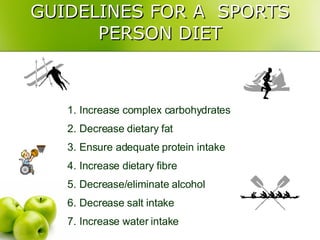
GUIDELINES FOR A  SPORTS PERSON DIET Increase complex carbohydrates Decrease dietary fat Ensure adequate protein intake Increase dietary fibre Decrease/eliminate alcohol Decrease salt intake Increase water intake
COMPETITION DIET It is important to understand nutritionally related factors that cause fatigue & reduced performance. These being : - depletion of muscle stores    &  dehydration
STRATEGIES TO REDUCE, DELAY OR OFFSET THESE FACTORS General preparation of energy stores (increase carbohydrate intake to ensure natural storage capacity) Carbohydrate loading for endurance events (gradually reduce training early in the week, maintain normal diet to maintain carb levels – reduce training further and consume high level of carbohydrates  80 – 85% of kj intake) Pre-competition meal (ensure that glycogen stores are topped up for strenuous exercise, adequate hydration)
STRATEGIES CONT.. Carbohydrate supplementation (marathons) (generally in fluid form in small amounts and frequent intervals – this maintains blood glucose levels and spares muscle glycogen) Glycogen replenishment (first 15 min after exercise eat foods high in glycogen eg fresh fruit, lollies….. Following two hours meal high in complex carbs & protein Fluid replenishment Before, during and after
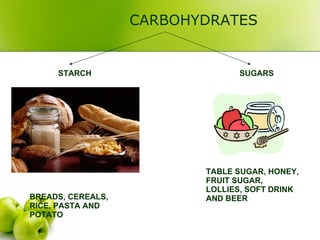
CARBOHYDRATES STARCH SUGARS BREADS, CEREALS, RICE, PASTA AND POTATO TABLE SUGAR, HONEY, FRUIT SUGAR, LOLLIES, SOFT DRINK AND BEER
  CARBOHYDRATES COMPLEX (contain other useful nutrients) Preferred option for carb intake due to being an efficient energy source, readily used. Stores depleted quickly so need to be replaced frequently SIMPLE Carbohydrates stored as GLYCOGEN in the muscles and liver. Muscles cannot perform without it. Therefore need to be replenished
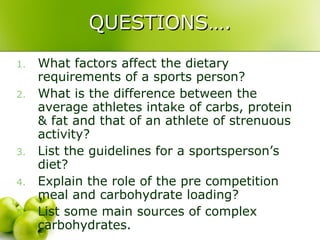
QUESTIONS…. What factors affect the dietary requirements of a sports person? What is the difference between the average athletes intake of carbs, protein & fat and that of an athlete of strenuous activity? List the guidelines for a sportsperson’s diet? Explain the role of the pre competition meal and carbohydrate loading? List some main sources of complex carbohydrates.
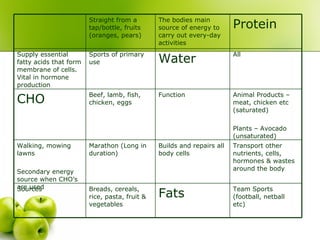
Team Sports (football, netball etc) Fats Breads, cereals, rice, pasta, fruit & vegetables Sources Transport other nutrients, cells, hormones & wastes around the body Builds and repairs all body cells Marathon (Long in duration) Walking, mowing lawns Secondary energy source when CHO’s are used Animal Products – meat, chicken etc (saturated) Plants – Avocado (unsaturated) Function Beef, lamb, fish, chicken, eggs CHO All Water Sports of primary use Supply essential fatty acids that form membrane of cells. Vital in hormone production Protein The bodies main source of energy to carry out every-day activities Straight from a tap/bottle, fruits (oranges, pears)
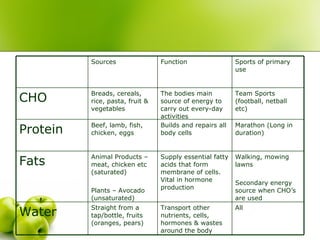
All Transport other nutrients, cells, hormones & wastes around the body Straight from a tap/bottle, fruits (oranges, pears) Water Walking, mowing lawns Secondary energy source when CHO’s are used Supply essential fatty acids that form membrane of cells. Vital in hormone production Animal Products – meat, chicken etc (saturated) Plants – Avocado (unsaturated) Fats Marathon (Long in duration) Builds and repairs all body cells Beef, lamb, fish, chicken, eggs Protein Team Sports (football, netball etc) The bodies main source of energy to carry out every-day activities Breads, cereals, rice, pasta, fruit & vegetables CHO Sports of primary use Function Sources
Working in Groups of 2 or 3 you are to create a poster detailing the suggestions of healthy eating Posters will be a reference guide for future activities

Sports Nutrition Powerpoint

  • 1.
    H3.7 – PhysicalEducation Unit Introduction
  • 2.
    What Will WeBe Learning… Sports Nutrition Sports Coaching Biomechanics Sports Injuries Patterns of Participation & Motivation for sports
  • 3.
    Practical Classes PracClasses will be held each Friday Periods 4 and 5 unless otherwise mentioned You are required to bring all necessary gear
  • 4.
    What Types ofSports? We will aim to participate in a variety of ‘Sports For Life’ These include sports such as……
  • 5.
  • 6.
    IS BASED UPON……The basic principles that govern general nutrition That is, a balance of all nutrients, a variety of food and moderation of the intake of that food. With that in mind, the importance of the training diet has been recognised.
  • 7.
    THE TRAINING DIET..Athletes now understand that they must eat well to ensure maximum return from heavy training schedules. The competition diet is established providing athletes with knowledge of special eating practices, before, during and after the event to maximise their performance.
  • 8.
    Each sports personwill have different dietary requirements depending on… Training Age Sex Body size Sport played Environment for training and competition
  • 9.
    GENERAL PRINCIPLES OFSPORTS NUTRITION Recommended balanced diet for average sports person is…. 55 – 60% Carbohydrates 25 – 30% Fats 10 – 15% Protein Recommended balanced diet for more strenuous athlete is… 70% carbohydrates 15 – 20% Fats 10 – 15% Protein
  • 10.
    GUIDELINES FOR A SPORTS PERSON DIET Increase complex carbohydrates Decrease dietary fat Ensure adequate protein intake Increase dietary fibre Decrease/eliminate alcohol Decrease salt intake Increase water intake
  • 11.
    COMPETITION DIET Itis important to understand nutritionally related factors that cause fatigue & reduced performance. These being : - depletion of muscle stores & dehydration
  • 12.
    STRATEGIES TO REDUCE,DELAY OR OFFSET THESE FACTORS General preparation of energy stores (increase carbohydrate intake to ensure natural storage capacity) Carbohydrate loading for endurance events (gradually reduce training early in the week, maintain normal diet to maintain carb levels – reduce training further and consume high level of carbohydrates 80 – 85% of kj intake) Pre-competition meal (ensure that glycogen stores are topped up for strenuous exercise, adequate hydration)
  • 13.
    STRATEGIES CONT.. Carbohydratesupplementation (marathons) (generally in fluid form in small amounts and frequent intervals – this maintains blood glucose levels and spares muscle glycogen) Glycogen replenishment (first 15 min after exercise eat foods high in glycogen eg fresh fruit, lollies….. Following two hours meal high in complex carbs & protein Fluid replenishment Before, during and after
  • 14.
    CARBOHYDRATES STARCH SUGARSBREADS, CEREALS, RICE, PASTA AND POTATO TABLE SUGAR, HONEY, FRUIT SUGAR, LOLLIES, SOFT DRINK AND BEER
  • 15.
    CARBOHYDRATESCOMPLEX (contain other useful nutrients) Preferred option for carb intake due to being an efficient energy source, readily used. Stores depleted quickly so need to be replaced frequently SIMPLE Carbohydrates stored as GLYCOGEN in the muscles and liver. Muscles cannot perform without it. Therefore need to be replenished
  • 16.
    QUESTIONS…. What factorsaffect the dietary requirements of a sports person? What is the difference between the average athletes intake of carbs, protein & fat and that of an athlete of strenuous activity? List the guidelines for a sportsperson’s diet? Explain the role of the pre competition meal and carbohydrate loading? List some main sources of complex carbohydrates.
  • 17.
    Team Sports (football,netball etc) Fats Breads, cereals, rice, pasta, fruit & vegetables Sources Transport other nutrients, cells, hormones & wastes around the body Builds and repairs all body cells Marathon (Long in duration) Walking, mowing lawns Secondary energy source when CHO’s are used Animal Products – meat, chicken etc (saturated) Plants – Avocado (unsaturated) Function Beef, lamb, fish, chicken, eggs CHO All Water Sports of primary use Supply essential fatty acids that form membrane of cells. Vital in hormone production Protein The bodies main source of energy to carry out every-day activities Straight from a tap/bottle, fruits (oranges, pears)
  • 18.
    All Transport othernutrients, cells, hormones & wastes around the body Straight from a tap/bottle, fruits (oranges, pears) Water Walking, mowing lawns Secondary energy source when CHO’s are used Supply essential fatty acids that form membrane of cells. Vital in hormone production Animal Products – meat, chicken etc (saturated) Plants – Avocado (unsaturated) Fats Marathon (Long in duration) Builds and repairs all body cells Beef, lamb, fish, chicken, eggs Protein Team Sports (football, netball etc) The bodies main source of energy to carry out every-day activities Breads, cereals, rice, pasta, fruit & vegetables CHO Sports of primary use Function Sources
  • 19.
    Working in Groupsof 2 or 3 you are to create a poster detailing the suggestions of healthy eating Posters will be a reference guide for future activities