Carbohydrates
Monosaccharides
Monosaccharides are a type of
simple carbohydrate, or simple
sugar.
The word comes from the Greek
• Manos = single, sacchar = sugar
Monosaccharides are the simplest
carbohydrates in that they cannot be
hydrolyzed to smaller carbohydrates.
A monosaccharide is a single
ringed carbohydrate
Formula : (CH2O)n
• Where n ranges from 3 to 7
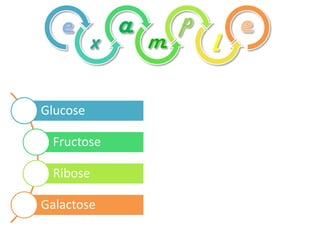
Glucose
Fructose
Ribose
Galactose
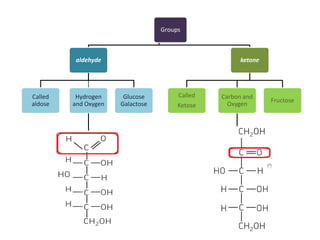
Groups
aldehyde
Called
aldose
Hydrogen
and Oxygen
Glucose
Galactose
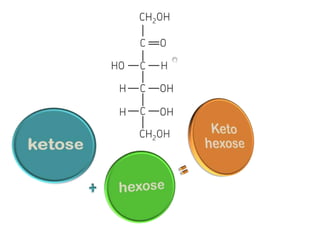
ketone
Called
Ketose
Carbon and
Oxygen
Fructose
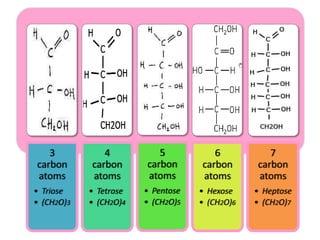
3
carbon
atoms
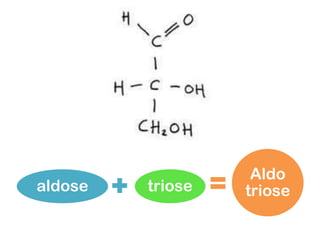
• Triose
• (CH2O)3
4
carbon
atoms
• Tetrose
• (CH2O)4
5
carbon
atoms
• Pentose
• (CH2O)5
6
carbon
atoms
• Hexose
• (CH2O)6
7
carbon
atoms
• Heptose
• (CH2O)7
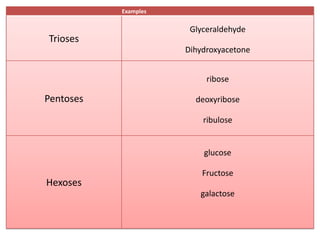
Examples
Trioses
Glyceraldehyde
Dihydroxyacetone
Pentoses
ribose
deoxyribose
ribulose
Hexoses
glucose
Fructose
galactose
Combination of these
systems
CH2O
CH2O
CH2O CH2Otriose
ketose
aldose
hexose
pentose
tetrose
tetrose
heptose
aldose triose
Aldo
triose
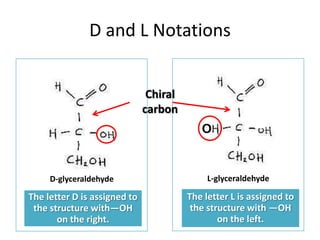
D and L Notations
The letter D is assigned to
the structure with—OH
on the right.
D-glyceraldehyde
The letter L is assigned to
the structure with —OH
on the left.
L-glyceraldehyde
O
Chiral
carbon
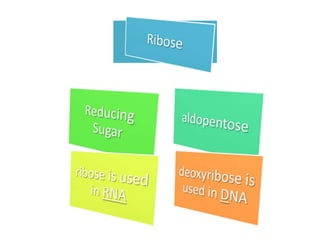
Ribose
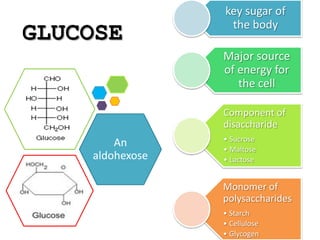
An
aldohexose
GLUCOSE
key sugar of
the body
Major source
of energy for
the cell
Component of
disaccharide
• Sucrose
• Maltose
• Lactose
Monomer of
polysaccharides
• Starch
• Cellulose
• Glycogen
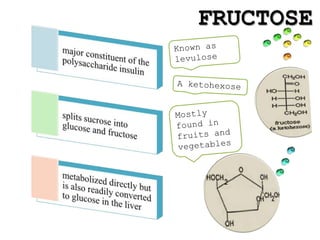
FRUCTOSE
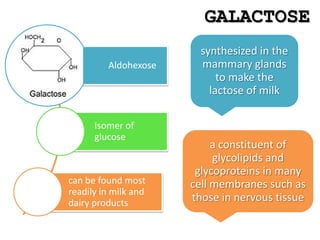
GALACTOSE
synthesized in the
mammary glands
to make the
lactose of milk
a constituent of
glycolipids and
glycoproteins in many
cell membranes such as
those in nervous tissue
Aldohexose
Isomer of
glucose
can be found most
readily in milk and
dairy products
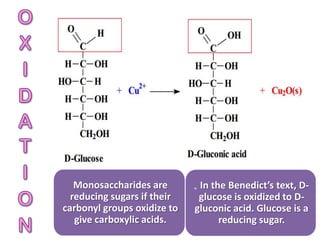
R E A C IT O N
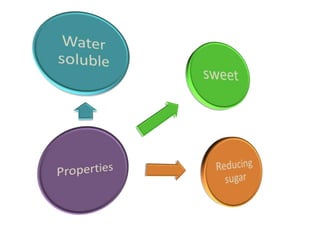
Monosaccharides are
reducing sugars if their
carbonyl groups oxidize to
give carboxylic acids.
„ In the Benedict’s text, D-
glucose is oxidized to D-
gluconic acid. Glucose is a
reducing sugar.
The reduction of the
carbonyl group
produces sugar
alcohols, or alditols.
D-Glucose is
reduced to D-
glucitol also called
sorbitol.

Carbohydrates - Monosaccharides