International Challenges for Technology
Enhanced Learning
and how to address them in Europe
Mike Sharples,
Institute of Educational Technology
Challenge 1
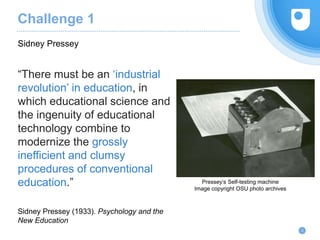
“There must be an ‘industrial
revolution’ in education, in
which educational science and
the ingenuity of educational
technology combine to
modernize the grossly
inefficient and clumsy
procedures of conventional
education.”
Sidney Pressey (1933). Psychology and the
New Education
Sidney Pressey
2
Pressey’s Self-testing machine
Image copyright OSU photo archives
Challenge 1
Efficient education
3
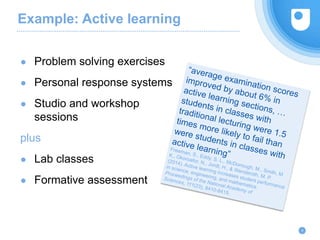
Example: Active learning
● Problem solving exercises
● Personal response systems
● Studio and workshop
sessions
plus
● Lab classes
● Formative assessment
4
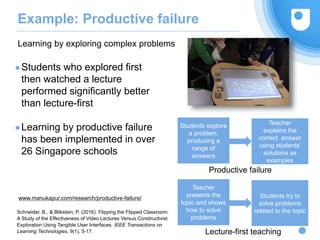
Example: Productive failure
●Students who explored first
then watched a lecture
performed significantly better
than lecture-first
●Learning by productive failure
has been implemented in over
26 Singapore schools
Learning by exploring complex problems
5
Students explore
a problem,
producing a
range of
answers
Teacher
explains the
correct answer
using students’
solutions as
examples
Productive failure
Teacher
presents the
topic and shows
how to solve
problems
Students try to
solve problems
related to the topic
Lecture-first teaching
www.manukapur.com/research/productive-failure/
Schneider, B., & Blikstein, P. (2016). Flipping the Flipped Classroom:
A Study of the Effectiveness of Video Lectures Versus Constructivist
Exploration Using Tangible User Interfaces. IEEE Transactions on
Learning Technologies, 9(1), 5-17.
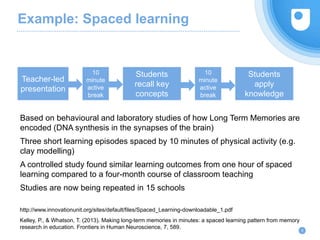
Example: Spaced learning
6
http://www.innovationunit.org/sites/default/files/Spaced_Learning-downloadable_1.pdf
Kelley, P., & Whatson, T. (2013). Making long-term memories in minutes: a spaced learning pattern from memory
research in education. Frontiers in Human Neuroscience, 7, 589.
Based on behavioural and laboratory studies of how Long Term Memories are
encoded (DNA synthesis in the synapses of the brain)
Three short learning episodes spaced by 10 minutes of physical activity (e.g.
clay modelling)
A controlled study found similar learning outcomes from one hour of spaced
learning compared to a four-month course of classroom teaching
Studies are now being repeated in 15 schools
Teacher-led
presentation
Students
recall key
concepts
10
minute
active
break
10
minute
active
break
Students
apply
knowledge
Challenge 2
“…providing the 100,000,000
university places now needed by
young people in emerging economies
desperate for higher education. …
The demand for education will
continue to rise; we cannot afford to
scale up at the current per student
cost, in any sector, in any country.”
Diana Laurillard, What is the problem for which MOOCs
are the solution? Blog post, May 14, 2014.
https://ioelondonblog.wordpress.com/2014/05/14/what-
is-the-problem-for-which-moocs-are-the-solution/
7
Challenge 2
Cost-effective and open
education
8
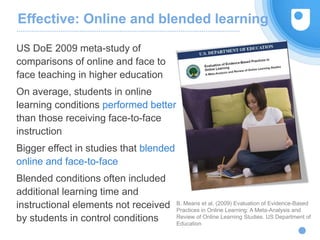
Effective: Online and blended learning
US DoE 2009 meta-study of
comparisons of online and face to
face teaching in higher education
On average, students in online
learning conditions performed better
than those receiving face-to-face
instruction
Bigger effect in studies that blended
online and face-to-face
Blended conditions often included
additional learning time and
instructional elements not received
by students in control conditions
Distinguish hype from reality
B. Means et al. (2009) Evaluation of Evidence-Based
Practices in Online Learning: A Meta-Analysis and
Review of Online Learning Studies. US Department of
Education
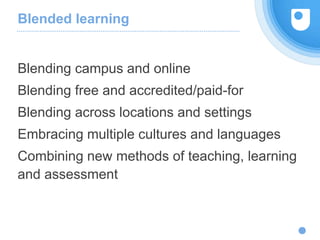
Blended learning
Blending campus and online
Blending free and accredited/paid-for
Blending across locations and settings
Embracing multiple cultures and languages
Combining new methods of teaching, learning
and assessment
Distinguish hype from reality
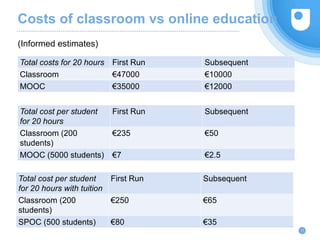
Costs of classroom vs online education
Total costs for 20 hours First Run Subsequent
Classroom €47000 €10000
MOOC €35000 €12000
(Informed estimates)
11
Total cost per student
for 20 hours
First Run Subsequent
Classroom (200
students)
€235 €50
MOOC (5000 students) €7 €2.5
Total cost per student
for 20 hours with tuition
First Run Subsequent
Classroom (200
students)
€250 €65
SPOC (500 students) €80 €35
“Significant innovations [in
TEL] are developed and
embedded over periods of
years rather than months.
Sustainable change is not
a simple matter of product
development, testing and
roll-out”
Scanlon, E. et al. (2013). Beyond prototypes:
Enabling innovation in technology enhanced
learning. Open University, Milton Keynes.
12
Challenge 3
Challenge 3
Sustained innovation
13
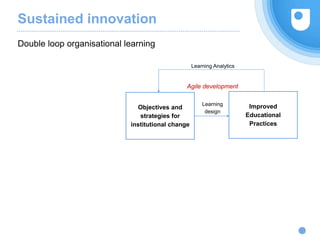
Improved
Educational
Practices
Objectives and
strategies for
institutional change
Learning Analytics
Agile development
Sustained innovation
Double loop organisational learning
Learning
design
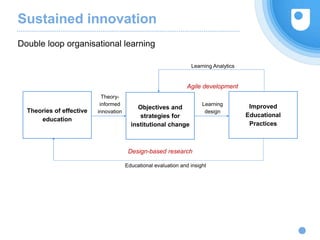
Learning
design
Improved
Educational
Practices
Objectives and
strategies for
institutional change
Theories of effective
education
Theory-
informed
innovation
Learning Analytics
Design-based research
Agile development
Educational evaluation and insight
Sustained innovation
Double loop organisational learning
Challenge 4
● To remain globally competitive and develop
engaged citizens, our schools should weave
21st century competencies and expertise
throughout the learning experience.
● Beyond these essential core academic
competencies, there is a growing body of
research on the importance of non-cognitive
competencies as they relate to academic
success.
● Non-cognitive competencies include successful
navigation through tasks such as forming
relationships and solving everyday problems.
They also include development of self-
awareness, control of impulsivity, executive
function, working cooperatively, and caring
about oneself and others.
16
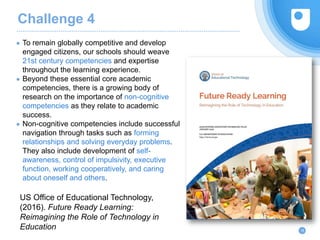
US Office of Educational Technology,
(2016). Future Ready Learning:
Reimagining the Role of Technology in
Education
Challenge 4
Develop education for the
future
17
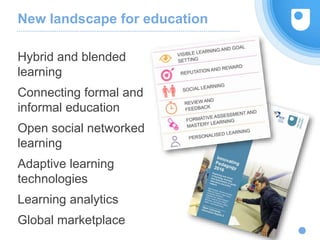
New landscape for education
Hybrid and blended
learning
Connecting formal and
informal education
Open social networked
learning
Adaptive learning
technologies
Learning analytics
Global marketplace
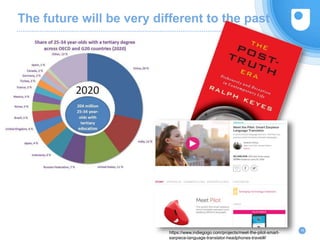
The future will be very different to the past
19
https://www.indiegogo.com/projects/meet-the-pilot-smart-
earpiece-language-translator-headphones-travel#/
How to address these challenges in
Europe?
20
Efficient education
21
●Replicate promising TEL studies from around the
world
Productive failure? Spaced learning? Mastery learning?
Dynamic formative assessment?
●Build a European TEL evidence base for
educators and policy makers
Based on common standards for analysing learning
Cost-effective and open education
22
● Now more than ever we need open global
education, bringing people around the world into
conversations for learning
● Open education platform for blended learning
(Open edX?)
● Modern European gateway to multilingual
educational resources
Modelled on ClassCentral?
Sustained innovation
23
● Sustained programme of funding for
European TEL research
● Building on excellence (from ProLearn,
Kaleidoscope, Stellar, Orphée networks)
● Network of partner schools and colleges to test
innovations
● Focus on interaction of new technology with
innovative pedagogy
● Collaborative endeavour of educational
technologists, computer scientists,
psychologists, neuroscientists, social scientists
Education for the future
24
● Engage with TEL as a multi-billion Euro
industry
● Develop lifelong learning support
Connect learning in informal and formal settings
● European investment in educational future
for a digital world
(guided by best evidence)

International Challenges for Technology Enhanced Learning

  • 1.
    International Challenges forTechnology Enhanced Learning and how to address them in Europe Mike Sharples, Institute of Educational Technology
  • 2.
    Challenge 1 “There mustbe an ‘industrial revolution’ in education, in which educational science and the ingenuity of educational technology combine to modernize the grossly inefficient and clumsy procedures of conventional education.” Sidney Pressey (1933). Psychology and the New Education Sidney Pressey 2 Pressey’s Self-testing machine Image copyright OSU photo archives
  • 3.
  • 4.
    Example: Active learning ●Problem solving exercises ● Personal response systems ● Studio and workshop sessions plus ● Lab classes ● Formative assessment 4
  • 5.
    Example: Productive failure ●Studentswho explored first then watched a lecture performed significantly better than lecture-first ●Learning by productive failure has been implemented in over 26 Singapore schools Learning by exploring complex problems 5 Students explore a problem, producing a range of answers Teacher explains the correct answer using students’ solutions as examples Productive failure Teacher presents the topic and shows how to solve problems Students try to solve problems related to the topic Lecture-first teaching www.manukapur.com/research/productive-failure/ Schneider, B., & Blikstein, P. (2016). Flipping the Flipped Classroom: A Study of the Effectiveness of Video Lectures Versus Constructivist Exploration Using Tangible User Interfaces. IEEE Transactions on Learning Technologies, 9(1), 5-17.
  • 6.
    Example: Spaced learning 6 http://www.innovationunit.org/sites/default/files/Spaced_Learning-downloadable_1.pdf Kelley,P., & Whatson, T. (2013). Making long-term memories in minutes: a spaced learning pattern from memory research in education. Frontiers in Human Neuroscience, 7, 589. Based on behavioural and laboratory studies of how Long Term Memories are encoded (DNA synthesis in the synapses of the brain) Three short learning episodes spaced by 10 minutes of physical activity (e.g. clay modelling) A controlled study found similar learning outcomes from one hour of spaced learning compared to a four-month course of classroom teaching Studies are now being repeated in 15 schools Teacher-led presentation Students recall key concepts 10 minute active break 10 minute active break Students apply knowledge
  • 7.
    Challenge 2 “…providing the100,000,000 university places now needed by young people in emerging economies desperate for higher education. … The demand for education will continue to rise; we cannot afford to scale up at the current per student cost, in any sector, in any country.” Diana Laurillard, What is the problem for which MOOCs are the solution? Blog post, May 14, 2014. https://ioelondonblog.wordpress.com/2014/05/14/what- is-the-problem-for-which-moocs-are-the-solution/ 7
  • 8.
  • 9.
    Effective: Online andblended learning US DoE 2009 meta-study of comparisons of online and face to face teaching in higher education On average, students in online learning conditions performed better than those receiving face-to-face instruction Bigger effect in studies that blended online and face-to-face Blended conditions often included additional learning time and instructional elements not received by students in control conditions Distinguish hype from reality B. Means et al. (2009) Evaluation of Evidence-Based Practices in Online Learning: A Meta-Analysis and Review of Online Learning Studies. US Department of Education
  • 10.
    Blended learning Blending campusand online Blending free and accredited/paid-for Blending across locations and settings Embracing multiple cultures and languages Combining new methods of teaching, learning and assessment Distinguish hype from reality
  • 11.
    Costs of classroomvs online education Total costs for 20 hours First Run Subsequent Classroom €47000 €10000 MOOC €35000 €12000 (Informed estimates) 11 Total cost per student for 20 hours First Run Subsequent Classroom (200 students) €235 €50 MOOC (5000 students) €7 €2.5 Total cost per student for 20 hours with tuition First Run Subsequent Classroom (200 students) €250 €65 SPOC (500 students) €80 €35
  • 12.
    “Significant innovations [in TEL]are developed and embedded over periods of years rather than months. Sustainable change is not a simple matter of product development, testing and roll-out” Scanlon, E. et al. (2013). Beyond prototypes: Enabling innovation in technology enhanced learning. Open University, Milton Keynes. 12 Challenge 3
  • 13.
  • 14.
    Improved Educational Practices Objectives and strategies for institutionalchange Learning Analytics Agile development Sustained innovation Double loop organisational learning Learning design
  • 15.
    Learning design Improved Educational Practices Objectives and strategies for institutionalchange Theories of effective education Theory- informed innovation Learning Analytics Design-based research Agile development Educational evaluation and insight Sustained innovation Double loop organisational learning
  • 16.
    Challenge 4 ● Toremain globally competitive and develop engaged citizens, our schools should weave 21st century competencies and expertise throughout the learning experience. ● Beyond these essential core academic competencies, there is a growing body of research on the importance of non-cognitive competencies as they relate to academic success. ● Non-cognitive competencies include successful navigation through tasks such as forming relationships and solving everyday problems. They also include development of self- awareness, control of impulsivity, executive function, working cooperatively, and caring about oneself and others. 16 US Office of Educational Technology, (2016). Future Ready Learning: Reimagining the Role of Technology in Education
  • 17.
  • 18.
    New landscape foreducation Hybrid and blended learning Connecting formal and informal education Open social networked learning Adaptive learning technologies Learning analytics Global marketplace
  • 19.
    The future willbe very different to the past 19 https://www.indiegogo.com/projects/meet-the-pilot-smart- earpiece-language-translator-headphones-travel#/
  • 20.
    How to addressthese challenges in Europe? 20
  • 21.
    Efficient education 21 ●Replicate promisingTEL studies from around the world Productive failure? Spaced learning? Mastery learning? Dynamic formative assessment? ●Build a European TEL evidence base for educators and policy makers Based on common standards for analysing learning
  • 22.
    Cost-effective and openeducation 22 ● Now more than ever we need open global education, bringing people around the world into conversations for learning ● Open education platform for blended learning (Open edX?) ● Modern European gateway to multilingual educational resources Modelled on ClassCentral?
  • 23.
    Sustained innovation 23 ● Sustainedprogramme of funding for European TEL research ● Building on excellence (from ProLearn, Kaleidoscope, Stellar, Orphée networks) ● Network of partner schools and colleges to test innovations ● Focus on interaction of new technology with innovative pedagogy ● Collaborative endeavour of educational technologists, computer scientists, psychologists, neuroscientists, social scientists
  • 24.
    Education for thefuture 24 ● Engage with TEL as a multi-billion Euro industry ● Develop lifelong learning support Connect learning in informal and formal settings ● European investment in educational future for a digital world (guided by best evidence)