
Mike Sharples
The Open University
Pedagogy of FutureLearn
How our learners learn
Pedagogy
“Theory and practice of te
aching, learning and asse
ssment”
Sharples, M., McAndrew, P., Weller, M., Ferguson, R., FitzGerald,
E., Hirst, T., Mor, Y., Gaved, M. and Whitelock, D. (2012).
Innovating Pedagogy 2012: Open University Innovation Report 1.
Milton Keynes: The Open University.
www.open.ac.uk/innovating
How do we learn?
For me learning is ….
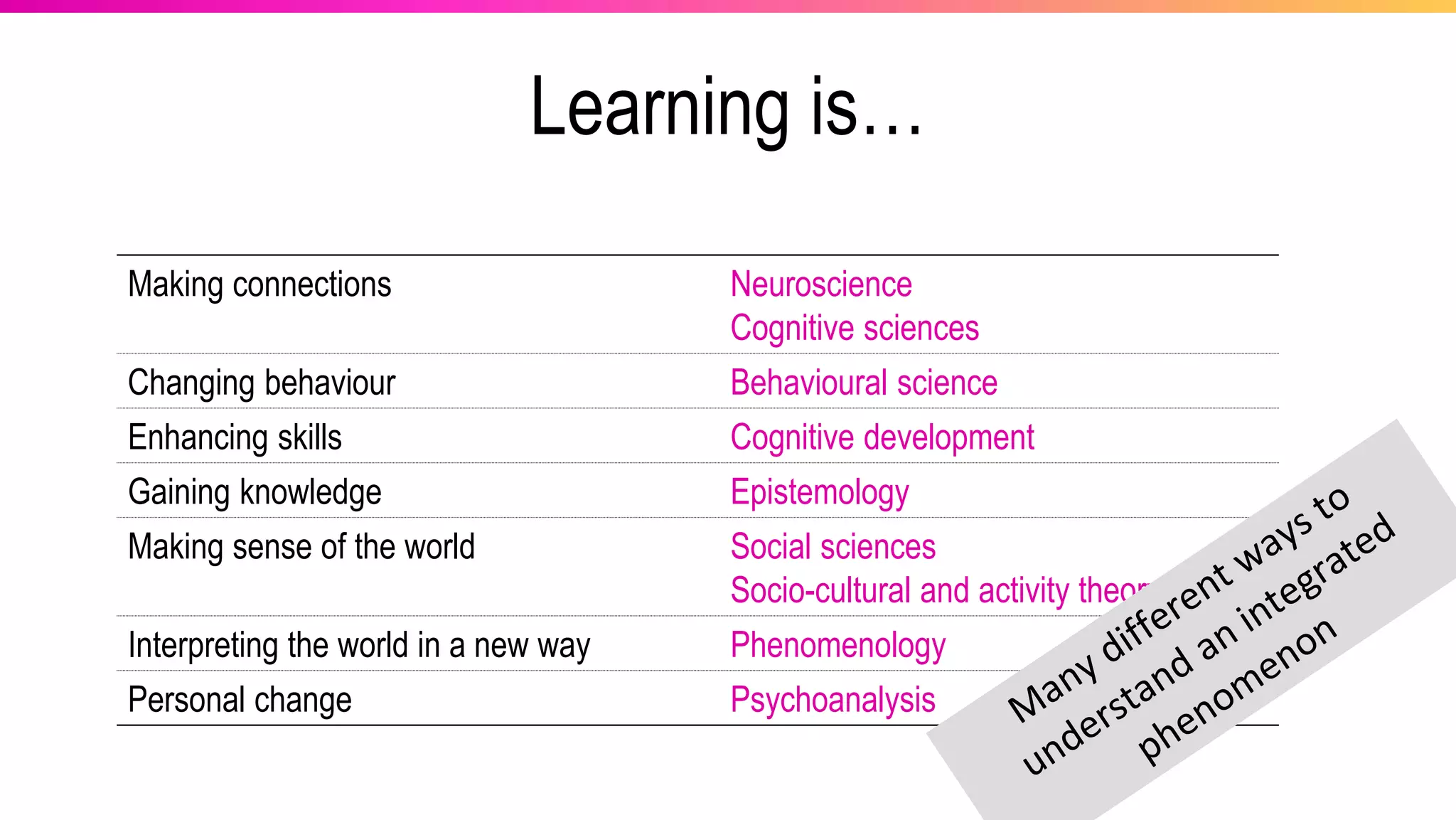
Learning is…
Making connections Neuroscience
Cognitive sciences
Changing behaviour Behavioural science
Enhancing skills Cognitive development
Gaining knowledge Epistemology
Making sense of the world Social sciences
Socio-cultural and activity theory
Interpreting the world in a new way Phenomenology
Personal change Psychoanalysis
New science of learning
A.N. Meltzoff, P. K. Kuhl, J. Movellan, & T. J.
Sejnowski (2009) Foundations for a New Science
of Learning, Science 325 (5938), 284.
“Insights from many
different fields are
converging to create a new
science of learning that
may transform educational
practice.”
New science of learning
“A key component is the role of ‘the
social’ in learning. What makes
social interaction such a powerful
catalyst for learning? Can key
elements be embodied in technology
to improve learning?”
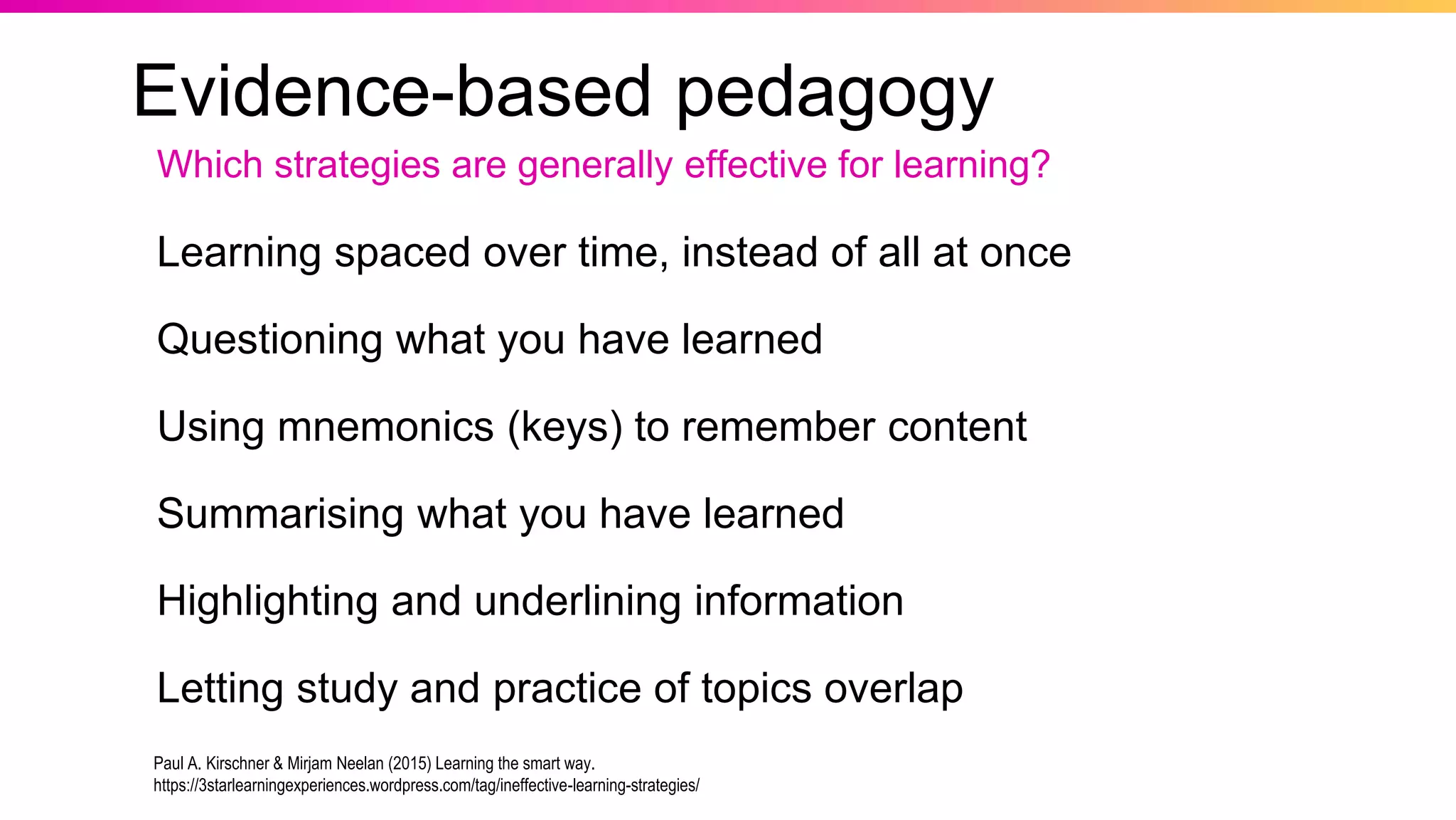
Evidence-based pedagogy
Learning spaced over time, instead of all at once
Questioning what you have learned
Using mnemonics (keys) to remember content
Summarising what you have learned
Highlighting and underlining information
Letting study and practice of topics overlap
Which strategies are generally effective for learning?
Paul A. Kirschner & Mirjam Neelan (2015) Learning the smart way.
https://3starlearningexperiences.wordpress.com/tag/ineffective-learning-strategies/
Evidence-based pedagogy
Learning spaced over time, instead of all at once ✔
Questioning what you have learned ✔
Using mnemonics (keys) to remember content ✘
Summarising what you have learned ✘
Highlighting and underlining information ✘
Letting study and practice of topics overlap ✔
Which strategies are generally effective for learning?
Paul A. Kirschner & Mirjam Neelan (2015) Learning the smart way.
https://3starlearningexperiences.wordpress.com/tag/ineffective-learning-strategies/
Telling stories
Storytelling provides a unifying framework around which we build
and think about courses
Provoking Conversation
Conversational learning is at the core of our belief about how
people come together and learn
Celebrating progress
Step completion, peer interaction, timed emails, quizzes and tests
with meaningful and formative feedback
FutureLearn Pedagogy
Why these?
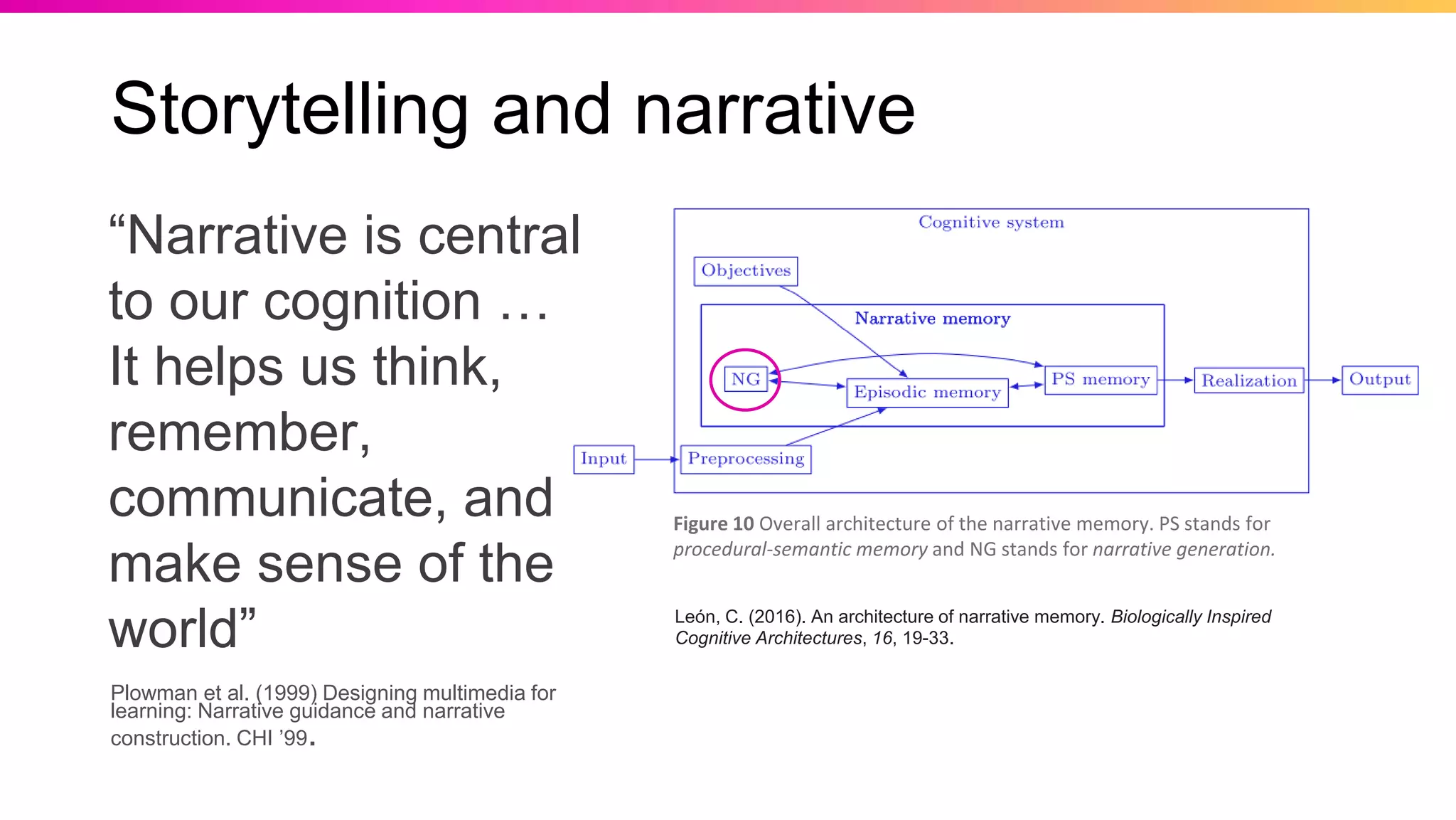
Storytelling and narrative
León, C. (2016). An architecture of narrative memory. Biologically Inspired
Cognitive Architectures, 16, 19-33.
Figure 10 Overall architecture of the narrative memory. PS stands for
procedural-semantic memory and NG stands for narrative generation.
“Narrative is central
to our cognition …
It helps us think,
remember,
communicate, and
make sense of the
world”
Plowman et al. (1999) Designing multimedia for
learning: Narrative guidance and narrative
construction. CHI ’99.
All human learning involves
conversation
We converse with ourselves to
reflect on experience
We converse with teachers to
understand their expert knowledge
We converse with other learners
to try and reach shared
understanding
How can I
understand
what you are
thinking?
How can I
understand
what you are
thinking?
Let’s try to
reach
agreement
http://clipart-library.com/images/Biarp5X4T.jpg
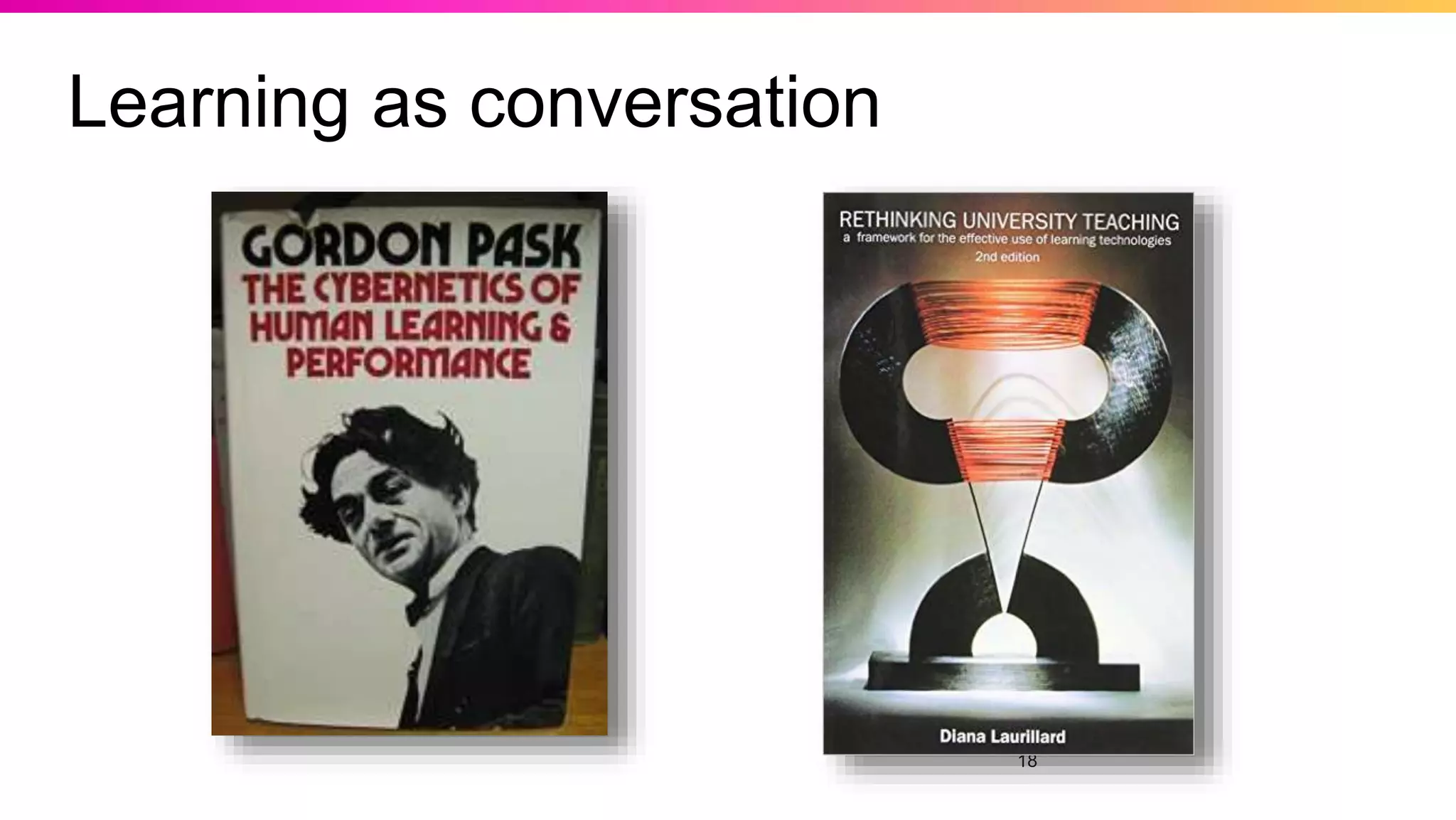
Learning as conversation
Visible progress
“What is most important is that
teaching is visible to the
student, and that the learning is
visible to the teacher. The more
the student becomes the
teacher, and the more the
teacher becomes the learner,
then the more successful are
the outcomes ”
John Hattie, Visible Learning p.17
What pedagogy works best at massive scale?
Some educational methods get worse with
scale
e.g. personal tutoring, sports coaching
Some educational methods don’t change
with scale
e.g. lecturing, testing
Which educational methods improve with
scale?
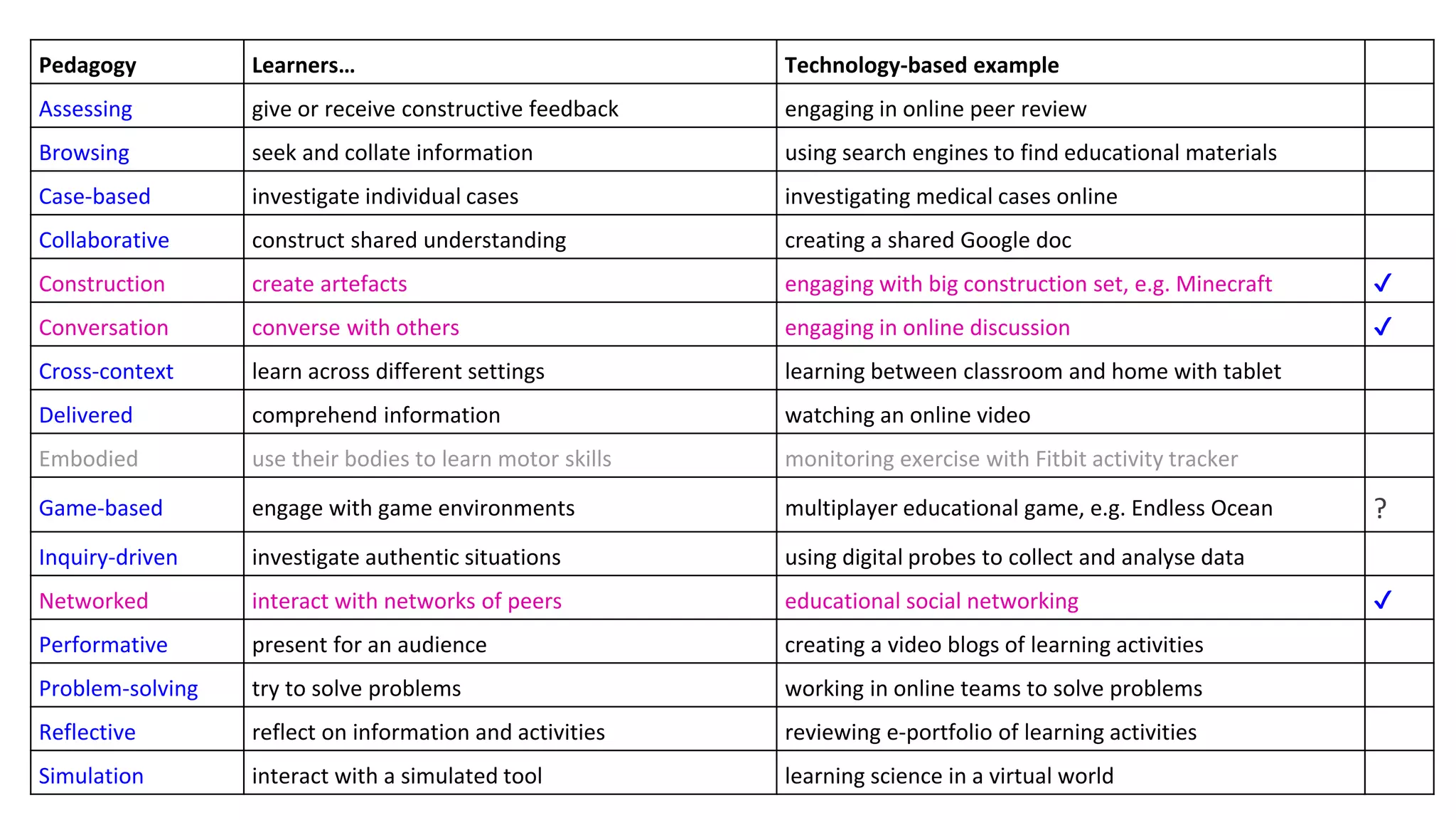
Pedagogy Learners… Technology-based example
Assessing give or receive constructive feedback engaging in online peer review
Browsing seek and collate information using search engines to find educational materials
Case-based investigate individual cases investigating medical cases online
Collaborative construct shared understanding creating a shared Google doc
Construction create artefacts engaging with big construction set, e.g. Minecraft
Conversation converse with others engaging in online discussion
Cross-context learn across different settings learning between classroom and home with tablet
Delivered comprehend information watching an online video
Embodied use their bodies to learn motor skills monitoring exercise with Fitbit activity tracker
Game-based engage with game environments multiplayer educational game, e.g. Endless Ocean
Inquiry-driven investigate authentic situations using digital probes to collect and analyse data
Networked interact with networks of peers educational social networking
Performative present for an audience creating a video blogs of learning activities
Problem-solving try to solve problems working in online teams to solve problems
Reflective reflect on information and activities reviewing e-portfolio of learning activities
Simulation interact with a simulated tool learning science in a virtual world
Pedagogy Learners… Technology-based example
Assessing give or receive constructive feedback engaging in online peer review
Browsing seek and collate information using search engines to find educational materials
Case-based investigate individual cases investigating medical cases online
Collaborative construct shared understanding creating a shared Google doc
Construction create artefacts engaging with big construction set, e.g. Minecraft ✔
Conversation converse with others engaging in online discussion ✔
Cross-context learn across different settings learning between classroom and home with tablet
Delivered comprehend information watching an online video
Embodied use their bodies to learn motor skills monitoring exercise with Fitbit activity tracker
Game-based engage with game environments multiplayer educational game, e.g. Endless Ocean ?
Inquiry-driven investigate authentic situations using digital probes to collect and analyse data
Networked interact with networks of peers educational social networking ✔
Performative present for an audience creating a video blogs of learning activities
Problem-solving try to solve problems working in online teams to solve problems
Reflective reflect on information and activities reviewing e-portfolio of learning activities
Simulation interact with a simulated tool learning science in a virtual world
18
Learning as conversation
Act
Experience
Check
Effect
How do we do that?
Human adaptivity
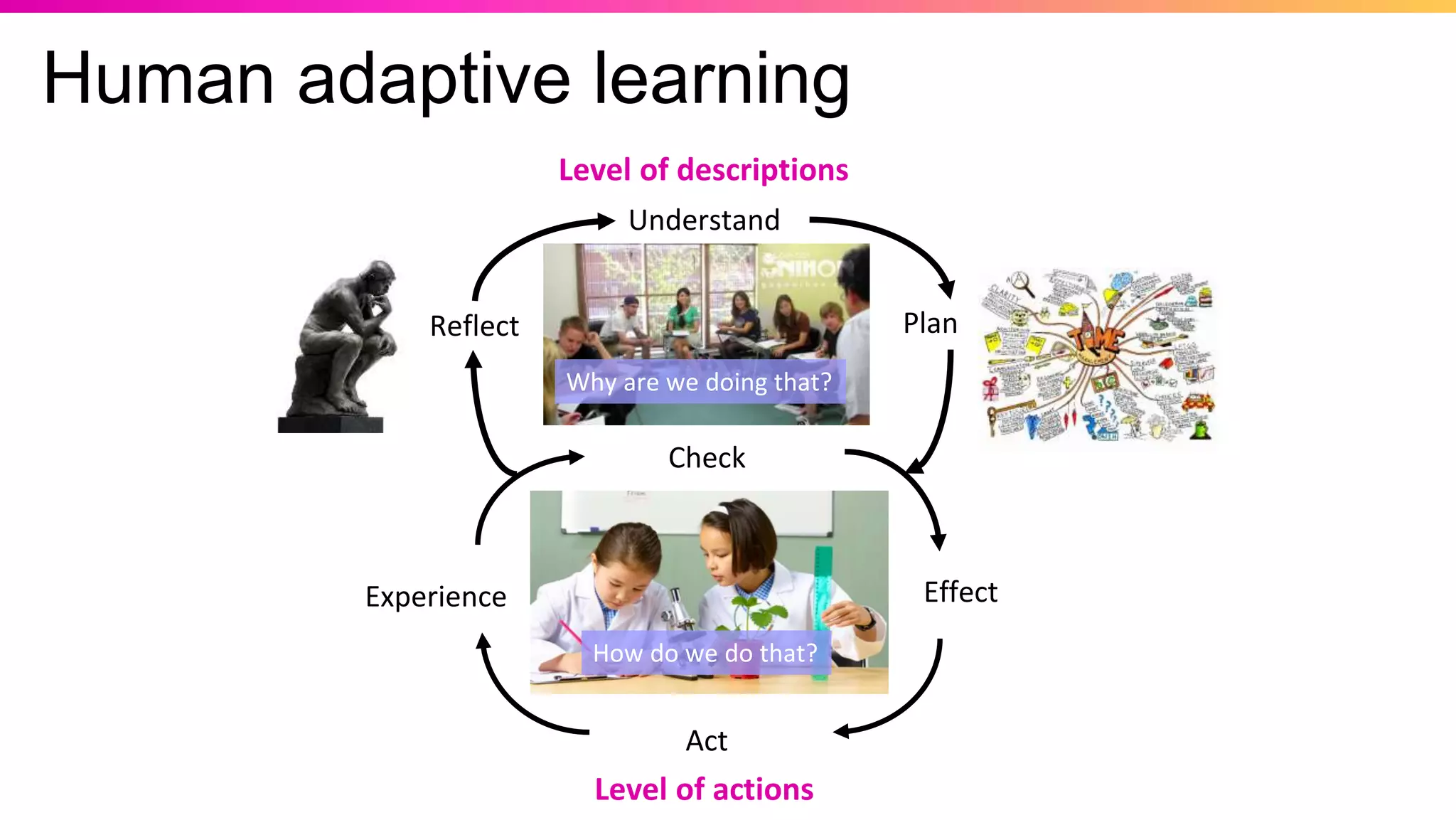
Reflect
Understand
Plan
Act
Experience
Check
Effect
Level of actions
Level of descriptions
How do we do that?
Why are we doing that?
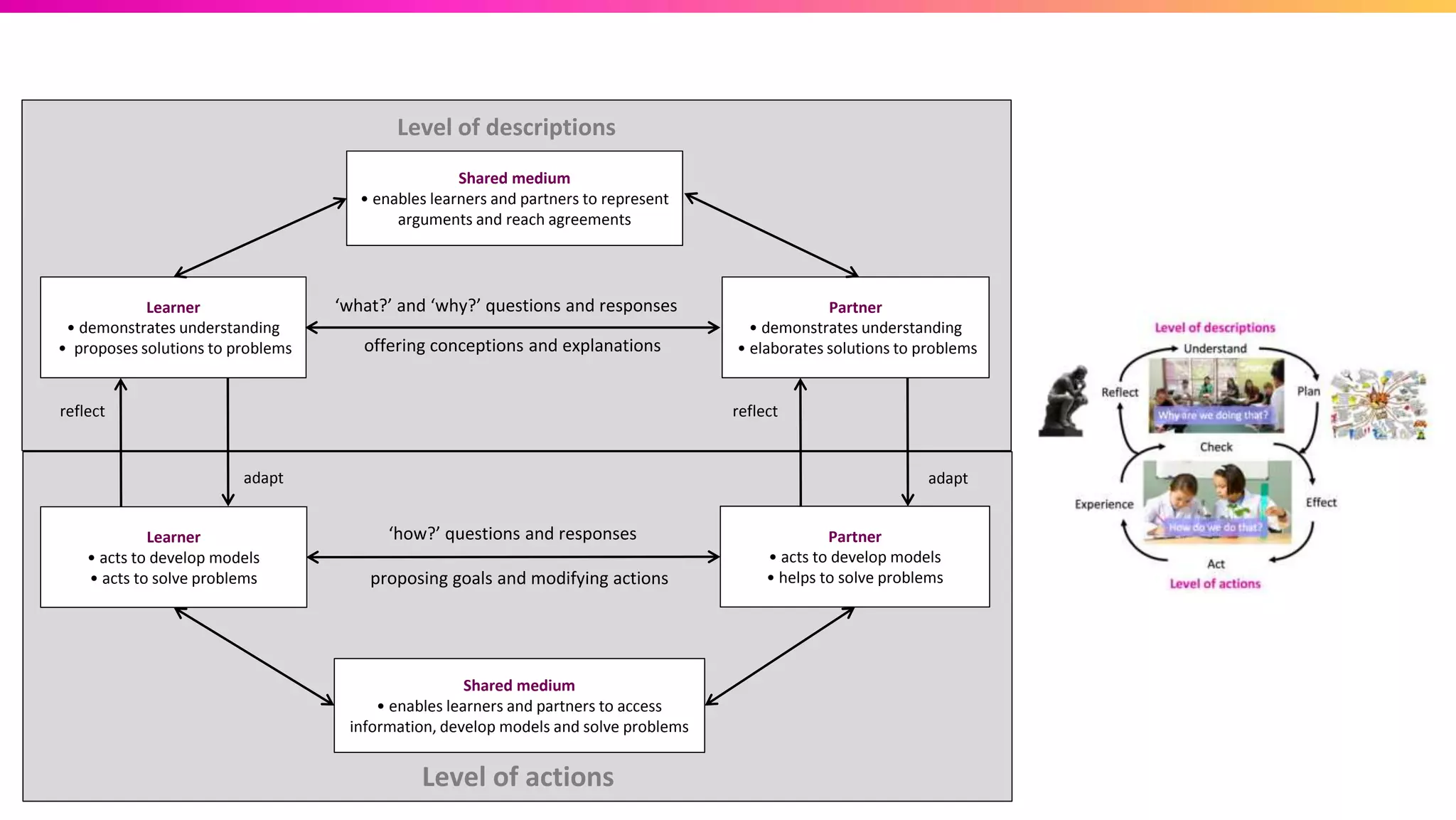
Human adaptive learning
Learner
• demonstrates understanding
• proposes solutions to problems
Learner
• acts to develop models
• acts to solve problems
Partner
• demonstrates understanding
• elaborates solutions to problems
Partner
• acts to develop models
• helps to solve problems
Level of descriptions
Level of actions
Shared medium
• enables learners and partners to represent
arguments and reach agreements
Shared medium
• enables learners and partners to access
information, develop models and solve problems
‘how?’ questions and responses
‘what?’ and ‘why?’ questions and responses
offering conceptions and explanations
proposing goals and modifying actions
reflect
adapt
reflect
adapt
Learner
• demonstrates understanding
• proposes solutions to problems
Learner
• acts to develop models
• acts to solve problems
Partner
• demonstrates understanding
• elaborates solutions to problems
Partner
• acts to develop models
• helps to solve problems
Level of descriptions
Level of actions
Shared medium
• enables learners and partners to represent
arguments and reach agreements
Shared medium
• enables learners and partners to access information,
develop models and solve problems
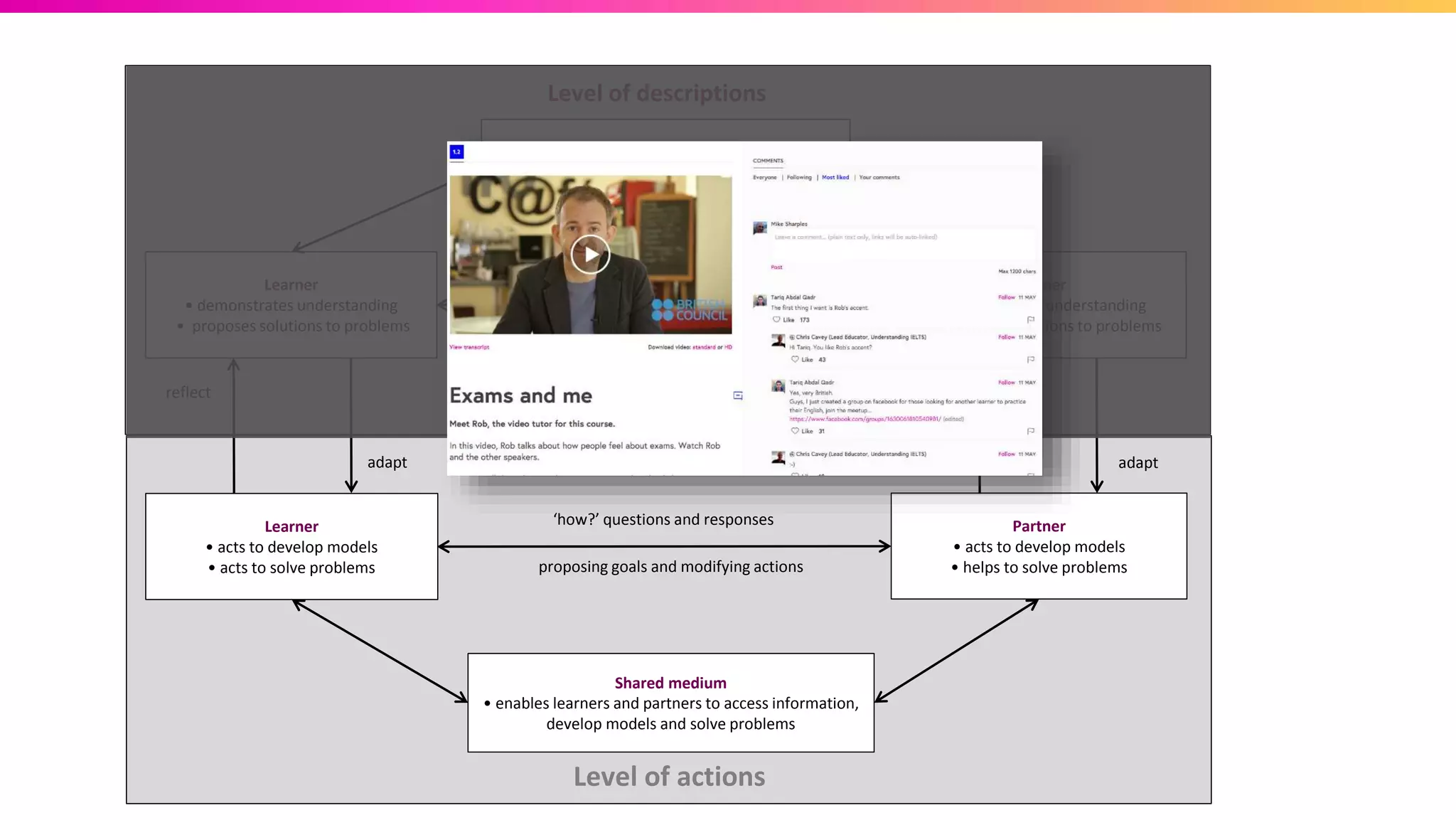
‘how?’ questions and responses
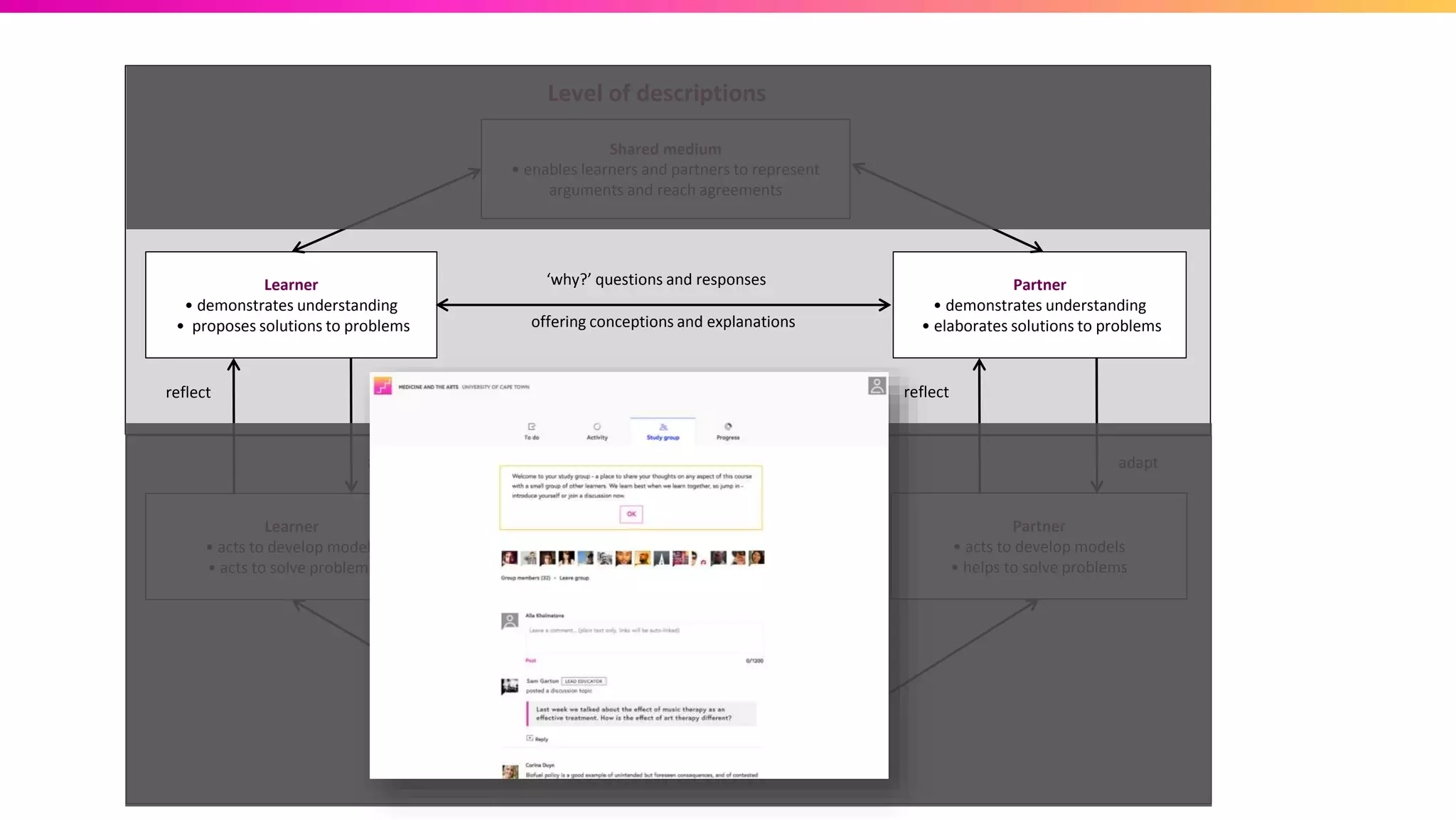
‘why?’ questions and responses
offering conceptions and explanations
proposing goals and modifying actions
reflect
adapt
reflect
adapt
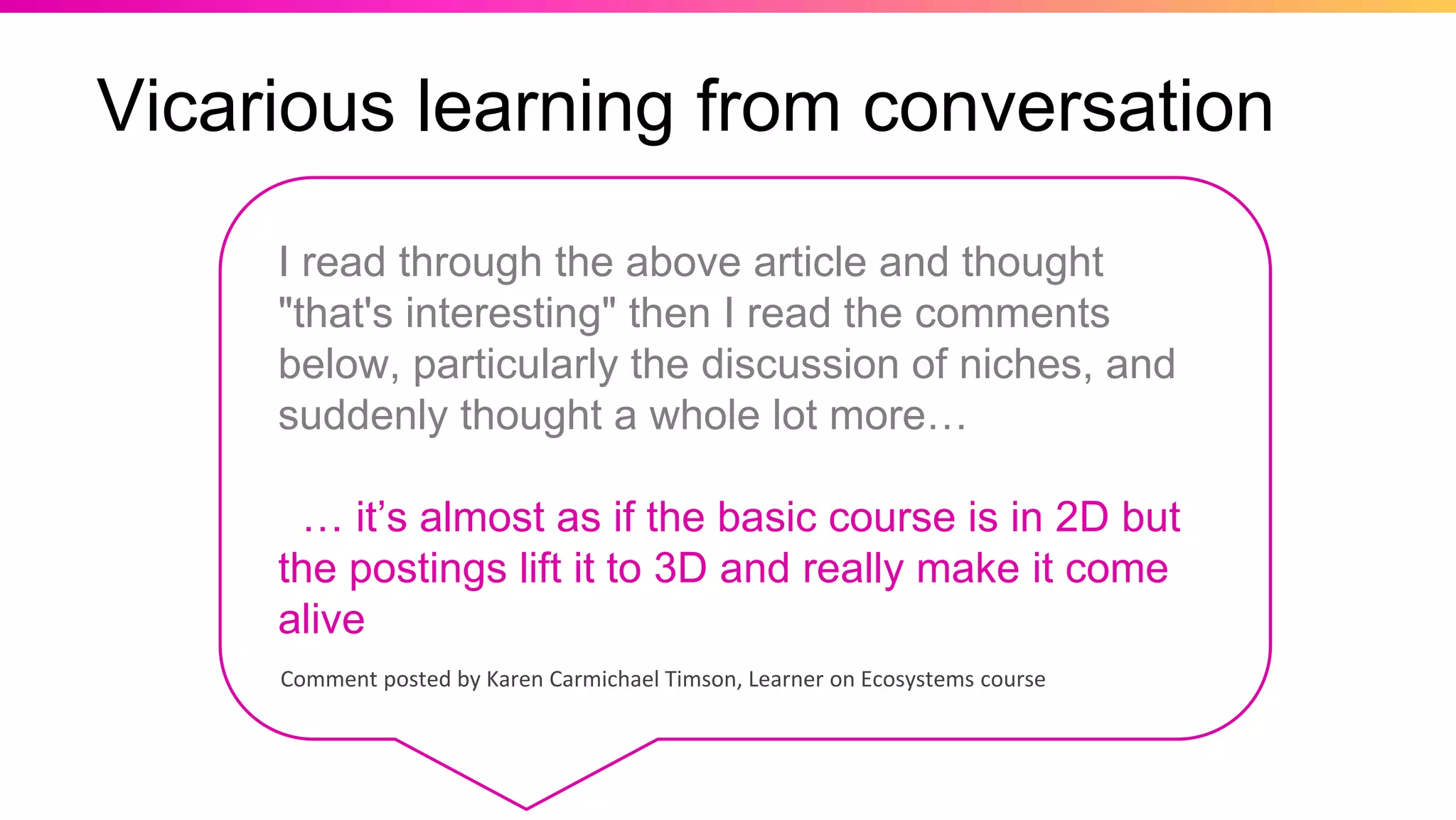
Vicarious learning from conversation
Comment posted by Karen Carmichael Timson, Learner on Ecosystems course
I read through the above article and thought
"that's interesting" then I read the comments
below, particularly the discussion of niches, and
suddenly thought a whole lot more…
… it’s almost as if the basic course is in 2D but
the postings lift it to 3D and really make it come
alive
Learner
• demonstrates understanding
• proposes solutions to problems
Learner
• acts to develop models
• acts to solve problems
Partner
• demonstrates understanding
• elaborates solutions to problems
Partner
• acts to develop models
• helps to solve problems
Level of descriptions
Level of actions
Shared medium
• enables learners and partners to represent
arguments and reach agreements
Shared medium
• enables learners and partners to access information,
develop models and solve problems
‘how?’ questions and responses
‘why?’ questions and responses
offering conceptions and explanations
proposing goals and modifying actions
reflect
adapt
reflect
adapt
Learner
• demonstrates understanding
• proposes solutions to problems
Learner
• acts to develop models
• acts to solve problems
Partner
• demonstrates understanding
• elaborates solutions to problems
Partner
• acts to develop models
• helps to solve problems
Level of descriptions
Level of actions
Shared medium
• enables learners and partners to represent
arguments and reach agreements
Shared medium
• enables learners and partners to access information,
develop models and solve problems
‘how?’ questions and responses
‘why?’ questions and responses
offering conceptions and explanations
proposing goals and modifying actions
reflect
adapt
reflect
adapt
Learner
• demonstrates understanding
• proposes solutions to problems
Learner
• acts to develop models
• acts to solve problems
Partner
• demonstrates understanding
• elaborates solutions to problems
Partner
• acts to develop models
• helps to solve problems
Level of descriptions
Level of actions
Shared medium
• enables learners and partners to represent
arguments and reach agreements
Shared medium
• enables learners and partners to access information,
develop models and solve problems
‘how?’ questions and responses
‘why?’ questions and responses
offering conceptions and explanations
proposing goals and modifying actions
reflect
adapt
reflect
adapt
How to improve study group
conversation?
For groups to work:
shared goals
each person knows how and when
to contribute
everyone makes an appropriate
contribution
share rewards in a fair way
opportunity to reflect on progress
and to discuss contributions
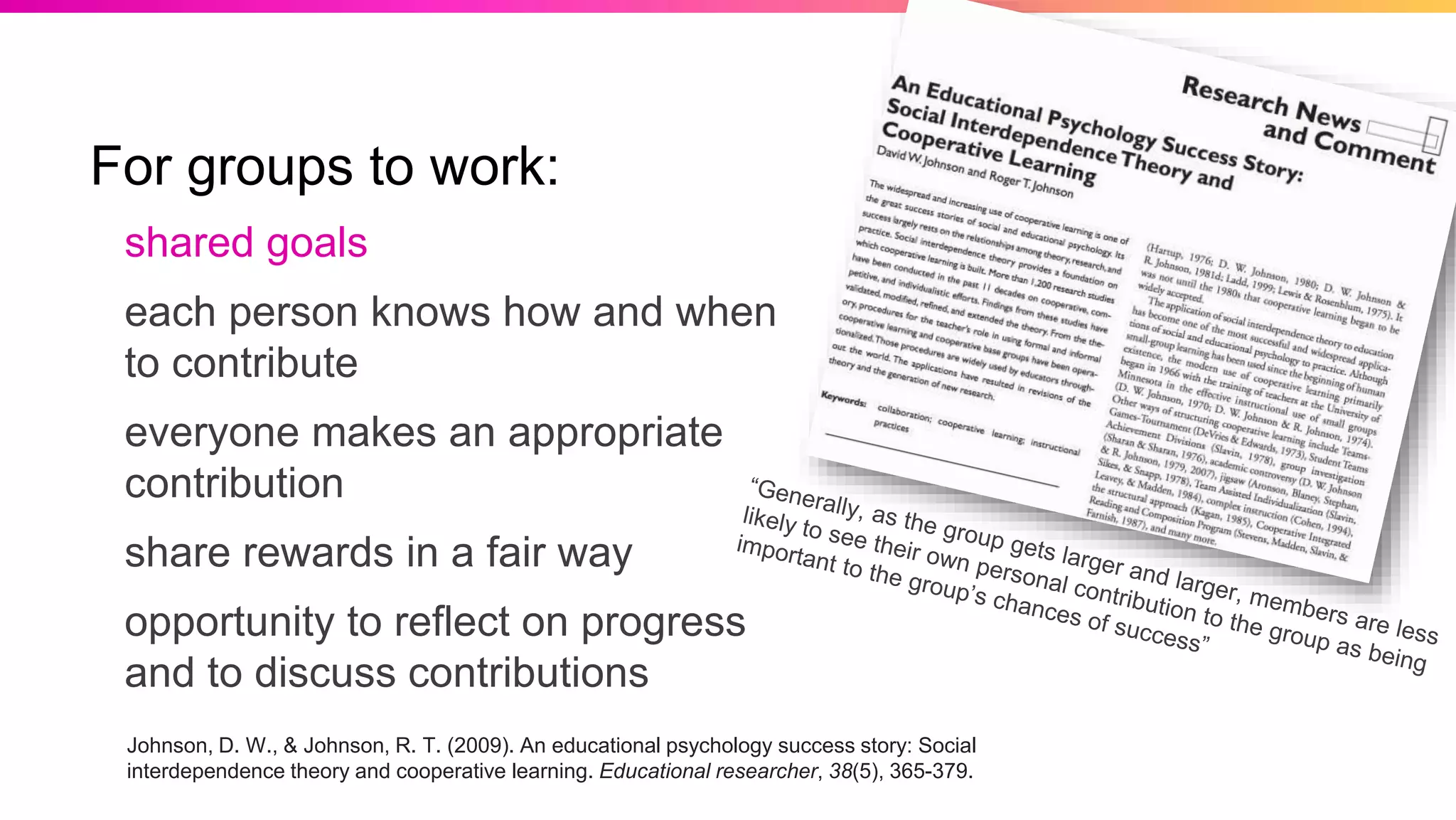
Johnson, D. W., & Johnson, R. T. (2009). An educational psychology success story: Social
interdependence theory and cooperative learning. Educational researcher, 38(5), 365-379.
Why do we have weeks, activities
and steps?
Weeks
Personally meaningful study periods. ‘Each week I
will…?’
Activities
Elements of pedagogy – each with a defined goal,
learning methods, and outcome. Design learning
around activities.
Steps
Pedagogic ‘Lego bricks’ that form an activity
Learning design
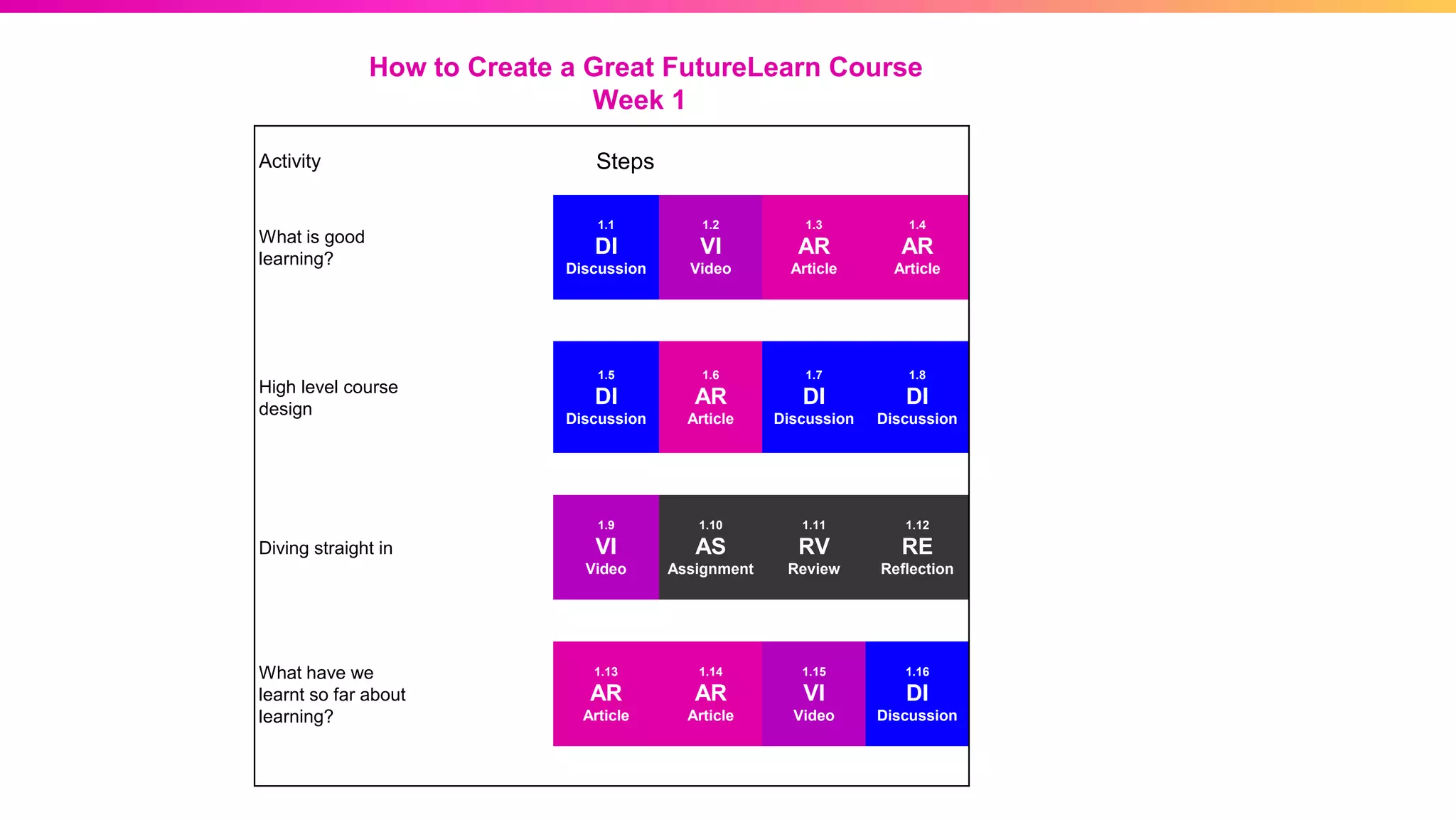
Activity Steps
What is good
learning?
1.1
DI
Discussion
1.2
VI
Video
1.3
AR
Article
1.4
AR
Article
High level course
design
1.5
DI
Discussion
1.6
AR
Article
1.7
DI
Discussion
1.8
DI
Discussion
Diving straight in
1.9
VI
Video
1.10
AS
Assignment
1.11
RV
Review
1.12
RE
Reflection
What have we
learnt so far about
learning?
1.13
AR
Article
1.14
AR
Article
1.15
VI
Video
1.16
DI
Discussion
How to Create a Great FutureLearn Course
Week 1
Activity Steps
What is good
learning?
1.1
DI
Discussion
1.2
VI
Video
1.3
AR
Article
1.4
AR
Article
High level course
design
1.5
DI
Discussion
1.6
AR
Article
1.7
DI
Discussion
1.8
DI
Discussion
Diving straight in
1.9
VI
Video
1.10
AS
Assignment
1.11
RV
Review
1.12
RE
Reflection
What have we
learnt so far about
learning?
1.13
AR
Article
1.14
AR
Article
1.15
VI
Video
1.16
DI
Discussion
How to Create a Great FutureLearn Course
Week 1
Pedagogy from Learning
Design Studio, Hong Kong
University
http://ilap-
sdls.cite.hku.hk/ld_alpaca/in
dex.php?lang=en
Activity Pedagogy Steps
What is good
learning?
Receive
Discuss
1.1
DI
Discussion
1.2
VI
Video
1.3
AR
Article
1.4
AR
Article
High level course
design
Receive
Reflect
Discuss
Create
1.5
DI
Discussion
1.6
AR
Article
1.7
DI
Discussion
1.8
DI
Discussion
Diving straight in
Receive
Practice
Discuss
Reflect
1.9
VI
Video
1.10
AS
Assignment
1.11
RV
Review
1.12
RE
Reflection
What have we
learnt so far about
learning?
Receive
Investigate
Discuss
1.13
AR
Article
1.14
AR
Article
1.15
VI
Video
1.16
DI
Discussion
How to Create a Great FutureLearn Course
Week 1
Pedagogy from Learning
Design Studio, Hong Kong
University
http://ilap-
sdls.cite.hku.hk/ld_alpaca/in
dex.php?lang=en
Why are FutureLearn steps 20
minutes?
https://en.wikipedia.org/wiki/Neuron#/media/File:Complete_neuron_cell_diagram_en.svg
Synapses link neurons
Learning is associated with
strengthening synaptic connections
Lasting chemical connections can be
formed in minutes, for networks of
neurons
Neural learning works best when short
sessions of stimulation are spaced with
periods of other activity, to let the
synaptic connections grow
Spaced learning
20 minute
teacher-led
presentation
20 minutes
students recall key
concepts
10
minute
active
break
10
minute
active
break
20 minutes
students apply
knowledge
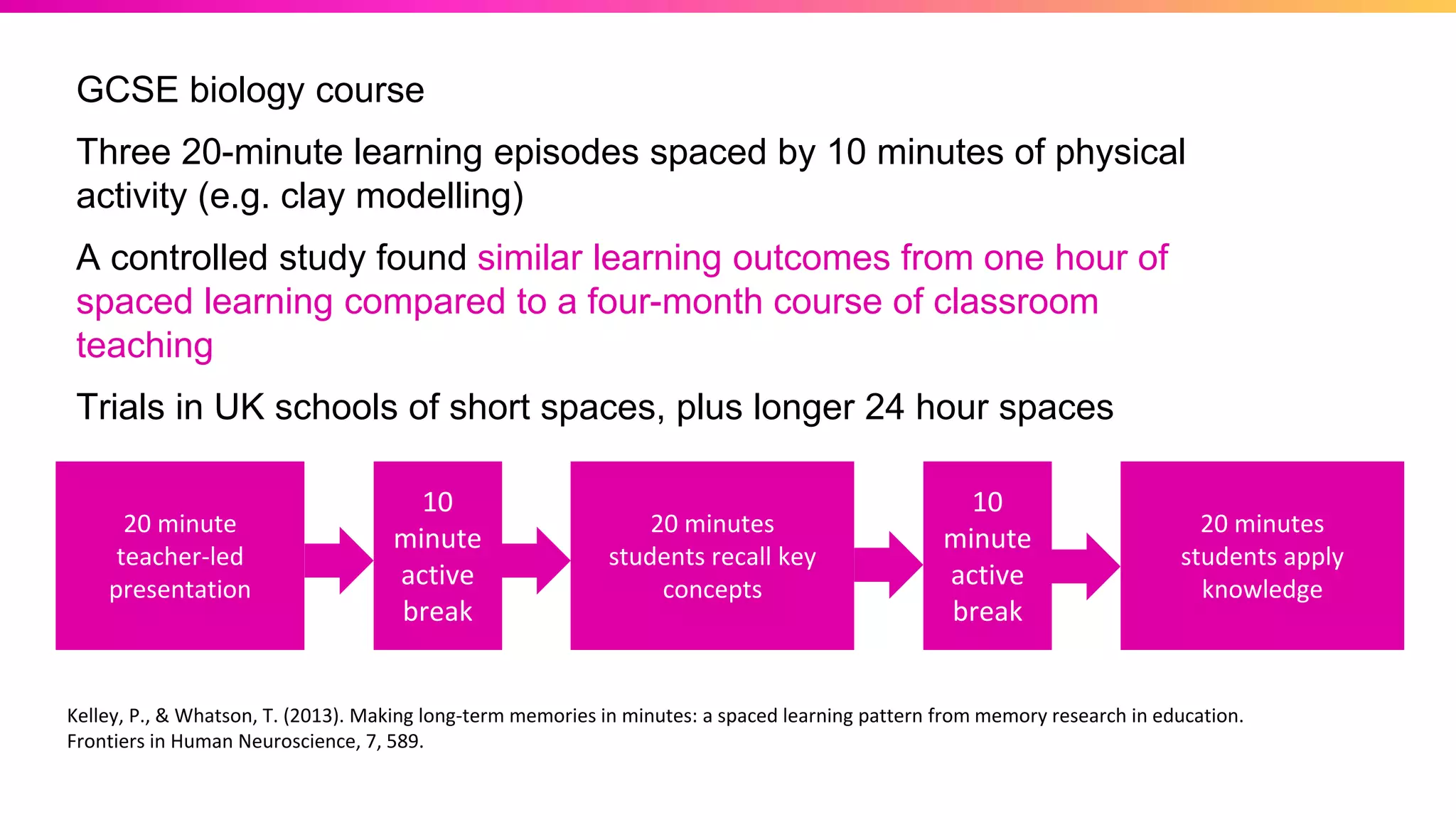
GCSE biology course
Three 20-minute learning episodes spaced by 10 minutes of physical
activity (e.g. clay modelling)
A controlled study found similar learning outcomes from one hour of
spaced learning compared to a four-month course of classroom
teaching
Trials in UK schools of short spaces, plus longer 24 hour spaces
Kelley, P., & Whatson, T. (2013). Making long-term memories in minutes: a spaced learning pattern from memory research in education.
Frontiers in Human Neuroscience, 7, 589.
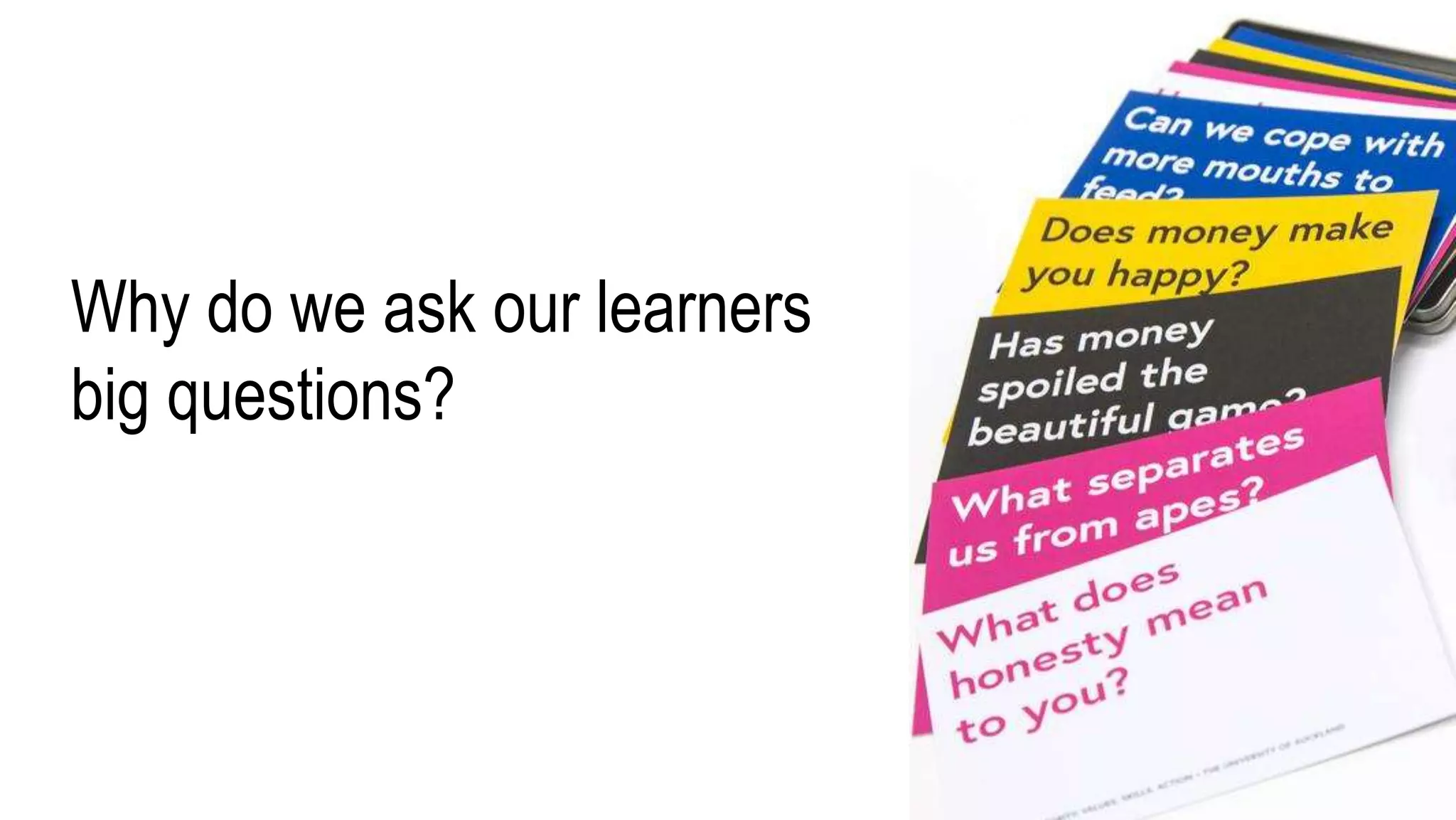
Why do we ask our learners
big questions?
39
Active learning: Flipped classroom
In their own time,
students learn from
videos and texts
Then students work
together to solve
problems and
explore
misunderstandings
Image: http://www.washington.edu/teaching/files/2012/11/FlippedClassroomUWcolors-1-1024x242.jpg
Each student is in
control: stop/start,
speed, make notes
Students solve
problems together and
learn from each other,
guided by the teacher
Active learning
40
Active learning: Explore first
Students start by exploring
a new topic and
attempting to solve
problems together
Students then engage with
a video presentation, or a
teacher-led lesson based
on their answers
Schneider, B., & Blikstein, P. (2016). Flipping the Flipped Classroom: A Study of the
Effectiveness of Video Lectures Versus Constructivist Exploration Using Tangible User
Interfaces. IEEE Transactions on Learning Technologies, 9(1), 5-17.
What’s missing?
Learning
analytics
Analysis of
learning
Learning design
Learning
activity
Linking learning design and learning
analytics
Learning by construction
Co-creating
and sharing
artefacts
Professional development
Team learning
Company cohorts
Mentoring
Competency learning
Case-based learning
Reflective portfolio
https://www.cipd.co.uk/learn/cpd/cycle
Reputation management
Supporting advancers
to gain long-term
expertise and
reputation
https://www.ispotnature.org/view/user/19634
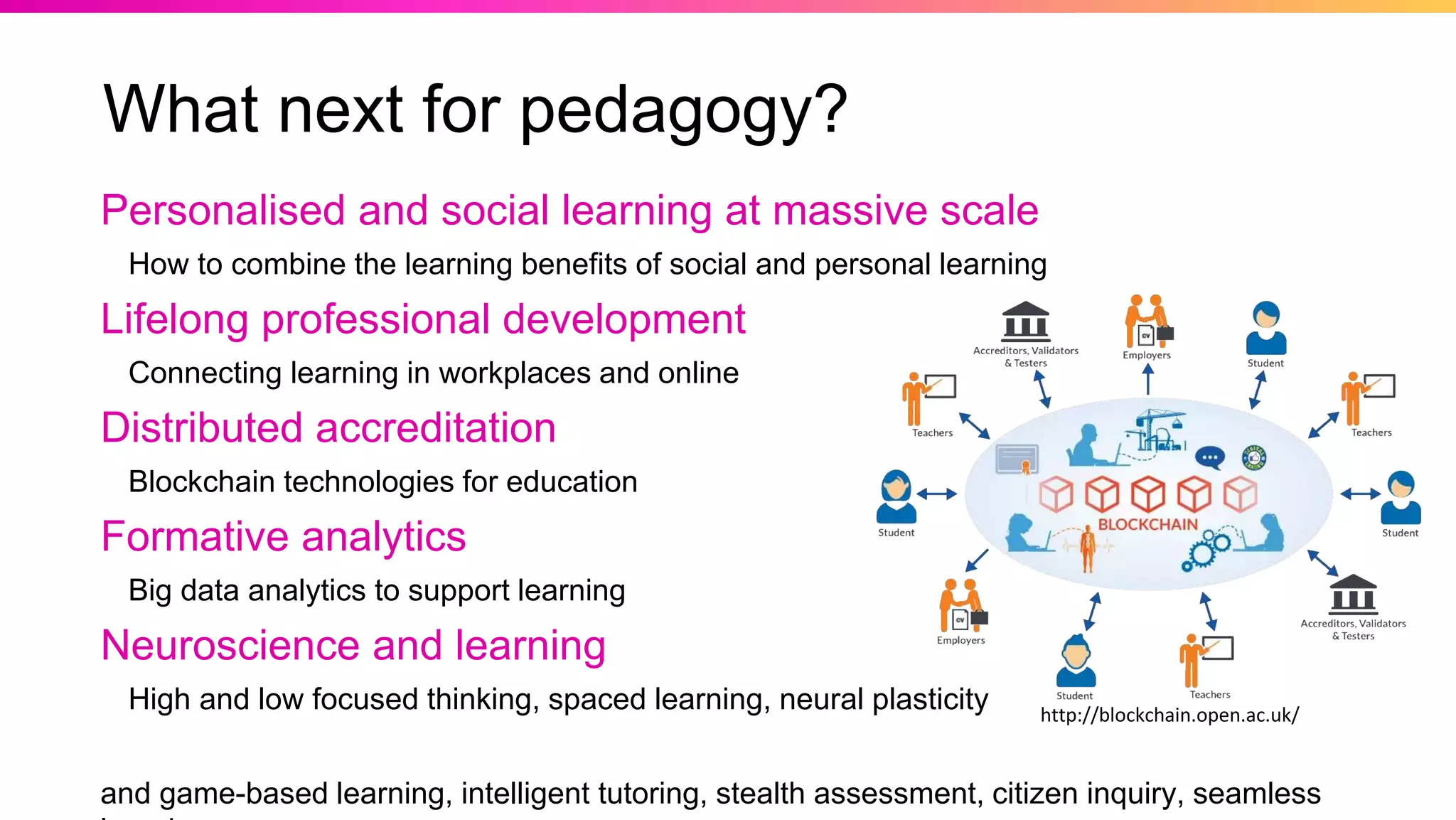
What next for pedagogy?
Personalised and social learning at massive scale
How to combine the learning benefits of social and personal learning
Lifelong professional development
Connecting learning in workplaces and online
Distributed accreditation
Blockchain technologies for education
Formative analytics
Big data analytics to support learning
Neuroscience and learning
High and low focused thinking, spaced learning, neural plasticity
and game-based learning, intelligent tutoring, stealth assessment, citizen inquiry, seamless
http://blockchain.open.ac.uk/

Pedagogy of FutureLearn

  • 1.
    Mike Sharples The OpenUniversity Pedagogy of FutureLearn How our learners learn
  • 2.
    Pedagogy “Theory and practiceof te aching, learning and asse ssment” Sharples, M., McAndrew, P., Weller, M., Ferguson, R., FitzGerald, E., Hirst, T., Mor, Y., Gaved, M. and Whitelock, D. (2012). Innovating Pedagogy 2012: Open University Innovation Report 1. Milton Keynes: The Open University. www.open.ac.uk/innovating
  • 3.
    How do welearn? For me learning is ….
  • 4.
    Learning is… Making connectionsNeuroscience Cognitive sciences Changing behaviour Behavioural science Enhancing skills Cognitive development Gaining knowledge Epistemology Making sense of the world Social sciences Socio-cultural and activity theory Interpreting the world in a new way Phenomenology Personal change Psychoanalysis
  • 5.
    New science oflearning A.N. Meltzoff, P. K. Kuhl, J. Movellan, & T. J. Sejnowski (2009) Foundations for a New Science of Learning, Science 325 (5938), 284. “Insights from many different fields are converging to create a new science of learning that may transform educational practice.”
  • 6.
    New science oflearning “A key component is the role of ‘the social’ in learning. What makes social interaction such a powerful catalyst for learning? Can key elements be embodied in technology to improve learning?”
  • 7.
    Evidence-based pedagogy Learning spacedover time, instead of all at once Questioning what you have learned Using mnemonics (keys) to remember content Summarising what you have learned Highlighting and underlining information Letting study and practice of topics overlap Which strategies are generally effective for learning? Paul A. Kirschner & Mirjam Neelan (2015) Learning the smart way. https://3starlearningexperiences.wordpress.com/tag/ineffective-learning-strategies/
  • 8.
    Evidence-based pedagogy Learning spacedover time, instead of all at once ✔ Questioning what you have learned ✔ Using mnemonics (keys) to remember content ✘ Summarising what you have learned ✘ Highlighting and underlining information ✘ Letting study and practice of topics overlap ✔ Which strategies are generally effective for learning? Paul A. Kirschner & Mirjam Neelan (2015) Learning the smart way. https://3starlearningexperiences.wordpress.com/tag/ineffective-learning-strategies/
  • 9.
    Telling stories Storytelling providesa unifying framework around which we build and think about courses Provoking Conversation Conversational learning is at the core of our belief about how people come together and learn Celebrating progress Step completion, peer interaction, timed emails, quizzes and tests with meaningful and formative feedback FutureLearn Pedagogy
  • 10.
  • 11.
    Storytelling and narrative León,C. (2016). An architecture of narrative memory. Biologically Inspired Cognitive Architectures, 16, 19-33. Figure 10 Overall architecture of the narrative memory. PS stands for procedural-semantic memory and NG stands for narrative generation. “Narrative is central to our cognition … It helps us think, remember, communicate, and make sense of the world” Plowman et al. (1999) Designing multimedia for learning: Narrative guidance and narrative construction. CHI ’99.
  • 12.
    All human learninginvolves conversation We converse with ourselves to reflect on experience We converse with teachers to understand their expert knowledge We converse with other learners to try and reach shared understanding How can I understand what you are thinking? How can I understand what you are thinking? Let’s try to reach agreement http://clipart-library.com/images/Biarp5X4T.jpg Learning as conversation
  • 13.
    Visible progress “What ismost important is that teaching is visible to the student, and that the learning is visible to the teacher. The more the student becomes the teacher, and the more the teacher becomes the learner, then the more successful are the outcomes ” John Hattie, Visible Learning p.17
  • 14.
    What pedagogy worksbest at massive scale?
  • 15.
    Some educational methodsget worse with scale e.g. personal tutoring, sports coaching Some educational methods don’t change with scale e.g. lecturing, testing Which educational methods improve with scale?
  • 16.
    Pedagogy Learners… Technology-basedexample Assessing give or receive constructive feedback engaging in online peer review Browsing seek and collate information using search engines to find educational materials Case-based investigate individual cases investigating medical cases online Collaborative construct shared understanding creating a shared Google doc Construction create artefacts engaging with big construction set, e.g. Minecraft Conversation converse with others engaging in online discussion Cross-context learn across different settings learning between classroom and home with tablet Delivered comprehend information watching an online video Embodied use their bodies to learn motor skills monitoring exercise with Fitbit activity tracker Game-based engage with game environments multiplayer educational game, e.g. Endless Ocean Inquiry-driven investigate authentic situations using digital probes to collect and analyse data Networked interact with networks of peers educational social networking Performative present for an audience creating a video blogs of learning activities Problem-solving try to solve problems working in online teams to solve problems Reflective reflect on information and activities reviewing e-portfolio of learning activities Simulation interact with a simulated tool learning science in a virtual world
  • 17.
    Pedagogy Learners… Technology-basedexample Assessing give or receive constructive feedback engaging in online peer review Browsing seek and collate information using search engines to find educational materials Case-based investigate individual cases investigating medical cases online Collaborative construct shared understanding creating a shared Google doc Construction create artefacts engaging with big construction set, e.g. Minecraft ✔ Conversation converse with others engaging in online discussion ✔ Cross-context learn across different settings learning between classroom and home with tablet Delivered comprehend information watching an online video Embodied use their bodies to learn motor skills monitoring exercise with Fitbit activity tracker Game-based engage with game environments multiplayer educational game, e.g. Endless Ocean ? Inquiry-driven investigate authentic situations using digital probes to collect and analyse data Networked interact with networks of peers educational social networking ✔ Performative present for an audience creating a video blogs of learning activities Problem-solving try to solve problems working in online teams to solve problems Reflective reflect on information and activities reviewing e-portfolio of learning activities Simulation interact with a simulated tool learning science in a virtual world
  • 18.
  • 19.
    Act Experience Check Effect How do wedo that? Human adaptivity
  • 20.
    Reflect Understand Plan Act Experience Check Effect Level of actions Levelof descriptions How do we do that? Why are we doing that? Human adaptive learning
  • 21.
    Learner • demonstrates understanding •proposes solutions to problems Learner • acts to develop models • acts to solve problems Partner • demonstrates understanding • elaborates solutions to problems Partner • acts to develop models • helps to solve problems Level of descriptions Level of actions Shared medium • enables learners and partners to represent arguments and reach agreements Shared medium • enables learners and partners to access information, develop models and solve problems ‘how?’ questions and responses ‘what?’ and ‘why?’ questions and responses offering conceptions and explanations proposing goals and modifying actions reflect adapt reflect adapt
  • 22.
    Learner • demonstrates understanding •proposes solutions to problems Learner • acts to develop models • acts to solve problems Partner • demonstrates understanding • elaborates solutions to problems Partner • acts to develop models • helps to solve problems Level of descriptions Level of actions Shared medium • enables learners and partners to represent arguments and reach agreements Shared medium • enables learners and partners to access information, develop models and solve problems ‘how?’ questions and responses ‘why?’ questions and responses offering conceptions and explanations proposing goals and modifying actions reflect adapt reflect adapt
  • 23.
    Vicarious learning fromconversation Comment posted by Karen Carmichael Timson, Learner on Ecosystems course I read through the above article and thought "that's interesting" then I read the comments below, particularly the discussion of niches, and suddenly thought a whole lot more… … it’s almost as if the basic course is in 2D but the postings lift it to 3D and really make it come alive
  • 24.
    Learner • demonstrates understanding •proposes solutions to problems Learner • acts to develop models • acts to solve problems Partner • demonstrates understanding • elaborates solutions to problems Partner • acts to develop models • helps to solve problems Level of descriptions Level of actions Shared medium • enables learners and partners to represent arguments and reach agreements Shared medium • enables learners and partners to access information, develop models and solve problems ‘how?’ questions and responses ‘why?’ questions and responses offering conceptions and explanations proposing goals and modifying actions reflect adapt reflect adapt
  • 25.
    Learner • demonstrates understanding •proposes solutions to problems Learner • acts to develop models • acts to solve problems Partner • demonstrates understanding • elaborates solutions to problems Partner • acts to develop models • helps to solve problems Level of descriptions Level of actions Shared medium • enables learners and partners to represent arguments and reach agreements Shared medium • enables learners and partners to access information, develop models and solve problems ‘how?’ questions and responses ‘why?’ questions and responses offering conceptions and explanations proposing goals and modifying actions reflect adapt reflect adapt
  • 26.
    Learner • demonstrates understanding •proposes solutions to problems Learner • acts to develop models • acts to solve problems Partner • demonstrates understanding • elaborates solutions to problems Partner • acts to develop models • helps to solve problems Level of descriptions Level of actions Shared medium • enables learners and partners to represent arguments and reach agreements Shared medium • enables learners and partners to access information, develop models and solve problems ‘how?’ questions and responses ‘why?’ questions and responses offering conceptions and explanations proposing goals and modifying actions reflect adapt reflect adapt
  • 27.
    How to improvestudy group conversation?
  • 28.
    For groups towork: shared goals each person knows how and when to contribute everyone makes an appropriate contribution share rewards in a fair way opportunity to reflect on progress and to discuss contributions Johnson, D. W., & Johnson, R. T. (2009). An educational psychology success story: Social interdependence theory and cooperative learning. Educational researcher, 38(5), 365-379.
  • 29.
    Why do wehave weeks, activities and steps?
  • 30.
    Weeks Personally meaningful studyperiods. ‘Each week I will…?’ Activities Elements of pedagogy – each with a defined goal, learning methods, and outcome. Design learning around activities. Steps Pedagogic ‘Lego bricks’ that form an activity Learning design
  • 31.
    Activity Steps What isgood learning? 1.1 DI Discussion 1.2 VI Video 1.3 AR Article 1.4 AR Article High level course design 1.5 DI Discussion 1.6 AR Article 1.7 DI Discussion 1.8 DI Discussion Diving straight in 1.9 VI Video 1.10 AS Assignment 1.11 RV Review 1.12 RE Reflection What have we learnt so far about learning? 1.13 AR Article 1.14 AR Article 1.15 VI Video 1.16 DI Discussion How to Create a Great FutureLearn Course Week 1
  • 32.
    Activity Steps What isgood learning? 1.1 DI Discussion 1.2 VI Video 1.3 AR Article 1.4 AR Article High level course design 1.5 DI Discussion 1.6 AR Article 1.7 DI Discussion 1.8 DI Discussion Diving straight in 1.9 VI Video 1.10 AS Assignment 1.11 RV Review 1.12 RE Reflection What have we learnt so far about learning? 1.13 AR Article 1.14 AR Article 1.15 VI Video 1.16 DI Discussion How to Create a Great FutureLearn Course Week 1 Pedagogy from Learning Design Studio, Hong Kong University http://ilap- sdls.cite.hku.hk/ld_alpaca/in dex.php?lang=en
  • 33.
    Activity Pedagogy Steps Whatis good learning? Receive Discuss 1.1 DI Discussion 1.2 VI Video 1.3 AR Article 1.4 AR Article High level course design Receive Reflect Discuss Create 1.5 DI Discussion 1.6 AR Article 1.7 DI Discussion 1.8 DI Discussion Diving straight in Receive Practice Discuss Reflect 1.9 VI Video 1.10 AS Assignment 1.11 RV Review 1.12 RE Reflection What have we learnt so far about learning? Receive Investigate Discuss 1.13 AR Article 1.14 AR Article 1.15 VI Video 1.16 DI Discussion How to Create a Great FutureLearn Course Week 1 Pedagogy from Learning Design Studio, Hong Kong University http://ilap- sdls.cite.hku.hk/ld_alpaca/in dex.php?lang=en
  • 34.
    Why are FutureLearnsteps 20 minutes?
  • 35.
  • 36.
    Synapses link neurons Learningis associated with strengthening synaptic connections Lasting chemical connections can be formed in minutes, for networks of neurons Neural learning works best when short sessions of stimulation are spaced with periods of other activity, to let the synaptic connections grow Spaced learning
  • 37.
    20 minute teacher-led presentation 20 minutes studentsrecall key concepts 10 minute active break 10 minute active break 20 minutes students apply knowledge GCSE biology course Three 20-minute learning episodes spaced by 10 minutes of physical activity (e.g. clay modelling) A controlled study found similar learning outcomes from one hour of spaced learning compared to a four-month course of classroom teaching Trials in UK schools of short spaces, plus longer 24 hour spaces Kelley, P., & Whatson, T. (2013). Making long-term memories in minutes: a spaced learning pattern from memory research in education. Frontiers in Human Neuroscience, 7, 589.
  • 38.
    Why do weask our learners big questions?
  • 39.
    39 Active learning: Flippedclassroom In their own time, students learn from videos and texts Then students work together to solve problems and explore misunderstandings Image: http://www.washington.edu/teaching/files/2012/11/FlippedClassroomUWcolors-1-1024x242.jpg Each student is in control: stop/start, speed, make notes Students solve problems together and learn from each other, guided by the teacher Active learning
  • 40.
    40 Active learning: Explorefirst Students start by exploring a new topic and attempting to solve problems together Students then engage with a video presentation, or a teacher-led lesson based on their answers Schneider, B., & Blikstein, P. (2016). Flipping the Flipped Classroom: A Study of the Effectiveness of Video Lectures Versus Constructivist Exploration Using Tangible User Interfaces. IEEE Transactions on Learning Technologies, 9(1), 5-17.
  • 41.
  • 42.
  • 43.
  • 44.
    Professional development Team learning Companycohorts Mentoring Competency learning Case-based learning Reflective portfolio https://www.cipd.co.uk/learn/cpd/cycle
  • 45.
    Reputation management Supporting advancers togain long-term expertise and reputation https://www.ispotnature.org/view/user/19634
  • 46.
    What next forpedagogy? Personalised and social learning at massive scale How to combine the learning benefits of social and personal learning Lifelong professional development Connecting learning in workplaces and online Distributed accreditation Blockchain technologies for education Formative analytics Big data analytics to support learning Neuroscience and learning High and low focused thinking, spaced learning, neural plasticity and game-based learning, intelligent tutoring, stealth assessment, citizen inquiry, seamless http://blockchain.open.ac.uk/

Editor's Notes

  • #12 We live ’storied’ lives. Helps us to answer ‘how?’ questions. Provides a coherent thread of interpretation.
  • #13 Sensemaking and intersubjectivity