Transforming	in-class	
and	out-of-class	
student	engagement	
through	active	
learning
Dr John	Couperthwaite
Solutions	Engineer	(EMEA),	Echo360
jcouperthwaite@echo360.com
@johncoup
• asking questions
• answer questions
•exit polls
•probe limits of
understanding
•demonstrate
success, and review
• tackle
misconceptions
• exercise skills
• conceptual
understanding,
judging etc
• provoke thinking
• stimulate discussions
• induce cognitive
conflicts
Challenge
and reflect on
prior
knowledge
Develop
knowledge
Communicate
Assess
learning
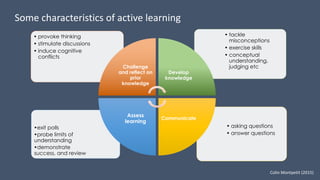
Some	characteristics	of	active	learning
Colin	Montpetit (2015)
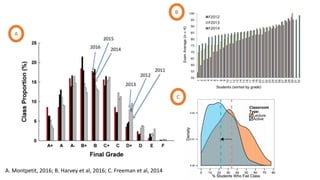
A.	Montpetit,	2016;	B.	Harvey	et	al,	2016;	C.	Freeman	et	al,	2014
A
B
C
“Faculty members need to shift from
‘What did I teach?’ to ‘What did my students learn?’
They must aim to create engaging learning.”
(Bradforth et al. 2015)
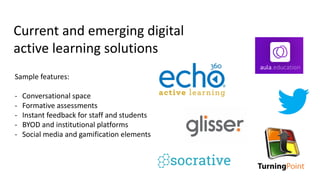
Current	and	emerging	digital	
active	learning	solutions
Sample	features:
- Conversational	space
- Formative	assessments
- Instant	feedback	for	staff	and	students
- BYOD	and	institutional	platforms
- Social	media	and	gamification	elements
FIVE steps to
connect active
learning experiences
This work is licensed under a Creative Commons Attribution-NonCommercial-ShareAlike 4.0 International License.
5	steps	to	connect	active	
learning	experiences
1. Blend	in-class	and	online	
‘coalesced’	learning
This work is licensed under a Creative Commons Attribution-NonCommercial-
ShareAlike 4.0 International License.
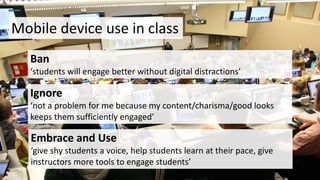
Mobile	device	use	in	class
Ban
‘students	will	engage	better	without	digital	distractions’
Ignore	
‘not	a	problem	for	me	because	my	content/charisma/good	looks	
keeps	them	sufficiently	engaged’
Embrace	and	Use
‘give	shy	students	a	voice,	help	students	learn	at	their	pace,	give	
instructors	more	tools	to	engage	students’
(David	White,	2016)
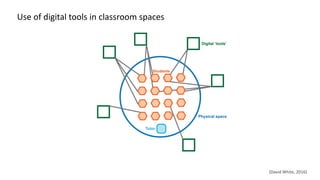
Use	of	digital	tools	in	classroom	spaces
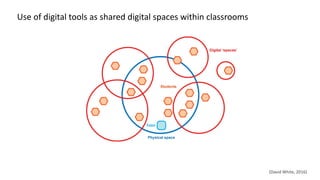
Use	of	digital	tools	as	shared	digital	spaces	within	classrooms
(David	White,	2016)
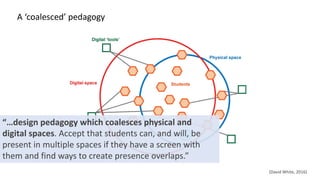
A	‘coalesced’	pedagogy
“…design	pedagogy	which	coalesces	physical	and	
digital	spaces.	Accept	that	students	can,	and	will,	be	
present	in	multiple	spaces	if	they	have	a	screen	with	
them	and	find	ways	to	create	presence	overlaps.”
(David	White,	2016)
5	steps	to	connect	active	
learning	experiences
1. Blend	in-class	and	online	
‘coalesced’	learning
2. Engage	students	during	class
This work is licensed under a Creative Commons Attribution-NonCommercial-
ShareAlike 4.0 International License.
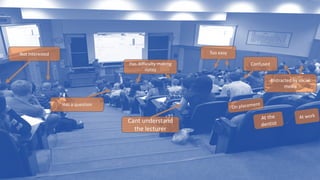
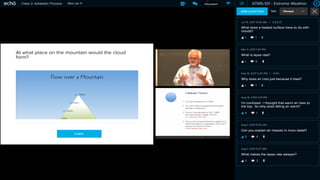
Confused
Has	a	question
Not	interested
Cant	understand	
the	lecturer
Too	easy
Distracted	by	social	
media
Has	difficulty	making	
notes
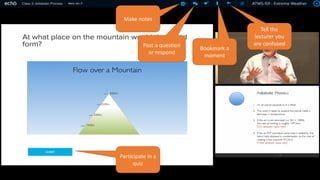
Make	notes
Bookmark	a	
moment
Post	a	question	
or	respond
Tell	the	
lecturer	you	
are	confused
Participate	in	a	
quiz
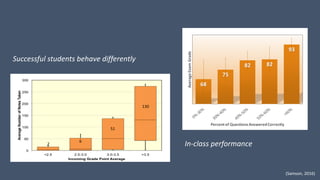
(Samson,	2016)
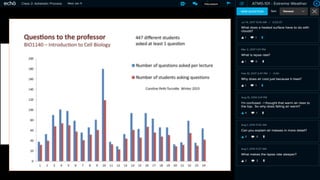
Successful	students	behave	differently
In-class	performance
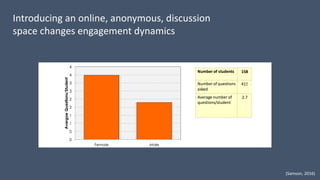
Introducing	an	online,	anonymous,	discussion	
space	changes	engagement	dynamics
(Samson,	2016)
5	steps	to	connect	active	
learning	experiences
1. Blend	in-class	and	online	
‘coalesced’	learning
2. Engage	students	during	class
3. Connect	out-of-class	learners
This work is licensed under a Creative Commons Attribution-NonCommercial-
ShareAlike 4.0 International License.
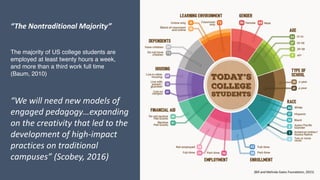
(Bill	and	Melinda	Gates	Foundation,	2015)
“The	Nontraditional	Majority”
The majority of US college students are
employed at least twenty hours a week,
and more than a third work full time
(Baum, 2010)
“We	will	need	new	models	of	
engaged	pedagogy…expanding	
on	the	creativity	that	led	to	the	
development	of	high-impact	
practices	on	traditional	
campuses”	(Scobey,	2016)
5	steps	to	connect	active	
learning	experiences
1. Blend	in-class	and	online	
‘coalesced’	learning
2. Engage	students	during	class
3. Connect	out-of-class	learners
4. Provide	real-time	feedback	for	
instructors
This work is licensed under a Creative Commons Attribution-NonCommercial-
ShareAlike 4.0 International License.
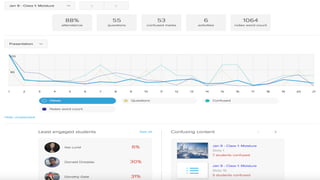
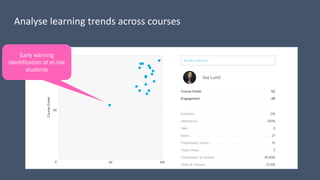
Early warning
identification of at-risk
students
Analyse learning	trends	across	courses
5	steps	to	connect	active	
learning	experiences
1. Blend	in-class	and	online	
‘coalesced’	learning
2. Engage	students	during	class
3. Connect	out-of-class	learners
4. Provide	real-time	feedback	for	
instructors
5. Merge	before,	during	and	after	
class	learning
This work is licensed under a Creative Commons Attribution-NonCommercial-
ShareAlike 4.0 International License.
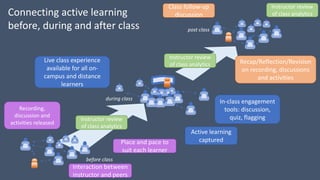
during	class
post	class
before	class
Live	class	experience	
available	for	all	on-
campus	and	distance	
learners
Interaction	between	
instructor	and	peers
Place	and	pace	to	
suit	each	learner
Recap/Reflection/Revision	
on	recording,	discussions	
and	activities
Instructor	review	
of	class	analytics
Instructor	review	
of	class	analytics
Instructor	review	
of	class	analytics
Class	follow-up	
discussion
Recording,	
discussion	and	
activities	released
In-class	engagement	
tools:	discussion,	
quiz,	flagging
Active	learning	
captured
Connecting	active	learning	
before,	during	and	after	class
Conclusions
Active	learning	before,	during	and after	the	
lecture	can	transform	learning	pathways,	giving	
greater	flexibility	for	learners.
The	lecture-based	learning	experience	can	be	
personalised	through	enhanced	instructor	
feedback	and	interaction.
Improvements	to	learning	outcomes,	students	
engagement	and	satisfaction	scores	are	
achievable.
…this presentation: http://bit.ly/altalc_activelearning
Baum, S. 2010. “Student Work and the Financial Aid System.” In Perna 2010, 3–20.
Bill and Melinda Gates Foundation, 2015 https://postsecondary.gatesfoundation.org/areas-of-focus/incentives/policy-
advocacy/advocacy-priorities/america-100-college-students/
Bradforth et al. 2015. "Improve undergraduate science education: It is time to use evidence-based teaching practices at all levels by
providing incentives and effective evaluations." Nature, vol. 523, no. 7560, p. 282.
Freeman S. et al, 2014. Active learning increases student performance in science, engineering, and mathematics.
http://www.pnas.org/content/111/23/8410.abstract
Harvey et al. 2016. Encouragement for Faculty to Implement Vision and Change http://www.lifescied.org/content/15/4/es7.full
Montpetit, C. 2015. Learning fearlessly: does fearless engagement translate into class performance? Blog post for Echo360, 10th
March. http://blog.echo360.com/learning-fearlessly-part-2
Samson, P. 2017. Student behaviours during class predict student success.
https://umich.app.box.com/s/0mpnapcn3nwfxih6c472rvdx9ang1u22
Scobey, D. 2016. Marginalized Majority: Nontraditional Students and the Equity Imperative.
https://www.aacu.org/diversitydemocracy/2016/winter/scobey
White, D. 2016. Coalescent spaces. http://daveowhite.com/coalescent/
References
Transforming	in-class	
and	out-of-class	
student	engagement	
through	active	
learning
Dr John	Couperthwaite
Solutions	Engineer	(EMEA),	Echo360
jcouperthwaite@echo360.com
@johncoup

Transforming in-class and out-of-class student engagement through active learning