
Designing small group discussion
for a MOOC platform
Mike Sharples, Laura Kirsop, Alla Kholmatova
Presentation at Learning with MOOCS III, Philadelphia
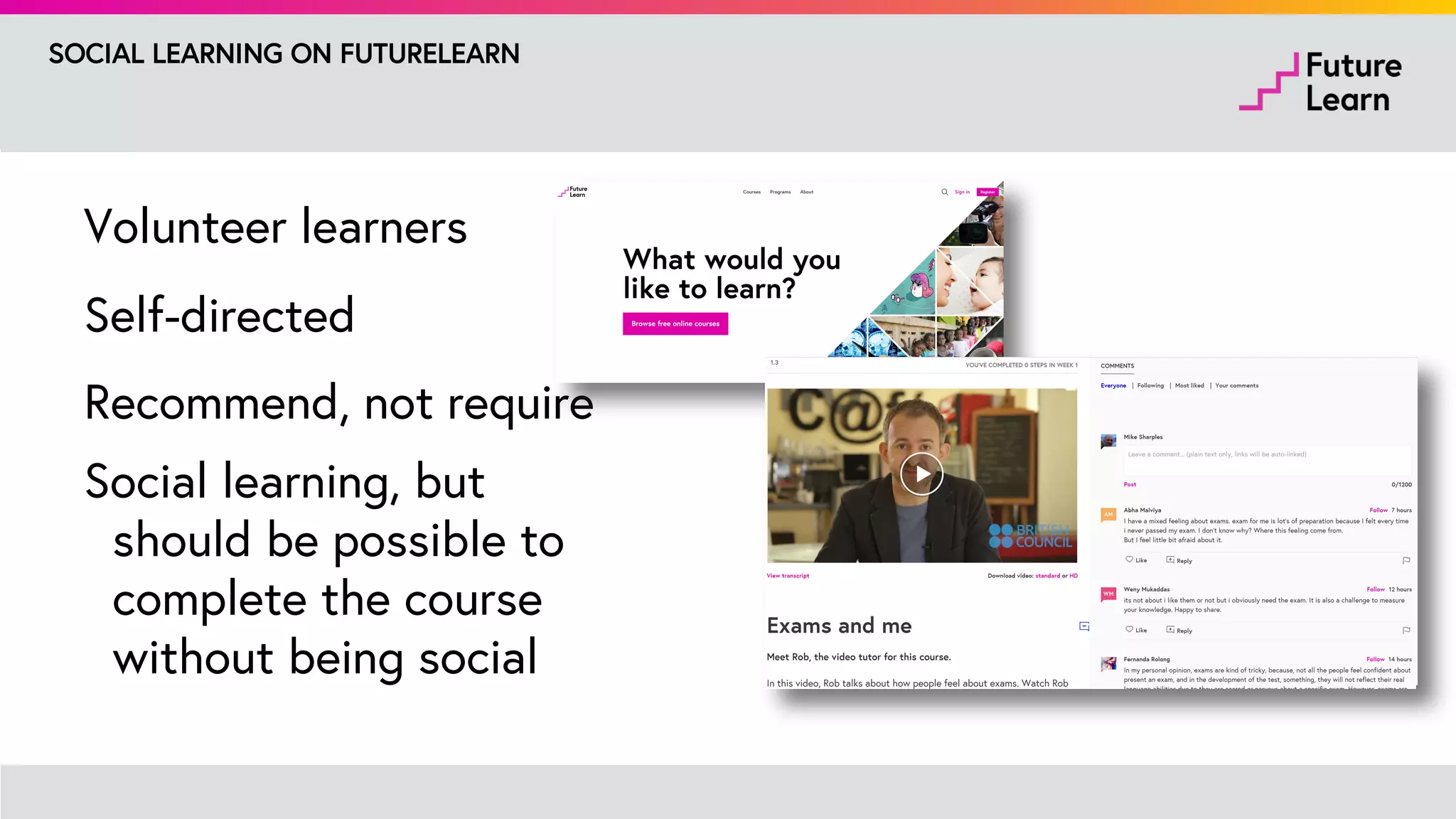
SOCIAL LEARNING ON FUTURELEARN
Volunteer learners
Self-directed
Recommend, not require
Social learning, but should
be possible to complete the
course without being social
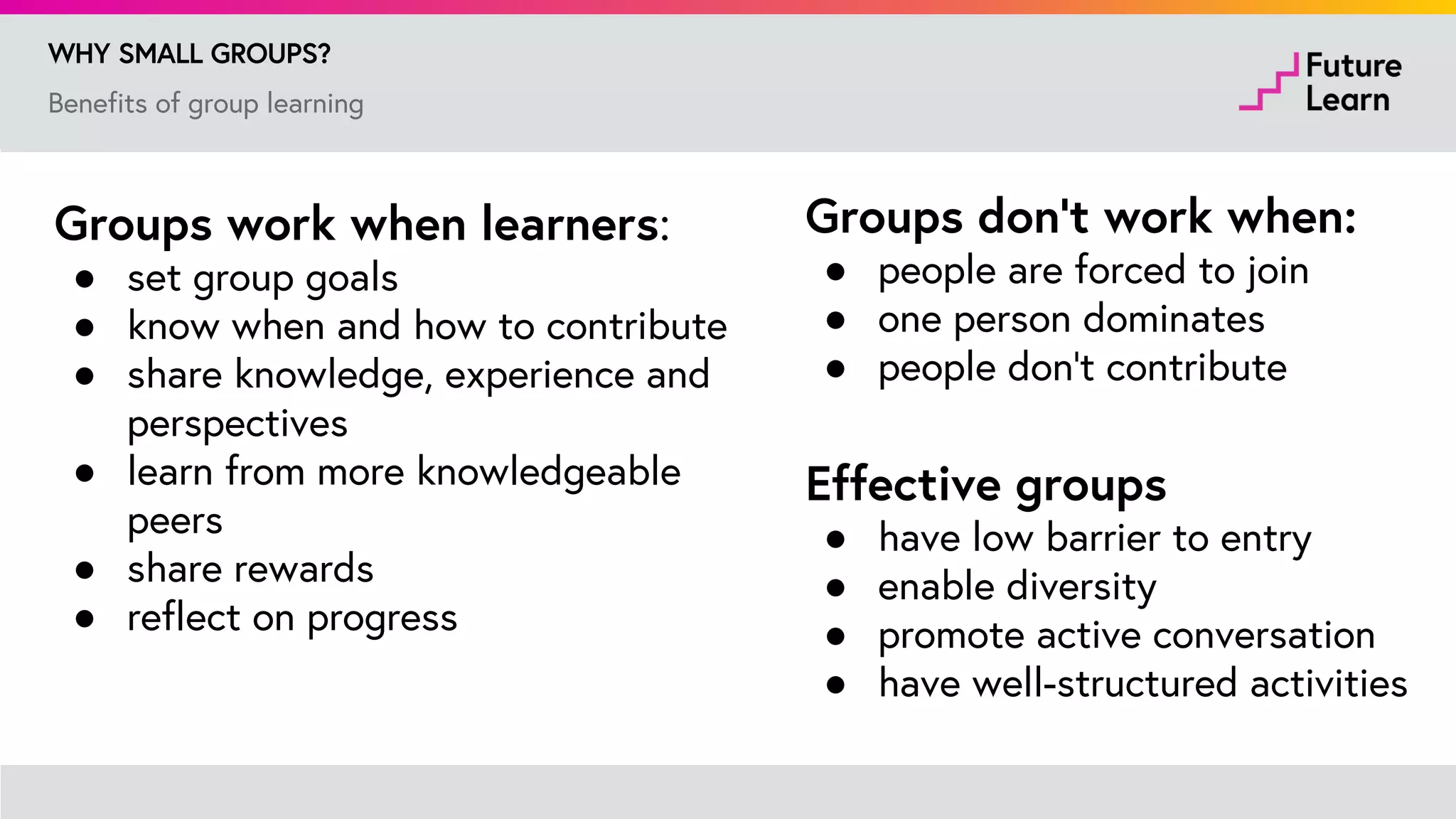
Benefits of group learning
WHY SMALL GROUPS?
Groups work when learners:
● set group goals
● know when and how to contribute
● share knowledge, experience and
perspectives
● learn from more knowledgeable peers
● share rewards
● reflect on progress
Groups don’t work when:
● people are forced to join
● one person dominates
● people don’t contribute
Johnson, D. W., & Johnson, R. T. (2009). An educational psychology success story: Social
interdependence theory and cooperative learning. Educational researcher, 38(5), 365-379.
Benefits of group learning
WHY SMALL GROUPS?
Effective groups for FutureLearn:
✓ Low barrier to entry
✓ Enable diversity
✓ Promote active conversations
✓ Include well structured activities
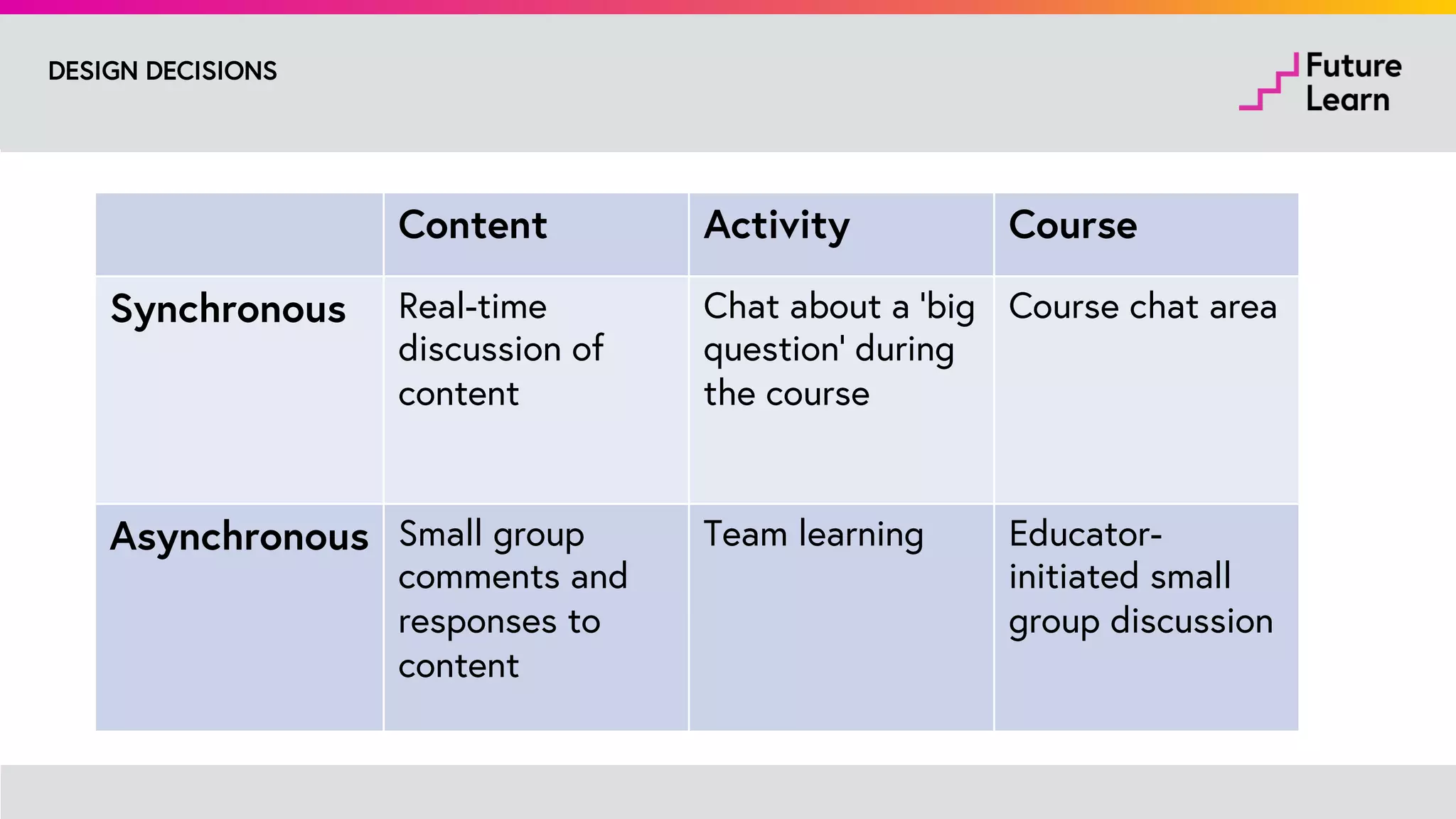
DESIGN DECISIONS
Content Activity Course
Synchronous Real-time
discussion of
content
Live chat about a
‘big question’
during the course
Course chat area
Asynchronous Small group
comments and
responses to
content
Team learning Educator-initiated
small group
discussion
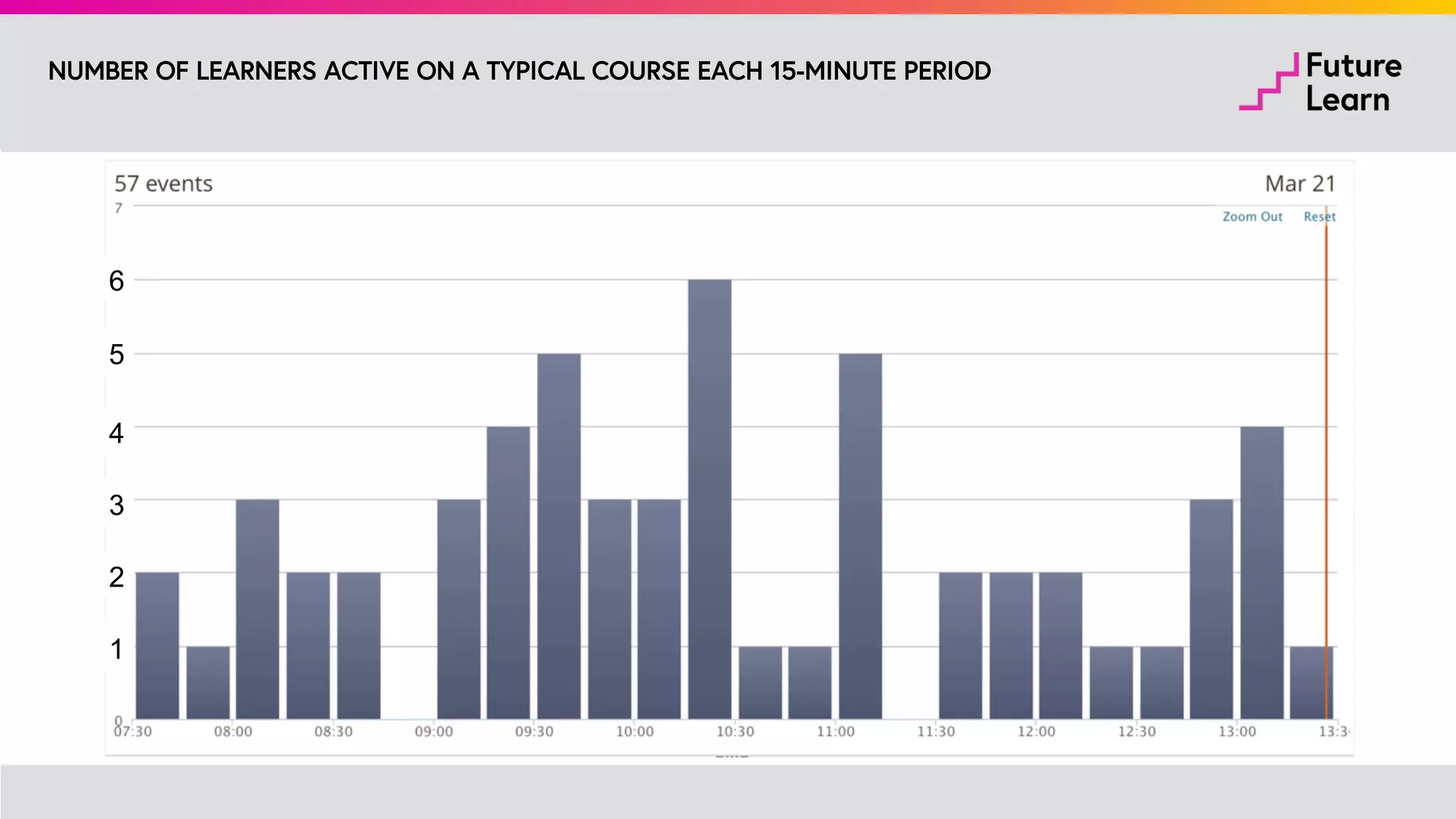
NUMBER OF LEARNERS ACTIVE ON A TYPICAL COURSE EACH 15-MINUTE PERIOD
1
2
3
4
5
6
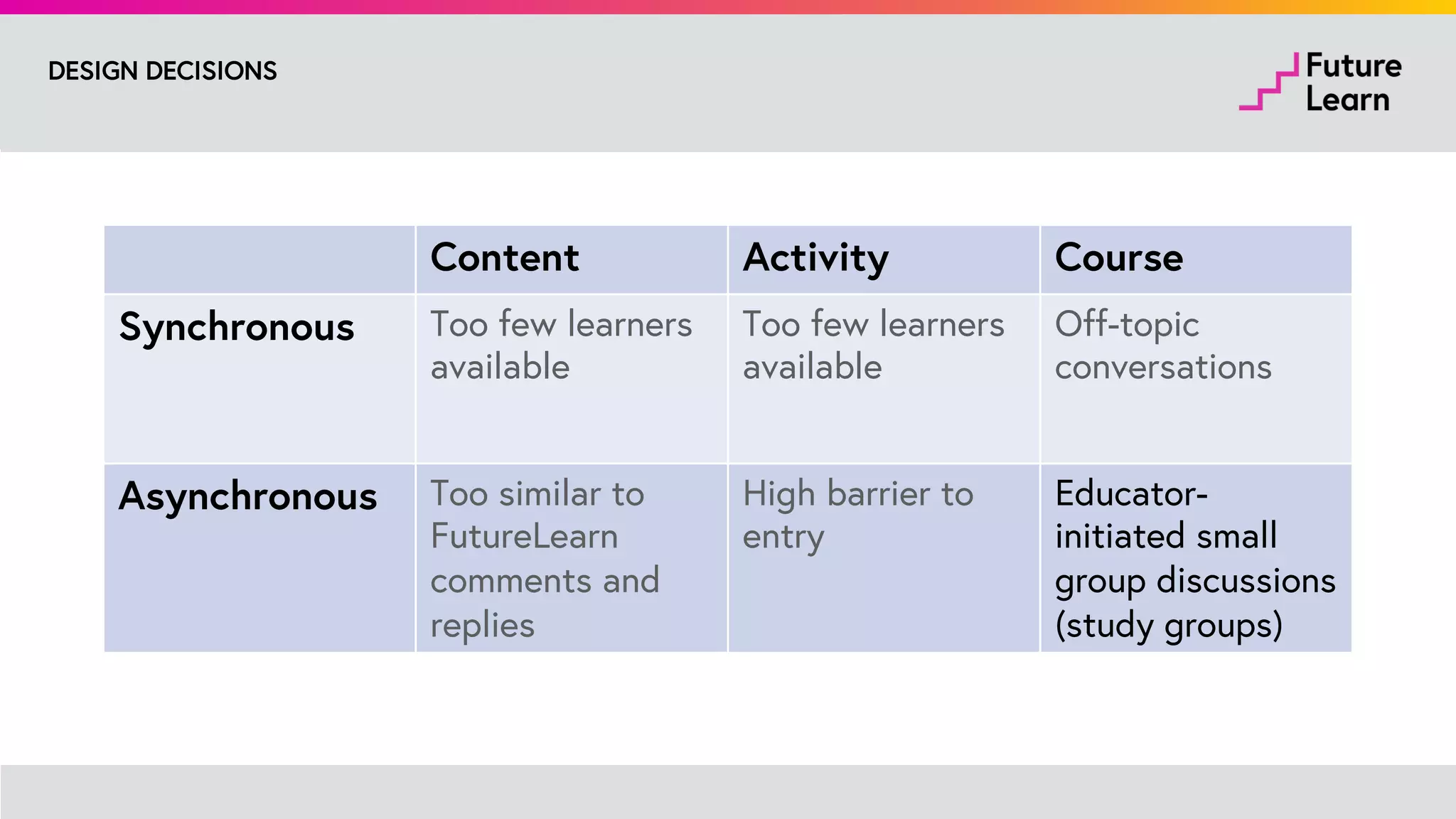
DESIGN DECISIONS
Content Activity Course
Synchronous Too few learners
available
Too few learners
available
Off-topic
conversations
Asynchronous Too similar to
FutureLearn
comments and
replies
High barrier to
entry
Educator-initiated
small group
discussions (study
groups)
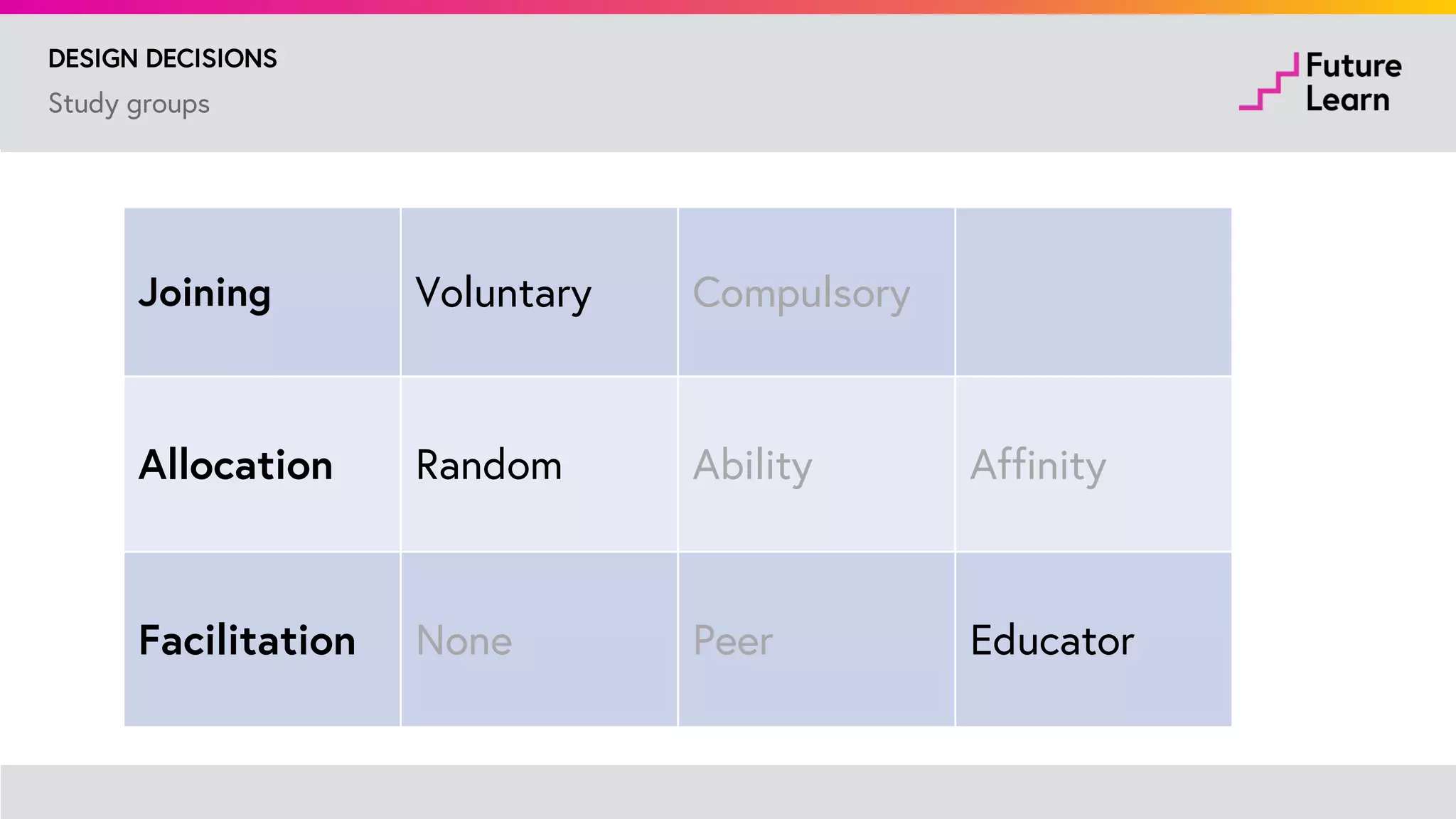
Study groups
DESIGN DECISIONS
Joining Voluntary Compulsory
Allocation Random Ability Affinity
Facilitation None Peer Educator
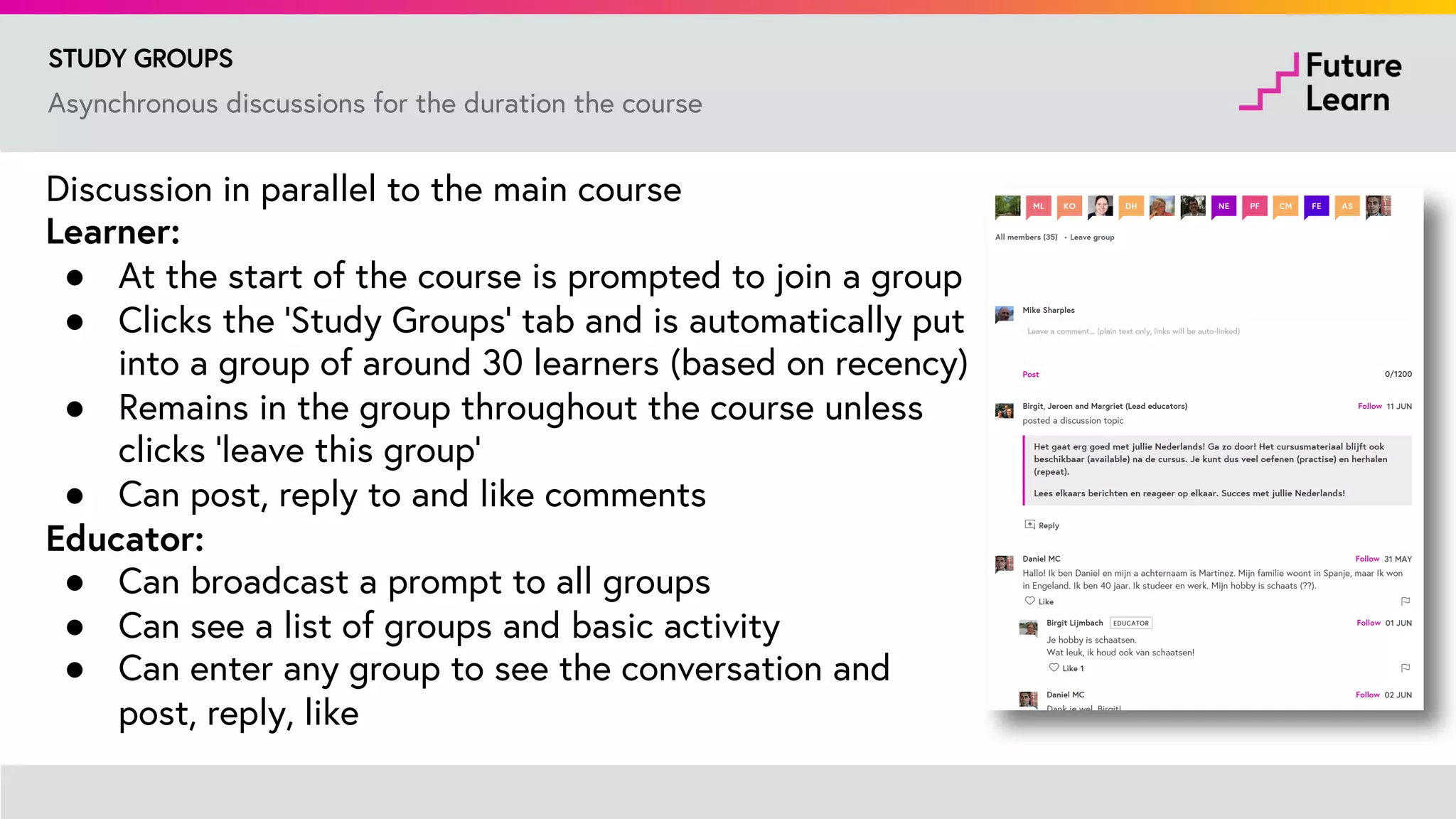
Asynchronous discussions for the duration the course
STUDY GROUPS
Discussion in parallel to the main course
Learner:
● at the start of the course is prompted to join a group
● clicks the ‘Study Groups’ tab and is automatically put
into a group of around 30 learners (based on
recency)
● remains in the group throughout the course unless
clicks ‘leave this group’
● can post, reply to and like comments
Asynchronous discussions for the duration the course
STUDY GROUPS
Discussion in parallel to the main course
Educator:
● can broadcast a prompt to all groups
● can see a list of groups and basic activity
● can enter any group to see the conversation and
post, reply, like
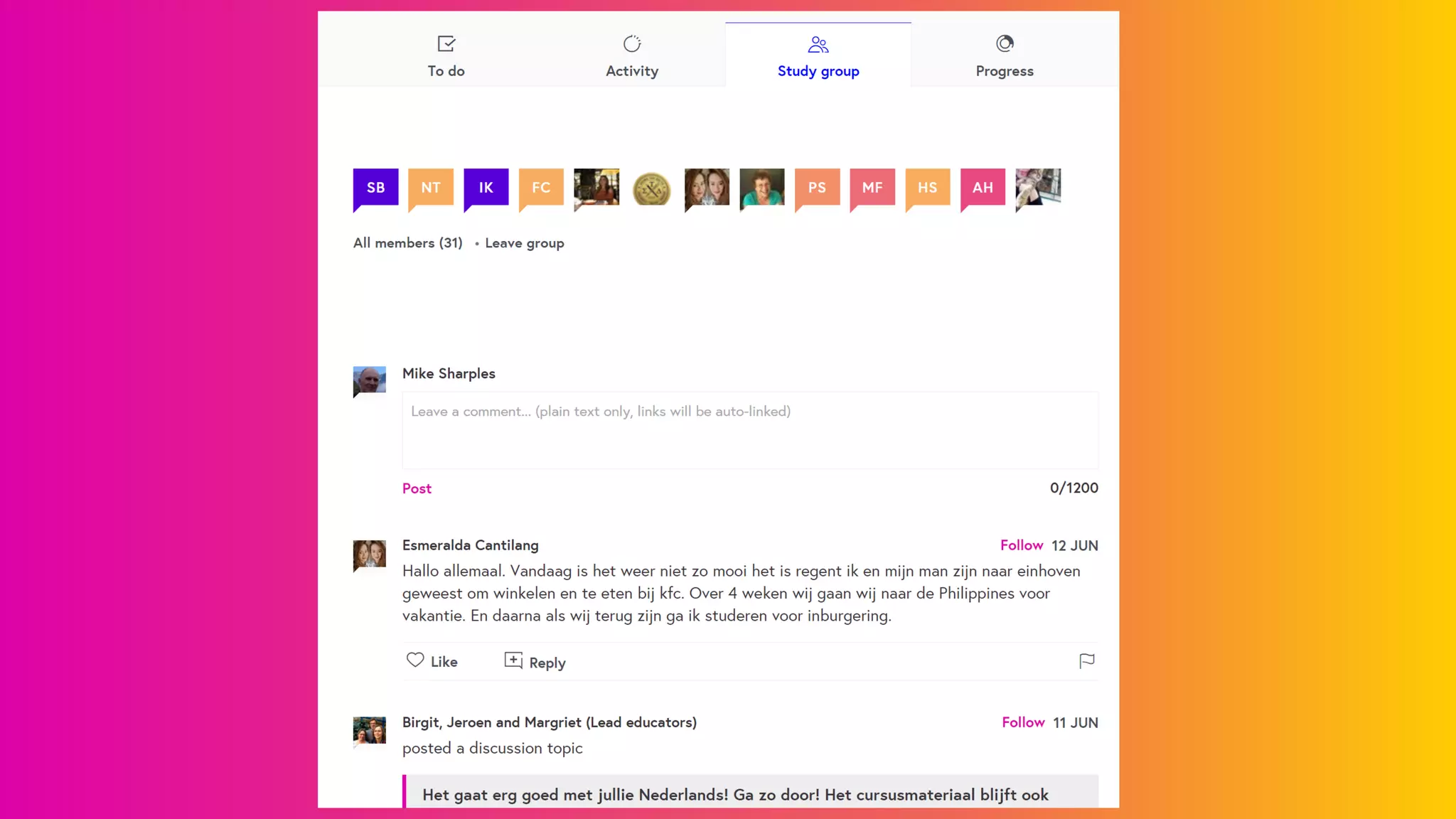
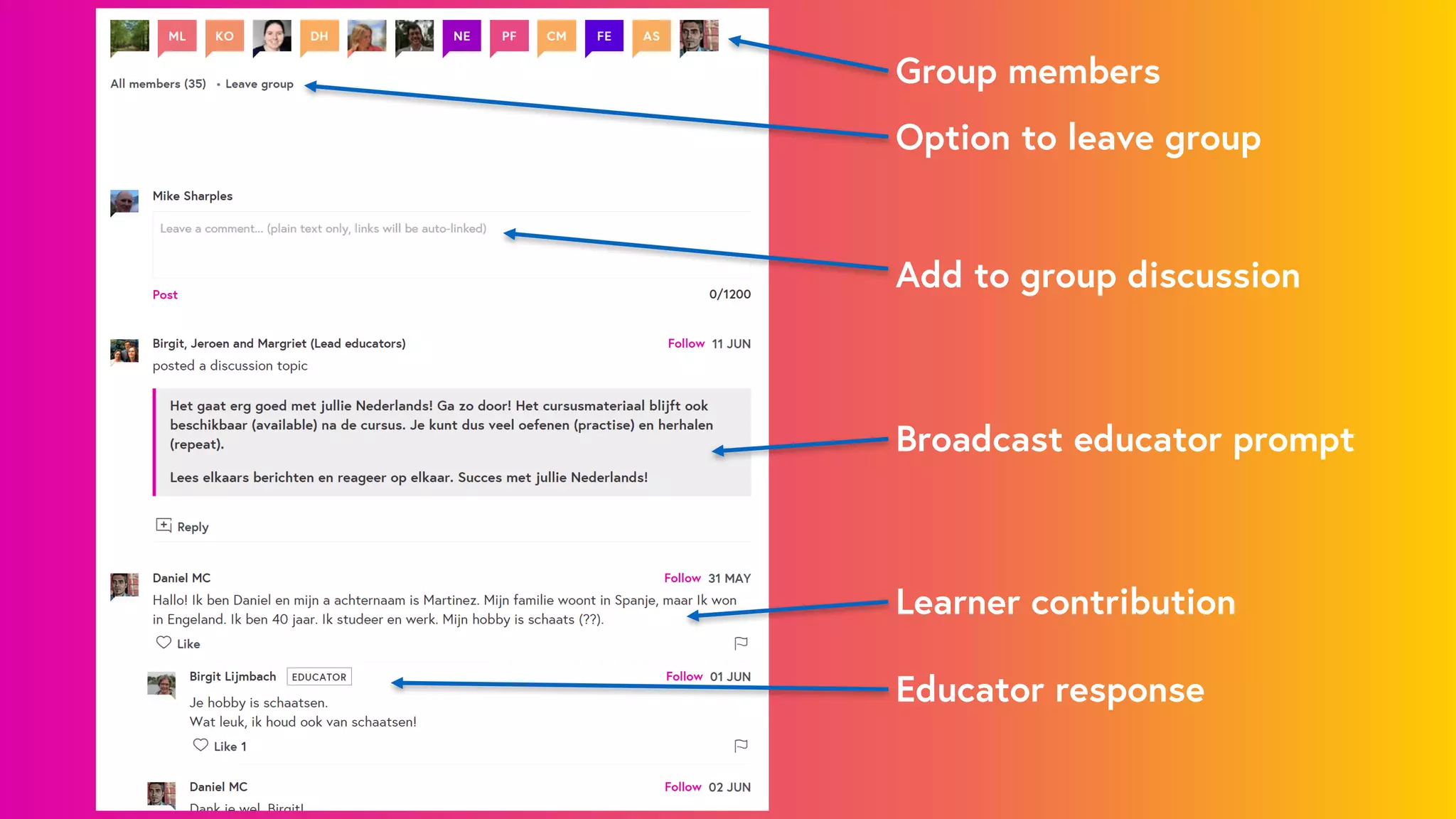
Group members
Add to group discussion
Broadcast educator prompt
Learner contribution
Educator response
Option to leave group
Pilot study with 12 courses
EVALUATION
● Analysis of data from trials with 12 courses
● Interview - 8 learners
● Micro-survey in 2nd week - 856 learners
● Detailed survey of learners who had completed 10% or
more of course - 1862 learners
● Interviews with representatives from 9 course teams
Successes
EVALUATION
● Learners and course teams saw opportunity to enhance
the learning experience
● Most learners had no preferences on who they were
grouped with - random allocation preferable
● Learners liked interacting with a group of peers
● Learners liked when Educators made contributions
Improvements
EVALUATION
● Learners were frustrated when discussion decreased
● Learners need direction on how to work in groups
● Course teams need guidance on designing learning for
study groups, e.g. ‘jigsaw learning’
● Course teams want a better view of group activity and
where to intervene
More structure and guidance

Small Group Discussion for a MOOC Platform

  • 1.
    Designing small groupdiscussion for a MOOC platform Mike Sharples, Laura Kirsop, Alla Kholmatova Presentation at Learning with MOOCS III, Philadelphia
  • 2.
    SOCIAL LEARNING ONFUTURELEARN Volunteer learners Self-directed Recommend, not require Social learning, but should be possible to complete the course without being social
  • 3.
    Benefits of grouplearning WHY SMALL GROUPS? Groups work when learners: ● set group goals ● know when and how to contribute ● share knowledge, experience and perspectives ● learn from more knowledgeable peers ● share rewards ● reflect on progress Groups don’t work when: ● people are forced to join ● one person dominates ● people don’t contribute Johnson, D. W., & Johnson, R. T. (2009). An educational psychology success story: Social interdependence theory and cooperative learning. Educational researcher, 38(5), 365-379.
  • 4.
    Benefits of grouplearning WHY SMALL GROUPS? Effective groups for FutureLearn: ✓ Low barrier to entry ✓ Enable diversity ✓ Promote active conversations ✓ Include well structured activities
  • 5.
    DESIGN DECISIONS Content ActivityCourse Synchronous Real-time discussion of content Live chat about a ‘big question’ during the course Course chat area Asynchronous Small group comments and responses to content Team learning Educator-initiated small group discussion
  • 6.
    NUMBER OF LEARNERSACTIVE ON A TYPICAL COURSE EACH 15-MINUTE PERIOD 1 2 3 4 5 6
  • 7.
    DESIGN DECISIONS Content ActivityCourse Synchronous Too few learners available Too few learners available Off-topic conversations Asynchronous Too similar to FutureLearn comments and replies High barrier to entry Educator-initiated small group discussions (study groups)
  • 8.
    Study groups DESIGN DECISIONS JoiningVoluntary Compulsory Allocation Random Ability Affinity Facilitation None Peer Educator
  • 10.
    Asynchronous discussions forthe duration the course STUDY GROUPS Discussion in parallel to the main course Learner: ● at the start of the course is prompted to join a group ● clicks the ‘Study Groups’ tab and is automatically put into a group of around 30 learners (based on recency) ● remains in the group throughout the course unless clicks ‘leave this group’ ● can post, reply to and like comments
  • 11.
    Asynchronous discussions forthe duration the course STUDY GROUPS Discussion in parallel to the main course Educator: ● can broadcast a prompt to all groups ● can see a list of groups and basic activity ● can enter any group to see the conversation and post, reply, like
  • 12.
    Group members Add togroup discussion Broadcast educator prompt Learner contribution Educator response Option to leave group
  • 13.
    Pilot study with12 courses EVALUATION ● Analysis of data from trials with 12 courses ● Interview - 8 learners ● Micro-survey in 2nd week - 856 learners ● Detailed survey of learners who had completed 10% or more of course - 1862 learners ● Interviews with representatives from 9 course teams
  • 14.
    Successes EVALUATION ● Learners andcourse teams saw opportunity to enhance the learning experience ● Most learners had no preferences on who they were grouped with - random allocation preferable ● Learners liked interacting with a group of peers ● Learners liked when Educators made contributions
  • 15.
    Improvements EVALUATION ● Learners werefrustrated when discussion decreased ● Learners need direction on how to work in groups ● Course teams need guidance on designing learning for study groups, e.g. ‘jigsaw learning’ ● Course teams want a better view of group activity and where to intervene More structure and guidance

Editor's Notes