


21st Century Student Engagement & Success through Collaborative Project-Based Learning 
Inaugural Big XII Teaching and Learning Conference, 
Stillwater, OK, August 4, 2014 
© 2014 Dr. Beata M. Jones, Texas Christian University
Overview 
• 
Welcome 
• 
Challenges to 21st Century Student Engagement 
• 
21st Century Learning Environment Setting 
• 
Needed 21st Century Student Learning Outcomes 
• 
Project-based Learning (PjBL) 
• 
PjBL Course Design 
• 
Scaffolding & Enriching PjBL Learning Environment 
• 
Q&A
Welcome! 
Beata M. Jones: 
• 
Ph. D. in Computer Science, 1993 
• 
At TCU 15+ years 
• 
Current Teaching: BIS & Interdisciplinary Honors Colloquia 
• 
Coordinating 21st Century Student FIG 
• 
Requiring projects for past 15+ years; 
• 
Doing PjBL for past 5 years Contact: b.jones@tcu.edu https://www.linkedin.com/pub/beatamjones @BeataJones
Hello! 
• 
My name is….. 
• 
I am from the ___ university/college 
• 
I teach____ 
• 
PjBL?
Is This Your Reality? 
“I am Worried About My Grade” (4:47)
Or Is This Your Reality? 
Michael Wesch: “Vision of Students Today” (4:44)
21st Century Students 
• 
Shorter attention spans 
• 
Easily bored 
• 
Resist memorization and busy work 
• 
Self-learners 
• 
Embrace trial and error 
• 
Attached to mobile technology 
• 
Perceive learning as a social activity to be shared with others 
• 
Make Learning Relevant 
• 
Engage Us! 
TCU Fig21 Videos: (60:00+)
What’s YOUR Biggest Challenge Teaching Millennial Students?
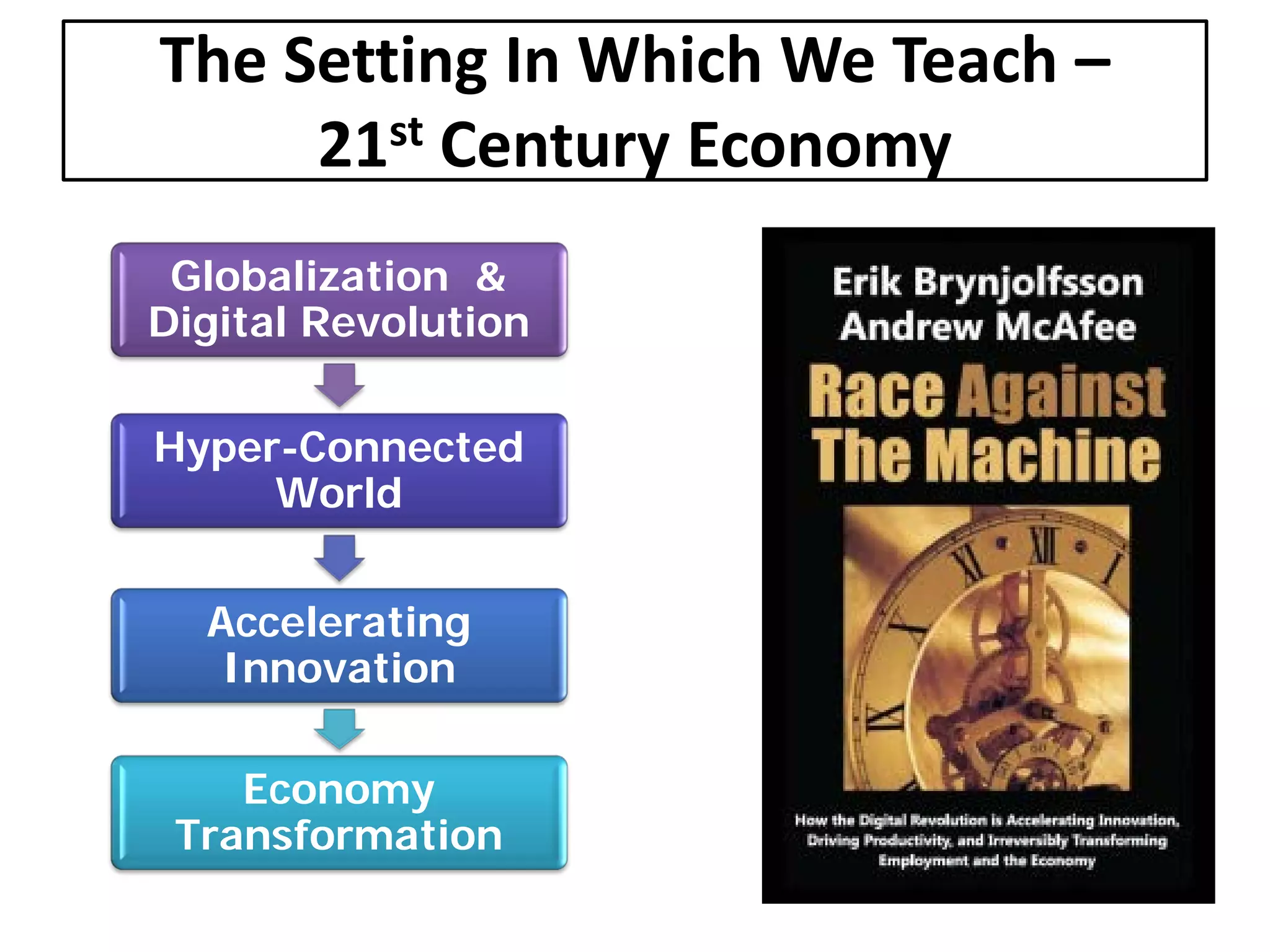
The Setting In Which We Teach – 21st Century Economy 
Globalization & Digital Revolution 
Hyper-Connected World 
Accelerating Innovation 
Economy Transformation
• 
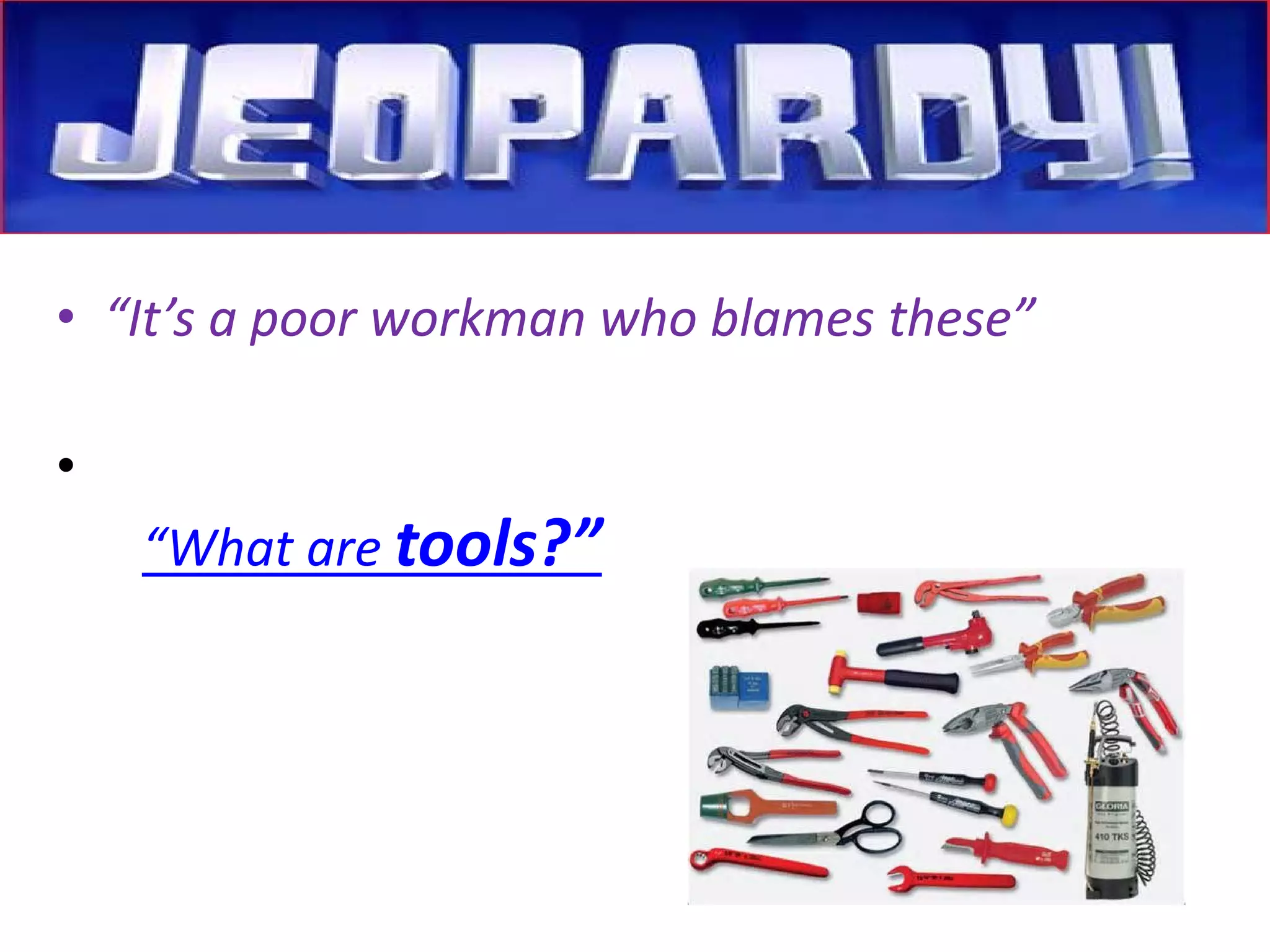
“It’s a poor workman who blames these” 
• 
“What are tools?”
Singularity 
• 
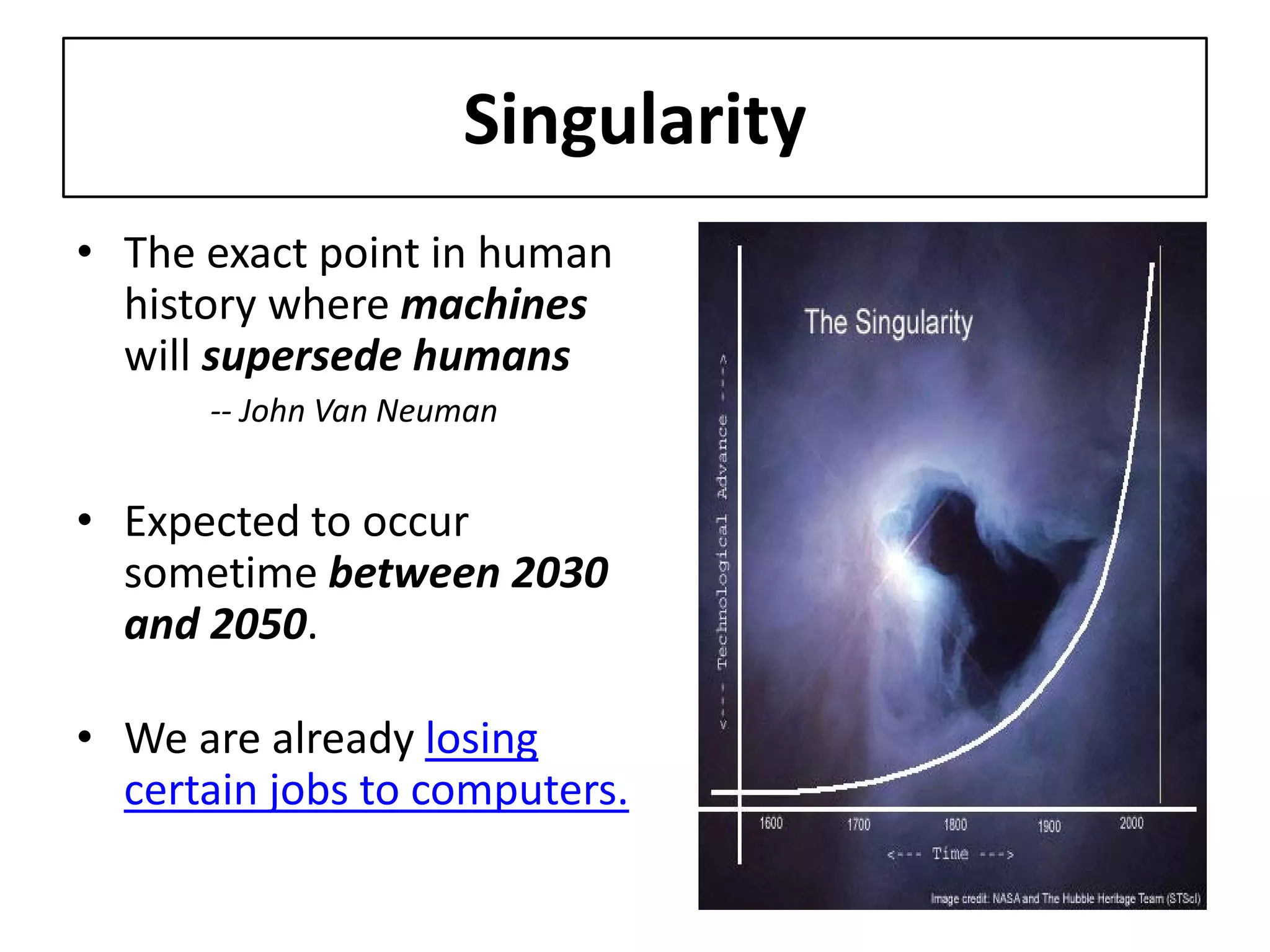
The exact point in human history where machines will supersede humans -- John Van Neuman 
• 
Expected to occur sometime between 2030 and 2050. 
• 
We are already losing certain jobs to computers.
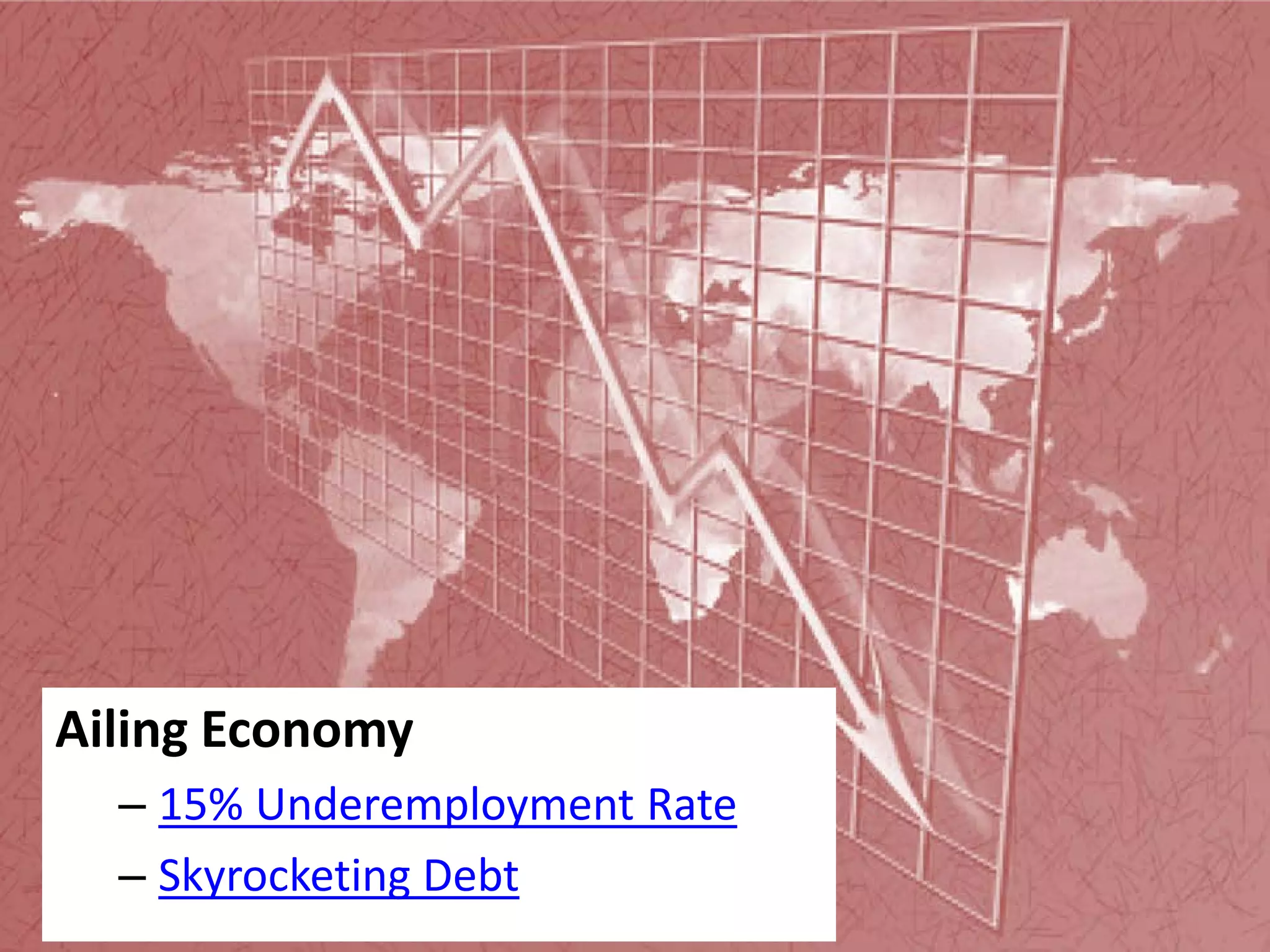
Ailing Economy 
– 
15% Underemployment Rate 
– 
Skyrocketing Debt
Dwindling Natural Resources
Ailing Education 
• 
College Graduates Not Prepared For The Job Market 
• 
Skyrocketing Cost Of College Education 
• 
Shrinking College Applicant Pool 
• 
Proposed Federal College Score Card 
• 
Proposed College Programs That Are Competency-based And Do Not Rely On Seat Time
• 
Need For More Innovation To Help With Economic Recovery & World Problems 
– 
New Products & Services-> More Jobs -> More Wealth 
• 
Need To Rethink Education 
– 
The What? & The How?
How Does Education Need to Change?
Exercise 
1. 
What’s your definition of Deep Learning? 
2. 
What’s your experience of Deep Learning? 
3. 
What’s the difference? 
Melissa Peet, Annual AAEEBL Conference Executive Summit, Boston, July 2014
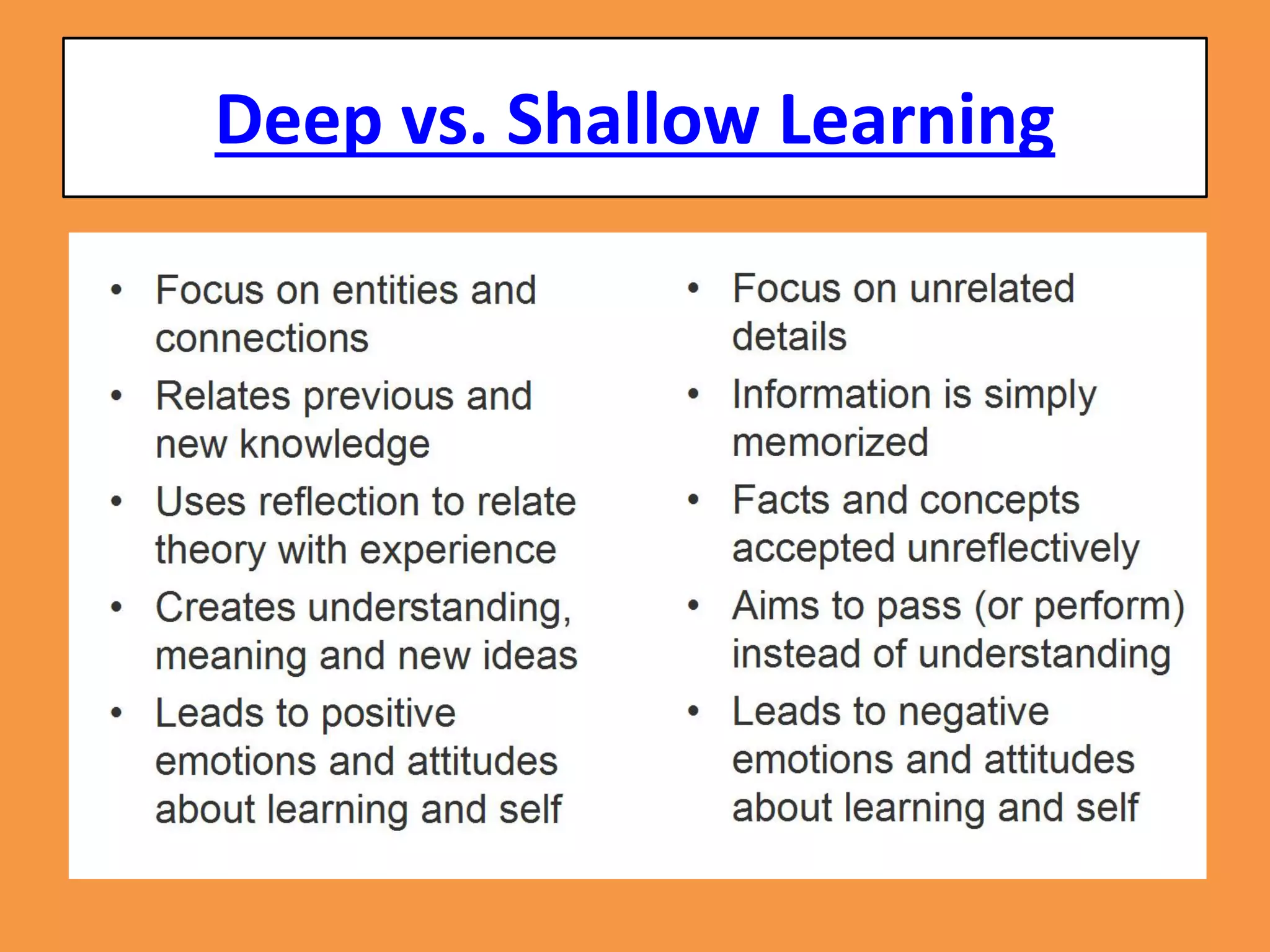
Deep vs. Shallow Learning
Knowledgeable to Knowledge-able 
Michael Wesch: “Knowledgeable to Knowledge-able” (18:34)
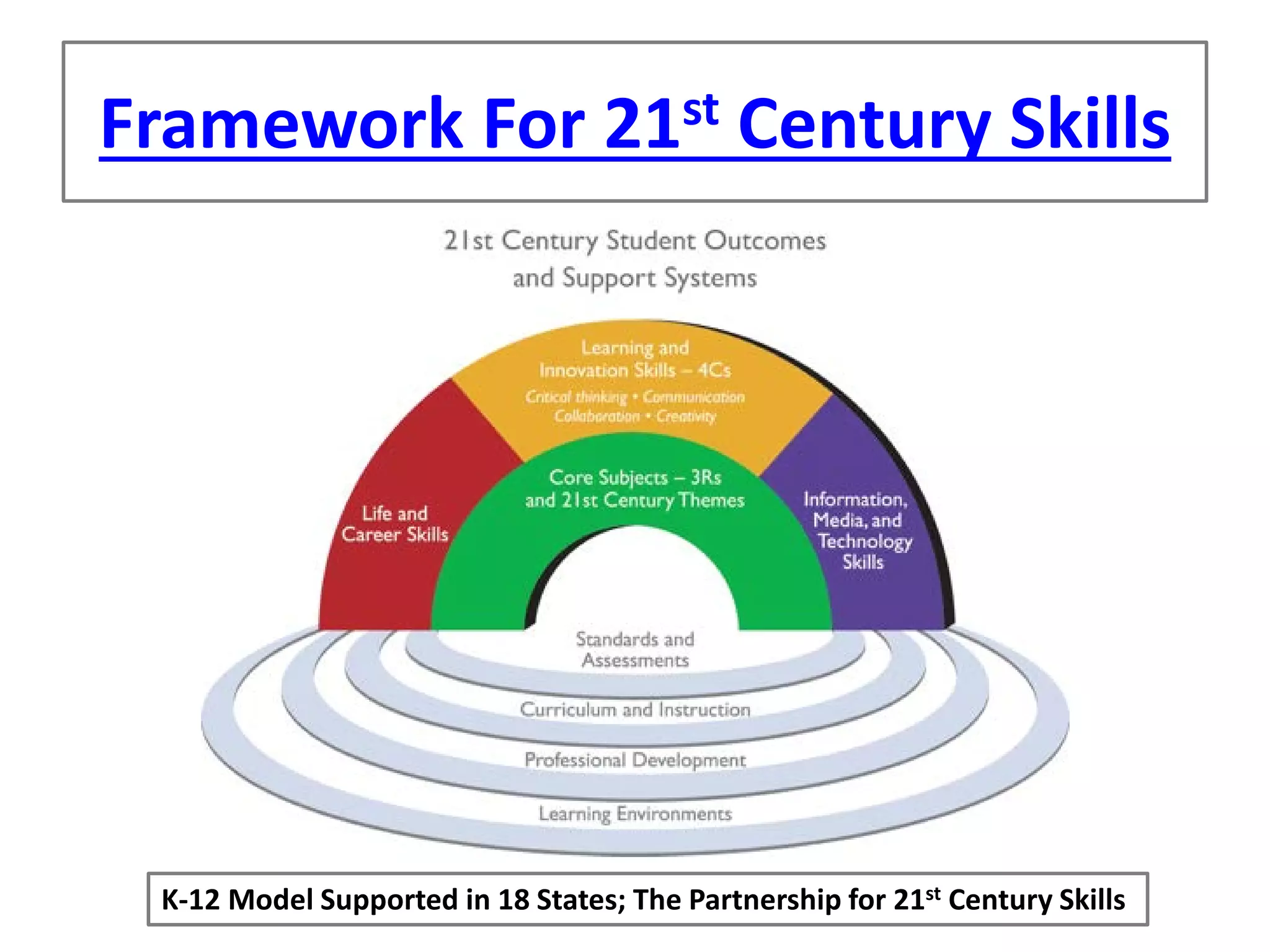
Framework For 21st Century Skills 
K-12 Model Supported in 18 States; The Partnership for 21st Century Skills
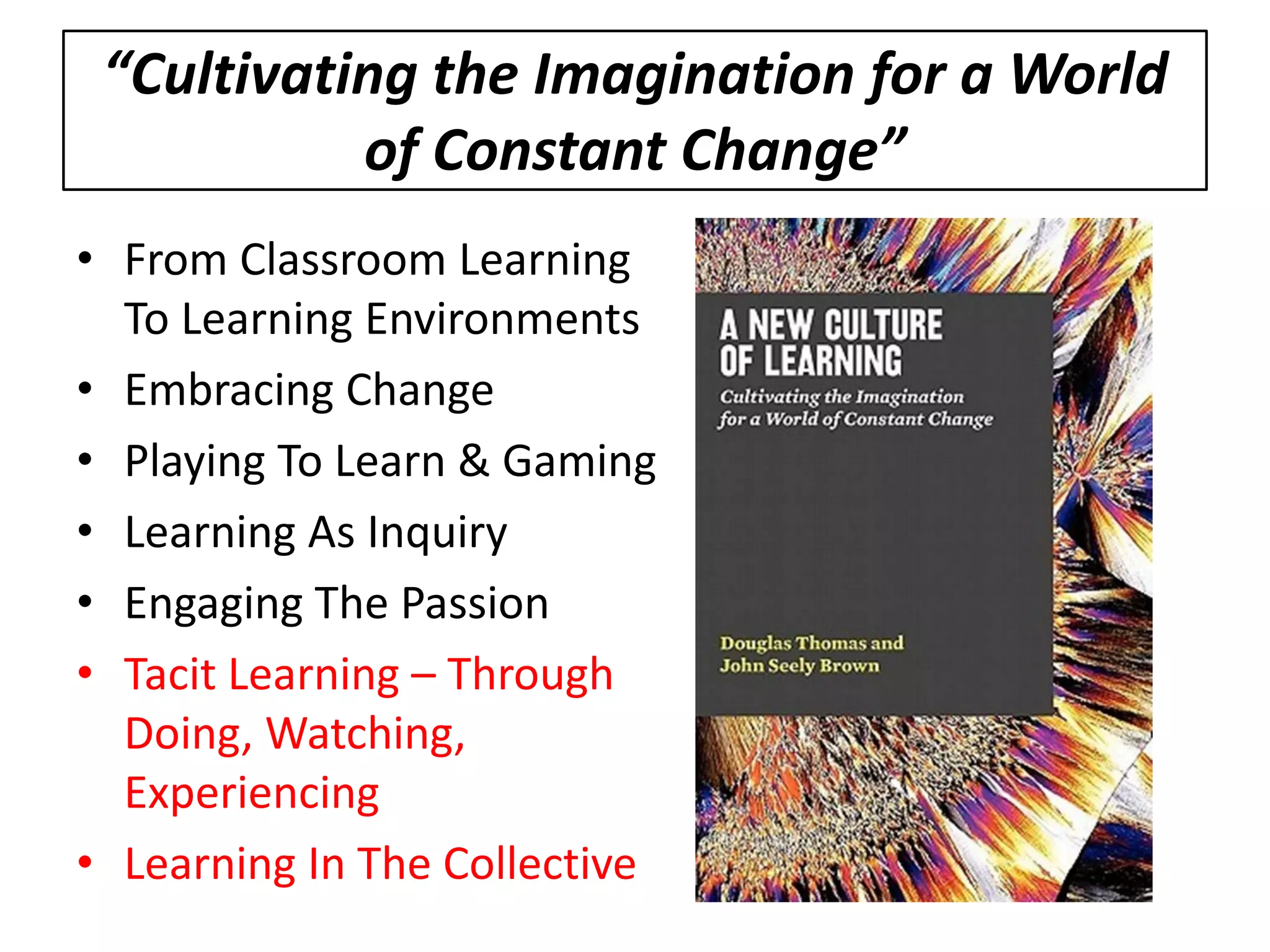
“Cultivating the Imagination for a World of Constant Change” 
• 
From Classroom Learning To Learning Environments 
• 
Embracing Change 
• 
Playing To Learn & Gaming 
• 
Learning As Inquiry 
• 
Engaging The Passion 
• 
Tacit Learning – Through Doing, Watching, Experiencing 
• 
Learning In The Collective
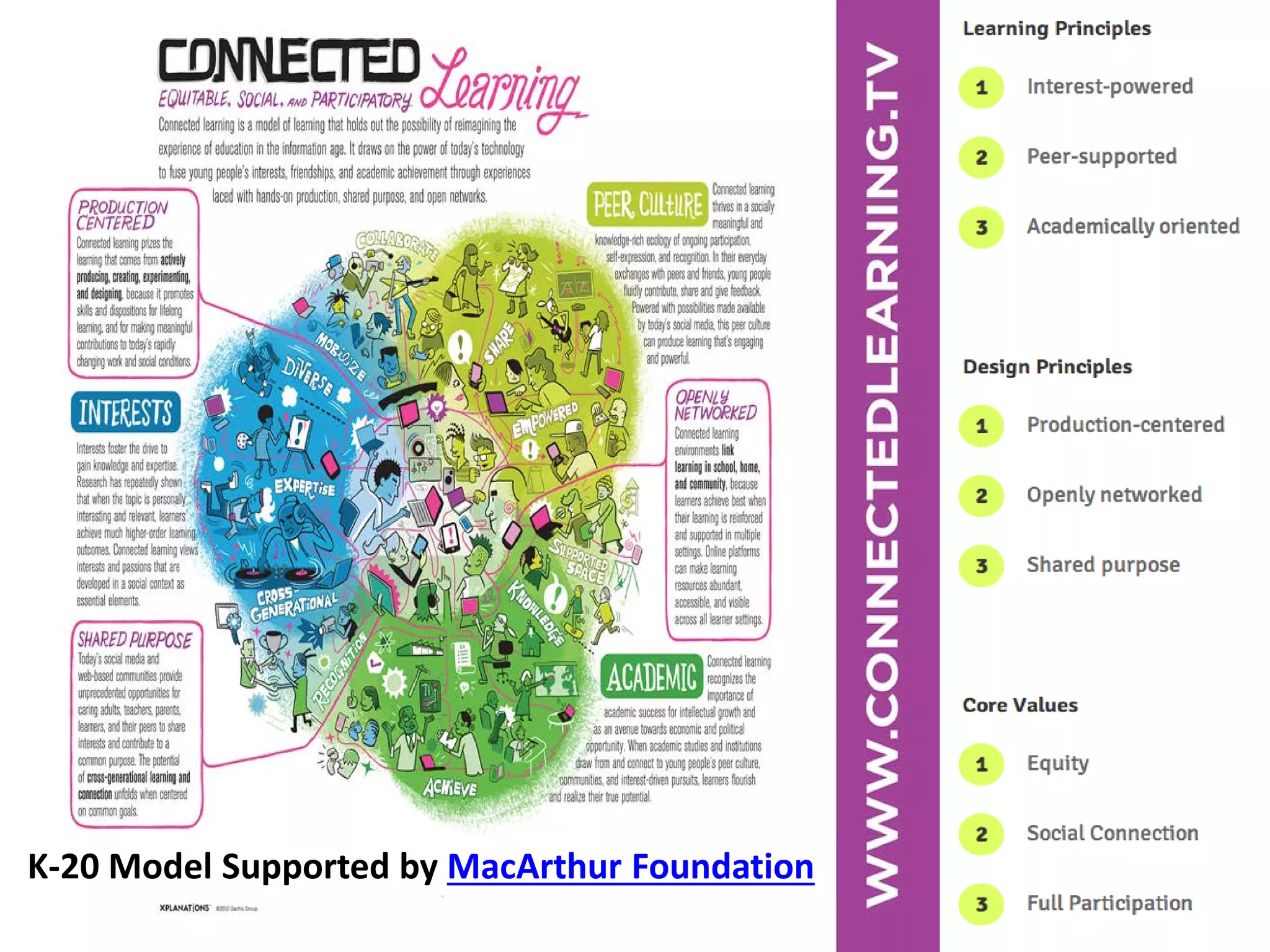
K-20 Model Supported by MacArthur Foundation
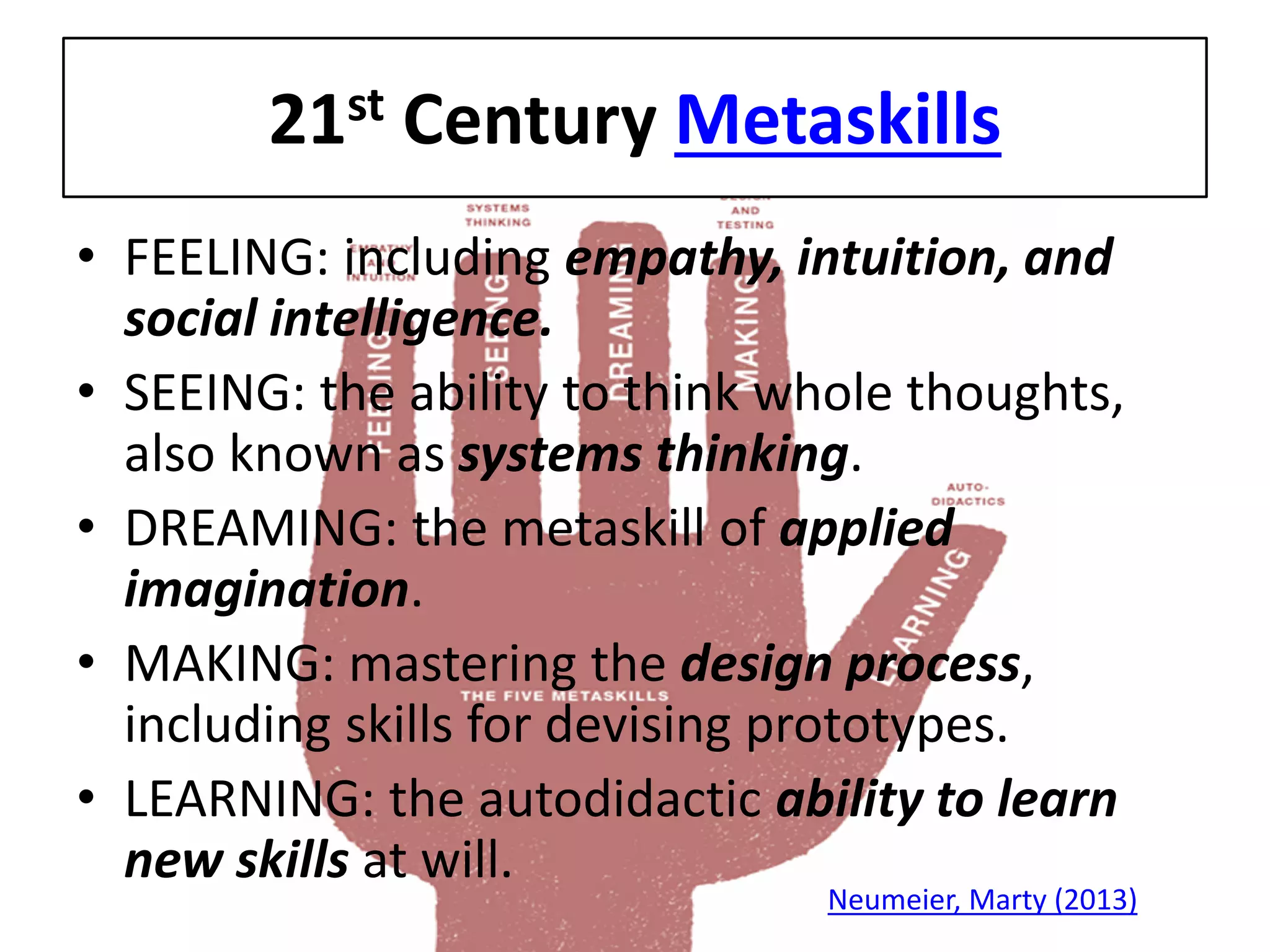
21st Century Metaskills 
• 
FEELING: including empathy, intuition, and social intelligence. 
• 
SEEING: the ability to think whole thoughts, also known as systems thinking. 
• 
DREAMING: the metaskill of applied imagination. 
• 
MAKING: mastering the design process, including skills for devising prototypes. 
• 
LEARNING: the autodidactic ability to learn new skills at will. 
Neumeier, Marty (2013)
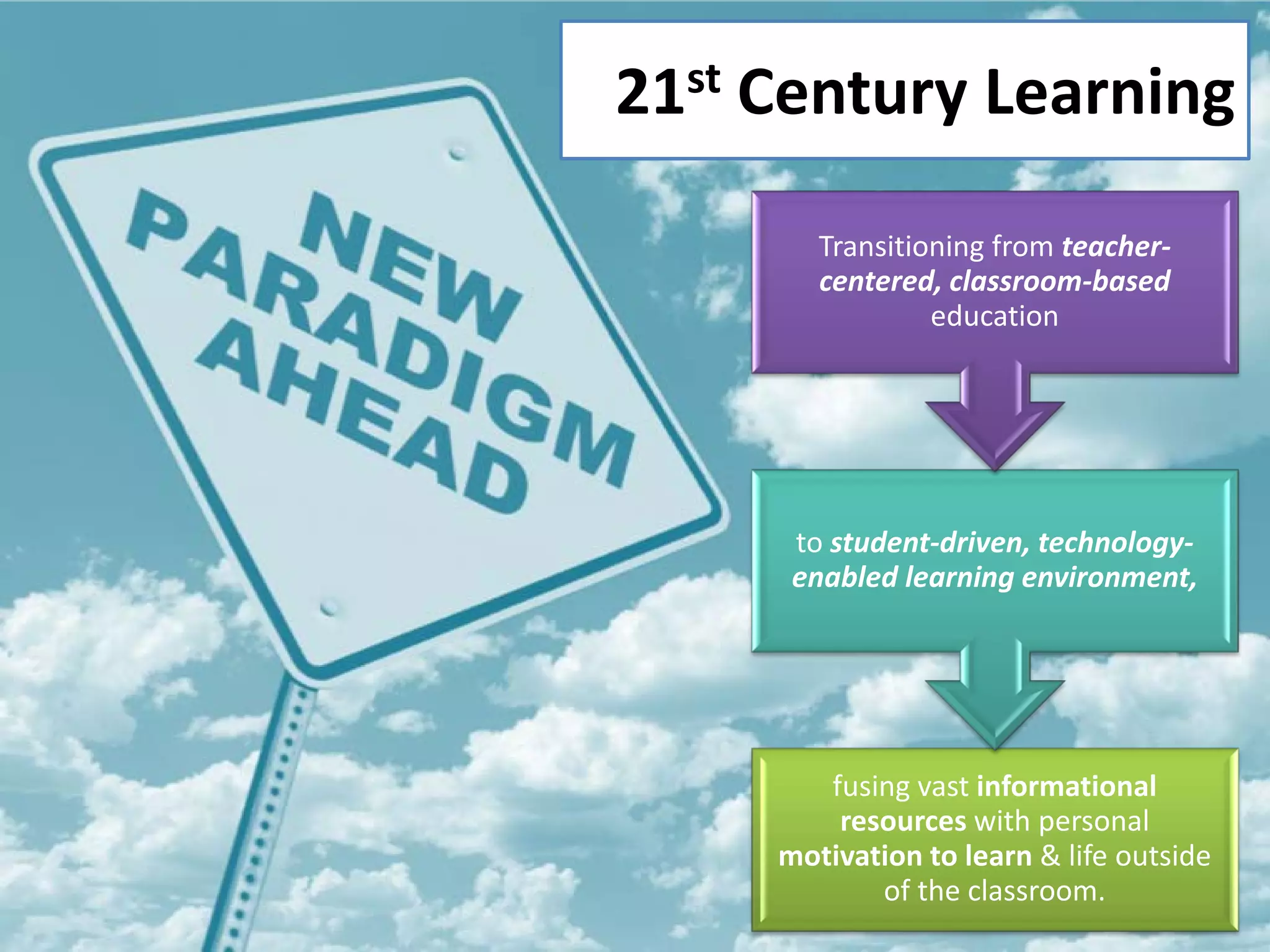
21st Century Learning 
fusing vast informational resources with personal motivation to learn & life outside of the classroom. 
to student-driven, technology- enabled learning environment, 
Transitioning from teacher- centered, classroom-based education
AAC&U High-Impact Practices 
Collaborative Assignments & Projects
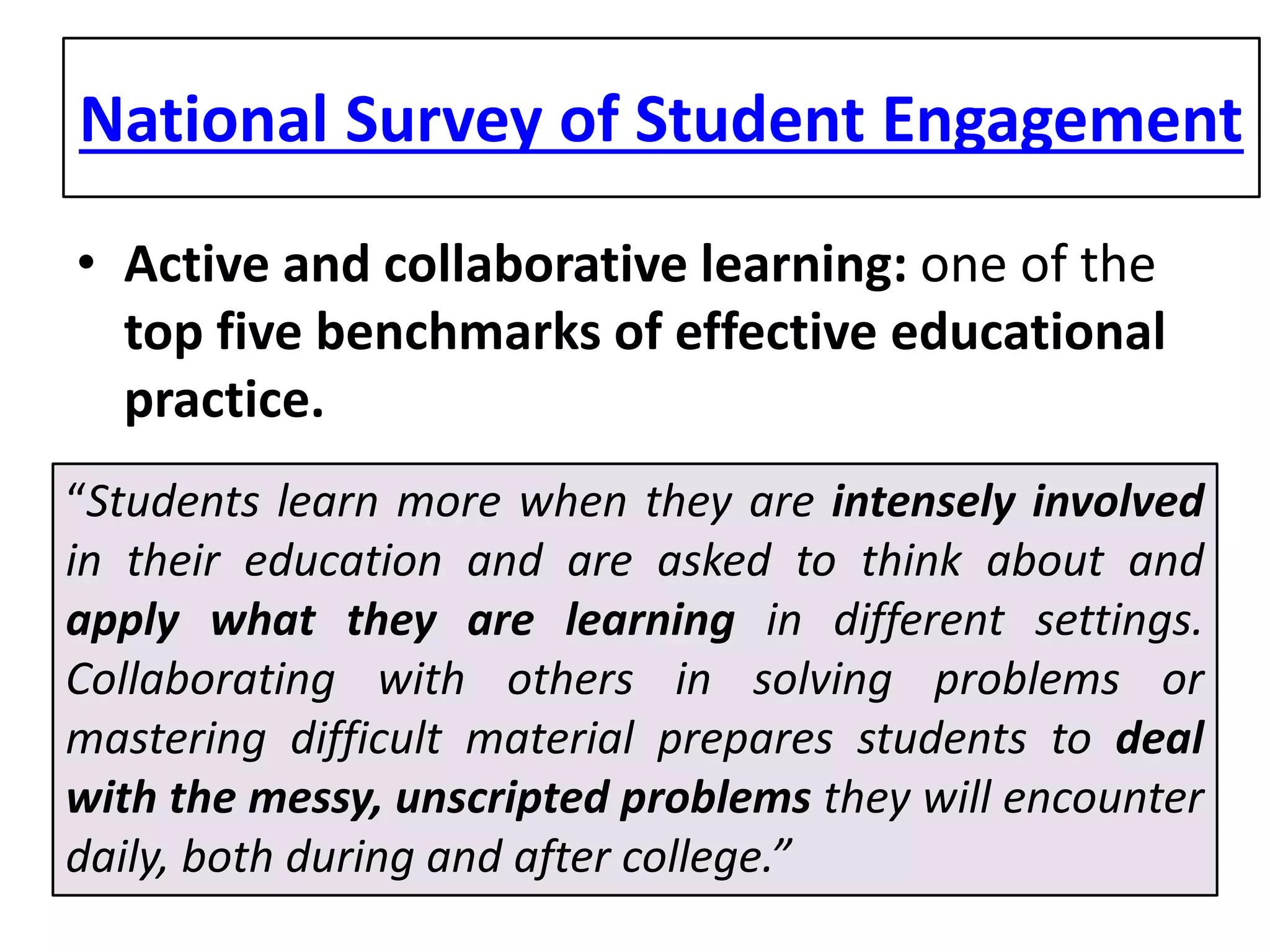
National Survey of Student Engagement 
• 
Active and collaborative learning: one of the top five benchmarks of effective educational practice. 
“Students learn more when they are intensely involved in their education and are asked to think about and apply what they are learning in different settings. Collaborating with others in solving problems or mastering difficult material prepares students to deal with the messy, unscripted problems they will encounter daily, both during and after college.”
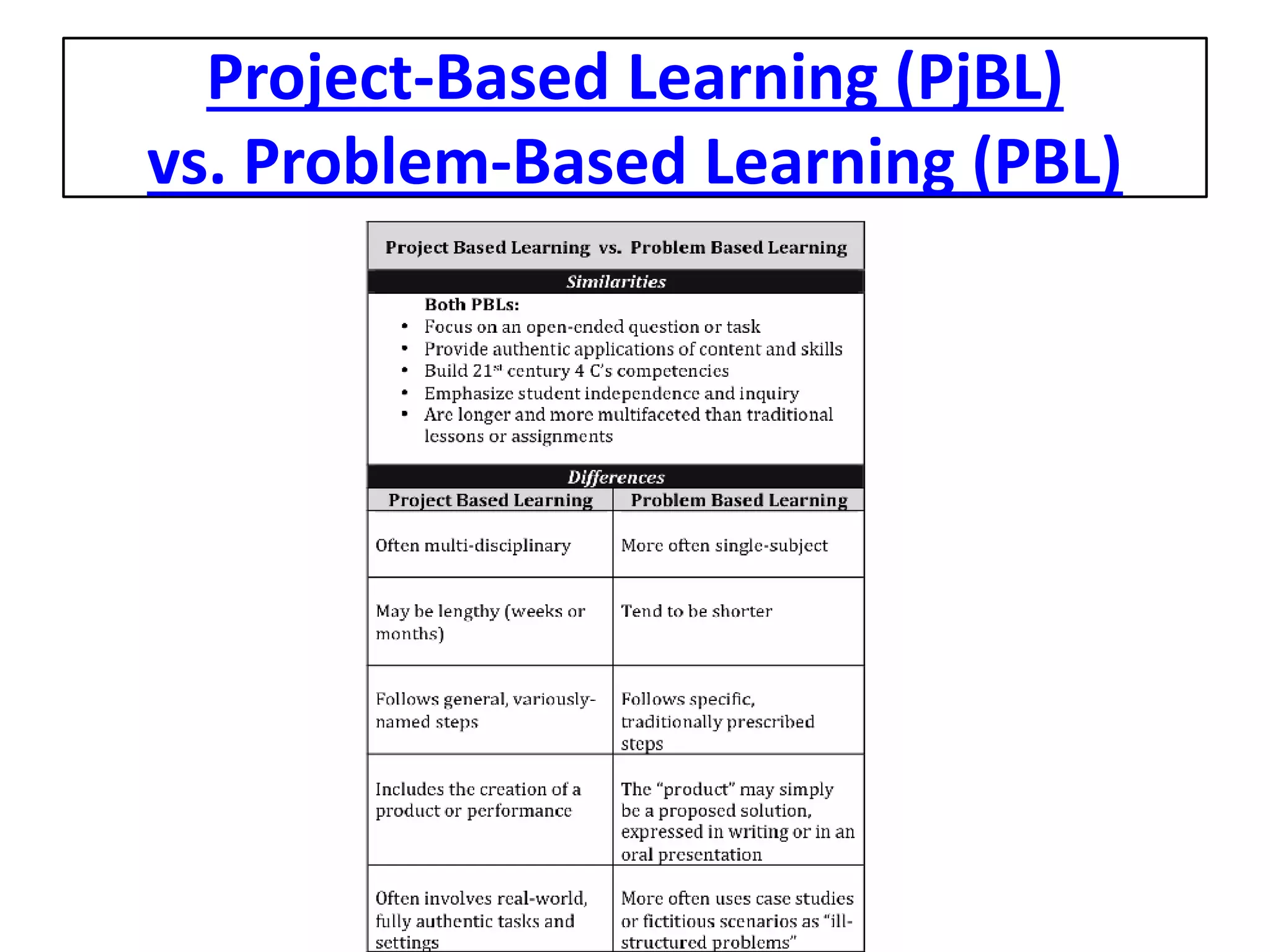
Project-Based Learning (PjBL) vs. Problem-Based Learning (PBL)
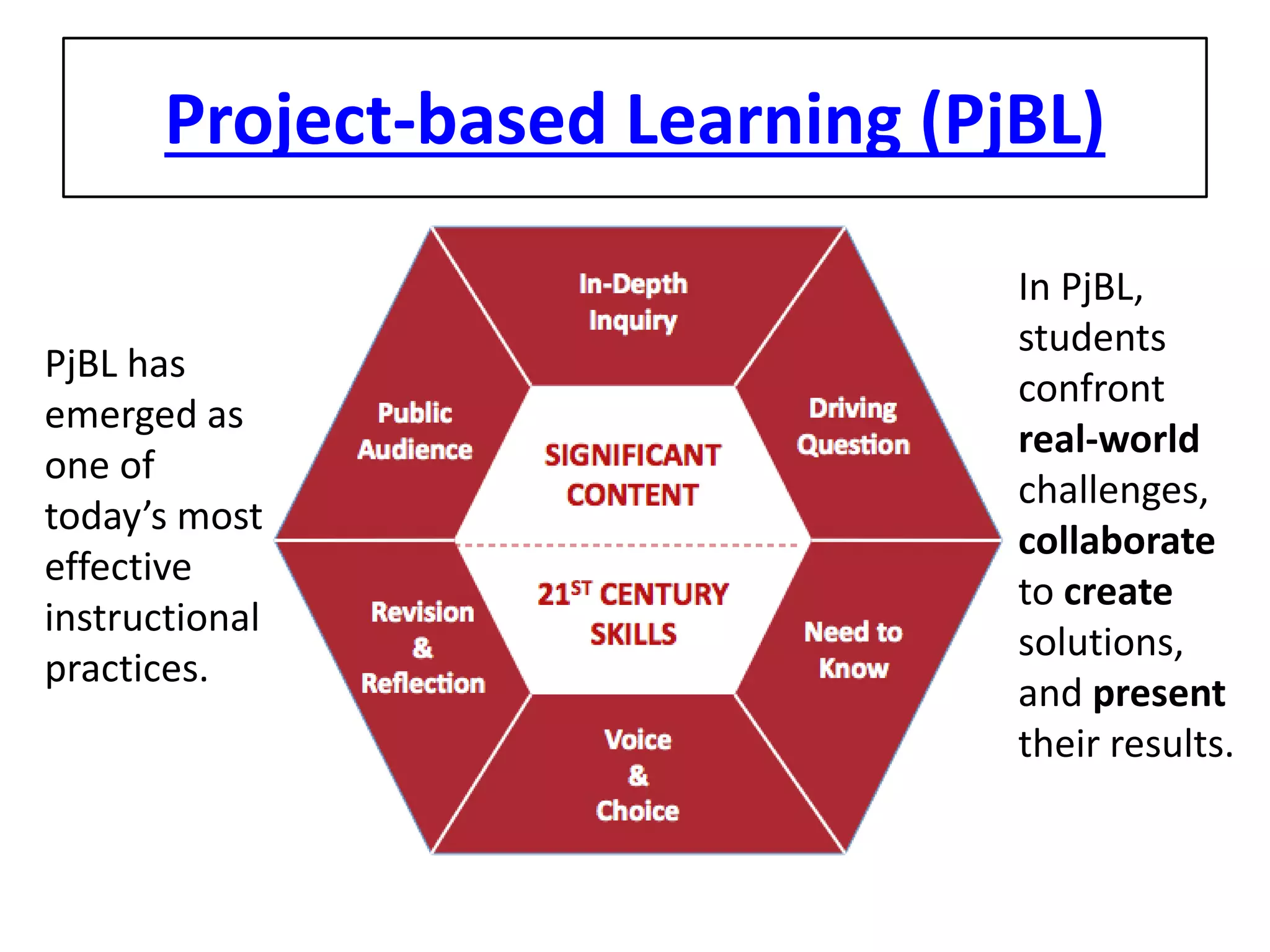
Project-based Learning (PjBL) 
PjBL has emerged as one of today’s most effective instructional practices. 
In PjBL, students confront real-world challenges, collaborate to create solutions, and present their results.
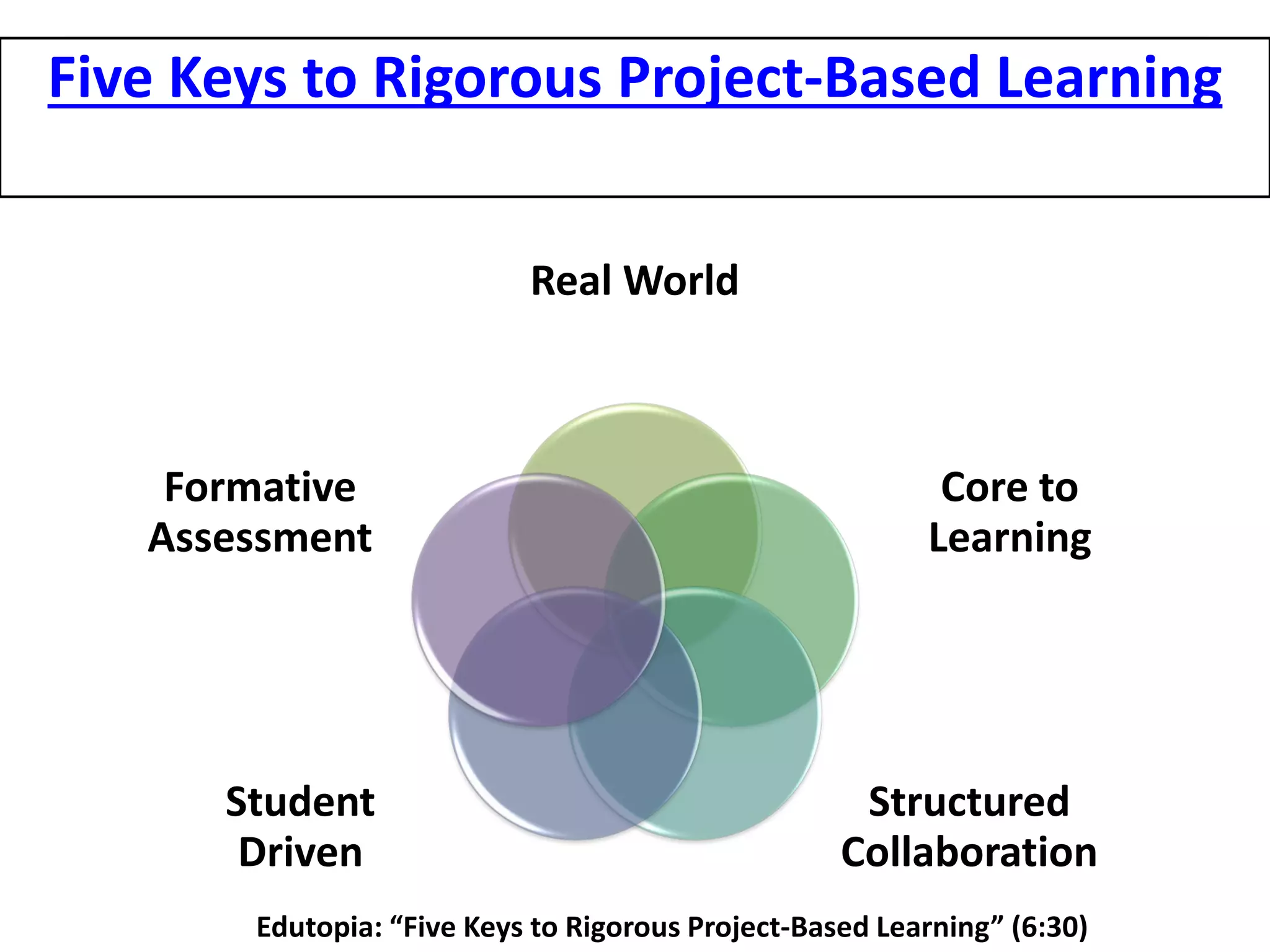
Five Keys to Rigorous PBL 
Real World 
Core to Learning 
Structured Collaboration 
Student Driven 
Formative Assessment 
Five Keys to Rigorous Project-Based Learning 
Edutopia: “Five Keys to Rigorous Project-Based Learning” (6:30)
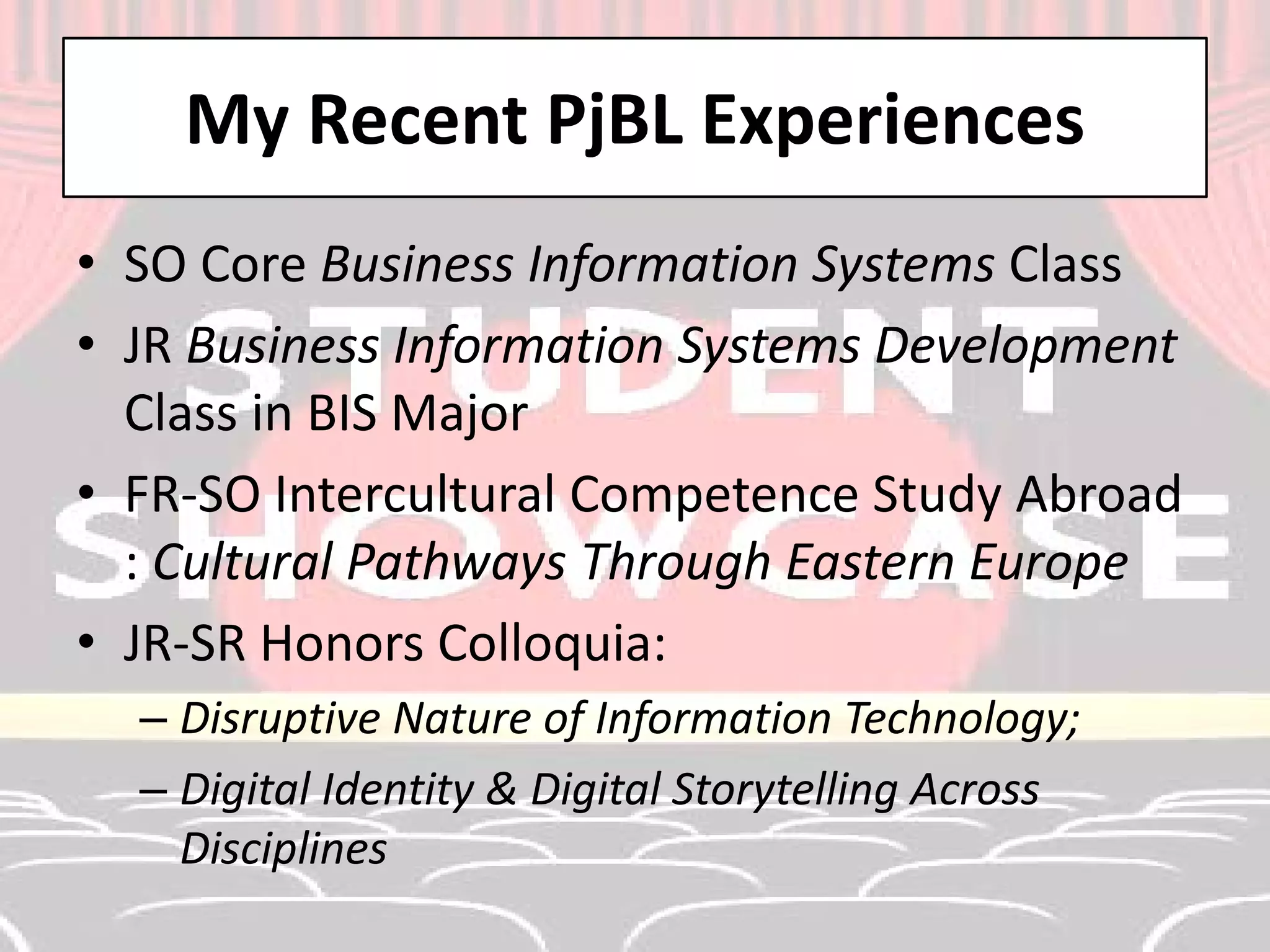
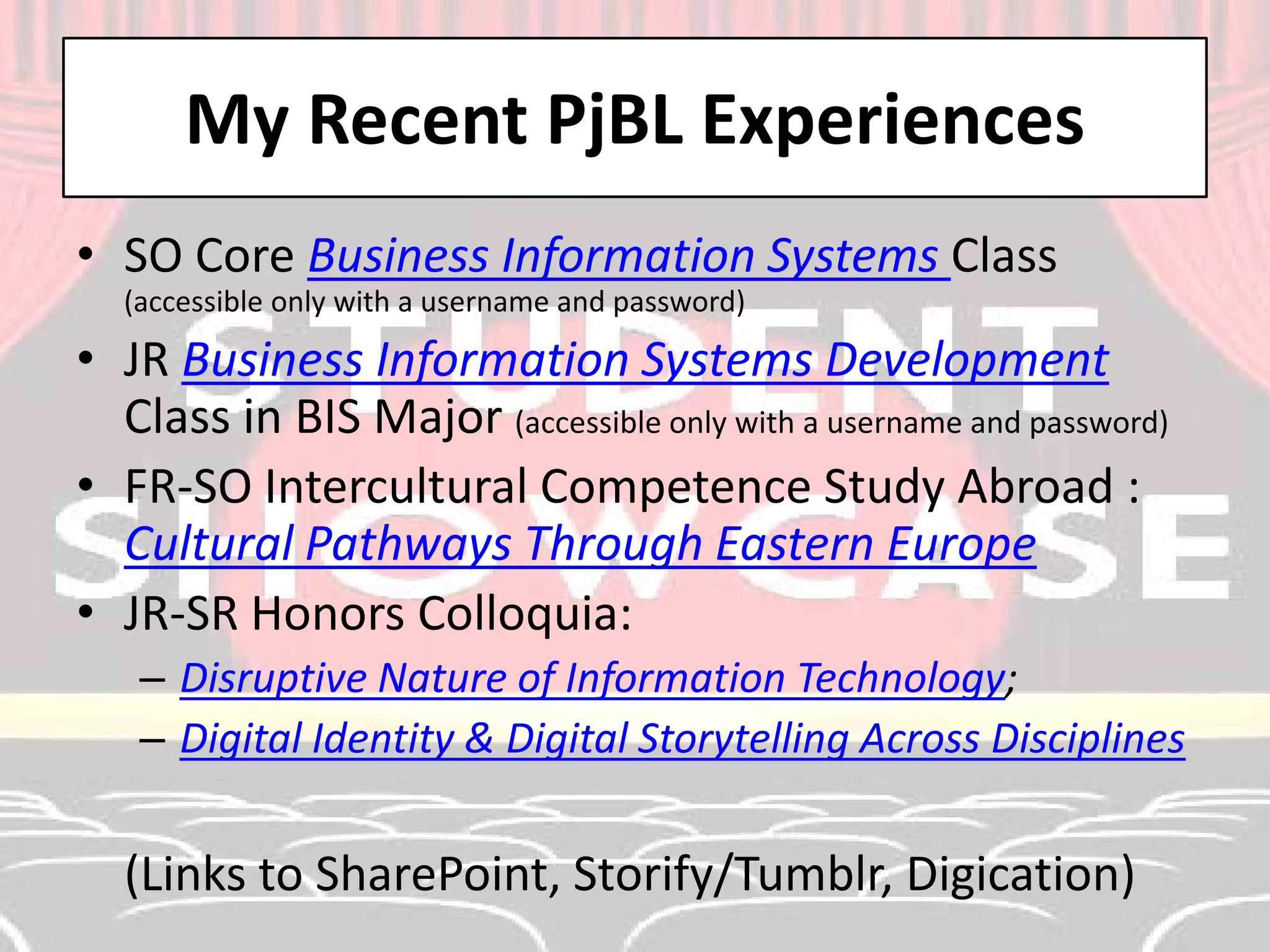
My Recent PjBL Experiences 
• 
SO Core Business Information Systems Class 
• 
JR Business Information Systems Development Class in BIS Major 
• 
FR-SO Intercultural Competence Study Abroad : Cultural Pathways Through Eastern Europe 
• 
JR-SR Honors Colloquia: 
– 
Disruptive Nature of Information Technology; 
– 
Digital Identity & Digital Storytelling Across Disciplines
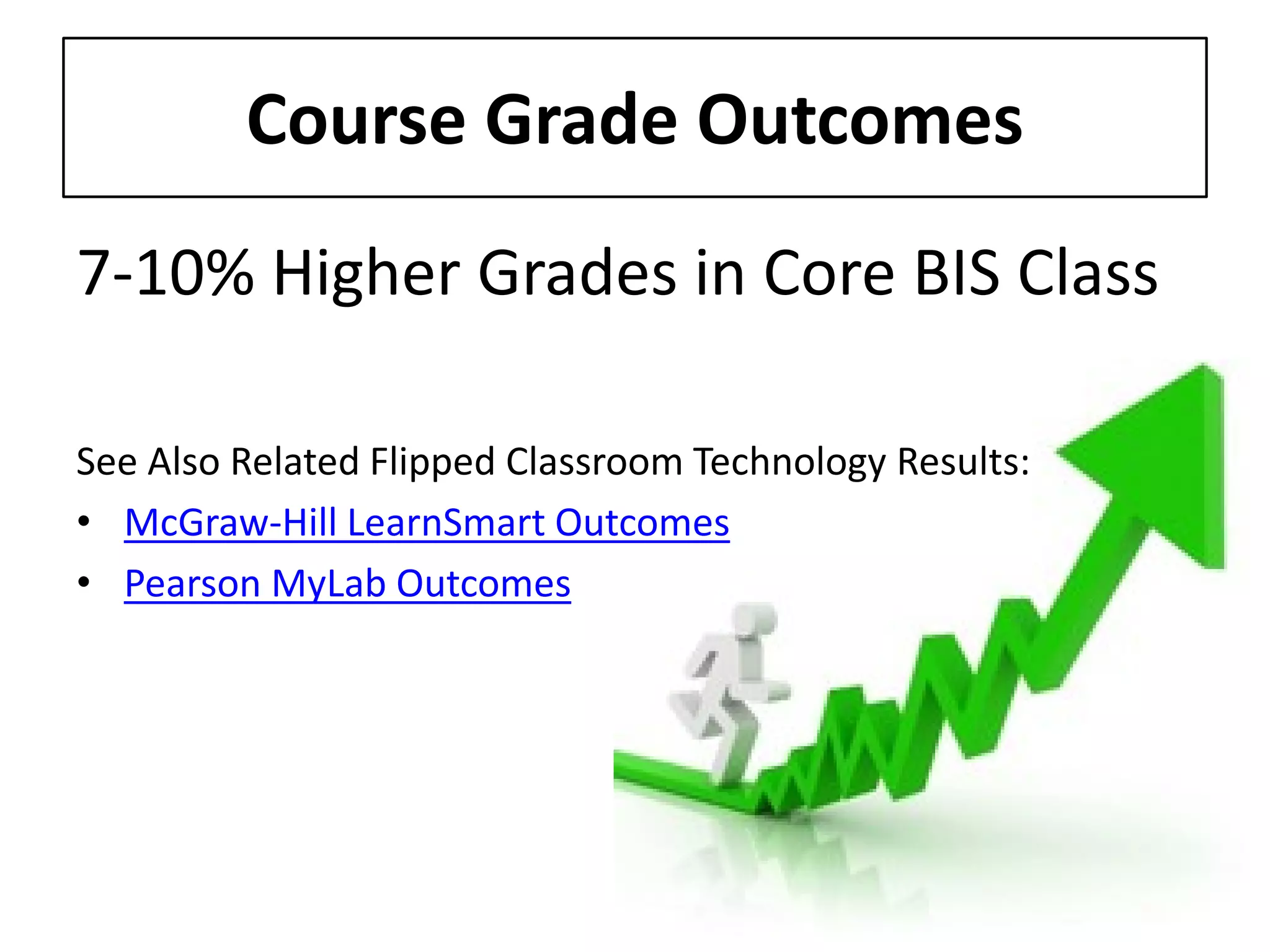
Course Grade Outcomes 
7-10% Higher Grades in Core BIS Class 
See Also Related Flipped Classroom Technology Results: 
•McGraw-Hill LearnSmart Outcomes 
•Pearson MyLab Outcomes
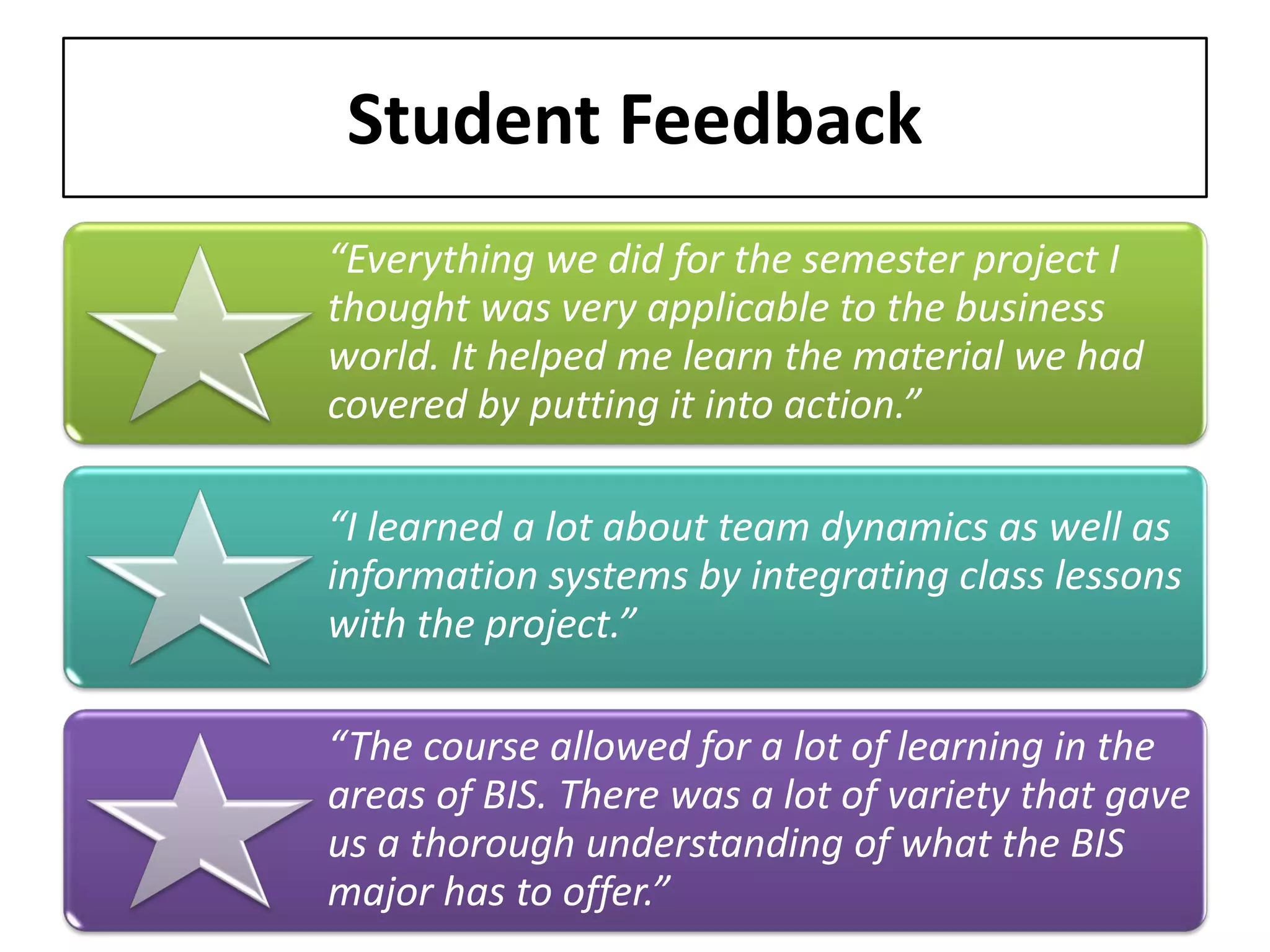
Student Feedback 
“Everything we did for the semester project I thought was very applicable to the business world. It helped me learn the material we had covered by putting it into action.” 
“I learned a lot about team dynamics as well as information systems by integrating class lessons with the project.” 
“The course allowed for a lot of learning in the areas of BIS. There was a lot of variety that gave us a thorough understanding of what the BIS major has to offer.”
My Recent PjBL Experiences 
• 
SO Core Business Information Systems Class (accessible only with a username and password) 
• 
JR Business Information Systems Development Class in BIS Major (accessible only with a username and password) 
• 
FR-SO Intercultural Competence Study Abroad : Cultural Pathways Through Eastern Europe 
• 
JR-SR Honors Colloquia: 
– 
Disruptive Nature of Information Technology; 
– 
Digital Identity & Digital Storytelling Across Disciplines 
(Links to SharePoint, Storify/Tumblr, Digication)
PjBL Course Design
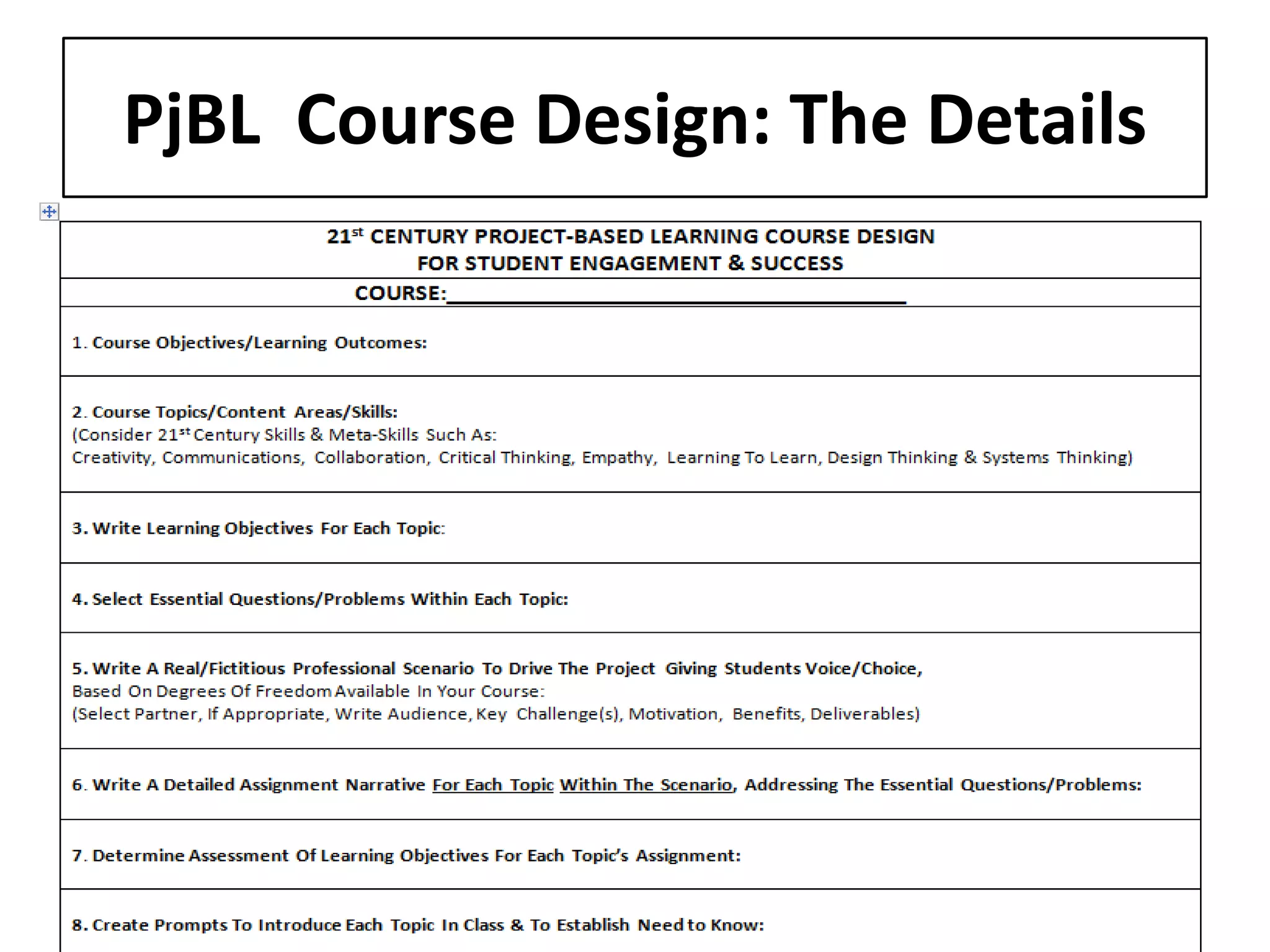
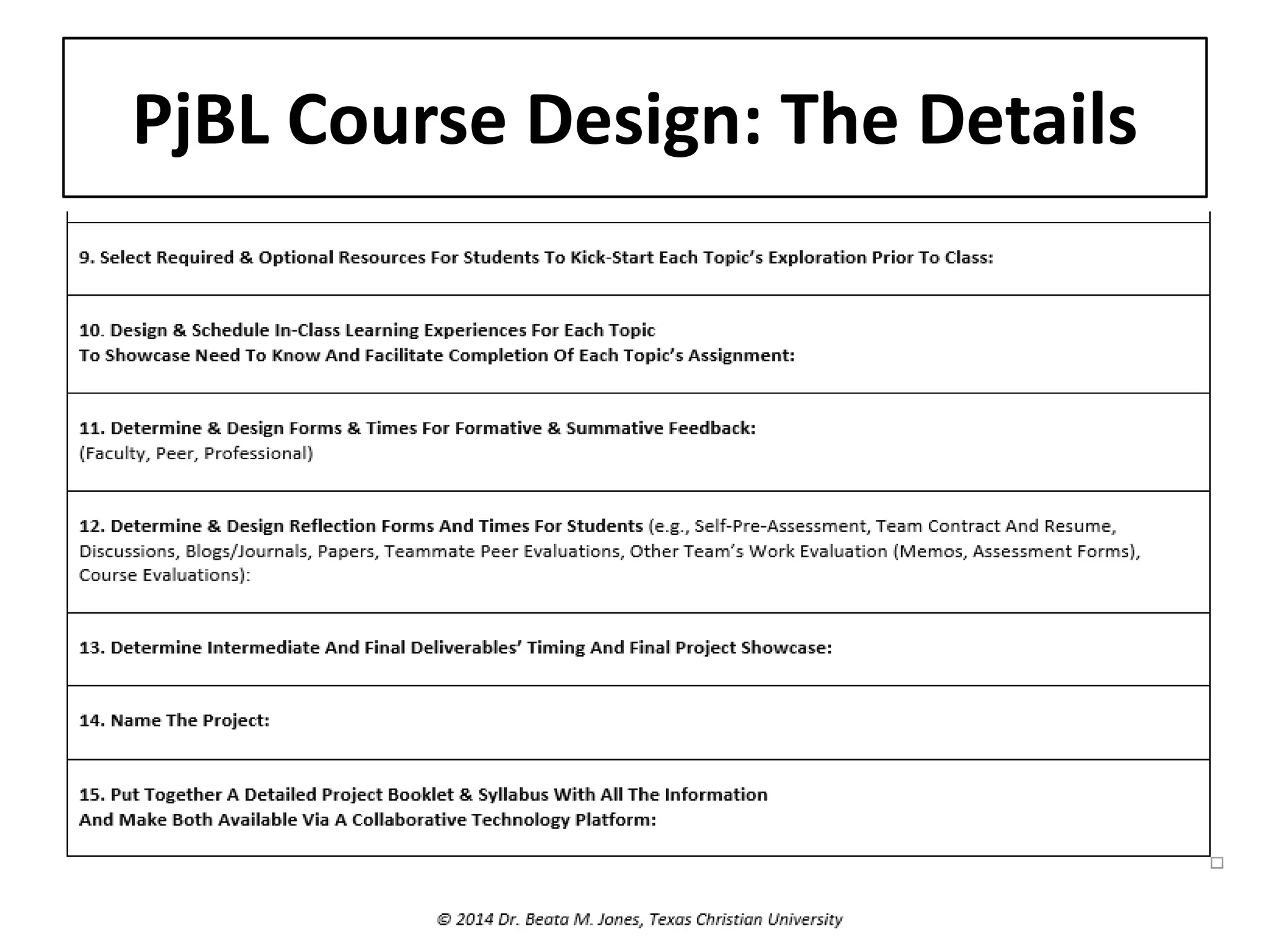
PjBL Course Design: The Details
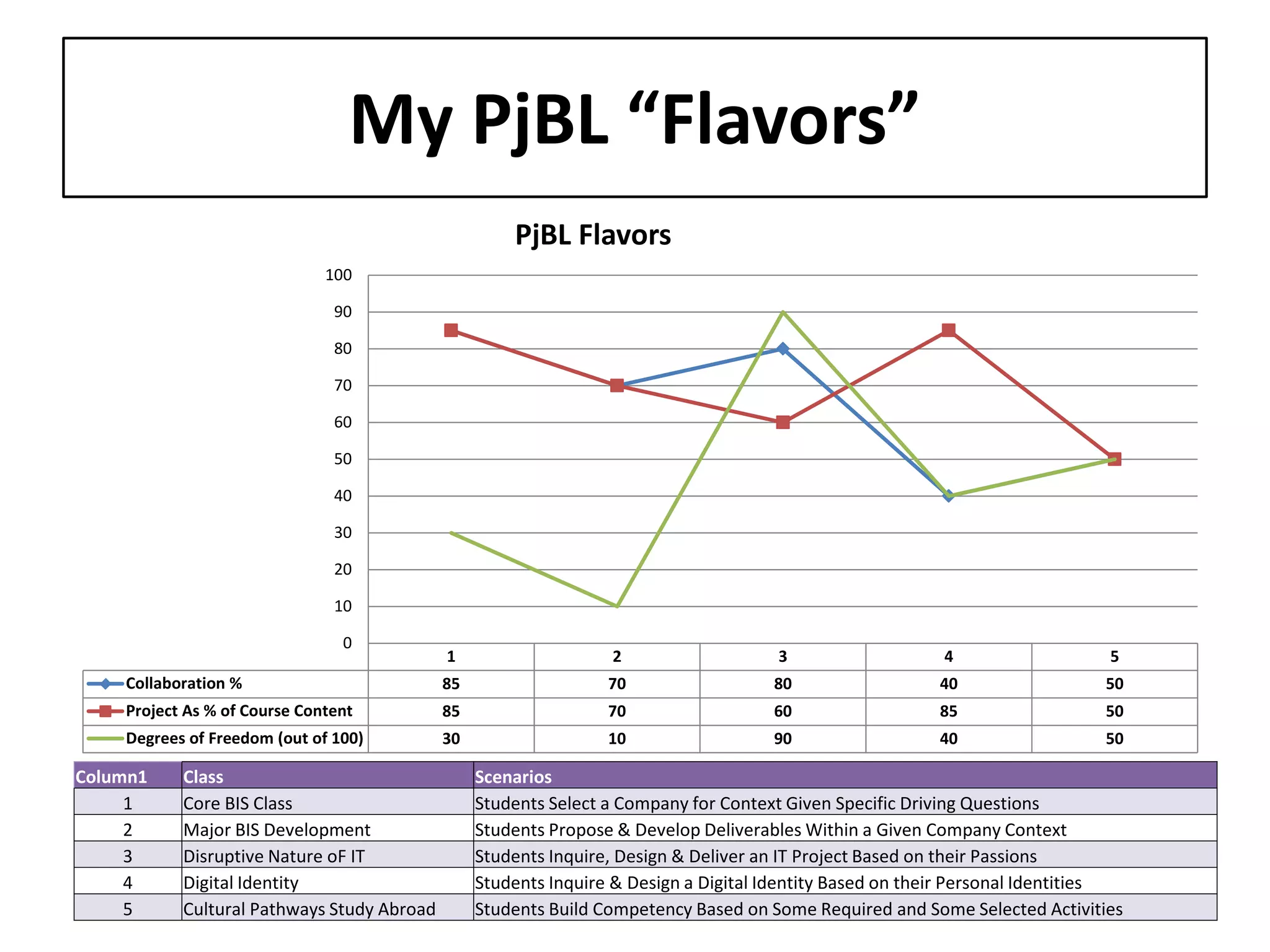
My PjBL “Flavors” 
1 
2 
3 
4 
5 
Collaboration % 
85 
70 
80 
40 
50 
Project As % of Course Content 
85 
70 
60 
85 
50 
Degrees of Freedom (out of 100) 
30 
10 
90 
40 
50 
0 
10 
20 
30 
40 
50 
60 
70 
80 
90 
100 
PjBL Flavors 
Column1 
Class 
Scenarios 
1 
Core BIS Class 
Students Select a Company for Context Given Specific Driving Questions 
2 
Major BIS Development 
Students Propose & Develop Deliverables Within a Given Company Context 
3 
Disruptive Nature oF IT 
Students Inquire, Design & Deliver an IT Project Based on their Passions 
4 
Digital Identity 
Students Inquire & Design a Digital Identity Based on their Personal Identities 
5 
Cultural Pathways Study Abroad 
Students Build Competency Based on Some Required and Some Selected Activities
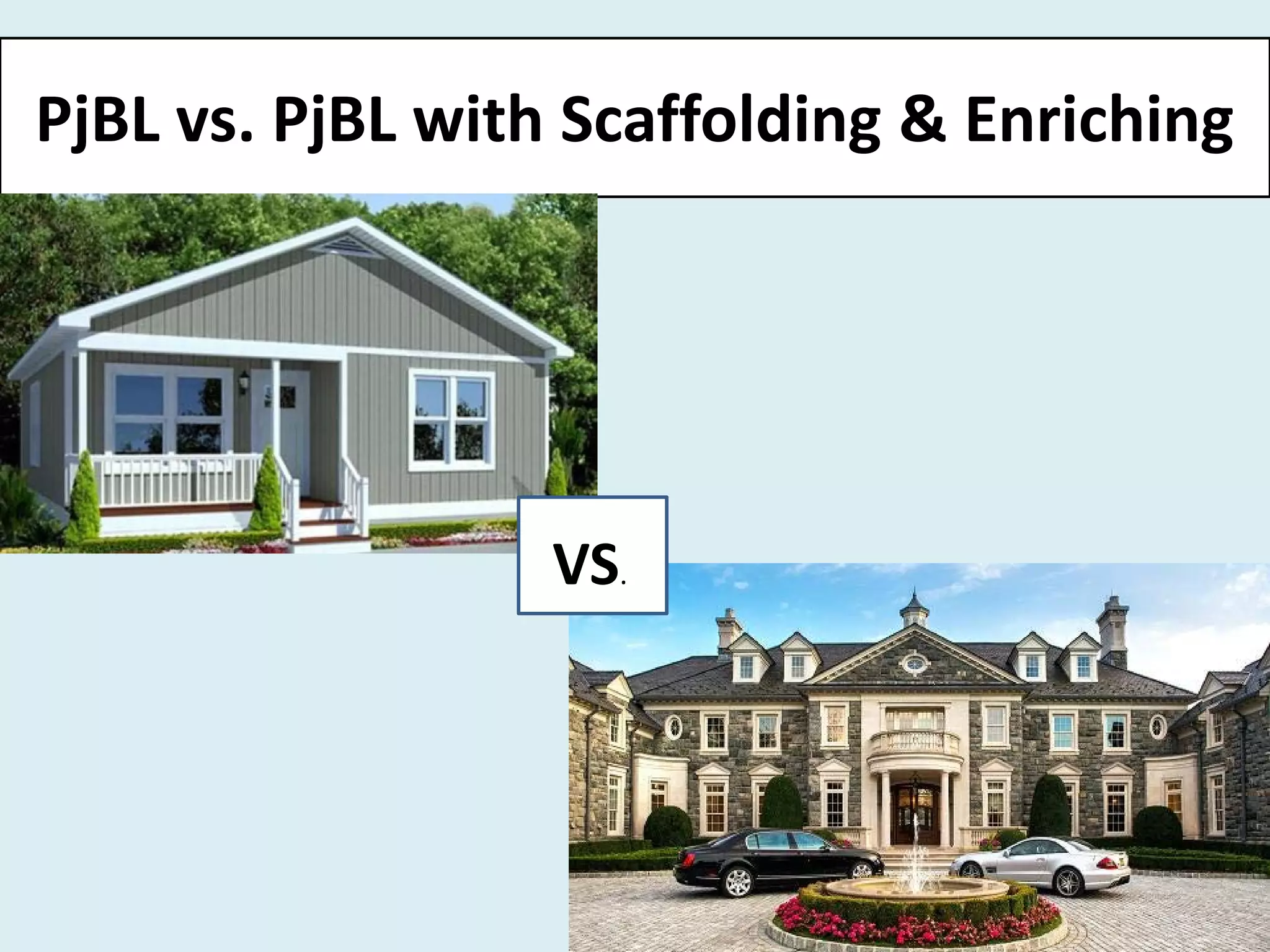
PjBL vs. PjBL with Scaffolding & Enriching 
VS.
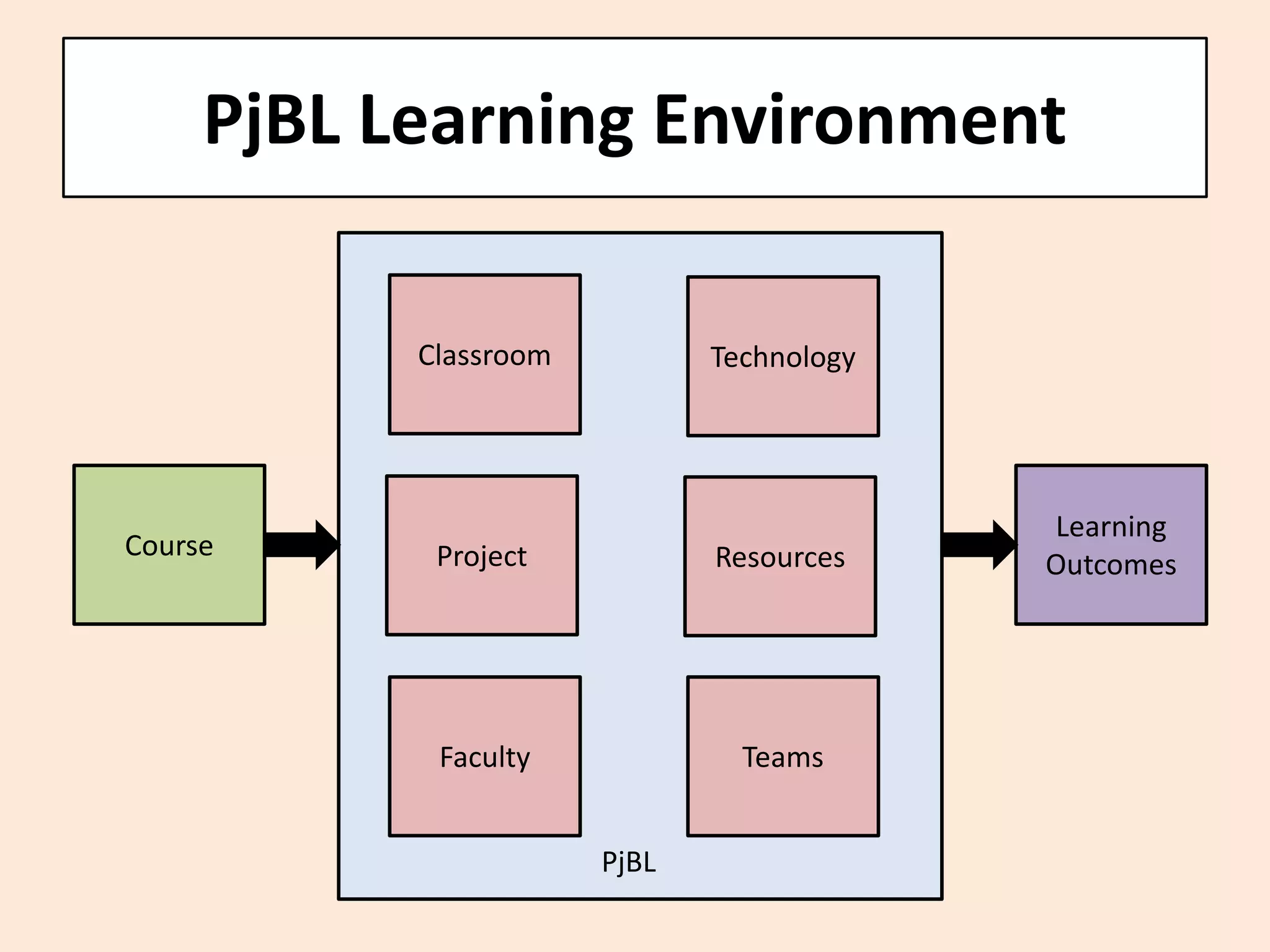
PjBL Learning Environment 
Course 
Learning Outcomes 
Project 
Faculty 
Teams 
Resources 
Technology 
Classroom 
PjBL
Course 
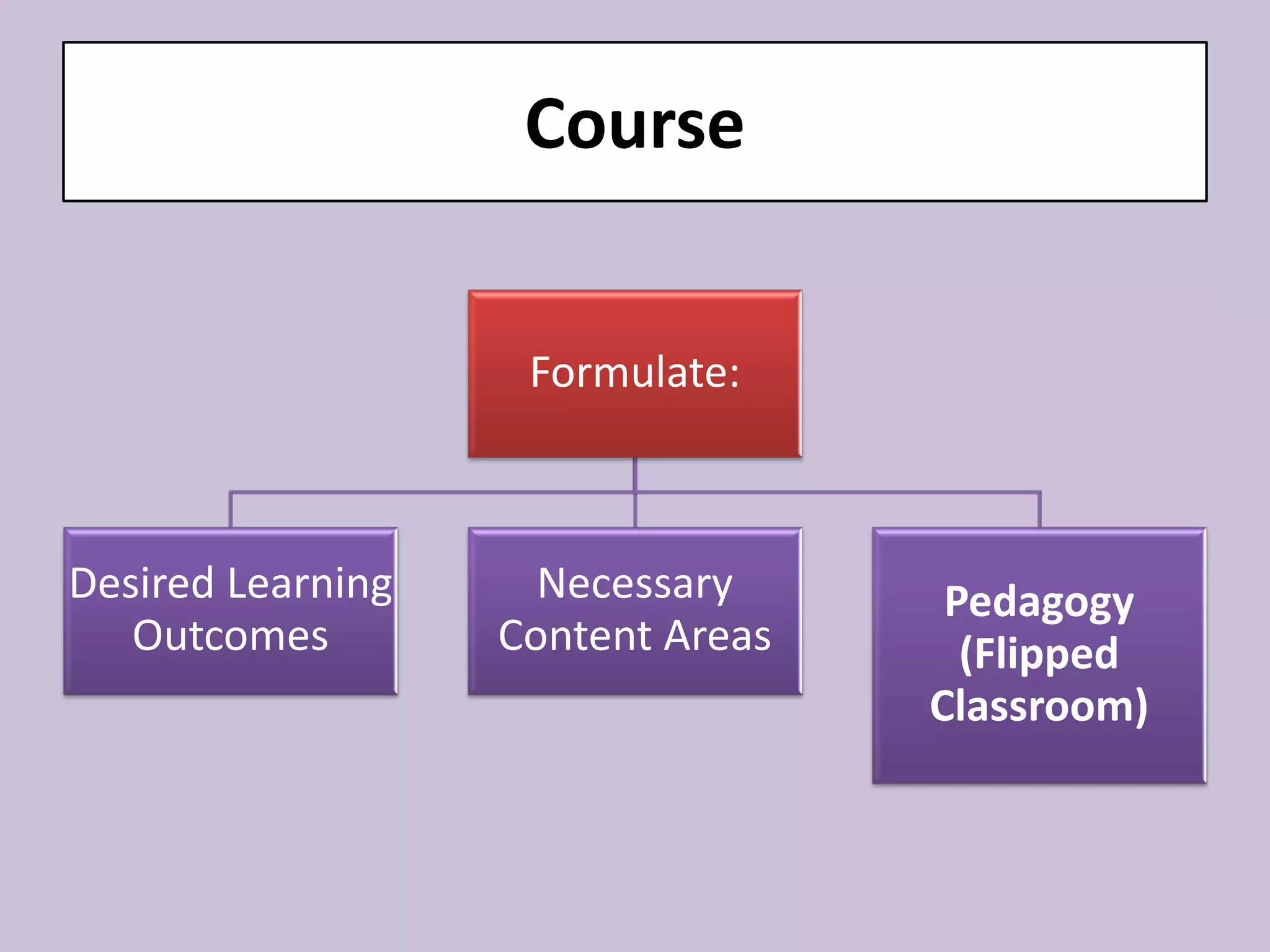
Formulate: 
Desired Learning Outcomes 
Necessary Content Areas 
Pedagogy (Flipped Classroom)
flipped classroom - Assign reading, research, speaker events, and/or video lectures for homework. Use class time to work in groups on assignments that assume familiarity with the assigned homework material.
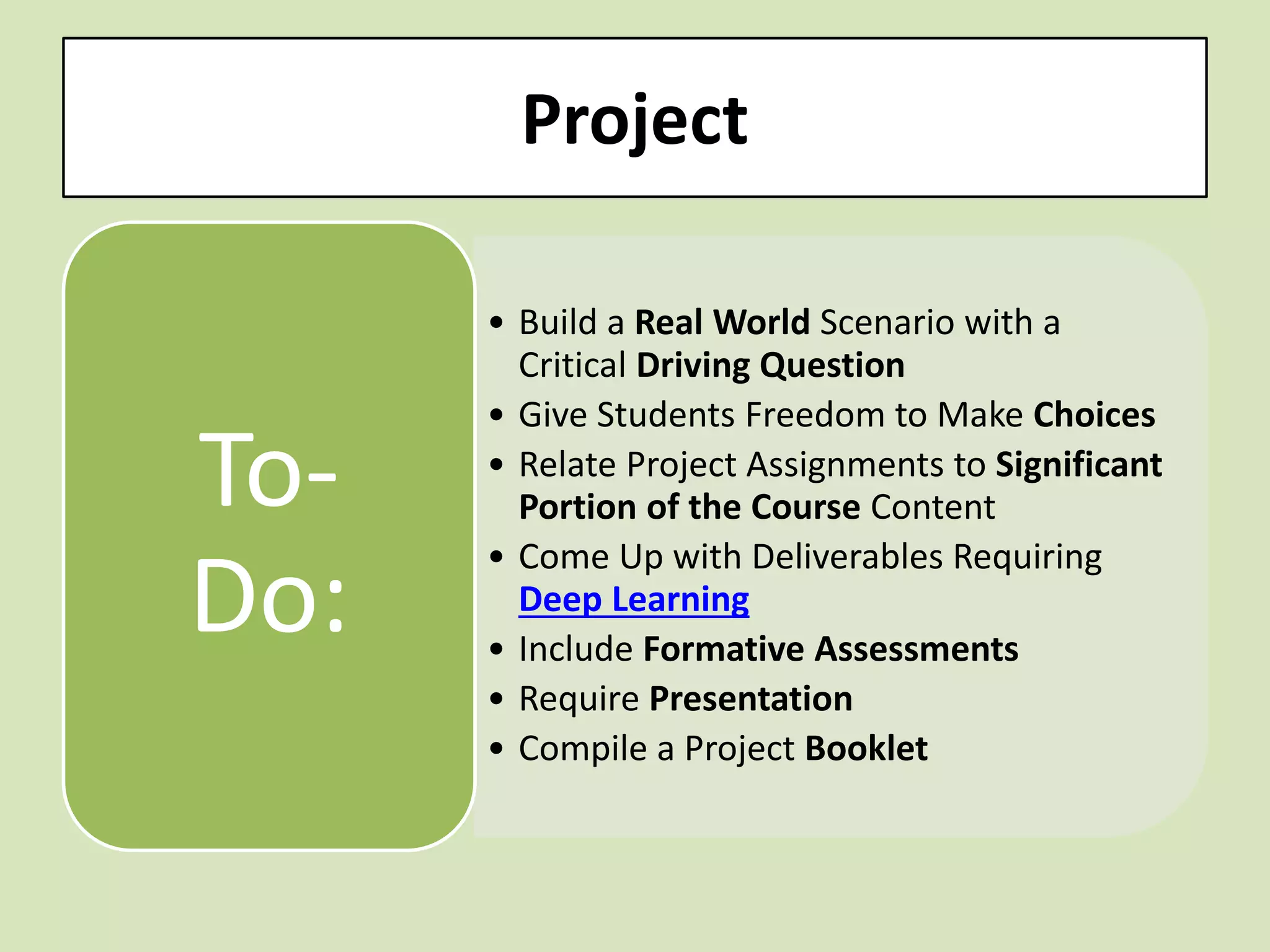
Project 
•Build a Real World Scenario with a Critical Driving Question 
•Give Students Freedom to Make Choices 
•Relate Project Assignments to Significant Portion of the Course Content 
•Come Up with Deliverables Requiring Deep Learning 
•Include Formative Assessments 
•Require Presentation 
•Compile a Project Booklet 
To- Do:
Make the project interdisciplinary, even if the course subject matter is not, by including discipline-specific assignments involving a variety of 21st century literacies- e.g., visual literacy, critical consumption of information, digital storytelling, creativity, etc.
If possible, focus students on challenges with a global scope to internationalize mindsets to improve global and/or cultural awareness.
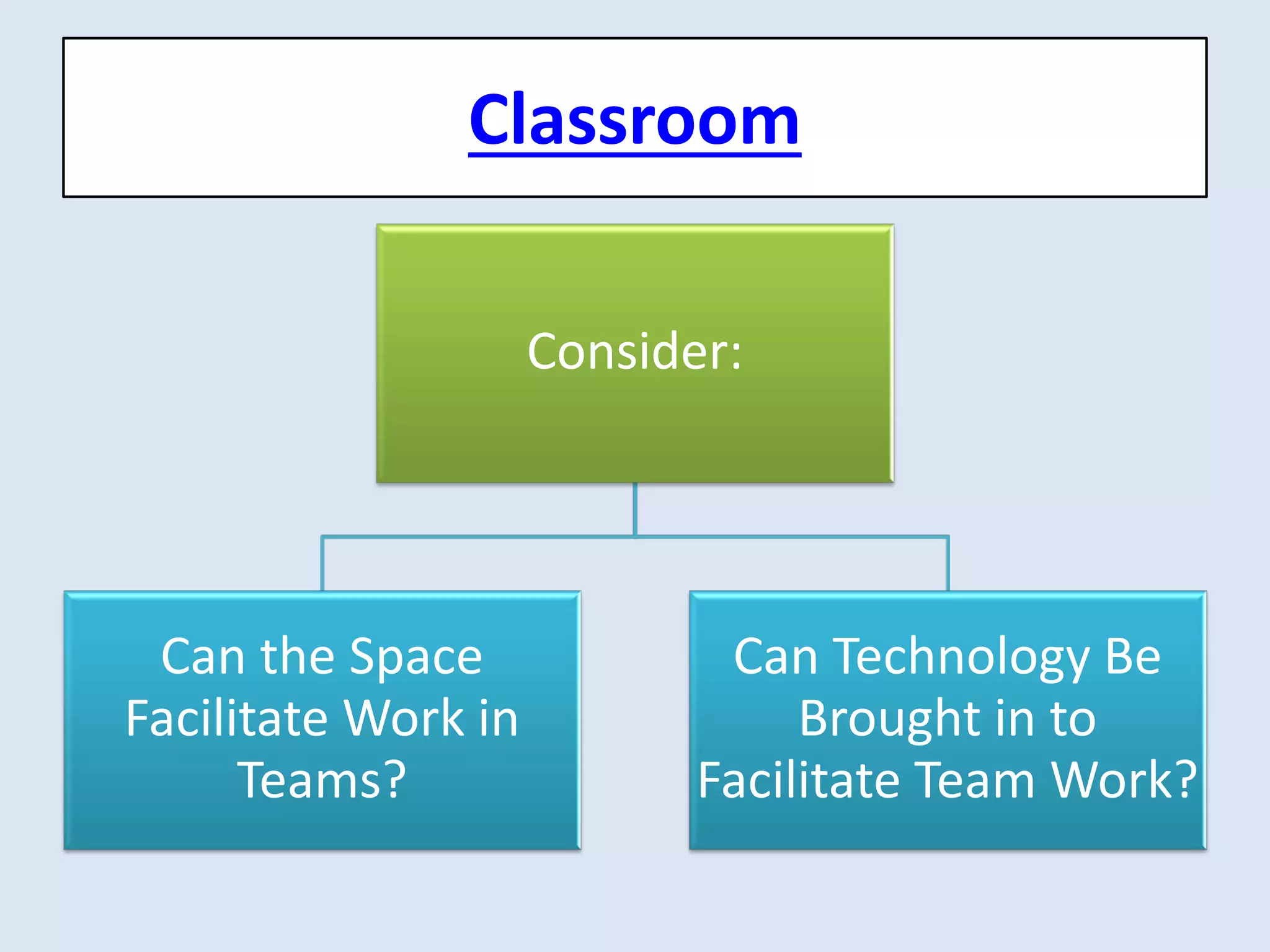
Classroom 
Consider: 
Can the Space Facilitate Work in Teams? 
Can Technology Be Brought in to Facilitate Team Work?
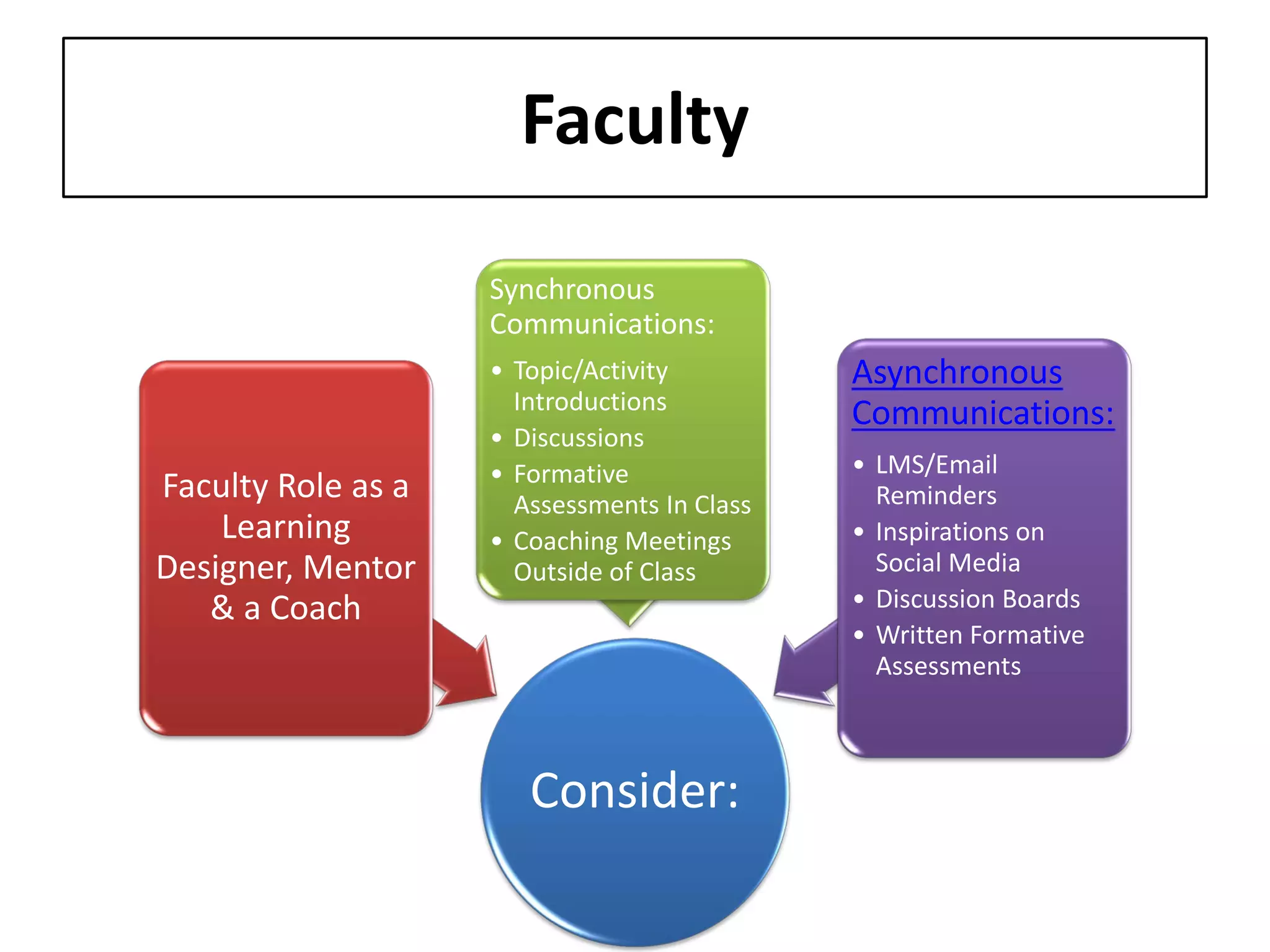
Faculty 
Consider: 
Faculty Role as a Learning Designer, Mentor & a Coach 
Synchronous Communications: 
•Topic/Activity Introductions 
•Discussions 
•Formative Assessments In Class 
•Coaching Meetings Outside of Class 
Asynchronous Communications: 
•LMS/Email Reminders 
•Inspirations on Social Media 
•Discussion Boards 
•Written Formative Assessments
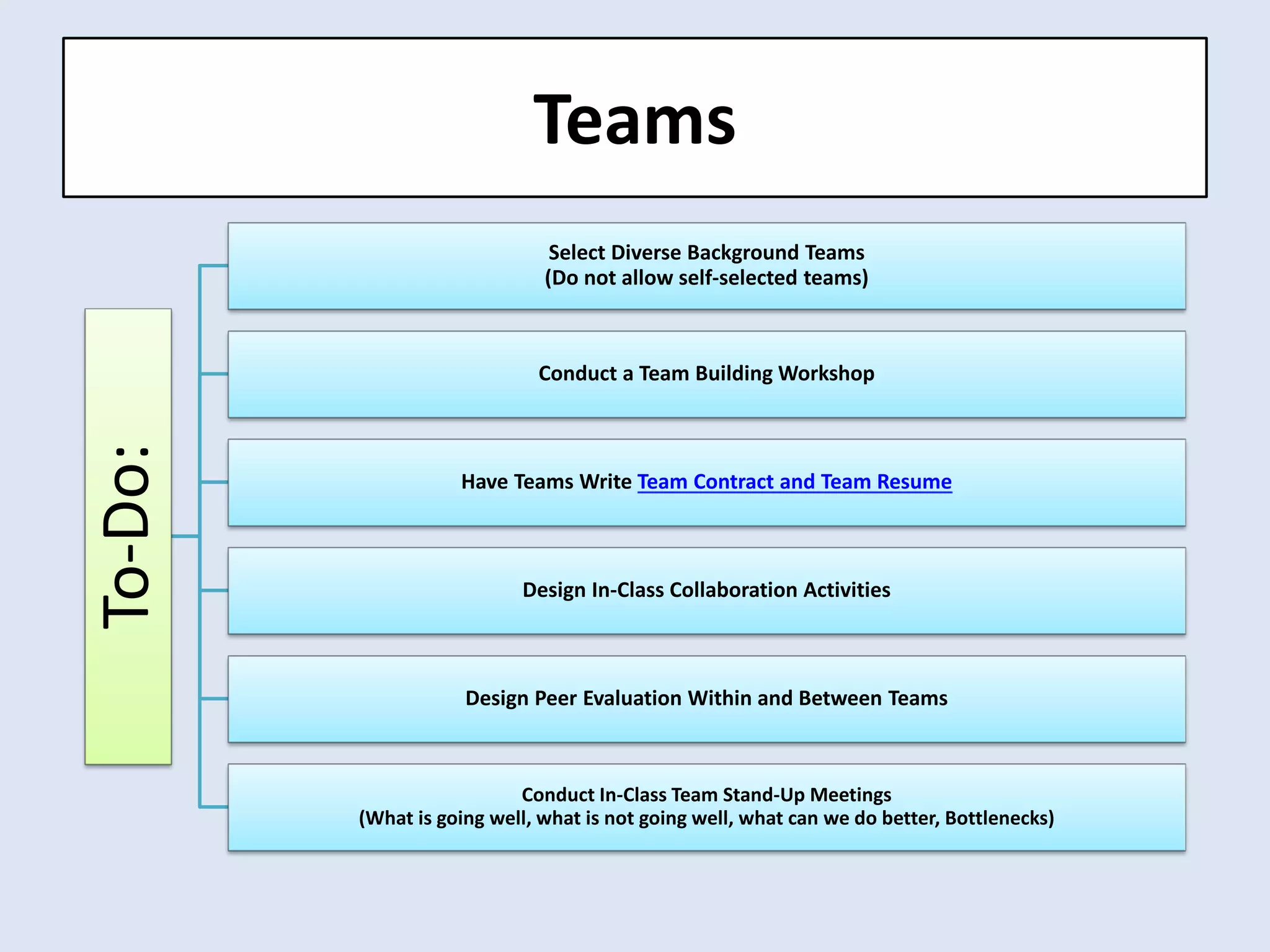
Teams 
To-Do: 
Select Diverse Background Teams (Do not allow self-selected teams) 
Conduct a Team Building Workshop 
Have Teams Write Team Contract and Team Resume 
Design In-Class Collaboration Activities 
Design Peer Evaluation Within and Between Teams 
Conduct In-Class Team Stand-Up Meetings (What is going well, what is not going well, what can we do better, Bottlenecks)
Promote collaboration – within groups, between groups, between classrooms, with different universities, with professionals -- to make learning social and more rewarding. (collaborative learning; connected learning)
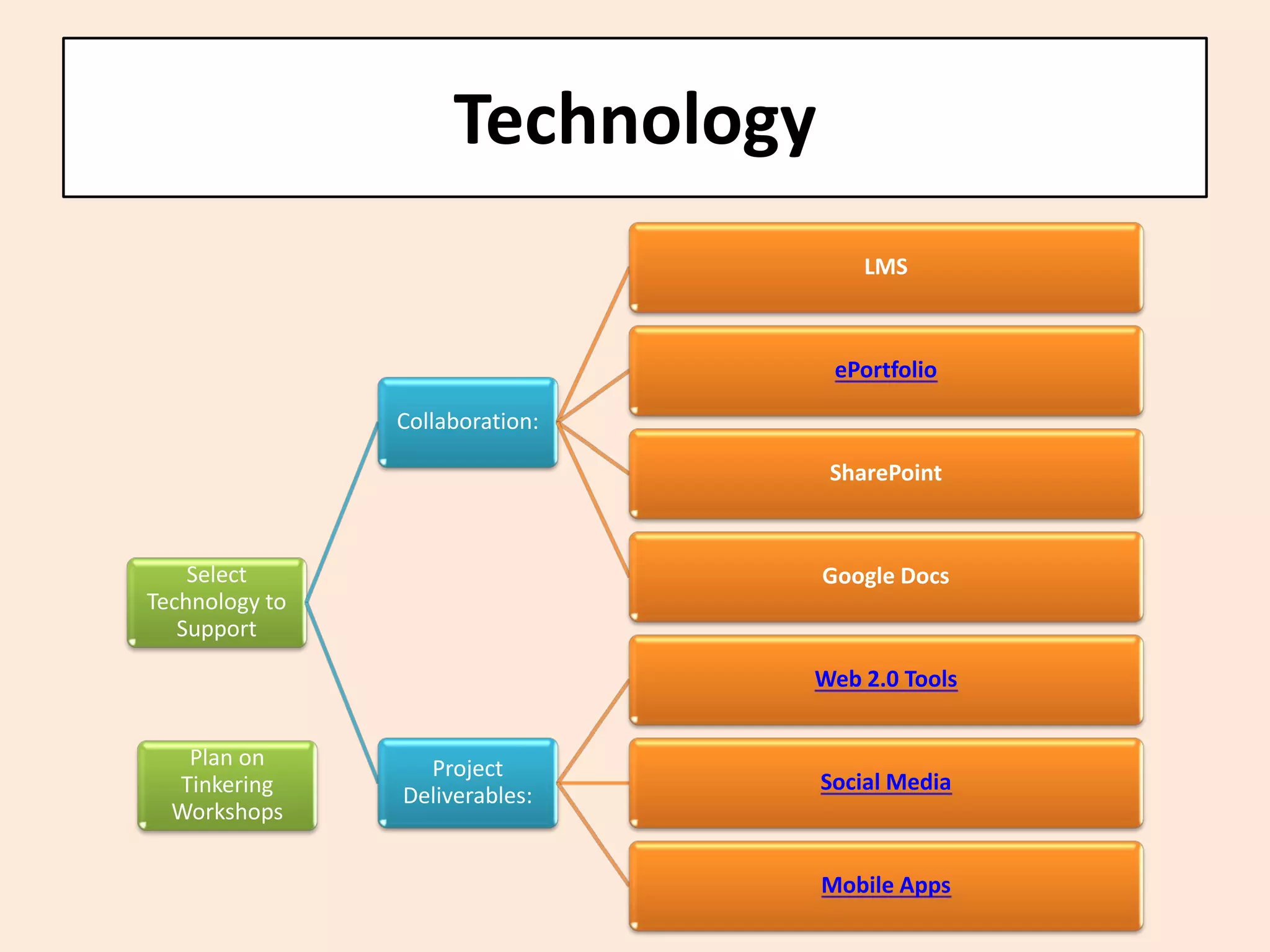
Technology 
Select Technology to Support 
Collaboration: 
LMS 
ePortfolio 
SharePoint 
Google Docs 
Project Deliverables: 
Web 2.0 Tools 
Social Media 
Mobile Apps 
Plan on Tinkering Workshops
– 
Build into the curriculum tinkering workshops or labs, where students have opportunities to be creative, and make mistakes without incurring penalties (encourages risk- taking)
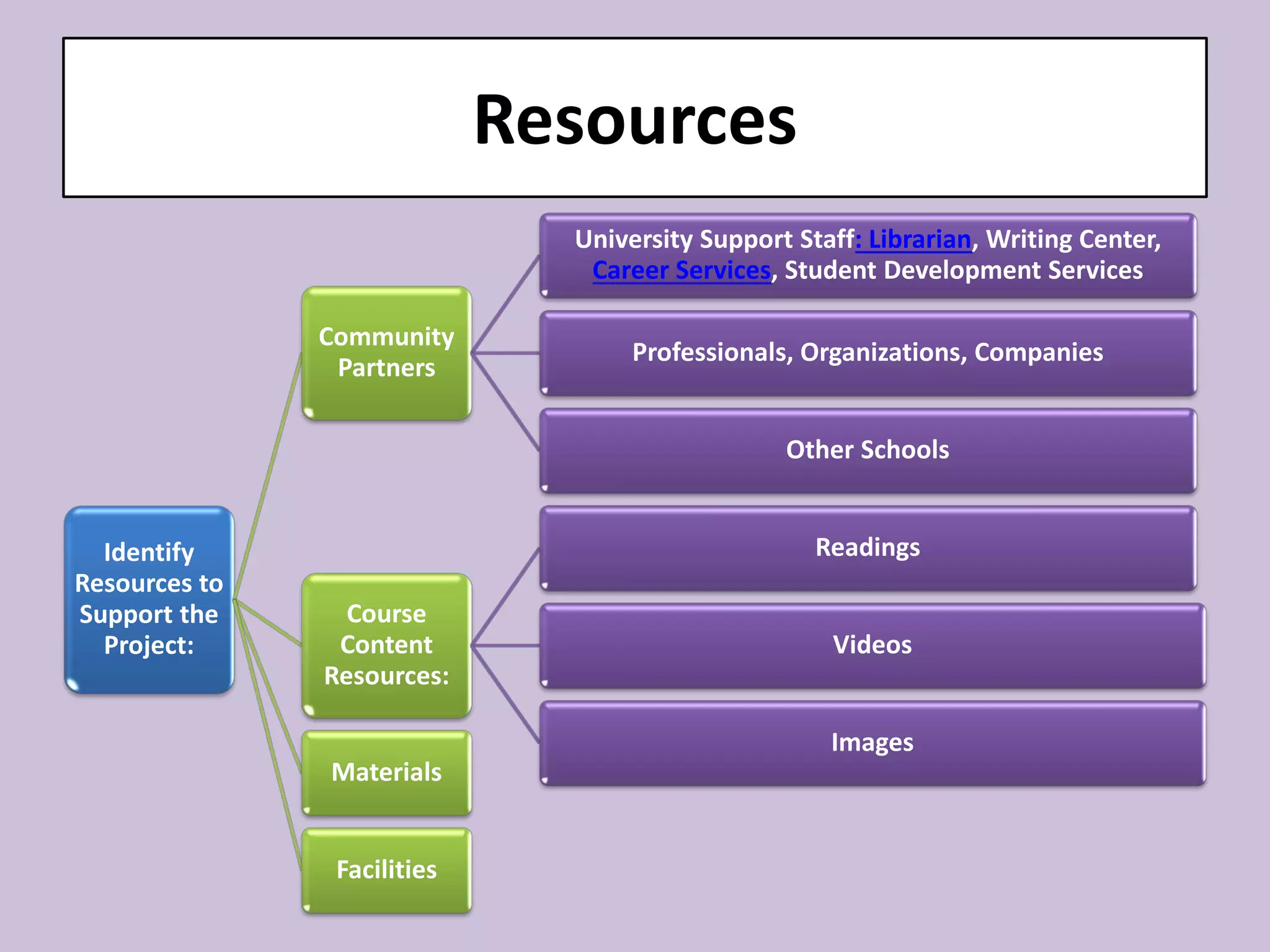
Resources 
Identify Resources to Support the Project: 
Community Partners 
University Support Staff: Librarian, Writing Center, Career Services, Student Development Services 
Professionals, Organizations, Companies 
Other Schools 
Course Content Resources: 
Readings 
Videos 
Images 
Materials 
Facilities
– 
Require students to have the writing center review written assignments to improve written communication skills and narrative/storytelling skills;
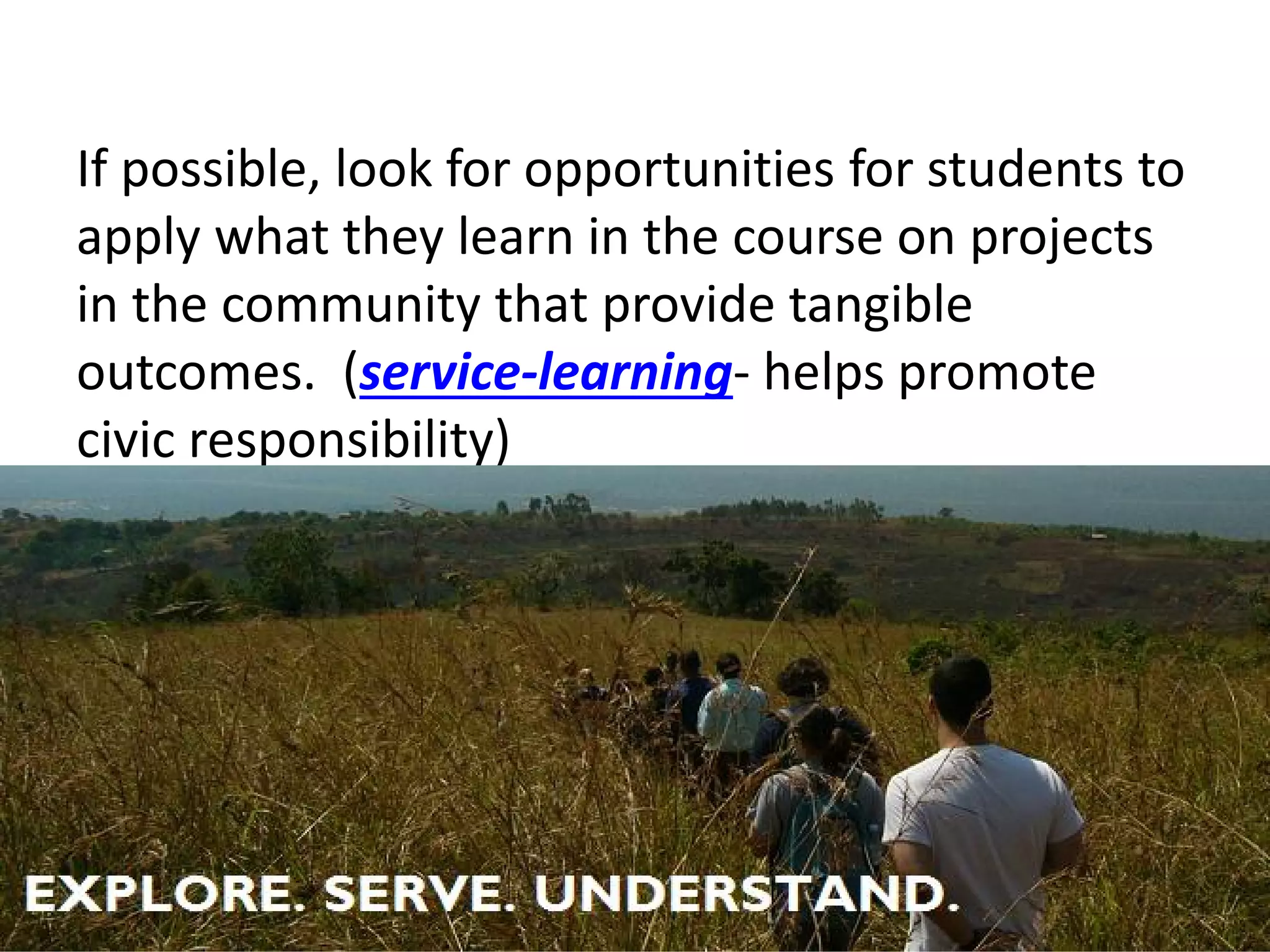
If possible, look for opportunities for students to apply what they learn in the course on projects in the community that provide tangible outcomes. (service-learning- helps promote civic responsibility)
PjBL Learning Outcomes 
“A meta-analysis conducted by Purdue University found that when implemented well, PjBL can increase long-term retention of material and replicable skill, as well as improve teachers' and students' attitudes towards learning.”
Great PjBL Meta-Resource 
Buck Institute for Education
Thank You! 
Share Your Feedback:

21st century student engagement and success through collaborative project-based learning

  • 1.
    21st Century StudentEngagement & Success through Collaborative Project-Based Learning Inaugural Big XII Teaching and Learning Conference, Stillwater, OK, August 4, 2014 © 2014 Dr. Beata M. Jones, Texas Christian University
  • 2.
    Overview • Welcome • Challenges to 21st Century Student Engagement • 21st Century Learning Environment Setting • Needed 21st Century Student Learning Outcomes • Project-based Learning (PjBL) • PjBL Course Design • Scaffolding & Enriching PjBL Learning Environment • Q&A
  • 3.
    Welcome! Beata M.Jones: • Ph. D. in Computer Science, 1993 • At TCU 15+ years • Current Teaching: BIS & Interdisciplinary Honors Colloquia • Coordinating 21st Century Student FIG • Requiring projects for past 15+ years; • Doing PjBL for past 5 years Contact: b.jones@tcu.edu https://www.linkedin.com/pub/beatamjones @BeataJones
  • 4.
    Hello! • Myname is….. • I am from the ___ university/college • I teach____ • PjBL?
  • 5.
    Is This YourReality? “I am Worried About My Grade” (4:47)
  • 6.
    Or Is ThisYour Reality? Michael Wesch: “Vision of Students Today” (4:44)
  • 7.
    21st Century Students • Shorter attention spans • Easily bored • Resist memorization and busy work • Self-learners • Embrace trial and error • Attached to mobile technology • Perceive learning as a social activity to be shared with others • Make Learning Relevant • Engage Us! TCU Fig21 Videos: (60:00+)
  • 8.
    What’s YOUR BiggestChallenge Teaching Millennial Students?
  • 9.
    The Setting InWhich We Teach – 21st Century Economy Globalization & Digital Revolution Hyper-Connected World Accelerating Innovation Economy Transformation
  • 10.
    • “It’s apoor workman who blames these” • “What are tools?”
  • 12.
    Singularity • Theexact point in human history where machines will supersede humans -- John Van Neuman • Expected to occur sometime between 2030 and 2050. • We are already losing certain jobs to computers.
  • 13.
    Ailing Economy – 15% Underemployment Rate – Skyrocketing Debt
  • 14.
  • 16.
    Ailing Education • College Graduates Not Prepared For The Job Market • Skyrocketing Cost Of College Education • Shrinking College Applicant Pool • Proposed Federal College Score Card • Proposed College Programs That Are Competency-based And Do Not Rely On Seat Time
  • 17.
    • Need ForMore Innovation To Help With Economic Recovery & World Problems – New Products & Services-> More Jobs -> More Wealth • Need To Rethink Education – The What? & The How?
  • 18.
    How Does EducationNeed to Change?
  • 19.
    Exercise 1. What’syour definition of Deep Learning? 2. What’s your experience of Deep Learning? 3. What’s the difference? Melissa Peet, Annual AAEEBL Conference Executive Summit, Boston, July 2014
  • 20.
  • 21.
    Knowledgeable to Knowledge-able Michael Wesch: “Knowledgeable to Knowledge-able” (18:34)
  • 22.
    Framework For 21stCentury Skills K-12 Model Supported in 18 States; The Partnership for 21st Century Skills
  • 23.
    “Cultivating the Imaginationfor a World of Constant Change” • From Classroom Learning To Learning Environments • Embracing Change • Playing To Learn & Gaming • Learning As Inquiry • Engaging The Passion • Tacit Learning – Through Doing, Watching, Experiencing • Learning In The Collective
  • 24.
    K-20 Model Supportedby MacArthur Foundation
  • 25.
    21st Century Metaskills • FEELING: including empathy, intuition, and social intelligence. • SEEING: the ability to think whole thoughts, also known as systems thinking. • DREAMING: the metaskill of applied imagination. • MAKING: mastering the design process, including skills for devising prototypes. • LEARNING: the autodidactic ability to learn new skills at will. Neumeier, Marty (2013)
  • 26.
    21st Century Learning fusing vast informational resources with personal motivation to learn & life outside of the classroom. to student-driven, technology- enabled learning environment, Transitioning from teacher- centered, classroom-based education
  • 27.
    AAC&U High-Impact Practices Collaborative Assignments & Projects
  • 28.
    National Survey ofStudent Engagement • Active and collaborative learning: one of the top five benchmarks of effective educational practice. “Students learn more when they are intensely involved in their education and are asked to think about and apply what they are learning in different settings. Collaborating with others in solving problems or mastering difficult material prepares students to deal with the messy, unscripted problems they will encounter daily, both during and after college.”
  • 29.
    Project-Based Learning (PjBL)vs. Problem-Based Learning (PBL)
  • 30.
    Project-based Learning (PjBL) PjBL has emerged as one of today’s most effective instructional practices. In PjBL, students confront real-world challenges, collaborate to create solutions, and present their results.
  • 31.
    Five Keys toRigorous PBL Real World Core to Learning Structured Collaboration Student Driven Formative Assessment Five Keys to Rigorous Project-Based Learning Edutopia: “Five Keys to Rigorous Project-Based Learning” (6:30)
  • 32.
    My Recent PjBLExperiences • SO Core Business Information Systems Class • JR Business Information Systems Development Class in BIS Major • FR-SO Intercultural Competence Study Abroad : Cultural Pathways Through Eastern Europe • JR-SR Honors Colloquia: – Disruptive Nature of Information Technology; – Digital Identity & Digital Storytelling Across Disciplines
  • 33.
    Course Grade Outcomes 7-10% Higher Grades in Core BIS Class See Also Related Flipped Classroom Technology Results: •McGraw-Hill LearnSmart Outcomes •Pearson MyLab Outcomes
  • 34.
    Student Feedback “Everythingwe did for the semester project I thought was very applicable to the business world. It helped me learn the material we had covered by putting it into action.” “I learned a lot about team dynamics as well as information systems by integrating class lessons with the project.” “The course allowed for a lot of learning in the areas of BIS. There was a lot of variety that gave us a thorough understanding of what the BIS major has to offer.”
  • 35.
    My Recent PjBLExperiences • SO Core Business Information Systems Class (accessible only with a username and password) • JR Business Information Systems Development Class in BIS Major (accessible only with a username and password) • FR-SO Intercultural Competence Study Abroad : Cultural Pathways Through Eastern Europe • JR-SR Honors Colloquia: – Disruptive Nature of Information Technology; – Digital Identity & Digital Storytelling Across Disciplines (Links to SharePoint, Storify/Tumblr, Digication)
  • 36.
  • 37.
  • 38.
  • 39.
    My PjBL “Flavors” 1 2 3 4 5 Collaboration % 85 70 80 40 50 Project As % of Course Content 85 70 60 85 50 Degrees of Freedom (out of 100) 30 10 90 40 50 0 10 20 30 40 50 60 70 80 90 100 PjBL Flavors Column1 Class Scenarios 1 Core BIS Class Students Select a Company for Context Given Specific Driving Questions 2 Major BIS Development Students Propose & Develop Deliverables Within a Given Company Context 3 Disruptive Nature oF IT Students Inquire, Design & Deliver an IT Project Based on their Passions 4 Digital Identity Students Inquire & Design a Digital Identity Based on their Personal Identities 5 Cultural Pathways Study Abroad Students Build Competency Based on Some Required and Some Selected Activities
  • 40.
    PjBL vs. PjBLwith Scaffolding & Enriching VS.
  • 41.
    PjBL Learning Environment Course Learning Outcomes Project Faculty Teams Resources Technology Classroom PjBL
  • 42.
    Course Formulate: DesiredLearning Outcomes Necessary Content Areas Pedagogy (Flipped Classroom)
  • 43.
    flipped classroom -Assign reading, research, speaker events, and/or video lectures for homework. Use class time to work in groups on assignments that assume familiarity with the assigned homework material.
  • 44.
    Project •Build aReal World Scenario with a Critical Driving Question •Give Students Freedom to Make Choices •Relate Project Assignments to Significant Portion of the Course Content •Come Up with Deliverables Requiring Deep Learning •Include Formative Assessments •Require Presentation •Compile a Project Booklet To- Do:
  • 45.
    Make the projectinterdisciplinary, even if the course subject matter is not, by including discipline-specific assignments involving a variety of 21st century literacies- e.g., visual literacy, critical consumption of information, digital storytelling, creativity, etc.
  • 46.
    If possible, focusstudents on challenges with a global scope to internationalize mindsets to improve global and/or cultural awareness.
  • 47.
    Classroom Consider: Canthe Space Facilitate Work in Teams? Can Technology Be Brought in to Facilitate Team Work?
  • 48.
    Faculty Consider: FacultyRole as a Learning Designer, Mentor & a Coach Synchronous Communications: •Topic/Activity Introductions •Discussions •Formative Assessments In Class •Coaching Meetings Outside of Class Asynchronous Communications: •LMS/Email Reminders •Inspirations on Social Media •Discussion Boards •Written Formative Assessments
  • 49.
    Teams To-Do: SelectDiverse Background Teams (Do not allow self-selected teams) Conduct a Team Building Workshop Have Teams Write Team Contract and Team Resume Design In-Class Collaboration Activities Design Peer Evaluation Within and Between Teams Conduct In-Class Team Stand-Up Meetings (What is going well, what is not going well, what can we do better, Bottlenecks)
  • 50.
    Promote collaboration –within groups, between groups, between classrooms, with different universities, with professionals -- to make learning social and more rewarding. (collaborative learning; connected learning)
  • 51.
    Technology Select Technologyto Support Collaboration: LMS ePortfolio SharePoint Google Docs Project Deliverables: Web 2.0 Tools Social Media Mobile Apps Plan on Tinkering Workshops
  • 52.
    – Build intothe curriculum tinkering workshops or labs, where students have opportunities to be creative, and make mistakes without incurring penalties (encourages risk- taking)
  • 53.
    Resources Identify Resourcesto Support the Project: Community Partners University Support Staff: Librarian, Writing Center, Career Services, Student Development Services Professionals, Organizations, Companies Other Schools Course Content Resources: Readings Videos Images Materials Facilities
  • 54.
    – Require studentsto have the writing center review written assignments to improve written communication skills and narrative/storytelling skills;
  • 55.
    If possible, lookfor opportunities for students to apply what they learn in the course on projects in the community that provide tangible outcomes. (service-learning- helps promote civic responsibility)
  • 56.
    PjBL Learning Outcomes “A meta-analysis conducted by Purdue University found that when implemented well, PjBL can increase long-term retention of material and replicable skill, as well as improve teachers' and students' attitudes towards learning.”
  • 57.
    Great PjBL Meta-Resource Buck Institute for Education
  • 58.
    Thank You! ShareYour Feedback: