Designs for active learning
Mike Sharples
Institute of Educational Technology
The Open University
@sharplm
2012: Prediction for Higher Education
By 2020, higher education will be quite different from the
way it is today. There will be mass adoption of
teleconferencing and distance learning to leverage expert
resources. Significant numbers of learning activities will
move to individualized, just-in-time learning approaches.
There will be a transition to "hybrid" classes that combine
online learning components with less-frequent on-
campus, in-person class meetings.
Pew Research Center prediction from 2012
60% of respondents, from 1000 digital learning experts
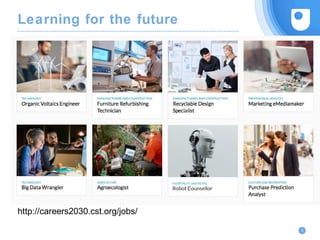
Learning for the future
http://careers2030.cst.org/jobs/
3
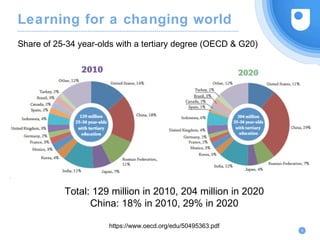
Learning for a changing world
Share of 25-34 year-olds with a tertiary degree (OECD & G20)
4
https://www.oecd.org/edu/50495363.pdf
Total: 129 million in 2010, 204 million in 2020
China: 18% in 2010, 29% in 2020
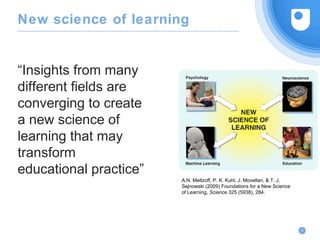
New science of learning
“Insights from many
different fields are
converging to create
a new science of
learning that may
transform
educational practice”
5
A.N. Meltzoff, P. K. Kuhl, J. Movellan, & T. J.
Sejnowski (2009) Foundations for a New Science
of Learning, Science 325 (5938), 284.
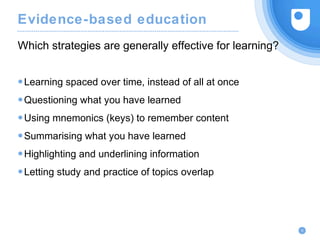
Evidence-based education
●Learning spaced over time, instead of all at once
●Questioning what you have learned
●Using mnemonics (keys) to remember content
●Summarising what you have learned
●Highlighting and underlining information
●Letting study and practice of topics overlap
Which strategies are generally effective for learning?
6
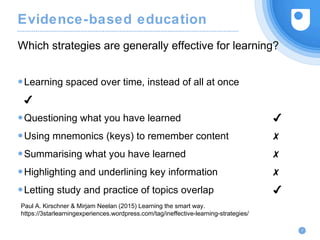
Evidence-based education
●Learning spaced over time, instead of all at once
✔
●Questioning what you have learned ✔
●Using mnemonics (keys) to remember content ✗
●Summarising what you have learned ✗
●Highlighting and underlining key information ✗
●Letting study and practice of topics overlap ✔
Which strategies are generally effective for learning?
7
Paul A. Kirschner & Mirjam Neelan (2015) Learning the smart way.
https://3starlearningexperiences.wordpress.com/tag/ineffective-learning-strategies/
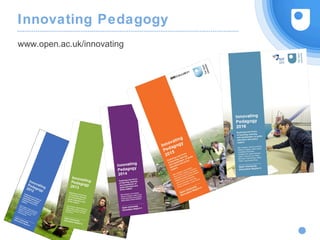
Innovating pedagogy
Annual report from The Open
University
2015, with SRI International
2016, with NIE Singapore
80,000 downloads per year
www.open.ac.uk/innovating
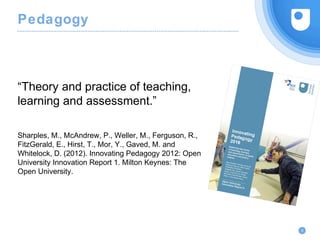
Pedagogy
“Theory and practice of teaching,
learning and assessment.”
Sharples, M., McAndrew, P., Weller, M., Ferguson, R.,
FitzGerald, E., Hirst, T., Mor, Y., Gaved, M. and
Whitelock, D. (2012). Innovating Pedagogy 2012: Open
University Innovation Report 1. Milton Keynes: The
Open University.
9
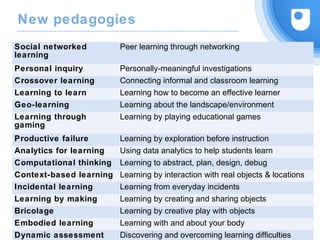
New pedagogies
10
Social networked
learning
Peer learning through networking
Personal inquiry Personally-meaningful investigations
Crossover learning Connecting informal and classroom learning
Learning to learn Learning how to become an effective learner
Geo-learning Learning about the landscape/environment
Learning through
gaming
Learning by playing educational games
Productive failure Learning by exploration before instruction
Analytics for learning Using data analytics to help students learn
Computational thinking Learning to abstract, plan, design, debug
Context-based learning Learning by interaction with real objects & locations
Incidental learning Learning from everyday incidents
Learning by making Learning by creating and sharing objects
Bricolage Learning by creative play with objects
Embodied learning Learning with and about your body
Dynamic assessment Discovering and overcoming learning difficulties
Explore first
Spaced learning
Conversational learning
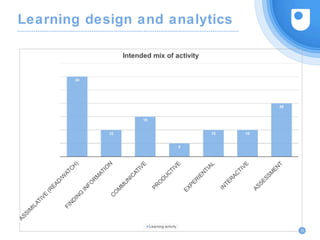
Learning design and analytics
11
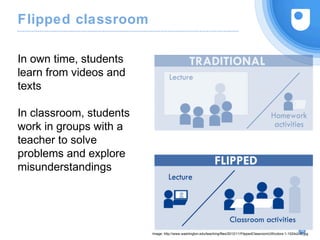
Flipped classroom
12
Image: http://www.washington.edu/teaching/files/2012/11/FlippedClassroomUWcolors-1-1024x242.jpg
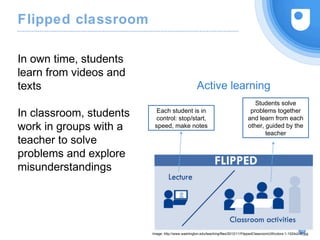
In own time, students
learn from videos and
texts
In classroom, students
work in groups with a
teacher to solve
problems and explore
misunderstandings
Flipped classroom
13
Image: http://www.washington.edu/teaching/files/2012/11/FlippedClassroomUWcolors-1-1024x242.jpg
Each student is in
control: stop/start,
speed, make notes
Students solve
problems together
and learn from each
other, guided by the
teacher
Active learning
In own time, students
learn from videos and
texts
In classroom, students
work in groups with a
teacher to solve
problems and explore
misunderstandings
Flipped classroom
14
Image: http://www.washington.edu/teaching/files/2012/11/FlippedClassroomUWcolors-1-1024x242.jpg
Each student is in
control: stop/start,
speed, make notes
Students solve
problems together
and learn from each
other, guided by the
teacher
Active learning
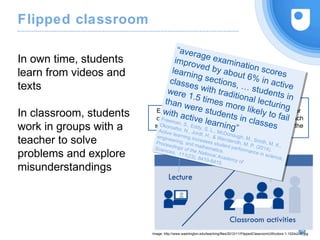
“average examination scores
improved by about 6% in active
learning sections, … students in
classes with traditional lecturing
were 1.5 times more likely to fail
than were students in classes
with active learning”
Freeman, S., Eddy, S. L., McDonough, M., Smith, M. K.,
Okoroafor, N., Jordt, H., & Wenderoth, M. P. (2014).
Active learning increases student performance in science,
engineering, and mathematics.
Proceedings of the National Academy of
Sciences, 111(23), 8410-8415.
“average examination scores
improved by about 6% in active
learning sections, … students in
classes with traditional lecturing
were 1.5 times more likely to fail
than were students in classes
with active learning”
Freeman, S., Eddy, S. L., McDonough, M., Smith, M. K.,
Okoroafor, N., Jordt, H., & Wenderoth, M. P. (2014).
Active learning increases student performance in science,
engineering, and mathematics.
Proceedings of the National Academy of
Sciences, 111(23), 8410-8415.
In own time, students
learn from videos and
texts
In classroom, students
work in groups with a
teacher to solve
problems and explore
misunderstandings
Explore first
15
EXPLORE FIRST
Group exploration
Video lecture
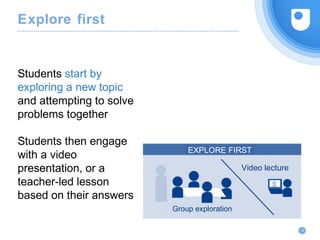
Students start by
exploring a new topic
and attempting to solve
problems together
Students then engage
with a video
presentation, or a
teacher-led lesson
based on their answers
Explore first
16
EXPLORE FIRST
Group exploration
Video lecture
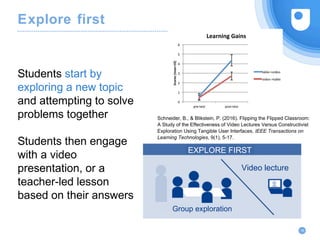
Students start by
exploring a new topic
and attempting to solve
problems together
Students then engage
with a video
presentation, or a
teacher-led lesson
based on their answers
Schneider, B., & Blikstein, P. (2016). Flipping the Flipped Classroom:
A Study of the Effectiveness of Video Lectures Versus Constructivist
Exploration Using Tangible User Interfaces. IEEE Transactions on
Learning Technologies, 9(1), 5-17.
Spaced learning
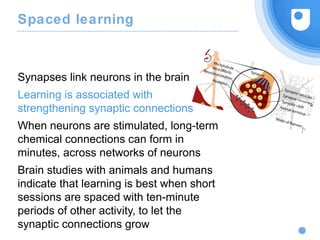
Synapses link neurons in the brain
Learning is associated with
strengthening synaptic connections
When neurons are stimulated, long-term
chemical connections can form in
minutes, across networks of neurons
Brain studies with animals and humans
indicate that learning is best when short
sessions are spaced with ten-minute
periods of other activity, to let the
synaptic connections grow
Spaced learning
18
http://www.innovationunit.org/sites/default/files/Spaced_Learning-downloadable_1.pdf
Kelley, P., & Whatson, T. (2013). Making long-term memories in minutes: a spaced learning pattern from memory
research in education. Frontiers in Human Neuroscience, 7, 589.
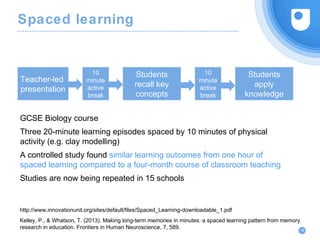
GCSE Biology course
Three 20-minute learning episodes spaced by 10 minutes of physical
activity (e.g. clay modelling)
A controlled study found similar learning outcomes from one hour of
spaced learning compared to a four-month course of classroom teaching
Studies are now being repeated in 15 schools
Teacher-led
presentation
Students
recall key
concepts
10
minute
active
break
10
minute
active
break
Students
apply
knowledge
Conversational learning:
Groupwork
People learn better when they
learn together
For groups to work:
shared goals
each person knows how and when to
contribute
everyone makes an appropriate
contribution
share rewards in a fair way
opportunity to reflect on progress and
to discuss contributions
19
Johnson, D. W., & Johnson, R. T. (2009). An educational psychology success story: Social
interdependence theory and cooperative learning. Educational researcher, 38(5), 365-379.
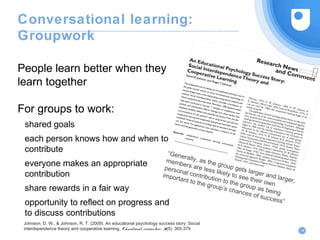
“Generally, as the group gets larger and larger,
members are less likely to see their own
personal contribution to the group as being
important to the group’s chances of success”
Conversational learning:
FutureLearn
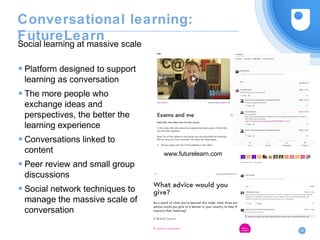
● Platform designed to support
learning as conversation
● The more people who
exchange ideas and
perspectives, the better the
learning experience
● Conversations linked to
content
● Peer review and small group
discussions
● Social network techniques to
manage the massive scale of
conversation
Social learning at massive scale
20
www.futurelearn.com
Is conversational
learning
effective?
21
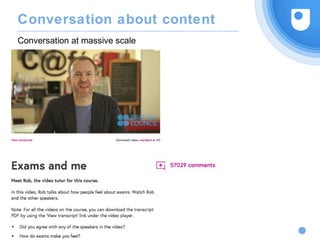
Conversation about content
Conversation at massive scale
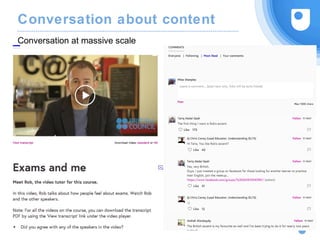
Conversation about content
Conversation at massive scale
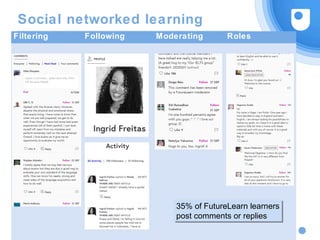
Social networked learning
Filtering Following Moderating Roles
35% of FutureLearn learners
post comments or replies
35% of FutureLearn learners
post comments or replies
Learning design and analytics
25
Student learning
Week 1Week 2 Week 30+
Rienties, B., Toetenel, L. (2016). “The impact of learning design on student behaviour, satisfaction and
performance: A cross-institutional comparison across 151 modules. Computers in Human Bevavior, 60, 333-341.
Assimilative
Finding
information
Communicative
Productive
Learning Design
151 modules
Experiential
Interactive
Assessment
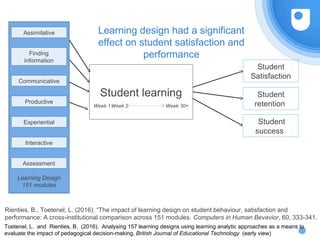
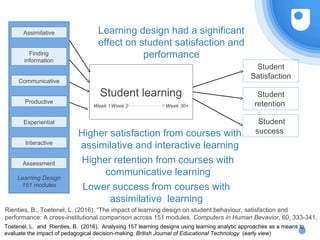
Learning design had a significant
effect on student satisfaction and
performance
Student
Satisfaction
Student
retention
Student
success
Toetenel, L. and Rienties, B. (2016). Analysing 157 learning designs using learning analytic approaches as a means to
evaluate the impact of pedagogical decision-making. British Journal of Educational Technology (early view)
Student learning
Week 1Week 2 Week 30+
Rienties, B., Toetenel, L. (2016). “The impact of learning design on student behaviour, satisfaction and
performance: A cross-institutional comparison across 151 modules. Computers in Human Bevavior, 60, 333-341.
Assimilative
Finding
information
Communicative
Productive
Learning Design
151 modules
Experiential
Interactive
Assessment
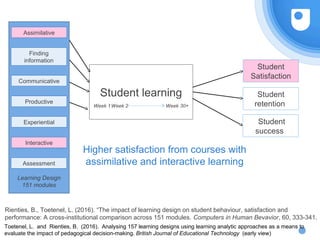
Higher satisfaction from courses with
assimilative and interactive learning
Student
Satisfaction
Student
retention
Student
success
Toetenel, L. and Rienties, B. (2016). Analysing 157 learning designs using learning analytic approaches as a means to
evaluate the impact of pedagogical decision-making. British Journal of Educational Technology (early view)
Student learning
Week 1Week 2 Week 30+
Rienties, B., Toetenel, L. (2016). “The impact of learning design on student behaviour, satisfaction and
performance: A cross-institutional comparison across 151 modules. Computers in Human Bevavior, 60, 333-341.
Assimilative
Finding
information
Communicative
Productive
Learning Design
151 modules
Experiential
Interactive
Assessment
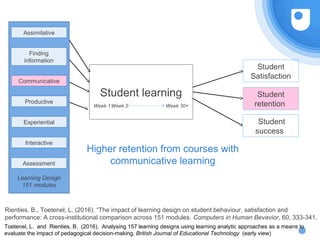
Higher retention from courses with
communicative learning
Student
Satisfaction
Student
retention
Student
success
Toetenel, L. and Rienties, B. (2016). Analysing 157 learning designs using learning analytic approaches as a means to
evaluate the impact of pedagogical decision-making. British Journal of Educational Technology (early view)
Student learning
Week 1Week 2 Week 30+
Rienties, B., Toetenel, L. (2016). “The impact of learning design on student behaviour, satisfaction and
performance: A cross-institutional comparison across 151 modules. Computers in Human Bevavior, 60, 333-341.
Assimilative
Finding
information
Communicative
Productive
Learning Design
151 modules
Experiential
Interactive
Assessment
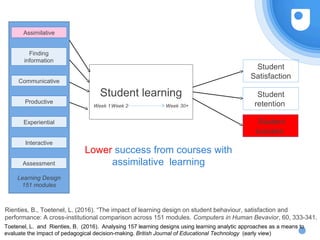
Lower success from courses with
assimilative learning
Student
Satisfaction
Student
retention
Student
success
Toetenel, L. and Rienties, B. (2016). Analysing 157 learning designs using learning analytic approaches as a means to
evaluate the impact of pedagogical decision-making. British Journal of Educational Technology (early view)
Student learning
Week 1Week 2 Week 30+
Rienties, B., Toetenel, L. (2016). “The impact of learning design on student behaviour, satisfaction and
performance: A cross-institutional comparison across 151 modules. Computers in Human Bevavior, 60, 333-341.
Assimilative
Finding
information
Communicative
Productive
Learning Design
151 modules
Experiential
Interactive
Assessment
Learning design had a significant
effect on student satisfaction and
performance
Higher satisfaction from courses with
assimilative and interactive learning
Higher retention from courses with
communicative learning
Lower success from courses with
assimilative learning
Student
Satisfaction
Student
retention
Student
success
Toetenel, L. and Rienties, B. (2016). Analysing 157 learning designs using learning analytic approaches as a means to
evaluate the impact of pedagogical decision-making. British Journal of Educational Technology (early view)
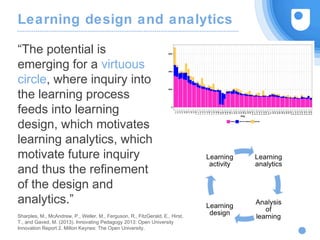
Learning design and analytics
“The potential is
emerging for a virtuous
circle, where inquiry into
the learning process
feeds into learning
design, which motivates
learning analytics, which
motivate future inquiry
and thus the refinement
of the design and
analytics.”
Sharples, M., McAndrew, P., Weller, M., Ferguson, R., FitzGerald, E., Hirst,
T., and Gaved, M. (2013). Innovating Pedagogy 2013: Open University
Innovation Report 2. Milton Keynes: The Open University.
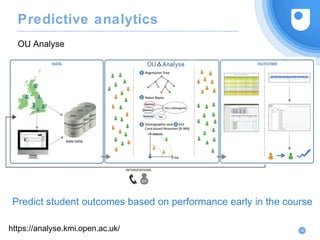
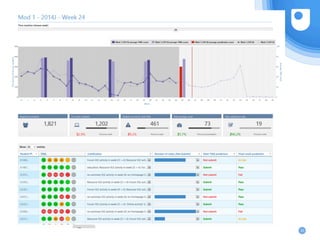
Predictive analytics
OU Analyse
32https://analyse.kmi.open.ac.uk/
Predict student outcomes based on performance early in the course
33
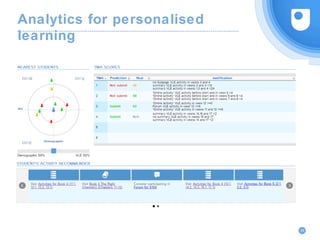
Analytics for personalised
learning
34
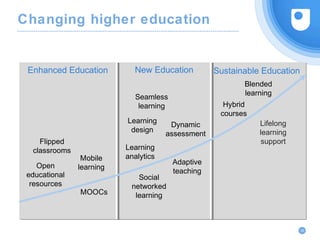
Changing higher education
35
Open
educational
resources
Enhanced Education New Education Sustainable Education
Mobile
learning
Blended
learning
Hybrid
courses
Flipped
classrooms
Seamless
learning
Learning
design
Dynamic
assessment
Adaptive
teaching
Learning
analytics
Social
networked
learningMOOCs
Lifelong
learning
support
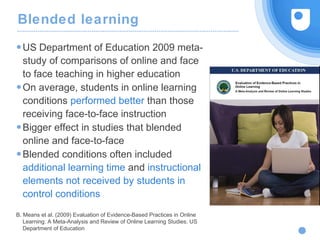
Blended learning
●US Department of Education 2009 meta-
study of comparisons of online and face
to face teaching in higher education
●On average, students in online learning
conditions performed better than those
receiving face-to-face instruction
●Bigger effect in studies that blended
online and face-to-face
●Blended conditions often included
additional learning time and instructional
elements not received by students in
control conditions
B. Means et al. (2009) Evaluation of Evidence-Based Practices in Online
Learning: A Meta-Analysis and Review of Online Learning Studies. US
Department of Education
Distinguish hype from reality
Blended learning
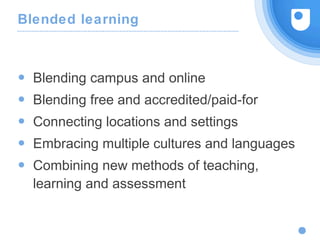
● Blending campus and online
● Blending free and accredited/paid-for
● Connecting locations and settings
● Embracing multiple cultures and languages
● Combining new methods of teaching,
learning and assessment
Distinguish hype from reality
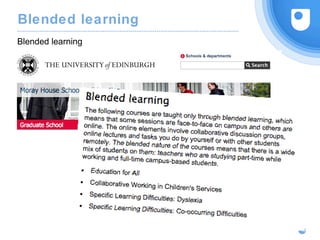
Blended learning
Blended learning
38
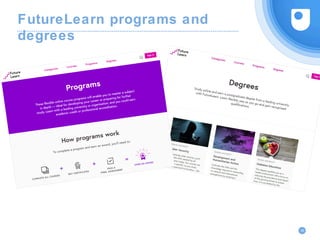
FutureLearn programs and
degrees
39
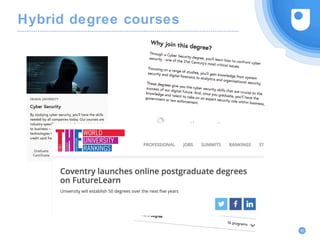
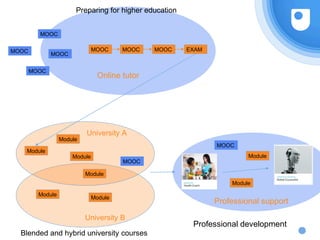
Hybrid degree courses
40
41
MOOC
MOOC
MOOC
MOOC
MOOC MOOC EXAM
Module
Module
Module
Online tutor
MOOC
MOOC
Module
Module
Module
Preparing for higher education
Blended and hybrid university courses
University B
University A
MOOC
Professional support
Module
Professional development
Module
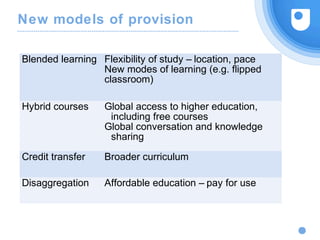
New models of provision
Blended learning Flexibility of study – location, pace
New modes of learning (e.g. flipped
classroom)
Hybrid courses Global access to higher education,
including free courses
Global conversation and knowledge
sharing
Credit transfer Broader curriculum
Disaggregation Affordable education – pay for use
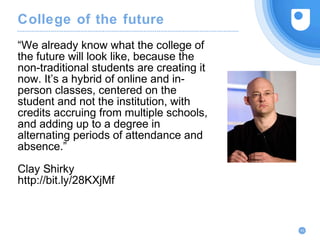
“We already know what the college of
the future will look like, because the
non-traditional students are creating it
now. It’s a hybrid of online and in-
person classes, centered on the
student and not the institution, with
credits accruing from multiple schools,
and adding up to a degree in
alternating periods of attendance and
absence.”
Clay Shirky
http://bit.ly/28KXjMf
43
College of the future
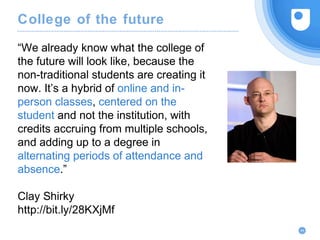
“We already know what the college of
the future will look like, because the
non-traditional students are creating it
now. It’s a hybrid of online and in-
person classes, centered on the
student and not the institution, with
credits accruing from multiple schools,
and adding up to a degree in
alternating periods of attendance and
absence.”
Clay Shirky
http://bit.ly/28KXjMf
44
College of the future
Innovating Pedagogy
www.open.ac.uk/innovating

Designs for Active Learning, Cambridge 2017

  • 1.
    Designs for activelearning Mike Sharples Institute of Educational Technology The Open University @sharplm
  • 2.
    2012: Prediction forHigher Education By 2020, higher education will be quite different from the way it is today. There will be mass adoption of teleconferencing and distance learning to leverage expert resources. Significant numbers of learning activities will move to individualized, just-in-time learning approaches. There will be a transition to "hybrid" classes that combine online learning components with less-frequent on- campus, in-person class meetings. Pew Research Center prediction from 2012 60% of respondents, from 1000 digital learning experts
  • 3.
    Learning for thefuture http://careers2030.cst.org/jobs/ 3
  • 4.
    Learning for achanging world Share of 25-34 year-olds with a tertiary degree (OECD & G20) 4 https://www.oecd.org/edu/50495363.pdf Total: 129 million in 2010, 204 million in 2020 China: 18% in 2010, 29% in 2020
  • 5.
    New science oflearning “Insights from many different fields are converging to create a new science of learning that may transform educational practice” 5 A.N. Meltzoff, P. K. Kuhl, J. Movellan, & T. J. Sejnowski (2009) Foundations for a New Science of Learning, Science 325 (5938), 284.
  • 6.
    Evidence-based education ●Learning spacedover time, instead of all at once ●Questioning what you have learned ●Using mnemonics (keys) to remember content ●Summarising what you have learned ●Highlighting and underlining information ●Letting study and practice of topics overlap Which strategies are generally effective for learning? 6
  • 7.
    Evidence-based education ●Learning spacedover time, instead of all at once ✔ ●Questioning what you have learned ✔ ●Using mnemonics (keys) to remember content ✗ ●Summarising what you have learned ✗ ●Highlighting and underlining key information ✗ ●Letting study and practice of topics overlap ✔ Which strategies are generally effective for learning? 7 Paul A. Kirschner & Mirjam Neelan (2015) Learning the smart way. https://3starlearningexperiences.wordpress.com/tag/ineffective-learning-strategies/
  • 8.
    Innovating pedagogy Annual reportfrom The Open University 2015, with SRI International 2016, with NIE Singapore 80,000 downloads per year www.open.ac.uk/innovating
  • 9.
    Pedagogy “Theory and practiceof teaching, learning and assessment.” Sharples, M., McAndrew, P., Weller, M., Ferguson, R., FitzGerald, E., Hirst, T., Mor, Y., Gaved, M. and Whitelock, D. (2012). Innovating Pedagogy 2012: Open University Innovation Report 1. Milton Keynes: The Open University. 9
  • 10.
    New pedagogies 10 Social networked learning Peerlearning through networking Personal inquiry Personally-meaningful investigations Crossover learning Connecting informal and classroom learning Learning to learn Learning how to become an effective learner Geo-learning Learning about the landscape/environment Learning through gaming Learning by playing educational games Productive failure Learning by exploration before instruction Analytics for learning Using data analytics to help students learn Computational thinking Learning to abstract, plan, design, debug Context-based learning Learning by interaction with real objects & locations Incidental learning Learning from everyday incidents Learning by making Learning by creating and sharing objects Bricolage Learning by creative play with objects Embodied learning Learning with and about your body Dynamic assessment Discovering and overcoming learning difficulties
  • 11.
    Explore first Spaced learning Conversationallearning Learning design and analytics 11
  • 12.
    Flipped classroom 12 Image: http://www.washington.edu/teaching/files/2012/11/FlippedClassroomUWcolors-1-1024x242.jpg Inown time, students learn from videos and texts In classroom, students work in groups with a teacher to solve problems and explore misunderstandings
  • 13.
    Flipped classroom 13 Image: http://www.washington.edu/teaching/files/2012/11/FlippedClassroomUWcolors-1-1024x242.jpg Eachstudent is in control: stop/start, speed, make notes Students solve problems together and learn from each other, guided by the teacher Active learning In own time, students learn from videos and texts In classroom, students work in groups with a teacher to solve problems and explore misunderstandings
  • 14.
    Flipped classroom 14 Image: http://www.washington.edu/teaching/files/2012/11/FlippedClassroomUWcolors-1-1024x242.jpg Eachstudent is in control: stop/start, speed, make notes Students solve problems together and learn from each other, guided by the teacher Active learning “average examination scores improved by about 6% in active learning sections, … students in classes with traditional lecturing were 1.5 times more likely to fail than were students in classes with active learning” Freeman, S., Eddy, S. L., McDonough, M., Smith, M. K., Okoroafor, N., Jordt, H., & Wenderoth, M. P. (2014). Active learning increases student performance in science, engineering, and mathematics. Proceedings of the National Academy of Sciences, 111(23), 8410-8415. “average examination scores improved by about 6% in active learning sections, … students in classes with traditional lecturing were 1.5 times more likely to fail than were students in classes with active learning” Freeman, S., Eddy, S. L., McDonough, M., Smith, M. K., Okoroafor, N., Jordt, H., & Wenderoth, M. P. (2014). Active learning increases student performance in science, engineering, and mathematics. Proceedings of the National Academy of Sciences, 111(23), 8410-8415. In own time, students learn from videos and texts In classroom, students work in groups with a teacher to solve problems and explore misunderstandings
  • 15.
    Explore first 15 EXPLORE FIRST Groupexploration Video lecture Students start by exploring a new topic and attempting to solve problems together Students then engage with a video presentation, or a teacher-led lesson based on their answers
  • 16.
    Explore first 16 EXPLORE FIRST Groupexploration Video lecture Students start by exploring a new topic and attempting to solve problems together Students then engage with a video presentation, or a teacher-led lesson based on their answers Schneider, B., & Blikstein, P. (2016). Flipping the Flipped Classroom: A Study of the Effectiveness of Video Lectures Versus Constructivist Exploration Using Tangible User Interfaces. IEEE Transactions on Learning Technologies, 9(1), 5-17.
  • 17.
    Spaced learning Synapses linkneurons in the brain Learning is associated with strengthening synaptic connections When neurons are stimulated, long-term chemical connections can form in minutes, across networks of neurons Brain studies with animals and humans indicate that learning is best when short sessions are spaced with ten-minute periods of other activity, to let the synaptic connections grow
  • 18.
    Spaced learning 18 http://www.innovationunit.org/sites/default/files/Spaced_Learning-downloadable_1.pdf Kelley, P.,& Whatson, T. (2013). Making long-term memories in minutes: a spaced learning pattern from memory research in education. Frontiers in Human Neuroscience, 7, 589. GCSE Biology course Three 20-minute learning episodes spaced by 10 minutes of physical activity (e.g. clay modelling) A controlled study found similar learning outcomes from one hour of spaced learning compared to a four-month course of classroom teaching Studies are now being repeated in 15 schools Teacher-led presentation Students recall key concepts 10 minute active break 10 minute active break Students apply knowledge
  • 19.
    Conversational learning: Groupwork People learnbetter when they learn together For groups to work: shared goals each person knows how and when to contribute everyone makes an appropriate contribution share rewards in a fair way opportunity to reflect on progress and to discuss contributions 19 Johnson, D. W., & Johnson, R. T. (2009). An educational psychology success story: Social interdependence theory and cooperative learning. Educational researcher, 38(5), 365-379. “Generally, as the group gets larger and larger, members are less likely to see their own personal contribution to the group as being important to the group’s chances of success”
  • 20.
    Conversational learning: FutureLearn ● Platformdesigned to support learning as conversation ● The more people who exchange ideas and perspectives, the better the learning experience ● Conversations linked to content ● Peer review and small group discussions ● Social network techniques to manage the massive scale of conversation Social learning at massive scale 20 www.futurelearn.com
  • 21.
  • 22.
  • 23.
  • 24.
    Social networked learning FilteringFollowing Moderating Roles 35% of FutureLearn learners post comments or replies 35% of FutureLearn learners post comments or replies
  • 25.
    Learning design andanalytics 25
  • 26.
    Student learning Week 1Week2 Week 30+ Rienties, B., Toetenel, L. (2016). “The impact of learning design on student behaviour, satisfaction and performance: A cross-institutional comparison across 151 modules. Computers in Human Bevavior, 60, 333-341. Assimilative Finding information Communicative Productive Learning Design 151 modules Experiential Interactive Assessment Learning design had a significant effect on student satisfaction and performance Student Satisfaction Student retention Student success Toetenel, L. and Rienties, B. (2016). Analysing 157 learning designs using learning analytic approaches as a means to evaluate the impact of pedagogical decision-making. British Journal of Educational Technology (early view)
  • 27.
    Student learning Week 1Week2 Week 30+ Rienties, B., Toetenel, L. (2016). “The impact of learning design on student behaviour, satisfaction and performance: A cross-institutional comparison across 151 modules. Computers in Human Bevavior, 60, 333-341. Assimilative Finding information Communicative Productive Learning Design 151 modules Experiential Interactive Assessment Higher satisfaction from courses with assimilative and interactive learning Student Satisfaction Student retention Student success Toetenel, L. and Rienties, B. (2016). Analysing 157 learning designs using learning analytic approaches as a means to evaluate the impact of pedagogical decision-making. British Journal of Educational Technology (early view)
  • 28.
    Student learning Week 1Week2 Week 30+ Rienties, B., Toetenel, L. (2016). “The impact of learning design on student behaviour, satisfaction and performance: A cross-institutional comparison across 151 modules. Computers in Human Bevavior, 60, 333-341. Assimilative Finding information Communicative Productive Learning Design 151 modules Experiential Interactive Assessment Higher retention from courses with communicative learning Student Satisfaction Student retention Student success Toetenel, L. and Rienties, B. (2016). Analysing 157 learning designs using learning analytic approaches as a means to evaluate the impact of pedagogical decision-making. British Journal of Educational Technology (early view)
  • 29.
    Student learning Week 1Week2 Week 30+ Rienties, B., Toetenel, L. (2016). “The impact of learning design on student behaviour, satisfaction and performance: A cross-institutional comparison across 151 modules. Computers in Human Bevavior, 60, 333-341. Assimilative Finding information Communicative Productive Learning Design 151 modules Experiential Interactive Assessment Lower success from courses with assimilative learning Student Satisfaction Student retention Student success Toetenel, L. and Rienties, B. (2016). Analysing 157 learning designs using learning analytic approaches as a means to evaluate the impact of pedagogical decision-making. British Journal of Educational Technology (early view)
  • 30.
    Student learning Week 1Week2 Week 30+ Rienties, B., Toetenel, L. (2016). “The impact of learning design on student behaviour, satisfaction and performance: A cross-institutional comparison across 151 modules. Computers in Human Bevavior, 60, 333-341. Assimilative Finding information Communicative Productive Learning Design 151 modules Experiential Interactive Assessment Learning design had a significant effect on student satisfaction and performance Higher satisfaction from courses with assimilative and interactive learning Higher retention from courses with communicative learning Lower success from courses with assimilative learning Student Satisfaction Student retention Student success Toetenel, L. and Rienties, B. (2016). Analysing 157 learning designs using learning analytic approaches as a means to evaluate the impact of pedagogical decision-making. British Journal of Educational Technology (early view)
  • 31.
    Learning design andanalytics “The potential is emerging for a virtuous circle, where inquiry into the learning process feeds into learning design, which motivates learning analytics, which motivate future inquiry and thus the refinement of the design and analytics.” Sharples, M., McAndrew, P., Weller, M., Ferguson, R., FitzGerald, E., Hirst, T., and Gaved, M. (2013). Innovating Pedagogy 2013: Open University Innovation Report 2. Milton Keynes: The Open University.
  • 32.
    Predictive analytics OU Analyse 32https://analyse.kmi.open.ac.uk/ Predictstudent outcomes based on performance early in the course
  • 33.
  • 34.
  • 35.
    Changing higher education 35 Open educational resources EnhancedEducation New Education Sustainable Education Mobile learning Blended learning Hybrid courses Flipped classrooms Seamless learning Learning design Dynamic assessment Adaptive teaching Learning analytics Social networked learningMOOCs Lifelong learning support
  • 36.
    Blended learning ●US Departmentof Education 2009 meta- study of comparisons of online and face to face teaching in higher education ●On average, students in online learning conditions performed better than those receiving face-to-face instruction ●Bigger effect in studies that blended online and face-to-face ●Blended conditions often included additional learning time and instructional elements not received by students in control conditions B. Means et al. (2009) Evaluation of Evidence-Based Practices in Online Learning: A Meta-Analysis and Review of Online Learning Studies. US Department of Education Distinguish hype from reality
  • 37.
    Blended learning ● Blendingcampus and online ● Blending free and accredited/paid-for ● Connecting locations and settings ● Embracing multiple cultures and languages ● Combining new methods of teaching, learning and assessment Distinguish hype from reality
  • 38.
  • 39.
  • 40.
  • 41.
    41 MOOC MOOC MOOC MOOC MOOC MOOC EXAM Module Module Module Onlinetutor MOOC MOOC Module Module Module Preparing for higher education Blended and hybrid university courses University B University A MOOC Professional support Module Professional development Module
  • 42.
    New models ofprovision Blended learning Flexibility of study – location, pace New modes of learning (e.g. flipped classroom) Hybrid courses Global access to higher education, including free courses Global conversation and knowledge sharing Credit transfer Broader curriculum Disaggregation Affordable education – pay for use
  • 43.
    “We already knowwhat the college of the future will look like, because the non-traditional students are creating it now. It’s a hybrid of online and in- person classes, centered on the student and not the institution, with credits accruing from multiple schools, and adding up to a degree in alternating periods of attendance and absence.” Clay Shirky http://bit.ly/28KXjMf 43 College of the future
  • 44.
    “We already knowwhat the college of the future will look like, because the non-traditional students are creating it now. It’s a hybrid of online and in- person classes, centered on the student and not the institution, with credits accruing from multiple schools, and adding up to a degree in alternating periods of attendance and absence.” Clay Shirky http://bit.ly/28KXjMf 44 College of the future
  • 45.

Editor's Notes

  • #27 Cluster analysis of 40 modules (>19k students) indicate that module teams design four different types of modules: constructivist, assessment driven, balanced, or socio-constructivist. The LAK paper by Rienties and colleagues indicates that VLE engagement is higher in modules with socio-constructivist or balanced variety learning designs, and lower for constructivist designs. In terms of learning outcomes, students rate constructivist modules higher, and socio-constructivist modules lower. However, in terms of student retention (% of students passed) constructivist modules have lower retention, while socio-constructivist have higher. Thus, learning design strongly influences behaviour, experience and performance. (and we believe we are the first to have mapped this with such a large cohort).
  • #28 Cluster analysis of 40 modules (>19k students) indicate that module teams design four different types of modules: constructivist, assessment driven, balanced, or socio-constructivist. The LAK paper by Rienties and colleagues indicates that VLE engagement is higher in modules with socio-constructivist or balanced variety learning designs, and lower for constructivist designs. In terms of learning outcomes, students rate constructivist modules higher, and socio-constructivist modules lower. However, in terms of student retention (% of students passed) constructivist modules have lower retention, while socio-constructivist have higher. Thus, learning design strongly influences behaviour, experience and performance. (and we believe we are the first to have mapped this with such a large cohort).
  • #29 Cluster analysis of 40 modules (>19k students) indicate that module teams design four different types of modules: constructivist, assessment driven, balanced, or socio-constructivist. The LAK paper by Rienties and colleagues indicates that VLE engagement is higher in modules with socio-constructivist or balanced variety learning designs, and lower for constructivist designs. In terms of learning outcomes, students rate constructivist modules higher, and socio-constructivist modules lower. However, in terms of student retention (% of students passed) constructivist modules have lower retention, while socio-constructivist have higher. Thus, learning design strongly influences behaviour, experience and performance. (and we believe we are the first to have mapped this with such a large cohort).
  • #30 Cluster analysis of 40 modules (>19k students) indicate that module teams design four different types of modules: constructivist, assessment driven, balanced, or socio-constructivist. The LAK paper by Rienties and colleagues indicates that VLE engagement is higher in modules with socio-constructivist or balanced variety learning designs, and lower for constructivist designs. In terms of learning outcomes, students rate constructivist modules higher, and socio-constructivist modules lower. However, in terms of student retention (% of students passed) constructivist modules have lower retention, while socio-constructivist have higher. Thus, learning design strongly influences behaviour, experience and performance. (and we believe we are the first to have mapped this with such a large cohort).
  • #31 Cluster analysis of 40 modules (>19k students) indicate that module teams design four different types of modules: constructivist, assessment driven, balanced, or socio-constructivist. The LAK paper by Rienties and colleagues indicates that VLE engagement is higher in modules with socio-constructivist or balanced variety learning designs, and lower for constructivist designs. In terms of learning outcomes, students rate constructivist modules higher, and socio-constructivist modules lower. However, in terms of student retention (% of students passed) constructivist modules have lower retention, while socio-constructivist have higher. Thus, learning design strongly influences behaviour, experience and performance. (and we believe we are the first to have mapped this with such a large cohort).