
1
The Future of Education
MMVC 2015
Halina Ostańkowicz – Bazan
July 2015
2
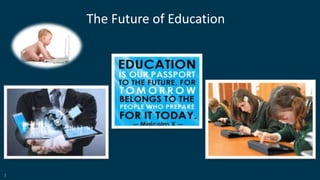
The Future of Education
3
1. REAL TEACHING, TRAINING AND LEARNING ARE CHANGING IN SUBSTANTIAL
WAYS.
2. TECHNOLOGY AND INNOVATION ARE DRIVING NEW APPROACHES
TO EDUCATION.
3. WHAT THE FUTURE OF EDUCATION LOOKS LIKE.
4
The Future of Education
• The technological revolution has increased the rate of
innovation, creativity, evolution, as well as critical thinking.
• Are we going to be able to predict the skills that people will
need in 20 years?
• Are traditional skills for instance reading, writing and arithmetic
out of date?
• Digital literacy, creativity, problem solving, team working and
effective communication are essential in a list of 21st-century
skills.
5
6
Full Definition of LEARNING
• the act or experience of one that learns
• knowledge or skill acquired by instruction
or study
• modification of a behavioral tendency by
experience (as exposure to conditioning)
• http://www.merriam-webster.com/dictionary/learning
7
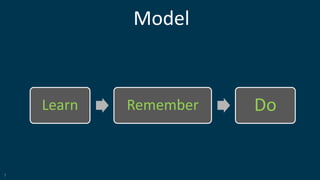
Model
Learn Remember Do
8
• Education for whom?
• How many people participate in education?
• What kind of education?
• How much does education cost?
• Who are our teachers?
Recognizing that learning is increasingly happening individually beyond formal
educational settings, the role of teachers will have to evolve from dispensers of
information and knowledge to facilitators of learning.
From a traditional focus on the content of learning programs and
teaching/learning methods, the focus is now shifting to the recognition, assessment
and validation of knowledge and skills.
9
Predictions of Future Education 2015
1. Competency-based learning improvements steam.
2. A slowdown in 1-to-1 (each child will have his own device, laptop or iPad
) initiatives; to have a one-device-fits-all approach does not make sense.
3. Technology personalizes learning and creates a student-centered
education system.
4. Drive in online corporate learning.
******
The very notion of education as an industry is problematic.
School is about transmitting values and principles from one generation to the next.
Education is the child-rearing activity of civilization. We support our young into reflective citizens
by teaching them the social and epistemological agreements of an increasingly global collective.
http://www.forbes.com/sites/michaelhorn/2015/01/08/5-predictions-for-education-in-2015/
10
What education will look like in the future?
There are people that say there is no future in online, classroom training is superior and there is no
way to replace it.
Others say that online training courses are boring and students do not enjoy taking them.
Classroom training versus online training :
+ Online education is easy to access and provides a convenient way to obtain course materials such as
homework, exam schedules, test scores and more.
+ For most online schools, all course information is obtained by browsing the internet and
sending/receiving email.
- Online education has devalued post-secondary education and will reduce the effectiveness of
obtaining quality career positions .
- It isolates the students from one another as well as their instructor reducing the overall value of
taking the course.
11
” Our children will create the future. We need to train people
to have the creativity to reinterpret the world.”
Yong Zhao, director, Institute for Global and Online Education, University of
Oregon
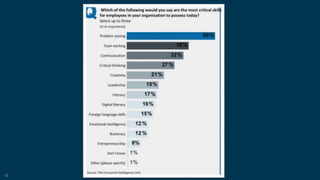
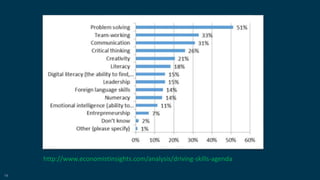
The Economist Intelligence Unit (EIU) embarked on a research programme,
sponsored by Google, to examine to what extent the skills taught in
education systems around the world are changing.
So how can education best prepare young people to navigate their way
through an increasingly interconnected and complex world?
12
Whereas 20th century learning was based on individual knowledge acquisition,
the 21st century demands collaborative learning and skills blended with critical
thinking.
All higher ed leaders implored our schools to prepare capable communicators.
• We should teach them to work together and focus more on
student engagement and learning.
• We need a shift from a teacher-centered delivery model to a
learner-centered approach.
• The students need to get much more sophisticated about
learning styles and educational diversity.
• They need knowledge, creativity, skills, and leadership.
13
• Think outside the box (or traditional classroom and schedule),
cultivate self-sufficient, independent learners, and prepare
students for a future landscape where the only certainty is
change..
• Our possibilities are limited only by our creative thinking.
• 21st century student competency –
critical thinking, collaboration, communication, and
creativity/innovation.
No one has a crystal ball to see the future…
14
What skills will the future demand?
1. Literacy
2. Numeracy
3. Foreign-language skills
4. Problem solving Team working
5. Communication
6. Video http://www.economistinsights.com/analysis/driving-skills-
agenda/multimedia
7. Critical thinking
8. Creativity
9. Digital literacy (the ability to find, evaluate, apply, share, and create content using
information technologies–such as computers– and the Internet)
10. Leadership
11. Emotional intelligence (the ability to understand the feelings of others and react
accordingly)
12. Entrepreneurship
15
16
http://www.economistinsights.com/analysis/driving-skills-agenda
17
• Using the Internet and connecting online made me feel
like learning is no longer something kept for the young.
• I strongly believe in lifelong learning, and I do take
advantage of new technologies.
• Education, or the transmission, acquisition, creation
and adaptation of information are the main points.
• Knowledge, skills and values, is a key lever of
sustainable development.
18
• Learning can be seen as something that takes place on an
ongoing basis from our daily interactions with others and with
the world around us. It can take the form of formal learning or
informal learning, or self-directed learning.
• This is based on a vision of inclusive societies in which all citizens
have equitable opportunities to access effective and relevant
learning throughout life delivered through multiple formal, non-
formal and informal settings.
• As such, education is essential to individuals’ development as it is
to the development of their families, of the local and national
communities to which they belong, and to the world at large.
Llifelong Learning
19
Education of Tomorrow
• The learner as well as the teacher of the future is totally
digitalized.
• Media data as well as computers are in daily use.
• New interaction and usage paradigms, for instance, on multi
touch devices have an impact on the way end users interact
with omnipresent devices.
• Students learn more from doing than watching.
20
5 Education Tech Trends For 2015
;
This is an exciting time to be in education technology.
• Technology for flipped-learning;
a form of blended learning in which students learn content online by watching video lectures, usually at home, and
homework is done in class with teachers and students discussing and solving questions
• is to engage learners in and out of the classroom.
The dynamic nature of this approach enables teachers to create effective and fun asynchronous and synchronous learning
experiences.
• Device agnostic learning
While videos and websites are basically ubiquitous across all devices, many apps are native, even exclusive, to one
device or mobile operating system.
The pain points caused by multiple standards, multiple screen sizes, and multiple operating systems are not
sustainable.
21
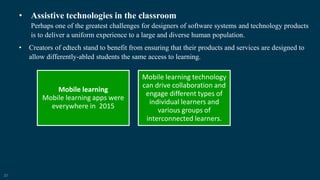
• Assistive technologies in the classroom
Perhaps one of the greatest challenges for designers of software systems and technology products
is to deliver a uniform experience to a large and diverse human population.
• Creators of edtech stand to benefit from ensuring that their products and services are designed to
allow differently-abled students the same access to learning.
Mobile learning
Mobile learning apps were
everywhere in 2015
Mobile learning technology
can drive collaboration and
engage different types of
individual learners and
various groups of
interconnected learners.
22
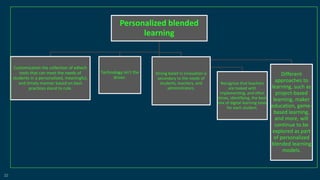
Personalized blended
learning
Customization the collection of edtech
tools that can meet the needs of
students in a personalized, meaningful,
and timely manner based on best
practices stand to rule.
Technology isn't the
driver.
Strong belief in innovation is
secondary to the needs of
students, teachers, and
administrators.
Recognize that teachers
are tasked with
implementing, and often
times, identifying, the best
mix of digital learning tools
for each student.
Different
approaches to
learning, such as
project-based
learning, maker
education, game-
based learning,
and more, will
continue to be
explored as part
of personalized
blended learning
models.
23
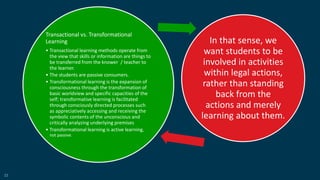
Transactional vs. Transformational
Learning
• Transactional learning methods operate from
the view that skills or information are things to
be transferred from the knower / teacher to
the learner.
• The students are passive consumers.
• Transformational learning is the expansion of
consciousness through the transformation of
basic worldview and specific capacities of the
self; transformative learning is facilitated
through consciously directed processes such
as appreciatively accessing and receiving the
symbolic contents of the unconscious and
critically analyzing underlying premises
• Transformational learning is active learning,
not passive.
In that sense, we
want students to be
involved in activities
within legal actions,
rather than standing
back from the
actions and merely
learning about them.
24
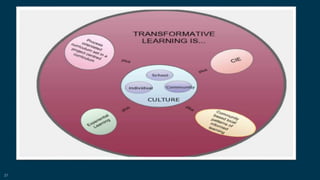
Transformative
Culture of Learning
25
1. A learning culture is a set of organizational values,
conventions, processes, and practices that encourage
individuals—and the organization as a whole—to
increase knowledge, competence, and performance.
2. “High impact” simply describes the idea that the
learning culture positively impacts business results.
3. In other words, it makes a difference.
http://www.oracle.com/us/chro-docs/june-2013-chro-deck4-1961622.pdf
26
Your Learning Culture
You
already
have one
Humans are
wired to learn
Learning is happening
every day
Learning is a bit
like breathing, in
the sense that it is
constant and life
giving.
27
For Human Being learning is as natural as breathing
• Self directed learning is the only answer in this fast
changing era of technology driven knowledge society.
• Not to just focus on imparting skills and knowledge to
the students, it is important to enable them to learn
how, when and where to apply all that they are
learning.
28
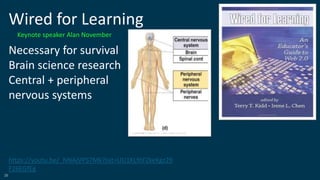
Wired for Learning
Necessary for survival
Brain science research
Central + peripheral
nervous systems
https://youtu.be/_NNAjVP57Mk?list=UU1KL9tFZkeKgz29
F26EGfEg
Keynote speaker Alan November
29
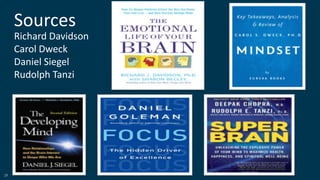
Sources
Richard Davidson
Carol Dweck
Daniel Siegel
Rudolph Tanzi
30
Questions
• Who controls the learning?
• Do your learning events match with your
experience/reality?
• How are you building value and trust with each learning
experience?
31
Transformative Learning
• Transformative learning is the expansion of consciousness through the
transformation of basic worldview and specific capacities of the self;
transformative learning is facilitated through consciously directed processes
such as appreciatively accessing and receiving the symbolic contents of the
unconscious and critically analyzing underlying premises .
• A defining condition of being human is that we have to understand the
meaning of our experience.
• Transformative learning develops autonomous thinking.
• An important part of transformative learning is for individuals to change their
frames of reference by critically reflecting on their assumptions and beliefs and
consciously making and implementing plans that bring about new ways of
defining their worlds.
https://en.wikipedia.org/wiki/Transformative_learning
32
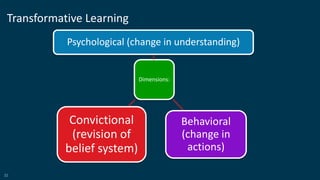
Transformative Learning
Dimensions:
Psychological (change in understanding)
Behavioral
(change in
actions)
Convictional
(revision of
belief system)
33
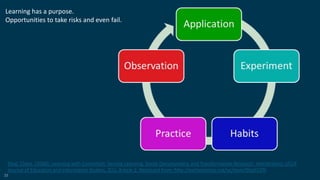
Learning has a purpose.
Opportunities to take risks and even fail.
Deal, Claire. (2006). Learning with Conviction: Service Learning, Social Documentary, and Transformative Research. InterActions: UCLA
Journal of Education and Information Studies, 2(1), Article 2. Retrieved from: http://escholarship.org/uc/item/96p552fh
34
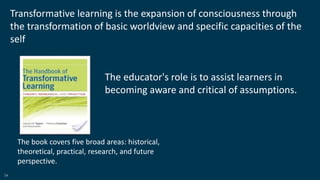
The book covers five broad areas: historical,
theoretical, practical, research, and future
perspective.
The educator's role is to assist learners in
becoming aware and critical of assumptions.
Transformative learning is the expansion of consciousness through
the transformation of basic worldview and specific capacities of the
self
35
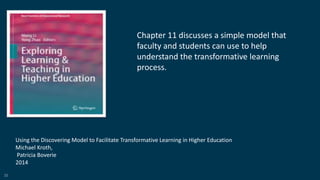
Using the Discovering Model to Facilitate Transformative Learning in Higher Education
Michael Kroth,
Patricia Boverie
2014
Chapter 11 discusses a simple model that
faculty and students can use to help
understand the transformative learning
process.
36
• Individuals are encouraged to develop
• Learning is respected and stimulated
• Every level has exciting learning openings
• Good teachers are recognized and
distinguished
• Innovations are included
• Learning is planned to be transformative
Transformative Learning Culture
37
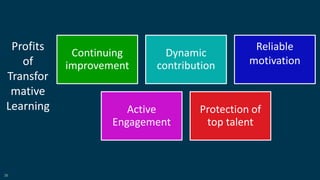
38
Continuing
improvement
Dynamic
contribution
Reliable
motivation
Active
Engagement
Protection of
top talent
Profits
of
Transfor
mative
Learning
39
Mindset is a simple idea discovered by world-renowned Stanford University psychologist
Carol Dweck in decades of research on achievement and success—a simple idea that makes
all the difference.
In a fixed mindset, people believe their basic qualities, like their intelligence or talent, are
simply fixed traits. They spend their time documenting their intelligence or talent instead of
developing them. They also believe that talent alone creates success—without effort.
They’re wrong.
In a growth mindset, people believe that their most basic abilities can be developed
through dedication and hard work—brains and talent are just the starting point. This view
creates a love of learning and a resilience that is essential for great accomplishment.
Virtually all great people have had these qualities.
Teaching a growth mindset creates motivation and productivity in the worlds of business,
education, and sports. It enhances relationships.
40
Mindsets are beliefs—beliefs about yourself and your most basic
qualities.
• Think about your intelligence, your talents, your personality.
• Are these qualities simply fixed traits, carved in stone and that’s that?
• Or are they things you can cultivate throughout your life?
• Scientists are learning that people have more capacity for life-long learning
and brain development than they ever thought.
• Each person has a unique genetic endowment.
• People may start with different temperaments and different aptitudes, but it is
clear that experience, training, and personal effort take them the rest of the
way.
41
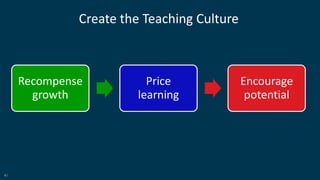
Recompense
growth
Price
learning
Encourage
potential
Create the Teaching Culture
42
Learning Solutions
Blended
learning
works
“with”
the
brain’s
wiring…
43
. Flipped classroom is an instructional strategy and a type of blended
learning that reverses the traditional educational arrangement by delivering
instructional content, often online, outside of the classroom and moves activities,
including those that may have traditionally been considered homework, into the
classroom.
• In a flipped classroom model, students watch online lectures, collaborate in
online discussions, or carry out research at home and engage in concepts in
the classroom with the guidance of the instructor.
• The flipped classroom intentionally shifts instruction to a learner-centered
model in which class time is dedicated to exploring topics in greater depth and
creating meaningful learning opportunities, while educational technology such
as online videos are employed to deliver content outside of the classroom.
https://en.wikipedia.org/wiki/Flipped_classroom
44
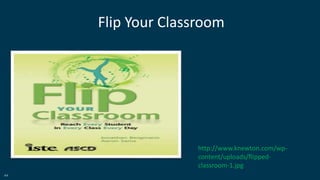
Flip Your Classroom
http://www.knewton.com/wp-
content/uploads/flipped-
classroom-1.jpg
45
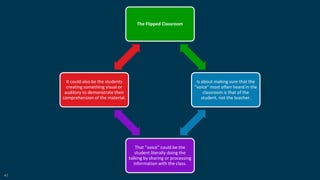
The Flipped Classroom
Is about making sure that the
"voice" most often heard in the
classroom is that of the
student, not the teacher.
That ”voice” could be the
student literally doing the
talking by sharing or processing
information with the class.
It could also be the students
creating something visual or
auditory to demonstrate their
comprehension of the material.
46
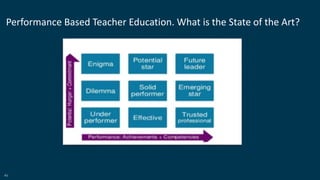
Performance Based Teacher Education. What is the State of the Art?
47
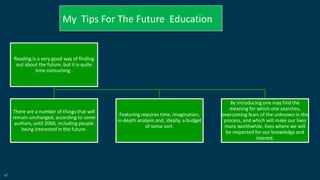
Reading is a very good way of finding
out about the future, but it is quite
time consuming .
There are a number of things that will
remain unchanged, according to some
authors, until 2060, including people
being interested in the future.
Featuring requires time, imagination,
in-depth analysis and, ideally, a budget
of some sort.
By introducing one may find the
meaning for which one searches,
overcoming fears of the unknown in the
process, and which will make our lives
more worthwhile, lives where we will
be respected for our knowledge and
interest.
My Tips For The Future Education
48
• Educators around the world are being told that they need to transform
Education systems to adapt young people for a future global knowledge
economy.
• But is this future vision robust, achievable or even desirable?
• What other futures might be emerging from the convergence of social and
technological change?
• What might these other futures mean for education?
49
My Hopes for the Future Education
"Education is simply the soul of a society as it passes from one generation to another." - G.K. Chesterton
My hope is that teachers will make learning personalized rather than standardized for everyone.
My hope allows to improve students’ creativity and teachers increase that natural curiosity with learners.
Curiosity is the basis of innovation. Curiosity will power our world to progress.
My hope is that you charge the power of technology in thoughtful and incredible ways. Applied science can
connect everyone, everywhere, at whatever time. We should use it to our advantage.
I hope for everyone to be able to discover the things you are passionate about.
I also hope that you have remarkable, encouraging educators and mentors who try groundbreaking and wild
teaching techniques to help you grow as a learner.
My hope is you are ready for the challenges as well as the failure.
Making mistakes is a way to learn. It’s not about the disaster; it’s how you respond to the failure.
And finally my hope is that your school is different from most of the current transactional learning models,
where the students are consumers of education.
Lastly, I hope for people to be just educational learners fitted in transformational learning approach with
opportunity for active, creative and profound personal development. Education can take place anywhere and
at anytime. It is not only about reading, writing, and learning mathematical practices.
Knowledge is wide-ranging. It’s breathing. Learning is the future.
50
Halina Ostańkowicz – Bazan
July 2015
Thank you for your attention
51
Some Updated References
1) Baker, Jason and Woods, Robert. Social Dynamics of Online learning: Pedagogical Imperatives and Practical
Applications. 18th Annual Conference on Distance Learning: 2005. www.uwex.edu/disted/comference/
2) Borden, Jeff. The Future of Online Learning. Elearn Magazine: August 2011.
http://elearnmag.acm.org/archive.cfm?aid=2024704
3) Challenges and Disadvantages of E-learning and Distance Learning. Compassion in politics: 26 September
2009. http://compassioninpolitics.wordpress.com/2009/09/26/challenges-disadvantages-e-learning-and-distance-
learning
4) Challenges and Disadvantages of E-learning and Distance Learning. Compassion in politics: 26 September
2009. http://compassioninpolitics.wordpress.com/2009/09/26/challenges-disadvantages-e-learning-and-distance-
learning
5) Disadvantages of Online Learning. Online Learning Marketplace.
http://www.onlinelearningmarketplace.com/5disadvantagesofonlinelearning.html
6) Disadvantages of Online Learning. Online Learning Marketplace.
http://www.onlinelearningmarketplace.com/5disadvantagesofonlinelearning.html
7) Georevich, Don. 5 Disadvantages of E-Learning. http://www.jobinterviewtools.com/blog/5-disadvantages-of-
e-learning/
52
8) Georevich, Don. 5 Disadvantages of E-Learning9) Goff, Brian. Collaborative Learning: Benefits of Online
Learning. Rochester Institute of technology: 2012. http://online.rit.edu/faculty/teaching strategies/collaborative
learning/benefits.cfm
9) http://www.futureofeducation.com/http://www.futureofeducation.com/
10) https://storify.com/ruangguru/rgchat-renecc-education-for-future
11) James, Gary. Advantages and Disadvantages of Online Learning. www.allencomm.com/events
12) McLaughlin, Mark. Online Grade Schools Becoming a Popular Alternative. CNBC.com:
http://www.cnbc.com/id/44255406/Online_Grade_Schools_Becoming_a_Popular_Alternative
13) The Disadvantages of Online Learning. Elearning-Companion: Supporting the Implementation of Elearning.
http://www.elearning-companion.com/disadvantages-of-online-learning.html
53
1) http://www.wiziq.com/teachblog/the-future-of-education-tthrough-the-looking-glass
2) http://www.storylineonline.net/
3) http://www.nap.edu/topic/282/education
4) http://www.nap.edu/catalog/19007/enhancing-the-effectiveness-of-team-science
5) http://www.nap.edu/catalog/18687/reaching-students-what-research-says-about-effective-instruction-
in-undergraduate
6) http://www.envisioning.io/education/
7) http://faculty.education.illinois.edu/j-levin/2020-vision.html
8) http://theskillslab.com/portfolio-item/building-future-education-uk-conference-2013/
9) http://www.universitiesuk.ac.uk/highereducation/Documents/2015/QualityEquitySustainability.pdf
10) http://www.forbes.com/sites/michaelhorn/2015/01/08/5-predictions-for-education-in-2015/
11) http://www.cbsnews.com/news/lessons-from-sesame-street-about-preschool-education/
12) http://www.slideshare.net/gleonhard/technology-and-future-education-university-dehaagse-gerd-
leonhard-ss
13) http://www.slideshare.net/Dell/future-cloudcomputingtechnology
54
14. http://www.wiziq.com/teachblog/the-future-of-education-tthrough-the-looking-glass
15. http://www.storylineonline.net/
16. http://www.nap.edu/topic/282/education
17. http://www.nap.edu/catalog/19007/enhancing-the-effectiveness-of-team-science
18. http://www.nap.edu/catalog/18687/reaching-students-what-research-says-about-effective-
instruction-in-undergraduate
19. http://www.envisioning.io/education/
20. http://faculty.education.illinois.edu/j-levin/2020-vision.html
21. http://theskillslab.com/portfolio-item/building-future-education-uk-conference-2013/
22. http://www.universitiesuk.ac.uk/highereducation/Documents/2015/QualityEquitySustainability.pdf
23. http://www.forbes.com/sites/michaelhorn/2015/01/08/5-predictions-for-education-in-2015/
24. http://www.cbsnews.com/news/lessons-from-sesame-street-about-preschool-education/
25. http://www.slideshare.net/Dell/future-cloudcomputingtechnology
26. http://www.slideshare.net/timbuckteeth/digital-learning-futures-3-things-about-future-learning
55
1) http://www.wiziq.com/teachblog/the-future-of-education-tthrough-the-looking-glass
2) http://www.storylineonline.net/
3) http://www.nap.edu/topic/282/education
4) http://www.nap.edu/catalog/19007/enhancing-the-effectiveness-of-team-science
5) http://www.nap.edu/catalog/18687/reaching-students-what-research-says-about-effective-instruction-
in-undergraduate
6) http://www.envisioning.io/education/
7) http://faculty.education.illinois.edu/j-levin/2020-vision.html
8) http://theskillslab.com/portfolio-item/building-future-education-uk-conference-2013/
9) http://www.universitiesuk.ac.uk/highereducation/Documents/2015/QualityEquitySustainability.pdf
10) http://www.forbes.com/sites/michaelhorn/2015/01/08/5-predictions-for-education-in-2015/
11) http://www.cbsnews.com/news/lessons-from-sesame-street-about-preschool-education/
12) http://www.slideshare.net/gleonhard/technology-and-future-education-university-dehaagse-gerd-
leonhard-ss
13) http://www.slideshare.net/Dell/future-cloudcomputingtechnology
14) http://www.slideshare.net/timbuckteeth/digital-learning-futures-3-things-about-future-learning
56
17. http://www.wiziq.com/teachblog/the-future-of-education-tthrough-the-looking-glass
18. http://www.storylineonline.net/
19. http://www.nap.edu/topic/282/education
20. http://www.nap.edu/catalog/19007/enhancing-the-effectiveness-of-team-science
21. http://www.nap.edu/catalog/18687/reaching-students-what-research-says-about-effective-
instruction-in-undergraduate
22. http://www.envisioning.io/education/
23. http://faculty.education.illinois.edu/j-levin/2020-vision.html
24. http://theskillslab.com/portfolio-item/building-future-education-uk-conference-2013/
25. http://www.universitiesuk.ac.uk/highereducation/Documents/2015/QualityEquitySustainability.p
df
26. http://www.forbes.com/sites/michaelhorn/2015/01/08/5-predictions-for-education-in-2015/
27. http://www.cbsnews.com/news/lessons-from-sesame-street-about-preschool-education/
28. http://www.slideshare.net/gleonhard/technology-and-future-education-university-dehaagse-
gerd-leonhard-ss
29. http://www.slideshare.net/Dell/future-cloudcomputingtechnology
30. http://www.slideshare.net/timbuckteeth/digital-learning-futures-3-things-about-future-learning
57
17. http://www.wiziq.com/teachblog/the-future-of-education-tthrough-the-looking-glass
18. http://www.storylineonline.net/
19. http://www.nap.edu/topic/282/education
20. http://www.nap.edu/catalog/19007/enhancing-the-effectiveness-of-team-science
21. http://www.nap.edu/catalog/18687/reaching-students-what-research-says-about-effective-
instruction-in-undergraduate
22. http://www.envisioning.io/education/
23. http://faculty.education.illinois.edu/j-levin/2020-vision.html
24. http://theskillslab.com/portfolio-item/building-future-education-uk-conference-2013/
25. http://www.universitiesuk.ac.uk/highereducation/Documents/2015/QualityEquitySustainability.pdf
26. http://www.forbes.com/sites/michaelhorn/2015/01/08/5-predictions-for-education-in-2015/
27. http://www.cbsnews.com/news/lessons-from-sesame-street-about-preschool-education/
28. http://www.slideshare.net/gleonhard/technology-and-future-education-university-dehaagse-gerd-
leonhard-ss
29. http://www.slideshare.net/Dell/future-cloudcomputingtechnology
30. http://www.slideshare.net/timbuckteeth/digital-learning-futures-3-things-about-future-learning

Halina future education_final hbo_wiziq

  • 1.
    1 The Future ofEducation MMVC 2015 Halina Ostańkowicz – Bazan July 2015
  • 2.
    2 The Future ofEducation
  • 3.
    3 1. REAL TEACHING,TRAINING AND LEARNING ARE CHANGING IN SUBSTANTIAL WAYS. 2. TECHNOLOGY AND INNOVATION ARE DRIVING NEW APPROACHES TO EDUCATION. 3. WHAT THE FUTURE OF EDUCATION LOOKS LIKE.
  • 4.
    4 The Future ofEducation • The technological revolution has increased the rate of innovation, creativity, evolution, as well as critical thinking. • Are we going to be able to predict the skills that people will need in 20 years? • Are traditional skills for instance reading, writing and arithmetic out of date? • Digital literacy, creativity, problem solving, team working and effective communication are essential in a list of 21st-century skills.
  • 5.
  • 6.
    6 Full Definition ofLEARNING • the act or experience of one that learns • knowledge or skill acquired by instruction or study • modification of a behavioral tendency by experience (as exposure to conditioning) • http://www.merriam-webster.com/dictionary/learning
  • 7.
  • 8.
    8 • Education forwhom? • How many people participate in education? • What kind of education? • How much does education cost? • Who are our teachers? Recognizing that learning is increasingly happening individually beyond formal educational settings, the role of teachers will have to evolve from dispensers of information and knowledge to facilitators of learning. From a traditional focus on the content of learning programs and teaching/learning methods, the focus is now shifting to the recognition, assessment and validation of knowledge and skills.
  • 9.
    9 Predictions of FutureEducation 2015 1. Competency-based learning improvements steam. 2. A slowdown in 1-to-1 (each child will have his own device, laptop or iPad ) initiatives; to have a one-device-fits-all approach does not make sense. 3. Technology personalizes learning and creates a student-centered education system. 4. Drive in online corporate learning. ****** The very notion of education as an industry is problematic. School is about transmitting values and principles from one generation to the next. Education is the child-rearing activity of civilization. We support our young into reflective citizens by teaching them the social and epistemological agreements of an increasingly global collective. http://www.forbes.com/sites/michaelhorn/2015/01/08/5-predictions-for-education-in-2015/
  • 10.
    10 What education willlook like in the future? There are people that say there is no future in online, classroom training is superior and there is no way to replace it. Others say that online training courses are boring and students do not enjoy taking them. Classroom training versus online training : + Online education is easy to access and provides a convenient way to obtain course materials such as homework, exam schedules, test scores and more. + For most online schools, all course information is obtained by browsing the internet and sending/receiving email. - Online education has devalued post-secondary education and will reduce the effectiveness of obtaining quality career positions . - It isolates the students from one another as well as their instructor reducing the overall value of taking the course.
  • 11.
    11 ” Our childrenwill create the future. We need to train people to have the creativity to reinterpret the world.” Yong Zhao, director, Institute for Global and Online Education, University of Oregon The Economist Intelligence Unit (EIU) embarked on a research programme, sponsored by Google, to examine to what extent the skills taught in education systems around the world are changing. So how can education best prepare young people to navigate their way through an increasingly interconnected and complex world?
  • 12.
    12 Whereas 20th centurylearning was based on individual knowledge acquisition, the 21st century demands collaborative learning and skills blended with critical thinking. All higher ed leaders implored our schools to prepare capable communicators. • We should teach them to work together and focus more on student engagement and learning. • We need a shift from a teacher-centered delivery model to a learner-centered approach. • The students need to get much more sophisticated about learning styles and educational diversity. • They need knowledge, creativity, skills, and leadership.
  • 13.
    13 • Think outsidethe box (or traditional classroom and schedule), cultivate self-sufficient, independent learners, and prepare students for a future landscape where the only certainty is change.. • Our possibilities are limited only by our creative thinking. • 21st century student competency – critical thinking, collaboration, communication, and creativity/innovation. No one has a crystal ball to see the future…
  • 14.
    14 What skills willthe future demand? 1. Literacy 2. Numeracy 3. Foreign-language skills 4. Problem solving Team working 5. Communication 6. Video http://www.economistinsights.com/analysis/driving-skills- agenda/multimedia 7. Critical thinking 8. Creativity 9. Digital literacy (the ability to find, evaluate, apply, share, and create content using information technologies–such as computers– and the Internet) 10. Leadership 11. Emotional intelligence (the ability to understand the feelings of others and react accordingly) 12. Entrepreneurship
  • 15.
  • 16.
  • 17.
    17 • Using theInternet and connecting online made me feel like learning is no longer something kept for the young. • I strongly believe in lifelong learning, and I do take advantage of new technologies. • Education, or the transmission, acquisition, creation and adaptation of information are the main points. • Knowledge, skills and values, is a key lever of sustainable development.
  • 18.
    18 • Learning canbe seen as something that takes place on an ongoing basis from our daily interactions with others and with the world around us. It can take the form of formal learning or informal learning, or self-directed learning. • This is based on a vision of inclusive societies in which all citizens have equitable opportunities to access effective and relevant learning throughout life delivered through multiple formal, non- formal and informal settings. • As such, education is essential to individuals’ development as it is to the development of their families, of the local and national communities to which they belong, and to the world at large. Llifelong Learning
  • 19.
    19 Education of Tomorrow •The learner as well as the teacher of the future is totally digitalized. • Media data as well as computers are in daily use. • New interaction and usage paradigms, for instance, on multi touch devices have an impact on the way end users interact with omnipresent devices. • Students learn more from doing than watching.
  • 20.
    20 5 Education TechTrends For 2015 ; This is an exciting time to be in education technology. • Technology for flipped-learning; a form of blended learning in which students learn content online by watching video lectures, usually at home, and homework is done in class with teachers and students discussing and solving questions • is to engage learners in and out of the classroom. The dynamic nature of this approach enables teachers to create effective and fun asynchronous and synchronous learning experiences. • Device agnostic learning While videos and websites are basically ubiquitous across all devices, many apps are native, even exclusive, to one device or mobile operating system. The pain points caused by multiple standards, multiple screen sizes, and multiple operating systems are not sustainable.
  • 21.
    21 • Assistive technologiesin the classroom Perhaps one of the greatest challenges for designers of software systems and technology products is to deliver a uniform experience to a large and diverse human population. • Creators of edtech stand to benefit from ensuring that their products and services are designed to allow differently-abled students the same access to learning. Mobile learning Mobile learning apps were everywhere in 2015 Mobile learning technology can drive collaboration and engage different types of individual learners and various groups of interconnected learners.
  • 22.
    22 Personalized blended learning Customization thecollection of edtech tools that can meet the needs of students in a personalized, meaningful, and timely manner based on best practices stand to rule. Technology isn't the driver. Strong belief in innovation is secondary to the needs of students, teachers, and administrators. Recognize that teachers are tasked with implementing, and often times, identifying, the best mix of digital learning tools for each student. Different approaches to learning, such as project-based learning, maker education, game- based learning, and more, will continue to be explored as part of personalized blended learning models.
  • 23.
    23 Transactional vs. Transformational Learning •Transactional learning methods operate from the view that skills or information are things to be transferred from the knower / teacher to the learner. • The students are passive consumers. • Transformational learning is the expansion of consciousness through the transformation of basic worldview and specific capacities of the self; transformative learning is facilitated through consciously directed processes such as appreciatively accessing and receiving the symbolic contents of the unconscious and critically analyzing underlying premises • Transformational learning is active learning, not passive. In that sense, we want students to be involved in activities within legal actions, rather than standing back from the actions and merely learning about them.
  • 24.
  • 25.
    25 1. A learningculture is a set of organizational values, conventions, processes, and practices that encourage individuals—and the organization as a whole—to increase knowledge, competence, and performance. 2. “High impact” simply describes the idea that the learning culture positively impacts business results. 3. In other words, it makes a difference. http://www.oracle.com/us/chro-docs/june-2013-chro-deck4-1961622.pdf
  • 26.
    26 Your Learning Culture You already haveone Humans are wired to learn Learning is happening every day Learning is a bit like breathing, in the sense that it is constant and life giving.
  • 27.
    27 For Human Beinglearning is as natural as breathing • Self directed learning is the only answer in this fast changing era of technology driven knowledge society. • Not to just focus on imparting skills and knowledge to the students, it is important to enable them to learn how, when and where to apply all that they are learning.
  • 28.
    28 Wired for Learning Necessaryfor survival Brain science research Central + peripheral nervous systems https://youtu.be/_NNAjVP57Mk?list=UU1KL9tFZkeKgz29 F26EGfEg Keynote speaker Alan November
  • 29.
  • 30.
    30 Questions • Who controlsthe learning? • Do your learning events match with your experience/reality? • How are you building value and trust with each learning experience?
  • 31.
    31 Transformative Learning • Transformativelearning is the expansion of consciousness through the transformation of basic worldview and specific capacities of the self; transformative learning is facilitated through consciously directed processes such as appreciatively accessing and receiving the symbolic contents of the unconscious and critically analyzing underlying premises . • A defining condition of being human is that we have to understand the meaning of our experience. • Transformative learning develops autonomous thinking. • An important part of transformative learning is for individuals to change their frames of reference by critically reflecting on their assumptions and beliefs and consciously making and implementing plans that bring about new ways of defining their worlds. https://en.wikipedia.org/wiki/Transformative_learning
  • 32.
    32 Transformative Learning Dimensions: Psychological (changein understanding) Behavioral (change in actions) Convictional (revision of belief system)
  • 33.
    33 Learning has apurpose. Opportunities to take risks and even fail. Deal, Claire. (2006). Learning with Conviction: Service Learning, Social Documentary, and Transformative Research. InterActions: UCLA Journal of Education and Information Studies, 2(1), Article 2. Retrieved from: http://escholarship.org/uc/item/96p552fh
  • 34.
    34 The book coversfive broad areas: historical, theoretical, practical, research, and future perspective. The educator's role is to assist learners in becoming aware and critical of assumptions. Transformative learning is the expansion of consciousness through the transformation of basic worldview and specific capacities of the self
  • 35.
    35 Using the DiscoveringModel to Facilitate Transformative Learning in Higher Education Michael Kroth, Patricia Boverie 2014 Chapter 11 discusses a simple model that faculty and students can use to help understand the transformative learning process.
  • 36.
    36 • Individuals areencouraged to develop • Learning is respected and stimulated • Every level has exciting learning openings • Good teachers are recognized and distinguished • Innovations are included • Learning is planned to be transformative Transformative Learning Culture
  • 37.
  • 38.
  • 39.
    39 Mindset is asimple idea discovered by world-renowned Stanford University psychologist Carol Dweck in decades of research on achievement and success—a simple idea that makes all the difference. In a fixed mindset, people believe their basic qualities, like their intelligence or talent, are simply fixed traits. They spend their time documenting their intelligence or talent instead of developing them. They also believe that talent alone creates success—without effort. They’re wrong. In a growth mindset, people believe that their most basic abilities can be developed through dedication and hard work—brains and talent are just the starting point. This view creates a love of learning and a resilience that is essential for great accomplishment. Virtually all great people have had these qualities. Teaching a growth mindset creates motivation and productivity in the worlds of business, education, and sports. It enhances relationships.
  • 40.
    40 Mindsets are beliefs—beliefsabout yourself and your most basic qualities. • Think about your intelligence, your talents, your personality. • Are these qualities simply fixed traits, carved in stone and that’s that? • Or are they things you can cultivate throughout your life? • Scientists are learning that people have more capacity for life-long learning and brain development than they ever thought. • Each person has a unique genetic endowment. • People may start with different temperaments and different aptitudes, but it is clear that experience, training, and personal effort take them the rest of the way.
  • 41.
  • 42.
  • 43.
    43 . Flipped classroomis an instructional strategy and a type of blended learning that reverses the traditional educational arrangement by delivering instructional content, often online, outside of the classroom and moves activities, including those that may have traditionally been considered homework, into the classroom. • In a flipped classroom model, students watch online lectures, collaborate in online discussions, or carry out research at home and engage in concepts in the classroom with the guidance of the instructor. • The flipped classroom intentionally shifts instruction to a learner-centered model in which class time is dedicated to exploring topics in greater depth and creating meaningful learning opportunities, while educational technology such as online videos are employed to deliver content outside of the classroom. https://en.wikipedia.org/wiki/Flipped_classroom
  • 44.
  • 45.
    45 The Flipped Classroom Isabout making sure that the "voice" most often heard in the classroom is that of the student, not the teacher. That ”voice” could be the student literally doing the talking by sharing or processing information with the class. It could also be the students creating something visual or auditory to demonstrate their comprehension of the material.
  • 46.
    46 Performance Based TeacherEducation. What is the State of the Art?
  • 47.
    47 Reading is avery good way of finding out about the future, but it is quite time consuming . There are a number of things that will remain unchanged, according to some authors, until 2060, including people being interested in the future. Featuring requires time, imagination, in-depth analysis and, ideally, a budget of some sort. By introducing one may find the meaning for which one searches, overcoming fears of the unknown in the process, and which will make our lives more worthwhile, lives where we will be respected for our knowledge and interest. My Tips For The Future Education
  • 48.
    48 • Educators aroundthe world are being told that they need to transform Education systems to adapt young people for a future global knowledge economy. • But is this future vision robust, achievable or even desirable? • What other futures might be emerging from the convergence of social and technological change? • What might these other futures mean for education?
  • 49.
    49 My Hopes forthe Future Education "Education is simply the soul of a society as it passes from one generation to another." - G.K. Chesterton My hope is that teachers will make learning personalized rather than standardized for everyone. My hope allows to improve students’ creativity and teachers increase that natural curiosity with learners. Curiosity is the basis of innovation. Curiosity will power our world to progress. My hope is that you charge the power of technology in thoughtful and incredible ways. Applied science can connect everyone, everywhere, at whatever time. We should use it to our advantage. I hope for everyone to be able to discover the things you are passionate about. I also hope that you have remarkable, encouraging educators and mentors who try groundbreaking and wild teaching techniques to help you grow as a learner. My hope is you are ready for the challenges as well as the failure. Making mistakes is a way to learn. It’s not about the disaster; it’s how you respond to the failure. And finally my hope is that your school is different from most of the current transactional learning models, where the students are consumers of education. Lastly, I hope for people to be just educational learners fitted in transformational learning approach with opportunity for active, creative and profound personal development. Education can take place anywhere and at anytime. It is not only about reading, writing, and learning mathematical practices. Knowledge is wide-ranging. It’s breathing. Learning is the future.
  • 50.
    50 Halina Ostańkowicz –Bazan July 2015 Thank you for your attention
  • 51.
    51 Some Updated References 1)Baker, Jason and Woods, Robert. Social Dynamics of Online learning: Pedagogical Imperatives and Practical Applications. 18th Annual Conference on Distance Learning: 2005. www.uwex.edu/disted/comference/ 2) Borden, Jeff. The Future of Online Learning. Elearn Magazine: August 2011. http://elearnmag.acm.org/archive.cfm?aid=2024704 3) Challenges and Disadvantages of E-learning and Distance Learning. Compassion in politics: 26 September 2009. http://compassioninpolitics.wordpress.com/2009/09/26/challenges-disadvantages-e-learning-and-distance- learning 4) Challenges and Disadvantages of E-learning and Distance Learning. Compassion in politics: 26 September 2009. http://compassioninpolitics.wordpress.com/2009/09/26/challenges-disadvantages-e-learning-and-distance- learning 5) Disadvantages of Online Learning. Online Learning Marketplace. http://www.onlinelearningmarketplace.com/5disadvantagesofonlinelearning.html 6) Disadvantages of Online Learning. Online Learning Marketplace. http://www.onlinelearningmarketplace.com/5disadvantagesofonlinelearning.html 7) Georevich, Don. 5 Disadvantages of E-Learning. http://www.jobinterviewtools.com/blog/5-disadvantages-of- e-learning/
  • 52.
    52 8) Georevich, Don.5 Disadvantages of E-Learning9) Goff, Brian. Collaborative Learning: Benefits of Online Learning. Rochester Institute of technology: 2012. http://online.rit.edu/faculty/teaching strategies/collaborative learning/benefits.cfm 9) http://www.futureofeducation.com/http://www.futureofeducation.com/ 10) https://storify.com/ruangguru/rgchat-renecc-education-for-future 11) James, Gary. Advantages and Disadvantages of Online Learning. www.allencomm.com/events 12) McLaughlin, Mark. Online Grade Schools Becoming a Popular Alternative. CNBC.com: http://www.cnbc.com/id/44255406/Online_Grade_Schools_Becoming_a_Popular_Alternative 13) The Disadvantages of Online Learning. Elearning-Companion: Supporting the Implementation of Elearning. http://www.elearning-companion.com/disadvantages-of-online-learning.html
  • 53.
    53 1) http://www.wiziq.com/teachblog/the-future-of-education-tthrough-the-looking-glass 2) http://www.storylineonline.net/ 3)http://www.nap.edu/topic/282/education 4) http://www.nap.edu/catalog/19007/enhancing-the-effectiveness-of-team-science 5) http://www.nap.edu/catalog/18687/reaching-students-what-research-says-about-effective-instruction- in-undergraduate 6) http://www.envisioning.io/education/ 7) http://faculty.education.illinois.edu/j-levin/2020-vision.html 8) http://theskillslab.com/portfolio-item/building-future-education-uk-conference-2013/ 9) http://www.universitiesuk.ac.uk/highereducation/Documents/2015/QualityEquitySustainability.pdf 10) http://www.forbes.com/sites/michaelhorn/2015/01/08/5-predictions-for-education-in-2015/ 11) http://www.cbsnews.com/news/lessons-from-sesame-street-about-preschool-education/ 12) http://www.slideshare.net/gleonhard/technology-and-future-education-university-dehaagse-gerd- leonhard-ss 13) http://www.slideshare.net/Dell/future-cloudcomputingtechnology
  • 54.
    54 14. http://www.wiziq.com/teachblog/the-future-of-education-tthrough-the-looking-glass 15. http://www.storylineonline.net/ 16.http://www.nap.edu/topic/282/education 17. http://www.nap.edu/catalog/19007/enhancing-the-effectiveness-of-team-science 18. http://www.nap.edu/catalog/18687/reaching-students-what-research-says-about-effective- instruction-in-undergraduate 19. http://www.envisioning.io/education/ 20. http://faculty.education.illinois.edu/j-levin/2020-vision.html 21. http://theskillslab.com/portfolio-item/building-future-education-uk-conference-2013/ 22. http://www.universitiesuk.ac.uk/highereducation/Documents/2015/QualityEquitySustainability.pdf 23. http://www.forbes.com/sites/michaelhorn/2015/01/08/5-predictions-for-education-in-2015/ 24. http://www.cbsnews.com/news/lessons-from-sesame-street-about-preschool-education/ 25. http://www.slideshare.net/Dell/future-cloudcomputingtechnology 26. http://www.slideshare.net/timbuckteeth/digital-learning-futures-3-things-about-future-learning
  • 55.
    55 1) http://www.wiziq.com/teachblog/the-future-of-education-tthrough-the-looking-glass 2) http://www.storylineonline.net/ 3)http://www.nap.edu/topic/282/education 4) http://www.nap.edu/catalog/19007/enhancing-the-effectiveness-of-team-science 5) http://www.nap.edu/catalog/18687/reaching-students-what-research-says-about-effective-instruction- in-undergraduate 6) http://www.envisioning.io/education/ 7) http://faculty.education.illinois.edu/j-levin/2020-vision.html 8) http://theskillslab.com/portfolio-item/building-future-education-uk-conference-2013/ 9) http://www.universitiesuk.ac.uk/highereducation/Documents/2015/QualityEquitySustainability.pdf 10) http://www.forbes.com/sites/michaelhorn/2015/01/08/5-predictions-for-education-in-2015/ 11) http://www.cbsnews.com/news/lessons-from-sesame-street-about-preschool-education/ 12) http://www.slideshare.net/gleonhard/technology-and-future-education-university-dehaagse-gerd- leonhard-ss 13) http://www.slideshare.net/Dell/future-cloudcomputingtechnology 14) http://www.slideshare.net/timbuckteeth/digital-learning-futures-3-things-about-future-learning
  • 56.
    56 17. http://www.wiziq.com/teachblog/the-future-of-education-tthrough-the-looking-glass 18. http://www.storylineonline.net/ 19.http://www.nap.edu/topic/282/education 20. http://www.nap.edu/catalog/19007/enhancing-the-effectiveness-of-team-science 21. http://www.nap.edu/catalog/18687/reaching-students-what-research-says-about-effective- instruction-in-undergraduate 22. http://www.envisioning.io/education/ 23. http://faculty.education.illinois.edu/j-levin/2020-vision.html 24. http://theskillslab.com/portfolio-item/building-future-education-uk-conference-2013/ 25. http://www.universitiesuk.ac.uk/highereducation/Documents/2015/QualityEquitySustainability.p df 26. http://www.forbes.com/sites/michaelhorn/2015/01/08/5-predictions-for-education-in-2015/ 27. http://www.cbsnews.com/news/lessons-from-sesame-street-about-preschool-education/ 28. http://www.slideshare.net/gleonhard/technology-and-future-education-university-dehaagse- gerd-leonhard-ss 29. http://www.slideshare.net/Dell/future-cloudcomputingtechnology 30. http://www.slideshare.net/timbuckteeth/digital-learning-futures-3-things-about-future-learning
  • 57.
    57 17. http://www.wiziq.com/teachblog/the-future-of-education-tthrough-the-looking-glass 18. http://www.storylineonline.net/ 19.http://www.nap.edu/topic/282/education 20. http://www.nap.edu/catalog/19007/enhancing-the-effectiveness-of-team-science 21. http://www.nap.edu/catalog/18687/reaching-students-what-research-says-about-effective- instruction-in-undergraduate 22. http://www.envisioning.io/education/ 23. http://faculty.education.illinois.edu/j-levin/2020-vision.html 24. http://theskillslab.com/portfolio-item/building-future-education-uk-conference-2013/ 25. http://www.universitiesuk.ac.uk/highereducation/Documents/2015/QualityEquitySustainability.pdf 26. http://www.forbes.com/sites/michaelhorn/2015/01/08/5-predictions-for-education-in-2015/ 27. http://www.cbsnews.com/news/lessons-from-sesame-street-about-preschool-education/ 28. http://www.slideshare.net/gleonhard/technology-and-future-education-university-dehaagse-gerd- leonhard-ss 29. http://www.slideshare.net/Dell/future-cloudcomputingtechnology 30. http://www.slideshare.net/timbuckteeth/digital-learning-futures-3-things-about-future-learning