Mike Sharples
Institute of Educational Technology
The Open University
www.mikesharples.org
20 years of mobile learning
What have we learned?
@sharplm
Reflections on 20 years of mobile learning
research projects
20 years of mobile learning
Sharples, M. (2000). The Design of Personal Mobile
Technologies for Lifelong Learning. Computers and Education,
34, 177-193
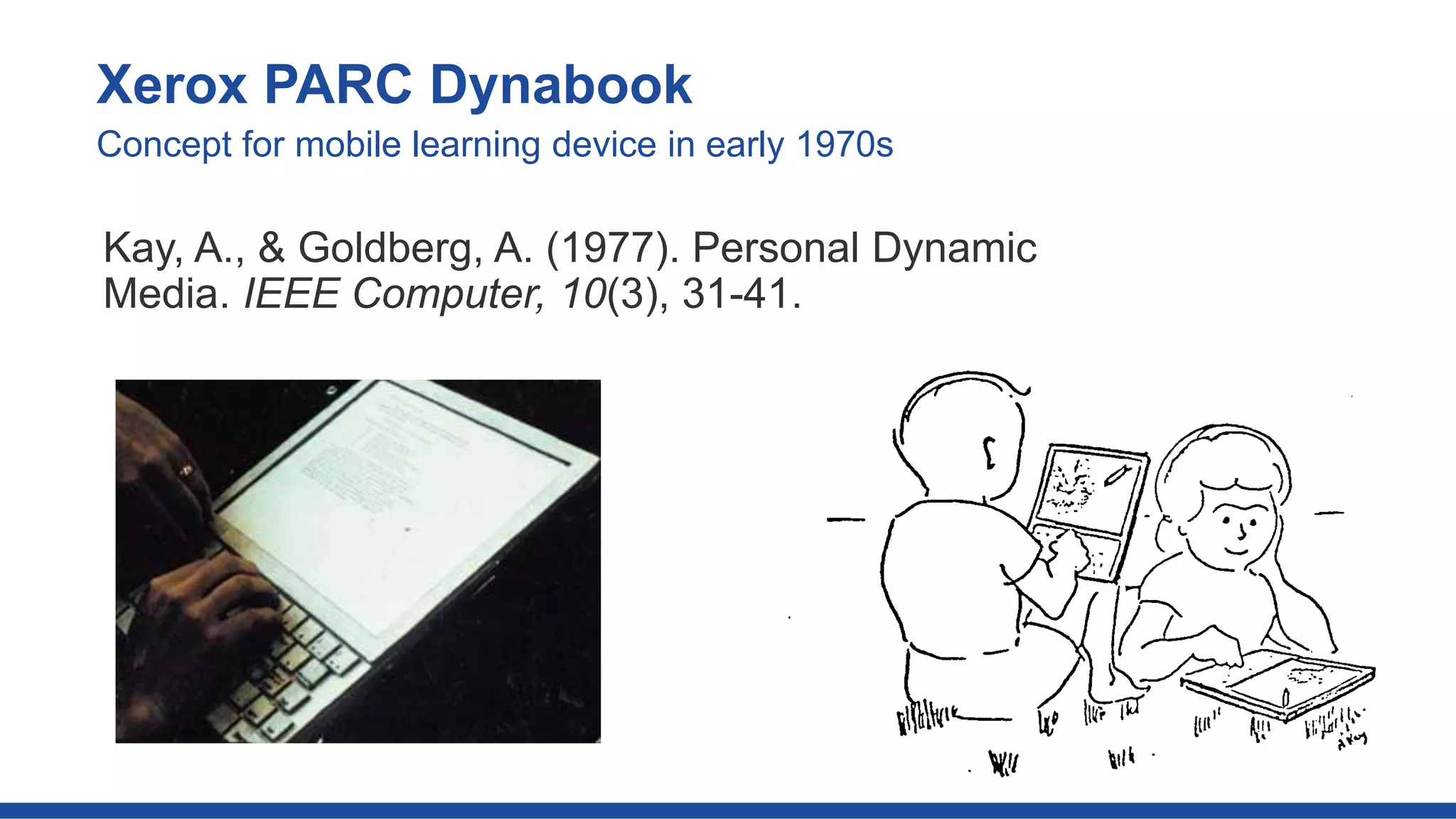
Kay, A., & Goldberg, A. (1977). Personal Dynamic
Media. IEEE Computer, 10(3), 31-41.
Xerox PARC Dynabook
Concept for mobile learning device in early 1970s
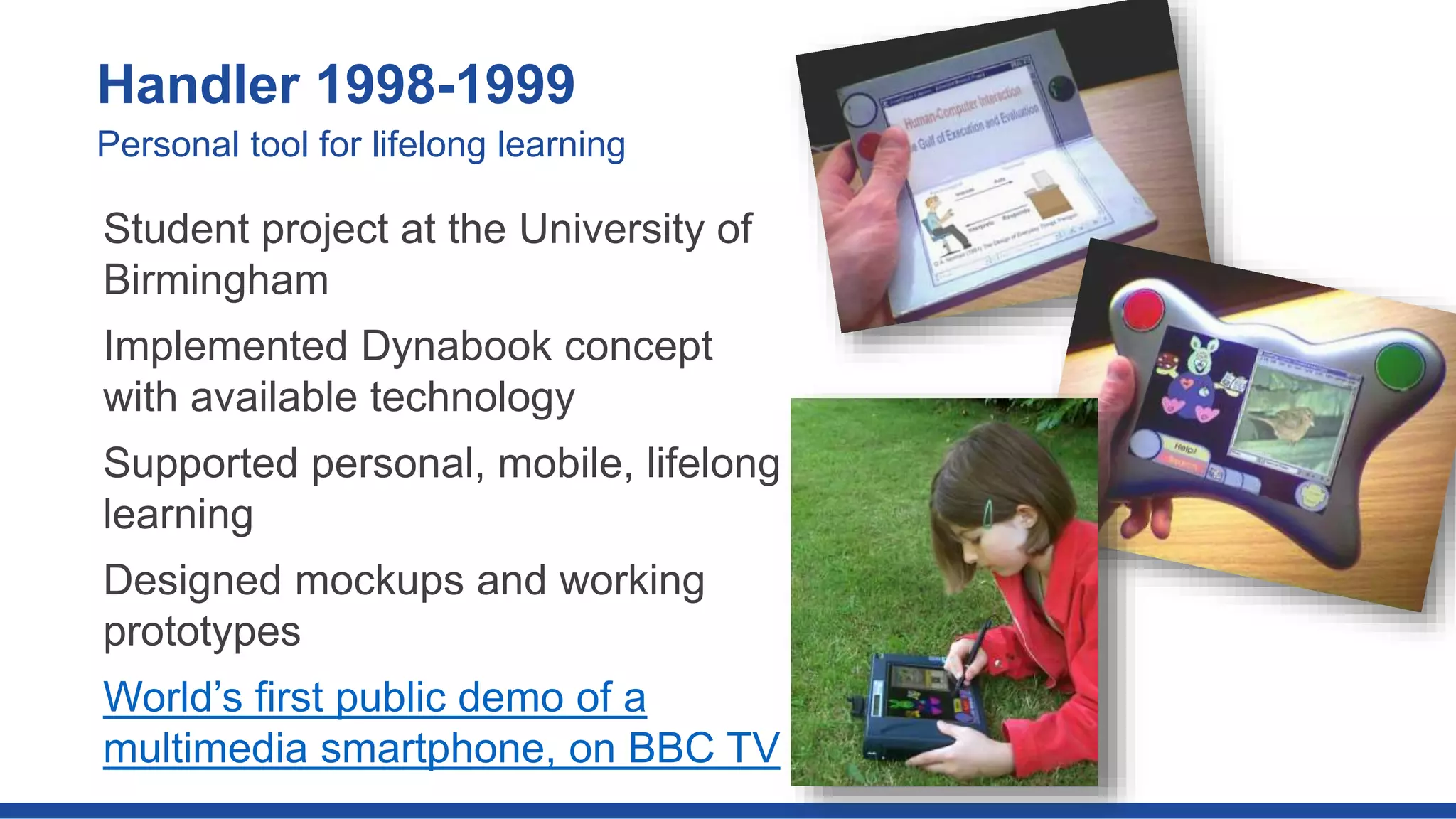
Student project at the University of
Birmingham
Implemented Dynabook concept
with available technology
Supported personal, mobile, lifelong
learning
Designed mockups and working
prototypes
World’s first public demo of a
multimedia smartphone, on BBC TV
Handler 1998-1999
Personal tool for lifelong learning
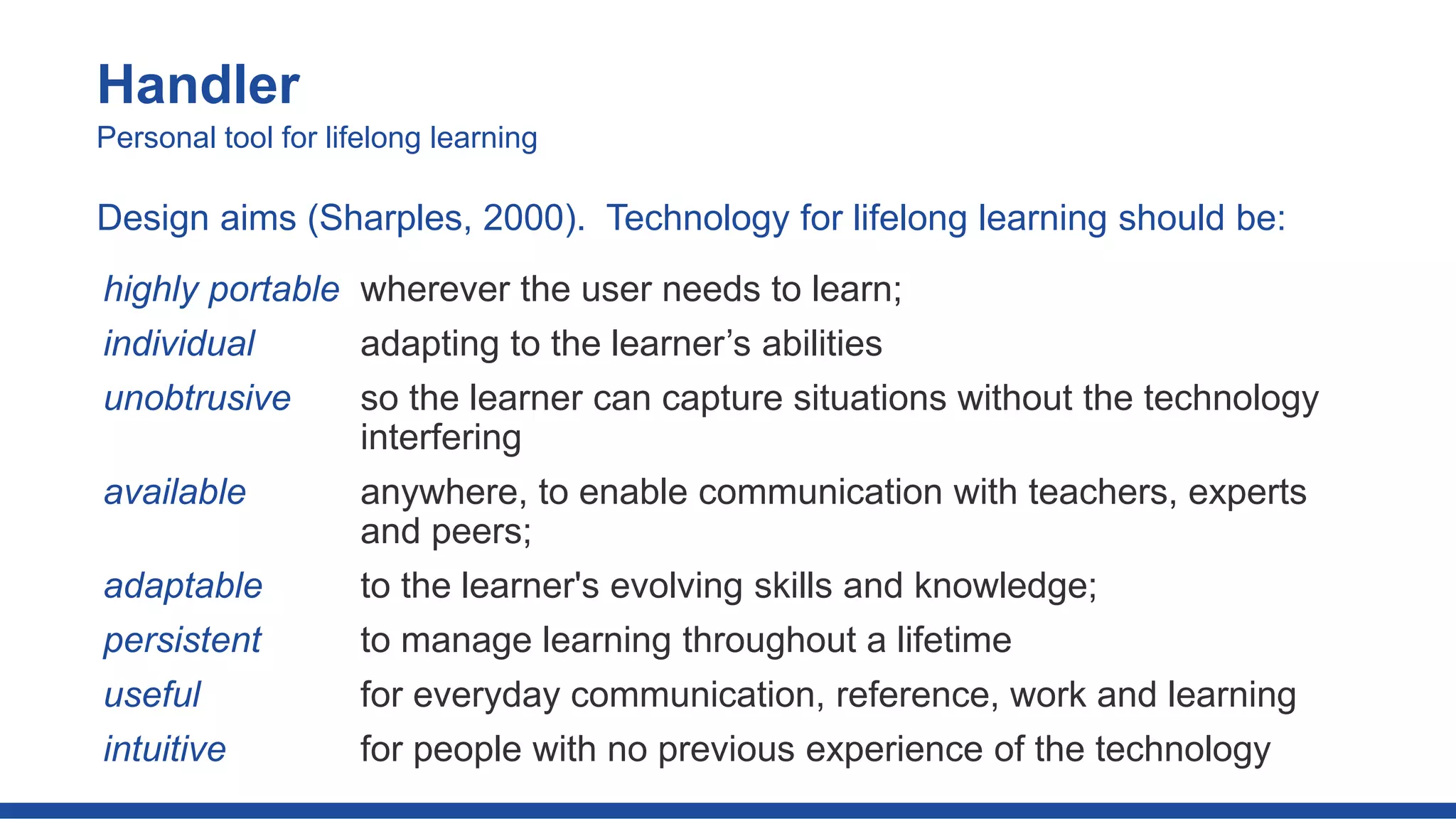
highly portable wherever the user needs to learn;
individual adapting to the learner’s abilities
unobtrusive so the learner can capture situations without the technology
interfering
available anywhere, to enable communication with teachers, experts
and peers;
adaptable to the learner's evolving skills and knowledge;
persistent to manage learning throughout a lifetime
useful for everyday communication, reference, work and learning
intuitive for people with no previous experience of the technology
Handler
Personal tool for lifelong learning
Design aims (Sharples, 2000). Technology for lifelong learning should be:
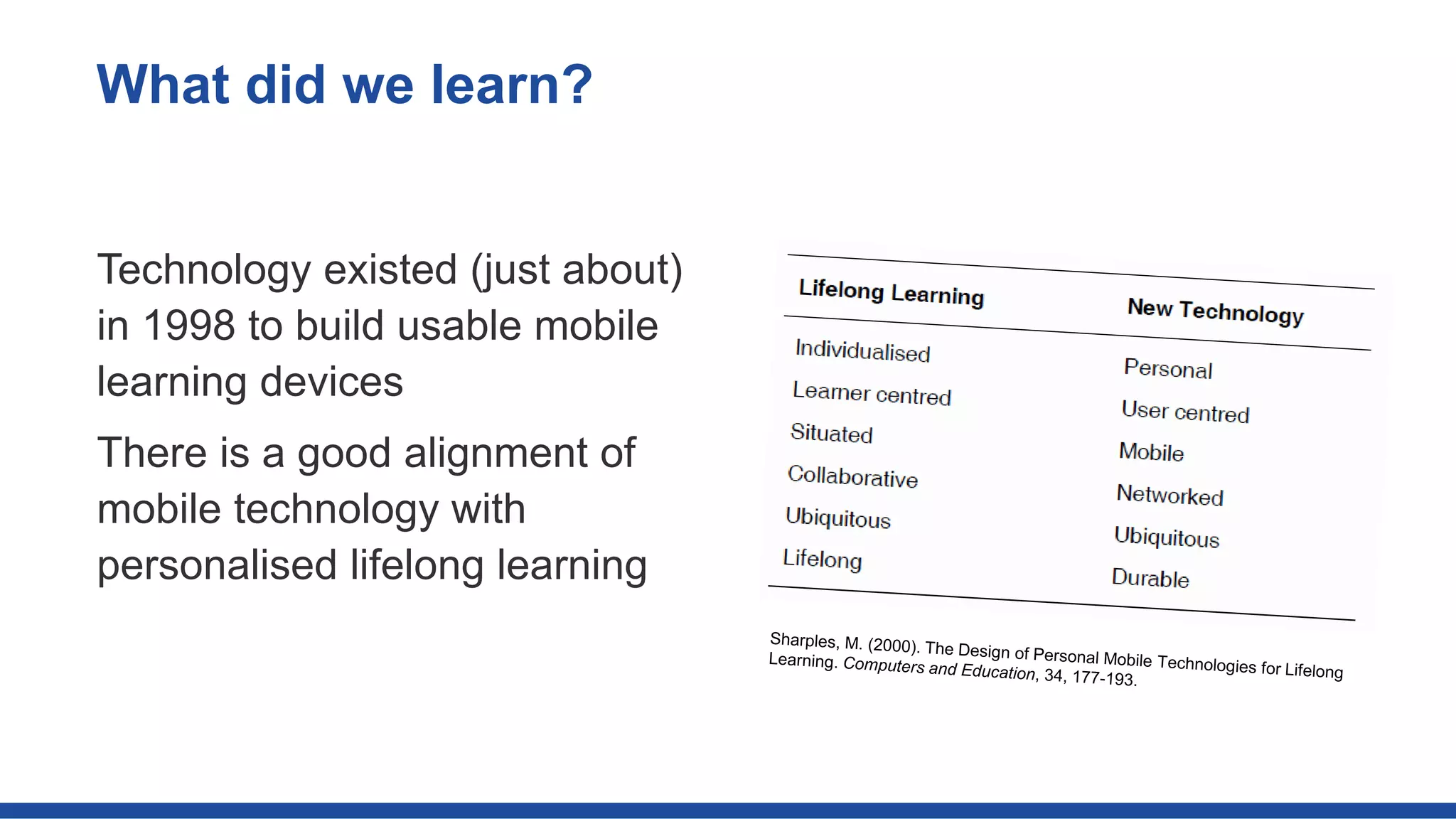
Technology existed (just about)
in 1998 to build usable mobile
learning devices
There is a good alignment of
mobile technology with
personalised lifelong learning
What did we learn?
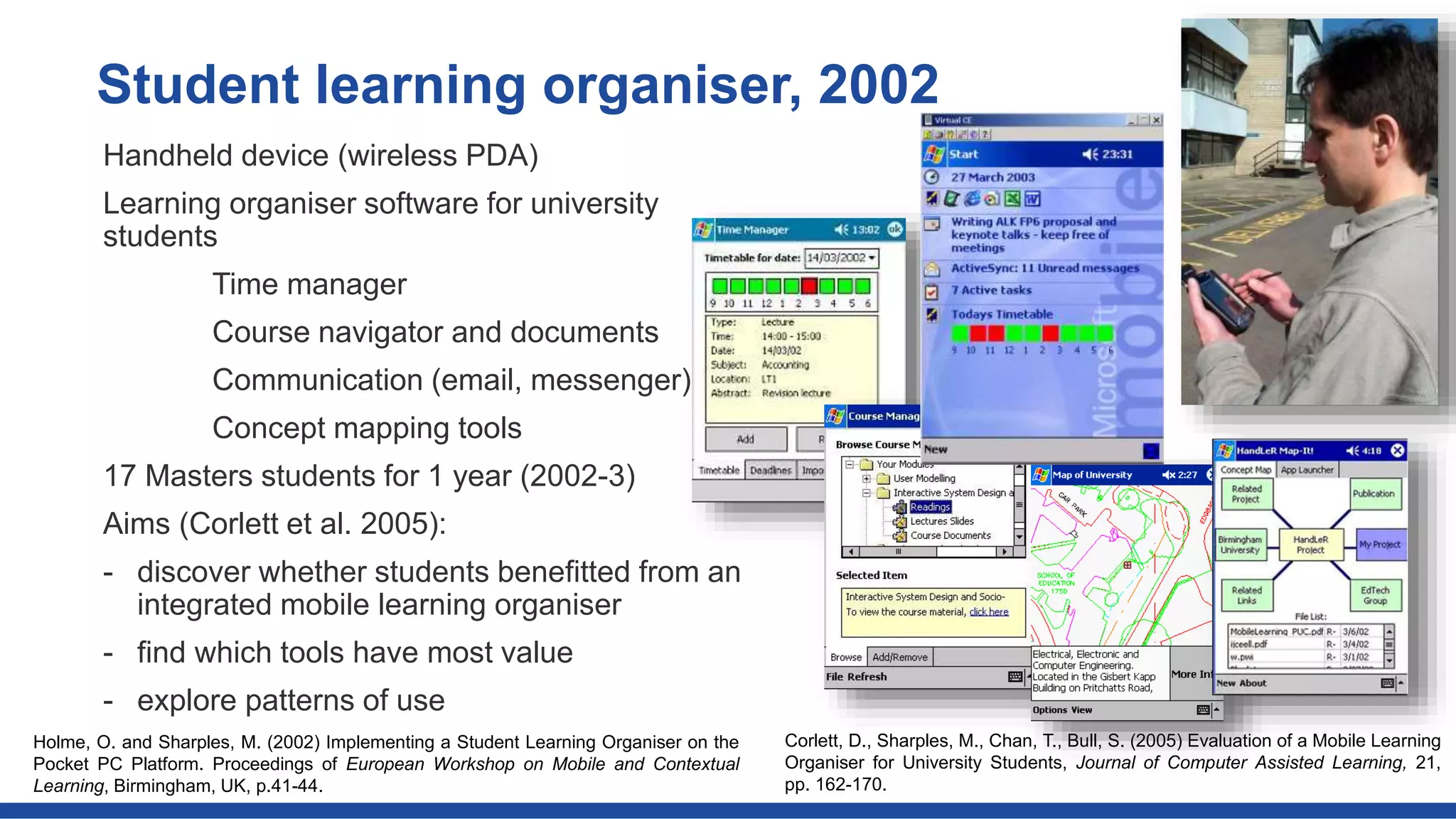
Handheld device (wireless PDA)
Learning organiser software for university
students
Time manager
Course navigator and documents
Communication (email, messenger)
Concept mapping tools
17 Masters students for 1 year (2002-3)
Aims (Corlett et al. 2005):
- discover whether students benefitted from an
integrated mobile learning organiser
- find which tools have most value
- explore patterns of use
Student learning organiser, 2002
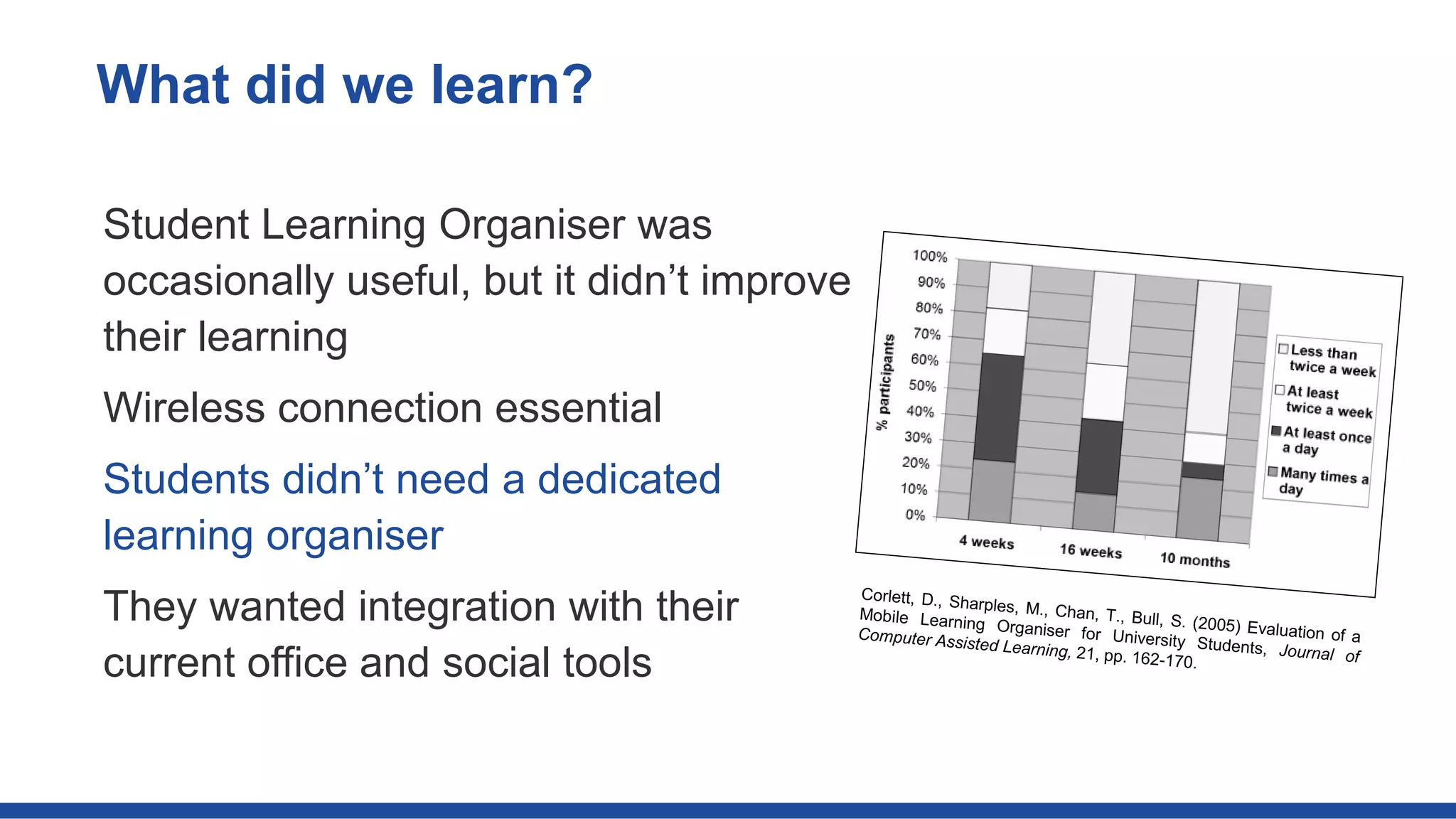
Corlett, D., Sharples, M., Chan, T., Bull, S. (2005) Evaluation of a Mobile Learning
Organiser for University Students, Journal of Computer Assisted Learning, 21,
pp. 162-170.
Holme, O. and Sharples, M. (2002) Implementing a Student Learning Organiser on the
Pocket PC Platform. Proceedings of European Workshop on Mobile and Contextual
Learning, Birmingham, UK, p.41-44.
Student Learning Organiser was
occasionally useful, but it didn’t improve
their learning
Wireless connection essential
Students didn’t need a dedicated
learning organiser
They wanted integration with their
current office and social tools
What did we learn?
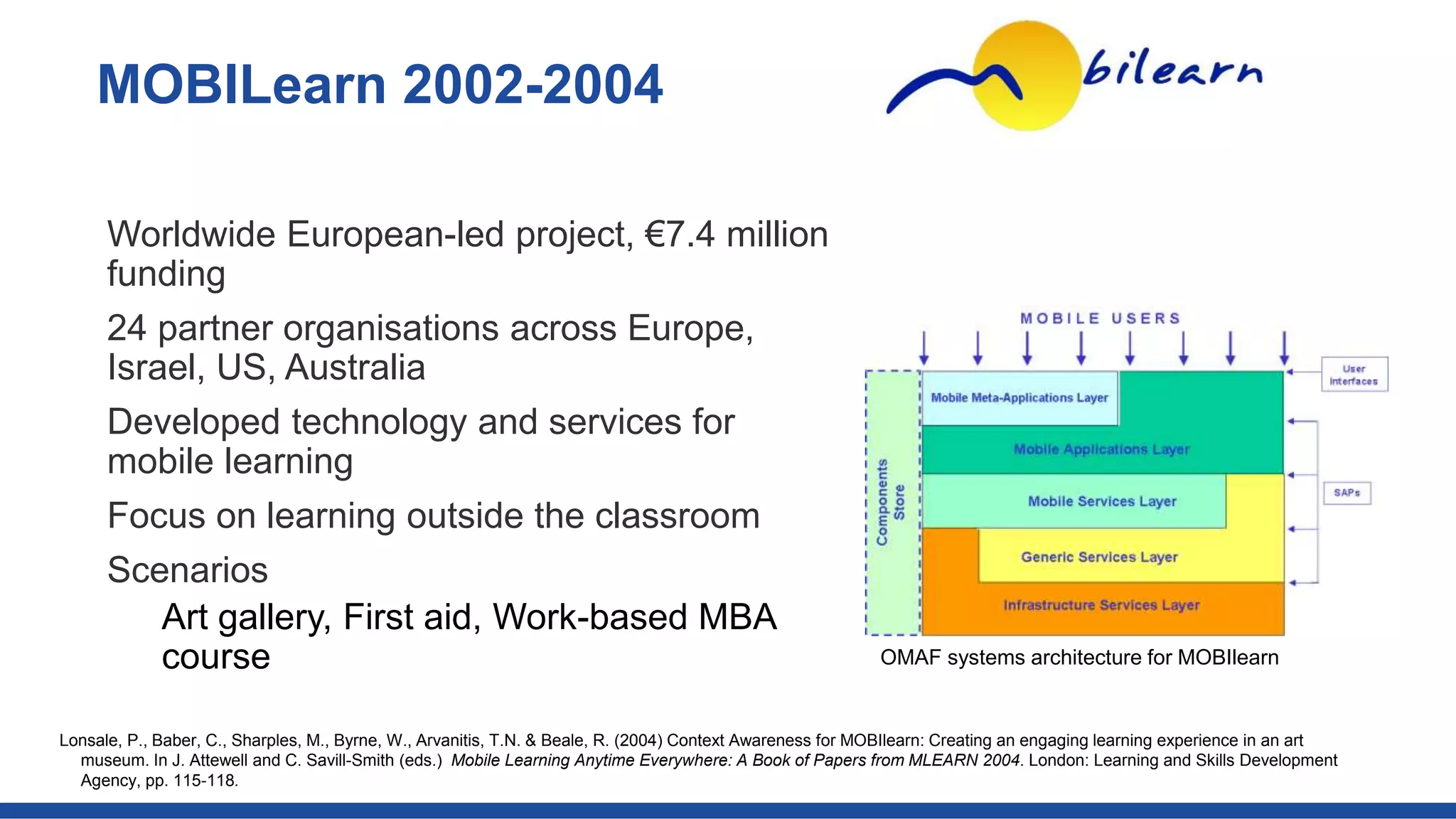
Worldwide European-led project, €7.4 million
funding
24 partner organisations across Europe,
Israel, US, Australia
Developed technology and services for
mobile learning
Focus on learning outside the classroom
Scenarios
Art gallery, First aid, Work-based MBA
course
MOBILearn 2002-2004
Lonsale, P., Baber, C., Sharples, M., Byrne, W., Arvanitis, T.N. & Beale, R. (2004) Context Awareness for MOBIlearn: Creating an engaging learning experience in an art
museum. In J. Attewell and C. Savill-Smith (eds.) Mobile Learning Anytime Everywhere: A Book of Papers from MLEARN 2004. London: Learning and Skills Development
Agency, pp. 115-118.
OMAF systems architecture for MOBIlearn
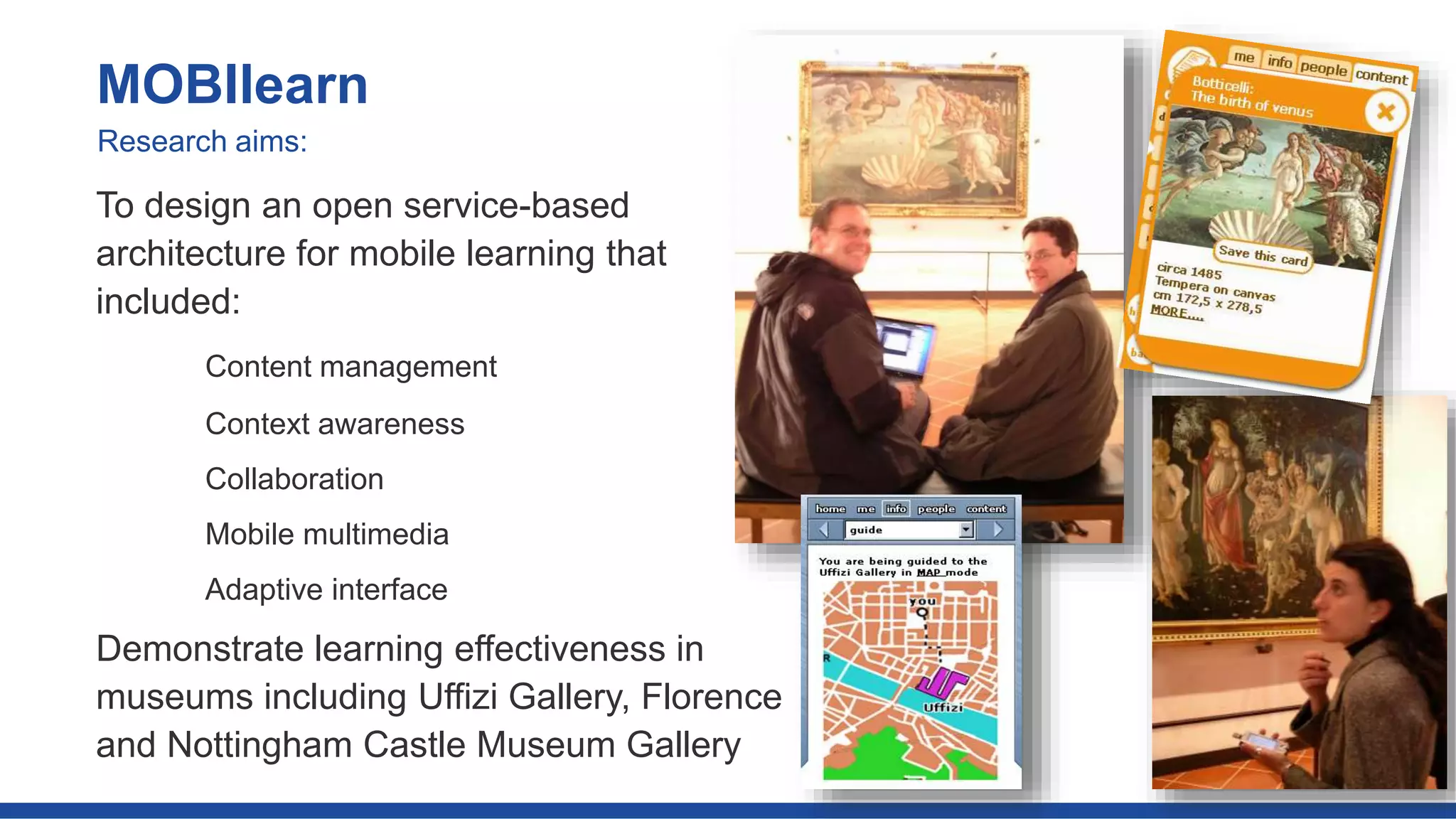
To design an open service-based
architecture for mobile learning that
included:
Content management
Context awareness
Collaboration
Mobile multimedia
Adaptive interface
Demonstrate learning effectiveness in
museums including Uffizi Gallery, Florence
and Nottingham Castle Museum Gallery
MOBIlearn
Research aims:
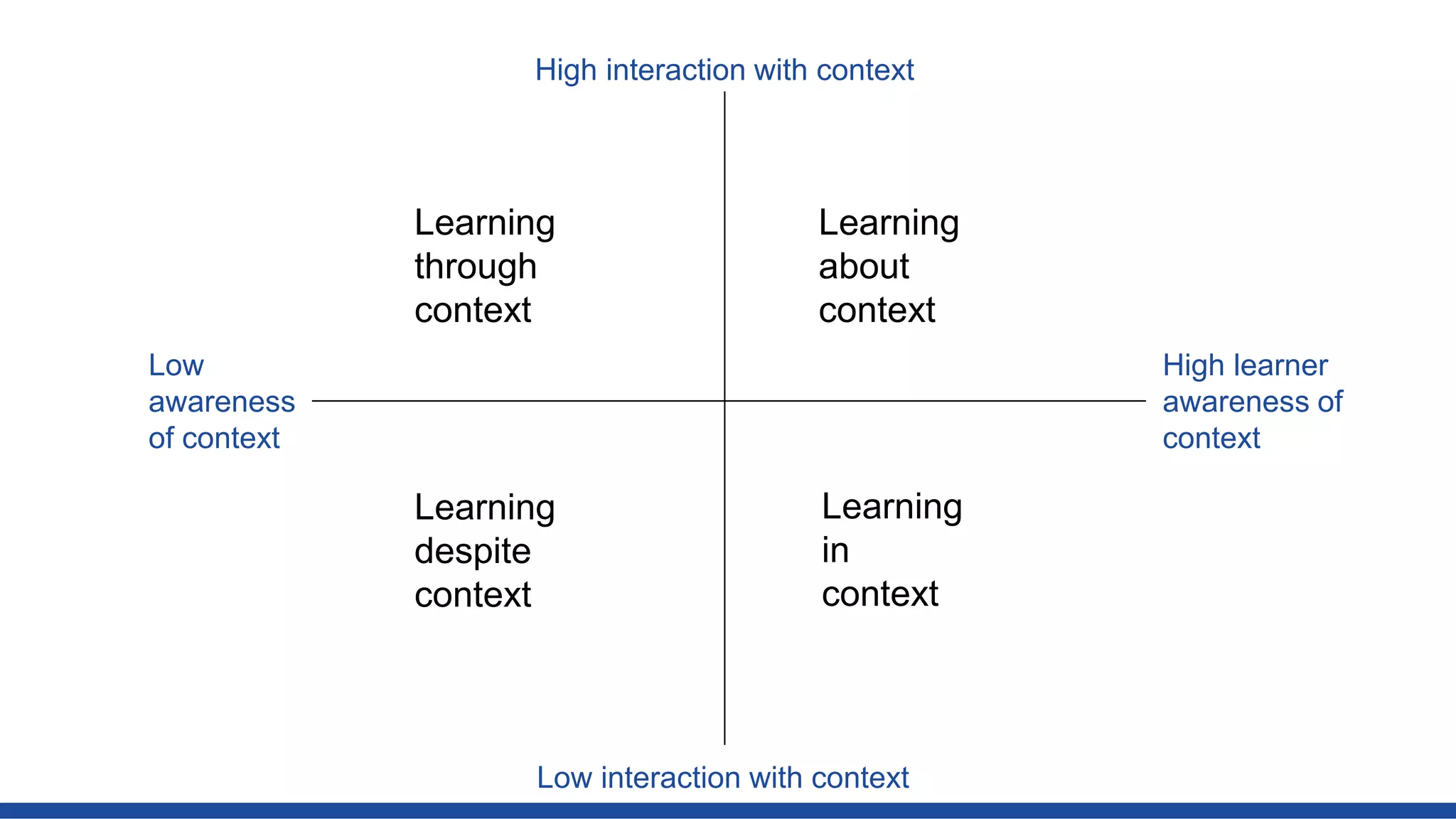
Context and mobile learning
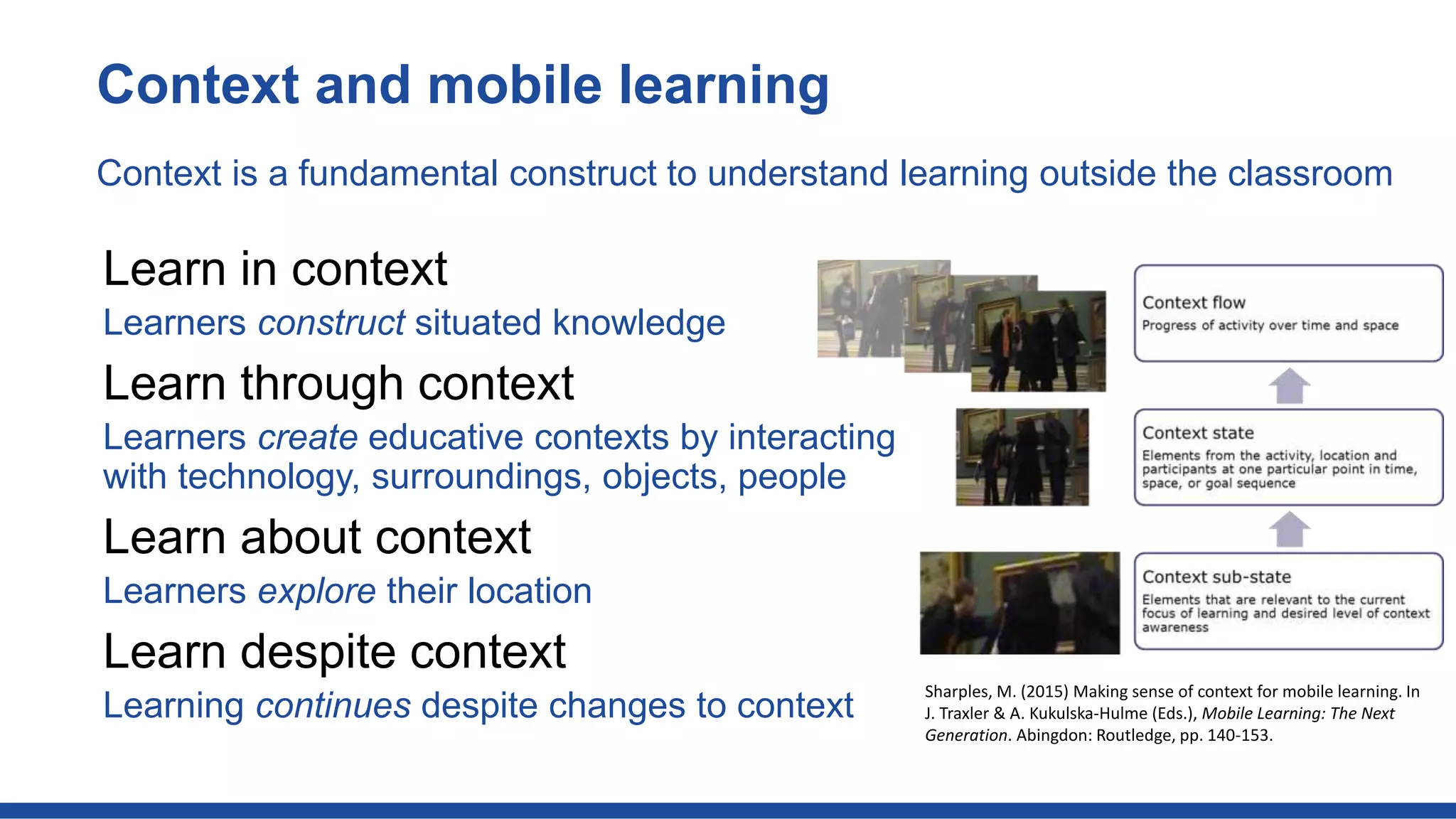
Context is a fundamental construct to understand learning outside the classroom
Learn in context
Learners construct situated knowledge
Learn through context
Learners create educative contexts by interacting
with technology, surroundings, objects, people
Learn about context
Learners explore their location
Learn despite context
Learning continues despite changes to context
Sharples, M. (2015) Making sense of context for mobile learning. In
J. Traxler & A. Kukulska-Hulme (Eds.), Mobile Learning: The Next
Generation. Abingdon: Routledge, pp. 140-153.
High interaction with context
Low interaction with context
High learner
awareness of
context
Learning
through
context
Learning
about
context
Learning
in
context
Learning
despite
context
Low
awareness
of context
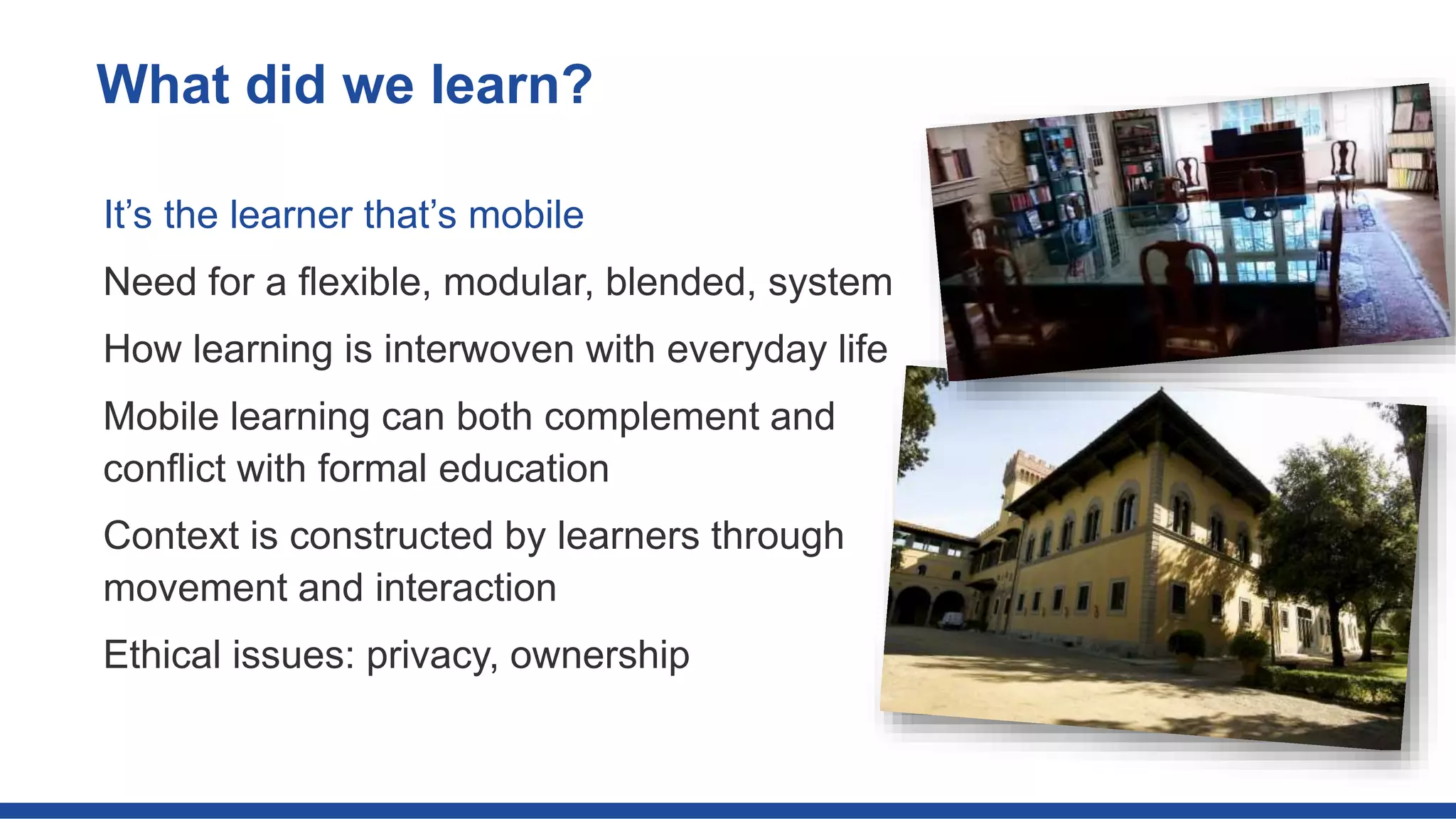
It’s the learner that’s mobile
Need for a flexible, modular, blended, system
How learning is interwoven with everyday life
Mobile learning can both complement and
conflict with formal education
Context is constructed by learners through
movement and interaction
Ethical issues: privacy, ownership
What did we learn?
How can we make school trips to
museums or heritage centres more
engaging and educative?
Learning through guided inquiry and
crossover learning
Investigation starts in the classroom
guided by the teacher, continues in the
museum and online, then developed and
shared back in the classroom
Students as media makers and curators
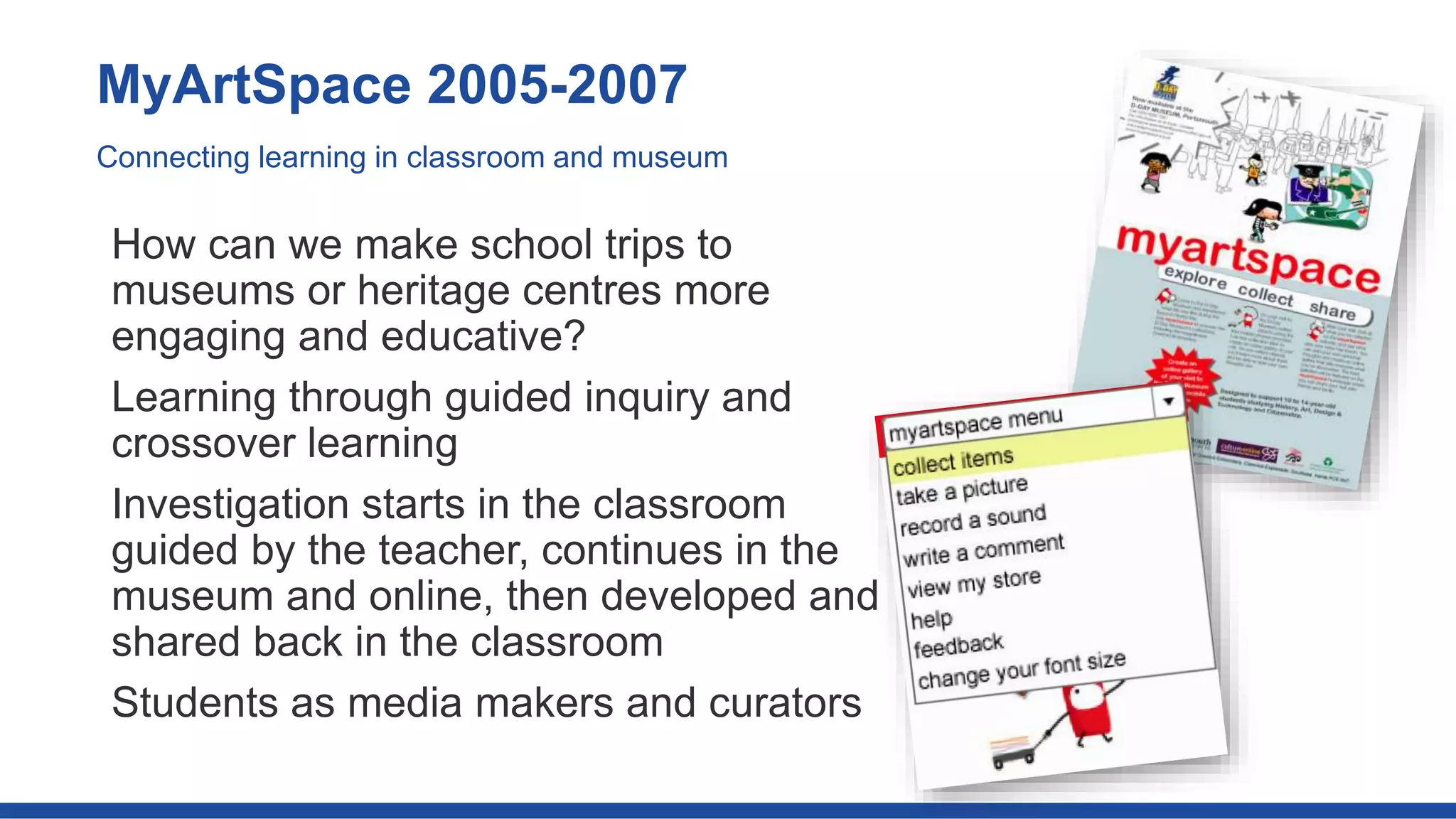
MyArtSpace 2005-2007
Connecting learning in classroom and museum
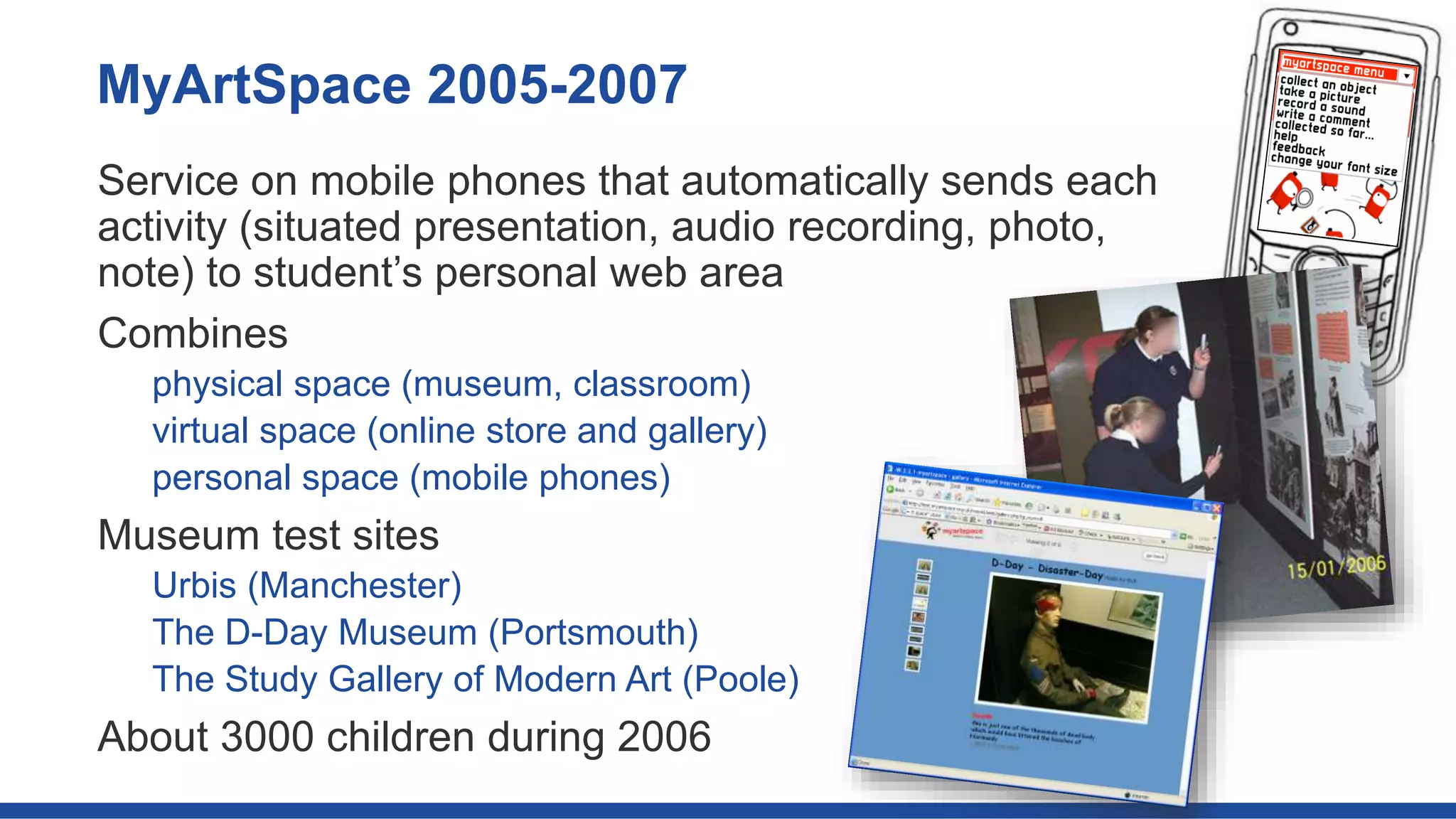
Service on mobile phones that automatically sends each
activity (situated presentation, audio recording, photo,
note) to student’s personal web area
Combines
physical space (museum, classroom)
virtual space (online store and gallery)
personal space (mobile phones)
Museum test sites
Urbis (Manchester)
The D-Day Museum (Portsmouth)
The Study Gallery of Modern Art (Poole)
About 3000 children during 2006
MyArtSpace 2005-2007
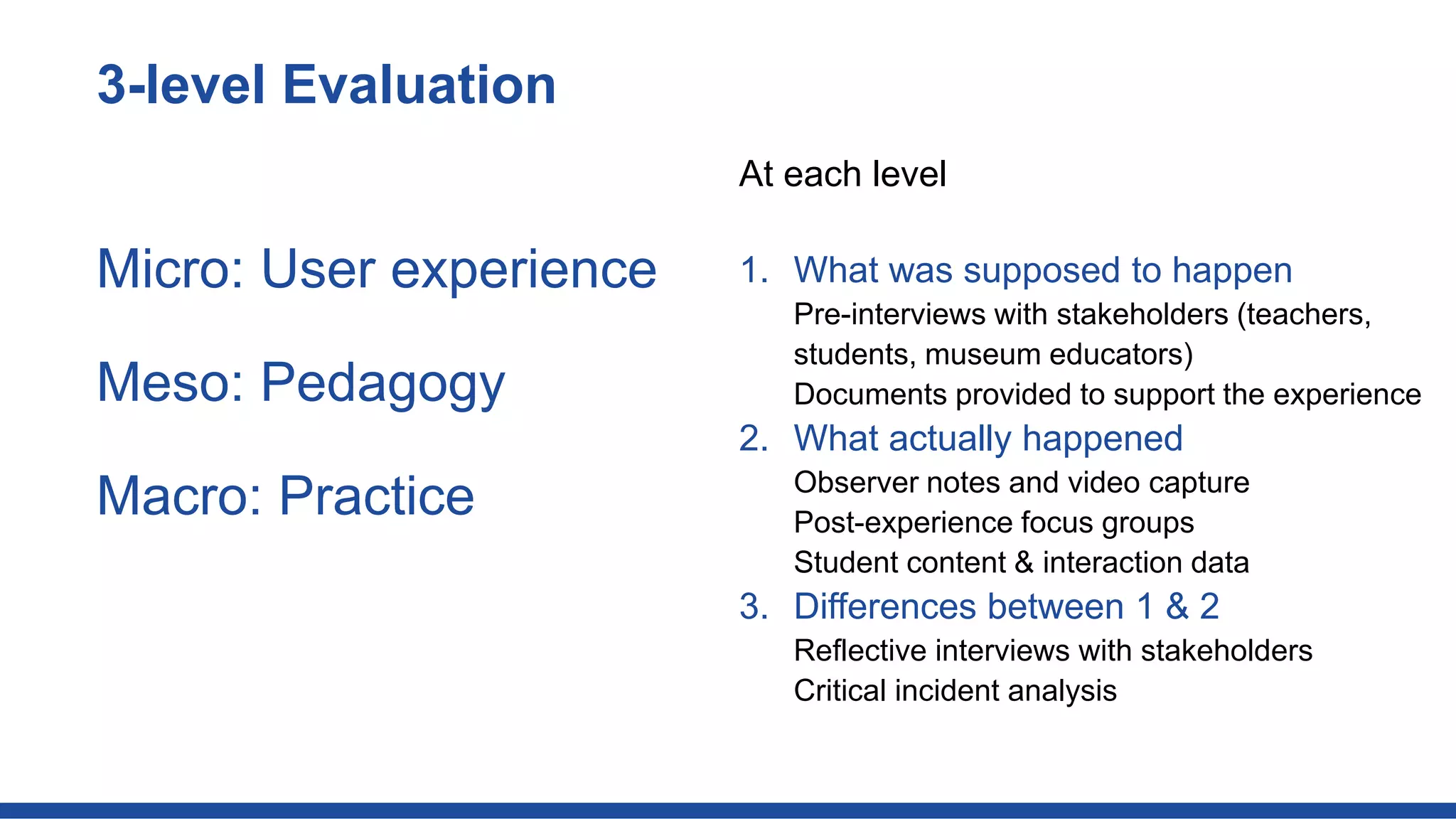
Micro: User experience
Meso: Pedagogy
Macro: Practice
3-level Evaluation
At each level
1. What was supposed to happen
Pre-interviews with stakeholders (teachers,
students, museum educators)
Documents provided to support the experience
2. What actually happened
Observer notes and video capture
Post-experience focus groups
Student content & interaction data
3. Differences between 1 & 2
Reflective interviews with stakeholders
Critical incident analysis
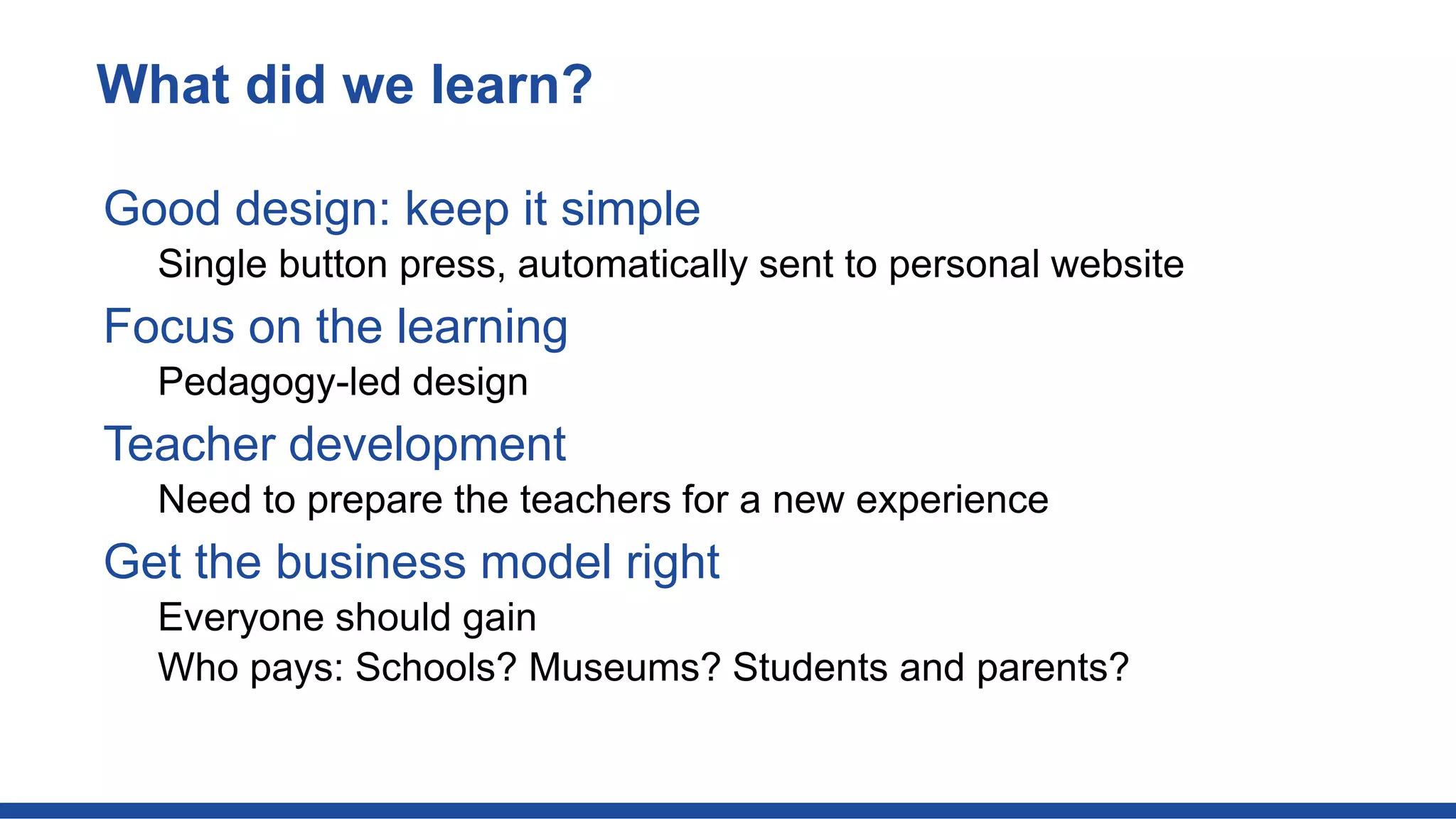
Good design: keep it simple
Single button press, automatically sent to personal website
Focus on the learning
Pedagogy-led design
Teacher development
Need to prepare the teachers for a new experience
Get the business model right
Everyone should gain
Who pays: Schools? Museums? Students and parents?
What did we learn?
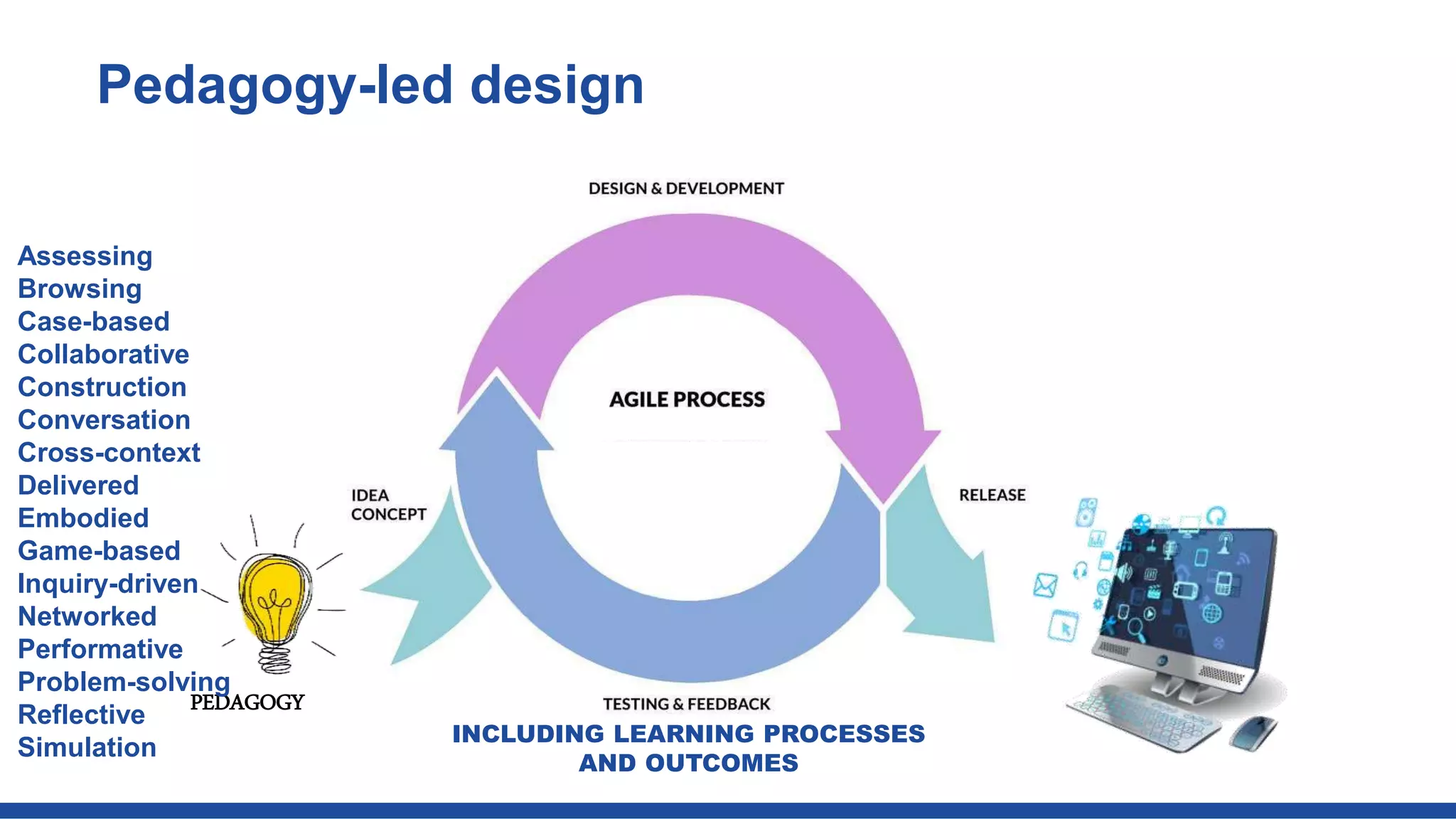
PEDAGOGY
INCLUDING LEARNING PROCESSES
AND OUTCOMES
Pedagogy-led design
Assessing
Browsing
Case-based
Collaborative
Construction
Conversation
Cross-context
Delivered
Embodied
Game-based
Inquiry-driven
Networked
Performative
Problem-solving
Reflective
Simulation
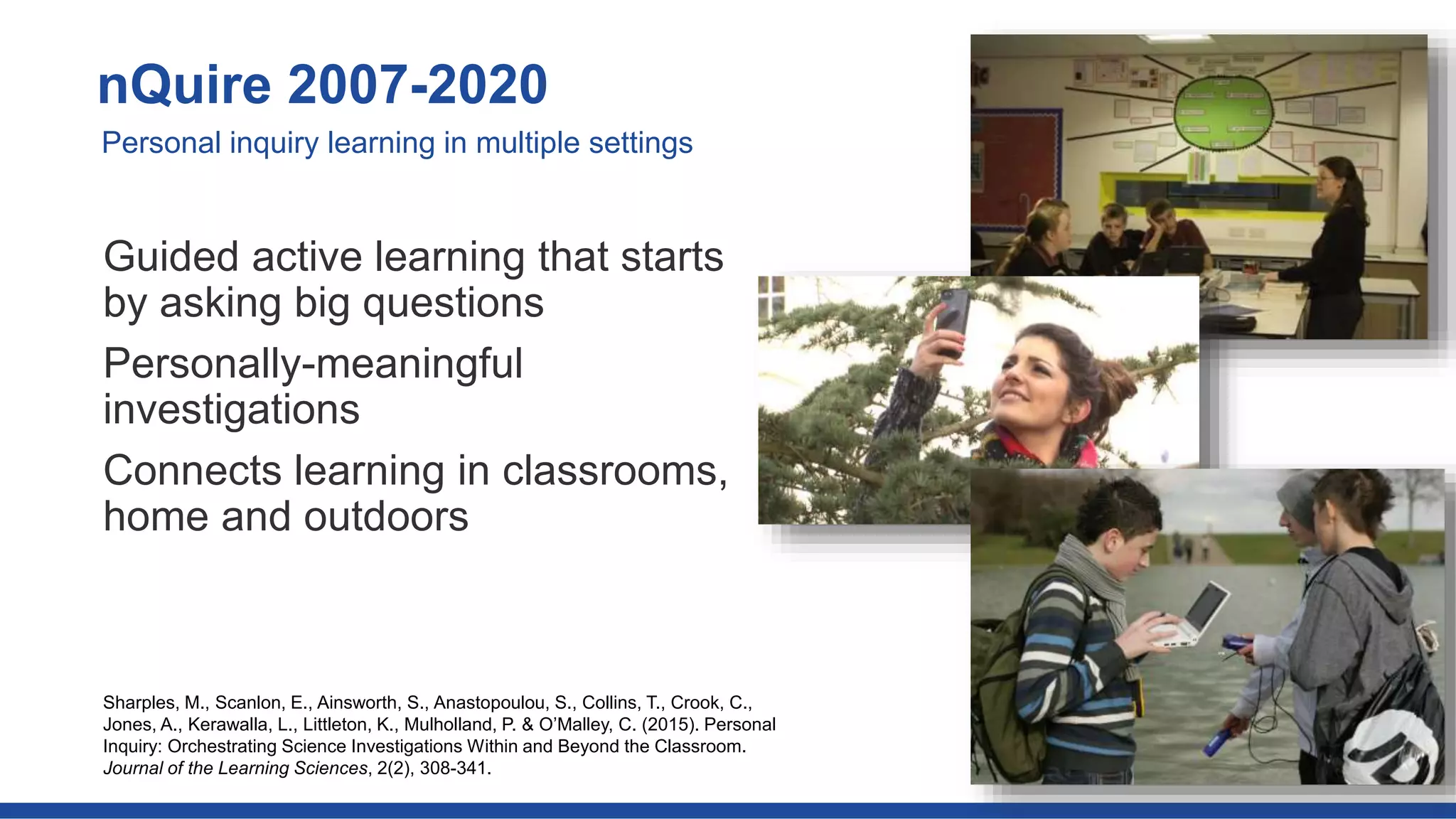
Guided active learning that starts
by asking big questions
Personally-meaningful
investigations
Connects learning in classrooms,
home and outdoors
nQuire 2007-2020
Personal inquiry learning in multiple settings
Sharples, M., Scanlon, E., Ainsworth, S., Anastopoulou, S., Collins, T., Crook, C.,
Jones, A., Kerawalla, L., Littleton, K., Mulholland, P. & O’Malley, C. (2015). Personal
Inquiry: Orchestrating Science Investigations Within and Beyond the Classroom.
Journal of the Learning Sciences, 2(2), 308-341.
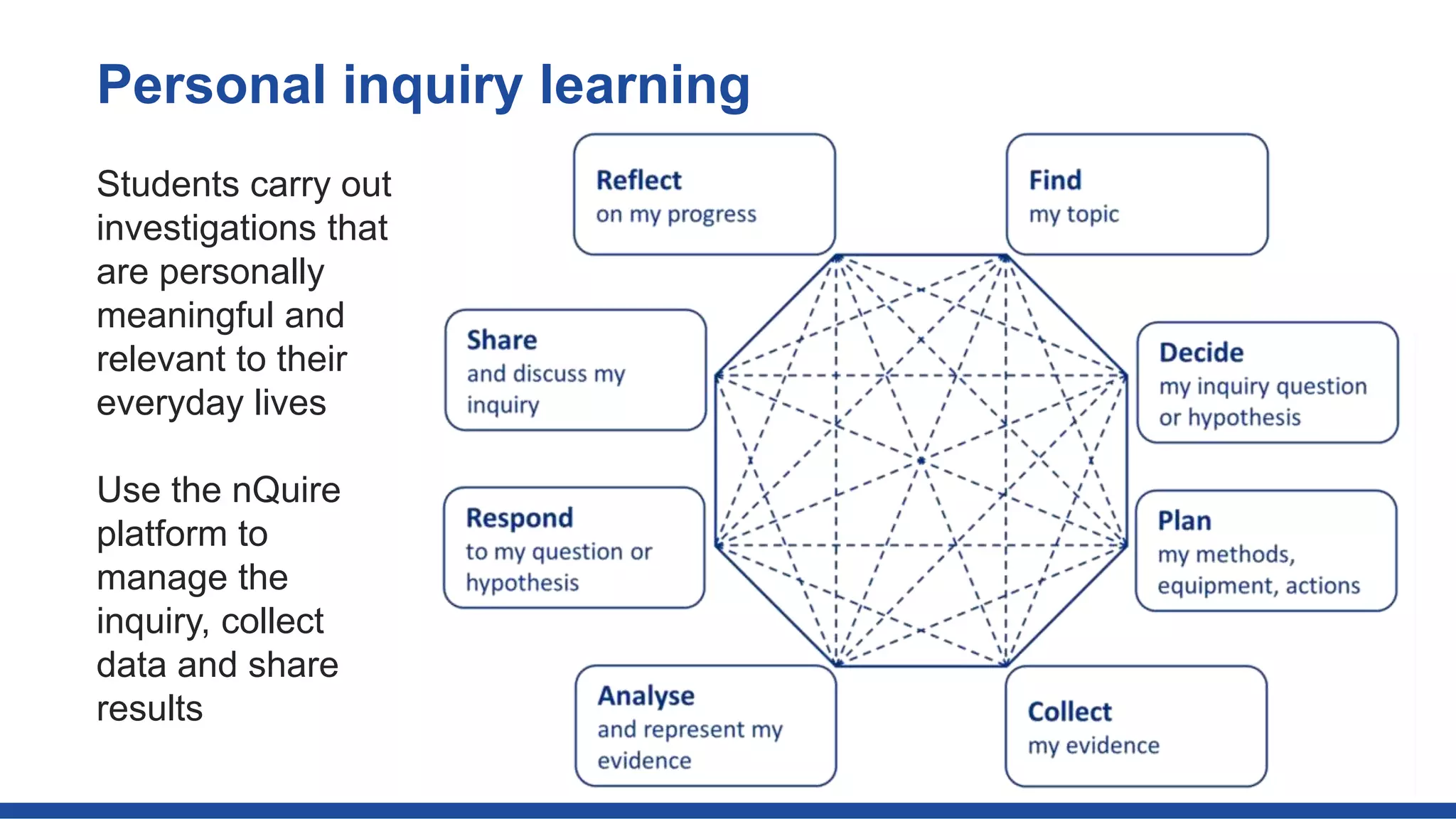
Personal inquiry learning
Students carry out
investigations that
are personally
meaningful and
relevant to their
everyday lives
Use the nQuire
platform to
manage the
inquiry, collect
data and share
results
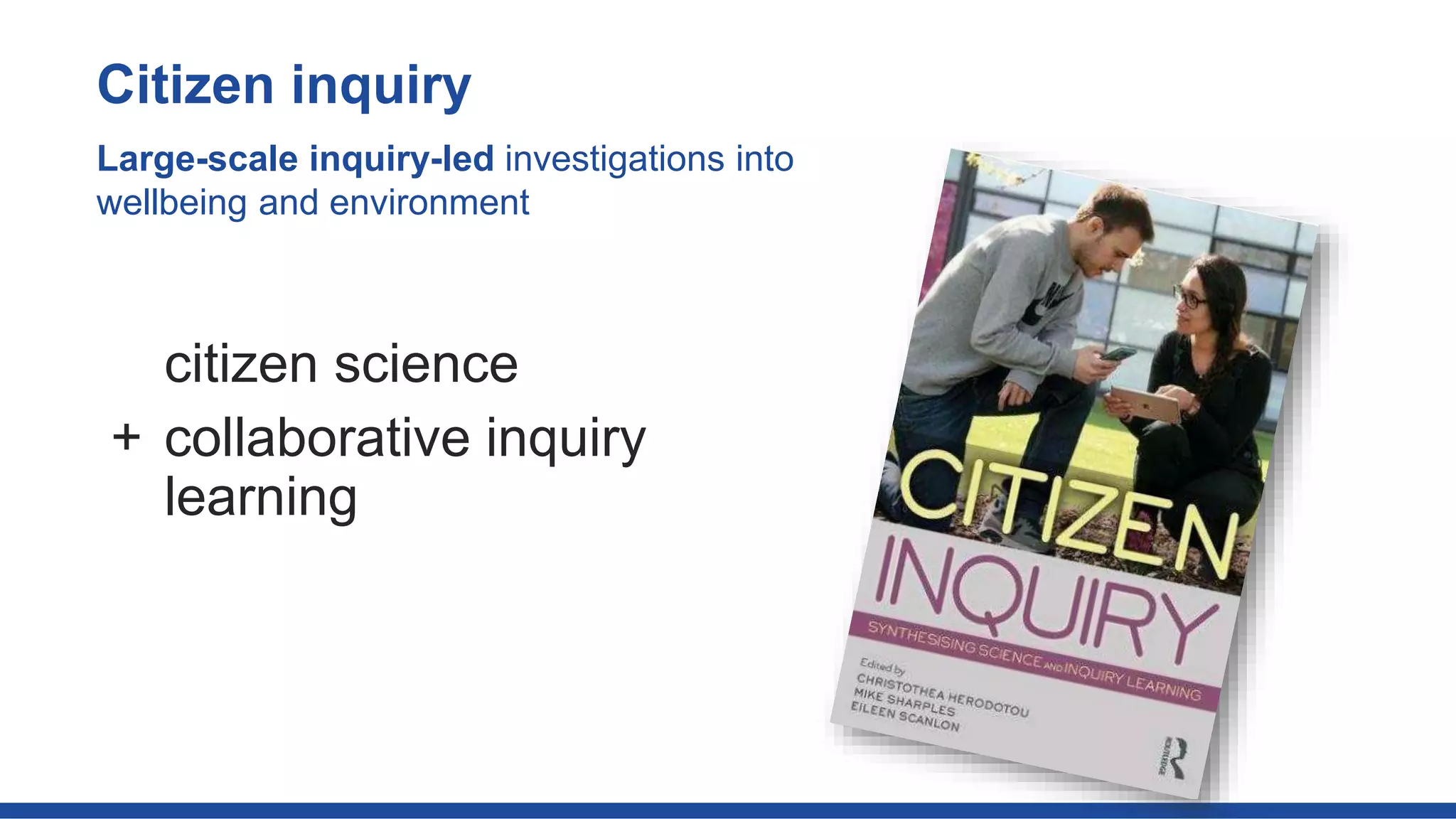
Citizen inquiry
Large-scale inquiry-led investigations into
wellbeing and environment
citizen science
+ collaborative inquiry
learning
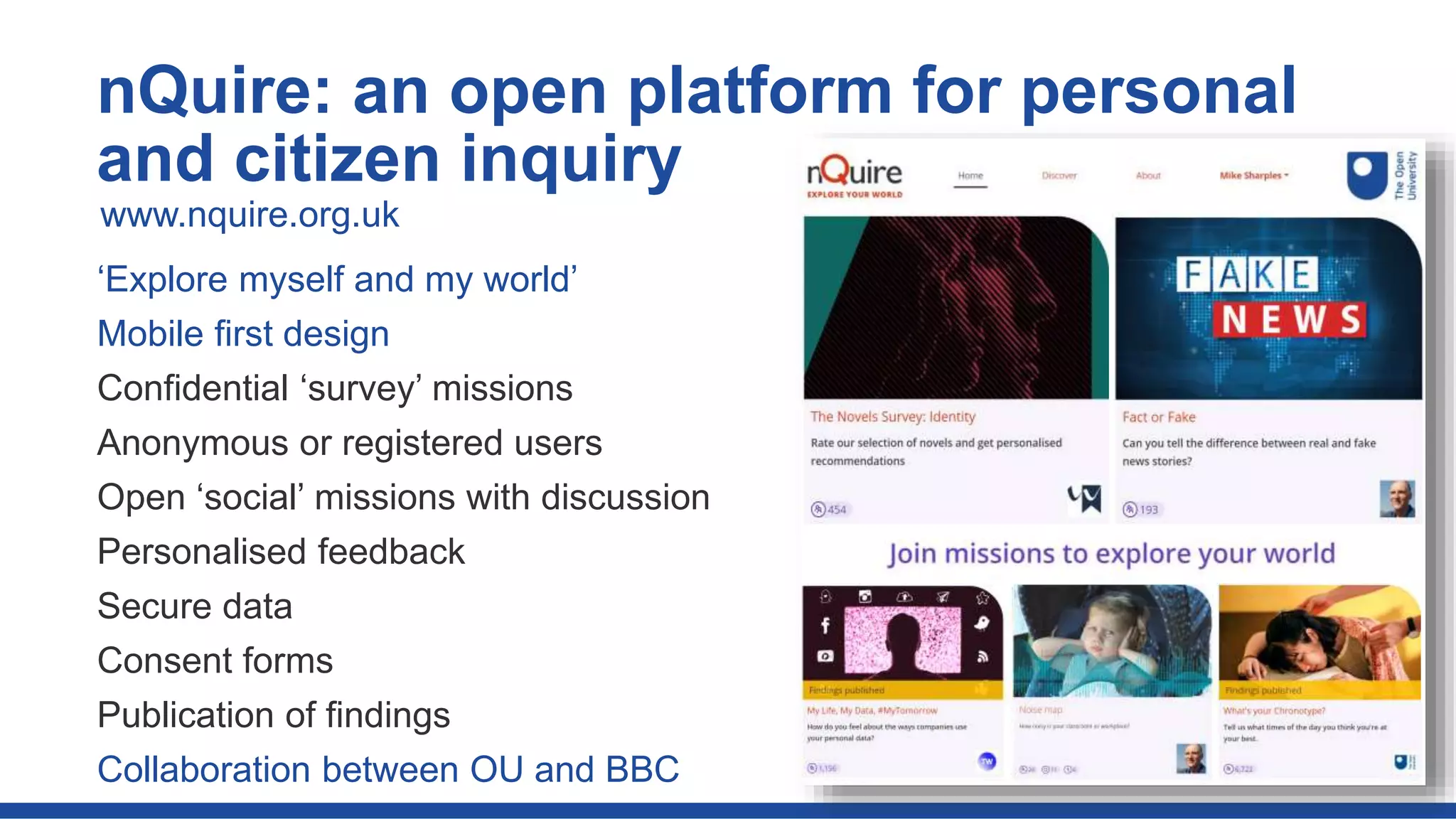
‘Explore myself and my world’
Mobile first design
Confidential ‘survey’ missions
Anonymous or registered users
Open ‘social’ missions with discussion
Personalised feedback
Secure data
Consent forms
Publication of findings
Collaboration between OU and BBC
nQuire: an open platform for personal
and citizen inquiry
www.nquire.org.uk
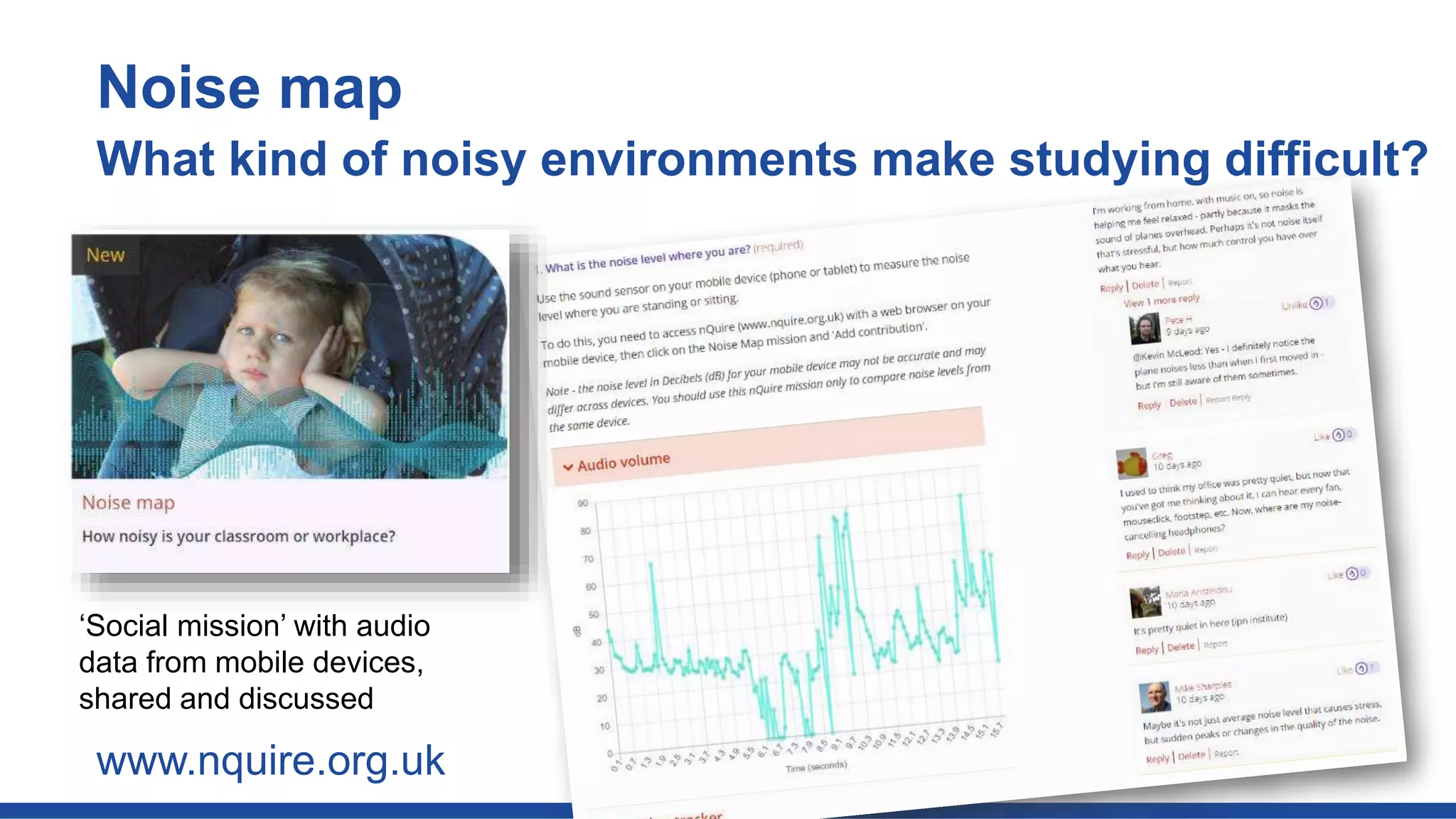
Noise map
What kind of noisy environments make studying difficult?
www.nquire.org.uk
‘Social mission’ with audio
data from mobile devices,
shared and discussed
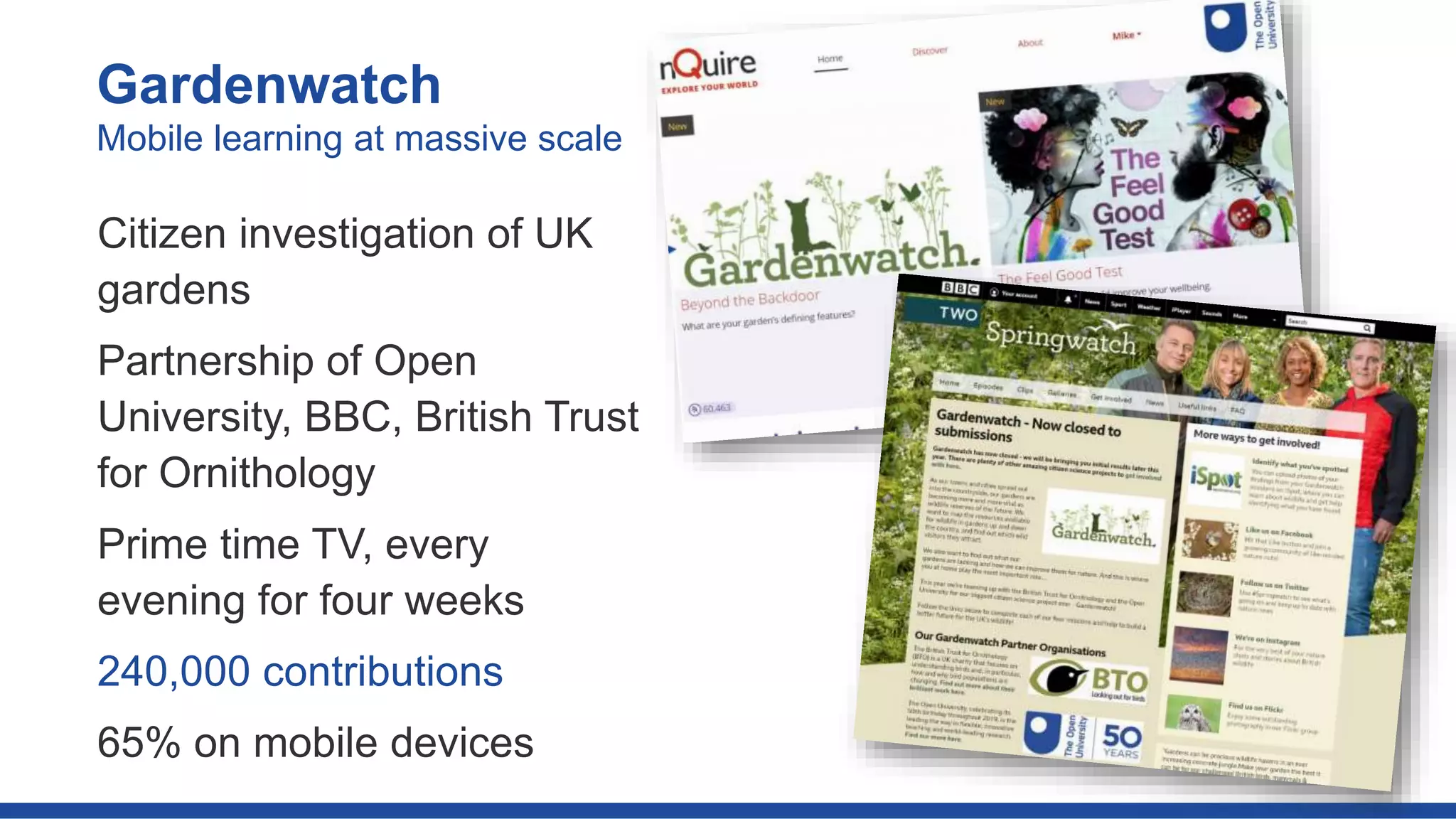
Gardenwatch
Citizen investigation of UK
gardens
Partnership of Open
University, BBC, British Trust
for Ornithology
Prime time TV, every
evening for four weeks
240,000 contributions
65% on mobile devices
Mobile learning at massive scale
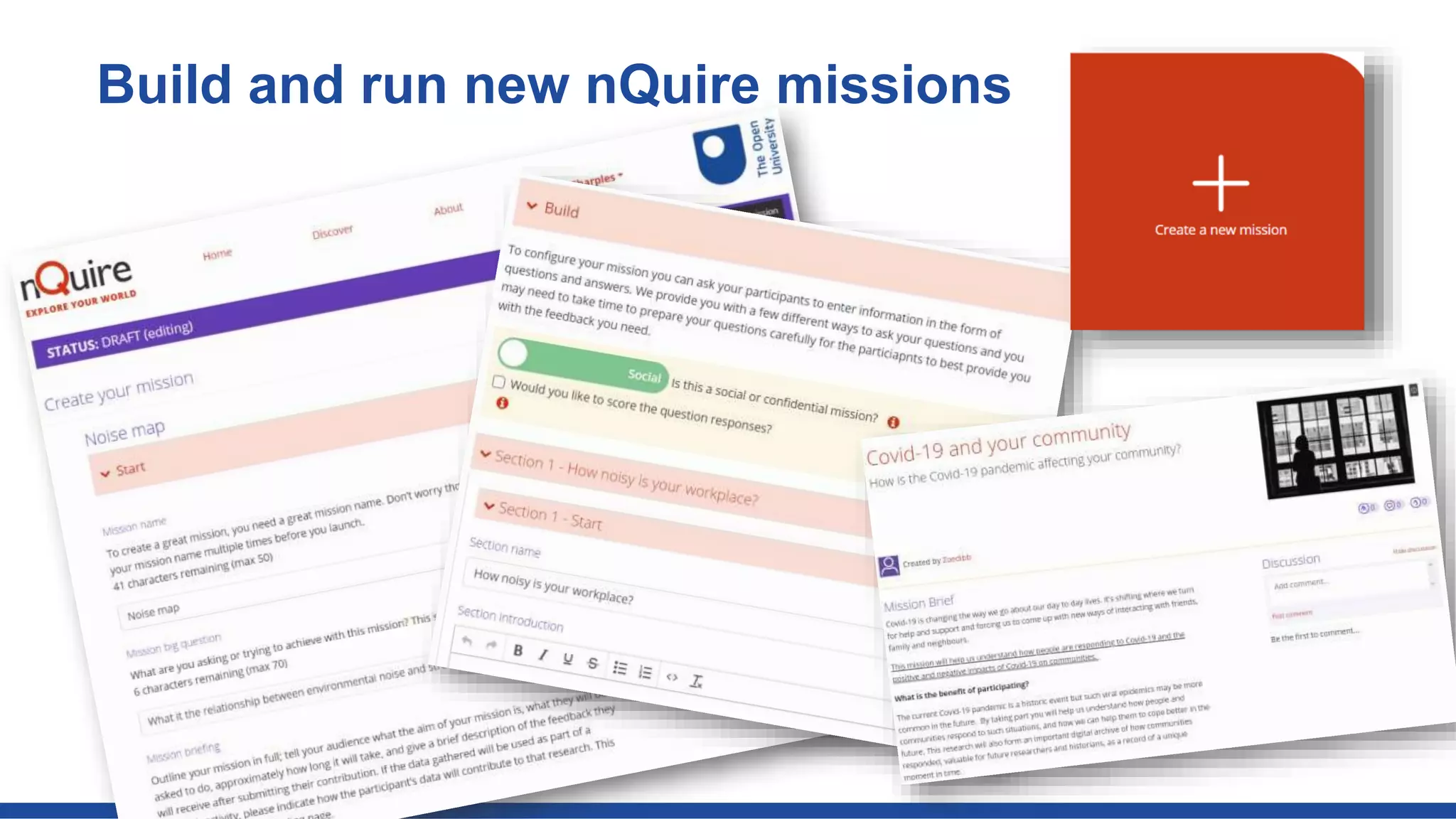
Build and run new nQuire missions
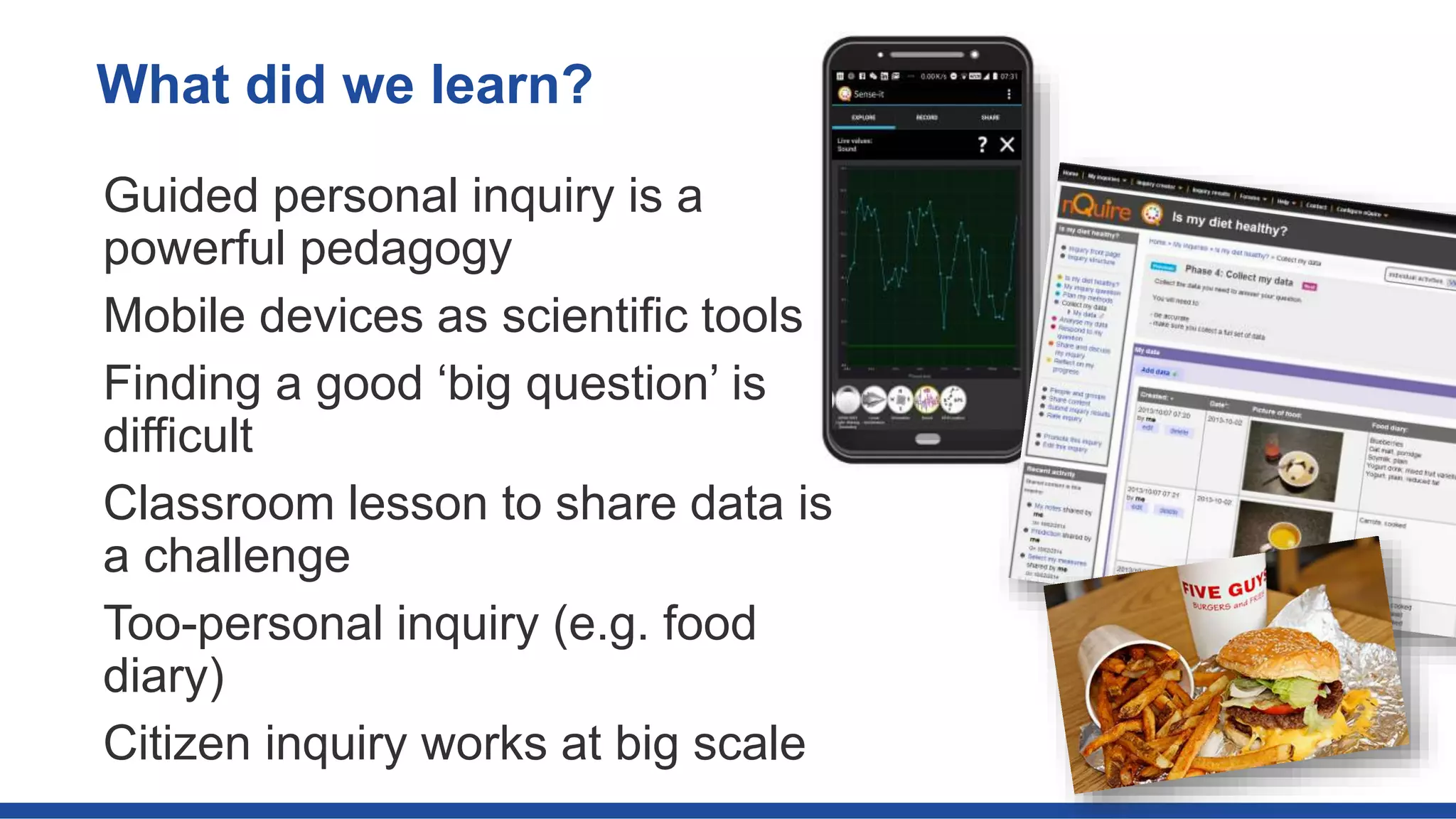
Guided personal inquiry is a
powerful pedagogy
Mobile devices as scientific tools
Finding a good ‘big question’ is
difficult
Classroom lesson to share data is
a challenge
Too-personal inquiry (e.g. food
diary)
Citizen inquiry works at big scale
What did we learn?
Focus on the mobility of learning, not just the device
Theories of learning for a mobile world
Context created through interaction
How to evaluate learning within and across locations
Importance of teacher development and preparation
How to evaluate at multiple levels, in many locations, for all
stakeholders
How to design and implement mobile learning at big scale
What we know now that we didn’t
know 20 years ago
How to integrate mobile learning into the school
curriculum
How to support mobile learning in developing countries
How to support teachers in innovative mobile pedagogy
How to design personal technology for lifelong learning
(objective of the original HandLer project)
What we still don’t know
Four challenges for the future
Any questions?

20 years of mobile learning - what have we learned?

  • 1.
    Mike Sharples Institute ofEducational Technology The Open University www.mikesharples.org 20 years of mobile learning What have we learned? @sharplm
  • 2.
    Reflections on 20years of mobile learning research projects
  • 3.
    20 years ofmobile learning Sharples, M. (2000). The Design of Personal Mobile Technologies for Lifelong Learning. Computers and Education, 34, 177-193
  • 4.
    Kay, A., &Goldberg, A. (1977). Personal Dynamic Media. IEEE Computer, 10(3), 31-41. Xerox PARC Dynabook Concept for mobile learning device in early 1970s
  • 5.
    Student project atthe University of Birmingham Implemented Dynabook concept with available technology Supported personal, mobile, lifelong learning Designed mockups and working prototypes World’s first public demo of a multimedia smartphone, on BBC TV Handler 1998-1999 Personal tool for lifelong learning
  • 6.
    highly portable whereverthe user needs to learn; individual adapting to the learner’s abilities unobtrusive so the learner can capture situations without the technology interfering available anywhere, to enable communication with teachers, experts and peers; adaptable to the learner's evolving skills and knowledge; persistent to manage learning throughout a lifetime useful for everyday communication, reference, work and learning intuitive for people with no previous experience of the technology Handler Personal tool for lifelong learning Design aims (Sharples, 2000). Technology for lifelong learning should be:
  • 7.
    Technology existed (justabout) in 1998 to build usable mobile learning devices There is a good alignment of mobile technology with personalised lifelong learning What did we learn?
  • 8.
    Handheld device (wirelessPDA) Learning organiser software for university students Time manager Course navigator and documents Communication (email, messenger) Concept mapping tools 17 Masters students for 1 year (2002-3) Aims (Corlett et al. 2005): - discover whether students benefitted from an integrated mobile learning organiser - find which tools have most value - explore patterns of use Student learning organiser, 2002 Corlett, D., Sharples, M., Chan, T., Bull, S. (2005) Evaluation of a Mobile Learning Organiser for University Students, Journal of Computer Assisted Learning, 21, pp. 162-170. Holme, O. and Sharples, M. (2002) Implementing a Student Learning Organiser on the Pocket PC Platform. Proceedings of European Workshop on Mobile and Contextual Learning, Birmingham, UK, p.41-44.
  • 9.
    Student Learning Organiserwas occasionally useful, but it didn’t improve their learning Wireless connection essential Students didn’t need a dedicated learning organiser They wanted integration with their current office and social tools What did we learn?
  • 10.
    Worldwide European-led project,€7.4 million funding 24 partner organisations across Europe, Israel, US, Australia Developed technology and services for mobile learning Focus on learning outside the classroom Scenarios Art gallery, First aid, Work-based MBA course MOBILearn 2002-2004 Lonsale, P., Baber, C., Sharples, M., Byrne, W., Arvanitis, T.N. & Beale, R. (2004) Context Awareness for MOBIlearn: Creating an engaging learning experience in an art museum. In J. Attewell and C. Savill-Smith (eds.) Mobile Learning Anytime Everywhere: A Book of Papers from MLEARN 2004. London: Learning and Skills Development Agency, pp. 115-118. OMAF systems architecture for MOBIlearn
  • 11.
    To design anopen service-based architecture for mobile learning that included: Content management Context awareness Collaboration Mobile multimedia Adaptive interface Demonstrate learning effectiveness in museums including Uffizi Gallery, Florence and Nottingham Castle Museum Gallery MOBIlearn Research aims:
  • 12.
    Context and mobilelearning Context is a fundamental construct to understand learning outside the classroom Learn in context Learners construct situated knowledge Learn through context Learners create educative contexts by interacting with technology, surroundings, objects, people Learn about context Learners explore their location Learn despite context Learning continues despite changes to context Sharples, M. (2015) Making sense of context for mobile learning. In J. Traxler & A. Kukulska-Hulme (Eds.), Mobile Learning: The Next Generation. Abingdon: Routledge, pp. 140-153.
  • 13.
    High interaction withcontext Low interaction with context High learner awareness of context Learning through context Learning about context Learning in context Learning despite context Low awareness of context
  • 14.
    It’s the learnerthat’s mobile Need for a flexible, modular, blended, system How learning is interwoven with everyday life Mobile learning can both complement and conflict with formal education Context is constructed by learners through movement and interaction Ethical issues: privacy, ownership What did we learn?
  • 15.
    How can wemake school trips to museums or heritage centres more engaging and educative? Learning through guided inquiry and crossover learning Investigation starts in the classroom guided by the teacher, continues in the museum and online, then developed and shared back in the classroom Students as media makers and curators MyArtSpace 2005-2007 Connecting learning in classroom and museum
  • 16.
    Service on mobilephones that automatically sends each activity (situated presentation, audio recording, photo, note) to student’s personal web area Combines physical space (museum, classroom) virtual space (online store and gallery) personal space (mobile phones) Museum test sites Urbis (Manchester) The D-Day Museum (Portsmouth) The Study Gallery of Modern Art (Poole) About 3000 children during 2006 MyArtSpace 2005-2007
  • 17.
    Micro: User experience Meso:Pedagogy Macro: Practice 3-level Evaluation At each level 1. What was supposed to happen Pre-interviews with stakeholders (teachers, students, museum educators) Documents provided to support the experience 2. What actually happened Observer notes and video capture Post-experience focus groups Student content & interaction data 3. Differences between 1 & 2 Reflective interviews with stakeholders Critical incident analysis
  • 18.
    Good design: keepit simple Single button press, automatically sent to personal website Focus on the learning Pedagogy-led design Teacher development Need to prepare the teachers for a new experience Get the business model right Everyone should gain Who pays: Schools? Museums? Students and parents? What did we learn?
  • 19.
    PEDAGOGY INCLUDING LEARNING PROCESSES ANDOUTCOMES Pedagogy-led design Assessing Browsing Case-based Collaborative Construction Conversation Cross-context Delivered Embodied Game-based Inquiry-driven Networked Performative Problem-solving Reflective Simulation
  • 20.
    Guided active learningthat starts by asking big questions Personally-meaningful investigations Connects learning in classrooms, home and outdoors nQuire 2007-2020 Personal inquiry learning in multiple settings Sharples, M., Scanlon, E., Ainsworth, S., Anastopoulou, S., Collins, T., Crook, C., Jones, A., Kerawalla, L., Littleton, K., Mulholland, P. & O’Malley, C. (2015). Personal Inquiry: Orchestrating Science Investigations Within and Beyond the Classroom. Journal of the Learning Sciences, 2(2), 308-341.
  • 21.
    Personal inquiry learning Studentscarry out investigations that are personally meaningful and relevant to their everyday lives Use the nQuire platform to manage the inquiry, collect data and share results
  • 22.
    Citizen inquiry Large-scale inquiry-ledinvestigations into wellbeing and environment citizen science + collaborative inquiry learning
  • 23.
    ‘Explore myself andmy world’ Mobile first design Confidential ‘survey’ missions Anonymous or registered users Open ‘social’ missions with discussion Personalised feedback Secure data Consent forms Publication of findings Collaboration between OU and BBC nQuire: an open platform for personal and citizen inquiry www.nquire.org.uk
  • 24.
    Noise map What kindof noisy environments make studying difficult? www.nquire.org.uk ‘Social mission’ with audio data from mobile devices, shared and discussed
  • 25.
    Gardenwatch Citizen investigation ofUK gardens Partnership of Open University, BBC, British Trust for Ornithology Prime time TV, every evening for four weeks 240,000 contributions 65% on mobile devices Mobile learning at massive scale
  • 26.
    Build and runnew nQuire missions
  • 27.
    Guided personal inquiryis a powerful pedagogy Mobile devices as scientific tools Finding a good ‘big question’ is difficult Classroom lesson to share data is a challenge Too-personal inquiry (e.g. food diary) Citizen inquiry works at big scale What did we learn?
  • 28.
    Focus on themobility of learning, not just the device Theories of learning for a mobile world Context created through interaction How to evaluate learning within and across locations Importance of teacher development and preparation How to evaluate at multiple levels, in many locations, for all stakeholders How to design and implement mobile learning at big scale What we know now that we didn’t know 20 years ago
  • 29.
    How to integratemobile learning into the school curriculum How to support mobile learning in developing countries How to support teachers in innovative mobile pedagogy How to design personal technology for lifelong learning (objective of the original HandLer project) What we still don’t know Four challenges for the future
  • 30.