1
Cybernetics and the Pioneers
of Computer Art
Base Two
Lecture, part of the series of events “Base Two”
commemorating the 300th anniversary of Gottfried
Wilhelm Leibniz´s death
Sprengel Museum Hannover, 19.10.2016
Thomas Dreher
URL: http://dreher.netzliteratur.net
URL: http://dreher.netzliteratur.net/4_Medienkunst_Kybernetik.html
2
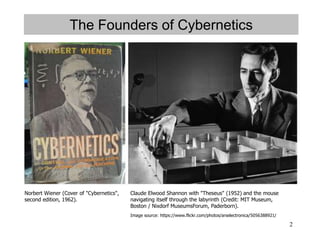
The Founders of Cybernetics
Norbert Wiener (Cover of "Cybernetics",
second edition, 1962).
Claude Elwood Shannon with "Theseus" (1952) and the mouse
navigating itself through the labyrinth (Credit: MIT Museum,
Boston / Nixdorf MuseumsForum, Paderborn).
Image source: https://www.flickr.com/photos/arselectronica/5056388921/
3
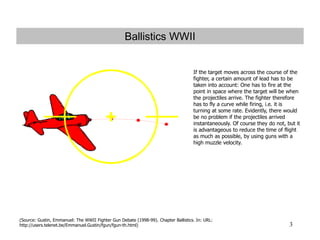
Ballistics WWII
If the target moves across the course of the
fighter, a certain amount of lead has to be
taken into account: One has to fire at the
point in space where the target will be when
the projectiles arrive. The fighter therefore
has to fly a curve while firing, i.e. it is
turning at some rate. Evidently, there would
be no problem if the projectiles arrived
instantaneously. Of course they do not, but it
is advantageous to reduce the time of flight
as much as possible, by using guns with a
high muzzle velocity.
UR
(Source: Gustin, Emmanuel: The WWII Fighter Gun Debate (1998-99). Chapter Ballistics. In: URL:
http://users.telenet.be/Emmanuel.Gustin/fgun/fgun-th.html)
4
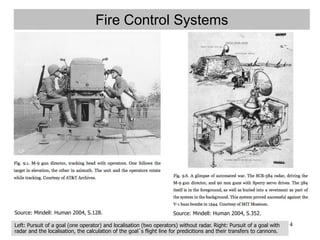
Fire Control Systems
Source: Mindell: Human 2004, S.352.Source: Mindell: Human 2004, S.128.
Left: Pursuit of a goal (one operator) and localisation (two operators) without radar. Right: Pursuit of a goal with
radar and the localisation, the calculation of the goal´s flight line for predicitions and their transfers to cannons.
5
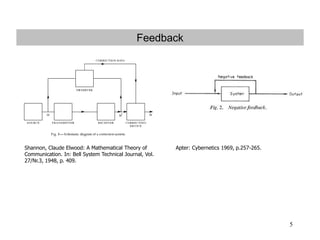
Feedback
Shannon, Claude Elwood: A Mathematical Theory of
Communication. In: Bell System Technical Journal, Vol.
27/Nr.3, 1948, p. 409.
UR
Apter: Cybernetics 1969, p.257-265.
6
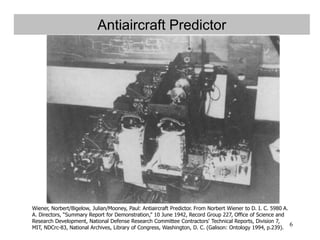
Antiaircraft Predictor
Wiener, Norbert/Bigelow, Julian/Mooney, Paul: Antiaircraft Predictor. From Norbert Wiener to D. I. C. 5980 A.
A. Directors, “Summary Report for Demonstration,” 10 June 1942, Record Group 227, Office of Science and
Research Development, National Defense Research Committee Contractors' Technical Reports, Division 7,
MIT, NDCrc-83, National Archives, Library of Congress, Washington, D. C. (Galison: Ontology 1994, p.239).
7
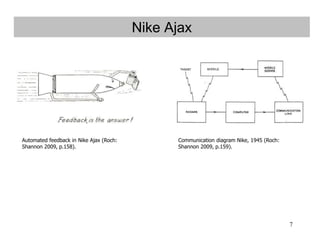
Nike Ajax
Automated feedback in Nike Ajax (Roch:
Shannon 2009, p.158).
Communication diagram Nike, 1945 (Roch:
Shannon 2009, p.159).
8
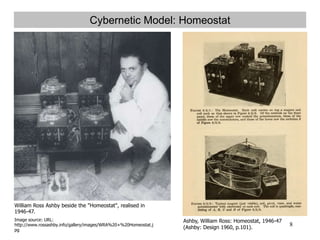
Cybernetic Model: Homeostat
Ashby, William Ross: Homeostat, 1946-47
(Ashby: Design 1960, p.101).
William Ross Ashby beside the "Homeostat", realised in
1946-47.
Image source: URL:
http://www.rossashby.info/gallery/images/WRA%20+%20Homeostat.j
pg
9
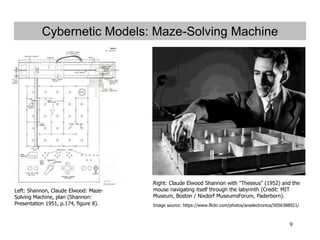
Cybernetic Models: Maze-Solving Machine
Left: Shannon, Claude Elwood: Maze-
Solving Machine, plan (Shannon:
Presentation 1951, p.174, figure 8).
Right: Claude Elwood Shannon with "Theseus" (1952) and the
mouse navigating itself through the labyrinth (Credit: MIT
Museum, Boston / Nixdorf MuseumsForum, Paderborn).
Image source: https://www.flickr.com/photos/arselectronica/5056388921/
10
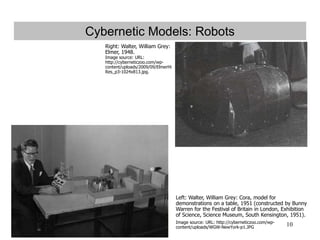
Cybernetic Models: Robots
Right: Walter, William Grey:
Elmer, 1948.
Image source: URL:
http://cyberneticzoo.com/wp-
content/uploads/2009/09/ElmerHi
Res_p3-1024x813.jpg.
Left: Walter, William Grey: Cora, model for
demonstrations on a table, 1951 (constructed by Bunny
Warren for the Festival of Britain in London, Exhibition
of Science, Science Museum, South Kensington, 1951).
Image source: URL: http://cyberneticzoo.com/wp-
content/uploads/WGW-NewYork-p1.JPG
11
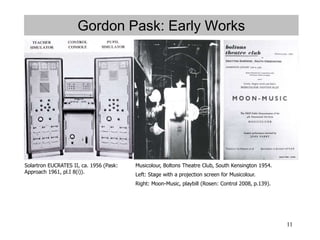
Gordon Pask: Early Works
Solartron EUCRATES II, ca. 1956 (Pask:
Approach 1961, pl.I 8(i)).
Musicolour, Boltons Theatre Club, South Kensington 1954.
Left: Stage with a projection screen for Musicolour.
Right: Moon-Music, playbill (Rosen: Control 2008, p.139).
12
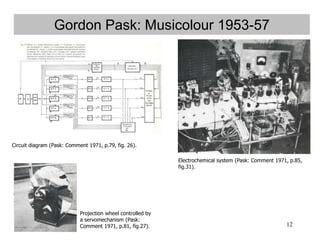
Gordon Pask: Musicolour 1953-57
Circuit diagram (Pask: Comment 1971, p.79, fig. 26).
Electrochemical system (Pask: Comment 1971, p.85,
fig.31).
Projection wheel controlled by
a servomechanism (Pask:
Comment 1971, p.81, fig.27).
13
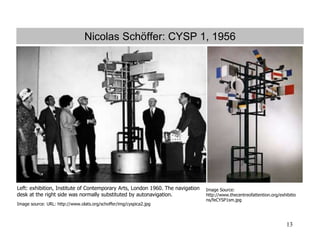
Nicolas Schöffer: CYSP 1, 1956
Left: exhibition, Institute of Contemporary Arts, London 1960. The navigation
desk at the right side was normally substituted by autonavigation.
Image source: URL: http://www.olats.org/schoffer/img/cyspica2.jpg
Image Source:
http://www.thecentreofattention.org/exhibitio
ns/feCYSP1sm.jpg
14
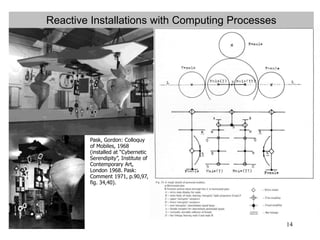
Pask, Gordon: Colloquy
of Mobiles, 1968
(installed at “Cybernetic
Serendipity”, Institute of
Contemporary Art,
London 1968. Pask:
Comment 1971, p.90,97,
fig. 34,40).
Reactive Installations with Computing Processes
15
Word Processing
Left: Link, David: Ferranti Mark I Emulator with Christopher
Strachey´s “Love-letters”, 1952 (Link: Angel 2006, p.16, fig.1).
The stored word library contained a selection from
Roget´s Thesaurus. The words supplied with syntax
indices – "adjectives", "substantives", "adverbs" and
"verbs" – are combined following two syntactical
structures: "My—[Adjective]—Substantive—[Adverb
(adv)]—Verb (verb) —Your—[Adjective]—
Substantive" or "You are my—Adjective (adj)—
Substantive (noun)". In the case of repetitions the
second structure was reduced to "My—Adjective—
Substantive". After a salutation combined by using a
database called "Letter Start" to select words followed
five sentences generated by combinations of stored
words using the syntactical schemes described above.
The end of the letter was constructed with the scheme
"Yours—Adverb—MUC" (MUC = Manchester
University Computer).
Right: Syntax indices of Christopher Strachey´s
“Love-letters”, 1952 (Link: Angel 2006, p.19).
16
Word Processing
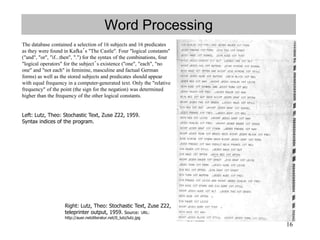
The database contained a selection of 16 subjects and 16 predicates
as they were found in Kafka´s "The Castle". Four "logical constants"
("and", "or", "if...then", ".") for the syntax of the combinations, four
"logical operators" for the subject´s existence ("one", "each", "no
one" and "not each" in feminine, masculine and factual German
forms) as well as the stored subjects and predicates should appear
with equal frequency in a computer-generated text. Only the "relative
frequency" of the point (the sign for the negation) was determined
higher than the frequency of the other logical constants.
Right: Lutz, Theo: Stochastic Text, Zuse Z22,
teleprinter output, 1959. Source: URL:
http://auer.netzliteratur.net/0_lutz/lutz.jpg
Left: Lutz, Theo: Stochastic Text, Zuse Z22, 1959.
Syntax indices of the program.
17
Computer Graphics
Noll, Nees and Nake revived the following procedures of computer literature
being developed by Christopher Strachey, Theo Lutz and a few others:
• The selection of basic elements,
• a random generator,
• determinations of the frequency the program chooses elements, and
• a syntax combining the elements.
18
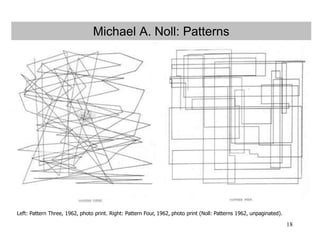
Michael A. Noll: Patterns
Left: Pattern Three, 1962, photo print. Right: Pattern Four, 1962, photo print (Noll: Patterns 1962, unpaginated).
19
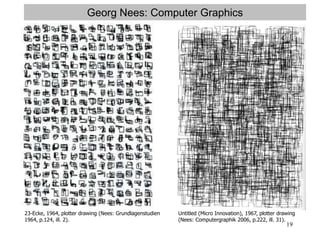
Georg Nees: Computer Graphics
23-Ecke, 1964, plotter drawing (Nees: Grundlagenstudien
1964, p.124, ill. 2).
Untitled (Micro Innovation), 1967, plotter drawing
(Nees: Computergraphik 2006, p.222, ill. 31).
20
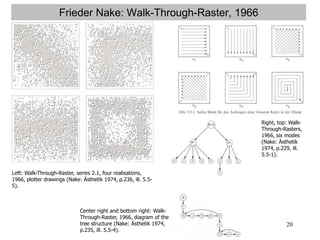
Frieder Nake: Walk-Through-Raster, 1966
Left: Walk-Through-Raster, series 2.1, four realisations,
1966, plotter drawings (Nake: Ästhetik 1974, p.236, ill. 5.5-
5).
Right, top: Walk-
Through-Rasters,
1966, six modes
(Nake: Ästhetik
1974, p.229, ill.
5.5-1).
Center right and bottom right: Walk-
Through-Raster, 1966, diagram of the
tree structure (Nake: Ästhetik 1974,
p.235, ill. 5.5-4).
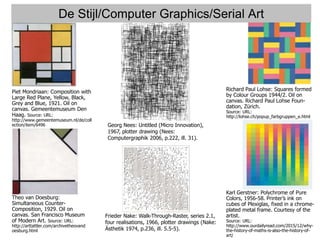
Piet Mondriaan: Composition with
Large Red Plane, Yellow, Black,
Grey and Blue, 1921. Oil on
canvas. Gemeentemuseum Den
Haag. Source: URL:
http://www.gemeentemuseum.nl/de/coll
ection/item/6496
Theo van Doesburg:
Simultaneous Counter-
Composition, 1929. Oil on
canvas. San Francisco Museum
of Modern Art. Source: URL:
http://arttattler.com/archivetheovand
oesburg.html
Karl Gerstner: Polychrome of Pure
Colors, 1956-58. Printer’s ink on
cubes of Plexiglas, fixed in a chrome-
plated metal frame. Courtesy of the
artist.
Source: URL:
http://www.ourdailyread.com/2015/12/why-
the-history-of-maths-is-also-the-history-of-
art/
Richard Paul Lohse: Squares formed
by Colour Groups 1944/2. Oil on
canvas. Richard Paul Lohse Foun-
dation, Zürich.
Source: URL:
http://lohse.ch/popup_farbgruppen_e.html
Georg Nees: Untitled (Micro Innovation),
1967, plotter drawing (Nees:
Computergraphik 2006, p.222, ill. 31).
De Stijl/Computer Graphics/Serial Art
Frieder Nake: Walk-Through-Raster, series 2.1,
four realisations, 1966, plotter drawings (Nake:
Ästhetik 1974, p.236, ill. 5.5-5).
22
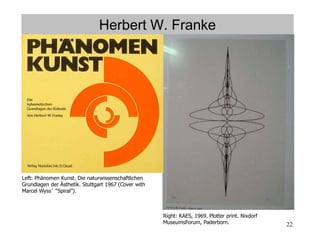
Herbert W. Franke
Right: KAES, 1969. Plotter print. Nixdorf
MuseumsForum, Paderborn.
Left: Phänomen Kunst. Die naturwissenschaftlichen
Grundlagen der Ästhetik. Stuttgart 1967 (Cover with
Marcel Wyss´ “Spiral”).
LiteraturBibliography with informations about the abbreviations used in the captions:
Dreher, Thomas: Cybernetics and the Pioneers of Computer Art. Chapter Bibliography. In: URL:
http://dreher.netzliteratur.net/4_Medienkunst_Kybernetike.html
8

Cybernetics and the Pioneers of Computer Art

  • 1.
    1 Cybernetics and thePioneers of Computer Art Base Two Lecture, part of the series of events “Base Two” commemorating the 300th anniversary of Gottfried Wilhelm Leibniz´s death Sprengel Museum Hannover, 19.10.2016 Thomas Dreher URL: http://dreher.netzliteratur.net URL: http://dreher.netzliteratur.net/4_Medienkunst_Kybernetik.html
  • 2.
    2 The Founders ofCybernetics Norbert Wiener (Cover of "Cybernetics", second edition, 1962). Claude Elwood Shannon with "Theseus" (1952) and the mouse navigating itself through the labyrinth (Credit: MIT Museum, Boston / Nixdorf MuseumsForum, Paderborn). Image source: https://www.flickr.com/photos/arselectronica/5056388921/
  • 3.
    3 Ballistics WWII If thetarget moves across the course of the fighter, a certain amount of lead has to be taken into account: One has to fire at the point in space where the target will be when the projectiles arrive. The fighter therefore has to fly a curve while firing, i.e. it is turning at some rate. Evidently, there would be no problem if the projectiles arrived instantaneously. Of course they do not, but it is advantageous to reduce the time of flight as much as possible, by using guns with a high muzzle velocity. UR (Source: Gustin, Emmanuel: The WWII Fighter Gun Debate (1998-99). Chapter Ballistics. In: URL: http://users.telenet.be/Emmanuel.Gustin/fgun/fgun-th.html)
  • 4.
    4 Fire Control Systems Source:Mindell: Human 2004, S.352.Source: Mindell: Human 2004, S.128. Left: Pursuit of a goal (one operator) and localisation (two operators) without radar. Right: Pursuit of a goal with radar and the localisation, the calculation of the goal´s flight line for predicitions and their transfers to cannons.
  • 5.
    5 Feedback Shannon, Claude Elwood:A Mathematical Theory of Communication. In: Bell System Technical Journal, Vol. 27/Nr.3, 1948, p. 409. UR Apter: Cybernetics 1969, p.257-265.
  • 6.
    6 Antiaircraft Predictor Wiener, Norbert/Bigelow,Julian/Mooney, Paul: Antiaircraft Predictor. From Norbert Wiener to D. I. C. 5980 A. A. Directors, “Summary Report for Demonstration,” 10 June 1942, Record Group 227, Office of Science and Research Development, National Defense Research Committee Contractors' Technical Reports, Division 7, MIT, NDCrc-83, National Archives, Library of Congress, Washington, D. C. (Galison: Ontology 1994, p.239).
  • 7.
    7 Nike Ajax Automated feedbackin Nike Ajax (Roch: Shannon 2009, p.158). Communication diagram Nike, 1945 (Roch: Shannon 2009, p.159).
  • 8.
    8 Cybernetic Model: Homeostat Ashby,William Ross: Homeostat, 1946-47 (Ashby: Design 1960, p.101). William Ross Ashby beside the "Homeostat", realised in 1946-47. Image source: URL: http://www.rossashby.info/gallery/images/WRA%20+%20Homeostat.j pg
  • 9.
    9 Cybernetic Models: Maze-SolvingMachine Left: Shannon, Claude Elwood: Maze- Solving Machine, plan (Shannon: Presentation 1951, p.174, figure 8). Right: Claude Elwood Shannon with "Theseus" (1952) and the mouse navigating itself through the labyrinth (Credit: MIT Museum, Boston / Nixdorf MuseumsForum, Paderborn). Image source: https://www.flickr.com/photos/arselectronica/5056388921/
  • 10.
    10 Cybernetic Models: Robots Right:Walter, William Grey: Elmer, 1948. Image source: URL: http://cyberneticzoo.com/wp- content/uploads/2009/09/ElmerHi Res_p3-1024x813.jpg. Left: Walter, William Grey: Cora, model for demonstrations on a table, 1951 (constructed by Bunny Warren for the Festival of Britain in London, Exhibition of Science, Science Museum, South Kensington, 1951). Image source: URL: http://cyberneticzoo.com/wp- content/uploads/WGW-NewYork-p1.JPG
  • 11.
    11 Gordon Pask: EarlyWorks Solartron EUCRATES II, ca. 1956 (Pask: Approach 1961, pl.I 8(i)). Musicolour, Boltons Theatre Club, South Kensington 1954. Left: Stage with a projection screen for Musicolour. Right: Moon-Music, playbill (Rosen: Control 2008, p.139).
  • 12.
    12 Gordon Pask: Musicolour1953-57 Circuit diagram (Pask: Comment 1971, p.79, fig. 26). Electrochemical system (Pask: Comment 1971, p.85, fig.31). Projection wheel controlled by a servomechanism (Pask: Comment 1971, p.81, fig.27).
  • 13.
    13 Nicolas Schöffer: CYSP1, 1956 Left: exhibition, Institute of Contemporary Arts, London 1960. The navigation desk at the right side was normally substituted by autonavigation. Image source: URL: http://www.olats.org/schoffer/img/cyspica2.jpg Image Source: http://www.thecentreofattention.org/exhibitio ns/feCYSP1sm.jpg
  • 14.
    14 Pask, Gordon: Colloquy ofMobiles, 1968 (installed at “Cybernetic Serendipity”, Institute of Contemporary Art, London 1968. Pask: Comment 1971, p.90,97, fig. 34,40). Reactive Installations with Computing Processes
  • 15.
    15 Word Processing Left: Link,David: Ferranti Mark I Emulator with Christopher Strachey´s “Love-letters”, 1952 (Link: Angel 2006, p.16, fig.1). The stored word library contained a selection from Roget´s Thesaurus. The words supplied with syntax indices – "adjectives", "substantives", "adverbs" and "verbs" – are combined following two syntactical structures: "My—[Adjective]—Substantive—[Adverb (adv)]—Verb (verb) —Your—[Adjective]— Substantive" or "You are my—Adjective (adj)— Substantive (noun)". In the case of repetitions the second structure was reduced to "My—Adjective— Substantive". After a salutation combined by using a database called "Letter Start" to select words followed five sentences generated by combinations of stored words using the syntactical schemes described above. The end of the letter was constructed with the scheme "Yours—Adverb—MUC" (MUC = Manchester University Computer). Right: Syntax indices of Christopher Strachey´s “Love-letters”, 1952 (Link: Angel 2006, p.19).
  • 16.
    16 Word Processing The databasecontained a selection of 16 subjects and 16 predicates as they were found in Kafka´s "The Castle". Four "logical constants" ("and", "or", "if...then", ".") for the syntax of the combinations, four "logical operators" for the subject´s existence ("one", "each", "no one" and "not each" in feminine, masculine and factual German forms) as well as the stored subjects and predicates should appear with equal frequency in a computer-generated text. Only the "relative frequency" of the point (the sign for the negation) was determined higher than the frequency of the other logical constants. Right: Lutz, Theo: Stochastic Text, Zuse Z22, teleprinter output, 1959. Source: URL: http://auer.netzliteratur.net/0_lutz/lutz.jpg Left: Lutz, Theo: Stochastic Text, Zuse Z22, 1959. Syntax indices of the program.
  • 17.
    17 Computer Graphics Noll, Neesand Nake revived the following procedures of computer literature being developed by Christopher Strachey, Theo Lutz and a few others: • The selection of basic elements, • a random generator, • determinations of the frequency the program chooses elements, and • a syntax combining the elements.
  • 18.
    18 Michael A. Noll:Patterns Left: Pattern Three, 1962, photo print. Right: Pattern Four, 1962, photo print (Noll: Patterns 1962, unpaginated).
  • 19.
    19 Georg Nees: ComputerGraphics 23-Ecke, 1964, plotter drawing (Nees: Grundlagenstudien 1964, p.124, ill. 2). Untitled (Micro Innovation), 1967, plotter drawing (Nees: Computergraphik 2006, p.222, ill. 31).
  • 20.
    20 Frieder Nake: Walk-Through-Raster,1966 Left: Walk-Through-Raster, series 2.1, four realisations, 1966, plotter drawings (Nake: Ästhetik 1974, p.236, ill. 5.5- 5). Right, top: Walk- Through-Rasters, 1966, six modes (Nake: Ästhetik 1974, p.229, ill. 5.5-1). Center right and bottom right: Walk- Through-Raster, 1966, diagram of the tree structure (Nake: Ästhetik 1974, p.235, ill. 5.5-4).
  • 21.
    Piet Mondriaan: Compositionwith Large Red Plane, Yellow, Black, Grey and Blue, 1921. Oil on canvas. Gemeentemuseum Den Haag. Source: URL: http://www.gemeentemuseum.nl/de/coll ection/item/6496 Theo van Doesburg: Simultaneous Counter- Composition, 1929. Oil on canvas. San Francisco Museum of Modern Art. Source: URL: http://arttattler.com/archivetheovand oesburg.html Karl Gerstner: Polychrome of Pure Colors, 1956-58. Printer’s ink on cubes of Plexiglas, fixed in a chrome- plated metal frame. Courtesy of the artist. Source: URL: http://www.ourdailyread.com/2015/12/why- the-history-of-maths-is-also-the-history-of- art/ Richard Paul Lohse: Squares formed by Colour Groups 1944/2. Oil on canvas. Richard Paul Lohse Foun- dation, Zürich. Source: URL: http://lohse.ch/popup_farbgruppen_e.html Georg Nees: Untitled (Micro Innovation), 1967, plotter drawing (Nees: Computergraphik 2006, p.222, ill. 31). De Stijl/Computer Graphics/Serial Art Frieder Nake: Walk-Through-Raster, series 2.1, four realisations, 1966, plotter drawings (Nake: Ästhetik 1974, p.236, ill. 5.5-5).
  • 22.
    22 Herbert W. Franke Right:KAES, 1969. Plotter print. Nixdorf MuseumsForum, Paderborn. Left: Phänomen Kunst. Die naturwissenschaftlichen Grundlagen der Ästhetik. Stuttgart 1967 (Cover with Marcel Wyss´ “Spiral”).
  • 23.
    LiteraturBibliography with informationsabout the abbreviations used in the captions: Dreher, Thomas: Cybernetics and the Pioneers of Computer Art. Chapter Bibliography. In: URL: http://dreher.netzliteratur.net/4_Medienkunst_Kybernetike.html 8