1
INTERFEROMETERS
HISTORY
SOLO HERMELIN
Updated: 6.01.11
4.01.15
http://www.solohermelin.com
2
InterferenceSOLO
Table of Content
Introduction
Haidinger Fringes
Fizeau Experiment
Jamin’s Interferometer
Fizeau Experiment in Moving Media and Fizeau Interferometer
Foucault Experiment
Michelson Interferometer
Mach-Zehnder Interferometer
Rayleigh’s Interferometer
Sirks-Pringsheim Interferometer
Fabry – Perot Interferometer
Sagnac Effect
Twyman-Green Interferometer
Michelson’s Experiments
Dyson’s Interferometer
Hanbury-Brown and Twiss Interferometer
Gires-Tournois Etalon
3
InterferenceSOLO
Table of Content (continue – 1)
Interference of Two Monochromatic Waves
Two Basic Classes of Interferometers
Fresnel’s Double Mirror (1819*)
Fresnel’s Double Prism
Lloyd’s Mirror Interferometer
Young’s Experiment
Division of Wavefront
Optical Reflected Path Length Difference: Parallel Interfaces
Amplitude Split Interferometers
Stokes Treatment of Reflection and Refraction
Optical Transmitted Path Length Difference: Parallel Interfaces
Haidinger Interference Fringes
Interference of Many Monochromatic Waves
Gas Refrectometer
References
4
InterferenceSOLO
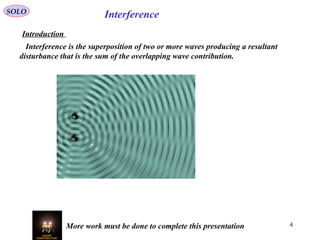
Introduction
Interference is the superposition of two or more waves producing a resultant
disturbance that is the sum of the overlapping wave contribution.
More work must be done to complete this presentation
5
SOLO Diffraction
The Grimaldi’s description of diffraction was published in
1665 , two years after his death: “Physico-Mathesis de lumine,
Coloribus et iride”
Francesco M. Grimaldi, S.J. (1613 – 1663) professor of mathematics and physics at the
Jesuit college in Bolognia discovered the diffraction of light and gave it the name
diffraction, which means “breaking up”.
http://www.faculty.fairfield.edu/jmac/sj/scientists/grimaldi.htm
“When the light is incident on a smooth white surface it will
show an illuminated base IK notable greater than the rays
would make which are transmitted in straight lines through
the two holes. This is proved as often as the experiment is
trayed by observing how great the base IK is in fact and
deducing by calculation how great the base NO ought to be
which is formed by the direct rays. Furter it should not be
omitted that the illuminated base IK appears in the middle
suffused with pure light, and either extremity its light is
colored.”
Single Slit
Diffraction
Double Slit
Diffraction
http://en.wikipedia.org/wiki/Francesco_Maria_Grimaldi
1665
6
SOLO Microscope
Robert Hooke (1635-1703) work in microscopy is described in Micrographia published
in 1665. Contains investigations of the colours of thin plates of mica, a theory of light as
a transverse vibration motion (in 1672).
1665
Robert Hooke
(1635-1703)
Robert Hooke’s compound
microscope: on the left
the illumination device
(an oil lamp), on
the right the microscope.
Robert Hooke reports in
Micrographia the discovery of
the rings of light formed by a
layer of air between two glass
plates, first observed by Robert
Boyle. In the same work he
gives the matching-wave-front
derivation of reflection and
refraction. The waves travel
through aeter.
Robert Hooke also assumed
that the white light is a simple
disturbance and colors are
complex distortion of the white
light. This theory was refuted
later by Newton.
7
OpticsSOLO
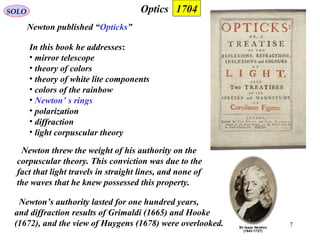
Newton published “Opticks”
1704
In this book he addresses:
• mirror telescope
• theory of colors
• theory of white lite components
• colors of the rainbow
• Newton’ s rings
• polarization
• diffraction
• light corpuscular theory
Newton threw the weight of his authority on the
corpuscular theory. This conviction was due to the
fact that light travels in straight lines, and none of
the waves that he knew possessed this property.
Newton’s authority lasted for one hundred years,
and diffraction results of Grimaldi (1665) and Hooke
(1672), and the view of Huygens (1678) were overlooked.
8
InterferenceSOLO
Newton Fringes
Colllimator
Lens
Beam-
splitter Point
Source
Viewing
Screen
Optical
flat
Circular
fringes
Black
Surface
9
OpticsSOLO
History (continue)
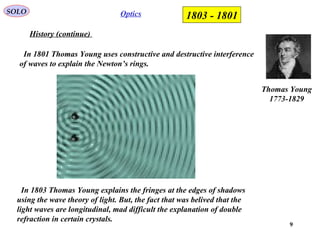
In 1801 Thomas Young uses constructive and destructive interference
of waves to explain the Newton’s rings.
Thomas Young
1773-1829
1801-1803
In 1803 Thomas Young explains the fringes at the edges of shadows
using the wave theory of light. But, the fact that was belived that the
light waves are longitudinal, mad difficult the explanation of double
refraction in certain crystals.
10
POLARIZATIONSOLO
History
In 1802 William Hyde Wollaston discovered that the sun spectrum
is composed by a number of dark lines, but the interpretation of this
phenomenon was done by Fraunhofer in 1814. Wollaston developed
In 1802 the refractometer, an instrument used to measure the refractive
index. The refractometer wa used by Wollaston to verify the laws of
double refraction in Iceland spar, on which he wrote a treatise.
Wollaston Prism
In 1807 William Hyde Wollaston developed the four-sided Wollaston prism, used
in microscopy.
1802-1807
11
SOLO
History
In 1813 Joseph Fraunhofer rediscovered William Hyde Wollaston’s
dark lines in the solar system, which are known as Fraunhofer’s lines.
He began a systematic measurement of the wavelengths of the solar
Spectrum, by mapping 570 lines.
Diffraction
http://www.musoptin.com/spektro1.html
1813
Fraunhofer Telescope.
Fraunhofer placed a narrow slit in front of a prism and viewed the spectrum of light
passing through this combination with a small telescope eypiece. By this technique he
was able to investigate the spectrum bit by bit, color by color.
12
SOLO
Between 1805 and 1815 Laplace, Biot and (in part) Malus created an elaborate
mathematical theory of light, based on the notion that light rays are streams of particles
that interact with the particles of matter by short range forces. By suitably modifying
Newton’s original emission theory of light and applying superior mathematical
methods, they were able to explain most of the known optical phenomena, including
the effect of double refraction (Laplace 1808) which had been the focus of Huyghen’s
work.
Diffraction
http://microscopy.fsu.edu/optics/timeline/people/gregory.html
http://www.schillerinstitute.org/fid_97-01/993poisson_jbt.html
Pierre-Simon Laplace
(1749-1827)
1805-1815
In 1817, expecting to soon celebrate the final triumph of their neo-Newtonian optics,
Laplace and Biot arranged for the physics prize of the French Academy of Science to
be proposed for the best work on theme of diffraction – the apparent bending of light
rays at the boundaries between different media.”
13
SOLO
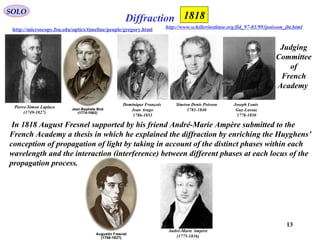
In 1818 August Fresnel supported by his friend André-Marie Ampère submitted to the
French Academy a thesis in which he explained the diffraction by enriching the Huyghens’
conception of propagation of light by taking in account of the distinct phases within each
wavelength and the interaction (interference) between different phases at each locus of the
propagation process.
Diffraction
http://microscopy.fsu.edu/optics/timeline/people/gregory.html http://www.schillerinstitute.org/fid_97-01/993poisson_jbt.html
André-Marie Ampère
(1775-1836)
Dominique François
Jean Arago
1786-1853
Siméon Denis Poisson
1781-1840
Pierre-Simon Laplace
(1749-1827)
Joseph Louis
Guy-Lussac
1778-1850
Judging
Committee
of
French
Academy
1818
14
SOLO
Diffraction
http://microscopy.fsu.edu/optics/timeline/people/gregory.html http://www.schillerinstitute.org/fid_97-01/993poisson_jbt.html
Dominique François
Jean Arago
1786-1853
Siméon Denis Poisson a French Academy member rise the objection that if the Fresnel
construction is valid a bright spot would have to appear in the middle of the shadow cast by a
spherical or disc-shaped object, when illuminated, and this is absurd.
Soon after the meeting, Dominique Francois Arago, one of the judges for the Academy
competition, did the experiment and there was the bright spot in the middle of the shadow.
Fresnel was awarded the prize in the competition.
Siméon Denis Poisson
1781-1840
Poisson’s or Arago’s Spot
1818
15
POLARIZATION
Arago and Fresnel investigated the interference of
polarized rays of light and found in 1816 that two
rays polarized at right angles to each other never
interface.
SOLO
History (continue)
Dominique François
Jean Arago
1786-1853
Augustin Jean
Fresnel
1788-1827
Arago relayed to Thomas Young in London the results
of the experiment he had performed with Fresnel. This
stimulate Young to propose in 1817 that the oscillations
in the optical wave where transverse, or perpendicular
to the direction of propagation, and not longitudinal as
every proponent of wave theory believed. Thomas Young
1773-1829
1816-1817
longitudinal
waves
transversal
waves
16
DiffractionSOLO
History of Diffraction
Augustin Jean
Fresnel
1788-1827
In 1818 Fresnel, by using Huygens’ concept of secondary wavelets
and Young’s explanation of interface, developed the diffraction
theory of scalar waves.
1818
17
DiffractionSOLO
Augustin Jean
Fresnel
1788-1827
In 1818 Fresnel, by using Huygens’ concept of secondary wavelets
and Young’s explanation of interface, developed the diffraction
theory of scalar waves.
P
0P
Q 1x
0x
1y
0y
η
ξ
Fr

Sr

ρ
 r

O
'θ
θ
Screen
Image
plane
Source
plane
0O
1O
Sn1
Σ
Σ - Screen Aperture
Sn1 - normal to Screen
From a source P0 at a distance from a aperture a spherical wavelet
propagates toward the aperture: ( ) ( )Srktj
S
source
Q e
r
A
tU −
= '
' ω
According to Huygens Principle second wavelets will start at the aperture and will add
at the image point P.
( ) ( ) ( )( )
( ) ( )( )
∫∫ Σ
++−
Σ
+−−
== dre
rr
A
Kdre
r
U
KtU rrktj
S
sourcerkttjQ
P
S 2/2/'
',', πωπω
θθθθ
where: ( )',θθK obliquity or inclination factor ( ) ( )SSS nrnr 11cos&11cos' 11
⋅=⋅= −−
θθ
( )
( )


===
===
0',0
max0',0
πθθ
θθ
K
K Obliquity factor and π/2 phase were introduced by Fresnel to explain
experiences results.
Fresnel Diffraction Formula
Fresnel took in consideration the phase of each wavelet to obtain:
18
SOLO
History
In 1821 Joseph Fraunhofer build the first diffraction grating,
made up of 260 close parallel wires. Latter he built a diffraction
grating using 10,000 parallel lines per inch.
Diffraction
Utzshneider, Fraunhfer, Reichenbach, Mertz
http://www.musoptin.com/fraunhofer.html
1821-1823
In 1823 Fraunhofer published his theory of diffraction.
http://micro.magnet.fsu.edu/optics/timeline/people/fraunhofer.html
19
SOLO ELECTROMAGNETICS
Conical Refraction on the Optical Axis (continue – 2)
Take a biaxial crystal and cut it so that two parallel faces
are perpendicular to the Optical Axis. If a monochromatic
unpolarized light is normal to one of the crystal faces, the
energy will spread out in the plate in a hollow cone, the
cone of internal conical refraction.
When the light exits the crystal the energy and wave
directions coincide, and the light will form a hollow cylinder.
This phenomenon was predicted by William Rowan Hamilton
in 1832 and confirmed experimentally by Humphrey Lloyd,
a year later (Born & Wolf).
Because it is no easy to obtain an accurate parallel beam of
monochromatic light on obtained two bright circles
(Born & Wolf).
1832
William Rowan
Hamilton
(1805-1855)
Humphrey Lloyd
(1800-1881)
20
SOLO
Airy Rings
In 1835, Sir George Biddell Airy, developed the formula for diffraction pattern,
of an image of a point source in an aberration-free optical system, using the wave
theory.
E. Hecht, “Optics”
Diffraction 1835
21
InterferenceSOLO
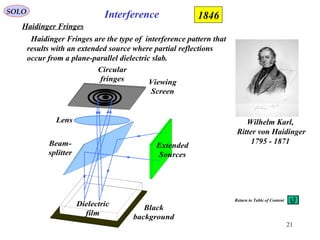
Haidinger Fringes
1846
Wilhelm Karl,
Ritter von Haidinger
1795 - 1871
Lens
Beam-
splitter
Extended
Sources
Viewing
Screen
Dielectric
film
Black
background
Circular
fringes
Haidinger Fringes are the type of interference pattern that
results with an extended source where partial reflections
occur from a plane-parallel dielectric slab.
Return to Table of Content
22
SOLO
Fizeau Experiment
Armand Hyppolite Louise Fizeau used, in 1849,an apparatus
consisted of a rotating toothed wheel and a mirror at a distance
of 8833 m.
Speed of Light
A toothed wheel rotated at the focal point of the lens L2 in Figure above. A pulse of
light passes at the opening between teeth passes through L2 and is returned by the
spherical mirror back to the toothed wheel. The rotation speed of the wheel is adjusted
such that the light can either pass or be obstructed by a tooth (it was 25 rev/sec). The
apparatus is not very accurate since the received light intensity must be minimized to
obtain the light velocity.
Fizeau obtained 315,300 km/sec for the light velocity.
( ) ( ) st 000,18/125/1720/1 =⋅= skm
t
d
v /000,311
000,18/1
633,822
=
⋅
==
1849
Return to Table of Content
23
InterferenceSOLO
Jamin’s Interferometer
1856
J. Jamin, C.R. Acad. Sci. Paris, 42, p.482, 1856
Jules Célestin Jamin
1818 - 1886
S
2
T
1
T 1C
2C
D
D
1
C 2C
E
1G
2
G
1
2
Jamin's Interferometer
In the Jamin’s Interferometer a monochromatic
light from a broad source S is broken into two
parallel beams by two parallel faces of a tick plate
of glass G1. These two rays pass through to
another identical plate of glass G2 to recombine
after reflection, forming interference fringes. If
the plates are parallel the paths are identical.
To measure the refractive index of a gas as
function of presure and temperature, two identical
empty tubes T1 and T2 are placed in the two
parallel beams.
The gas is slowly introduced in one of the tube.
The number of fringes Δm is counted when the
gas reaches the desired pressure and temperature.
The compensating plates C1 and C2, of equal
thickness are rotated by the single knob D. One
path length is shorted the other lengthened to
compensate the difference between the paths.
Return to Table of Content
24
SOLO
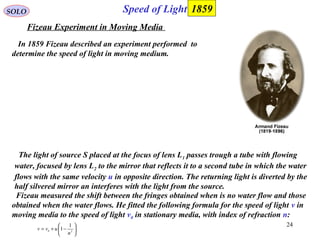
Fizeau Experiment in Moving Media
In 1859 Fizeau described an experiment performed to
determine the speed of light in moving medium.
Speed of Light
The light of source S placed at the focus of lens L1 passes trough a tube with flowing
water, focused by lens L2 to the mirror that reflects it to a second tube in which the water
flows with the same velocity u in opposite direction. The returning light is diverted by the
half silvered mirror an interferes with the light from the source.
Fizeau measured the shift between the fringes obtained when is no water flow and those
obtained when the water flows. He fitted the following formula for the speed of light v in
moving media to the speed of light v0 in stationary media, with index of refraction n:






−+= 20
1
1
n
uvv
1859
25
InterferenceSOLO
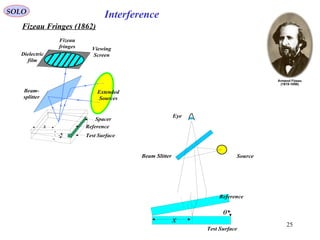
Fizeau Fringes (1862)
Spacer
Beam-
splitter
Extended
Sources
Viewing
ScreenDielectric
film
Fizeau
fringes
x
α
1n
f
n
2
n
Reference
Test Surface
Test Surface
Reference
Beam Slitter
Eye
Source
θ
x
26
InterferenceSOLO
Fizeau Fringes (1862)
Spacer
Beam-
splitter
Extended
Sources
Viewing
ScreenDielectric
film
Fizeau
fringes
x
α
1n
f
n
2
n
Reference
Test Surface
27
InterferenceSOLO
Fizeau Interferometer
1862
Fizeau, C.R. Acad. Sci. Paris, 66, p.429, 1862
J.C. Wyant, “Introduction to Interferometric Optical Testing (SC213)”, Optical Science Center, University
of Arizona, http://www.optics.arizona.edu
Return to Table of Content
28
SOLO
Foucault Experiment
Foucault working with Fizeau improved the apparatus by replacing
the toothed wheel with a rotating mirror. In 1850 Foucault used the
improved apparatus to measure the speed of light in air and in water.
In 1862 he used an improved version to give an accurate measurement
of speed of light in air.
Speed of Light
The solar light passes trough half silvered mirror, through lens L. It is reflected by the
Rotating mirror to a Spherical Mirror at a distance of d = 20 m, back to rotating mirror,
through L to half silvered mirror to the Display. When the rotting mirror is stationary the
ray reaches the point A on the Display. When the rotting mirror is rotating at angular rate
ω, the ray to the spherical mirror will change direction by an angle α = ωτ (τ = d/c)
and the displayed ray by an angle 2 α, reaching point A’ on the Display.
1850-1862
29
SOLO
Foucault Experiment (continue – 1)
Speed of Light
http://micro.magnet.fsu.edu/primer/lightandcolor/speedoflight.html
The Spherical Mirror was at a distance d = 20 m from the Rotating Mirror, that rotated
at 1,000 revolutions per second, given a displacement of AA’ of 1 mm.
The speed of light obtained by Foucault was 298,000 km/sec.
In 1850 Foucault completed the measurement of speed of light in water.
Newton’s corpuscular light model required that the speed of light in optically dense
media be greater than in air, whereas the wave theory, as initiated by Huyghens,
correctly predicted that the speed of light must be smaller in optically dense media,
and this was verified by Foucault experiments.
Return to Table of Content
30
SOLO
Michelson Interferometer – Interference Fringes
Interference 1882 Nobel Prize 1907
José Antonio Diaz Navas
http://www.ugr.es/~jadiaz/
















+







 +
++= π
λ
π
f
yx
dIIIII
22
2121 2cos
2
cos2
I – intensity of the interference fringes
I1, I2 – intensity of the intensities of the two beams
λ – wavelength
d – path length difference between the two
interferometers arms
x,y – coordinates of the focal plane of a lens of
focal length f
“Interference Phenomena in a new form of Refractometer”,
American J. of Science (3), 23, (1882), pp.392-400 and
Philos. Mag. (5) 13 (1892), pp.236-242
31
SOLO
Michelson Interferometer – Broad Source
Interference 1882 Nobel Prize 1907
José Antonio Diaz Navas
http://www.ugr.es/~jadiaz/
[ ] 















+







 +




















+∆
−++= π
λ
π
υπ
f
yx
d
Logc
yx
f
d
IIIII
22
22
2121 2cos
2
cos
2
1
cos
exp2
I – intensity of the interference fringes
I1, I2 – intensity of the intensities of the two beams
λ, c – wavelength, speed of light
d – path length difference between the two
interferometers arms
x,y – coordinates of the focal plane of a lens of
focal length f
The intensity of the interference fringes for a Michelson interferometer having a source emitting
with a Gaussian profile having a bandwidth of Δν is given by
32
SPECIAL RELATIVITY
Michelson and Morley Experiment
Albert Abraham
Michelson
1852 - 1931
Edward W. Morley
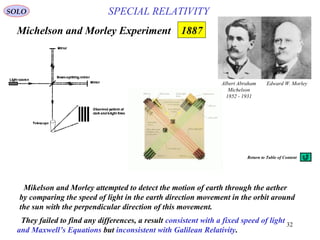
Mikelson and Morley attempted to detect the motion of earth through the aether
by comparing the speed of light in the earth direction movement in the orbit around
the sun with the perpendicular direction of this movement.
They failed to find any differences, a result consistent with a fixed speed of light
and Maxwell’s Equations but inconsistent with Galilean Relativity.
SOLO
1887
Return to Table of Content
33
Interferometers
SOLO
Ernst Mach and Ludwig Zehnder separately described what has become
the Mach-Zehnder Interferometer.
1891/92
Ludwig Louis Albert
Zehnder
1854-1949
Ernst Waldfried Joseph Wenzel
Mach
1838 - 1916
Ernst Mach. “Modifikation und Anwendung des Jamin Interferenz-Refraktometers”.
Anz. Acad. Wiss. Wien math. Naturwiss. Klasse 28, p.223-224, 1981
Ludwig Zehnder, “Ein neuer Interferenzrefractor”, Z.Instrumentenkd. 11, p.275-285,
1981
Mach-Zehnder Interferometer
Return to Table of Content
34
InterferenceSOLO
Sirks-Pringsheim Interferometer
1893/1898
J. A. Sirks, Hd. Ned. Nat. en Geneesk. Congr., Groningen, p. 92, 1893
E. Pringsheim, Verh. Phys. Ges., Berlin, p. 152, 1898
A variant of the Jamin interferometer, using plates
which are slightly wedge shaped instead of plane
parallel, was developed by Sirks and later by
Pringsheim for the refractive index of small objects.
Corresponding to an incident ray SA in a principal
section of the wedges, the two rays SABCG, SADEF
which leave the second plate intersect virtually at a
point P behind the second plate. With a quasi-
monochromatic source there fringes apparently
localized in the vicinity of P, which can be observed
with the microscope M. The fringes at P run at
right angles to the plane defined by the two
emergent rays, i.e. parallel to the wedge apexes. The
Object O to be examined is placed between the
plates in the path of the ray CG. The image P’ of P
in the front of the surface of the second plate also
lies on CG, at a position which depends on the
inclination of the plates. Return to Table of Content
35
InterferenceSOLO
Rayleigh’s Interferometer
1896
Lord Rayleigh, Proc. Roy. Soc.,59, p. 198, 1896
Nobel Prize 1904
Rayleigh’s Interferometer is used to measure the refractive
index of a gas. His refractometer is based on Young’s double
slit interferometer. The two coherent rays passing through the
slits S1 and S2, from the single source S passed through the
tubes T1 and T2 filed with the gas.
When the pressure of the gas is changed in on of the tube a
difference in the refraction index occurs, the optical paths of
the two rays change and the fringe system, viewed at the
eyepiece E located at the focus of the second lens, changes.
A count of the fringes as they moved
provides a measurement of optical path
change, therefore of the refractive index.
The compensating plates C1 and C2, of equal
thickness are rotated by the single knob D. One
path length is shorted the other lengthened to
compensate the difference between the paths.
S
1S
2
S
2
T
1
T
f
1C
2
C
D
D
1C 2C
E
Rayleigh's Interferometer
Return to Table of Content
36
InterferenceSOLO
Fabry – Perot Interferometer
1899
http://en.wikipedia.org/wiki/Fabry-Perot_interferometer
Marie P. A.C. Fabry and Jean B.A. Perot (France)
developed the Fabry – Perot Interferometer
Jean-Baptiste Alfred
Perot
1863 – 1925
Marie P. A.C. Fabry and Jean B.A. Perot,
“Théory et applications d’une nouvelle méthode de spectroscopie
interférentielle”, Ann. Chim. Phys. (7), 16, p.115-144, 1899
http://www.daviddarling.info/encyclopedia/F/Fabry.html
Marie Paul August Charles
Fabry
1867 – 1945
http://www.patrimoine.polytechnique.fr/collectionhomme/portrait/fabrybig.jpg
This interferometer makes use of multiple reflections between two closely spaced
partially silvered surfaces. Part of the light is transmitted each time the light
reaches the second surface, resulting in multiple offset beams which can
interfere with each other. The large number of interfering rays produces an
interferometer with extremely high resolution, somewhat like the multiple slits
of a diffraction grating increase its resolution.
http://hyperphysics.phy-astr.gsu.edu/hbase/phyopt/fabry.html
Return to Table of Content
3737
Optics History
SOLO
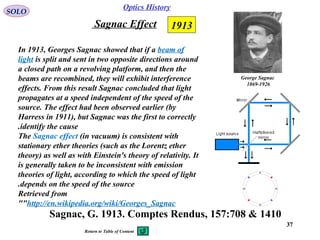
Sagnac, G. 1913. Comptes Rendus, 157:708 & 1410
1913Sagnac Effect
In 1913, Georges Sagnac showed that if a beam of
light is split and sent in two opposite directions around
a closed path on a revolving platform, and then the
beams are recombined, they will exhibit interference
effects. From this result Sagnac concluded that light
propagates at a speed independent of the speed of the
source. The effect had been observed earlier (by
Harress in 1911), but Sagnac was the first to correctly
identify the cause.
The Sagnac effect (in vacuum) is consistent with
stationary ether theories (such as the Lorentz ether
theory) as well as with Einstein's theory of relativity. It
is generally taken to be inconsistent with emission
theories of light, according to which the speed of light
depends on the speed of the source.
Retrieved from
"http://en.wikipedia.org/wiki/Georges_Sagnac"
George Sagnac
1869-1926
Return to Table of Content
38
InterferenceSOLO
Twyman-Green Interferometer
1916
T. Twyman and A. Green, British Patent No. 103832, 1916
J.C. Wyant, “Introduction to Interferometric Optical Testing (SC213)”, Optical
Science Center, University of Arizona, http://www.optics.arizona.edu
Return to Table of Content
39
SOLO
Michelson’s Experiments
Michelson performed a series of experiments to determine the
speed of light using a rotating mirror situated at Mount Wilson and
a fixed mirror on Mount San Antonio, at a distance of 22 miles (35
km). He obtained an average value of 299,796 km/sec.
Speed of Light 1926
Return to Table of Content
40
InterferenceSOLO
Dyson’s Interferometer
1950
J. Dyson, Proc. Roy. Soc., A., 204, p.170, 1950
Dyson’s Interferometer is a Polarization
Interferometer.
Light from a source L.S. polarized
circularly or linearly at 45º to the plate in
Figure is incident on a Wollason Prism WP,
which divide it into the reference beam
(solid line) polarized perpendicularly to the
plane of the Figure.
Both beams propagate through a lens L,
are reflected from surfaces M3 and M2 ,
respectively, and propagate again through
the lens L.
Subsequently, they are transmitted through
the Quarter-Wave Plate QWP.
Upon propagating twice through the Quarter-Wave Plate QWP, the Measurement Beam becomes
polarized perpendicularly to the plane of the Figure, while the Reference Beam becomes polarized
in the plane of the Figure. Both beams are transmitted through the lens L, reflected from surfaces
M2 and M3’ respectively. Subsequently they return, through the lens L, to the Wollaston Prism
WP, which combine them into one beam whose State of Polarization is a function of the Phase
Difference introduced by the measured displacement Δx. Detection Setup DS produces an
electrical signal corresponding to the State of Polarization of the Beam, from which the measured
displacement Δx can be obtained.
Return to Table of Content
41
InterferenceSOLO
Hanbury-Brown and Twiss Interferometer
1956
Robert Hanbury-Brown and Richard Q. Twiss published “A test of a new type
of stellar interferometer on Sirius”, Nature, vol. 178, pp.1046, 1956
Richard Q. Twiss
1920 - 2005
Robert Hanbury-Brown
1916 - 2002
the Hanbury Brown and Twiss (HBT) effect is any of a variety
of correlation and anti-correlation effects in the intensities
received by two detectors from a beam of particles. HBT
effects can generally be attributed to the dual wave-particle
nature of the beam, and the results of a given experiment
depend on whether the beam is composed of fermions or
bosons. Devices which use the effect are commonly called
intensity interferometers and were originally used in
astronomy, although they are also heavily used in the field of
quantum optics.
Return to Table of Content
42
InterferenceSOLO
Gires-Tournois Etalon
1964
F. Gires, and P. Tournois (1964). "Interferometre utilisable pour la compression
d'impulsions lumineuses modulees en frequence". C. R. Acad. Sci. Paris 258:
6112–6115. (An interferometer useful for pulse compression of a frequency
modulated light pulse.)
A Gires-Turnois interferometer is an optic standing-
wave cavity designed to create chromatic dispersion.
The front mirror is partially reflective, while the back
mirror has a high reflectivity. If no losses occur in the
cavity, the power reflectivity is unity at all wavelength,
but the phase of the reflected light is frequency-dependent
due to the cavity effect, causing group delay dispersion (GDD).
Return to Table of Content
43
InterferenceSOLO
Interference of Two Monochromatic Waves
Given two waves ( ω = constant ):
( ) ( ) ( )[ ]{ } ( ){ }tUtiAtAtu 111111 ReexpRecos =+=+= φωφω
where the corresponding phasors, are defined as:
( ) ( )[ ]111 exp: φω += tiAtU
The two waves interfere to give:
( ) ( ) ( ) ( ) ( )
( ) ( ){ } ( )φω
φωφω
+=+=
+++=+=
tAtUtU
tAtAtututu
cosRe
coscos
21
221121
( ) ( ) ( )[ ]{ } ( ){ }tUtiAtAtu 222222 ReexpRecos =+=+= φωφω
( ) ( )[ ]222 exp: φω += tiAtU
1
U
2
U
21 UUU +=
1φ2φ φ
( )1221
2
2
2
1
212211
cos2
2
φφ −⋅⋅++=
⋅⋅+⋅+⋅==
∗∗∗
AAAA
UUUUUUUA
2
U
( )






+
+
=
−++=
−
2211
22111
2121
2
2
2
1
coscos
sinsin
tan
cos2
φφ
φφ
φ
φφ
AA
AA
AAAAA
The Phasor summation
is identical to
Vector summation
44
InterferenceSOLO
Interference of Monochromatic Waves
Given two electromagnetic monochromatic ( ω = constant ) waves:
( ) ( ) ( ) ( ) ( )[ ]{ } ( ){ }trErktirErktrEtrE ,ReexpRecos, 1111110111110111

=+⋅−=+⋅−= φωφω
( ) ( ) ( ) ( ) ( )[ ]{ } ( ){ }trErktirErktrEtrE ,ReexpRecos, 2222220222220222

=+⋅−=+⋅−= φωφω
where the corresponding phasors, are defined as:
( ) ( ) ( )[ ]11110111 exp:, φω +⋅−= rktirEtrE

( ) ( ) ( )[ ]22220222
exp:, φω +⋅−= rktirEtrE

1
S
2
S
P
1r

2
r

2211 1
2
:&1
2
: rkrk
λ
π
λ
π
==

At the point P the two waves interfere to give:
( ) ( ) ( ) ( ) ( ) ( ) ( )
( ) ( ){ }trEtrE
rktrErktrEtrEtrEtrE
,,Re
coscos,,,
2211
2222021111012211


+=
+⋅−++⋅−=+= φωφω
The Irradiance at the point P is given by:
( ) ( ) ( ) ( )trHtrHtrEtrEI ,,,,
 ∗∗
⋅=⋅= µε
45
InterferenceSOLO
Interference of Monochromatic Waves
1S
2S
P
1
r

2
r

The Irradiance at the point P is given by:
( ) ( ) ( ) ( )[ ] ( ) ( )[ ]
( ) ( ) ( ) ( ) ( ) ( ) ( ) ( )trEtrEtrEtrEtrEtrEtrEtrE
trEtrEtrEtrEtrEtrEI
,,,,,,,,
,,,,,,
1122221122221111
22112211


∗∗∗∗
∗∗∗
⋅+⋅+⋅+⋅=
+⋅+=⋅=
εεεε
εε
( ) ( ) ( ) ( )10110111111
,, rErEtrEtrEI

⋅=⋅=
∗
εε
( ) ( ) ( ) ( )20220222222 ,, rErEtrEtrEI

⋅=⋅=
∗
εε
( ) ( ) ( ) ( )
( ) ( )[ ] ( ) ( )[ ]
( ) ( )[ ] ( ) ( )[ ]
( ) ( ) ( )[ ] ( )[ ]{ }
( ) ( ) ( ) ( )21112221211122202101
211122211122202101
111101222202
222202111101
1122221112
cos2cos2
expexp
expexp
expexp
,,,,
φφφφε
φφφφε
φωφωε
φωφωε
εε
−+⋅−⋅=−+⋅−⋅⋅=
−+⋅−⋅−+−+⋅−⋅⋅=
+⋅−−⋅+⋅−+
+⋅−−⋅+⋅−=
⋅+⋅=
∗∗
rkrkIIrkrkrErE
rkrkirkrkirErE
rktirErktirE
rktirErktirE
trEtrEtrEtrEI





( )21112221211221
cos2 φφ −+⋅−⋅++=++= rkrkIIIIIIII

46
InterferenceSOLO
Interference of Monochromatic Waves
1
S
2
S
P
1
r

2
r

The maximum Irradiance at the point P is given by:


,2,1,0&22 2111222121max
±±==−+⋅−⋅←++= mmrkrkIIIII πφφ
The minimum Irradiance at the point P is given by:
( ) 

,2,1,0&122 2111222121min
±±=+=−+⋅−⋅←−+= mmrkrkIIIII πφφ
2211 1
2
:&1
2
: rkrk
λ
π
λ
π
==

Since
,2,1,0&
2
2 21
122121max
±±==
−
+−←++= mmrrIIIII λλ
π
φφ
( ) ,2,1,0&
2
12
2
2 21
122121min
±±=+=
−
+−←−+= mmrrIIIII
λ
λ
π
φφ
The Visibility of the fringes is defined as:
21
21
minmax
minmax
2
:
II
II
II
II
V
+
=
+
−
=
Return to Table of Content
47
InterferenceSOLO
Billet’s Split Lens
Meslin’s Experiment
Two Basic Classes of Interferometers
• Division of Wavefront (portion of the primary wavefront are used either
directly as sources to emit secondary waves or in conjunction with optical
devices to product virtual sources of secondary waves.
The primary and secondary waves recombine and interfere)
• Division of Amplitude (the primary wave itself is divided into two waves,
which travel different paths before recombining and interfering)
Beamsplitter
Diffraction
Young’s Experiment
Fresnel’s Double Mirror
Fresnel’s Bi-prism
Lloyd’’s Mirror (1834) mirror
48
Two Basic Classes of Interferometers
InterferenceSOLO
Return to Table of Content
49
Wavefront-Splitting InterferometerSOLO
Young’s Experiment
1r
2
r
s
a
y
2S
1S
P
OS 'O
aΣ oΣ
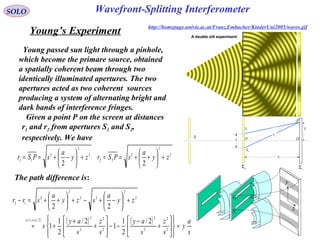
Young passed sun light through a pinhole,
which become the primare source, obtained
a spatially coherent beam through two
identically illuminated apertures. The two
apertures acted as two coherent sources
producing a system of alternating bright and
dark bands of interference fringes.
Given a point P on the screen at distances
r1 and r2 from apertures S1 and S2,
respectively. We have
The path difference is:
2
2
2
22
2
2
2
11
22
zy
a
sPSrzy
a
sPSr +





++==+





−+==
( ) ( ) ( )
s
a
y
s
z
s
ay
s
z
s
ay
s
zy
a
szy
a
srr
ays
=














+
−
−−





+
+
+≈
+





−+−+





++=−
+>>
2
2
2
2
2
2
2
2
2/
2
2
22
2
2
12
2/
2
1
1
2/
2
1
1
22
http://homepage.univie.ac.at/Franz.Embacher/KinderUni2005/waves.gif
2S
1S
y
z
50
SOLO
Young’s Experiment (continue – 1)
s
a
yrr
sa<<
≈− 12
The bright fringes are obtained when:
,2,1,012
±±==− mmrr λ
,2,1,0 ±±== mm
s
a
y λ
The distance between two consecutive
bright fringes is:
( ) λλλ
a
s
a
s
m
a
s
myyy mm =−+≈−=∆ + 11
The dark fringes are obtained when:
,2,1,0
2
12
±±=+=− mmrr
λ
λ
( ) ,2,1,0
2
12 ±±=+= mm
s
a
y
λ
λ - wavelength
The Intensity at point P is:
( ) ( )[ ]{ } 





=−+=−+⋅−⋅++=
=
−=−
==
=
s
ya
IrrkIrkrkIIIII
k
syarr
III
λ
π
φφ
λπ
φφ
2
0
/2
/
1202111222121 cos4cos12cos2
12
021
21

1r
2r
s
a
y
2S
1S
P
OS 'O
aΣ oΣ
http://homepage.univie.ac.at/Franz.Embacher/KinderUni2005/waves.gif
Wavefront-Splitting Interferometer
Classes of InterferometersReturn to Table of Content
51
SOLO
http://info.uibk.ac.at//c/c7/c704/museum/en/details/optics/fresnel.html
University of Innsbruck
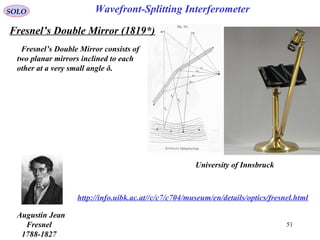
Fresnel’s Double Mirror consists of
two planar mirrors inclined to each
other at a very small angle δ.
Wavefront-Splitting Interferometer
Augustin Jean
Fresnel
1788-1827
Fresnel’s Double Mirror (1819*)
52
SOLO
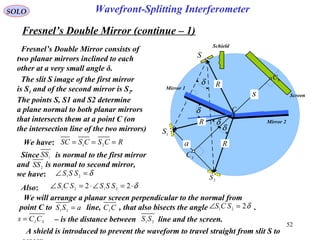
Fresnel’s Double Mirror (continue – 1)
Fresnel’s Double Mirror consists of
two planar mirrors inclined to each
other at a very small angle δ.
The slit S image of the first mirror
is S1 and of the second mirror is S2.
The points S, S1 and S2 determine
a plane normal to both planar mirrors
that intersects them at a point C (on
the intersection line of the two mirrors)
We have: RCSCSSC === 21
δ=∠ 21
SSS
Since is normal to the first mirror
and is normal to second mirror,
we have:
1SS
2
SS
Also: δ⋅=∠⋅=∠ 22 2121
SSSSCS
a
1
S
2S
S
R
R
R
Screen
Schield
Mirror 2
C
δ
δ
δ
δ
s
Mirror 1
S
C
I
C
We will arrange a planar screen perpendicular to the normal from
point C to line, , that also bisects the angle .aSS =21
δ221
=∠ SCSCCI
– is the distance between line and the screen.21
SSSI
CCs =
A shield is introduced to prevent the waveform to travel straight from slit S to
Wavefront-Splitting Interferometer
53
SOLO
Fresnel’s Double Mirror (continue – 2)
From the slit S a cylindrical waveform
is reflected by one side of the mirror at
point A and reaches the screen at point
P, while an other cylindrical waveform
is reflected by the other side of the mirror
at point B and interferes with the first at
the point P on the screen.
Because of the reflection:
BSSBASSA 21
& ==
Therefore we have:
111
rPSAPASAPSA ==+=+
222 rPSBPBSBPSB ==+=+
a
1S
2S
S
A
B
P
R
R
R
Screen
Schield
Mirror 2
C
δ
δ
δ
δ
s
2
r
1r
Mirror 1
y
S
C
I
C
where: – is the distance between line and the screen.21
SSSI
CCs =
PCySSa S
== &21
2
2
2
22
2
2
2
11
22
zy
a
sPSrzy
a
sPSr +





++==+





−+==
Wavefront-Splitting Interferometer
54
S
P
R
Screen
Schield
Mirror2
C
δ
s
Mirror1
Slit
S
C
y
z
SOLO
Fresnel’s Double Mirror (continue – 3)
We have:
The path difference is:
The bright fringes are obtained when:
( ) λλλ
a
s
a
s
m
a
s
myyy mm =−+≈−=∆ + 11
a
1S
2S
S
A
B
P
R
R
R
Screen
Schield
Mirror 2
C
δ
δ
δ
δ
s
2
r
1
r
Mirror 1
y
S
C
I
C
S
A
B
P
R
Screen
Schield
Mirror2
C
δ
s
Mirror1
Slit
SC
y
z
S
A
B
P
R
Screen
Schield
Mirror2
C
δ
s
Mirror1
Slit
y
SC
z
P
2
2
2
22
2
2
2
11
22
zy
a
sPSrzy
a
sPSr +





++==+





−+==
( ) ( ) ( )
s
a
y
s
z
s
ay
s
z
s
ay
s
zy
a
szy
a
srr
ays
=














+
−
−−





+
+
+≈
+





−+−+





++=−
+>>
2
2
2
2
2
2
2
2
2/
2
2
22
2
2
12
2/
2
1
1
2/
2
1
1
22
Wavefront-Splitting Interferometer
,2,1,0&
2
21
12
±±==
−
+− mmrr λλ
π
φφ
Since the distance between two
consecutive bright fringes is:
21
φφ =
Classes of Interferometers
Return to Table of Content
55
SOLO
Fresnel’s Double Prism
The Fresnel’s Double Prism or Bi-prism
consists of two thin prisms joined at their
bases. A singlr cylindrical wave emerge from
a slit. The top part of the wave-front is
Refracted downward, and the lower segment
is refracted upward. In the region of
superposition interference occurs.
Screen
Bi-prism
Slit
y
z
δ
s
a
2S
1
S
O
S 'O
aΣ
o
Σ
1<<α
iθ
d
iθ - incident angle
δ - dispersion angle
α - prism angle
From the Figure we can see that two
virtual sources S1 and S2 exists. Let a
be the distance between them.
From the Figure
( ) δδθθ
θ
δ
ddd
a i
ii
1
1
sintan
2
<<
<<
≈−−=
where
θi – ray incident angle
δ – ray dispersion (deviation) angle
d – distance slit to bi-prism vertex
α – prism angle
( )[ ]
[ ] ( )ααθαθ
αθαθαθδ
α
θ
α
θ
1sin
sincossinsinsin
1
1
1
1
1
2/1221
−≈−−+≈
−−−+=
<<
<<
−
<<
<<
−
nn
n
n
ii
iii
ii
See δ development
Wavefront-Splitting Interferometer
56
SOLO
Dispersive Prisms
( ) ( )2211 itti
θθθθδ −+−=
21 it
θθα +=
αθθδ −+= 21 ti
202
sinsin ti
nn θθ =Snell’s Law
10
≈n
( ) ( )[ ]1
1
2
1
2
sinsinsinsin tit
nn θαθθ −== −−
( )[ ] ( )[ ]11
21
11
1
2 sincossin1sinsinsincoscossinsin ttttt nn θαθαθαθαθ −−=−= −−
Snell’s Law 110
sinsin ti
nn θθ =
11
sin
1
sin it
n
θθ =
10
≈n
( )[ ]1
2/1
1
221
2 sincossinsinsin iit n θαθαθ −−= −
( )[ ] αθαθαθδ −−−+= −
1
2/1
1
221
1
sincossinsinsin iii
n
The ray deviation angle is
Optics - Prisms
57
SOLO
Fresnel’s Double Prism (continue – 1)
From the Figure we found that the distance a
between virtual sources S1 and S2 is:
( ) δδθθ
θ
δ
ddd
a i
ii
1
1
sintan
2
<<
<<
≈−−=
( )[ ]
[ ] ( )ααθαθ
αθαθαθδ
α
θ
α
θ
1sin
sincossinsinsin
1
1
1
1
1
2/1221
−≈−−+≈
−−−+=
<<
<<
−
<<
<<
−
nn
n
n
ii
iii
ii
See δ development
( )α12 −≈ nda
s
a
y
2S
1
S P
OS 'O
aΣ o
Σ
1<<α
α - prism angle
1r
2r
Screen
Bi-prism
Slit
y
z
Consider two rays starting from the slit S that
pass the bi-prism and interfere on the screen
at P. We can assume that they are strait lines
starting at the virtual source S1 and S2, and
having optical paths r1 and r2, respectively.
2
2
2
22
2
2
2
11
22
zy
a
sPSrzy
a
sPSr +





++==+





−+==
Wavefront-Splitting Interferometer
δ
s
a
2S
1
S
O
S 'O
a
Σ
o
Σ
1<<α
iθ
d
iθ - incident angle
δ - dispersion angle
α - prism angle
58
SOLO
Fresnel’s Double Prism (continue – 2)
( )α12 −≈ nda
s
a
y
2S
1
S P
OS 'O
a
Σ o
Σ
1<<α
α - prism angle
1r
2
r
d
Screen
Bi-prism
Slit
y
z
2
2
2
22
2
2
2
11
22
zy
a
sPSrzy
a
sPSr +





++==+





−+==
The path difference is:
The bright fringes are obtained when:
( ) λλλ
a
s
a
s
m
a
s
myyy mm =−+≈−=∆ + 11
( ) ( ) ( )
s
a
y
s
z
s
ay
s
z
s
ay
s
zy
a
szy
a
srr
ays
=














+
−
−−





+
+
+≈
+





−+−+





++=−
+>>
2
2
2
2
2
2
2
2
2/
2
2
22
2
2
12
2/
2
1
1
2/
2
1
1
22
We have:
Wavefront-Splitting Interferometer
,2,1,0&
2
21
12
±±==
−
+− mmrr λλ
π
φφ
Since the distance between two
consecutive bright fringes is:
21
φφ =
Classes of Interferometers
Return to Table of Content
59
SOLO
Lloyd’s Mirror Interferometer
The Lloyd’s planar mirror is perpendicular
to the planar screen. A cylindrical waveform
from the slit S is reflected by the mirror and
interferes at the screen with the portion of the
wave that proceeds directly to the screen. Screen
Plane Mirror
Slit
y
z
From the Figure we can see that a
virtual source S1, that is symmetric relative
to mirror plane exists. The slit, parallel to
mirror plane, is at the same distance, a/2,
from the mirror plane as it’s virtual image.
Wavefront-Splitting Interferometer
sa
y
1S
P
O
S
o
Σ
1r
2
r2/a
2/a
Planar Mirror
Screen
Screen
Plane Mirror
Slit
y
z
Consider two rays starting from the slit S, one
proceeding directly to the screen and the other
reflected by the mirror and interfere on the screen
at P. We can assume that they are strait lines
starting at S and at the the virtual source S1, and
having optical paths r1 and r2, respectively.
2
2
2
12
2
2
2
1
22
zy
a
sPSrzy
a
sPSr +





++==+





−+==
Humphrey Lloyd
1800-1881
60
SOLO
Lloyd’s Mirror Interferometer (continue – 1)
Wavefront-Splitting Interferometer
sa
y
1S
P
O
S
oΣ
1r
2r2/a
2/a
Planar Mirror
Screen
Screen
Plane Mirror
Slit
y
z
The path difference is:
The bright fringes are obtained when:
The distance between two consecutive bright fringes is:
( ) λλλ
a
s
a
s
m
a
s
myyy mm
=−+≈−=∆ +
11
( ) ( ) ( )
s
a
y
s
z
s
ay
s
z
s
ay
s
zy
a
szy
a
srr
ays
=














+
−
−−





+
+
+≈
+





−+−+





++=−
+>>
2
2
2
2
2
2
2
2
2/
2
2
22
2
2
12
2/
2
1
1
2/
2
1
1
22
We have:
2
2
2
12
2
2
2
1
22
zy
a
sPSrzy
a
sPSr +





++==+





−+==
,2,1,0&
2
21
12
±±==
−
+− mmrr λλ
π
φφ
Classes of Interferometers
Return to Table of Content
61
Stokes Treatment of Reflection and RefractionSOLO
An other treatment of reflection and refraction was given by Sir George Stokes.
Suppose we have an incident wave of amplitude E0i
reaching the boundary of two media (where n1 = ni
and n2 = nt) at an angle θ1. The amplitudes of the
reflected and transmitted (refracted) waves are, E0i·r
and E0i·t, respectively (see Fig. a). Here r (θ1) and
t (θ2) are the reflection and transmission coefficients.
According to Fermat’s Principle the situation where the rays
direction is reversed (see Fig. b) is also permissible. Therefore we
have two incident rays E0i·r in media with refraction index n1 and E0i·t
in media with refraction index n2.
E0i·r is reflected, in media with refraction index n1, to obtain a wave
with amplitude (E0i·r )·t and refracted, in media with refraction index
n2, to obtain a wave with amplitude (E0i·r )·r (see Fig. c).
E0i·t is reflected, in media with refraction index n2, to obtain a wave
with amplitude (E0i·t )·r’ and refracted, in media with refraction index
n1, to obtain a wave with amplitude (E0i·t )·t’ (see Fig. c).
θ1 and θ2 are related by Snell’s Law: 2211 sinsin θθ nn =
62
Stokes Treatment of Reflection and RefractionSOLO
An other treatment of reflection and refraction was given by Sir George Stokes
(under the assumption that is not absorption of energy at the boundary of the two media).
To have Fig. c identical to Fig. b the following conditions
must be satisfied:
( ) ( ) ( ) ( ) iii
ErrEttE 0110120
' =+ θθθθ
( ) ( ) ( ) ( ) 0' 220210
=+ θθθθ rtEtrE ii
Hence:
( ) ( ) ( ) ( )
( ) ( )12
1112
'
1'
θθ
θθθθ
rr
rrtt
−=
=+
Stokes relations
θ1 and θ2 are related by Snell’s Law: 2211 sinsin θθ nn =
Let check that Fresnel Equation do satisfy Stokes relations
( )
2211
11
2
coscos
cos221
θθ
θ
θ
µµ
nn
n
t
+
=
=
⊥
2112
11
||
coscos
cos221
θθ
θµµ
nn
n
t
+
=
=
( )
2211
2211
1
coscos
coscos21
θθ
θθ
θ
µµ
nn
nn
r
+
−
=
=
⊥
( )
2112
2112
1||
coscos
coscos21
θθ
θθ
θ
µµ
nn
nn
r
+
−
=
=
Parallel Interfaces
Return to Table of Content
63
SOLO
Optical Reflected Path Length Difference: Parallel Interfaces
Two-Beam Interference: Parallel Interfaces
We have a point source and a dielectric slab
that performs a double reflection giving two
coherent rays (1) and (2). Using a lens the two
rays interfere at lens focus.
'D
1
θ
1
θ
1
θ 2θ
2
θ
d
C
B
D
1n
2
n
1
n
Point
source
Image
1
2
Dielectric
slab
We consider a dielectric slab that has low
reflectivity at each interface: r,r’<<1
Assume an incident ray that at point B is
( ) ( )tiABEi ωexp=
For the reflected ray (1) we have at point D
( ) 







−=
0
1
22
'2
exp'
λ
π
ω
BDn
tiADE
For the reflected ray (2) we have at point D’. DD’ is normal two ray (2) so that both rays
travel the same optical paths until interference.
( ) ( )







 +
−=
0
2
11
2
exp
λ
π
ω
CDBCn
tiADE
Amplitude Split Interferometers
64
SOLO
Optical Reflected Path Length Difference: Parallel Interfaces (continue – 1)
Two-Beam Interference: Parallel Interfaces
To compute the amplitudes A1 and A2 we
will use :
'D
1
θ
1
θ
1θ 2θ
2
θ
d
C
B
D
1
n
2n
1
n
Point
source
Image
1
2
Dielectric
slab
2θ
2
θ
1θ
( ) ( ) ( )2211 '' θτθθτ rAA =
( )12 θrAA =
Using Stokes relations:
where:
( ) ( )11 , θτθr - reflectivity and transitivity at B
( )2' θr - reflectivity at C
( )2' θτ - transitivity at D from slab to air
( ) ( )12' θθ rr −=
( ) ( ) ( )
( )
11'
1
1
2
21
1
2
<<
≈−=
θ
θθτθτ
r
r
( ) ( ) ( ) ( )12211 '' θθτθθτ rArAA −==
we obtain:
( )12 θrAA =
The minus sign shows that is an additional phase delay of π between ray (1)
at point D and ray (2) at point D’.
Amplitude Split Interferometers
65
SOLO
Optical Reflected Path Length Difference: Parallel Interfaces (continue – 2)
Two-Beam Interference: Parallel Interfaces
'D
1
θ
1
θ
1
θ 2θ
2
θ
d
C
B
D
1n
2
n
1
n
Point
source
Image
1
2
Dielectric
slab
( ) ( ) 







−=
0
1
12
'2
exp'
λ
π
ωθ
BDn
tirADE
( ) ( ) ( )








+
+
−= π
λ
π
ωθ
0
2
11
2
exp
CDBCn
tirADE
2cos/ θdCDBC ==
From the Figure we obtain:
12 sintan2' θθdBD =
The phase difference at interference is:
( )[ ] π
λ
π
φφ +−+−=− BDnCDBCn 12
0
21
2
2
2
2
2
sinsin
1
2
2
1121
cos
sin
sin
cos
sin
sintan
2211
θ
θ
θ
θ
θ
θθ
θθ
nnn
nn =
==
( ) πθ
λ
π
πθ
θλ
π
πθθ
θλ
π
φφ +−=+





−−=+














−−=− 2
0
2
2
2
2
2
0
121
2
2
0
21 cos
4
sin1
cos
22
sintan
cos
2
2 ndnd
n
n
d
Amplitude Split Interferometers
66
SOLO
Optical Reflected Path Length Difference: Parallel Interfaces (continue – 3)
Two-Beam Interference: Parallel Interfaces
'D
1
θ
1
θ
1
θ 2
θ
2
θ
d
C
B
D
1
n
2
n
1n
Point
source
Image
1
2
Dielectric
slab
( ) ( ) ( )212 exp' φωθ += tirADE
( ) ( ) ( )111 exp φωθ += tirADE
πθ
λ
π
φφ +−=− 2
0
2
21 cos
4 nd
The Intensity at the interference is:
( )
( ){ } ( ){ }
( )2/sin4
cos12cos12
cos2
2
0
0210
2111222121
021
122
δ
πδφφ
φφ
I
II
rkrkIIIII
III
rkrk
=
+−+=−+=
−+⋅−⋅++=
==
⋅=⋅


where
2
0
2
cos
4
: θ
λ
π
δ
nd
=
( )1
22
021 ~ θrAIII ==
Amplitude Split Interferometers
Return to Table of Content
67
SOLO
Optical Transmitted Path Length Difference: Parallel Interfaces
Two-Beam Interference: Parallel Interfaces
Amplitude Split Interferometers
( ) ( ) ( )







 +
−=
0
12
12
'2
exp'
λ
π
ωθ
BDnABn
tirADE
( ) ( ) ( )








+
++
−= π
λ
π
ωθ
0
2
11
2
exp
CDBCABn
tirADE
2cos/ θdCDBCAB ===
From the Figure we obtain:
12 sintan2' θθdBD =
The phase difference at interference is:
( )[ ] π
λ
π
φφ +−+−=− '
2
12
0
21 BDnCDBCn
2
2
2
2
sinsin
1
2
2
1121
cos
sin
sin
cos
sin
sintan
2211
θ
θ
θ
θ
θ
θθ
θθ
nnn
nn =
==
( ) πθ
λ
π
πθ
θλ
π
πθθ
θλ
π
φφ +−=+





−−=+














−−=− 2
0
2
2
2
2
2
0
121
2
2
0
21
cos
4
sin1
cos
22
sintan
cos
2
2 ndnd
n
n
d
( ) ( ) ( ) ( )01
0
2
10 exp
2
exp δωθ
λ
π
ωθ −=







−= tirA
ABn
tirABE
2
0
2
20
2
0
cos
4
:
cos
2
:
θ
λ
π
δ
θλ
π
δ
nd
nd
=
=
Return to Table of Content
68
InterferenceSOLO
Haidinger Fringes
1846
Wilhelm Karl,
Ritter von Haidinger
1795 - 1871
Lens
Beam-
splitter
Extended
Sources
Viewing
Screen
Dielectric
film
Black
background
Circular
fringes
Haidinger Fringes are the type of interference pattern that
results with an extended source where partial reflections
occur from a plane-parallel dielectric slab.
69
SOLO
Haidinger Interference Fringes
Two-Beam Interference: Parallel Interfaces
We have:
1θ
1θ
2
θ
2
θ
d
1n
2
n
1n
Extended
source
Focal
plane
1P 2
P
1θ
Dielectric
slab
Beam
splitter
Lens
θ
f
x
Haidinger Fringes are the type of interference pattern that
results with an extended source where partial reflections
occur from a plane-parallel dielectric slab.
Wilhelm Karl,
Ritter von Haidinger
1795 - 1871
Amplitude Split Interferometers
Return to Table of Content
70
InterferenceSOLO
Interference of Many Monochromatic Waves
Given two waves ( ω = constant ):
( ) ( ) ( )[ ]{ } ( ){ }tUtiAtAtu 111111 ReexpRecos =+=+= φωφω
The N waves interfere to give:
( ) ( ) ( ) ( )
( ) ( ) ( ){ } ( )φω +=+++=
+++=
tAtUtUtU
tutututu
N
N
cosRe 21
21


( ) ( ) ( )[ ]{ } ( ){ }tUtiAtAtu 222222 ReexpRecos =+=+= φωφω
1U
N
UUUU +++= 21
1φ
2φ
φ
2
U
N
U
Nφ
The Phasor summation is identical to Vector summation
( ) ( ) ( )[ ]{ } ( ){ }tUtiAtAtu NNNNNN ReexpRecos =+=+= φωφω
71
InterferenceSOLO
Multiple Beam Interference from a Parallel Film
We have a point source and a dielectric slab that performs a multiple reflection and
transmission.
72
InterferenceSOLO
Multiple Beam Interference from a Parallel Film
( )
( )
( )[ ]


δω
δω
δω
ω
1
0
32
2
0
3
3
02
01
''
''
''
−−−
−
−
=
=
=
=
NtiN
rN
ti
r
ti
r
ti
r
eEtrtE
eEtrtE
eEtrtE
eErE
We have:
We have a point source and a dielectric slab that performs a multiple reflection and
transmission.
( )
( )
( ) ( )[ ]


δωδ
δωδ
δωδ
ωδ
1
0
12
2
0
4
3
0
2
2
01
0
0
0
0
''
''
''
'
−−−−
−−
−−
−
=
=
=
=
NtiiN
rN
tii
t
tii
t
tii
t
eeEtrtE
eeEtrtE
eeEtrtE
eeEttE 2
0
2
20
2
0
cos
4
:
cos
2
:
θ
λ
π
δ
θλ
π
δ
nd
nd
=
=
73
InterferenceSOLO
Multiple Beam Interference from a Parallel Film
Using lens the multi-rays interfere at lens focus.
( )
[ ] tiNiNii
rNrrr
eEetrtetrtetrtr
EEEE
ωδδδ
0
13223
21
'''''' 

+++++=
++++=
−−−−−
( )
ti
i
NiN
i
eE
er
er
etrtr ω
δ
δ
δ
02
132
'1
'1
'' 





−
−
+= −
−−−
−
∞→
<
Nand
rIf 1' ti
i
i
r eE
er
etrt
rE ω
δ
δ
02
'1
''






−
+= −
−
In the case of zero absorption, no energy being
taken out of the waves, using Stokes relations
2
1'&' rttrr −=−=
( ) ti
i
i
r eE
er
er
E ω
δ
δ
02
1
1






−
−
= −
−
∞→
<
Nand
rIf 1
74
InterferenceSOLO
Multiple Beam Interference from a Parallel Film
Using lens the multi-rays interfere at lens focus.
( ) ( )
[ ] ( )0
0
112242
21
''''1 δωδδδ −−−−−−
+++++=
++++=
tiNiNii
tNttt
eEttererer
EEEE


( )0
02
2
'
'1
'1 δω
δ
δ
−
−
−
−
−
= ti
i
NiN
eEtt
er
er
∞→
<
Nand
rIf 1' ( )0
02
'1
' δω
δ
−
−
−
= ti
it eE
er
tt
E
In the case of zero absorption, no energy being
taken out of the waves, using Stokes relations
2
1'&' rttrr −=−=
( )0
02
2
1
1 δω
δ
−
−
−
−
= ti
it eE
er
r
E
2
0
2
20
2
0
cos
4
:
cos
2
:
θ
λ
π
δ
θλ
π
δ
nd
nd
=
=
75
InterferenceSOLO
Multiple Beam Interference from a Parallel Film
∞→
<
Nand
rIf 1
( ) ti
i
i
r eE
er
er
E ω
δ
δ
02
1
1






−
−
= −
−
( )0
02
2
1
1 δω
δ
−
−
−
−
= ti
it eE
er
r
E
Let compute the Reflected and Transmitted
Irradiances:
( ) ( ) ( )
( ) 024
2
*
0022
*
cos21
cos12
1
1
1
1
I
rr
r
EE
er
er
er
er
EEI i
i
i
i
rrr
δ
δ
δ
δ
δ
δ
−+
−
=





−
−
−
−
=∝ −
−
( )
( ) 024
22
*
002
2
2
2
*
cos21
1
1
1
1
1
I
rr
r
EE
er
r
er
r
EEI iittt
δδδ
−+
−
=
−
−
−
−
=∝ −
Using lens the multi-rays interfere at lens focus we found
that in the case of zero absorption, no energy
being taken out of the waves, using Stokes
relations
2
1'&' rttrr −=−=
0III tr =+
( ) ( )[ ] ( )
( )[ ] ( )
0222
2222/sin21cos
2/sin1/21
2/sin1/2
2
I
rr
rr
Ir
δ
δδδ
−+
−
=
−=
( )
( )[ ] ( )
0222
2/sin21cos
2/sin1/21
1
2
I
rr
It
δ
δδ
−+
=
−=
We see that
76
The transmission of an etalon as a function of
wavelength. A high-finesse etalon (red line)
shows sharper peaks and lower transmission
minima than a low-finesse etalon (blue).
InterferenceSOLO
Multiple Beam Interference from a Parallel Film
Return to Table of Content
77
Gas RefrectometerSOLO
S
1S
2
S
2T
1T
f
1C
2
C
D
D
1C 2C
E
Rayleigh's Interferometer
t
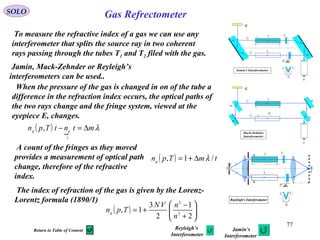
To measure the refractive index of a gas we can use any
interferometer that splits the source ray in two coherent
rays passing through the tubes T1 and T2 filed with the gas.
When the pressure of the gas is changed in on of the tube a
difference in the refraction index occurs, the optical paths of
the two rays change and the fringe system, viewed at the
eyepiece E, changes.
A count of the fringes as they moved
provides a measurement of optical path
change, therefore of the refractive
index.
Jamin, Mack-Zehnder or Reyleigh’s
interferometers can be used..
S
2T
1
T 1
C
2
C
D
D
1C 2C
E
1
G
2
G
1
2
Jamin's Interferometer
t
S
1
T
E
1
M
2
G
1
2
Mach-Zehnder
Interferometer
2M
3
M
4M
2T
t
( ) 
λmtntTpn ag
∆=−
1
,
( ) tmTpng /1, λ∆+=
The index of refraction of the gas is given by the Lorenz-
Lorentz formula (1890/1)
( ) 





+
−
+=
2
1
2
3
1, 2
2
n
nVN
Tpng
Reyleigh’s
Interferometer
Jamin’s
Interferometer
Return to Table of Content
78
Interferometers History
SOLO
References
M.V.Klein, T.E. Furtak, “Optics”, 2nd Ed., John Wiley & Sons, 1986 , Ch. 5,
Interference
M. Born, E. Wolf, “Principles of Optics”, Pergamon Press,6th
Ed., 1980, Ch. VII,
Elements of the Theory of Interference and Interferometers
S.G. Lipson, H. Lipson, “Optical Physics”, Cambridge University Press, 1969, Ch. 7,
Fraunhofer Diffraction and Interference
E. Hecht, “Optics”, Addison Wesley, 2002, 4th
Ed., Ch. 9, Interference
Françon, M., “Optical Interferometry”, Academic Press, 1966
M.V.Klein,“Optics”, 2nd Ed., John Wiley & Sons, 1970, Ch. 5, Interference
Steel, W.,H., “Interferometry”, Cambridge University Press, 1967
M. Kerker, “Scattering of Light and Other Electromagnetic Radiation”,
Academic Press, 1969
J.C. Wyant, “Introduction to Interferometric Optical Testing (SC213)”, Optical
Science Center, University of Arizona, http://www.optics.arizona.edu/jcwyant/
Return to Table of Content
January 5, 2015 79
SOLO
Technion
Israeli Institute of Technology
1964 – 1968 BSc EE
1968 – 1971 MSc EE
Israeli Air Force
1970 – 1974
RAFAEL
Israeli Armament Development Authority
1974 – 2013
Stanford University
1983 – 1986 PhD AA
80
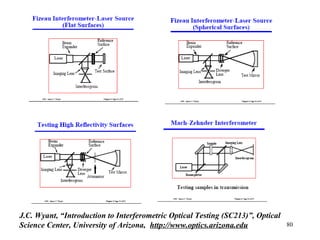
J.C. Wyant, “Introduction to Interferometric Optical Testing (SC213)”, Optical
Science Center, University of Arizona, http://www.optics.arizona.edu
81J.C. Wyant, “Introduction to Interferometric Optical Testing (SC213)”, Optical
Science Center, University of Arizona, http://www.optics.arizona.edu
82J.C. Wyant, “Introduction to Interferometric Optical Testing (SC213)”, Optical
Science Center, University of Arizona, http://www.optics.arizona.edu
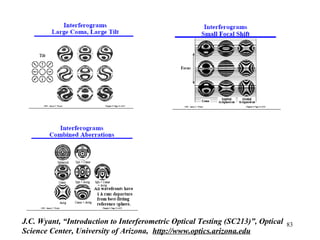
83J.C. Wyant, “Introduction to Interferometric Optical Testing (SC213)”, Optical
Science Center, University of Arizona, http://www.optics.arizona.edu
84
85
86
87
88
Field and linear interferometers
InterferenceSOLO
Double-Slit Interferometer
Fourier-transform Interferometer
Astronomical Interferometer/Michelson Stellar Interferometer
Mireau Interferometer (also known as a Mireau objective) (microscopy)
Multi-Beam Interferometer (microscopy)
Watson Interferometer (microscopy)
Linnik Interferometer (microscopy)
Diffraction-Grating Interferometer (white light)
White-light Interferometer (see also Optical coherence tomography)
Shear Interferometer (lateral and radial)
http://en.wikipedia.org/wiki/List_of_types_of_interferometers
Michelson Interferometer
Mach-Zehnder Interferometer
Fabry-Perot Interferometer
Sagnac Interferometer
Gires-Tournois Etalon
89
Field and linear interferometers
InterferenceSOLO
Moire Interferometer (see Moire pattern)
Holographic Interferometer
Near-field Interferometer
Fringes of Equal Chromatic Order Inteferometer (FECO)
Fresnel Interferometer (e.g. Fresnel biprism, Fresnel mirror or Lloyd's mirror)
Polarization Interferometer (see also Babinet-Soleil compensator)
Newton Interferometer (see Newton's rings)
Cyclic Interferometer
Point Diffraction Interferometer
White-light Scatterplate Interferometer (white-light) (microscopy)
Phase-shifting Interferometer
Wedge Interferometer
Schlieren Interferometer (phase-shifting)
Talbot Lau Interferometer
http://en.wikipedia.org/wiki/List_of_types_of_interferometers
Fizeau Interferometer
Rayleigh Interferometer
Twyman-Green Interferometer
90
Intensity and nonlinear interferometers
InterferenceSOLO
http://en.wikipedia.org/wiki/List_of_types_of_interferometers
Intensity Interferometer
Intensity Optical Correlator
Frequency-Resolved Optical Gating (FROG)
Spectral Phase Interferometry for Direct Electric-field Reconstruction (SPIDER)
Quantum optics interferometers
Hong-Ou-Mandel Interferometer (HOM) (see Leonard Mandel)
Interferometers outside optics
Francon Interferometer
Atom Interferometer
Ramsey Interferometer
Mini Grail Interferometer
Hanbury-Brown Twiss Interferometer
91
http://www.grahamoptical.com/phase.html
In phase-shifting interferometers, Piezo-electric
transducers move the analyzing wavefront with respect to
the reference wavefront by a specified phase angle, while a
frame-grabber captures a video frame at each position and
stores them on the computer. The frame data are then
processed by the computer to calculate optical wavefront
errors. The software finds aberrations and computes both
peak-to-valley (PV) and Root Mean Square (rms) values.
The operator has the option to subtract tilt, power,
astigmatism, coma, and spherical aberrations from the
data. Interactive computer graphics make it easy to
interpret the output and numerical data provides
quantitative results. The image at the right shows the
interferogram as the phase shifter moves the reference
surface by 1/4 wave at each step
How Phase Shifting Works
92
http://www.grahamoptical.com/phase.html
How Phase Shifting Works (continue – 1)
However, surfaces aren't always that flat, and the
interferogram is not always so simple, The example at
the left is a surface which is slightly convcave and
somewhat irregular. Attempting to interpret the
meaning of this fringe pattern is substantially more
difficult than when the fringes are better behaved.
That is why phase-shifting interferometers are needed
to accurately evaluate surface configuration of any
but the simplest surfaces.
The Model 2VP PHASE MITE Interferometer shown
below is equipped with Durango Universal
Interferometry Software. It is just one of Graham's
Phase-Shifting Interferometers. Click on the link for
further information on other available Phase-Shifting
interferometers manufactured by GRAHAM.
Click on the following link for further information on
Durango.
93

Interferometers history

  • 1.
  • 2.
    2 InterferenceSOLO Table of Content Introduction HaidingerFringes Fizeau Experiment Jamin’s Interferometer Fizeau Experiment in Moving Media and Fizeau Interferometer Foucault Experiment Michelson Interferometer Mach-Zehnder Interferometer Rayleigh’s Interferometer Sirks-Pringsheim Interferometer Fabry – Perot Interferometer Sagnac Effect Twyman-Green Interferometer Michelson’s Experiments Dyson’s Interferometer Hanbury-Brown and Twiss Interferometer Gires-Tournois Etalon
  • 3.
    3 InterferenceSOLO Table of Content(continue – 1) Interference of Two Monochromatic Waves Two Basic Classes of Interferometers Fresnel’s Double Mirror (1819*) Fresnel’s Double Prism Lloyd’s Mirror Interferometer Young’s Experiment Division of Wavefront Optical Reflected Path Length Difference: Parallel Interfaces Amplitude Split Interferometers Stokes Treatment of Reflection and Refraction Optical Transmitted Path Length Difference: Parallel Interfaces Haidinger Interference Fringes Interference of Many Monochromatic Waves Gas Refrectometer References
  • 4.
    4 InterferenceSOLO Introduction Interference is thesuperposition of two or more waves producing a resultant disturbance that is the sum of the overlapping wave contribution. More work must be done to complete this presentation
  • 5.
    5 SOLO Diffraction The Grimaldi’sdescription of diffraction was published in 1665 , two years after his death: “Physico-Mathesis de lumine, Coloribus et iride” Francesco M. Grimaldi, S.J. (1613 – 1663) professor of mathematics and physics at the Jesuit college in Bolognia discovered the diffraction of light and gave it the name diffraction, which means “breaking up”. http://www.faculty.fairfield.edu/jmac/sj/scientists/grimaldi.htm “When the light is incident on a smooth white surface it will show an illuminated base IK notable greater than the rays would make which are transmitted in straight lines through the two holes. This is proved as often as the experiment is trayed by observing how great the base IK is in fact and deducing by calculation how great the base NO ought to be which is formed by the direct rays. Furter it should not be omitted that the illuminated base IK appears in the middle suffused with pure light, and either extremity its light is colored.” Single Slit Diffraction Double Slit Diffraction http://en.wikipedia.org/wiki/Francesco_Maria_Grimaldi 1665
  • 6.
    6 SOLO Microscope Robert Hooke(1635-1703) work in microscopy is described in Micrographia published in 1665. Contains investigations of the colours of thin plates of mica, a theory of light as a transverse vibration motion (in 1672). 1665 Robert Hooke (1635-1703) Robert Hooke’s compound microscope: on the left the illumination device (an oil lamp), on the right the microscope. Robert Hooke reports in Micrographia the discovery of the rings of light formed by a layer of air between two glass plates, first observed by Robert Boyle. In the same work he gives the matching-wave-front derivation of reflection and refraction. The waves travel through aeter. Robert Hooke also assumed that the white light is a simple disturbance and colors are complex distortion of the white light. This theory was refuted later by Newton.
  • 7.
    7 OpticsSOLO Newton published “Opticks” 1704 Inthis book he addresses: • mirror telescope • theory of colors • theory of white lite components • colors of the rainbow • Newton’ s rings • polarization • diffraction • light corpuscular theory Newton threw the weight of his authority on the corpuscular theory. This conviction was due to the fact that light travels in straight lines, and none of the waves that he knew possessed this property. Newton’s authority lasted for one hundred years, and diffraction results of Grimaldi (1665) and Hooke (1672), and the view of Huygens (1678) were overlooked.
  • 8.
  • 9.
    9 OpticsSOLO History (continue) In 1801Thomas Young uses constructive and destructive interference of waves to explain the Newton’s rings. Thomas Young 1773-1829 1801-1803 In 1803 Thomas Young explains the fringes at the edges of shadows using the wave theory of light. But, the fact that was belived that the light waves are longitudinal, mad difficult the explanation of double refraction in certain crystals.
  • 10.
    10 POLARIZATIONSOLO History In 1802 WilliamHyde Wollaston discovered that the sun spectrum is composed by a number of dark lines, but the interpretation of this phenomenon was done by Fraunhofer in 1814. Wollaston developed In 1802 the refractometer, an instrument used to measure the refractive index. The refractometer wa used by Wollaston to verify the laws of double refraction in Iceland spar, on which he wrote a treatise. Wollaston Prism In 1807 William Hyde Wollaston developed the four-sided Wollaston prism, used in microscopy. 1802-1807
  • 11.
    11 SOLO History In 1813 JosephFraunhofer rediscovered William Hyde Wollaston’s dark lines in the solar system, which are known as Fraunhofer’s lines. He began a systematic measurement of the wavelengths of the solar Spectrum, by mapping 570 lines. Diffraction http://www.musoptin.com/spektro1.html 1813 Fraunhofer Telescope. Fraunhofer placed a narrow slit in front of a prism and viewed the spectrum of light passing through this combination with a small telescope eypiece. By this technique he was able to investigate the spectrum bit by bit, color by color.
  • 12.
    12 SOLO Between 1805 and1815 Laplace, Biot and (in part) Malus created an elaborate mathematical theory of light, based on the notion that light rays are streams of particles that interact with the particles of matter by short range forces. By suitably modifying Newton’s original emission theory of light and applying superior mathematical methods, they were able to explain most of the known optical phenomena, including the effect of double refraction (Laplace 1808) which had been the focus of Huyghen’s work. Diffraction http://microscopy.fsu.edu/optics/timeline/people/gregory.html http://www.schillerinstitute.org/fid_97-01/993poisson_jbt.html Pierre-Simon Laplace (1749-1827) 1805-1815 In 1817, expecting to soon celebrate the final triumph of their neo-Newtonian optics, Laplace and Biot arranged for the physics prize of the French Academy of Science to be proposed for the best work on theme of diffraction – the apparent bending of light rays at the boundaries between different media.”
  • 13.
    13 SOLO In 1818 AugustFresnel supported by his friend André-Marie Ampère submitted to the French Academy a thesis in which he explained the diffraction by enriching the Huyghens’ conception of propagation of light by taking in account of the distinct phases within each wavelength and the interaction (interference) between different phases at each locus of the propagation process. Diffraction http://microscopy.fsu.edu/optics/timeline/people/gregory.html http://www.schillerinstitute.org/fid_97-01/993poisson_jbt.html André-Marie Ampère (1775-1836) Dominique François Jean Arago 1786-1853 Siméon Denis Poisson 1781-1840 Pierre-Simon Laplace (1749-1827) Joseph Louis Guy-Lussac 1778-1850 Judging Committee of French Academy 1818
  • 14.
    14 SOLO Diffraction http://microscopy.fsu.edu/optics/timeline/people/gregory.html http://www.schillerinstitute.org/fid_97-01/993poisson_jbt.html Dominique François JeanArago 1786-1853 Siméon Denis Poisson a French Academy member rise the objection that if the Fresnel construction is valid a bright spot would have to appear in the middle of the shadow cast by a spherical or disc-shaped object, when illuminated, and this is absurd. Soon after the meeting, Dominique Francois Arago, one of the judges for the Academy competition, did the experiment and there was the bright spot in the middle of the shadow. Fresnel was awarded the prize in the competition. Siméon Denis Poisson 1781-1840 Poisson’s or Arago’s Spot 1818
  • 15.
    15 POLARIZATION Arago and Fresnelinvestigated the interference of polarized rays of light and found in 1816 that two rays polarized at right angles to each other never interface. SOLO History (continue) Dominique François Jean Arago 1786-1853 Augustin Jean Fresnel 1788-1827 Arago relayed to Thomas Young in London the results of the experiment he had performed with Fresnel. This stimulate Young to propose in 1817 that the oscillations in the optical wave where transverse, or perpendicular to the direction of propagation, and not longitudinal as every proponent of wave theory believed. Thomas Young 1773-1829 1816-1817 longitudinal waves transversal waves
  • 16.
    16 DiffractionSOLO History of Diffraction AugustinJean Fresnel 1788-1827 In 1818 Fresnel, by using Huygens’ concept of secondary wavelets and Young’s explanation of interface, developed the diffraction theory of scalar waves. 1818
  • 17.
    17 DiffractionSOLO Augustin Jean Fresnel 1788-1827 In 1818Fresnel, by using Huygens’ concept of secondary wavelets and Young’s explanation of interface, developed the diffraction theory of scalar waves. P 0P Q 1x 0x 1y 0y η ξ Fr  Sr  ρ  r  O 'θ θ Screen Image plane Source plane 0O 1O Sn1 Σ Σ - Screen Aperture Sn1 - normal to Screen From a source P0 at a distance from a aperture a spherical wavelet propagates toward the aperture: ( ) ( )Srktj S source Q e r A tU − = ' ' ω According to Huygens Principle second wavelets will start at the aperture and will add at the image point P. ( ) ( ) ( )( ) ( ) ( )( ) ∫∫ Σ ++− Σ +−− == dre rr A Kdre r U KtU rrktj S sourcerkttjQ P S 2/2/' ',', πωπω θθθθ where: ( )',θθK obliquity or inclination factor ( ) ( )SSS nrnr 11cos&11cos' 11 ⋅=⋅= −− θθ ( ) ( )   === === 0',0 max0',0 πθθ θθ K K Obliquity factor and π/2 phase were introduced by Fresnel to explain experiences results. Fresnel Diffraction Formula Fresnel took in consideration the phase of each wavelet to obtain:
  • 18.
    18 SOLO History In 1821 JosephFraunhofer build the first diffraction grating, made up of 260 close parallel wires. Latter he built a diffraction grating using 10,000 parallel lines per inch. Diffraction Utzshneider, Fraunhfer, Reichenbach, Mertz http://www.musoptin.com/fraunhofer.html 1821-1823 In 1823 Fraunhofer published his theory of diffraction. http://micro.magnet.fsu.edu/optics/timeline/people/fraunhofer.html
  • 19.
    19 SOLO ELECTROMAGNETICS Conical Refractionon the Optical Axis (continue – 2) Take a biaxial crystal and cut it so that two parallel faces are perpendicular to the Optical Axis. If a monochromatic unpolarized light is normal to one of the crystal faces, the energy will spread out in the plate in a hollow cone, the cone of internal conical refraction. When the light exits the crystal the energy and wave directions coincide, and the light will form a hollow cylinder. This phenomenon was predicted by William Rowan Hamilton in 1832 and confirmed experimentally by Humphrey Lloyd, a year later (Born & Wolf). Because it is no easy to obtain an accurate parallel beam of monochromatic light on obtained two bright circles (Born & Wolf). 1832 William Rowan Hamilton (1805-1855) Humphrey Lloyd (1800-1881)
  • 20.
    20 SOLO Airy Rings In 1835,Sir George Biddell Airy, developed the formula for diffraction pattern, of an image of a point source in an aberration-free optical system, using the wave theory. E. Hecht, “Optics” Diffraction 1835
  • 21.
    21 InterferenceSOLO Haidinger Fringes 1846 Wilhelm Karl, Rittervon Haidinger 1795 - 1871 Lens Beam- splitter Extended Sources Viewing Screen Dielectric film Black background Circular fringes Haidinger Fringes are the type of interference pattern that results with an extended source where partial reflections occur from a plane-parallel dielectric slab. Return to Table of Content
  • 22.
    22 SOLO Fizeau Experiment Armand HyppoliteLouise Fizeau used, in 1849,an apparatus consisted of a rotating toothed wheel and a mirror at a distance of 8833 m. Speed of Light A toothed wheel rotated at the focal point of the lens L2 in Figure above. A pulse of light passes at the opening between teeth passes through L2 and is returned by the spherical mirror back to the toothed wheel. The rotation speed of the wheel is adjusted such that the light can either pass or be obstructed by a tooth (it was 25 rev/sec). The apparatus is not very accurate since the received light intensity must be minimized to obtain the light velocity. Fizeau obtained 315,300 km/sec for the light velocity. ( ) ( ) st 000,18/125/1720/1 =⋅= skm t d v /000,311 000,18/1 633,822 = ⋅ == 1849 Return to Table of Content
  • 23.
    23 InterferenceSOLO Jamin’s Interferometer 1856 J. Jamin,C.R. Acad. Sci. Paris, 42, p.482, 1856 Jules Célestin Jamin 1818 - 1886 S 2 T 1 T 1C 2C D D 1 C 2C E 1G 2 G 1 2 Jamin's Interferometer In the Jamin’s Interferometer a monochromatic light from a broad source S is broken into two parallel beams by two parallel faces of a tick plate of glass G1. These two rays pass through to another identical plate of glass G2 to recombine after reflection, forming interference fringes. If the plates are parallel the paths are identical. To measure the refractive index of a gas as function of presure and temperature, two identical empty tubes T1 and T2 are placed in the two parallel beams. The gas is slowly introduced in one of the tube. The number of fringes Δm is counted when the gas reaches the desired pressure and temperature. The compensating plates C1 and C2, of equal thickness are rotated by the single knob D. One path length is shorted the other lengthened to compensate the difference between the paths. Return to Table of Content
  • 24.
    24 SOLO Fizeau Experiment inMoving Media In 1859 Fizeau described an experiment performed to determine the speed of light in moving medium. Speed of Light The light of source S placed at the focus of lens L1 passes trough a tube with flowing water, focused by lens L2 to the mirror that reflects it to a second tube in which the water flows with the same velocity u in opposite direction. The returning light is diverted by the half silvered mirror an interferes with the light from the source. Fizeau measured the shift between the fringes obtained when is no water flow and those obtained when the water flows. He fitted the following formula for the speed of light v in moving media to the speed of light v0 in stationary media, with index of refraction n:       −+= 20 1 1 n uvv 1859
  • 25.
  • 26.
  • 27.
    27 InterferenceSOLO Fizeau Interferometer 1862 Fizeau, C.R.Acad. Sci. Paris, 66, p.429, 1862 J.C. Wyant, “Introduction to Interferometric Optical Testing (SC213)”, Optical Science Center, University of Arizona, http://www.optics.arizona.edu Return to Table of Content
  • 28.
    28 SOLO Foucault Experiment Foucault workingwith Fizeau improved the apparatus by replacing the toothed wheel with a rotating mirror. In 1850 Foucault used the improved apparatus to measure the speed of light in air and in water. In 1862 he used an improved version to give an accurate measurement of speed of light in air. Speed of Light The solar light passes trough half silvered mirror, through lens L. It is reflected by the Rotating mirror to a Spherical Mirror at a distance of d = 20 m, back to rotating mirror, through L to half silvered mirror to the Display. When the rotting mirror is stationary the ray reaches the point A on the Display. When the rotting mirror is rotating at angular rate ω, the ray to the spherical mirror will change direction by an angle α = ωτ (τ = d/c) and the displayed ray by an angle 2 α, reaching point A’ on the Display. 1850-1862
  • 29.
    29 SOLO Foucault Experiment (continue– 1) Speed of Light http://micro.magnet.fsu.edu/primer/lightandcolor/speedoflight.html The Spherical Mirror was at a distance d = 20 m from the Rotating Mirror, that rotated at 1,000 revolutions per second, given a displacement of AA’ of 1 mm. The speed of light obtained by Foucault was 298,000 km/sec. In 1850 Foucault completed the measurement of speed of light in water. Newton’s corpuscular light model required that the speed of light in optically dense media be greater than in air, whereas the wave theory, as initiated by Huyghens, correctly predicted that the speed of light must be smaller in optically dense media, and this was verified by Foucault experiments. Return to Table of Content
  • 30.
    30 SOLO Michelson Interferometer –Interference Fringes Interference 1882 Nobel Prize 1907 José Antonio Diaz Navas http://www.ugr.es/~jadiaz/                 +         + ++= π λ π f yx dIIIII 22 2121 2cos 2 cos2 I – intensity of the interference fringes I1, I2 – intensity of the intensities of the two beams λ – wavelength d – path length difference between the two interferometers arms x,y – coordinates of the focal plane of a lens of focal length f “Interference Phenomena in a new form of Refractometer”, American J. of Science (3), 23, (1882), pp.392-400 and Philos. Mag. (5) 13 (1892), pp.236-242
  • 31.
    31 SOLO Michelson Interferometer –Broad Source Interference 1882 Nobel Prize 1907 José Antonio Diaz Navas http://www.ugr.es/~jadiaz/ [ ]                 +         +                     +∆ −++= π λ π υπ f yx d Logc yx f d IIIII 22 22 2121 2cos 2 cos 2 1 cos exp2 I – intensity of the interference fringes I1, I2 – intensity of the intensities of the two beams λ, c – wavelength, speed of light d – path length difference between the two interferometers arms x,y – coordinates of the focal plane of a lens of focal length f The intensity of the interference fringes for a Michelson interferometer having a source emitting with a Gaussian profile having a bandwidth of Δν is given by
  • 32.
    32 SPECIAL RELATIVITY Michelson andMorley Experiment Albert Abraham Michelson 1852 - 1931 Edward W. Morley Mikelson and Morley attempted to detect the motion of earth through the aether by comparing the speed of light in the earth direction movement in the orbit around the sun with the perpendicular direction of this movement. They failed to find any differences, a result consistent with a fixed speed of light and Maxwell’s Equations but inconsistent with Galilean Relativity. SOLO 1887 Return to Table of Content
  • 33.
    33 Interferometers SOLO Ernst Mach andLudwig Zehnder separately described what has become the Mach-Zehnder Interferometer. 1891/92 Ludwig Louis Albert Zehnder 1854-1949 Ernst Waldfried Joseph Wenzel Mach 1838 - 1916 Ernst Mach. “Modifikation und Anwendung des Jamin Interferenz-Refraktometers”. Anz. Acad. Wiss. Wien math. Naturwiss. Klasse 28, p.223-224, 1981 Ludwig Zehnder, “Ein neuer Interferenzrefractor”, Z.Instrumentenkd. 11, p.275-285, 1981 Mach-Zehnder Interferometer Return to Table of Content
  • 34.
    34 InterferenceSOLO Sirks-Pringsheim Interferometer 1893/1898 J. A.Sirks, Hd. Ned. Nat. en Geneesk. Congr., Groningen, p. 92, 1893 E. Pringsheim, Verh. Phys. Ges., Berlin, p. 152, 1898 A variant of the Jamin interferometer, using plates which are slightly wedge shaped instead of plane parallel, was developed by Sirks and later by Pringsheim for the refractive index of small objects. Corresponding to an incident ray SA in a principal section of the wedges, the two rays SABCG, SADEF which leave the second plate intersect virtually at a point P behind the second plate. With a quasi- monochromatic source there fringes apparently localized in the vicinity of P, which can be observed with the microscope M. The fringes at P run at right angles to the plane defined by the two emergent rays, i.e. parallel to the wedge apexes. The Object O to be examined is placed between the plates in the path of the ray CG. The image P’ of P in the front of the surface of the second plate also lies on CG, at a position which depends on the inclination of the plates. Return to Table of Content
  • 35.
    35 InterferenceSOLO Rayleigh’s Interferometer 1896 Lord Rayleigh,Proc. Roy. Soc.,59, p. 198, 1896 Nobel Prize 1904 Rayleigh’s Interferometer is used to measure the refractive index of a gas. His refractometer is based on Young’s double slit interferometer. The two coherent rays passing through the slits S1 and S2, from the single source S passed through the tubes T1 and T2 filed with the gas. When the pressure of the gas is changed in on of the tube a difference in the refraction index occurs, the optical paths of the two rays change and the fringe system, viewed at the eyepiece E located at the focus of the second lens, changes. A count of the fringes as they moved provides a measurement of optical path change, therefore of the refractive index. The compensating plates C1 and C2, of equal thickness are rotated by the single knob D. One path length is shorted the other lengthened to compensate the difference between the paths. S 1S 2 S 2 T 1 T f 1C 2 C D D 1C 2C E Rayleigh's Interferometer Return to Table of Content
  • 36.
    36 InterferenceSOLO Fabry – PerotInterferometer 1899 http://en.wikipedia.org/wiki/Fabry-Perot_interferometer Marie P. A.C. Fabry and Jean B.A. Perot (France) developed the Fabry – Perot Interferometer Jean-Baptiste Alfred Perot 1863 – 1925 Marie P. A.C. Fabry and Jean B.A. Perot, “Théory et applications d’une nouvelle méthode de spectroscopie interférentielle”, Ann. Chim. Phys. (7), 16, p.115-144, 1899 http://www.daviddarling.info/encyclopedia/F/Fabry.html Marie Paul August Charles Fabry 1867 – 1945 http://www.patrimoine.polytechnique.fr/collectionhomme/portrait/fabrybig.jpg This interferometer makes use of multiple reflections between two closely spaced partially silvered surfaces. Part of the light is transmitted each time the light reaches the second surface, resulting in multiple offset beams which can interfere with each other. The large number of interfering rays produces an interferometer with extremely high resolution, somewhat like the multiple slits of a diffraction grating increase its resolution. http://hyperphysics.phy-astr.gsu.edu/hbase/phyopt/fabry.html Return to Table of Content
  • 37.
    3737 Optics History SOLO Sagnac, G.1913. Comptes Rendus, 157:708 & 1410 1913Sagnac Effect In 1913, Georges Sagnac showed that if a beam of light is split and sent in two opposite directions around a closed path on a revolving platform, and then the beams are recombined, they will exhibit interference effects. From this result Sagnac concluded that light propagates at a speed independent of the speed of the source. The effect had been observed earlier (by Harress in 1911), but Sagnac was the first to correctly identify the cause. The Sagnac effect (in vacuum) is consistent with stationary ether theories (such as the Lorentz ether theory) as well as with Einstein's theory of relativity. It is generally taken to be inconsistent with emission theories of light, according to which the speed of light depends on the speed of the source. Retrieved from "http://en.wikipedia.org/wiki/Georges_Sagnac" George Sagnac 1869-1926 Return to Table of Content
  • 38.
    38 InterferenceSOLO Twyman-Green Interferometer 1916 T. Twymanand A. Green, British Patent No. 103832, 1916 J.C. Wyant, “Introduction to Interferometric Optical Testing (SC213)”, Optical Science Center, University of Arizona, http://www.optics.arizona.edu Return to Table of Content
  • 39.
    39 SOLO Michelson’s Experiments Michelson performeda series of experiments to determine the speed of light using a rotating mirror situated at Mount Wilson and a fixed mirror on Mount San Antonio, at a distance of 22 miles (35 km). He obtained an average value of 299,796 km/sec. Speed of Light 1926 Return to Table of Content
  • 40.
    40 InterferenceSOLO Dyson’s Interferometer 1950 J. Dyson,Proc. Roy. Soc., A., 204, p.170, 1950 Dyson’s Interferometer is a Polarization Interferometer. Light from a source L.S. polarized circularly or linearly at 45º to the plate in Figure is incident on a Wollason Prism WP, which divide it into the reference beam (solid line) polarized perpendicularly to the plane of the Figure. Both beams propagate through a lens L, are reflected from surfaces M3 and M2 , respectively, and propagate again through the lens L. Subsequently, they are transmitted through the Quarter-Wave Plate QWP. Upon propagating twice through the Quarter-Wave Plate QWP, the Measurement Beam becomes polarized perpendicularly to the plane of the Figure, while the Reference Beam becomes polarized in the plane of the Figure. Both beams are transmitted through the lens L, reflected from surfaces M2 and M3’ respectively. Subsequently they return, through the lens L, to the Wollaston Prism WP, which combine them into one beam whose State of Polarization is a function of the Phase Difference introduced by the measured displacement Δx. Detection Setup DS produces an electrical signal corresponding to the State of Polarization of the Beam, from which the measured displacement Δx can be obtained. Return to Table of Content
  • 41.
    41 InterferenceSOLO Hanbury-Brown and TwissInterferometer 1956 Robert Hanbury-Brown and Richard Q. Twiss published “A test of a new type of stellar interferometer on Sirius”, Nature, vol. 178, pp.1046, 1956 Richard Q. Twiss 1920 - 2005 Robert Hanbury-Brown 1916 - 2002 the Hanbury Brown and Twiss (HBT) effect is any of a variety of correlation and anti-correlation effects in the intensities received by two detectors from a beam of particles. HBT effects can generally be attributed to the dual wave-particle nature of the beam, and the results of a given experiment depend on whether the beam is composed of fermions or bosons. Devices which use the effect are commonly called intensity interferometers and were originally used in astronomy, although they are also heavily used in the field of quantum optics. Return to Table of Content
  • 42.
    42 InterferenceSOLO Gires-Tournois Etalon 1964 F. Gires,and P. Tournois (1964). "Interferometre utilisable pour la compression d'impulsions lumineuses modulees en frequence". C. R. Acad. Sci. Paris 258: 6112–6115. (An interferometer useful for pulse compression of a frequency modulated light pulse.) A Gires-Turnois interferometer is an optic standing- wave cavity designed to create chromatic dispersion. The front mirror is partially reflective, while the back mirror has a high reflectivity. If no losses occur in the cavity, the power reflectivity is unity at all wavelength, but the phase of the reflected light is frequency-dependent due to the cavity effect, causing group delay dispersion (GDD). Return to Table of Content
  • 43.
    43 InterferenceSOLO Interference of TwoMonochromatic Waves Given two waves ( ω = constant ): ( ) ( ) ( )[ ]{ } ( ){ }tUtiAtAtu 111111 ReexpRecos =+=+= φωφω where the corresponding phasors, are defined as: ( ) ( )[ ]111 exp: φω += tiAtU The two waves interfere to give: ( ) ( ) ( ) ( ) ( ) ( ) ( ){ } ( )φω φωφω +=+= +++=+= tAtUtU tAtAtututu cosRe coscos 21 221121 ( ) ( ) ( )[ ]{ } ( ){ }tUtiAtAtu 222222 ReexpRecos =+=+= φωφω ( ) ( )[ ]222 exp: φω += tiAtU 1 U 2 U 21 UUU += 1φ2φ φ ( )1221 2 2 2 1 212211 cos2 2 φφ −⋅⋅++= ⋅⋅+⋅+⋅== ∗∗∗ AAAA UUUUUUUA 2 U ( )       + + = −++= − 2211 22111 2121 2 2 2 1 coscos sinsin tan cos2 φφ φφ φ φφ AA AA AAAAA The Phasor summation is identical to Vector summation
  • 44.
    44 InterferenceSOLO Interference of MonochromaticWaves Given two electromagnetic monochromatic ( ω = constant ) waves: ( ) ( ) ( ) ( ) ( )[ ]{ } ( ){ }trErktirErktrEtrE ,ReexpRecos, 1111110111110111  =+⋅−=+⋅−= φωφω ( ) ( ) ( ) ( ) ( )[ ]{ } ( ){ }trErktirErktrEtrE ,ReexpRecos, 2222220222220222  =+⋅−=+⋅−= φωφω where the corresponding phasors, are defined as: ( ) ( ) ( )[ ]11110111 exp:, φω +⋅−= rktirEtrE  ( ) ( ) ( )[ ]22220222 exp:, φω +⋅−= rktirEtrE  1 S 2 S P 1r  2 r  2211 1 2 :&1 2 : rkrk λ π λ π ==  At the point P the two waves interfere to give: ( ) ( ) ( ) ( ) ( ) ( ) ( ) ( ) ( ){ }trEtrE rktrErktrEtrEtrEtrE ,,Re coscos,,, 2211 2222021111012211   += +⋅−++⋅−=+= φωφω The Irradiance at the point P is given by: ( ) ( ) ( ) ( )trHtrHtrEtrEI ,,,,  ∗∗ ⋅=⋅= µε
  • 45.
    45 InterferenceSOLO Interference of MonochromaticWaves 1S 2S P 1 r  2 r  The Irradiance at the point P is given by: ( ) ( ) ( ) ( )[ ] ( ) ( )[ ] ( ) ( ) ( ) ( ) ( ) ( ) ( ) ( )trEtrEtrEtrEtrEtrEtrEtrE trEtrEtrEtrEtrEtrEI ,,,,,,,, ,,,,,, 1122221122221111 22112211   ∗∗∗∗ ∗∗∗ ⋅+⋅+⋅+⋅= +⋅+=⋅= εεεε εε ( ) ( ) ( ) ( )10110111111 ,, rErEtrEtrEI  ⋅=⋅= ∗ εε ( ) ( ) ( ) ( )20220222222 ,, rErEtrEtrEI  ⋅=⋅= ∗ εε ( ) ( ) ( ) ( ) ( ) ( )[ ] ( ) ( )[ ] ( ) ( )[ ] ( ) ( )[ ] ( ) ( ) ( )[ ] ( )[ ]{ } ( ) ( ) ( ) ( )21112221211122202101 211122211122202101 111101222202 222202111101 1122221112 cos2cos2 expexp expexp expexp ,,,, φφφφε φφφφε φωφωε φωφωε εε −+⋅−⋅=−+⋅−⋅⋅= −+⋅−⋅−+−+⋅−⋅⋅= +⋅−−⋅+⋅−+ +⋅−−⋅+⋅−= ⋅+⋅= ∗∗ rkrkIIrkrkrErE rkrkirkrkirErE rktirErktirE rktirErktirE trEtrEtrEtrEI      ( )21112221211221 cos2 φφ −+⋅−⋅++=++= rkrkIIIIIIII 
  • 46.
    46 InterferenceSOLO Interference of MonochromaticWaves 1 S 2 S P 1 r  2 r  The maximum Irradiance at the point P is given by:   ,2,1,0&22 2111222121max ±±==−+⋅−⋅←++= mmrkrkIIIII πφφ The minimum Irradiance at the point P is given by: ( )   ,2,1,0&122 2111222121min ±±=+=−+⋅−⋅←−+= mmrkrkIIIII πφφ 2211 1 2 :&1 2 : rkrk λ π λ π ==  Since ,2,1,0& 2 2 21 122121max ±±== − +−←++= mmrrIIIII λλ π φφ ( ) ,2,1,0& 2 12 2 2 21 122121min ±±=+= − +−←−+= mmrrIIIII λ λ π φφ The Visibility of the fringes is defined as: 21 21 minmax minmax 2 : II II II II V + = + − = Return to Table of Content
  • 47.
    47 InterferenceSOLO Billet’s Split Lens Meslin’sExperiment Two Basic Classes of Interferometers • Division of Wavefront (portion of the primary wavefront are used either directly as sources to emit secondary waves or in conjunction with optical devices to product virtual sources of secondary waves. The primary and secondary waves recombine and interfere) • Division of Amplitude (the primary wave itself is divided into two waves, which travel different paths before recombining and interfering) Beamsplitter Diffraction Young’s Experiment Fresnel’s Double Mirror Fresnel’s Bi-prism Lloyd’’s Mirror (1834) mirror
  • 48.
    48 Two Basic Classesof Interferometers InterferenceSOLO Return to Table of Content
  • 49.
    49 Wavefront-Splitting InterferometerSOLO Young’s Experiment 1r 2 r s a y 2S 1S P OS'O aΣ oΣ Young passed sun light through a pinhole, which become the primare source, obtained a spatially coherent beam through two identically illuminated apertures. The two apertures acted as two coherent sources producing a system of alternating bright and dark bands of interference fringes. Given a point P on the screen at distances r1 and r2 from apertures S1 and S2, respectively. We have The path difference is: 2 2 2 22 2 2 2 11 22 zy a sPSrzy a sPSr +      ++==+      −+== ( ) ( ) ( ) s a y s z s ay s z s ay s zy a szy a srr ays =               + − −−      + + +≈ +      −+−+      ++=− +>> 2 2 2 2 2 2 2 2 2/ 2 2 22 2 2 12 2/ 2 1 1 2/ 2 1 1 22 http://homepage.univie.ac.at/Franz.Embacher/KinderUni2005/waves.gif 2S 1S y z
  • 50.
    50 SOLO Young’s Experiment (continue– 1) s a yrr sa<< ≈− 12 The bright fringes are obtained when: ,2,1,012 ±±==− mmrr λ ,2,1,0 ±±== mm s a y λ The distance between two consecutive bright fringes is: ( ) λλλ a s a s m a s myyy mm =−+≈−=∆ + 11 The dark fringes are obtained when: ,2,1,0 2 12 ±±=+=− mmrr λ λ ( ) ,2,1,0 2 12 ±±=+= mm s a y λ λ - wavelength The Intensity at point P is: ( ) ( )[ ]{ }       =−+=−+⋅−⋅++= = −=− == = s ya IrrkIrkrkIIIII k syarr III λ π φφ λπ φφ 2 0 /2 / 1202111222121 cos4cos12cos2 12 021 21  1r 2r s a y 2S 1S P OS 'O aΣ oΣ http://homepage.univie.ac.at/Franz.Embacher/KinderUni2005/waves.gif Wavefront-Splitting Interferometer Classes of InterferometersReturn to Table of Content
  • 51.
    51 SOLO http://info.uibk.ac.at//c/c7/c704/museum/en/details/optics/fresnel.html University of Innsbruck Fresnel’sDouble Mirror consists of two planar mirrors inclined to each other at a very small angle δ. Wavefront-Splitting Interferometer Augustin Jean Fresnel 1788-1827 Fresnel’s Double Mirror (1819*)
  • 52.
    52 SOLO Fresnel’s Double Mirror(continue – 1) Fresnel’s Double Mirror consists of two planar mirrors inclined to each other at a very small angle δ. The slit S image of the first mirror is S1 and of the second mirror is S2. The points S, S1 and S2 determine a plane normal to both planar mirrors that intersects them at a point C (on the intersection line of the two mirrors) We have: RCSCSSC === 21 δ=∠ 21 SSS Since is normal to the first mirror and is normal to second mirror, we have: 1SS 2 SS Also: δ⋅=∠⋅=∠ 22 2121 SSSSCS a 1 S 2S S R R R Screen Schield Mirror 2 C δ δ δ δ s Mirror 1 S C I C We will arrange a planar screen perpendicular to the normal from point C to line, , that also bisects the angle .aSS =21 δ221 =∠ SCSCCI – is the distance between line and the screen.21 SSSI CCs = A shield is introduced to prevent the waveform to travel straight from slit S to Wavefront-Splitting Interferometer
  • 53.
    53 SOLO Fresnel’s Double Mirror(continue – 2) From the slit S a cylindrical waveform is reflected by one side of the mirror at point A and reaches the screen at point P, while an other cylindrical waveform is reflected by the other side of the mirror at point B and interferes with the first at the point P on the screen. Because of the reflection: BSSBASSA 21 & == Therefore we have: 111 rPSAPASAPSA ==+=+ 222 rPSBPBSBPSB ==+=+ a 1S 2S S A B P R R R Screen Schield Mirror 2 C δ δ δ δ s 2 r 1r Mirror 1 y S C I C where: – is the distance between line and the screen.21 SSSI CCs = PCySSa S == &21 2 2 2 22 2 2 2 11 22 zy a sPSrzy a sPSr +      ++==+      −+== Wavefront-Splitting Interferometer
  • 54.
    54 S P R Screen Schield Mirror2 C δ s Mirror1 Slit S C y z SOLO Fresnel’s Double Mirror(continue – 3) We have: The path difference is: The bright fringes are obtained when: ( ) λλλ a s a s m a s myyy mm =−+≈−=∆ + 11 a 1S 2S S A B P R R R Screen Schield Mirror 2 C δ δ δ δ s 2 r 1 r Mirror 1 y S C I C S A B P R Screen Schield Mirror2 C δ s Mirror1 Slit SC y z S A B P R Screen Schield Mirror2 C δ s Mirror1 Slit y SC z P 2 2 2 22 2 2 2 11 22 zy a sPSrzy a sPSr +      ++==+      −+== ( ) ( ) ( ) s a y s z s ay s z s ay s zy a szy a srr ays =               + − −−      + + +≈ +      −+−+      ++=− +>> 2 2 2 2 2 2 2 2 2/ 2 2 22 2 2 12 2/ 2 1 1 2/ 2 1 1 22 Wavefront-Splitting Interferometer ,2,1,0& 2 21 12 ±±== − +− mmrr λλ π φφ Since the distance between two consecutive bright fringes is: 21 φφ = Classes of Interferometers Return to Table of Content
  • 55.
    55 SOLO Fresnel’s Double Prism TheFresnel’s Double Prism or Bi-prism consists of two thin prisms joined at their bases. A singlr cylindrical wave emerge from a slit. The top part of the wave-front is Refracted downward, and the lower segment is refracted upward. In the region of superposition interference occurs. Screen Bi-prism Slit y z δ s a 2S 1 S O S 'O aΣ o Σ 1<<α iθ d iθ - incident angle δ - dispersion angle α - prism angle From the Figure we can see that two virtual sources S1 and S2 exists. Let a be the distance between them. From the Figure ( ) δδθθ θ δ ddd a i ii 1 1 sintan 2 << << ≈−−= where θi – ray incident angle δ – ray dispersion (deviation) angle d – distance slit to bi-prism vertex α – prism angle ( )[ ] [ ] ( )ααθαθ αθαθαθδ α θ α θ 1sin sincossinsinsin 1 1 1 1 1 2/1221 −≈−−+≈ −−−+= << << − << << − nn n n ii iii ii See δ development Wavefront-Splitting Interferometer
  • 56.
    56 SOLO Dispersive Prisms ( )( )2211 itti θθθθδ −+−= 21 it θθα += αθθδ −+= 21 ti 202 sinsin ti nn θθ =Snell’s Law 10 ≈n ( ) ( )[ ]1 1 2 1 2 sinsinsinsin tit nn θαθθ −== −− ( )[ ] ( )[ ]11 21 11 1 2 sincossin1sinsinsincoscossinsin ttttt nn θαθαθαθαθ −−=−= −− Snell’s Law 110 sinsin ti nn θθ = 11 sin 1 sin it n θθ = 10 ≈n ( )[ ]1 2/1 1 221 2 sincossinsinsin iit n θαθαθ −−= − ( )[ ] αθαθαθδ −−−+= − 1 2/1 1 221 1 sincossinsinsin iii n The ray deviation angle is Optics - Prisms
  • 57.
    57 SOLO Fresnel’s Double Prism(continue – 1) From the Figure we found that the distance a between virtual sources S1 and S2 is: ( ) δδθθ θ δ ddd a i ii 1 1 sintan 2 << << ≈−−= ( )[ ] [ ] ( )ααθαθ αθαθαθδ α θ α θ 1sin sincossinsinsin 1 1 1 1 1 2/1221 −≈−−+≈ −−−+= << << − << << − nn n n ii iii ii See δ development ( )α12 −≈ nda s a y 2S 1 S P OS 'O aΣ o Σ 1<<α α - prism angle 1r 2r Screen Bi-prism Slit y z Consider two rays starting from the slit S that pass the bi-prism and interfere on the screen at P. We can assume that they are strait lines starting at the virtual source S1 and S2, and having optical paths r1 and r2, respectively. 2 2 2 22 2 2 2 11 22 zy a sPSrzy a sPSr +      ++==+      −+== Wavefront-Splitting Interferometer δ s a 2S 1 S O S 'O a Σ o Σ 1<<α iθ d iθ - incident angle δ - dispersion angle α - prism angle
  • 58.
    58 SOLO Fresnel’s Double Prism(continue – 2) ( )α12 −≈ nda s a y 2S 1 S P OS 'O a Σ o Σ 1<<α α - prism angle 1r 2 r d Screen Bi-prism Slit y z 2 2 2 22 2 2 2 11 22 zy a sPSrzy a sPSr +      ++==+      −+== The path difference is: The bright fringes are obtained when: ( ) λλλ a s a s m a s myyy mm =−+≈−=∆ + 11 ( ) ( ) ( ) s a y s z s ay s z s ay s zy a szy a srr ays =               + − −−      + + +≈ +      −+−+      ++=− +>> 2 2 2 2 2 2 2 2 2/ 2 2 22 2 2 12 2/ 2 1 1 2/ 2 1 1 22 We have: Wavefront-Splitting Interferometer ,2,1,0& 2 21 12 ±±== − +− mmrr λλ π φφ Since the distance between two consecutive bright fringes is: 21 φφ = Classes of Interferometers Return to Table of Content
  • 59.
    59 SOLO Lloyd’s Mirror Interferometer TheLloyd’s planar mirror is perpendicular to the planar screen. A cylindrical waveform from the slit S is reflected by the mirror and interferes at the screen with the portion of the wave that proceeds directly to the screen. Screen Plane Mirror Slit y z From the Figure we can see that a virtual source S1, that is symmetric relative to mirror plane exists. The slit, parallel to mirror plane, is at the same distance, a/2, from the mirror plane as it’s virtual image. Wavefront-Splitting Interferometer sa y 1S P O S o Σ 1r 2 r2/a 2/a Planar Mirror Screen Screen Plane Mirror Slit y z Consider two rays starting from the slit S, one proceeding directly to the screen and the other reflected by the mirror and interfere on the screen at P. We can assume that they are strait lines starting at S and at the the virtual source S1, and having optical paths r1 and r2, respectively. 2 2 2 12 2 2 2 1 22 zy a sPSrzy a sPSr +      ++==+      −+== Humphrey Lloyd 1800-1881
  • 60.
    60 SOLO Lloyd’s Mirror Interferometer(continue – 1) Wavefront-Splitting Interferometer sa y 1S P O S oΣ 1r 2r2/a 2/a Planar Mirror Screen Screen Plane Mirror Slit y z The path difference is: The bright fringes are obtained when: The distance between two consecutive bright fringes is: ( ) λλλ a s a s m a s myyy mm =−+≈−=∆ + 11 ( ) ( ) ( ) s a y s z s ay s z s ay s zy a szy a srr ays =               + − −−      + + +≈ +      −+−+      ++=− +>> 2 2 2 2 2 2 2 2 2/ 2 2 22 2 2 12 2/ 2 1 1 2/ 2 1 1 22 We have: 2 2 2 12 2 2 2 1 22 zy a sPSrzy a sPSr +      ++==+      −+== ,2,1,0& 2 21 12 ±±== − +− mmrr λλ π φφ Classes of Interferometers Return to Table of Content
  • 61.
    61 Stokes Treatment ofReflection and RefractionSOLO An other treatment of reflection and refraction was given by Sir George Stokes. Suppose we have an incident wave of amplitude E0i reaching the boundary of two media (where n1 = ni and n2 = nt) at an angle θ1. The amplitudes of the reflected and transmitted (refracted) waves are, E0i·r and E0i·t, respectively (see Fig. a). Here r (θ1) and t (θ2) are the reflection and transmission coefficients. According to Fermat’s Principle the situation where the rays direction is reversed (see Fig. b) is also permissible. Therefore we have two incident rays E0i·r in media with refraction index n1 and E0i·t in media with refraction index n2. E0i·r is reflected, in media with refraction index n1, to obtain a wave with amplitude (E0i·r )·t and refracted, in media with refraction index n2, to obtain a wave with amplitude (E0i·r )·r (see Fig. c). E0i·t is reflected, in media with refraction index n2, to obtain a wave with amplitude (E0i·t )·r’ and refracted, in media with refraction index n1, to obtain a wave with amplitude (E0i·t )·t’ (see Fig. c). θ1 and θ2 are related by Snell’s Law: 2211 sinsin θθ nn =
  • 62.
    62 Stokes Treatment ofReflection and RefractionSOLO An other treatment of reflection and refraction was given by Sir George Stokes (under the assumption that is not absorption of energy at the boundary of the two media). To have Fig. c identical to Fig. b the following conditions must be satisfied: ( ) ( ) ( ) ( ) iii ErrEttE 0110120 ' =+ θθθθ ( ) ( ) ( ) ( ) 0' 220210 =+ θθθθ rtEtrE ii Hence: ( ) ( ) ( ) ( ) ( ) ( )12 1112 ' 1' θθ θθθθ rr rrtt −= =+ Stokes relations θ1 and θ2 are related by Snell’s Law: 2211 sinsin θθ nn = Let check that Fresnel Equation do satisfy Stokes relations ( ) 2211 11 2 coscos cos221 θθ θ θ µµ nn n t + = = ⊥ 2112 11 || coscos cos221 θθ θµµ nn n t + = = ( ) 2211 2211 1 coscos coscos21 θθ θθ θ µµ nn nn r + − = = ⊥ ( ) 2112 2112 1|| coscos coscos21 θθ θθ θ µµ nn nn r + − = = Parallel Interfaces Return to Table of Content
  • 63.
    63 SOLO Optical Reflected PathLength Difference: Parallel Interfaces Two-Beam Interference: Parallel Interfaces We have a point source and a dielectric slab that performs a double reflection giving two coherent rays (1) and (2). Using a lens the two rays interfere at lens focus. 'D 1 θ 1 θ 1 θ 2θ 2 θ d C B D 1n 2 n 1 n Point source Image 1 2 Dielectric slab We consider a dielectric slab that has low reflectivity at each interface: r,r’<<1 Assume an incident ray that at point B is ( ) ( )tiABEi ωexp= For the reflected ray (1) we have at point D ( )         −= 0 1 22 '2 exp' λ π ω BDn tiADE For the reflected ray (2) we have at point D’. DD’ is normal two ray (2) so that both rays travel the same optical paths until interference. ( ) ( )         + −= 0 2 11 2 exp λ π ω CDBCn tiADE Amplitude Split Interferometers
  • 64.
    64 SOLO Optical Reflected PathLength Difference: Parallel Interfaces (continue – 1) Two-Beam Interference: Parallel Interfaces To compute the amplitudes A1 and A2 we will use : 'D 1 θ 1 θ 1θ 2θ 2 θ d C B D 1 n 2n 1 n Point source Image 1 2 Dielectric slab 2θ 2 θ 1θ ( ) ( ) ( )2211 '' θτθθτ rAA = ( )12 θrAA = Using Stokes relations: where: ( ) ( )11 , θτθr - reflectivity and transitivity at B ( )2' θr - reflectivity at C ( )2' θτ - transitivity at D from slab to air ( ) ( )12' θθ rr −= ( ) ( ) ( ) ( ) 11' 1 1 2 21 1 2 << ≈−= θ θθτθτ r r ( ) ( ) ( ) ( )12211 '' θθτθθτ rArAA −== we obtain: ( )12 θrAA = The minus sign shows that is an additional phase delay of π between ray (1) at point D and ray (2) at point D’. Amplitude Split Interferometers
  • 65.
    65 SOLO Optical Reflected PathLength Difference: Parallel Interfaces (continue – 2) Two-Beam Interference: Parallel Interfaces 'D 1 θ 1 θ 1 θ 2θ 2 θ d C B D 1n 2 n 1 n Point source Image 1 2 Dielectric slab ( ) ( )         −= 0 1 12 '2 exp' λ π ωθ BDn tirADE ( ) ( ) ( )         + + −= π λ π ωθ 0 2 11 2 exp CDBCn tirADE 2cos/ θdCDBC == From the Figure we obtain: 12 sintan2' θθdBD = The phase difference at interference is: ( )[ ] π λ π φφ +−+−=− BDnCDBCn 12 0 21 2 2 2 2 2 sinsin 1 2 2 1121 cos sin sin cos sin sintan 2211 θ θ θ θ θ θθ θθ nnn nn = == ( ) πθ λ π πθ θλ π πθθ θλ π φφ +−=+      −−=+               −−=− 2 0 2 2 2 2 2 0 121 2 2 0 21 cos 4 sin1 cos 22 sintan cos 2 2 ndnd n n d Amplitude Split Interferometers
  • 66.
    66 SOLO Optical Reflected PathLength Difference: Parallel Interfaces (continue – 3) Two-Beam Interference: Parallel Interfaces 'D 1 θ 1 θ 1 θ 2 θ 2 θ d C B D 1 n 2 n 1n Point source Image 1 2 Dielectric slab ( ) ( ) ( )212 exp' φωθ += tirADE ( ) ( ) ( )111 exp φωθ += tirADE πθ λ π φφ +−=− 2 0 2 21 cos 4 nd The Intensity at the interference is: ( ) ( ){ } ( ){ } ( )2/sin4 cos12cos12 cos2 2 0 0210 2111222121 021 122 δ πδφφ φφ I II rkrkIIIII III rkrk = +−+=−+= −+⋅−⋅++= == ⋅=⋅   where 2 0 2 cos 4 : θ λ π δ nd = ( )1 22 021 ~ θrAIII == Amplitude Split Interferometers Return to Table of Content
  • 67.
    67 SOLO Optical Transmitted PathLength Difference: Parallel Interfaces Two-Beam Interference: Parallel Interfaces Amplitude Split Interferometers ( ) ( ) ( )         + −= 0 12 12 '2 exp' λ π ωθ BDnABn tirADE ( ) ( ) ( )         + ++ −= π λ π ωθ 0 2 11 2 exp CDBCABn tirADE 2cos/ θdCDBCAB === From the Figure we obtain: 12 sintan2' θθdBD = The phase difference at interference is: ( )[ ] π λ π φφ +−+−=− ' 2 12 0 21 BDnCDBCn 2 2 2 2 sinsin 1 2 2 1121 cos sin sin cos sin sintan 2211 θ θ θ θ θ θθ θθ nnn nn = == ( ) πθ λ π πθ θλ π πθθ θλ π φφ +−=+      −−=+               −−=− 2 0 2 2 2 2 2 0 121 2 2 0 21 cos 4 sin1 cos 22 sintan cos 2 2 ndnd n n d ( ) ( ) ( ) ( )01 0 2 10 exp 2 exp δωθ λ π ωθ −=        −= tirA ABn tirABE 2 0 2 20 2 0 cos 4 : cos 2 : θ λ π δ θλ π δ nd nd = = Return to Table of Content
  • 68.
    68 InterferenceSOLO Haidinger Fringes 1846 Wilhelm Karl, Rittervon Haidinger 1795 - 1871 Lens Beam- splitter Extended Sources Viewing Screen Dielectric film Black background Circular fringes Haidinger Fringes are the type of interference pattern that results with an extended source where partial reflections occur from a plane-parallel dielectric slab.
  • 69.
    69 SOLO Haidinger Interference Fringes Two-BeamInterference: Parallel Interfaces We have: 1θ 1θ 2 θ 2 θ d 1n 2 n 1n Extended source Focal plane 1P 2 P 1θ Dielectric slab Beam splitter Lens θ f x Haidinger Fringes are the type of interference pattern that results with an extended source where partial reflections occur from a plane-parallel dielectric slab. Wilhelm Karl, Ritter von Haidinger 1795 - 1871 Amplitude Split Interferometers Return to Table of Content
  • 70.
    70 InterferenceSOLO Interference of ManyMonochromatic Waves Given two waves ( ω = constant ): ( ) ( ) ( )[ ]{ } ( ){ }tUtiAtAtu 111111 ReexpRecos =+=+= φωφω The N waves interfere to give: ( ) ( ) ( ) ( ) ( ) ( ) ( ){ } ( )φω +=+++= +++= tAtUtUtU tutututu N N cosRe 21 21   ( ) ( ) ( )[ ]{ } ( ){ }tUtiAtAtu 222222 ReexpRecos =+=+= φωφω 1U N UUUU +++= 21 1φ 2φ φ 2 U N U Nφ The Phasor summation is identical to Vector summation ( ) ( ) ( )[ ]{ } ( ){ }tUtiAtAtu NNNNNN ReexpRecos =+=+= φωφω
  • 71.
    71 InterferenceSOLO Multiple Beam Interferencefrom a Parallel Film We have a point source and a dielectric slab that performs a multiple reflection and transmission.
  • 72.
    72 InterferenceSOLO Multiple Beam Interferencefrom a Parallel Film ( ) ( ) ( )[ ]   δω δω δω ω 1 0 32 2 0 3 3 02 01 '' '' '' −−− − − = = = = NtiN rN ti r ti r ti r eEtrtE eEtrtE eEtrtE eErE We have: We have a point source and a dielectric slab that performs a multiple reflection and transmission. ( ) ( ) ( ) ( )[ ]   δωδ δωδ δωδ ωδ 1 0 12 2 0 4 3 0 2 2 01 0 0 0 0 '' '' '' ' −−−− −− −− − = = = = NtiiN rN tii t tii t tii t eeEtrtE eeEtrtE eeEtrtE eeEttE 2 0 2 20 2 0 cos 4 : cos 2 : θ λ π δ θλ π δ nd nd = =
  • 73.
    73 InterferenceSOLO Multiple Beam Interferencefrom a Parallel Film Using lens the multi-rays interfere at lens focus. ( ) [ ] tiNiNii rNrrr eEetrtetrtetrtr EEEE ωδδδ 0 13223 21 ''''''   +++++= ++++= −−−−− ( ) ti i NiN i eE er er etrtr ω δ δ δ 02 132 '1 '1 ''       − − += − −−− − ∞→ < Nand rIf 1' ti i i r eE er etrt rE ω δ δ 02 '1 ''       − += − − In the case of zero absorption, no energy being taken out of the waves, using Stokes relations 2 1'&' rttrr −=−= ( ) ti i i r eE er er E ω δ δ 02 1 1       − − = − − ∞→ < Nand rIf 1
  • 74.
    74 InterferenceSOLO Multiple Beam Interferencefrom a Parallel Film Using lens the multi-rays interfere at lens focus. ( ) ( ) [ ] ( )0 0 112242 21 ''''1 δωδδδ −−−−−− +++++= ++++= tiNiNii tNttt eEttererer EEEE   ( )0 02 2 ' '1 '1 δω δ δ − − − − − = ti i NiN eEtt er er ∞→ < Nand rIf 1' ( )0 02 '1 ' δω δ − − − = ti it eE er tt E In the case of zero absorption, no energy being taken out of the waves, using Stokes relations 2 1'&' rttrr −=−= ( )0 02 2 1 1 δω δ − − − − = ti it eE er r E 2 0 2 20 2 0 cos 4 : cos 2 : θ λ π δ θλ π δ nd nd = =
  • 75.
    75 InterferenceSOLO Multiple Beam Interferencefrom a Parallel Film ∞→ < Nand rIf 1 ( ) ti i i r eE er er E ω δ δ 02 1 1       − − = − − ( )0 02 2 1 1 δω δ − − − − = ti it eE er r E Let compute the Reflected and Transmitted Irradiances: ( ) ( ) ( ) ( ) 024 2 * 0022 * cos21 cos12 1 1 1 1 I rr r EE er er er er EEI i i i i rrr δ δ δ δ δ δ −+ − =      − − − − =∝ − − ( ) ( ) 024 22 * 002 2 2 2 * cos21 1 1 1 1 1 I rr r EE er r er r EEI iittt δδδ −+ − = − − − − =∝ − Using lens the multi-rays interfere at lens focus we found that in the case of zero absorption, no energy being taken out of the waves, using Stokes relations 2 1'&' rttrr −=−= 0III tr =+ ( ) ( )[ ] ( ) ( )[ ] ( ) 0222 2222/sin21cos 2/sin1/21 2/sin1/2 2 I rr rr Ir δ δδδ −+ − = −= ( ) ( )[ ] ( ) 0222 2/sin21cos 2/sin1/21 1 2 I rr It δ δδ −+ = −= We see that
  • 76.
    76 The transmission ofan etalon as a function of wavelength. A high-finesse etalon (red line) shows sharper peaks and lower transmission minima than a low-finesse etalon (blue). InterferenceSOLO Multiple Beam Interference from a Parallel Film Return to Table of Content
  • 77.
    77 Gas RefrectometerSOLO S 1S 2 S 2T 1T f 1C 2 C D D 1C 2C E Rayleigh'sInterferometer t To measure the refractive index of a gas we can use any interferometer that splits the source ray in two coherent rays passing through the tubes T1 and T2 filed with the gas. When the pressure of the gas is changed in on of the tube a difference in the refraction index occurs, the optical paths of the two rays change and the fringe system, viewed at the eyepiece E, changes. A count of the fringes as they moved provides a measurement of optical path change, therefore of the refractive index. Jamin, Mack-Zehnder or Reyleigh’s interferometers can be used.. S 2T 1 T 1 C 2 C D D 1C 2C E 1 G 2 G 1 2 Jamin's Interferometer t S 1 T E 1 M 2 G 1 2 Mach-Zehnder Interferometer 2M 3 M 4M 2T t ( )  λmtntTpn ag ∆=− 1 , ( ) tmTpng /1, λ∆+= The index of refraction of the gas is given by the Lorenz- Lorentz formula (1890/1) ( )       + − += 2 1 2 3 1, 2 2 n nVN Tpng Reyleigh’s Interferometer Jamin’s Interferometer Return to Table of Content
  • 78.
    78 Interferometers History SOLO References M.V.Klein, T.E.Furtak, “Optics”, 2nd Ed., John Wiley & Sons, 1986 , Ch. 5, Interference M. Born, E. Wolf, “Principles of Optics”, Pergamon Press,6th Ed., 1980, Ch. VII, Elements of the Theory of Interference and Interferometers S.G. Lipson, H. Lipson, “Optical Physics”, Cambridge University Press, 1969, Ch. 7, Fraunhofer Diffraction and Interference E. Hecht, “Optics”, Addison Wesley, 2002, 4th Ed., Ch. 9, Interference Françon, M., “Optical Interferometry”, Academic Press, 1966 M.V.Klein,“Optics”, 2nd Ed., John Wiley & Sons, 1970, Ch. 5, Interference Steel, W.,H., “Interferometry”, Cambridge University Press, 1967 M. Kerker, “Scattering of Light and Other Electromagnetic Radiation”, Academic Press, 1969 J.C. Wyant, “Introduction to Interferometric Optical Testing (SC213)”, Optical Science Center, University of Arizona, http://www.optics.arizona.edu/jcwyant/ Return to Table of Content
  • 79.
    January 5, 201579 SOLO Technion Israeli Institute of Technology 1964 – 1968 BSc EE 1968 – 1971 MSc EE Israeli Air Force 1970 – 1974 RAFAEL Israeli Armament Development Authority 1974 – 2013 Stanford University 1983 – 1986 PhD AA
  • 80.
    80 J.C. Wyant, “Introductionto Interferometric Optical Testing (SC213)”, Optical Science Center, University of Arizona, http://www.optics.arizona.edu
  • 81.
    81J.C. Wyant, “Introductionto Interferometric Optical Testing (SC213)”, Optical Science Center, University of Arizona, http://www.optics.arizona.edu
  • 82.
    82J.C. Wyant, “Introductionto Interferometric Optical Testing (SC213)”, Optical Science Center, University of Arizona, http://www.optics.arizona.edu
  • 83.
    83J.C. Wyant, “Introductionto Interferometric Optical Testing (SC213)”, Optical Science Center, University of Arizona, http://www.optics.arizona.edu
  • 84.
  • 85.
  • 86.
  • 87.
  • 88.
    88 Field and linearinterferometers InterferenceSOLO Double-Slit Interferometer Fourier-transform Interferometer Astronomical Interferometer/Michelson Stellar Interferometer Mireau Interferometer (also known as a Mireau objective) (microscopy) Multi-Beam Interferometer (microscopy) Watson Interferometer (microscopy) Linnik Interferometer (microscopy) Diffraction-Grating Interferometer (white light) White-light Interferometer (see also Optical coherence tomography) Shear Interferometer (lateral and radial) http://en.wikipedia.org/wiki/List_of_types_of_interferometers Michelson Interferometer Mach-Zehnder Interferometer Fabry-Perot Interferometer Sagnac Interferometer Gires-Tournois Etalon
  • 89.
    89 Field and linearinterferometers InterferenceSOLO Moire Interferometer (see Moire pattern) Holographic Interferometer Near-field Interferometer Fringes of Equal Chromatic Order Inteferometer (FECO) Fresnel Interferometer (e.g. Fresnel biprism, Fresnel mirror or Lloyd's mirror) Polarization Interferometer (see also Babinet-Soleil compensator) Newton Interferometer (see Newton's rings) Cyclic Interferometer Point Diffraction Interferometer White-light Scatterplate Interferometer (white-light) (microscopy) Phase-shifting Interferometer Wedge Interferometer Schlieren Interferometer (phase-shifting) Talbot Lau Interferometer http://en.wikipedia.org/wiki/List_of_types_of_interferometers Fizeau Interferometer Rayleigh Interferometer Twyman-Green Interferometer
  • 90.
    90 Intensity and nonlinearinterferometers InterferenceSOLO http://en.wikipedia.org/wiki/List_of_types_of_interferometers Intensity Interferometer Intensity Optical Correlator Frequency-Resolved Optical Gating (FROG) Spectral Phase Interferometry for Direct Electric-field Reconstruction (SPIDER) Quantum optics interferometers Hong-Ou-Mandel Interferometer (HOM) (see Leonard Mandel) Interferometers outside optics Francon Interferometer Atom Interferometer Ramsey Interferometer Mini Grail Interferometer Hanbury-Brown Twiss Interferometer
  • 91.
    91 http://www.grahamoptical.com/phase.html In phase-shifting interferometers,Piezo-electric transducers move the analyzing wavefront with respect to the reference wavefront by a specified phase angle, while a frame-grabber captures a video frame at each position and stores them on the computer. The frame data are then processed by the computer to calculate optical wavefront errors. The software finds aberrations and computes both peak-to-valley (PV) and Root Mean Square (rms) values. The operator has the option to subtract tilt, power, astigmatism, coma, and spherical aberrations from the data. Interactive computer graphics make it easy to interpret the output and numerical data provides quantitative results. The image at the right shows the interferogram as the phase shifter moves the reference surface by 1/4 wave at each step How Phase Shifting Works
  • 92.
    92 http://www.grahamoptical.com/phase.html How Phase ShiftingWorks (continue – 1) However, surfaces aren't always that flat, and the interferogram is not always so simple, The example at the left is a surface which is slightly convcave and somewhat irregular. Attempting to interpret the meaning of this fringe pattern is substantially more difficult than when the fringes are better behaved. That is why phase-shifting interferometers are needed to accurately evaluate surface configuration of any but the simplest surfaces. The Model 2VP PHASE MITE Interferometer shown below is equipped with Durango Universal Interferometry Software. It is just one of Graham's Phase-Shifting Interferometers. Click on the link for further information on other available Phase-Shifting interferometers manufactured by GRAHAM. Click on the following link for further information on Durango.
  • 93.

Editor's Notes

  • #6 M.V. Kleine &amp; T.E. Furtak, “Optics”, John Wiley &amp; Sons,2nd Ed., 1986, pg.26
  • #9 E. Hecht, “Optics”, Addison Wesley, 4th Ed., 2002, pp.406-407
  • #20 http://www.europhysicsnews.com/full/39/article5.pdf#search=&amp;apos;Humphrey%20Lloyd%20%26%20Conical&amp;apos;
  • #22 http://en.wikipedia.org/wiki/Wilhelm_Karl_Ritter_von_Haidinger E. Hecht, “Optics”, Addison Wesley, 4th Ed., 2002, pp.403-404
  • #24 Born &amp; Wolf, “Principles of Optics”, 5th Ed., Pergamon Press, 1975, pp. 306-312 http://de.wikipedia.org/wiki/Jules_C%C3%A9lestin_Jamin F.A. Jenkins, H.E. White, “Fundamentals of Optics”, McGraw Hill, 4th Ed., 1976, pp.282-284
  • #25 Eliott, pg. 49
  • #26 E. Hecht, “Optics”, Addison Wesley, 4th Ed., 2002, pp.404-405 J.C. Wyant, “Introduction to Interferometric Optical Testing (SC213)”, Optical Science Center, University of Arizona, http://www.optics.arizona.edu
  • #27 E. Hecht, “Optics”, Addison Wesley, 4th Ed., 2002, pp.404-405 J.C. Wyant, “Introduction to Interferometric Optical Testing (SC213)”, Optical Science Center, University of Arizona, http://www.optics.arizona.edu
  • #28 Born &amp; Wolf, “Principles of Optics”, 5th Ed., Pergamon Press, 1975, pp. 289-290
  • #31 http://www.optics.arizona.edu/jcwyant/JoseDiaz/MichelsonInterferometer-BroadSource.htm http://hyperphysics.phy-astr.gsu.edu/hbase/hframe.html J.R. Meyer-Arendt,”Introduction to Classic and Modern Optics”, 3th Ed., Prentice Hall, 1989, pp.213
  • #32 http://www.optics.arizona.edu/jcwyant/JoseDiaz/MichelsonInterferometer-BroadSource.htm http://hyperphysics.phy-astr.gsu.edu/hbase/hframe.html J.R. Meyer-Arendt,”Introduction to Classic and Modern Optics”, 3th Ed., Prentice Hall, 1989, pp.213
  • #34 J.R. Meyer-Arendt,”Introduction to Classic and Modern Optics”, 3th Ed., Prentice Hall, 1989, pp.217 Born &amp; Wolf, “Principles of Optics”, 5th Ed., Pergamon Press, 1972, pp. 312-316
  • #35 Born &amp; Wolf, “Principles of Optics”, 5th Ed., Pergamon Press, 1975, pp. 310-311 http://de.wikipedia.org/wiki/Jules_C%C3%A9lestin_Jamin http://galaxy.eti.pg.gda.pl/katedry/kmoe/pracownicy/Pawel.Wierzba/otp/two_beams_interferometers.pdf
  • #36 Born &amp; Wolf, “Principles of Optics”, 5th Ed., Pergamon Press, 1975, pp. 269 F.G. Smith, J.H. Thompson, “Optics”, John Wiley &amp; Sons, 1971, pp. 258 F.A. Jenkins, H.E. White, “Fundamentals of Optics”, McGraw Hill, 4th Ed., 1976, pp.282-284
  • #37 J.R. Meyer-Arendt,”Introduction to Classic and Modern Optics”, 3th Ed., Prentice Hall, 1989, pp.223
  • #38 http://hal.archives-ouvertes.fr/docs/00/25/43/39/PDF/ajp-jp4199606C456.pdf
  • #39 Born &amp; Wolf, “Principles of Optics”, 5th Ed., Pergamon Press, 1975, pp. 303-306
  • #41 Born &amp; Wolf, “Principles of Optics”, 5th Ed., Pergamon Press, 1975, pp. 311-312 http://de.wikipedia.org/wiki/Jules_C%C3%A9lestin_Jamin http://www.metrology.pg.gda.pl/full/2008/M&amp;MS_2008_205.pdf
  • #42 http://en.wikipedia.org/wiki/Hanbury-Brown_and_Twiss_effect M. Françon, “Optical Interferometry”, Academic Press, 1966, p.181 http://www.powershow.com/view/cd86b-OGZhN/Hanbury_Brown_and_Twiss_Effect_powerpoint_ppt_presentation
  • #43 http://en.wikipedia.org/wiki/Gires-Tournois_etalon
  • #44 Born &amp; Wolf, “Principles of Optics”, 5th Ed., Pergamon Press, 1975, pp. 262 -
  • #45 Born &amp; Wolf, “Principles of Optics”, 5th Ed., Pergamon Press, 1975, pp. 262 -
  • #46 Born &amp; Wolf, “Principles of Optics”, 5th Ed., Pergamon Press, 1975, pp. 262 -
  • #47 Born &amp; Wolf, “Principles of Optics”, 5th Ed., Pergamon Press, 1975, pp. 262 -
  • #48 Born &amp; Wolf, “Principles of Optics”, 5th Ed., Pergamon Press, 1975, pp. 262 -
  • #50 Born &amp; Wolf, “Principles of Optics”, 5th Ed., Pergamon Press, 1975, pp. 262 – http://homepage.univie.ac.at/Franz.Embacher/KinderUni2005/waves.gif
  • #51 Born &amp; Wolf, “Principles of Optics”, 5th Ed., Pergamon Press, 1975, pp. 262 – http://homepage.univie.ac.at/Franz.Embacher/KinderUni2005/waves.gif
  • #52 * Mathieu, J.P., “Optics – Part 1: Electromagnetic Optics”, Pergamon Press, 1975, pg. 21 Born &amp; Wolf, “Principles of Optics”, 5th Ed., Pergamon Press, 1975, pp. 262 -
  • #53 E. Hecht, “Optics”, 4th Ed., Addison Wesley, 2002, p.398 Born &amp; Wolf, “Principles of Optics”, 5th Ed., Pergamon Press, 1975, pp. 262 -
  • #54 E. Hecht, “Optics”, 4th Ed., Addison Wesley, 2002, p.398 Born &amp; Wolf, “Principles of Optics”, 5th Ed., Pergamon Press, 1975, pp. 262 -
  • #55 E. Hecht, “Optics”, 4th Ed., Addison Wesley, 2002, p.398 Born &amp; Wolf, “Principles of Optics”, 5th Ed., Pergamon Press, 1975, pp. 262 -
  • #56 Born &amp; Wolf, “Principles of Optics”, 5th Ed., Pergamon Press, 1975, pp. 262 -
  • #58 Born &amp; Wolf, “Principles of Optics”, 5th Ed., Pergamon Press, 1975, pp. 262 -
  • #59 Born &amp; Wolf, “Principles of Optics”, 5th Ed., Pergamon Press, 1975, pp. 262 -
  • #60 Born &amp; Wolf, “Principles of Optics”, 5th Ed., Pergamon Press, 1975, pp. 262 – http://en.wikipedia.org/wiki/Lloyd’s
  • #61 Born &amp; Wolf, “Principles of Optics”, 5th Ed., Pergamon Press, 1975, pp. 262 -
  • #62 Hecht, “Optics”, 4th Ed, .Addison Wesley, 2002, pp.136-137 E. Hecht, A. Zajac, “Optics”, Addison-Wesley, 4th Ed., 1979, pp.91-93
  • #63 Hecht, “Optics”, 4th Ed, .Addison Wesley, 2002, pp.136-137 E. Hecht, A. Zajac, “Optics”, Addison-Wesley, 4th Ed., 1979, pp.91-93
  • #64 M.V. Klein &amp; T. Furtak, “Optics”, 2nd Ed., John Wiley &amp; Sons, 1986, pp. 284-288
  • #65 M.V. Klein &amp; T. Furtak, “Optics”, 2nd Ed., John Wiley &amp; Sons, 1986, pp. 284-288
  • #66 M.V. Klein &amp; T. Furtak, “Optics”, 2nd Ed., John Wiley &amp; Sons, 1986, pp. 284-288
  • #67 M.V. Klein &amp; T. Furtak, “Optics”, 2nd Ed., John Wiley &amp; Sons, 1986, pp. 284-288
  • #68 M.V. Klein &amp; T. Furtak, “Optics”, 2nd Ed., John Wiley &amp; Sons, 1986, pp. 284-288
  • #69 http://en.wikipedia.org/wiki/Wilhelm_Karl_Ritter_von_Haidinger E. Hecht, “Optics”, Addison Wesley, 4th Ed., 2002, pp.403-404
  • #70 Born &amp; Wolf, “Principles of Optics”, 5th Ed., Pergamon Press, 1975, pp. 262 -
  • #71 Born &amp; Wolf, “Principles of Optics”, 5th Ed., Pergamon Press, 1975, pp. 262 -
  • #72 Born &amp; Wolf, “Principles of Optics”, 5th Ed., Pergamon Press, 1975, pp. 323 - 329
  • #73 Born &amp; Wolf, “Principles of Optics”, 5th Ed., Pergamon Press, 1975, pp. 323 - 329
  • #74 Born &amp; Wolf, “Principles of Optics”, 5th Ed., Pergamon Press, 1975, pp. 323 - 329
  • #75 Born &amp; Wolf, “Principles of Optics”, 5th Ed., Pergamon Press, 1975, pp. 323 - 329
  • #76 Born &amp; Wolf, “Principles of Optics”, 5th Ed., Pergamon Press, 1975, pp. 323 - 329
  • #77 http://en.wikipedia.org/wiki/Fabry%E2%80%93P%C3%A9rot_interferometer
  • #78 F.A. Jenkins, H.E. White, “Fundamentals of Optics”, McGraw Hill, 4th Ed., 1976, pp.282-284 M. Kerker, “Scattering of Light and Other Electromagnetic Radiation”, Academic Press, 1969, pp. 31-39