The Sagnacs Effect
Presentation
Disclaimer: Due to the vastness of the topics
covered, only the important themes are
explained as understood (in the short interval.)
Overview
• Relativity
• Newtonian Relativity
• Einstein's Relativity
• Ritz Theory of Emission
• Relativity vs. Emission Theory
• The Sagnac’s Effect
• Ring Laser Gyros
• Summary
Relativity
The fact that we cannot detect
absolute motion is known as
Relativity.
Relativity
Video
Newtonian Relativity
• Also known as classical relativity
• Defined in terms of reference frame.
• A reference frame in which Newton’s Laws hold is called
an inertial frame
• Postulates:
1. There exists an absolute space ( Newton Laws true)
2. All inertial frames share a universal time.
• Time runs at the same rate in all frames (Galilean
Transformation)
Newtonian Relativity
http://www2.is.wayne.edu/IST_2420_Web_Site/Newtonian_Relativity.htm
3 inertial frames:
1. Carrier-Earth (land underneath)
2. Car-Carrier
3. Car-Base
CONCLUSION: Nothing (in terms
motion-speed) is constant, every
thing is relative to some other
inertial frame of reference
Ritz Theory of Emission
• A competing theory for the theory of relativity.
• It obeys the central principal of relativity : No fixed
frame of reference.
• But claims: what if the light travels at a speed X with
reference to the source?
• Hence it tries to combine the laws governing
electrodynamics and mechanics.
Einstein's Relativity
• It is a theory of the structure of spacetime.
• It is based on two postulates:
1. Laws of physics remain the same for all observers
(who are in uniform motion relative to each other)
2. Speed of light is independent of the speed of any
other object, even its source.
• Postulate two contradicts Ritz Emission theory.
• Important consequences include Relativity of
simultaneity, Time Dilation, Energy Equivalence.
Einstein's Relativity vs. Newton
• There is no universal time
• Every inertial frame has its own independent
time.
• Speed of light binds all frames of reference.
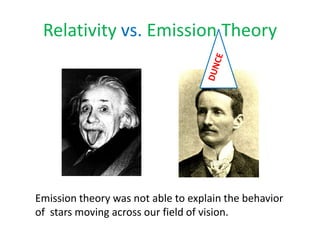
Relativity vs. Emission Theory
Emission theory was not able to explain the behavior
of stars moving across our field of vision.
The Sagnac’s Effect
• A phenomenon observed during interference of
waves when the source is rotated.
• A beam of light is split in two.
• Beams travel in opposite direction
• When apparatus is stationary both beam have an
equal distance to cover.
• Due to rotation of the apparatus both beams face
unequal distances.
• Interference occurs.
The Sagnac’s Effect
Video1 Video 2
Sagnac’s effect dismisses emission
theory and strengthens the case for
special relativity.
Sagnac Effect (Uses): RLG
• The apparatus can be made to measures its
own angular velocity with respect to the local
inertial frame.
• Hence it is highly effective for use in inertial
guidance systems.
• It is the basis for any Ring Laser Gyro
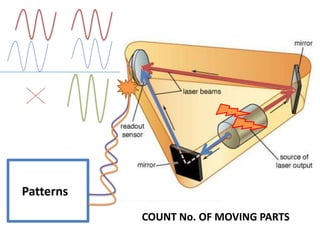
Ring Laser Gyro
Patterns
COUNT No. OF MOVING PARTS
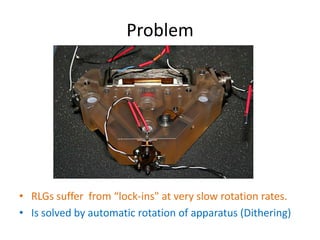
Problem
• RLGs suffer from “lock-ins" at very slow rotation rates.
• Is solved by automatic rotation of apparatus (Dithering)
Summary
• Newtonian Relativity: Universal time and
Absolute space
• Einstein Relativity: Independent time and
inertial frames, concept of spacetime fabric.
• Ritz Emission theory: Light moving with a
speed RELATIVE to its source (rejected)
• Sagnac’s effect: Interference of two beams of
light due to rotation.
• RLG: Working and Problem (solved)
THANK YOU
?
??
Questions

The Sagnac Effect

  • 1.
    The Sagnacs Effect Presentation Disclaimer:Due to the vastness of the topics covered, only the important themes are explained as understood (in the short interval.)
  • 2.
    Overview • Relativity • NewtonianRelativity • Einstein's Relativity • Ritz Theory of Emission • Relativity vs. Emission Theory • The Sagnac’s Effect • Ring Laser Gyros • Summary
  • 3.
    Relativity The fact thatwe cannot detect absolute motion is known as Relativity.
  • 4.
  • 5.
    Newtonian Relativity • Alsoknown as classical relativity • Defined in terms of reference frame. • A reference frame in which Newton’s Laws hold is called an inertial frame • Postulates: 1. There exists an absolute space ( Newton Laws true) 2. All inertial frames share a universal time. • Time runs at the same rate in all frames (Galilean Transformation)
  • 6.
  • 7.
  • 8.
    Newtonian Relativity http://www2.is.wayne.edu/IST_2420_Web_Site/Newtonian_Relativity.htm 3 inertialframes: 1. Carrier-Earth (land underneath) 2. Car-Carrier 3. Car-Base CONCLUSION: Nothing (in terms motion-speed) is constant, every thing is relative to some other inertial frame of reference
  • 9.
    Ritz Theory ofEmission • A competing theory for the theory of relativity. • It obeys the central principal of relativity : No fixed frame of reference. • But claims: what if the light travels at a speed X with reference to the source? • Hence it tries to combine the laws governing electrodynamics and mechanics.
  • 10.
    Einstein's Relativity • Itis a theory of the structure of spacetime. • It is based on two postulates: 1. Laws of physics remain the same for all observers (who are in uniform motion relative to each other) 2. Speed of light is independent of the speed of any other object, even its source. • Postulate two contradicts Ritz Emission theory. • Important consequences include Relativity of simultaneity, Time Dilation, Energy Equivalence.
  • 11.
    Einstein's Relativity vs.Newton • There is no universal time • Every inertial frame has its own independent time. • Speed of light binds all frames of reference.
  • 12.
    Relativity vs. EmissionTheory Emission theory was not able to explain the behavior of stars moving across our field of vision.
  • 13.
    The Sagnac’s Effect •A phenomenon observed during interference of waves when the source is rotated. • A beam of light is split in two. • Beams travel in opposite direction • When apparatus is stationary both beam have an equal distance to cover. • Due to rotation of the apparatus both beams face unequal distances. • Interference occurs.
  • 14.
    The Sagnac’s Effect Video1Video 2 Sagnac’s effect dismisses emission theory and strengthens the case for special relativity.
  • 15.
    Sagnac Effect (Uses):RLG • The apparatus can be made to measures its own angular velocity with respect to the local inertial frame. • Hence it is highly effective for use in inertial guidance systems. • It is the basis for any Ring Laser Gyro
  • 16.
  • 17.
  • 18.
    Problem • RLGs sufferfrom “lock-ins" at very slow rotation rates. • Is solved by automatic rotation of apparatus (Dithering)
  • 19.
    Summary • Newtonian Relativity:Universal time and Absolute space • Einstein Relativity: Independent time and inertial frames, concept of spacetime fabric. • Ritz Emission theory: Light moving with a speed RELATIVE to its source (rejected) • Sagnac’s effect: Interference of two beams of light due to rotation. • RLG: Working and Problem (solved)
  • 20.
  • 21.