(Reflecting &
Refracting)
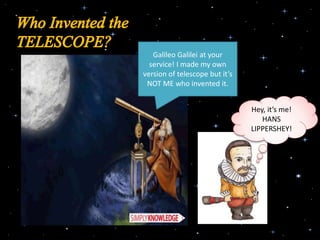
Hey, it’s me!
HANS
LIPPERSHEY!
Galileo Galilei at your
service! I made my own
version of telescope but it’s
NOT ME who invented it.
The Telescope (definition)
• It is an instrument which helps the human
eye see objects not ordinarily
visible
• It also increases the size
of an object’s image on
the retina.
Two Basic Parts of Optical Telescopes:
1. – a very large
lens that collects a large amount of light from
a far away object.
This forms the object’s first
real, inverted and diminished image.
2. – it has a
short focal length. It acts like a magnifying
lens for the image cast by the objective lens.
It forms the final virtual,
enlarged image of the object.
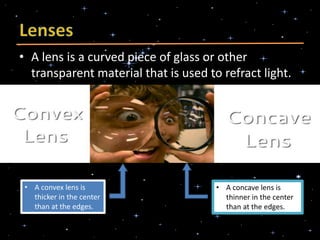
• A lens is a curved piece of glass or other
transparent material that is used to refract light.
• A convex lens is
thicker in the center
than at the edges.
• A concave lens is
thinner in the center
than at the edges.
Types of
Telescopes
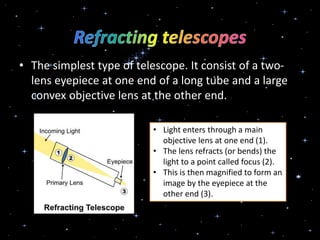
• The simplest type of telescope. It consist of a two-
lens eyepiece at one end of a long tube and a large
convex objective lens at the other end.
• Light enters through a main
objective lens at one end (1).
• The lens refracts (or bends) the
light to a point called focus (2).
• This is then magnified to form an
image by the eyepiece at the
other end (3).
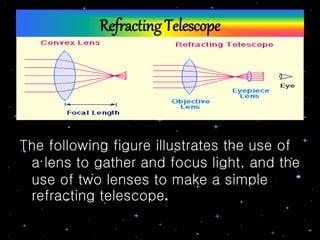
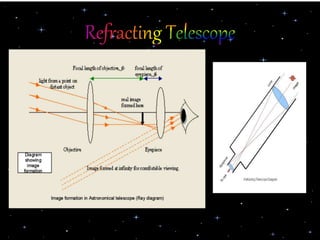
Refracting Telescope
The following figure illustrates the use of
a lens to gather and focus light, and the
use of two lenses to make a simple
refracting telescope.
Disadvantages:
• They can be heavy because of
their need for large lenses.
• They can also have a large
body which may impact on
transportation and storage.
• They may also be expensive,
as large high quality lenses are
more costly to produce.
Advantages:
• Generally easy to use
• More reliable as their
optics are permanently
fixed and aligned.
•
• Many large astronomical
• telescopes use concave mirrors
• instead of objective lenses.
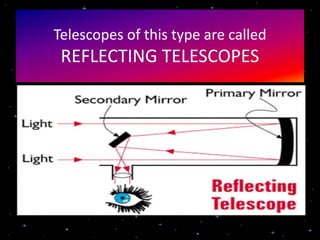
Telescopes of this type are called
REFLECTING TELESCOPES
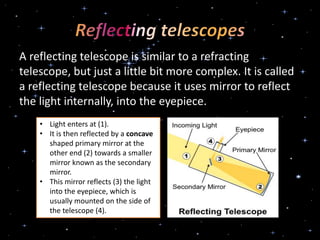
A reflecting telescope is similar to a refracting
telescope, but just a little bit more complex. It is called
a reflecting telescope because it uses mirror to reflect
the light internally, into the eyepiece.
• Light enters at (1).
• It is then reflected by a concave
shaped primary mirror at the
other end (2) towards a smaller
mirror known as the secondary
mirror.
• This mirror reflects (3) the light
into the eyepiece, which is
usually mounted on the side of
the telescope (4).
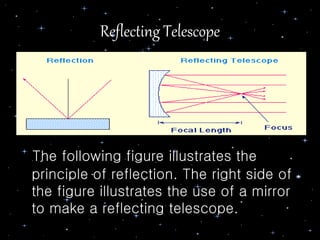
Reflecting Telescope
The following figure illustrates the
principle of reflection. The right side of
the figure illustrates the use of a mirror
to make a reflecting telescope.
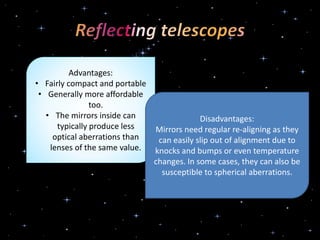
Advantages:
• Fairly compact and portable
• Generally more affordable
too.
• The mirrors inside can
typically produce less
optical aberrations than
lenses of the same value.
Disadvantages:
Mirrors need regular re-aligning as they
can easily slip out of alignment due to
knocks and bumps or even temperature
changes. In some cases, they can also be
susceptible to spherical aberrations.
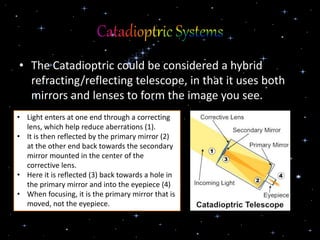
• The Catadioptric could be considered a hybrid
refracting/reflecting telescope, in that it uses both
mirrors and lenses to form the image you see.
• Light enters at one end through a correcting
lens, which help reduce aberrations (1).
• It is then reflected by the primary mirror (2)
at the other end back towards the secondary
mirror mounted in the center of the
corrective lens.
• Here it is reflected (3) back towards a hole in
the primary mirror and into the eyepiece (4)
• When focusing, it is the primary mirror that is
moved, not the eyepiece.
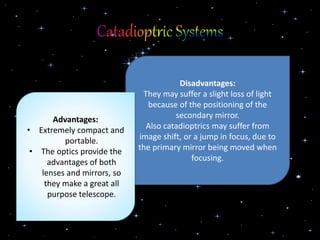
Disadvantages:
They may suffer a slight loss of light
because of the positioning of the
secondary mirror.
Also catadioptrics may suffer from
image shift, or a jump in focus, due to
the primary mirror being moved when
focusing.
Advantages:
• Extremely compact and
portable.
• The optics provide the
advantages of both
lenses and mirrors, so
they make a great all
purpose telescope.
It can also be from atomic and
subatomic particles which we
called RADIATIONS.
What kind of telescope is invented to
detect this radiations?
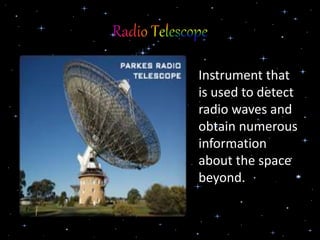
Instrument that
is used to detect
radio waves and
obtain numerous
information
about the space
beyond.
• A radio telescope consist of a parabolic (disk-
shaped) mirror that reflects radio waves to a
preamplifier. The preamplifier converts the
waves into electronic impulses, which are then
fed into an electronic mixer that reconverts
the electronic signals and visual images.
Generalizations:
• How do scientist gather information from the
space beyond the solar system?
• How do refracting and reflecting telescopes
form images of distant objects?
• What does a radio telescope do?
Tell whether the following statements are TRUE or FALSE.
1. An optical telescope is used to magnify the image of a
distant object to make it look closer.
2. A refracting telescope is an optical telescope that
uses a mirror to collect light.
3. An optical telescope collects light waves while a radio
telescope collects radio waves.
4. Convex lenses are used in a reflecting telescope.
5. A concave lens can produce only virtual images
because parallel light rays passing through the lens
never meet.
B. Arrange the jumbled letters in order to find the
answer in the following questions/ statements.
SHPLREIPEY 1. A Dutch optician who invented a “spy glass” which is then
renowned as telescope.
EBJOVICET SELN 2. A very large lens that collects a large amount of light from a
far away object.
COFSU 3. It is the point where the lens in a refracting telescope refracts
(or bends) the light.
IDORA SLECOTEPE 4. Instrument that is used to detect radio waves and obtain
numerous information about the space beyond.
EEECYPEI 5. It forms the final virtual, enlarged image of the object.
• Explain how a refracting telescope forms a
magnified image of a distant object.
• Describe a reflecting telescope.
• What are stars?
• Why do stars twinkle?

Telescope: Refracting and Reflecting

  • 1.
  • 2.
    Hey, it’s me! HANS LIPPERSHEY! GalileoGalilei at your service! I made my own version of telescope but it’s NOT ME who invented it.
  • 3.
    The Telescope (definition) •It is an instrument which helps the human eye see objects not ordinarily visible • It also increases the size of an object’s image on the retina.
  • 4.
    Two Basic Partsof Optical Telescopes: 1. – a very large lens that collects a large amount of light from a far away object. This forms the object’s first real, inverted and diminished image.
  • 5.
    2. – ithas a short focal length. It acts like a magnifying lens for the image cast by the objective lens. It forms the final virtual, enlarged image of the object.
  • 6.
    • A lensis a curved piece of glass or other transparent material that is used to refract light. • A convex lens is thicker in the center than at the edges. • A concave lens is thinner in the center than at the edges.
  • 7.
  • 8.
    • The simplesttype of telescope. It consist of a two- lens eyepiece at one end of a long tube and a large convex objective lens at the other end. • Light enters through a main objective lens at one end (1). • The lens refracts (or bends) the light to a point called focus (2). • This is then magnified to form an image by the eyepiece at the other end (3).
  • 9.
    Refracting Telescope The followingfigure illustrates the use of a lens to gather and focus light, and the use of two lenses to make a simple refracting telescope.
  • 11.
    Disadvantages: • They canbe heavy because of their need for large lenses. • They can also have a large body which may impact on transportation and storage. • They may also be expensive, as large high quality lenses are more costly to produce. Advantages: • Generally easy to use • More reliable as their optics are permanently fixed and aligned.
  • 12.
    • • Many largeastronomical • telescopes use concave mirrors • instead of objective lenses.
  • 13.
    Telescopes of thistype are called REFLECTING TELESCOPES
  • 14.
    A reflecting telescopeis similar to a refracting telescope, but just a little bit more complex. It is called a reflecting telescope because it uses mirror to reflect the light internally, into the eyepiece. • Light enters at (1). • It is then reflected by a concave shaped primary mirror at the other end (2) towards a smaller mirror known as the secondary mirror. • This mirror reflects (3) the light into the eyepiece, which is usually mounted on the side of the telescope (4).
  • 15.
    Reflecting Telescope The followingfigure illustrates the principle of reflection. The right side of the figure illustrates the use of a mirror to make a reflecting telescope.
  • 16.
    Advantages: • Fairly compactand portable • Generally more affordable too. • The mirrors inside can typically produce less optical aberrations than lenses of the same value. Disadvantages: Mirrors need regular re-aligning as they can easily slip out of alignment due to knocks and bumps or even temperature changes. In some cases, they can also be susceptible to spherical aberrations.
  • 17.
    • The Catadioptriccould be considered a hybrid refracting/reflecting telescope, in that it uses both mirrors and lenses to form the image you see. • Light enters at one end through a correcting lens, which help reduce aberrations (1). • It is then reflected by the primary mirror (2) at the other end back towards the secondary mirror mounted in the center of the corrective lens. • Here it is reflected (3) back towards a hole in the primary mirror and into the eyepiece (4) • When focusing, it is the primary mirror that is moved, not the eyepiece.
  • 18.
    Disadvantages: They may suffera slight loss of light because of the positioning of the secondary mirror. Also catadioptrics may suffer from image shift, or a jump in focus, due to the primary mirror being moved when focusing. Advantages: • Extremely compact and portable. • The optics provide the advantages of both lenses and mirrors, so they make a great all purpose telescope.
  • 19.
    It can alsobe from atomic and subatomic particles which we called RADIATIONS.
  • 20.
    What kind oftelescope is invented to detect this radiations?
  • 21.
    Instrument that is usedto detect radio waves and obtain numerous information about the space beyond.
  • 22.
    • A radiotelescope consist of a parabolic (disk- shaped) mirror that reflects radio waves to a preamplifier. The preamplifier converts the waves into electronic impulses, which are then fed into an electronic mixer that reconverts the electronic signals and visual images.
  • 23.
    Generalizations: • How doscientist gather information from the space beyond the solar system? • How do refracting and reflecting telescopes form images of distant objects? • What does a radio telescope do?
  • 24.
    Tell whether thefollowing statements are TRUE or FALSE. 1. An optical telescope is used to magnify the image of a distant object to make it look closer. 2. A refracting telescope is an optical telescope that uses a mirror to collect light. 3. An optical telescope collects light waves while a radio telescope collects radio waves. 4. Convex lenses are used in a reflecting telescope. 5. A concave lens can produce only virtual images because parallel light rays passing through the lens never meet.
  • 25.
    B. Arrange thejumbled letters in order to find the answer in the following questions/ statements. SHPLREIPEY 1. A Dutch optician who invented a “spy glass” which is then renowned as telescope. EBJOVICET SELN 2. A very large lens that collects a large amount of light from a far away object. COFSU 3. It is the point where the lens in a refracting telescope refracts (or bends) the light. IDORA SLECOTEPE 4. Instrument that is used to detect radio waves and obtain numerous information about the space beyond. EEECYPEI 5. It forms the final virtual, enlarged image of the object.
  • 26.
    • Explain howa refracting telescope forms a magnified image of a distant object. • Describe a reflecting telescope. • What are stars? • Why do stars twinkle?

Editor's Notes

  • #7 As light rays parallel to the optical axis pass through a convex lens, they are bent toward the center of the lens. The rays meet at the focal point of the lens and continue to travel beyond. The more curved the lens, the more it refracts light. A convex lens acts somewhat like a concave mirror, because it focuses rays of light When light rays traveling parallel to the optical axis pass through a concave lens, they bend away from the optical axis and never meet. A concave lens can produce only virtual images because parallel light rays passing through the lens never meet.
  • #9 As light rays parallel to the optical axis pass through a convex lens, they are bent toward the center of the lens. The rays meet at the focal point of the lens and continue to travel beyond. The more curved the lens, the more it refracts light. A convex lens acts somewhat like a concave mirror, because it focuses rays of light.