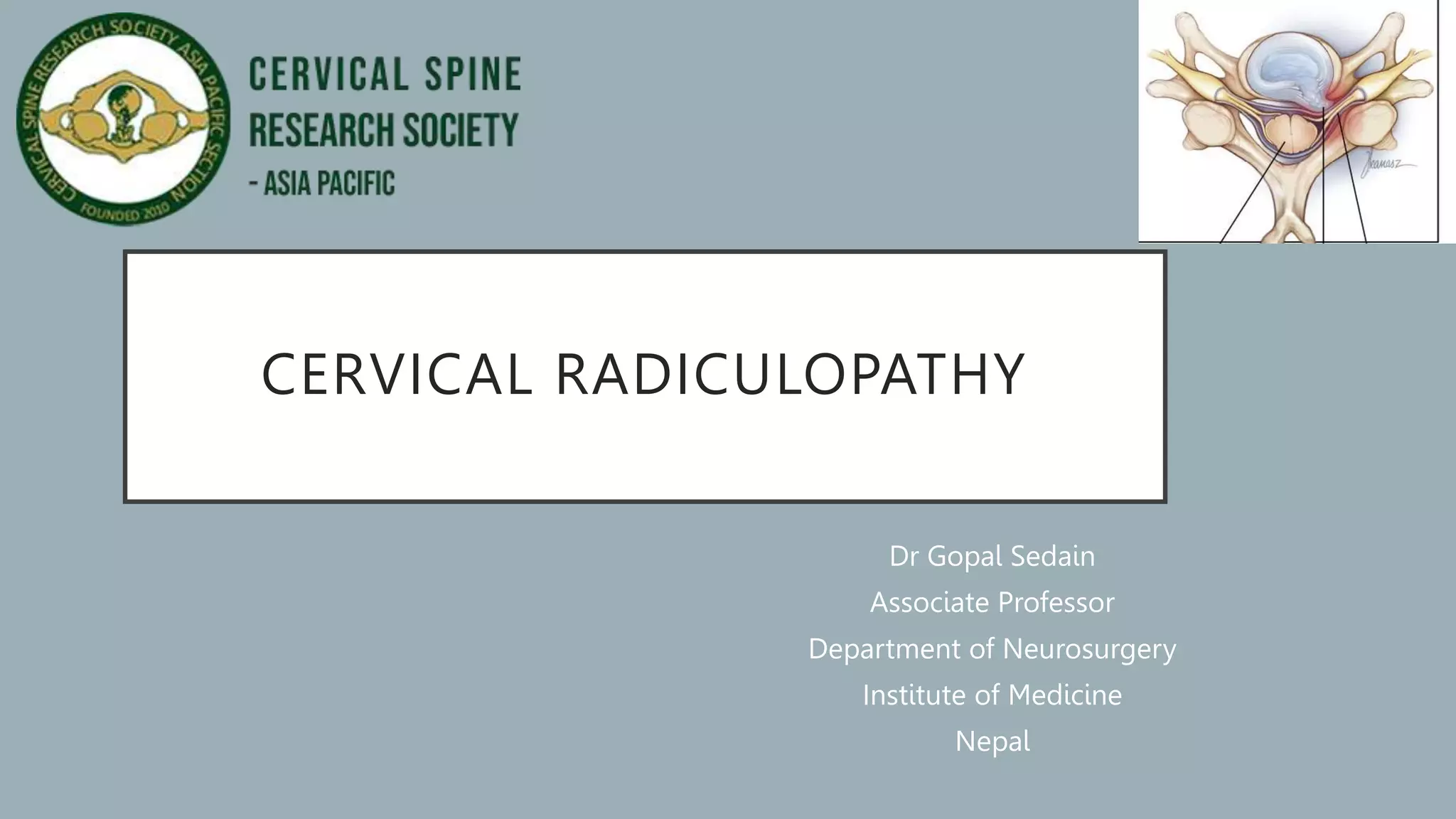
CERVICAL RADICULOPATHY
Dr Gopal Sedain
Associate Professor
Department of Neurosurgery
Institute of Medicine
Nepal
DEFINITION
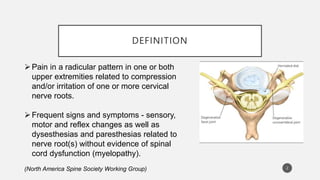
Pain in a radicular pattern in one or both
upper extremities related to compression
and/or irritation of one or more cervical
nerve roots.
Frequent signs and symptoms - sensory,
motor and reflex changes as well as
dysesthesias and paresthesias related to
nerve root(s) without evidence of spinal
cord dysfunction (myelopathy).
(North America Spine Society Working Group) 2
EPIDEMIOLOGY
• Incidence: 85 per 100,000
• Peak incidence 5th decade
• C7 nerve root (60%)
• C6 nerve root(25%)
Risk factors
• Manual labor involving heavy lifting, driving, or operation of vibrating
equipment, golf, chronic smoking.
3
PATHOPHYSIOLOGY
• Key pathophysiologic feature is inflammation
• Cytokine-mediated response leads to a decrease in the number
of large-diameter myelinated axons.
• Acute radiculopathy ----predominant motor findings.
• Chronic radiculopathy ------predominantly sensory findings
and is more commonly seen in older patients.
4
PATHOPHYSIOLOGY
• From a pathologic perspective, chronic radiculopathy
often has
• disk pathology
• facet arthropathy and,
• uncovertebral osteophytes.
5
SIGNS AND SYMPTOMS
Pain or paresthesia in a
• dermatomal pattern 54%,
• diffuse or non dermatomal pattern 46%
Clinical findings related to the fingers are
the most accurate for localizing a disc to a
single level
A single level disc may produce signs and
symptoms that correspond to overlapping
dermatomal levels.
Henderson CM, Hennessy RG, Shuey HM, Jr., Shackelford EG. Posterior-lateral foraminotomy as an exclusive operative technique
for cervical radiculopathy: a review of 846 consecutively operated cases. Neurosurgery. Nov1983;13(5):504-512.
6
PROVOCATIVE TESTS
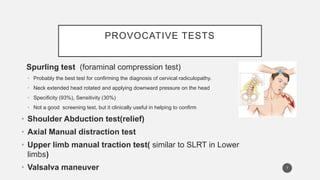
Spurling test (foraminal compression test)
• Probably the best test for confirming the diagnosis of cervical radiculopathy.
• Neck extended head rotated and applying downward pressure on the head
• Specificity (93%), Sensitivity (30%)
• Not a good screening test, but it clinically useful in helping to confirm
• Shoulder Abduction test(relief)
• Axial Manual distraction test
• Upper limb manual traction test( similar to SLRT in Lower
limbs)
• Valsalva maneuver 7
RADICULOPATHY MIMICKERS
• Carpel Tunnel Syndrome: positive NCS, thenar muscle wasting, positive
phalen’s sign
• PIN(Posterior Interosseus Nerve ) syndrome vs C7 radiculopathy:
sensory intact, normal triceps and wrist flexors in PIN
• Cubital tunnel syndrome vs C8 radiculopathy: intact adductor pollicis in
C8
• Brachial plexus neuritis(Parsonage turner): pain followed by weakness
esp C5/6 after few days as pain subsides in neuronitis vs together in
radiculopathy
8
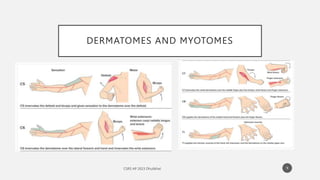
DERMATOMES AND MYOTOMES
9
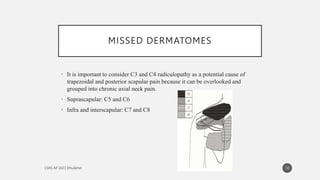
MISSED DERMATOMES
• It is important to consider C3 and C4 radiculopathy as a potential cause of
trapezoidal and posterior scapular pain because it can be overlooked and
grouped into chronic axial neck pain.
• Suprascapular: C5 and C6
• Infra and interscapular: C7 and C8
10
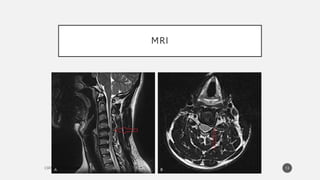
IMAGING
• Xray: AP/Oblique views
• CT:
• MRI:
MRI is considered the imaging method of choice for the
evaluation of cervical radiculopathy.
< 40 years : 10% have disc herniations;
>40 years, 20% have evidence of foraminal stenosis and 8%
had disc protrusion or herniation.
11
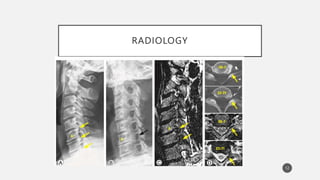
RADIOLOGY
12
MRI
13
ELECTRODIAGNOSIS
• Positive sharp waves and fibrillation potentials : 18-21 days
after the onset of a radiculopathy
• EMG is to confirm nerve root dysfunction when the
diagnosis is uncertain / when the physical examination
findings are unclear.
• Normal EMG results in a patient with signs and symptoms
does not exclude the diagnosis of cervical radiculopathy.
14
TREATMENT
• There is no clear evidence that surgical treatment of cervical radiculopathy
provides better long-term outcomes than nonoperative measures.
Bone and Joint Decade 2000-2010 Task Force on Neck Pain and Its Associated Disorders
• Over 85% of acute cervical radiculopathy resolves without any
specific treatments within 8-12 weeks
• NSAIDs for 1 to 2 weeks
• Oral steroids
• Tricyclic antidepressants
• Gabapentin/Pregabalin can be useful adjuncts in the treatment of cervical
radiculopathy
• Methylcobalamin (??)
15
TREATMENT
• Over 85% of acute cervical radiculopathy resolves without
any specific treatments within 8-12 weeks
• NSAIDs for 1 to 2 weeks
• Oral steroids
• Tricyclic antidepressants
• Gabapentin/Pregabalin can be useful adjuncts in the
treatment of cervical radiculopathy
• Methyl cobalamin (vitamin B12): ??
16
ORAL STEROIDS
• Randomized, double-blinded, placebo-controlled trial
• 50mg/day for 5 days and tapered over 5 days
• Decrease in NDI and VRS more in prednisolone group
Ghasemi M, Masaeli A, Rezvani M, Shaygannejad V, Golabchi K, Norouzi R. Oral prednisolone in
the treatment of cervical radiculopathy: a randomized placebo controlled trial. J Res Med Sci
2013;18:S43-6.
17
TRANSLAMINAR/TRANSFORAMINAL
STEROIDS
• Relief from a single treatment can be significant and long-
lasting.
• Half of the patients : relief of at least 50% for weeks following
injection
• Complication rates - 0% and 16.8%
• Complications can be devastating; brainstem or spinal cord
sequelae
Carragee EJ, Hurwitz EL, Cheng I, Carroll LJ, Nordin M, Guzman J, Peloso P, Holm LW, Côté P, Hogg-Johnson S, van der Velde G, Cassidy JD,
Haldeman S; Bone and Joint Decade 2000-2010 Task Force on Neck Pain and Its Associated Disorders. Treatment of neck pain: injections and
surgical interventions: results of the Bone and Joint Decade 2000-2010 Task Force on Neck Pain and Its Associated Disorders. Spine (Phila Pa
1976). 2008 Feb 15;33(4 Suppl):S153-69.
18
COLLAR?
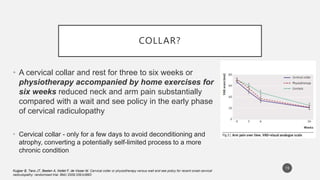
• A cervical collar and rest for three to six weeks or
physiotherapy accompanied by home exercises for
six weeks reduced neck and arm pain substantially
compared with a wait and see policy in the early phase
of cervical radiculopathy
• Cervical collar - only for a few days to avoid deconditioning and
atrophy, converting a potentially self-limited process to a more
chronic condition
Kuijper B, Tans JT, Beelen A, Nollet F, de Visser M. Cervical collar or physiotherapy versus wait and see policy for recent onset cervical
radiculopathy: randomised trial. BMJ 2009;339:b3883
19
TRACTION
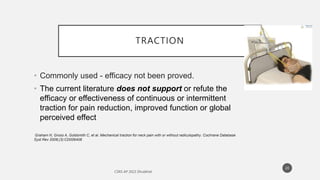
• Commonly used - efficacy not been proved.
• The current literature does not support or refute the
efficacy or effectiveness of continuous or intermittent
traction for pain reduction, improved function or global
perceived effect
Graham N, Gross A, Goldsmith C, et al. Mechanical traction for neck pain with or without radiculopathy. Cochrane Database
Syst Rev 2008;(3):CD006408
20
TENS
• Transcutaneous electrical nerve stimulation (TENS)
has also had mixed reviews.
• Studies have been inconsistent and conclusions
regarding its use in acute pain have not been
reached.
21
SURGERY
• Surgery: for worsening neurology/pain not controlled by conservative
means
• Meta-analysis of RCTs
• ACDF/ cervical disc replacement(CDR) /minimally invasive PCF: all
effective
• CDR - lowest rate of secondary surgical procedures (P=.0178)
• Minimally invasive posterior cervical foraminotomy - lowest percentage of
adverse events (P< .0001),
• No single technique proved to be the most effective.
Gutman G, Rosenzweig DH, Golan JD. Surgical Treatment of Cervical Radiculopathy: Meta-analysis of Randomized Controlled Trials. Spine (Phila Pa
1976). 2018 Mar 15;43(6):E365-E372
22
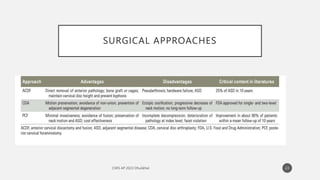
SURGICAL APPROACHES
23
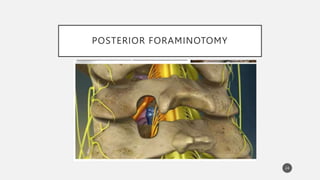
POSTERIOR FORAMINOTOMY
24
PCF(POSTERIOR CERVICAL
LAMINOFORAMINOTOMY)
Cost effective
• A low rate (∼1%) of need for future index-level surgery and a
• < 1% rate of development of symptomatic adjacent-level disease : mean 32-
month follow-up.
Limitations :
• prohibitive risk for addressing more ventral disease,
• failure to address cervical kyphosis
• difficulty with addressing bilateral disease.
• Skovrlj B, Gologorsky Y, Haque R, et al. Complications, outcomes, and need for fusion after minimally invasive posterior cervical foraminotomy and microdiscectomy. Spine J. 2014;14:2405–
2411.
25
TAKE HOME MESSAGE
26
• Most of cervical radiculopathy is managed by non surgical means
• Comprehensive team care in association with physiotherapists and pain
physicians will improve outcome
• Minimal Invasive Posterior cervical foraminotomy can have good results
without need for implants and possible adjacent level degeneration
27

Cervical radiculopathy.pptx

  • 1.
    CERVICAL RADICULOPATHY Dr GopalSedain Associate Professor Department of Neurosurgery Institute of Medicine Nepal
  • 2.
    DEFINITION Pain in aradicular pattern in one or both upper extremities related to compression and/or irritation of one or more cervical nerve roots. Frequent signs and symptoms - sensory, motor and reflex changes as well as dysesthesias and paresthesias related to nerve root(s) without evidence of spinal cord dysfunction (myelopathy). (North America Spine Society Working Group) 2
  • 3.
    EPIDEMIOLOGY • Incidence: 85per 100,000 • Peak incidence 5th decade • C7 nerve root (60%) • C6 nerve root(25%) Risk factors • Manual labor involving heavy lifting, driving, or operation of vibrating equipment, golf, chronic smoking. 3
  • 4.
    PATHOPHYSIOLOGY • Key pathophysiologicfeature is inflammation • Cytokine-mediated response leads to a decrease in the number of large-diameter myelinated axons. • Acute radiculopathy ----predominant motor findings. • Chronic radiculopathy ------predominantly sensory findings and is more commonly seen in older patients. 4
  • 5.
    PATHOPHYSIOLOGY • From apathologic perspective, chronic radiculopathy often has • disk pathology • facet arthropathy and, • uncovertebral osteophytes. 5
  • 6.
    SIGNS AND SYMPTOMS Painor paresthesia in a • dermatomal pattern 54%, • diffuse or non dermatomal pattern 46% Clinical findings related to the fingers are the most accurate for localizing a disc to a single level A single level disc may produce signs and symptoms that correspond to overlapping dermatomal levels. Henderson CM, Hennessy RG, Shuey HM, Jr., Shackelford EG. Posterior-lateral foraminotomy as an exclusive operative technique for cervical radiculopathy: a review of 846 consecutively operated cases. Neurosurgery. Nov1983;13(5):504-512. 6
  • 7.
    PROVOCATIVE TESTS Spurling test(foraminal compression test) • Probably the best test for confirming the diagnosis of cervical radiculopathy. • Neck extended head rotated and applying downward pressure on the head • Specificity (93%), Sensitivity (30%) • Not a good screening test, but it clinically useful in helping to confirm • Shoulder Abduction test(relief) • Axial Manual distraction test • Upper limb manual traction test( similar to SLRT in Lower limbs) • Valsalva maneuver 7
  • 8.
    RADICULOPATHY MIMICKERS • CarpelTunnel Syndrome: positive NCS, thenar muscle wasting, positive phalen’s sign • PIN(Posterior Interosseus Nerve ) syndrome vs C7 radiculopathy: sensory intact, normal triceps and wrist flexors in PIN • Cubital tunnel syndrome vs C8 radiculopathy: intact adductor pollicis in C8 • Brachial plexus neuritis(Parsonage turner): pain followed by weakness esp C5/6 after few days as pain subsides in neuronitis vs together in radiculopathy 8
  • 9.
  • 10.
    MISSED DERMATOMES • Itis important to consider C3 and C4 radiculopathy as a potential cause of trapezoidal and posterior scapular pain because it can be overlooked and grouped into chronic axial neck pain. • Suprascapular: C5 and C6 • Infra and interscapular: C7 and C8 10
  • 11.
    IMAGING • Xray: AP/Obliqueviews • CT: • MRI: MRI is considered the imaging method of choice for the evaluation of cervical radiculopathy. < 40 years : 10% have disc herniations; >40 years, 20% have evidence of foraminal stenosis and 8% had disc protrusion or herniation. 11
  • 12.
  • 13.
  • 14.
    ELECTRODIAGNOSIS • Positive sharpwaves and fibrillation potentials : 18-21 days after the onset of a radiculopathy • EMG is to confirm nerve root dysfunction when the diagnosis is uncertain / when the physical examination findings are unclear. • Normal EMG results in a patient with signs and symptoms does not exclude the diagnosis of cervical radiculopathy. 14
  • 15.
    TREATMENT • There isno clear evidence that surgical treatment of cervical radiculopathy provides better long-term outcomes than nonoperative measures. Bone and Joint Decade 2000-2010 Task Force on Neck Pain and Its Associated Disorders • Over 85% of acute cervical radiculopathy resolves without any specific treatments within 8-12 weeks • NSAIDs for 1 to 2 weeks • Oral steroids • Tricyclic antidepressants • Gabapentin/Pregabalin can be useful adjuncts in the treatment of cervical radiculopathy • Methylcobalamin (??) 15
  • 16.
    TREATMENT • Over 85%of acute cervical radiculopathy resolves without any specific treatments within 8-12 weeks • NSAIDs for 1 to 2 weeks • Oral steroids • Tricyclic antidepressants • Gabapentin/Pregabalin can be useful adjuncts in the treatment of cervical radiculopathy • Methyl cobalamin (vitamin B12): ?? 16
  • 17.
    ORAL STEROIDS • Randomized,double-blinded, placebo-controlled trial • 50mg/day for 5 days and tapered over 5 days • Decrease in NDI and VRS more in prednisolone group Ghasemi M, Masaeli A, Rezvani M, Shaygannejad V, Golabchi K, Norouzi R. Oral prednisolone in the treatment of cervical radiculopathy: a randomized placebo controlled trial. J Res Med Sci 2013;18:S43-6. 17
  • 18.
    TRANSLAMINAR/TRANSFORAMINAL STEROIDS • Relief froma single treatment can be significant and long- lasting. • Half of the patients : relief of at least 50% for weeks following injection • Complication rates - 0% and 16.8% • Complications can be devastating; brainstem or spinal cord sequelae Carragee EJ, Hurwitz EL, Cheng I, Carroll LJ, Nordin M, Guzman J, Peloso P, Holm LW, Côté P, Hogg-Johnson S, van der Velde G, Cassidy JD, Haldeman S; Bone and Joint Decade 2000-2010 Task Force on Neck Pain and Its Associated Disorders. Treatment of neck pain: injections and surgical interventions: results of the Bone and Joint Decade 2000-2010 Task Force on Neck Pain and Its Associated Disorders. Spine (Phila Pa 1976). 2008 Feb 15;33(4 Suppl):S153-69. 18
  • 19.
    COLLAR? • A cervicalcollar and rest for three to six weeks or physiotherapy accompanied by home exercises for six weeks reduced neck and arm pain substantially compared with a wait and see policy in the early phase of cervical radiculopathy • Cervical collar - only for a few days to avoid deconditioning and atrophy, converting a potentially self-limited process to a more chronic condition Kuijper B, Tans JT, Beelen A, Nollet F, de Visser M. Cervical collar or physiotherapy versus wait and see policy for recent onset cervical radiculopathy: randomised trial. BMJ 2009;339:b3883 19
  • 20.
    TRACTION • Commonly used- efficacy not been proved. • The current literature does not support or refute the efficacy or effectiveness of continuous or intermittent traction for pain reduction, improved function or global perceived effect Graham N, Gross A, Goldsmith C, et al. Mechanical traction for neck pain with or without radiculopathy. Cochrane Database Syst Rev 2008;(3):CD006408 20
  • 21.
    TENS • Transcutaneous electricalnerve stimulation (TENS) has also had mixed reviews. • Studies have been inconsistent and conclusions regarding its use in acute pain have not been reached. 21
  • 22.
    SURGERY • Surgery: forworsening neurology/pain not controlled by conservative means • Meta-analysis of RCTs • ACDF/ cervical disc replacement(CDR) /minimally invasive PCF: all effective • CDR - lowest rate of secondary surgical procedures (P=.0178) • Minimally invasive posterior cervical foraminotomy - lowest percentage of adverse events (P< .0001), • No single technique proved to be the most effective. Gutman G, Rosenzweig DH, Golan JD. Surgical Treatment of Cervical Radiculopathy: Meta-analysis of Randomized Controlled Trials. Spine (Phila Pa 1976). 2018 Mar 15;43(6):E365-E372 22
  • 23.
  • 24.
  • 25.
    PCF(POSTERIOR CERVICAL LAMINOFORAMINOTOMY) Cost effective •A low rate (∼1%) of need for future index-level surgery and a • < 1% rate of development of symptomatic adjacent-level disease : mean 32- month follow-up. Limitations : • prohibitive risk for addressing more ventral disease, • failure to address cervical kyphosis • difficulty with addressing bilateral disease. • Skovrlj B, Gologorsky Y, Haque R, et al. Complications, outcomes, and need for fusion after minimally invasive posterior cervical foraminotomy and microdiscectomy. Spine J. 2014;14:2405– 2411. 25
  • 26.
    TAKE HOME MESSAGE 26 •Most of cervical radiculopathy is managed by non surgical means • Comprehensive team care in association with physiotherapists and pain physicians will improve outcome • Minimal Invasive Posterior cervical foraminotomy can have good results without need for implants and possible adjacent level degeneration
  • 27.

Editor's Notes

  • #4 Disc herniation is responsible for only 21.9% of cervical radiculopathy cases  less commonly caused by tumors, trauma, synovial cysts, meningeal cysts, dural arteriovenous fistulae or tortuous vertebral arteries