DR. SUSHMA RATHEE
A S S I S T A N T C L I N I C A L P S Y C H O L O G I S T ,
P G I M E R , C H A N D I G A R H
E M A I L : S U S H M A R A T H E E C P @ G M A I L . C O M
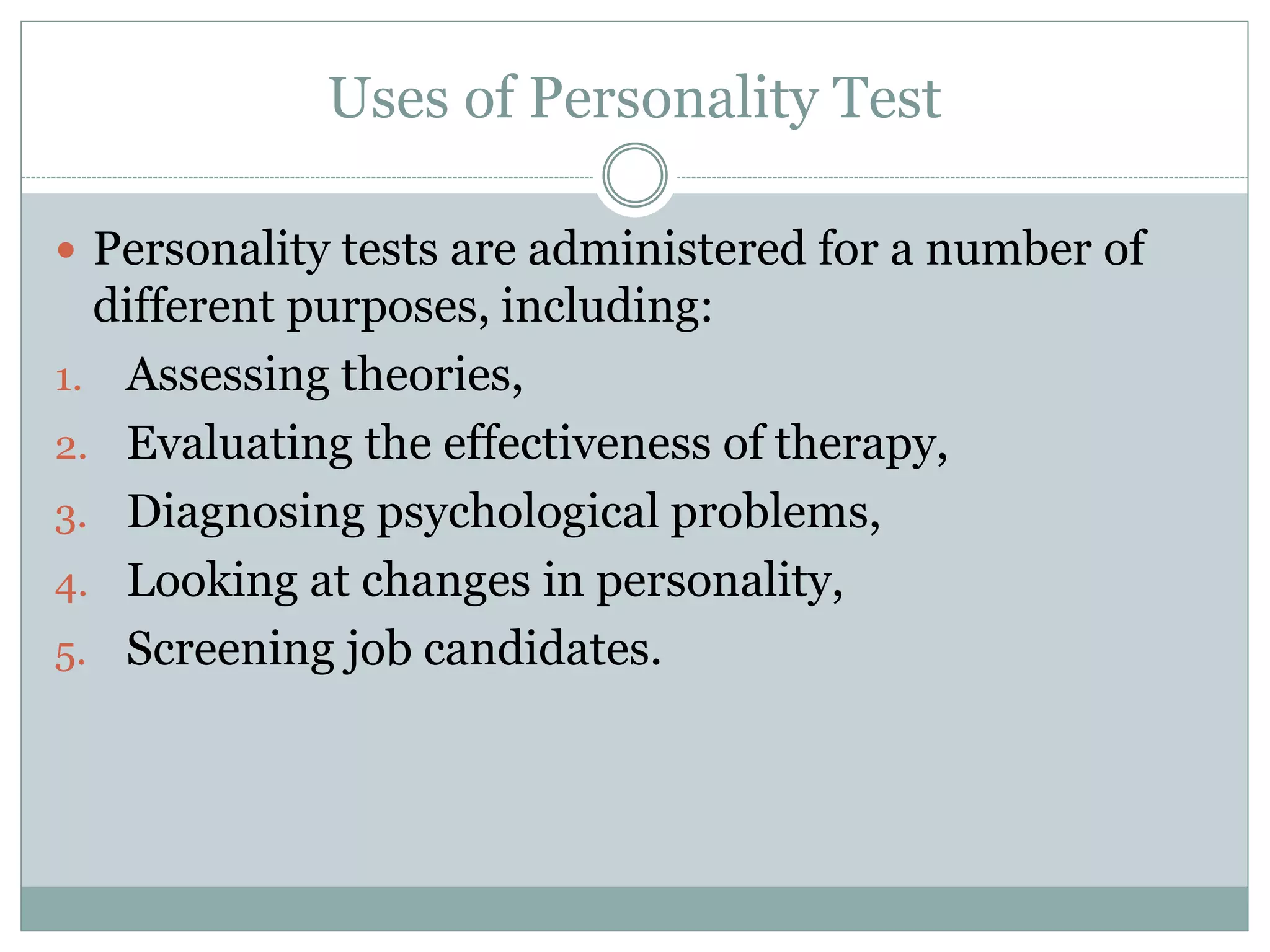
Personality Assessment
 Standardized personality tests
 “Standardized” means created by having very large
representative sample of people take the test and find average
answer.
 A standardized test is any form of test that (1) requires all
test takers to answer the same questions, or a selection of
questions from common bank of questions, in the same way,
and that (2) is scored in a “standard” or consistent manner,
which makes it possible to compare the relative performance
of individual students or groups of students.
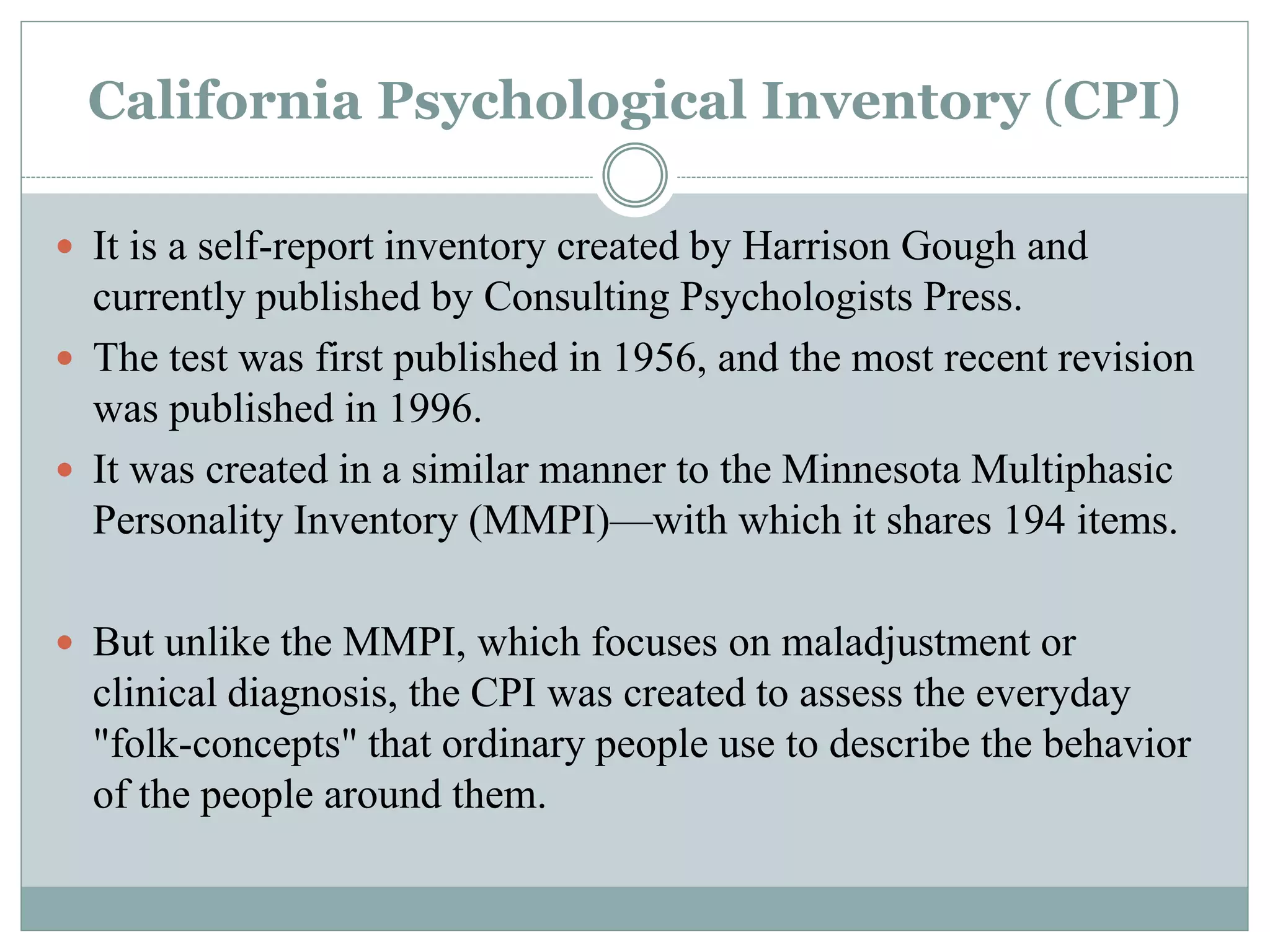
Uses of Personality Test
 Personality tests are administered for a number of
different purposes, including:
1. Assessing theories,
2. Evaluating the effectiveness of therapy,
3. Diagnosing psychological problems,
4. Looking at changes in personality,
5. Screening job candidates.
Interview Method:
 The interview is the most common method of judging
personality. The interviewer questions or lets the individual speak
freely so as to get a clear picture of the individual
 There are three types of clinical interviews:
 Structured: A structured interview requires that the same
questions be asked of each client in an identical manner.
 Unstructured: The counselor to determine the questions and
topics covered during the interview.
 Semi-structured: A semi-structured interview combines these
formats.
Personality Assessment
The most widely used of these tests is the Minnesota
Multiphasic Personality Inventory (MMPI) (a series of 567
true-false questions)
Measures personality & clinical conditions.
 Minnesota Multiphasic Personality Inventory (MMPI)
 Prototypic self-report inventory used by clinical psychologists
 Revised version, MMPI-2, was published in 1989
 Widely used clinical assessment tool
 Psychologists debate the validity of scales.
Sample MMPI Profile
7 - 27
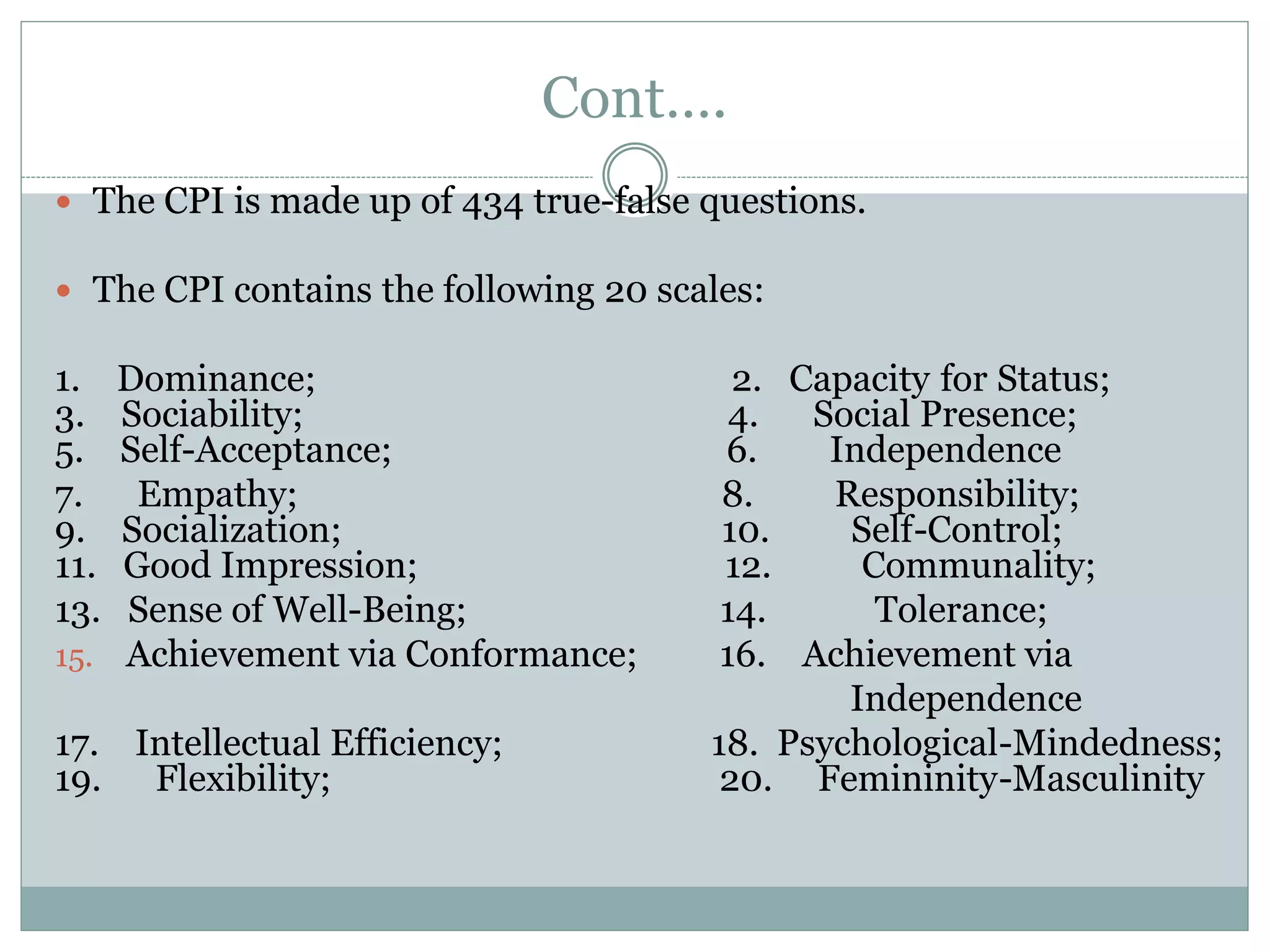
California Psychological Inventory (CPI)
 It is a self-report inventory created by Harrison Gough and
currently published by Consulting Psychologists Press.
 The test was first published in 1956, and the most recent revision
was published in 1996.
 It was created in a similar manner to the Minnesota Multiphasic
Personality Inventory (MMPI)—with which it shares 194 items.
 But unlike the MMPI, which focuses on maladjustment or
clinical diagnosis, the CPI was created to assess the everyday
"folk-concepts" that ordinary people use to describe the behavior
of the people around them.
Cont….
 The CPI is made up of 434 true-false questions.
 The CPI contains the following 20 scales:
1. Dominance; 2. Capacity for Status;
3. Sociability; 4. Social Presence;
5. Self-Acceptance; 6. Independence
7. Empathy; 8. Responsibility;
9. Socialization; 10. Self-Control;
11. Good Impression; 12. Communality;
13. Sense of Well-Being; 14. Tolerance;
15. Achievement via Conformance; 16. Achievement via
Independence
17. Intellectual Efficiency; 18. Psychological-Mindedness;
19. Flexibility; 20. Femininity-Masculinity
Myers-Briggs Type Indicator
 Based on Carl Jung’s work
 People are fundamentally different
 People are fundamentally alike
 People have preference combinations for
extraversion/introversion, perception, judgment
 Briggs & Myers developed the MBTI to understand
individual differences
MBTI Preferences
Preferences Represents
Extraversion Introversion How one
re-energizes
Sensing Intuiting How one gathers
information
Thinking Feeling How one makes
decisions
Judging Perceiving How one orients to the
outer world
Raymond Cattell and Traits
 Surface Traits: Features that make up the visible
areas of personality
 Source Traits: Underlying traits of a personality;
each reflected in a number of surface traits
 Cattell also created 16PF, personality test
 Gives a “picture” of an individual’s personality
Eysenck’s supertraits
 Hans Eysenck (1916–97) was a contemporary of Cattell and
also used factor analysis to classify personality traits.
 But Eysenck (1967) began with a theory of personality which
he based on two super traits – extraversion–introversion and
neuroticism–stability.
Four personality types can be derived from the traits associated with
Eysenck’s two major personality dimensions of extraversion and
neuroticism. (Fig. 14.7)
Self-Report Inventories
© 2016 Cengage Learning. All Rights Reserved. May not be copied, scanned, or duplicated, in whole or in part, except for use as
permitted in a license distributed with a certain product or service or otherwise on a password-protected website for classroom use.
 Problems with self-report inventories
 Faking
 Test takers intentionally give misleading information on self-
report inventories
 Fake good - Presenting themselves as better than they really are
 Fake bad - Making themselves look worse than they really are
 Test makers build safeguards into tests to reduce faking
7 - 28
Personality Inventory for Children
(PIC)
 Measures a wide range of child functioning: behavior,
affect, cognitive status.
 Two versions: Long (420 questions) and Short (280
questions). Short is most frequently used.
 True False Format.
 Takes approx. 30 minutes.
 Ages 3-16
Personality Inventory for Children
(PIC)
 Developed from theoretical constructs, then validated
using populations with specific maladaptive functioning.
 Also based on empirical research, primary factors of
personality based on behavioral observations, and areas
of interest believe to be useful for practicing clinicians.
 Subscales and Profile Types
 Combinations of scale elevations to produce 12 profile
types
 Projective Techniques
Personality Assessment
Rorschach inkblot test
 The Rorschach inkblot test is a type of projective
psychological test created in 1921 by a Swiss psychologist
named Hermann Rorschach.
 Often utilized to assess personality and emotional functioning. It
has been employed to detect underlying thought disorder,
especially in cases where patients are reluctant to describe their
thinking processes openly.
 10 cards; 5 black and white(1,4,5,6 & 7), 5 Multicolor (2,3,8,9 &
10)
 Beck, Piotrowski and Exner three most popular method of
scoring.
 Scoring:
 Content
 Location
 Determinants
 Response<17
 Popular Response<5
Thematic apperception test (TAT)
 1930s by Henry Alexander Murray and Christiana D.
Morgan at Harvard University.
 Proponents of the technique assert that subjects' responses, in the
narratives they make up about ambiguous pictures of people,
reveal their underlying motives, concerns, and the way they see
the social world.
 Historically, the test has been among the most widely researched,
taught, and used of such techniques.
 The complete version of the test contains 32 picture cards.
 Some of the cards show male figures, some female, some both male
and female figures, some of ambiguous gender, some adults, some
children, and some show no human figures at all.
 One card is completely blank and is used to elicit both a scene and a
story about the given scene from the storyteller.
 Murray recommended using 20 cards.
 Thematic Apperception Tests are meant to evoke an involuntary
display of one’s subconscious.
 Instructions:
 what has led up to the event shown,
 what is happening at the moment,
 what the characters are feeling and thinking,
 what the outcome of the story was.
 Three common methods that are currently used in research are
the: Defense Mechanisms Manual; Social Cognition and Object
Relations; and Personal Problem-Solving System—Revised.
Children's Apperception Test (CAT)
 Used to assess individual variations in children's
responses to standardized stimuli presented in the
form of pictures of animals (CAT-A) or humans
(CAT-H) in common social situations.
 The CAT is used to assess personality, level of
maturity, and, often, psychological health.
Sentence completion tests
 A class of semi-structured projective techniques.
 Sentence completion tests typically provide respondents with beginnings
of sentences, referred to as "stems", and respondents then complete the
sentences in ways that are meaningful to them.
 The responses are believed to provide indications
of attitudes, beliefs, motivations, or other mental states.
 Hermann Ebbinghaus is generally credited with developing the first
sentence completion test in 1897. Ebbinghaus's sentence
completion test was used as part of an intelligence test.
Beck Anxiety Inventory (BAI)
Created by Aaron T. Beck and other colleagues, is a 21-question multiple-
choice self-report inventory that is used for measuring the severity
of anxiety in children and adults.
Response:
 Not at all Mildly=0
 but it didn’t bother me much=1
 Moderately – it wasn’t pleasant at times=2
 Severely – it bothered me a lot=3

 The total score is calculated by finding the sum of the 21 items.
 0–9: normal or no anxiety
 10-18: mild to moderate anxiety
 19-29: moderate to severe anxiety
 30-63: severe anxiety.
Scoring
 Ten areas:
1. Family
2. Past
3. Goals
4. Drives
5. Internal States
6. Cathexes
7. Energy
8. Time Perspective
9. Reaction to others
10. Reactions of other toward self
 Stress interviews, as the name suggests, test a candidate's ability to
handle stress and perform under pressure. This is done by creating
an uncomfortable environment, so you can gain insight into how a
candidate would react to stressful situations .
Personality assessment

Personality assessment

  • 1.
    DR. SUSHMA RATHEE AS S I S T A N T C L I N I C A L P S Y C H O L O G I S T , P G I M E R , C H A N D I G A R H E M A I L : S U S H M A R A T H E E C P @ G M A I L . C O M Personality Assessment
  • 2.
    Personality Assessment  Standardizedpersonality tests  “Standardized” means created by having very large representative sample of people take the test and find average answer.  A standardized test is any form of test that (1) requires all test takers to answer the same questions, or a selection of questions from common bank of questions, in the same way, and that (2) is scored in a “standard” or consistent manner, which makes it possible to compare the relative performance of individual students or groups of students.
  • 4.
    Uses of PersonalityTest  Personality tests are administered for a number of different purposes, including: 1. Assessing theories, 2. Evaluating the effectiveness of therapy, 3. Diagnosing psychological problems, 4. Looking at changes in personality, 5. Screening job candidates.
  • 5.
    Interview Method:  Theinterview is the most common method of judging personality. The interviewer questions or lets the individual speak freely so as to get a clear picture of the individual  There are three types of clinical interviews:  Structured: A structured interview requires that the same questions be asked of each client in an identical manner.  Unstructured: The counselor to determine the questions and topics covered during the interview.  Semi-structured: A semi-structured interview combines these formats.
  • 6.
    Personality Assessment The mostwidely used of these tests is the Minnesota Multiphasic Personality Inventory (MMPI) (a series of 567 true-false questions) Measures personality & clinical conditions.  Minnesota Multiphasic Personality Inventory (MMPI)  Prototypic self-report inventory used by clinical psychologists  Revised version, MMPI-2, was published in 1989  Widely used clinical assessment tool  Psychologists debate the validity of scales.
  • 8.
  • 9.
    California Psychological Inventory(CPI)  It is a self-report inventory created by Harrison Gough and currently published by Consulting Psychologists Press.  The test was first published in 1956, and the most recent revision was published in 1996.  It was created in a similar manner to the Minnesota Multiphasic Personality Inventory (MMPI)—with which it shares 194 items.  But unlike the MMPI, which focuses on maladjustment or clinical diagnosis, the CPI was created to assess the everyday "folk-concepts" that ordinary people use to describe the behavior of the people around them.
  • 10.
    Cont….  The CPIis made up of 434 true-false questions.  The CPI contains the following 20 scales: 1. Dominance; 2. Capacity for Status; 3. Sociability; 4. Social Presence; 5. Self-Acceptance; 6. Independence 7. Empathy; 8. Responsibility; 9. Socialization; 10. Self-Control; 11. Good Impression; 12. Communality; 13. Sense of Well-Being; 14. Tolerance; 15. Achievement via Conformance; 16. Achievement via Independence 17. Intellectual Efficiency; 18. Psychological-Mindedness; 19. Flexibility; 20. Femininity-Masculinity
  • 11.
    Myers-Briggs Type Indicator Based on Carl Jung’s work  People are fundamentally different  People are fundamentally alike  People have preference combinations for extraversion/introversion, perception, judgment  Briggs & Myers developed the MBTI to understand individual differences
  • 12.
    MBTI Preferences Preferences Represents ExtraversionIntroversion How one re-energizes Sensing Intuiting How one gathers information Thinking Feeling How one makes decisions Judging Perceiving How one orients to the outer world
  • 13.
    Raymond Cattell andTraits  Surface Traits: Features that make up the visible areas of personality  Source Traits: Underlying traits of a personality; each reflected in a number of surface traits  Cattell also created 16PF, personality test  Gives a “picture” of an individual’s personality
  • 14.
    Eysenck’s supertraits  HansEysenck (1916–97) was a contemporary of Cattell and also used factor analysis to classify personality traits.  But Eysenck (1967) began with a theory of personality which he based on two super traits – extraversion–introversion and neuroticism–stability.
  • 15.
    Four personality typescan be derived from the traits associated with Eysenck’s two major personality dimensions of extraversion and neuroticism. (Fig. 14.7)
  • 16.
    Self-Report Inventories © 2016Cengage Learning. All Rights Reserved. May not be copied, scanned, or duplicated, in whole or in part, except for use as permitted in a license distributed with a certain product or service or otherwise on a password-protected website for classroom use.  Problems with self-report inventories  Faking  Test takers intentionally give misleading information on self- report inventories  Fake good - Presenting themselves as better than they really are  Fake bad - Making themselves look worse than they really are  Test makers build safeguards into tests to reduce faking 7 - 28
  • 17.
    Personality Inventory forChildren (PIC)  Measures a wide range of child functioning: behavior, affect, cognitive status.  Two versions: Long (420 questions) and Short (280 questions). Short is most frequently used.  True False Format.  Takes approx. 30 minutes.  Ages 3-16
  • 18.
    Personality Inventory forChildren (PIC)  Developed from theoretical constructs, then validated using populations with specific maladaptive functioning.  Also based on empirical research, primary factors of personality based on behavioral observations, and areas of interest believe to be useful for practicing clinicians.  Subscales and Profile Types  Combinations of scale elevations to produce 12 profile types
  • 19.
  • 20.
  • 21.
    Rorschach inkblot test The Rorschach inkblot test is a type of projective psychological test created in 1921 by a Swiss psychologist named Hermann Rorschach.  Often utilized to assess personality and emotional functioning. It has been employed to detect underlying thought disorder, especially in cases where patients are reluctant to describe their thinking processes openly.  10 cards; 5 black and white(1,4,5,6 & 7), 5 Multicolor (2,3,8,9 & 10)
  • 22.
     Beck, Piotrowskiand Exner three most popular method of scoring.  Scoring:  Content  Location  Determinants  Response<17  Popular Response<5
  • 23.
    Thematic apperception test(TAT)  1930s by Henry Alexander Murray and Christiana D. Morgan at Harvard University.  Proponents of the technique assert that subjects' responses, in the narratives they make up about ambiguous pictures of people, reveal their underlying motives, concerns, and the way they see the social world.  Historically, the test has been among the most widely researched, taught, and used of such techniques.
  • 24.
     The completeversion of the test contains 32 picture cards.  Some of the cards show male figures, some female, some both male and female figures, some of ambiguous gender, some adults, some children, and some show no human figures at all.  One card is completely blank and is used to elicit both a scene and a story about the given scene from the storyteller.  Murray recommended using 20 cards.  Thematic Apperception Tests are meant to evoke an involuntary display of one’s subconscious.
  • 25.
     Instructions:  whathas led up to the event shown,  what is happening at the moment,  what the characters are feeling and thinking,  what the outcome of the story was.  Three common methods that are currently used in research are the: Defense Mechanisms Manual; Social Cognition and Object Relations; and Personal Problem-Solving System—Revised.
  • 26.
    Children's Apperception Test(CAT)  Used to assess individual variations in children's responses to standardized stimuli presented in the form of pictures of animals (CAT-A) or humans (CAT-H) in common social situations.  The CAT is used to assess personality, level of maturity, and, often, psychological health.
  • 27.
    Sentence completion tests A class of semi-structured projective techniques.  Sentence completion tests typically provide respondents with beginnings of sentences, referred to as "stems", and respondents then complete the sentences in ways that are meaningful to them.  The responses are believed to provide indications of attitudes, beliefs, motivations, or other mental states.  Hermann Ebbinghaus is generally credited with developing the first sentence completion test in 1897. Ebbinghaus's sentence completion test was used as part of an intelligence test.
  • 28.
    Beck Anxiety Inventory(BAI) Created by Aaron T. Beck and other colleagues, is a 21-question multiple- choice self-report inventory that is used for measuring the severity of anxiety in children and adults. Response:  Not at all Mildly=0  but it didn’t bother me much=1  Moderately – it wasn’t pleasant at times=2  Severely – it bothered me a lot=3   The total score is calculated by finding the sum of the 21 items.  0–9: normal or no anxiety  10-18: mild to moderate anxiety  19-29: moderate to severe anxiety  30-63: severe anxiety.
  • 30.
    Scoring  Ten areas: 1.Family 2. Past 3. Goals 4. Drives 5. Internal States 6. Cathexes 7. Energy 8. Time Perspective 9. Reaction to others 10. Reactions of other toward self
  • 31.
     Stress interviews,as the name suggests, test a candidate's ability to handle stress and perform under pressure. This is done by creating an uncomfortable environment, so you can gain insight into how a candidate would react to stressful situations .