Teaching The
Student In Front Of
You
A wholly inadequate crash course in
differentiation, psychosocial
development, and neuroscience
In table groups:
List characteristics of a child that
you know you will naturally like.
List characteristics of a child that
you know you will struggle to like.
You teach who you are.
-Parker Palmer
Schooling
=
Learning
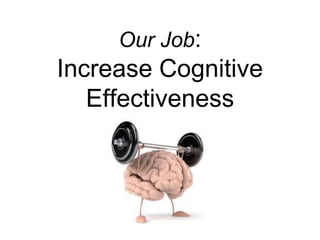
Our Job:
Increase Cognitive
Effectiveness
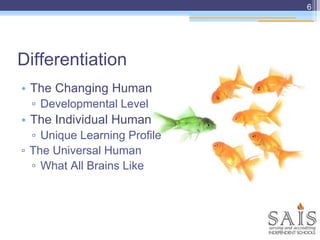
Differentiation
• The Changing Human
▫ Developmental Level
• The Individual Human
▫ Unique Learning Profile
▫ The Universal Human
▫ What All Brains Like
6
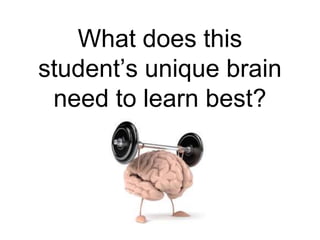
What does this
student’s unique brain
need to learn best?
“The only time my education was interrupted was
when I was in school.”
— George Bernard Shaw
“It’s a miracle that curiosity survives formal
education."
— Albert Einstein
Disclaimers
• This won’t help you with any particular student.
• Lots of frameworks, but no expectations that any
particular student will follow them
Hopes
• Awareness of the many, many ways and time
frames in which normal people unfold
• Think deeply about kids (ie. a diagnostic instinct):
“I wonder what’s going on inside there?”
• Handful of ideas, authors, research for further
investigation
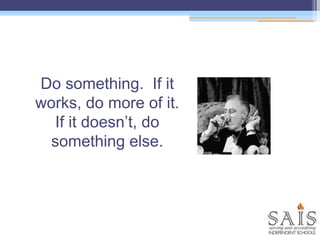
Do something. If it
works, do more of it.
If it doesn’t, do
something else.
Cerebrodiversity
Cerebrodiversity
• We have a collective neural heterogeneity
• No such thing as an optimal brain. Even the brain
that scores 2400
• Cerebrodiversity IS the reason for differentiation
• If Cerebrodiversity is a fact, then differentiation is not
negotiable
• Grade levels and age-specific outcomes violate what
we know about human development
• All brains are unique. Each of our brains solve wiring
problems in slightly or very different ways .
I.Q. changes
Intelligence is malleable.
Intelligence Tests: A seriously
flawed view
• Volatile until 8 or 9 years
• Volatile again in adolescence
• Highly dependent on language
• Not correlated to adult success
• Full-scale IQ scores are worthless. Don’t use
them.
15
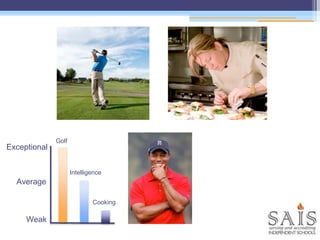
Exceptional
Weak
Golf
Cooking
Intelligence
Average
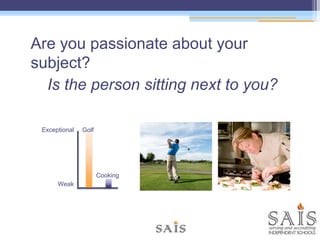
Are you passionate about your
subject?
Is the person sitting next to you?
Exceptional
Weak
Golf
Cooking
Verbal
Spatial
Literacy
Math
Performance
Social/Collaboration
Executive
Function
Persistence
Top of
your
school
Bottom
of your
school
Student 1
Verbal
Spatial
Social/Collaborat
ion
Persistence
Student 2
Social/Collaborat
ion
Persistence
EF
Student 3
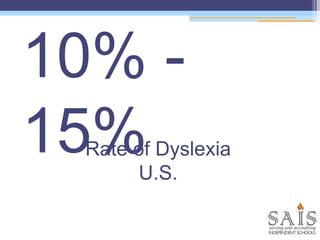
10% -
15%Rate of Dyslexia
U.S.
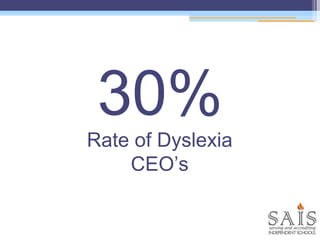
30%
Rate of Dyslexia
CEO’s
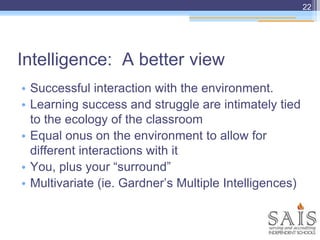
Intelligence: A better view
22
• Successful interaction with the environment.
• Learning success and struggle are intimately tied
to the ecology of the classroom
• Equal onus on the environment to allow for
different interactions with it
• You, plus your “surround”
• Multivariate (ie. Gardner’s Multiple Intelligences)
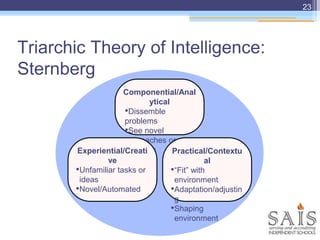
Triarchic Theory of Intelligence:
Sternberg
23
Componential/Anal
ytical
•Dissemble
problems
•See novel
approaches or
solutionsExperiential/Creati
ve
•Unfamiliar tasks or
ideas
•Novel/Automated
Practical/Contextu
al
•“Fit” with
environment
•Adaptation/adjustin
g
•Shaping
environment
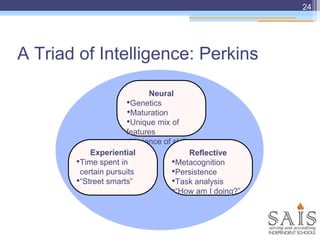
A Triad of Intelligence: Perkins
24
Neural
•Genetics
•Maturation
•Unique mix of
features
•Variance of skills
Experiential
•Time spent in
certain pursuits
•“Street smarts”
Reflective
•Metacognition
•Persistence
•Task analysis
•“How am I doing?”
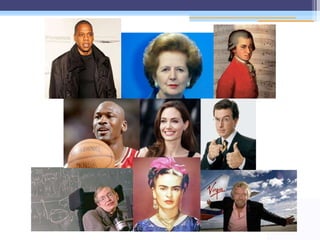
This Person
is......
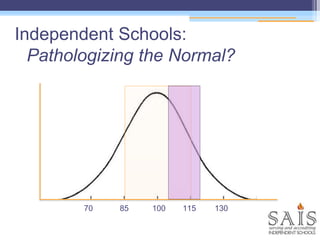
10085 115 13070
Independent Schools:
Pathologizing the Normal?
Developmental And Learning
Frameworks
A Historical View
27
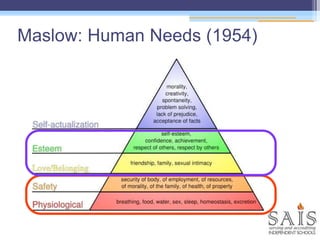
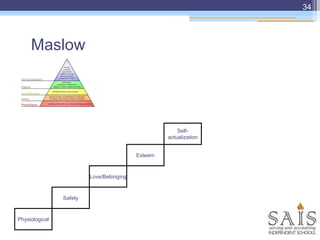
Maslow: Human Needs (1954)
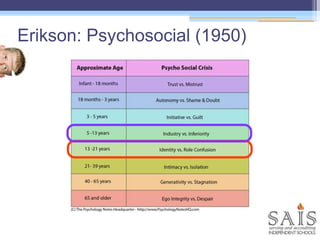
Erikson: Psychosocial (1950)
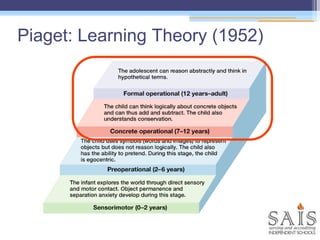
Piaget: Learning Theory (1952)
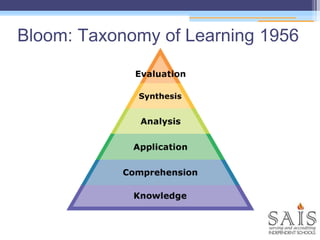
Bloom: Taxonomy of Learning 1956
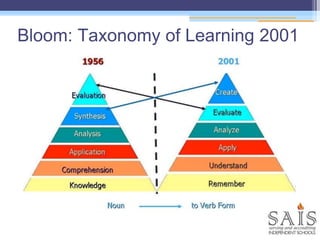
Bloom: Taxonomy of Learning 2001
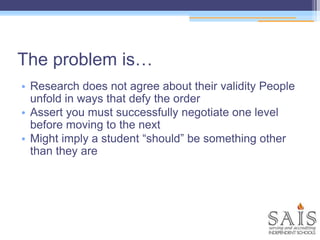
The problem is…
• Research does not agree about their validity People
unfold in ways that defy the order
• Assert you must successfully negotiate one level
before moving to the next
• Might imply a student “should” be something other
than they are
34
Physiological
Safety
Love/Belonging
Esteem
Self-
actualization
Maslow
35
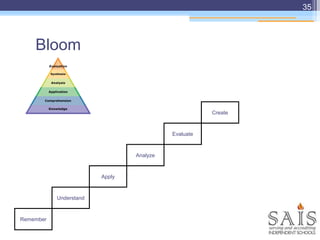
Remember
Understand
Apply
Analyze
Evaluate
Create
Bloom
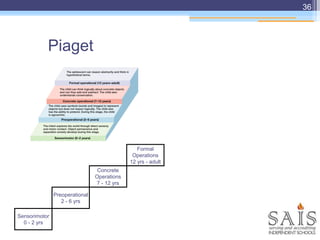
36
Sensorimotor
0 - 2 yrs
Preoperational
2 - 6 yrs
Concrete
Operations
7 - 12 yrs
Formal
Operations
12 yrs - adult
Piaget
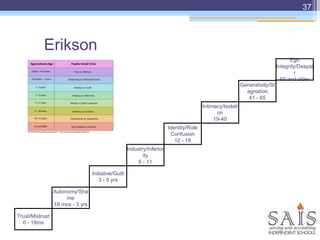
37
Trust/Mistrust
0 - 18ms
Autonomy/Sha
me
18 mos - 3 yrs
Initiative/Guilt
3 - 5 yrs
Industry/Inferior
ity
6 - 11
Identity/Role
Confusion
12 - 18
Intimacy/Isolati
on
19-40
Erikson
Generativity/St
agnation
41 - 65
Ego
Integrity/Despai
r
65 and older
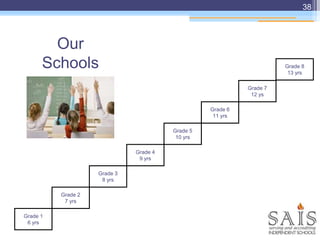
38
Grade 1
6 yrs
Grade 2
7 yrs
Grade 3
8 yrs
Grade 4
9 yrs
Grade 5
10 yrs
Grade 6
11 yrs
Our
Schools
Grade 7
12 ys
Grade 8
13 yrs
The Developing Brain
Critical periods of development from birth to teen
39
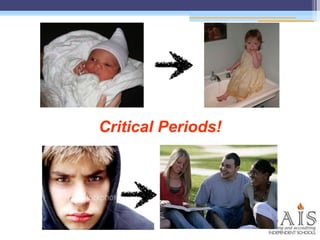
Critical Periods!
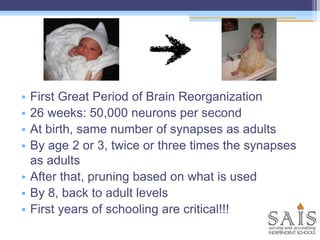
• First Great Period of Brain Reorganization
• 26 weeks: 50,000 neurons per second
• At birth, same number of synapses as adults
• By age 2 or 3, twice or three times the synapses
as adults
• After that, pruning based on what is used
• By 8, back to adult levels
• First years of schooling are critical!!!
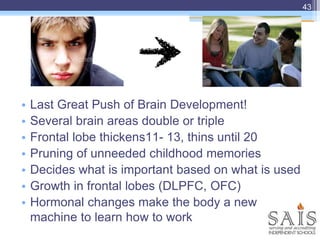
• Last Great Push of Brain Development!
• Several brain areas double or triple
• Frontal lobe thickens11- 13, thins until 20
• Pruning of unneeded childhood memories
• Decides what is important based on what is used
• Growth in frontal lobes (DLPFC, OFC)
• Hormonal changes make the body a new
machine to learn how to work
43
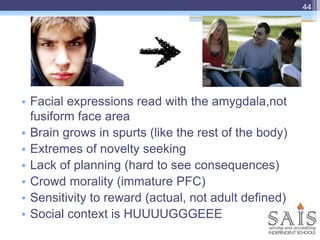
• Facial expressions read with the amygdala,not
fusiform face area
• Brain grows in spurts (like the rest of the body)
• Extremes of novelty seeking
• Lack of planning (hard to see consequences)
• Crowd morality (immature PFC)
• Sensitivity to reward (actual, not adult defined)
• Social context is HUUUUGGGEEE
44
The Social-Emotional Brain
What stress is good and bad for the brain?
45
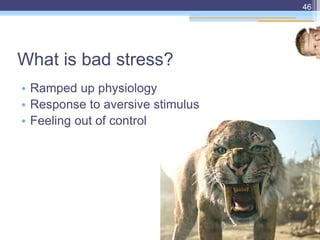
What is bad stress?
• Ramped up physiology
• Response to aversive stimulus
• Feeling out of control
46
Effects of Bad Stress?
• Adrenaline burst (RUN!!!)
• Followup of cortisol balances adrenaline
• We are designed for this in short bursts
• Chronic:
▫ Deregulates blood pressure
▫ Increases stroke or heart attack
▫ Depresses immune system
▫ Hippocampus has lots of cortisol receptors: blocks
neurogenesis
47
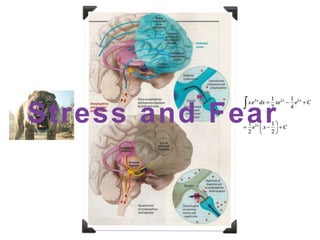
Stress and Fear
Good Stress?
• Out of our comfort zone
• Probably surmountable
• Not chronic
• Hippocampus thrives on this level
49
The High School Creature
• Prefrontal cortex grows rapidly
• Greater abstraction, the intellectual capacity to form
identity
• Stimuli during that time is more impacting, feeds more
directly into our memories (memories during growth
spurts are more easily made than during times of neuro-
stability)
• Limbic systems has greater relative influence
• Brain has more dopamine during adolescence
• Much less able to control fear response than as children
or adults.
50
New York Magazine, January 26 2013 Why We Never Leave High School
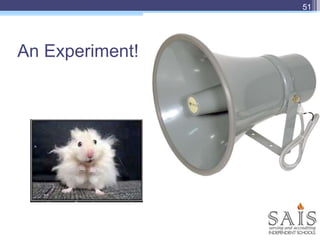
An Experiment!
51
Walla Walla, Washington
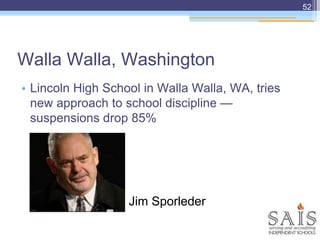
• Lincoln High School in Walla Walla, WA, tries
new approach to school discipline —
suspensions drop 85%
52
Jim Sporleder
53
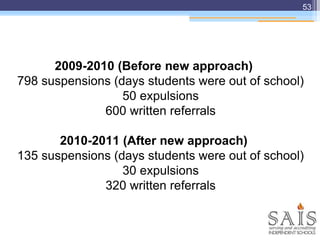
2009-2010 (Before new approach)
798 suspensions (days students were out of school)
50 expulsions
600 written referrals
2010-2011 (After new approach)
135 suspensions (days students were out of school)
30 expulsions
320 written referrals
Good Stress?
• Reduced calories
• Learning new, challenging things
• Exercising vigorously
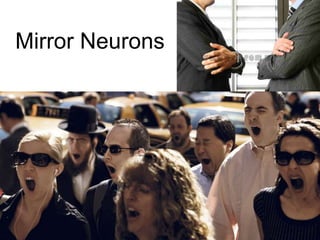
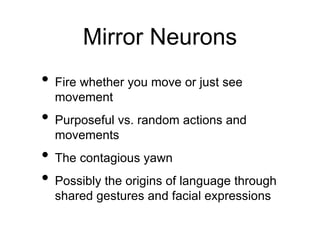
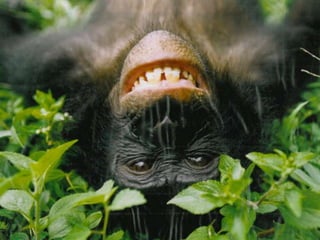
Mirror Neurons
• Fire whether you move or just see
movement
• Purposeful vs. random actions and
movements
• The contagious yawn
• Possibly the origins of language through
shared gestures and facial expressions
Mirror Neurons
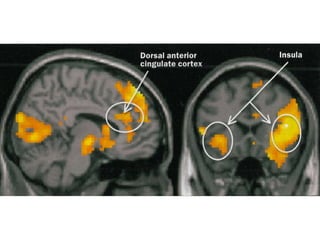
Ostracism
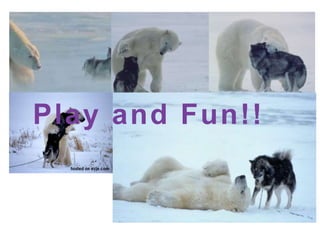
Play and Fun!!
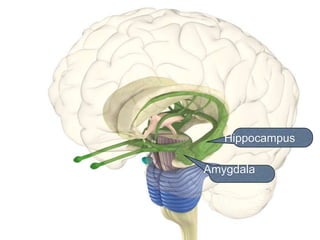
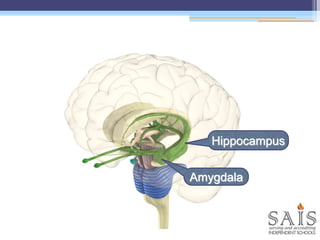
Hippocampus
Amygdala
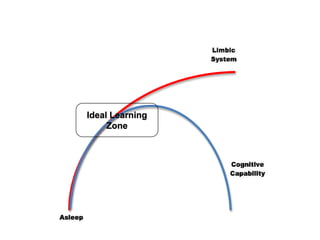
Ideal Learning
Zone
Developmental And Learning
Frameworks
Recent Ideas
63
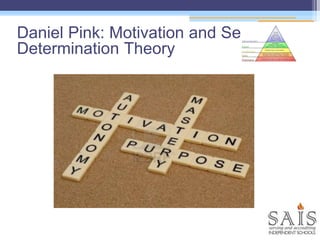
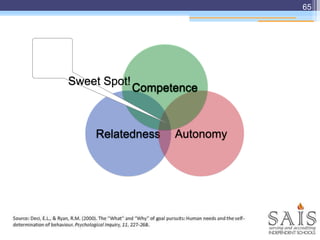
Daniel Pink: Motivation and Self
Determination Theory
65
Relatedness Autonomy
Competence
Sweet Spot!
Motivation Research on Rewards
• Harms effectiveness
• Reduces creativity and intrinsic motivation
• Reduces collaboration
• Increases unethical behavior
• Rewards can boost completion of mechanical
tasks, but hinders cognitive tasks
• Strongest motivator? Feeling effective
Drive, Daniel Pink
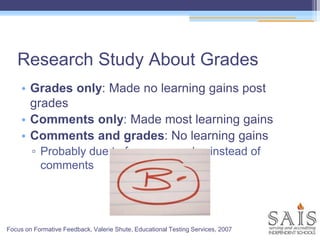
Research Study About Grades
• Grades only: Made no learning gains post
grades
• Comments only: Made most learning gains
• Comments and grades: No learning gains
▫ Probably due to focus on grades instead of
comments
Focus on Formative Feedback, Valerie Shute, Educational Testing Services, 2007
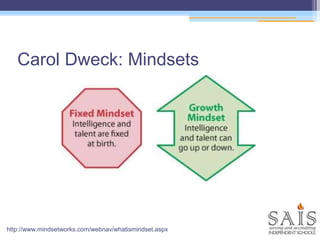
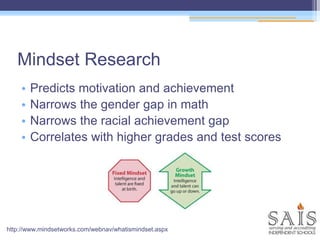
Carol Dweck: Mindsets
http://www.mindsetworks.com/webnav/whatismindset.aspx
Mindset Research
• Predicts motivation and achievement
• Narrows the gender gap in math
• Narrows the racial achievement gap
• Correlates with higher grades and test scores
http://www.mindsetworks.com/webnav/whatismindset.aspx
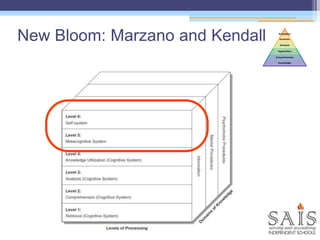
New Bloom: Marzano and Kendall
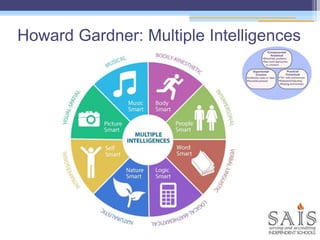
Howard Gardner: Multiple Intelligences
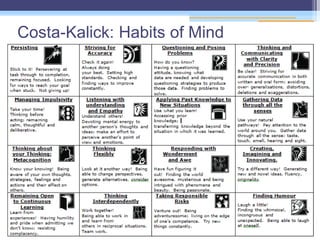
Costa-Kalick: Habits of Mind
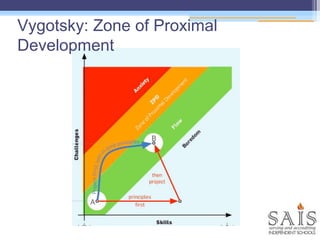
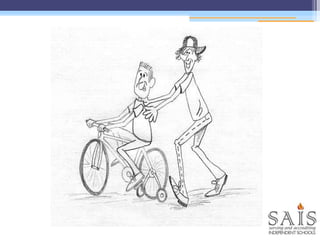
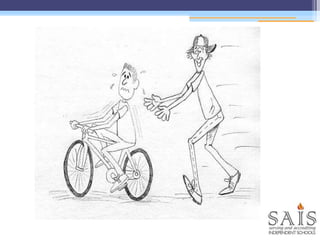
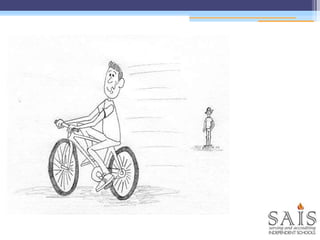
Vygotsky: Zone of Proximal
Development
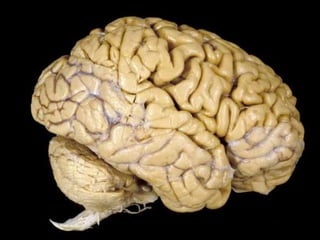
A Tour of the Brain
78
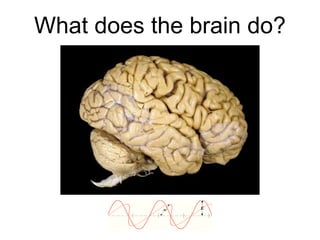
What does the brain do?
85
You see with your brain, not
with your eyes.
You hear with your brain, not
with your ears.
You feel with your brain, not
with your fingers.
You smell with your brain, not
with your nose.
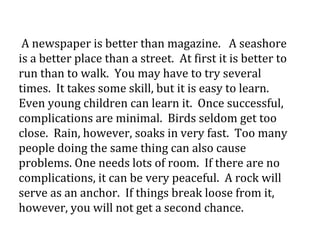
A newspaper is better than magazine. A seashore
is a better place than a street. At first it is better to
run than to walk. You may have to try several
times. It takes some skill, but it is easy to learn.
Even young children can learn it. Once successful,
complications are minimal. Birds seldom get too
close. Rain, however, soaks in very fast. Too many
people doing the same thing can also cause
problems. One needs lots of room. If there are no
complications, it can be very peaceful. A rock will
serve as an anchor. If things break loose from it,
however, you will not get a second chance.
Kite
Architecture of the Brain
92
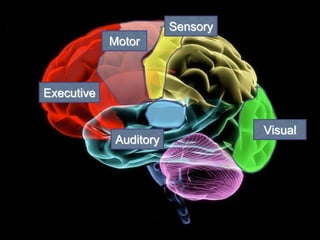
Motor
Sensory
Visual
Auditory
Executive
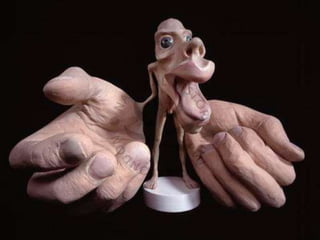
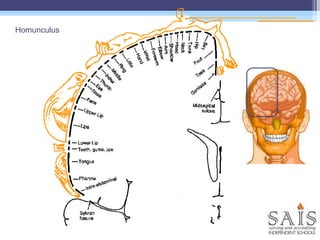
Homunculus
Hippocampus
Amygdala
Processing
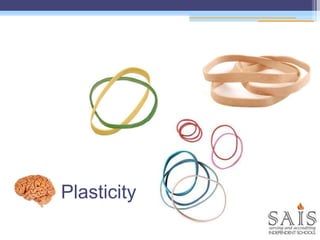
Plasticity
• The brain rewires itself all the time.
• Intelligence is not fixed.
• Study: Knowledge of the expanding nature of
intelligence did more to boost math grades than
how to study for math.
• Teen brains have a natural variation of IQ test
scores
Plasticity
99
“Pay
Attention!”
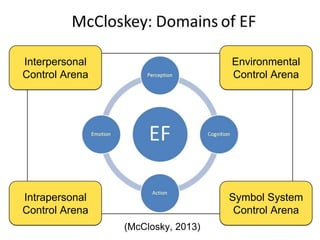
(McClosky, 2013)
Interpersonal
Control Arena
Symbol System
Control Arena
Intrapersonal
Control Arena
Environmental
Control Arena
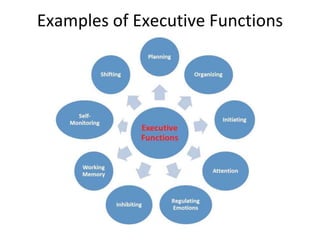
Examples of Executive Functions
The Remembering Brain
Memory and how to help it work better
105
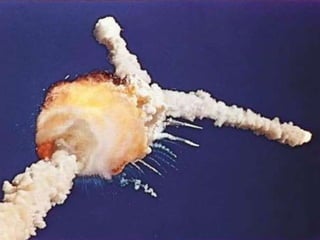
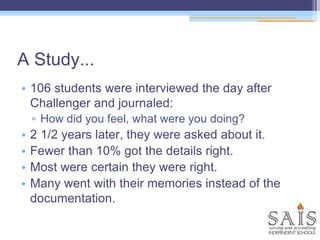
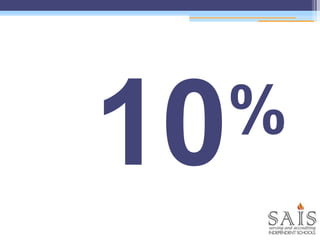
• 106 students were interviewed the day after
Challenger and journaled:
▫ How did you feel, what were you doing?
• 2 1/2 years later, they were asked about it.
• Fewer than 10% got the details right.
• Most were certain they were right.
• Many went with their memories instead of the
documentation.
A Study...
What is memory?
• Stored:
▫ Information
▫ Procedures and processes
▫ Affective states
▫ Impressions
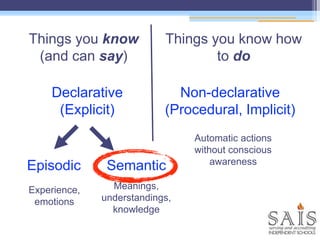
Semantic
Meanings,
understandings,
knowledge
Episodic
Experience,
emotions
Things you know
(and can say)
Things you know how
to do
Declarative
(Explicit)
Non-declarative
(Procedural, Implicit)
Automatic actions
without conscious
awareness
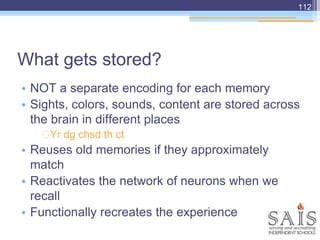
What gets stored?
• NOT a separate encoding for each memory
• Sights, colors, sounds, content are stored across
the brain in different places
Yr dg chsd th ct
• Reuses old memories if they approximately
match
• Reactivates the network of neurons when we
recall
• Functionally recreates the experience
112
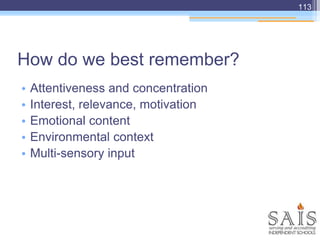
How do we best remember?
• Attentiveness and concentration
• Interest, relevance, motivation
• Emotional content
• Environmental context
• Multi-sensory input
113
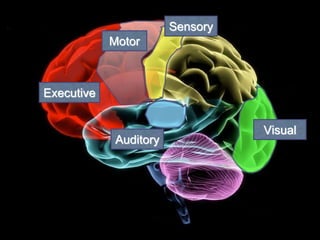
Motor
Sensory
Visual
Auditory
Executive
%
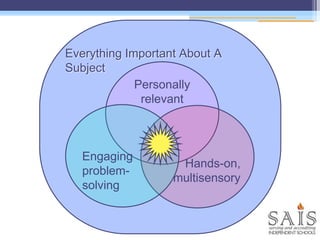
Everything Important About A
Subject
Personally
relevant
Hands-on,
multisensory
Engaging
problem-
solving
Memory Strategies
• “Repeat to remember”
• “Remember to repeat” (space rehearsal)
• Manipulate new information elaborately!
• Invoke emotion and experience
• Involve all senses
• Attach it to a context
• Talk about it right after!
• Sleep!!!!
118
119
120
121
122
123
124

Child and adolescent development

  • 1.
    Teaching The Student InFront Of You A wholly inadequate crash course in differentiation, psychosocial development, and neuroscience
  • 2.
    In table groups: Listcharacteristics of a child that you know you will naturally like. List characteristics of a child that you know you will struggle to like.
  • 3.
    You teach whoyou are. -Parker Palmer
  • 4.
  • 5.
  • 6.
    Differentiation • The ChangingHuman ▫ Developmental Level • The Individual Human ▫ Unique Learning Profile ▫ The Universal Human ▫ What All Brains Like 6
  • 7.
    What does this student’sunique brain need to learn best?
  • 8.
    “The only timemy education was interrupted was when I was in school.” — George Bernard Shaw “It’s a miracle that curiosity survives formal education." — Albert Einstein
  • 9.
    Disclaimers • This won’thelp you with any particular student. • Lots of frameworks, but no expectations that any particular student will follow them
  • 10.
    Hopes • Awareness ofthe many, many ways and time frames in which normal people unfold • Think deeply about kids (ie. a diagnostic instinct): “I wonder what’s going on inside there?” • Handful of ideas, authors, research for further investigation
  • 11.
    Do something. Ifit works, do more of it. If it doesn’t, do something else.
  • 12.
  • 13.
    Cerebrodiversity • We havea collective neural heterogeneity • No such thing as an optimal brain. Even the brain that scores 2400 • Cerebrodiversity IS the reason for differentiation • If Cerebrodiversity is a fact, then differentiation is not negotiable • Grade levels and age-specific outcomes violate what we know about human development • All brains are unique. Each of our brains solve wiring problems in slightly or very different ways .
  • 14.
  • 15.
    Intelligence Tests: Aseriously flawed view • Volatile until 8 or 9 years • Volatile again in adolescence • Highly dependent on language • Not correlated to adult success • Full-scale IQ scores are worthless. Don’t use them. 15
  • 16.
  • 17.
    Are you passionateabout your subject? Is the person sitting next to you? Exceptional Weak Golf Cooking
  • 18.
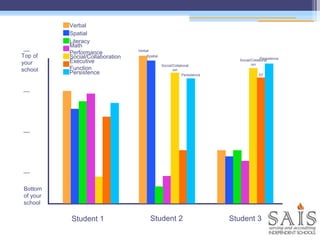
    Verbal Spatial Literacy Math Performance Social/Collaboration Executive Function Persistence Top of your school Bottom of your school Student1 Verbal Spatial Social/Collaborat ion Persistence Student 2 Social/Collaborat ion Persistence EF Student 3
  • 19.
    10% - 15%Rate ofDyslexia U.S.
  • 20.
  • 22.
    Intelligence: A betterview 22 • Successful interaction with the environment. • Learning success and struggle are intimately tied to the ecology of the classroom • Equal onus on the environment to allow for different interactions with it • You, plus your “surround” • Multivariate (ie. Gardner’s Multiple Intelligences)
  • 23.
    Triarchic Theory ofIntelligence: Sternberg 23 Componential/Anal ytical •Dissemble problems •See novel approaches or solutionsExperiential/Creati ve •Unfamiliar tasks or ideas •Novel/Automated Practical/Contextu al •“Fit” with environment •Adaptation/adjustin g •Shaping environment
  • 24.
    A Triad ofIntelligence: Perkins 24 Neural •Genetics •Maturation •Unique mix of features •Variance of skills Experiential •Time spent in certain pursuits •“Street smarts” Reflective •Metacognition •Persistence •Task analysis •“How am I doing?”
  • 25.
  • 26.
    10085 115 13070 IndependentSchools: Pathologizing the Normal?
  • 27.
  • 28.
  • 29.
  • 30.
  • 31.
    Bloom: Taxonomy ofLearning 1956
  • 32.
    Bloom: Taxonomy ofLearning 2001
  • 33.
    The problem is… •Research does not agree about their validity People unfold in ways that defy the order • Assert you must successfully negotiate one level before moving to the next • Might imply a student “should” be something other than they are
  • 34.
  • 35.
  • 36.
    36 Sensorimotor 0 - 2yrs Preoperational 2 - 6 yrs Concrete Operations 7 - 12 yrs Formal Operations 12 yrs - adult Piaget
  • 37.
    37 Trust/Mistrust 0 - 18ms Autonomy/Sha me 18mos - 3 yrs Initiative/Guilt 3 - 5 yrs Industry/Inferior ity 6 - 11 Identity/Role Confusion 12 - 18 Intimacy/Isolati on 19-40 Erikson Generativity/St agnation 41 - 65 Ego Integrity/Despai r 65 and older
  • 38.
    38 Grade 1 6 yrs Grade2 7 yrs Grade 3 8 yrs Grade 4 9 yrs Grade 5 10 yrs Grade 6 11 yrs Our Schools Grade 7 12 ys Grade 8 13 yrs
  • 39.
    The Developing Brain Criticalperiods of development from birth to teen 39
  • 41.
  • 42.
    • First GreatPeriod of Brain Reorganization • 26 weeks: 50,000 neurons per second • At birth, same number of synapses as adults • By age 2 or 3, twice or three times the synapses as adults • After that, pruning based on what is used • By 8, back to adult levels • First years of schooling are critical!!!
  • 43.
    • Last GreatPush of Brain Development! • Several brain areas double or triple • Frontal lobe thickens11- 13, thins until 20 • Pruning of unneeded childhood memories • Decides what is important based on what is used • Growth in frontal lobes (DLPFC, OFC) • Hormonal changes make the body a new machine to learn how to work 43
  • 44.
    • Facial expressionsread with the amygdala,not fusiform face area • Brain grows in spurts (like the rest of the body) • Extremes of novelty seeking • Lack of planning (hard to see consequences) • Crowd morality (immature PFC) • Sensitivity to reward (actual, not adult defined) • Social context is HUUUUGGGEEE 44
  • 45.
    The Social-Emotional Brain Whatstress is good and bad for the brain? 45
  • 46.
    What is badstress? • Ramped up physiology • Response to aversive stimulus • Feeling out of control 46
  • 47.
    Effects of BadStress? • Adrenaline burst (RUN!!!) • Followup of cortisol balances adrenaline • We are designed for this in short bursts • Chronic: ▫ Deregulates blood pressure ▫ Increases stroke or heart attack ▫ Depresses immune system ▫ Hippocampus has lots of cortisol receptors: blocks neurogenesis 47
  • 48.
  • 49.
    Good Stress? • Outof our comfort zone • Probably surmountable • Not chronic • Hippocampus thrives on this level 49
  • 50.
    The High SchoolCreature • Prefrontal cortex grows rapidly • Greater abstraction, the intellectual capacity to form identity • Stimuli during that time is more impacting, feeds more directly into our memories (memories during growth spurts are more easily made than during times of neuro- stability) • Limbic systems has greater relative influence • Brain has more dopamine during adolescence • Much less able to control fear response than as children or adults. 50 New York Magazine, January 26 2013 Why We Never Leave High School
  • 51.
  • 52.
    Walla Walla, Washington •Lincoln High School in Walla Walla, WA, tries new approach to school discipline — suspensions drop 85% 52 Jim Sporleder
  • 53.
    53 2009-2010 (Before newapproach) 798 suspensions (days students were out of school) 50 expulsions 600 written referrals 2010-2011 (After new approach) 135 suspensions (days students were out of school) 30 expulsions 320 written referrals
  • 54.
    Good Stress? • Reducedcalories • Learning new, challenging things • Exercising vigorously
  • 55.
  • 56.
    • Fire whetheryou move or just see movement • Purposeful vs. random actions and movements • The contagious yawn • Possibly the origins of language through shared gestures and facial expressions Mirror Neurons
  • 59.
  • 60.
  • 61.
  • 62.
  • 63.
  • 64.
    Daniel Pink: Motivationand Self Determination Theory
  • 65.
  • 66.
    Motivation Research onRewards • Harms effectiveness • Reduces creativity and intrinsic motivation • Reduces collaboration • Increases unethical behavior • Rewards can boost completion of mechanical tasks, but hinders cognitive tasks • Strongest motivator? Feeling effective Drive, Daniel Pink
  • 67.
    Research Study AboutGrades • Grades only: Made no learning gains post grades • Comments only: Made most learning gains • Comments and grades: No learning gains ▫ Probably due to focus on grades instead of comments Focus on Formative Feedback, Valerie Shute, Educational Testing Services, 2007
  • 68.
  • 69.
    Mindset Research • Predictsmotivation and achievement • Narrows the gender gap in math • Narrows the racial achievement gap • Correlates with higher grades and test scores http://www.mindsetworks.com/webnav/whatismindset.aspx
  • 70.
    New Bloom: Marzanoand Kendall
  • 71.
  • 72.
  • 73.
    Vygotsky: Zone ofProximal Development
  • 78.
    A Tour ofthe Brain 78
  • 80.
    What does thebrain do?
  • 85.
  • 86.
    You see withyour brain, not with your eyes.
  • 87.
    You hear withyour brain, not with your ears.
  • 88.
    You feel withyour brain, not with your fingers.
  • 89.
    You smell withyour brain, not with your nose.
  • 90.
    A newspaper isbetter than magazine. A seashore is a better place than a street. At first it is better to run than to walk. You may have to try several times. It takes some skill, but it is easy to learn. Even young children can learn it. Once successful, complications are minimal. Birds seldom get too close. Rain, however, soaks in very fast. Too many people doing the same thing can also cause problems. One needs lots of room. If there are no complications, it can be very peaceful. A rock will serve as an anchor. If things break loose from it, however, you will not get a second chance.
  • 91.
  • 92.
  • 93.
  • 94.
  • 96.
  • 97.
  • 98.
  • 99.
    • The brainrewires itself all the time. • Intelligence is not fixed. • Study: Knowledge of the expanding nature of intelligence did more to boost math grades than how to study for math. • Teen brains have a natural variation of IQ test scores Plasticity 99
  • 102.
  • 103.
    (McClosky, 2013) Interpersonal Control Arena SymbolSystem Control Arena Intrapersonal Control Arena Environmental Control Arena
  • 104.
  • 105.
    The Remembering Brain Memoryand how to help it work better 105
  • 109.
    • 106 studentswere interviewed the day after Challenger and journaled: ▫ How did you feel, what were you doing? • 2 1/2 years later, they were asked about it. • Fewer than 10% got the details right. • Most were certain they were right. • Many went with their memories instead of the documentation. A Study...
  • 110.
    What is memory? •Stored: ▫ Information ▫ Procedures and processes ▫ Affective states ▫ Impressions
  • 111.
    Semantic Meanings, understandings, knowledge Episodic Experience, emotions Things you know (andcan say) Things you know how to do Declarative (Explicit) Non-declarative (Procedural, Implicit) Automatic actions without conscious awareness
  • 112.
    What gets stored? •NOT a separate encoding for each memory • Sights, colors, sounds, content are stored across the brain in different places Yr dg chsd th ct • Reuses old memories if they approximately match • Reactivates the network of neurons when we recall • Functionally recreates the experience 112
  • 113.
    How do webest remember? • Attentiveness and concentration • Interest, relevance, motivation • Emotional content • Environmental context • Multi-sensory input 113
  • 115.
  • 116.
  • 117.
    Everything Important AboutA Subject Personally relevant Hands-on, multisensory Engaging problem- solving
  • 118.
    Memory Strategies • “Repeatto remember” • “Remember to repeat” (space rehearsal) • Manipulate new information elaborately! • Invoke emotion and experience • Involve all senses • Attach it to a context • Talk about it right after! • Sleep!!!! 118
  • 119.
  • 120.
  • 121.
  • 122.
  • 123.
  • 124.

Editor's Notes

  • #2 going to discuss developmental theories, intelligence, and brain science relevant to education
  • #4 Incredibly personal endeavor, teaching Not just about the students’ development. It is critically about your own Keep a running list of your own strengths and weaknesses
  • #5 The brain is constantly busy doing something. In the name of schooling, we do lots of things in school that are counter to how the brain likes to engage in learning Learning is what the brain does. We just have to get out of its way.
  • #6 To do whatever works to move forward a student’s cognitive efficacy (that means social, artistic, academic, all of it) Research: Daily piano lessons as good as more math instruction, makes better readers Rhythm training as good as sound-symbol training for decoding basic sounds Includes all the multiple intelligences, subjects, relationships, etc. but with the goal of changing the brain to make it more effective. This is our job. We need to be sure that our choices as teachers match how the brain likes to learn. NOT learning styles NPR, debunking, the brain DOES NOT like a certain modality. It likes to use them all simultaneously.
  • #7 Universal Human: may not sound like differentiation, but if you do what the research suggests, much more likely to support the developmental and unique needs of your students
  • #9 To be the teacher that makes this not true A statement of the mismatch between schools and what the brain likes
  • #13 Gordon Sherman New Grange Princeton NJ
  • #16 Intelligence tests, WISC being most prominent Highly volitle until 8 or 9 years old Subtests can swing up to 15 points across adolescence Highly dependent on language Any IQ test measures analytical intelligence (ERB, IOWA’s) which is a thin sliver of what intelligence is. Analytical is verbal knowledge, fluid reasoning, patterns, sequences, analyzing data, memory component. Doesn’t measure creative, social, practical
  • #17 We don’t detract from Tiger because of his cooking, yet we say, yes, Karen is great in English, but she REALLY struggles in math. I’m not sure she’s going to graduate. NO Full-scale IQ
  • #19 Imagine this scale to be your school’s student population If the student-environment What about the kids who are skilled in the “non=school” items
  • #20 Did you know that some kids don’t learn to read until 7 or so, without being dyslexic? And without being distinguishable from peers later?
  • #22 Dave Packard Back to einstein and shaw: what does it mean for someone to be enormously successful in their lives, but “not right” for our schools?
  • #24 1960‘s One of the first to go against the psychometric model of intelligence
  • #27 Hit hard in terms of independent schools Independent schools v. real world
  • #29 Major source of student behavioral struggle Consider these when you are having trouble with a student as a way to think about a starting place to help them
  • #30 5-13 yo Child comparing self-worth to others (such as in a classroom environment) Child can recognize major disparities in personal abilities relative to other children. Erikson places emphasis on the teacher, who should ensure that children do not feel inferior. 13-21 Identity vs. Role Confusion - Adolescent / 12 years till 18. Questioning of self. Who am I, how do I fit in? Where am I going in life? Erikson believes, that if the parents allow the child to explore, they will conclude their own identity. However, if the parents continually push him/her to conform to their views, the teen will face identity confusion.
  • #40 Partially constructed at birth Not done until 20 Fine tuning until mid-forties
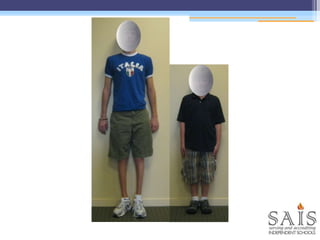
  • #41 No grade levels No science behind the idea brains are just a different in rates of growth as bodies No grade levels: Look at any given age. You see wide range of physical traits. Brain development is just as uneven.
  • #43 late adoptions infants recognize all human phonemes Babies have same number of connections as adults at birth, double or triple until 3, then cuts back dramatically. By 8, back to adult numbers. p58 At puberty, starts all over again with major growth, followed by pruning.
  • #44 DL-PFC motor planning, organization, and regulation. Sensory and mnemonic information regulation of intellectual function and action. working memory. OFC sensory integration, affective value of reinforcers, decision-making and expectation.[1] planning behavior sensitivity to reward and punishment.[4] After that, it’s mylenation
  • #45 Like starting the engine of a powerful race car with a really unskilled driver behind the wheel Amygdala swollen Prefrontal cortex shuts down on surge days suppresses sleep chemicals Hormones: testosterone overstimulates amygdala, anger bursts Girls surges of estrogen can lead to anxiousness and feelings of being overwhelmed Both much less controllable than in adults.
  • #47 Effects: Cardio-blood pressure is deregulated Too much adrenaline scars blood vessels, increasing susceptibility to stroke and heart attack. Immune response is weakened Study: drama students at UCLA. One group happy scripts all day, the other sad. Blood levels showed dpressed immune response in sad group Learning: Stressed adults do 50% worse than non-stressed Stress in the home: Kids who watch parents fight have consistently higher levels of cortisol in their urine
  • #48 Mechanism: Immediate release of adrenaline, fight flight Followup release of glucocorticoids (cortisol), which wipes out the unpleasant effects, resetting us to normalcy System designed for bursts of stress. When there is ongoing stress, the hormone builds up and is harmful. Hippocampus has lots of cortisol receptors If stress is not severe, the hippocampus performs better If too much, can prevent neurogenesis and can eventually kill hippocampal cells
  • #49 Math anxiety Tara study Regulatory skills make the difference Ramped up physiology Response to aversive stimulus Feeling out of Chronic: Deregulates blood pressure Increases stroke or heart attack Depresses immune system Hippocampus has lots of cortisol receptors: blocks neurogenesis
  • #51 American high schools are the most “sadistically unhealthy places to send adolescents” What about alternate paths to adulthood (jobs, apprenticeships) that place adolescents alongside adults? We sequester them.
  • #52 Paired tone with shock for mice, neutral color with a horrible noise for humans, which evoked fear response. Children, adolescents and adults. All associated the two, sweat response (meaning fear). Over next few days, showed the color without the noise. Children and adults dissociated the two. Adolescents remained as fearful as when they started, high alert. Mice 30 days later (adulthood) responded as if the experiment had just been done. Do humans take adolescent fears so strongly into adulthood?
  • #53 A student blows up at a teacher, drops the F-bomb. The usual approach at Lincoln – and, safe to say, at most high schools in this country – is automatic suspension. Instead, Sporleder sits the kid down and says quietly: “Wow. Are you OK? This doesn’t sound like you. What’s going on?” He gets even more specific: “You really looked stressed. On a scale of 1-10, where are you with your anger?” The kid was ready. Ready, man! For an anger blast to his face….”How could you do that?” “What’s wrong with you?”…and for the big boot out of school. But he was NOT ready for kindness. The armor-plated defenses melt like ice under a blowtorch and the words pour out: “My dad’s an alcoholic. He’s promised me things my whole life and never keeps those promises.” The waterfall of words that go deep into his home life, which is no piece of breeze, end with this sentence: “I shouldn’t have blown up at the teacher.” Whoa. And then he goes back to the teacher and apologizes. Without prompting from Sporleder.
  • #55 Ratey’s work
  • #56 Italian neuroscientist Giacomo Rizzolatti, testing motor neurons, surprised to see them fire when another monkey did something. Fire whether you move or just see movement Purposeful vs. random actions and movements The contagious yawn Possibly the origins of language through shared gestures and facial expressions Empathy starts, not with higher order thought, but with running when others run, laughing, crying yawning, sleeping, Yawn contagion works across species Imagining flexing a muscle increases both brain activity and muscle strength Cleveland Clinic Foundation, cited in SciAm Mind March/April p14 “Brainpower”
  • #57 One understands what another is doing or saying because they are in fact experiencing the same action.
  • #59 Even with no prior expectation, face to face contact, brain registers as pain DACC registers pain, insula judges pain severity Personality is not related to how severely the pain registers Not related to whether or not you like or dislike the person shunning you Why: Survival SciAmMind Jan/Feb 2011
  • #60 Ostraka: broken shards of pottery--ie. disposable True across all social animals (in non-humans, usually end up dead) Even in studies using computer avatars, those left out reported sadness, anger, low levels of belonging, lack of meaning in their real lives SciAmMind Jan/Feb 2011
  • #62 Reminder: Emotions connected to learning and memory
  • #63 What causes emotions to run too high? stress
  • #65 Where can we give kids autonomy, purpose? Ask, What could you do to Let kids create social contract for class Let kids come up with logical consequences when they cross the line Kids articulate rubric criteria evaluate their own work and the work of others choose direction for curriculum student honor councils
  • #71 Self:” Efficacy, Emotions, Beliefs about learning Metacognitive: monitoring learning goals, accuracy, clarity, execution
  • #72 Ultimately and argument for richness in experience that school structure has forced us to have to articulate Possible place to include piano lessons making kids better at language and the same as math with less instruction Gardner is not in favor of using this as a way of measuring intelligence. They’s taken my little theory and they’ve developed an entire industry out of it.
  • #73 Research on persistence
  • #74 A person can’t learn any more than their personal next step. Boredom is bad. Freaking out from stress is bad. Feeling effective is good.
  • #78 Music Athletics Dance
  • #79 Talk about: Architecture 2 major concepts of brain’s functional organization: Modularity and Plasticity WHY? Understanding the architecture and control over your own brain has shown learning gains
  • #80 Warm butter, jelly, soft tofu, toothpaste Doubled in size over our evolution 3 lbs, 2% of average body weight, but 20% of energy consumed Enough electricity to keep a 25W light bulb burning Responsible for every poem, every slam dunk, every war, every act of love, every song, every conversation Impossibly incomplete overview
  • #81 Converts photon energy, sound waves, and physical vibrations and pressure into electrical signals. Uses really poor input material to generate our experience. Fills in gaps of sensory input, sometimes getting it wrong. Rewires itself all the time. This is learning. Does lots of work we don’t know about. poor signal: yell at a feather and try to move it with your sound waves (no breath) ears ringing after a show study of letters on screen, fMRI Waking up with the answer We don’t question that our computer does lots of work aside from what we tell it. In fact, we’ll see in the sleep section how important this is.
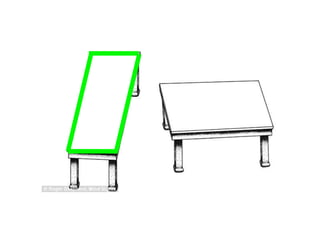
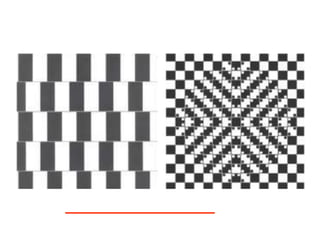
  • #82 Optical illusions are studied regularly in cognitive neuroscience.
  • #87 Vision is King! Use it all over the place! Fully analyzed opinion of what the brain thinks is there. NOT A CAMERA The brain completely deconstructs the signal, then reconstructs it with what it thinks you should be seeing. You are hallucinating right now: Retinal blind spots are filled in by the brain with what is most likely to be there. Charles-Bonnet syndrome: 2 little policemen escorting a tiny criminal into a matchbox size van. Sufferers know it’s not real. Takes about half of the brains working resources Take oral presentation: 10 % memory after 72 hours. 65% if you add visuals Blind sight
  • #93 Teaching kids about the brain helps them learn. Math study where kids were taught either more math, or about the changing nature of the brain
  • #94 Considerations beyond the simple senses We see consciously,but also process sight unconsciously Story : Blind sight Story: learning to see Vision is for vision: braille, tongue reading Activity: Hand motions
  • #96 Talk about the need for hands on! Thumbs on today’s students must be even larger
  • #97 Connect HIppocampus to cortex
  • #98 Do “n” story activity Do pitcher activity if possible
  • #99 The 15 point swing I mentioned was correlated to an increase in the motor areas of speech production (verbal), and the motor areas of hand use (perceptual) London cabbies--Hippocampus makes a map of the external world
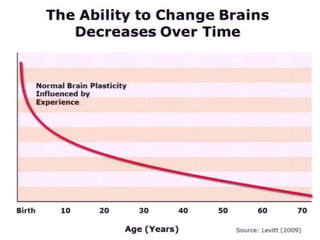
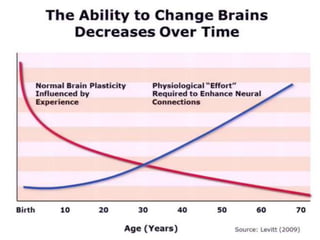
  • #101 Reduces, but never goes away
  • #102 Lot’s of effort, but 50% reduction in dementia
  • #103 When we have this urge, we are likely seeing a constellation of EFs not being realized
  • #110 Emotions DO add charge to memories. They just aren’t more accurate
  • #112 HM: man with destroyed hippocampus had no memory of learning a new procedural skill, but got better at it over time Semantic: meanings, understandings, and other concept-based knowledge unrelated to specific experiences Episodic: (times, places, associated emotions, and other contextual knowledge) Procedural: performance of a task without conscious awareness of these previous experiences
  • #113 Nouns are stored in a place vowels are stored in a place (Stroke victim: Your dog chased the cat: Yr dg chsd th ct: vowels are in a different place than consonants
  • #114 Ask for types of cortex, make point about memory being better for having done the hand signals
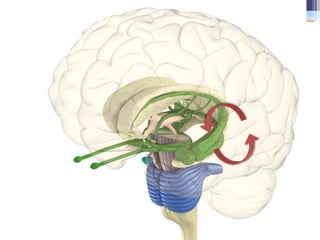
  • #115 Memory and Learning Study: after a session of explicit learning, if a similar task was undertaken within 2 hours, the original learning was displaced. Cortex to hippocampus,listen in on what the cortex is receiving, hippocampus has return axons. Much of this happens when we sleep The hippocampus doesn’t stop this loop until the memory is stable. It can take years. • Declarative memories are stored in the same sensory cortical regions HIppocampus seems to be where the neurons created from exercise migrate to. When you remember something, it becomes unstable, and is reencoded with changes Story: Man with damaged Hippocampus can lay down new memories, retains old ones, can’t recognize aged faces.
  • #116 Considerations beyond the simple senses We see consciously,but also process sight unconsciously Story : Blind sight Story: learning to see Vision is for vision: braille, tongue reading Activity: Hand motions
  • #117 Forget 90% of what we learn in a typical class in 30 days. Medina
  • #118 What would make a subject personally relevant? French revolution, themes of adult power, kids feeling a lack of control, all very relevant for a teen.
  • #119 About 30 seconds to do something with it. Saying it back to your self very powerful The more elaborately we encode the information, the better we remember it. Memory traces are stored in the part of the cortext that perceived and processed it. We retrieve learning best in the context and state it was encoded in. Ideas: Real-world experiences: You need to know the meaning to best encode Compelling introductions Most of the factors that predict whether something learned will be remembered happen in the first few seconds of exposure.