INTELLIGENCE
PSYCHOLOGY
WHAT IS INTELLIGENCE?
Dictionary defines it as the ability to acquire
knowledge and skills
A set of cognitive skills that include abstract
thinking, reasoning, problem solving and
ability to acquire knowledge
WHAT IS INTELLIGENCE?
Some researchers suggest that intelligence is a
single, general ability.
Others argues that intelligence encompasses a
range of aptitudes, skills and talents.
There are several theories that have been
developed regarding intelligence
Intelligence Theories
General Intelligence – Charles
Spearman
Described a concept known as “general
intelligence” or “g-factor”
Examines subject’s performance on a
number of mental aptitude tests
People who performed well on one
cognitive task tended to perform well on
others – and vice versa – if a subject
performed poorly on one task, they
Intelligence Theories
Raymond Cattel ;Two Factor Theory
Fluid Intelligence: one’s ability to reason,
problem-solve and make sense of abstract
information
Ability to think through a problem that one has
never confronted before
Culture free intelligence
E.g any new task that one comes across
Crystalline Intelligence: the knowledge and
skills one has acquired throughout their life
Knowledge gained through experience, learning,
education and practice
Culture concerned Intelligence
Intelligence Theories
Multiple Intelligences – Howard Gardner
Argued that numerical expressions of human
intelligence are not a full and accurate depiction
of people’s abilities
Proposed a theory that described eight distinct
intelligences based on skills and abilities that are
valued within different cultures.
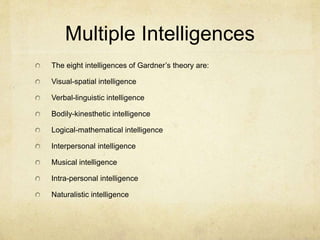
Multiple Intelligences
The eight intelligences of Gardner’s theory are:
Visual-spatial intelligence
Verbal-linguistic intelligence
Bodily-kinesthetic intelligence
Logical-mathematical intelligence
Interpersonal intelligence
Musical intelligence
Intra-personal intelligence
Naturalistic intelligence
Intelligence Theories
Triarchic Theory of Intelligence – Robert
Sternberg
Defined intelligence as mental activity directed
towards purposive adaptation to selection and
shaping of real-world environments relevant to
one’s life
Argued that Gardner’s intelligences are more like
individual talents rather than mental activities
Triarchic Theory of
Intelligence
Successful intelligence is comprised of three
different factors:
Analytical intelligence: problem-solving abilities
Creative intelligence: the ability to deal with
new situations using past experience and current
skill
Practical intelligence: the ability to adapt to a
changing environment
What is IQ?
IQ: Intelligence Quotient
A number derived from a standardized
intelligence test.
Originally scores were calculated by dividing the
subject’s mental age by their chronological age
and then multiplying by 100.
Today, scores are calculated by comparing the
subject’s score to the scores of other people in
the same age group
What is IQ?
IQ tests are designed to measure both
crystallized and fluid intelligence
Crystallized intelligence:
Fluid intelligence
Subjects must complete a series of subtests
designed to measure mathematical abilities,
language skills, memory, reasoning skills, and
information-processing skills
What is IQ?
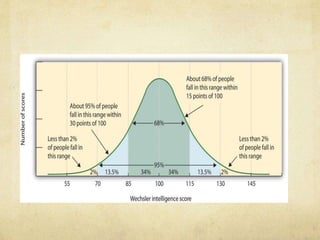
On modern IQ tests, the average score is 100
with a standard deviation of 15
While an IQ test may be a good general indicator
of your reasoning and problem-solving abilities,
many psychologists suggest that these tests do
not tell the whole story – they do not measure
practical abilities and talents.
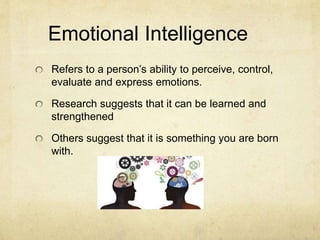
Emotional Intelligence
Refers to a person’s ability to perceive, control,
evaluate and express emotions.
Research suggests that it can be learned and
strengthened
Others suggest that it is something you are born
with.
How do we measure EQ?
Reuven Bar-On’s EQ-I
A self-report test designed to measure
competencies including awareness, stress
tolerance, problem solving, and happiness
Believed that emotional intelligence is an array of
non-cognitive abilities, competencies and skills
that influence our ability to succeed in coping
with environmental demands.
How do we measure EQ?
Multifactor Emotional Intelligence Scale (MEIS)
An ability based test in which test-takers perform
tasks designed to assess their ability to perceive,
identify, understand and utilize emotions.
What determines
Intelligence?
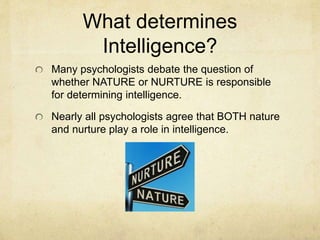
Many psychologists debate the question of
whether NATURE or NURTURE is responsible
for determining intelligence.
Nearly all psychologists agree that BOTH nature
and nurture play a role in intelligence.
Evidence of Nature
(genetics)
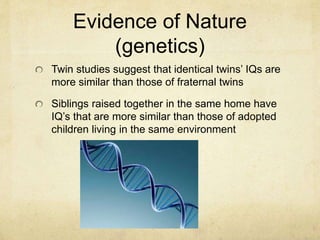
Twin studies suggest that identical twins’ IQs are
more similar than those of fraternal twins
Siblings raised together in the same home have
IQ’s that are more similar than those of adopted
children living in the same environment
Evidence of Nurture
(Environment)
Identical twins raised apart have IQs that are less
similar that identical twins raised in the same
environment
School attendance has an impact on IQ scores
Children who are breastfed during the first 3-5
months of life score higher on IQ tests at age 6
that children the same age who were not
breastfed
Are people with high IQs
more successful?
Many people believe that having a high IQ is a
sure fire way to guarantee success in life
While people with high IQs are naturally more
successful, it does not guarantee success in all
domains of life
Are people with high IQs
more successful?
Often highly intelligent people have poor social
skills and struggle with mental instability.
Personality factors including motivation,
willingness to work hard, being committed to
goals, creativity, and emotional maturity are also
linked to success in life
Problem Solving
Convergent Problems:
Problems in which the solutions are known
Analytical reasoning
Use of crystalline intellegence
E.g: Operating any new gadget
Divergent Problems:
Problems in which the solutions are unknown
Novel Solutions….leads to Creativity
Creativity: Thinking/ Behaving the way that is
novel and orignal along with useful and adaptice

Intellegence.pptx

  • 1.
  • 2.
    WHAT IS INTELLIGENCE? Dictionarydefines it as the ability to acquire knowledge and skills A set of cognitive skills that include abstract thinking, reasoning, problem solving and ability to acquire knowledge
  • 3.
    WHAT IS INTELLIGENCE? Someresearchers suggest that intelligence is a single, general ability. Others argues that intelligence encompasses a range of aptitudes, skills and talents. There are several theories that have been developed regarding intelligence
  • 4.
    Intelligence Theories General Intelligence– Charles Spearman Described a concept known as “general intelligence” or “g-factor” Examines subject’s performance on a number of mental aptitude tests People who performed well on one cognitive task tended to perform well on others – and vice versa – if a subject performed poorly on one task, they
  • 5.
    Intelligence Theories Raymond Cattel;Two Factor Theory Fluid Intelligence: one’s ability to reason, problem-solve and make sense of abstract information Ability to think through a problem that one has never confronted before Culture free intelligence E.g any new task that one comes across
  • 6.
    Crystalline Intelligence: theknowledge and skills one has acquired throughout their life Knowledge gained through experience, learning, education and practice Culture concerned Intelligence
  • 7.
    Intelligence Theories Multiple Intelligences– Howard Gardner Argued that numerical expressions of human intelligence are not a full and accurate depiction of people’s abilities Proposed a theory that described eight distinct intelligences based on skills and abilities that are valued within different cultures.
  • 8.
    Multiple Intelligences The eightintelligences of Gardner’s theory are: Visual-spatial intelligence Verbal-linguistic intelligence Bodily-kinesthetic intelligence Logical-mathematical intelligence Interpersonal intelligence Musical intelligence Intra-personal intelligence Naturalistic intelligence
  • 9.
    Intelligence Theories Triarchic Theoryof Intelligence – Robert Sternberg Defined intelligence as mental activity directed towards purposive adaptation to selection and shaping of real-world environments relevant to one’s life Argued that Gardner’s intelligences are more like individual talents rather than mental activities
  • 10.
    Triarchic Theory of Intelligence Successfulintelligence is comprised of three different factors: Analytical intelligence: problem-solving abilities Creative intelligence: the ability to deal with new situations using past experience and current skill Practical intelligence: the ability to adapt to a changing environment
  • 11.
    What is IQ? IQ:Intelligence Quotient A number derived from a standardized intelligence test. Originally scores were calculated by dividing the subject’s mental age by their chronological age and then multiplying by 100. Today, scores are calculated by comparing the subject’s score to the scores of other people in the same age group
  • 12.
    What is IQ? IQtests are designed to measure both crystallized and fluid intelligence Crystallized intelligence: Fluid intelligence Subjects must complete a series of subtests designed to measure mathematical abilities, language skills, memory, reasoning skills, and information-processing skills
  • 13.
    What is IQ? Onmodern IQ tests, the average score is 100 with a standard deviation of 15 While an IQ test may be a good general indicator of your reasoning and problem-solving abilities, many psychologists suggest that these tests do not tell the whole story – they do not measure practical abilities and talents.
  • 16.
    Emotional Intelligence Refers toa person’s ability to perceive, control, evaluate and express emotions. Research suggests that it can be learned and strengthened Others suggest that it is something you are born with.
  • 17.
    How do wemeasure EQ? Reuven Bar-On’s EQ-I A self-report test designed to measure competencies including awareness, stress tolerance, problem solving, and happiness Believed that emotional intelligence is an array of non-cognitive abilities, competencies and skills that influence our ability to succeed in coping with environmental demands.
  • 18.
    How do wemeasure EQ? Multifactor Emotional Intelligence Scale (MEIS) An ability based test in which test-takers perform tasks designed to assess their ability to perceive, identify, understand and utilize emotions.
  • 19.
    What determines Intelligence? Many psychologistsdebate the question of whether NATURE or NURTURE is responsible for determining intelligence. Nearly all psychologists agree that BOTH nature and nurture play a role in intelligence.
  • 20.
    Evidence of Nature (genetics) Twinstudies suggest that identical twins’ IQs are more similar than those of fraternal twins Siblings raised together in the same home have IQ’s that are more similar than those of adopted children living in the same environment
  • 21.
    Evidence of Nurture (Environment) Identicaltwins raised apart have IQs that are less similar that identical twins raised in the same environment School attendance has an impact on IQ scores Children who are breastfed during the first 3-5 months of life score higher on IQ tests at age 6 that children the same age who were not breastfed
  • 22.
    Are people withhigh IQs more successful? Many people believe that having a high IQ is a sure fire way to guarantee success in life While people with high IQs are naturally more successful, it does not guarantee success in all domains of life
  • 23.
    Are people withhigh IQs more successful? Often highly intelligent people have poor social skills and struggle with mental instability. Personality factors including motivation, willingness to work hard, being committed to goals, creativity, and emotional maturity are also linked to success in life
  • 24.
    Problem Solving Convergent Problems: Problemsin which the solutions are known Analytical reasoning Use of crystalline intellegence E.g: Operating any new gadget
  • 25.
    Divergent Problems: Problems inwhich the solutions are unknown Novel Solutions….leads to Creativity Creativity: Thinking/ Behaving the way that is novel and orignal along with useful and adaptice