• Physical growth
• Physiological growth
• Secondary sex characteristics
• Cognitive development
• Emotional development
• Social development
Adolescence age
13 to 18 Year Old
Adolescence
• Is derived the Latin verb “Adolescere” which means to grow into maturity
• It is a biosocial transition from childhood to adulthood
• It is based on childhood experiences and accomplishments.
• Adolescence refers to the behavioral characteristics of this period that are
influenced by physical and cultural changes
• Period of rapid physical and biological changes with may leads to competence,
tension, frustration and feeling of insecurity
Adolescence is a period of stress and
strain, storm and strife
Adolescence
 It begins with the appearance of secondary sex characteristics and ends when
somatic growth is completed and the individual is psychological mature.
 Through formal operational thinking, adolescent can deal with a problem.
Physical growth:
Height:
•Height of grails will be maximum between the age 16-17
•By the age of 13, the adolescent triples his birth length.
•Males gains 10 to 30cm in height.
•Females gains less height than males as they gain 5 to 20cm.
•Growth in height ceases at 16 or 17 years in females and 18 to 20in males
Physical growth
Weight:
•Growth spurt begins earlier in girls (10–14 years, while it is 12–16 in boys).
•Males gains 7 to 30kg, while female gains 7 to 25kg.
•Trunk broadens
• Digestive, circulatory and responding system fully develops
• Body tissues, skeleton starts growing
• Tissues other than bones continue to develop
Physical growth
Appearance of secondary sex characteristics
Secondary sex characteristics in girls
• Increase in transverse diameter of the pelvis.
• Development of the breasts.
• Change in the vaginal secretions.
• Growth of pubic and axillary hair.
• Menstruation (first menstruation is called menarche, which occurs between 12 to
13 years).
• Endocrine system temporary imbalance of the entire endocrine system in early
adolescence and sex grounds become functional
Secondary sex characteristics in boys
• Increase in size of genitalia.
• Swelling of the breast.
• Growth of pubic, axillary, facial and chest hair.
• Change in voice.
• Rapid growth of shoulder breadth.
• Production of spermatozoa (which is sign of puberty).
Appearance of secondary sex characteristics
Emotional development
 This period is heightened emotions, glands function comes under socials pressure
 Problem related to romance
 Easily excited and explode emotionally( 14 years)
 Temper tantrums, mood swing
 Intense self consciousness
 Day dreaming in common
 Adolescent exhibits alternating and recurrent episodes of disturbed behavior
with periods of quite one. He may become hostile or ready to fight, complain or
resist every thing.
Adolescence period is also called:
• Period of temporary insanity
• Period of 4S (stress, storm, stream and strife)
• Increased compassion patterns, love, anger, jealousy,
• Emotion of love
- Auto- egotism (self love)
- Homo- sexuality
- Hetero sexuality
Intellectual or mental characteristics
• Development of intelligence
• Increases in span of attention
• Development of memory
• Development of imagination
• Widening of interest
Peers
• As adolescence approaches, the family’s influence diminishes
• The peer group becomes an important social force
• The need for peer approval can affect decisions concerning participation in
physical activity positively or negatively
Social development
He needs to know "who he is" in relation to family and society, i.e., he
develops a sense of identity. If the adolescent is unable to formulate a
satisfactory identity from the multi-identifications, sense of self-confusion
will be developed according to Erikson:
Adolescent shows interest in other sex.
He looks for close friendships.
Developmental task
• Is a task which arises at on a certain period in the life of the individual,
successful achievement of which leads to his/her happiness and to success with
later task while failure leads to unhappiness and difficulty with later tasks.
• Developmental task are based on the needs of the society.
• The major task facing adolescents is to create a stable identity and become
complete and productive adults.
• A developmental task represents our culture's definition of "normal"
development at different points in the life span.
Developmental tasks that enable adolescents to create an
Identity.
• Achieving new and more mature relations with others, both boys and girls, in
their age group.
• Achieving a masculine or feminine social role.
• Accepting one's physique
• Achieving emotional independence from parents and other adults
• Preparing for marriage and family life
• Preparing for an economic career.
• Acquiring a set of values and an ethical system as a guide to behavior --
developing an ideology.
• Desiring and achieving socially responsible behavior
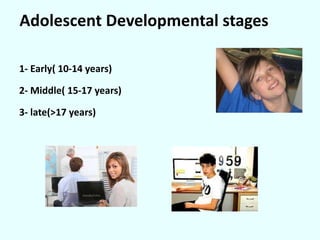
Adolescent Developmental stages
1- Early( 10-14 years)
2- Middle( 15-17 years)
3- late(>17 years)
Central question
Adolescent developmental stages
Early
Am I normal?
Middle
Who am I?
“ where do I belong?”
Late
where I am going?
o Coming to terms puberty
o Struggle for autonomy commence
o Same sex peer relationships
o Mood swings
o New intellectual powers
o New sexual drives
o Experimentation and risk- taking
o Relationships have self- centered
quality
o Need for peer group acceptance
o Emergence of sexual identity
o Independence from parents
o Realistic body image
o Acceptance of sexual identity
o Clear educational and vocational
goals, own value system
o Developing mutually caring and
responsible relationship
Major developmental issues
Main concern
Early
o Anxieties about body shape and
changes
o Comparison with peers
Middle
o Influence of peers
o Tensions between family and
individual over assertions of autonomy
o Balancing demand of family and peers
o Prone to fad behavior and risk taking
o Strong need for privacy
o Maintaining ethnic identity while
striving to fit in with dominant culture
late
o Self- responsibility
o Achieving economic independence
o Developing intimate relationship.
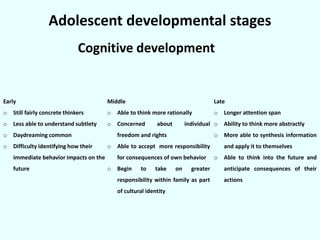
Adolescent developmental stages
Cognitive development
Early
o Still fairly concrete thinkers
o Less able to understand subtlety
o Daydreaming common
o Difficulty identifying how their
immediate behavior impacts on the
future
Middle
o Able to think more rationally
o Concerned about individual
freedom and rights
o Able to accept more responsibility
for consequences of own behavior
o Begin to take on greater
responsibility within family as part
of cultural identity
Late
o Longer attention span
o Ability to think more abstractly
o More able to synthesis information
and apply it to themselves
o Able to think into the future and
anticipate consequences of their
actions
Adolescent developmental stages
Practice points
Early
o Reassure about normality
o Ask more direct than open- ended
questions
o Base interventions needed on
immediate or short- term outcomes
o Help identify possible adverse
outcomes if they continue the
undesirable behavior
Middle
o Address confidentiality concerns
o Always assess for health risk
behavior
o Focus intervention on short to
medium term outcomes.
o Relate behaviors to immediate
physical and social concerns
Late
o Ask for open- ended
questions
o Focus interventions on short
and long term goals
o Address prevention more
broadly
Adolescent developmental stages
1- primary or Physiological needs( oxygen, water, food, rest and sleep)
• Rest needs is about 8 hours.
• Separate physical education programs
Needs of Adolescents
Needs of adolescents
2- secondary or socio- Psychological needs
• A balance between security and freedom
• Need for love
• Need for approval
• Need for self- expression
• Different types of Co-curricular Activities are needed for providing new
experiences and utilising energy
• Sex education on the suitable basis is needed.
• Unobtrusive adult guidance is needed
• Need for freedom from dependence
• Need for association with the opposite sex.
• Needs for self support
• Need for philosophy of life
Needs of Adolescents
An adolescent is a problem- individual. There are many problem around him and he
needs help and guidance for their solution at every step.
- Excessive energy: In take of food is increased the general health is also improved.
The result is excessive energy.
Our traditional schools do not provide such physical activities. Consequently the
adolescent is restless. Various activities act as sublimation for the adolescent and
they feel relieve.
• With the advent of adolescence the gonads come into activity for first time. The
appearance of secondary sexual characteristics is to the same. They produce
emotional upheaval in the adolescent.
• The first appearance of menstrual course or nocturnal emission bewilders and
shock the adolescent who is quit ignorant about it. the school should supply the
right kind of information regarding sex at this stage. Due to ignorance about sex,
many promising personalities are doomed
Aggressiveness or withdrawal
• When an adolescent can not adjust himself with the world he grows to be
aggressive or withdrawal from the field and his personality is arrested. If the
conflict is too serious he regresses
• The school should be provide sample opportunities to the children to express
themselves properly. Co curricular activities, scouting students self- government
and changed the methods of instruction can go along way in enabling the
adolescent to adjust himself with the world.
Rebellious Attitude
• The adolescent are no more children. They should be recognized as young men
and women in the school as well as in the home. Their craving for the
independence should be satisfied to some extent. They should be given some
responsibility.
• They turn to be very obedient if they be trusted. But things do not work smoothly
in ordinary school and home. Their sense of independence and responsibility is
seldom recognized. The result is rebellion against authority.
Physical awkwardness
• Most of the adolescent have the sense of physical clumsiness. Consequently
their movement stand to be awkward and unbalanced. They may be corrected in
the playground and on the stage. Game and dancing will given them harmonious
and balanced movement social service at the occasion of festival etc. practical
work can help the children in this respect.
Excessive- day dreaming
• Excessive- day dreaming is normal at this stage but when it grows to excessive it
may be injurious as far as development of personality is concerned.
• It is the ambition to be freedom from parental sovereign. The individual hates
control of the parents. He seeks identity to himself.
• The teacher should note that the adolescent are active and busy in their studies
and other aspects of their life.
• The children are indulging in excessive- day dreaming should be encouraged to be
constructive and creative.
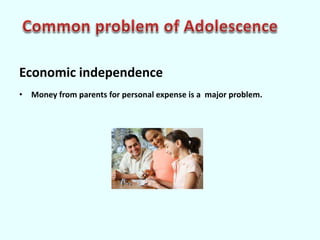
Economic independence
• Money from parents for personal expense is a major problem.
Emotional Tension
• Emotional development is at maximum and instable.
• Self respect and personal pride make the individual emotionally bad .
• He expect the things to be done as he aspires.
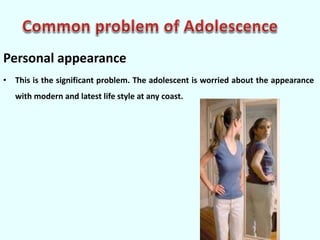
Personal appearance
• This is the significant problem. The adolescent is worried about the appearance
with modern and latest life style at any coast.
Morphological/ developmental problem
• Over growth of hair or under growth of hair.
• Over weight and under weight.
• Skin color problems
• Facial deformities, pimples, etc
• Abnormal growth of genital and breast
Psychological problems
• Ignorance about many basic facts leads to psychological problems like
misconception about sexual feeling, sex related issues.
• Misconception about child birth, reproduction
• Misconception about coitus menstrual cycles.
• Fear about sex and sexual issue.
Psychological problems
• Guilt about sex related issue.
• Complex about skin color, abilities, and beauty
• Inexplicable conception about dress ad fashion codes.
• Wrong and unrealistic ideologies about friendship and courtship
• Attraction towards opposite sex
• Exceptional vulnerability to suicide psychology.
Social
• Intense closeness with brother sister and friends.
• Unpredictable and volatile relationship with friend
• Unrealistic social perception about violence, sex, love as influenced by media.
• Fear/ imagination about marriage life
Educational
• Tension of attending the classes, examination and test.
• Low IQ feeling
• Fear about failure in examination
• Fear about low score
• Worry about future career
• Misconception about teacher.
Adolescents problem with reference to Indian
context
• Perplexity with regard to somatic variation
• Problem related with intensification of sex- consciousness
• Adjustment difficulties with parents
• Childhood- adulthood conflict.
• Adjustment difficulties with school discipline.
• Adjustment difficulties with community
Causes of Emotional Disturbance
• Main causes intense self-consciousness, strong feeling of inferiority, unhappy
relation with parents, disgust or fear of first experience of sex emotion.
• Change of the roles of the adolescent at home, school, society, from dependence
to independence life with great responsibility leads to emotional disturbance.
• Attitude of parents( still leading them as children high expectation of parents,
community and society)
• Difficulty to adjust with members of opposite sex.
• Political, religious and social controversy.
• Failure to achieve designed success.
• Too strict discipline or lack of understanding.
• Uncertainly about future
Causes of Emotional Disturbance
• Physical symptoms:
Biting the teeth, licking lips, nail, pulling hair,
Symptom of Emotional Disturbance
• Physiological symptoms:
- Aggression, hyperactivity adult, shyness and withdrawing.
Symptom of Emotional Disturbance
Education for Adolescents
• Adjustment with school discipline:
- School should assume responsibility for vocational guidance
- School should not implant habits of unquestioning obedience which inhibits the
growth of young people towards these dependence
- Teacher need to be understanding, good counselors. Maintenance of emotional
tolerance
• Training in the art of living together
• Development of child’s entire personality
• Recognize individual differences
• Freedom of self development
• Development of scientific attitude
• Value of interdependence
• Satisfaction of the urage for practical activity.
• Physical exercise and activities.
• Discouraging tight and sleeveless dress
Education for Adolescents
Role of the teacher in solving the problems
1- proper physical development
The teacher should plan for this aspect in following manner:
• By organizing various types of physical exercises, sport and games.
• By imparting the proper knowledge about physical and health education.
• By organizing various extracurricular activities.
2- proper mental Development
The mental development of adolescent should be according to the
following lines:
o It should be according to the ability and aptitude of the pupil.
o They should study both art and science
o Excursion too various places may be organized
o Modern methods of teaching should be used to teach various subjects.
Role of the teacher in solving the problems
2- proper mental development
• All the school teacher should try to impart him necessary guidance as and when
required.
• They should be entrusted with responsibility so as to develop a feeling of
responsibility in them.
• There are individual differences among students. Every child should be able to
find out subjects of his choice.
Role of the teacher in solving the problems
3- proper emotional Development
The emotional development of adolescent should be as follow:
• Try to sublimate the lower emotions of the child.
• A healthy emotional atmosphere should be maintain at school.
• Try to avoid frustration among the adolescents.
• The teacher should play due regard to the personality of each child.
• The adolescent should be imparted proper knowledge about sex. If this aspect is
properly attended to it would lead to a better emotional development.
Role of the teacher in solving the problems
4- proper social development
The social development of adolescent should be as follow:
• He should have knowledge about social relation and the art of group living.
Various group activities may be organized.
• A right and rational attitude towards democracy should be develop in the school
atmosphere. This would enable the child develop his own philosophy of life.
Role of the teacher in solving the problems
Define Adolescence:
Process or state of growing to maturity
Process of growing from adulthood to old age
When you get old
When you are a child
Peer pressure is:
Always negative
Means conforming to your friends
Increases throughout adolescence
Has not effect on adults

Adolescent

  • 1.
    • Physical growth •Physiological growth • Secondary sex characteristics • Cognitive development • Emotional development • Social development Adolescence age 13 to 18 Year Old
  • 2.
    Adolescence • Is derivedthe Latin verb “Adolescere” which means to grow into maturity • It is a biosocial transition from childhood to adulthood • It is based on childhood experiences and accomplishments. • Adolescence refers to the behavioral characteristics of this period that are influenced by physical and cultural changes • Period of rapid physical and biological changes with may leads to competence, tension, frustration and feeling of insecurity
  • 3.
    Adolescence is aperiod of stress and strain, storm and strife
  • 4.
    Adolescence  It beginswith the appearance of secondary sex characteristics and ends when somatic growth is completed and the individual is psychological mature.  Through formal operational thinking, adolescent can deal with a problem.
  • 5.
    Physical growth: Height: •Height ofgrails will be maximum between the age 16-17 •By the age of 13, the adolescent triples his birth length. •Males gains 10 to 30cm in height. •Females gains less height than males as they gain 5 to 20cm. •Growth in height ceases at 16 or 17 years in females and 18 to 20in males
  • 6.
    Physical growth Weight: •Growth spurtbegins earlier in girls (10–14 years, while it is 12–16 in boys). •Males gains 7 to 30kg, while female gains 7 to 25kg. •Trunk broadens
  • 7.
    • Digestive, circulatoryand responding system fully develops • Body tissues, skeleton starts growing • Tissues other than bones continue to develop Physical growth
  • 8.
    Appearance of secondarysex characteristics Secondary sex characteristics in girls • Increase in transverse diameter of the pelvis. • Development of the breasts. • Change in the vaginal secretions. • Growth of pubic and axillary hair. • Menstruation (first menstruation is called menarche, which occurs between 12 to 13 years). • Endocrine system temporary imbalance of the entire endocrine system in early adolescence and sex grounds become functional
  • 9.
    Secondary sex characteristicsin boys • Increase in size of genitalia. • Swelling of the breast. • Growth of pubic, axillary, facial and chest hair. • Change in voice. • Rapid growth of shoulder breadth. • Production of spermatozoa (which is sign of puberty). Appearance of secondary sex characteristics
  • 10.
    Emotional development  Thisperiod is heightened emotions, glands function comes under socials pressure  Problem related to romance  Easily excited and explode emotionally( 14 years)  Temper tantrums, mood swing  Intense self consciousness  Day dreaming in common  Adolescent exhibits alternating and recurrent episodes of disturbed behavior with periods of quite one. He may become hostile or ready to fight, complain or resist every thing.
  • 11.
    Adolescence period isalso called: • Period of temporary insanity • Period of 4S (stress, storm, stream and strife) • Increased compassion patterns, love, anger, jealousy, • Emotion of love - Auto- egotism (self love) - Homo- sexuality - Hetero sexuality
  • 12.
    Intellectual or mentalcharacteristics • Development of intelligence • Increases in span of attention • Development of memory • Development of imagination • Widening of interest
  • 13.
    Peers • As adolescenceapproaches, the family’s influence diminishes • The peer group becomes an important social force • The need for peer approval can affect decisions concerning participation in physical activity positively or negatively
  • 14.
    Social development He needsto know "who he is" in relation to family and society, i.e., he develops a sense of identity. If the adolescent is unable to formulate a satisfactory identity from the multi-identifications, sense of self-confusion will be developed according to Erikson: Adolescent shows interest in other sex. He looks for close friendships.
  • 15.
    Developmental task • Isa task which arises at on a certain period in the life of the individual, successful achievement of which leads to his/her happiness and to success with later task while failure leads to unhappiness and difficulty with later tasks. • Developmental task are based on the needs of the society. • The major task facing adolescents is to create a stable identity and become complete and productive adults. • A developmental task represents our culture's definition of "normal" development at different points in the life span.
  • 16.
    Developmental tasks thatenable adolescents to create an Identity. • Achieving new and more mature relations with others, both boys and girls, in their age group. • Achieving a masculine or feminine social role. • Accepting one's physique • Achieving emotional independence from parents and other adults • Preparing for marriage and family life • Preparing for an economic career. • Acquiring a set of values and an ethical system as a guide to behavior -- developing an ideology. • Desiring and achieving socially responsible behavior
  • 17.
    Adolescent Developmental stages 1-Early( 10-14 years) 2- Middle( 15-17 years) 3- late(>17 years)
  • 18.
    Central question Adolescent developmentalstages Early Am I normal? Middle Who am I? “ where do I belong?” Late where I am going? o Coming to terms puberty o Struggle for autonomy commence o Same sex peer relationships o Mood swings o New intellectual powers o New sexual drives o Experimentation and risk- taking o Relationships have self- centered quality o Need for peer group acceptance o Emergence of sexual identity o Independence from parents o Realistic body image o Acceptance of sexual identity o Clear educational and vocational goals, own value system o Developing mutually caring and responsible relationship Major developmental issues
  • 19.
    Main concern Early o Anxietiesabout body shape and changes o Comparison with peers Middle o Influence of peers o Tensions between family and individual over assertions of autonomy o Balancing demand of family and peers o Prone to fad behavior and risk taking o Strong need for privacy o Maintaining ethnic identity while striving to fit in with dominant culture late o Self- responsibility o Achieving economic independence o Developing intimate relationship. Adolescent developmental stages
  • 20.
    Cognitive development Early o Stillfairly concrete thinkers o Less able to understand subtlety o Daydreaming common o Difficulty identifying how their immediate behavior impacts on the future Middle o Able to think more rationally o Concerned about individual freedom and rights o Able to accept more responsibility for consequences of own behavior o Begin to take on greater responsibility within family as part of cultural identity Late o Longer attention span o Ability to think more abstractly o More able to synthesis information and apply it to themselves o Able to think into the future and anticipate consequences of their actions Adolescent developmental stages
  • 21.
    Practice points Early o Reassureabout normality o Ask more direct than open- ended questions o Base interventions needed on immediate or short- term outcomes o Help identify possible adverse outcomes if they continue the undesirable behavior Middle o Address confidentiality concerns o Always assess for health risk behavior o Focus intervention on short to medium term outcomes. o Relate behaviors to immediate physical and social concerns Late o Ask for open- ended questions o Focus interventions on short and long term goals o Address prevention more broadly Adolescent developmental stages
  • 22.
    1- primary orPhysiological needs( oxygen, water, food, rest and sleep) • Rest needs is about 8 hours. • Separate physical education programs Needs of Adolescents
  • 23.
    Needs of adolescents 2-secondary or socio- Psychological needs • A balance between security and freedom • Need for love • Need for approval • Need for self- expression • Different types of Co-curricular Activities are needed for providing new experiences and utilising energy • Sex education on the suitable basis is needed. • Unobtrusive adult guidance is needed
  • 24.
    • Need forfreedom from dependence • Need for association with the opposite sex. • Needs for self support • Need for philosophy of life Needs of Adolescents
  • 25.
    An adolescent isa problem- individual. There are many problem around him and he needs help and guidance for their solution at every step. - Excessive energy: In take of food is increased the general health is also improved. The result is excessive energy. Our traditional schools do not provide such physical activities. Consequently the adolescent is restless. Various activities act as sublimation for the adolescent and they feel relieve.
  • 26.
    • With theadvent of adolescence the gonads come into activity for first time. The appearance of secondary sexual characteristics is to the same. They produce emotional upheaval in the adolescent. • The first appearance of menstrual course or nocturnal emission bewilders and shock the adolescent who is quit ignorant about it. the school should supply the right kind of information regarding sex at this stage. Due to ignorance about sex, many promising personalities are doomed
  • 27.
    Aggressiveness or withdrawal •When an adolescent can not adjust himself with the world he grows to be aggressive or withdrawal from the field and his personality is arrested. If the conflict is too serious he regresses • The school should be provide sample opportunities to the children to express themselves properly. Co curricular activities, scouting students self- government and changed the methods of instruction can go along way in enabling the adolescent to adjust himself with the world.
  • 28.
    Rebellious Attitude • Theadolescent are no more children. They should be recognized as young men and women in the school as well as in the home. Their craving for the independence should be satisfied to some extent. They should be given some responsibility. • They turn to be very obedient if they be trusted. But things do not work smoothly in ordinary school and home. Their sense of independence and responsibility is seldom recognized. The result is rebellion against authority.
  • 29.
    Physical awkwardness • Mostof the adolescent have the sense of physical clumsiness. Consequently their movement stand to be awkward and unbalanced. They may be corrected in the playground and on the stage. Game and dancing will given them harmonious and balanced movement social service at the occasion of festival etc. practical work can help the children in this respect.
  • 30.
    Excessive- day dreaming •Excessive- day dreaming is normal at this stage but when it grows to excessive it may be injurious as far as development of personality is concerned. • It is the ambition to be freedom from parental sovereign. The individual hates control of the parents. He seeks identity to himself. • The teacher should note that the adolescent are active and busy in their studies and other aspects of their life. • The children are indulging in excessive- day dreaming should be encouraged to be constructive and creative.
  • 31.
    Economic independence • Moneyfrom parents for personal expense is a major problem.
  • 32.
    Emotional Tension • Emotionaldevelopment is at maximum and instable. • Self respect and personal pride make the individual emotionally bad . • He expect the things to be done as he aspires.
  • 33.
    Personal appearance • Thisis the significant problem. The adolescent is worried about the appearance with modern and latest life style at any coast.
  • 34.
    Morphological/ developmental problem •Over growth of hair or under growth of hair. • Over weight and under weight. • Skin color problems • Facial deformities, pimples, etc • Abnormal growth of genital and breast
  • 35.
    Psychological problems • Ignoranceabout many basic facts leads to psychological problems like misconception about sexual feeling, sex related issues. • Misconception about child birth, reproduction • Misconception about coitus menstrual cycles. • Fear about sex and sexual issue.
  • 36.
    Psychological problems • Guiltabout sex related issue. • Complex about skin color, abilities, and beauty • Inexplicable conception about dress ad fashion codes. • Wrong and unrealistic ideologies about friendship and courtship • Attraction towards opposite sex • Exceptional vulnerability to suicide psychology.
  • 37.
    Social • Intense closenesswith brother sister and friends. • Unpredictable and volatile relationship with friend • Unrealistic social perception about violence, sex, love as influenced by media. • Fear/ imagination about marriage life
  • 38.
    Educational • Tension ofattending the classes, examination and test. • Low IQ feeling • Fear about failure in examination • Fear about low score • Worry about future career • Misconception about teacher.
  • 39.
    Adolescents problem withreference to Indian context • Perplexity with regard to somatic variation • Problem related with intensification of sex- consciousness • Adjustment difficulties with parents • Childhood- adulthood conflict. • Adjustment difficulties with school discipline. • Adjustment difficulties with community
  • 40.
    Causes of EmotionalDisturbance • Main causes intense self-consciousness, strong feeling of inferiority, unhappy relation with parents, disgust or fear of first experience of sex emotion. • Change of the roles of the adolescent at home, school, society, from dependence to independence life with great responsibility leads to emotional disturbance. • Attitude of parents( still leading them as children high expectation of parents, community and society) • Difficulty to adjust with members of opposite sex.
  • 41.
    • Political, religiousand social controversy. • Failure to achieve designed success. • Too strict discipline or lack of understanding. • Uncertainly about future Causes of Emotional Disturbance
  • 42.
    • Physical symptoms: Bitingthe teeth, licking lips, nail, pulling hair, Symptom of Emotional Disturbance
  • 43.
    • Physiological symptoms: -Aggression, hyperactivity adult, shyness and withdrawing. Symptom of Emotional Disturbance
  • 44.
    Education for Adolescents •Adjustment with school discipline: - School should assume responsibility for vocational guidance - School should not implant habits of unquestioning obedience which inhibits the growth of young people towards these dependence - Teacher need to be understanding, good counselors. Maintenance of emotional tolerance
  • 45.
    • Training inthe art of living together • Development of child’s entire personality • Recognize individual differences • Freedom of self development • Development of scientific attitude • Value of interdependence • Satisfaction of the urage for practical activity. • Physical exercise and activities. • Discouraging tight and sleeveless dress Education for Adolescents
  • 46.
    Role of theteacher in solving the problems 1- proper physical development The teacher should plan for this aspect in following manner: • By organizing various types of physical exercises, sport and games. • By imparting the proper knowledge about physical and health education. • By organizing various extracurricular activities.
  • 47.
    2- proper mentalDevelopment The mental development of adolescent should be according to the following lines: o It should be according to the ability and aptitude of the pupil. o They should study both art and science o Excursion too various places may be organized o Modern methods of teaching should be used to teach various subjects. Role of the teacher in solving the problems
  • 48.
    2- proper mentaldevelopment • All the school teacher should try to impart him necessary guidance as and when required. • They should be entrusted with responsibility so as to develop a feeling of responsibility in them. • There are individual differences among students. Every child should be able to find out subjects of his choice. Role of the teacher in solving the problems
  • 49.
    3- proper emotionalDevelopment The emotional development of adolescent should be as follow: • Try to sublimate the lower emotions of the child. • A healthy emotional atmosphere should be maintain at school. • Try to avoid frustration among the adolescents. • The teacher should play due regard to the personality of each child. • The adolescent should be imparted proper knowledge about sex. If this aspect is properly attended to it would lead to a better emotional development. Role of the teacher in solving the problems
  • 50.
    4- proper socialdevelopment The social development of adolescent should be as follow: • He should have knowledge about social relation and the art of group living. Various group activities may be organized. • A right and rational attitude towards democracy should be develop in the school atmosphere. This would enable the child develop his own philosophy of life. Role of the teacher in solving the problems
  • 51.
    Define Adolescence: Process orstate of growing to maturity Process of growing from adulthood to old age When you get old When you are a child
  • 52.
    Peer pressure is: Alwaysnegative Means conforming to your friends Increases throughout adolescence Has not effect on adults