Wechsler Intelligence Scale
for Children- Fourth Edition
WISC-IV
BACKGROUND
• First published in 1949.
• Represented downward extension of W-B.
• Incorporated many items contemplated for use in the W-B
II.
• Reliable instrument that correlated well with other tests of
intelligence.
• Some of the flaws were:
1. Standardization sample- only white children.
2. Some of the test items perpetuating gender and cultural
stereotypes.
3. Parts of the test manual so unclear- ambiguities in
administration and scoring.
• A Revision- the Wechsler intelligence scale for children-
revised (WISC-R).
•Published in 1974.
•Included non-whites in standardization sample.
•Test material pictures more balanced culturally.
•Language- modernized and “child-ized”.
For e.g. word cigars in an arithmetic item was replaced
with candy bars.
•Innovations in administration and scoring
For e.g. -Verbal and Performance tests were
administered in alternating fashion, a practice that would
also be extended to the WAIS-III and WPPSI-R.
• Revision of WISC-R Wechsler's Intelligence Scale for
Children- III in 1991.
• To update and improve the test items and norms.
• For example, easier items were added to the Arithmetic
scale to assess counting ability, while at the other end
relatively difficult, multistep word problems were added.
• A Symbol Search subtest was introduced in the WISC-
III. Added as a result of research on controlled attention,
and thought to tap freedom from distractibility
The Test Today
•Published in 2003.
•Culmination of a five year research program.
•Most noteworthy – a ‘warming’ to the CHC model of
intelligence.
•Carroll(1997)- believed ‘g’ to be very much alive and well
in major instruments designed to measure intelligence.
•Evidence for a general factor of intelligence
overwhelming.
•Trend toward an emphasis on multiple, more narrowly
defined cognitive abilities- not resulted in rejection of
underlying, global aspect of general intelligence.
•Results of Factor analytic research- converge in the
identification of 8 to 10 broad domains of intelligence.
•Cognitive functions are interrelated.
•Difficult to obtain a pure measure of intelligence.
•For example, a test purporting to measure processing
speed , may involve multiple abilities such as visual
discrimination ability and motor ability.
•Questions raised about: desirability of even trying to
isolate specific abilities for measurement.
•In real life, cognitive tasks rarely performed in isolation.
•Attributes and factors of intelligence- at once collective
and individual properties.
•Appear differently when alone from what they do when
operating in concert.
•The developers of the WISC-IV revised the test.
•Now it yields a measure of general intellectual
functioning as well as four index scores: a verbal
comprehension index, a perceptual Reasoning
index, a working memory index and a processing
speed index.
•Each is based on scores on three to five subtests.
•Process score- an index designed to help
understand the way the test taker processes various
kinds if information.
•WISC-IV does not yield any separate verbal and
performance IQ scores.
• Other changes in this edition-
• The subtests known as Picture Arrangement, object
assembly and Mazes have been eliminated.
• Separate norms are now presented for Block design,
with and without time bonus. These separate norms
represent an acknowledgment that certain cultures
value speeded task than others.
• The subtests information, arithmetic, and picture
completion-formerly core subtests-are now
supplemental subtests.
• There are 10 core subtests and 5 supplemental
subtests.
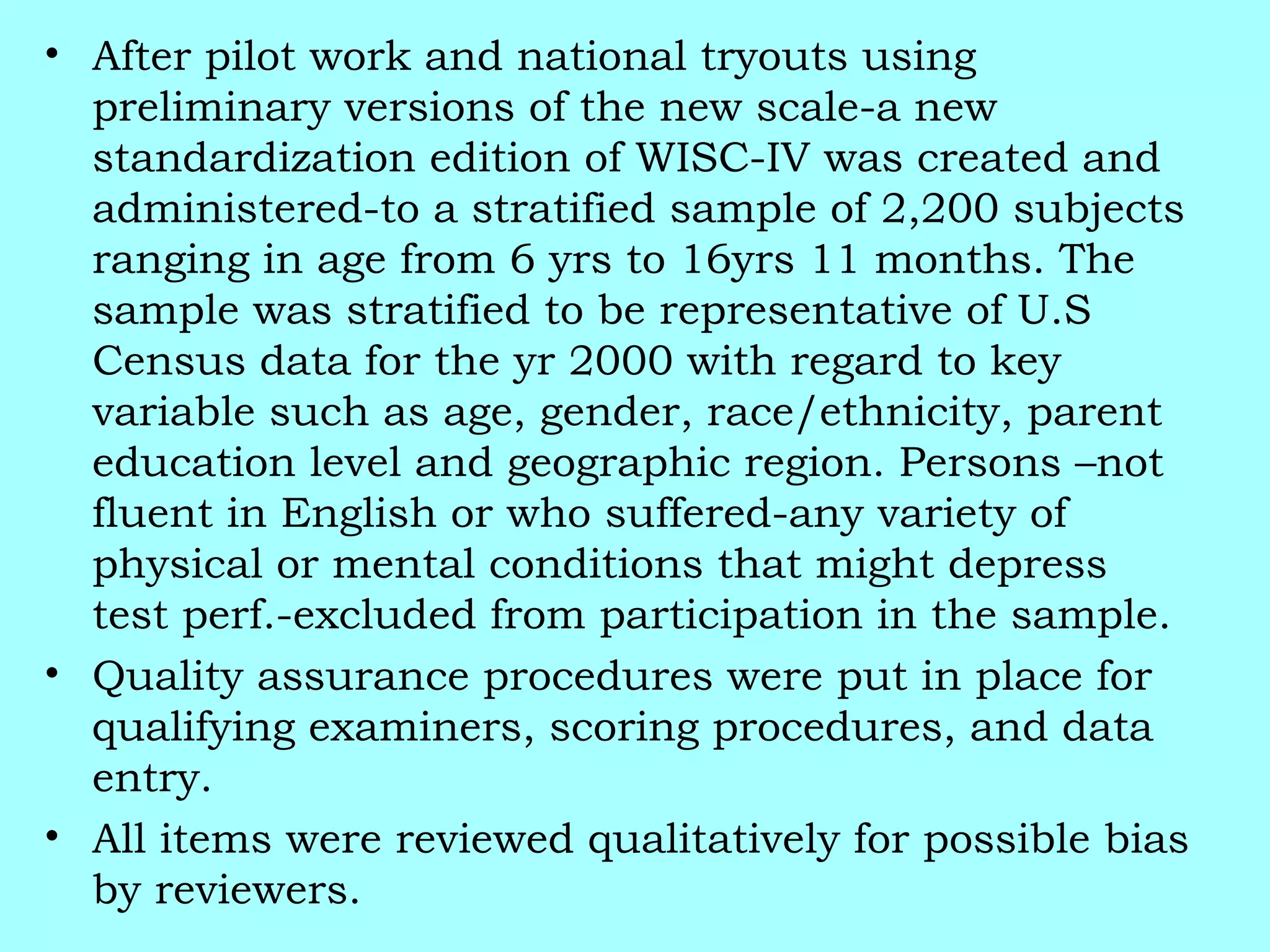
• After pilot work and national tryouts using
preliminary versions of the new scale-a new
standardization edition of WISC-IV was created and
administered-to a stratified sample of 2,200 subjects
ranging in age from 6 yrs to 16yrs 11 months. The
sample was stratified to be representative of U.S
Census data for the yr 2000 with regard to key
variable such as age, gender, race/ethnicity, parent
education level and geographic region. Persons –not
fluent in English or who suffered-any variety of
physical or mental conditions that might depress
test perf.-excluded from participation in the sample.
• Quality assurance procedures were put in place for
qualifying examiners, scoring procedures, and data
entry.
• All items were reviewed qualitatively for possible bias
by reviewers.
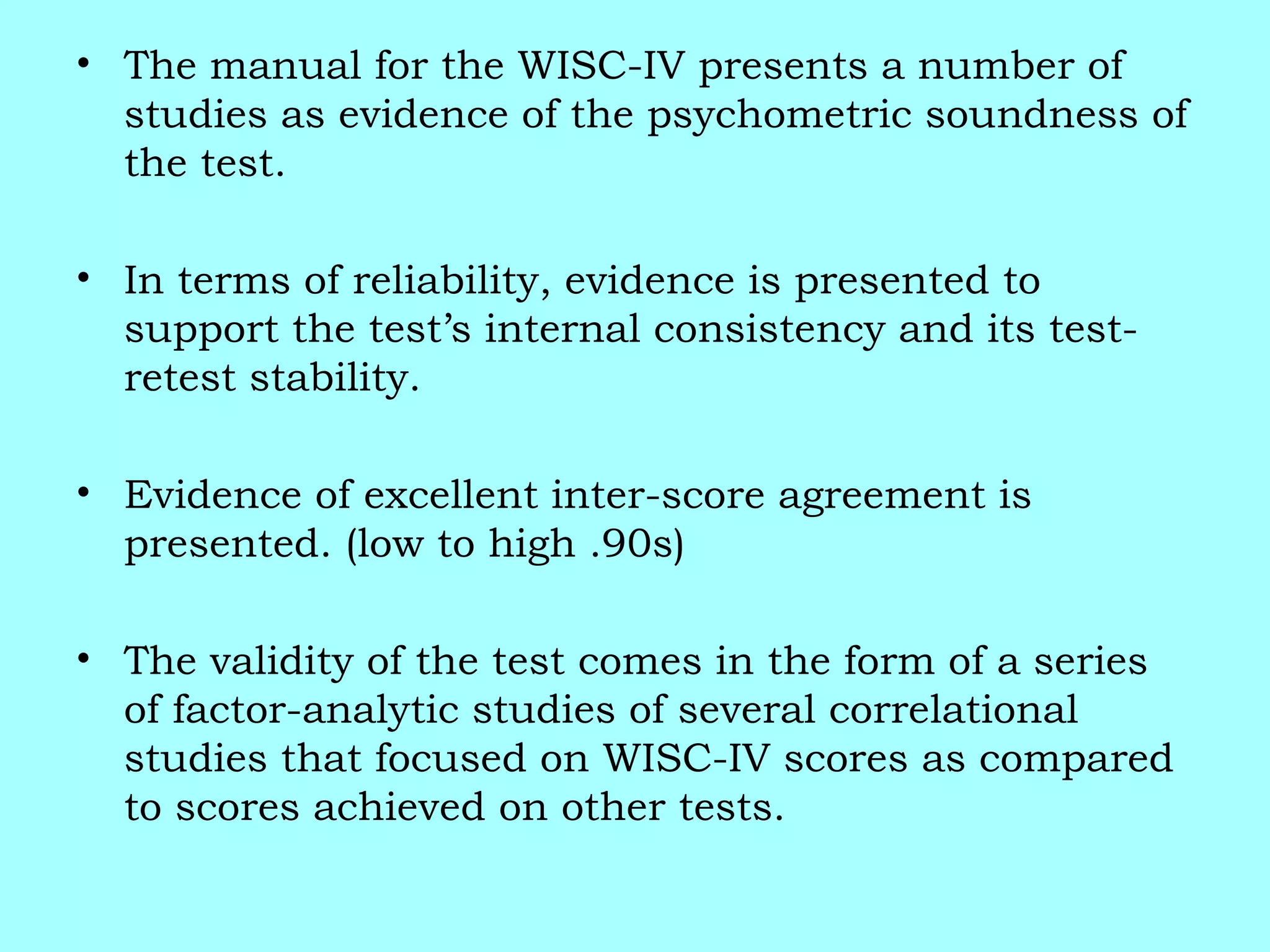
• The manual for the WISC-IV presents a number of
studies as evidence of the psychometric soundness of
the test.
• In terms of reliability, evidence is presented to
support the test’s internal consistency and its test-
retest stability.
• Evidence of excellent inter-score agreement is
presented. (low to high .90s)
• The validity of the test comes in the form of a series
of factor-analytic studies of several correlational
studies that focused on WISC-IV scores as compared
to scores achieved on other tests.
Comparing WISC-IV to SB5
•SB5 can be used with testtakers much younger and
older than those tested using WISC-IV.
•Yet comparison between the two – akin to tradition
among assessors who test children.
•A number of similarities and differences between SB5
and WISC-IV.
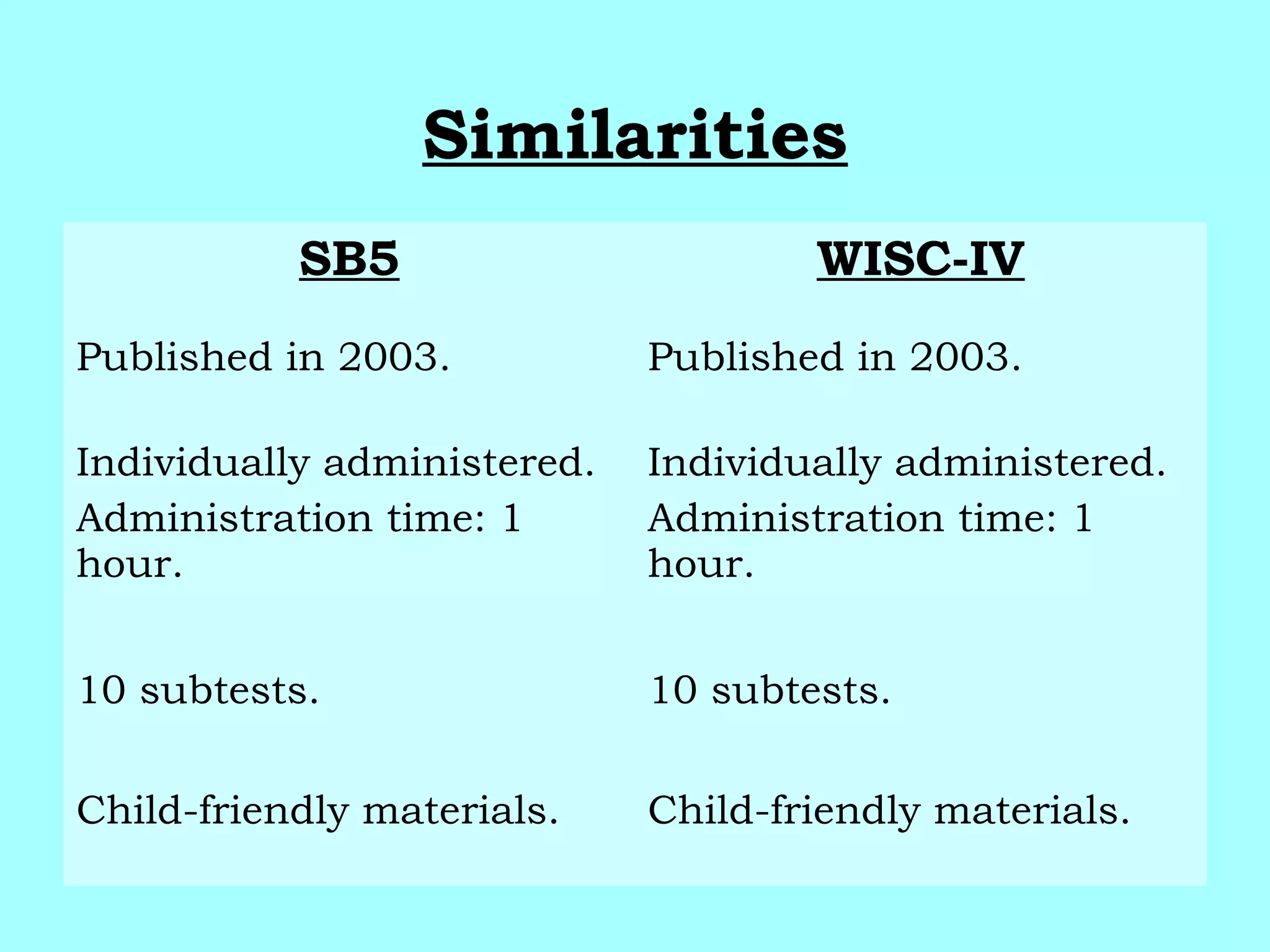
Similarities
SB5 WISC-IV
Published in 2003. Published in 2003.
Individually administered.
Administration time: 1
hour.
Individually administered.
Administration time: 1
hour.
10 subtests. 10 subtests.
Child-friendly materials. Child-friendly materials.
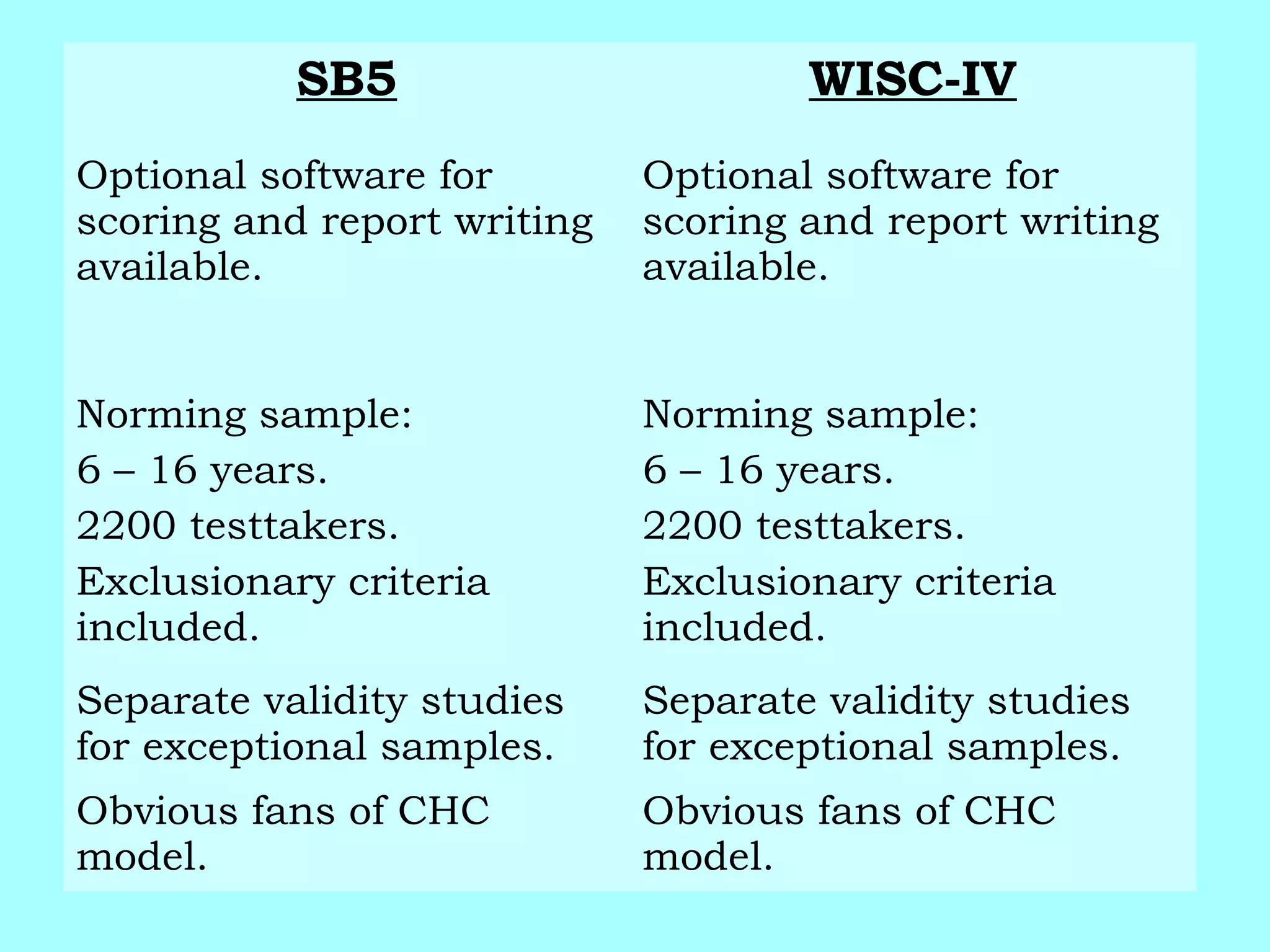
SB5 WISC-IV
Optional software for
scoring and report writing
available.
Optional software for
scoring and report writing
available.
Norming sample:
6 – 16 years.
2200 testtakers.
Exclusionary criteria
included.
Norming sample:
6 – 16 years.
2200 testtakers.
Exclusionary criteria
included.
Separate validity studies
for exceptional samples.
Separate validity studies
for exceptional samples.
Obvious fans of CHC
model.
Obvious fans of CHC
model.
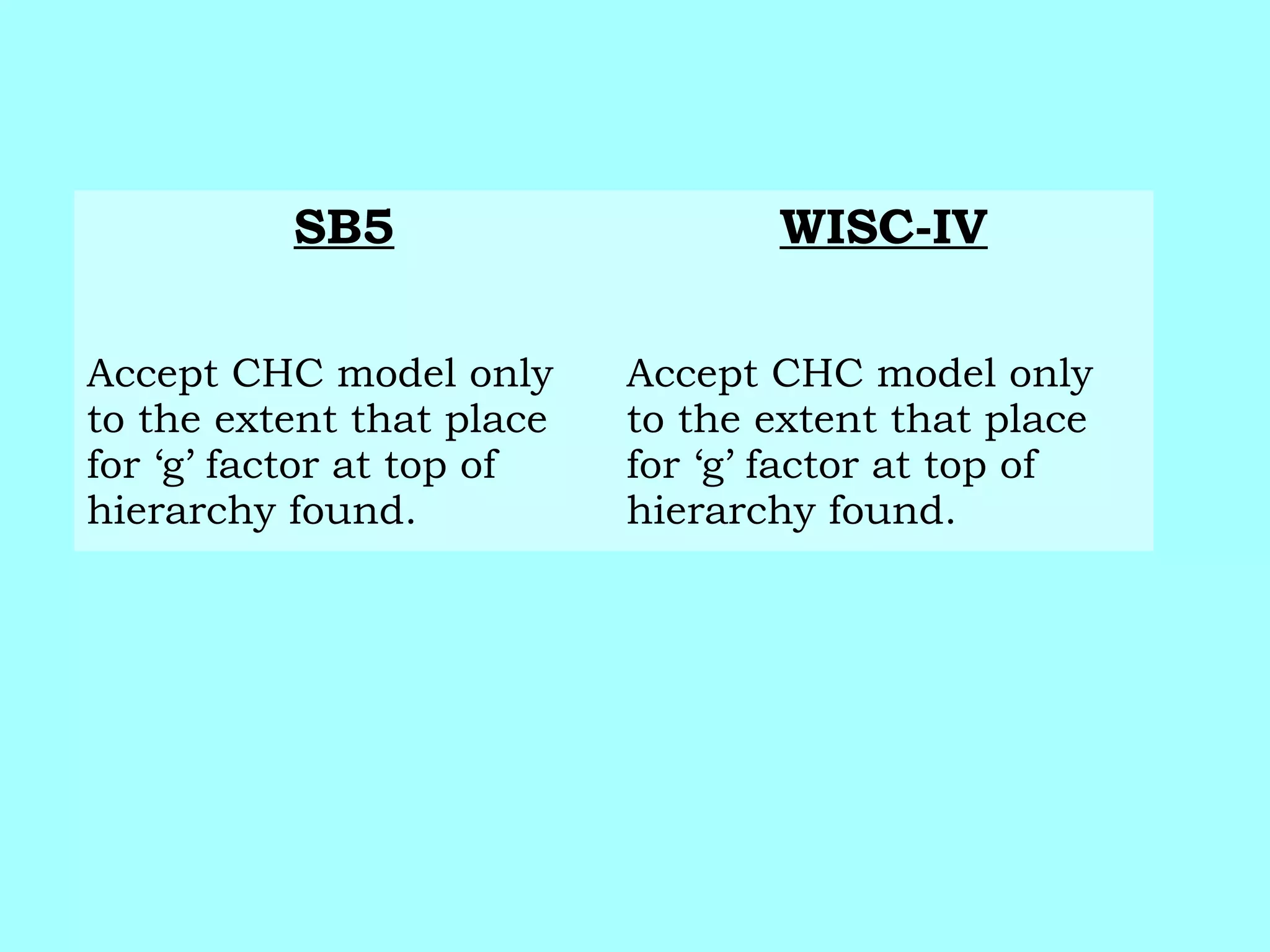
SB5 WISC-IV
Accept CHC model only
to the extent that place
for ‘g’ factor at top of
hierarchy found.
Accept CHC model only
to the extent that place
for ‘g’ factor at top of
hierarchy found.
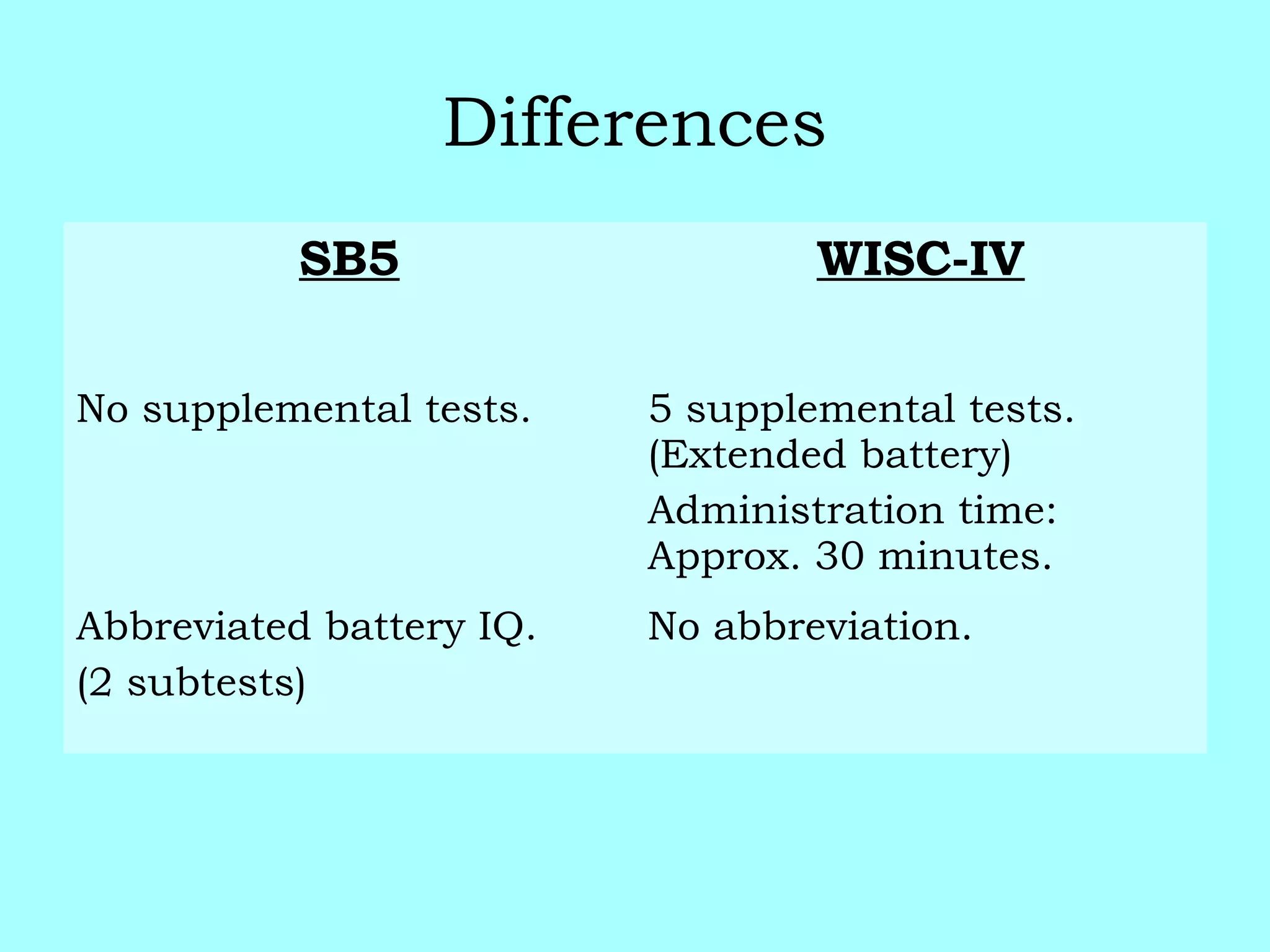
Differences
SB5 WISC-IV
No supplemental tests. 5 supplemental tests.
(Extended battery)
Administration time:
Approx. 30 minutes.
Abbreviated battery IQ.
(2 subtests)
No abbreviation.
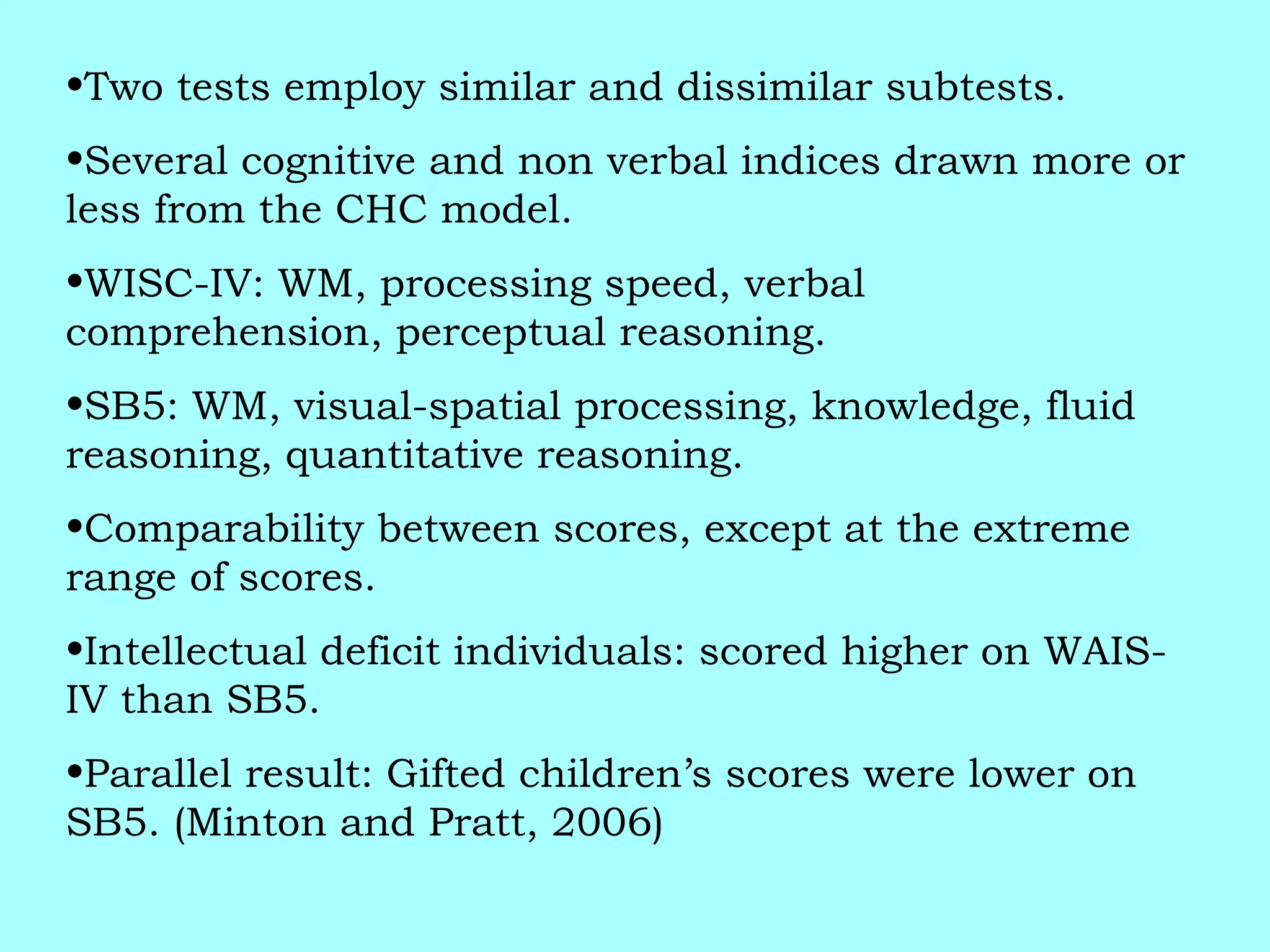
•Two tests employ similar and dissimilar subtests.
•Several cognitive and non verbal indices drawn more or
less from the CHC model.
•WISC-IV: WM, processing speed, verbal
comprehension, perceptual reasoning.
•SB5: WM, visual-spatial processing, knowledge, fluid
reasoning, quantitative reasoning.
•Comparability between scores, except at the extreme
range of scores.
•Intellectual deficit individuals: scored higher on WAIS-
IV than SB5.
•Parallel result: Gifted children’s scores were lower on
SB5. (Minton and Pratt, 2006)
Thank you !!

WISC

  • 1.
    Wechsler Intelligence Scale forChildren- Fourth Edition WISC-IV
  • 2.
    BACKGROUND • First publishedin 1949. • Represented downward extension of W-B. • Incorporated many items contemplated for use in the W-B II. • Reliable instrument that correlated well with other tests of intelligence. • Some of the flaws were: 1. Standardization sample- only white children. 2. Some of the test items perpetuating gender and cultural stereotypes. 3. Parts of the test manual so unclear- ambiguities in administration and scoring.
  • 3.
    • A Revision-the Wechsler intelligence scale for children- revised (WISC-R). •Published in 1974. •Included non-whites in standardization sample. •Test material pictures more balanced culturally. •Language- modernized and “child-ized”. For e.g. word cigars in an arithmetic item was replaced with candy bars. •Innovations in administration and scoring For e.g. -Verbal and Performance tests were administered in alternating fashion, a practice that would also be extended to the WAIS-III and WPPSI-R.
  • 4.
    • Revision ofWISC-R Wechsler's Intelligence Scale for Children- III in 1991. • To update and improve the test items and norms. • For example, easier items were added to the Arithmetic scale to assess counting ability, while at the other end relatively difficult, multistep word problems were added. • A Symbol Search subtest was introduced in the WISC- III. Added as a result of research on controlled attention, and thought to tap freedom from distractibility
  • 5.
    The Test Today •Publishedin 2003. •Culmination of a five year research program. •Most noteworthy – a ‘warming’ to the CHC model of intelligence. •Carroll(1997)- believed ‘g’ to be very much alive and well in major instruments designed to measure intelligence. •Evidence for a general factor of intelligence overwhelming. •Trend toward an emphasis on multiple, more narrowly defined cognitive abilities- not resulted in rejection of underlying, global aspect of general intelligence. •Results of Factor analytic research- converge in the identification of 8 to 10 broad domains of intelligence.
  • 6.
    •Cognitive functions areinterrelated. •Difficult to obtain a pure measure of intelligence. •For example, a test purporting to measure processing speed , may involve multiple abilities such as visual discrimination ability and motor ability. •Questions raised about: desirability of even trying to isolate specific abilities for measurement. •In real life, cognitive tasks rarely performed in isolation. •Attributes and factors of intelligence- at once collective and individual properties. •Appear differently when alone from what they do when operating in concert.
  • 7.
    •The developers ofthe WISC-IV revised the test. •Now it yields a measure of general intellectual functioning as well as four index scores: a verbal comprehension index, a perceptual Reasoning index, a working memory index and a processing speed index. •Each is based on scores on three to five subtests. •Process score- an index designed to help understand the way the test taker processes various kinds if information. •WISC-IV does not yield any separate verbal and performance IQ scores.
  • 8.
    • Other changesin this edition- • The subtests known as Picture Arrangement, object assembly and Mazes have been eliminated. • Separate norms are now presented for Block design, with and without time bonus. These separate norms represent an acknowledgment that certain cultures value speeded task than others. • The subtests information, arithmetic, and picture completion-formerly core subtests-are now supplemental subtests. • There are 10 core subtests and 5 supplemental subtests.
  • 9.
    • After pilotwork and national tryouts using preliminary versions of the new scale-a new standardization edition of WISC-IV was created and administered-to a stratified sample of 2,200 subjects ranging in age from 6 yrs to 16yrs 11 months. The sample was stratified to be representative of U.S Census data for the yr 2000 with regard to key variable such as age, gender, race/ethnicity, parent education level and geographic region. Persons –not fluent in English or who suffered-any variety of physical or mental conditions that might depress test perf.-excluded from participation in the sample. • Quality assurance procedures were put in place for qualifying examiners, scoring procedures, and data entry. • All items were reviewed qualitatively for possible bias by reviewers.
  • 10.
    • The manualfor the WISC-IV presents a number of studies as evidence of the psychometric soundness of the test. • In terms of reliability, evidence is presented to support the test’s internal consistency and its test- retest stability. • Evidence of excellent inter-score agreement is presented. (low to high .90s) • The validity of the test comes in the form of a series of factor-analytic studies of several correlational studies that focused on WISC-IV scores as compared to scores achieved on other tests.
  • 11.
    Comparing WISC-IV toSB5 •SB5 can be used with testtakers much younger and older than those tested using WISC-IV. •Yet comparison between the two – akin to tradition among assessors who test children. •A number of similarities and differences between SB5 and WISC-IV.
  • 12.
    Similarities SB5 WISC-IV Published in2003. Published in 2003. Individually administered. Administration time: 1 hour. Individually administered. Administration time: 1 hour. 10 subtests. 10 subtests. Child-friendly materials. Child-friendly materials.
  • 13.
    SB5 WISC-IV Optional softwarefor scoring and report writing available. Optional software for scoring and report writing available. Norming sample: 6 – 16 years. 2200 testtakers. Exclusionary criteria included. Norming sample: 6 – 16 years. 2200 testtakers. Exclusionary criteria included. Separate validity studies for exceptional samples. Separate validity studies for exceptional samples. Obvious fans of CHC model. Obvious fans of CHC model.
  • 14.
    SB5 WISC-IV Accept CHCmodel only to the extent that place for ‘g’ factor at top of hierarchy found. Accept CHC model only to the extent that place for ‘g’ factor at top of hierarchy found.
  • 15.
    Differences SB5 WISC-IV No supplementaltests. 5 supplemental tests. (Extended battery) Administration time: Approx. 30 minutes. Abbreviated battery IQ. (2 subtests) No abbreviation.
  • 16.
    •Two tests employsimilar and dissimilar subtests. •Several cognitive and non verbal indices drawn more or less from the CHC model. •WISC-IV: WM, processing speed, verbal comprehension, perceptual reasoning. •SB5: WM, visual-spatial processing, knowledge, fluid reasoning, quantitative reasoning. •Comparability between scores, except at the extreme range of scores. •Intellectual deficit individuals: scored higher on WAIS- IV than SB5. •Parallel result: Gifted children’s scores were lower on SB5. (Minton and Pratt, 2006)
  • 17.