Thinking, Language  and Intelligence
Thought Cognition—mental activities involved in acquiring, retaining, and using knowledge Thinking—manipulation of mental representations to draw inferences and conclusions Mental image—representation of objects  or events that are not present
Concepts Concept—mental category of objects or ideas based on shared properties Formal concept—mental category formed by learning rules Natural concept—mental category formed by everyday experience
Examples of Concepts Formal concept—follows rigid rules, not usually intuitive (A polygon is….) Natural concept—results from everyday experience (Some mammals are….)
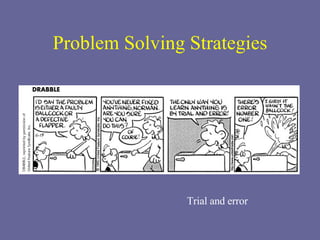
Problem Solving Strategies Trial and error
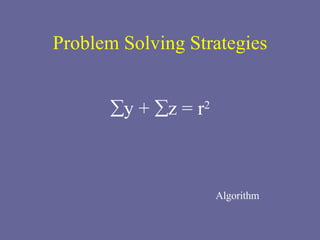
Problem Solving Strategies  y +   z = r 2 Algorithm
Problem Solving Strategies Heuristic—strategy that involves following a general rule of thumb to reduce the number of possible solutions
Insight and Intuition Insight—sudden realization about how a problem can be solved Intuition—coming to a conclusion without conscious awareness of thought processes involved
Functional Fixedness type of mental set inability to see an object as having  a function other than its usual one
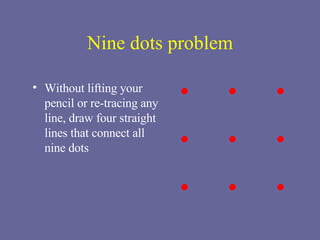
Nine dots problem Without lifting your pencil or re-tracing any line, draw four straight lines that connect all nine dots
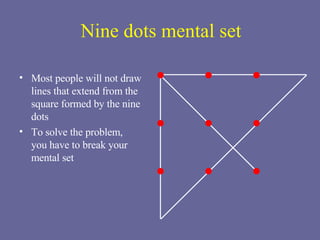
Nine dots mental set Most people will not draw lines that extend from the square formed by the nine dots To solve the problem,  you have to break your mental set
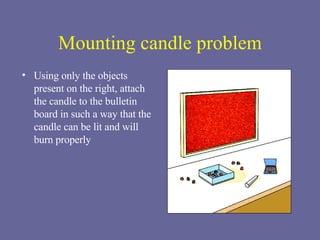
Mounting candle problem Using only the objects present on the right, attach the candle to the bulletin board in such a way that the candle can be lit and will burn properly
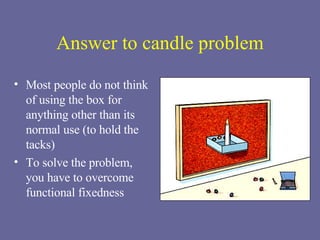
Answer to candle problem Most people do not think of using the box for anything other than its normal use (to hold the tacks) To solve the problem,  you have to overcome functional fixedness
Metal Set Q: Why couldn’t you solve the previous problems? A:  Mental set —a well-established habit  of perception or thought
Decision Making Single feature model—make a decision by focusing on only one feature Additive model—systematically evaluate the important features of each alternative Elimination-by-aspects—rate choices based on features.  Eliminate those that do not meet the desired criteria, despite other desirable characteristics.
Availability Heuristic Judge probability of an event by how easily you  can recall previous occurrences of that event Most will overestimate deaths from natural disasters because disasters are frequently on TV Most will underestimate deaths from asthma  because they don’t make the local news
Representative Heuristic Judge probability of an event based on  how it matches a prototype Can be good But can also lead to errors Most will overuse this strategy
Bias Effects Confirmation bias—only search for information confirming one’s hypothesis Belief bias—accept only information that conforms to beliefs Fallacy of positive instances—remember uncommon events that confirm our beliefs Overestimation—tendency to overestimate  rarity of events
1. Break mental sets 2. Find useful analogy 3. Represent information efficiently 4. Find shortcuts 5. Establish sub-goals 6. Turn ill-defined problems into well-defined problems Strategies for solving problems
Language Language and thinking Language and social perception Language and gender bias Animal communication
Language and Thinking Language is a system for combining arbitrary symbols to produce an infinite number of meaningful statements
Characteristics of Language Connection between word and symbol usually  arbitrary Meaning of symbols is  shared  among speakers of the language Has  syntax --set of specific structural rules Is  generative --can create infinite number of phrases Displacement --can communicate meaningfully about things that are not present
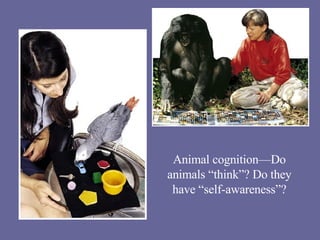
Animal Communication Animals clearly communicate with each other, but is that language? Some primates that have been trained demonstrate the same level of language comprehension as that of an average  2 1/2-year-old child Non-primates can also acquire some language abilities,  i.e., dolphins, parrots
Animal cognition—Do animals “think”? Do they have “self-awareness”?
Intelligence Global capacity to think rationally, act purposefully, and deal effectively with  the environment
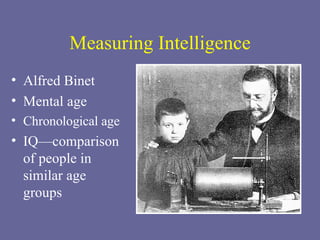
Measuring Intelligence Alfred Binet Mental age Chronological age IQ—comparison of people in similar age groups
Alfred Binet (1857–1911) Intelligence—collection of higher-order mental abilities loosely related to one another Did not rank “normal” students according to the scores Intelligence is nurtured Binet-Simon Test developed in France, 1905
Modern Intelligence Tests The Stanford-Binet Scale modification of the original Binet-Simon, bu Lewis Terman at Stanford university intelligence quotient (IQ)—child’s mental age divided by child’s chronological age
Group Intelligence Testing Began during WWI when the army had to screen millions of army recruits Army Alpha--given to people who could read Army Beta--given to people who could not read Adapted for civilian use, but widely misused
Wechsler Intelligence Tests Used more widely now than Stanford-Binet Modeled after Binet’s, adult test called WAIS Consisted of several subtests Reflected belief that intelligence involves different strengths and weaknesses
WAIS Scales Test measured several abilities Performance scales--nonverbal abilities Verbal scales--vocabulary, comprehension, and other verbal tasks Sub-scales gave the WAIS practical and clinical value
Types of Tests Achievement test—designed to measure level of knowledge, skill, or accomplishment in a particular area Aptitude test—designed to measure capability to benefit from education or training Interest test—measures self-reported vocational interests and skills
Qualities of Good Tests Standardized—administered to large  groups of people under uniform conditions to establish norms Reliable—ability to produce consistent results when administered on repeated occasions under similar conditions Valid—ability to measure what the test  is intended to measure
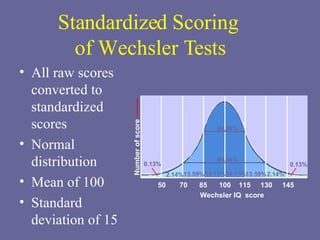
Standardized Scoring  of Wechsler Tests All raw scores converted to standardized scores Normal distribution Mean of 100 Standard deviation of 15 50  70  85  100  115  130  145 2.14% 13.59% 34.13% 34.13% 13.59% 2.14% 0.13% 0.13% 95.44% 68.26% Wechsler IQ  score Number of score
How valid are IQ tests? Validity—test measures what it’s intended to measure Does test correlate with other measures of same construct? School achievement IQ tests (i.e., S-B and the Wechsler) correlate highly but  they were designed to test what you learn in school Prestigious positions On-the-job performance & other work-related variables
What do IQ tests measure  about your mind? Mental speed and span of working memory typically use a digit span test to measure this more recent studies find significant correlations between reaction times and IQ scores Why is this important? mental quickness may expand capacity of  working memory
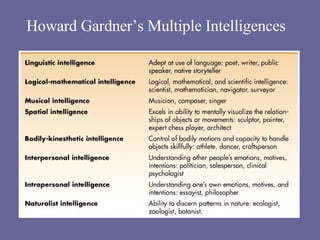
Theories of Intelligence Charles Spearman—“g” factor Louis Thurstone—intelligence as a person’s “pattern” of mental abilities Howard Gardner—multiple intelligences Sternberg–triarchic theory
Howard Gardner’s Multiple Intelligences
Robert Sternberg Analytic intelligence—mental processes used in learning how to solve problems Creative intelligence—ability to deal with novel situations by drawing on existing skills and knowledge Practical intelligence—ability to adapt to the environment (street smarts)
Nature vs. Nurture in IQ Are differences between people due to environmental or genetic differences? Misunderstanding the question “ Is a person’s intelligence due more to genes  or to environment?” both genes & intelligence crucial for any trait
Heredity and Environment Heritability degree to which variation in trait stems from genetic, rather than environmental, differences among individuals Environment degree to which variation is due to environmental rather than genetic differences
Twin Studies & Family Influence If trait genetic: closely related more similar than less closely related Many close relatives share environments too Types of studies to separate effects monozygotic twins reared together monozygotic twins reared apart siblings/dizygotic reared together siblings/dizygotic reared apart adoptive siblings reared together
Racial Difference in IQ Racial difference in average IQ among different racial groups can be measured More variation in IQ scores within a particular group than between groups
Within and Between  Group Differences Each corn field planted from same package of genetically diverse seeds One field is quite fertile, the other is not Within each field, differences due to genetics Between each field, differences due to environment (fertility)
Other Influences on IQ Scores Cross cultural studies show that average IQ of groups subject to social discrimination are often lower than socially dominant group even if there is no racial difference Tests reflect the culture in which they are developed; cultural factors also influence test taking behavior (culture bias)
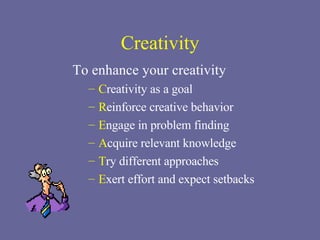
Creativity To enhance your creativity C reativity as a goal R einforce creative behavior E ngage in problem finding A cquire relevant knowledge T ry different approaches E xert effort and expect setbacks

Chapter 7 Ppp

  • 1.
    Thinking, Language and Intelligence
  • 2.
    Thought Cognition—mental activitiesinvolved in acquiring, retaining, and using knowledge Thinking—manipulation of mental representations to draw inferences and conclusions Mental image—representation of objects or events that are not present
  • 3.
    Concepts Concept—mental categoryof objects or ideas based on shared properties Formal concept—mental category formed by learning rules Natural concept—mental category formed by everyday experience
  • 4.
    Examples of ConceptsFormal concept—follows rigid rules, not usually intuitive (A polygon is….) Natural concept—results from everyday experience (Some mammals are….)
  • 5.
  • 6.
    Problem Solving Strategies y +  z = r 2 Algorithm
  • 7.
    Problem Solving StrategiesHeuristic—strategy that involves following a general rule of thumb to reduce the number of possible solutions
  • 8.
    Insight and IntuitionInsight—sudden realization about how a problem can be solved Intuition—coming to a conclusion without conscious awareness of thought processes involved
  • 9.
    Functional Fixedness typeof mental set inability to see an object as having a function other than its usual one
  • 10.
    Nine dots problemWithout lifting your pencil or re-tracing any line, draw four straight lines that connect all nine dots
  • 11.
    Nine dots mentalset Most people will not draw lines that extend from the square formed by the nine dots To solve the problem, you have to break your mental set
  • 12.
    Mounting candle problemUsing only the objects present on the right, attach the candle to the bulletin board in such a way that the candle can be lit and will burn properly
  • 13.
    Answer to candleproblem Most people do not think of using the box for anything other than its normal use (to hold the tacks) To solve the problem, you have to overcome functional fixedness
  • 14.
    Metal Set Q:Why couldn’t you solve the previous problems? A: Mental set —a well-established habit of perception or thought
  • 15.
    Decision Making Singlefeature model—make a decision by focusing on only one feature Additive model—systematically evaluate the important features of each alternative Elimination-by-aspects—rate choices based on features. Eliminate those that do not meet the desired criteria, despite other desirable characteristics.
  • 16.
    Availability Heuristic Judgeprobability of an event by how easily you can recall previous occurrences of that event Most will overestimate deaths from natural disasters because disasters are frequently on TV Most will underestimate deaths from asthma because they don’t make the local news
  • 17.
    Representative Heuristic Judgeprobability of an event based on how it matches a prototype Can be good But can also lead to errors Most will overuse this strategy
  • 18.
    Bias Effects Confirmationbias—only search for information confirming one’s hypothesis Belief bias—accept only information that conforms to beliefs Fallacy of positive instances—remember uncommon events that confirm our beliefs Overestimation—tendency to overestimate rarity of events
  • 19.
    1. Break mentalsets 2. Find useful analogy 3. Represent information efficiently 4. Find shortcuts 5. Establish sub-goals 6. Turn ill-defined problems into well-defined problems Strategies for solving problems
  • 20.
    Language Language andthinking Language and social perception Language and gender bias Animal communication
  • 21.
    Language and ThinkingLanguage is a system for combining arbitrary symbols to produce an infinite number of meaningful statements
  • 22.
    Characteristics of LanguageConnection between word and symbol usually arbitrary Meaning of symbols is shared among speakers of the language Has syntax --set of specific structural rules Is generative --can create infinite number of phrases Displacement --can communicate meaningfully about things that are not present
  • 23.
    Animal Communication Animalsclearly communicate with each other, but is that language? Some primates that have been trained demonstrate the same level of language comprehension as that of an average 2 1/2-year-old child Non-primates can also acquire some language abilities, i.e., dolphins, parrots
  • 24.
    Animal cognition—Do animals“think”? Do they have “self-awareness”?
  • 25.
    Intelligence Global capacityto think rationally, act purposefully, and deal effectively with the environment
  • 26.
    Measuring Intelligence AlfredBinet Mental age Chronological age IQ—comparison of people in similar age groups
  • 27.
    Alfred Binet (1857–1911)Intelligence—collection of higher-order mental abilities loosely related to one another Did not rank “normal” students according to the scores Intelligence is nurtured Binet-Simon Test developed in France, 1905
  • 28.
    Modern Intelligence TestsThe Stanford-Binet Scale modification of the original Binet-Simon, bu Lewis Terman at Stanford university intelligence quotient (IQ)—child’s mental age divided by child’s chronological age
  • 29.
    Group Intelligence TestingBegan during WWI when the army had to screen millions of army recruits Army Alpha--given to people who could read Army Beta--given to people who could not read Adapted for civilian use, but widely misused
  • 30.
    Wechsler Intelligence TestsUsed more widely now than Stanford-Binet Modeled after Binet’s, adult test called WAIS Consisted of several subtests Reflected belief that intelligence involves different strengths and weaknesses
  • 31.
    WAIS Scales Testmeasured several abilities Performance scales--nonverbal abilities Verbal scales--vocabulary, comprehension, and other verbal tasks Sub-scales gave the WAIS practical and clinical value
  • 32.
    Types of TestsAchievement test—designed to measure level of knowledge, skill, or accomplishment in a particular area Aptitude test—designed to measure capability to benefit from education or training Interest test—measures self-reported vocational interests and skills
  • 33.
    Qualities of GoodTests Standardized—administered to large groups of people under uniform conditions to establish norms Reliable—ability to produce consistent results when administered on repeated occasions under similar conditions Valid—ability to measure what the test is intended to measure
  • 34.
    Standardized Scoring of Wechsler Tests All raw scores converted to standardized scores Normal distribution Mean of 100 Standard deviation of 15 50 70 85 100 115 130 145 2.14% 13.59% 34.13% 34.13% 13.59% 2.14% 0.13% 0.13% 95.44% 68.26% Wechsler IQ score Number of score
  • 35.
    How valid areIQ tests? Validity—test measures what it’s intended to measure Does test correlate with other measures of same construct? School achievement IQ tests (i.e., S-B and the Wechsler) correlate highly but they were designed to test what you learn in school Prestigious positions On-the-job performance & other work-related variables
  • 36.
    What do IQtests measure about your mind? Mental speed and span of working memory typically use a digit span test to measure this more recent studies find significant correlations between reaction times and IQ scores Why is this important? mental quickness may expand capacity of working memory
  • 37.
    Theories of IntelligenceCharles Spearman—“g” factor Louis Thurstone—intelligence as a person’s “pattern” of mental abilities Howard Gardner—multiple intelligences Sternberg–triarchic theory
  • 38.
  • 39.
    Robert Sternberg Analyticintelligence—mental processes used in learning how to solve problems Creative intelligence—ability to deal with novel situations by drawing on existing skills and knowledge Practical intelligence—ability to adapt to the environment (street smarts)
  • 40.
    Nature vs. Nurturein IQ Are differences between people due to environmental or genetic differences? Misunderstanding the question “ Is a person’s intelligence due more to genes or to environment?” both genes & intelligence crucial for any trait
  • 41.
    Heredity and EnvironmentHeritability degree to which variation in trait stems from genetic, rather than environmental, differences among individuals Environment degree to which variation is due to environmental rather than genetic differences
  • 42.
    Twin Studies &Family Influence If trait genetic: closely related more similar than less closely related Many close relatives share environments too Types of studies to separate effects monozygotic twins reared together monozygotic twins reared apart siblings/dizygotic reared together siblings/dizygotic reared apart adoptive siblings reared together
  • 43.
    Racial Difference inIQ Racial difference in average IQ among different racial groups can be measured More variation in IQ scores within a particular group than between groups
  • 44.
    Within and Between Group Differences Each corn field planted from same package of genetically diverse seeds One field is quite fertile, the other is not Within each field, differences due to genetics Between each field, differences due to environment (fertility)
  • 45.
    Other Influences onIQ Scores Cross cultural studies show that average IQ of groups subject to social discrimination are often lower than socially dominant group even if there is no racial difference Tests reflect the culture in which they are developed; cultural factors also influence test taking behavior (culture bias)
  • 46.
    Creativity To enhanceyour creativity C reativity as a goal R einforce creative behavior E ngage in problem finding A cquire relevant knowledge T ry different approaches E xert effort and expect setbacks