INTELLIGENCE
PREPARED BY
Mrs.AKILA.A,M.Sc (N), M.Sc (PSY)
ASSOCIATE PROFESSOR
INTRODUCTION
• Intelligence is the general capacity for
comprehension and reasoning that
manifest itself in various ways. It consists
of an individual’s mental or cognitive
ability, which helps the person in solving
his actual life problems and leading a
happy and well controlled life.
DEFINITION OF INTELLIGENCE
• Intelligence is the aggregate or global
capacity of the individual to think rationally,
to act purposefully and to deal effectively
with the environment.(Wechsler-1944)
• The mental quality consisting of the ability
to learn from experience, solve problems
and use knowledge to adapt to new
situations-(David G Myers-2004)
USES OF INTELLIGENCE
1.It helps the individual to adjust to new
changing situations quickly and correctly.
2. It helps to carry on the higher mental
processes such a reasoning, judging
3. It helps to learn difficult tasks and solve
problems.
4. It helps the individual to improve
performance in any situation.
5.It helps in quick understanding of things
6.It helps the individual to apply the
knowledge gained in various subject
/situations in dealing with present
situation.
7. It helps to improve Interpersonal
relationship.
8. It help in building our resourcefulness.
CLASSIFICATION OF
INTELLIGENCE
• Edward L. Thorndike given 3 types:
1.Abstract intelligence
2. Mechanical or concrete intelligence
3.Social intelligence
Abstract intelligence or general
intelligence:
• The ability to understand and manage
ideas, verbal and mathematical symbols.
• Intelligence testing has tended to
concentrate on abstract intelligence.
• This type of intelligence is acquired by
study of books and related literature.
• Mostly good teachers, lawyers,
philosophers, doctors have this type of
intelligence.
Mechanical or concrete
intelligence:
• It is related to concrete materials.
• This type of intelligence is applicable when
the individual is handling concrete objects
or machines or operation of tools or
instruments.
• It includes the ability to visualise the
relationship among objects and
understand how the physical world works.
• Example: Engineers, Mechanics
Social intelligence:
• It is an ability of an individual to react to
social situations in daily life.
• It includes the ability to understand people
and act wisely in human relationships.
• People with this type of intelligence , know
the art of winning friends and influence
them.
• Example: Leaders, Salesman, ministers,
Diplomats.
GARDNER’S 8 Major Kinds of
Intelligence
• MUSICAL-Music smart
• BODILY KINESTHETIC- Body smart
• LOGICAL-MATHEMATICAL- Logic smart
• LINGUISTIC- word smart
• SPATIAL – Picture smart
• INTRAPERSONAL- Self smart
• INTERPERSONAL- People smart
• NATURALIST- Nature smart
MUSICAL INTELLIGENCE:
• skills in tasks involving music.
• The ability to recognise tonal patterns and
sounds, as well as a sensitivity to rhythms
and beats.
• Example: Musicians
BODILY- KINESTHETIC
INTELLIGENCE
• Skills in using the whole body or various
portions of it, in the solution of problems or
in the construction of products.
• The ability to control one’s body
movements and to handle objects skillfully.
• Example : Dancers, athl.ts, actors,
LOGICAL-MATHEMATICAL
INTELLIGENCE
• Skills in solving the problems and scientific
thinking.
• The ability to think conceptually and
abstractly and the capacity to do logical or
numerical patterns.
• Example: Scientists
LINGUISTIC OR VERBAL
INTELLIGENCE
• The ability to use words and language.
• Skills involved in the production and use of
language.
• Example: Literati.
SPATIAL INTELLIGENCE
• Skills involving spatial configurations,
• The ability to visualise objects and spatial
dimensions and create internal images
and pictures.
• Example: Artists and architects
INTERPERSONAL INTELLIGENCE
• Skills in interacting with others, such as
sensitivity to the moods, temperaments,
motivations and intentions of others.
• The capacity for person – person
communications and relationships.
INTRAPERSONAL
INTELLIGENCE
• Knowledge of the internal aspects of one
self, access to one’s own feelings and
emotions.
• The capacity to be self aware and in tune
with inner feelings, values , beliefs and
thinking Process.
NATURALIST INTELLIGENCE
• The ability to recognise and categorise
plants, animals and other objects in
nature.
OTHER TYPES OF INTELLIGENCE
• EXISTENTIAL INTELLIEGENCE:
The sensitivity and capacity to tackle deep
questions about human existence such as the
meaning of life, why do we die and how did
we get here.
OTHER TYPES OF INTELLIGENCE
EMOTIONAL INTELLIGENCE:
• It is an intelligence that provides an
understanding of what other people are
feeling and experiencing, and permits us
to respond appropriately to others need.
• It is the basis of empathy for others, self
awareness and social skills.
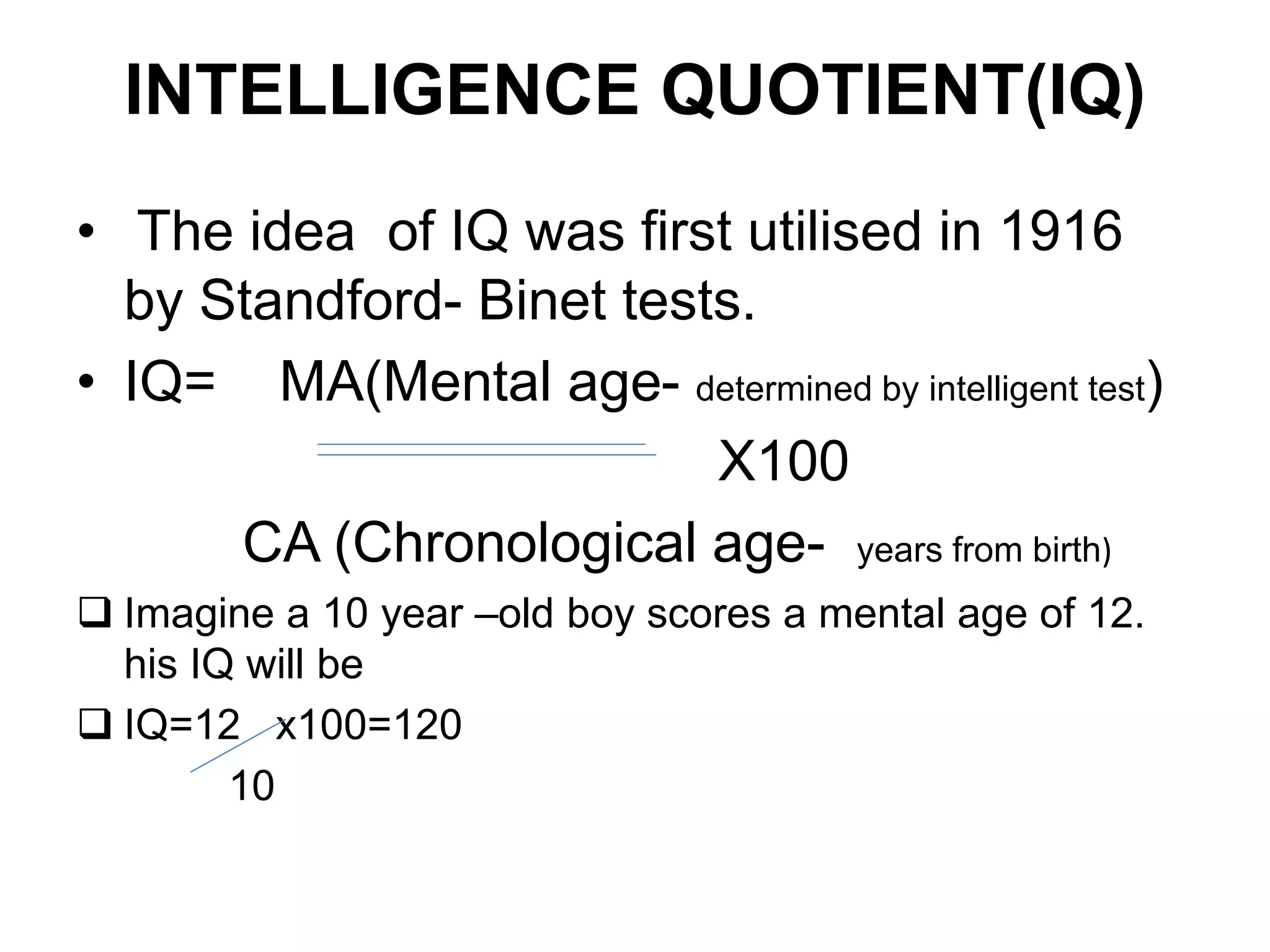
INTELLIGENCE QUOTIENT(IQ)
• The idea of IQ was first utilised in 1916
by Standford- Binet tests.
• IQ= MA(Mental age- determined by intelligent test)
X100
CA (Chronological age- years from birth)
 Imagine a 10 year –old boy scores a mental age of 12.
his IQ will be
 IQ=12 x100=120
10
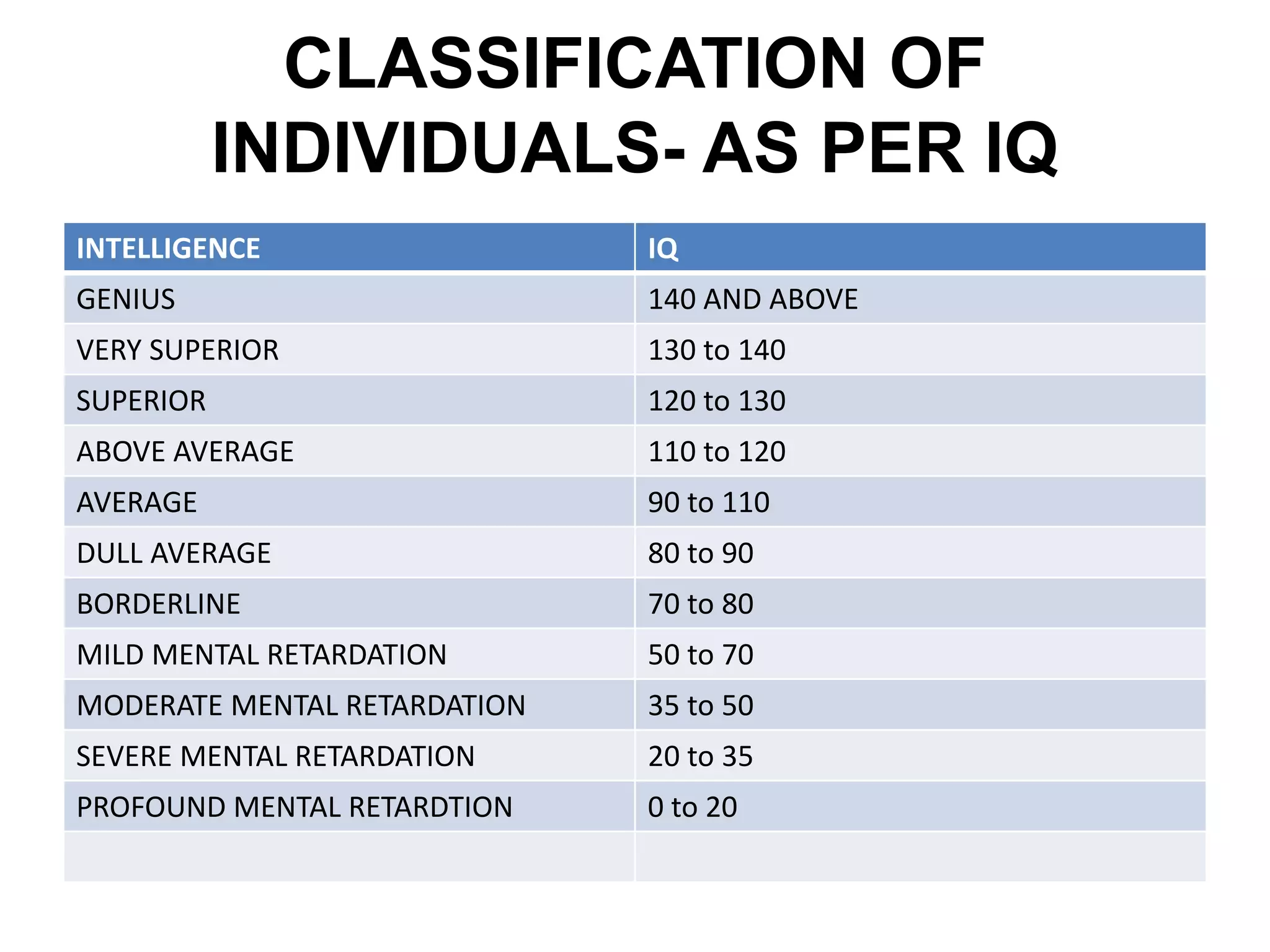
CLASSIFICATION OF
INDIVIDUALS- AS PER IQ
INTELLIGENCE IQ
GENIUS 140 AND ABOVE
VERY SUPERIOR 130 to 140
SUPERIOR 120 to 130
ABOVE AVERAGE 110 to 120
AVERAGE 90 to 110
DULL AVERAGE 80 to 90
BORDERLINE 70 to 80
MILD MENTAL RETARDATION 50 to 70
MODERATE MENTAL RETARDATION 35 to 50
SEVERE MENTAL RETARDATION 20 to 35
PROFOUND MENTAL RETARDTION 0 to 20
THEORIES OF INTELLIGENCE
1.SPERMAN’S TWO FACTOR THEORY;
 Sperman Proposed two factor theory; ‘g’ or
General factors and ‘S’ or Specific Factors.
 The performance of any cognitive activity
depends on g and one or more specific
factors.
 The general factor represents what all mental
tests have in common.
 Individuals differ in ‘g’ which can be thought
of in terms of information processing power.
• Specific factors relates to whatever unique
abilities a particular test requires and it
differs from test to test.
• Spearman and his followers place much
more important on general intelligence
than on the specific factors.
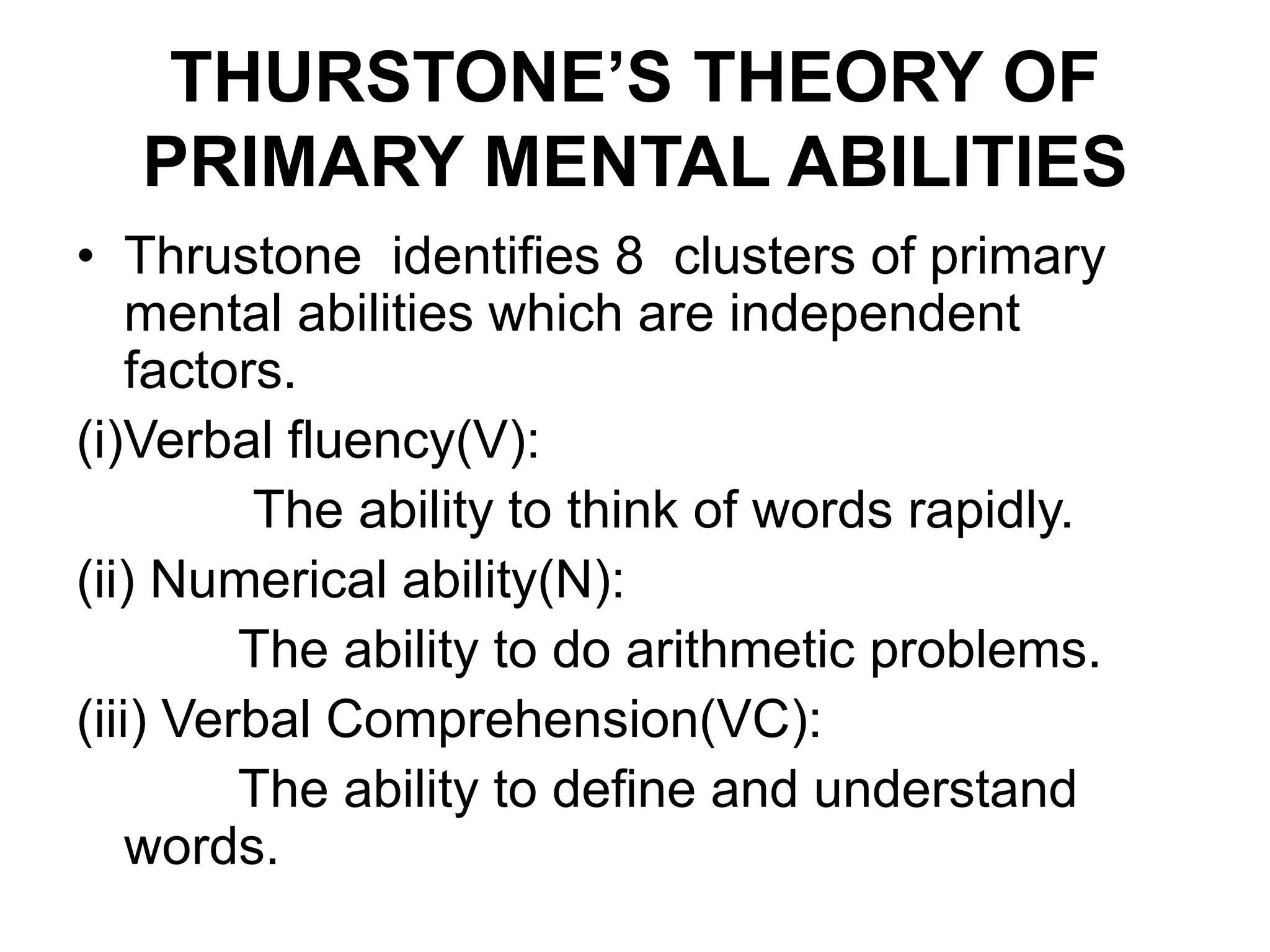
THURSTONE’S THEORY OF
PRIMARY MENTAL ABILITIES
• Thrustone identifies 8 clusters of primary
mental abilities which are independent
factors.
(i)Verbal fluency(V):
The ability to think of words rapidly.
(ii) Numerical ability(N):
The ability to do arithmetic problems.
(iii) Verbal Comprehension(VC):
The ability to define and understand
words.
(iv)Memory(M):
The ability to memorise and recall.
(v) Perceptual speed(P):
The ability to grasp visual details and to
see differences and similarities among
objects.
(vi)Spatial relations (S):
The ability to visualise designs.
(vii)Reasoning (R):
The ability to find principles and rules to
understand.
(Viii) Problem solving (PS):
The ability to solve the problems
independently.
STRENBERG’S TRIARCHIC
THEORY OF INTELLIGENCE
• Strenberg described 3 different kinds of intelligence.
(i) Analytical thinking:
It deals with problem solving abilities and focuses on
planning, monitoring, reflection and transfer.
(ii)Creative thinking:
It focuses on developing , applying new ideas and
creating solutions.
(iii)Practical thinking:
-Common sense.
- It focuses on the ability to adapt to a changing
environment and experiences.
CATTELL’S THEORY OF
INTELLIGENCE
• Raymond Cattell ‘ believed that ‘g’ is
composed of fluid and crystallized
intelligence.
(i) Fluid intelligence:
The ability to see the relationship
between things and to think logically and in
the abstract. It declines with age.
(ii) Crystallized intelligence:
It is based on acquired knowledge and
skills.
PROCESS- ORIENTED THEORIES
It includes, Piaget’s theory and Bruner’s theory.
• These theories have focused on intellectual
processes – the pattern of thinking that
people use when they reason and solve
problems.
• These theorists prefer to use the term
cognitive processes in place of intelligence.
• Often interested in how people solve
problems and how many get the right
solution.
• Focused on the development of cognitive
abilities.
1.Piaget’s theory (1970):
• According to piaget, intelligence is an
adaptive process involving interplay of
biological maturation and interaction with
the environment.
• He viewed intelligence as an evolution of
cognitive processes such as
understanding the laws of nature,
Principles of grammar and mathematical
rules.
2.Bruner’s Theory(1973):
• According to Bruner intelligence is a
growing dependence on representation of
objects or situations.
• These growing abilities are influenced by
thhe environment, especially the rewards
and punishments people receive for using
particular intellectual skills in particular
ways.
INFORMATION- PROCESSING
THEORY
• According to American Psychologist
Robert Strenberg, information processing
approach is the manner in which one
proceeds to perform a mental task or solve
a problem from the time one comes across
it, gather and make use of the information
for completing the task.
• The process of problem solving steps are:
(i) Encoding (identifying the relevant
available information in the mind)
(ii) Inferring (drawing the necessary
inference)
(iii) Mapping (establishing the relationship
between the previous situation and the
present)
(iv) Application(applying the inferred
relationship)
(v) Justification (justifying the analysed
solution of the problem)
(vi) Responsing (providing the best possible
solution)
ASSESSMENTOF
INTELLIGENCE(INTELLIGENCE
TEST)
Assessment of intelligence can be done
through psychological tests. Alfred Binet
(1875-1911) was the first psychologist to
device an intelligence test.
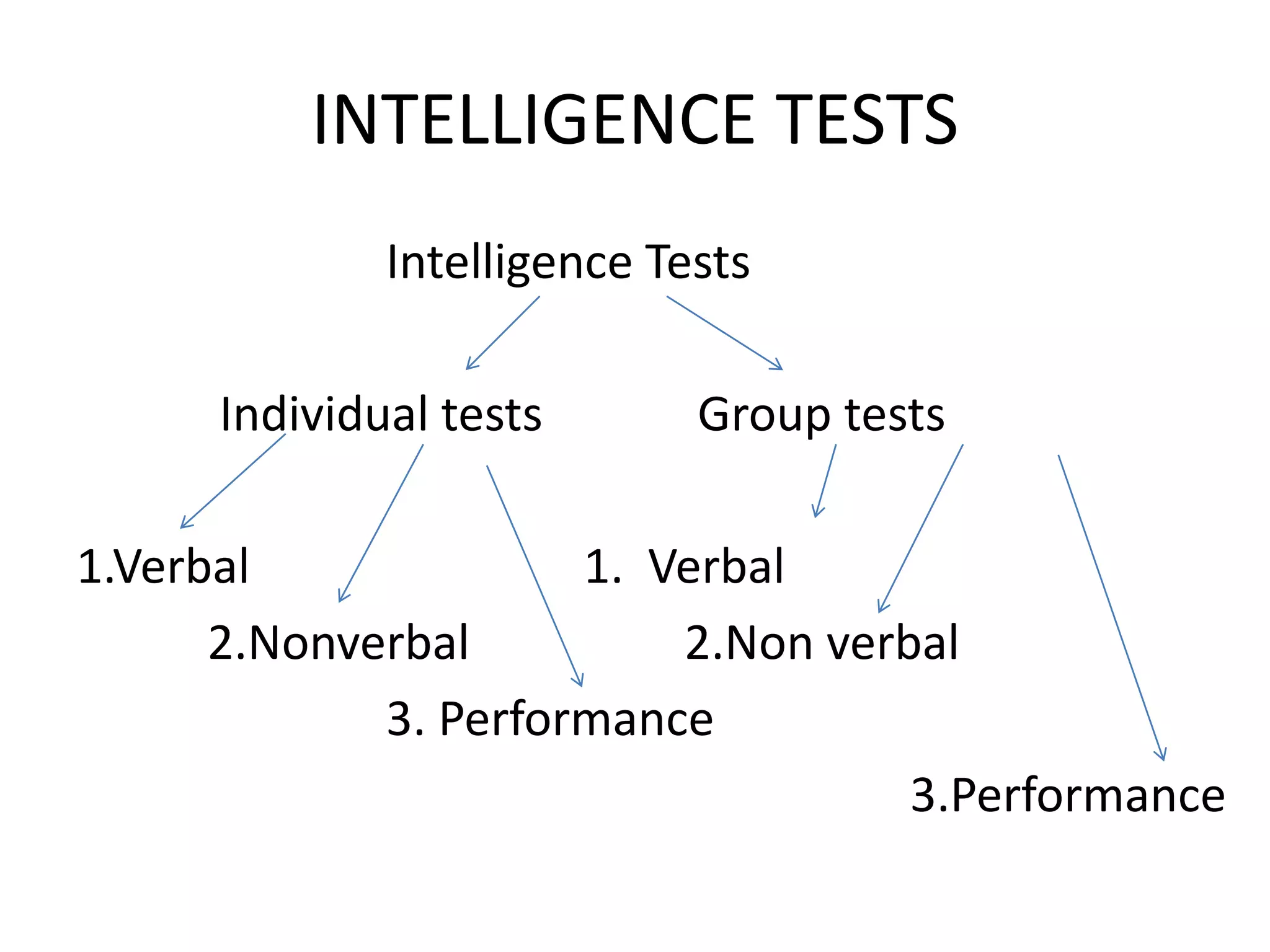
INTELLIGENCE TESTS
Intelligence Tests
Individual tests Group tests
1.Verbal 1. Verbal
2.Nonverbal 2.Non verbal
3. Performance
3.Performance
INDIVIDUAL VS GROUP TEST:
I.1.Individual test:
-These tests are administered on a single
individual by the tester.
-They allow direct observation of the test
– taking behaviour and thus serves a
diagnostic Purpose.
- Good rapport should be established.
- Time Consuming and increases the cost
of test
- Skill and experience is important factor
Example: Standford - Binet ,
Weschlers Scales
2.Group Test:
- developed during I world war to recruit
people to army.
-The army alpha test was designed and
administered to recruit who were literate and
proficient in English.
- The army beta test was used for foreign born
recruits or those who couldn’t read with
proficiency.
.
Example of group test:
1.Pramila Ahuja for those who aged 13-17
years
2. General mental ability devised by
S.Jalatta for college students
Advantages of Group test:
- Administered to large group
- Simplifies the examiners role
- Scoring is more objective
VERBAL, NONVERBAL AND PERFORMANCE
TEST:
II. 1.Verbal Test:
- Requires the use of language
- Instructions are given verbally and the
individuals are required to use language.
-The literate only allowed to take test.
Example:
1. Army alpha test
2. Standford- Binet Test
II. 2.Non – verbal test:
- do not necessitate the use of language.
- tests contain drawings which can be
administered on individuals belonging to
any culture.
- even this can be used for people who
have not had schooling.
- subjects /people are asked to find the
missing item from the alternatives.
Example:
Ravens Progressive Matrices and culture
fair test
II.3.Performance Test:
- which involves motor responses
- useful for illiterate , deaf and dumb or
those who have had very little education.
- This can be used as a supplementing test.
Example:
1.Bhatia’s Battery of Performance test
2. Leiter international Performance scale
3.Columbia mental maturity Scale
Example of tasks involved in
Performance test:
1. Draw something
2. Find the right path in a maze
3. Construct designs
4. Fit together blocks on a board
5. Picture completion
Comparision between individual
and group test
INDIVIDUAL TEST GROUP TEST
1.One individual at a time,
hence it is not economical in
terms of time, labor and
money.
1.Any group of children can
be tested at the same time,
hence economical.
2.These are applicable both
for children and adults
2. These tests cannot be
administered to young
children below the age of 10
years.
3. These bring the tester and
child closer and establish a
better relationship between
the two.
3.Personal contact between
the two is not possible
USES OF INTELLIGENCE TEST
1.Predicts how well a individual will learn in
a program of study.
2. Helps to classify the students according to
the capacity
3.Helps in selecting the students for
admission or for scholarships
4.Helps for Vocational guidance and
counselling
5. Useful in recruiting the employees for job
6.It helps for research also.
LIMITATIONS OF INTELLIGENCE
TEST
1. It cannot measure intelligence with
mathematical accuracy.
2. It doesn't predict the absolute success in
school or in a profession
3. It do not throw any light on the character,
morals, emotions or temperament of the
individual.
ALTERATIONS IN INTELLIGENCE
• People differ in intellectual ability and
capacities like reasoning and thinking, power
of imagination, creative expression etc
• Mental subnormality:
It refers to sub-average intellectual
functioning, which originates in the
developmental period and is associated with
impairment in adaptive behaviour. Their IQ
will be below 70 on standard Psychological
tests of intelligence.
• Mentally gifted children:
-These are the individuals with IQs of
140 or higher.
-In the early childhood, a gifted child is
generally misfit in his class.
- The Gifted child may be able to
comprehend much faster.
NURSES IMPLICATIONS OF
INTELLIGENCE
• Knowledge about the nature of intelligence is
essential for the nurses.
• Nurses’s explanations should be on the
intellectual level of the patient.
• Knowledge about the intelligence helps the
nurses to identify the sub normalities.
• Knoweledge about the differences in the
development of intelligence among new borns
will help the nurses to give suitable care.
CONCLUSION
• Every individual is unique, differs with
intelligence. As a nurse, we have to apply
this knowledge in providing care to the
patient and also to the family members
who differs in intelligence.
Psychology unit iii-intelligence

Psychology unit iii-intelligence

  • 1.
    INTELLIGENCE PREPARED BY Mrs.AKILA.A,M.Sc (N),M.Sc (PSY) ASSOCIATE PROFESSOR
  • 2.
    INTRODUCTION • Intelligence isthe general capacity for comprehension and reasoning that manifest itself in various ways. It consists of an individual’s mental or cognitive ability, which helps the person in solving his actual life problems and leading a happy and well controlled life.
  • 3.
    DEFINITION OF INTELLIGENCE •Intelligence is the aggregate or global capacity of the individual to think rationally, to act purposefully and to deal effectively with the environment.(Wechsler-1944) • The mental quality consisting of the ability to learn from experience, solve problems and use knowledge to adapt to new situations-(David G Myers-2004)
  • 4.
    USES OF INTELLIGENCE 1.Ithelps the individual to adjust to new changing situations quickly and correctly. 2. It helps to carry on the higher mental processes such a reasoning, judging 3. It helps to learn difficult tasks and solve problems. 4. It helps the individual to improve performance in any situation.
  • 5.
    5.It helps inquick understanding of things 6.It helps the individual to apply the knowledge gained in various subject /situations in dealing with present situation. 7. It helps to improve Interpersonal relationship. 8. It help in building our resourcefulness.
  • 6.
    CLASSIFICATION OF INTELLIGENCE • EdwardL. Thorndike given 3 types: 1.Abstract intelligence 2. Mechanical or concrete intelligence 3.Social intelligence
  • 7.
    Abstract intelligence orgeneral intelligence: • The ability to understand and manage ideas, verbal and mathematical symbols. • Intelligence testing has tended to concentrate on abstract intelligence. • This type of intelligence is acquired by study of books and related literature. • Mostly good teachers, lawyers, philosophers, doctors have this type of intelligence.
  • 8.
    Mechanical or concrete intelligence: •It is related to concrete materials. • This type of intelligence is applicable when the individual is handling concrete objects or machines or operation of tools or instruments. • It includes the ability to visualise the relationship among objects and understand how the physical world works. • Example: Engineers, Mechanics
  • 9.
    Social intelligence: • Itis an ability of an individual to react to social situations in daily life. • It includes the ability to understand people and act wisely in human relationships. • People with this type of intelligence , know the art of winning friends and influence them. • Example: Leaders, Salesman, ministers, Diplomats.
  • 10.
    GARDNER’S 8 MajorKinds of Intelligence • MUSICAL-Music smart • BODILY KINESTHETIC- Body smart • LOGICAL-MATHEMATICAL- Logic smart • LINGUISTIC- word smart • SPATIAL – Picture smart • INTRAPERSONAL- Self smart • INTERPERSONAL- People smart • NATURALIST- Nature smart
  • 11.
    MUSICAL INTELLIGENCE: • skillsin tasks involving music. • The ability to recognise tonal patterns and sounds, as well as a sensitivity to rhythms and beats. • Example: Musicians
  • 12.
    BODILY- KINESTHETIC INTELLIGENCE • Skillsin using the whole body or various portions of it, in the solution of problems or in the construction of products. • The ability to control one’s body movements and to handle objects skillfully. • Example : Dancers, athl.ts, actors,
  • 13.
    LOGICAL-MATHEMATICAL INTELLIGENCE • Skills insolving the problems and scientific thinking. • The ability to think conceptually and abstractly and the capacity to do logical or numerical patterns. • Example: Scientists
  • 14.
    LINGUISTIC OR VERBAL INTELLIGENCE •The ability to use words and language. • Skills involved in the production and use of language. • Example: Literati.
  • 15.
    SPATIAL INTELLIGENCE • Skillsinvolving spatial configurations, • The ability to visualise objects and spatial dimensions and create internal images and pictures. • Example: Artists and architects
  • 16.
    INTERPERSONAL INTELLIGENCE • Skillsin interacting with others, such as sensitivity to the moods, temperaments, motivations and intentions of others. • The capacity for person – person communications and relationships.
  • 17.
    INTRAPERSONAL INTELLIGENCE • Knowledge ofthe internal aspects of one self, access to one’s own feelings and emotions. • The capacity to be self aware and in tune with inner feelings, values , beliefs and thinking Process.
  • 18.
    NATURALIST INTELLIGENCE • Theability to recognise and categorise plants, animals and other objects in nature.
  • 19.
    OTHER TYPES OFINTELLIGENCE • EXISTENTIAL INTELLIEGENCE: The sensitivity and capacity to tackle deep questions about human existence such as the meaning of life, why do we die and how did we get here.
  • 20.
    OTHER TYPES OFINTELLIGENCE EMOTIONAL INTELLIGENCE: • It is an intelligence that provides an understanding of what other people are feeling and experiencing, and permits us to respond appropriately to others need. • It is the basis of empathy for others, self awareness and social skills.
  • 21.
    INTELLIGENCE QUOTIENT(IQ) • Theidea of IQ was first utilised in 1916 by Standford- Binet tests. • IQ= MA(Mental age- determined by intelligent test) X100 CA (Chronological age- years from birth)  Imagine a 10 year –old boy scores a mental age of 12. his IQ will be  IQ=12 x100=120 10
  • 22.
    CLASSIFICATION OF INDIVIDUALS- ASPER IQ INTELLIGENCE IQ GENIUS 140 AND ABOVE VERY SUPERIOR 130 to 140 SUPERIOR 120 to 130 ABOVE AVERAGE 110 to 120 AVERAGE 90 to 110 DULL AVERAGE 80 to 90 BORDERLINE 70 to 80 MILD MENTAL RETARDATION 50 to 70 MODERATE MENTAL RETARDATION 35 to 50 SEVERE MENTAL RETARDATION 20 to 35 PROFOUND MENTAL RETARDTION 0 to 20
  • 23.
    THEORIES OF INTELLIGENCE 1.SPERMAN’STWO FACTOR THEORY;  Sperman Proposed two factor theory; ‘g’ or General factors and ‘S’ or Specific Factors.  The performance of any cognitive activity depends on g and one or more specific factors.  The general factor represents what all mental tests have in common.  Individuals differ in ‘g’ which can be thought of in terms of information processing power.
  • 24.
    • Specific factorsrelates to whatever unique abilities a particular test requires and it differs from test to test. • Spearman and his followers place much more important on general intelligence than on the specific factors.
  • 25.
    THURSTONE’S THEORY OF PRIMARYMENTAL ABILITIES • Thrustone identifies 8 clusters of primary mental abilities which are independent factors. (i)Verbal fluency(V): The ability to think of words rapidly. (ii) Numerical ability(N): The ability to do arithmetic problems. (iii) Verbal Comprehension(VC): The ability to define and understand words.
  • 26.
    (iv)Memory(M): The ability tomemorise and recall. (v) Perceptual speed(P): The ability to grasp visual details and to see differences and similarities among objects. (vi)Spatial relations (S): The ability to visualise designs. (vii)Reasoning (R): The ability to find principles and rules to understand. (Viii) Problem solving (PS): The ability to solve the problems independently.
  • 27.
    STRENBERG’S TRIARCHIC THEORY OFINTELLIGENCE • Strenberg described 3 different kinds of intelligence. (i) Analytical thinking: It deals with problem solving abilities and focuses on planning, monitoring, reflection and transfer. (ii)Creative thinking: It focuses on developing , applying new ideas and creating solutions. (iii)Practical thinking: -Common sense. - It focuses on the ability to adapt to a changing environment and experiences.
  • 28.
    CATTELL’S THEORY OF INTELLIGENCE •Raymond Cattell ‘ believed that ‘g’ is composed of fluid and crystallized intelligence. (i) Fluid intelligence: The ability to see the relationship between things and to think logically and in the abstract. It declines with age. (ii) Crystallized intelligence: It is based on acquired knowledge and skills.
  • 29.
    PROCESS- ORIENTED THEORIES Itincludes, Piaget’s theory and Bruner’s theory. • These theories have focused on intellectual processes – the pattern of thinking that people use when they reason and solve problems. • These theorists prefer to use the term cognitive processes in place of intelligence. • Often interested in how people solve problems and how many get the right solution. • Focused on the development of cognitive abilities.
  • 30.
    1.Piaget’s theory (1970): •According to piaget, intelligence is an adaptive process involving interplay of biological maturation and interaction with the environment. • He viewed intelligence as an evolution of cognitive processes such as understanding the laws of nature, Principles of grammar and mathematical rules.
  • 31.
    2.Bruner’s Theory(1973): • Accordingto Bruner intelligence is a growing dependence on representation of objects or situations. • These growing abilities are influenced by thhe environment, especially the rewards and punishments people receive for using particular intellectual skills in particular ways.
  • 32.
    INFORMATION- PROCESSING THEORY • Accordingto American Psychologist Robert Strenberg, information processing approach is the manner in which one proceeds to perform a mental task or solve a problem from the time one comes across it, gather and make use of the information for completing the task. • The process of problem solving steps are: (i) Encoding (identifying the relevant available information in the mind)
  • 33.
    (ii) Inferring (drawingthe necessary inference) (iii) Mapping (establishing the relationship between the previous situation and the present) (iv) Application(applying the inferred relationship) (v) Justification (justifying the analysed solution of the problem) (vi) Responsing (providing the best possible solution)
  • 34.
    ASSESSMENTOF INTELLIGENCE(INTELLIGENCE TEST) Assessment of intelligencecan be done through psychological tests. Alfred Binet (1875-1911) was the first psychologist to device an intelligence test.
  • 35.
    INTELLIGENCE TESTS Intelligence Tests Individualtests Group tests 1.Verbal 1. Verbal 2.Nonverbal 2.Non verbal 3. Performance 3.Performance
  • 36.
    INDIVIDUAL VS GROUPTEST: I.1.Individual test: -These tests are administered on a single individual by the tester. -They allow direct observation of the test – taking behaviour and thus serves a diagnostic Purpose. - Good rapport should be established. - Time Consuming and increases the cost of test - Skill and experience is important factor Example: Standford - Binet , Weschlers Scales
  • 37.
    2.Group Test: - developedduring I world war to recruit people to army. -The army alpha test was designed and administered to recruit who were literate and proficient in English. - The army beta test was used for foreign born recruits or those who couldn’t read with proficiency. .
  • 38.
    Example of grouptest: 1.Pramila Ahuja for those who aged 13-17 years 2. General mental ability devised by S.Jalatta for college students Advantages of Group test: - Administered to large group - Simplifies the examiners role - Scoring is more objective
  • 39.
    VERBAL, NONVERBAL ANDPERFORMANCE TEST: II. 1.Verbal Test: - Requires the use of language - Instructions are given verbally and the individuals are required to use language. -The literate only allowed to take test. Example: 1. Army alpha test 2. Standford- Binet Test
  • 40.
    II. 2.Non –verbal test: - do not necessitate the use of language. - tests contain drawings which can be administered on individuals belonging to any culture. - even this can be used for people who have not had schooling. - subjects /people are asked to find the missing item from the alternatives. Example: Ravens Progressive Matrices and culture fair test
  • 41.
    II.3.Performance Test: - whichinvolves motor responses - useful for illiterate , deaf and dumb or those who have had very little education. - This can be used as a supplementing test. Example: 1.Bhatia’s Battery of Performance test 2. Leiter international Performance scale 3.Columbia mental maturity Scale
  • 42.
    Example of tasksinvolved in Performance test: 1. Draw something 2. Find the right path in a maze 3. Construct designs 4. Fit together blocks on a board 5. Picture completion
  • 43.
    Comparision between individual andgroup test INDIVIDUAL TEST GROUP TEST 1.One individual at a time, hence it is not economical in terms of time, labor and money. 1.Any group of children can be tested at the same time, hence economical. 2.These are applicable both for children and adults 2. These tests cannot be administered to young children below the age of 10 years. 3. These bring the tester and child closer and establish a better relationship between the two. 3.Personal contact between the two is not possible
  • 44.
    USES OF INTELLIGENCETEST 1.Predicts how well a individual will learn in a program of study. 2. Helps to classify the students according to the capacity 3.Helps in selecting the students for admission or for scholarships 4.Helps for Vocational guidance and counselling 5. Useful in recruiting the employees for job 6.It helps for research also.
  • 45.
    LIMITATIONS OF INTELLIGENCE TEST 1.It cannot measure intelligence with mathematical accuracy. 2. It doesn't predict the absolute success in school or in a profession 3. It do not throw any light on the character, morals, emotions or temperament of the individual.
  • 46.
    ALTERATIONS IN INTELLIGENCE •People differ in intellectual ability and capacities like reasoning and thinking, power of imagination, creative expression etc • Mental subnormality: It refers to sub-average intellectual functioning, which originates in the developmental period and is associated with impairment in adaptive behaviour. Their IQ will be below 70 on standard Psychological tests of intelligence.
  • 47.
    • Mentally giftedchildren: -These are the individuals with IQs of 140 or higher. -In the early childhood, a gifted child is generally misfit in his class. - The Gifted child may be able to comprehend much faster.
  • 48.
    NURSES IMPLICATIONS OF INTELLIGENCE •Knowledge about the nature of intelligence is essential for the nurses. • Nurses’s explanations should be on the intellectual level of the patient. • Knowledge about the intelligence helps the nurses to identify the sub normalities. • Knoweledge about the differences in the development of intelligence among new borns will help the nurses to give suitable care.
  • 49.
    CONCLUSION • Every individualis unique, differs with intelligence. As a nurse, we have to apply this knowledge in providing care to the patient and also to the family members who differs in intelligence.