Intel 8086
Architecture & Programming
Features of 8086 Microprocessor

1) 8086 has 16-bit ALU; this means 16-bit numbers are
    directly processed by 8086.
 2) It has 16-bit data bus, so it can read data or write
    data to memory or I/O ports either 16 bits or 8 bits at
    a time.
3)      It has 20 address lines, so it can address up to 220 i.e.
       1048576 = 1Mbytes of memory (words i.e. 16 bit
       numbers are stored in consecutive memorylocations).
       Due to the 1Mbytes memory size multiprogramming
       is made feasible as well as several multiprogramming
       features have been incorporated in 8086 design.

3/9/2006                    Y.H.Dandawate                       2
Features Continued …

4) 8086 includes few features, which enhance
   multiprocessing capability (it can be used with math
   coprocessors like 8087, I/O processor 8089 etc.
5) Operates on +5v supply and single phase (single line)
   clock frequency.(Clock is generated by separate
   peripheral chip 8284).
6) 8086 comes with different versions. 8086 runs at 5
   MHz, 8086-2 runs at 8 MHz, 8086-1 runs at 10 MHz.
7) It comes in 40-pin configuration with HMOS
   technology having around 20,000 transistors in its
   circuitry.

3/9/2006                 Y.H.Dandawate                     3
Features Continued …

8) It has multiplexed address and data bus like
   8085 due to which the pin count is reduced
   considerably.
9) Higher Throughput (Speed)
  (This is achieved by a concept called pipelining).

    Nowadays 8086 is no longer used. But the concept of its principles and
    structures is very useful for understanding other advanced Intel
    microprocessors.


3/9/2006                         Y.H.Dandawate                               4
Pin Diagram of 8086


3/9/2006              Y.H.Dandawate   5
Internal Architecture of 8086
Architecture of 8086 (contd..)
    Fetching the next instruction while current
    instruction is under execution is called
    pipelining.
    What happens to queue when jump or call
     instruction is executed ?
    When 8086 is reset the contents of IP are
    0000 H and contents of CS are FFFF H.
    Other registers are cleared to 0000 h.
3/9/2006             Y.H.Dandawate                7
Memory Segmentation
Advantages of memory segmentation

    Allow the memory capacity to be 1Mb even
    though the addresses associated with the
    individual instructions are only 16 bits wide.
    Facilitate the use of separate memory areas for the
    program, its data and the stack.
    Permit a program and/or its data to be put into
    different areas of memory each time the program
    is executed.
    Multitasking becomes easy.

3/9/2006                Y.H.Dandawate                 9
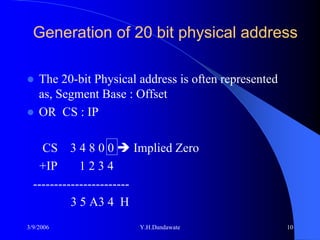
Generation of 20 bit physical address

    The 20-bit Physical address is often represented
    as, Segment Base : Offset
    OR CS : IP

    CS 3 4 8 0 0          Implied Zero
   +IP       1234
  -----------------------
           3 5 A3 4 H
3/9/2006                 Y.H.Dandawate                 10
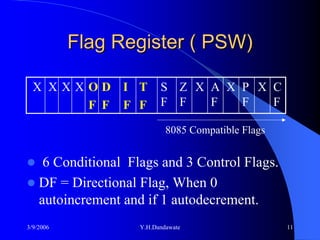
Flag Register ( PSW)

  X XXXOD I T              S Z X A X P X C
       F F F F             F F   F   F   F

                             8085 Compatible Flags


     6 Conditional Flags and 3 Control Flags.
    DF = Directional Flag, When 0
    autoincrement and if 1 autodecrement.
3/9/2006             Y.H.Dandawate                   11
Addressing Modes
A] Data Category
                     B] Branch Category


 1) Immediate Addressing
 2) Direct Addressing
    ( Segment Override prefix)
 3) Register Addressing
 4) Register Indirect Addressing
3/9/2006              Y.H.Dandawate       12
Addressing Modes Contd….
5) Register Relative addressing
6) Base Index addressing
7) Relative Base Index addressing

B] Branch Category
 1) Intrasegment Direct
 2) Intersegment Indirect
 3) Intrasegment Direct
 4) Intersegment Indirect
3/9/2006             Y.H.Dandawate   13
INSTRUCTION SET OF 8086
Classified into 7 categories
1] Data Transfer
2] Arithmetic
3] Logical
4] Control
5]Processor Control Instructions
6] String Manipulation
7] Interrupt Control
3/9/2006              Y.H.Dandawate   14
Data Transfer Instructions
Note : Data Transfer Instructions do not affect
       any flags
1] MOV dest, src
   Note that source and destination cannot be memory
    location. Also source and destination must be same type.
2] PUSH Src : Copies word on stack.
3] POP dest : Copies word from stack into dest. Reg.
4] IN acc, port : Copies 8 or 16 bit data from port to
    accumulator.
    a) Fixed Port
    b) Variable Port
5] OUT port,acc
3/9/2006                 Y.H.Dandawate                     15
Data Transfer Instructions Contd …

6] LES Reg, Mem : Load register and extra segment
          register with words from memory.
7] LDS Reg,Mem : Load register and data segment
           register with words from memory.
8] LEA Reg,Src : load Effective address.
     (Offset is loaded in specified register)
9] LAHF : Copy lower byte of flag register into AH
               register.
10] SAHF : Copy AH register to lower byte of flag
3/9/2006        register. Y.H.Dandawate            16
Data Transfer Instructions Contd …

11] XCHG dest, src : Exchange contains of
            source and destination.
12] XLAT : Translate a byte in AL.
             This instruction replaces the byte in AL
  with byte pointed by BX.To point desired byte in
  look up table instruction adds contains of BX with
  AL ( BX+ AL). Goes to this location and loads
  into AL.


3/9/2006              Y.H.Dandawate                 17
Arithmetic Instructions
1] ADD dest,src
2] ADC dest,src : Add with carry
3] AAA : ASCII adjust after addition.
        We can add two ASCII numbers directly and
   use AAA after addition so as to get result directly
   in BCD. (Works with AL only)
4] DAA : Decimal adjust accumulator.
         ( Works with AL only)

3/9/2006               Y.H.Dandawate                18
Arithmetic Instructions Contd …
5] SUB dest, src
6] SBB dest, src : Subtract with borrow.
7] AAS : ASCII adjust for subtraction
   ( Same as AAA and works with AL only)
8] DAS : Decimal adjust after Subtraction.
    ( Works with AL only)
9] MUL src
10 ] IMUL src : Multiplication of signed byte.
3/9/2006              Y.H.Dandawate              19
Arithmetic Instructions Contd …
11] AAM : BCD adjust after multiply.
         ( Works with AL only)
12] DIV src
    If any one attempts to divide by 0 , then ?
13] IDIV : Division of signed numbers
14] AAD : BCD to Binary convert before
           Division.
15] DEC dest
3/9/2006               Y.H.Dandawate              20
Arithmetic Instructions Contd …
16] INC dest
17] CWD : Convert signed word to signed
             double word.
18] CBW : Convert signed byte to signed
             word.
( CBW and CWD works only with AL,AX and DX
   registers.)
19] NEG dest : Forms Twos complement.
3/9/2006          Y.H.Dandawate              21
Logical Instructions
1] AND    dest,src
2] NOT dest : Invert each bit in destination
3] OR dest,src
4] XOR dest,src
5] RCL dest,count : Rotate left through Carry
     If rotate once count is directly specified in the
   instruction.For more no.of rotations count is
   specified in CL register.
6] RCR dest,count : Rotate right through carry
7] ROL dest,count : Rotate left ( into carry as well
   as into LSB)
8] ROR dest,Count : Rotate left ( into carry as well
   as into MSB)
3/9/2006               Y.H.Dandawate                     22
Logical Instructions Contd…
9] SAL/ SHL dest, count : Shift left and put 0
  in LSB.
10] SAR dest,count : Shift right
     New MSB = Old MSB
11] SHR dest,count : Shift right .MSB is filled
  with 0’s.
12] TEST dest,src : AND logically,updates
  flags but source and dest are unchanged.
3/9/2006            Y.H.Dandawate             23
Logical Instructions Contd…
13] CMP dest,src
CF, ZF and SF are used
  Ex .CMP CX,BX
                     CF                   ZF   SF
           CX = BX        0               1     0
           CX> BX         0               0     0
           CX<BX      1                   0     1
3/9/2006                  Y.H.Dandawate             24
CONTROL TRANSFER INSTRUCTIONS

1] CALL : Call a procedure
   Two types of calls
    i) Near Call ( Intrasegment )
    ii) Far Call ( Intersegment)
2] RET : Return execution from procedure
3] JMP : Unconditional Jump to specified
  destination.Two types near and Far
3/9/2006          Y.H.Dandawate            25
CONTROL TRANSFER INSTRUCTIONS Contd …


4] JA / JNBE : Jump if above / Jump if not below
    The terms above and below are used when we
   refer to the magnitude of Unsigned number .
   Used normally after CMP.
5] JAE / JNB / JNC
6] JB / JC / JNAE
7] JBE / JNA
8] JE/ JZ
3/9/2006             Y.H.Dandawate               26
CONTROL TRANSFER INSTRUCTIONS Contd …


9] JCXZ : Jump if CX is Zero.
10] JG / JNLE : Jump if Greater /Jump if not less
   than or equal.
 The term greater than or less than is used in
   connection with two signed numbers.
11] JGE / JNL :
12] JL / JNGE :
13] JLE / JNG :
14] JNE / JNZ :
3/9/2006              Y.H.Dandawate                 27
CONTROL TRANSFER INSTRUCTIONS Contd …


15] JNO : Jump if no overflow
16] JNS : Jump if no sign
17] JS
18] JO
19] JNP / JPO
20] JP / JPE
  In all above conditional instructions the destination
   of jump is in the range of -128 to + 127 bytes from
   the address after jump.
3/9/2006               Y.H.Dandawate                 28
CONTROL TRANSFER INSTRUCTIONS Contd …


21] LOOP : Loop to the specified label if CX not equal to
   Zero.
 The count is loaded in CX reg. Every time LOOP is executed
   then CX is automatically decremented . ( Used in delay
   programs.)
22] LOOPE/ LOOPZ : Loop while CX not equal to zero and
   ZF = 1.
23] LOOPNE / LOOPNZ : Loop while CX not equal to zero
   and ZF = 0.
  In all above LOOP instructions the destination of jump is in
   the range of -128 to + 127 bytes from the address after
   LOOP.

3/9/2006                  Y.H.Dandawate                     29
PROCESSOR CONTROL
1] CLC : Clear Carry flag.
2] STC : Set carry Flag
3] CMC : Complement Carry Flag
4] CLD : Clear Direction Flag.
5] STD : Set Direction Flag
6] CLI : Clear Interrupt Flag.
7] STI : Set Interrupt Flag.
8] HLT : Halt Processing.
3/9/2006           Y.H.Dandawate   30
PROCESSOR CONTROL Contd…

9] NOP : No Operation
10] ESC : Escape
     Executed by Co-processors and actions are
   performed according to 6 bit coding in the
   instruction.
11] LOCK : Assert bus lock Signal
     This is prefix instruction.
12] WAIT : Wait for test or Interrupt Signal.
      Assert wait states.


3/9/2006              Y.H.Dandawate              31
STRING CONTROL
1] MOVS/ MOVSB/ MOVSW
   dest stringname ,src string name
   This inst moves data byte or word from
  location in DS to location in ES.
2] REP / REPE / REPZ / REPNE / REPNZ
   Repeat string instructions until specified
  conditions exsist.
  This is prefix instruction.
3/9/2006           Y.H.Dandawate            32
STRING CONTROL Contd…
3] CMPS / CMPSB / CMPSW
   Compare string bytes or string words.
4] SCAS / SCASB / SCASW
   Scan a string byte or string word.
   Compares byte in AL or word in AX.
   String address is to be loaded in DI.
5] STOS / STOSB / STOSW
    Store byte or word in a string.
    Copies a byte or word in AL or AX to memory location
    pointed by DI.
6] LODS / LODSB /LODSW
     Load a byte or word in AL or AX
     Copies byte or word from memory location pointed by SI into AL or
     AX register.


3/9/2006                         Y.H.Dandawate                           33
Interrupt Control
1] INT type
2] INTO Interrupt on overflow
3] IRET Interrupt return


3/9/2006          Y.H.Dandawate   34
ASSEMBLER DIRECTIVES
1] ASSUME
   Used to tell assembler the name of logical
  segment. Ex. ASSUME CS: Code here
2] END
3] DB
4] DW
5] DD Define Double Word
6] DQ Define Quad Word
7] DT Define Ten Bytes
3/9/2006           Y.H.Dandawate                35
ASSEMBLER DIRECTIVES Contd…
8] PROC Procedure
    PROC DELAY NEAR
9] ENDP
10] ENDS
11] EQU
12] EVEN : Align on even memory address.
13] ORG
14] OFFSET
    Ex MOV BX,Offset of Data Here
15] PTR Pointer

3/9/2006            Y.H.Dandawate          36
ASSEMBLER DIRECTIVES Contd…

16] LABEL
    Ex AGAIN LABEL FAR
17] EXTRN
    Tells the assembler that the names or
  labels following this directive is in some
  other assembly module.
18] PUBLIC
    Links modules together
3/9/2006            Y.H.Dandawate              37
ASSEMBLER DIRECTIVES Contd…
19] INCLUDE
    Include source code from file.
20] NAME
    To give specific name to module.
21] GROUP
    Grouping of logical segments.
22] SEGMENT
23] SHORT
    Operator that tells assembler about short displacement.
24] TYPE
    Type of variable whether byte or word.

3/9/2006                  Y.H.Dandawate                       38

Intel 8086

  • 1.
  • 2.
    Features of 8086Microprocessor 1) 8086 has 16-bit ALU; this means 16-bit numbers are directly processed by 8086. 2) It has 16-bit data bus, so it can read data or write data to memory or I/O ports either 16 bits or 8 bits at a time. 3) It has 20 address lines, so it can address up to 220 i.e. 1048576 = 1Mbytes of memory (words i.e. 16 bit numbers are stored in consecutive memorylocations). Due to the 1Mbytes memory size multiprogramming is made feasible as well as several multiprogramming features have been incorporated in 8086 design. 3/9/2006 Y.H.Dandawate 2
  • 3.
    Features Continued … 4)8086 includes few features, which enhance multiprocessing capability (it can be used with math coprocessors like 8087, I/O processor 8089 etc. 5) Operates on +5v supply and single phase (single line) clock frequency.(Clock is generated by separate peripheral chip 8284). 6) 8086 comes with different versions. 8086 runs at 5 MHz, 8086-2 runs at 8 MHz, 8086-1 runs at 10 MHz. 7) It comes in 40-pin configuration with HMOS technology having around 20,000 transistors in its circuitry. 3/9/2006 Y.H.Dandawate 3
  • 4.
    Features Continued … 8)It has multiplexed address and data bus like 8085 due to which the pin count is reduced considerably. 9) Higher Throughput (Speed) (This is achieved by a concept called pipelining). Nowadays 8086 is no longer used. But the concept of its principles and structures is very useful for understanding other advanced Intel microprocessors. 3/9/2006 Y.H.Dandawate 4
  • 5.
    Pin Diagram of8086 3/9/2006 Y.H.Dandawate 5
  • 6.
  • 7.
    Architecture of 8086(contd..) Fetching the next instruction while current instruction is under execution is called pipelining. What happens to queue when jump or call instruction is executed ? When 8086 is reset the contents of IP are 0000 H and contents of CS are FFFF H. Other registers are cleared to 0000 h. 3/9/2006 Y.H.Dandawate 7
  • 8.
  • 9.
    Advantages of memorysegmentation Allow the memory capacity to be 1Mb even though the addresses associated with the individual instructions are only 16 bits wide. Facilitate the use of separate memory areas for the program, its data and the stack. Permit a program and/or its data to be put into different areas of memory each time the program is executed. Multitasking becomes easy. 3/9/2006 Y.H.Dandawate 9
  • 10.
    Generation of 20bit physical address The 20-bit Physical address is often represented as, Segment Base : Offset OR CS : IP CS 3 4 8 0 0 Implied Zero +IP 1234 ----------------------- 3 5 A3 4 H 3/9/2006 Y.H.Dandawate 10
  • 11.
    Flag Register (PSW) X XXXOD I T S Z X A X P X C F F F F F F F F F 8085 Compatible Flags 6 Conditional Flags and 3 Control Flags. DF = Directional Flag, When 0 autoincrement and if 1 autodecrement. 3/9/2006 Y.H.Dandawate 11
  • 12.
    Addressing Modes A] DataCategory B] Branch Category 1) Immediate Addressing 2) Direct Addressing ( Segment Override prefix) 3) Register Addressing 4) Register Indirect Addressing 3/9/2006 Y.H.Dandawate 12
  • 13.
    Addressing Modes Contd…. 5)Register Relative addressing 6) Base Index addressing 7) Relative Base Index addressing B] Branch Category 1) Intrasegment Direct 2) Intersegment Indirect 3) Intrasegment Direct 4) Intersegment Indirect 3/9/2006 Y.H.Dandawate 13
  • 14.
    INSTRUCTION SET OF8086 Classified into 7 categories 1] Data Transfer 2] Arithmetic 3] Logical 4] Control 5]Processor Control Instructions 6] String Manipulation 7] Interrupt Control 3/9/2006 Y.H.Dandawate 14
  • 15.
    Data Transfer Instructions Note: Data Transfer Instructions do not affect any flags 1] MOV dest, src Note that source and destination cannot be memory location. Also source and destination must be same type. 2] PUSH Src : Copies word on stack. 3] POP dest : Copies word from stack into dest. Reg. 4] IN acc, port : Copies 8 or 16 bit data from port to accumulator. a) Fixed Port b) Variable Port 5] OUT port,acc 3/9/2006 Y.H.Dandawate 15
  • 16.
    Data Transfer InstructionsContd … 6] LES Reg, Mem : Load register and extra segment register with words from memory. 7] LDS Reg,Mem : Load register and data segment register with words from memory. 8] LEA Reg,Src : load Effective address. (Offset is loaded in specified register) 9] LAHF : Copy lower byte of flag register into AH register. 10] SAHF : Copy AH register to lower byte of flag 3/9/2006 register. Y.H.Dandawate 16
  • 17.
    Data Transfer InstructionsContd … 11] XCHG dest, src : Exchange contains of source and destination. 12] XLAT : Translate a byte in AL. This instruction replaces the byte in AL with byte pointed by BX.To point desired byte in look up table instruction adds contains of BX with AL ( BX+ AL). Goes to this location and loads into AL. 3/9/2006 Y.H.Dandawate 17
  • 18.
    Arithmetic Instructions 1] ADDdest,src 2] ADC dest,src : Add with carry 3] AAA : ASCII adjust after addition. We can add two ASCII numbers directly and use AAA after addition so as to get result directly in BCD. (Works with AL only) 4] DAA : Decimal adjust accumulator. ( Works with AL only) 3/9/2006 Y.H.Dandawate 18
  • 19.
    Arithmetic Instructions Contd… 5] SUB dest, src 6] SBB dest, src : Subtract with borrow. 7] AAS : ASCII adjust for subtraction ( Same as AAA and works with AL only) 8] DAS : Decimal adjust after Subtraction. ( Works with AL only) 9] MUL src 10 ] IMUL src : Multiplication of signed byte. 3/9/2006 Y.H.Dandawate 19
  • 20.
    Arithmetic Instructions Contd… 11] AAM : BCD adjust after multiply. ( Works with AL only) 12] DIV src If any one attempts to divide by 0 , then ? 13] IDIV : Division of signed numbers 14] AAD : BCD to Binary convert before Division. 15] DEC dest 3/9/2006 Y.H.Dandawate 20
  • 21.
    Arithmetic Instructions Contd… 16] INC dest 17] CWD : Convert signed word to signed double word. 18] CBW : Convert signed byte to signed word. ( CBW and CWD works only with AL,AX and DX registers.) 19] NEG dest : Forms Twos complement. 3/9/2006 Y.H.Dandawate 21
  • 22.
    Logical Instructions 1] AND dest,src 2] NOT dest : Invert each bit in destination 3] OR dest,src 4] XOR dest,src 5] RCL dest,count : Rotate left through Carry If rotate once count is directly specified in the instruction.For more no.of rotations count is specified in CL register. 6] RCR dest,count : Rotate right through carry 7] ROL dest,count : Rotate left ( into carry as well as into LSB) 8] ROR dest,Count : Rotate left ( into carry as well as into MSB) 3/9/2006 Y.H.Dandawate 22
  • 23.
    Logical Instructions Contd… 9]SAL/ SHL dest, count : Shift left and put 0 in LSB. 10] SAR dest,count : Shift right New MSB = Old MSB 11] SHR dest,count : Shift right .MSB is filled with 0’s. 12] TEST dest,src : AND logically,updates flags but source and dest are unchanged. 3/9/2006 Y.H.Dandawate 23
  • 24.
    Logical Instructions Contd… 13]CMP dest,src CF, ZF and SF are used Ex .CMP CX,BX CF ZF SF CX = BX 0 1 0 CX> BX 0 0 0 CX<BX 1 0 1 3/9/2006 Y.H.Dandawate 24
  • 25.
    CONTROL TRANSFER INSTRUCTIONS 1]CALL : Call a procedure Two types of calls i) Near Call ( Intrasegment ) ii) Far Call ( Intersegment) 2] RET : Return execution from procedure 3] JMP : Unconditional Jump to specified destination.Two types near and Far 3/9/2006 Y.H.Dandawate 25
  • 26.
    CONTROL TRANSFER INSTRUCTIONSContd … 4] JA / JNBE : Jump if above / Jump if not below The terms above and below are used when we refer to the magnitude of Unsigned number . Used normally after CMP. 5] JAE / JNB / JNC 6] JB / JC / JNAE 7] JBE / JNA 8] JE/ JZ 3/9/2006 Y.H.Dandawate 26
  • 27.
    CONTROL TRANSFER INSTRUCTIONSContd … 9] JCXZ : Jump if CX is Zero. 10] JG / JNLE : Jump if Greater /Jump if not less than or equal. The term greater than or less than is used in connection with two signed numbers. 11] JGE / JNL : 12] JL / JNGE : 13] JLE / JNG : 14] JNE / JNZ : 3/9/2006 Y.H.Dandawate 27
  • 28.
    CONTROL TRANSFER INSTRUCTIONSContd … 15] JNO : Jump if no overflow 16] JNS : Jump if no sign 17] JS 18] JO 19] JNP / JPO 20] JP / JPE In all above conditional instructions the destination of jump is in the range of -128 to + 127 bytes from the address after jump. 3/9/2006 Y.H.Dandawate 28
  • 29.
    CONTROL TRANSFER INSTRUCTIONSContd … 21] LOOP : Loop to the specified label if CX not equal to Zero. The count is loaded in CX reg. Every time LOOP is executed then CX is automatically decremented . ( Used in delay programs.) 22] LOOPE/ LOOPZ : Loop while CX not equal to zero and ZF = 1. 23] LOOPNE / LOOPNZ : Loop while CX not equal to zero and ZF = 0. In all above LOOP instructions the destination of jump is in the range of -128 to + 127 bytes from the address after LOOP. 3/9/2006 Y.H.Dandawate 29
  • 30.
    PROCESSOR CONTROL 1] CLC: Clear Carry flag. 2] STC : Set carry Flag 3] CMC : Complement Carry Flag 4] CLD : Clear Direction Flag. 5] STD : Set Direction Flag 6] CLI : Clear Interrupt Flag. 7] STI : Set Interrupt Flag. 8] HLT : Halt Processing. 3/9/2006 Y.H.Dandawate 30
  • 31.
    PROCESSOR CONTROL Contd… 9]NOP : No Operation 10] ESC : Escape Executed by Co-processors and actions are performed according to 6 bit coding in the instruction. 11] LOCK : Assert bus lock Signal This is prefix instruction. 12] WAIT : Wait for test or Interrupt Signal. Assert wait states. 3/9/2006 Y.H.Dandawate 31
  • 32.
    STRING CONTROL 1] MOVS/MOVSB/ MOVSW dest stringname ,src string name This inst moves data byte or word from location in DS to location in ES. 2] REP / REPE / REPZ / REPNE / REPNZ Repeat string instructions until specified conditions exsist. This is prefix instruction. 3/9/2006 Y.H.Dandawate 32
  • 33.
    STRING CONTROL Contd… 3]CMPS / CMPSB / CMPSW Compare string bytes or string words. 4] SCAS / SCASB / SCASW Scan a string byte or string word. Compares byte in AL or word in AX. String address is to be loaded in DI. 5] STOS / STOSB / STOSW Store byte or word in a string. Copies a byte or word in AL or AX to memory location pointed by DI. 6] LODS / LODSB /LODSW Load a byte or word in AL or AX Copies byte or word from memory location pointed by SI into AL or AX register. 3/9/2006 Y.H.Dandawate 33
  • 34.
    Interrupt Control 1] INTtype 2] INTO Interrupt on overflow 3] IRET Interrupt return 3/9/2006 Y.H.Dandawate 34
  • 35.
    ASSEMBLER DIRECTIVES 1] ASSUME Used to tell assembler the name of logical segment. Ex. ASSUME CS: Code here 2] END 3] DB 4] DW 5] DD Define Double Word 6] DQ Define Quad Word 7] DT Define Ten Bytes 3/9/2006 Y.H.Dandawate 35
  • 36.
    ASSEMBLER DIRECTIVES Contd… 8]PROC Procedure PROC DELAY NEAR 9] ENDP 10] ENDS 11] EQU 12] EVEN : Align on even memory address. 13] ORG 14] OFFSET Ex MOV BX,Offset of Data Here 15] PTR Pointer 3/9/2006 Y.H.Dandawate 36
  • 37.
    ASSEMBLER DIRECTIVES Contd… 16]LABEL Ex AGAIN LABEL FAR 17] EXTRN Tells the assembler that the names or labels following this directive is in some other assembly module. 18] PUBLIC Links modules together 3/9/2006 Y.H.Dandawate 37
  • 38.
    ASSEMBLER DIRECTIVES Contd… 19]INCLUDE Include source code from file. 20] NAME To give specific name to module. 21] GROUP Grouping of logical segments. 22] SEGMENT 23] SHORT Operator that tells assembler about short displacement. 24] TYPE Type of variable whether byte or word. 3/9/2006 Y.H.Dandawate 38