
Presented By: Shehrevar Davierwala
Visit: http://sites.google.com/site/techwizardin
http://www.authorstream.com/shehrevard
http://shehrevard.blogspot.com
Intel 8086 Microprocessor
Overview
 Textbook:
J. L. Antonakos, "An Introduction to the Intel Family of
Microprocessors," Third Edition, Prentice Hall, 1999
What are microprocessor-based systems?
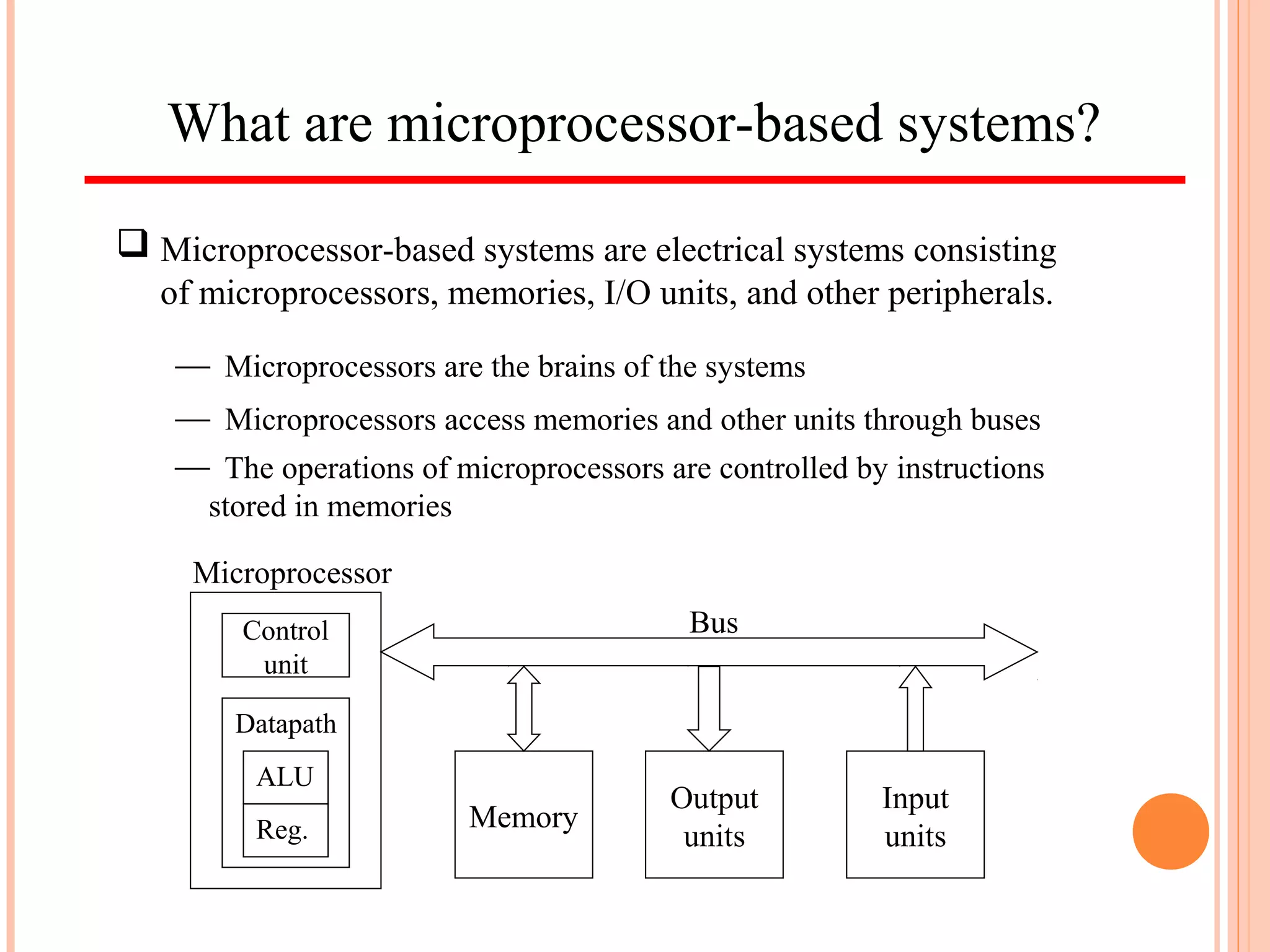
 Microprocessor-based systems are electrical systems consisting
of microprocessors, memories, I/O units, and other peripherals.
Memory
Output
units
Input
units
Bus
Microprocessor
Control
unit
Datapath
ALU
Reg.
 Microprocessors access memories and other units through buses
 The operations of microprocessors are controlled by instructions
stored in memories
 Microprocessors are the brains of the systems
What are microprocessors?
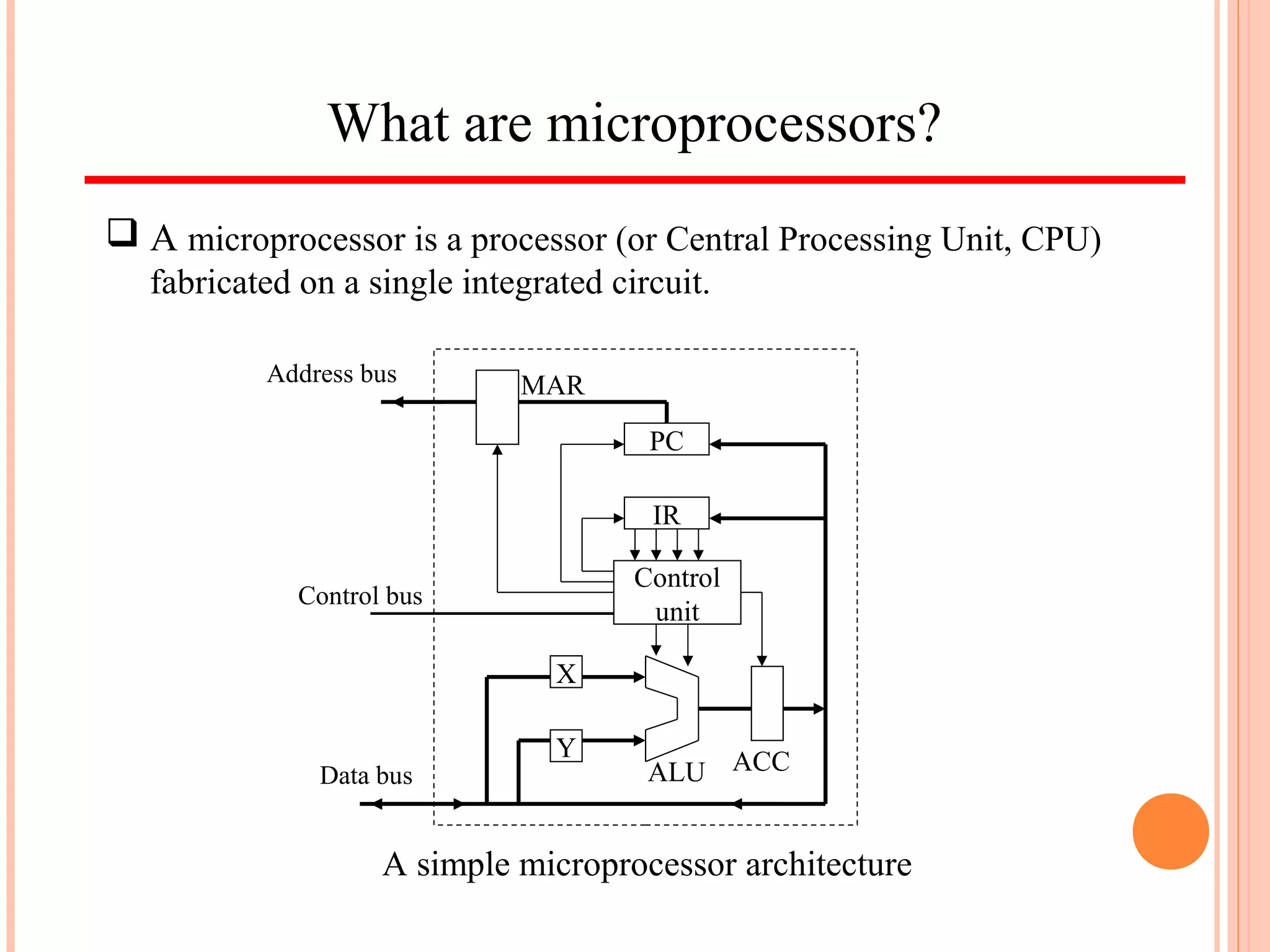
 A microprocessor is a processor (or Central Processing Unit, CPU)
fabricated on a single integrated circuit.
X
Y
Control
unit
IR
PC
ALU ACC
MAR
Data bus
Control bus
Address bus
A simple microprocessor architecture
Evolution of Computers
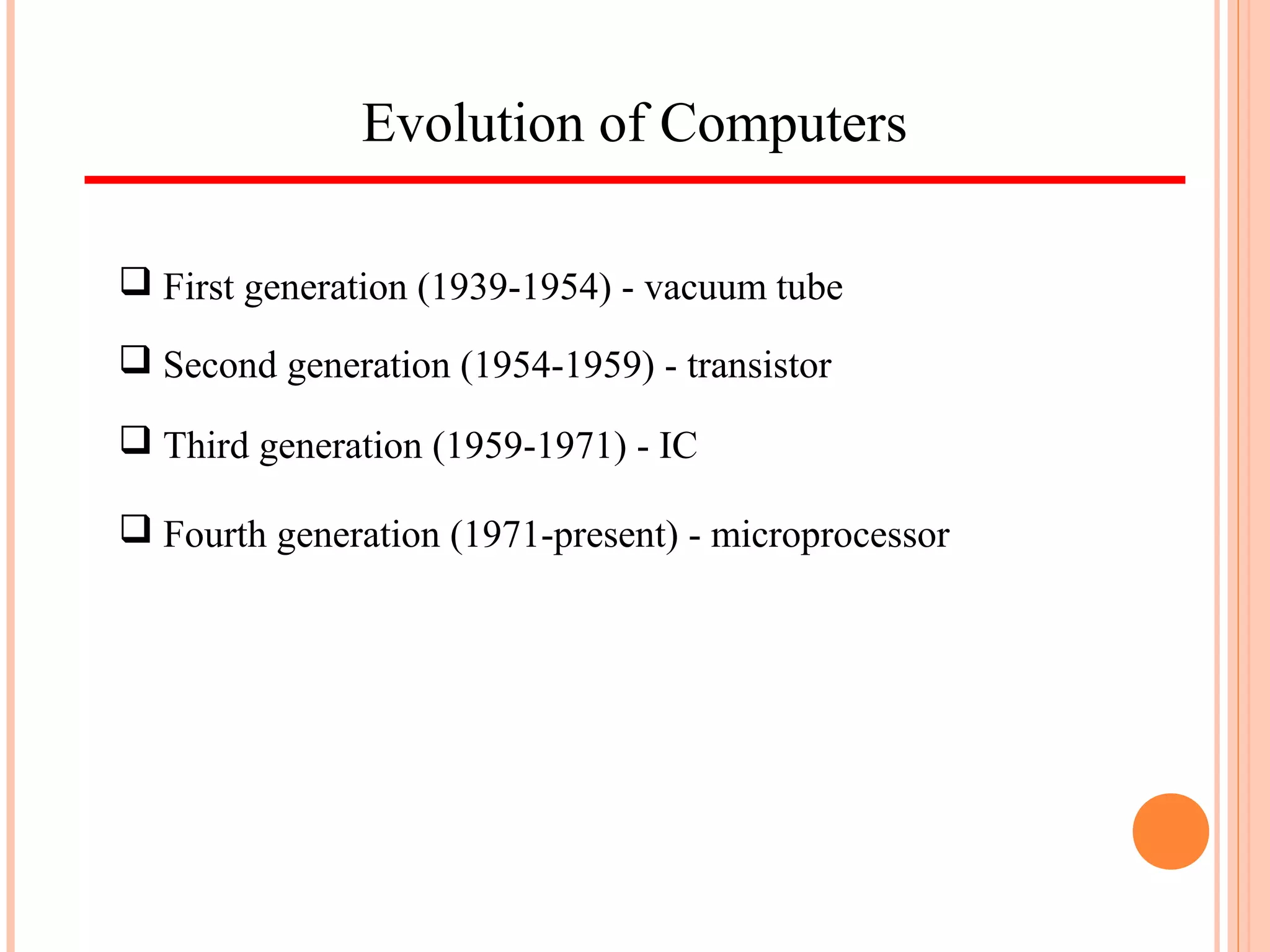
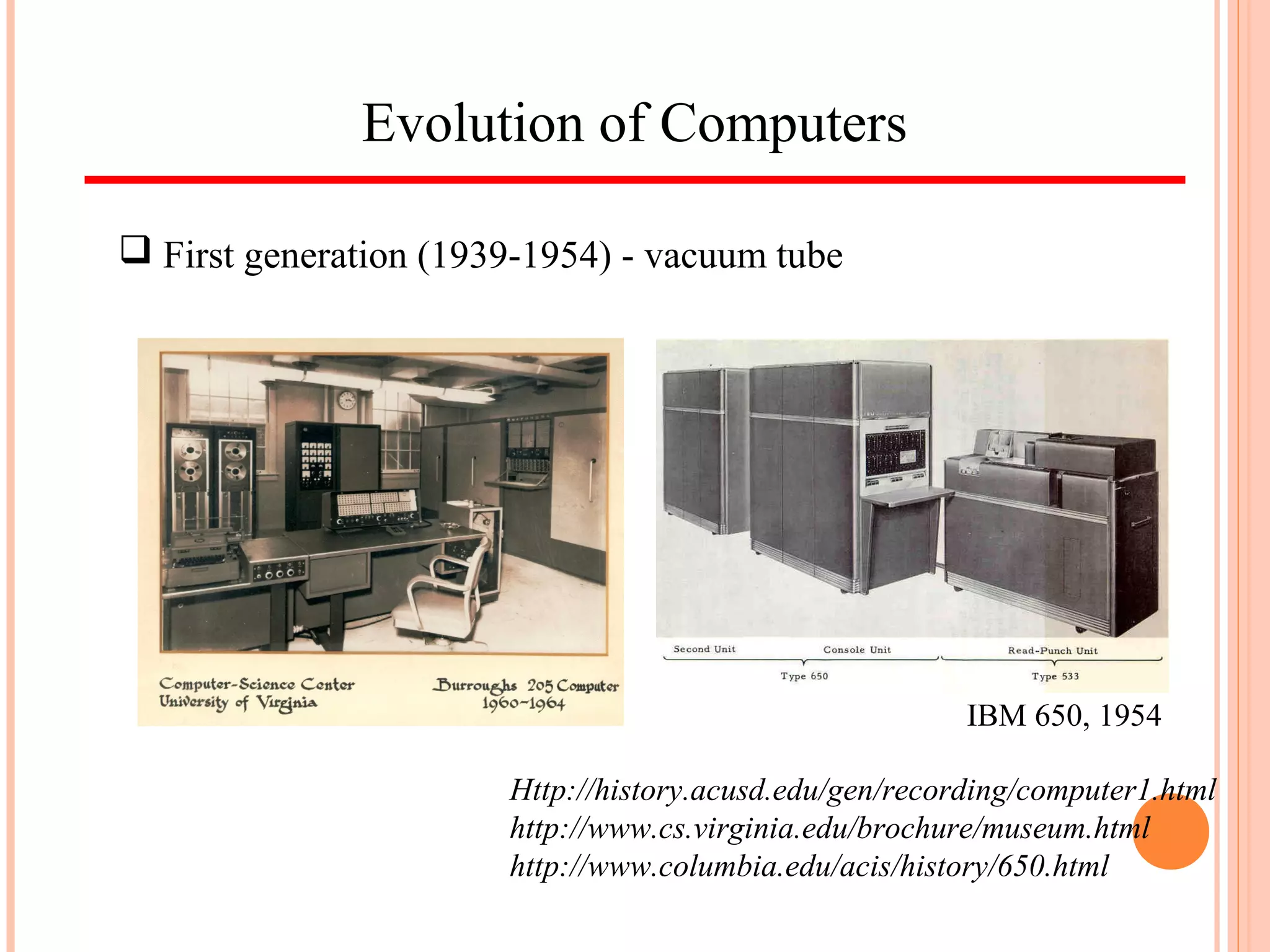
 First generation (1939-1954) - vacuum tube
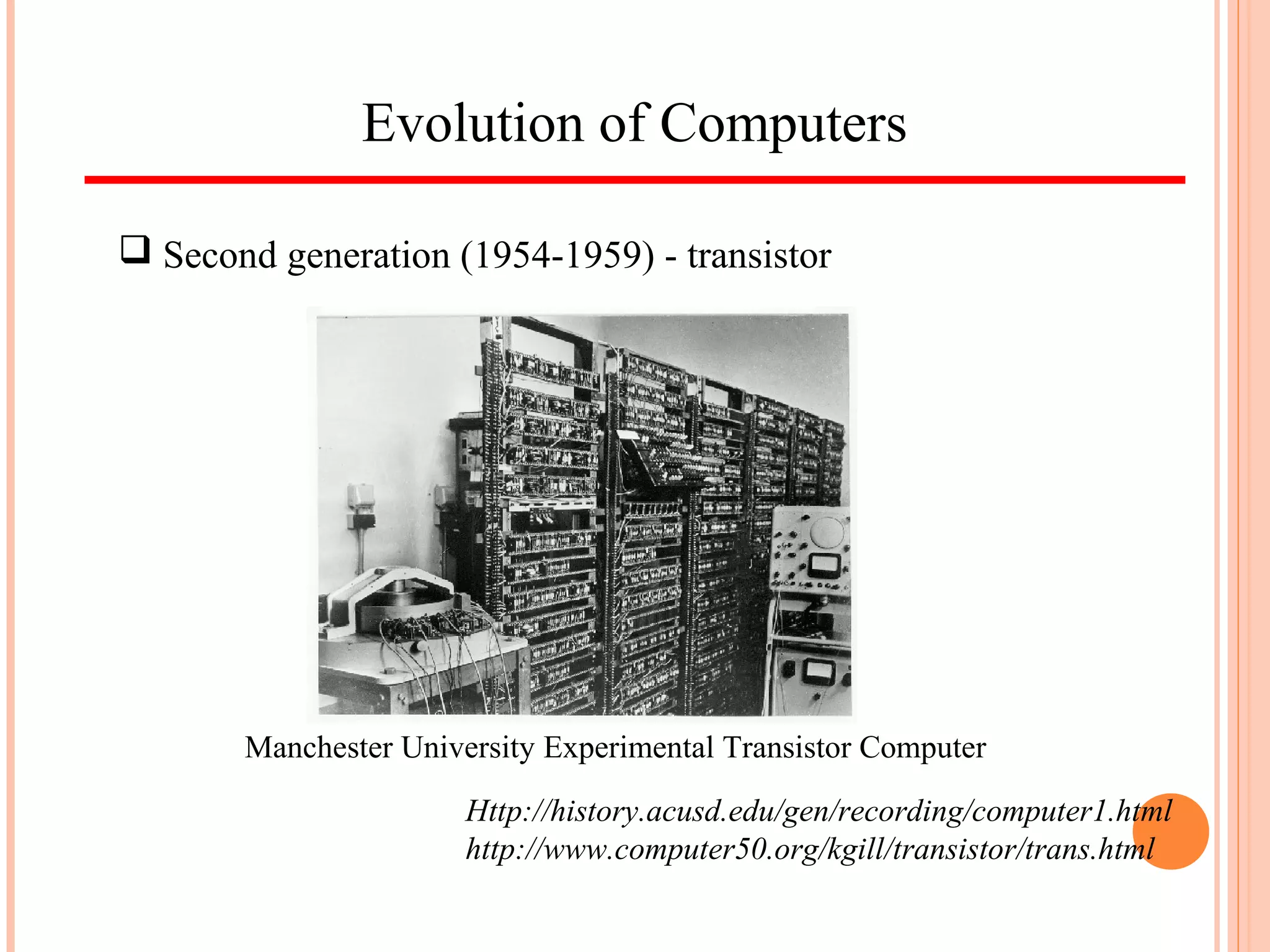
 Second generation (1954-1959) - transistor
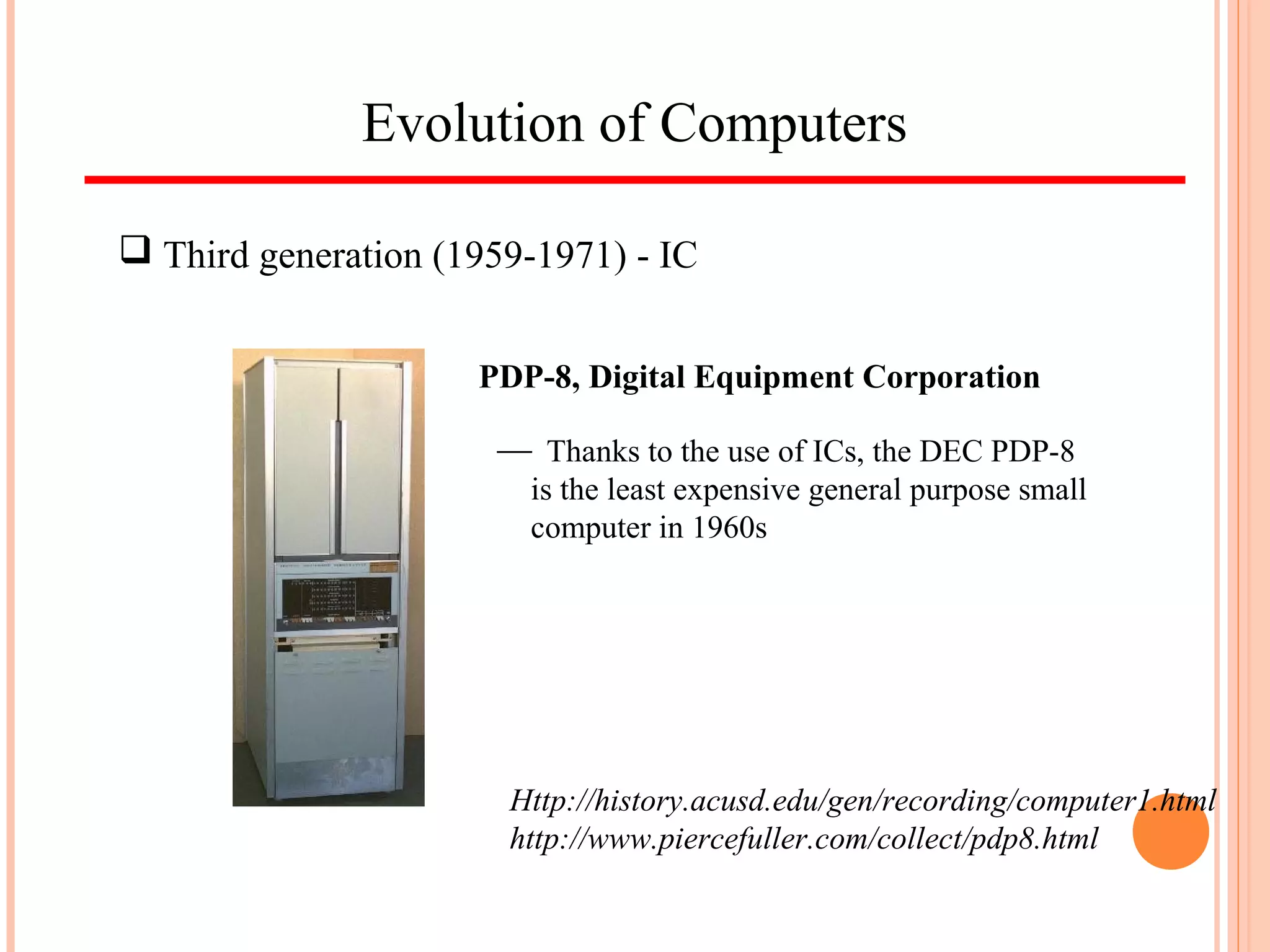
 Third generation (1959-1971) - IC
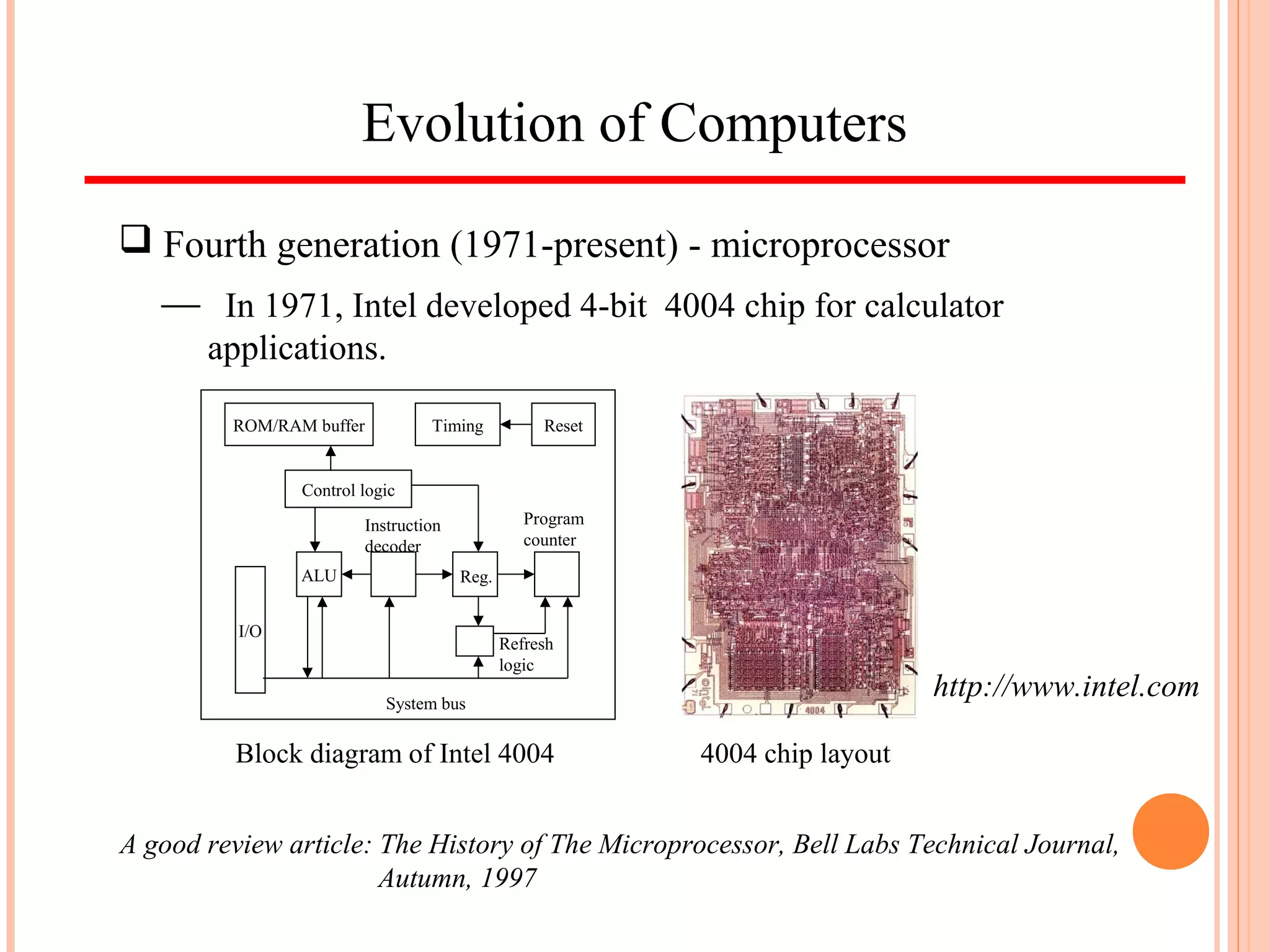
 Fourth generation (1971-present) - microprocessor
Evolution of Computers
Http://history.acusd.edu/gen/recording/computer1.html
http://www.cs.virginia.edu/brochure/museum.html
http://www.columbia.edu/acis/history/650.html
 First generation (1939-1954) - vacuum tube
IBM 650, 1954
Evolution of Computers
 Second generation (1954-1959) - transistor
Http://history.acusd.edu/gen/recording/computer1.html
http://www.computer50.org/kgill/transistor/trans.html
Manchester University Experimental Transistor Computer
Evolution of Computers
 Third generation (1959-1971) - IC
Http://history.acusd.edu/gen/recording/computer1.html
http://www.piercefuller.com/collect/pdp8.html
PDP-8, Digital Equipment Corporation
 Thanks to the use of ICs, the DEC PDP-8
is the least expensive general purpose small
computer in 1960s
Evolution of Computers
 Fourth generation (1971-present) - microprocessor
 In 1971, Intel developed 4-bit 4004 chip for calculator
applications.
ALU
Instruction
decoder
Reg.
Program
counter
I/O
Refresh
logic
System bus
Control logic
ROM/RAM buffer Timing Reset
http://www.intel.com
A good review article: The History of The Microprocessor, Bell Labs Technical Journal,
Autumn, 1997
Block diagram of Intel 4004 4004 chip layout
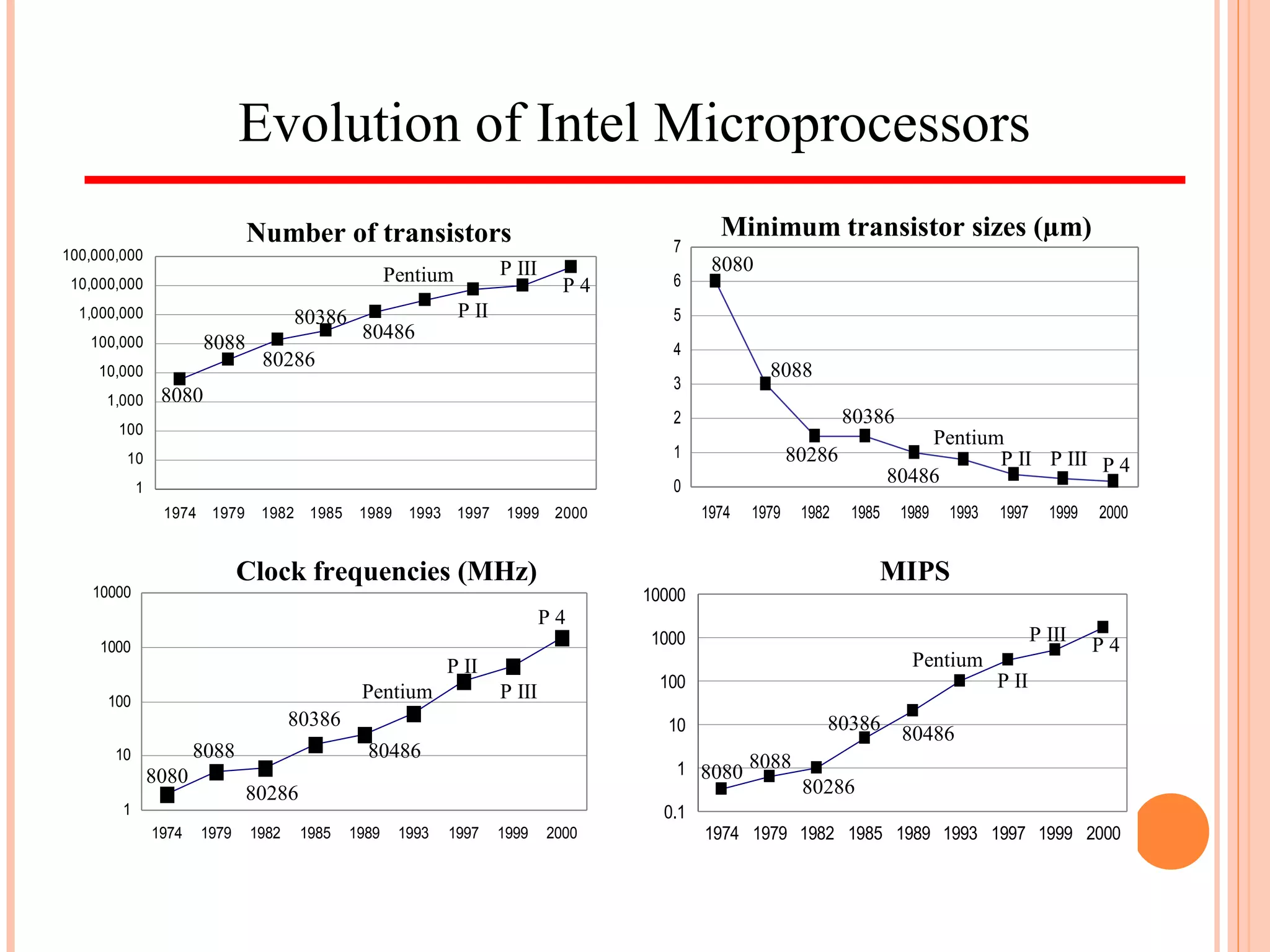
Evolution of Intel Microprocessors
1
10
100
1000
10000
1974 1979 1982 1985 1989 1993 1997 1999 2000
8080
8088
80286
80386
80486
Pentium
P II
P III
P 4
0
1
2
3
4
5
6
7
1974 1979 1982 1985 1989 1993 1997 1999 2000
8080
8088
80286
80386
80486
Pentium
P II P III P 4
1
10
100
1,000
10,000
100,000
1,000,000
10,000,000
100,000,000
1974 1979 1982 1985 1989 1993 1997 1999 2000
8080
8088
80286
80386
80486
Pentium
P II
P III
P 4
0.1
1
10
100
1000
10000
1974 1979 1982 1985 1989 1993 1997 1999 2000
8080
8088
80286
80386 80486
Pentium
P II
P III
P 4
Number of transistors Minimum transistor sizes (µm)
Clock frequencies (MHz) MIPS
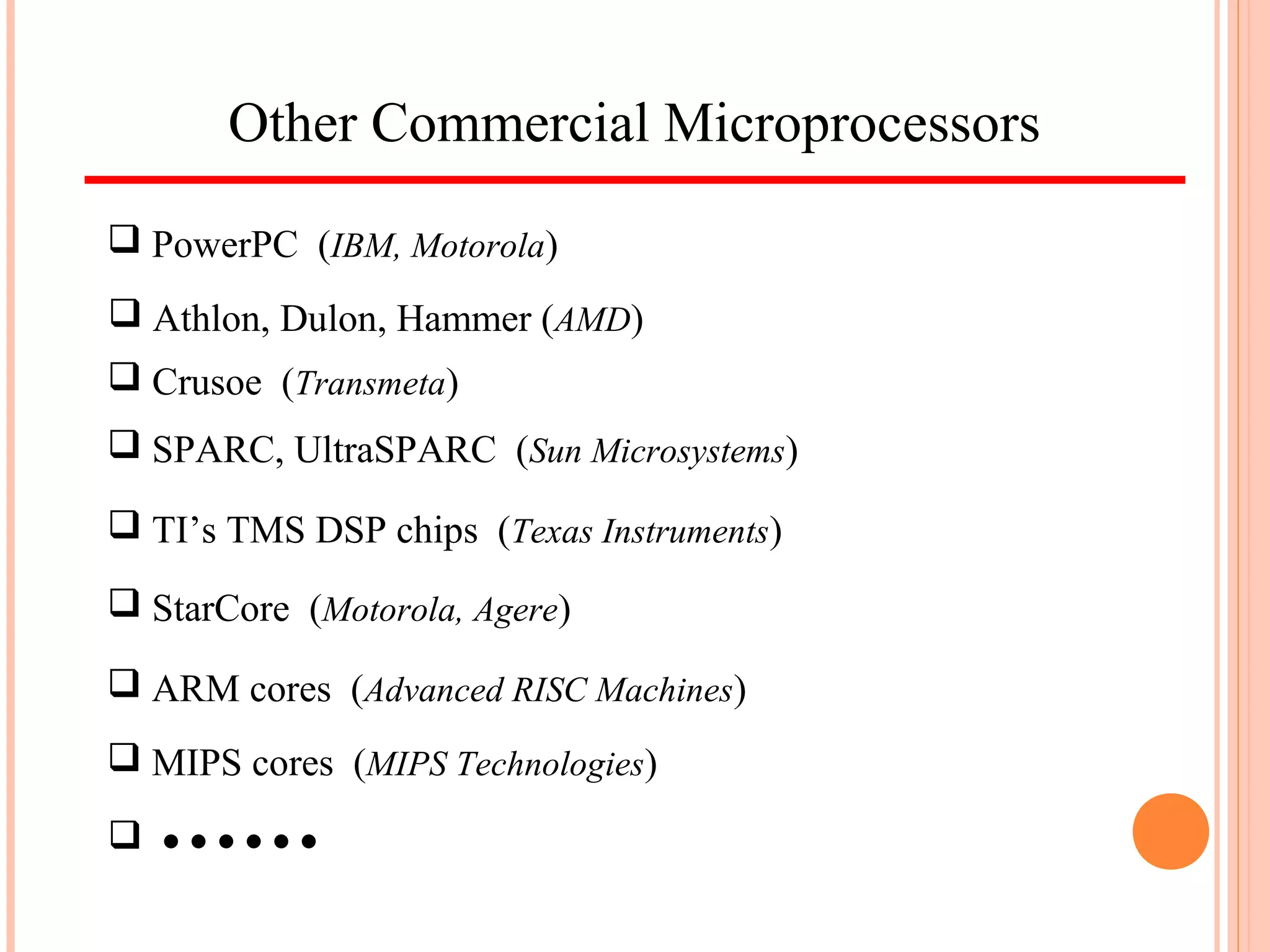
Other Commercial Microprocessors
 PowerPC (IBM, Motorola)
 Athlon, Dulon, Hammer (AMD)
 Crusoe (Transmeta)
 SPARC, UltraSPARC (Sun Microsystems)
 ARM cores (Advanced RISC Machines)
 MIPS cores (MIPS Technologies)
 TI’s TMS DSP chips (Texas Instruments)
 StarCore (Motorola, Agere)
 • • • • • •
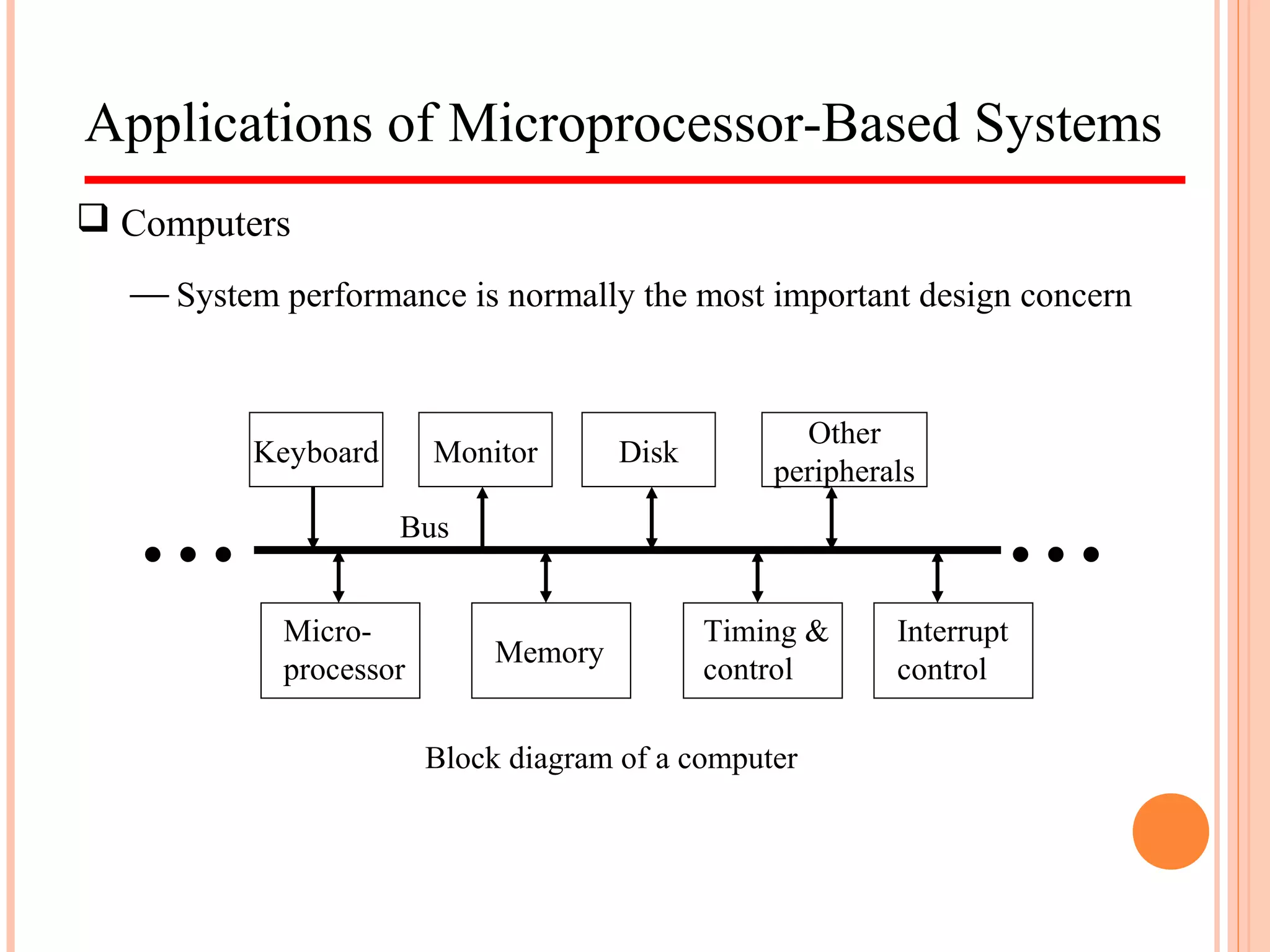
Applications of Microprocessor-Based Systems
 Computers
Block diagram of a computer
Memory
Timing &
control
Keyboard
Interrupt
control
... ...
Monitor
Micro-
processor
Disk
Other
peripherals
Bus
 System performance is normally the most important design concern
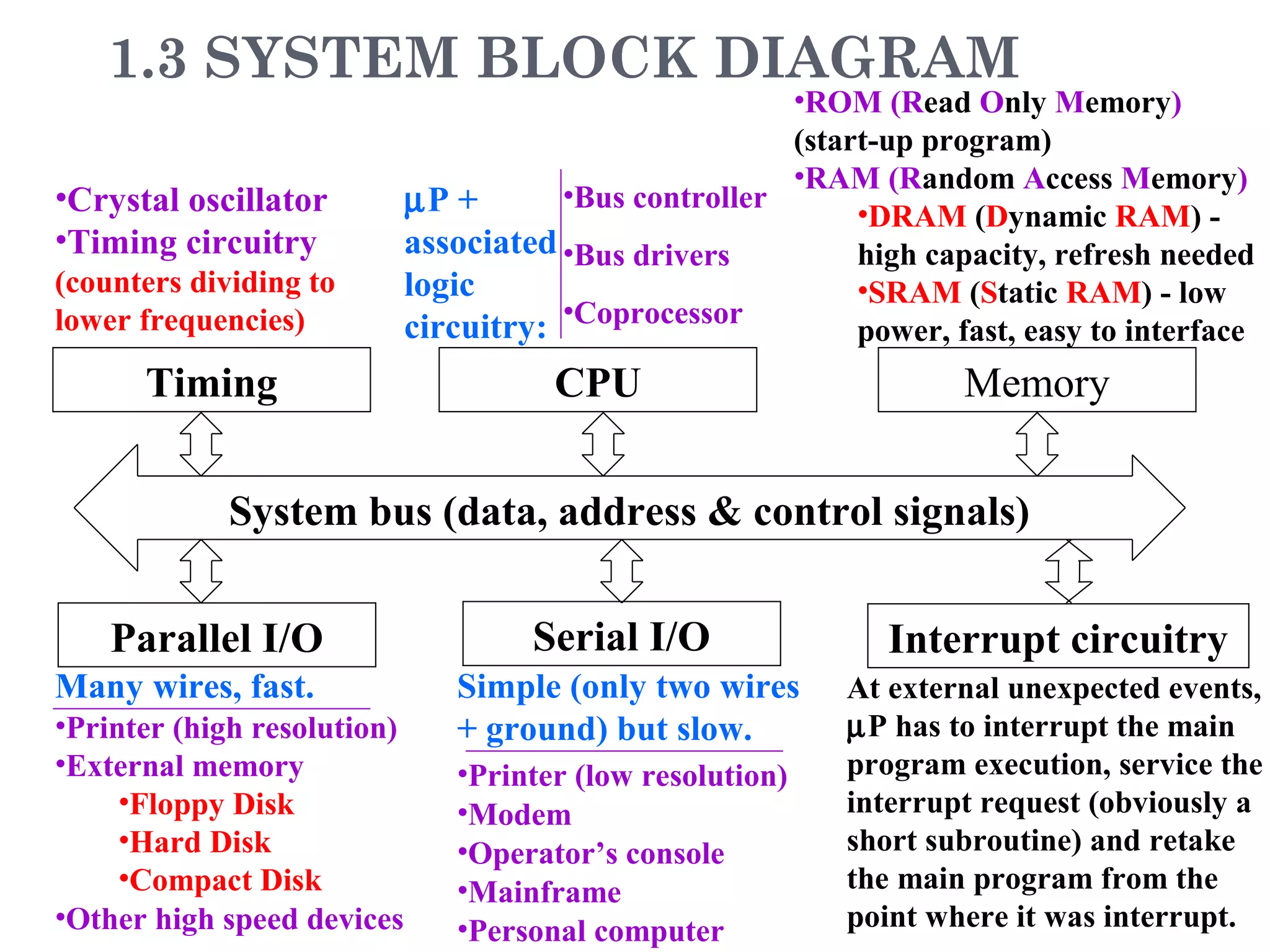
1.3 SYSTEM BLOCK DIAGRAM
System bus (data, address & control signals)
Memory
Interrupt circuitrySerial I/OParallel I/O
Timing CPU
µP +
associated
logic
circuitry:
•Bus controller
•Bus drivers
•Coprocessor
•ROM (Read Only Memory)
(start-up program)
•RAM (Random Access Memory)
•DRAM (Dynamic RAM) -
high capacity, refresh needed
•SRAM (Static RAM) - low
power, fast, easy to interface
•Crystal oscillator
•Timing circuitry
(counters dividing to
lower frequencies)
At external unexpected events,
µP has to interrupt the main
program execution, service the
interrupt request (obviously a
short subroutine) and retake
the main program from the
point where it was interrupt.
Simple (only two wires
+ ground) but slow.
•Printer (low resolution)
•Modem
•Operator’s console
•Mainframe
•Personal computer
Many wires, fast.
•Printer (high resolution)
•External memory
•Floppy Disk
•Hard Disk
•Compact Disk
•Other high speed devices
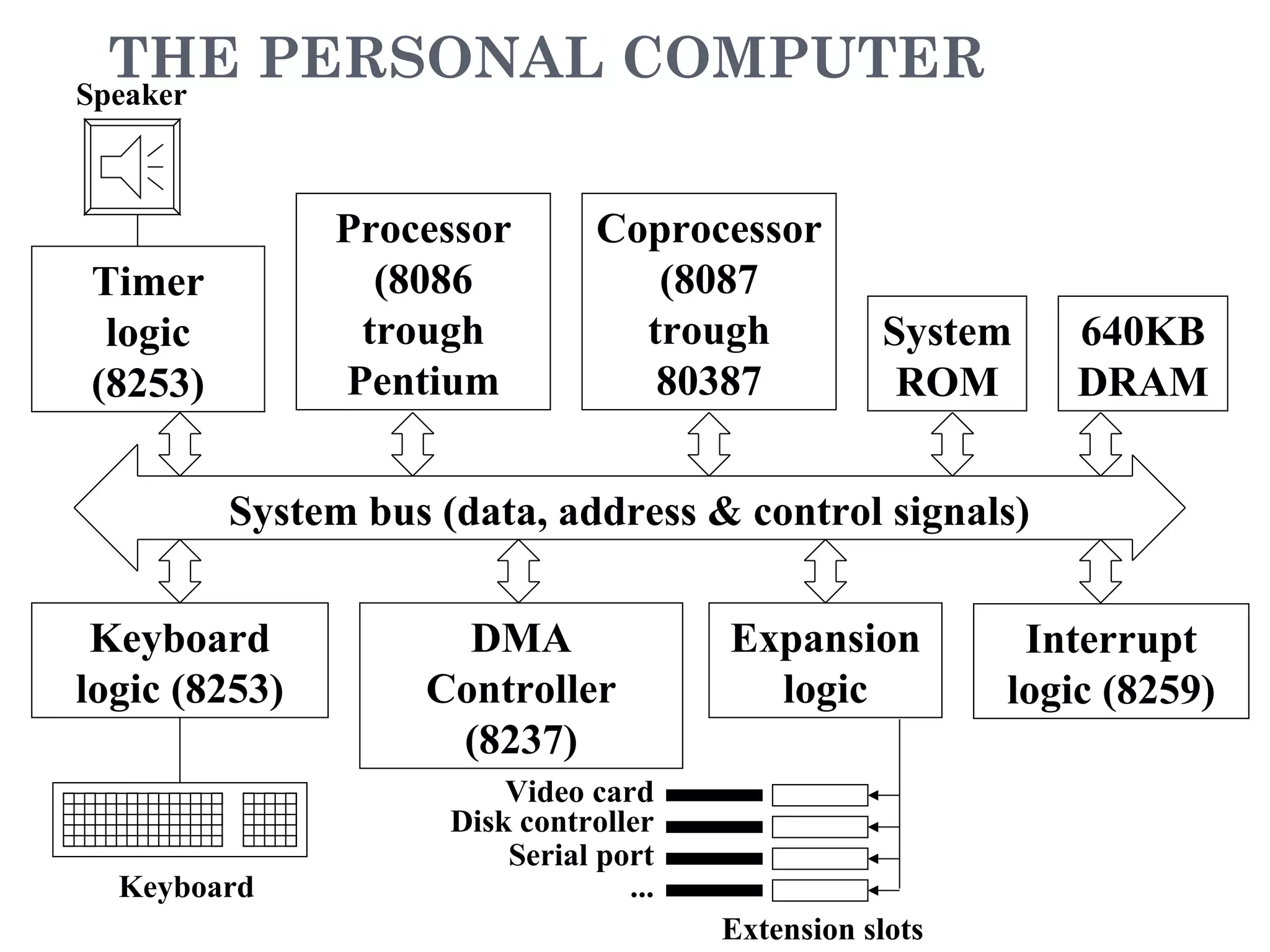
THE PERSONAL COMPUTER
Processor
(8086
trough
Pentium
System bus (data, address & control signals)
System
ROM
Interrupt
logic (8259)
Keyboard
logic (8253)
DMA
Controller
(8237)
Timer
logic
(8253)
Coprocessor
(8087
trough
80387
640KB
DRAM
Expansion
logic
Keyboard
Speaker
Extension slots
Video card
Disk controller
Serial port
...
CPU
RAM ROM
Timer
Interrupt
I/O port
USART
A/D, D/A
OSC.
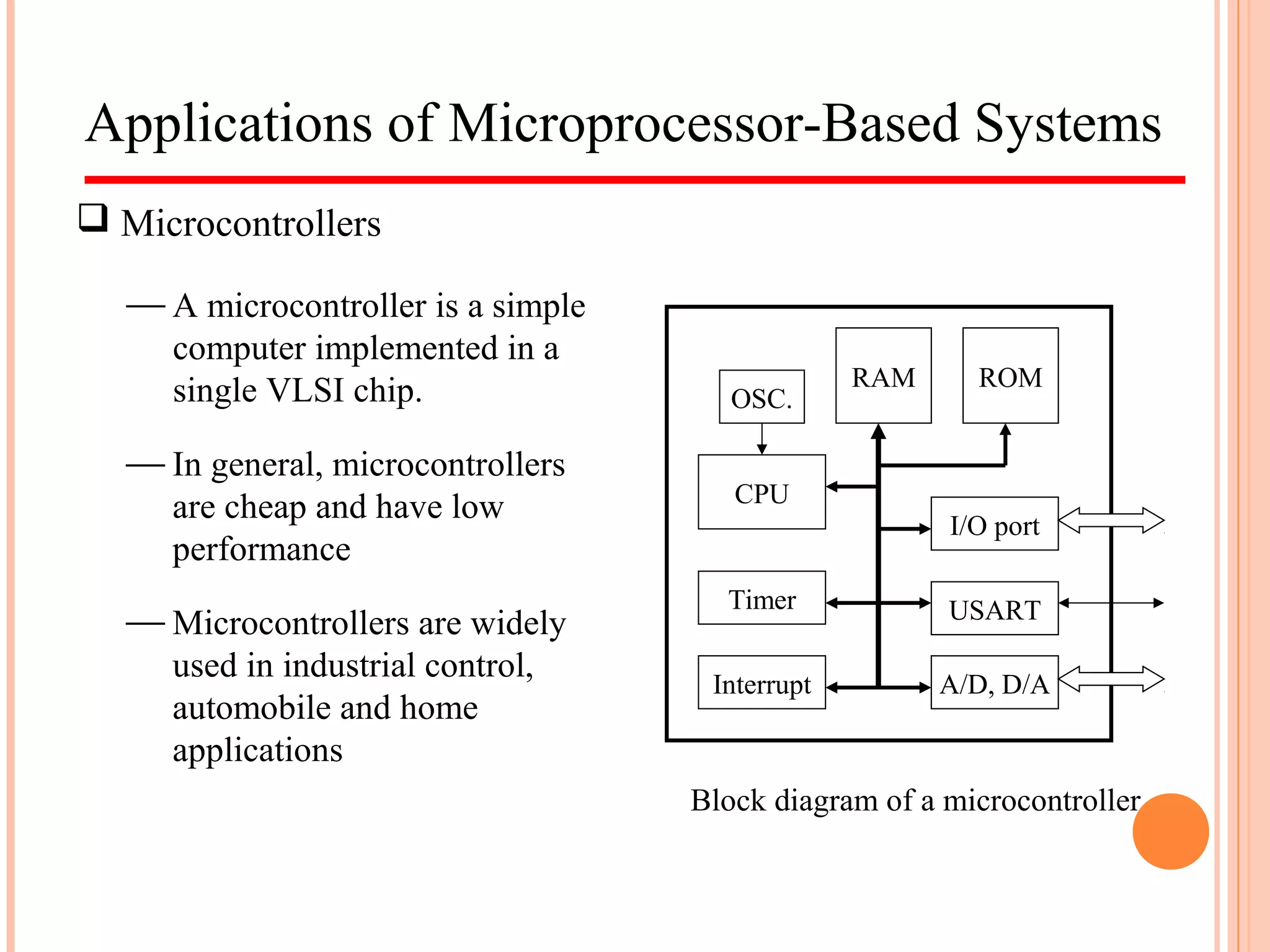
Applications of Microprocessor-Based Systems
 Microcontrollers
Block diagram of a microcontroller
 In general, microcontrollers
are cheap and have low
performance
 A microcontroller is a simple
computer implemented in a
single VLSI chip.
 Microcontrollers are widely
used in industrial control,
automobile and home
applications
http://www.ti.com
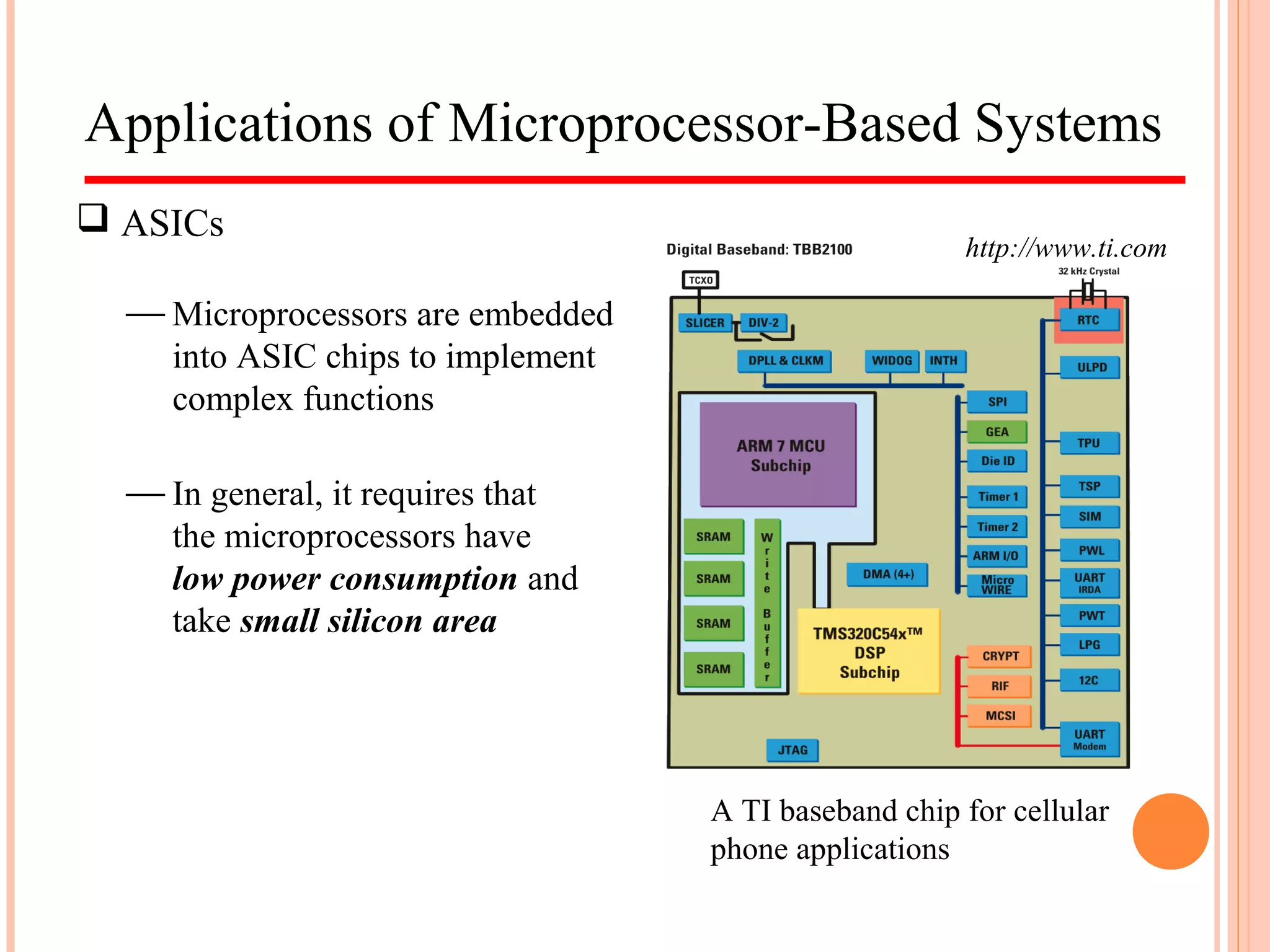
Applications of Microprocessor-Based Systems
 ASICs
 Microprocessors are embedded
into ASIC chips to implement
complex functions
 In general, it requires that
the microprocessors have
low power consumption and
take small silicon area
A TI baseband chip for cellular
phone applications
Overview
Overview
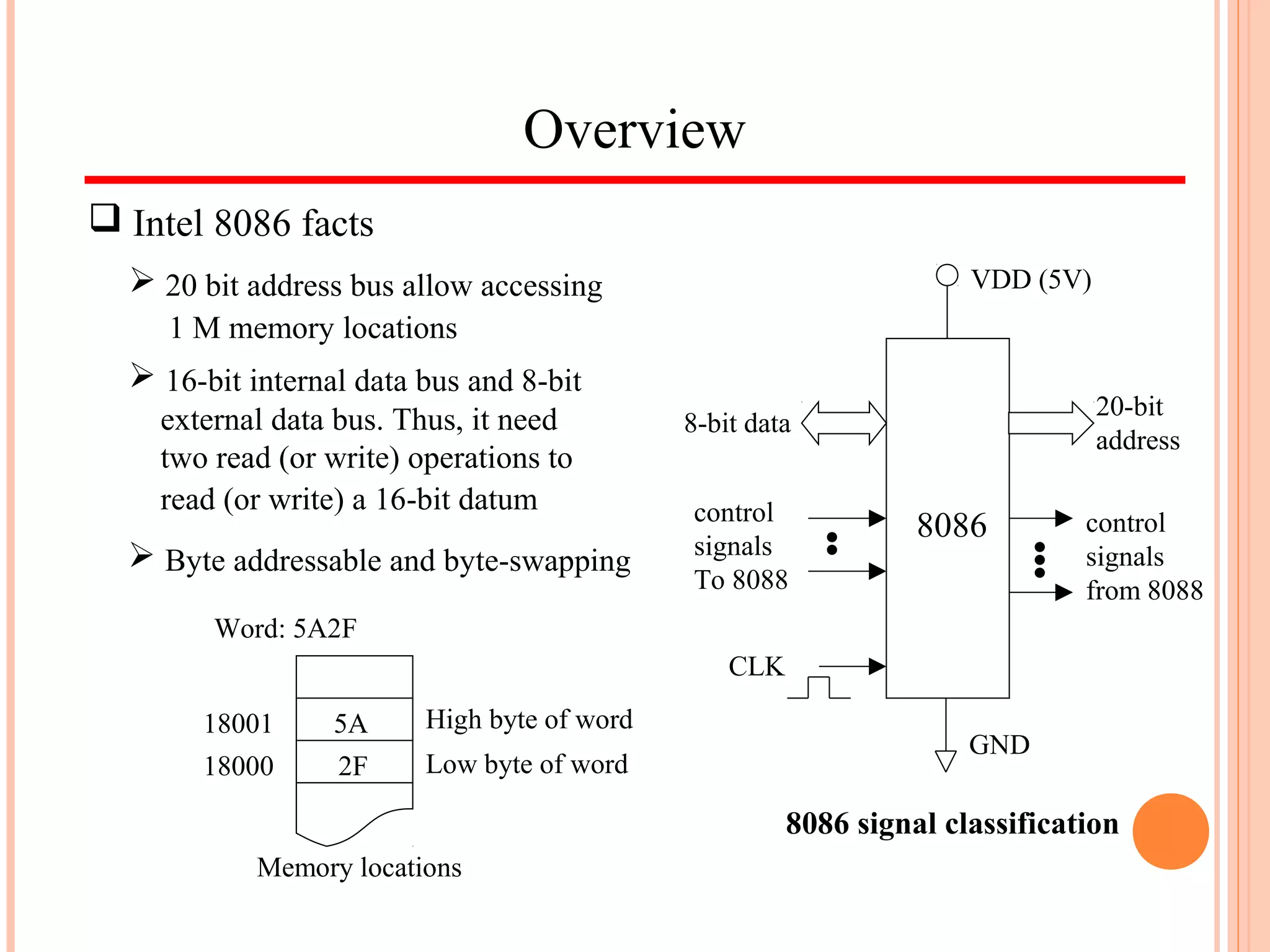
 Intel 8086 facts
8086
VDD (5V)
GND
CLK
20-bit
address
8-bit data
••
•••
control
signals
To 8088
control
signals
from 8088
8086 signal classification
 20 bit address bus allow accessing
1 M memory locations
 16-bit internal data bus and 8-bit
external data bus. Thus, it need
two read (or write) operations to
read (or write) a 16-bit datum
 Byte addressable and byte-swapping
Memory locations
5A
2F18000
18001
Low byte of word
High byte of word
Word: 5A2F
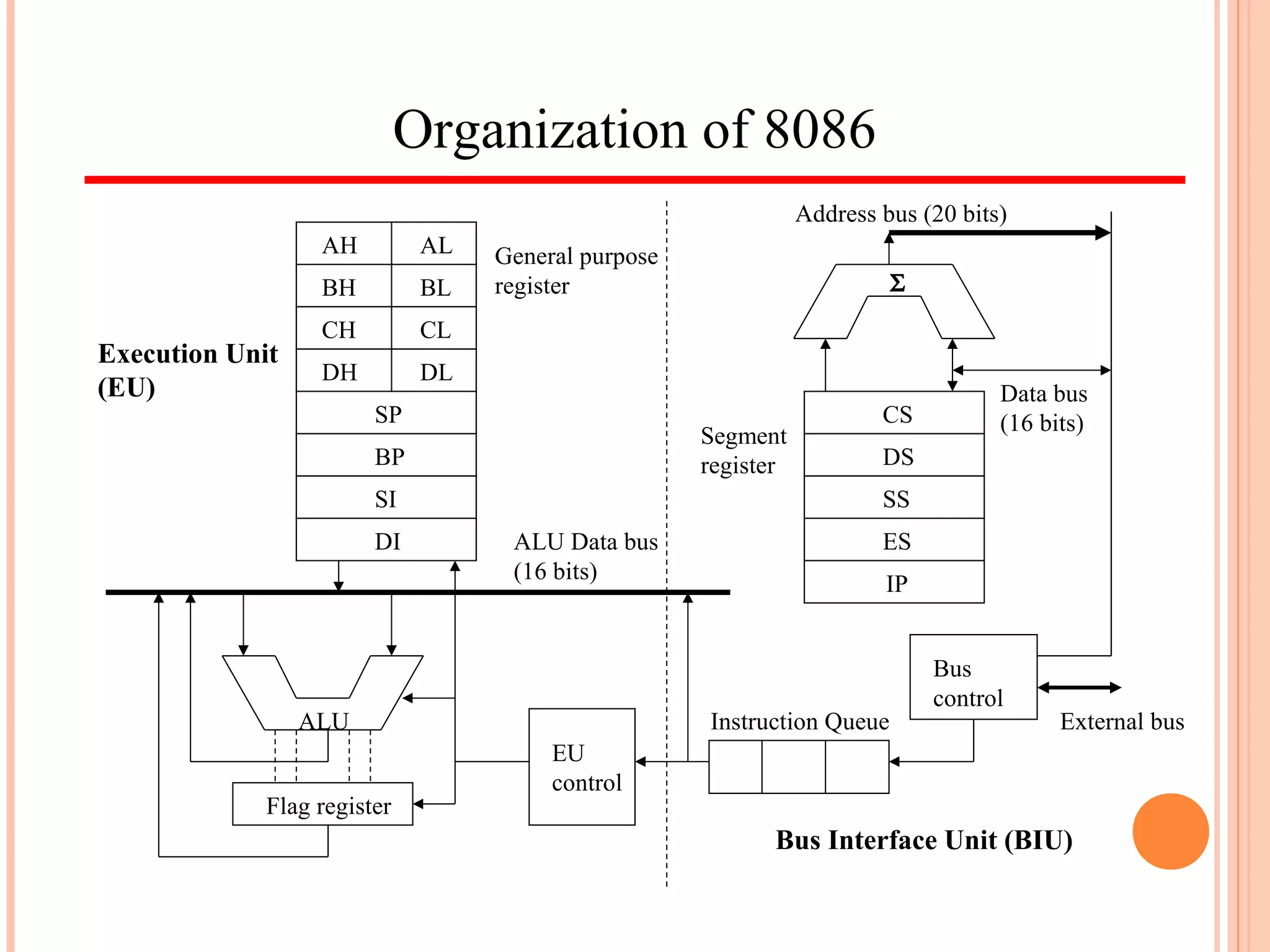
Organization of 8086
AH AL
BH BL
CH CL
DH DL
SP
BP
SI
DI
ALU
Flag register
Execution Unit
(EU)
EU
control
Σ
CS
DS
SS
ESALU Data bus
(16 bits)
Address bus (20 bits)
Instruction Queue
Bus
control
External bus
IP
Data bus
(16 bits)
Bus Interface Unit (BIU)
General purpose
register
Segment
register
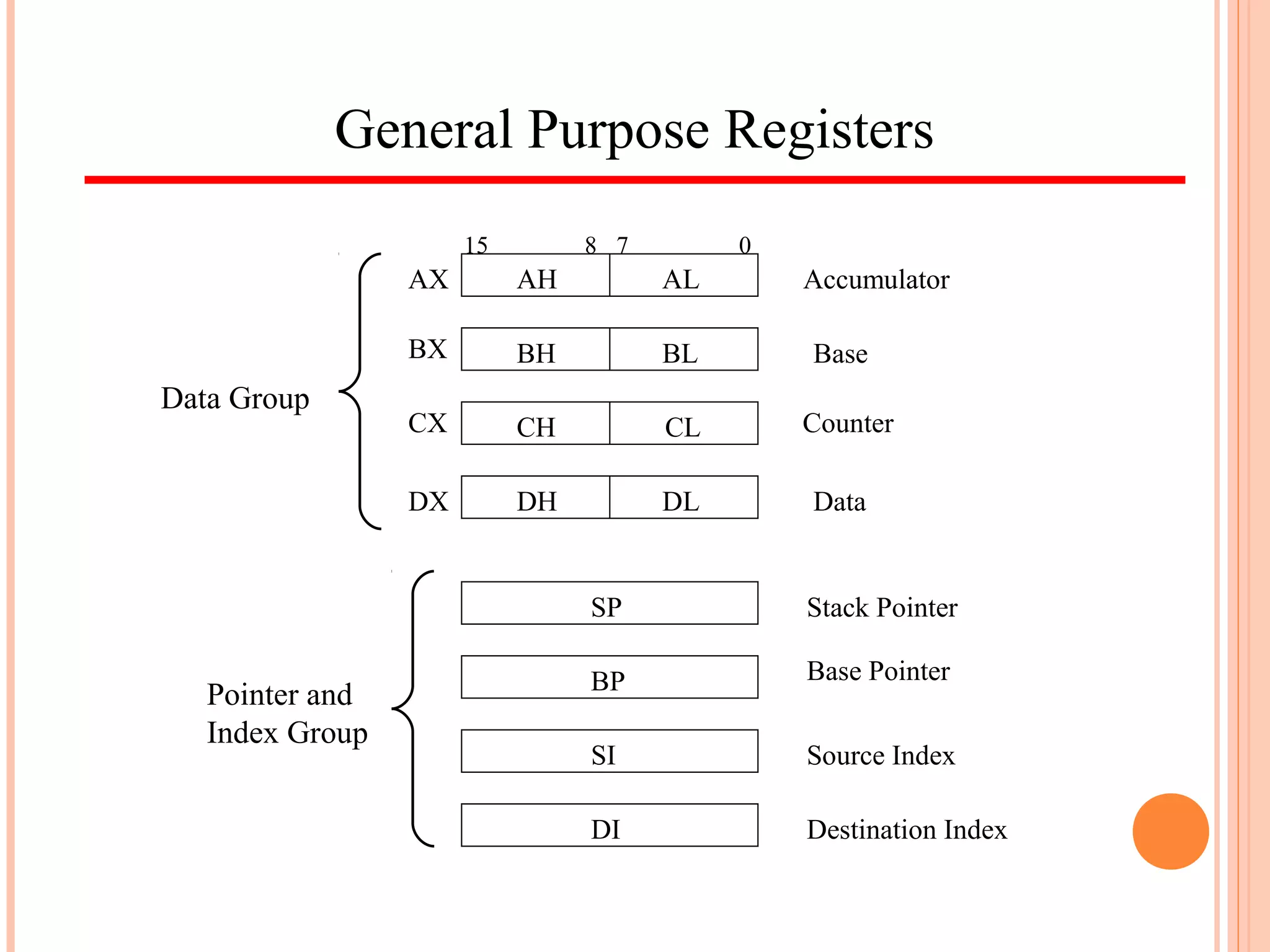
General Purpose Registers
15 8 7 0
AX
BX
CX
DX
AH AL
BH BL
CH CL
DH DL
Accumulator
Base
Counter
Data
SP
BP
SI
DI
Data Group
Pointer and
Index Group
Stack Pointer
Base Pointer
Source Index
Destination Index
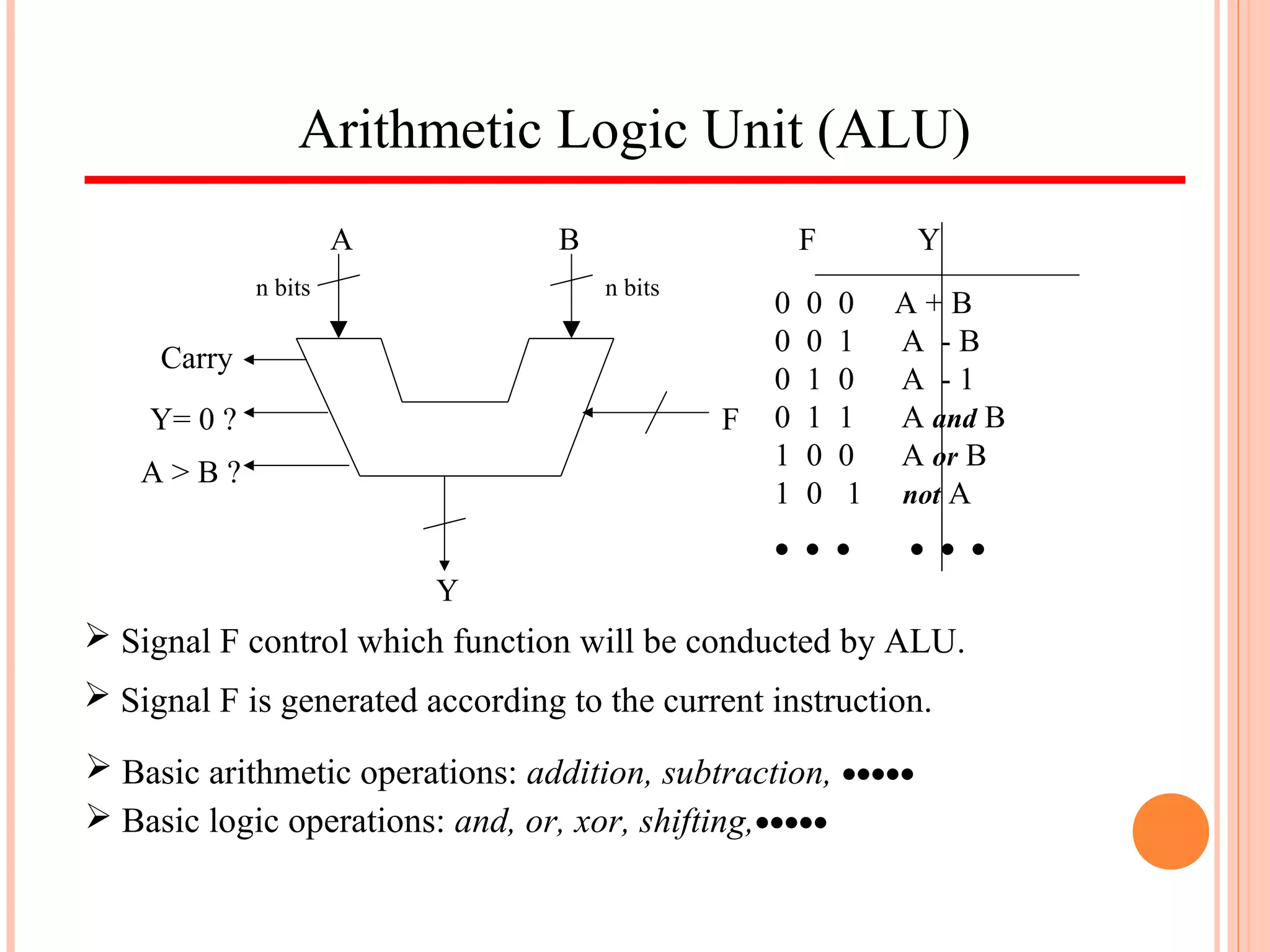
Arithmetic Logic Unit (ALU)
n bits n bits
A B
Y
F
Carry
Y= 0 ?
A > B ?
F Y
0 0 0 A + B
0 0 1 A - B
0 1 0 A - 1
0 1 1 A and B
1 0 0 A or B
1 0 1 not A
• • • • • •
 Signal F control which function will be conducted by ALU.
 Signal F is generated according to the current instruction.
 Basic arithmetic operations: addition, subtraction, •••••
 Basic logic operations: and, or, xor, shifting,•••••
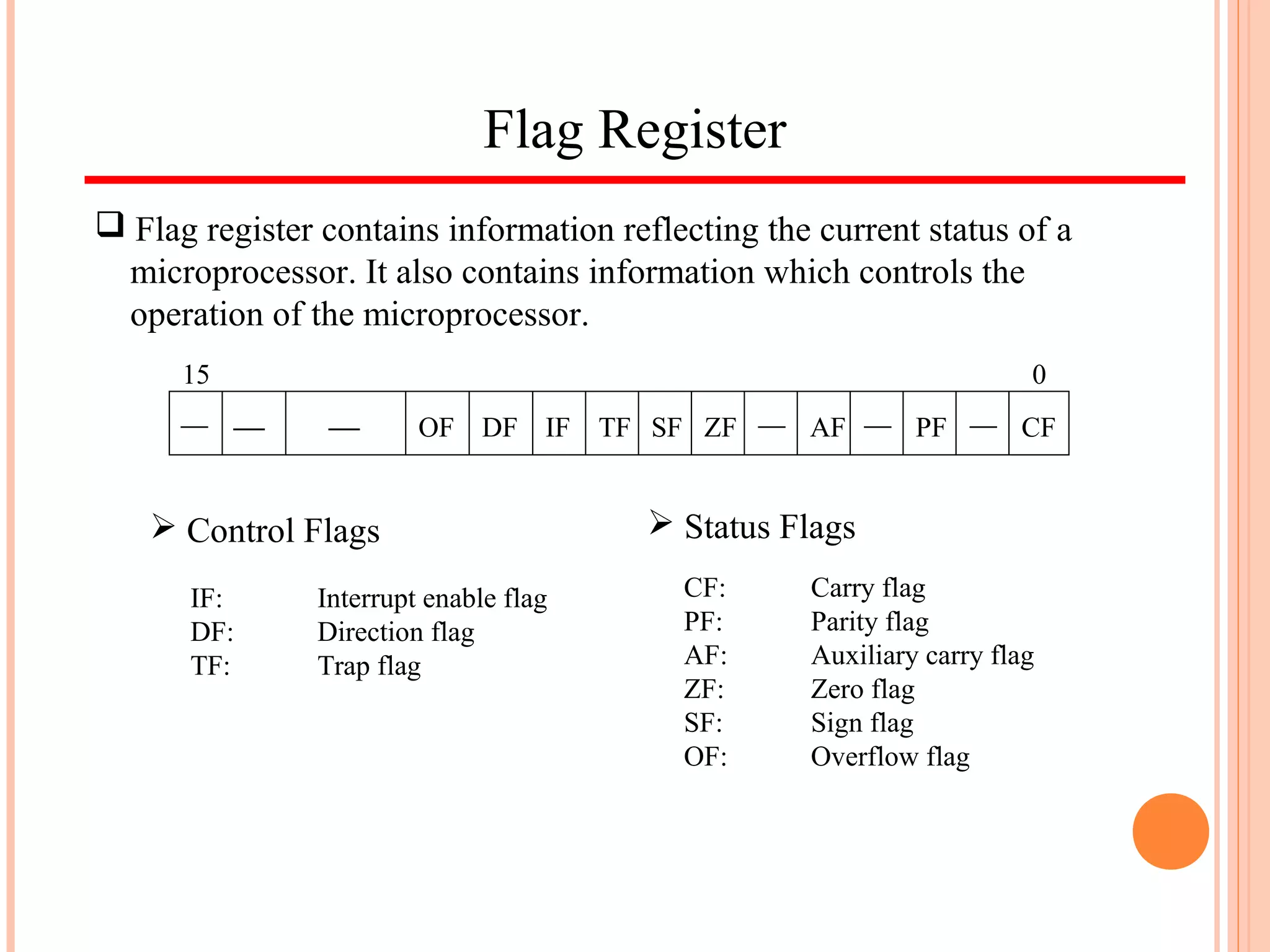
Flag Register
 OF DF IF TF ZFSF  AF PF CF 
015
 Control Flags  Status Flags
IF: Interrupt enable flag
DF: Direction flag
TF: Trap flag
CF: Carry flag
PF: Parity flag
AF: Auxiliary carry flag
ZF: Zero flag
SF: Sign flag
OF: Overflow flag
 Flag register contains information reflecting the current status of a
microprocessor. It also contains information which controls the
operation of the microprocessor.
 
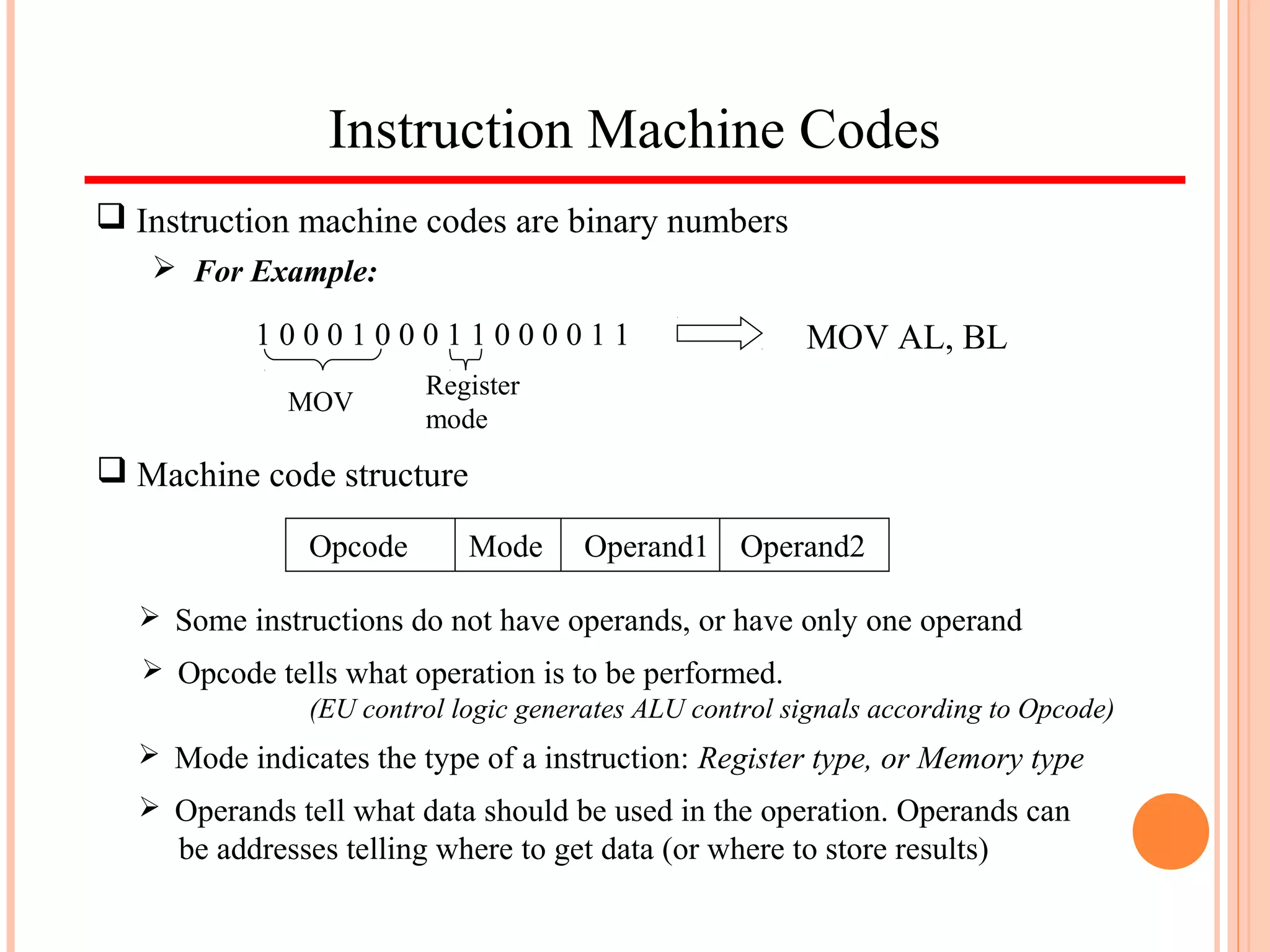
Instruction Machine Codes
 Instruction machine codes are binary numbers
 For Example:
1 0 0 0 1 0 0 0 1 1 0 0 0 0 1 1 MOV AL, BL
MOV
 Machine code structure
Opcode Operand1
 Opcode tells what operation is to be performed.
(EU control logic generates ALU control signals according to Opcode)
 Some instructions do not have operands, or have only one operand
 Operands tell what data should be used in the operation. Operands can
be addresses telling where to get data (or where to store results)
Register
mode
Mode Operand2
 Mode indicates the type of a instruction: Register type, or Memory type
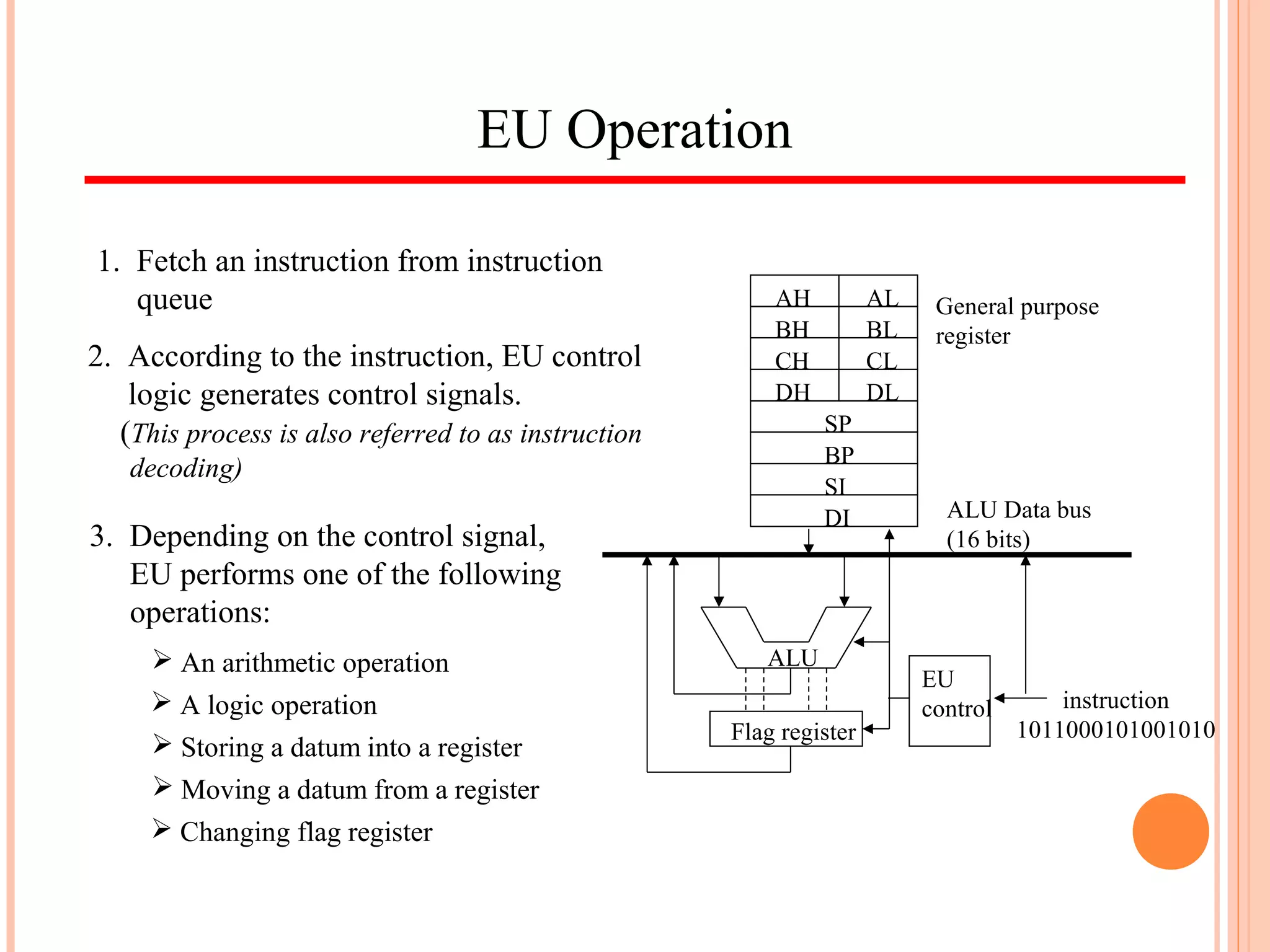
EU Operation
ALU Data bus
(16 bits)
AH AL
BH BL
CH CL
DH DL
SP
BP
SI
DI
General purpose
register
ALU
Flag register
EU
control instruction
1011000101001010
1. Fetch an instruction from instruction
queue
2. According to the instruction, EU control
logic generates control signals.
(This process is also referred to as instruction
decoding)
3. Depending on the control signal,
EU performs one of the following
operations:
 An arithmetic operation
 A logic operation
 Storing a datum into a register
 Moving a datum from a register
 Changing flag register
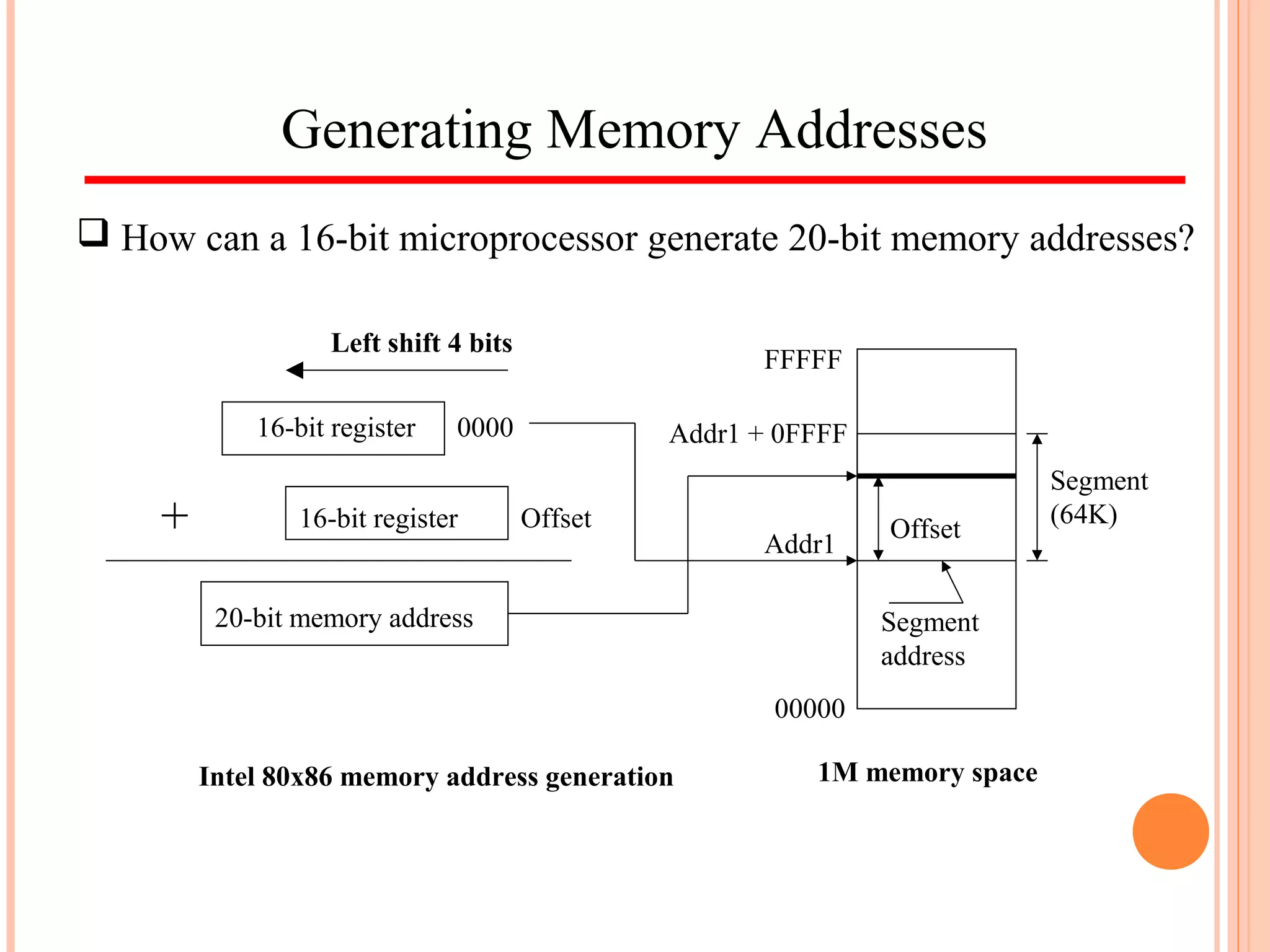
Generating Memory Addresses
 How can a 16-bit microprocessor generate 20-bit memory addresses?
Segment
(64K)
0000
+
16-bit register
16-bit register
20-bit memory address
00000
FFFFF
Left shift 4 bits
Intel 80x86 memory address generation 1M memory space
Offset
Segment
address
Offset
Addr1
Addr1 + 0FFFF
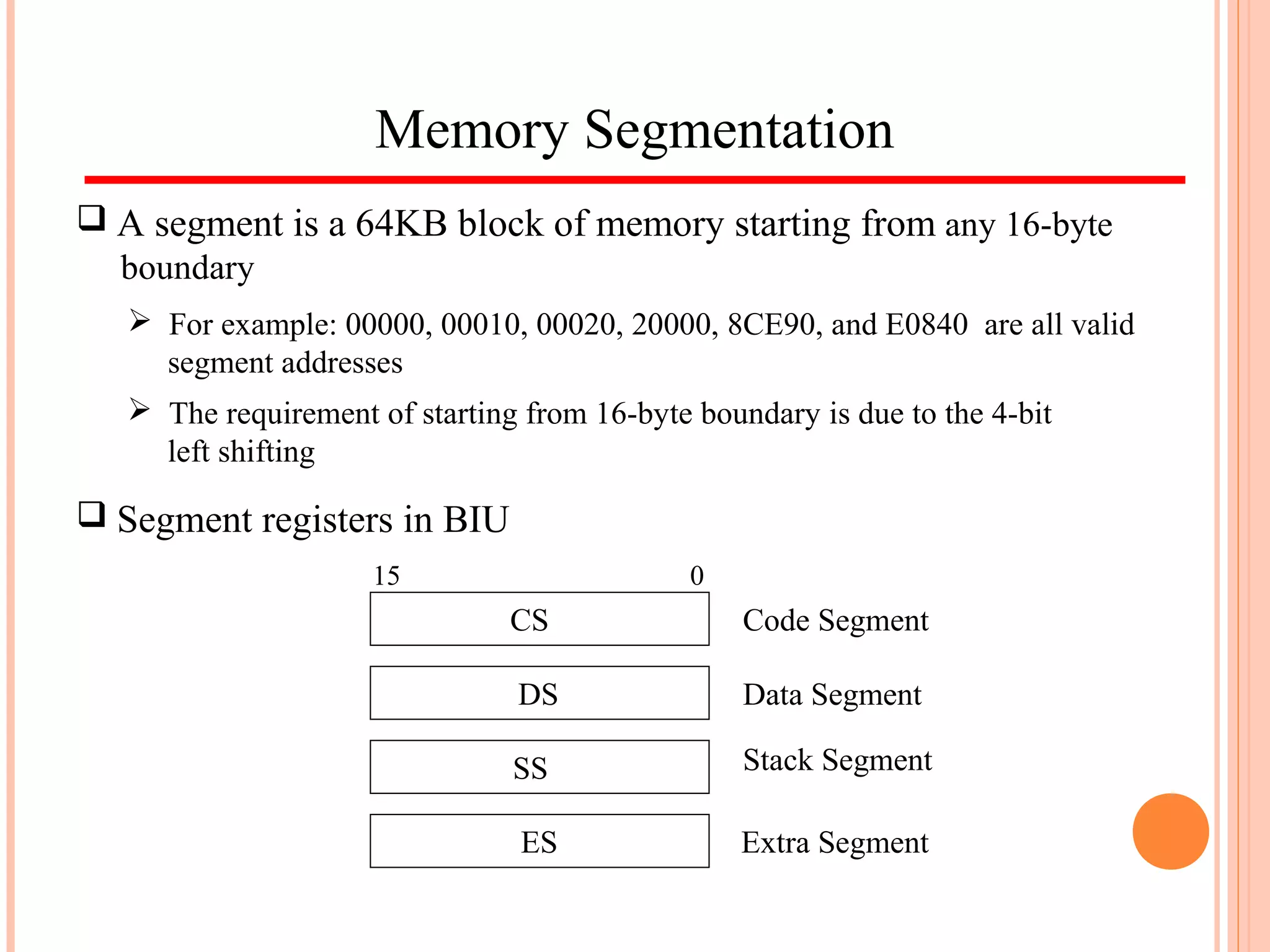
Memory Segmentation
 A segment is a 64KB block of memory starting from any 16-byte
boundary
 For example: 00000, 00010, 00020, 20000, 8CE90, and E0840 are all valid
segment addresses
 The requirement of starting from 16-byte boundary is due to the 4-bit
left shifting
 Segment registers in BIU
CS
SS
DS
ES
Code Segment
Data Segment
Stack Segment
Extra Segment
015
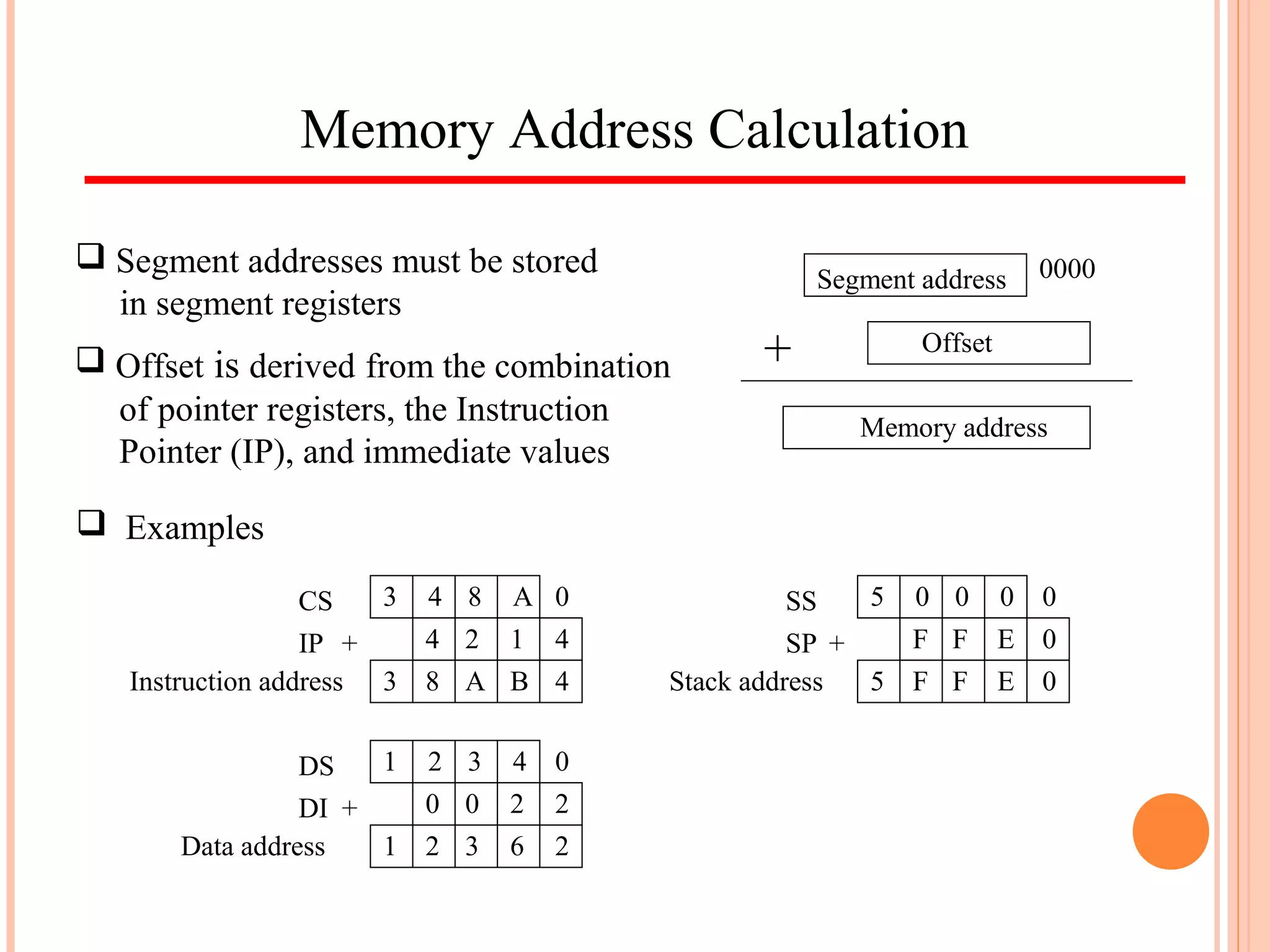
Memory Address Calculation
 Segment addresses must be stored
in segment registers
 Offset is derived from the combination
of pointer registers, the Instruction
Pointer (IP), and immediate values
0000
+
Segment address
Offset
Memory address
 Examples
3 4 8 A 0
4 2 1 4
8 A B 43
CS
IP +
Instruction address
5 0 0 0 0
F F E 0
F F E 05
SS
SP +
Stack address
1 2 3 4 0
0 0 2 2
2 3 6 21
DS
DI +
Data address
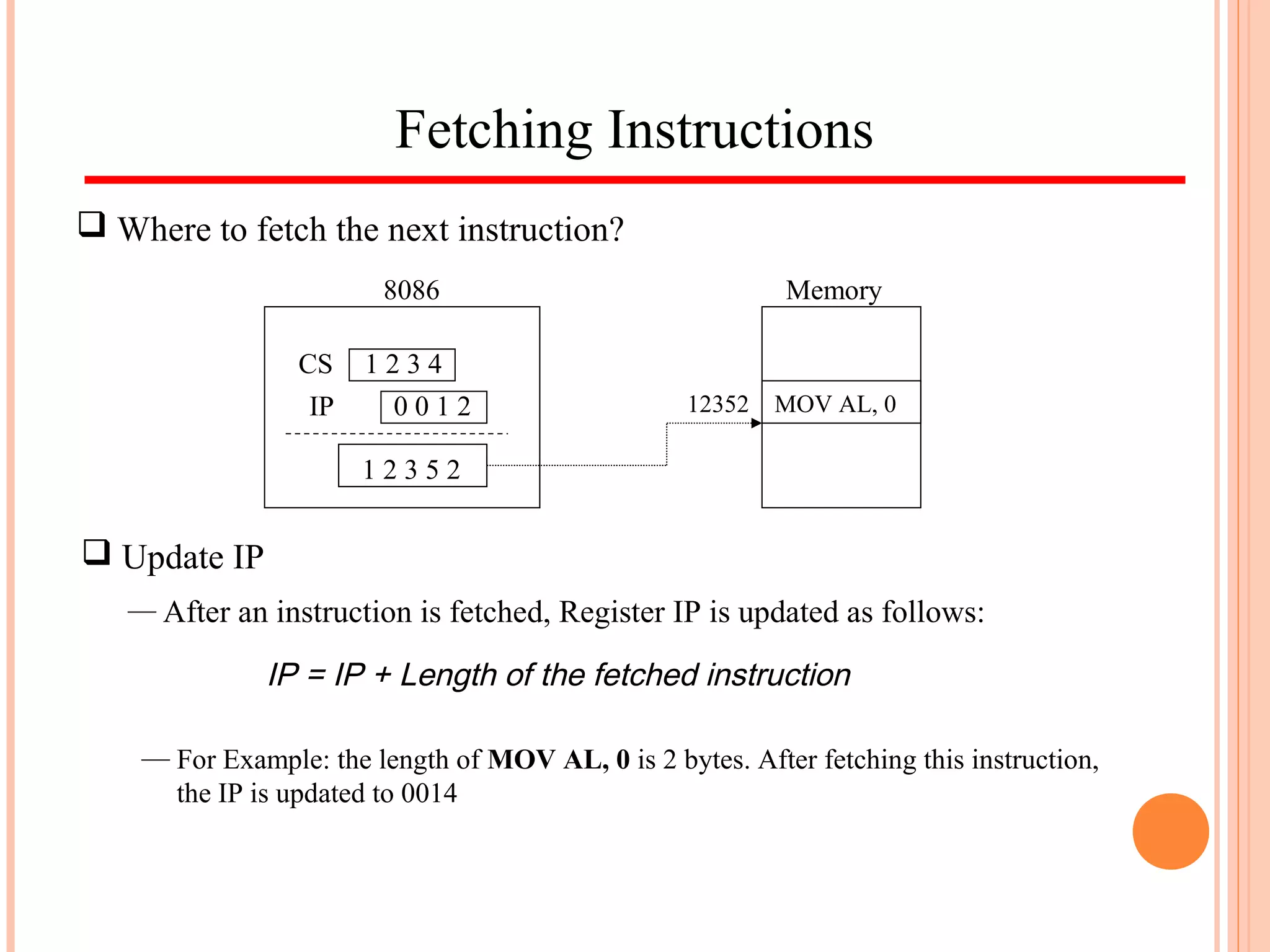
Fetching Instructions
 Where to fetch the next instruction?
CS
IP
1 2 3 4
0 0 1 2
1 2 3 5 2
12352 MOV AL, 0
8086 Memory
 Update IP
— After an instruction is fetched, Register IP is updated as follows:
IP = IP + Length of the fetched instruction
— For Example: the length of MOV AL, 0 is 2 bytes. After fetching this instruction,
the IP is updated to 0014
Accessing Data Memory
 There is a number of methods to generate the memory address when
accessing data memory. These methods are referred to as
Addressing Modes
 Examples:
— Direct addressing: MOV AL, [0300H]
1 2 3 4 0
0 3 0 0
2 6 4 01
DS
Memory address
(assume DS=1234H)
— Register indirect addressing: MOV AL, [SI]
1 2 3 4 0
0 3 1 0
2 6 5 01
DS
Memory address
(assume DS=1234H)
(assume SI=0310H)
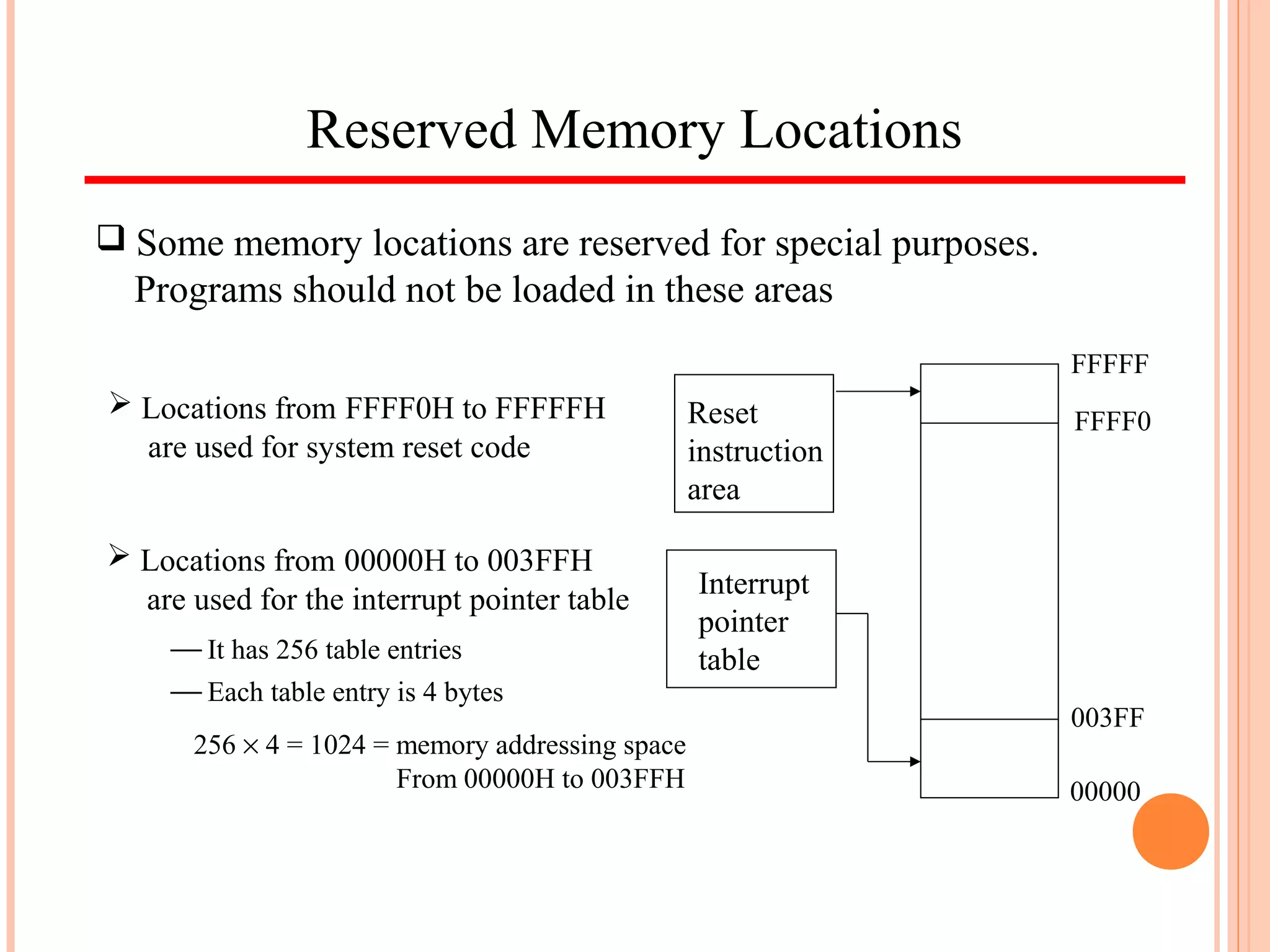
Reserved Memory Locations
FFFFF
FFFF0
003FF
00000
Reset
instruction
area
Interrupt
pointer
table
 Locations from 00000H to 003FFH
are used for the interrupt pointer table
 Locations from FFFF0H to FFFFFH
are used for system reset code
 Some memory locations are reserved for special purposes.
Programs should not be loaded in these areas
 It has 256 table entries
 Each table entry is 4 bytes
256 × 4 = 1024 = memory addressing space
From 00000H to 003FFH
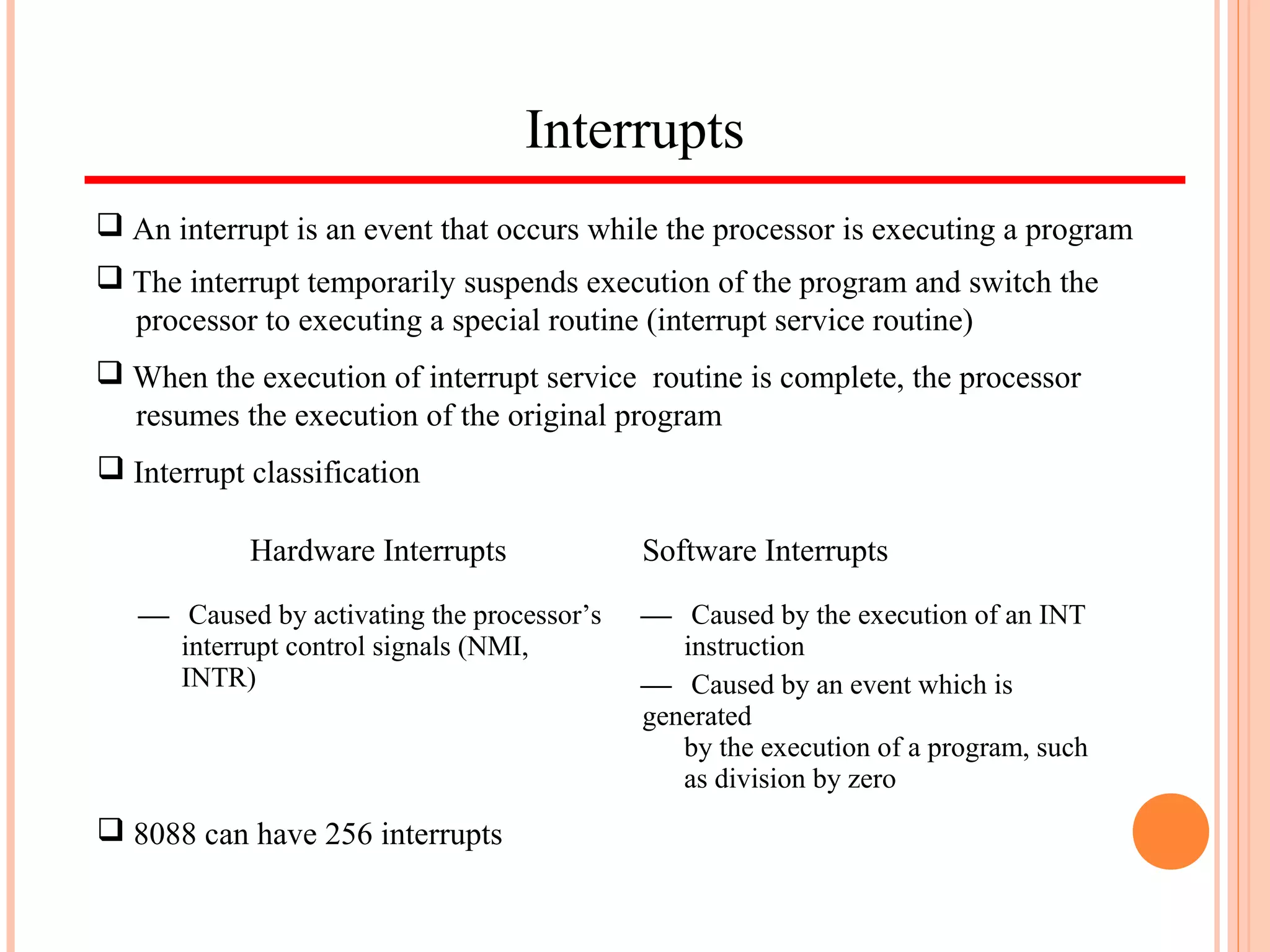
Interrupts
 An interrupt is an event that occurs while the processor is executing a program
 The interrupt temporarily suspends execution of the program and switch the
processor to executing a special routine (interrupt service routine)
 When the execution of interrupt service routine is complete, the processor
resumes the execution of the original program
Hardware Interrupts Software Interrupts
 Caused by activating the processor’s
interrupt control signals (NMI,
INTR)
 Caused by the execution of an INT
instruction
 Caused by an event which is
generated
by the execution of a program, such
as division by zero
 Interrupt classification
 8088 can have 256 interrupts
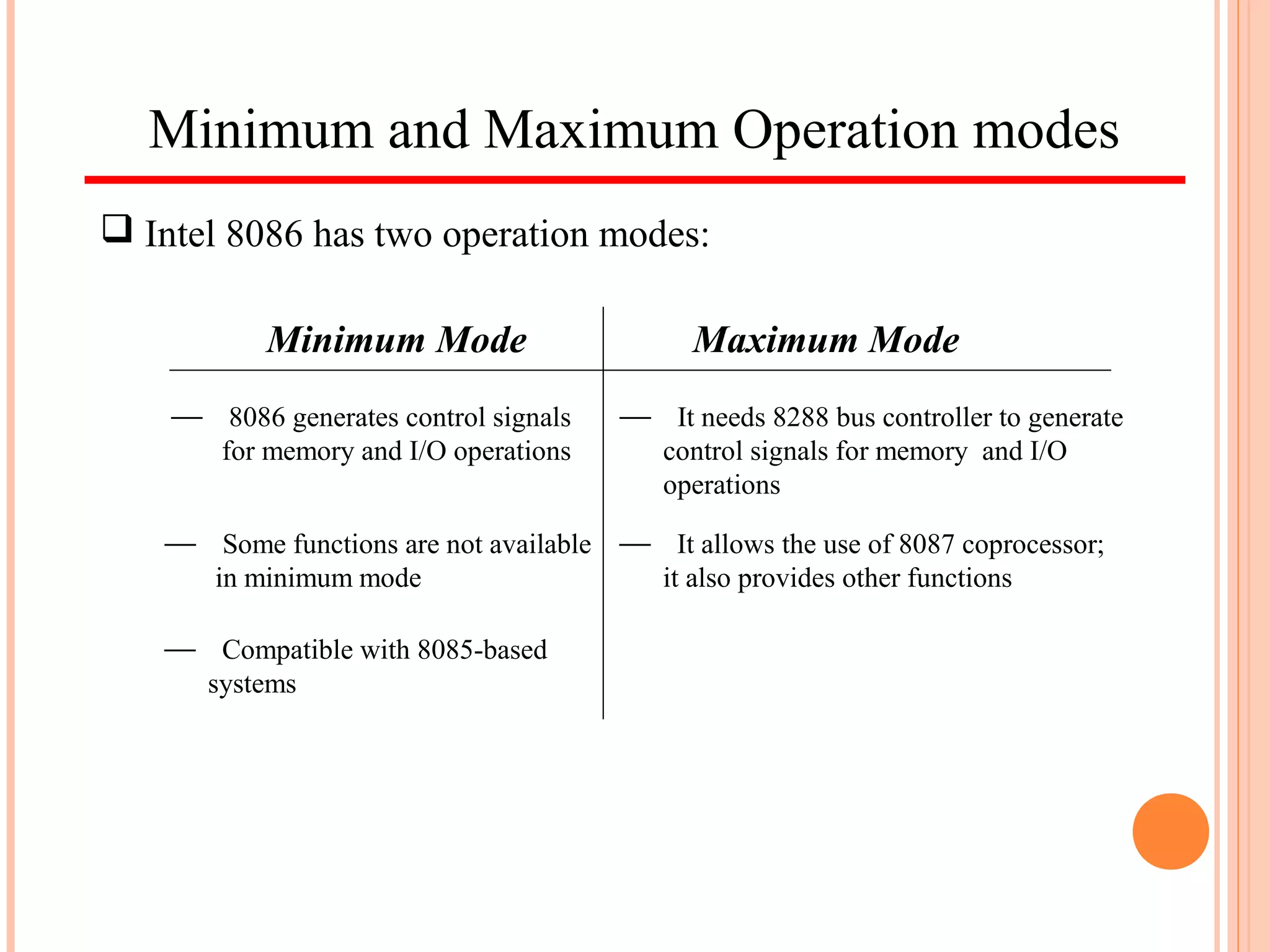
Minimum and Maximum Operation modes
 Intel 8086 has two operation modes:
Minimum Mode Maximum Mode
 8086 generates control signals
for memory and I/O operations
 It needs 8288 bus controller to generate
control signals for memory and I/O
operations
 Some functions are not available
in minimum mode
 It allows the use of 8087 coprocessor;
it also provides other functions
 Compatible with 8085-based
systems

Introduction to intel 8086 part1

  • 1.
    Presented By: ShehrevarDavierwala Visit: http://sites.google.com/site/techwizardin http://www.authorstream.com/shehrevard http://shehrevard.blogspot.com Intel 8086 Microprocessor
  • 2.
    Overview  Textbook: J. L.Antonakos, "An Introduction to the Intel Family of Microprocessors," Third Edition, Prentice Hall, 1999
  • 3.
    What are microprocessor-basedsystems?  Microprocessor-based systems are electrical systems consisting of microprocessors, memories, I/O units, and other peripherals. Memory Output units Input units Bus Microprocessor Control unit Datapath ALU Reg.  Microprocessors access memories and other units through buses  The operations of microprocessors are controlled by instructions stored in memories  Microprocessors are the brains of the systems
  • 4.
    What are microprocessors? A microprocessor is a processor (or Central Processing Unit, CPU) fabricated on a single integrated circuit. X Y Control unit IR PC ALU ACC MAR Data bus Control bus Address bus A simple microprocessor architecture
  • 5.
    Evolution of Computers First generation (1939-1954) - vacuum tube  Second generation (1954-1959) - transistor  Third generation (1959-1971) - IC  Fourth generation (1971-present) - microprocessor
  • 6.
  • 7.
    Evolution of Computers Second generation (1954-1959) - transistor Http://history.acusd.edu/gen/recording/computer1.html http://www.computer50.org/kgill/transistor/trans.html Manchester University Experimental Transistor Computer
  • 8.
    Evolution of Computers Third generation (1959-1971) - IC Http://history.acusd.edu/gen/recording/computer1.html http://www.piercefuller.com/collect/pdp8.html PDP-8, Digital Equipment Corporation  Thanks to the use of ICs, the DEC PDP-8 is the least expensive general purpose small computer in 1960s
  • 9.
    Evolution of Computers Fourth generation (1971-present) - microprocessor  In 1971, Intel developed 4-bit 4004 chip for calculator applications. ALU Instruction decoder Reg. Program counter I/O Refresh logic System bus Control logic ROM/RAM buffer Timing Reset http://www.intel.com A good review article: The History of The Microprocessor, Bell Labs Technical Journal, Autumn, 1997 Block diagram of Intel 4004 4004 chip layout
  • 10.
    Evolution of IntelMicroprocessors 1 10 100 1000 10000 1974 1979 1982 1985 1989 1993 1997 1999 2000 8080 8088 80286 80386 80486 Pentium P II P III P 4 0 1 2 3 4 5 6 7 1974 1979 1982 1985 1989 1993 1997 1999 2000 8080 8088 80286 80386 80486 Pentium P II P III P 4 1 10 100 1,000 10,000 100,000 1,000,000 10,000,000 100,000,000 1974 1979 1982 1985 1989 1993 1997 1999 2000 8080 8088 80286 80386 80486 Pentium P II P III P 4 0.1 1 10 100 1000 10000 1974 1979 1982 1985 1989 1993 1997 1999 2000 8080 8088 80286 80386 80486 Pentium P II P III P 4 Number of transistors Minimum transistor sizes (µm) Clock frequencies (MHz) MIPS
  • 11.
    Other Commercial Microprocessors PowerPC (IBM, Motorola)  Athlon, Dulon, Hammer (AMD)  Crusoe (Transmeta)  SPARC, UltraSPARC (Sun Microsystems)  ARM cores (Advanced RISC Machines)  MIPS cores (MIPS Technologies)  TI’s TMS DSP chips (Texas Instruments)  StarCore (Motorola, Agere)  • • • • • •
  • 12.
    Applications of Microprocessor-BasedSystems  Computers Block diagram of a computer Memory Timing & control Keyboard Interrupt control ... ... Monitor Micro- processor Disk Other peripherals Bus  System performance is normally the most important design concern
  • 13.
    1.3 SYSTEM BLOCKDIAGRAM System bus (data, address & control signals) Memory Interrupt circuitrySerial I/OParallel I/O Timing CPU µP + associated logic circuitry: •Bus controller •Bus drivers •Coprocessor •ROM (Read Only Memory) (start-up program) •RAM (Random Access Memory) •DRAM (Dynamic RAM) - high capacity, refresh needed •SRAM (Static RAM) - low power, fast, easy to interface •Crystal oscillator •Timing circuitry (counters dividing to lower frequencies) At external unexpected events, µP has to interrupt the main program execution, service the interrupt request (obviously a short subroutine) and retake the main program from the point where it was interrupt. Simple (only two wires + ground) but slow. •Printer (low resolution) •Modem •Operator’s console •Mainframe •Personal computer Many wires, fast. •Printer (high resolution) •External memory •Floppy Disk •Hard Disk •Compact Disk •Other high speed devices
  • 14.
    THE PERSONAL COMPUTER Processor (8086 trough Pentium Systembus (data, address & control signals) System ROM Interrupt logic (8259) Keyboard logic (8253) DMA Controller (8237) Timer logic (8253) Coprocessor (8087 trough 80387 640KB DRAM Expansion logic Keyboard Speaker Extension slots Video card Disk controller Serial port ...
  • 15.
    CPU RAM ROM Timer Interrupt I/O port USART A/D,D/A OSC. Applications of Microprocessor-Based Systems  Microcontrollers Block diagram of a microcontroller  In general, microcontrollers are cheap and have low performance  A microcontroller is a simple computer implemented in a single VLSI chip.  Microcontrollers are widely used in industrial control, automobile and home applications
  • 16.
    http://www.ti.com Applications of Microprocessor-BasedSystems  ASICs  Microprocessors are embedded into ASIC chips to implement complex functions  In general, it requires that the microprocessors have low power consumption and take small silicon area A TI baseband chip for cellular phone applications
  • 17.
  • 18.
    Overview  Intel 8086facts 8086 VDD (5V) GND CLK 20-bit address 8-bit data •• ••• control signals To 8088 control signals from 8088 8086 signal classification  20 bit address bus allow accessing 1 M memory locations  16-bit internal data bus and 8-bit external data bus. Thus, it need two read (or write) operations to read (or write) a 16-bit datum  Byte addressable and byte-swapping Memory locations 5A 2F18000 18001 Low byte of word High byte of word Word: 5A2F
  • 19.
    Organization of 8086 AHAL BH BL CH CL DH DL SP BP SI DI ALU Flag register Execution Unit (EU) EU control Σ CS DS SS ESALU Data bus (16 bits) Address bus (20 bits) Instruction Queue Bus control External bus IP Data bus (16 bits) Bus Interface Unit (BIU) General purpose register Segment register
  • 20.
    General Purpose Registers 158 7 0 AX BX CX DX AH AL BH BL CH CL DH DL Accumulator Base Counter Data SP BP SI DI Data Group Pointer and Index Group Stack Pointer Base Pointer Source Index Destination Index
  • 21.
    Arithmetic Logic Unit(ALU) n bits n bits A B Y F Carry Y= 0 ? A > B ? F Y 0 0 0 A + B 0 0 1 A - B 0 1 0 A - 1 0 1 1 A and B 1 0 0 A or B 1 0 1 not A • • • • • •  Signal F control which function will be conducted by ALU.  Signal F is generated according to the current instruction.  Basic arithmetic operations: addition, subtraction, •••••  Basic logic operations: and, or, xor, shifting,•••••
  • 22.
    Flag Register  OFDF IF TF ZFSF  AF PF CF  015  Control Flags  Status Flags IF: Interrupt enable flag DF: Direction flag TF: Trap flag CF: Carry flag PF: Parity flag AF: Auxiliary carry flag ZF: Zero flag SF: Sign flag OF: Overflow flag  Flag register contains information reflecting the current status of a microprocessor. It also contains information which controls the operation of the microprocessor.  
  • 23.
    Instruction Machine Codes Instruction machine codes are binary numbers  For Example: 1 0 0 0 1 0 0 0 1 1 0 0 0 0 1 1 MOV AL, BL MOV  Machine code structure Opcode Operand1  Opcode tells what operation is to be performed. (EU control logic generates ALU control signals according to Opcode)  Some instructions do not have operands, or have only one operand  Operands tell what data should be used in the operation. Operands can be addresses telling where to get data (or where to store results) Register mode Mode Operand2  Mode indicates the type of a instruction: Register type, or Memory type
  • 24.
    EU Operation ALU Databus (16 bits) AH AL BH BL CH CL DH DL SP BP SI DI General purpose register ALU Flag register EU control instruction 1011000101001010 1. Fetch an instruction from instruction queue 2. According to the instruction, EU control logic generates control signals. (This process is also referred to as instruction decoding) 3. Depending on the control signal, EU performs one of the following operations:  An arithmetic operation  A logic operation  Storing a datum into a register  Moving a datum from a register  Changing flag register
  • 25.
    Generating Memory Addresses How can a 16-bit microprocessor generate 20-bit memory addresses? Segment (64K) 0000 + 16-bit register 16-bit register 20-bit memory address 00000 FFFFF Left shift 4 bits Intel 80x86 memory address generation 1M memory space Offset Segment address Offset Addr1 Addr1 + 0FFFF
  • 26.
    Memory Segmentation  Asegment is a 64KB block of memory starting from any 16-byte boundary  For example: 00000, 00010, 00020, 20000, 8CE90, and E0840 are all valid segment addresses  The requirement of starting from 16-byte boundary is due to the 4-bit left shifting  Segment registers in BIU CS SS DS ES Code Segment Data Segment Stack Segment Extra Segment 015
  • 27.
    Memory Address Calculation Segment addresses must be stored in segment registers  Offset is derived from the combination of pointer registers, the Instruction Pointer (IP), and immediate values 0000 + Segment address Offset Memory address  Examples 3 4 8 A 0 4 2 1 4 8 A B 43 CS IP + Instruction address 5 0 0 0 0 F F E 0 F F E 05 SS SP + Stack address 1 2 3 4 0 0 0 2 2 2 3 6 21 DS DI + Data address
  • 28.
    Fetching Instructions  Whereto fetch the next instruction? CS IP 1 2 3 4 0 0 1 2 1 2 3 5 2 12352 MOV AL, 0 8086 Memory  Update IP — After an instruction is fetched, Register IP is updated as follows: IP = IP + Length of the fetched instruction — For Example: the length of MOV AL, 0 is 2 bytes. After fetching this instruction, the IP is updated to 0014
  • 29.
    Accessing Data Memory There is a number of methods to generate the memory address when accessing data memory. These methods are referred to as Addressing Modes  Examples: — Direct addressing: MOV AL, [0300H] 1 2 3 4 0 0 3 0 0 2 6 4 01 DS Memory address (assume DS=1234H) — Register indirect addressing: MOV AL, [SI] 1 2 3 4 0 0 3 1 0 2 6 5 01 DS Memory address (assume DS=1234H) (assume SI=0310H)
  • 30.
    Reserved Memory Locations FFFFF FFFF0 003FF 00000 Reset instruction area Interrupt pointer table Locations from 00000H to 003FFH are used for the interrupt pointer table  Locations from FFFF0H to FFFFFH are used for system reset code  Some memory locations are reserved for special purposes. Programs should not be loaded in these areas  It has 256 table entries  Each table entry is 4 bytes 256 × 4 = 1024 = memory addressing space From 00000H to 003FFH
  • 31.
    Interrupts  An interruptis an event that occurs while the processor is executing a program  The interrupt temporarily suspends execution of the program and switch the processor to executing a special routine (interrupt service routine)  When the execution of interrupt service routine is complete, the processor resumes the execution of the original program Hardware Interrupts Software Interrupts  Caused by activating the processor’s interrupt control signals (NMI, INTR)  Caused by the execution of an INT instruction  Caused by an event which is generated by the execution of a program, such as division by zero  Interrupt classification  8088 can have 256 interrupts
  • 32.
    Minimum and MaximumOperation modes  Intel 8086 has two operation modes: Minimum Mode Maximum Mode  8086 generates control signals for memory and I/O operations  It needs 8288 bus controller to generate control signals for memory and I/O operations  Some functions are not available in minimum mode  It allows the use of 8087 coprocessor; it also provides other functions  Compatible with 8085-based systems