8086 Pin Function

By:
Mahendra B. Salunke
SITS, Narhe
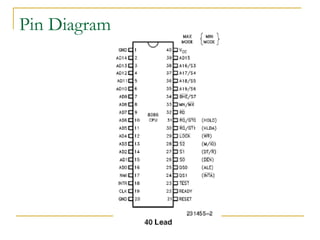
Pin Diagram
Pin Functions






Out of 40 pins, 32 pins are having same
function in minimum or maximum mode,
And remaining 8 pins are having different
functions in minimum and maximum mode.
Following are the pins which are having same
functions
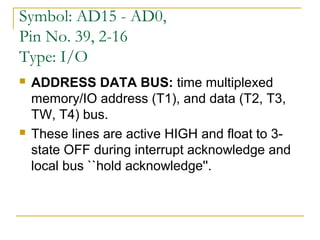
Symbol: AD15 - AD0,
Pin No. 39, 2-16
Type: I/O




ADDRESS DATA BUS: time multiplexed
memory/IO address (T1), and data (T2, T3,
TW, T4) bus.
These lines are active HIGH and float to 3state OFF during interrupt acknowledge and
local bus ``hold acknowledge''.
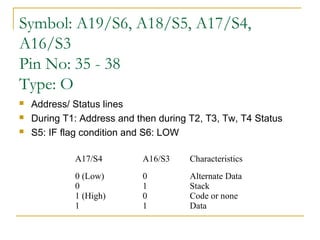
Symbol: A19/S6, A18/S5, A17/S4,
A16/S3
Pin No: 35 - 38
Type: O




Address/ Status lines
During T1: Address and then during T2, T3, Tw, T4 Status
S5: IF flag condition and S6: LOW
A17/S4

A16/S3

Characteristics

0 (Low)
0
1 (High)
1

0
1
0
1

Alternate Data
Stack
Code or none
Data
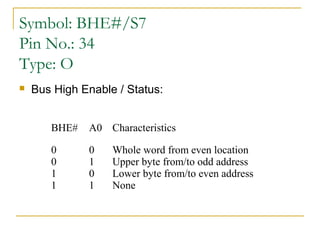
Symbol: BHE#/S7
Pin No.: 34
Type: O


Bus High Enable / Status:
BHE#

A0 Characteristics

0
0
1
1

0
1
0
1

Whole word from even location
Upper byte from/to odd address
Lower byte from/to even address
None
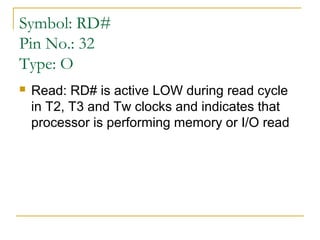
Symbol: RD#
Pin No.: 32
Type: O


Read: RD# is active LOW during read cycle
in T2, T3 and Tw clocks and indicates that
processor is performing memory or I/O read
Symbol: READY
Pin No.: 22
Type: I




Ready signal is received from memory or I/O
devices to indicate the completion of data
transfer
Synchronized by 8284 clock generator
Symbol: INTR
Pin No.: 18
Type: I






Interrupt Request: Level triggered input
received from interrupting device
Sampled during last clock of each instruction
cycle
A subroutine is vectored through IVT if
interrupt enable flag (IF) is SET
Symbol: TEST#
Pin No.: 23
Type: I


Test: Input is examined by the ‘wait’
instruction, if TEST# is LOW processor will
continue execution otherwise wait in an idle
state.
Symbol: NMI
Pin No.: 17
Type: I




Non Maskable Interrupt: Edge triggered input
causes a TYPE 2 interrupt.
Not maskable internally by software.
Symbol: RESET
Pin No.: 21
Type: I




Reset: Input causes the processor to
immediately terminate its present activity
Must be HIGH for at least 4 clock cycles
Symbol: CLK
Pin No.: 19
Type: I




Clock: provides the basic timing for the
processor and bus controller.
It is asymmetric with a 33% duty cycle to
provide optimized internal timing.
Symbol: Vcc
Pin No.: 40


Vcc: +5V power supply pin.
Symbol: GND
Pin No.: 1, 20


GROUND
Symbol: MN/MX#
Pin No.: 33
Type: I






MINIMUM/MAXIMUM: indicates what mode
the processor is to operate in.
HIGH indicates minimum mode (Single
processor system)
LOW indicates maximum mode (Multiprocessor system)
Pins having different functions in
maximum mode


Pin number 24 to 31 is having different
functions in maximum mode which is
explained below
Symbol: S2#, S1#, S0#
Pin No.: 26-28
Type: O




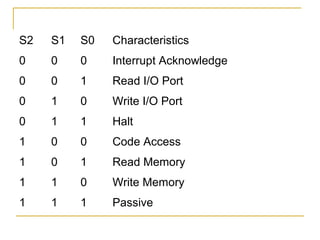
Status: active during T4, T1, and T2 and is
returned to the passive state (1, 1, 1) during
T3 or during TW when READY is HIGH
Used by the 8288 Bus Controller to generate
all memory and I/O access control signals
S2

S1

S0

Characteristics

0

0

0

Interrupt Acknowledge

0

0

1

Read I/O Port

0

1

0

Write I/O Port

0

1

1

Halt

1

0

0

Code Access

1

0

1

Read Memory

1

1

0

Write Memory

1

1

1

Passive
Symbol: RQ#/GT0#, RQ#/GT1#
Pin No.: 30, 31
Type: I/O




Request/Grant: Pins are used by other local
bus masters to force the processor to release
the local bus at the end of the processor's
current bus cycle.
RQ/GT0# is having higher priority than
RQ/GT1#
Symbol: LOCK#
Pin No.: 29
Type: O




LOCK: output indicates that other system bus
masters are not to gain control of the system
bus while LOCK is active LOW.
Activated by the ``LOCK'' prefix instruction
and remains active until the completion of the
next instruction.
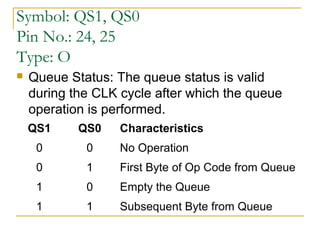
Symbol: QS1, QS0
Pin No.: 24, 25
Type: O


Queue Status: The queue status is valid
during the CLK cycle after which the queue
operation is performed.
QS1

QS0

Characteristics

0

0

No Operation

0

1

First Byte of Op Code from Queue

1

0

Empty the Queue

1

1

Subsequent Byte from Queue
Pins having different functions in
minimum mode


Pin number 24 to 31 is having different
functions in minimum mode which is
explained below
Symbol: M/IO#
Pin No.: 28
Type: O





Status Line: used to distinguish a memory
access from an I/O access
HIGH for memory operation and
LOW for I/O operations
Symbol: WR#
Pin No.: 29
Type: O


Write: indicates that the processor is
performing a write memory or write I/O cycle
Symbol: INTA#
Pin No.: 24
Type: O




Interrupt Acknowledgement: used as a read
strobe for interrupt acknowledge cycles
Active LOW during T2, T3 and TW of each
interrupt acknowledge cycle.
Symbol: ALE
Pin No.: 25
Type: O




Address Latch Enable: It is a HIGH pulse
active during T1 of any bus cycle
Provided by the processor to latch the
address into the 8282/8283 address latch.
Symbol: DT/R#
Pin No.: 27
Type: O


Data Transmit/Receive: used to control the
direction of data flow through the transceiver
Symbol: DEN#
Pin No.: 26
Type: O


Data Enable: provided as an output enable
for the 8286/8287 in a minimum system
which uses the transceiver
Symbol: HOLD, HLDA
Pin No.: 31, 30
Type: I, O




Hold: indicates that another master is
requesting a local bus ``hold.'‘
The processor receiving the ``hold'' request
will issue HLDA (HIGH) as an
acknowledgement
Web: www.salunke.webs.com
E-mail: msalunke@gmail.com

8086 pin function

  • 1.
    8086 Pin Function By: MahendraB. Salunke SITS, Narhe
  • 2.
  • 3.
    Pin Functions    Out of40 pins, 32 pins are having same function in minimum or maximum mode, And remaining 8 pins are having different functions in minimum and maximum mode. Following are the pins which are having same functions
  • 4.
    Symbol: AD15 -AD0, Pin No. 39, 2-16 Type: I/O   ADDRESS DATA BUS: time multiplexed memory/IO address (T1), and data (T2, T3, TW, T4) bus. These lines are active HIGH and float to 3state OFF during interrupt acknowledge and local bus ``hold acknowledge''.
  • 5.
    Symbol: A19/S6, A18/S5,A17/S4, A16/S3 Pin No: 35 - 38 Type: O    Address/ Status lines During T1: Address and then during T2, T3, Tw, T4 Status S5: IF flag condition and S6: LOW A17/S4 A16/S3 Characteristics 0 (Low) 0 1 (High) 1 0 1 0 1 Alternate Data Stack Code or none Data
  • 6.
    Symbol: BHE#/S7 Pin No.:34 Type: O  Bus High Enable / Status: BHE# A0 Characteristics 0 0 1 1 0 1 0 1 Whole word from even location Upper byte from/to odd address Lower byte from/to even address None
  • 7.
    Symbol: RD# Pin No.:32 Type: O  Read: RD# is active LOW during read cycle in T2, T3 and Tw clocks and indicates that processor is performing memory or I/O read
  • 8.
    Symbol: READY Pin No.:22 Type: I   Ready signal is received from memory or I/O devices to indicate the completion of data transfer Synchronized by 8284 clock generator
  • 9.
    Symbol: INTR Pin No.:18 Type: I    Interrupt Request: Level triggered input received from interrupting device Sampled during last clock of each instruction cycle A subroutine is vectored through IVT if interrupt enable flag (IF) is SET
  • 10.
    Symbol: TEST# Pin No.:23 Type: I  Test: Input is examined by the ‘wait’ instruction, if TEST# is LOW processor will continue execution otherwise wait in an idle state.
  • 11.
    Symbol: NMI Pin No.:17 Type: I   Non Maskable Interrupt: Edge triggered input causes a TYPE 2 interrupt. Not maskable internally by software.
  • 12.
    Symbol: RESET Pin No.:21 Type: I   Reset: Input causes the processor to immediately terminate its present activity Must be HIGH for at least 4 clock cycles
  • 13.
    Symbol: CLK Pin No.:19 Type: I   Clock: provides the basic timing for the processor and bus controller. It is asymmetric with a 33% duty cycle to provide optimized internal timing.
  • 14.
    Symbol: Vcc Pin No.:40  Vcc: +5V power supply pin.
  • 15.
    Symbol: GND Pin No.:1, 20  GROUND
  • 16.
    Symbol: MN/MX# Pin No.:33 Type: I    MINIMUM/MAXIMUM: indicates what mode the processor is to operate in. HIGH indicates minimum mode (Single processor system) LOW indicates maximum mode (Multiprocessor system)
  • 17.
    Pins having differentfunctions in maximum mode  Pin number 24 to 31 is having different functions in maximum mode which is explained below
  • 18.
    Symbol: S2#, S1#,S0# Pin No.: 26-28 Type: O   Status: active during T4, T1, and T2 and is returned to the passive state (1, 1, 1) during T3 or during TW when READY is HIGH Used by the 8288 Bus Controller to generate all memory and I/O access control signals
  • 19.
    S2 S1 S0 Characteristics 0 0 0 Interrupt Acknowledge 0 0 1 Read I/OPort 0 1 0 Write I/O Port 0 1 1 Halt 1 0 0 Code Access 1 0 1 Read Memory 1 1 0 Write Memory 1 1 1 Passive
  • 20.
    Symbol: RQ#/GT0#, RQ#/GT1# PinNo.: 30, 31 Type: I/O   Request/Grant: Pins are used by other local bus masters to force the processor to release the local bus at the end of the processor's current bus cycle. RQ/GT0# is having higher priority than RQ/GT1#
  • 21.
    Symbol: LOCK# Pin No.:29 Type: O   LOCK: output indicates that other system bus masters are not to gain control of the system bus while LOCK is active LOW. Activated by the ``LOCK'' prefix instruction and remains active until the completion of the next instruction.
  • 22.
    Symbol: QS1, QS0 PinNo.: 24, 25 Type: O  Queue Status: The queue status is valid during the CLK cycle after which the queue operation is performed. QS1 QS0 Characteristics 0 0 No Operation 0 1 First Byte of Op Code from Queue 1 0 Empty the Queue 1 1 Subsequent Byte from Queue
  • 23.
    Pins having differentfunctions in minimum mode  Pin number 24 to 31 is having different functions in minimum mode which is explained below
  • 24.
    Symbol: M/IO# Pin No.:28 Type: O    Status Line: used to distinguish a memory access from an I/O access HIGH for memory operation and LOW for I/O operations
  • 25.
    Symbol: WR# Pin No.:29 Type: O  Write: indicates that the processor is performing a write memory or write I/O cycle
  • 26.
    Symbol: INTA# Pin No.:24 Type: O   Interrupt Acknowledgement: used as a read strobe for interrupt acknowledge cycles Active LOW during T2, T3 and TW of each interrupt acknowledge cycle.
  • 27.
    Symbol: ALE Pin No.:25 Type: O   Address Latch Enable: It is a HIGH pulse active during T1 of any bus cycle Provided by the processor to latch the address into the 8282/8283 address latch.
  • 28.
    Symbol: DT/R# Pin No.:27 Type: O  Data Transmit/Receive: used to control the direction of data flow through the transceiver
  • 29.
    Symbol: DEN# Pin No.:26 Type: O  Data Enable: provided as an output enable for the 8286/8287 in a minimum system which uses the transceiver
  • 30.
    Symbol: HOLD, HLDA PinNo.: 31, 30 Type: I, O   Hold: indicates that another master is requesting a local bus ``hold.'‘ The processor receiving the ``hold'' request will issue HLDA (HIGH) as an acknowledgement
  • 31.