Structure of AssemblyLanguage
[ label: ]mnemonic [operands] [ ;comment ]
Example:
MOV R1, #25H ; load data 25H into R1
2
3.
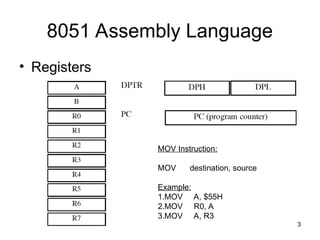
8051 Assembly Language
•Registers
3
MOV Instruction:
MOV destination, source
Example:
1.MOV A, $55H
2.MOV R0, A
3.MOV A, R3
4.
Instruction Groups
• The8051 has 255 instructions
– Every 8-bit opcode from 00 to FF is used except for
A5.
• The instructions are grouped into 5 groups
– Arithmetic
– Logic
– Data Transfer
– Boolean
– Branching
5.
Arithmetic Instructions
• ADD
–8-bit addition between the accumulator (A) and a second
operand.
• The result is always in the accumulator.
• The CY flag is set/reset appropriately.
• ADDC
– 8-bit addition between the accumulator, a second
operand and the previous value of the CY flag.
• Useful for 16-bit addition in two steps.
• The CY flag is set/reset appropriately.
6.
Arithmetic Instructions
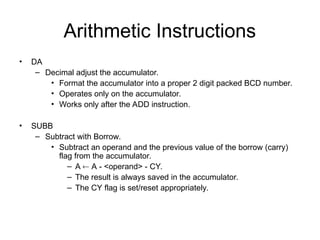
• DA
–Decimal adjust the accumulator.
• Format the accumulator into a proper 2 digit packed BCD number.
• Operates only on the accumulator.
• Works only after the ADD instruction.
• SUBB
– Subtract with Borrow.
• Subtract an operand and the previous value of the borrow (carry)
flag from the accumulator.
– A A - <operand> - CY.
– The result is always saved in the accumulator.
– The CY flag is set/reset appropriately.
7.
Arithmetic Instructions
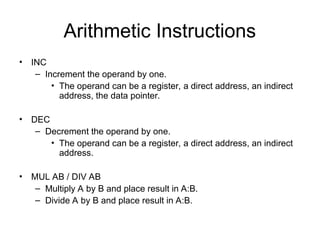
• INC
–Increment the operand by one.
• The operand can be a register, a direct address, an indirect
address, the data pointer.
• DEC
– Decrement the operand by one.
• The operand can be a register, a direct address, an indirect
address.
• MUL AB / DIV AB
– Multiply A by B and place result in A:B.
– Divide A by B and place result in A:B.
8.
Logical Operations
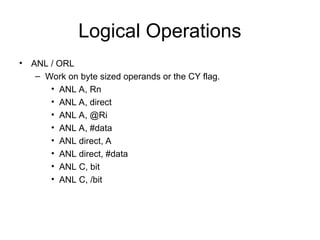
• ANL/ ORL
– Work on byte sized operands or the CY flag.
• ANL A, Rn
• ANL A, direct
• ANL A, @Ri
• ANL A, #data
• ANL direct, A
• ANL direct, #data
• ANL C, bit
• ANL C, /bit
9.
Logical Operations
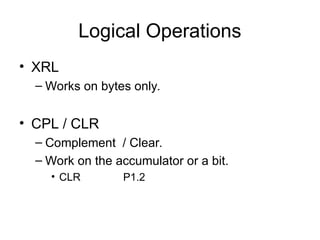
• XRL
–Works on bytes only.
• CPL / CLR
– Complement / Clear.
– Work on the accumulator or a bit.
• CLR P1.2
10.
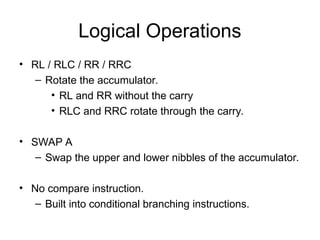
Logical Operations
• RL/ RLC / RR / RRC
– Rotate the accumulator.
• RL and RR without the carry
• RLC and RRC rotate through the carry.
• SWAP A
– Swap the upper and lower nibbles of the accumulator.
• No compare instruction.
– Built into conditional branching instructions.
11.
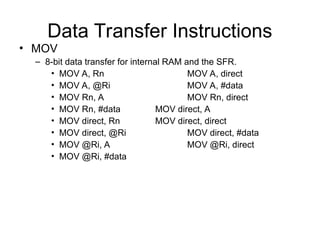
Data Transfer Instructions
•MOV
– 8-bit data transfer for internal RAM and the SFR.
• MOV A, Rn MOV A, direct
• MOV A, @Ri MOV A, #data
• MOV Rn, A MOV Rn, direct
• MOV Rn, #data MOV direct, A
• MOV direct, Rn MOV direct, direct
• MOV direct, @Ri MOV direct, #data
• MOV @Ri, A MOV @Ri, direct
• MOV @Ri, #data
12.
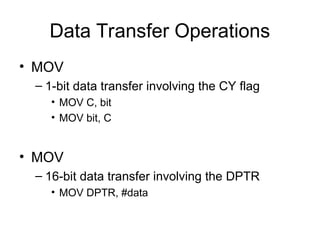
Data Transfer Operations
•MOV
– 1-bit data transfer involving the CY flag
• MOV C, bit
• MOV bit, C
• MOV
– 16-bit data transfer involving the DPTR
• MOV DPTR, #data
13.
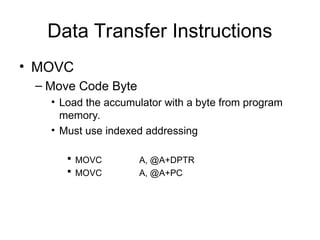
Data Transfer Instructions
•MOVC
– Move Code Byte
• Load the accumulator with a byte from program
memory.
• Must use indexed addressing
MOVC A, @A+DPTR
MOVC A, @A+PC
14.
Data Transfer Instructions
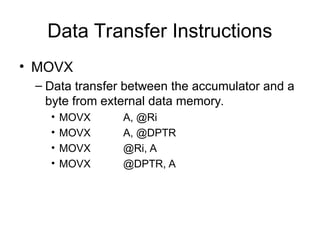
•MOVX
– Data transfer between the accumulator and a
byte from external data memory.
• MOVX A, @Ri
• MOVX A, @DPTR
• MOVX @Ri, A
• MOVX @DPTR, A
15.
Data Transfer Instructions
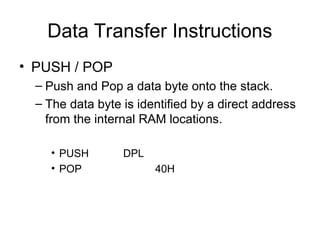
•PUSH / POP
– Push and Pop a data byte onto the stack.
– The data byte is identified by a direct address
from the internal RAM locations.
• PUSH DPL
• POP 40H
16.
Data Transfer Instructions
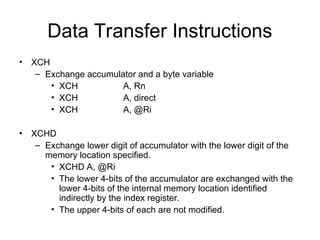
•XCH
– Exchange accumulator and a byte variable
• XCH A, Rn
• XCH A, direct
• XCH A, @Ri
• XCHD
– Exchange lower digit of accumulator with the lower digit of the
memory location specified.
• XCHD A, @Ri
• The lower 4-bits of the accumulator are exchanged with the
lower 4-bits of the internal memory location identified
indirectly by the index register.
• The upper 4-bits of each are not modified.
17.
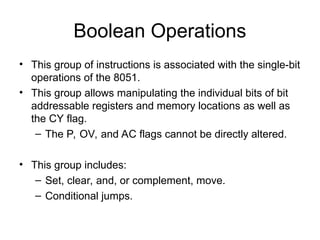
Boolean Operations
• Thisgroup of instructions is associated with the single-bit
operations of the 8051.
• This group allows manipulating the individual bits of bit
addressable registers and memory locations as well as
the CY flag.
– The P, OV, and AC flags cannot be directly altered.
• This group includes:
– Set, clear, and, or complement, move.
– Conditional jumps.
18.
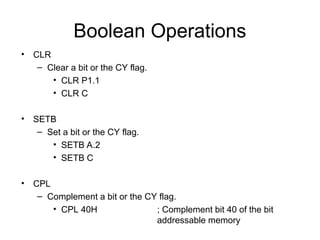
Boolean Operations
• CLR
–Clear a bit or the CY flag.
• CLR P1.1
• CLR C
• SETB
– Set a bit or the CY flag.
• SETB A.2
• SETB C
• CPL
– Complement a bit or the CY flag.
• CPL 40H ; Complement bit 40 of the bit
addressable memory
19.
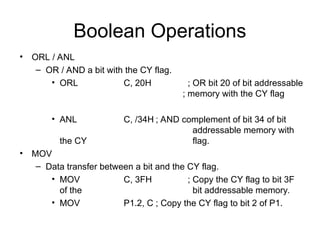
Boolean Operations
• ORL/ ANL
– OR / AND a bit with the CY flag.
• ORL C, 20H ; OR bit 20 of bit addressable
; memory with the CY flag
• ANL C, /34H ; AND complement of bit 34 of bit
addressable memory with
the CY flag.
• MOV
– Data transfer between a bit and the CY flag.
• MOV C, 3FH ; Copy the CY flag to bit 3F
of the bit addressable memory.
• MOV P1.2, C ; Copy the CY flag to bit 2 of P1.
20.
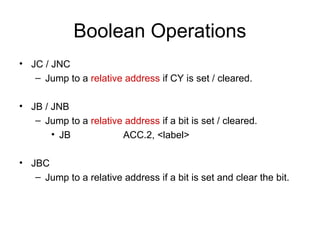
Boolean Operations
• JC/ JNC
– Jump to a relative address if CY is set / cleared.
• JB / JNB
– Jump to a relative address if a bit is set / cleared.
• JB ACC.2, <label>
• JBC
– Jump to a relative address if a bit is set and clear the bit.
21.
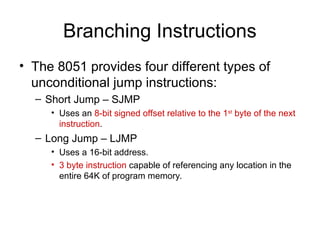
Branching Instructions
• The8051 provides four different types of
unconditional jump instructions:
– Short Jump – SJMP
• Uses an 8-bit signed offset relative to the 1st
byte of the next
instruction.
– Long Jump – LJMP
• Uses a 16-bit address.
• 3 byte instruction capable of referencing any location in the
entire 64K of program memory.
22.
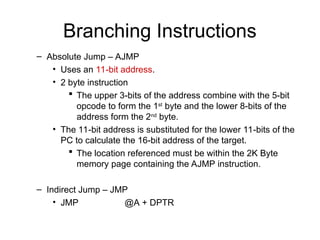
Branching Instructions
– AbsoluteJump – AJMP
• Uses an 11-bit address.
• 2 byte instruction
The upper 3-bits of the address combine with the 5-bit
opcode to form the 1st
byte and the lower 8-bits of the
address form the 2nd
byte.
• The 11-bit address is substituted for the lower 11-bits of the
PC to calculate the 16-bit address of the target.
The location referenced must be within the 2K Byte
memory page containing the AJMP instruction.
– Indirect Jump – JMP
• JMP @A + DPTR
23.
Branching Instructions
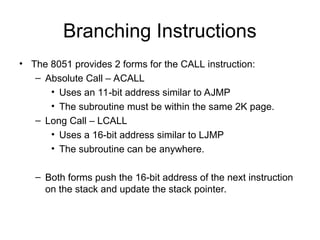
• The8051 provides 2 forms for the CALL instruction:
– Absolute Call – ACALL
• Uses an 11-bit address similar to AJMP
• The subroutine must be within the same 2K page.
– Long Call – LCALL
• Uses a 16-bit address similar to LJMP
• The subroutine can be anywhere.
– Both forms push the 16-bit address of the next instruction
on the stack and update the stack pointer.
24.
Branching Instructions
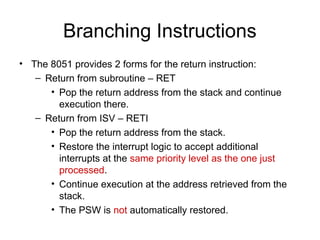
• The8051 provides 2 forms for the return instruction:
– Return from subroutine – RET
• Pop the return address from the stack and continue
execution there.
– Return from ISV – RETI
• Pop the return address from the stack.
• Restore the interrupt logic to accept additional
interrupts at the same priority level as the one just
processed.
• Continue execution at the address retrieved from the
stack.
• The PSW is not automatically restored.
25.
Branching Instructions
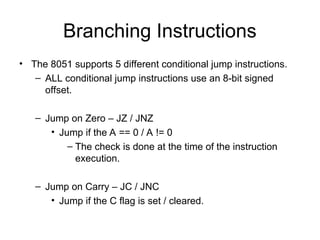
• The8051 supports 5 different conditional jump instructions.
– ALL conditional jump instructions use an 8-bit signed
offset.
– Jump on Zero – JZ / JNZ
• Jump if the A == 0 / A != 0
– The check is done at the time of the instruction
execution.
– Jump on Carry – JC / JNC
• Jump if the C flag is set / cleared.
26.
Branching Instructions
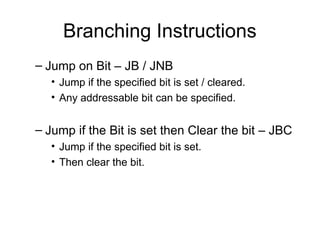
– Jumpon Bit – JB / JNB
• Jump if the specified bit is set / cleared.
• Any addressable bit can be specified.
– Jump if the Bit is set then Clear the bit – JBC
• Jump if the specified bit is set.
• Then clear the bit.
27.
Branching Instructions
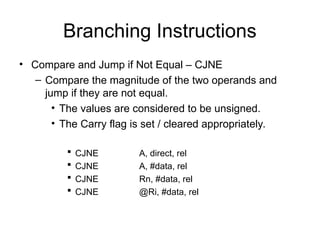
• Compareand Jump if Not Equal – CJNE
– Compare the magnitude of the two operands and
jump if they are not equal.
• The values are considered to be unsigned.
• The Carry flag is set / cleared appropriately.
CJNE A, direct, rel
CJNE A, #data, rel
CJNE Rn, #data, rel
CJNE @Ri, #data, rel
28.
Branching Instructions
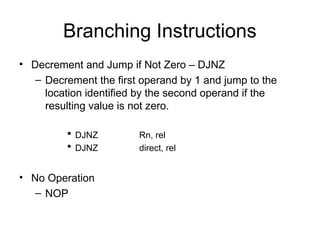
• Decrementand Jump if Not Zero – DJNZ
– Decrement the first operand by 1 and jump to the
location identified by the second operand if the
resulting value is not zero.
DJNZ Rn, rel
DJNZ direct, rel
• No Operation
– NOP
29.
Addressing Modes
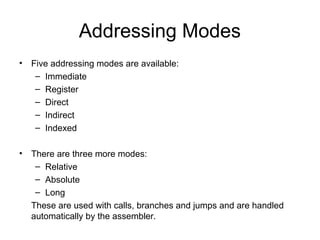
• Fiveaddressing modes are available:
– Immediate
– Register
– Direct
– Indirect
– Indexed
• There are three more modes:
– Relative
– Absolute
– Long
These are used with calls, branches and jumps and are handled
automatically by the assembler.
30.
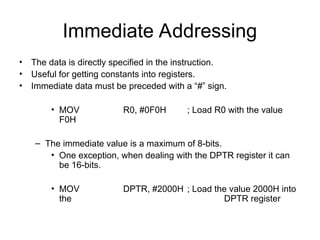
Immediate Addressing
• Thedata is directly specified in the instruction.
• Useful for getting constants into registers.
• Immediate data must be preceded with a “#” sign.
• MOV R0, #0F0H ; Load R0 with the value
F0H
– The immediate value is a maximum of 8-bits.
• One exception, when dealing with the DPTR register it can
be 16-bits.
• MOV DPTR, #2000H ; Load the value 2000H into
the DPTR register
31.
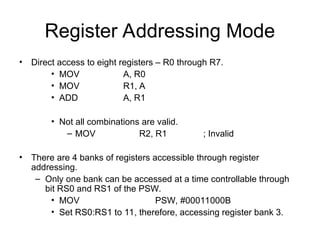
Register Addressing Mode
•Direct access to eight registers – R0 through R7.
• MOV A, R0
• MOV R1, A
• ADD A, R1
• Not all combinations are valid.
– MOV R2, R1 ; Invalid
• There are 4 banks of registers accessible through register
addressing.
– Only one bank can be accessed at a time controllable through
bit RS0 and RS1 of the PSW.
• MOV PSW, #00011000B
• Set RS0:RS1 to 11, therefore, accessing register bank 3.
32.
Direct Addressing
• Directaddressing can access any on-chip hardware register.
– All on-chip memory locations and registers have 8-bit
addresses.
– Can use the 8-bit address in the instruction.
• MOV A, 4H ; Amem[04H]
– Or can use the register name.
• MOV A, R4
– Don’t get confused with Immediate mode.
• No “#” sign.
33.
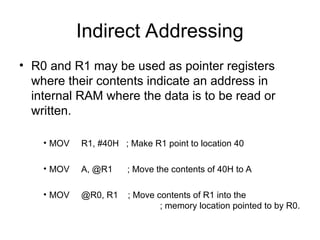
Indirect Addressing
• R0and R1 may be used as pointer registers
where their contents indicate an address in
internal RAM where the data is to be read or
written.
• MOV R1, #40H ; Make R1 point to location 40
• MOV A, @R1 ; Move the contents of 40H to A
• MOV @R0, R1 ; Move contents of R1 into the
; memory location pointed to by R0.
34.
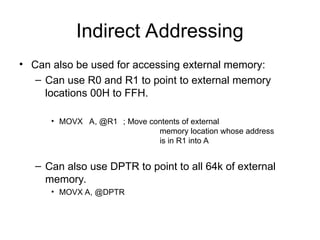
Indirect Addressing
• Canalso be used for accessing external memory:
– Can use R0 and R1 to point to external memory
locations 00H to FFH.
• MOVX A, @R1 ; Move contents of external
memory location whose address
is in R1 into A
– Can also use DPTR to point to all 64k of external
memory.
• MOVX A, @DPTR
35.
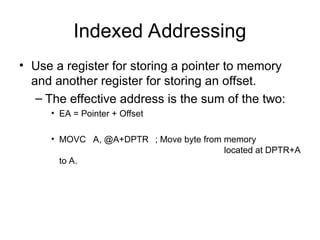
Indexed Addressing
• Usea register for storing a pointer to memory
and another register for storing an offset.
– The effective address is the sum of the two:
• EA = Pointer + Offset
• MOVC A, @A+DPTR ; Move byte from memory
located at DPTR+A
to A.
36.
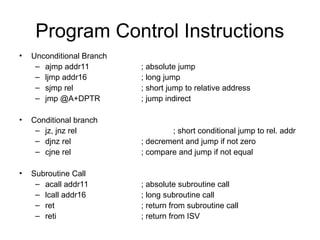
Program Control Instructions
•Unconditional Branch
– ajmp addr11 ; absolute jump
– ljmp addr16 ; long jump
– sjmp rel ; short jump to relative address
– jmp @A+DPTR ; jump indirect
• Conditional branch
– jz, jnz rel ; short conditional jump to rel. addr
– djnz rel ; decrement and jump if not zero
– cjne rel ; compare and jump if not equal
• Subroutine Call
– acall addr11 ; absolute subroutine call
– lcall addr16 ; long subroutine call
– ret ; return from subroutine call
– reti ; return from ISV
37.
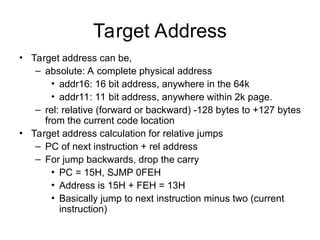
Target Address
• Targetaddress can be,
– absolute: A complete physical address
• addr16: 16 bit address, anywhere in the 64k
• addr11: 11 bit address, anywhere within 2k page.
– rel: relative (forward or backward) -128 bytes to +127 bytes
from the current code location
• Target address calculation for relative jumps
– PC of next instruction + rel address
– For jump backwards, drop the carry
• PC = 15H, SJMP 0FEH
• Address is 15H + FEH = 13H
• Basically jump to next instruction minus two (current
instruction)
38.
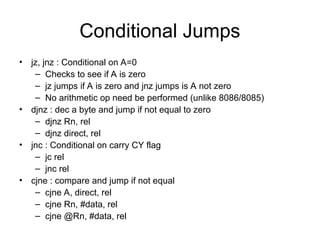
Conditional Jumps
• jz,jnz : Conditional on A=0
– Checks to see if A is zero
– jz jumps if A is zero and jnz jumps is A not zero
– No arithmetic op need be performed (unlike 8086/8085)
• djnz : dec a byte and jump if not equal to zero
– djnz Rn, rel
– djnz direct, rel
• jnc : Conditional on carry CY flag
– jc rel
– jnc rel
• cjne : compare and jump if not equal
– cjne A, direct, rel
– cjne Rn, #data, rel
– cjne @Rn, #data, rel
39.
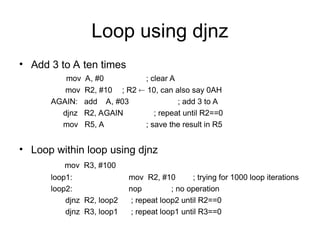
Loop using djnz
•Add 3 to A ten times
mov A, #0 ; clear A
mov R2, #10 ; R2 10, can also say 0AH
AGAIN: add A, #03 ; add 3 to A
djnz R2, AGAIN ; repeat until R2==0
mov R5, A ; save the result in R5
• Loop within loop using djnz
mov R3, #100
loop1: mov R2, #10 ; trying for 1000 loop iterations
loop2: nop ; no operation
djnz R2, loop2 ; repeat loop2 until R2==0
djnz R3, loop1 ; repeat loop1 until R3==0
40.
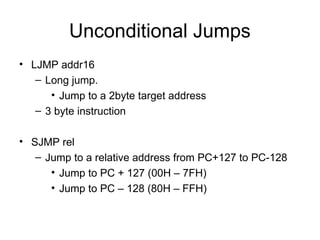
Unconditional Jumps
• LJMPaddr16
– Long jump.
• Jump to a 2byte target address
– 3 byte instruction
• SJMP rel
– Jump to a relative address from PC+127 to PC-128
• Jump to PC + 127 (00H – 7FH)
• Jump to PC – 128 (80H – FFH)
41.
Call Instructions
• Subroutines:
–Reusable code snippets
• LCALL addr16
– Long call.
• 3 byte instruction.
– Call any subroutine in entire 64k code space
– PC is stored on the stack
• ACALL addr11
– 2 byte instruction
– Call any subroutine within 2k of code space
– Other than this, same behavior as LCALL
– Saves code ROM for devices with less than 64K ROM
• RET
– Return from a subroutine call, Pops PC from stack
![Microcontroller Intel 8051
[Instruction Set]](https://image.slidesharecdn.com/instructionsintroductionm2-250319131627-3344825b/85/Instructions_introductionM2-1-about-microcontrollerppt-1-320.jpg)
![Microcontroller Intel 8051
[Instruction Set]](https://image.slidesharecdn.com/instructionsintroductionm2-250319131627-3344825b/75/Instructions_introductionM2-1-about-microcontrollerppt-1-2048.jpg)
![Structure of Assembly Language
[ label: ]mnemonic [operands] [ ;comment ]
Example:
MOV R1, #25H ; load data 25H into R1
2](https://image.slidesharecdn.com/instructionsintroductionm2-250319131627-3344825b/85/Instructions_introductionM2-1-about-microcontrollerppt-2-320.jpg)
![Direct Addressing
• Direct addressing can access any on-chip hardware register.
– All on-chip memory locations and registers have 8-bit
addresses.
– Can use the 8-bit address in the instruction.
• MOV A, 4H ; Amem[04H]
– Or can use the register name.
• MOV A, R4
– Don’t get confused with Immediate mode.
• No “#” sign.](https://image.slidesharecdn.com/instructionsintroductionm2-250319131627-3344825b/85/Instructions_introductionM2-1-about-microcontrollerppt-32-320.jpg)