ELEC 379 : DESIGN OF DIGITAL AND MICROCOMPUTER SYSTEMS
1998/99 WINTER SESSION, TERM 2
The Intel 8086 Instruction Set
This lecture describes a subset of the 80x86 architecture and instruction set. While it’s not possible to cover all the
details of the 80x86 you should learn enough about the 8086 instruction set to be able to write simple routines to
service interrupts and read/write data to/from I/O ports. In particular, you should be able to:
 
write a real-mode 8086 assembly language program including: (1) transfer of 8 and 16-bit data between regis-
ters and memory using register, immediate, direct, and register indirect addressing, (2) some essential arithmetic
and logic instructions on byte and 16-bit values, (3) stack push/pop, (4) input/output, (5) conditional and uncon-
ditional branches, (6) call/return, (7) interrupt/return, (8) essential pseudo-ops (org, db, dw).
 
compute a physical address from segment and offset values,
 
describe response of the 8086 CPU to software (INT) and external (NMI, IRQ) interrupts and return from inter-
rupts.
Real and Protected Modes
While the original Intel 16-bit CPUs, the 8086/8088
are no longer widely used, all later Intel processors
such as the 80386, 80486 and Pentium processors
can still execute 8086 software. The more recent
CPUs can be switched by software into either the
8086-compatible “real” mode or to the “protected”
mode. Protected mode extends the data and ad-
dress registers from 16 to 32 bits and includes sup-
port for memory protection and virtual memory. Un-
fortunately, the details of interrupt handling in pro-
tected mode are too complex to cover in a reasonable
amount of time so we will restrict ourselves to 80x86
real-mode programming.
Registers
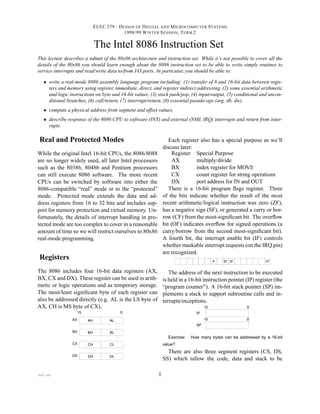
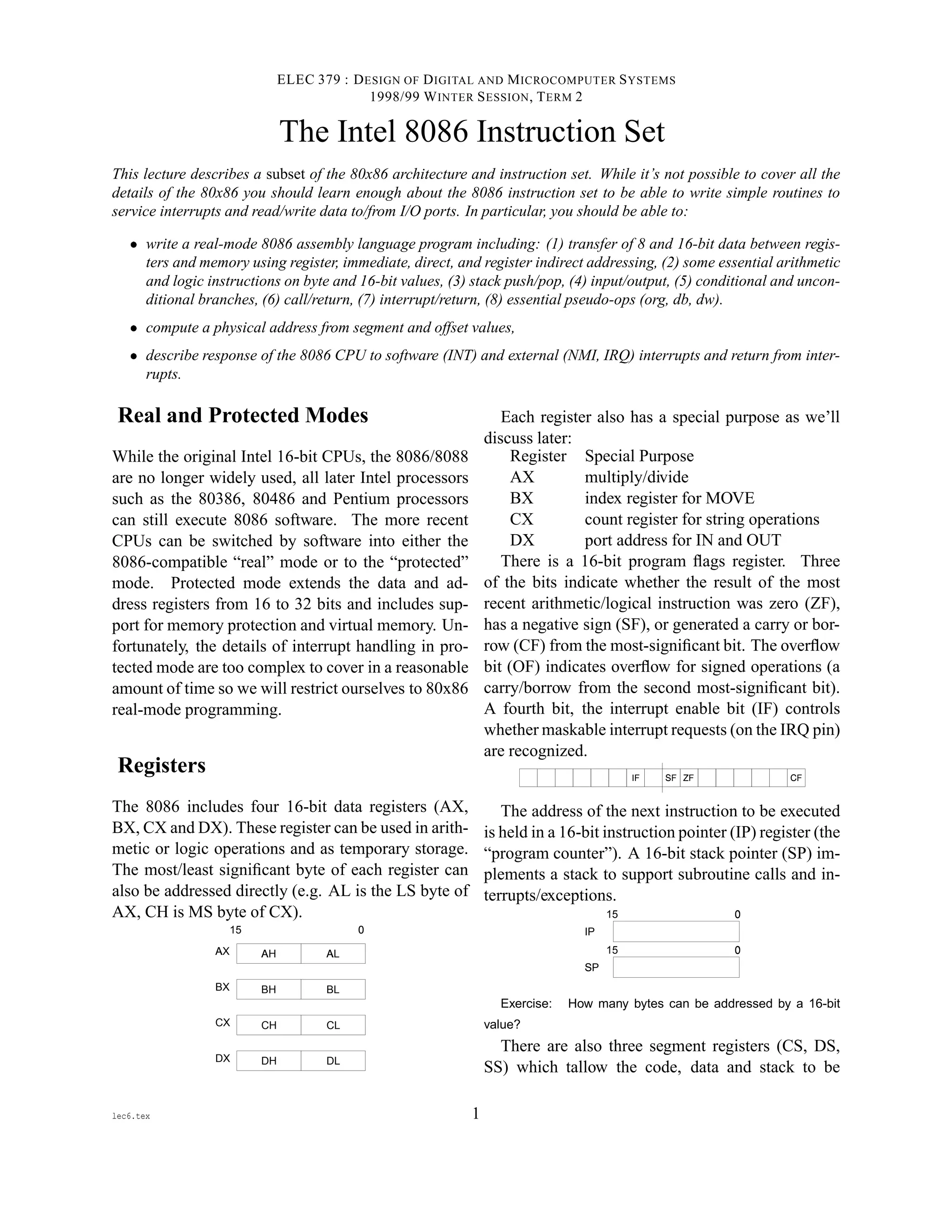
The 8086 includes four 16-bit data registers (AX,
BX, CX and DX). These register can be used in arith-
metic or logic operations and as temporary storage.
The most/least significant byte of each register can
also be addressed directly (e.g. AL is the LS byte of
AX, CH is MS byte of CX).
15 0
¡
AX
¢
BX
CX
DX
AH
¢
AL
¢
BH BL
CH CL
DH DL
Each register also has a special purpose as we’ll
discuss later:
Register Special Purpose
AX multiply/divide
BX index register for MOVE
CX count register for string operations
DX port address for IN and OUT
There is a 16-bit program flags register. Three
of the bits indicate whether the result of the most
recent arithmetic/logical instruction was zero (ZF),
has a negative sign (SF), or generated a carry or bor-
row (CF) from the most-significant bit. The overflow
bit (OF) indicates overflow for signed operations (a
carry/borrow from the second most-significant bit).
A fourth bit, the interrupt enable bit (IF) controls
whether maskable interrupt requests (on the IRQ pin)
are recognized.
CF
£
ZF
¤
SF
¥
IF
The address of the next instruction to be executed
is held in a 16-bit instruction pointer (IP) register (the
“program counter”). A 16-bit stack pointer (SP) im-
plements a stack to support subroutine calls and in-
terrupts/exceptions.
15 0
¡
IP
15 0
¡
SP
¦
Exercise: How many bytes can be addressed by a 16-bit
value?
There are also three segment registers (CS, DS,
SS) which tallow the code, data and stack to be
lec6.tex 1
placed in any three 64 kByte “segments” within
the CPU’s 1 megabyte (20-bit) address space as de-
scribed later.
DS
CS
SS
§
15 0
¨
Instruction Set
We only cover the small subset of the 8088 instruc-
tion set that is essential. In particular, we will not
mention various registers, addressing modes and in-
structions that could often provide faster ways of do-
ing things.
A summary of the 80x86 protected-mode instruc-
tion set is available on the course Web page and
should be printed out if you don’t have another ref-
erence.
Data Transfer
The MOV instruction is used to transfer 8 and 16-bit
data to and from registers. Either the source or des-
tination has to be a register. The other operand can
come from another register, from memory, from im-
mediate data (a value included in the instruction) or
from a memory location “pointed at” by register BX.
For example, if COUNT is the label of a memory lo-
cation the following are possible assembly-language
instructions :
; register: move contents of BX to AX
MOV AX,BX
; direct: move contents of AX to memory
MOV COUNT,AX
; immediate: load CX with the value 240
MOV CX,0F0H
; memory: load CX with the value at
; address 240
MOV CX,[0F0H]
; register indirect: move contents of AL
; to memory location in BX
MOV [BX],AL
Most 80x86 assemblers keep track of the type of
each symbol and require a type “override” when the
symbol is used in a different way. The OFFSET oper-
ator to convert a memory reference to a 16-bit value.
For example:
MOV BX,COUNT ; load the value at location COUNT
MOV BX,OFFSET COUNT ; load the offset of COUNT
16-bit registers can be pushed (the SP is first
decremented by two and then the value stored at SP)
or popped (the value is restored from the memory at
SP and then SP is incremented by 2). For example:
PUSH AX ; push contents of AX
POP BX ; restore into BX
There are some things to note about Intel assembly
language syntax:
©
the order of the operands is destination,source
— the reverse of that used on the 68000!
©
semicolons begin a comment
©
the suffix ’H’ is used to indicate a hexadecimal
constant, if the constant begins with a letter it
must be prefixed with a zero to distinguish it
from a label
©
the suffix ’B’ indicates a binary constant
©
square brackets indicate accesses to memory
©
the size of the transfer (byte or word) is deter-
mined by the size of the destination
Exercise: What is the difference between the operands [CX]
and CX? What about [1000H] and 1000H? Which of the above
can be used as the destination of a MOV instruction? Which of
the above can used as the source?
I/O Operations
The 8086 has separate I/O and memory address
spaces. Values in the I/O space are accessed with
IN and OUT instructions. The port address is loaded
into DX and the data is read/written to/from AL or
AX:
MOV DX,372H ; load DX with port address
OUT DX,AL ; output byte in AL to port
; 372 (hex)
IN AX,DX ; input word to AX
2
Arithmetic/Logic
Arithmetic and logic instructions can be performed
on byte and 16-bit values. The first operand has to
be a register and the result is stored in that register.
; increment BX by 4
ADD BX,4
; subtract 1 from AL
SUB AL,1
; increment BX
INC BX
; compare (subtract and set flags
; but without storing result)
CMP AX,[MAX]
; mask in LS 4 bits of AL
AND AL,0FH
; divide AX by two
SHR AX
; set MS bit of CX
OR CX,8000H
; clear AX
XOR AX,AX
Exercise: Explain how the AND, SHR (shift right), OR and
XOR instructions achieve the results given in the comments
above.
Control Transfer
Conditional jumps transfer control to another address
depending on the values of the flags in the flag reg-
ister. Conditional jumps are restricted to a range of
-128 to +127 bytes from the next instruction while
unconditional jumps can be to any point.
; jump if last result was zero (two values equal)
JZ skip
; jump if carry set (below)
JC neg
; jump on carry not set
JNC smaller
; unconditional jump:
JMP loop
The assembly-language equivalent of an if state-
ment in a high-level language is a CoMPare opera-
tion followed by a conditional jump.
Exercise: What would be the assembly-language equivalent
of the C-language statement if ( a != 0 ) goto LOOP;?
What about if ( a < b ) return ;?
The CALL and RET instructions call and return from
subroutines. The processor pushes IP on the stack
during a CALL instruction and the contents of IP are
popped by the RET instructions. For example:
CALL readchar
...
readchar:
...
RET
Exercise: Write a sequence of a MOVE, a PUSH and a
RET instruction that has the same effect as the instruction JMP
1234H?
Segment/Offset Addressing
Since address registers and address operands are only
16 bits they can only address 64k bytes. In order to
address the 20-bit address range of the 8086, physi-
cal addresses (those that are put on the address bus)
are always formed by adding the values of one of the
segment registers to the 16-bit address to form a 20-
bit address.
The segment registers themselves only contain the
most-significant 16 bits of the 20-bit value that is
contributed by the segment registers. The least sig-
nificant four bits of the segment address are always
zero.
By default, the DS (data segment) is used for
data transfer instructions (e.g. MOV), CS (code
segment) is used with control transfer instructions
(e.g. JMP or CALL), and SS is used with the stack
pointer (e.g. PUSH or to save/restore addresses dur-
ing CALL/RET or INT instructions).
Exercise: If DS contains 0100H, what address will be written
by the instruction MOV [2000H],AL? If CX contains 1122H, SP
contains 1234H, and SS contains 2000H, what memory values
will change and what will be their values when the PUSH CX
instruction is executed?
The use of segment registers reduces the size of
pointers to 16 bits. This reduces the code size but
also restricts the addressing range of a pointer to
64k bytes. Performing address arithmetic within data
structures larger than 64k is awkward. This is the
biggest drawback of the 8086 architecture.
We will restrict ourselves to short programs where
all of the code, data and stack are placed into the
same 64k segment (i.e. CS=DS=SS).
Interrupts and Exceptions
In addition to interrupts caused by external events
(such as an IRQ signal), certain instructions such as
3
a dividing by zero or the INT instruction generate
exceptions.
The 8086 reserves the lower 1024 bytes of mem-
ory for an interrupt vector table. There is one
4-byte vector for each of the 256 possible inter-
rupt/exception numbers. When an interrupt or ex-
ception occurs, the processor: (1) clears the interrupt
flag in the flags register, (2) pushes the flags register,
CS, and IP (in that order), (3) loads IP and CS (in that
order) from the appropriate interrupt vector location,
and (4) transfers control to that location.
For external interrupts (IRQ or NMI) the interrupt
number is read from the data bus during an interrupt
acknowledge bus cycle. For internal interrupts (e.g.
INT instruction) the interrupt number is determined
from the instruction.
The INT instruction allows a program to generate
any of the 256 interrupts. This “software interrupt”
is typically used to access operating system services.
Exercise: MS-DOS programs use the INT 21H instruction to
request operating system services. Where would the address of
the entry point to these DOS services be found?
The CLI and STI instructions clear/set the
interrupt-enable bit in the flags register to dis-
able/enable external interrupts.
The IRET instruction pops the IP, CS and flags reg-
ister values from the stack and thus returns control to
the instruction following the one where interrupt or
exception occurred.
Exercise: What would happen if you used RET instead of
IRET to return from an interrupt?
Pseudo-Ops
A number of assembler directives (“pseudo-ops”) are
also required to write assembly language programs.
ORG specifies the location of code or data within the
segment, DB and DW assemble bytes and words of
constant data respectively.
Example
This is a simple program that demonstrates the main
features of the 8086 instruction set. It uses the INT
operation to invoke MS-DOS to write characters to
the screen.
; Sample 8086 assembly language program. This program
; prints the printable characters in a null-terminated
; string (similar to the unix ("strings" program).
; There is only one "segment" called "code" and the
; linker can assume DS and CS will be set to the right
; values for "code". The code begins at offset 100h
; within the segment "code" (MS-DOS .COM files).
code segment public
assume cs:code,ds:code
org 100h
start:
mov bx,offset msg ; bx points to string
loop:
mov al,[bx] ; load a character into al
cmp al,0 ; see if it’s a zero
jz done ; quit if so
cmp al,32 ; see if it’s printable
jl noprt ; don’t print if not
call printc ; otherwise print it
noprt:
inc bx ; point to next character
jmp loop ; and loop back
done:
int 20h ; return to DOS
; subroutine to print the byte in al
printc:
push ax ; push ax and dx
push dx
mov dl,al ; use DOS to
mov ah,02H ; print character
int 21H
pop dx ; restore ax and dx
pop ax
ret
msg db ’This’,9,31,32,’is’,20H,’a string.’,0
; example of how to reserve memory (not used above):
buf db 128 dup (?) ; 128 uninitialized bytes
code ends
end start
The offset operand is used to tell this assembler
to use the offset of msg from the start of the code
segment.
4

Intrl 8086 instruction set

  • 1.
    ELEC 379 :DESIGN OF DIGITAL AND MICROCOMPUTER SYSTEMS 1998/99 WINTER SESSION, TERM 2 The Intel 8086 Instruction Set This lecture describes a subset of the 80x86 architecture and instruction set. While it’s not possible to cover all the details of the 80x86 you should learn enough about the 8086 instruction set to be able to write simple routines to service interrupts and read/write data to/from I/O ports. In particular, you should be able to:   write a real-mode 8086 assembly language program including: (1) transfer of 8 and 16-bit data between regis- ters and memory using register, immediate, direct, and register indirect addressing, (2) some essential arithmetic and logic instructions on byte and 16-bit values, (3) stack push/pop, (4) input/output, (5) conditional and uncon- ditional branches, (6) call/return, (7) interrupt/return, (8) essential pseudo-ops (org, db, dw).   compute a physical address from segment and offset values,   describe response of the 8086 CPU to software (INT) and external (NMI, IRQ) interrupts and return from inter- rupts. Real and Protected Modes While the original Intel 16-bit CPUs, the 8086/8088 are no longer widely used, all later Intel processors such as the 80386, 80486 and Pentium processors can still execute 8086 software. The more recent CPUs can be switched by software into either the 8086-compatible “real” mode or to the “protected” mode. Protected mode extends the data and ad- dress registers from 16 to 32 bits and includes sup- port for memory protection and virtual memory. Un- fortunately, the details of interrupt handling in pro- tected mode are too complex to cover in a reasonable amount of time so we will restrict ourselves to 80x86 real-mode programming. Registers The 8086 includes four 16-bit data registers (AX, BX, CX and DX). These register can be used in arith- metic or logic operations and as temporary storage. The most/least significant byte of each register can also be addressed directly (e.g. AL is the LS byte of AX, CH is MS byte of CX). 15 0 ¡ AX ¢ BX CX DX AH ¢ AL ¢ BH BL CH CL DH DL Each register also has a special purpose as we’ll discuss later: Register Special Purpose AX multiply/divide BX index register for MOVE CX count register for string operations DX port address for IN and OUT There is a 16-bit program flags register. Three of the bits indicate whether the result of the most recent arithmetic/logical instruction was zero (ZF), has a negative sign (SF), or generated a carry or bor- row (CF) from the most-significant bit. The overflow bit (OF) indicates overflow for signed operations (a carry/borrow from the second most-significant bit). A fourth bit, the interrupt enable bit (IF) controls whether maskable interrupt requests (on the IRQ pin) are recognized. CF £ ZF ¤ SF ¥ IF The address of the next instruction to be executed is held in a 16-bit instruction pointer (IP) register (the “program counter”). A 16-bit stack pointer (SP) im- plements a stack to support subroutine calls and in- terrupts/exceptions. 15 0 ¡ IP 15 0 ¡ SP ¦ Exercise: How many bytes can be addressed by a 16-bit value? There are also three segment registers (CS, DS, SS) which tallow the code, data and stack to be lec6.tex 1
  • 2.
    placed in anythree 64 kByte “segments” within the CPU’s 1 megabyte (20-bit) address space as de- scribed later. DS CS SS § 15 0 ¨ Instruction Set We only cover the small subset of the 8088 instruc- tion set that is essential. In particular, we will not mention various registers, addressing modes and in- structions that could often provide faster ways of do- ing things. A summary of the 80x86 protected-mode instruc- tion set is available on the course Web page and should be printed out if you don’t have another ref- erence. Data Transfer The MOV instruction is used to transfer 8 and 16-bit data to and from registers. Either the source or des- tination has to be a register. The other operand can come from another register, from memory, from im- mediate data (a value included in the instruction) or from a memory location “pointed at” by register BX. For example, if COUNT is the label of a memory lo- cation the following are possible assembly-language instructions : ; register: move contents of BX to AX MOV AX,BX ; direct: move contents of AX to memory MOV COUNT,AX ; immediate: load CX with the value 240 MOV CX,0F0H ; memory: load CX with the value at ; address 240 MOV CX,[0F0H] ; register indirect: move contents of AL ; to memory location in BX MOV [BX],AL Most 80x86 assemblers keep track of the type of each symbol and require a type “override” when the symbol is used in a different way. The OFFSET oper- ator to convert a memory reference to a 16-bit value. For example: MOV BX,COUNT ; load the value at location COUNT MOV BX,OFFSET COUNT ; load the offset of COUNT 16-bit registers can be pushed (the SP is first decremented by two and then the value stored at SP) or popped (the value is restored from the memory at SP and then SP is incremented by 2). For example: PUSH AX ; push contents of AX POP BX ; restore into BX There are some things to note about Intel assembly language syntax: © the order of the operands is destination,source — the reverse of that used on the 68000! © semicolons begin a comment © the suffix ’H’ is used to indicate a hexadecimal constant, if the constant begins with a letter it must be prefixed with a zero to distinguish it from a label © the suffix ’B’ indicates a binary constant © square brackets indicate accesses to memory © the size of the transfer (byte or word) is deter- mined by the size of the destination Exercise: What is the difference between the operands [CX] and CX? What about [1000H] and 1000H? Which of the above can be used as the destination of a MOV instruction? Which of the above can used as the source? I/O Operations The 8086 has separate I/O and memory address spaces. Values in the I/O space are accessed with IN and OUT instructions. The port address is loaded into DX and the data is read/written to/from AL or AX: MOV DX,372H ; load DX with port address OUT DX,AL ; output byte in AL to port ; 372 (hex) IN AX,DX ; input word to AX 2
  • 3.
    Arithmetic/Logic Arithmetic and logicinstructions can be performed on byte and 16-bit values. The first operand has to be a register and the result is stored in that register. ; increment BX by 4 ADD BX,4 ; subtract 1 from AL SUB AL,1 ; increment BX INC BX ; compare (subtract and set flags ; but without storing result) CMP AX,[MAX] ; mask in LS 4 bits of AL AND AL,0FH ; divide AX by two SHR AX ; set MS bit of CX OR CX,8000H ; clear AX XOR AX,AX Exercise: Explain how the AND, SHR (shift right), OR and XOR instructions achieve the results given in the comments above. Control Transfer Conditional jumps transfer control to another address depending on the values of the flags in the flag reg- ister. Conditional jumps are restricted to a range of -128 to +127 bytes from the next instruction while unconditional jumps can be to any point. ; jump if last result was zero (two values equal) JZ skip ; jump if carry set (below) JC neg ; jump on carry not set JNC smaller ; unconditional jump: JMP loop The assembly-language equivalent of an if state- ment in a high-level language is a CoMPare opera- tion followed by a conditional jump. Exercise: What would be the assembly-language equivalent of the C-language statement if ( a != 0 ) goto LOOP;? What about if ( a < b ) return ;? The CALL and RET instructions call and return from subroutines. The processor pushes IP on the stack during a CALL instruction and the contents of IP are popped by the RET instructions. For example: CALL readchar ... readchar: ... RET Exercise: Write a sequence of a MOVE, a PUSH and a RET instruction that has the same effect as the instruction JMP 1234H? Segment/Offset Addressing Since address registers and address operands are only 16 bits they can only address 64k bytes. In order to address the 20-bit address range of the 8086, physi- cal addresses (those that are put on the address bus) are always formed by adding the values of one of the segment registers to the 16-bit address to form a 20- bit address. The segment registers themselves only contain the most-significant 16 bits of the 20-bit value that is contributed by the segment registers. The least sig- nificant four bits of the segment address are always zero. By default, the DS (data segment) is used for data transfer instructions (e.g. MOV), CS (code segment) is used with control transfer instructions (e.g. JMP or CALL), and SS is used with the stack pointer (e.g. PUSH or to save/restore addresses dur- ing CALL/RET or INT instructions). Exercise: If DS contains 0100H, what address will be written by the instruction MOV [2000H],AL? If CX contains 1122H, SP contains 1234H, and SS contains 2000H, what memory values will change and what will be their values when the PUSH CX instruction is executed? The use of segment registers reduces the size of pointers to 16 bits. This reduces the code size but also restricts the addressing range of a pointer to 64k bytes. Performing address arithmetic within data structures larger than 64k is awkward. This is the biggest drawback of the 8086 architecture. We will restrict ourselves to short programs where all of the code, data and stack are placed into the same 64k segment (i.e. CS=DS=SS). Interrupts and Exceptions In addition to interrupts caused by external events (such as an IRQ signal), certain instructions such as 3
  • 4.
    a dividing byzero or the INT instruction generate exceptions. The 8086 reserves the lower 1024 bytes of mem- ory for an interrupt vector table. There is one 4-byte vector for each of the 256 possible inter- rupt/exception numbers. When an interrupt or ex- ception occurs, the processor: (1) clears the interrupt flag in the flags register, (2) pushes the flags register, CS, and IP (in that order), (3) loads IP and CS (in that order) from the appropriate interrupt vector location, and (4) transfers control to that location. For external interrupts (IRQ or NMI) the interrupt number is read from the data bus during an interrupt acknowledge bus cycle. For internal interrupts (e.g. INT instruction) the interrupt number is determined from the instruction. The INT instruction allows a program to generate any of the 256 interrupts. This “software interrupt” is typically used to access operating system services. Exercise: MS-DOS programs use the INT 21H instruction to request operating system services. Where would the address of the entry point to these DOS services be found? The CLI and STI instructions clear/set the interrupt-enable bit in the flags register to dis- able/enable external interrupts. The IRET instruction pops the IP, CS and flags reg- ister values from the stack and thus returns control to the instruction following the one where interrupt or exception occurred. Exercise: What would happen if you used RET instead of IRET to return from an interrupt? Pseudo-Ops A number of assembler directives (“pseudo-ops”) are also required to write assembly language programs. ORG specifies the location of code or data within the segment, DB and DW assemble bytes and words of constant data respectively. Example This is a simple program that demonstrates the main features of the 8086 instruction set. It uses the INT operation to invoke MS-DOS to write characters to the screen. ; Sample 8086 assembly language program. This program ; prints the printable characters in a null-terminated ; string (similar to the unix ("strings" program). ; There is only one "segment" called "code" and the ; linker can assume DS and CS will be set to the right ; values for "code". The code begins at offset 100h ; within the segment "code" (MS-DOS .COM files). code segment public assume cs:code,ds:code org 100h start: mov bx,offset msg ; bx points to string loop: mov al,[bx] ; load a character into al cmp al,0 ; see if it’s a zero jz done ; quit if so cmp al,32 ; see if it’s printable jl noprt ; don’t print if not call printc ; otherwise print it noprt: inc bx ; point to next character jmp loop ; and loop back done: int 20h ; return to DOS ; subroutine to print the byte in al printc: push ax ; push ax and dx push dx mov dl,al ; use DOS to mov ah,02H ; print character int 21H pop dx ; restore ax and dx pop ax ret msg db ’This’,9,31,32,’is’,20H,’a string.’,0 ; example of how to reserve memory (not used above): buf db 128 dup (?) ; 128 uninitialized bytes code ends end start The offset operand is used to tell this assembler to use the offset of msg from the start of the code segment. 4