Integrating Technology, Higher-Order Thinking, and Student-Centered Learning Doug Adams ALTEC [email_address]
Description This workshop is designed to expand awareness and understanding of the use of technology for teaching and student learning. Participants will explore technology resources that support authentic,  student-centered learning  utilizing  higher-order thinking skills . Using a variety of free Web-based tools, participants will learn how to integrate  project-based learning  activities that support  differentiated instruction  to meet the needs of all learners.
LoTi Connection Levels of Teaching Innovation http:// loticonnection.com   Free online survey New survey in 2008 Not validated Not comparable to old survey Classroom observation tools
Agenda 21 st  Century Skills Higher Order Thinking Questioning Complex Thinking Strategies Authentic Assessment Engaged Learning Thinking Tools Lesson Plan Enrichment
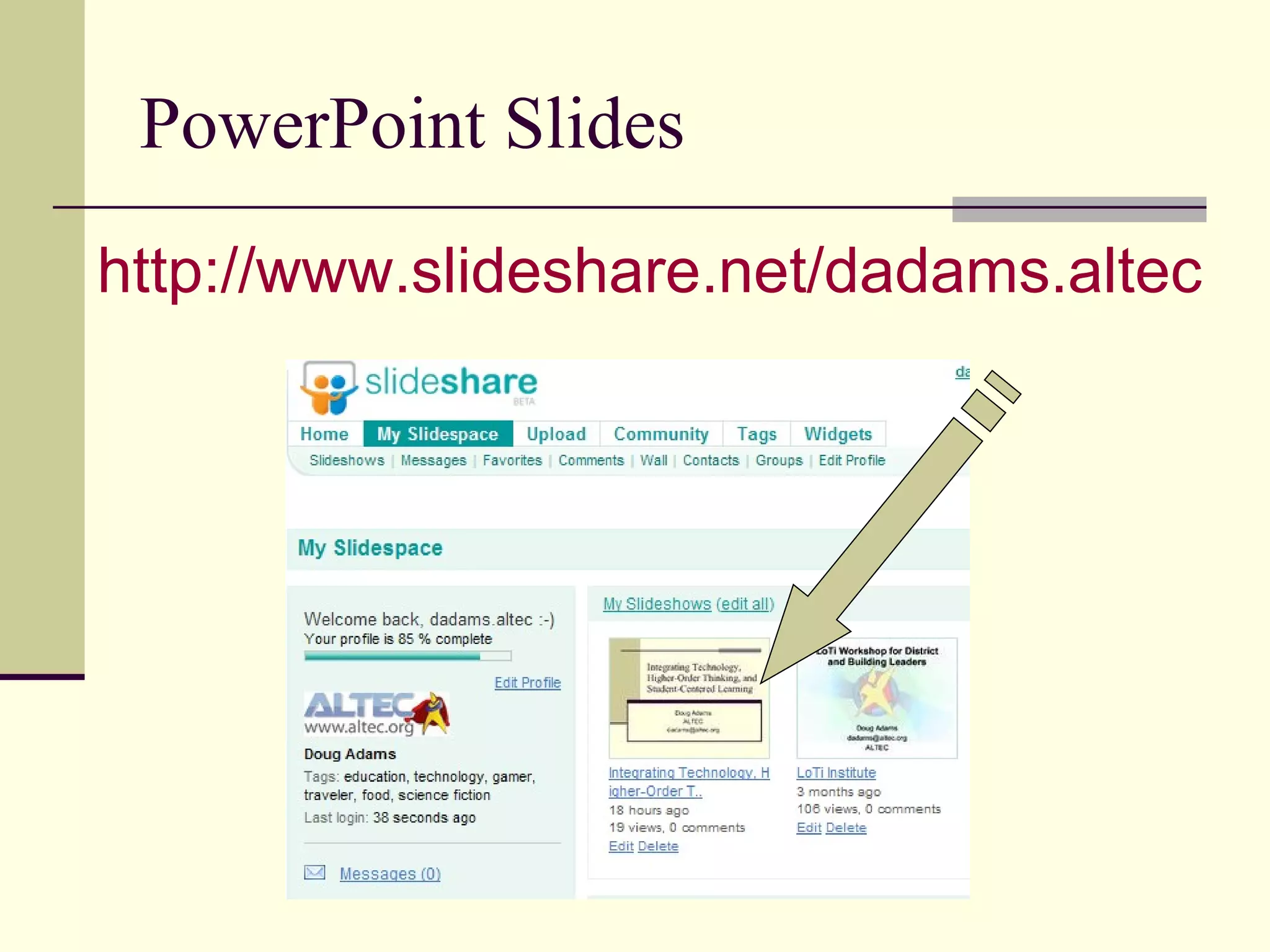
PowerPoint Slides http://www.slideshare.net/dadams.altec
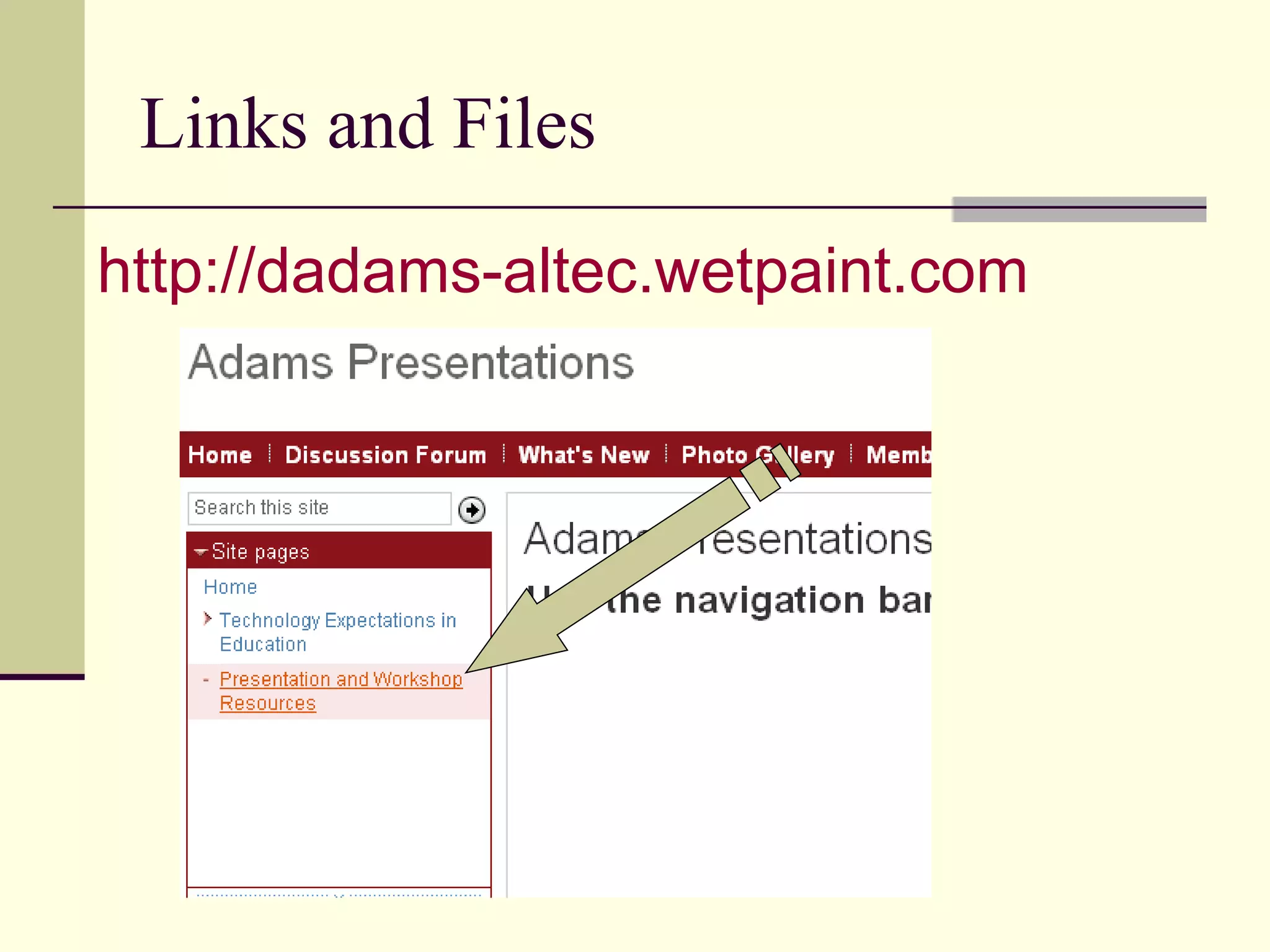
Links and Files http://dadams- altec.wetpaint.com
 
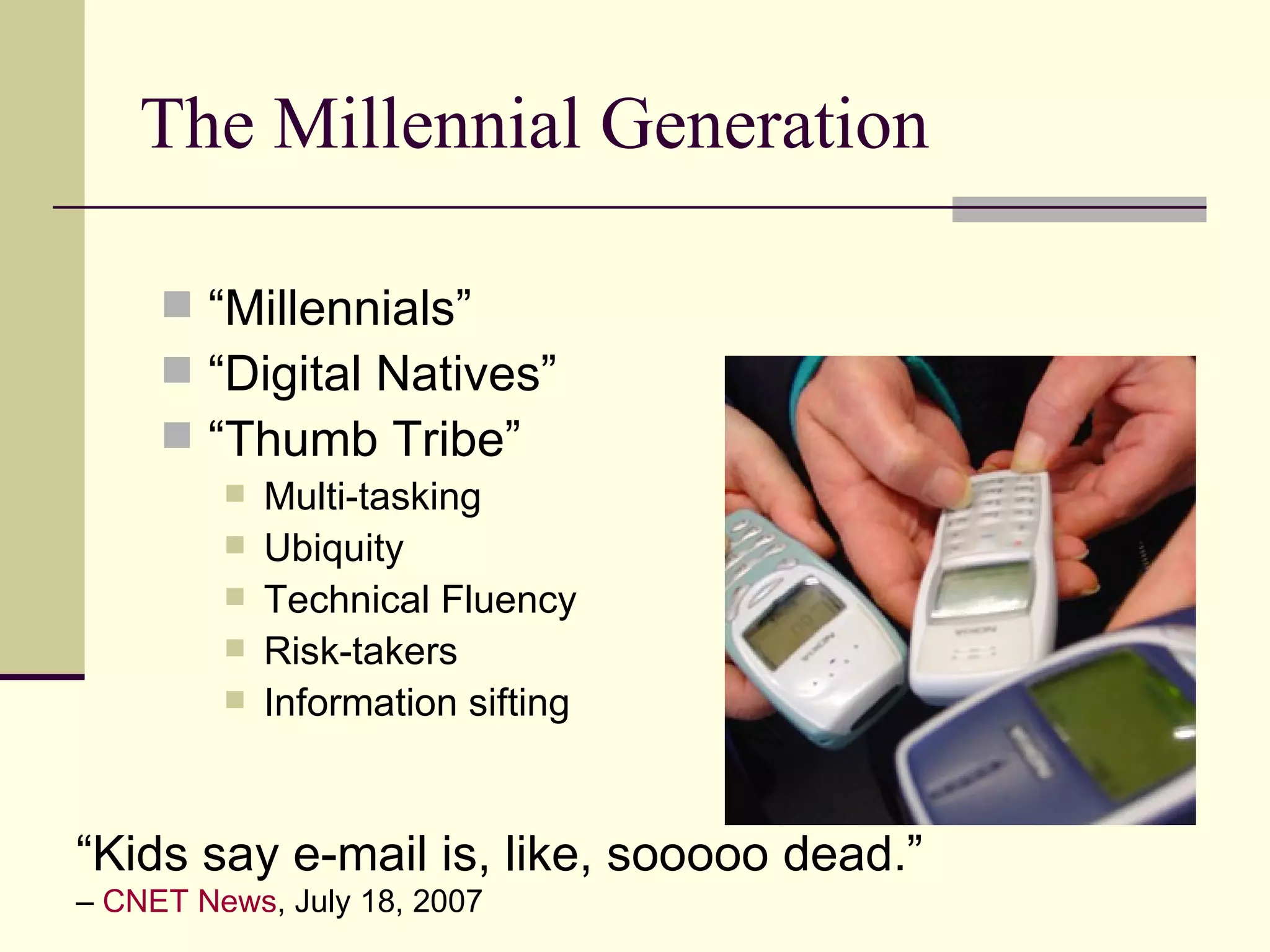
The Millennial Generation “Millennials” “Digital Natives” “Thumb Tribe” Multi-tasking Ubiquity Technical Fluency Risk-takers Information sifting “ Kids say e-mail is, like, sooooo dead.”   –  CNET News , July 18, 2007
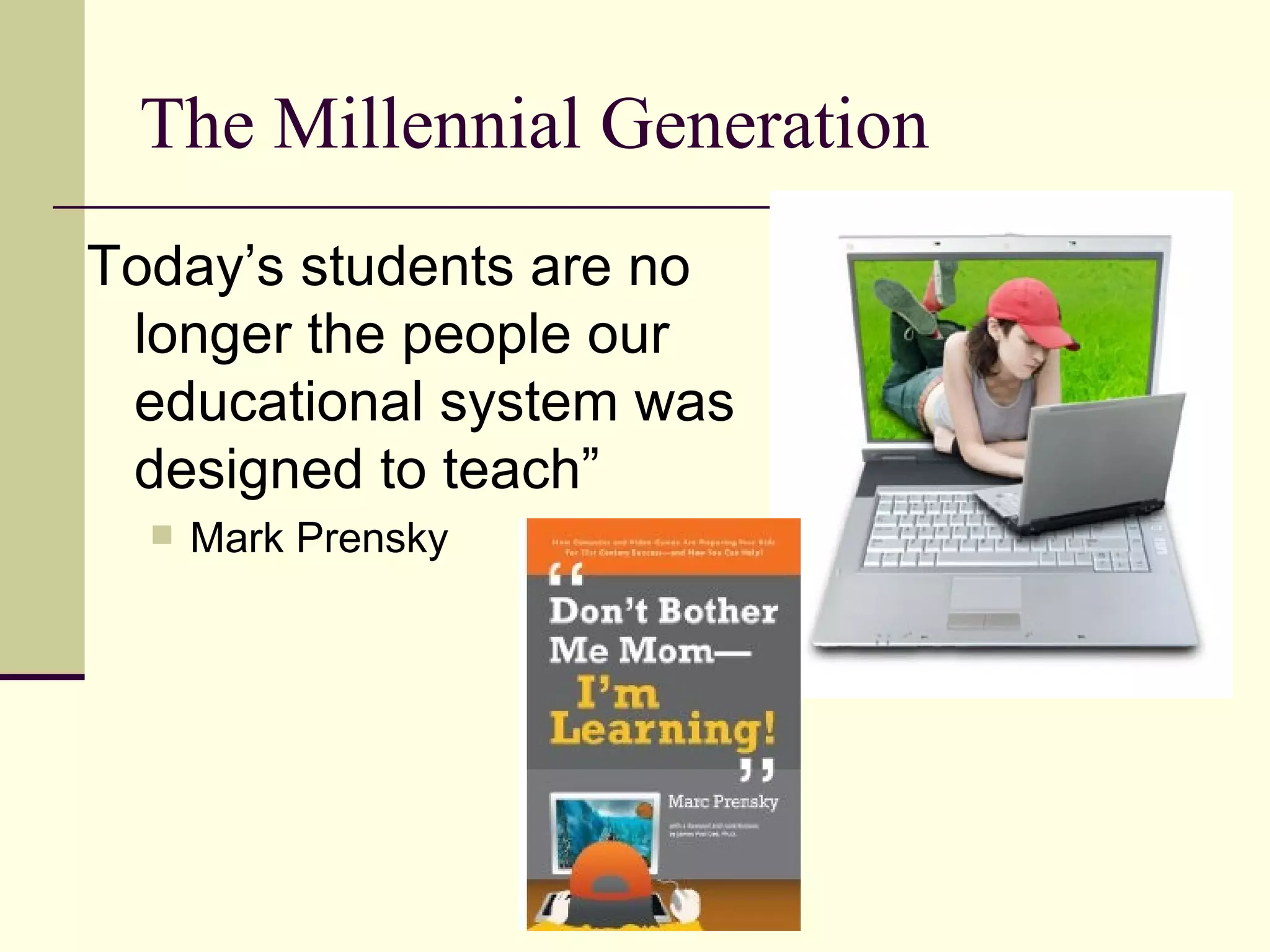
The Millennial Generation Today’s students are no longer the people our educational system was designed to teach” Mark Prensky
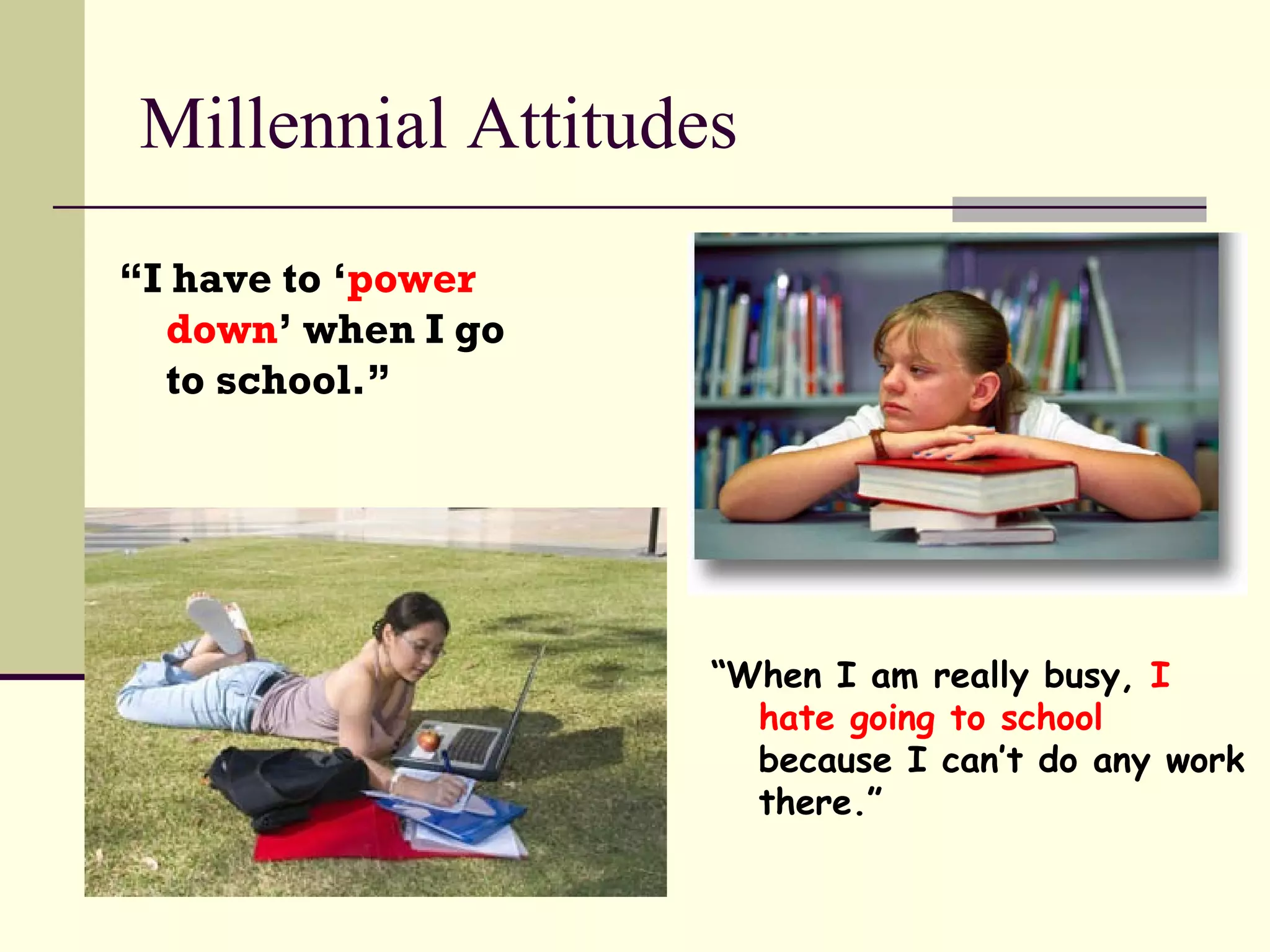
Millennial Attitudes “ I have to ‘ power down ’ when I go  to school.” “ When I am really busy,  I hate going to school  because I can’t do any work there.”
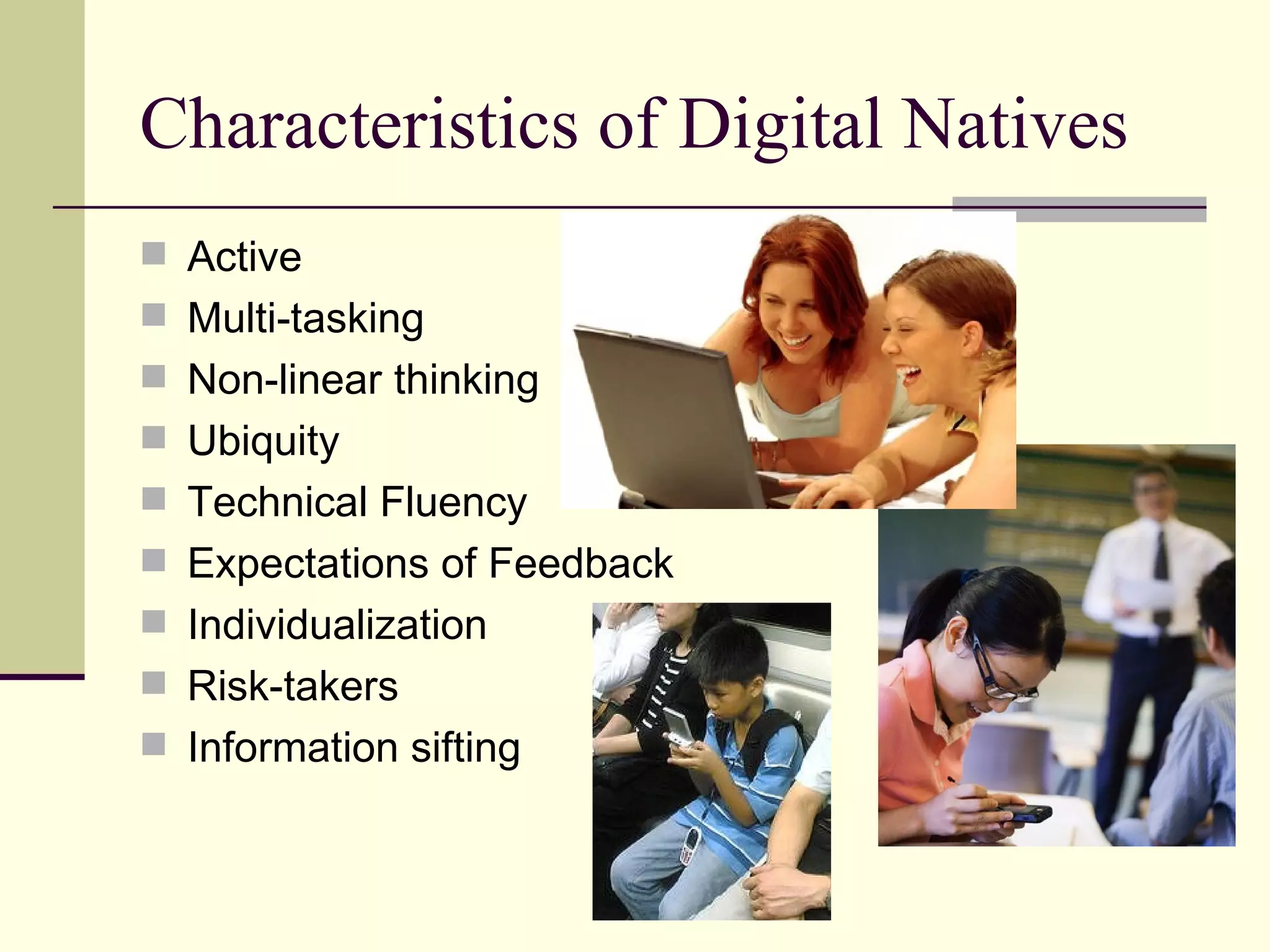
Characteristics of Digital Natives Active Multi-tasking Non-linear thinking Ubiquity Technical Fluency Expectations of Feedback Individualization Risk-takers Information sifting
Brain Research The brain developed to solve problems  related to surviving in an unstable outdoor environment that occur in near constant motion.  John Medina,  Brain Rules
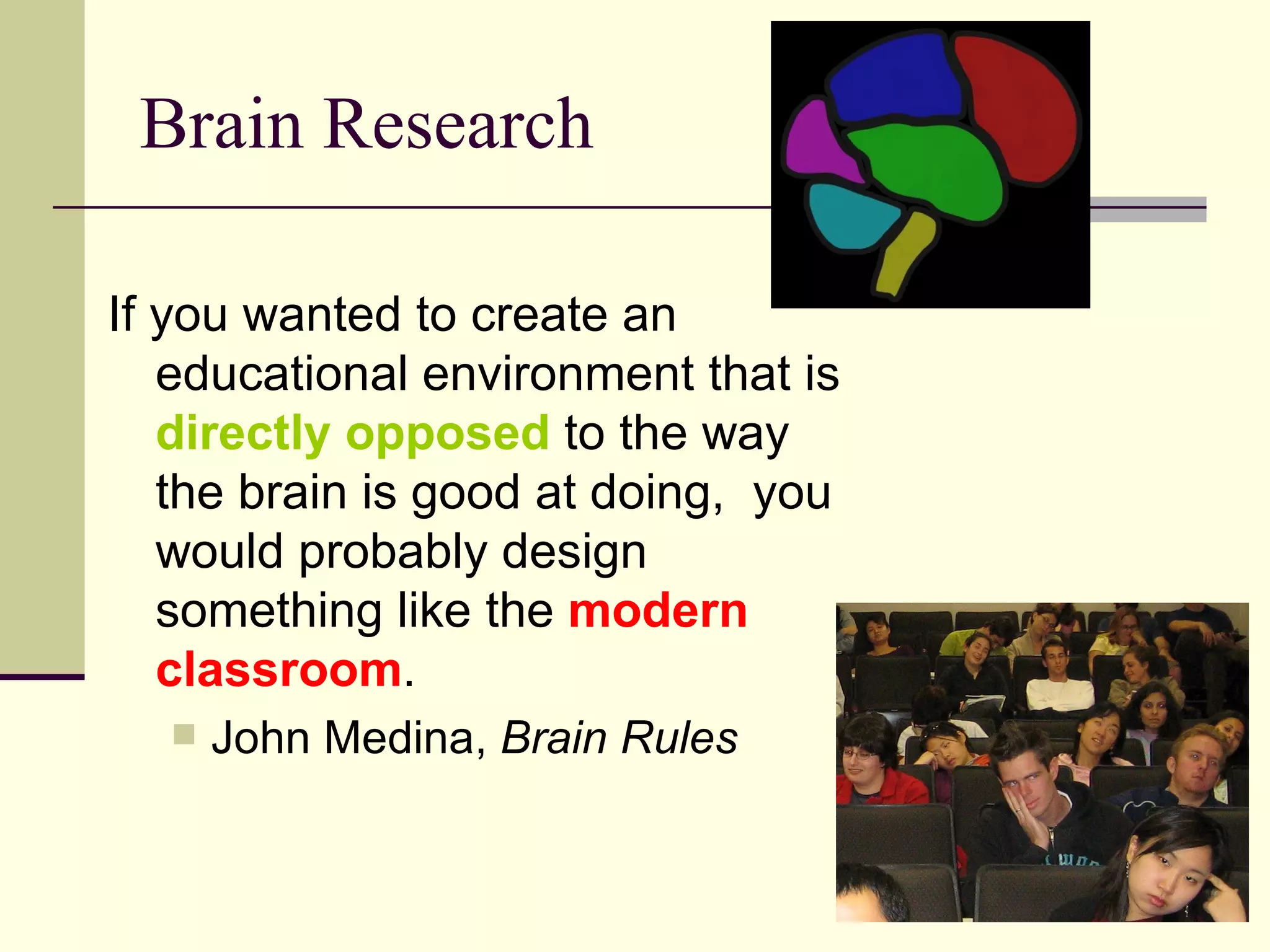
Brain Research If you wanted to create an educational environment that is  directly opposed  to the way the brain is good at doing,  you would probably design something like the  modern classroom . John Medina,  Brain Rules
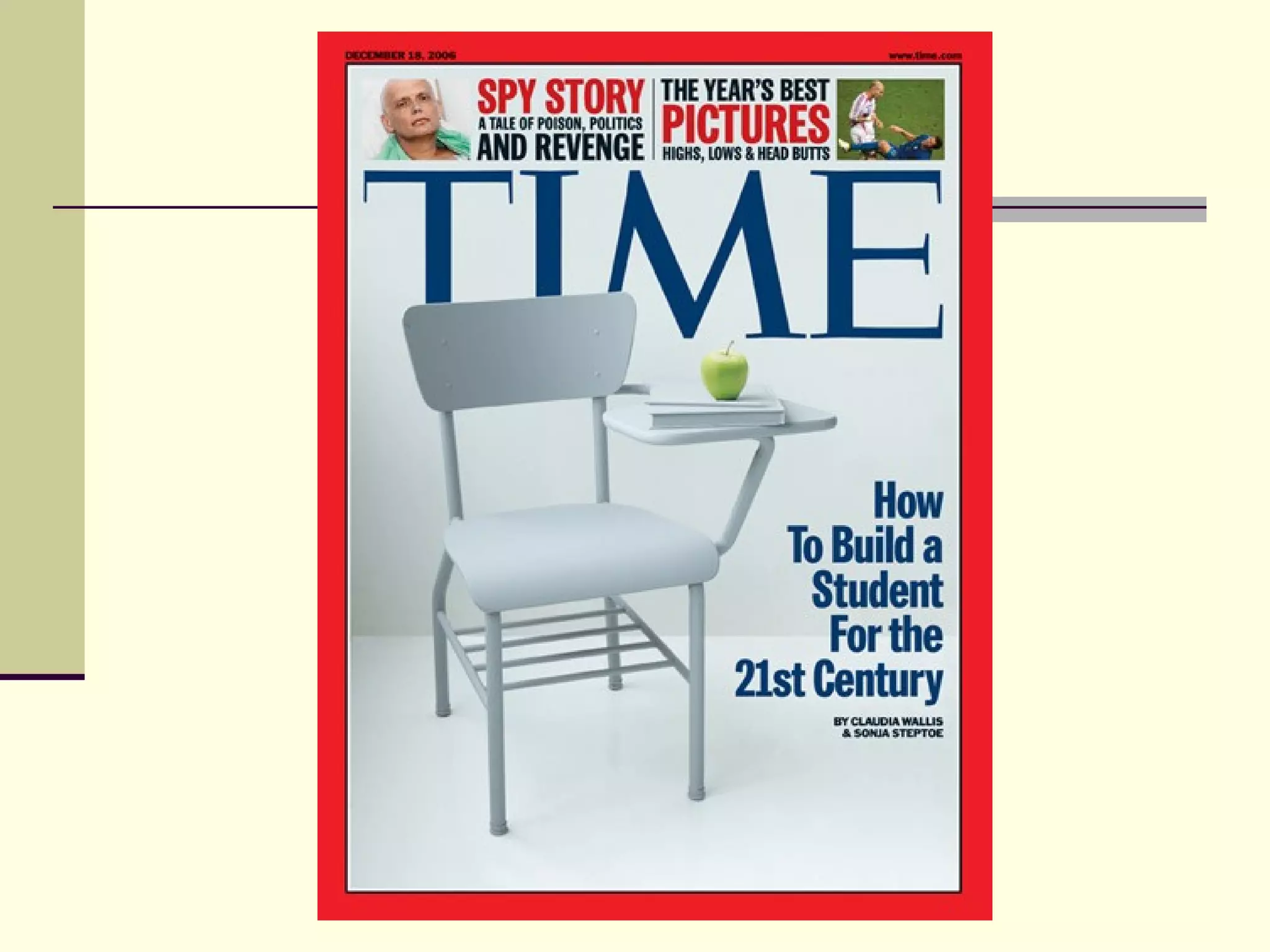
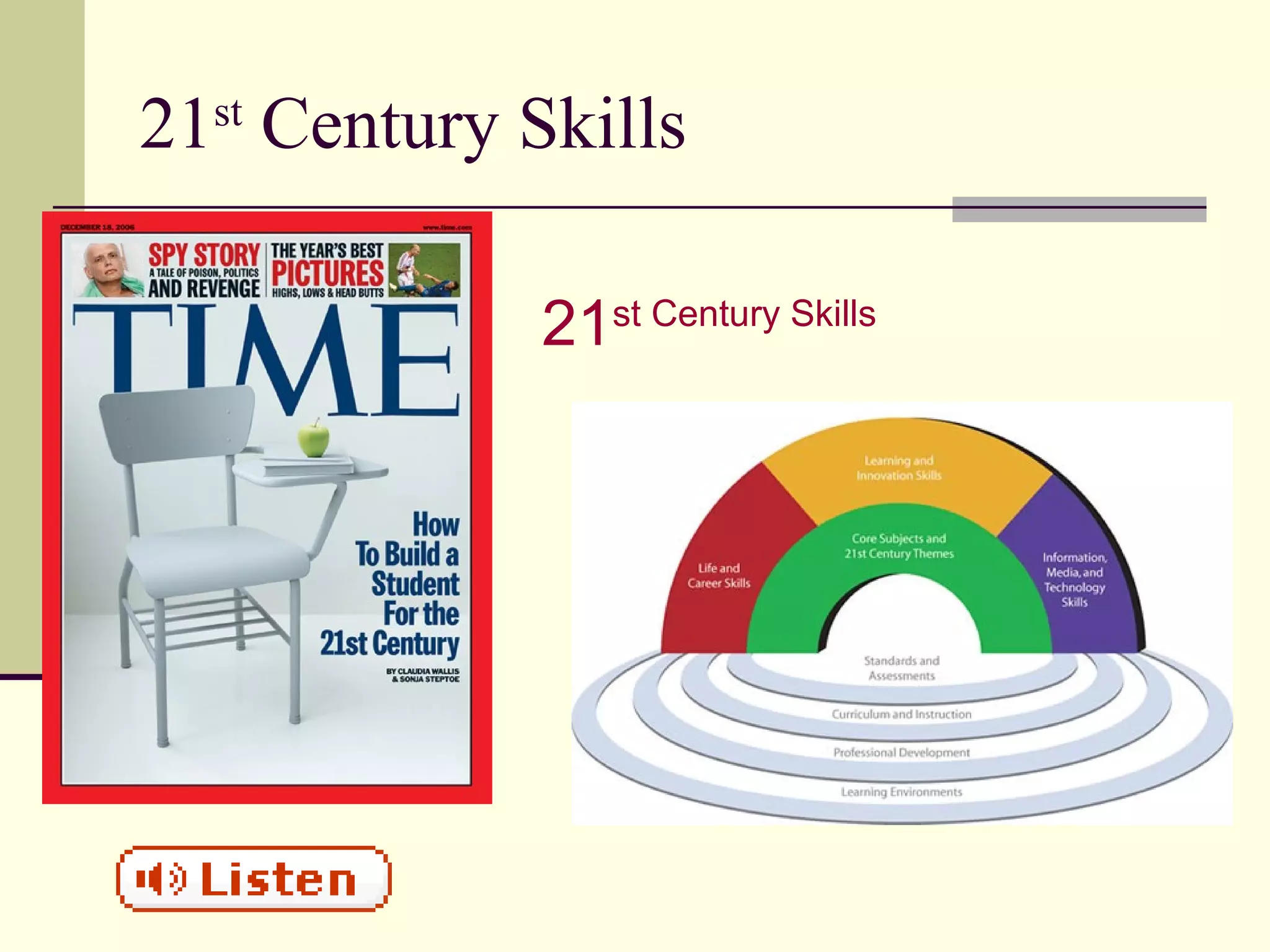
21 st  Century Skills 21 st  Century Skills
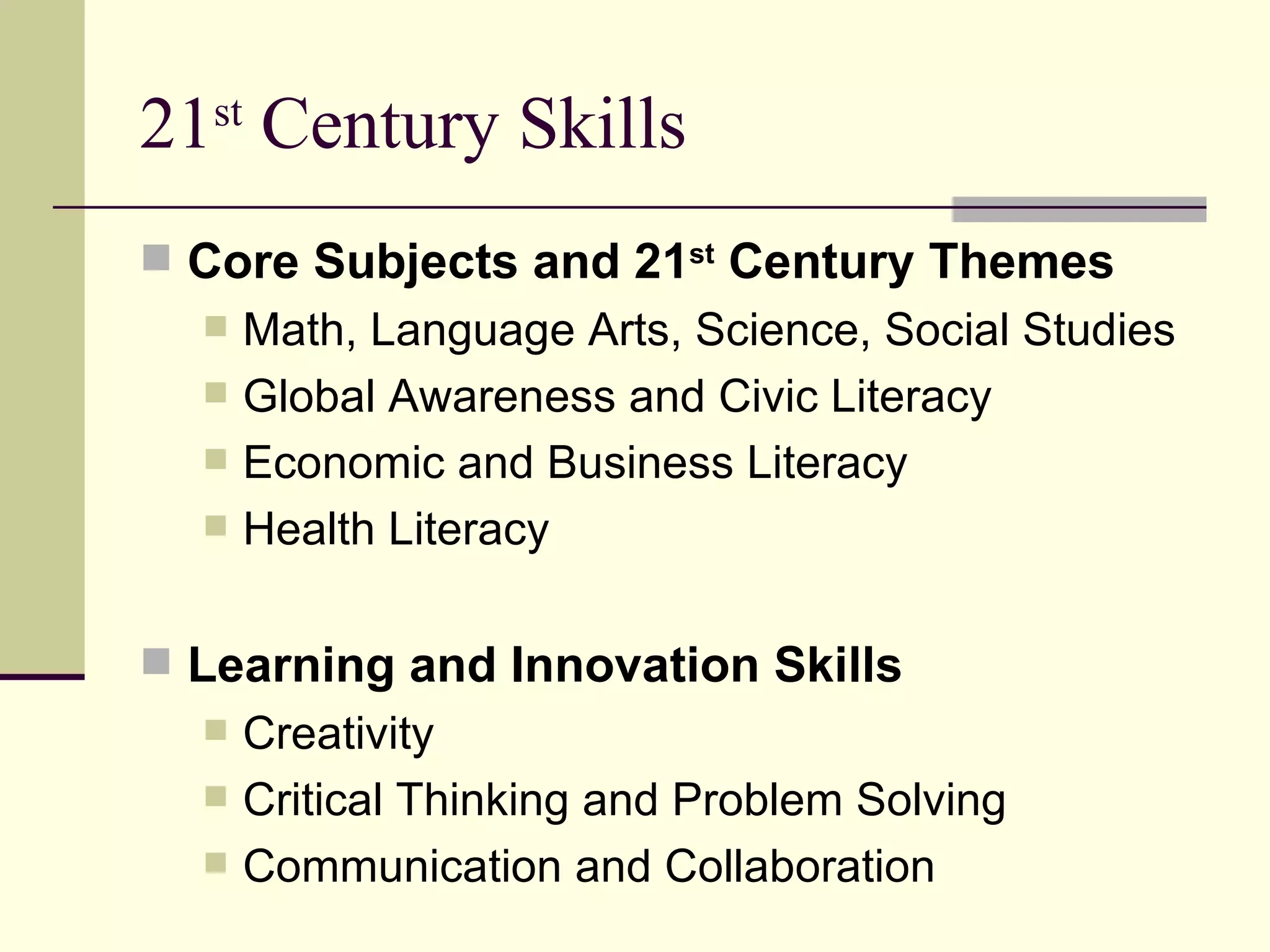
21 st  Century Skills Core Subjects and 21 st  Century Themes Math, Language Arts, Science, Social Studies Global Awareness and Civic Literacy Economic and Business Literacy Health Literacy Learning and Innovation Skills Creativity Critical Thinking and Problem Solving Communication and Collaboration
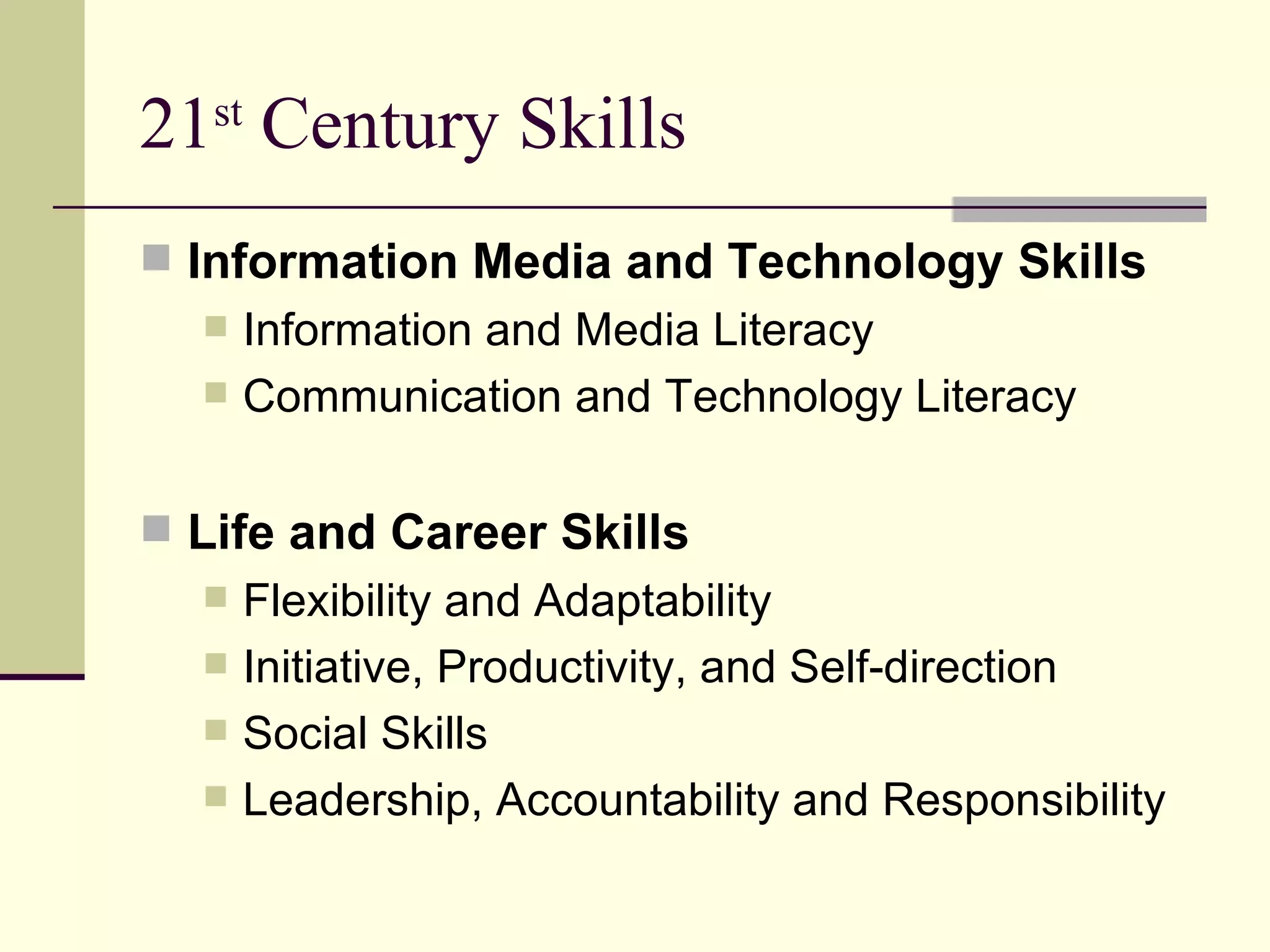
21 st  Century Skills Information Media and Technology Skills Information and Media Literacy Communication and Technology Literacy Life and Career Skills Flexibility and Adaptability Initiative, Productivity, and Self-direction Social Skills Leadership, Accountability and Responsibility
Visual Ranking and 21 st  C Skills Intel’s Education Page http://intel.com/education K-12 Teaching Tools Visual Ranking Tool Click Student Log-In [email_address] Team ID Team Password
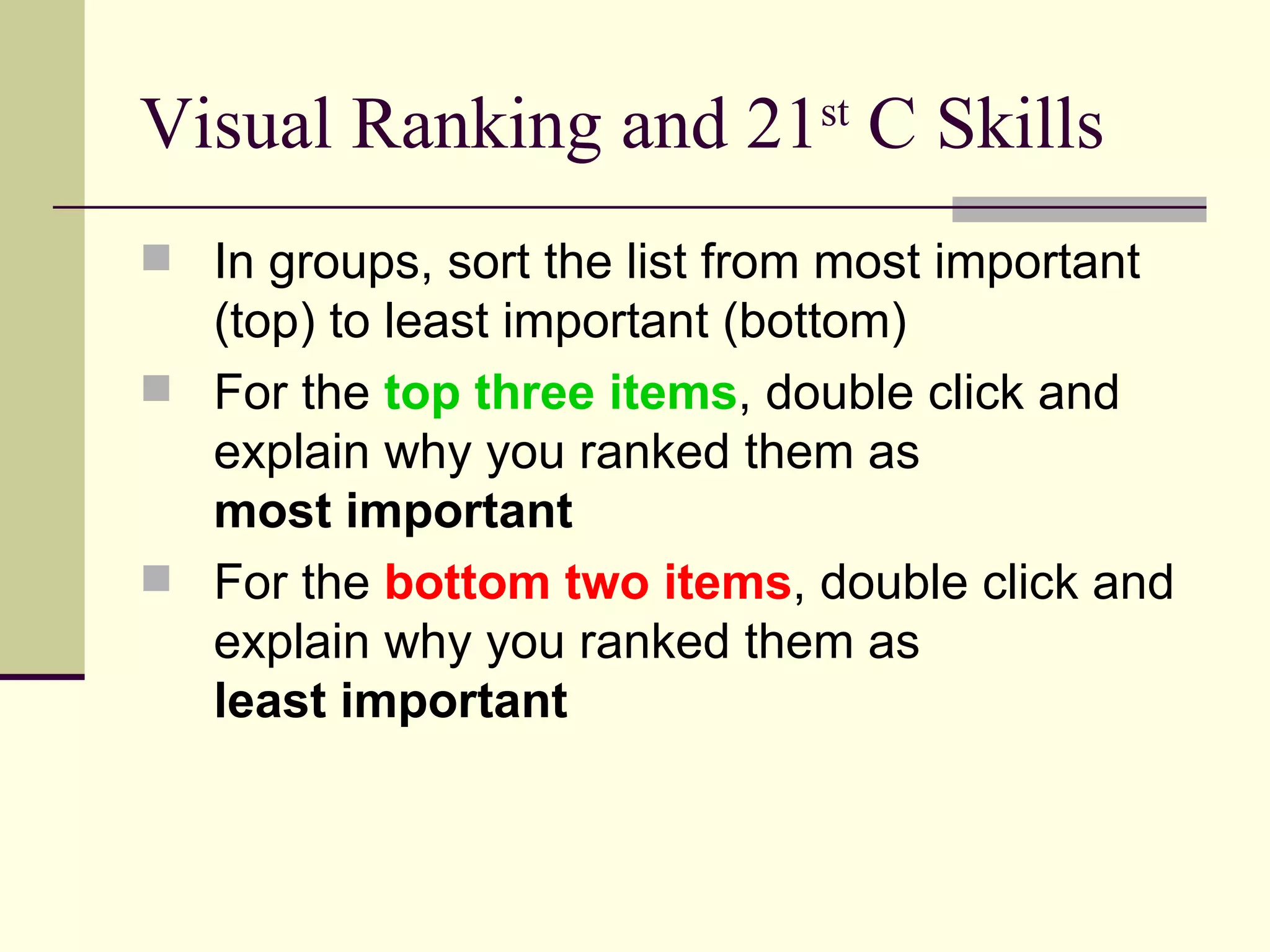
Visual Ranking and 21 st  C Skills In groups, sort the list from most important (top) to least important (bottom) For the  top three items , double click and explain why you ranked them as  most important For the  bottom two items , double click and explain why you ranked them as  least important
Next activity! As you are watching the movie clip, write questions you might ask On a test To the characters To the actors/writers/producer One question per Post-it note
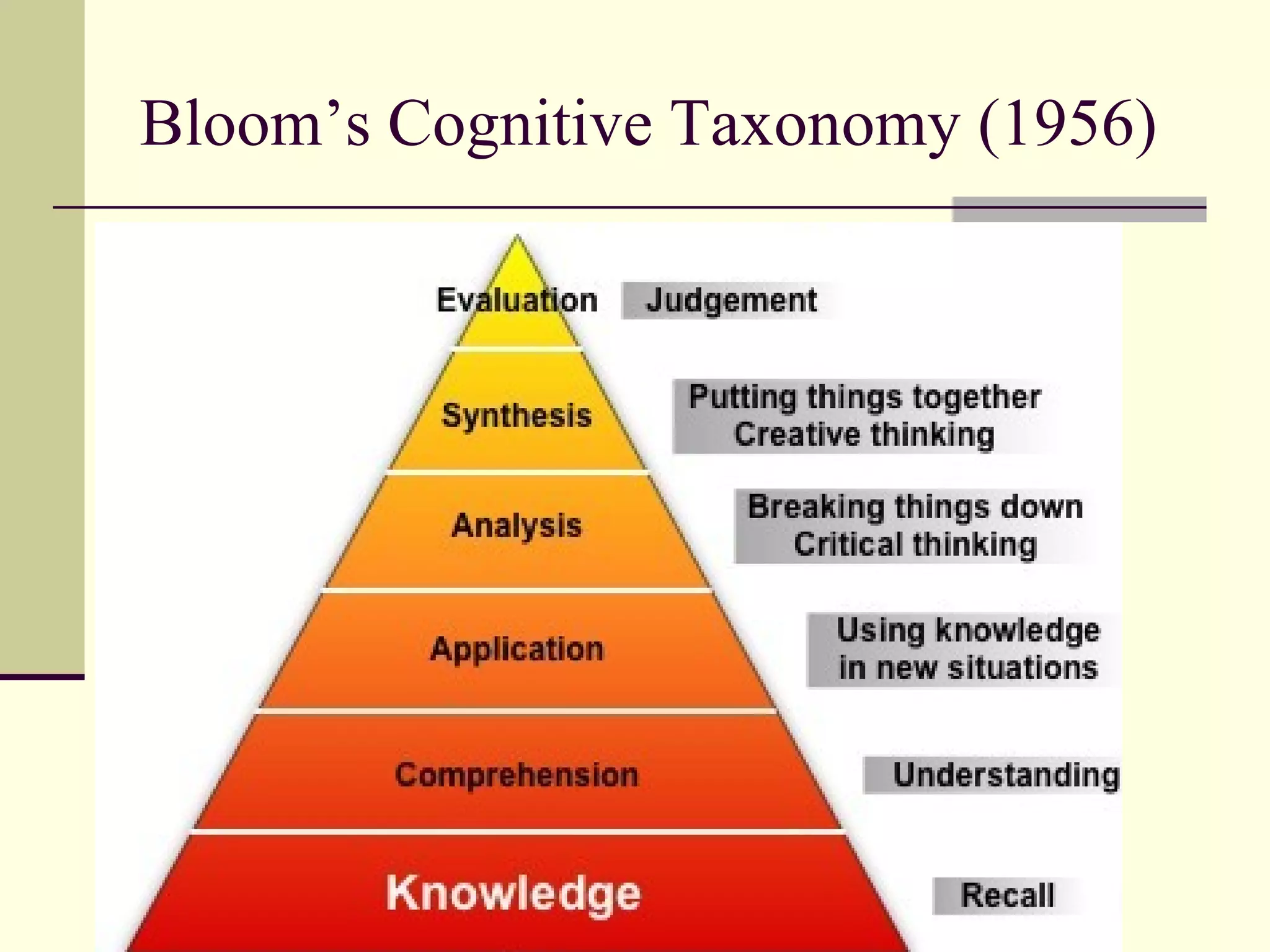
Bloom’s Cognitive Taxonomy (1956)
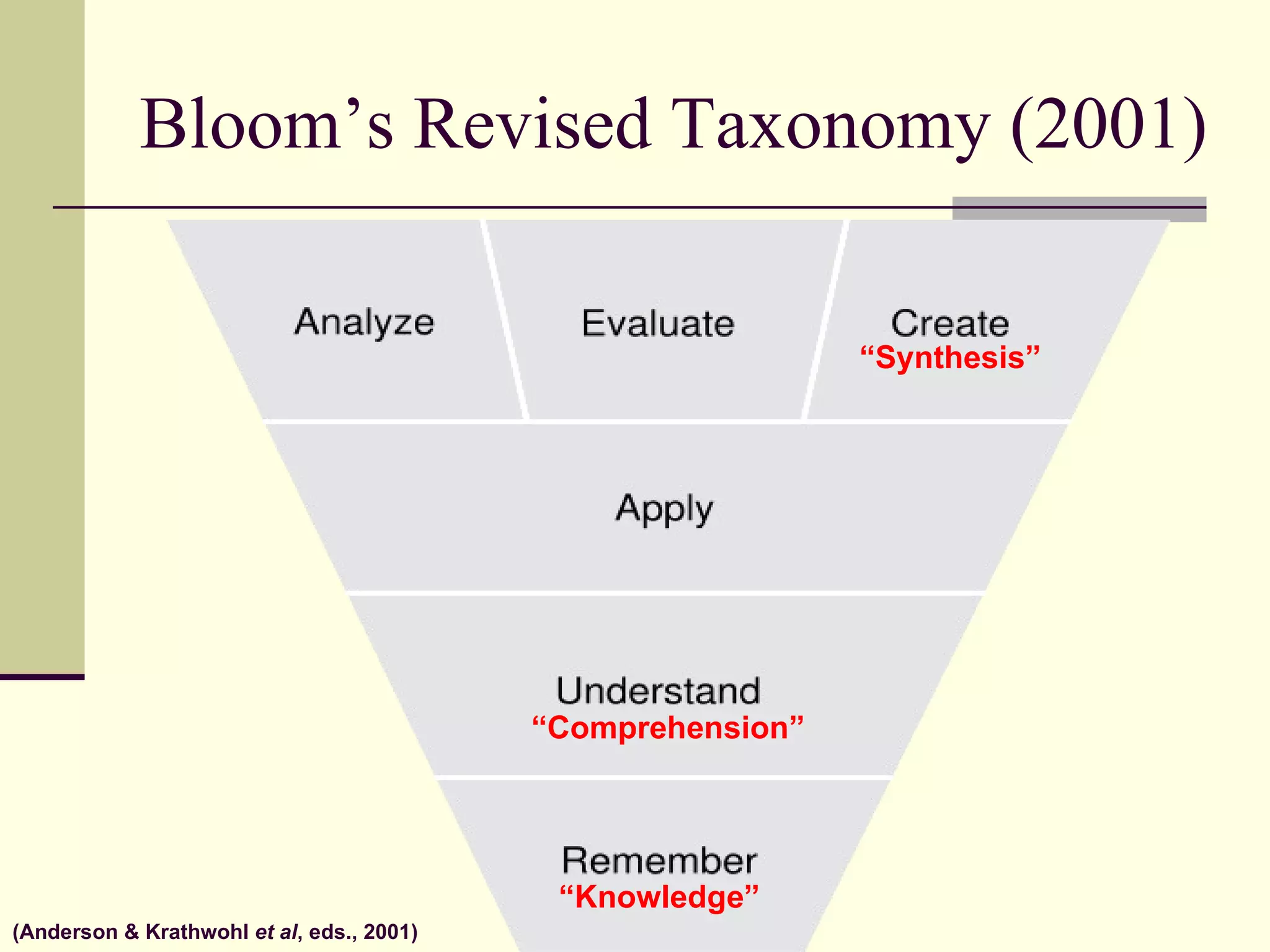
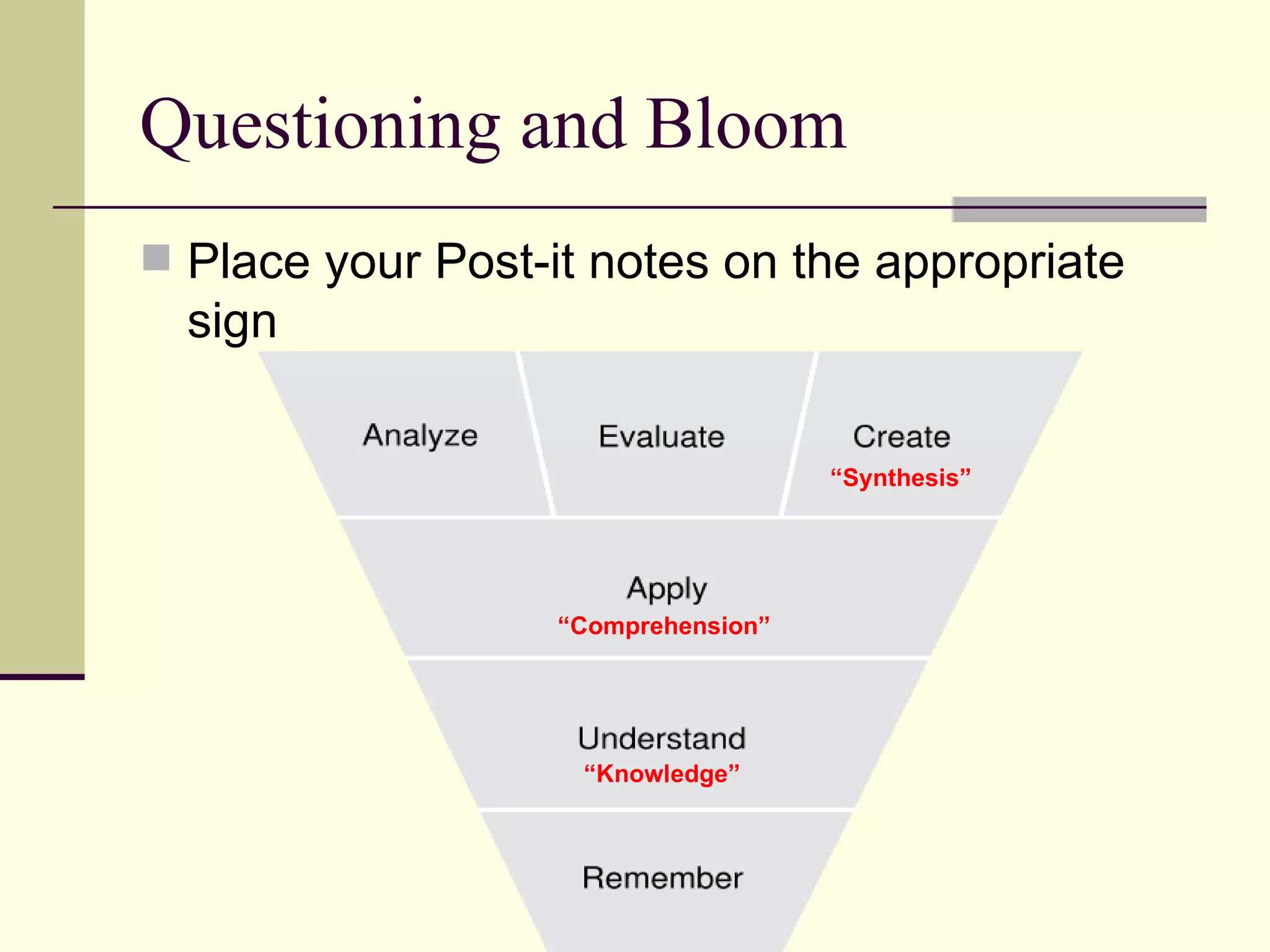
Bloom’s Revised Taxonomy (2001) (Anderson & Krathwohl  et al , eds., 2001) “ Knowledge” “ Comprehension” “ Synthesis”
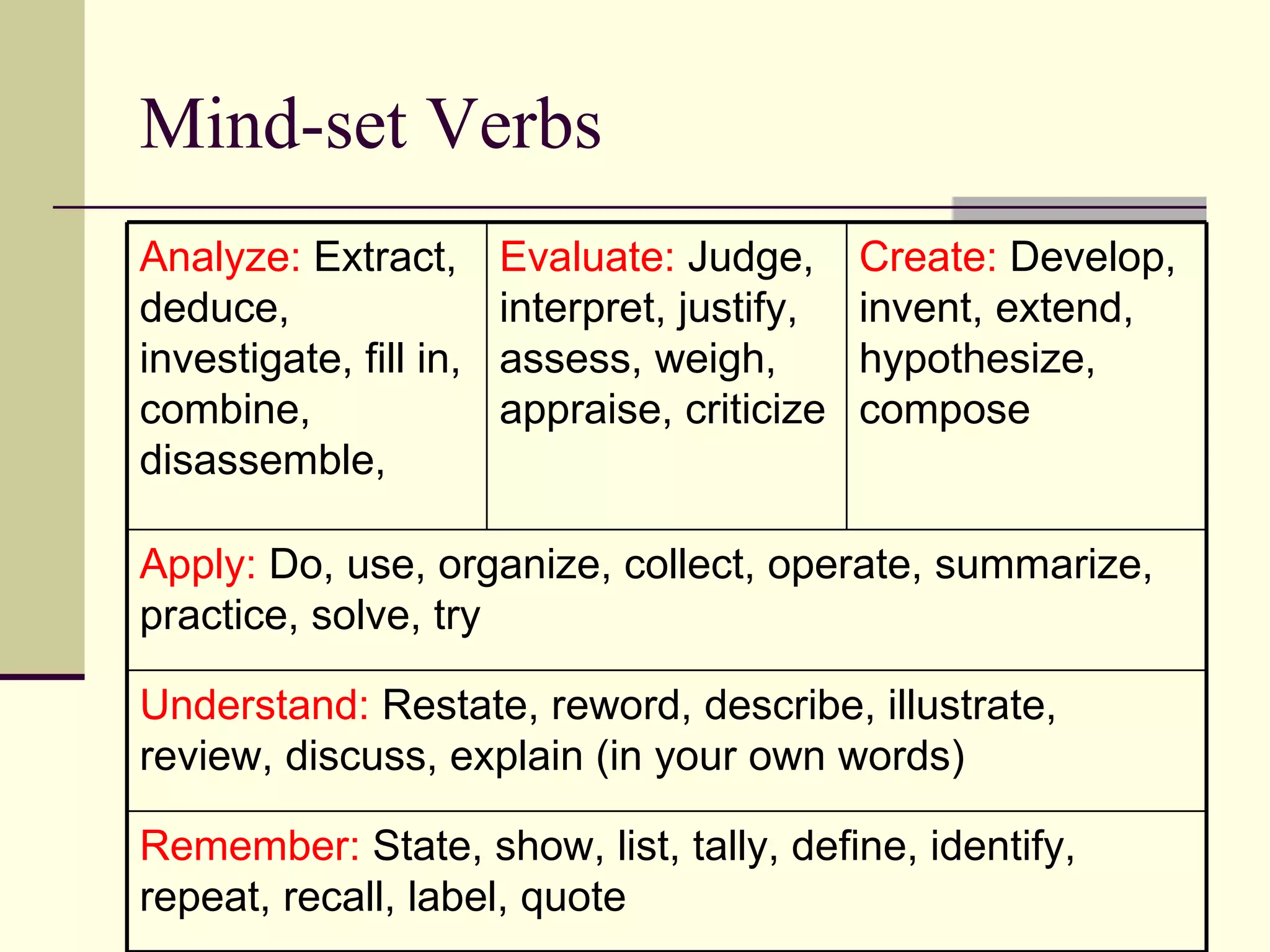
Mind-set Verbs Apply:  Do, use, organize, collect, operate, summarize, practice, solve, try Remember:  State, show, list, tally, define, identify, repeat, recall, label, quote Understand:  Restate, reword, describe, illustrate, review, discuss, explain (in your own words) Create:  Develop, invent, extend, hypothesize, compose Evaluate:  Judge, interpret, justify, assess, weigh, appraise, criticize Analyze:  Extract, deduce, investigate, fill in, combine, disassemble,
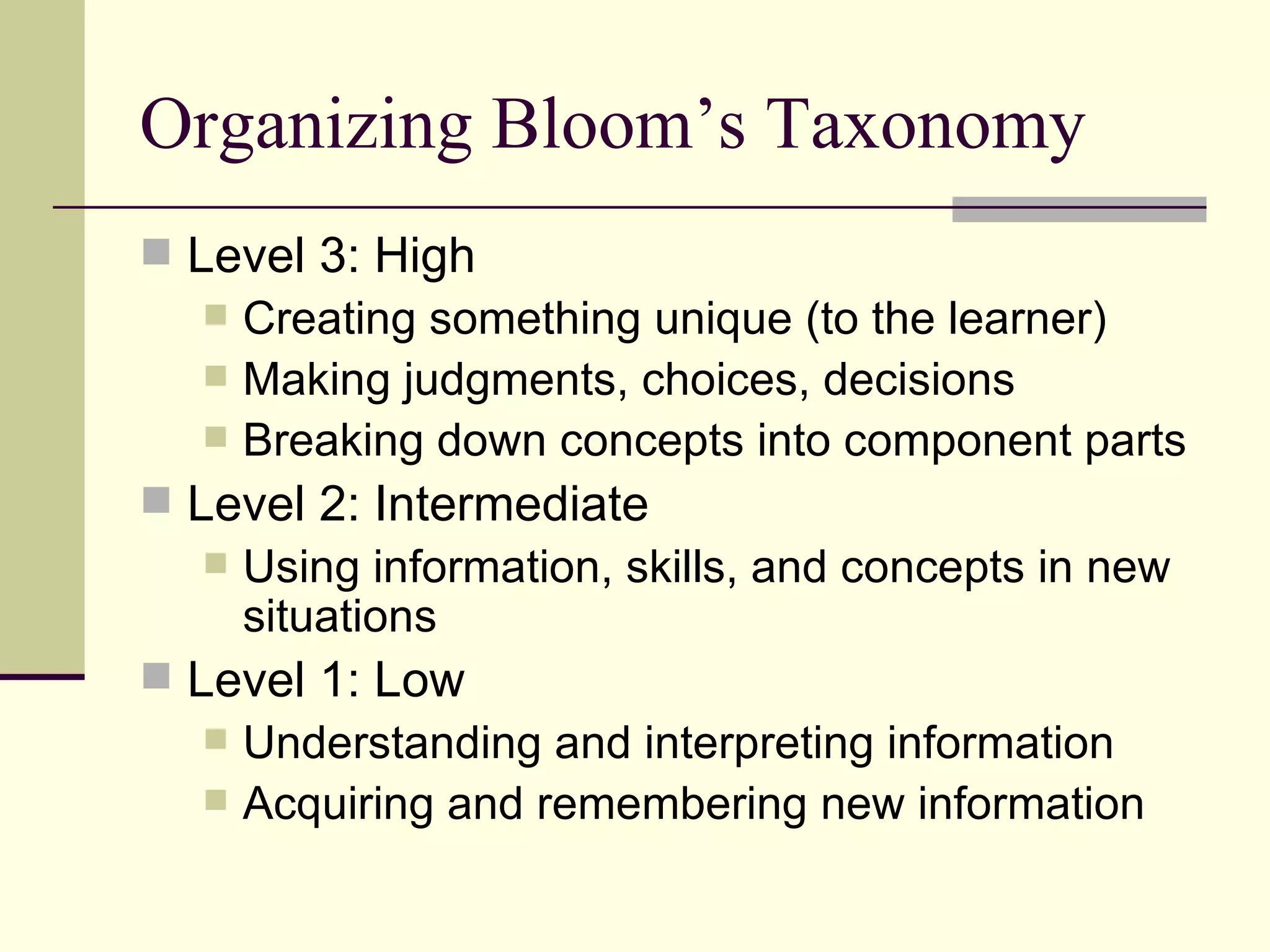
Organizing Bloom’s Taxonomy Level 3: High Creating something unique (to the learner) Making judgments, choices, decisions Breaking down concepts into component parts Level 2: Intermediate Using information, skills, and concepts in new situations Level 1: Low Understanding and interpreting information Acquiring and remembering new information
Questioning and Bloom Place your Post-it notes on the appropriate sign “ Knowledge” “ Comprehension” “ Synthesis”
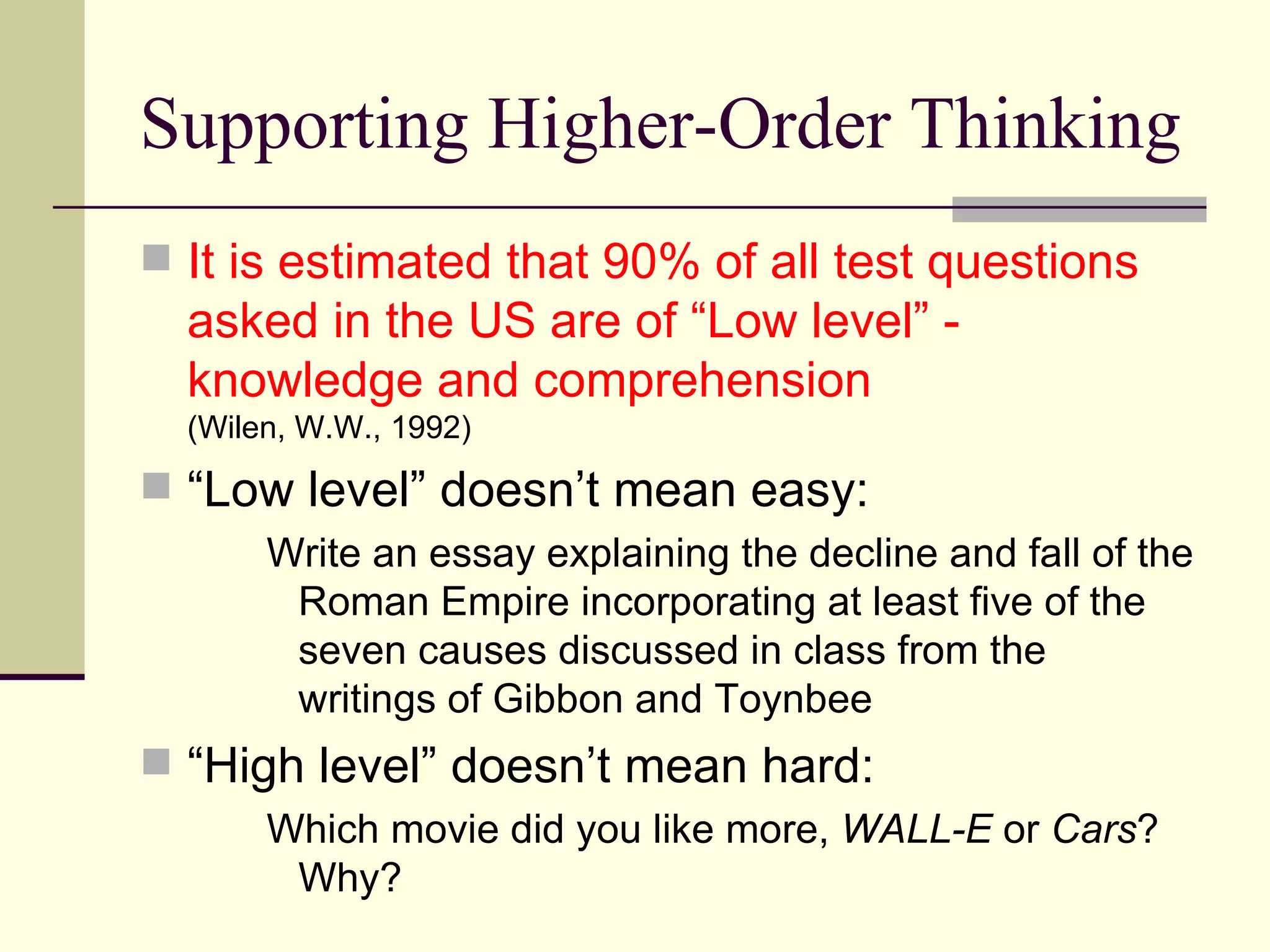
Supporting Higher-Order Thinking It is estimated that 90% of all test questions asked in the US are of “Low level” - knowledge and comprehension  (Wilen, W.W., 1992) “ Low level” doesn’t mean easy: Write an essay explaining the decline and fall of the Roman Empire incorporating at least five of the seven causes discussed in class from the writings of Gibbon and Toynbee “ High level” doesn’t mean hard: Which movie did you like more,  WALL-E  or  Cars ?  Why?
Curriculum-Framing Questions Guide a unit of study and include:  Essential Questions Unit Questions  Content Questions
Essential Questions Are broad, open-ended questions  Address big ideas and enduring concepts Often cross disciplines and help students see how subjects are related Example:  Why is math important to my life? How does conflict produce change? What lessons can be learned by running a city?
Unit Questions Are open-ended questions that tie directly to a project or unit Help students demonstrate the scope of their understanding of a subject Examples:  How important is measurement in building a home? How are changes in economics a factor in war? In the story,  Charlotte’s Web , how do the animals’ different abilities help Wilbur survive and succeed? How does stress on the environment impact biology?
Content Questions Are fact-based, concrete questions  Have a narrow set of correct answers Often relate to definitions, identifications, and general recall of information (example: questions found on a test) Examples: How do you find the values of unknowns in equations? What is a fable? Who is the main character in  To Kill a Mockingbird ? How are volcanoes made? Why is it cold in the winter when the sun is shining?
Complex Thinking Strategies Decision Making Reasoning Investigation Experimental Inquiry Directed Problem Solving Creative Problem Solving Reflective Thinking
Complex Thinking Strategies Identify some complex thinking strategies being used in this video
Complex Thinking Strategies Decision Making Reasoning Investigation Experimental Inquiry Directed Problem Solving Creative Problem Solving Reflective Thinking
Complex Thinking Strategies Identify some complex thinking strategies being used in this video
Technology and Complex Thinking Intel Thinking Tools   http:// www.intel.com /education/tools   Visual Ranking : Assign ranking to a list; and then debate differences, reach consensus, and organize ideas Seeing Reason : Investigate relationships in complex systems  Showing Evidence : Construct well-reasoned arguments that are supported by evidence, using a visual framework
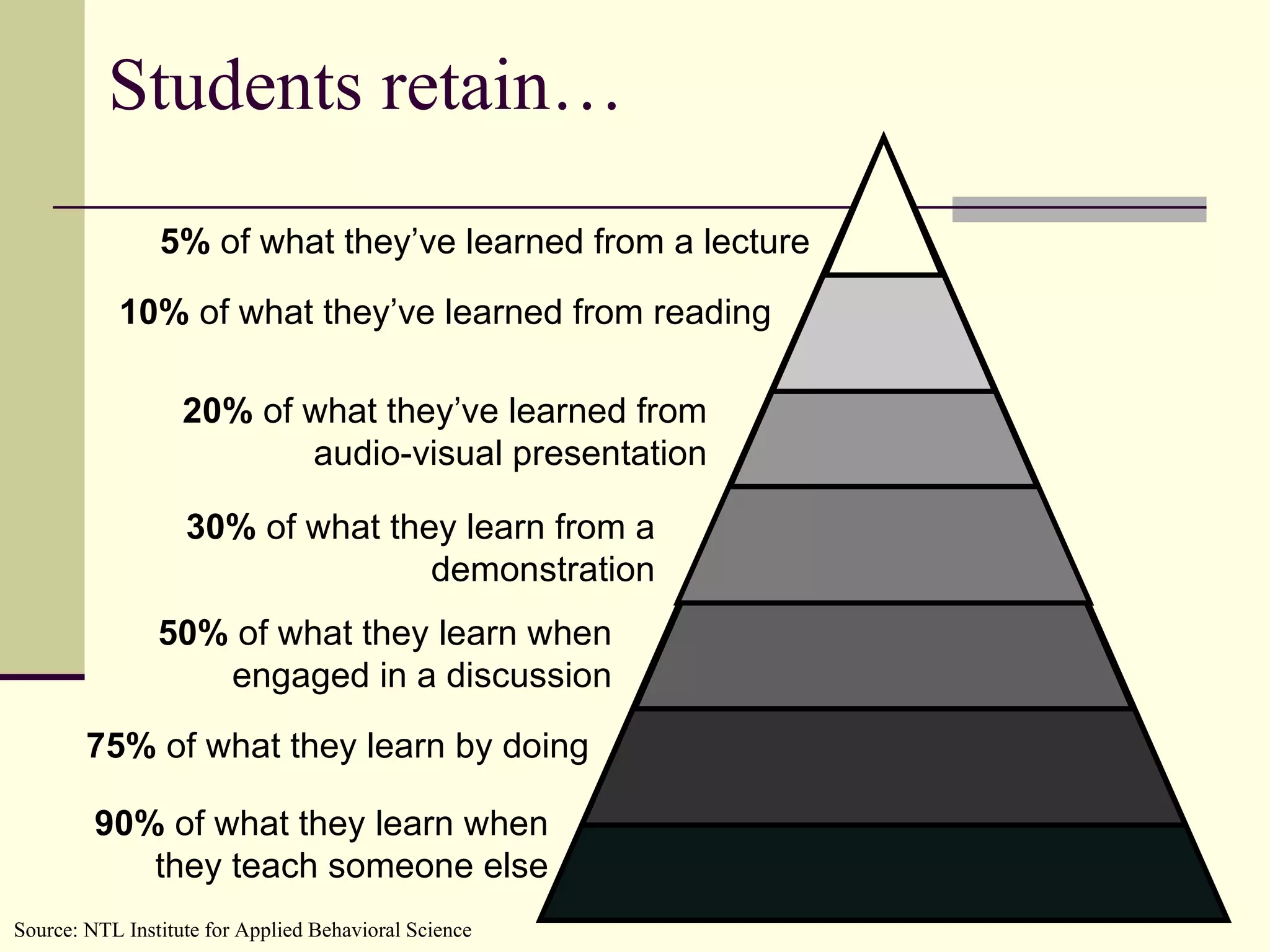
Students retain… 90%  of what they learn when they teach someone else 5%  of what they’ve learned from a lecture 10%  of what they’ve learned from reading 20%  of what they’ve learned from audio-visual presentation 30%  of what they learn from a demonstration 50%  of what they learn when engaged in a discussion 75%  of what they learn by doing Source: NTL Institute for Applied Behavioral Science
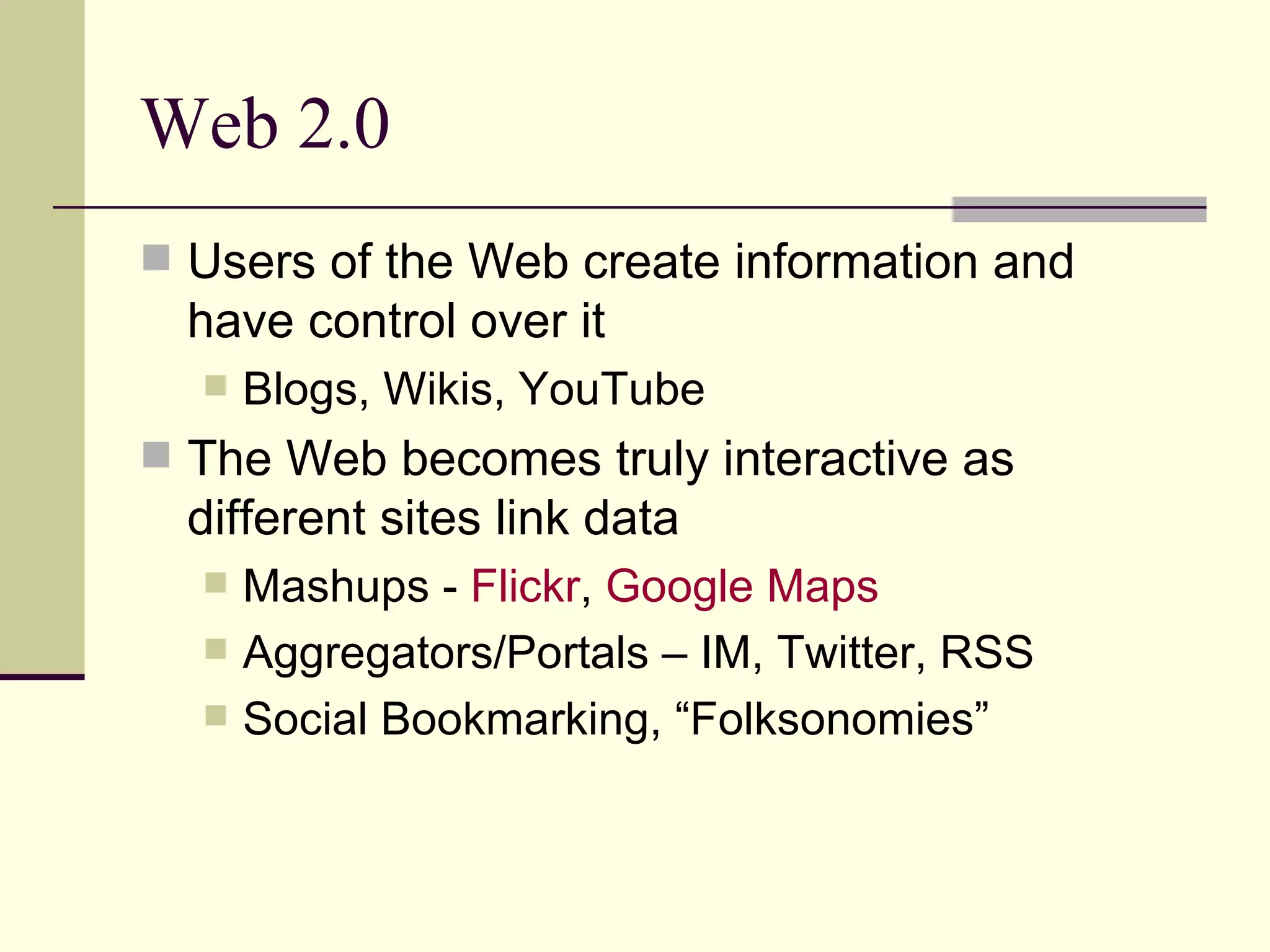
Web 2.0 Users of the Web create information and have control over it Blogs, Wikis, YouTube The Web becomes truly interactive as different sites link data Mashups -  Flickr ,  Google Maps  Aggregators/Portals – IM, Twitter, RSS Social Bookmarking, “Folksonomies”
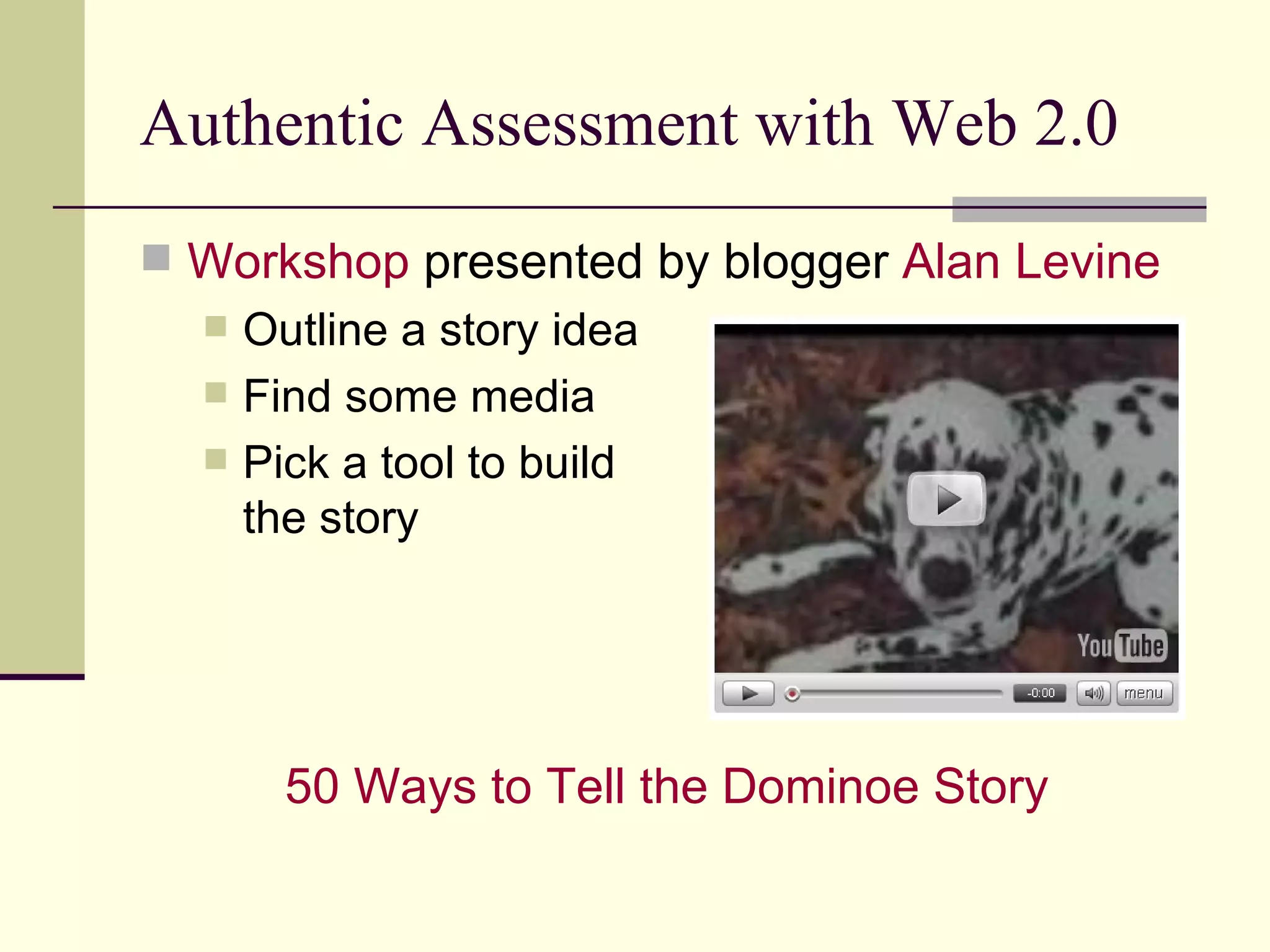
Authentic Assessment with Web 2.0 Workshop  presented by blogger  Alan Levine Outline a story idea Find some media Pick a tool to build  the story 50 Ways to Tell the  Dominoe  Story
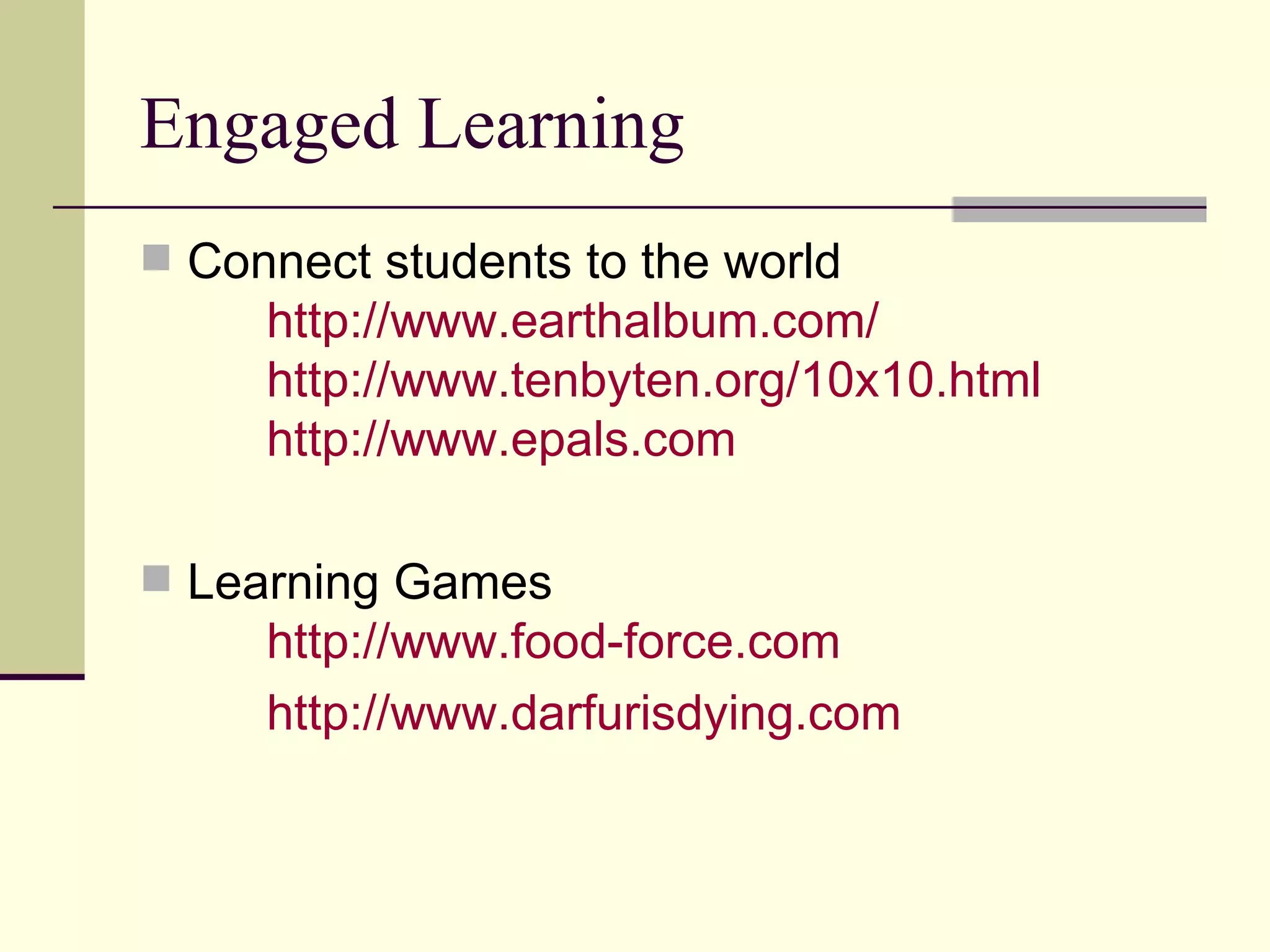
Engaged Learning Connect students to the world  http:// www.earthalbum.com / http://www.tenbyten.org/10x10.html   http:// www.epals.com Learning Games http://www.food-force.com http:// www.darfurisdying.com
Lesson Plan Enrichment Activity Lesson Plan – Math: Fraction Blocks Lesson Plan – Reading: Book Reports ( http://dadams- altec.wetpaint.com ) Activity: Based on our discussions so far with 21 st  Century Skills, Essential Questions, Higher Order Thinking and Complex Thinking Strategies, take this example lesson plan (math/reading) and enrich it for use in your teacher’s classroom.
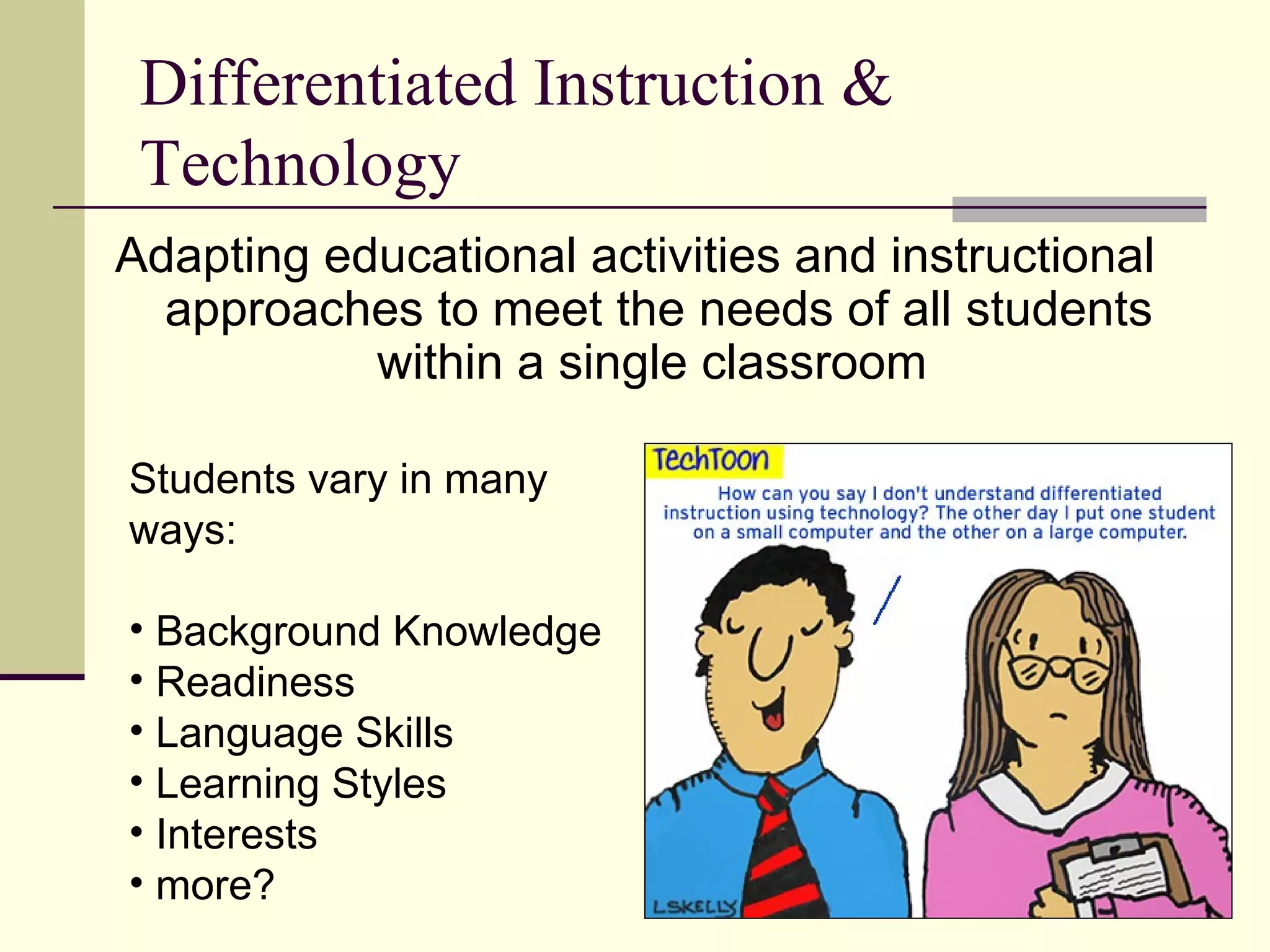
Differentiated Instruction & Technology Adapting educational activities and instructional approaches to meet the needs of all students within a single classroom  Students vary in many ways: Background Knowledge Readiness Language Skills Learning Styles Interests more?
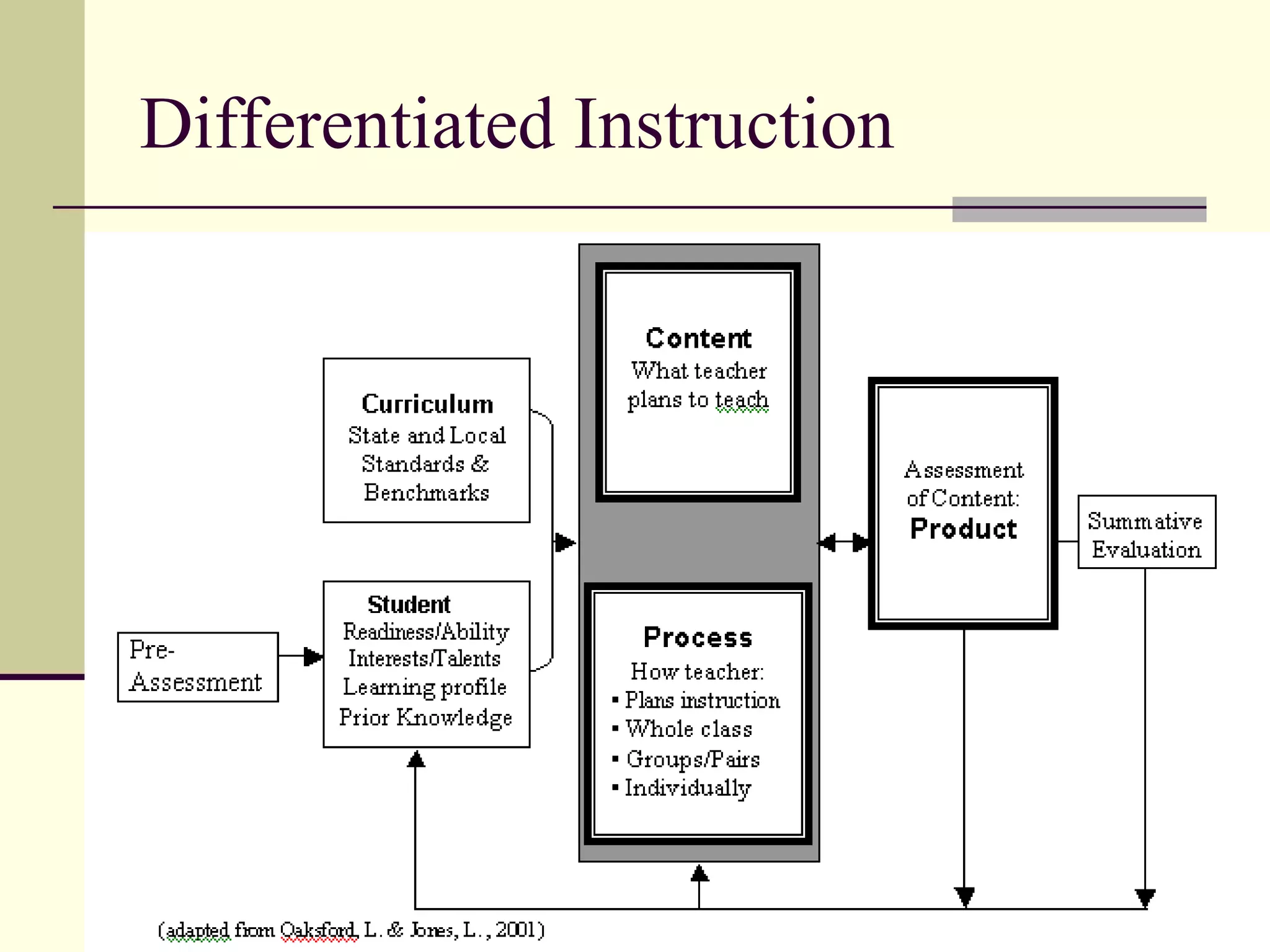
Differentiated Instruction
Differentiation - Content Student selection of topics/interests Compacting the curriculum Accelerated or remedial activities Example: ThinkTank ( http://thinktank.4teachers.org )
Differentiation - Process Vary the expectations and requirements Allow students to participate in setting goals Combine group work with individual activities Example: RubiStar and PBL Checklists ( http://rubistar.4teachers.org/ ) ( http://pblchecklist.4teachers.org/ )
Differentiation - Product Allow students to demonstrate knowledge in a variety of ways Vary performance expectations Example: KidsVid and Web Poster Wizard ( http:// kidsvid.altec.org / ) ( http://poster.4teachers.org/ )
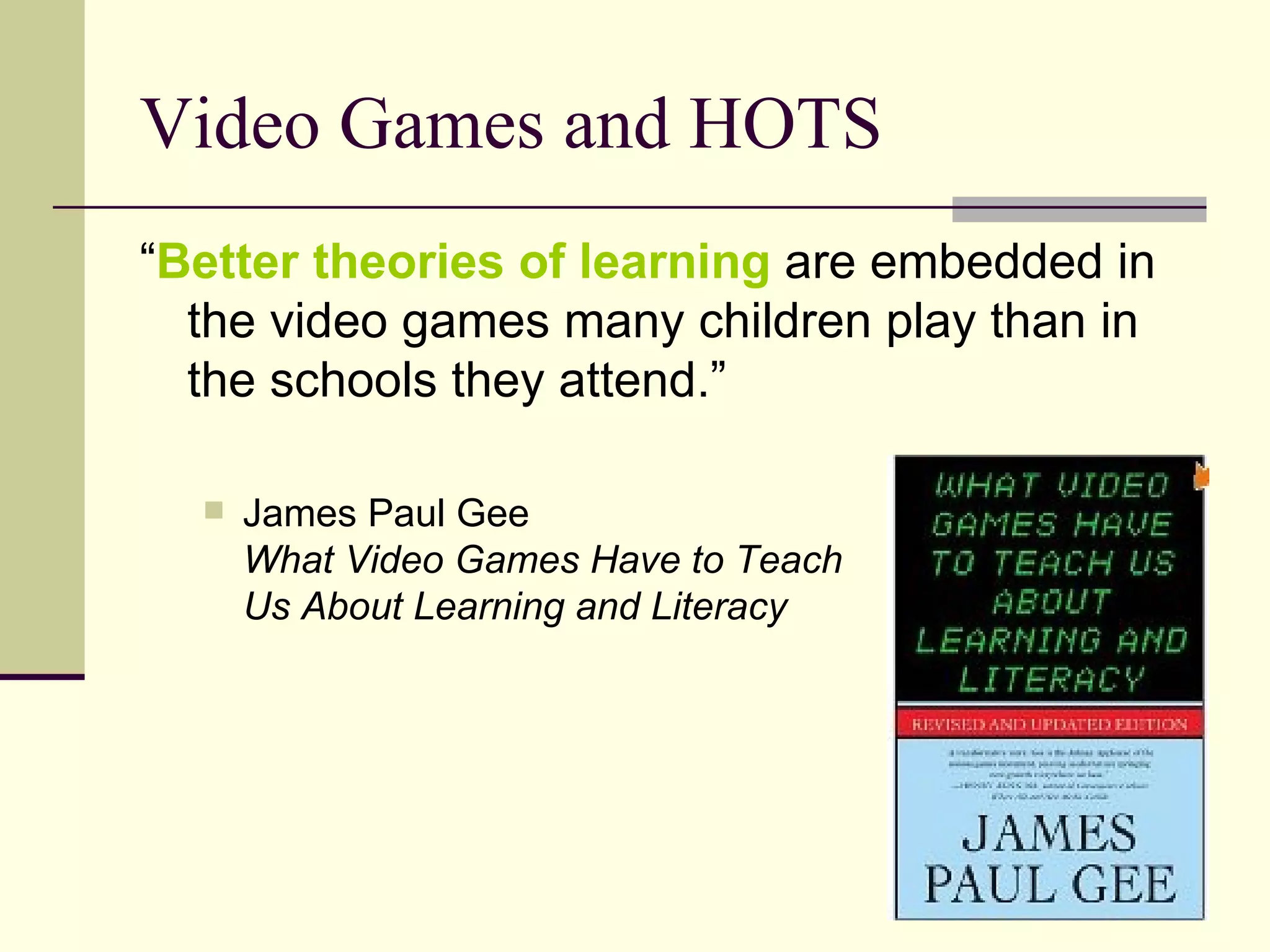
Video Games and HOTS “ Better theories of learning  are embedded in the video games many children play than in the schools they attend.” James Paul Gee What Video Games Have to Teach  Us About Learning and Literacy
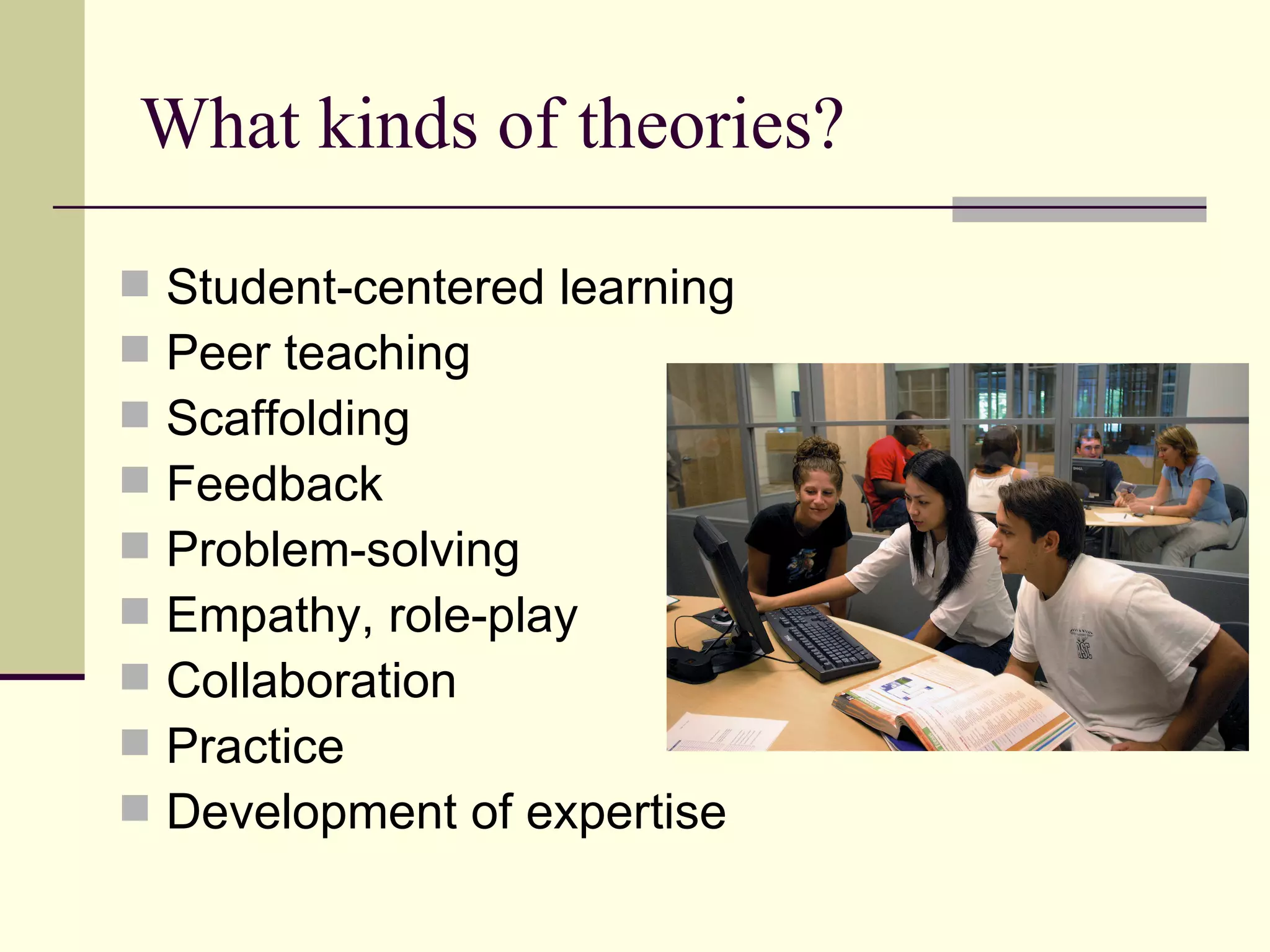
What kinds of theories? Student-centered learning Peer teaching Scaffolding Feedback Problem-solving Empathy, role-play Collaboration Practice Development of expertise
Agenda 21 st  Century Skills Higher Order Thinking Questioning Complex Thinking Strategies Authentic Assessment Engaged Learning Thinking Tools Lesson Plan Enrichment
Resources http://www.slideshare.net/dadams.altec http://dadams-altec.wetpaint.com Doug Adams [email_address] http:// altec.org

Integrating Technology, Higher-Order Thinking, and Student-Centered Learning

  • 1.
    Integrating Technology, Higher-OrderThinking, and Student-Centered Learning Doug Adams ALTEC [email_address]
  • 2.
    Description This workshopis designed to expand awareness and understanding of the use of technology for teaching and student learning. Participants will explore technology resources that support authentic, student-centered learning utilizing higher-order thinking skills . Using a variety of free Web-based tools, participants will learn how to integrate project-based learning activities that support differentiated instruction to meet the needs of all learners.
  • 3.
    LoTi Connection Levelsof Teaching Innovation http:// loticonnection.com Free online survey New survey in 2008 Not validated Not comparable to old survey Classroom observation tools
  • 4.
    Agenda 21 st Century Skills Higher Order Thinking Questioning Complex Thinking Strategies Authentic Assessment Engaged Learning Thinking Tools Lesson Plan Enrichment
  • 5.
  • 6.
    Links and Fileshttp://dadams- altec.wetpaint.com
  • 7.
  • 8.
    The Millennial Generation“Millennials” “Digital Natives” “Thumb Tribe” Multi-tasking Ubiquity Technical Fluency Risk-takers Information sifting “ Kids say e-mail is, like, sooooo dead.” – CNET News , July 18, 2007
  • 9.
    The Millennial GenerationToday’s students are no longer the people our educational system was designed to teach” Mark Prensky
  • 10.
    Millennial Attitudes “I have to ‘ power down ’ when I go to school.” “ When I am really busy, I hate going to school because I can’t do any work there.”
  • 11.
    Characteristics of DigitalNatives Active Multi-tasking Non-linear thinking Ubiquity Technical Fluency Expectations of Feedback Individualization Risk-takers Information sifting
  • 12.
    Brain Research Thebrain developed to solve problems related to surviving in an unstable outdoor environment that occur in near constant motion. John Medina, Brain Rules
  • 13.
    Brain Research Ifyou wanted to create an educational environment that is directly opposed to the way the brain is good at doing, you would probably design something like the modern classroom . John Medina, Brain Rules
  • 14.
    21 st Century Skills 21 st Century Skills
  • 15.
    21 st Century Skills Core Subjects and 21 st Century Themes Math, Language Arts, Science, Social Studies Global Awareness and Civic Literacy Economic and Business Literacy Health Literacy Learning and Innovation Skills Creativity Critical Thinking and Problem Solving Communication and Collaboration
  • 16.
    21 st Century Skills Information Media and Technology Skills Information and Media Literacy Communication and Technology Literacy Life and Career Skills Flexibility and Adaptability Initiative, Productivity, and Self-direction Social Skills Leadership, Accountability and Responsibility
  • 17.
    Visual Ranking and21 st C Skills Intel’s Education Page http://intel.com/education K-12 Teaching Tools Visual Ranking Tool Click Student Log-In [email_address] Team ID Team Password
  • 18.
    Visual Ranking and21 st C Skills In groups, sort the list from most important (top) to least important (bottom) For the top three items , double click and explain why you ranked them as most important For the bottom two items , double click and explain why you ranked them as least important
  • 19.
    Next activity! Asyou are watching the movie clip, write questions you might ask On a test To the characters To the actors/writers/producer One question per Post-it note
  • 20.
  • 21.
    Bloom’s Revised Taxonomy(2001) (Anderson & Krathwohl et al , eds., 2001) “ Knowledge” “ Comprehension” “ Synthesis”
  • 22.
    Mind-set Verbs Apply: Do, use, organize, collect, operate, summarize, practice, solve, try Remember: State, show, list, tally, define, identify, repeat, recall, label, quote Understand: Restate, reword, describe, illustrate, review, discuss, explain (in your own words) Create: Develop, invent, extend, hypothesize, compose Evaluate: Judge, interpret, justify, assess, weigh, appraise, criticize Analyze: Extract, deduce, investigate, fill in, combine, disassemble,
  • 23.
    Organizing Bloom’s TaxonomyLevel 3: High Creating something unique (to the learner) Making judgments, choices, decisions Breaking down concepts into component parts Level 2: Intermediate Using information, skills, and concepts in new situations Level 1: Low Understanding and interpreting information Acquiring and remembering new information
  • 24.
    Questioning and BloomPlace your Post-it notes on the appropriate sign “ Knowledge” “ Comprehension” “ Synthesis”
  • 25.
    Supporting Higher-Order ThinkingIt is estimated that 90% of all test questions asked in the US are of “Low level” - knowledge and comprehension (Wilen, W.W., 1992) “ Low level” doesn’t mean easy: Write an essay explaining the decline and fall of the Roman Empire incorporating at least five of the seven causes discussed in class from the writings of Gibbon and Toynbee “ High level” doesn’t mean hard: Which movie did you like more, WALL-E or Cars ? Why?
  • 26.
    Curriculum-Framing Questions Guidea unit of study and include: Essential Questions Unit Questions Content Questions
  • 27.
    Essential Questions Arebroad, open-ended questions Address big ideas and enduring concepts Often cross disciplines and help students see how subjects are related Example: Why is math important to my life? How does conflict produce change? What lessons can be learned by running a city?
  • 28.
    Unit Questions Areopen-ended questions that tie directly to a project or unit Help students demonstrate the scope of their understanding of a subject Examples: How important is measurement in building a home? How are changes in economics a factor in war? In the story, Charlotte’s Web , how do the animals’ different abilities help Wilbur survive and succeed? How does stress on the environment impact biology?
  • 29.
    Content Questions Arefact-based, concrete questions Have a narrow set of correct answers Often relate to definitions, identifications, and general recall of information (example: questions found on a test) Examples: How do you find the values of unknowns in equations? What is a fable? Who is the main character in To Kill a Mockingbird ? How are volcanoes made? Why is it cold in the winter when the sun is shining?
  • 30.
    Complex Thinking StrategiesDecision Making Reasoning Investigation Experimental Inquiry Directed Problem Solving Creative Problem Solving Reflective Thinking
  • 31.
    Complex Thinking StrategiesIdentify some complex thinking strategies being used in this video
  • 32.
    Complex Thinking StrategiesDecision Making Reasoning Investigation Experimental Inquiry Directed Problem Solving Creative Problem Solving Reflective Thinking
  • 33.
    Complex Thinking StrategiesIdentify some complex thinking strategies being used in this video
  • 34.
    Technology and ComplexThinking Intel Thinking Tools http:// www.intel.com /education/tools Visual Ranking : Assign ranking to a list; and then debate differences, reach consensus, and organize ideas Seeing Reason : Investigate relationships in complex systems Showing Evidence : Construct well-reasoned arguments that are supported by evidence, using a visual framework
  • 35.
    Students retain… 90% of what they learn when they teach someone else 5% of what they’ve learned from a lecture 10% of what they’ve learned from reading 20% of what they’ve learned from audio-visual presentation 30% of what they learn from a demonstration 50% of what they learn when engaged in a discussion 75% of what they learn by doing Source: NTL Institute for Applied Behavioral Science
  • 36.
    Web 2.0 Usersof the Web create information and have control over it Blogs, Wikis, YouTube The Web becomes truly interactive as different sites link data Mashups - Flickr , Google Maps Aggregators/Portals – IM, Twitter, RSS Social Bookmarking, “Folksonomies”
  • 37.
    Authentic Assessment withWeb 2.0 Workshop presented by blogger Alan Levine Outline a story idea Find some media Pick a tool to build the story 50 Ways to Tell the Dominoe Story
  • 38.
    Engaged Learning Connectstudents to the world http:// www.earthalbum.com / http://www.tenbyten.org/10x10.html http:// www.epals.com Learning Games http://www.food-force.com http:// www.darfurisdying.com
  • 39.
    Lesson Plan EnrichmentActivity Lesson Plan – Math: Fraction Blocks Lesson Plan – Reading: Book Reports ( http://dadams- altec.wetpaint.com ) Activity: Based on our discussions so far with 21 st Century Skills, Essential Questions, Higher Order Thinking and Complex Thinking Strategies, take this example lesson plan (math/reading) and enrich it for use in your teacher’s classroom.
  • 40.
    Differentiated Instruction &Technology Adapting educational activities and instructional approaches to meet the needs of all students within a single classroom Students vary in many ways: Background Knowledge Readiness Language Skills Learning Styles Interests more?
  • 41.
  • 42.
    Differentiation - ContentStudent selection of topics/interests Compacting the curriculum Accelerated or remedial activities Example: ThinkTank ( http://thinktank.4teachers.org )
  • 43.
    Differentiation - ProcessVary the expectations and requirements Allow students to participate in setting goals Combine group work with individual activities Example: RubiStar and PBL Checklists ( http://rubistar.4teachers.org/ ) ( http://pblchecklist.4teachers.org/ )
  • 44.
    Differentiation - ProductAllow students to demonstrate knowledge in a variety of ways Vary performance expectations Example: KidsVid and Web Poster Wizard ( http:// kidsvid.altec.org / ) ( http://poster.4teachers.org/ )
  • 45.
    Video Games andHOTS “ Better theories of learning are embedded in the video games many children play than in the schools they attend.” James Paul Gee What Video Games Have to Teach Us About Learning and Literacy
  • 46.
    What kinds oftheories? Student-centered learning Peer teaching Scaffolding Feedback Problem-solving Empathy, role-play Collaboration Practice Development of expertise
  • 47.
    Agenda 21 st Century Skills Higher Order Thinking Questioning Complex Thinking Strategies Authentic Assessment Engaged Learning Thinking Tools Lesson Plan Enrichment
  • 48.