Project-Based Learning, Higher-Order Thinking, and Student-Centered Instruction Doug Adams ALTEC [email_address]
First activity! As you are watching the movie clip, write questions you might ask On a test To the characters To the actors/writers/producer
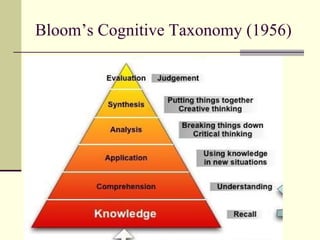
Bloom’s Cognitive Taxonomy (1956)
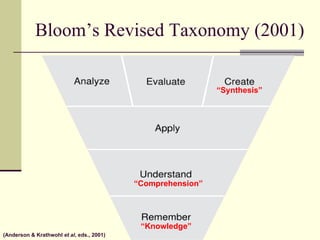
Bloom’s Revised Taxonomy (2001) (Anderson & Krathwohl  et al , eds., 2001) “ Knowledge” “ Comprehension” “ Synthesis”
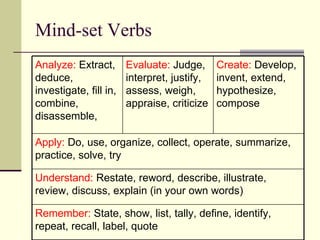
Mind-set Verbs Apply:  Do, use, organize, collect, operate, summarize, practice, solve, try Remember:  State, show, list, tally, define, identify, repeat, recall, label, quote Understand:  Restate, reword, describe, illustrate, review, discuss, explain (in your own words) Create:  Develop, invent, extend, hypothesize, compose Evaluate:  Judge, interpret, justify, assess, weigh, appraise, criticize Analyze:  Extract, deduce, investigate, fill in, combine, disassemble,
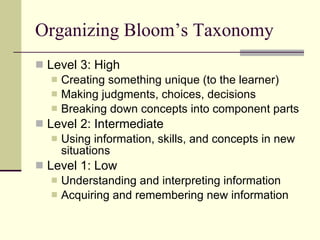
Organizing Bloom’s Taxonomy Level 3: High Creating something unique (to the learner) Making judgments, choices, decisions Breaking down concepts into component parts Level 2: Intermediate Using information, skills, and concepts in new situations Level 1: Low Understanding and interpreting information Acquiring and remembering new information
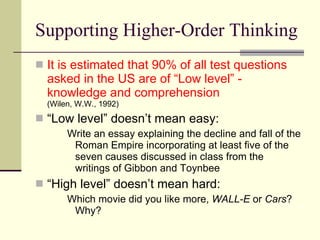
Supporting Higher-Order Thinking It is estimated that 90% of all test questions asked in the US are of “Low level” - knowledge and comprehension  (Wilen, W.W., 1992) “ Low level” doesn’t mean easy: Write an essay explaining the decline and fall of the Roman Empire incorporating at least five of the seven causes discussed in class from the writings of Gibbon and Toynbee “ High level” doesn’t mean hard: Which movie did you like more,  WALL-E  or  Cars ?  Why?
Complex Thinking Strategies Decision Making Reasoning Investigation Experimental Inquiry Directed Problem Solving Creative Problem Solving Reflective Thinking
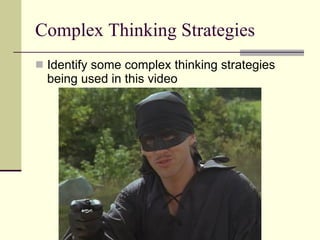
Complex Thinking Strategies Identify some complex thinking strategies being used in this video
Curriculum-Framing Questions Guide a unit of study and include:  Essential Questions Unit Questions  Content Questions
Essential Questions Are broad, open-ended questions  Address big ideas and enduring concepts Often cross disciplines and help students see how subjects are related Example:  Why is math important to my life? How does conflict produce change? What lessons can be learned by running a city?
Unit Questions Are open-ended questions that tie directly to a project or unit Help students demonstrate the scope of their understanding of a subject Examples:  How important is measurement in building a home? How are changes in economics a factor in war? In the story,  Charlotte’s Web , how do the animals’ different abilities help Wilbur survive and succeed? How does stress on the environment impact biology?
Content Questions Are fact-based, concrete questions  Have a narrow set of correct answers Often relate to definitions, identifications, and general recall of information (example: questions found on a test) Examples: How do you find the values of unknowns in equations? What is a fable? Who is the main character in  To Kill a Mockingbird ? How are volcanoes made? Why is it cold in the winter when the sun is shining?
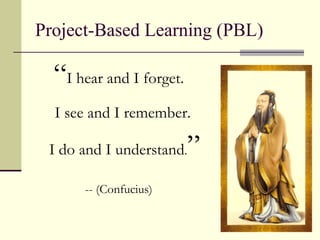
Project-Based Learning (PBL) “ I hear and I forget. I see and I remember.  I do and I understand . ” -- (Confucius)
Why Projects? To learn collaboration,  work in teams . To learn critical thinking,  take on problems . To learn oral communication,  present . To learn written communication,  write . To learn technology,  use technology . To develop citizenship,  take on civic issues . To learn about careers,  do internships . To learn content,  do all of the above .
Project-Based Learning Hands-on, student-centered activity in which students demonstrate understanding through performance/creation Long-term Non-traditional Personalized Mastery of material in context http:// www.edutopia.org /project-learning-overview-video
Benefits of PBL Increased motivation and engagement Increased application and retention Better transfer of skills 21 st  Century Skills:  critical thinking collaboration Communication Connects school to real world Multiple assessment opportunities
Challenges with PBL Designing projects Resources Time Expertise Assessing projects Meeting standards Reliability and validity Rubrics Resistance from establishment
Examples Edutopia Barrel of Worms ( http:// www.edutopia.org/newsome -park ) Monarch Butterflies ( http://www.edutopia.org/journey-north ) Matrix http:// www.youtube.com/user/matrixlearning
Steps to Creating a Project Develop an idea  Decide goals Define the knowledge to be demonstrated Decide how students can demonstrate that knowledge Create a schedule Create an assessment plan Monitor project and evaluate
1) Develop an idea Start with a driving question – Essential or Unit question, NOT Content Be authentic Use real-world problems Tie to community or school life Allow students to have an impact Be current Involve students Use what you know
Driving Question Shift from “right answer” to complex, local, active questions: What are the characteristics of healthy soil? vs Is our soil healthy enough to support a vegetable garden?
Driving Question Shift from abstract to concrete: How do architects use geometry? vs How can we design a building with the most number of apartments with the given specifications?
Driving Question Shift from “too big” to answerable: How has technology affected history? vs Does technology make war more or less humane?
Driving Question Shift from “teacher talk” to student-friendly: How does the author of Bleak House use voice and characterization to reflect on his childhood and the social climate? vs How do our childhood memories affect how we see the world?
Activity Look at an existing unit that you enjoy Come up with a driving question to use as inspiration for a project Can work solo or teamed (no more than 3) Driving question should reflect input from all
2) Decide goals Core content and skills to be  assessed 21 st  Century skills to be  assessed Additional content to be  encouraged What standards will be addressed?
3) Make a plan Involve students How can we answer this question? What can we do to support the inquiry? Look at available resources Primary sources online Local resources Internet
Primary Source Material Engage Students Tie to prior knowledge Evaluate the source Look at details Make it personal Promote Inquiry Make speculations (creator, purpose, audience) Compare to other primary and secondary sources Talk about other places to find primary sources
Primary Source Example Library of Congress ( http:// www.loc.gov ) American Memory Project World Digital Library Thomas – Legislation Information Veteran’s history Teacher Resources
More Primary Sources Similar resources exist at many high-level government sites Geology & Geography ( http://USGS.gov )  Space and Physics ( http://NASA.gov )  Oceanography & Meteorology ( http://NOAA.gov )  Health & Medicine ( http://CDC.gov  &  http://HHS.gov )  Energy ( http://www.energy.gov )  Smithsonian Museums ( http:// si.edu )
Project-Based Learning Resources Buck Institute for Education (BIE)  http://www.bie.org Edutopia http://www.edutopia.org/project-learning http://www.edutopia.org/teaching-module-pbl ePals http://www.epals.org iEARN (International Education and Resource Network)  http://www.iearn.org/
3) Create a schedule What time can be allotted to the project? Start with “contact hours” How many days? Regular schedule or  ad hoc? What events have a fixed time? Will multiple classrooms be involved? Help students budget time Involve students in creating timeline Fixed benchmarks Help with time management
Activity In groups, fill in more of the Project Planning Form Content and skills to be assessed Content and skills to be encouraged Standards Description Brainstorm resources Think about time limits and benchmarks
4) Create an assessment plan Involve students in planning Rubrics Self Peer Teacher Expert Assess identified skills from goals Plan for differentiation
Activity Complete Project Planning Form Describe final project Who is the audience? What rubrics will you need to create? What other assessments will you need? What will you need to accommodate through differentiation?
5) Monitor and evaluate Be a mentor, not a director Help students stick to the timeline Remind students of rubrics Reflect often Discuss what worked and what didn’t Plan for changes Share ideas for new projects
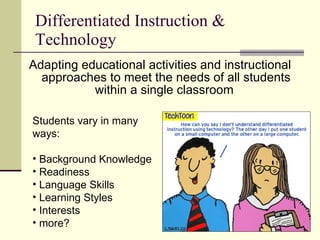
Differentiated Instruction & Technology Adapting educational activities and instructional approaches to meet the needs of all students within a single classroom  Students vary in many ways: Background Knowledge Readiness Language Skills Learning Styles Interests more?
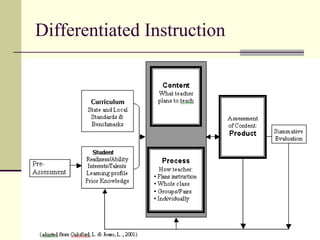
Differentiated Instruction
Differentiation - Content Student selection of topics/interests Compacting the curriculum Accelerated or remedial activities Example: ThinkTank ( http://thinktank.4teachers.org )
Differentiation - Process Vary the expectations and requirements Allow students to participate in setting goals Combine group work with individual activities Example: RubiStar and PBL Checklists ( http://rubistar.4teachers.org/ ) ( http://pblchecklist.4teachers.org/ )
Differentiation - Product Allow students to demonstrate knowledge in a variety of ways Vary performance expectations Example: KidsVid and Web Poster Wizard ( http:// kidsvid.altec.org / ) ( http://poster.4teachers.org/ )

Project-Based Learning - USD 340

  • 1.
    Project-Based Learning, Higher-OrderThinking, and Student-Centered Instruction Doug Adams ALTEC [email_address]
  • 2.
    First activity! Asyou are watching the movie clip, write questions you might ask On a test To the characters To the actors/writers/producer
  • 3.
  • 4.
    Bloom’s Revised Taxonomy(2001) (Anderson & Krathwohl et al , eds., 2001) “ Knowledge” “ Comprehension” “ Synthesis”
  • 5.
    Mind-set Verbs Apply: Do, use, organize, collect, operate, summarize, practice, solve, try Remember: State, show, list, tally, define, identify, repeat, recall, label, quote Understand: Restate, reword, describe, illustrate, review, discuss, explain (in your own words) Create: Develop, invent, extend, hypothesize, compose Evaluate: Judge, interpret, justify, assess, weigh, appraise, criticize Analyze: Extract, deduce, investigate, fill in, combine, disassemble,
  • 6.
    Organizing Bloom’s TaxonomyLevel 3: High Creating something unique (to the learner) Making judgments, choices, decisions Breaking down concepts into component parts Level 2: Intermediate Using information, skills, and concepts in new situations Level 1: Low Understanding and interpreting information Acquiring and remembering new information
  • 7.
    Supporting Higher-Order ThinkingIt is estimated that 90% of all test questions asked in the US are of “Low level” - knowledge and comprehension (Wilen, W.W., 1992) “ Low level” doesn’t mean easy: Write an essay explaining the decline and fall of the Roman Empire incorporating at least five of the seven causes discussed in class from the writings of Gibbon and Toynbee “ High level” doesn’t mean hard: Which movie did you like more, WALL-E or Cars ? Why?
  • 8.
    Complex Thinking StrategiesDecision Making Reasoning Investigation Experimental Inquiry Directed Problem Solving Creative Problem Solving Reflective Thinking
  • 9.
    Complex Thinking StrategiesIdentify some complex thinking strategies being used in this video
  • 10.
    Curriculum-Framing Questions Guidea unit of study and include: Essential Questions Unit Questions Content Questions
  • 11.
    Essential Questions Arebroad, open-ended questions Address big ideas and enduring concepts Often cross disciplines and help students see how subjects are related Example: Why is math important to my life? How does conflict produce change? What lessons can be learned by running a city?
  • 12.
    Unit Questions Areopen-ended questions that tie directly to a project or unit Help students demonstrate the scope of their understanding of a subject Examples: How important is measurement in building a home? How are changes in economics a factor in war? In the story, Charlotte’s Web , how do the animals’ different abilities help Wilbur survive and succeed? How does stress on the environment impact biology?
  • 13.
    Content Questions Arefact-based, concrete questions Have a narrow set of correct answers Often relate to definitions, identifications, and general recall of information (example: questions found on a test) Examples: How do you find the values of unknowns in equations? What is a fable? Who is the main character in To Kill a Mockingbird ? How are volcanoes made? Why is it cold in the winter when the sun is shining?
  • 14.
    Project-Based Learning (PBL)“ I hear and I forget. I see and I remember. I do and I understand . ” -- (Confucius)
  • 15.
    Why Projects? Tolearn collaboration, work in teams . To learn critical thinking, take on problems . To learn oral communication, present . To learn written communication, write . To learn technology, use technology . To develop citizenship, take on civic issues . To learn about careers, do internships . To learn content, do all of the above .
  • 16.
    Project-Based Learning Hands-on,student-centered activity in which students demonstrate understanding through performance/creation Long-term Non-traditional Personalized Mastery of material in context http:// www.edutopia.org /project-learning-overview-video
  • 17.
    Benefits of PBLIncreased motivation and engagement Increased application and retention Better transfer of skills 21 st Century Skills: critical thinking collaboration Communication Connects school to real world Multiple assessment opportunities
  • 18.
    Challenges with PBLDesigning projects Resources Time Expertise Assessing projects Meeting standards Reliability and validity Rubrics Resistance from establishment
  • 19.
    Examples Edutopia Barrelof Worms ( http:// www.edutopia.org/newsome -park ) Monarch Butterflies ( http://www.edutopia.org/journey-north ) Matrix http:// www.youtube.com/user/matrixlearning
  • 20.
    Steps to Creatinga Project Develop an idea Decide goals Define the knowledge to be demonstrated Decide how students can demonstrate that knowledge Create a schedule Create an assessment plan Monitor project and evaluate
  • 21.
    1) Develop anidea Start with a driving question – Essential or Unit question, NOT Content Be authentic Use real-world problems Tie to community or school life Allow students to have an impact Be current Involve students Use what you know
  • 22.
    Driving Question Shiftfrom “right answer” to complex, local, active questions: What are the characteristics of healthy soil? vs Is our soil healthy enough to support a vegetable garden?
  • 23.
    Driving Question Shiftfrom abstract to concrete: How do architects use geometry? vs How can we design a building with the most number of apartments with the given specifications?
  • 24.
    Driving Question Shiftfrom “too big” to answerable: How has technology affected history? vs Does technology make war more or less humane?
  • 25.
    Driving Question Shiftfrom “teacher talk” to student-friendly: How does the author of Bleak House use voice and characterization to reflect on his childhood and the social climate? vs How do our childhood memories affect how we see the world?
  • 26.
    Activity Look atan existing unit that you enjoy Come up with a driving question to use as inspiration for a project Can work solo or teamed (no more than 3) Driving question should reflect input from all
  • 27.
    2) Decide goalsCore content and skills to be assessed 21 st Century skills to be assessed Additional content to be encouraged What standards will be addressed?
  • 28.
    3) Make aplan Involve students How can we answer this question? What can we do to support the inquiry? Look at available resources Primary sources online Local resources Internet
  • 29.
    Primary Source MaterialEngage Students Tie to prior knowledge Evaluate the source Look at details Make it personal Promote Inquiry Make speculations (creator, purpose, audience) Compare to other primary and secondary sources Talk about other places to find primary sources
  • 30.
    Primary Source ExampleLibrary of Congress ( http:// www.loc.gov ) American Memory Project World Digital Library Thomas – Legislation Information Veteran’s history Teacher Resources
  • 31.
    More Primary SourcesSimilar resources exist at many high-level government sites Geology & Geography ( http://USGS.gov ) Space and Physics ( http://NASA.gov ) Oceanography & Meteorology ( http://NOAA.gov ) Health & Medicine ( http://CDC.gov & http://HHS.gov ) Energy ( http://www.energy.gov ) Smithsonian Museums ( http:// si.edu )
  • 32.
    Project-Based Learning ResourcesBuck Institute for Education (BIE) http://www.bie.org Edutopia http://www.edutopia.org/project-learning http://www.edutopia.org/teaching-module-pbl ePals http://www.epals.org iEARN (International Education and Resource Network) http://www.iearn.org/
  • 33.
    3) Create aschedule What time can be allotted to the project? Start with “contact hours” How many days? Regular schedule or ad hoc? What events have a fixed time? Will multiple classrooms be involved? Help students budget time Involve students in creating timeline Fixed benchmarks Help with time management
  • 34.
    Activity In groups,fill in more of the Project Planning Form Content and skills to be assessed Content and skills to be encouraged Standards Description Brainstorm resources Think about time limits and benchmarks
  • 35.
    4) Create anassessment plan Involve students in planning Rubrics Self Peer Teacher Expert Assess identified skills from goals Plan for differentiation
  • 36.
    Activity Complete ProjectPlanning Form Describe final project Who is the audience? What rubrics will you need to create? What other assessments will you need? What will you need to accommodate through differentiation?
  • 37.
    5) Monitor andevaluate Be a mentor, not a director Help students stick to the timeline Remind students of rubrics Reflect often Discuss what worked and what didn’t Plan for changes Share ideas for new projects
  • 38.
    Differentiated Instruction &Technology Adapting educational activities and instructional approaches to meet the needs of all students within a single classroom Students vary in many ways: Background Knowledge Readiness Language Skills Learning Styles Interests more?
  • 39.
  • 40.
    Differentiation - ContentStudent selection of topics/interests Compacting the curriculum Accelerated or remedial activities Example: ThinkTank ( http://thinktank.4teachers.org )
  • 41.
    Differentiation - ProcessVary the expectations and requirements Allow students to participate in setting goals Combine group work with individual activities Example: RubiStar and PBL Checklists ( http://rubistar.4teachers.org/ ) ( http://pblchecklist.4teachers.org/ )
  • 42.
    Differentiation - ProductAllow students to demonstrate knowledge in a variety of ways Vary performance expectations Example: KidsVid and Web Poster Wizard ( http:// kidsvid.altec.org / ) ( http://poster.4teachers.org/ )