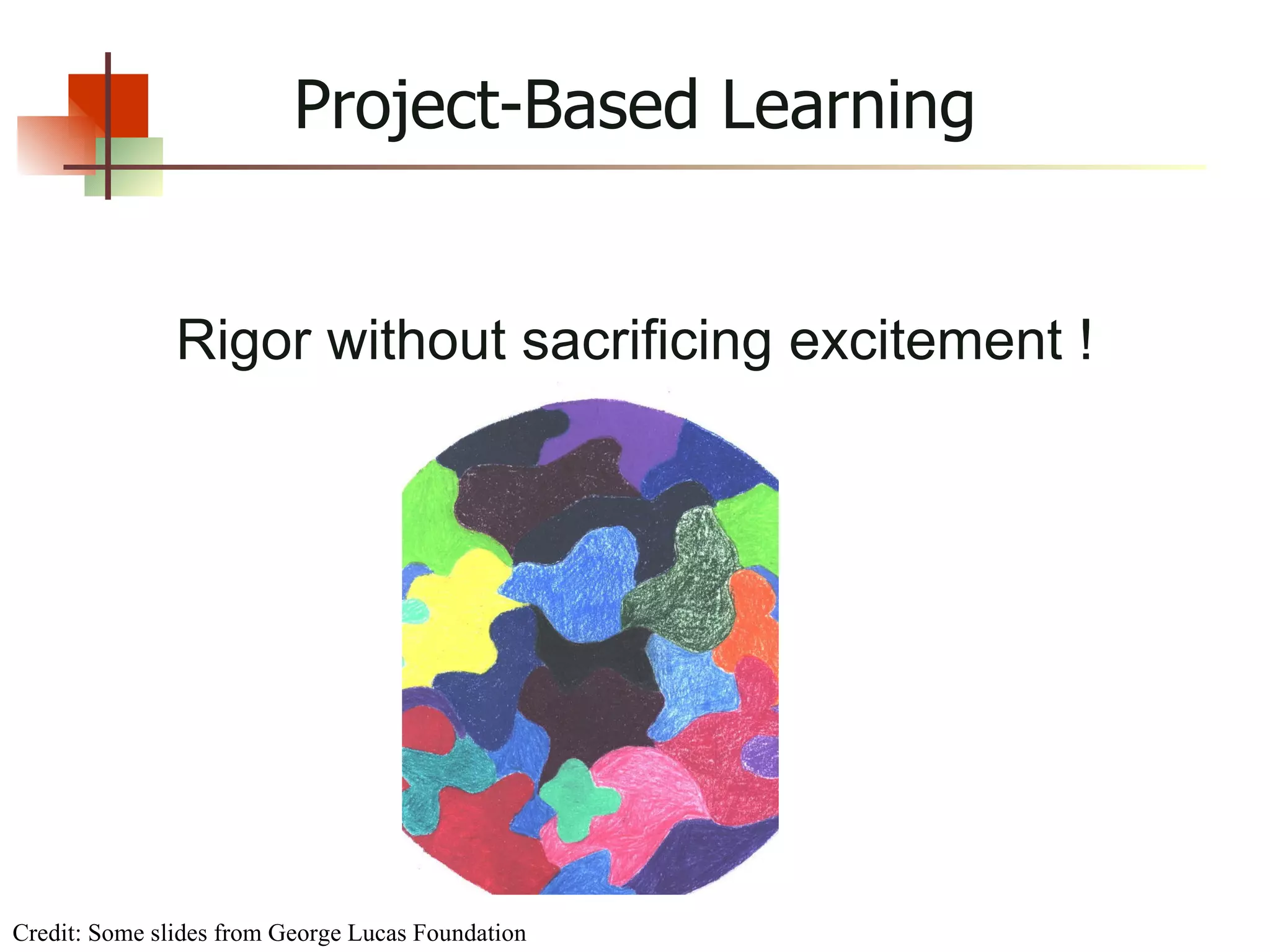
Project-Based Learning Rigor without sacrificing excitement ! Credit: Some slides from George Lucas Foundation
“ The biggest obstacle to school change is our memories.” -- Dr. Allen Glenn Obstacles
Change “ We must be the change we want to see in the world.” -- Mahatma Gandhi
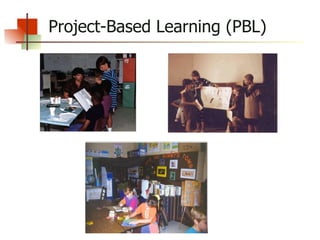
Project-Based Learning (PBL)
What is Project-Based Learning?   PBL is curriculum fueled and standards based. PBL asks a question or poses a problem that ALL students can answer. Concrete, hands-on experiences come together during project-based learning. PBL allows students to investigate issues and topics in real-world problems. PBL fosters abstract, intellectual tasks to explore complex issues.
How Does Project-Based Learning Work? Select and research topic: Make sure the topic is of personal interest to you and the students and that it is based on their needs and developmental levels. Consult the state and local curriculum guides, teacher’s editions of textbooks, trade books on the topic, and other expert learners. Involve the children in planning. Identify concepts/brainstorm topic: Identify key concepts or subtopics related to the theme of the project. A semantic map is an excellent way to visualize and brainstorm content related to a theme. Use K-W-L with the children for their input about what they want to know. Get ownership through their questions.  Locate materials and resources: Locate diverse materials and resources related to the topic, i.e., children’s literature, films, manipulatives, music, arts/crafts, resources, and people from your Web community. Utilize diverse global perspectives.   Plan learning experiences: Develop a variety of learning experiences related to the topic. Include hands-on activities using concrete objects. Plan for small and large group activities, learning centers/stations, independent research, exploration, problem-solving, using both divergent/convergent learning activities.
Use Internet resources and models when  gathering materials and planning learning experiences.  Online Correspondence and Exchanges:  Involves setting up keypal (e-mail penpal) connections between your students, their online peers, and subject matter experts (SMEs) like scientists and engineers working in the field. Also includes the formation of learning communities. Information Gathering:  These projects challenge students to use the Internet to collect, analyze, compare, and reflect upon different sources of information. Problem-Solving and Competitions:  Online competitions are projects through which students must use the Internet and other sources to solve problems while competing with other classrooms. Student created learning products are an outcome. WebQuests and Treasure Hunts:  Online learning activities in which students explore and collect a body of online information and make sense of it – from an inquiry-driven approach.  Online Conferencing : Students use asynchronous and synchronous learning environments or audio or video conferencing software to collaborate and complete various project objectives
Guidelines to PBL Continued Integrate content areas: Use a webbing approach to organize concepts and activities into content areas: the arts, sciences, social studies, mathematics, literature, and technology. The goal is seamless integration of all content area learning within the planned activities. Organize the learning environment:  Consider space, time, materials, learning experiences, teacher/learner roles, methods of assessment and evaluation. Initiate integrated/interdisciplinary study: Arouse students’ curiosity and interest with stimulating introduction. Consider visual display of theme as well as introductory activities.  Culminating activity: Bring closure to the theme by concluding with an event. Incorporate parent involvement, collaboration with other classes both in the school and the blogosphere, and allow students to use technology to enhance learning and celebrate success! Assessment and authentic evaluation: Use assessment and evaluation which may include the following: “kidwatching,” observations, anecdotal records, checklists, conferences, informal interviews, rubrics and digital portfolios.
Question Take a real-world topic and begin an in-depth investigation Start with the Essential question(s). Have students do a concept map with you around the topic. (You have already created one during your planning) KWL Questions from group to research
Plan Plan which content standards will be addressed while answering the question. (I start with my concept map, then I break into a topic map, then I match standards) Involve students in the questioning, planning, and project-building process. (I decide which areas I will teach and then I put them in cooperative learning groups of mixed ability and let them choice their area to become experts)  Teacher and students brainstorm activities that support the inquiry.(I use a tic tac toe activity chart. Groups will choose three to do.)
Schedule Teacher and students design a timeline for project components. Set benchmarks--Keep it simple and age-appropriate. Learning contracts help with individual passions. Learning stations help support exploration and discovery Schedule individual and group meetings with you. Schedule initiating and culminating events well in advanced.
Monitor Facilitate the process. Mentor the process . Utilize rubrics.
Assess Make the assessment authentic. Know authentic assessment will require more time and effort from the teacher. Vary the type of assessment used. Electronic portfolios work well (video, podcasts, and digital pics of work)
Evaluate Take time to reflect, individually and as a group. Share feelings and experiences. Discuss what worked well. Discuss what needs change. Share ideas that will lead to new inquiries, thus new projects.
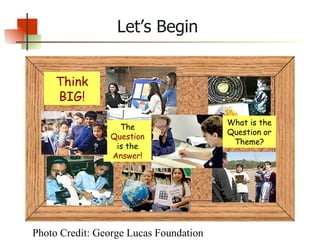
Let’s Begin Photo Credit: George Lucas Foundation Think BIG! The  Question  is the  Answer! What is the Question or Theme?

Project Based Learning

  • 1.
    Project-Based Learning Rigorwithout sacrificing excitement ! Credit: Some slides from George Lucas Foundation
  • 2.
    “ The biggestobstacle to school change is our memories.” -- Dr. Allen Glenn Obstacles
  • 3.
    Change “ Wemust be the change we want to see in the world.” -- Mahatma Gandhi
  • 4.
  • 5.
    What is Project-BasedLearning? PBL is curriculum fueled and standards based. PBL asks a question or poses a problem that ALL students can answer. Concrete, hands-on experiences come together during project-based learning. PBL allows students to investigate issues and topics in real-world problems. PBL fosters abstract, intellectual tasks to explore complex issues.
  • 6.
    How Does Project-BasedLearning Work? Select and research topic: Make sure the topic is of personal interest to you and the students and that it is based on their needs and developmental levels. Consult the state and local curriculum guides, teacher’s editions of textbooks, trade books on the topic, and other expert learners. Involve the children in planning. Identify concepts/brainstorm topic: Identify key concepts or subtopics related to the theme of the project. A semantic map is an excellent way to visualize and brainstorm content related to a theme. Use K-W-L with the children for their input about what they want to know. Get ownership through their questions. Locate materials and resources: Locate diverse materials and resources related to the topic, i.e., children’s literature, films, manipulatives, music, arts/crafts, resources, and people from your Web community. Utilize diverse global perspectives. Plan learning experiences: Develop a variety of learning experiences related to the topic. Include hands-on activities using concrete objects. Plan for small and large group activities, learning centers/stations, independent research, exploration, problem-solving, using both divergent/convergent learning activities.
  • 7.
    Use Internet resourcesand models when gathering materials and planning learning experiences. Online Correspondence and Exchanges: Involves setting up keypal (e-mail penpal) connections between your students, their online peers, and subject matter experts (SMEs) like scientists and engineers working in the field. Also includes the formation of learning communities. Information Gathering: These projects challenge students to use the Internet to collect, analyze, compare, and reflect upon different sources of information. Problem-Solving and Competitions: Online competitions are projects through which students must use the Internet and other sources to solve problems while competing with other classrooms. Student created learning products are an outcome. WebQuests and Treasure Hunts: Online learning activities in which students explore and collect a body of online information and make sense of it – from an inquiry-driven approach. Online Conferencing : Students use asynchronous and synchronous learning environments or audio or video conferencing software to collaborate and complete various project objectives
  • 8.
    Guidelines to PBLContinued Integrate content areas: Use a webbing approach to organize concepts and activities into content areas: the arts, sciences, social studies, mathematics, literature, and technology. The goal is seamless integration of all content area learning within the planned activities. Organize the learning environment: Consider space, time, materials, learning experiences, teacher/learner roles, methods of assessment and evaluation. Initiate integrated/interdisciplinary study: Arouse students’ curiosity and interest with stimulating introduction. Consider visual display of theme as well as introductory activities. Culminating activity: Bring closure to the theme by concluding with an event. Incorporate parent involvement, collaboration with other classes both in the school and the blogosphere, and allow students to use technology to enhance learning and celebrate success! Assessment and authentic evaluation: Use assessment and evaluation which may include the following: “kidwatching,” observations, anecdotal records, checklists, conferences, informal interviews, rubrics and digital portfolios.
  • 9.
    Question Take areal-world topic and begin an in-depth investigation Start with the Essential question(s). Have students do a concept map with you around the topic. (You have already created one during your planning) KWL Questions from group to research
  • 10.
    Plan Plan whichcontent standards will be addressed while answering the question. (I start with my concept map, then I break into a topic map, then I match standards) Involve students in the questioning, planning, and project-building process. (I decide which areas I will teach and then I put them in cooperative learning groups of mixed ability and let them choice their area to become experts) Teacher and students brainstorm activities that support the inquiry.(I use a tic tac toe activity chart. Groups will choose three to do.)
  • 11.
    Schedule Teacher andstudents design a timeline for project components. Set benchmarks--Keep it simple and age-appropriate. Learning contracts help with individual passions. Learning stations help support exploration and discovery Schedule individual and group meetings with you. Schedule initiating and culminating events well in advanced.
  • 12.
    Monitor Facilitate theprocess. Mentor the process . Utilize rubrics.
  • 13.
    Assess Make theassessment authentic. Know authentic assessment will require more time and effort from the teacher. Vary the type of assessment used. Electronic portfolios work well (video, podcasts, and digital pics of work)
  • 14.
    Evaluate Take timeto reflect, individually and as a group. Share feelings and experiences. Discuss what worked well. Discuss what needs change. Share ideas that will lead to new inquiries, thus new projects.
  • 15.
    Let’s Begin PhotoCredit: George Lucas Foundation Think BIG! The Question is the Answer! What is the Question or Theme?

Editor's Notes

  • #2 Project-based learning is truly learning in action. It engages students so that they are no longer passive receptacles of information, but active pursuers of knowledge.