









Games in Education
Doug Adams
ALTEC/4Teachers.org
Resources
http://www.slideshare.net/dadams.altec
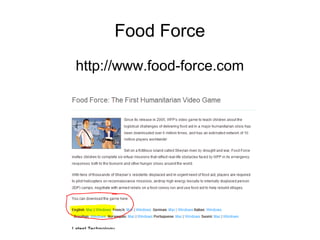
Food Force
http://www.food-force.com
Why Games?
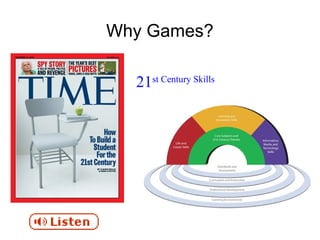
21st Century Skills
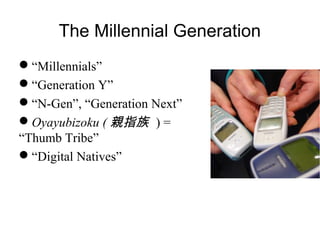
The Millennial Generation
“Millennials”
“Generation Y”
“N-Gen”, “Generation Next”
Oyayubizoku ( 親指族 ) =
“Thumb Tribe”
“Digital Natives”
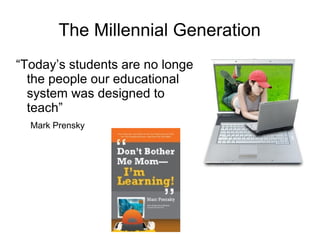
The Millennial Generation
“Today’s students are no longer
the people our educational
system was designed to
teach”
Mark Prensky
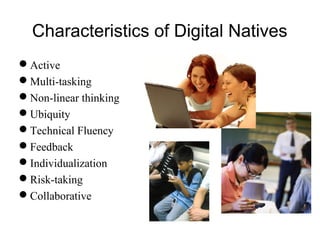
Characteristics of Digital Natives
Active
Multi-tasking
Non-linear thinking
Ubiquity
Technical Fluency
Feedback
Individualization
Risk-taking
Collaborative
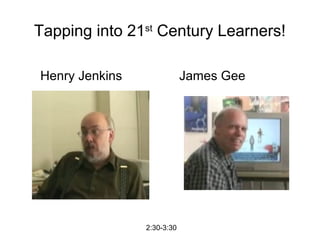
Tapping into 21st
Century Learners!
Henry Jenkins James Gee
2:30-3:30
What is a Game?
A competitive activity in which players
follow a set of rules
Competitive: Single player (player versus
self), multi-player, computer controlled player
Active: player actions affect outcomes
Rules:
Define victory conditions
Describe legal play
Differentiate games from one another
Simulations
Simulation: a reproduction or representation of reality
Some simulations are games
Sim City
Zoo Tycoon
“serious games”
Some simulations may not be games
Economic models
Cinematic re-enactments
Anatomical or geographical exploration
Incidental Learning – Food Force (if ready)
Gaming in Education
Do not, my friend, keep children to their studies by
compulsion, but by play -- Plato, Republic.
Games have been widely used in education throughout history
Athletics
Debates
Spelling bees
Classroom Jeopardy
Most common uses are assessment and practice
Incidental learning minimized
Gaming in Education
The 1970s saw a dramatic increase in the use of
games for educational purposes
“As the true character of gaming as a unique
communication form becomes clear, its use… will
become pervasive”
Richard Duke (1974), The Future’s Language
In the 1980s there was a focus on basic skill
development – Reader Rabbit & Math Blaster
Why Games?
Brain Research
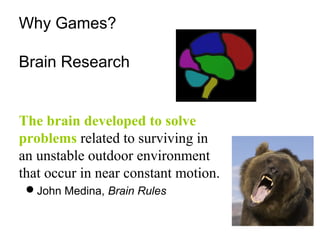
The brain developed to solve
problems related to surviving in
an unstable outdoor environment
that occur in near constant motion.
John Medina, Brain Rules
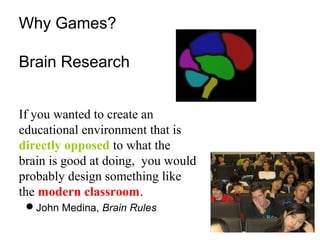
If you wanted to create an
educational environment that is
directly opposed to what the
brain is good at doing, you would
probably design something like
the modern classroom.
John Medina, Brain Rules
Why Games?
Brain Research
Patterns
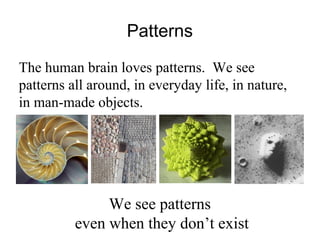
The human brain loves patterns. We see
patterns all around, in everyday life, in nature,
in man-made objects.
We see patterns
even when they don’t exist
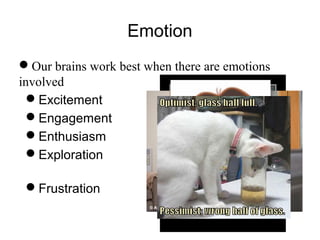
Emotion
Our brains work best when there are emotions
involved
Excitement
Engagement
Enthusiasm
Exploration
Frustration
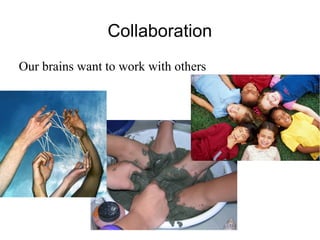
Collaboration
Our brains want to work with others
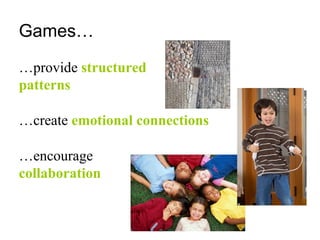
Games…
…provide structured
patterns
…create emotional connections
…encourage
collaboration
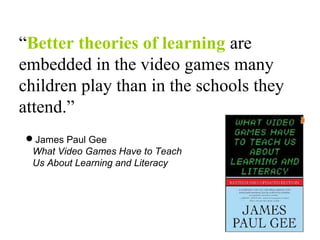
“Better theories of learning are
embedded in the video games many
children play than in the schools they
attend.”
James Paul Gee
What Video Games Have to Teach
Us About Learning and Literacy
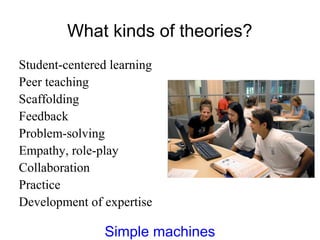
What kinds of theories?
Student-centered learning
Peer teaching
Scaffolding
Feedback
Problem-solving
Empathy, role-play
Collaboration
Practice
Development of expertise
Simple machines
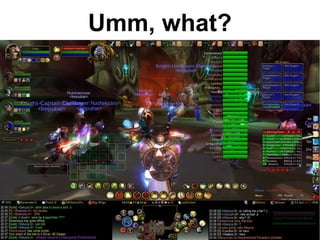
Umm, what?
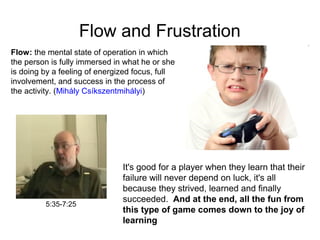
Flow and Frustration
5:35-7:25
Flow: the mental state of operation in which
the person is fully immersed in what he or she
is doing by a feeling of energized focus, full
involvement, and success in the process of
the activity. (Mihály Csíkszentmihályi)
It's good for a player when they learn that their
failure will never depend on luck, it's all
because they strived, learned and finally
succeeded. And at the end, all the fun from
this type of game comes down to the joy of
learning
How Games Teach
1. Activity – a game depends on learner
not being passive
2. Engagement – longer time on task,
greater involvement, rewards
3. X2: Exploration and Experimentation –
support creativity, scientific thinking,
opportunity for (relatively consequence
free) failure
How Games Teach
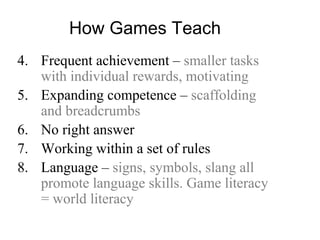
4. Frequent achievement – smaller tasks
with individual rewards, motivating
5. Expanding competence – scaffolding
and breadcrumbs
6. No right answer
7. Working within a set of rules
8. Language – signs, symbols, slang all
promote language skills. Game literacy
= world literacy
How Games Teach
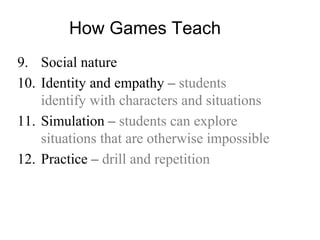
9. Social nature
10. Identity and empathy – students
identify with characters and situations
11. Simulation – students can explore
situations that are otherwise impossible
12. Practice – drill and repetition
How Games Teach
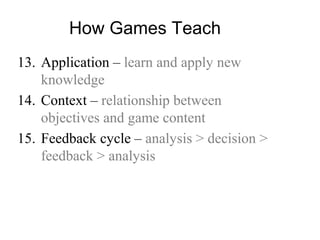
13. Application – learn and apply new
knowledge
14. Context – relationship between
objectives and game content
15. Feedback cycle – analysis > decision >
feedback > analysis
How Games Teach
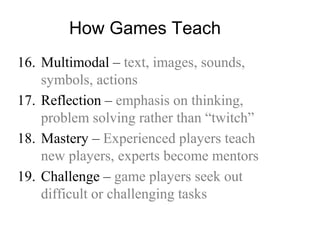
16. Multimodal – text, images, sounds,
symbols, actions
17. Reflection – emphasis on thinking,
problem solving rather than “twitch”
18. Mastery – Experienced players teach
new players, experts become mentors
19. Challenge – game players seek out
difficult or challenging tasks
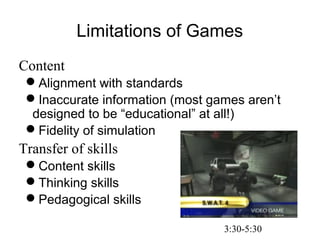
Limitations of Games
Content
Alignment with standards
Inaccurate information (most games aren’t
designed to be “educational” at all!)
Fidelity of simulation
Transfer of skills
Content skills
Thinking skills
Pedagogical skills
3:30-5:30
Challenges for Teachers
Time
Alignment with Standards
Cost
Software
Hardware
Assessment
Rubrics, participation, presentations
Management Strategies
Set Expectations & Parameters
Internet Safety & Guidelines
Parent Note Home
Student Contract
Rotate for Freshness
Keep Links Organized
Class blog, Delicious, Diigo
Kids suggestion box
Concerns about Games
They cause violence
They are just for boys
They are just for kids
“Reality Bytes: Eight Myths About Video Games Debunked” by Henry Jenkins
Scientific American
A pernicious excitement to learn and play _____ has spread all
over the country, and numerous clubs for playing this game have
been formed in cities and villages. Why should we regret this? It
may be asked.
We answer, _____ is a mere amusement of very inferior character,
which robs the mind of valuable time that might be devoted to
nobler acquirements, while it affords no benefit whatever to the
body.
_____ has acquired a high reputation as being a means to
discipline the mind, but persons engaged in sedentary occupations
should never practice this cheerless game; they require out-door
exercises—not this sort of mental gladiatorship.
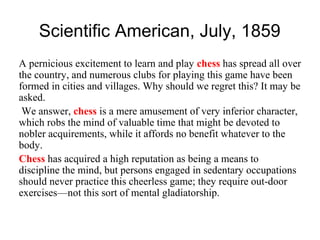
Scientific American, July, 1859
A pernicious excitement to learn and play chess has spread all over
the country, and numerous clubs for playing this game have been
formed in cities and villages. Why should we regret this? It may be
asked.
We answer, chess is a mere amusement of very inferior character,
which robs the mind of valuable time that might be devoted to
nobler acquirements, while it affords no benefit whatever to the
body.
Chess has acquired a high reputation as being a means to
discipline the mind, but persons engaged in sedentary occupations
should never practice this cheerless game; they require out-door
exercises—not this sort of mental gladiatorship.
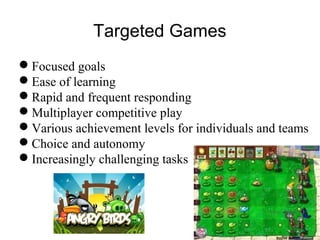
Targeted Games
Focused goals
Ease of learning
Rapid and frequent responding
Multiplayer competitive play
Various achievement levels for individuals and teams
Choice and autonomy
Increasingly challenging tasks
(aka) “Skill & Drill”
Mr. Nussbaum http://www.mrnussbaum.com/
Explore for a while
Compare “true games” to “simulations” or
“activities”
Why are most games “drill and practice”?
Is this sort of activity outdated?
Is there a place for it?
Can it still be standards based?
1X1=1
2X2=4
3X3=9
4X4=16
ALTEC Games
http://arcademics.com/
Math and Language Arts
http://www.4kids.org/
Angles and Coordinates
Jerry Chaffin Theory
Rate vs. Percent Correct
Certain Types of Knowledge
Build Fluency (accuracy and speed)
Build speed, disregard accuracy
Once response rate is high, focus on accuracy
Immediate drop in speed, but quick to recover
Sensible use
Kids need foundation
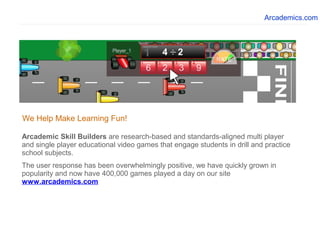
Arcademic Skill Builders are research-based and standards-aligned multi player
and single player educational video games that engage students in drill and practice
school subjects.
The user response has been overwhelmingly positive, we have quickly grown in
popularity and now have 400,000 games played a day on our site
www.arcademics.com
We Help Make Learning Fun!
Arcademics.com
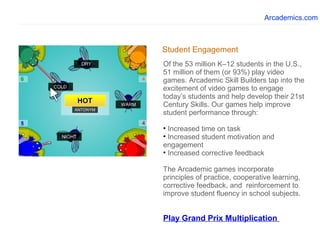
Of the 53 million K–12 students in the U.S.,
51 million of them (or 93%) play video
games. Arcademic Skill Builders tap into the
excitement of video games to engage
today’s students and help develop their 21st
Century Skills. Our games help improve
student performance through:
• Increased time on task
• Increased student motivation and
engagement
• Increased corrective feedback
The Arcademic games incorporate
principles of practice, cooperative learning,
corrective feedback, and reinforcement to
improve student fluency in school subjects.
Play Grand Prix Multiplication
Student Engagement
Arcademics.com
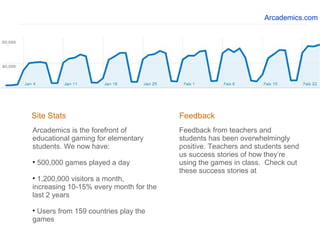
Arcademics is the forefront of
educational gaming for elementary
students. We now have:
• 500,000 games played a day
• 1,200,000 visitors a month,
increasing 10-15% every month for the
last 2 years
• Users from 159 countries play the
games
Site Stats
Feedback from teachers and
students has been overwhelmingly
positive. Teachers and students send
us success stories of how they’re
using the games in class. Check out
these success stories at
http://www.arcademicskillbuilders.co
m/
Feedback
Arcademics.com
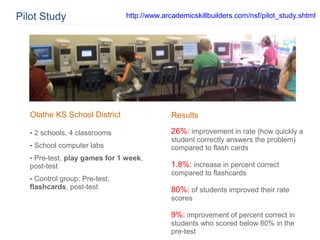
Pilot Study
Olathe KS School District
- 2 schools, 4 classrooms
- School computer labs
- Pre-test, play games for 1 week,
post-test
- Control group: Pre-test,
flashcards, post-test
Results
26%: improvement in rate (how quickly a
student correctly answers the problem)
compared to flash cards
1.8%: increase in percent correct
compared to flashcards
80%: of students improved their rate
scores
9%: improvement of percent correct in
students who scored below 80% in the
pre-test
http://www.arcademicskillbuilders.com/nsf/pilot_study.shtml
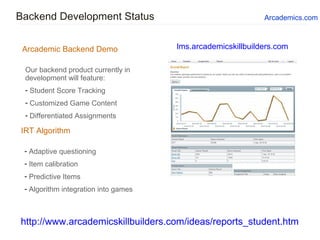
Backend Development Status
Our backend product currently in
development will feature:
- Student Score Tracking
- Customized Game Content
- Differentiated Assignments
Arcademic Backend Demo lms.arcademicskillbuilders.com
- Adaptive questioning
- Item calibration
- Predictive Items
- Algorithm integration into games
IRT Algorithm
Arcademics.com
http://www.arcademicskillbuilders.com/ideas/reports_student.htm
Goal:
Use emerging technology games and digital
tools in after-school programs to improve
middle school mathematics achievement of
students in urban and rural schools not
making AYP.
Ratio & Proportion
Linear Equations
Data & Statistics
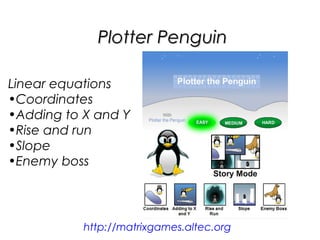
http://matrixgames.altec.org
Plotter PenguinPlotter Penguin
Linear equations
•Coordinates
•Adding to X and Y
•Rise and run
•Slope
•Enemy boss
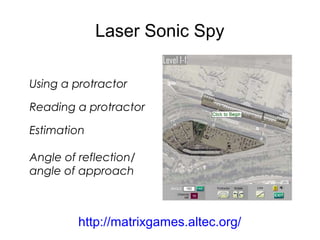
Laser Sonic Spy
Using a protractor
Reading a protractor
Estimation
Angle of reflection/
angle of approach
http://matrixgames.altec.org/
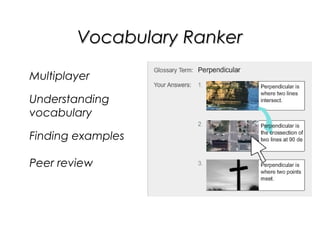
Vocabulary RankerVocabulary Ranker
Multiplayer
Understanding
vocabulary
Finding examples
Peer review
What makes a game…
Standards-Based? Worthy? Valid?
“Big Al” Biology
http://www.bbc.co.uk/dinosaurs/bigalgame/index.html
“Design a Planet” Planet Characteristics
http://astroventure.arc.nasa.gov/
“Bedtime Bandits” Time
http://www.mrnussbaumgames.com/bedtime_bandits/index.html
“Banana Hut” Angles
http://www.oswego.org/ocsd-web/games/bananahunt/bhunt.html
More Game Examples
Food Force
Stop Disasters
Magic Pen
You Are the Historian
Team Treks
Third World Farmer
Minyanland
ElectroCity
Nanoquest
Real Lives
Traveler IQ
The Forbidden City
Discover Babylon
Dimension Math
Lunar Quest
Web Rangers
Peacemaker
Budget Hero
Redistricting Game
•Massively multiplayer online games are the fastest
growing segment of the industry
•Most popular are modeled after heroic fantasy, but
other themes are prevalent
•80% of players are over 19 years old, 60% are male
•Many worlds will support 500,00-1,000,000 players
from around the world online at any time
Virtual worlds
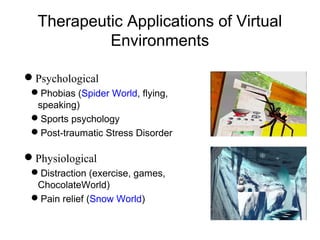
Therapeutic Applications of Virtual
Environments
Psychological
Phobias (Spider World, flying,
speaking)
Sports psychology
Post-traumatic Stress Disorder
Physiological
Distraction (exercise, games,
ChocolateWorld)
Pain relief (Snow World)
Club Penguin
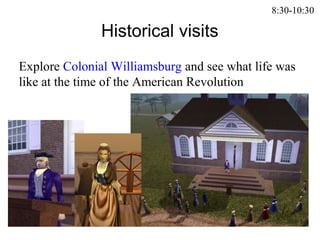
Historical visits
Explore Colonial Williamsburg and see what life was
like at the time of the American Revolution
8:30-10:30
Economics in Virtual Worlds
Planning and goal setting (Club Penguin)
Auctioning and bidding systems
Virtual stock exchanges
MarketWatch
Hollywood Stock Exchange
Economics in Virtual Worlds
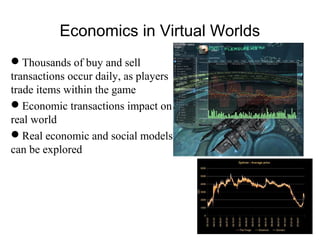
Thousands of buy and sell
transactions occur daily, as players
trade items within the game
Economic transactions impact on
real world
Real economic and social models
can be explored
City of Heroes
Survey of Discussion Topics 7/15/10
Speculative markets
Variants on auction strategies
Market functions and mechanics
Arbitrage
“Trading transparency”
Guide to Market Participation
“The instant resolution nature of the consignment house has an interesting effect on
steady-state properties of the market. Let’s suppose for a moment that the system is
seeded with a large number of random entries for both bids and postings:
(b1 b2 … bN) and
(p1 p2 … pN)
The subscripts here denote increasing denominations of currency, i.e. both the bids and
postings are sorted within their own pools.
As long as any bids are higher than any postings, the system will resolve transactions
and remove those bids and postings from play. If there are any bids and postings left,
which we would expect in many instances, there are by definition two domains in the
market afterwards:
(b1 b2 … bM) ... (pM+1 pM+2 … pN)
That is, the highest remaining bid is lower than the lowest remaining posting. In other
words, these two domains – known as the bid pool and the sell pool - are disjoint.
They have in a very tangible sense become two separate markets.”
Sources
Don't Bother Me Mom--I'm Learning! by Marc Prensky – Paragon House Publishers (2006)
What Video Games Have to Teach Us About Learning and Literacy by James Paul Gee – Palgrave Macmillan;
2nd edition (2007)
How Computer Games Help Children Learn by David Williamson Shaffer – Palgrave Macmillan (2008)
Born Digital: Understanding the First Generation of Digital Natives by John Palfrey – Basic Books (2008)
Grand Theft Childhood: The Surprising Truth About Violent Video Games and What Parents Can Do by
Lawrence Kutner – Simon & Schuster (2008)
Brain Rules by John Medina – Pear Press (2008) http://www.brainrules.net/
“Reality Bytes: Eight Myths About Video Games Debunked” by Henry Jenkins
http://www.pbs.org/kcts/videogamerevolution/impact/myths.html
Federation of American Scientists - Summit on Educational Games (2006)
http://www.fas.org/gamesummit/
“Games, Motivation, and Learning” - White Paper (PDF)
http://caspianlearning.co.uk/Whtp_Games_Motivation_Learning.pdf
“You Play World of Warcraft? You're Hired! Why multiplayer games may be the best kind of job training” by
John Seely Brown and Douglas Thomas (Wired Magazine, April, 2006)
http://www.wired.com/wired/archive/14.04/learn.html
Games in Education video by Mark Wagner and Michael Guerena of the Orange County (CA) Department of
Education's Educational Technology group -- http://video.google.com/videoplay?
docid=6117726917684965691
Web Sites
This Presentation – http://www.slideshare.net/dadams.altec
4Kids – http://4kids.org
Arcademic Skill Builders – http://www.arcademicskillbuilders.com
Matrix Games -- http://matrixgames.altec.org/
Dimension Math (fee-based, demos online) -- http://www.dimensionm.com/
Mr. Nussbaum -- http://www.mrnussbaum.com/mathcode.htm
Oswego County School District -- http://resources.oswego.org/games/
National Library of Virtual Manipulatives – http://nlvm.usu.edu/en/nav/vlibrary.html
Club Penguin – http://clubpenguin.com
Virtual Stock Exchange – http://vse.marketwatch.com/Game/Homepage.aspx
Hollywood Stock Exchange – http://hsx.com/
Marc Prensky’s Web site – http://www.marcprensky.com/writing/
Henry Jenkins’ blog – http://henryjenkins.org
Doug Adams
dadams@altec.org
http://altec.org

KSDE video games in the classroom

  • 1.
    Games in Education DougAdams ALTEC/4Teachers.org
  • 2.
  • 3.
  • 4.
  • 5.
    The Millennial Generation “Millennials” “GenerationY” “N-Gen”, “Generation Next” Oyayubizoku ( 親指族 ) = “Thumb Tribe” “Digital Natives”
  • 6.
    The Millennial Generation “Today’sstudents are no longer the people our educational system was designed to teach” Mark Prensky
  • 7.
    Characteristics of DigitalNatives Active Multi-tasking Non-linear thinking Ubiquity Technical Fluency Feedback Individualization Risk-taking Collaborative
  • 8.
    Tapping into 21st CenturyLearners! Henry Jenkins James Gee 2:30-3:30
  • 9.
    What is aGame? A competitive activity in which players follow a set of rules Competitive: Single player (player versus self), multi-player, computer controlled player Active: player actions affect outcomes Rules: Define victory conditions Describe legal play Differentiate games from one another
  • 10.
    Simulations Simulation: a reproductionor representation of reality Some simulations are games Sim City Zoo Tycoon “serious games” Some simulations may not be games Economic models Cinematic re-enactments Anatomical or geographical exploration Incidental Learning – Food Force (if ready)
  • 11.
    Gaming in Education Donot, my friend, keep children to their studies by compulsion, but by play -- Plato, Republic. Games have been widely used in education throughout history Athletics Debates Spelling bees Classroom Jeopardy Most common uses are assessment and practice Incidental learning minimized
  • 12.
    Gaming in Education The1970s saw a dramatic increase in the use of games for educational purposes “As the true character of gaming as a unique communication form becomes clear, its use… will become pervasive” Richard Duke (1974), The Future’s Language In the 1980s there was a focus on basic skill development – Reader Rabbit & Math Blaster
  • 13.
    Why Games? Brain Research Thebrain developed to solve problems related to surviving in an unstable outdoor environment that occur in near constant motion. John Medina, Brain Rules
  • 14.
    If you wantedto create an educational environment that is directly opposed to what the brain is good at doing, you would probably design something like the modern classroom. John Medina, Brain Rules Why Games? Brain Research
  • 15.
    Patterns The human brainloves patterns. We see patterns all around, in everyday life, in nature, in man-made objects. We see patterns even when they don’t exist
  • 20.
    Emotion Our brains workbest when there are emotions involved Excitement Engagement Enthusiasm Exploration Frustration
  • 21.
    Collaboration Our brains wantto work with others
  • 22.
  • 23.
    “Better theories oflearning are embedded in the video games many children play than in the schools they attend.” James Paul Gee What Video Games Have to Teach Us About Learning and Literacy
  • 24.
    What kinds oftheories? Student-centered learning Peer teaching Scaffolding Feedback Problem-solving Empathy, role-play Collaboration Practice Development of expertise Simple machines
  • 25.
  • 26.
    Flow and Frustration 5:35-7:25 Flow:the mental state of operation in which the person is fully immersed in what he or she is doing by a feeling of energized focus, full involvement, and success in the process of the activity. (Mihály Csíkszentmihályi) It's good for a player when they learn that their failure will never depend on luck, it's all because they strived, learned and finally succeeded. And at the end, all the fun from this type of game comes down to the joy of learning
  • 27.
    How Games Teach 1.Activity – a game depends on learner not being passive 2. Engagement – longer time on task, greater involvement, rewards 3. X2: Exploration and Experimentation – support creativity, scientific thinking, opportunity for (relatively consequence free) failure
  • 28.
    How Games Teach 4.Frequent achievement – smaller tasks with individual rewards, motivating 5. Expanding competence – scaffolding and breadcrumbs 6. No right answer 7. Working within a set of rules 8. Language – signs, symbols, slang all promote language skills. Game literacy = world literacy
  • 29.
    How Games Teach 9.Social nature 10. Identity and empathy – students identify with characters and situations 11. Simulation – students can explore situations that are otherwise impossible 12. Practice – drill and repetition
  • 30.
    How Games Teach 13.Application – learn and apply new knowledge 14. Context – relationship between objectives and game content 15. Feedback cycle – analysis > decision > feedback > analysis
  • 31.
    How Games Teach 16.Multimodal – text, images, sounds, symbols, actions 17. Reflection – emphasis on thinking, problem solving rather than “twitch” 18. Mastery – Experienced players teach new players, experts become mentors 19. Challenge – game players seek out difficult or challenging tasks
  • 32.
    Limitations of Games Content Alignmentwith standards Inaccurate information (most games aren’t designed to be “educational” at all!) Fidelity of simulation Transfer of skills Content skills Thinking skills Pedagogical skills 3:30-5:30
  • 33.
    Challenges for Teachers Time Alignmentwith Standards Cost Software Hardware Assessment Rubrics, participation, presentations
  • 34.
    Management Strategies Set Expectations& Parameters Internet Safety & Guidelines Parent Note Home Student Contract Rotate for Freshness Keep Links Organized Class blog, Delicious, Diigo Kids suggestion box
  • 35.
    Concerns about Games Theycause violence They are just for boys They are just for kids “Reality Bytes: Eight Myths About Video Games Debunked” by Henry Jenkins
  • 36.
    Scientific American A perniciousexcitement to learn and play _____ has spread all over the country, and numerous clubs for playing this game have been formed in cities and villages. Why should we regret this? It may be asked. We answer, _____ is a mere amusement of very inferior character, which robs the mind of valuable time that might be devoted to nobler acquirements, while it affords no benefit whatever to the body. _____ has acquired a high reputation as being a means to discipline the mind, but persons engaged in sedentary occupations should never practice this cheerless game; they require out-door exercises—not this sort of mental gladiatorship.
  • 37.
    Scientific American, July,1859 A pernicious excitement to learn and play chess has spread all over the country, and numerous clubs for playing this game have been formed in cities and villages. Why should we regret this? It may be asked. We answer, chess is a mere amusement of very inferior character, which robs the mind of valuable time that might be devoted to nobler acquirements, while it affords no benefit whatever to the body. Chess has acquired a high reputation as being a means to discipline the mind, but persons engaged in sedentary occupations should never practice this cheerless game; they require out-door exercises—not this sort of mental gladiatorship.
  • 38.
    Targeted Games Focused goals Easeof learning Rapid and frequent responding Multiplayer competitive play Various achievement levels for individuals and teams Choice and autonomy Increasingly challenging tasks
  • 39.
    (aka) “Skill &Drill” Mr. Nussbaum http://www.mrnussbaum.com/ Explore for a while Compare “true games” to “simulations” or “activities” Why are most games “drill and practice”? Is this sort of activity outdated? Is there a place for it? Can it still be standards based? 1X1=1 2X2=4 3X3=9 4X4=16
  • 40.
    ALTEC Games http://arcademics.com/ Math andLanguage Arts http://www.4kids.org/ Angles and Coordinates
  • 41.
    Jerry Chaffin Theory Ratevs. Percent Correct Certain Types of Knowledge Build Fluency (accuracy and speed) Build speed, disregard accuracy Once response rate is high, focus on accuracy Immediate drop in speed, but quick to recover Sensible use Kids need foundation
  • 42.
    Arcademic Skill Buildersare research-based and standards-aligned multi player and single player educational video games that engage students in drill and practice school subjects. The user response has been overwhelmingly positive, we have quickly grown in popularity and now have 400,000 games played a day on our site www.arcademics.com We Help Make Learning Fun! Arcademics.com
  • 43.
    Of the 53million K–12 students in the U.S., 51 million of them (or 93%) play video games. Arcademic Skill Builders tap into the excitement of video games to engage today’s students and help develop their 21st Century Skills. Our games help improve student performance through: • Increased time on task • Increased student motivation and engagement • Increased corrective feedback The Arcademic games incorporate principles of practice, cooperative learning, corrective feedback, and reinforcement to improve student fluency in school subjects. Play Grand Prix Multiplication Student Engagement Arcademics.com
  • 44.
    Arcademics is theforefront of educational gaming for elementary students. We now have: • 500,000 games played a day • 1,200,000 visitors a month, increasing 10-15% every month for the last 2 years • Users from 159 countries play the games Site Stats Feedback from teachers and students has been overwhelmingly positive. Teachers and students send us success stories of how they’re using the games in class. Check out these success stories at http://www.arcademicskillbuilders.co m/ Feedback Arcademics.com
  • 45.
    Pilot Study Olathe KSSchool District - 2 schools, 4 classrooms - School computer labs - Pre-test, play games for 1 week, post-test - Control group: Pre-test, flashcards, post-test Results 26%: improvement in rate (how quickly a student correctly answers the problem) compared to flash cards 1.8%: increase in percent correct compared to flashcards 80%: of students improved their rate scores 9%: improvement of percent correct in students who scored below 80% in the pre-test http://www.arcademicskillbuilders.com/nsf/pilot_study.shtml
  • 46.
    Backend Development Status Ourbackend product currently in development will feature: - Student Score Tracking - Customized Game Content - Differentiated Assignments Arcademic Backend Demo lms.arcademicskillbuilders.com - Adaptive questioning - Item calibration - Predictive Items - Algorithm integration into games IRT Algorithm Arcademics.com http://www.arcademicskillbuilders.com/ideas/reports_student.htm
  • 47.
    Goal: Use emerging technologygames and digital tools in after-school programs to improve middle school mathematics achievement of students in urban and rural schools not making AYP. Ratio & Proportion Linear Equations Data & Statistics http://matrixgames.altec.org
  • 48.
    http://matrixgames.altec.org Plotter PenguinPlotter Penguin Linearequations •Coordinates •Adding to X and Y •Rise and run •Slope •Enemy boss
  • 49.
    Laser Sonic Spy Usinga protractor Reading a protractor Estimation Angle of reflection/ angle of approach http://matrixgames.altec.org/
  • 50.
  • 51.
    What makes agame… Standards-Based? Worthy? Valid? “Big Al” Biology http://www.bbc.co.uk/dinosaurs/bigalgame/index.html “Design a Planet” Planet Characteristics http://astroventure.arc.nasa.gov/ “Bedtime Bandits” Time http://www.mrnussbaumgames.com/bedtime_bandits/index.html “Banana Hut” Angles http://www.oswego.org/ocsd-web/games/bananahunt/bhunt.html
  • 52.
    More Game Examples FoodForce Stop Disasters Magic Pen You Are the Historian Team Treks Third World Farmer Minyanland ElectroCity Nanoquest Real Lives Traveler IQ The Forbidden City Discover Babylon Dimension Math Lunar Quest Web Rangers Peacemaker Budget Hero Redistricting Game
  • 53.
    •Massively multiplayer onlinegames are the fastest growing segment of the industry •Most popular are modeled after heroic fantasy, but other themes are prevalent •80% of players are over 19 years old, 60% are male •Many worlds will support 500,00-1,000,000 players from around the world online at any time Virtual worlds
  • 54.
    Therapeutic Applications ofVirtual Environments Psychological Phobias (Spider World, flying, speaking) Sports psychology Post-traumatic Stress Disorder Physiological Distraction (exercise, games, ChocolateWorld) Pain relief (Snow World)
  • 55.
  • 56.
    Historical visits Explore ColonialWilliamsburg and see what life was like at the time of the American Revolution 8:30-10:30
  • 57.
    Economics in VirtualWorlds Planning and goal setting (Club Penguin) Auctioning and bidding systems Virtual stock exchanges MarketWatch Hollywood Stock Exchange
  • 58.
    Economics in VirtualWorlds Thousands of buy and sell transactions occur daily, as players trade items within the game Economic transactions impact on real world Real economic and social models can be explored
  • 59.
    City of Heroes Surveyof Discussion Topics 7/15/10 Speculative markets Variants on auction strategies Market functions and mechanics Arbitrage “Trading transparency”
  • 60.
    Guide to MarketParticipation “The instant resolution nature of the consignment house has an interesting effect on steady-state properties of the market. Let’s suppose for a moment that the system is seeded with a large number of random entries for both bids and postings: (b1 b2 … bN) and (p1 p2 … pN) The subscripts here denote increasing denominations of currency, i.e. both the bids and postings are sorted within their own pools. As long as any bids are higher than any postings, the system will resolve transactions and remove those bids and postings from play. If there are any bids and postings left, which we would expect in many instances, there are by definition two domains in the market afterwards: (b1 b2 … bM) ... (pM+1 pM+2 … pN) That is, the highest remaining bid is lower than the lowest remaining posting. In other words, these two domains – known as the bid pool and the sell pool - are disjoint. They have in a very tangible sense become two separate markets.”
  • 61.
    Sources Don't Bother MeMom--I'm Learning! by Marc Prensky – Paragon House Publishers (2006) What Video Games Have to Teach Us About Learning and Literacy by James Paul Gee – Palgrave Macmillan; 2nd edition (2007) How Computer Games Help Children Learn by David Williamson Shaffer – Palgrave Macmillan (2008) Born Digital: Understanding the First Generation of Digital Natives by John Palfrey – Basic Books (2008) Grand Theft Childhood: The Surprising Truth About Violent Video Games and What Parents Can Do by Lawrence Kutner – Simon & Schuster (2008) Brain Rules by John Medina – Pear Press (2008) http://www.brainrules.net/ “Reality Bytes: Eight Myths About Video Games Debunked” by Henry Jenkins http://www.pbs.org/kcts/videogamerevolution/impact/myths.html Federation of American Scientists - Summit on Educational Games (2006) http://www.fas.org/gamesummit/ “Games, Motivation, and Learning” - White Paper (PDF) http://caspianlearning.co.uk/Whtp_Games_Motivation_Learning.pdf “You Play World of Warcraft? You're Hired! Why multiplayer games may be the best kind of job training” by John Seely Brown and Douglas Thomas (Wired Magazine, April, 2006) http://www.wired.com/wired/archive/14.04/learn.html Games in Education video by Mark Wagner and Michael Guerena of the Orange County (CA) Department of Education's Educational Technology group -- http://video.google.com/videoplay? docid=6117726917684965691
  • 62.
    Web Sites This Presentation– http://www.slideshare.net/dadams.altec 4Kids – http://4kids.org Arcademic Skill Builders – http://www.arcademicskillbuilders.com Matrix Games -- http://matrixgames.altec.org/ Dimension Math (fee-based, demos online) -- http://www.dimensionm.com/ Mr. Nussbaum -- http://www.mrnussbaum.com/mathcode.htm Oswego County School District -- http://resources.oswego.org/games/ National Library of Virtual Manipulatives – http://nlvm.usu.edu/en/nav/vlibrary.html Club Penguin – http://clubpenguin.com Virtual Stock Exchange – http://vse.marketwatch.com/Game/Homepage.aspx Hollywood Stock Exchange – http://hsx.com/ Marc Prensky’s Web site – http://www.marcprensky.com/writing/ Henry Jenkins’ blog – http://henryjenkins.org
  • 63.

Editor's Notes

  • #5 "A guild master must be adept at many skills: attracting, evaluating, and recruiting new members; creating apprenticeship programs; orchestrating group strategy; and adjudicating disputes. Guilds routinely splinter over petty squabbles and other basic failures of management; the master must resolve them without losing valuable members, who can easily quit and join a rival guild." Brown, J.S. & Thomas, D. (2006). "You Play World of Warcraft? You're Hired!" Wired 14.04. http://www.wired.com/wired/archive/14.04/learn.html Core Subjects and 21st Century Themes Math, Language Arts, Science, Social Studies Global Awareness and Civic Literacy Economic and Business Literacy Health Literacy Learning and Innovation Skills Creativity, Critical Thinking and Problem Solving Communication and Collaboration Information Media and Technology Skills Information and Media Literacy - Communication and Technology Literacy Life and Career Skills Flexibility and Adaptability - Initiative, Productivity, and Self-direction Social Skills - Leadership, Accountability and Responsibility
  • #6 http://www.wordspy.com/words/thumbculture.asp http://observer.guardian.co.uk/uk_news/story/0,6903,673103,00.html http://www.pliink.com/mt/marxy/archives/2007/03/the-second-digi.html The "thumb tribe" (親指族) - who primarily input text through the telephone numerical layout - show serious inexperience with using PCs and with typing on a real keyboard. They are "retrogressing" to a point where they have the pathetic PC skills of their out-of-date elders. Over the last six years, almost all age groups have seen their share of total home PC access usage increase - except for 20 year-olds who have dropped from making up 23.6% to now only 11.9%. This current rate means that they make up an almost identical proportion of the total as 50 year-olds. Kids are saying that they use e-mail to talk to their teachers, or for their jobs. “E-mail is useful for talking to adults.” Most of their interpersonal contact is via IM, or through postings on social networking sites.
  • #8 18:02-19:00 - Jenkins New media is adopted early by kids. Generation growing up with a technology treat it in a pragmatic manner. Next generation of teachers will have had game experience and it will be part of their culture. 20:44-21:05 - Gee The future is going to belong to people who are tech savvy and comfortable with technology, who don't view tech learning as hard or special but instead as an everyday thing. Active Web 2.0 – students are creators. In his book Joystick Nation, J.C. Herz wrote “TV turned kids of the fifties and sixties into a nation of screen watchers, videogames have created a cadre of screen manipulators”. At the very least, kids expect to be able to comment. Usually they want to construct. Multi-tasking The brain is linear in its application. Multi-tasking is really quickly switching and frequently between tasks. This comes naturally to a digital native, but makes non-natives uncomfortable. Non-linear thinking Hypertext and information on demand allows students to explore. Depth of thought is often exchanged for breadth of experience, leaving detailed information for on-demand searching – why memorize the periodic table when you can look it up whenever you need it? Be aware stat student research may lead them away from their initial topic idea. Ubiquity Technology is everywhere, and kids expect to be able to connect with anyone, anytime. See “periodic table” above Technical Fluency Compare to a person who is speaking a foreign language. Even if you speak it well, a native speaker sounds like he is talking faster. A digital native just “knows” how to interact with technology just as a native of a foreign country knows how to interact in a new situation. A native speaker uses nuances, slang, and assumptions of cultural reference. “Invisible bike” or “Leeeroy Jenkins” Feedback Instant feedback is expected. Students will desire frequent reward opportunities. Very clear goals and requirements are desired. And those goals should be individualized as much as possible (next) Individualization Digital Natives expect that their technology will be customized for them. Gone are the days of the model-T (“any color you want as long as it is black”) or the princess phone. Web sites, stores, music, and even material things are individual and customized. Risk-takers Losing a game or failing a task just means that you need to try again. Learning new technology (which happens all the time) is a matter of just trying something and watching how it responds. Mastery priciples should come into play to give students more opportunities – errors are chances to grow rather than failures to learn. Information sifting Students can manage vast amounts of information. They can quickly categorize data and find the relevant parts. For example, embedded advertising and popup windows.
  • #11 http://hagar.up.ac.za/cie/med_old/modules/mio880/docs/theory/simulations.html 1) simulations that teach about something, i.e.: a) Physical simulations – tectonic plates b) Process simulations – supply and demand 2) simulations that teach how to do something, i.e.: a) Procedural simulations – use a scientific calculator b) Situational simulations – deal with classroom management problems 5:20–5:35 Lemonade Stand Try out “Food Force”
  • #12 In “assessment” games, incidental learning of content is minimized. Learning takes place in preparation for the game, but the actual play has few opportunities for incidental learning of the content. Of course students do learn about interpersonal, intrapersonal, problem solving, communication, and life skills (like time management) strategies even in assessment games.
  • #28 Beginning Video 2:30-3:30 (Jenkins and Gee) Engagement 6:50-7:25 - Jenkins teachers complain that making education "fun" devalues the process of hard work. instead we should talk about "engagement" Active Multi-tasking Non-linear thinking Ubiquity Technical Fluency Feedback Individualization Risk-takers Information sifting
  • #29 Active Multi-tasking Non-linear thinking Ubiquity Technical Fluency Feedback Individualization Risk-takers Information sifting
  • #30 Active Multi-tasking Non-linear thinking Ubiquity Technical Fluency Feedback Individualization Risk-takers Information sifting
  • #31 Active Multi-tasking Non-linear thinking Ubiquity Technical Fluency Feedback Individualization Risk-takers Information sifting
  • #32 Active Multi-tasking Non-linear thinking Ubiquity Technical Fluency Feedback Individualization Risk-takers Information sifting 5:35 -6:00 - Jenkins Kids will go to bed early to avoid difficult homework, but will stay up late to beat a difficult game The worst thing a kid will say about homework is that it is too hard. The worst thing they'll say about a game is that it is too easy 6:00-6:55 - Clark Aldritch Teachers need to take advantage of frustration
  • #33 4:00-4:30 - Clark Aldrich It is really hard to use a simulation or computer game in a classroom. It is not the same skill set that we use when lecturing or giving tests or even in a lab. It is one of the great next generation teaching skills is to take something like Civilization and use it in the classroom. 4:30-5:20 - James Gee SWAT team, following the rules need similar games to teach kids about other systems, like doing good science
  • #39 Why? Assessments, basic skill attainment
  • #40 Why? Assessments, basic skill attainment
  • #42 On certain kinds of knowledge, like parts of speech, site words (reading recognition) and arithmetic, a student needs to become very fluent (accurate and fast). To build that speed and fluency we need to first build up the response rate to which they perform these skills, disregarding the errors. Once we get a response rate high, we need to focus on the accuracy rate. See an immediate drop in response rate but will build up quickly. Need to be sensible…not use subjects that kids know nothing about, this won’t work. If kids are using fingers to add, this would work for them. Disregard errors until rate is up, then knock out errors. It’s easier to knock out errors than it is to build up speed.
  • #54 http://www.gamespy.com/gdc2003/korean/ 26 million online in Korea. 54% play online games. Lineage has 150,000 simultaneous users, country the size of Indiana. Corporate sponsorship for gamers
  • #55 www.e-therapy.info Human Interface Technology Lab (www.hitl.washington.edu) http://www.churchoffools.com
  • #57 http://wwww.projectnml.org/revolution 8:40-10:35 - Revolution
  • #59 This is a good example of incidental learning. In many games where a market is significant, players who want to participate meaningfully in the market need to understand real world economic characteristics. Most players do just fine playing the game as if they were selling their treasure at garage sales – they try to sell what they have quickly and not to get cheated while making a small amount of money. However a significant number of players treat the online markets as serious business. Castranova article Kaufman grant re: Junior Achievement (Segue into COH)