


Education 3.0 Dr. Jeff D Borden – jeffb@ecollege.com Scott Anderberg – scotta@ecollege.com Garnet Berry – garnet.berry@fronter.com
Teaching Perspective
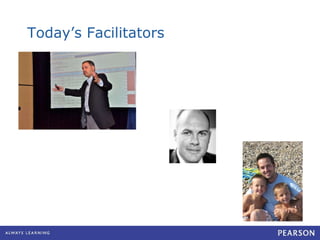
Today’s Facilitators
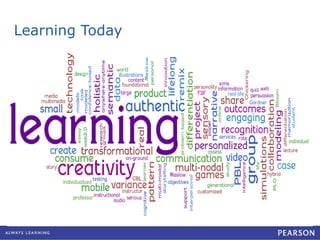
Learning Today
Agenda Level Setting IBM “Smart Planet for Education” List Importance of research Cross-curricular courses Teaching Creativity The new competencies Authentic assessment Personalized Learning Summary
Agenda Level Setting IBM “Smart Planet for Education” List Stop ignoring research Columbia University Cross-curricular courses The Pink Room (video) Teach students how to be creative / innovative Equella Teach the new competencies LMS as Aggregator Real life, practical assessment Nursing Neighborhood Personalized Learning MyLabs
Level Setting 1
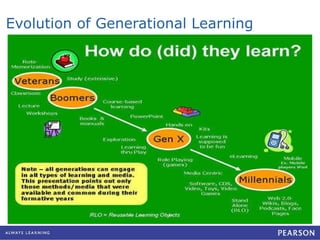
Evolution of Generational Learning
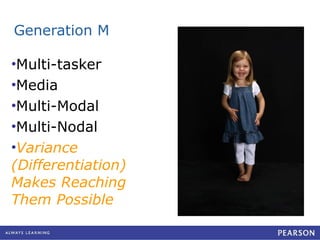
Generation M Multi-tasker Media Multi-Modal Multi-Nodal Variance (Differentiation) Makes Reaching Them Possible
Don’t forget: You can copy-paste this slide into other presentations, and move or resize the poll.
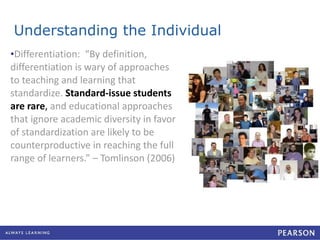
Understanding the Individual Differentiation:  “By definition, differentiation is wary of approaches to teaching and learning that standardize.   Standard-issue students are rare ,  and educational approaches that ignore academic diversity in favor of standardization are likely to be counterproductive in reaching the full range of learners.” – Tomlinson (2006)
Clasped Hands
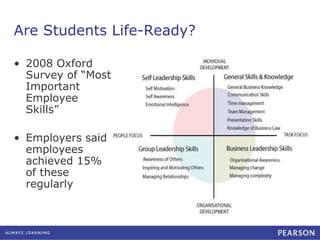
Are Students Life-Ready? 2008 Oxford Survey of “Most Important Employee Skills” Employers said employees achieved 15% of these regularly
Technology Can Help: History Pin
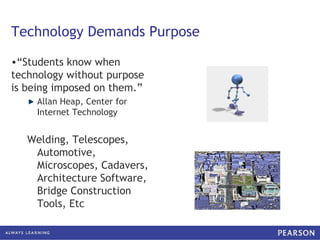
Technology Demands Purpose “ Students know when technology without purpose is being imposed on them.” Allan Heap, Center for Internet Technology Welding, Telescopes, Automotive, Microscopes, Cadavers, Architecture Software, Bridge Construction Tools, Etc
 
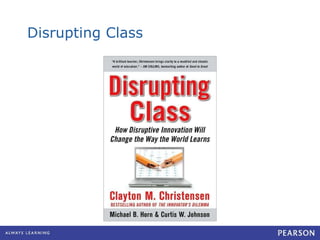
Disrupting Class
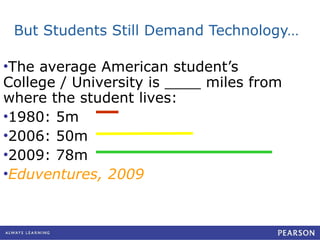
But Students Still Demand Technology… The average American student’s College / University is ____ miles from where the student lives: 1980: 5m 2006: 50m 2009: 78m Eduventures, 2009
How Do We Fix Education? 2
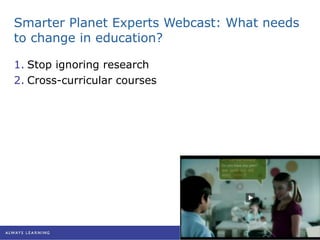
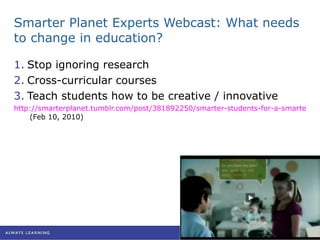
Smarter Planet Experts Webcast: What needs to change in education? Stop ignoring research
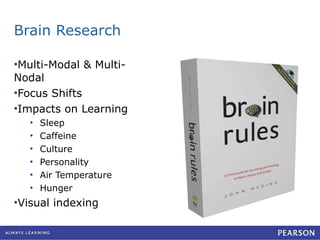
Brain Research Multi-Modal & Multi-Nodal Focus Shifts Impacts on Learning Sleep Caffeine Culture Personality Air Temperature Hunger Visual indexing
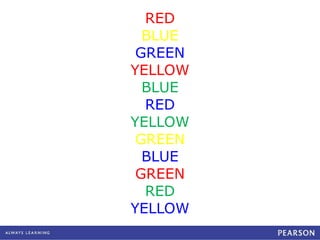
RED BLUE GREEN YELLOW BLUE RED YELLOW GREEN BLUE GREEN RED YELLOW
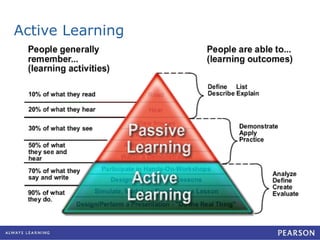
Active Learning
 
Columbia University Scott
 
Smarter Planet Experts Webcast: What needs to change in education? Stop ignoring research Cross-curricular courses
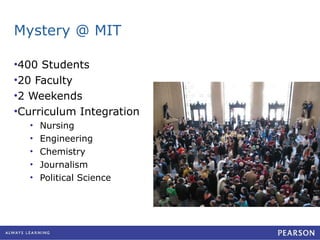
Mystery @ MIT 400 Students 20 Faculty 2 Weekends Curriculum Integration Nursing Engineering Chemistry Journalism Political Science
The Pink Room (video) Garnet
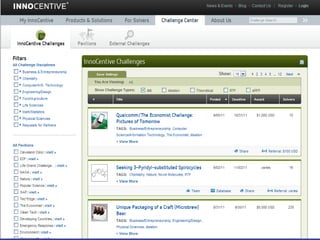
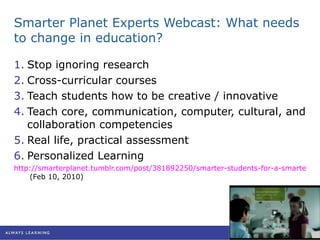
Smarter Planet Experts Webcast: What needs to change in education? Stop ignoring research Cross-curricular courses Teach students how to be creative / innovative http://smarterplanet.tumblr.com/post/381892250/smarter-students-for-a-smarter-planet-live  (Feb 10, 2010)
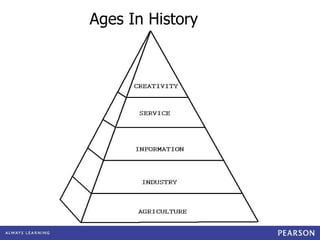
Ages In History
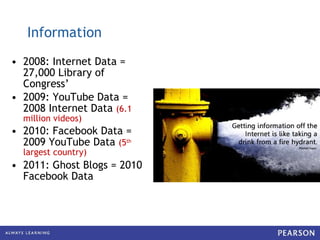
Information 2008: Internet Data = 27,000 Library of Congress’ 2009: YouTube Data = 2008 Internet Data   (6.1 million videos) 2010: Facebook Data = 2009 YouTube Data  (5 th  largest country) 2011: Ghost Blogs = 2010 Facebook Data
Important Future Quote “ In the long run, excesses of technology mean that the  comparative advantage shifts from those with information glut to those with ordered knowledge ; from those who can process vast amounts of blab to those who can explain what is worth knowing and why…” (Ratinoff, 1995)
Creativity “ Chief Executives believe that – more than rigor, management discipline, integrity, or even vision – navigating an increasingly complex world will require creativity.” 80% of employers seeking creative employees cannot find them to hire… IBM 2010 Global CEO Survey 1500 CEO’s from 60 Countries
 
Equella Garnet
 
 
Discover Babylon
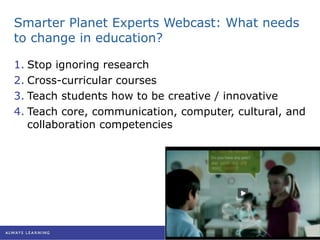
Smarter Planet Experts Webcast: What needs to change in education? Stop ignoring research Cross-curricular courses Teach students how to be creative / innovative Teach core, communication, computer, cultural, and collaboration competencies
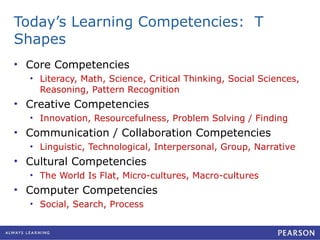
Today’s Learning Competencies:  T Shapes Core Competencies Literacy, Math, Science, Critical Thinking, Social Sciences, Reasoning, Pattern Recognition Creative Competencies Innovation, Resourcefulness, Problem Solving / Finding Communication / Collaboration Competencies Linguistic, Technological, Interpersonal, Group, Narrative Cultural Competencies The World Is Flat, Micro-cultures, Macro-cultures Computer Competencies Social, Search, Process
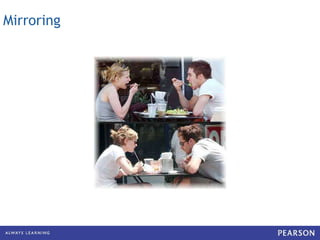
Communication Competence Nonverbal Communication: 86% Haptics Objectics Proxemics Chronemics Optics Vocalics Kinesics Facial Mirroring
Mirroring
LMS as Aggregator Garnet
The Mixxer
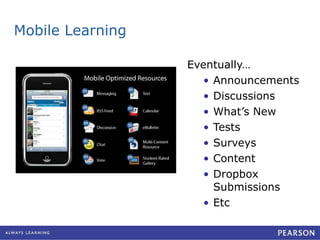
Mobile Learning Eventually… Announcements Discussions What’s New Tests Surveys Content Dropbox Submissions Etc
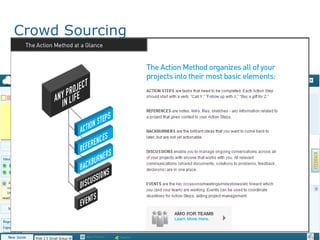
Crowd Sourcing www.edistorm.com www.betterme.com www.crocodoc.com www.thinkfold.com
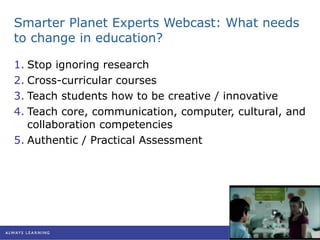
Smarter Planet Experts Webcast: What needs to change in education? Stop ignoring research Cross-curricular courses Teach students how to be creative / innovative Teach core, communication, computer, cultural, and collaboration competencies Authentic / Practical Assessment
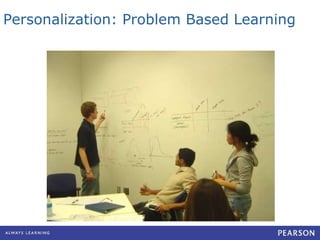
Personalization: Problem Based Learning
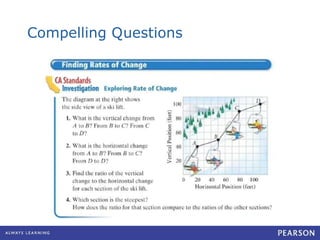
Compelling Q uestions
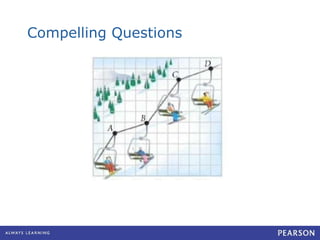
Compelling Questions
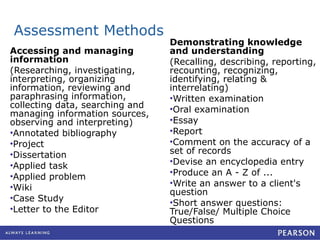
Assessment Methods Thinking critically / making judgments (Developing arguments, reflecting, evaluating, assessing, judging)  Essay  Report  Journal  Letter of Advice to .... (about policy, public health matters .....)  Present a case for an interest group  Prepare a committee briefing paper for a specific meeting  Book review (or article) for a particular journal  Write a newspaper article for a foreign newspaper  Comment on an article's theoretical perspective  Solving problems and developing plans  (Identifying problems, posing problems, defining problems, analyzing data, reviewing, designing experiments, planning, applying information)  Problem scenario  Group Project Work-based problem  Prepare a committee of enquiry report  Draft a research bid to a realistic brief  Analyze a case  Conference paper (or notes for a conference paper plus annotated bibliography)
Assessment Methods Performing procedures and demonstrating techniques  (Computation, taking readings, using equipment, following laboratory procedures, following protocols, carrying out instructions)   Demonstration  Role Play  Make a video (write script and produce/make a video)  Produce a poster  Lab report  Prepare an illustrated manual on using the equipment, for a particular audience  Observation of real or simulated professional practice  Simulations Games Zentation Facilitate Web Chat Managing and developing oneself  (Working co-operatively, working independently, learning independently, being self-directed, managing time, managing tasks, organizing)  Temporal Case Study Gaming Discussion Journal  Blog Portfolio  Learning Contract  Group work  Polls Surveys Self Check Wiki Immersive Gaming
Assessment Methods Accessing and managing information (Researching, investigating, interpreting, organizing information, reviewing and paraphrasing information, collecting data, searching and managing information sources, observing and interpreting)  Annotated bibliography  Project  Dissertation  Applied task  Applied problem Wiki Case Study Letter to the Editor Demonstrating knowledge and understanding  (Recalling, describing, reporting, recounting, recognizing, identifying, relating & interrelating)  Written examination  Oral examination  Essay  Report  Comment on the accuracy of a set of records  Devise an encyclopedia entry  Produce an A - Z of ...  Write an answer to a client's question  Short answer questions: True/False/ Multiple Choice Questions
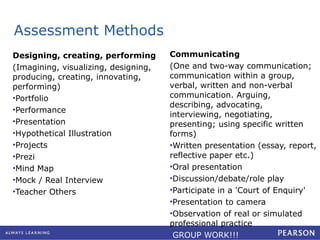
Assessment Methods Designing, creating, performing  (Imagining, visualizing, designing, producing, creating, innovating, performing)  Portfolio  Performance  Presentation  Hypothetical Illustration Projects  Prezi Mind Map Mock / Real Interview Teacher Others Communicating  (One and two-way communication; communication within a group, verbal, written and non-verbal communication. Arguing, describing, advocating, interviewing, negotiating, presenting; using specific written forms) Written presentation (essay, report, reflective paper etc.)  Oral presentation  Discussion/debate/role play  Participate in a 'Court of Enquiry'  Presentation to camera  Observation of real or simulated professional practice  GROUP WORK!!!
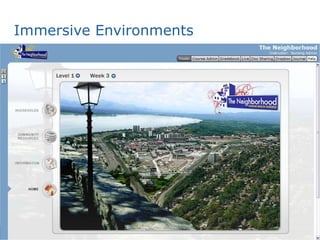
Nursing Neighborhood Scott
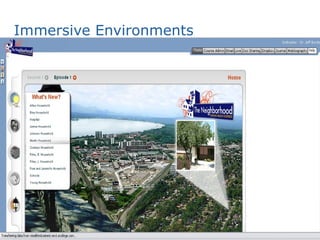
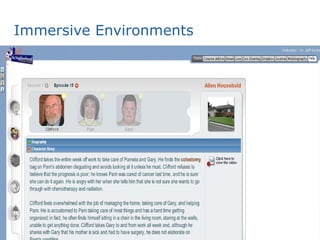
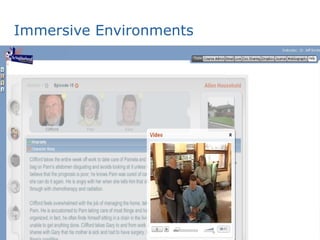
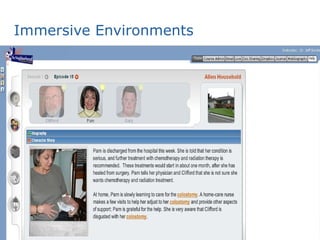
Immersive Environments
Smarter Planet Experts Webcast: What needs to change in education? Stop ignoring research Cross-curricular courses Teach students how to be creative / innovative Teach core, communication, computer, cultural, and collaboration competencies Real life, practical assessment Personalized Learning http://smarterplanet.tumblr.com/post/381892250/smarter-students-for-a-smarter-planet-live  (Feb 10, 2010)
Personalization: Choice
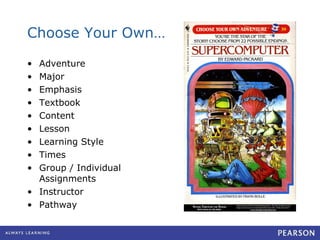
Choose Your Own… Adventure Major Emphasis Textbook Content Lesson Learning Style Times Group / Individual Assignments Instructor Pathway


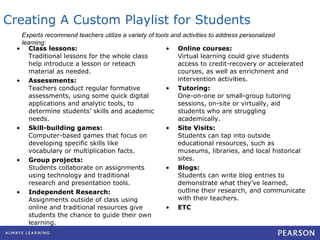
Creating A Custom Playlist for Students Class lessons: Traditional lessons for the whole class help introduce a lesson or reteach material as needed. Assessments: Teachers conduct regular formative assessments, using some quick digital applications and analytic tools, to determine students’ skills and academic needs.  Skill-building games: Computer-based games that focus on developing specific skills like vocabulary or multiplication facts. Group projects: Students collaborate on assignments using technology and traditional research and presentation tools. Independent Research: Assignments outside of class using online and traditional resources give students the chance to guide their own learning. Online courses: Virtual learning could give students access to credit-recovery or accelerated courses, as well as enrichment and intervention activities. Tutoring: One-on-one or small-group tutoring sessions, on-site or virtually, aid students who are struggling academically. Site Visits: Students can tap into outside educational resources, such as museums, libraries, and local historical sites. Blogs: Students can write blog entries to demonstrate what they’ve learned, outline their research, and communicate with their teachers. ETC Experts recommend teachers utilize a variety of tools and activities to address personalized learning:
MyLabs Scott
Summing Up 2
Smarter Planet Experts Webcast: What needs to change in education? Stop ignoring research Cross-curricular courses Teach students how to be creative / innovative Teach core, communication, computer, cultural, and collaboration competencies Real life, practical assessment Personalized Learning http://smarterplanet.tumblr.com/post/381892250/smarter-students-for-a-smarter-planet-live  (Feb 10, 2010)
Students…
Thank You! Jeff D Borden, M.A. Senior Director of Teaching & Learning [email_address]

OED11 Education 3.0

  • 1.
    Education 3.0 Dr.Jeff D Borden – jeffb@ecollege.com Scott Anderberg – scotta@ecollege.com Garnet Berry – garnet.berry@fronter.com
  • 2.
  • 3.
  • 4.
  • 5.
    Agenda Level SettingIBM “Smart Planet for Education” List Importance of research Cross-curricular courses Teaching Creativity The new competencies Authentic assessment Personalized Learning Summary
  • 6.
    Agenda Level SettingIBM “Smart Planet for Education” List Stop ignoring research Columbia University Cross-curricular courses The Pink Room (video) Teach students how to be creative / innovative Equella Teach the new competencies LMS as Aggregator Real life, practical assessment Nursing Neighborhood Personalized Learning MyLabs
  • 7.
  • 8.
  • 9.
    Generation M Multi-taskerMedia Multi-Modal Multi-Nodal Variance (Differentiation) Makes Reaching Them Possible
  • 10.
    Don’t forget: Youcan copy-paste this slide into other presentations, and move or resize the poll.
  • 11.
    Understanding the IndividualDifferentiation: “By definition, differentiation is wary of approaches to teaching and learning that standardize. Standard-issue students are rare , and educational approaches that ignore academic diversity in favor of standardization are likely to be counterproductive in reaching the full range of learners.” – Tomlinson (2006)
  • 12.
  • 13.
    Are Students Life-Ready?2008 Oxford Survey of “Most Important Employee Skills” Employers said employees achieved 15% of these regularly
  • 14.
  • 15.
    Technology Demands Purpose“ Students know when technology without purpose is being imposed on them.” Allan Heap, Center for Internet Technology Welding, Telescopes, Automotive, Microscopes, Cadavers, Architecture Software, Bridge Construction Tools, Etc
  • 16.
  • 17.
  • 18.
    But Students StillDemand Technology… The average American student’s College / University is ____ miles from where the student lives: 1980: 5m 2006: 50m 2009: 78m Eduventures, 2009
  • 19.
    How Do WeFix Education? 2
  • 20.
    Smarter Planet ExpertsWebcast: What needs to change in education? Stop ignoring research
  • 21.
    Brain Research Multi-Modal& Multi-Nodal Focus Shifts Impacts on Learning Sleep Caffeine Culture Personality Air Temperature Hunger Visual indexing
  • 22.
    RED BLUE GREENYELLOW BLUE RED YELLOW GREEN BLUE GREEN RED YELLOW
  • 23.
  • 24.
  • 25.
  • 26.
  • 27.
    Smarter Planet ExpertsWebcast: What needs to change in education? Stop ignoring research Cross-curricular courses
  • 28.
    Mystery @ MIT400 Students 20 Faculty 2 Weekends Curriculum Integration Nursing Engineering Chemistry Journalism Political Science
  • 29.
    The Pink Room(video) Garnet
  • 30.
    Smarter Planet ExpertsWebcast: What needs to change in education? Stop ignoring research Cross-curricular courses Teach students how to be creative / innovative http://smarterplanet.tumblr.com/post/381892250/smarter-students-for-a-smarter-planet-live (Feb 10, 2010)
  • 31.
  • 32.
    Information 2008: InternetData = 27,000 Library of Congress’ 2009: YouTube Data = 2008 Internet Data (6.1 million videos) 2010: Facebook Data = 2009 YouTube Data (5 th largest country) 2011: Ghost Blogs = 2010 Facebook Data
  • 33.
    Important Future Quote“ In the long run, excesses of technology mean that the comparative advantage shifts from those with information glut to those with ordered knowledge ; from those who can process vast amounts of blab to those who can explain what is worth knowing and why…” (Ratinoff, 1995)
  • 34.
    Creativity “ ChiefExecutives believe that – more than rigor, management discipline, integrity, or even vision – navigating an increasingly complex world will require creativity.” 80% of employers seeking creative employees cannot find them to hire… IBM 2010 Global CEO Survey 1500 CEO’s from 60 Countries
  • 35.
  • 36.
  • 37.
  • 38.
  • 39.
  • 40.
    Smarter Planet ExpertsWebcast: What needs to change in education? Stop ignoring research Cross-curricular courses Teach students how to be creative / innovative Teach core, communication, computer, cultural, and collaboration competencies
  • 41.
    Today’s Learning Competencies: T Shapes Core Competencies Literacy, Math, Science, Critical Thinking, Social Sciences, Reasoning, Pattern Recognition Creative Competencies Innovation, Resourcefulness, Problem Solving / Finding Communication / Collaboration Competencies Linguistic, Technological, Interpersonal, Group, Narrative Cultural Competencies The World Is Flat, Micro-cultures, Macro-cultures Computer Competencies Social, Search, Process
  • 42.
    Communication Competence NonverbalCommunication: 86% Haptics Objectics Proxemics Chronemics Optics Vocalics Kinesics Facial Mirroring
  • 43.
  • 44.
  • 45.
  • 46.
    Mobile Learning Eventually…Announcements Discussions What’s New Tests Surveys Content Dropbox Submissions Etc
  • 47.
    Crowd Sourcing www.edistorm.comwww.betterme.com www.crocodoc.com www.thinkfold.com
  • 48.
    Smarter Planet ExpertsWebcast: What needs to change in education? Stop ignoring research Cross-curricular courses Teach students how to be creative / innovative Teach core, communication, computer, cultural, and collaboration competencies Authentic / Practical Assessment
  • 49.
  • 50.
  • 51.
  • 52.
    Assessment Methods Thinkingcritically / making judgments (Developing arguments, reflecting, evaluating, assessing, judging) Essay Report Journal Letter of Advice to .... (about policy, public health matters .....) Present a case for an interest group Prepare a committee briefing paper for a specific meeting Book review (or article) for a particular journal Write a newspaper article for a foreign newspaper Comment on an article's theoretical perspective Solving problems and developing plans (Identifying problems, posing problems, defining problems, analyzing data, reviewing, designing experiments, planning, applying information) Problem scenario Group Project Work-based problem Prepare a committee of enquiry report Draft a research bid to a realistic brief Analyze a case Conference paper (or notes for a conference paper plus annotated bibliography)
  • 53.
    Assessment Methods Performingprocedures and demonstrating techniques (Computation, taking readings, using equipment, following laboratory procedures, following protocols, carrying out instructions) Demonstration Role Play Make a video (write script and produce/make a video) Produce a poster Lab report Prepare an illustrated manual on using the equipment, for a particular audience Observation of real or simulated professional practice Simulations Games Zentation Facilitate Web Chat Managing and developing oneself (Working co-operatively, working independently, learning independently, being self-directed, managing time, managing tasks, organizing) Temporal Case Study Gaming Discussion Journal Blog Portfolio Learning Contract Group work Polls Surveys Self Check Wiki Immersive Gaming
  • 54.
    Assessment Methods Accessingand managing information (Researching, investigating, interpreting, organizing information, reviewing and paraphrasing information, collecting data, searching and managing information sources, observing and interpreting) Annotated bibliography Project Dissertation Applied task Applied problem Wiki Case Study Letter to the Editor Demonstrating knowledge and understanding (Recalling, describing, reporting, recounting, recognizing, identifying, relating & interrelating) Written examination Oral examination Essay Report Comment on the accuracy of a set of records Devise an encyclopedia entry Produce an A - Z of ... Write an answer to a client's question Short answer questions: True/False/ Multiple Choice Questions
  • 55.
    Assessment Methods Designing,creating, performing (Imagining, visualizing, designing, producing, creating, innovating, performing) Portfolio Performance Presentation Hypothetical Illustration Projects Prezi Mind Map Mock / Real Interview Teacher Others Communicating (One and two-way communication; communication within a group, verbal, written and non-verbal communication. Arguing, describing, advocating, interviewing, negotiating, presenting; using specific written forms) Written presentation (essay, report, reflective paper etc.) Oral presentation Discussion/debate/role play Participate in a 'Court of Enquiry' Presentation to camera Observation of real or simulated professional practice GROUP WORK!!!
  • 56.
  • 57.
  • 58.
  • 59.
  • 60.
  • 61.
  • 62.
    Smarter Planet ExpertsWebcast: What needs to change in education? Stop ignoring research Cross-curricular courses Teach students how to be creative / innovative Teach core, communication, computer, cultural, and collaboration competencies Real life, practical assessment Personalized Learning http://smarterplanet.tumblr.com/post/381892250/smarter-students-for-a-smarter-planet-live (Feb 10, 2010)
  • 63.
  • 64.
    Choose Your Own…Adventure Major Emphasis Textbook Content Lesson Learning Style Times Group / Individual Assignments Instructor Pathway
  • 65.
  • 66.
  • 67.
  • 68.
    Creating A CustomPlaylist for Students Class lessons: Traditional lessons for the whole class help introduce a lesson or reteach material as needed. Assessments: Teachers conduct regular formative assessments, using some quick digital applications and analytic tools, to determine students’ skills and academic needs. Skill-building games: Computer-based games that focus on developing specific skills like vocabulary or multiplication facts. Group projects: Students collaborate on assignments using technology and traditional research and presentation tools. Independent Research: Assignments outside of class using online and traditional resources give students the chance to guide their own learning. Online courses: Virtual learning could give students access to credit-recovery or accelerated courses, as well as enrichment and intervention activities. Tutoring: One-on-one or small-group tutoring sessions, on-site or virtually, aid students who are struggling academically. Site Visits: Students can tap into outside educational resources, such as museums, libraries, and local historical sites. Blogs: Students can write blog entries to demonstrate what they’ve learned, outline their research, and communicate with their teachers. ETC Experts recommend teachers utilize a variety of tools and activities to address personalized learning:
  • 69.
  • 70.
  • 71.
    Smarter Planet ExpertsWebcast: What needs to change in education? Stop ignoring research Cross-curricular courses Teach students how to be creative / innovative Teach core, communication, computer, cultural, and collaboration competencies Real life, practical assessment Personalized Learning http://smarterplanet.tumblr.com/post/381892250/smarter-students-for-a-smarter-planet-live (Feb 10, 2010)
  • 72.
  • 73.
    Thank You! JeffD Borden, M.A. Senior Director of Teaching & Learning [email_address]

Editor's Notes

  • #11 Press F5 or enter presentation mode to view the poll If you like, you can use this slide as a template for your own voting slides. You might use a slide like this if you feel your audience would benefit from the picture showing a text message on a phone. In an emergency during your presentation, if the poll isn't showing, navigate to this link in your web browser: http://www.polleverywhere.com/multiple_choice_polls/NTg0OTU0MTI3
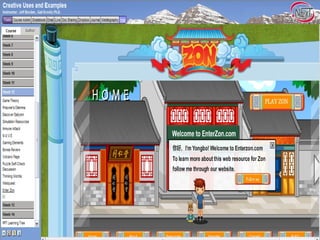
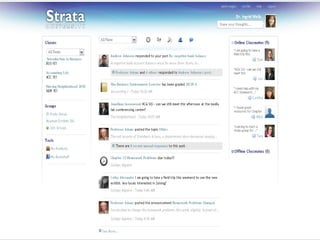
  • #27 The LearningStudio “Social UX” interface. This allows a Facebook like experience in a safe, fire-walled environment.
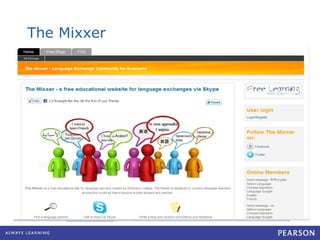
  • #46 Connect to a native speaker of the language you want to learn and learn from them as you teach them YOUR native language.
  • #48 Edistorm – social brainstorming tool taking this important phase of group collaboration from 50% down to 5% Betterme – anonymous feedback for group members Crocodoc – real time document collaboration / sharing – members create word, ppt, excel docs together in real time Thinkfold – timeline creator for group or project management Action Method – project management site that “nudges” members who have upcoming tasks