Presents: Planning OBE Lesson Incorporating ICT Ceanlia Vermeulen INNOVATE 2008 SCHOOLS’ ICT CONFERENCE CAPE TOWN 1-3 OCTOBER 2008
How to Plan a OBE Lesson incorporating ICT to support aspects of Learning & Thinking In the Classroom
 
 
Presenter Ceanlia Vermeulen Grade 7 Facilitator/Educator Hillcrest Primary School Phone: 031 – 765 7393 Fax: 0866 943 205 Email:  [email_address] Copies of examples and planners used during this presentation are available through email.
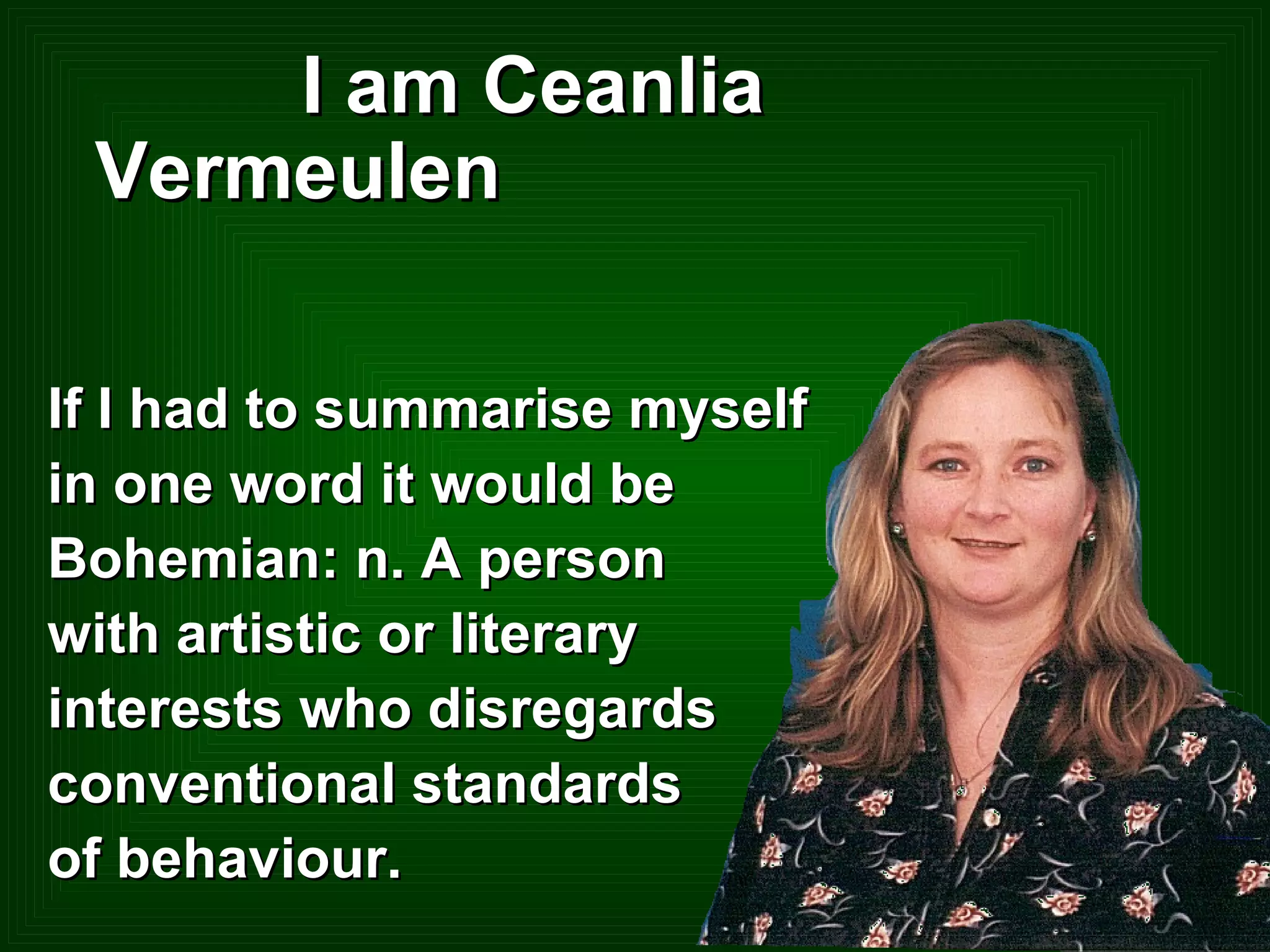
I am Ceanlia Vermeulen If I had to summarise myself in one word it would be Bohemian: n. A person  with artistic or literary  interests who disregards  conventional standards  of behaviour.
What is my motto? Umuntu  ungumuntu ngabantu –  a person is a person because of other people. If you want to achieve what you want to achieve, help other people achieve what they want to achieve.
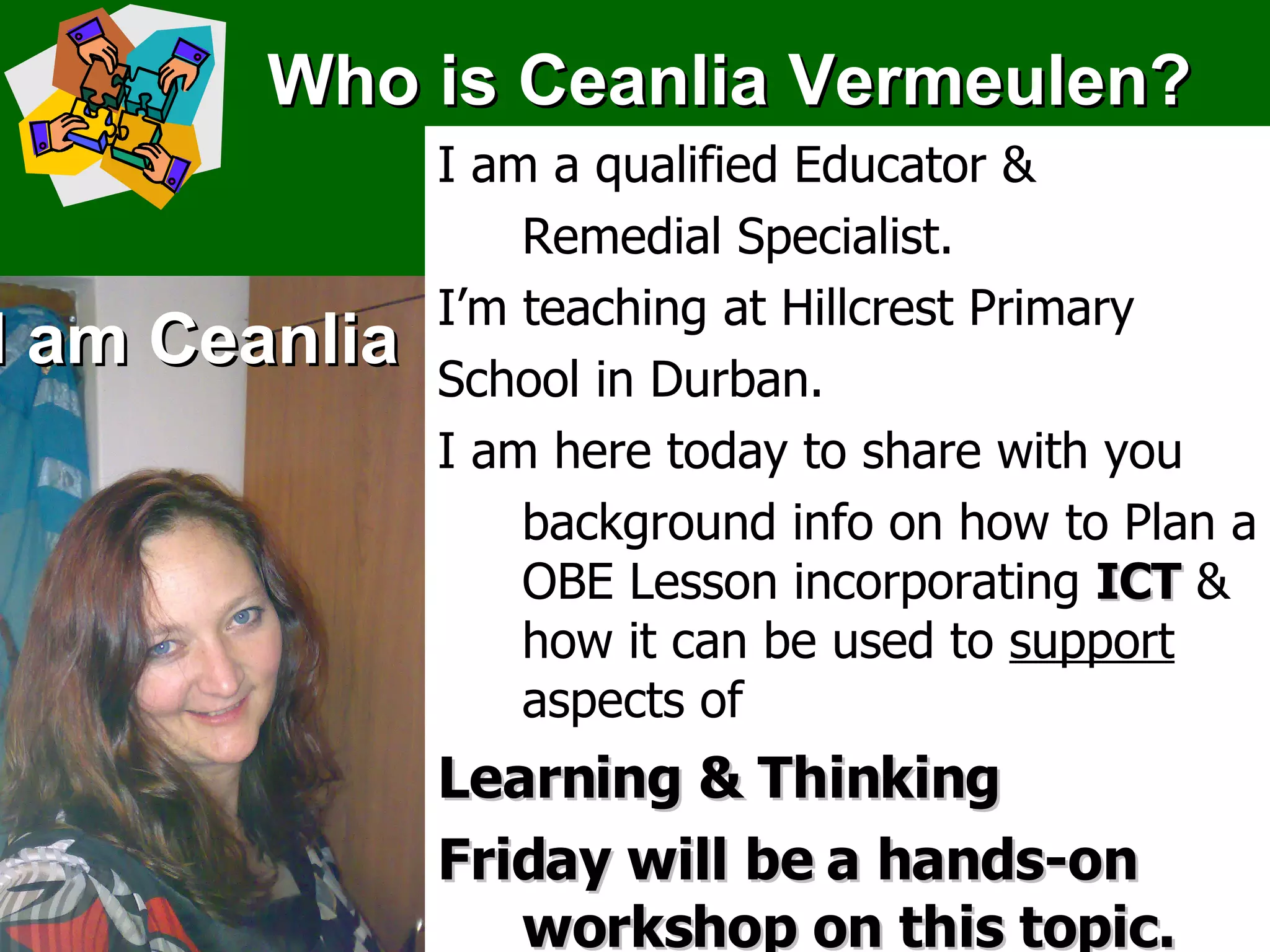
Who is Ceanlia Vermeulen? I am Ceanlia I am a qualified Educator &  Remedial Specialist. I’m teaching at Hillcrest Primary  School in Durban. I am here today to share with you background info on how to Plan a OBE Lesson incorporating  ICT  & how it can be used to  support   aspects of  Learning & Thinking Friday will be a hands-on workshop on this topic.
Defining ICT   "Information and communications technologies ( ICT ) are the  computing and communications facilities and features that variously  support   teaching ,  learning  and  a range of  activities  in  education .
Wanted:  Resilient, independent learners who have flexible skills and competencies; who can work well in teams and lead themselves and others to perform up to and beyond their potential. What do we as Educators  want for the  21 st  century learning school
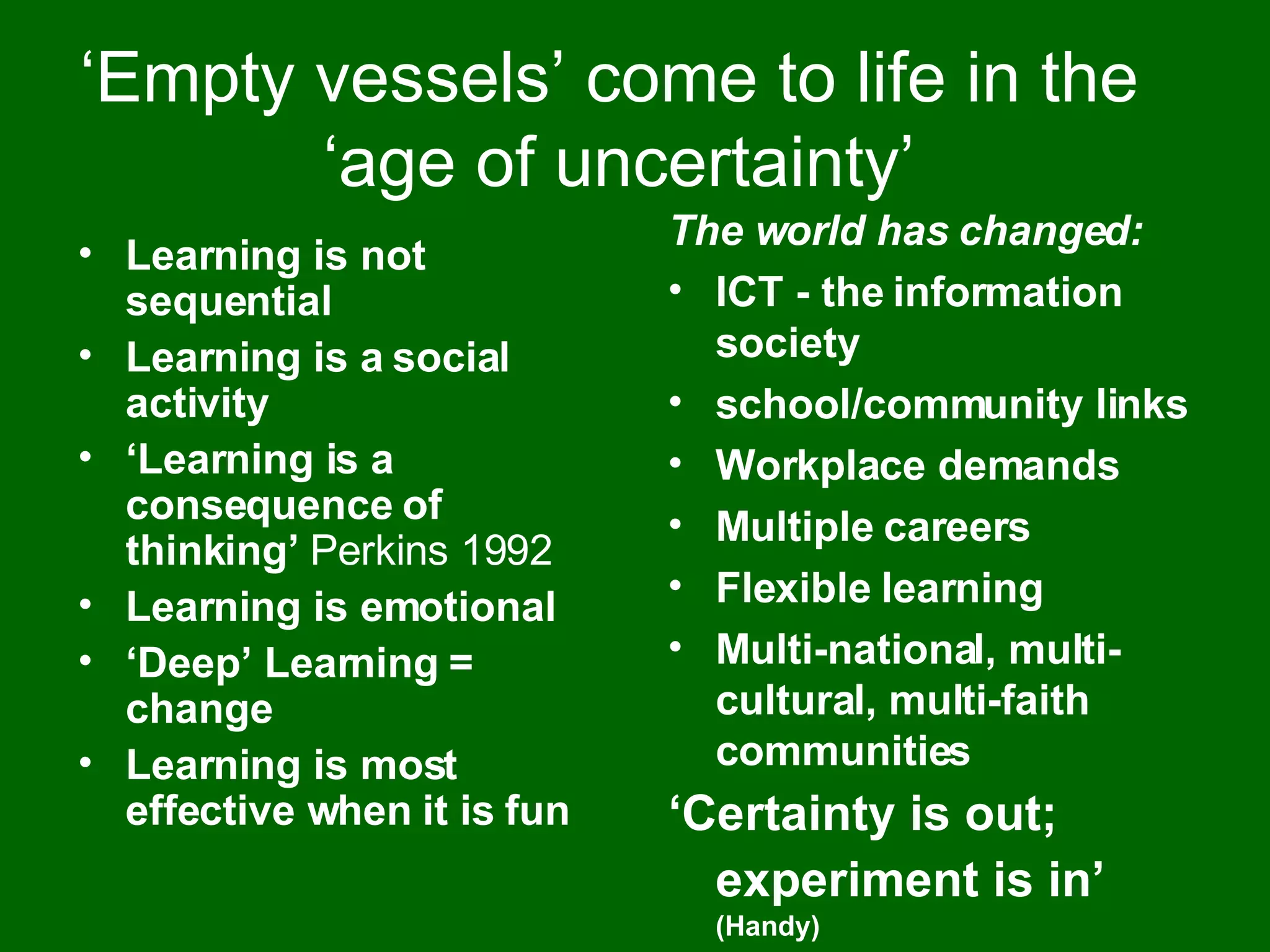
‘ Empty vessels’ come to life in the  ‘age of uncertainty’ Learning is not sequential Learning is a social activity ‘ Learning is a consequence of thinking’  Perkins 1992 Learning is emotional ‘ Deep’ Learning = change Learning is most effective when it is fun The world has changed: ICT - the information society school/community links Workplace demands Multiple careers Flexible learning Multi-national, multi-cultural, multi-faith communities ‘ Certainty is out; experiment is in’   (Handy)
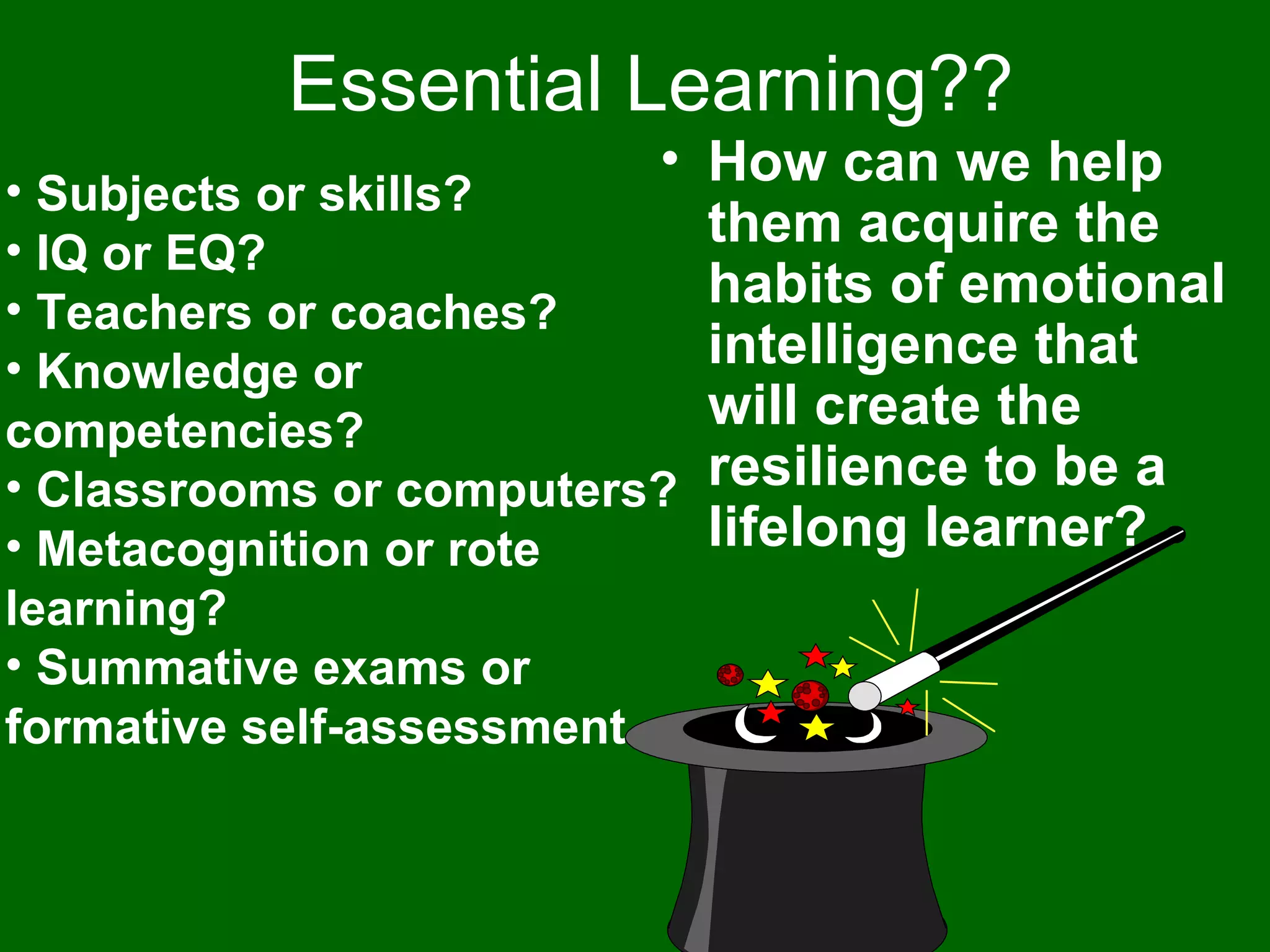
Essential Learning?? Subjects or skills? IQ or EQ? Teachers or coaches? Knowledge or competencies? Classrooms or computers? Metacognition or rote learning? Summative exams or formative self-assessment How can we help them acquire the habits of emotional intelligence that will create the resilience to be a lifelong learner?
I(c)T’s about learning “ The genie is out of the bottle. There is no turning back…This is not just a change from inputs (teaching) to outputs (learning).  Rather it is a paradigm shift in the conceptualization of the school, where everyone is a learner and even the organization is allowed to make mistakes and be a learner ”  (David Loader, Principal, Wesley College, Melbourne in “The Inner Principal”, 1997)
 
What then is good learning? “ Unless  individuals  take a very  active role  in  what  it is that they are studying, unless they learned to  ask questions ,  to do  things hands on, the ideas just disappear” Howard Gardner
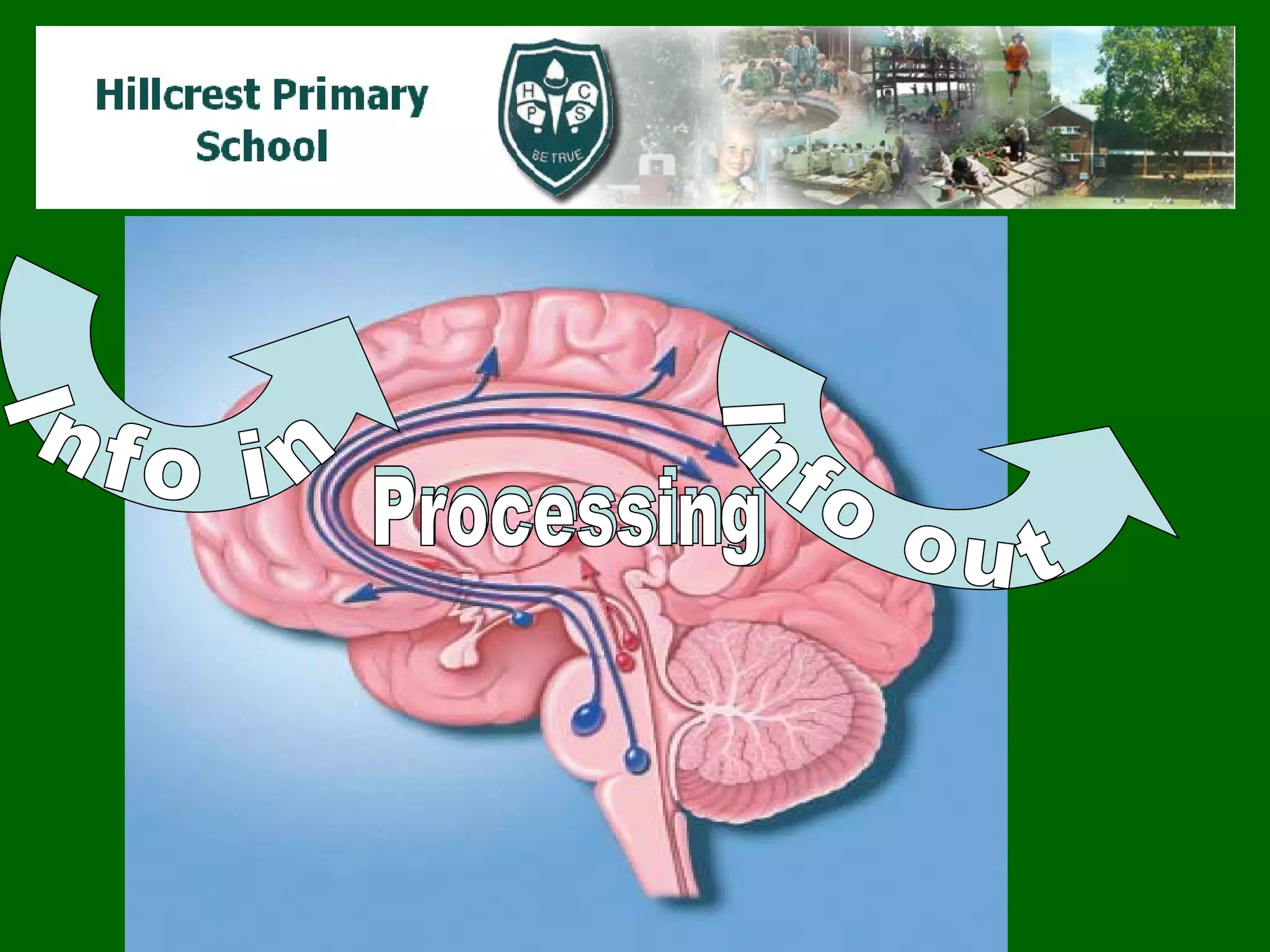
Info in Processing Processing Info out
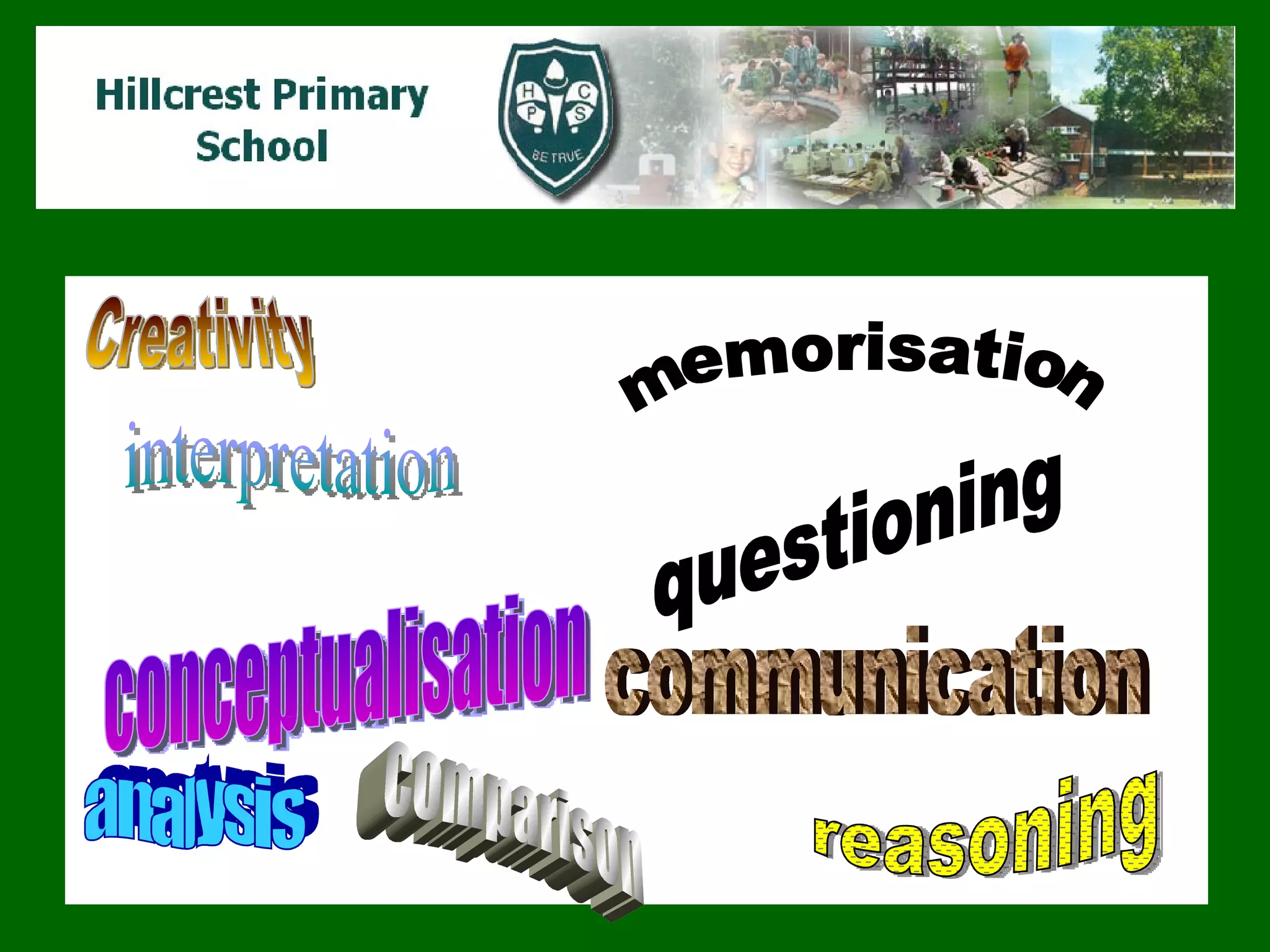
There are a wide range of thinking skills or processes.  What are the range of thinking processes that can be defined? When asked about  thinking skills  generally, an audience might well come up with a fairly random range of skills, such as these:
Creativity questioning memorisation conceptualisation communication analysis comparison reasoning interpretation
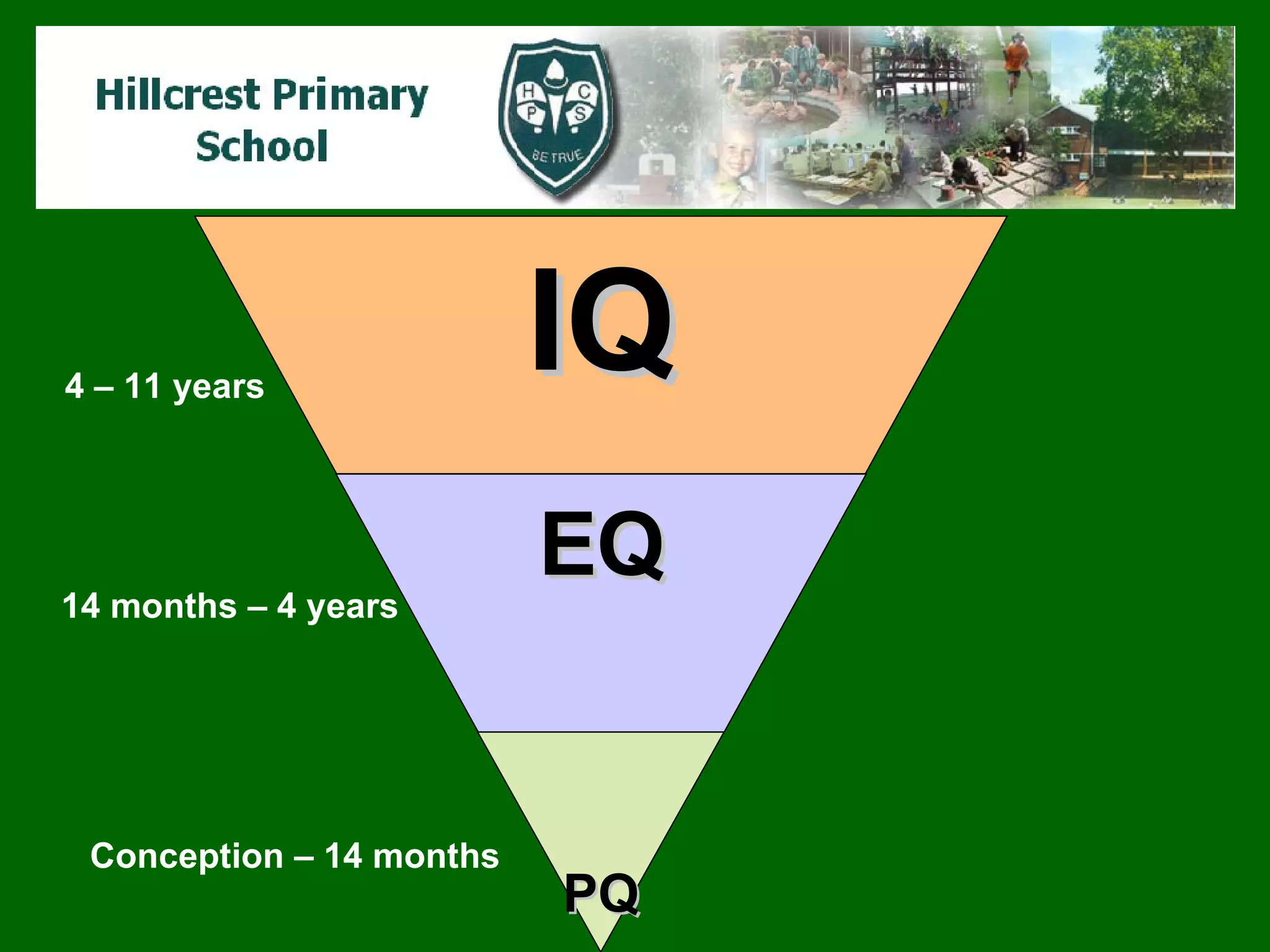
Conception – 14 months 14 months – 4 years 4 – 11 years PQ EQ IQ
 
One way to  categorise  thinking skills is to use an existing framework.  A framework which is still regarded as being helpful in this respect is that devised  by  Bloom  (1952).
He produced a  taxonomy [classification, categorisation]  of  knowledge  handling skills where he used  six categories :
Bloom’s Taxonomy Everyone in education has heard of Bloom’s Taxonomy.  We all know that there are  different levels  of thinking and inquiry and that in an  ideal classroom ,  we would help learners  move up the ladder to  higher-level thought .
Bloom’s Taxonomy But in the  real world  of teaching, we often can’t find the  time  or the  resources  to make that happen.
The Web The Web —  despite its reputation for providing information and nothing more —  can  help  you push your learners to higher-level thinking.
Theory  vs. practice The standard reproach  teachers give when presented with  innovative  or pedagogically powerful  teaching methods , methods that  address  various  learning styles  or target  critical questioning skills  is,
Theory  vs. practice "Does this help me prepare my learners for the  end-of-program/end-of-grade test?"  The current frenzy spawned by accountability systems across the nation all but eliminates the slightest thought of preparing our learners to  think .
Instead, we often seem resigned to  ensuring classrooms of "3’s" and "4’s."  So how do we respond to the question  "Why do I need to know this?"  And why does this question exist at all if we are teaching effectively?  Must our response always be, "You need to know this because it will be on the test"?
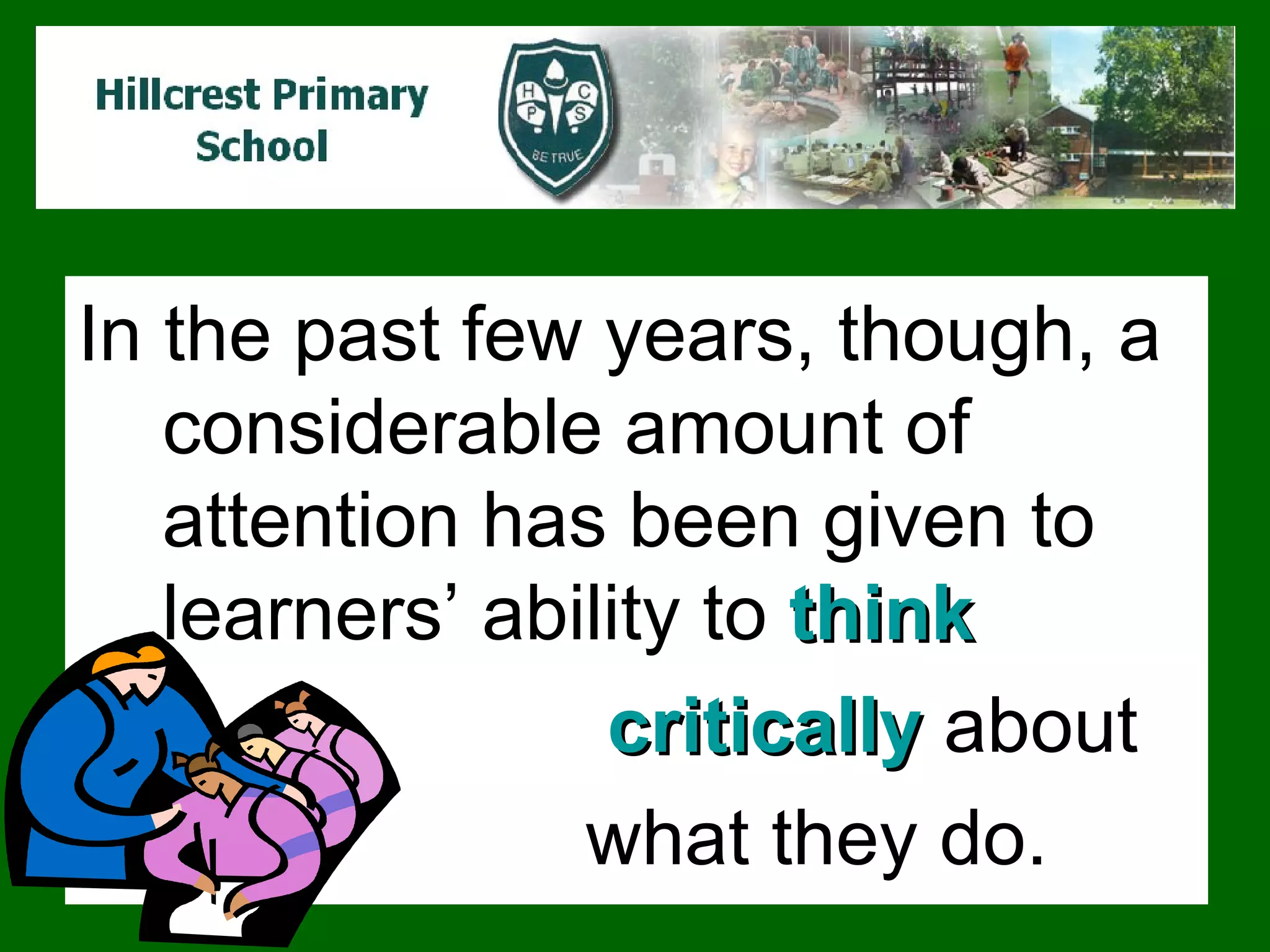
In the past few years, though, a considerable amount of attention has been given to learners’ ability to  think   critically  about  what they do.
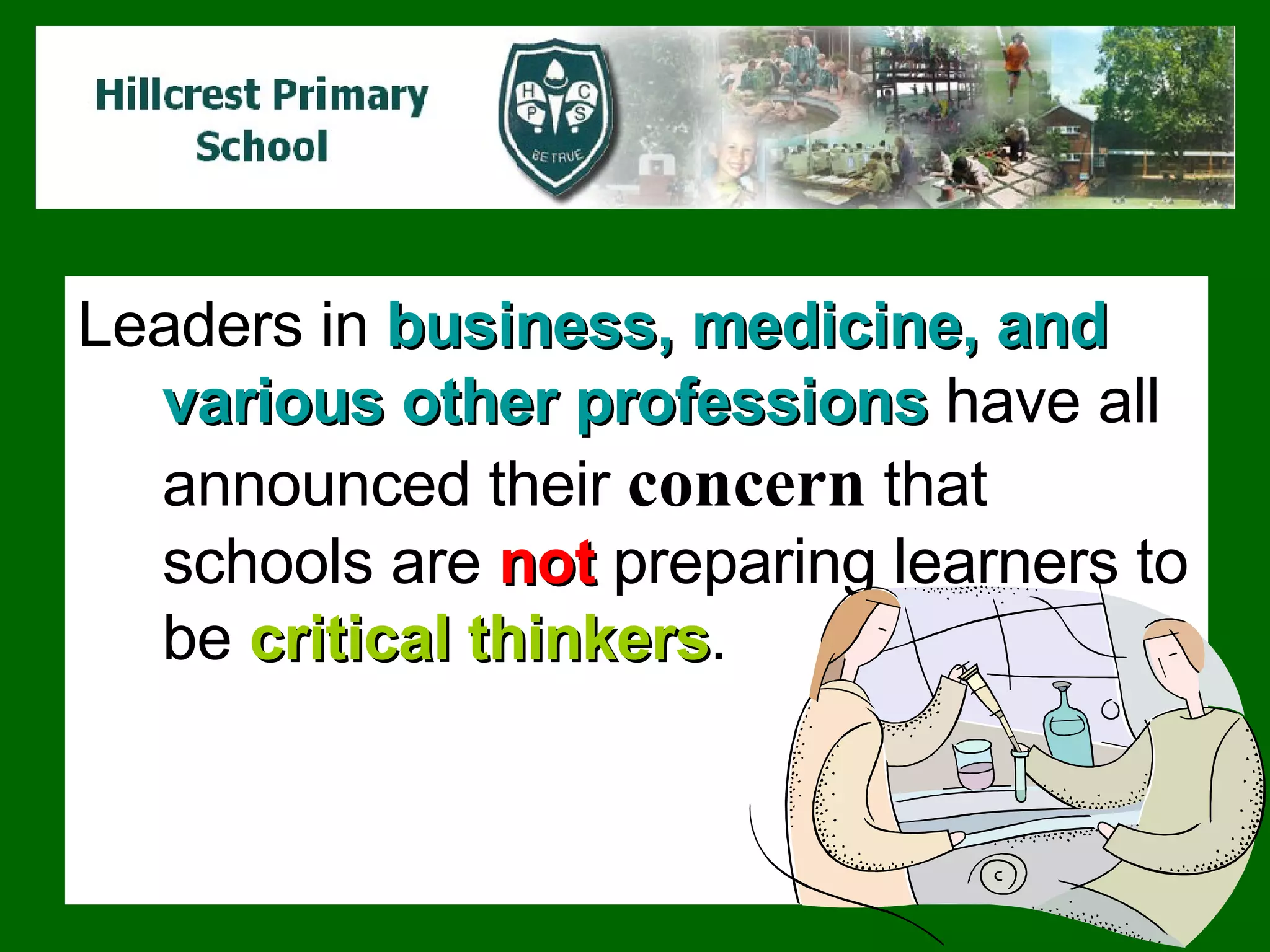
Leaders in  business, medicine, and various other professions  have all announced their  concern  that schools are  not  preparing learners to be  critical thinkers .
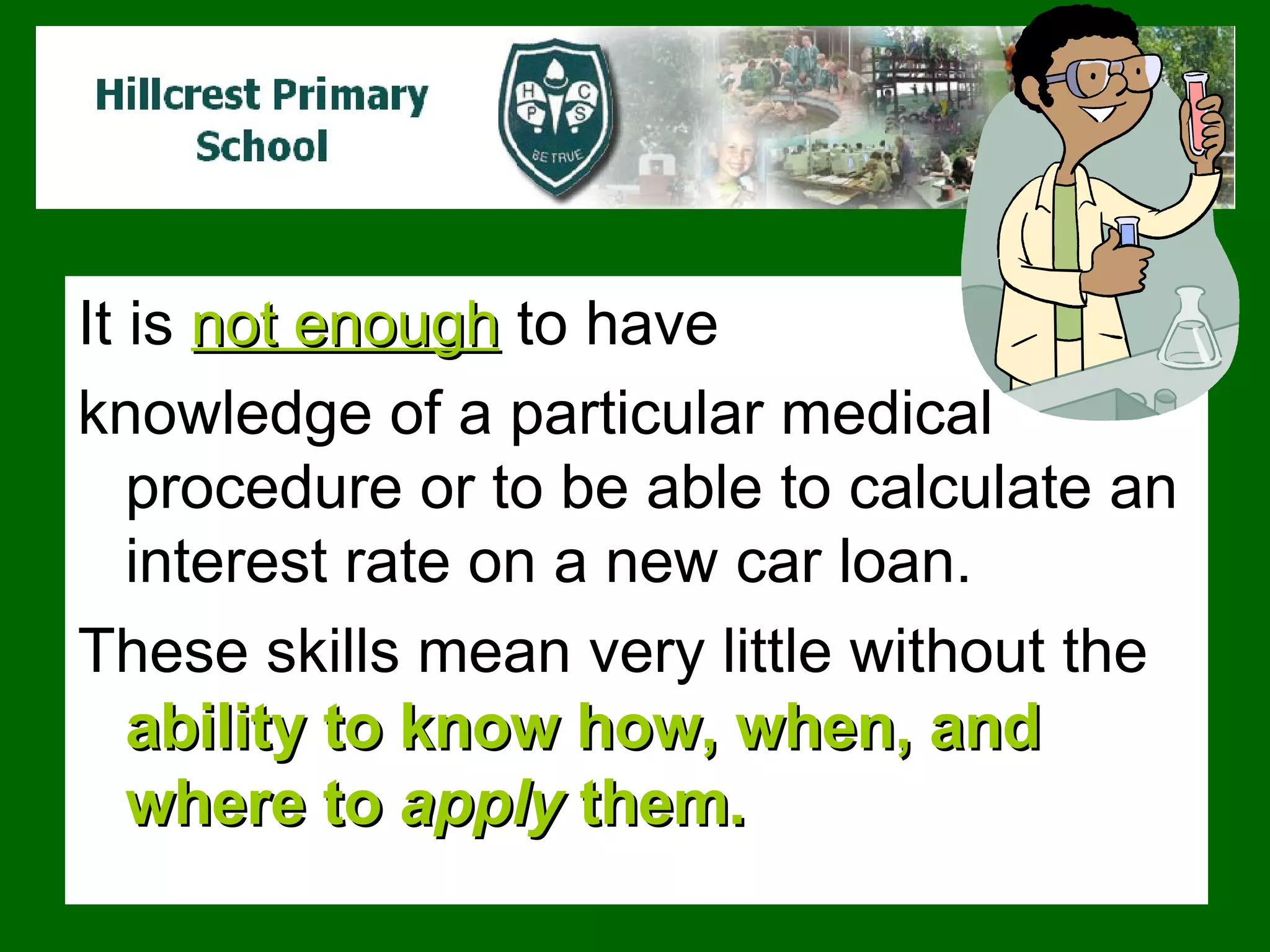
It is  not enough  to have  knowledge of a particular medical procedure or to be able to calculate an interest rate on a new car loan.  These skills mean very little without the  ability to know how, when, and where to  apply  them.
Bloom’s Taxonomy Recognizing that there are  different levels  of thinking behaviours important to learning,  Benjamin Bloom and his colleagues developed a  classification system  which has served educators since 1956.
Bloom’s Taxonomy This system, known as Bloom’s Taxonomy,  is a common structure for  categorizing  test questions and  designing instruction.
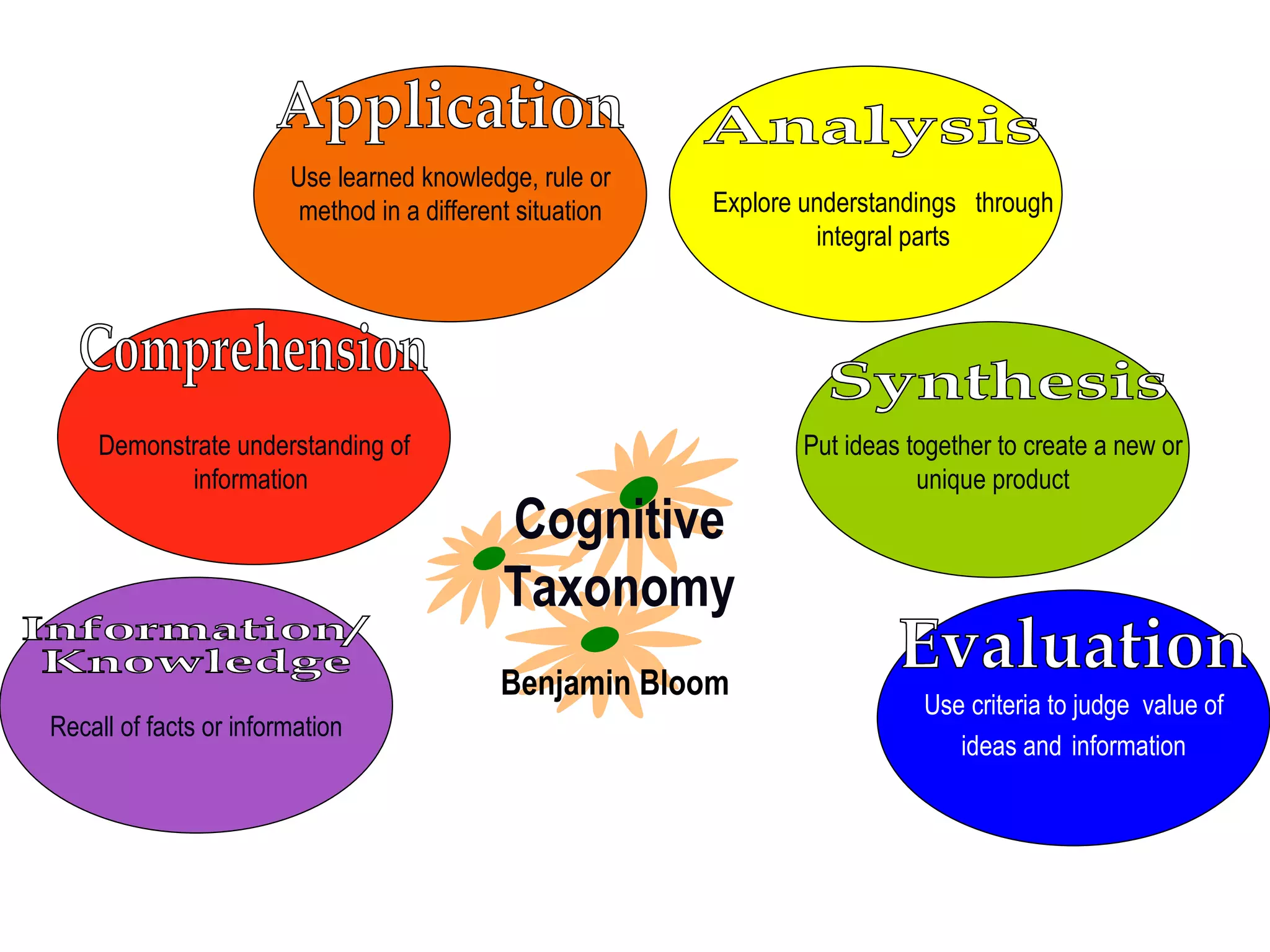
The taxonomy is divided into  six levels , from basic factual recall,  or  Knowledge ,  to the highest order,  Evaluation , which assesses the value of theories or asks the teacher or learner to discriminate among ideas.
In the 1950s, Bloom found that 95% of the test questions developed to assess learner learning required them only to think at the lowest level of learning,  the recall of information.
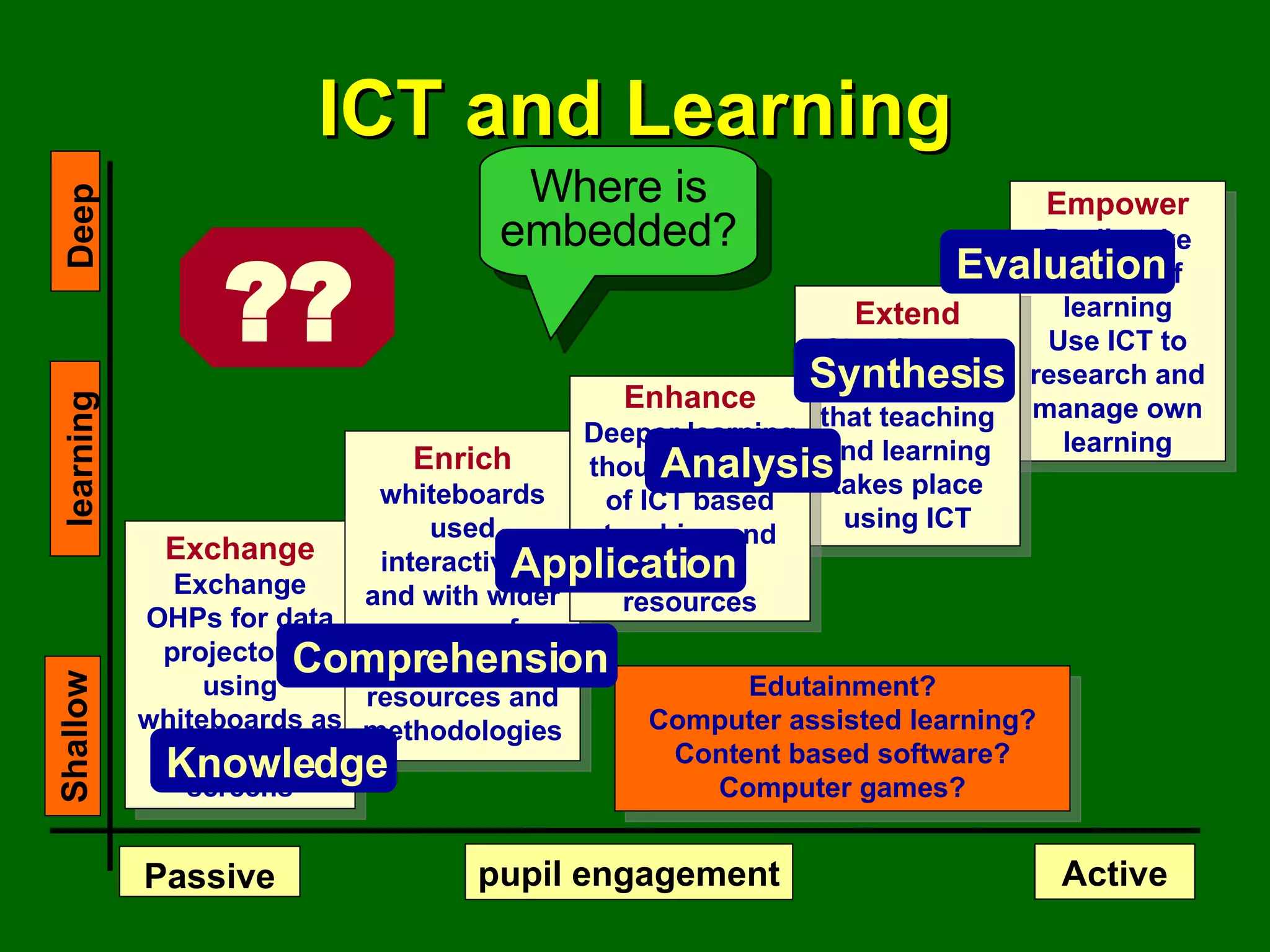
ICT and Learning Empower Pupils take control of learning Use ICT to research and manage own learning Exchange Exchange OHPs for data projectors,  using whiteboards as projection screens Enrich whiteboards used interactively and with wider range of teaching resources and methodologies Edutainment? Computer assisted learning? Content based software? Computer games? ?? Extend Significantly alter the way that teaching and learning takes place using ICT Enhance Deeper learning though the use of ICT based teaching and learning resources Knowledge Comprehension Application Analysis Synthesis Evaluation Where is embedded? Passive Active pupil engagement learning Deep  Shallow
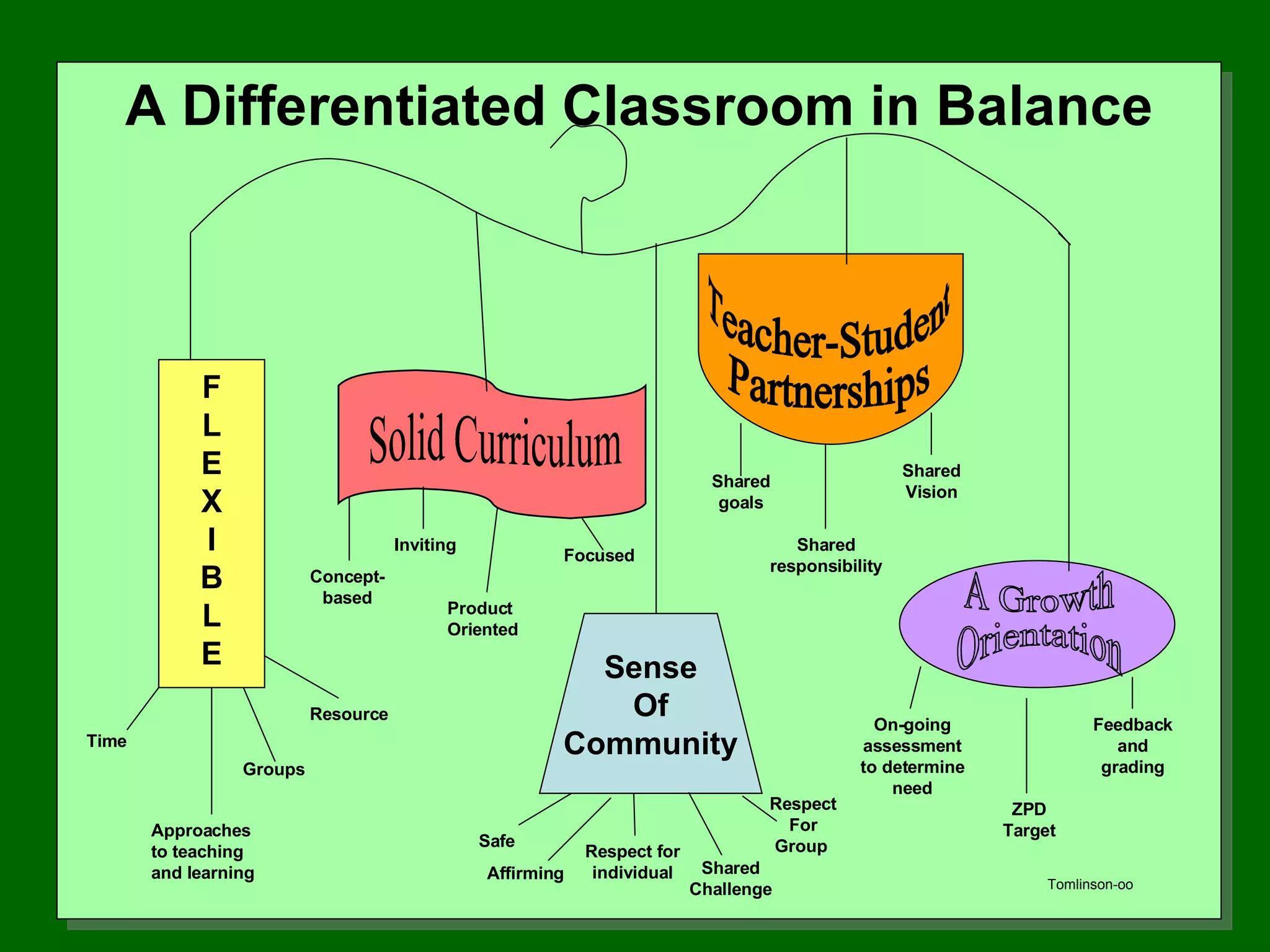
A Differentiated Classroom in Balance F L E X I B L E Solid Curriculum Sense Of Community Teacher-Student Partnerships A Growth Orientation Time Groups Resource Approaches to teaching and learning Concept- based Inviting Product Oriented  Focused Safe Respect for individual Respect For Group  Shared goals Shared responsibility Shared Vision On-going assessment to determine need Feedback and grading ZPD Target Tomlinson-oo Affirming Shared Challenge
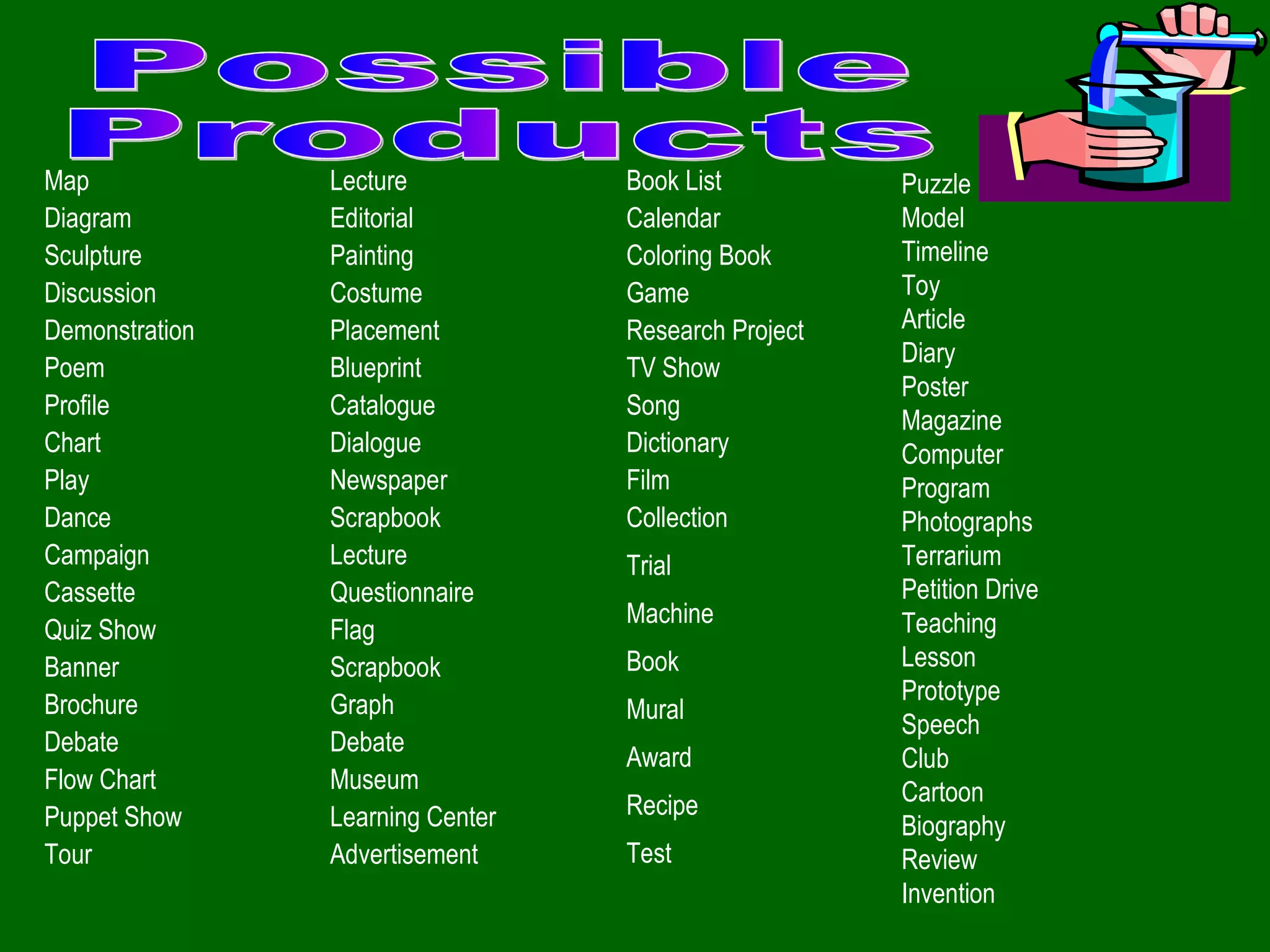
Map Diagram Sculpture Discussion Demonstration Poem Profile Chart Play Dance Campaign Cassette Quiz Show Banner Brochure Debate Flow Chart Puppet Show Tour Lecture Editorial Painting Costume Placement Blueprint Catalogue Dialogue Newspaper Scrapbook Lecture Questionnaire Flag Scrapbook Graph Debate Museum Learning Center Advertisement Possible Products Book List Calendar Coloring Book Game Research Project TV Show Song Dictionary Film Collection Trial Machine Book Mural Award Recipe Test Puzzle Model Timeline Toy Article Diary Poster Magazine Computer Program Photographs Terrarium Petition Drive Teaching Lesson Prototype Speech Club Cartoon Biography Review Invention
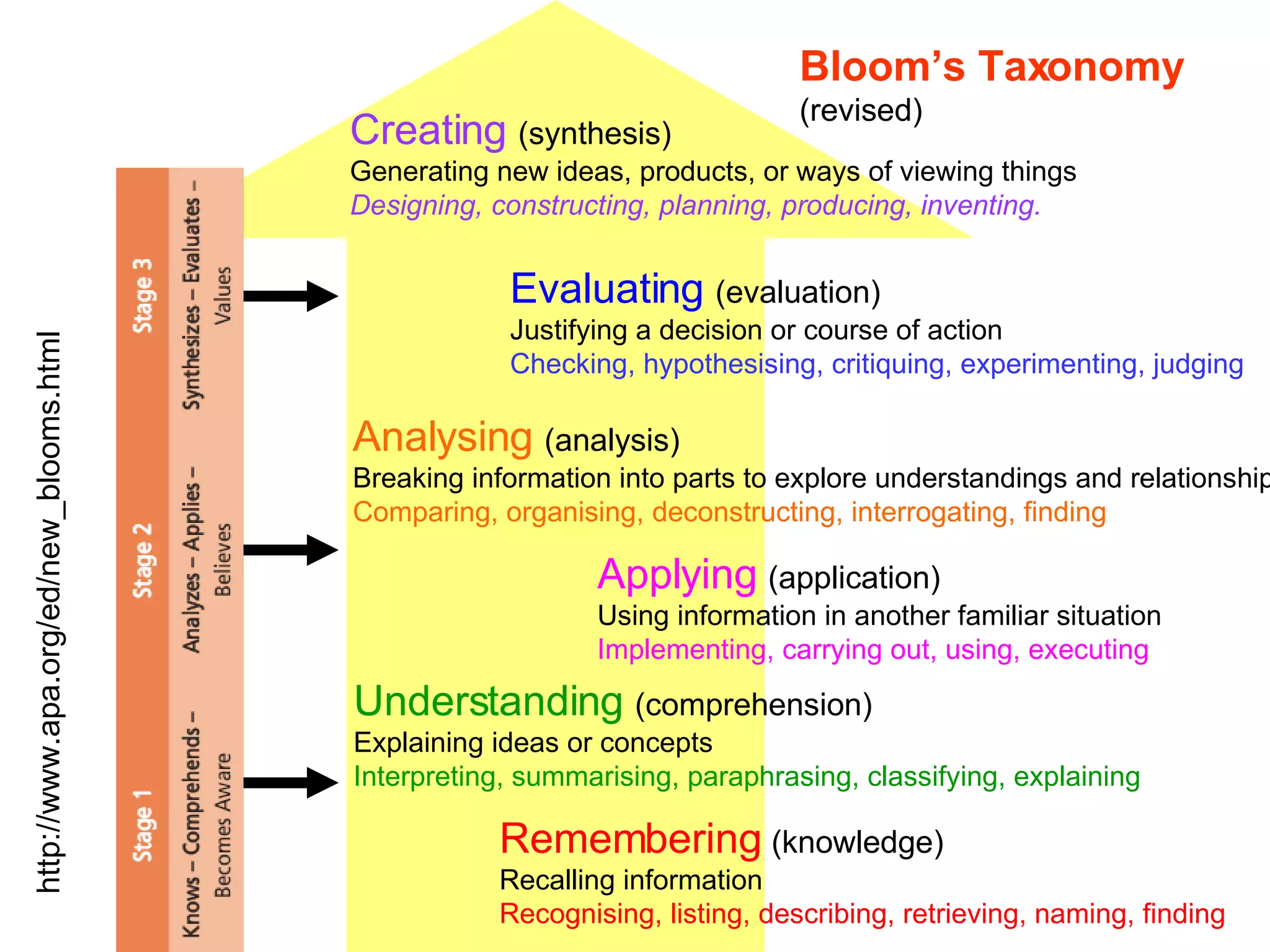
BLOOM’S REVISED TAXONOMY Creating  (synthesis) Generating new ideas, products, or ways of viewing things Designing, constructing, planning, producing, inventing. Evaluating  (evaluation) Justifying a decision or course of action Checking, hypothesising, critiquing, experimenting, judging Analysing  (analysis) Breaking information into parts to explore understandings and relationships Comparing, organising, deconstructing, interrogating, finding Applying  (application) Using information in another familiar situation Implementing, carrying out, using, executing Understanding  (comprehension) Explaining ideas or concepts Interpreting, summarising, paraphrasing, classifying, explaining Remembering  (knowledge) Recalling information Recognising, listing, describing, retrieving, naming, finding http://www.apa.org/ed/new_blooms.html Bloom’s Taxonomy (revised)
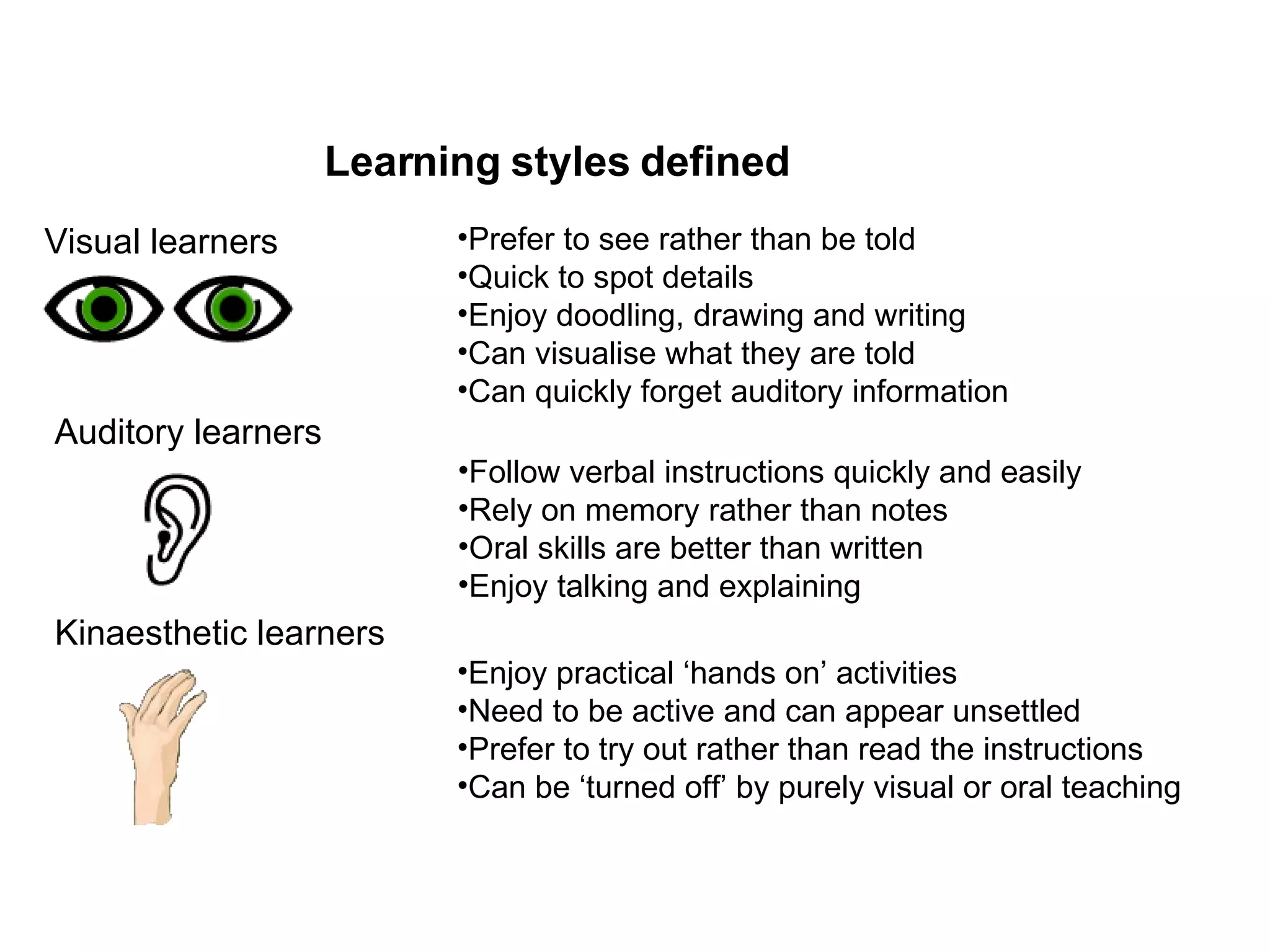
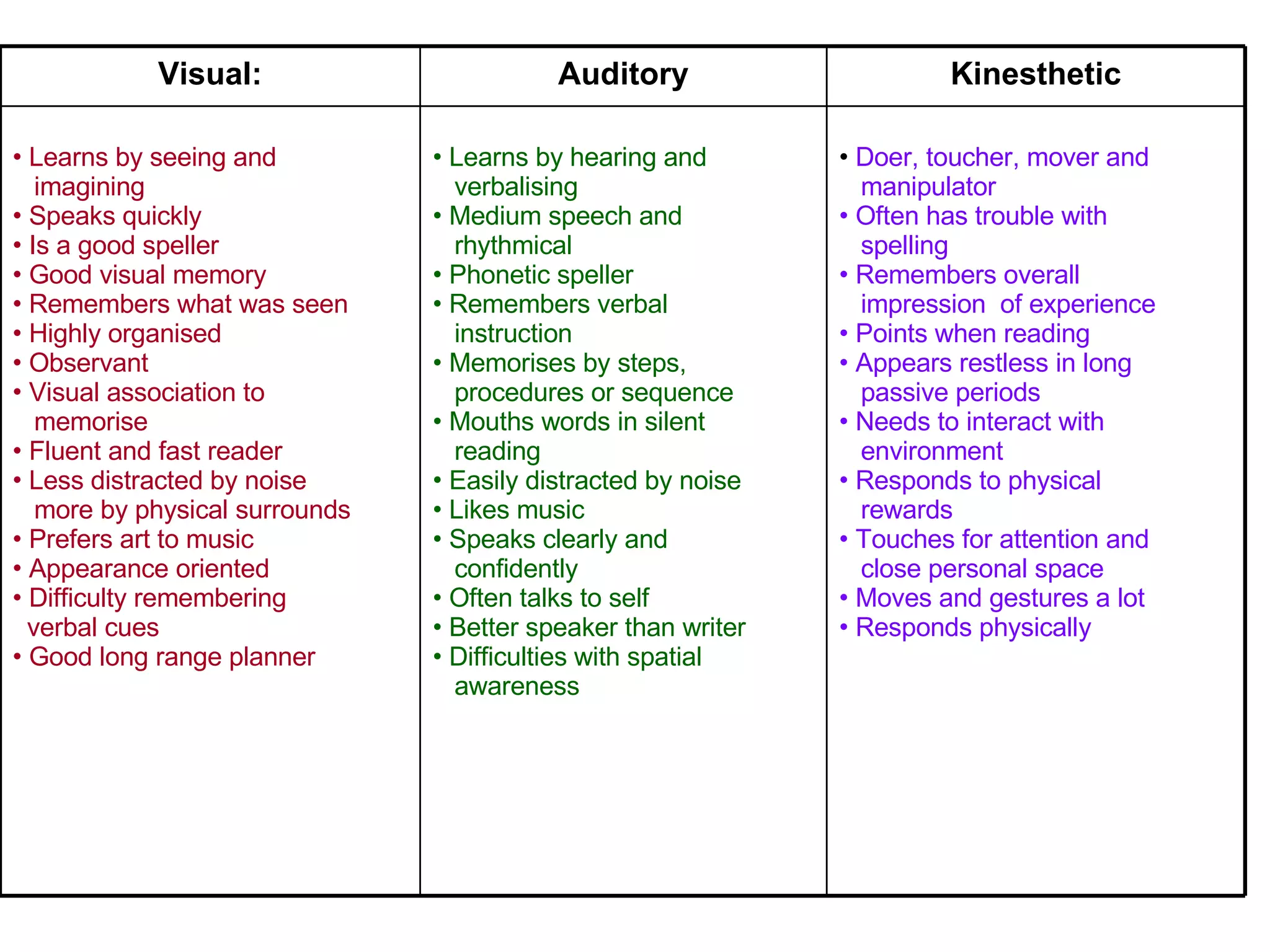
Visual learners Prefer to see rather than be told Quick to spot details Enjoy doodling, drawing and writing Can visualise what they are told Can quickly forget auditory information Auditory learners Follow verbal instructions quickly and easily Rely on memory rather than notes Oral skills are better than written Enjoy talking and explaining Kinaesthetic learners Enjoy practical ‘hands on’ activities Need to be active and can appear unsettled Prefer to try out rather than read the instructions Can be ‘turned off’ by purely visual or oral teaching Learning styles defined
Doer, toucher, mover and  manipulator Often has trouble with  spelling Remembers overall  impression  of experience Points when reading Appears restless in long  passive periods Needs to interact with  environment Responds to physical  rewards Touches for attention and  close personal space Moves and gestures a lot Responds physically Learns by hearing and  verbalising Medium speech and  rhythmical Phonetic speller Remembers verbal  instruction Memorises by steps,  procedures or sequence Mouths words in silent  reading Easily distracted by noise Likes music Speaks clearly and  confidently Often talks to self Better speaker than writer Difficulties with spatial  awareness Learns by seeing and  imagining Speaks quickly Is a good speller G ood visual memory Remembers what was seen Highly organised Observant Visual association to  memorise Fluent and fast reader Less distracted by noise  more by physical surrounds Prefers art to music Appearance oriented Difficulty remembering  verbal cues Good long range planner Kinesthetic Auditory Visual:
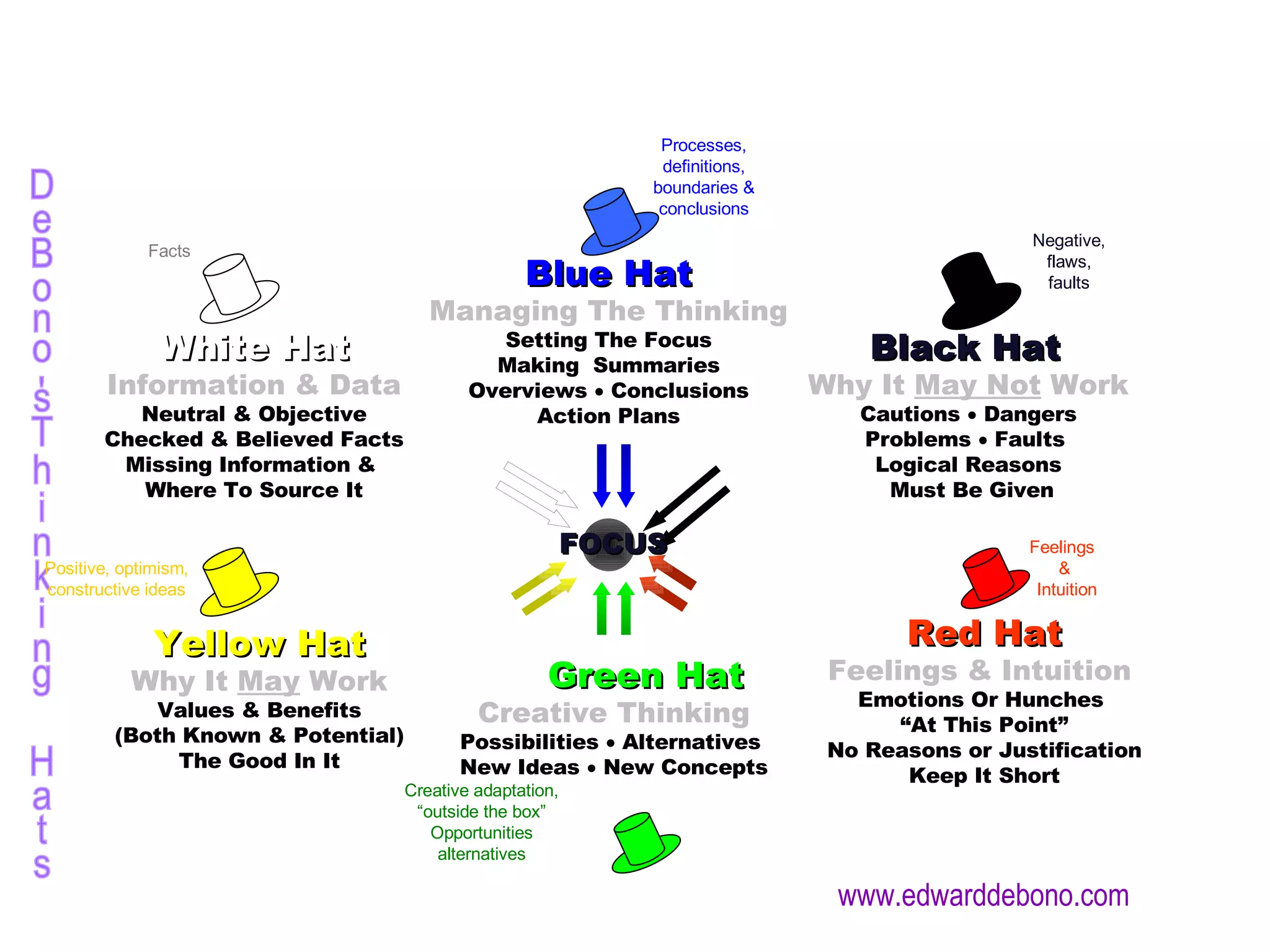
Blue Hat Managing The Thinking Setting The Focus Making  Summaries Overviews    Conclusions Action Plans Green Hat Creative Thinking Possibilities    Alternatives  New Ideas    New Concepts Black Hat   Why It  May Not  Work Cautions    Dangers Problems    Faults  Logical Reasons Must Be Given Yellow Hat Why It  May  Work Values & Benefits (Both Known & Potential) The Good In It Red Hat Feelings & Intuition   Emotions Or Hunches  “ At This Point” No Reasons or Justification Keep It Short White Hat Information & Data Neutral & Objective Checked & Believed Facts Missing Information &  Where To Source It FOCUS DeBono'sThinking Hats Facts Positive, optimism, constructive ideas Processes, definitions, boundaries & conclusions Creative adaptation, “outside the box” Opportunities alternatives Negative, flaws, faults www.edwarddebono.com Feelings  & Intuition
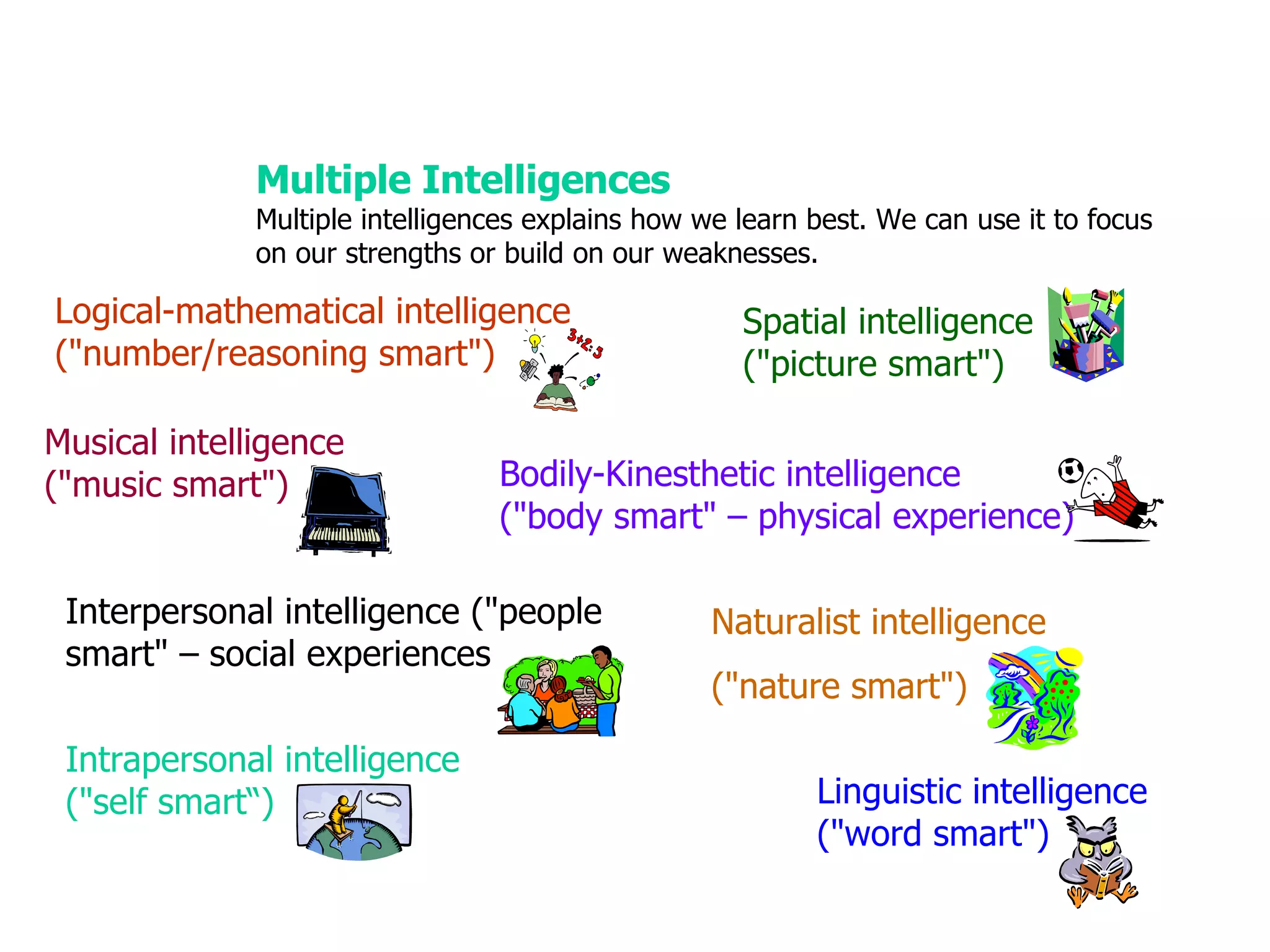
Logical-mathematical intelligence  ("number/reasoning smart") Multiple Intelligences Multiple intelligences explains how we learn best. We can use it to focus on our strengths or build on our weaknesses. Spatial intelligence  ("picture smart") Bodily-Kinesthetic intelligence  ("body smart" – physical experience) Musical intelligence ("music smart") Interpersonal intelligence ("people smart" – social experience s Intrapersonal intelligence ("self smart“ ) Linguistic intelligence ("word smart") Naturalist intelligenc e ("nature smart")
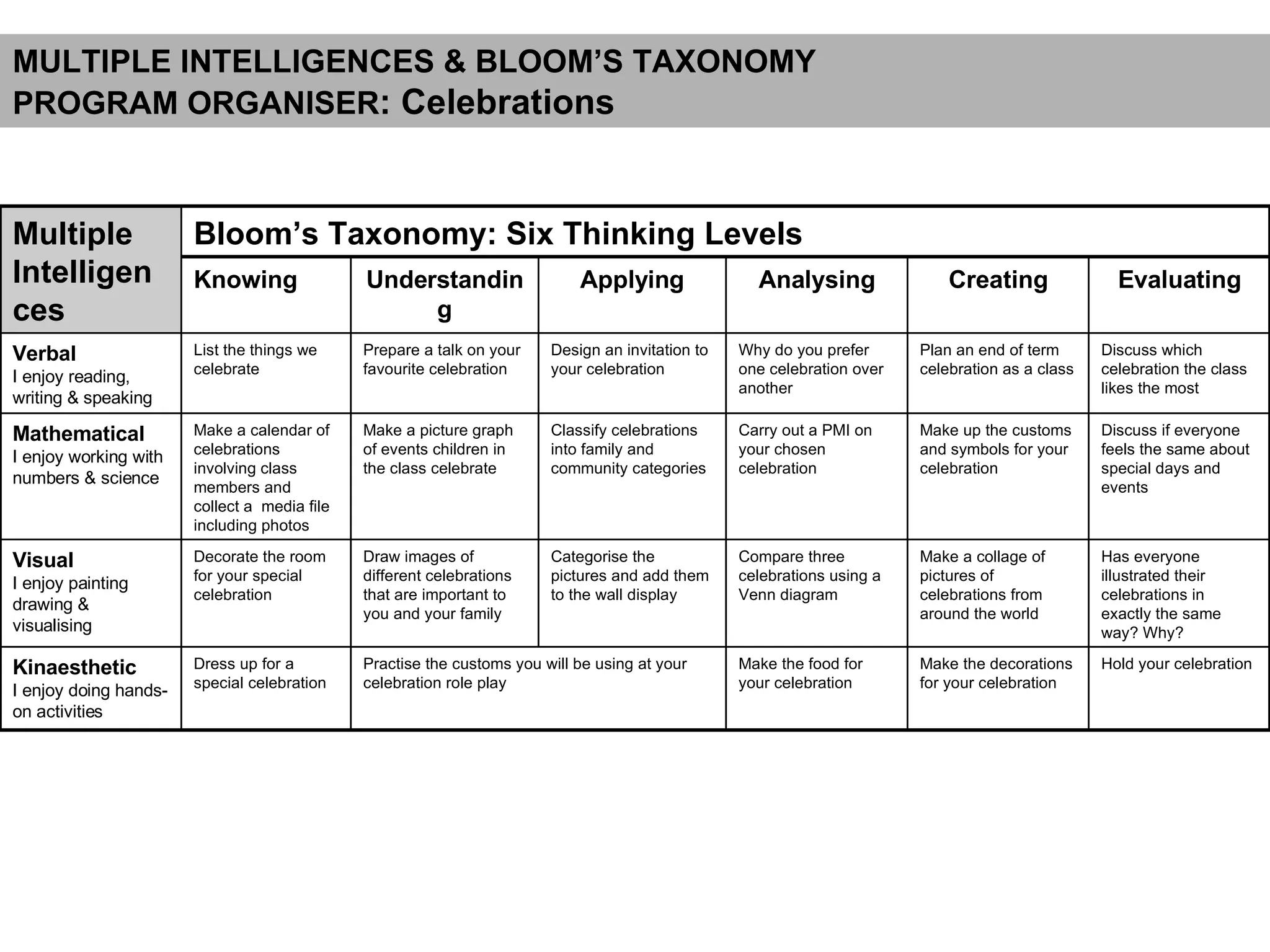
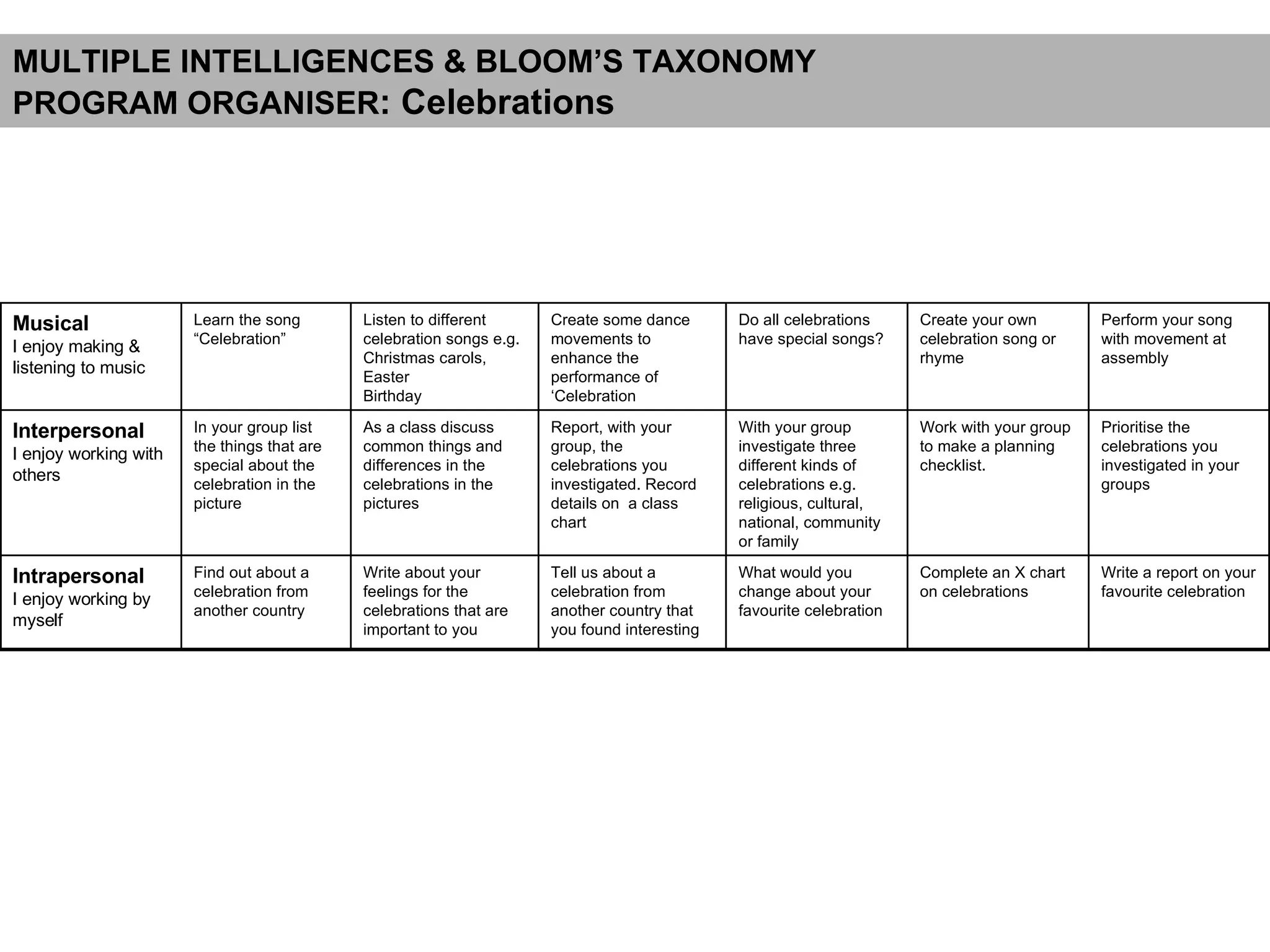
All teachers develop questions at various times that span the levels of Bloom’s taxonomy. The difficult part is to address each level in the same lesson.  Take a look at this analysis of a lesson plan, which highlights all six of Bloom’s levels in a  Celebrations  lesson.
A close study of this lesson reveals how a teacher can help learners advance beyond simple repetition to self-regulated learning. If this is so powerful and so easy,  then why doesn’t every teacher do it every day?
MULTIPLE INTELLIGENCES & BLOOM’S TAXONOMY PROGRAM ORGANISER : Celebrations  Hold your celebration Make the decorations for your celebration Make the food for your celebration  Practise the customs you will be using at your celebration role play Dress up for a special celebration Kinaesthetic I enjoy doing hands-on activities Has everyone illustrated their celebrations in exactly the same way? Why? Make a collage of pictures of celebrations from around the world Compare three celebrations using a Venn diagram Categorise the pictures and add them to the wall display Draw images of different celebrations that are important to you and your family Decorate the room for your special celebration Visual I enjoy painting  drawing & visualising Discuss if everyone feels the same about special days and events  Make up the customs and symbols for your celebration Carry out a PMI on your chosen celebration Classify celebrations into family and community categories Make a picture graph of events children in the class celebrate Make a calendar of  celebrations involving class members and collect a  media file including photos Mathematical I enjoy working with numbers & science Discuss which celebration the class likes the most Plan an end of term celebration as a class Why do you prefer one celebration over another Design an invitation to your celebration Prepare a talk on your favourite celebration List the things we celebrate Verbal I enjoy reading, writing & speaking Evaluating Creating Analysing Applying Understanding Knowing Bloom’s Taxonomy: Six Thinking Levels Multiple Intelligences
MULTIPLE INTELLIGENCES & BLOOM’S TAXONOMY PROGRAM ORGANISER : Celebrations  Write a report on your favourite celebration Complete an X chart on celebrations What would you change about your favourite celebration Tell us about a celebration from another country that you found interesting Write about your feelings for the celebrations that are important to you Find out about a celebration from another country Intrapersonal I enjoy working by myself Prioritise the celebrations you investigated in your groups Work with your group to make a planning checklist.  With your group investigate three different kinds of celebrations e.g. religious, cultural, national, community or family Report, with your group, the celebrations you investigated. Record details on  a class chart As a class discuss common things and differences in the celebrations in the pictures In your group list the things that are special about the celebration in the picture Interpersonal I enjoy working with others Perform your song with movement at assembly Create your own celebration song or rhyme Do all celebrations have special songs? Create some dance movements to enhance the performance of ‘Celebration Listen to different celebration songs e.g. Christmas carols, Easter Birthday  Learn the song “Celebration” Musical I enjoy making & listening to music
Using the web  Most of us think of the Internet as a giant library…and not always a very good one. But the World Wide Web is more than just a warehouse for disorganized information.
Using the web  For the creative teacher, it’s a vast opportunity to encourage learner inquiry at every level of Bloom’s Taxonomy, from knowledge to evaluation.
Knowledge Knowledge measures recall. On this level, learners are asked to remember pieces of information, specific terms and techniques.  The learner will  name…   Label  the diagram and  list …  Define  these terms…
Knowledge Resources for finding, practicing, and memorizing information are sites that support knowledge-level questioning and includes ready-reference sites, like almanacs and encyclopaedias, for learners to find facts.
Knowledge Some sites include puzzle generators and a quiz generator,  tools teachers may find  useful to help learners  practice and recall terms  and facts.
Comprehension Comprehension is understanding.  On this level, learners are asked to grasp meaning and to demonstrate understanding by summarizing or explaining. Paraphrase  the following…  The learner will  explain …  Illustrate  the concept of… and  give examples .
Resources that foster understanding through  discussion,  description, and translation are sites that support comprehension-level questioning.
The tutorials and self-paced instructional materials from  eHow  provide the context for learning anything from pet care (How to train your dog not to beg at dinner) to holiday planning (How to throw a perfect Birthday party).
Application Application is when you use  what you know. learners are expected to take what they learn and apply it in a new, real-life situation. The learner will  demonstrate …  Using  this information,  prepare …  Solve  the following…
Application Sites with activities that allow learners to use the knowledge they have gained are sites that support application-level questioning.  CNN learner News  has weekly activities that encourage learners to draw conclusions from a series of facts. For example, given information about the life and work of an individual, learners can try to guess the person’s identity.
Analysis  Analysis answers  why .  It is the breaking down of knowledge into parts and the relation of those parts to the whole concept.  Differentiate  between… The learner will  analyze  and  infer …  Reduce  these materials, then  outline …
Analysis  Sites that dissect the subject matter, explain how the parts fit together, and then encourage learners to seek more information support analysis. Teachers may use the  Problem-based Learning Clearinghouse  to find questions to use with their secondary-level classes or to learn to develop their own scenarios and role-playing questions.
Synthesis Synthesis is assembling knowledge into a new whole.  This means collecting information, then creating a new insight. The learner will  design …  Devise  a new…  Revise  this work and  integrate …
Synthesis Sites that encourage cooperative learning activities that use a variety of materials to create new products support synthesis-level questioning.
Synthesis ThinkQuest  is an activity in which learners can work together to create interactive, content-rich Web sites. Explore projects in the ThinkQuest Library to see some amazing creations.
Synthesis A  WebQuest  is "an inquiry-oriented activity in which most or all of the information used by learners is drawn from the Web. WebQuests are designed to use learners’ time well, to focus on using information rather than looking for it, and to support learners’ thinking at the levels of analysis, synthesis, and evaluation.
Synthesis " By definition, then, the WebQuest model is an activity using higher-level thinking skills. This activity is very popular; in addition to the activities listed on the official site, there are WebQuests online to cover virtually any subject.
Evaluation Evaluation is  judging . Given criteria, learners judge the value of the information for a specific purpose.  Evaluate  the given material…  Using these criteria,  critique …  The learner will  compare …
Evaluation Sites that require the learner to evaluate contain information, often primary-source information, that the learners must judge and then convey their opinion.
Evaluation Opportunities for debate abound! 42eXplore’s  Oral History  site gathers the firsthand expressions of individuals who have lived through experiences the learners may be studying. learners must consider the role of the speaker, the relationship of the interviewer, and the time in which the interview took place in order to properly evaluate the content of the oral history piece.
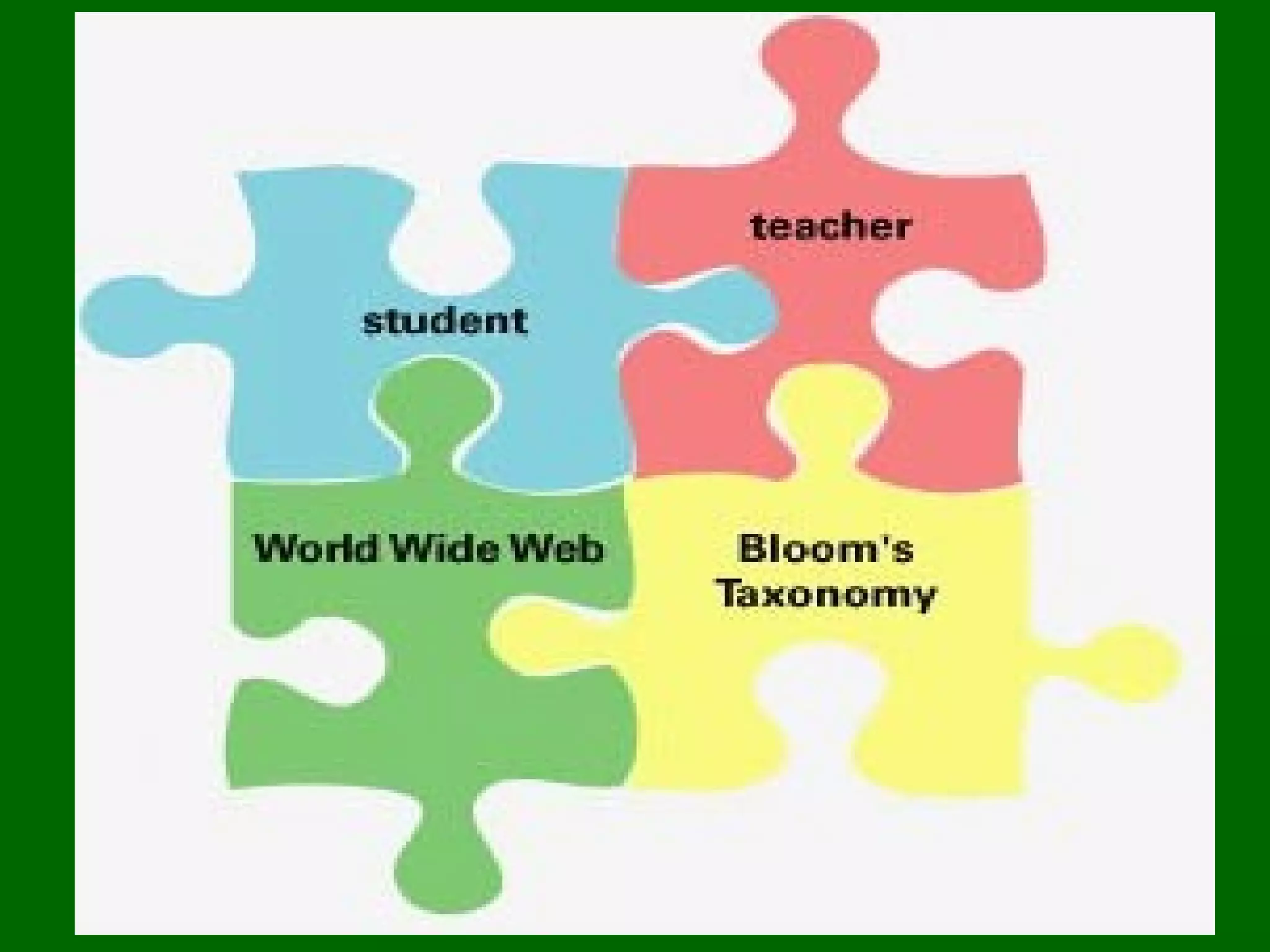
A dynamic learning environment Bloom’s Taxonomy and the World Wide Web are two pieces of a puzzle that forms a dynamic learning environment.  With them in place, the  remaining two pieces,  the teacher and the learner,  will be changed.
A dynamic learning environment If the teacher creates a constructivist or inquiry-based classroom environment, then both teacher and learner must behave differently to  take advantage of the  learning opportunity  it affords.
The learner In an inquiry-based classroom, learners are not relegated to the traditional desks in straight rows. learners are not empty vessels waiting to be filled.
The learner They assume an active role in which they must locate, evaluate, organize, synthesize, and present information, transforming it into knowledge in the process.  (Note the distinction  here from Bloom’s  definition of  knowledge — see below.)
The learner Learners work collaboratively with classmates to explore a problem. This makes it possible for each learner to come to his or her own understanding of a particular topic  as he or she  constructs knowledge.
The learner This environment is focused on the learning and is more learner-centered than the traditional classroom.
The teacher If the classroom has become more learner-centered, then what does this mean for the teacher? Is he or she no longer necessary? Of course not. In fact, the teacher’s role is just as important as it has always been — if not more so.
The teacher With a knowledge of learning styles and of Bloom’s Taxonomy coupled with access to the wealth of resources provided by the World Wide Web, the teacher works alongside the learners.
The teacher Teachers scaffold learning so that learners can assume a more active role in their own learning. This means that lessons are in fact more carefully constructed to guide learners through the exploration of content.
The teacher Teachers’ instructional arsenal contains a greater variety of instructional techniques and knowledge of instructional design. Their role has evolved from the limited didactic form of lecturing once held as the standard view of an effective teacher.
Attention to Bloom’s Taxonomy does not mean that every class period must be optimally designed to place learners in inquiry-based roles.
Teaching requires that we constantly assess where learners are and how best to address their needs.  This may mean that on certain occasions it is necessary to lecture.
In the long run, it means that the teacher  balances   methods of instruction by providing opportunities for the learners to take some  ownership of their learning .
It means that it is more likely that  various learning styles will be addressed .  And it means that we may not hear the dreaded question  Why do I need to know this?   so often
How and what our students learn is a reflection of how and what we teach!
Cognitive Taxonomy   Benjamin Bloom   Information/ Knowledge Comprehension Application Analysis Synthesis Evaluation Recall of facts or information Use criteria to judge  value of ideas and   information Put ideas together to create a new or unique product Explore understandings  through integral parts Use learned knowledge, rule or method in a different situation Demonstrate understanding of information
Final thoughts:  A Bloom by any other name Benjamin Bloom did his work long before the advent of the " Information Age ," and some of his terms conflict with the way we often talk about the Internet.  It has become common to say that what learners find on the Web is only  information ,  and that they have to  construct  knowledge  from that information on their own.
Final thoughts:  A Bloom by any other name If Bloom were devising his taxonomy today, he might call the first level  Information instead of Knowledge .
Perhaps the point to remember is that it doesn’t much matter what you call it,  as long as you teach it .  Bloom’s Taxonomy is a convenient means of talking about  higher-level thinking , but other taxonomies could be (and have been) designed with different names for more or fewer levels.  I will conduct a hands-on workshop on this topic on Friday 10:45 in Classroom 2
If your learners are  analyzing ,  synthesizing , and  evaluating , they’ll be able to  decide for themselves  what to call their ideas!
Reflection Quotes ‘ I hear and I forget.  I see and I remember.  I do and I understand.’ Old Chinese proverb! “ Children do not just passively take in information from the world around them and learn it; rather, they actively transform it into something that is unique and personally meaningful. They use their experience as the context for building new meanings and skills onto what they have already learnt.”   Levin 1996:74 in Dau,E Child’s Play 2001:7
 
 
Thank you! Ceanlia Vermeulen [email_address] Cell: 082 905 9339

Planning Obe Lessonwith Bloom

  • 1.
    Presents: Planning OBELesson Incorporating ICT Ceanlia Vermeulen INNOVATE 2008 SCHOOLS’ ICT CONFERENCE CAPE TOWN 1-3 OCTOBER 2008
  • 2.
    How to Plana OBE Lesson incorporating ICT to support aspects of Learning & Thinking In the Classroom
  • 3.
  • 4.
  • 5.
    Presenter Ceanlia VermeulenGrade 7 Facilitator/Educator Hillcrest Primary School Phone: 031 – 765 7393 Fax: 0866 943 205 Email: [email_address] Copies of examples and planners used during this presentation are available through email.
  • 6.
    I am CeanliaVermeulen If I had to summarise myself in one word it would be Bohemian: n. A person with artistic or literary interests who disregards conventional standards of behaviour.
  • 7.
    What is mymotto? Umuntu ungumuntu ngabantu – a person is a person because of other people. If you want to achieve what you want to achieve, help other people achieve what they want to achieve.
  • 8.
    Who is CeanliaVermeulen? I am Ceanlia I am a qualified Educator & Remedial Specialist. I’m teaching at Hillcrest Primary School in Durban. I am here today to share with you background info on how to Plan a OBE Lesson incorporating ICT & how it can be used to support aspects of Learning & Thinking Friday will be a hands-on workshop on this topic.
  • 9.
    Defining ICT "Information and communications technologies ( ICT ) are the computing and communications facilities and features that variously support teaching , learning and a range of activities in education .
  • 10.
    Wanted: Resilient,independent learners who have flexible skills and competencies; who can work well in teams and lead themselves and others to perform up to and beyond their potential. What do we as Educators want for the 21 st century learning school
  • 11.
    ‘ Empty vessels’come to life in the ‘age of uncertainty’ Learning is not sequential Learning is a social activity ‘ Learning is a consequence of thinking’ Perkins 1992 Learning is emotional ‘ Deep’ Learning = change Learning is most effective when it is fun The world has changed: ICT - the information society school/community links Workplace demands Multiple careers Flexible learning Multi-national, multi-cultural, multi-faith communities ‘ Certainty is out; experiment is in’ (Handy)
  • 12.
    Essential Learning?? Subjectsor skills? IQ or EQ? Teachers or coaches? Knowledge or competencies? Classrooms or computers? Metacognition or rote learning? Summative exams or formative self-assessment How can we help them acquire the habits of emotional intelligence that will create the resilience to be a lifelong learner?
  • 13.
    I(c)T’s about learning“ The genie is out of the bottle. There is no turning back…This is not just a change from inputs (teaching) to outputs (learning). Rather it is a paradigm shift in the conceptualization of the school, where everyone is a learner and even the organization is allowed to make mistakes and be a learner ” (David Loader, Principal, Wesley College, Melbourne in “The Inner Principal”, 1997)
  • 14.
  • 15.
    What then isgood learning? “ Unless individuals take a very active role in what it is that they are studying, unless they learned to ask questions , to do things hands on, the ideas just disappear” Howard Gardner
  • 16.
    Info in ProcessingProcessing Info out
  • 17.
    There are awide range of thinking skills or processes. What are the range of thinking processes that can be defined? When asked about thinking skills generally, an audience might well come up with a fairly random range of skills, such as these:
  • 18.
    Creativity questioning memorisationconceptualisation communication analysis comparison reasoning interpretation
  • 19.
    Conception – 14months 14 months – 4 years 4 – 11 years PQ EQ IQ
  • 20.
  • 21.
    One way to categorise thinking skills is to use an existing framework. A framework which is still regarded as being helpful in this respect is that devised by Bloom (1952).
  • 22.
    He produced a taxonomy [classification, categorisation] of knowledge handling skills where he used six categories :
  • 23.
    Bloom’s Taxonomy Everyonein education has heard of Bloom’s Taxonomy. We all know that there are different levels of thinking and inquiry and that in an ideal classroom , we would help learners move up the ladder to higher-level thought .
  • 24.
    Bloom’s Taxonomy Butin the real world of teaching, we often can’t find the time or the resources to make that happen.
  • 25.
    The Web TheWeb — despite its reputation for providing information and nothing more — can help you push your learners to higher-level thinking.
  • 26.
    Theory vs.practice The standard reproach teachers give when presented with innovative or pedagogically powerful teaching methods , methods that address various learning styles or target critical questioning skills is,
  • 27.
    Theory vs.practice "Does this help me prepare my learners for the end-of-program/end-of-grade test?" The current frenzy spawned by accountability systems across the nation all but eliminates the slightest thought of preparing our learners to think .
  • 28.
    Instead, we oftenseem resigned to ensuring classrooms of "3’s" and "4’s." So how do we respond to the question "Why do I need to know this?" And why does this question exist at all if we are teaching effectively? Must our response always be, "You need to know this because it will be on the test"?
  • 29.
    In the pastfew years, though, a considerable amount of attention has been given to learners’ ability to think critically about what they do.
  • 30.
    Leaders in business, medicine, and various other professions have all announced their concern that schools are not preparing learners to be critical thinkers .
  • 31.
    It is not enough to have knowledge of a particular medical procedure or to be able to calculate an interest rate on a new car loan. These skills mean very little without the ability to know how, when, and where to apply them.
  • 32.
    Bloom’s Taxonomy Recognizingthat there are different levels of thinking behaviours important to learning, Benjamin Bloom and his colleagues developed a classification system which has served educators since 1956.
  • 33.
    Bloom’s Taxonomy Thissystem, known as Bloom’s Taxonomy, is a common structure for categorizing test questions and designing instruction.
  • 34.
    The taxonomy isdivided into six levels , from basic factual recall, or Knowledge , to the highest order, Evaluation , which assesses the value of theories or asks the teacher or learner to discriminate among ideas.
  • 35.
    In the 1950s,Bloom found that 95% of the test questions developed to assess learner learning required them only to think at the lowest level of learning, the recall of information.
  • 36.
    ICT and LearningEmpower Pupils take control of learning Use ICT to research and manage own learning Exchange Exchange OHPs for data projectors, using whiteboards as projection screens Enrich whiteboards used interactively and with wider range of teaching resources and methodologies Edutainment? Computer assisted learning? Content based software? Computer games? ?? Extend Significantly alter the way that teaching and learning takes place using ICT Enhance Deeper learning though the use of ICT based teaching and learning resources Knowledge Comprehension Application Analysis Synthesis Evaluation Where is embedded? Passive Active pupil engagement learning Deep Shallow
  • 37.
    A Differentiated Classroomin Balance F L E X I B L E Solid Curriculum Sense Of Community Teacher-Student Partnerships A Growth Orientation Time Groups Resource Approaches to teaching and learning Concept- based Inviting Product Oriented Focused Safe Respect for individual Respect For Group Shared goals Shared responsibility Shared Vision On-going assessment to determine need Feedback and grading ZPD Target Tomlinson-oo Affirming Shared Challenge
  • 38.
    Map Diagram SculptureDiscussion Demonstration Poem Profile Chart Play Dance Campaign Cassette Quiz Show Banner Brochure Debate Flow Chart Puppet Show Tour Lecture Editorial Painting Costume Placement Blueprint Catalogue Dialogue Newspaper Scrapbook Lecture Questionnaire Flag Scrapbook Graph Debate Museum Learning Center Advertisement Possible Products Book List Calendar Coloring Book Game Research Project TV Show Song Dictionary Film Collection Trial Machine Book Mural Award Recipe Test Puzzle Model Timeline Toy Article Diary Poster Magazine Computer Program Photographs Terrarium Petition Drive Teaching Lesson Prototype Speech Club Cartoon Biography Review Invention
  • 39.
    BLOOM’S REVISED TAXONOMYCreating (synthesis) Generating new ideas, products, or ways of viewing things Designing, constructing, planning, producing, inventing. Evaluating (evaluation) Justifying a decision or course of action Checking, hypothesising, critiquing, experimenting, judging Analysing (analysis) Breaking information into parts to explore understandings and relationships Comparing, organising, deconstructing, interrogating, finding Applying (application) Using information in another familiar situation Implementing, carrying out, using, executing Understanding (comprehension) Explaining ideas or concepts Interpreting, summarising, paraphrasing, classifying, explaining Remembering (knowledge) Recalling information Recognising, listing, describing, retrieving, naming, finding http://www.apa.org/ed/new_blooms.html Bloom’s Taxonomy (revised)
  • 40.
    Visual learners Preferto see rather than be told Quick to spot details Enjoy doodling, drawing and writing Can visualise what they are told Can quickly forget auditory information Auditory learners Follow verbal instructions quickly and easily Rely on memory rather than notes Oral skills are better than written Enjoy talking and explaining Kinaesthetic learners Enjoy practical ‘hands on’ activities Need to be active and can appear unsettled Prefer to try out rather than read the instructions Can be ‘turned off’ by purely visual or oral teaching Learning styles defined
  • 41.
    Doer, toucher, moverand manipulator Often has trouble with spelling Remembers overall impression of experience Points when reading Appears restless in long passive periods Needs to interact with environment Responds to physical rewards Touches for attention and close personal space Moves and gestures a lot Responds physically Learns by hearing and verbalising Medium speech and rhythmical Phonetic speller Remembers verbal instruction Memorises by steps, procedures or sequence Mouths words in silent reading Easily distracted by noise Likes music Speaks clearly and confidently Often talks to self Better speaker than writer Difficulties with spatial awareness Learns by seeing and imagining Speaks quickly Is a good speller G ood visual memory Remembers what was seen Highly organised Observant Visual association to memorise Fluent and fast reader Less distracted by noise more by physical surrounds Prefers art to music Appearance oriented Difficulty remembering verbal cues Good long range planner Kinesthetic Auditory Visual:
  • 42.
    Blue Hat ManagingThe Thinking Setting The Focus Making Summaries Overviews  Conclusions Action Plans Green Hat Creative Thinking Possibilities  Alternatives New Ideas  New Concepts Black Hat Why It May Not Work Cautions  Dangers Problems  Faults Logical Reasons Must Be Given Yellow Hat Why It May Work Values & Benefits (Both Known & Potential) The Good In It Red Hat Feelings & Intuition Emotions Or Hunches “ At This Point” No Reasons or Justification Keep It Short White Hat Information & Data Neutral & Objective Checked & Believed Facts Missing Information & Where To Source It FOCUS DeBono'sThinking Hats Facts Positive, optimism, constructive ideas Processes, definitions, boundaries & conclusions Creative adaptation, “outside the box” Opportunities alternatives Negative, flaws, faults www.edwarddebono.com Feelings & Intuition
  • 43.
    Logical-mathematical intelligence ("number/reasoning smart") Multiple Intelligences Multiple intelligences explains how we learn best. We can use it to focus on our strengths or build on our weaknesses. Spatial intelligence ("picture smart") Bodily-Kinesthetic intelligence ("body smart" – physical experience) Musical intelligence ("music smart") Interpersonal intelligence ("people smart" – social experience s Intrapersonal intelligence ("self smart“ ) Linguistic intelligence ("word smart") Naturalist intelligenc e ("nature smart")
  • 44.
    All teachers developquestions at various times that span the levels of Bloom’s taxonomy. The difficult part is to address each level in the same lesson. Take a look at this analysis of a lesson plan, which highlights all six of Bloom’s levels in a Celebrations lesson.
  • 45.
    A close studyof this lesson reveals how a teacher can help learners advance beyond simple repetition to self-regulated learning. If this is so powerful and so easy, then why doesn’t every teacher do it every day?
  • 46.
    MULTIPLE INTELLIGENCES &BLOOM’S TAXONOMY PROGRAM ORGANISER : Celebrations Hold your celebration Make the decorations for your celebration Make the food for your celebration Practise the customs you will be using at your celebration role play Dress up for a special celebration Kinaesthetic I enjoy doing hands-on activities Has everyone illustrated their celebrations in exactly the same way? Why? Make a collage of pictures of celebrations from around the world Compare three celebrations using a Venn diagram Categorise the pictures and add them to the wall display Draw images of different celebrations that are important to you and your family Decorate the room for your special celebration Visual I enjoy painting drawing & visualising Discuss if everyone feels the same about special days and events Make up the customs and symbols for your celebration Carry out a PMI on your chosen celebration Classify celebrations into family and community categories Make a picture graph of events children in the class celebrate Make a calendar of celebrations involving class members and collect a media file including photos Mathematical I enjoy working with numbers & science Discuss which celebration the class likes the most Plan an end of term celebration as a class Why do you prefer one celebration over another Design an invitation to your celebration Prepare a talk on your favourite celebration List the things we celebrate Verbal I enjoy reading, writing & speaking Evaluating Creating Analysing Applying Understanding Knowing Bloom’s Taxonomy: Six Thinking Levels Multiple Intelligences
  • 47.
    MULTIPLE INTELLIGENCES &BLOOM’S TAXONOMY PROGRAM ORGANISER : Celebrations Write a report on your favourite celebration Complete an X chart on celebrations What would you change about your favourite celebration Tell us about a celebration from another country that you found interesting Write about your feelings for the celebrations that are important to you Find out about a celebration from another country Intrapersonal I enjoy working by myself Prioritise the celebrations you investigated in your groups Work with your group to make a planning checklist. With your group investigate three different kinds of celebrations e.g. religious, cultural, national, community or family Report, with your group, the celebrations you investigated. Record details on a class chart As a class discuss common things and differences in the celebrations in the pictures In your group list the things that are special about the celebration in the picture Interpersonal I enjoy working with others Perform your song with movement at assembly Create your own celebration song or rhyme Do all celebrations have special songs? Create some dance movements to enhance the performance of ‘Celebration Listen to different celebration songs e.g. Christmas carols, Easter Birthday Learn the song “Celebration” Musical I enjoy making & listening to music
  • 48.
    Using the web Most of us think of the Internet as a giant library…and not always a very good one. But the World Wide Web is more than just a warehouse for disorganized information.
  • 49.
    Using the web For the creative teacher, it’s a vast opportunity to encourage learner inquiry at every level of Bloom’s Taxonomy, from knowledge to evaluation.
  • 50.
    Knowledge Knowledge measuresrecall. On this level, learners are asked to remember pieces of information, specific terms and techniques. The learner will name… Label the diagram and list … Define these terms…
  • 51.
    Knowledge Resources forfinding, practicing, and memorizing information are sites that support knowledge-level questioning and includes ready-reference sites, like almanacs and encyclopaedias, for learners to find facts.
  • 52.
    Knowledge Some sitesinclude puzzle generators and a quiz generator, tools teachers may find useful to help learners practice and recall terms and facts.
  • 53.
    Comprehension Comprehension isunderstanding. On this level, learners are asked to grasp meaning and to demonstrate understanding by summarizing or explaining. Paraphrase the following… The learner will explain … Illustrate the concept of… and give examples .
  • 54.
    Resources that fosterunderstanding through discussion, description, and translation are sites that support comprehension-level questioning.
  • 55.
    The tutorials andself-paced instructional materials from eHow provide the context for learning anything from pet care (How to train your dog not to beg at dinner) to holiday planning (How to throw a perfect Birthday party).
  • 56.
    Application Application iswhen you use what you know. learners are expected to take what they learn and apply it in a new, real-life situation. The learner will demonstrate … Using this information, prepare … Solve the following…
  • 57.
    Application Sites withactivities that allow learners to use the knowledge they have gained are sites that support application-level questioning. CNN learner News has weekly activities that encourage learners to draw conclusions from a series of facts. For example, given information about the life and work of an individual, learners can try to guess the person’s identity.
  • 58.
    Analysis Analysisanswers why . It is the breaking down of knowledge into parts and the relation of those parts to the whole concept. Differentiate between… The learner will analyze and infer … Reduce these materials, then outline …
  • 59.
    Analysis Sitesthat dissect the subject matter, explain how the parts fit together, and then encourage learners to seek more information support analysis. Teachers may use the Problem-based Learning Clearinghouse to find questions to use with their secondary-level classes or to learn to develop their own scenarios and role-playing questions.
  • 60.
    Synthesis Synthesis isassembling knowledge into a new whole. This means collecting information, then creating a new insight. The learner will design … Devise a new… Revise this work and integrate …
  • 61.
    Synthesis Sites thatencourage cooperative learning activities that use a variety of materials to create new products support synthesis-level questioning.
  • 62.
    Synthesis ThinkQuest is an activity in which learners can work together to create interactive, content-rich Web sites. Explore projects in the ThinkQuest Library to see some amazing creations.
  • 63.
    Synthesis A WebQuest is "an inquiry-oriented activity in which most or all of the information used by learners is drawn from the Web. WebQuests are designed to use learners’ time well, to focus on using information rather than looking for it, and to support learners’ thinking at the levels of analysis, synthesis, and evaluation.
  • 64.
    Synthesis " Bydefinition, then, the WebQuest model is an activity using higher-level thinking skills. This activity is very popular; in addition to the activities listed on the official site, there are WebQuests online to cover virtually any subject.
  • 65.
    Evaluation Evaluation is judging . Given criteria, learners judge the value of the information for a specific purpose. Evaluate the given material… Using these criteria, critique … The learner will compare …
  • 66.
    Evaluation Sites thatrequire the learner to evaluate contain information, often primary-source information, that the learners must judge and then convey their opinion.
  • 67.
    Evaluation Opportunities fordebate abound! 42eXplore’s Oral History site gathers the firsthand expressions of individuals who have lived through experiences the learners may be studying. learners must consider the role of the speaker, the relationship of the interviewer, and the time in which the interview took place in order to properly evaluate the content of the oral history piece.
  • 68.
    A dynamic learningenvironment Bloom’s Taxonomy and the World Wide Web are two pieces of a puzzle that forms a dynamic learning environment. With them in place, the remaining two pieces, the teacher and the learner, will be changed.
  • 69.
    A dynamic learningenvironment If the teacher creates a constructivist or inquiry-based classroom environment, then both teacher and learner must behave differently to take advantage of the learning opportunity it affords.
  • 70.
    The learner Inan inquiry-based classroom, learners are not relegated to the traditional desks in straight rows. learners are not empty vessels waiting to be filled.
  • 71.
    The learner Theyassume an active role in which they must locate, evaluate, organize, synthesize, and present information, transforming it into knowledge in the process. (Note the distinction here from Bloom’s definition of knowledge — see below.)
  • 72.
    The learner Learnerswork collaboratively with classmates to explore a problem. This makes it possible for each learner to come to his or her own understanding of a particular topic as he or she constructs knowledge.
  • 73.
    The learner Thisenvironment is focused on the learning and is more learner-centered than the traditional classroom.
  • 74.
    The teacher Ifthe classroom has become more learner-centered, then what does this mean for the teacher? Is he or she no longer necessary? Of course not. In fact, the teacher’s role is just as important as it has always been — if not more so.
  • 75.
    The teacher Witha knowledge of learning styles and of Bloom’s Taxonomy coupled with access to the wealth of resources provided by the World Wide Web, the teacher works alongside the learners.
  • 76.
    The teacher Teachersscaffold learning so that learners can assume a more active role in their own learning. This means that lessons are in fact more carefully constructed to guide learners through the exploration of content.
  • 77.
    The teacher Teachers’instructional arsenal contains a greater variety of instructional techniques and knowledge of instructional design. Their role has evolved from the limited didactic form of lecturing once held as the standard view of an effective teacher.
  • 78.
    Attention to Bloom’sTaxonomy does not mean that every class period must be optimally designed to place learners in inquiry-based roles.
  • 79.
    Teaching requires thatwe constantly assess where learners are and how best to address their needs. This may mean that on certain occasions it is necessary to lecture.
  • 80.
    In the longrun, it means that the teacher balances methods of instruction by providing opportunities for the learners to take some ownership of their learning .
  • 81.
    It means thatit is more likely that various learning styles will be addressed . And it means that we may not hear the dreaded question Why do I need to know this? so often
  • 82.
    How and whatour students learn is a reflection of how and what we teach!
  • 83.
    Cognitive Taxonomy Benjamin Bloom Information/ Knowledge Comprehension Application Analysis Synthesis Evaluation Recall of facts or information Use criteria to judge value of ideas and information Put ideas together to create a new or unique product Explore understandings through integral parts Use learned knowledge, rule or method in a different situation Demonstrate understanding of information
  • 84.
    Final thoughts: A Bloom by any other name Benjamin Bloom did his work long before the advent of the " Information Age ," and some of his terms conflict with the way we often talk about the Internet. It has become common to say that what learners find on the Web is only information , and that they have to construct knowledge from that information on their own.
  • 85.
    Final thoughts: A Bloom by any other name If Bloom were devising his taxonomy today, he might call the first level Information instead of Knowledge .
  • 86.
    Perhaps the pointto remember is that it doesn’t much matter what you call it, as long as you teach it . Bloom’s Taxonomy is a convenient means of talking about higher-level thinking , but other taxonomies could be (and have been) designed with different names for more or fewer levels. I will conduct a hands-on workshop on this topic on Friday 10:45 in Classroom 2
  • 87.
    If your learnersare analyzing , synthesizing , and evaluating , they’ll be able to decide for themselves what to call their ideas!
  • 88.
    Reflection Quotes ‘I hear and I forget. I see and I remember. I do and I understand.’ Old Chinese proverb! “ Children do not just passively take in information from the world around them and learn it; rather, they actively transform it into something that is unique and personally meaningful. They use their experience as the context for building new meanings and skills onto what they have already learnt.” Levin 1996:74 in Dau,E Child’s Play 2001:7
  • 89.
  • 90.
  • 91.
    Thank you! CeanliaVermeulen [email_address] Cell: 082 905 9339