How Games Teach Doug Adams ALTEC
Resources and Files This PowerPoint: http://www.slideshare.net/dadams.altec My Wiki page: http://dadams- altec.wetpaint.com Technology Expectations in Education Games and Education
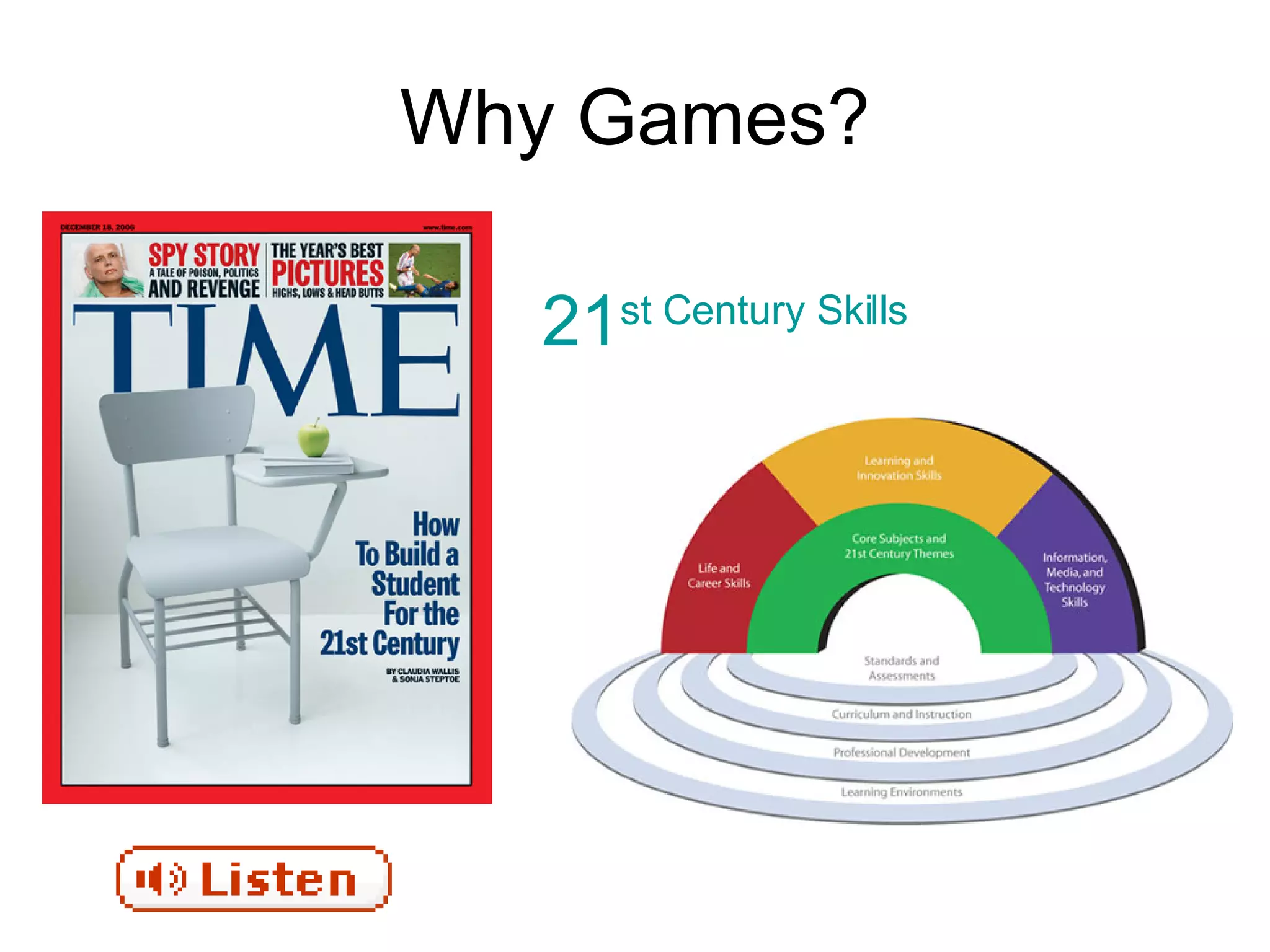
Why Games? 21 st  Century Skills
Scientific American  Magazine  July, 1903 “ The letter of a century ago still has a certain literary value.  Nowadays we only ‘correspond’ or we ‘beg to state.’  It still remains for our children to discard the forms of polite address which have come down to us.  The letter of the future will be a colorless communication of telegraphic brevity. ”
The Millennial Generation “ Millennials” “ Generation Y” “ N-Gen”, “Generation Next” Oyayubizoku ( 親指族   ) = “Thumb Tribe” Young Japanese have become so adept at their phones — manipulating a set of cursor keys or a button-sized joystick by thumb — that some people refer to a new ' thumb culture '. ( The Daily Telegraph , August 7, 2000) “ Digital Natives” “ Kids say e-mail is, like, sooooo dead.”  –  CNET News , July 18, 2007
Characteristics of Digital Natives Active Multi-tasking Non-linear thinking Ubiquity Technical Fluency Feedback Individualization Risk-takers Collaborative
Attitudes in the Millennial World “ Our knowledge comes from the  intelligence of the mob . There are websites that let us view user ratings on  news ,  bookmarks ,  definitions ,  wines ,  burritos ,  beers , and  videos . I want to have that same experience when searching for my first home.  Show me what the community thinks.  Give me the data the way I am used to receiving it….  ” -- Beam Me Up Jimmy - A Look At Tomorrow's 1st Time Home Buyer   http:// realestatetomato.typepad.com
What is a Game? A competitive activity in which players follow a set of rules Single player (player versus self), multi-player, computer controlled player Active: player actions affect outcomes Rules Define victory conditions Describe legal play Differentiate games from one another
Simulations Simulation: a reproduction or representation of reality Some  simulations  are games Sim City Zoo Tycoon “ Serious games ” Some simulations may not be games Economic models Cinematic re-enactments Anatomical or geographical exploration Incidental Learning
Incidental Learning Systems-based reasoning  - reasoning about some phenomenon in terms of a system  Understanding feedback  - understands relationships among system components  Model-based reasoning  - evokes a model to understand some system in the virtual world  Model-testing & prediction  - compares model’s predictions to actual observations  Mathematical modeling  - proposes mathematical model to describe relationships in system  Mathematical computation  - explicates some mathematical computation not given by game  --  Constance Steinkuehler , UW-M, 2007
Gaming in Education Do not, my friend, keep children to their studies by compulsion, but by play  -- Plato, Republic. Games have been widely used in education throughout history Athletics Debates Spelling bees Classroom Jeopardy Most common uses are  assessment  and  practice Incidental learning minimized
Gaming in Education The 1970s saw a dramatic increase in the use of games for educational purposes "As the true character of gaming as a unique  communication form becomes clear, its use… will become pervasive” Richard Duke (1974),  The Future’s Language In the 1980s there was a focus on basic skill development –  Reader Rabbit  &  Math Blaster
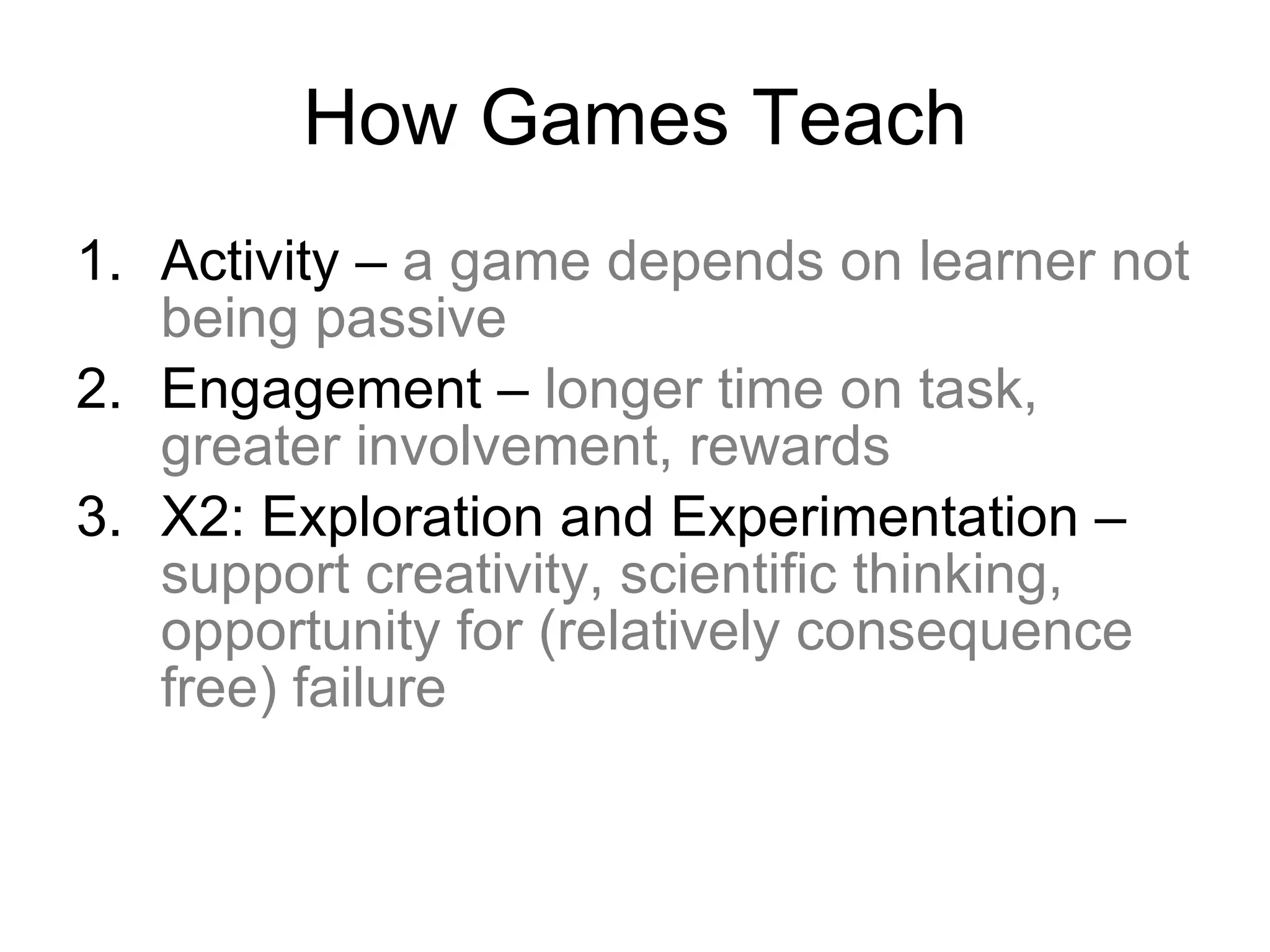
How Games Teach Activity  –  a game depends on learner not being passive Engagement –  longer time on task, greater involvement, rewards X2: Exploration and Experimentation –  support creativity, scientific thinking, opportunity for (relatively consequence free) failure
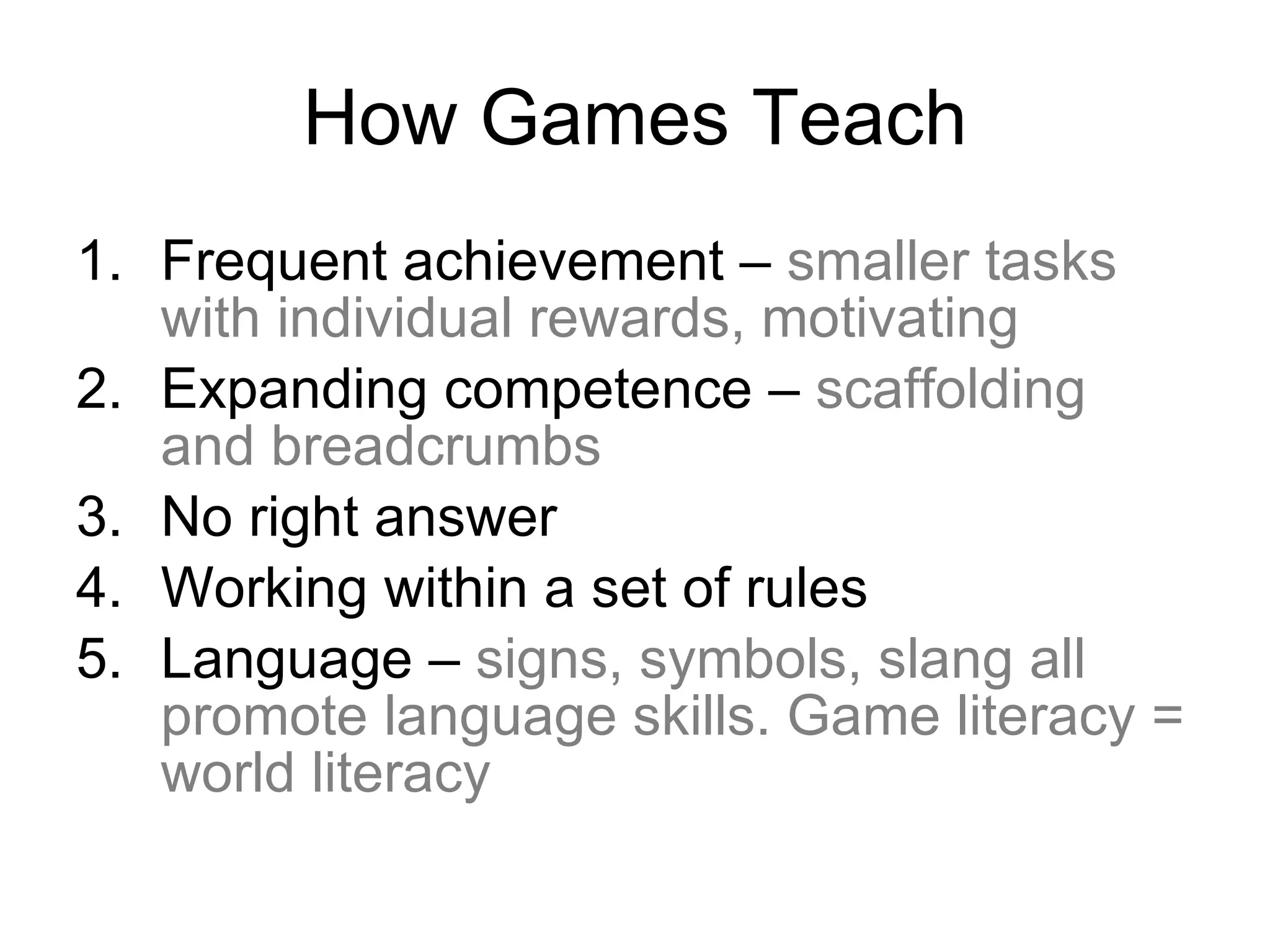
How Games Teach Frequent achievement –  smaller tasks with individual rewards, motivating Expanding competence –  scaffolding and breadcrumbs No right answer Working within a set of rules Language –  signs, symbols, slang all promote language skills. Game literacy = world literacy
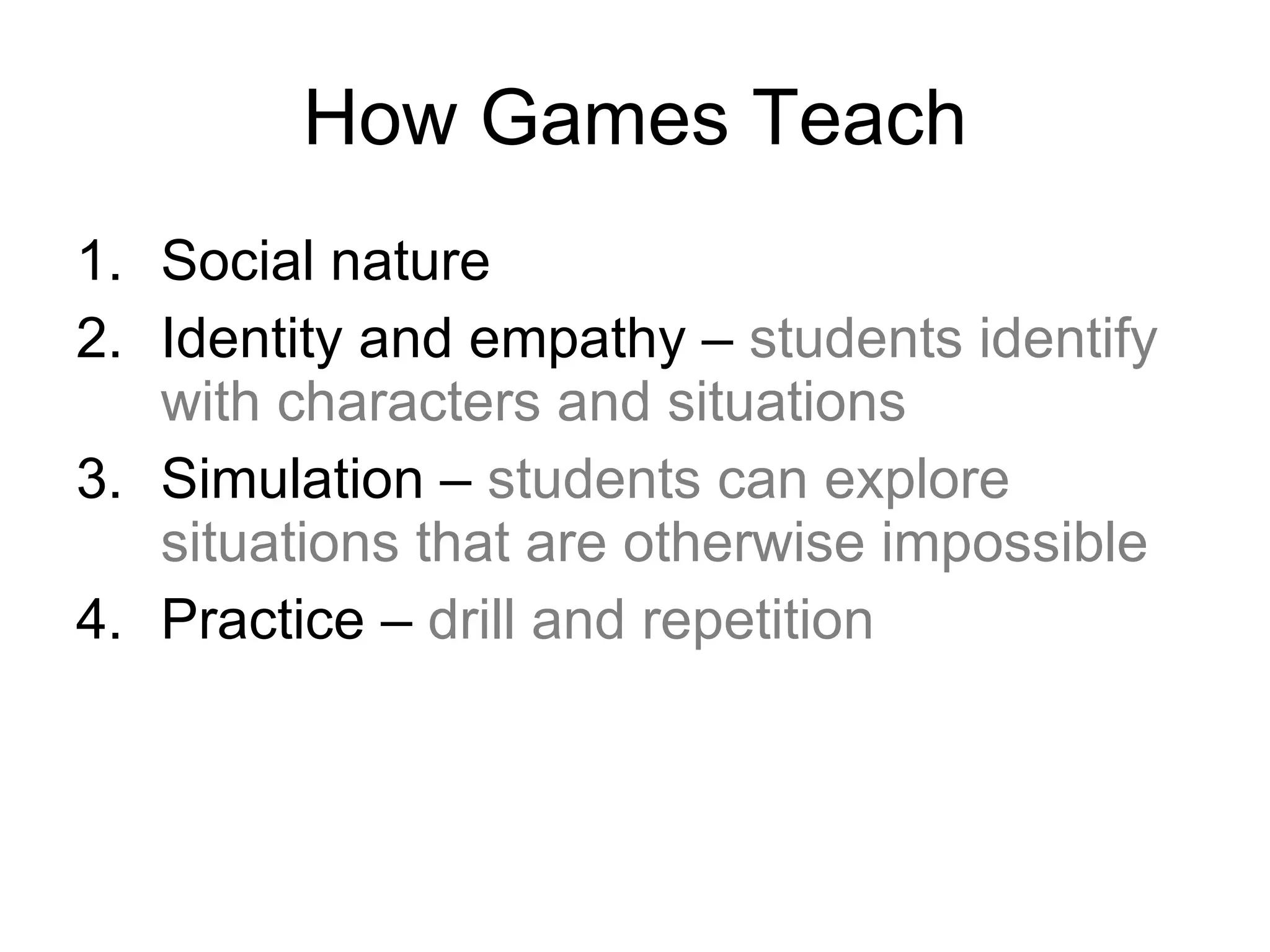
How Games Teach Social nature  Identity and empathy –  students identify with characters and situations Simulation –  students can explore situations that are otherwise impossible Practice –  drill and repetition
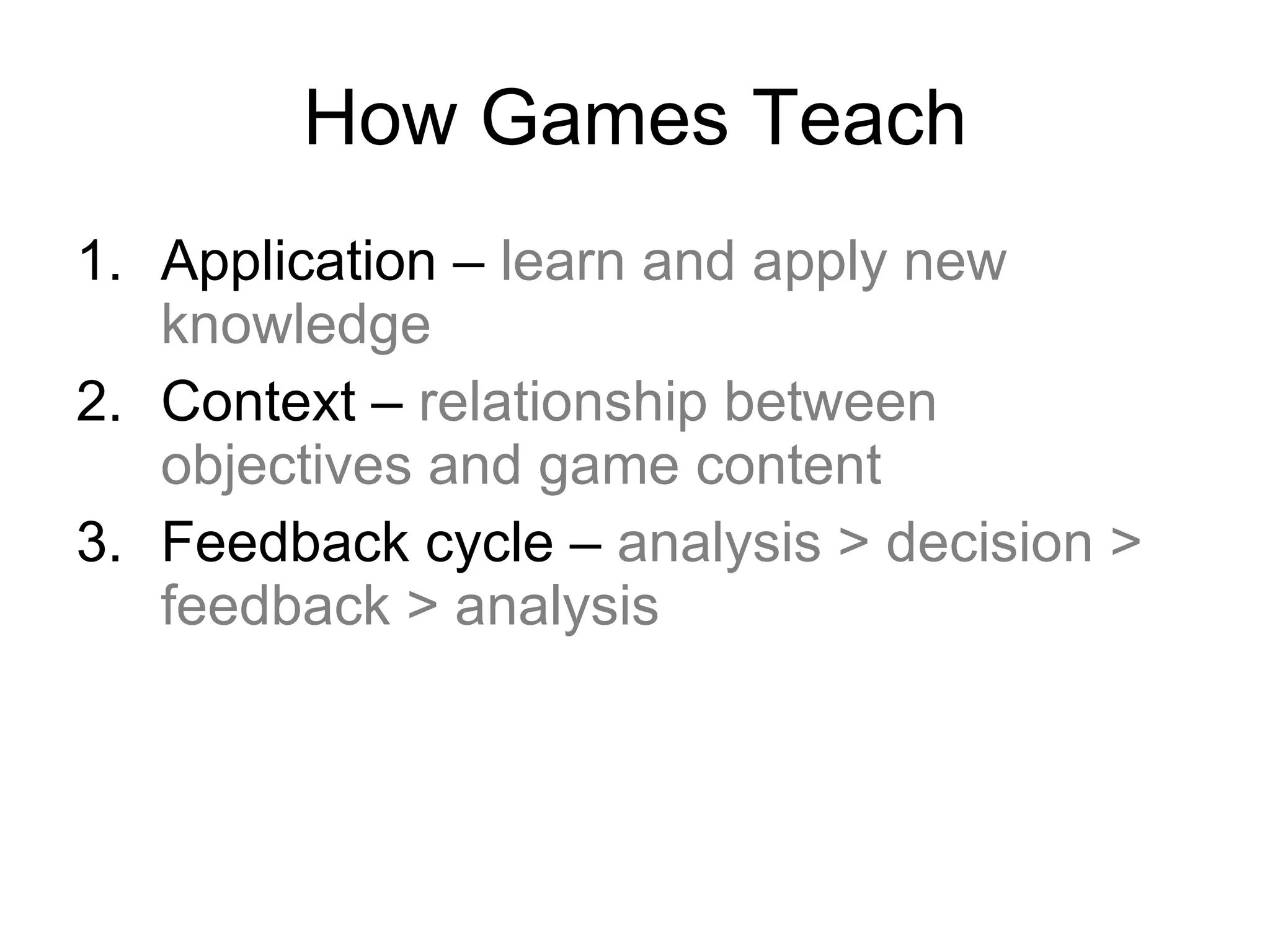
How Games Teach Application –  learn and apply new knowledge Context –  relationship between objectives and game content Feedback cycle –  analysis > decision > feedback > analysis
How Games Teach Multimodal –  text, images, sounds, symbols, actions Reflection –  emphasis on thinking, problem solving rather than “twitch” Mastery –  Experienced players teach new players, experts become mentors Challenge –  game players seek out difficult or challenging tasks
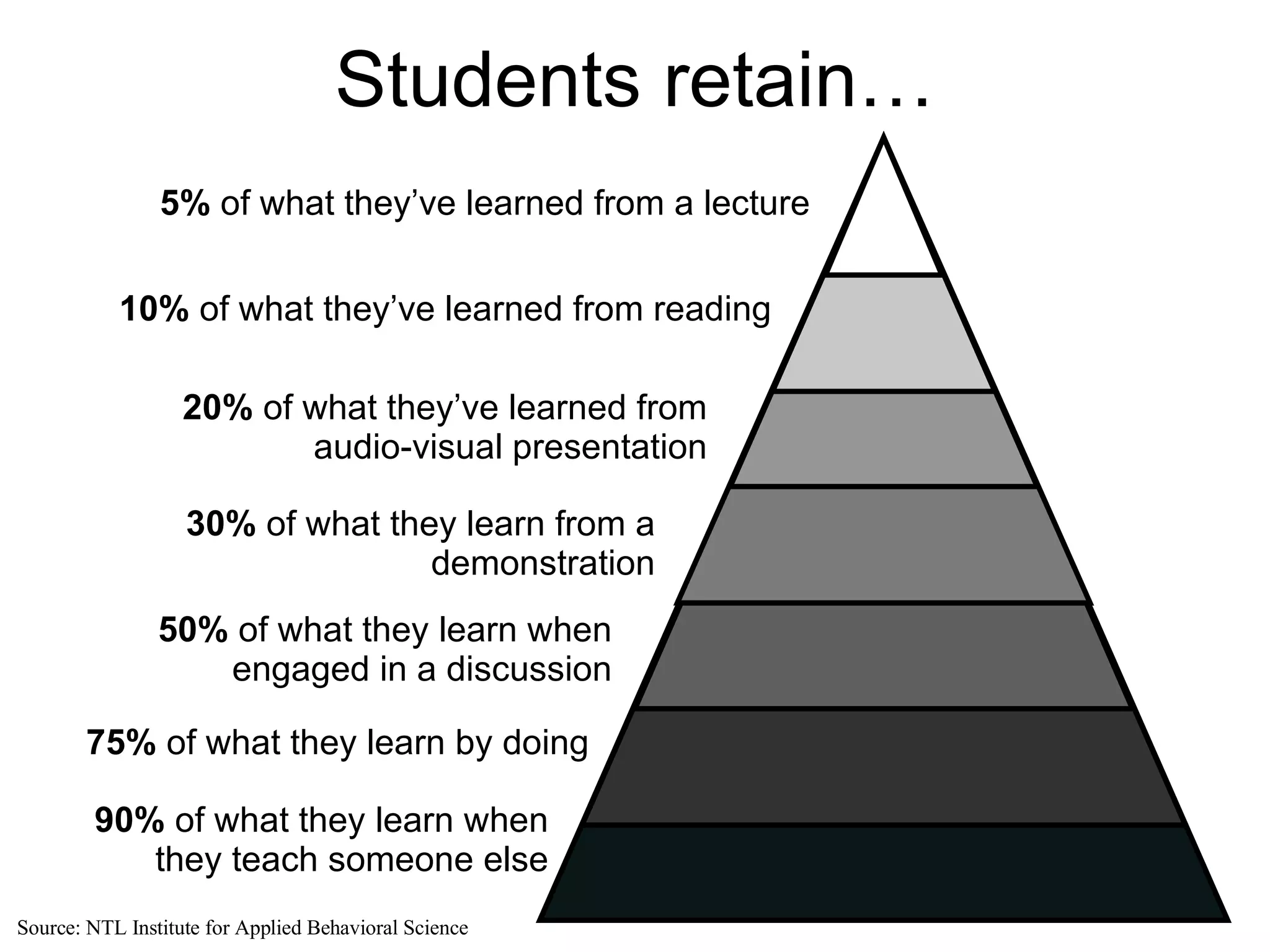
Students retain… 90%  of what they learn when they teach someone else 5%  of what they’ve learned from a lecture 10%  of what they’ve learned from reading 20%  of what they’ve learned from audio-visual presentation 30%  of what they learn from a demonstration 50%  of what they learn when engaged in a discussion 75%  of what they learn by doing Source: NTL Institute for Applied Behavioral Science
Limitations of Games Content Alignment with standards Inaccurate information (most games aren’t designed to be “educational” at all!) Fidelity of simulation Transfer of skills Content skills Thinking skills Pedagogical skills
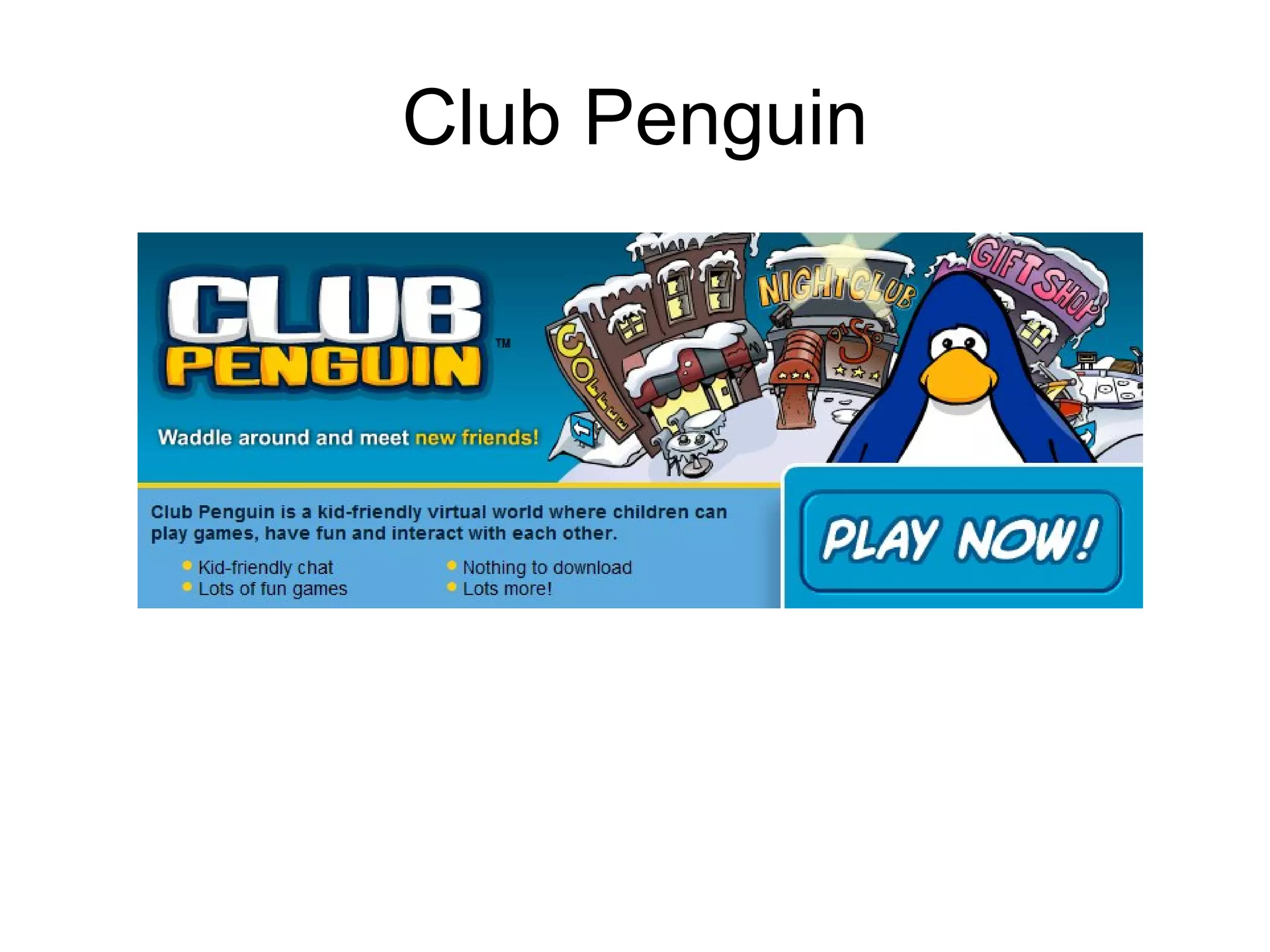
Club Penguin
But how will people live in a world that is so…   VIRTUAL? From  Scientific American,  Aug, 1902: [C]hildren cope more easily with the new necessities of life, and new arrangements which perplexed their parents become habits easily borne.  Thus we may imagine future generations perfectly calm among a hundred telephones and sleeping sweetly while airships whizz among countless electric wires over their heads and a perpetual night traffic of motor cars hurtles past their bedroom windows.  As yet, our nervous systems are not so callous.
Doug Adams [email_address] http://altec.org

How Games Teach - MACE 08

  • 1.
    How Games TeachDoug Adams ALTEC
  • 2.
    Resources and FilesThis PowerPoint: http://www.slideshare.net/dadams.altec My Wiki page: http://dadams- altec.wetpaint.com Technology Expectations in Education Games and Education
  • 3.
    Why Games? 21st Century Skills
  • 4.
    Scientific American Magazine July, 1903 “ The letter of a century ago still has a certain literary value. Nowadays we only ‘correspond’ or we ‘beg to state.’ It still remains for our children to discard the forms of polite address which have come down to us. The letter of the future will be a colorless communication of telegraphic brevity. ”
  • 5.
    The Millennial Generation“ Millennials” “ Generation Y” “ N-Gen”, “Generation Next” Oyayubizoku ( 親指族 ) = “Thumb Tribe” Young Japanese have become so adept at their phones — manipulating a set of cursor keys or a button-sized joystick by thumb — that some people refer to a new ' thumb culture '. ( The Daily Telegraph , August 7, 2000) “ Digital Natives” “ Kids say e-mail is, like, sooooo dead.” – CNET News , July 18, 2007
  • 6.
    Characteristics of DigitalNatives Active Multi-tasking Non-linear thinking Ubiquity Technical Fluency Feedback Individualization Risk-takers Collaborative
  • 7.
    Attitudes in theMillennial World “ Our knowledge comes from the intelligence of the mob . There are websites that let us view user ratings on news , bookmarks , definitions , wines , burritos , beers , and videos . I want to have that same experience when searching for my first home. Show me what the community thinks. Give me the data the way I am used to receiving it…. ” -- Beam Me Up Jimmy - A Look At Tomorrow's 1st Time Home Buyer http:// realestatetomato.typepad.com
  • 8.
    What is aGame? A competitive activity in which players follow a set of rules Single player (player versus self), multi-player, computer controlled player Active: player actions affect outcomes Rules Define victory conditions Describe legal play Differentiate games from one another
  • 9.
    Simulations Simulation: areproduction or representation of reality Some simulations are games Sim City Zoo Tycoon “ Serious games ” Some simulations may not be games Economic models Cinematic re-enactments Anatomical or geographical exploration Incidental Learning
  • 10.
    Incidental Learning Systems-basedreasoning - reasoning about some phenomenon in terms of a system Understanding feedback - understands relationships among system components Model-based reasoning - evokes a model to understand some system in the virtual world Model-testing & prediction - compares model’s predictions to actual observations Mathematical modeling - proposes mathematical model to describe relationships in system Mathematical computation - explicates some mathematical computation not given by game -- Constance Steinkuehler , UW-M, 2007
  • 11.
    Gaming in EducationDo not, my friend, keep children to their studies by compulsion, but by play -- Plato, Republic. Games have been widely used in education throughout history Athletics Debates Spelling bees Classroom Jeopardy Most common uses are assessment and practice Incidental learning minimized
  • 12.
    Gaming in EducationThe 1970s saw a dramatic increase in the use of games for educational purposes "As the true character of gaming as a unique communication form becomes clear, its use… will become pervasive” Richard Duke (1974), The Future’s Language In the 1980s there was a focus on basic skill development – Reader Rabbit & Math Blaster
  • 13.
    How Games TeachActivity – a game depends on learner not being passive Engagement – longer time on task, greater involvement, rewards X2: Exploration and Experimentation – support creativity, scientific thinking, opportunity for (relatively consequence free) failure
  • 14.
    How Games TeachFrequent achievement – smaller tasks with individual rewards, motivating Expanding competence – scaffolding and breadcrumbs No right answer Working within a set of rules Language – signs, symbols, slang all promote language skills. Game literacy = world literacy
  • 15.
    How Games TeachSocial nature Identity and empathy – students identify with characters and situations Simulation – students can explore situations that are otherwise impossible Practice – drill and repetition
  • 16.
    How Games TeachApplication – learn and apply new knowledge Context – relationship between objectives and game content Feedback cycle – analysis > decision > feedback > analysis
  • 17.
    How Games TeachMultimodal – text, images, sounds, symbols, actions Reflection – emphasis on thinking, problem solving rather than “twitch” Mastery – Experienced players teach new players, experts become mentors Challenge – game players seek out difficult or challenging tasks
  • 18.
    Students retain… 90% of what they learn when they teach someone else 5% of what they’ve learned from a lecture 10% of what they’ve learned from reading 20% of what they’ve learned from audio-visual presentation 30% of what they learn from a demonstration 50% of what they learn when engaged in a discussion 75% of what they learn by doing Source: NTL Institute for Applied Behavioral Science
  • 19.
    Limitations of GamesContent Alignment with standards Inaccurate information (most games aren’t designed to be “educational” at all!) Fidelity of simulation Transfer of skills Content skills Thinking skills Pedagogical skills
  • 20.
  • 21.
    But how willpeople live in a world that is so… VIRTUAL? From Scientific American, Aug, 1902: [C]hildren cope more easily with the new necessities of life, and new arrangements which perplexed their parents become habits easily borne. Thus we may imagine future generations perfectly calm among a hundred telephones and sleeping sweetly while airships whizz among countless electric wires over their heads and a perpetual night traffic of motor cars hurtles past their bedroom windows. As yet, our nervous systems are not so callous.
  • 22.