Epinephrine

      By: Dr. Vahid Nikoui

  Email: nikoui@razi.tums.ac.ir
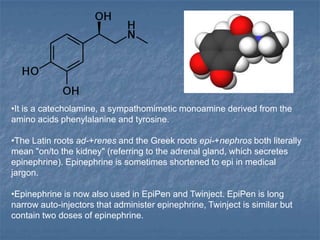
•It is a catecholamine, a sympathomimetic monoamine derived from the
amino acids phenylalanine and tyrosine.

•The Latin roots ad-+renes and the Greek roots epi-+nephros both literally
mean "on/to the kidney" (referring to the adrenal gland, which secretes
epinephrine). Epinephrine is sometimes shortened to epi in medical
jargon.

•Epinephrine is now also used in EpiPen and Twinject. EpiPen is long
narrow auto-injectors that administer epinephrine, Twinject is similar but
contain two doses of epinephrine.
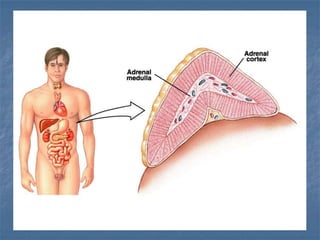
Adrenal Anatomy

• small, triangular glands loosely attached
to the kidneys

• divided into two morphologically and
distinct regions

          - adrenal cortex (outer)

          - adrenal medulla (inner)
Anatomy and Origin


• embryologically derived from
pheochromoblasts

• differentiate into modified neuronal cells
         • more gland than nerve
         • chromaffin cells

• acts like sympathetic ganglion
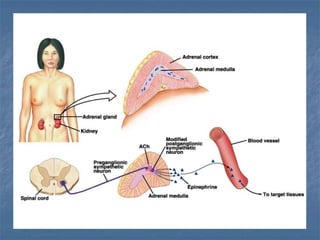
Function of the Adrenal Medulla

• an extension of the sympathetic nervous
system

• acts as a peripheral amplifier

• activated by same stimuli as the
sympathetic nervous system

      (examples – exercise, cold, stress,
      hemorrhage, etc.)
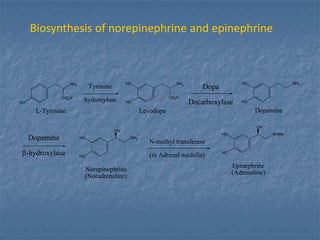
Biosynthesis of norepinephrine and epinephrine


                                               HO                   NH2                      HO                 NH2
                    NH2
                               Tyrosine                                       Dopa
HO
                CO2H
                           hydroxylase         HO
                                                                 CO2H
                                                                          Decarboxylase      HO

       L-Tyrosine                                     Levodopa                                    Dopamine

                                                                                                  OH
                                          OH
                                                                                     HO                  NHMe
     Dopamine             HO                    NH2
                                                         N-methyl transferase
     -hydroxylase         HO                             (in Adrenal medulla)        HO


                                                                                          Epinephrine
                           Norepinephrine                                                 (Adrenaline)
                           (Noradrenaline)
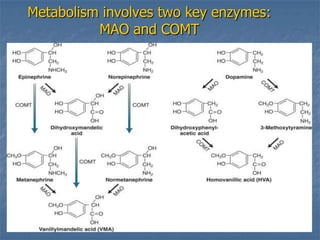
Metabolism involves two key enzymes:
          MAO and COMT
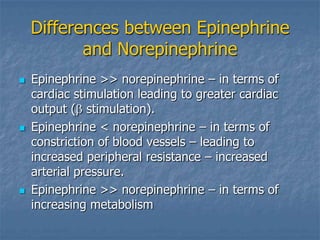
Differences between Epinephrine
           and Norepinephrine
   Epinephrine >> norepinephrine – in terms of
    cardiac stimulation leading to greater cardiac
    output ( stimulation).
   Epinephrine < norepinephrine – in terms of
    constriction of blood vessels – leading to
    increased peripheral resistance – increased
    arterial pressure.
   Epinephrine >> norepinephrine – in terms of
    increasing metabolism
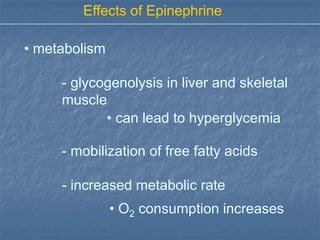
Effects of Epinephrine

• metabolism

     - glycogenolysis in liver and skeletal
     muscle
            • can lead to hyperglycemia

     - mobilization of free fatty acids

     - increased metabolic rate
               • O2 consumption increases
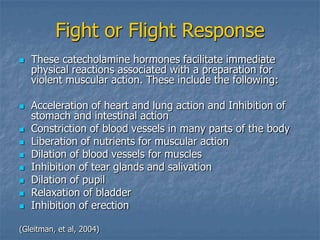
Fight or Flight Response
   These catecholamine hormones facilitate immediate
    physical reactions associated with a preparation for
    violent muscular action. These include the following:

   Acceleration of heart and lung action and Inhibition of
    stomach and intestinal action
   Constriction of blood vessels in many parts of the body
   Liberation of nutrients for muscular action
   Dilation of blood vessels for muscles
   Inhibition of tear glands and salivation
   Dilation of pupil
   Relaxation of bladder
   Inhibition of erection

(Gleitman, et al, 2004)
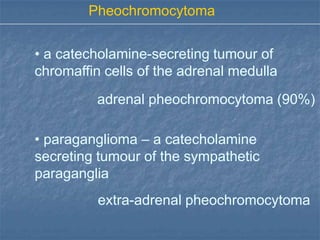
Pheochromocytoma


• a catecholamine-secreting tumour of
chromaffin cells of the adrenal medulla
          adrenal pheochromocytoma (90%)

• paraganglioma – a catecholamine
secreting tumour of the sympathetic
paraganglia
          extra-adrenal pheochromocytoma
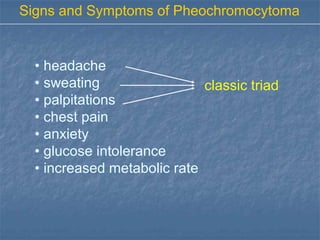
Signs and Symptoms of Pheochromocytoma


  • headache
  • sweating                 classic triad
  • palpitations
  • chest pain
  • anxiety
  • glucose intolerance
  • increased metabolic rate
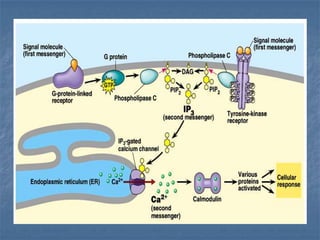
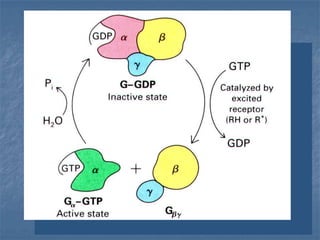
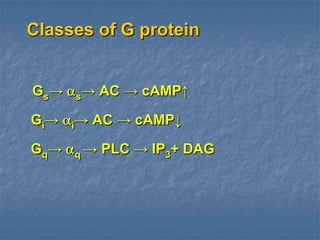
Classes of G protein


Gs→    s→   AC → cAMP↑

Gi→    i→   AC → cAMP↓

G q→   q→    PLC → IP3+ DAG
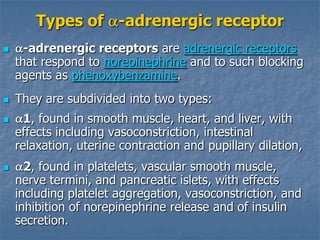
Types of -adrenergic receptor
     -adrenergic receptors are adrenergic receptors
    that respond to norepinephrine and to such blocking
    agents as phenoxybenzamine.
   They are subdivided into two types:
     1, found in smooth muscle, heart, and liver, with
    effects including vasoconstriction, intestinal
    relaxation, uterine contraction and pupillary dilation,
     2, found in platelets, vascular smooth muscle,
    nerve termini, and pancreatic islets, with effects
    including platelet aggregation, vasoconstriction, and
    inhibition of norepinephrine release and of insulin
    secretion.
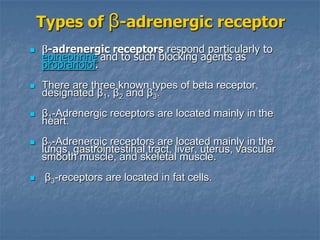
Types of β-adrenergic receptor
    -adrenergic receptors respond particularly to
    epinephrine and to such blocking agents as
    propranolol.
   There are three known types of beta receptor,
    designated β1, β2 and β3.
   β1-Adrenergic receptors are located mainly in the
    heart.
   β2-Adrenergic receptors are located mainly in the
    lungs, gastrointestinal tract, liver, uterus, vascular
    smooth muscle, and skeletal muscle.
    β3-receptors are located in fat cells.
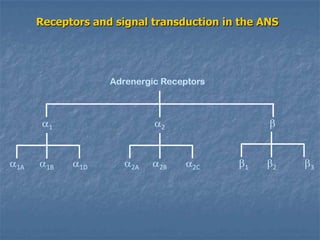
Receptors and signal transduction in the ANS


                  Adrenergic Receptors


       1                    2


1A    1B    1D        2A    2B     2C     1    2    3
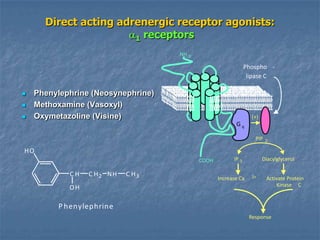
Direct acting adrenergic receptor agonists:
                       1 receptors

                                    NH 3

                                                               Phospho -
                                                                lipase C

   Phenylephrine (Neosynephrine)
   Methoxamine (Vasoxyl)
   Oxymetazoline (Visine)                                       (+)
                                                         Gq

                                                                  PIP   2

HO
                                           COOH         IP 3           Diacylglycerol

            CH   C H 2 NH   C H3                                 2+
                                                  Increase Ca           Activate Protein
                                                                            Kinase C
            OH

         P henylephrine
                                                                Response
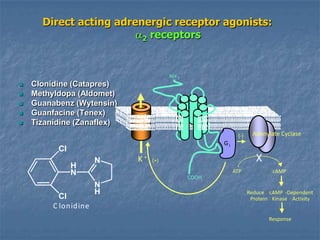
Direct acting adrenergic receptor agonists:
                         2 receptors


                                       NH 3
   Clonidine (Catapres)
   Methyldopa (Aldomet)
   Guanabenz (Wytensin)
   Guanfacine (Tenex)
   Tizanidine (Zanaflex)
                                                           (-)     Adenylate Cyclase
                                                     GI
          Cl
                      N     K+   (+)                                X
               H
               N                                          ATP             cAMP
                                              COOH
                      N
                      H                                          Reduce cAMP -Dependent
           Cl                                                     Protein Kinase Activity
         C lonidine
                                                                         Response
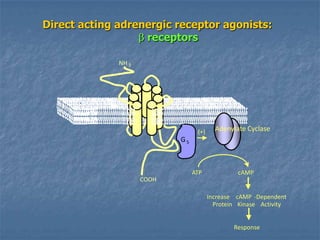
Direct acting adrenergic receptor agonists:
                   receptors

              NH 3


                                  (+)     Adenylate Cyclase
                            GS


                                 ATP             cAMP
                     COOH

                                        Increase cAMP -Dependent
                                          Protein Kinase Activity


                                                Response
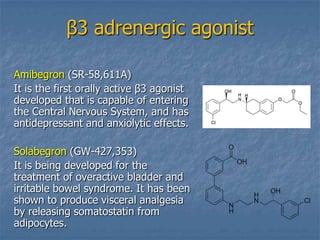
β3 adrenergic agonist

Amibegron (SR-58,611A)
It is the first orally active β3 agonist
developed that is capable of entering
the Central Nervous System, and has
antidepressant and anxiolytic effects.

Solabegron (GW-427,353)
It is being developed for the
treatment of overactive bladder and
irritable bowel syndrome. It has been
shown to produce visceral analgesia
by releasing somatostatin from
adipocytes.
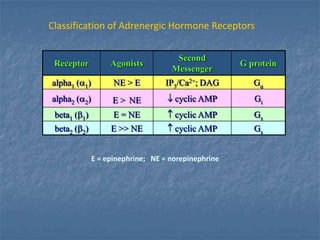
Classification of Adrenergic Hormone Receptors

                                     Second
 Receptor          Agonists                          G protein
                                    Messenger
alpha1 ( 1)         NE > E        IP3/Ca2+; DAG         Gq
alpha2 ( 2)         E > NE           cyclic AMP         Gi
 beta1 ( 1)         E = NE           cyclic AMP         Gs
 beta2 ( 2)        E >> NE           cyclic AMP         Gs


              E = epinephrine; NE = norepinephrine
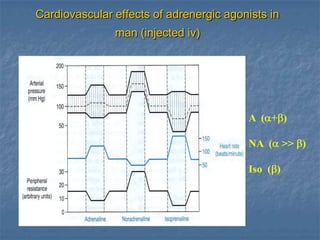
Cardiovascular effects of adrenergic agonists in
               man (injected iv)


                                         A ( + )

                                         NA ( >> )

                                         Iso ( )
Indications


Cardiac Arrest
     Ventricular fibrillation
     Asystole
Indications


   Sever hypotension
   Anaphylaxis
Dosage
In cardiac arrest
1 mg (10 mL 1:10,000 solution)

If this fails, higher doses of epinephrine (up to 0.2 mg/kg) are acceptable but
    not recommended (there is growing evidence that it may be harmful).

Precautions

Can precipitate myocardial ischemia
Avoid mixing with alkaline solutions
Can induce myocardial ectopy
EpiPen
EpiPen is a registered trademark for the most commonly used autoinjector of
epinephrine (aka adrenaline), used in medicine to treat anaphylactic shock.


                http://www.epipen.com/howtouse_high.aspx
Anaphylaxis
Anaphylaxis is a severe and rapid multi-system allergic
reaction. The term comes from the Greek words ana
(against) and phyllus (protection). Anaphylaxis occurs when
a person is exposed to a trigger substance, called an
allergen, to which they have already become sensitized.
Minute amounts of allergens may cause a life-threatening
anaphylactic reaction. Anaphylaxis may occur after ingestion,
inhalation, skin contact or injection of an allergen. The most
severe type of anaphylaxis—anaphylactic shock—will
usually lead to death in minutes if left untreated.
Most common presentation is sudden cardiovascular
collapse.
Ephinephrine can be injected directly into the heart to stimulate it
after it as stopped beating due to drowning, suffocation, shock,
electrocution, and anesthesia.
The epinephrine dramatically restores the heart beat.
In cases of shock, norepinephrine has been used to restore and
maintain sufficient blood pressure and ensure adequate blood flow
to vital organs.

When local anesthetics are used to reduce or eliminate pain in a
specific area, epinephrine is frequently used in conjunction with
these agents to constrict the blood vessels at the area and prevent
drug diffusion from that area.
Thanks for Your Company

Epinephrine

  • 1.
    Epinephrine By: Dr. Vahid Nikoui Email: nikoui@razi.tums.ac.ir
  • 2.
    •It is acatecholamine, a sympathomimetic monoamine derived from the amino acids phenylalanine and tyrosine. •The Latin roots ad-+renes and the Greek roots epi-+nephros both literally mean "on/to the kidney" (referring to the adrenal gland, which secretes epinephrine). Epinephrine is sometimes shortened to epi in medical jargon. •Epinephrine is now also used in EpiPen and Twinject. EpiPen is long narrow auto-injectors that administer epinephrine, Twinject is similar but contain two doses of epinephrine.
  • 3.
    Adrenal Anatomy • small,triangular glands loosely attached to the kidneys • divided into two morphologically and distinct regions - adrenal cortex (outer) - adrenal medulla (inner)
  • 5.
    Anatomy and Origin •embryologically derived from pheochromoblasts • differentiate into modified neuronal cells • more gland than nerve • chromaffin cells • acts like sympathetic ganglion
  • 6.
    Function of theAdrenal Medulla • an extension of the sympathetic nervous system • acts as a peripheral amplifier • activated by same stimuli as the sympathetic nervous system (examples – exercise, cold, stress, hemorrhage, etc.)
  • 8.
    Biosynthesis of norepinephrineand epinephrine HO NH2 HO NH2 NH2 Tyrosine Dopa HO CO2H hydroxylase HO CO2H Decarboxylase HO L-Tyrosine Levodopa Dopamine OH OH HO NHMe Dopamine HO NH2 N-methyl transferase -hydroxylase HO (in Adrenal medulla) HO Epinephrine Norepinephrine (Adrenaline) (Noradrenaline)
  • 9.
    Metabolism involves twokey enzymes: MAO and COMT
  • 10.
    Differences between Epinephrine and Norepinephrine  Epinephrine >> norepinephrine – in terms of cardiac stimulation leading to greater cardiac output ( stimulation).  Epinephrine < norepinephrine – in terms of constriction of blood vessels – leading to increased peripheral resistance – increased arterial pressure.  Epinephrine >> norepinephrine – in terms of increasing metabolism
  • 11.
    Effects of Epinephrine •metabolism - glycogenolysis in liver and skeletal muscle • can lead to hyperglycemia - mobilization of free fatty acids - increased metabolic rate • O2 consumption increases
  • 12.
    Fight or FlightResponse  These catecholamine hormones facilitate immediate physical reactions associated with a preparation for violent muscular action. These include the following:  Acceleration of heart and lung action and Inhibition of stomach and intestinal action  Constriction of blood vessels in many parts of the body  Liberation of nutrients for muscular action  Dilation of blood vessels for muscles  Inhibition of tear glands and salivation  Dilation of pupil  Relaxation of bladder  Inhibition of erection (Gleitman, et al, 2004)
  • 13.
    Pheochromocytoma • a catecholamine-secretingtumour of chromaffin cells of the adrenal medulla adrenal pheochromocytoma (90%) • paraganglioma – a catecholamine secreting tumour of the sympathetic paraganglia extra-adrenal pheochromocytoma
  • 14.
    Signs and Symptomsof Pheochromocytoma • headache • sweating classic triad • palpitations • chest pain • anxiety • glucose intolerance • increased metabolic rate
  • 17.
    Classes of Gprotein Gs→ s→ AC → cAMP↑ Gi→ i→ AC → cAMP↓ G q→ q→ PLC → IP3+ DAG
  • 18.
    Types of -adrenergicreceptor  -adrenergic receptors are adrenergic receptors that respond to norepinephrine and to such blocking agents as phenoxybenzamine.  They are subdivided into two types:  1, found in smooth muscle, heart, and liver, with effects including vasoconstriction, intestinal relaxation, uterine contraction and pupillary dilation,  2, found in platelets, vascular smooth muscle, nerve termini, and pancreatic islets, with effects including platelet aggregation, vasoconstriction, and inhibition of norepinephrine release and of insulin secretion.
  • 19.
    Types of β-adrenergicreceptor  -adrenergic receptors respond particularly to epinephrine and to such blocking agents as propranolol.  There are three known types of beta receptor, designated β1, β2 and β3.  β1-Adrenergic receptors are located mainly in the heart.  β2-Adrenergic receptors are located mainly in the lungs, gastrointestinal tract, liver, uterus, vascular smooth muscle, and skeletal muscle.  β3-receptors are located in fat cells.
  • 20.
    Receptors and signaltransduction in the ANS Adrenergic Receptors 1 2 1A 1B 1D 2A 2B 2C 1 2 3
  • 21.
    Direct acting adrenergicreceptor agonists: 1 receptors NH 3 Phospho - lipase C  Phenylephrine (Neosynephrine)  Methoxamine (Vasoxyl)  Oxymetazoline (Visine) (+) Gq PIP 2 HO COOH IP 3 Diacylglycerol CH C H 2 NH C H3 2+ Increase Ca Activate Protein Kinase C OH P henylephrine Response
  • 22.
    Direct acting adrenergicreceptor agonists: 2 receptors NH 3  Clonidine (Catapres)  Methyldopa (Aldomet)  Guanabenz (Wytensin)  Guanfacine (Tenex)  Tizanidine (Zanaflex) (-) Adenylate Cyclase GI Cl N K+ (+) X H N ATP cAMP COOH N H Reduce cAMP -Dependent Cl Protein Kinase Activity C lonidine Response
  • 23.
    Direct acting adrenergicreceptor agonists: receptors NH 3 (+) Adenylate Cyclase GS ATP cAMP COOH Increase cAMP -Dependent Protein Kinase Activity Response
  • 24.
    β3 adrenergic agonist Amibegron(SR-58,611A) It is the first orally active β3 agonist developed that is capable of entering the Central Nervous System, and has antidepressant and anxiolytic effects. Solabegron (GW-427,353) It is being developed for the treatment of overactive bladder and irritable bowel syndrome. It has been shown to produce visceral analgesia by releasing somatostatin from adipocytes.
  • 25.
    Classification of AdrenergicHormone Receptors Second Receptor Agonists G protein Messenger alpha1 ( 1) NE > E IP3/Ca2+; DAG Gq alpha2 ( 2) E > NE cyclic AMP Gi beta1 ( 1) E = NE cyclic AMP Gs beta2 ( 2) E >> NE cyclic AMP Gs E = epinephrine; NE = norepinephrine
  • 26.
    Cardiovascular effects ofadrenergic agonists in man (injected iv) A ( + ) NA ( >> ) Iso ( )
  • 27.
    Indications Cardiac Arrest  Ventricular fibrillation  Asystole
  • 28.
    Indications  Sever hypotension  Anaphylaxis
  • 29.
    Dosage In cardiac arrest 1mg (10 mL 1:10,000 solution) If this fails, higher doses of epinephrine (up to 0.2 mg/kg) are acceptable but not recommended (there is growing evidence that it may be harmful). Precautions Can precipitate myocardial ischemia Avoid mixing with alkaline solutions Can induce myocardial ectopy
  • 30.
    EpiPen EpiPen is aregistered trademark for the most commonly used autoinjector of epinephrine (aka adrenaline), used in medicine to treat anaphylactic shock. http://www.epipen.com/howtouse_high.aspx
  • 31.
    Anaphylaxis Anaphylaxis is asevere and rapid multi-system allergic reaction. The term comes from the Greek words ana (against) and phyllus (protection). Anaphylaxis occurs when a person is exposed to a trigger substance, called an allergen, to which they have already become sensitized. Minute amounts of allergens may cause a life-threatening anaphylactic reaction. Anaphylaxis may occur after ingestion, inhalation, skin contact or injection of an allergen. The most severe type of anaphylaxis—anaphylactic shock—will usually lead to death in minutes if left untreated. Most common presentation is sudden cardiovascular collapse.
  • 32.
    Ephinephrine can beinjected directly into the heart to stimulate it after it as stopped beating due to drowning, suffocation, shock, electrocution, and anesthesia. The epinephrine dramatically restores the heart beat. In cases of shock, norepinephrine has been used to restore and maintain sufficient blood pressure and ensure adequate blood flow to vital organs. When local anesthetics are used to reduce or eliminate pain in a specific area, epinephrine is frequently used in conjunction with these agents to constrict the blood vessels at the area and prevent drug diffusion from that area.
  • 33.