Presented to:
Dr.Rukhsana
Presented by:
Girls
Urine Concentration
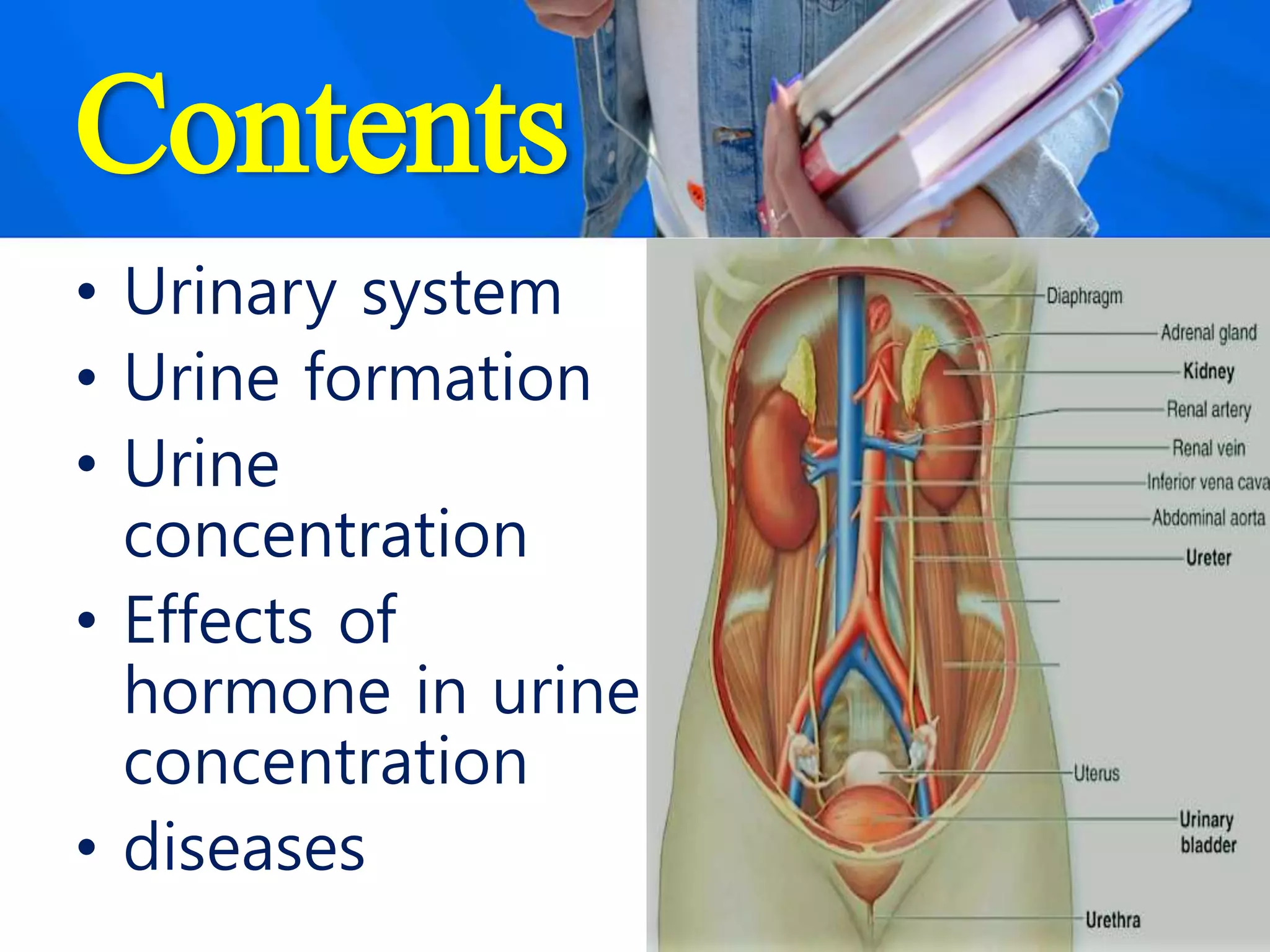
Contents
• Urinary system
• Urine formation
• Urine
concentration
• Effects of
hormone in urine
concentration
• diseases
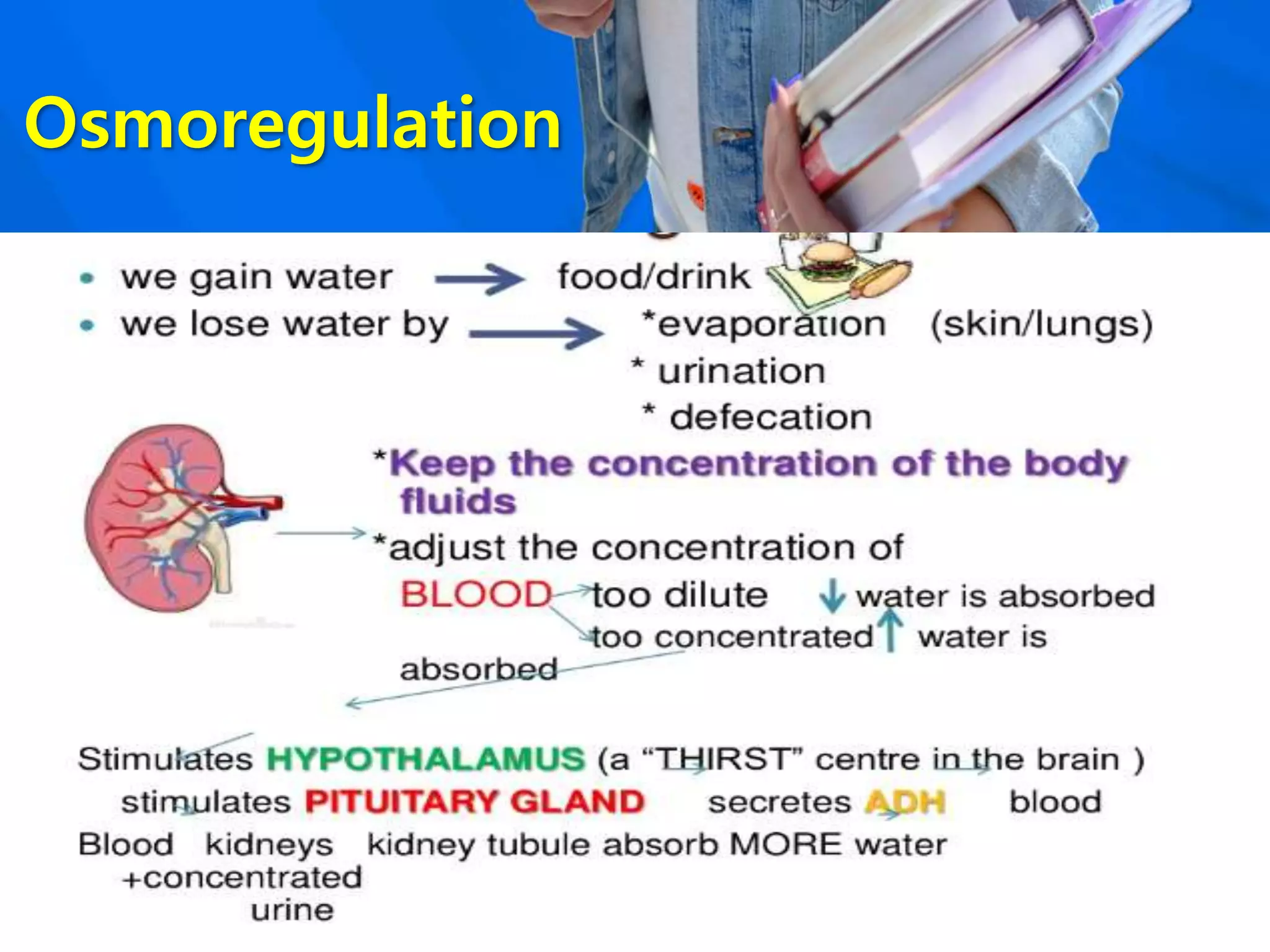
Osmoregulation
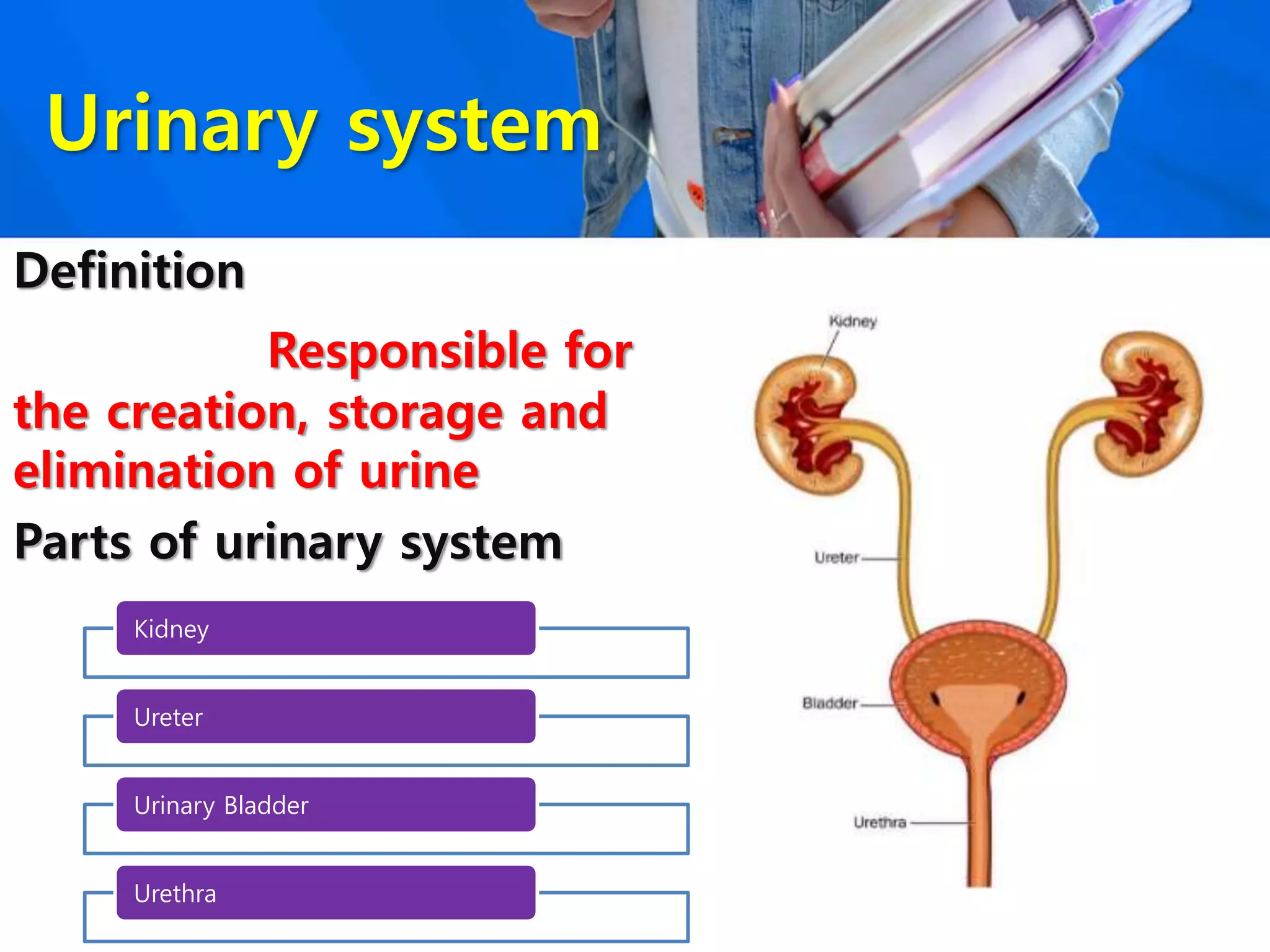
Urinary system
Definition
Responsible for
the creation, storage and
elimination of urine
Parts of urinary system
Kidney
Ureter
Urinary Bladder
Urethra
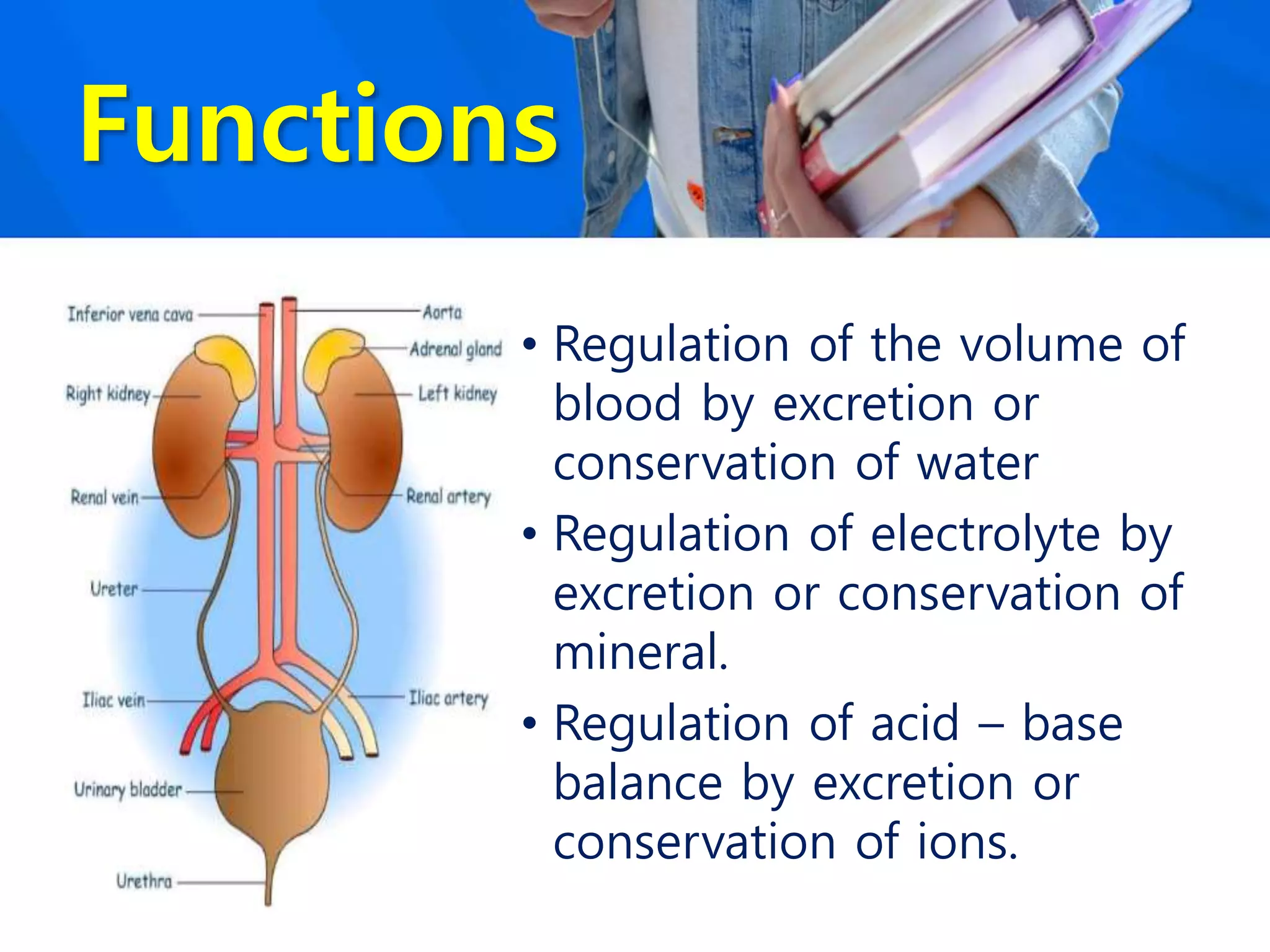
Functions
• Regulation of the volume of
blood by excretion or
conservation of water
• Regulation of electrolyte by
excretion or conservation of
mineral.
• Regulation of acid – base
balance by excretion or
conservation of ions.
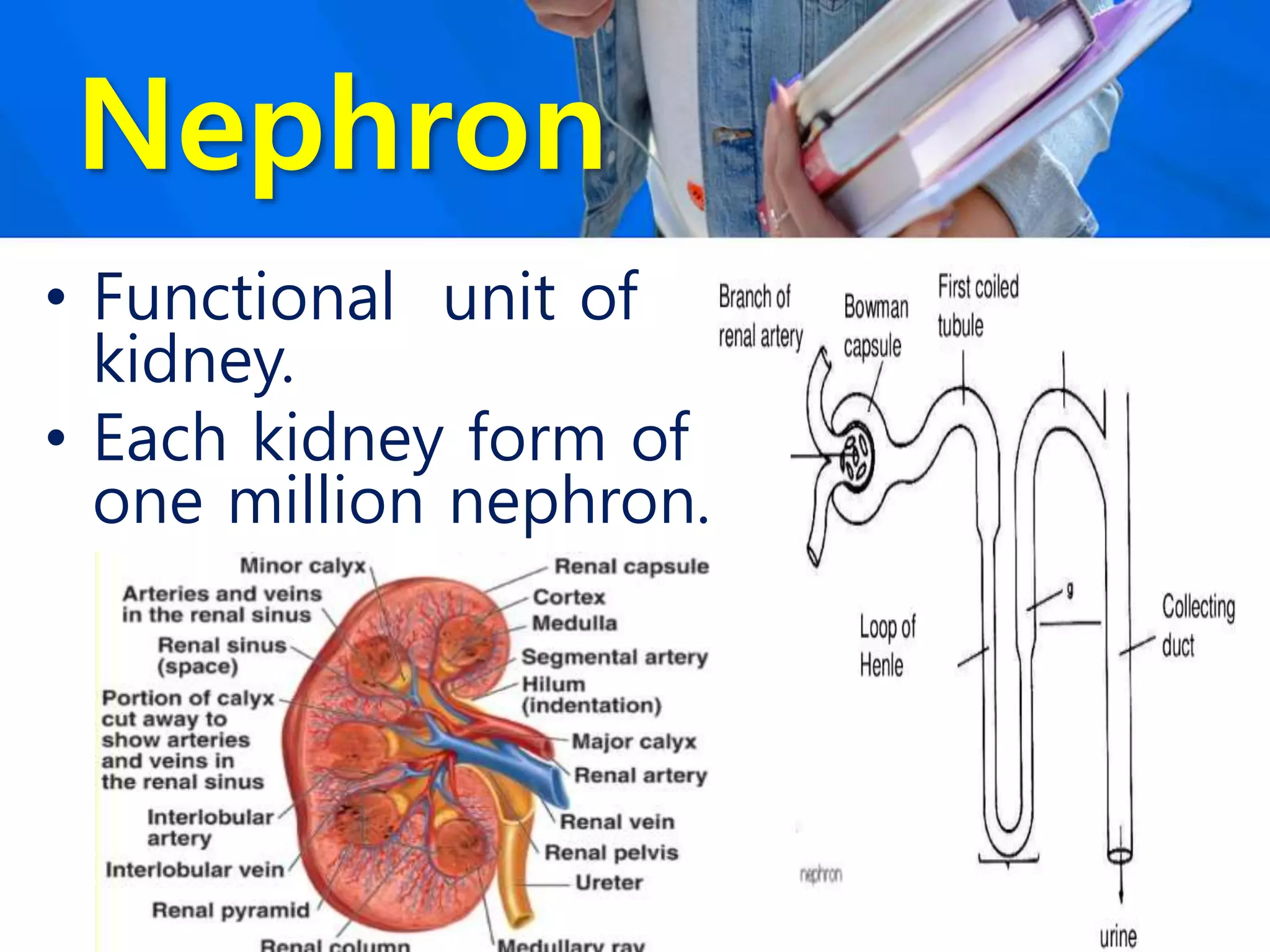
Nephron
• Functional unit of
kidney.
• Each kidney form of
one million nephron.
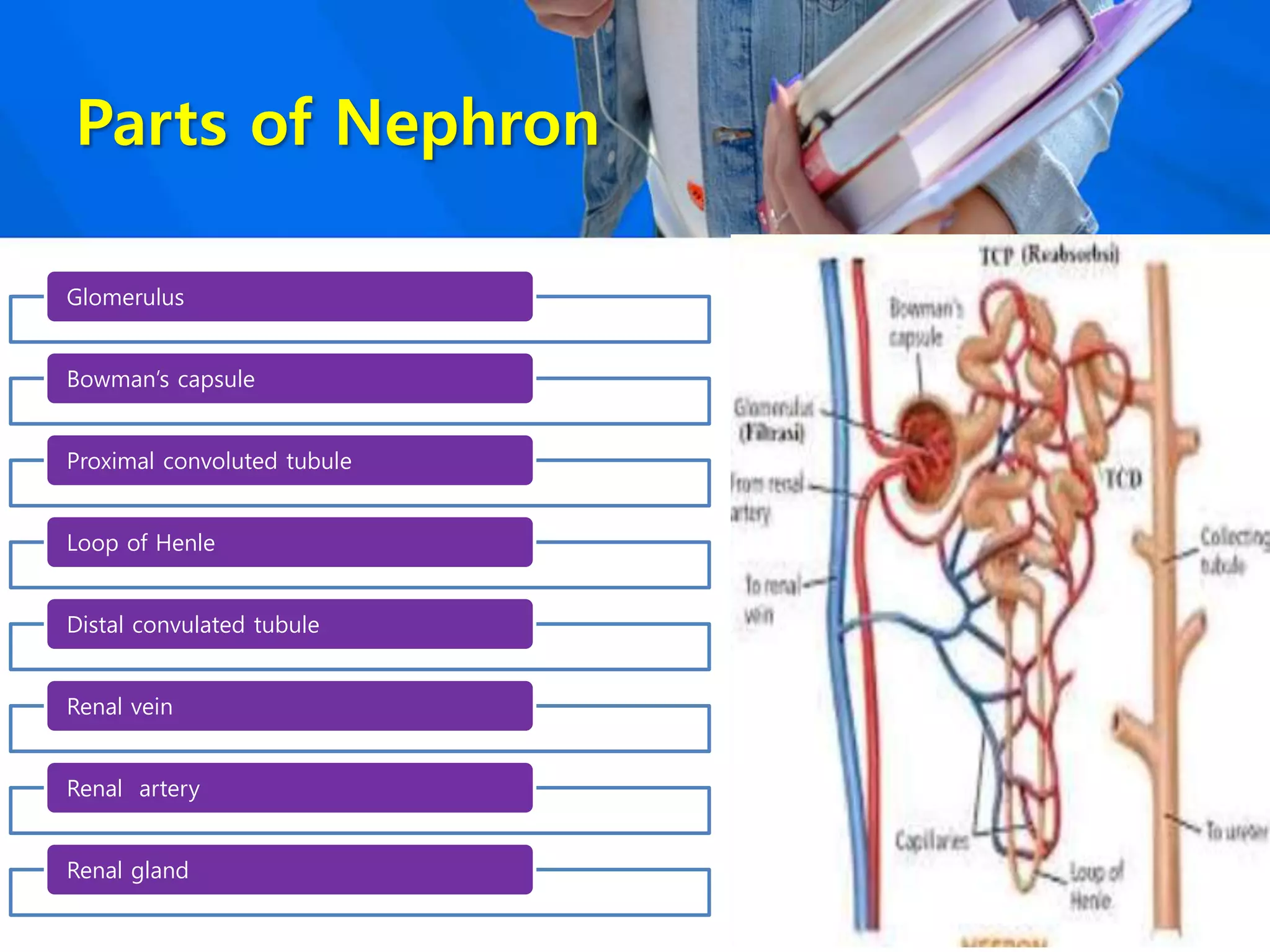
Parts of Nephron
Glomerulus
Bowman’s capsule
Proximal convoluted tubule
Loop of Henle
Distal convulated tubule
Renal vein
Renal artery
Renal gland
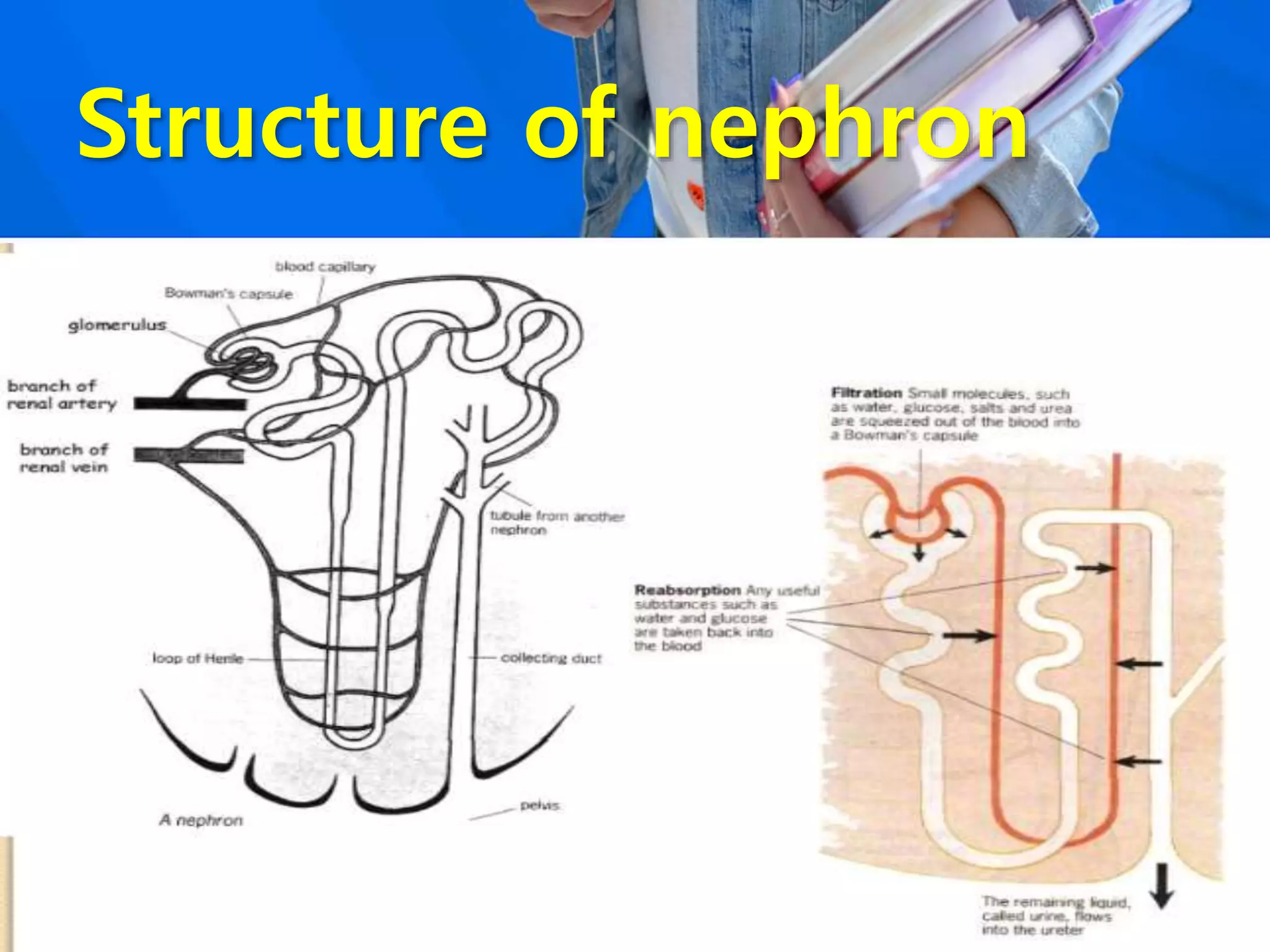
Structure of nephron
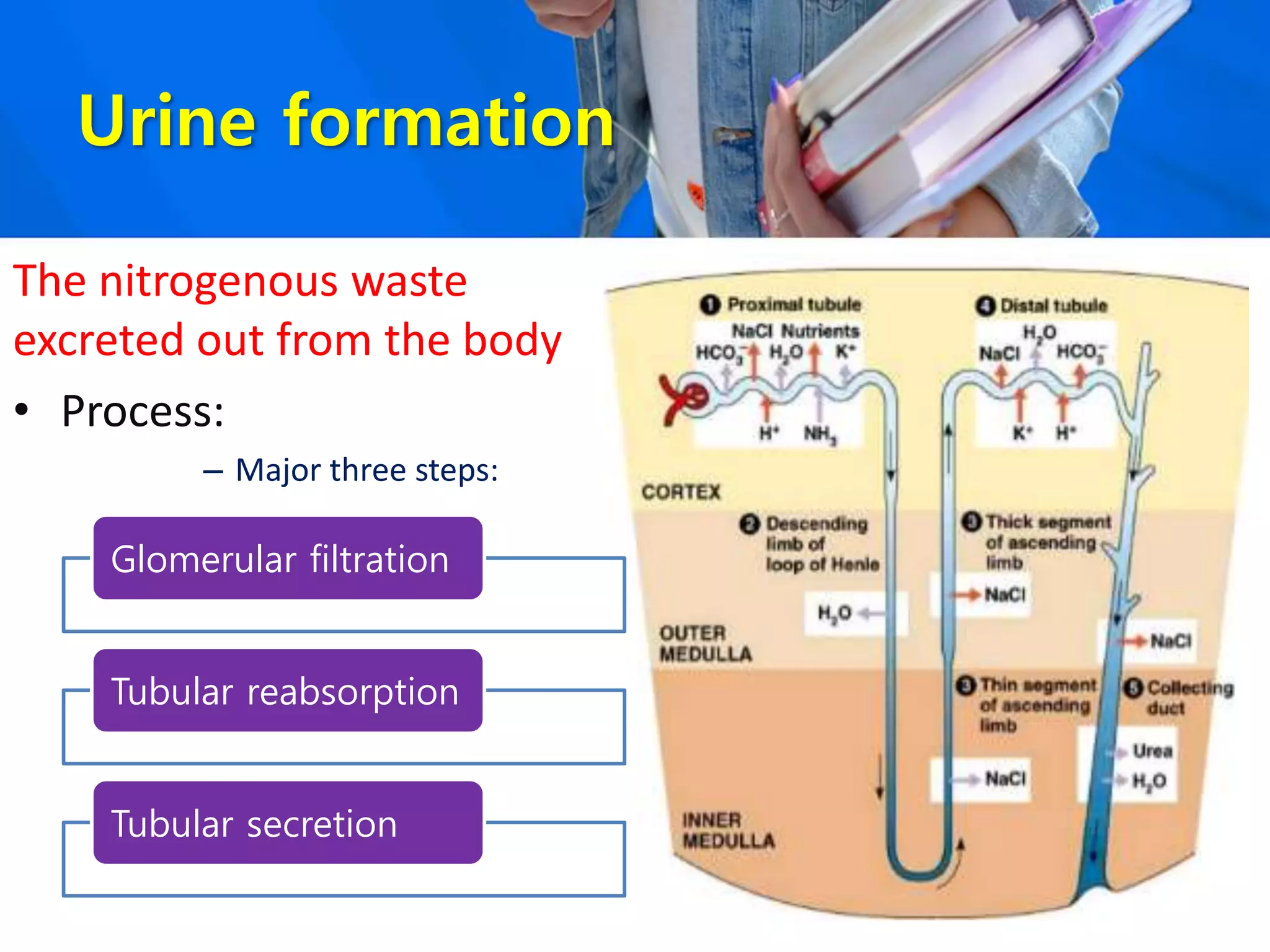
Urine formation
The nitrogenous waste
excreted out from the body
• Process:
– Major three steps:
Glomerular filtration
Tubular reabsorption
Tubular secretion
Glomerular filterate
• Beginning of the process.
• A process by which the blood courses
through the glomeruli , much of its fluid
, containing both useful chemicals and
dissolves waste materials,soaks out the
blood through membranes where it is
filtered and then flows into BOWMAN’S
capsule.
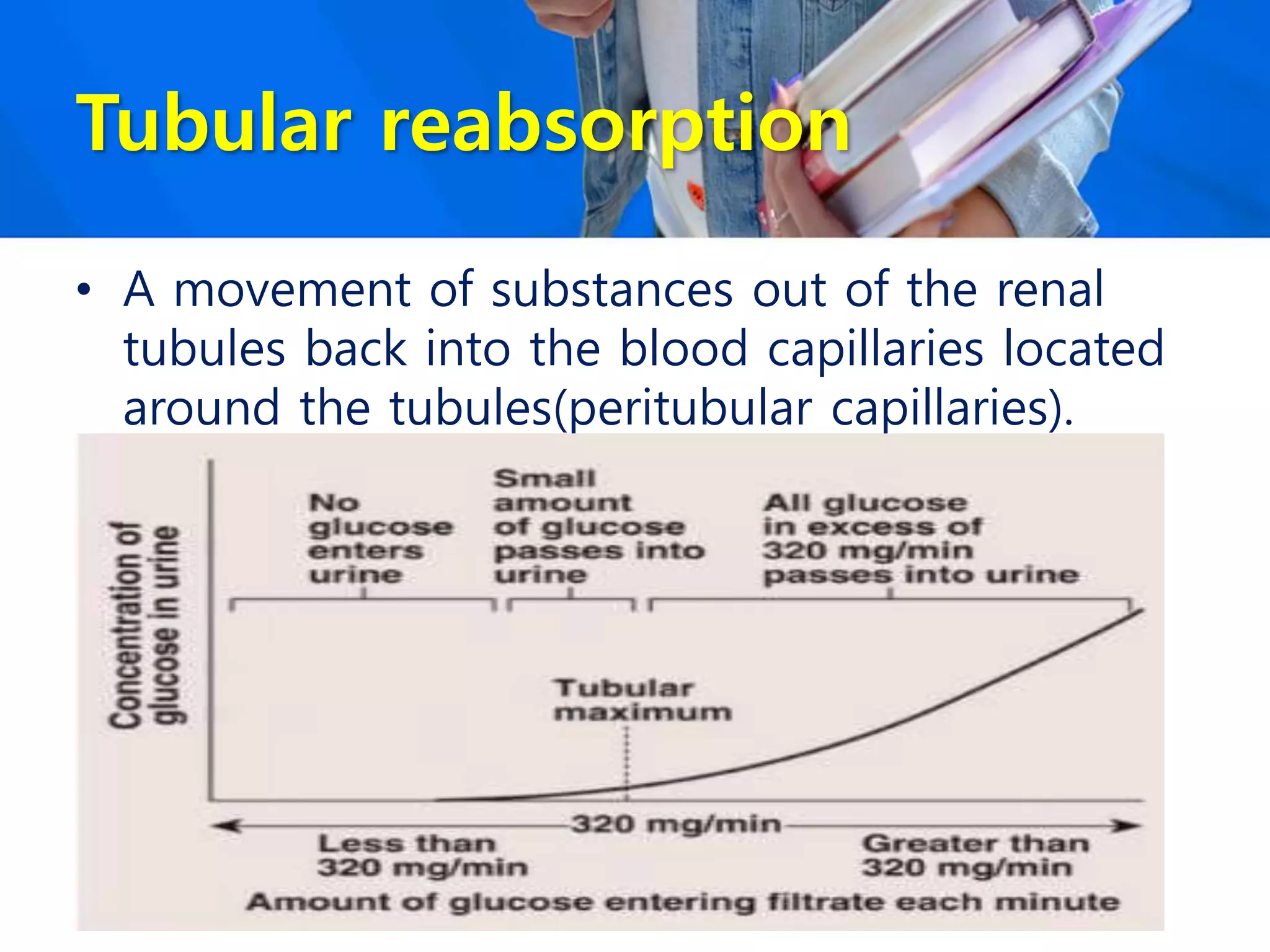
Tubular reabsorption
• A movement of substances out of the renal
tubules back into the blood capillaries located
around the tubules(peritubular capillaries).
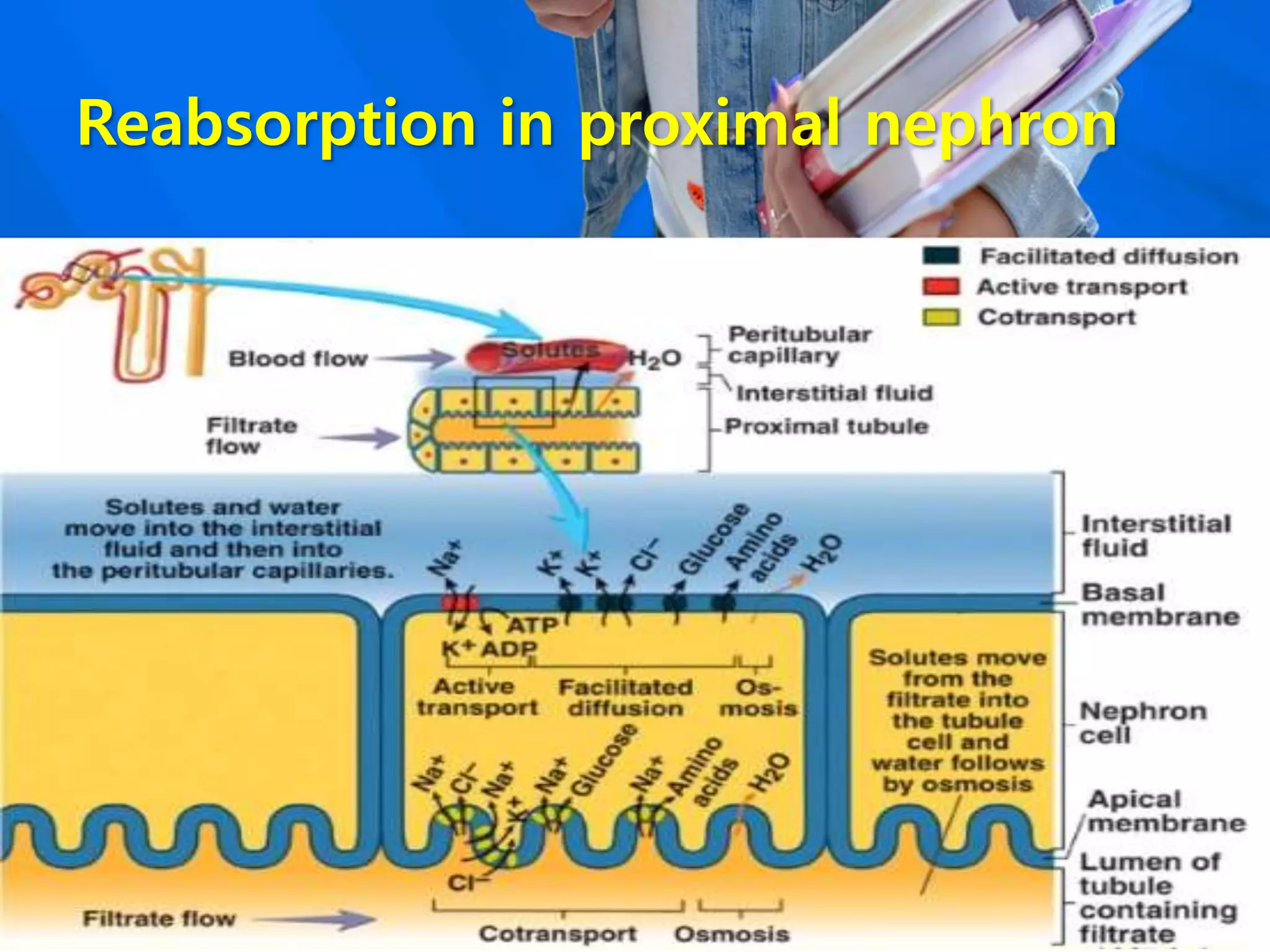
Reabsorption in proximal nephron
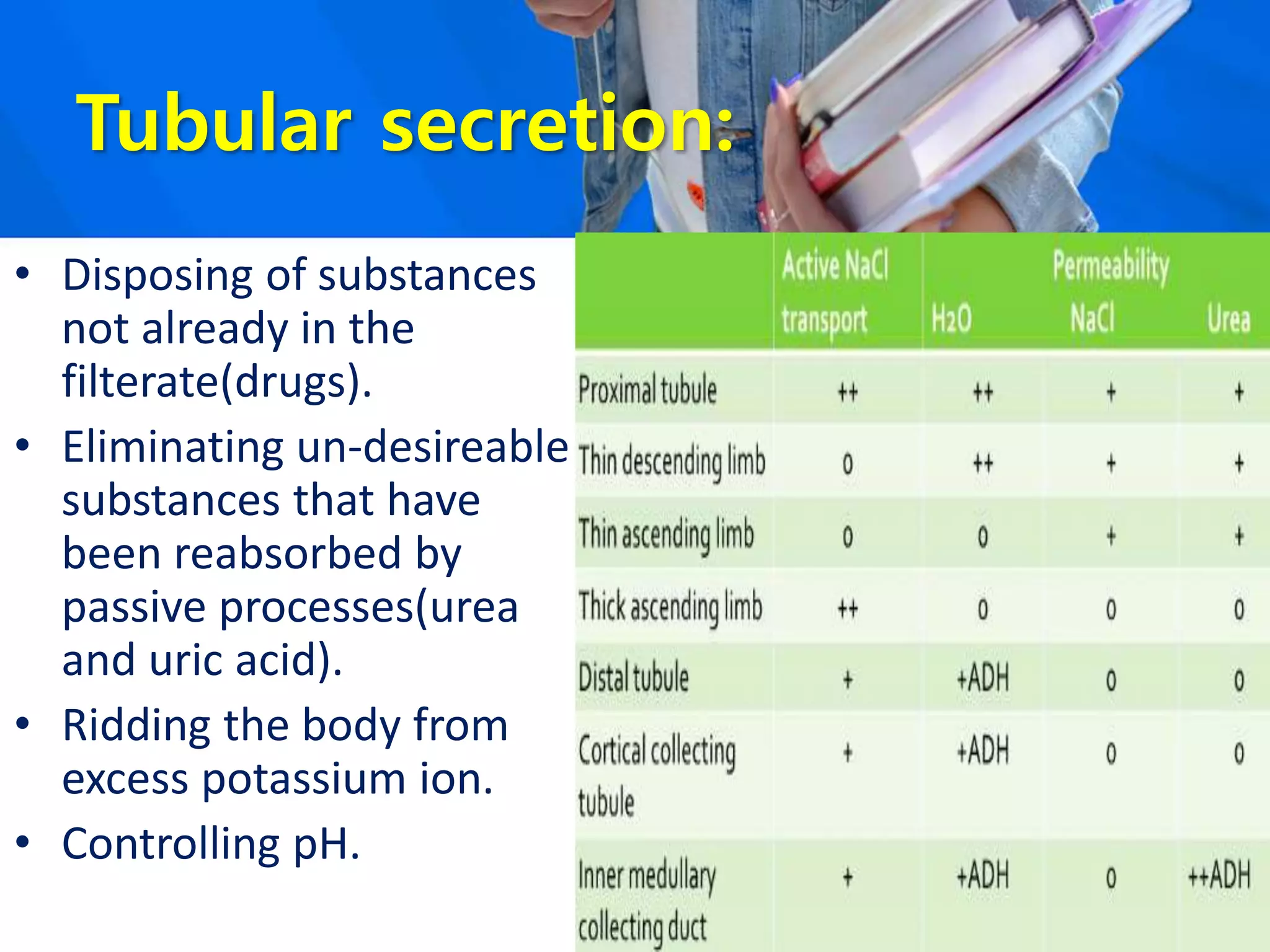
Tubular secretion:
• Disposing of substances
not already in the
filterate(drugs).
• Eliminating un-desireable
substances that have
been reabsorbed by
passive processes(urea
and uric acid).
• Ridding the body from
excess potassium ion.
• Controlling pH.
ADH
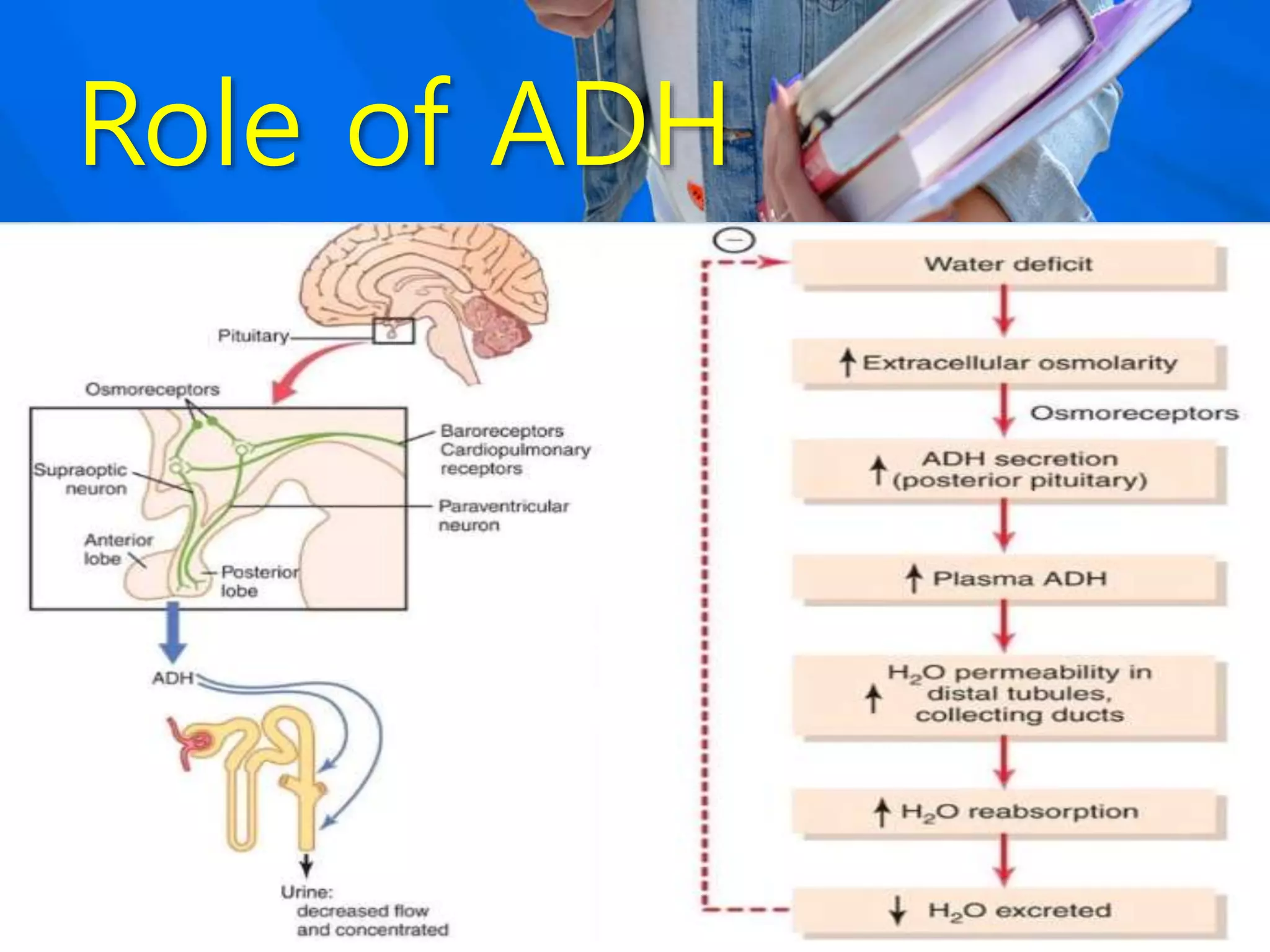
Antidiuretic hormone ,also known
as arginine vasopressin, is a nine
amino acid peptide secreted from
the posterior pitutary.
Role of ADH
Physiological effects of ADH
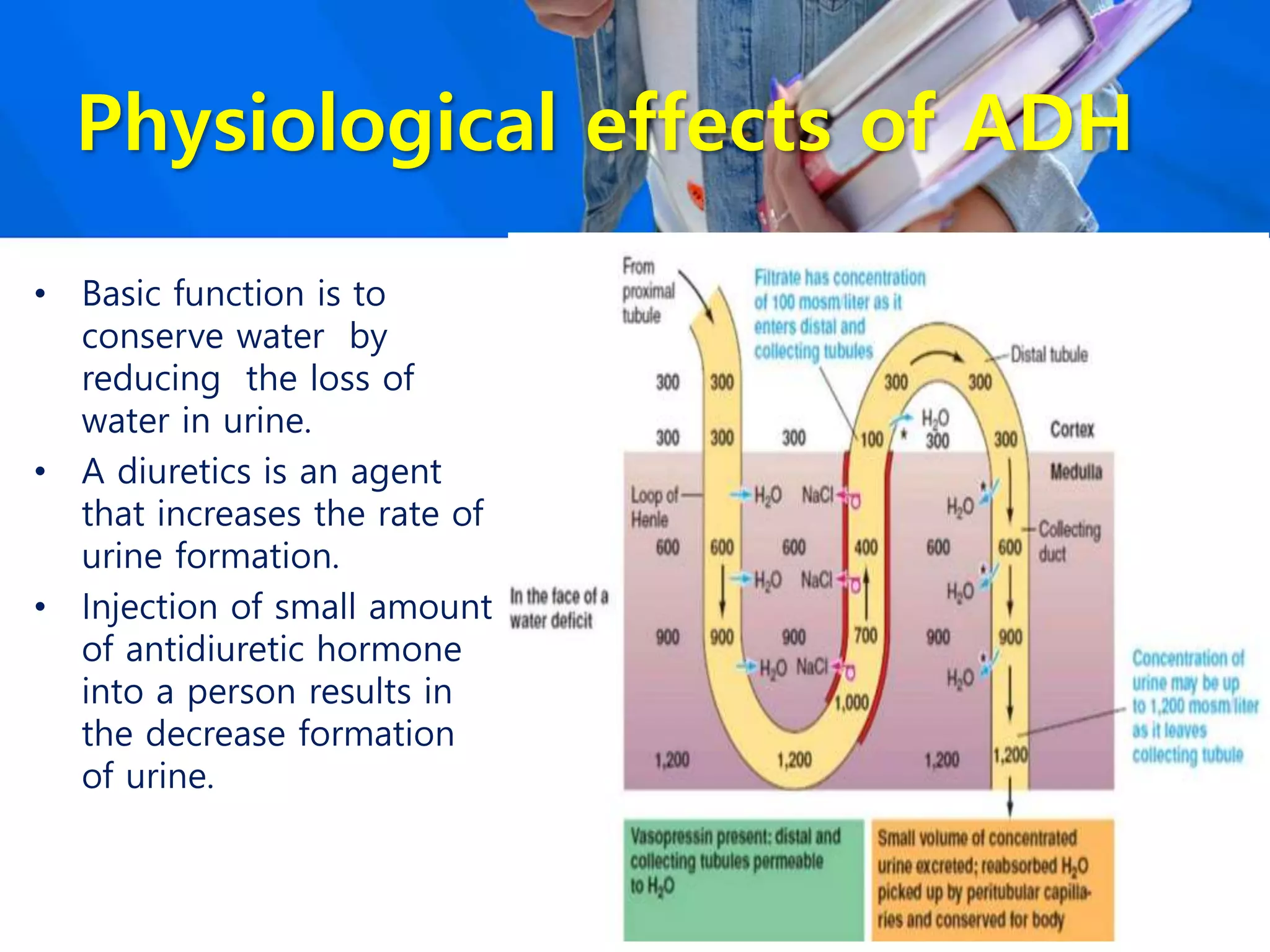
• Basic function is to
conserve water by
reducing the loss of
water in urine.
• A diuretics is an agent
that increases the rate of
urine formation.
• Injection of small amount
of antidiuretic hormone
into a person results in
the decrease formation
of urine.
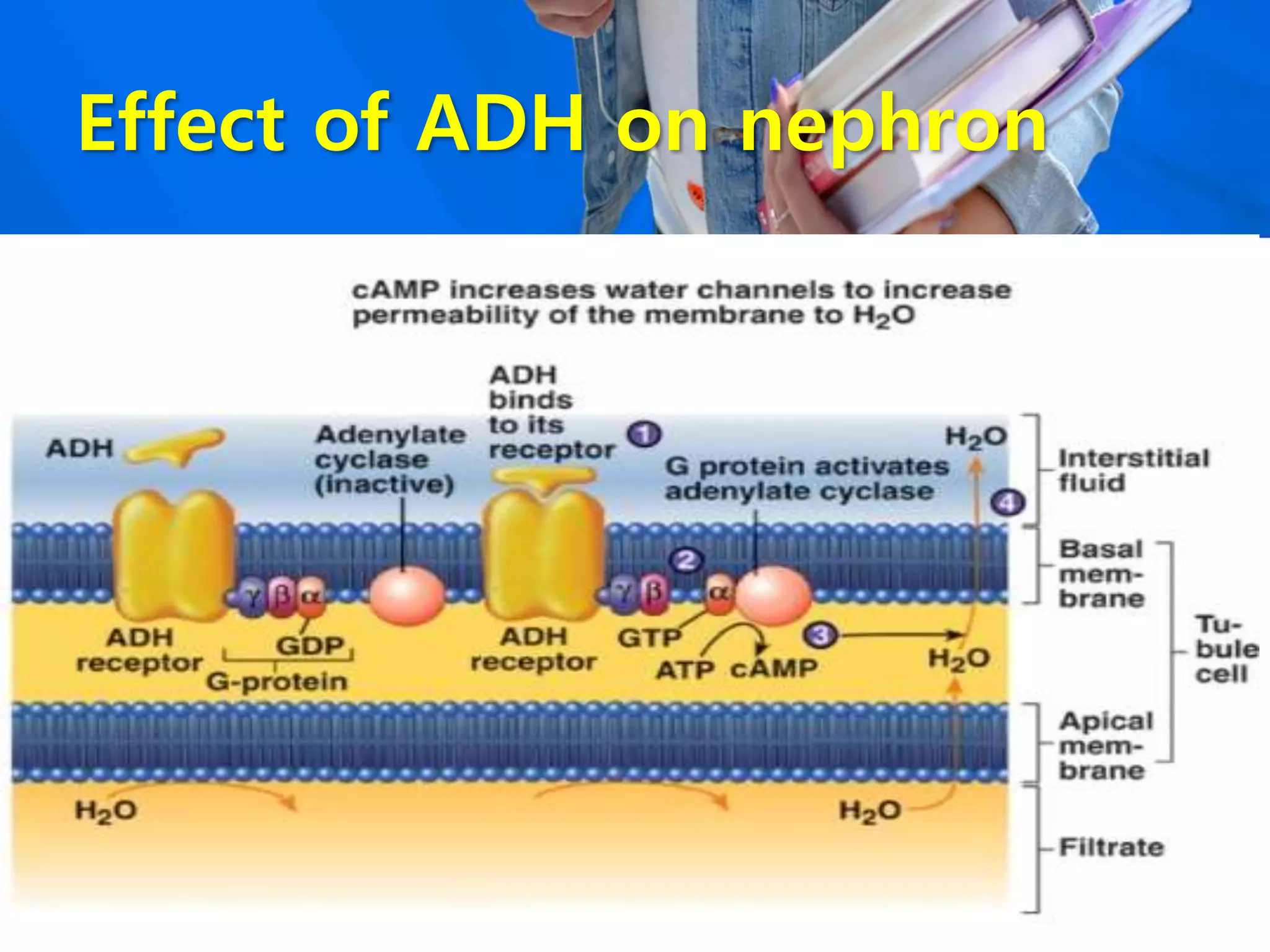
Effect of ADH on nephron
cont’
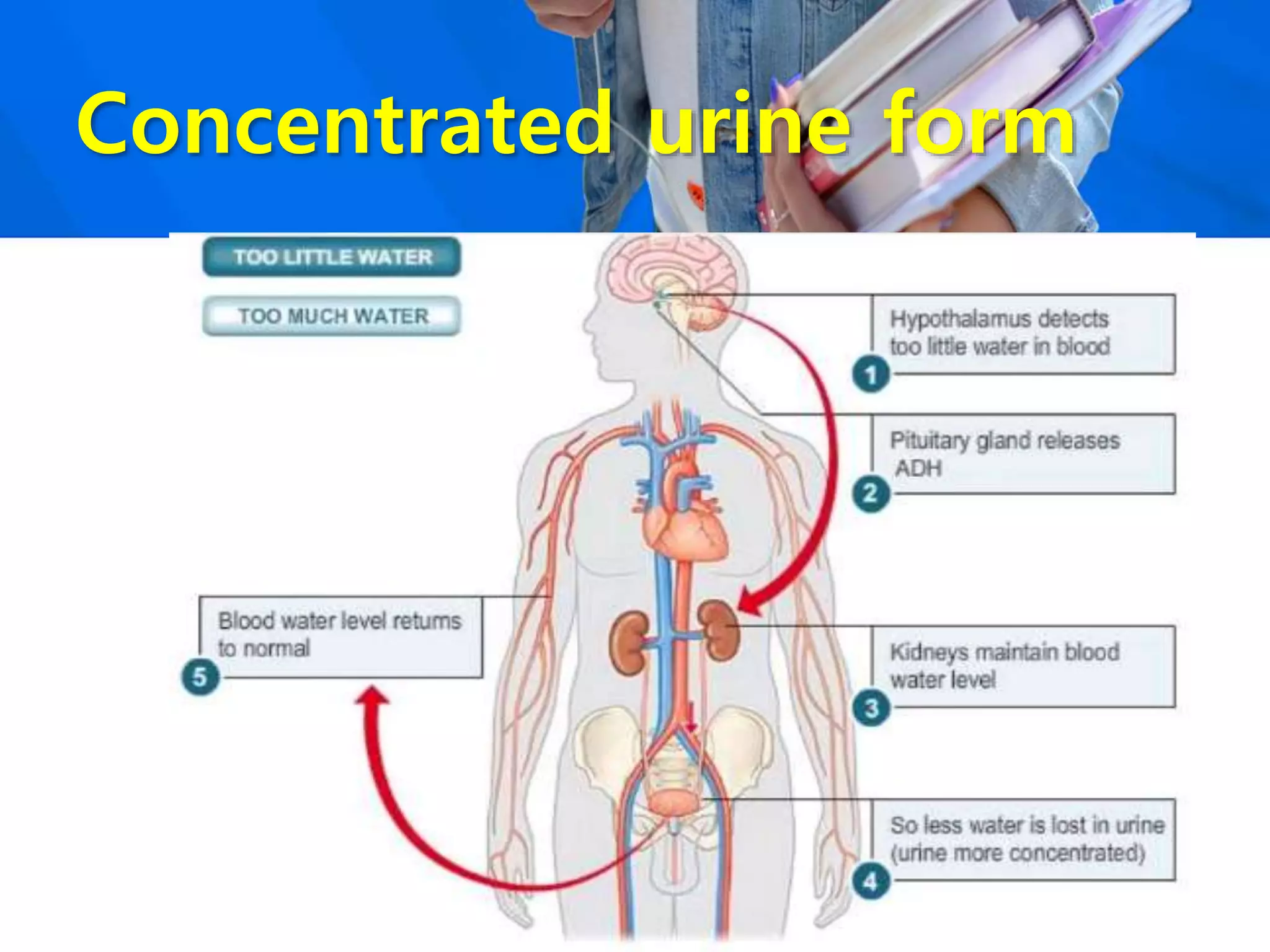
• The more concentrated plasma, the more
ADH is released into the blood, the more
concentrated urine is produced.
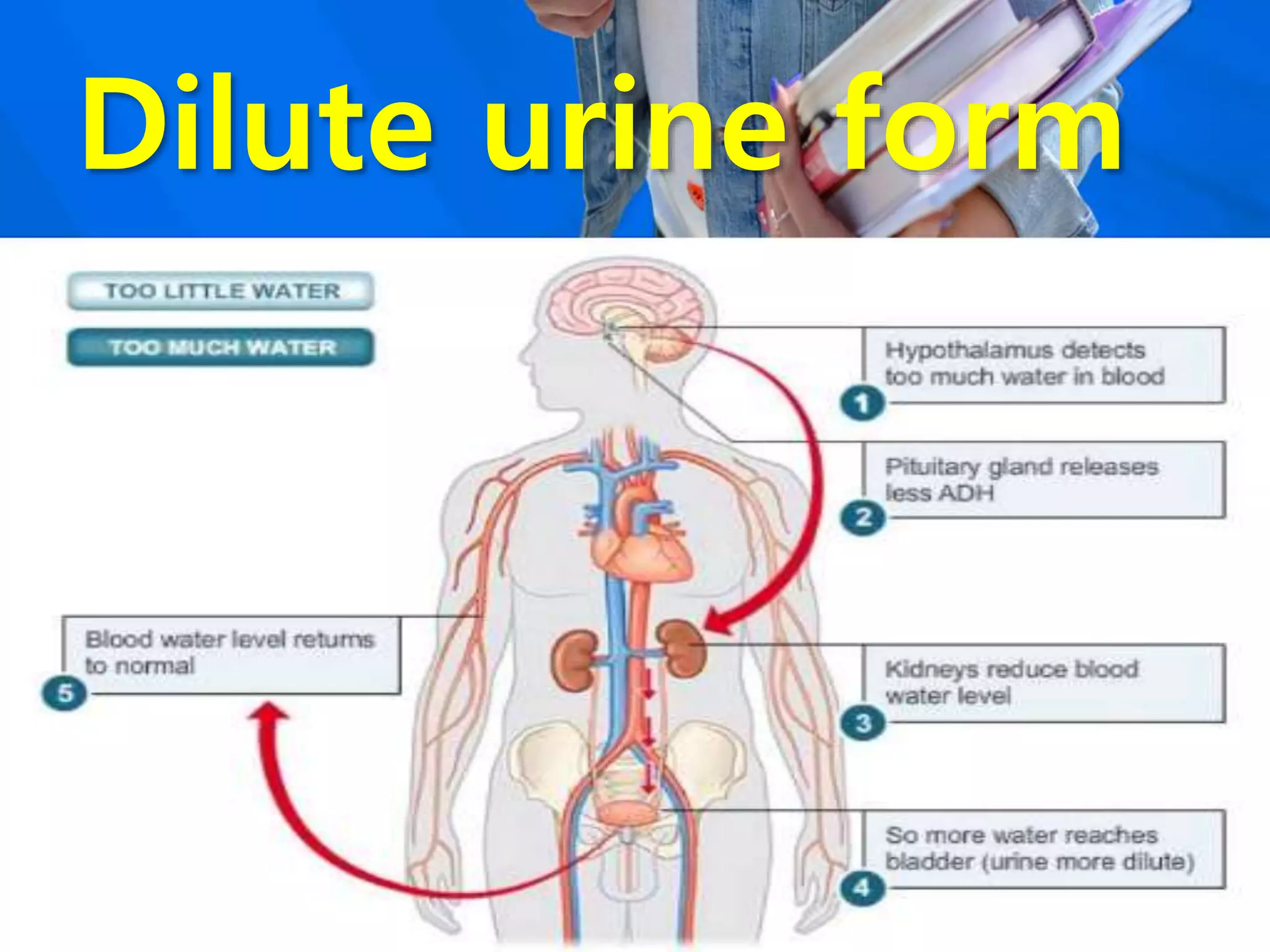
• When the plasma is dilute, less ADH is
released into the blood, the more water
leave the kidney, producing more dilute
urine.
• This method of control is an example of
negative feedback.
Negative feedback
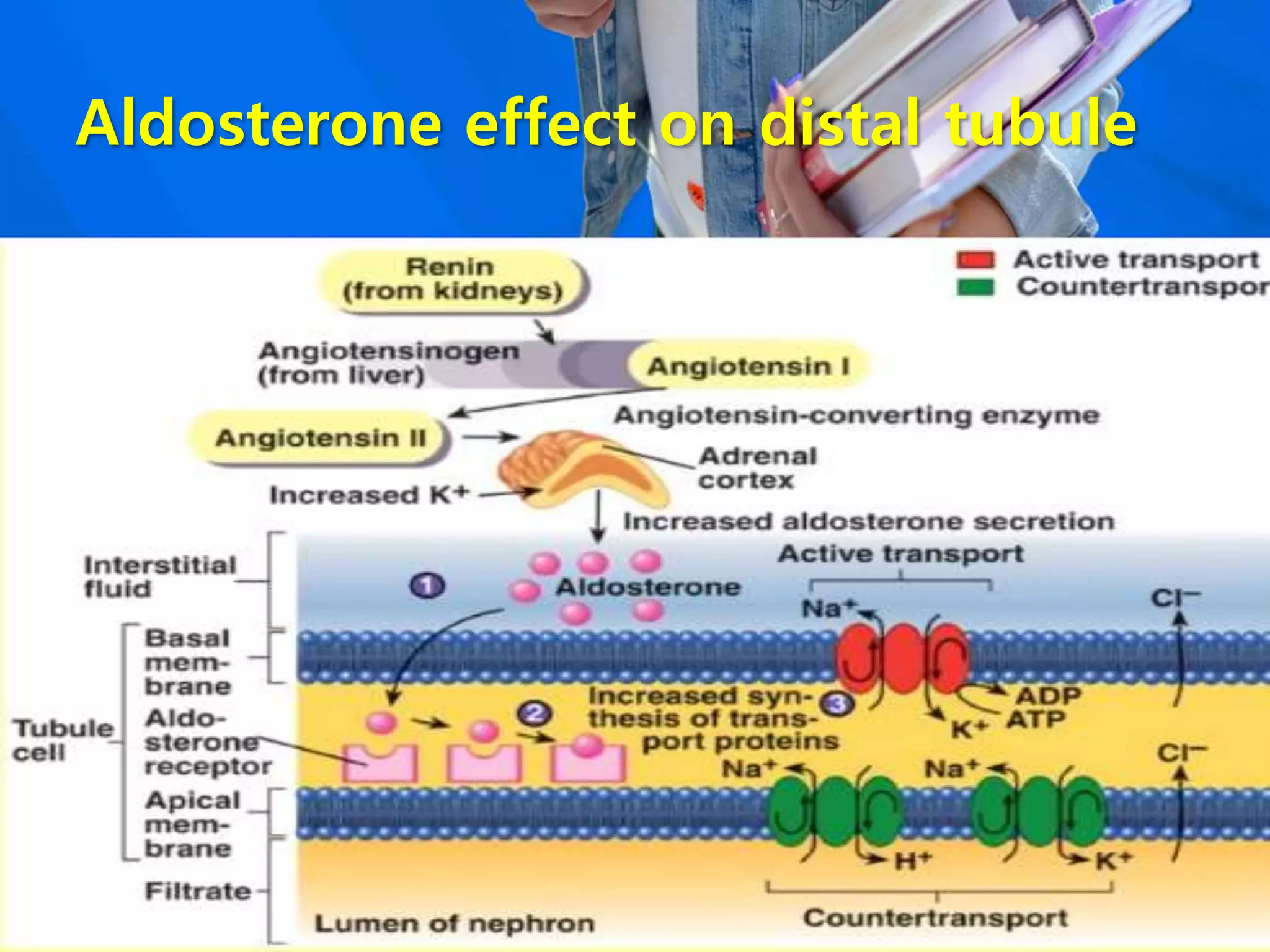
Aldosterone effect on distal tubule
Effect of alcohol and ecstasy on ADH
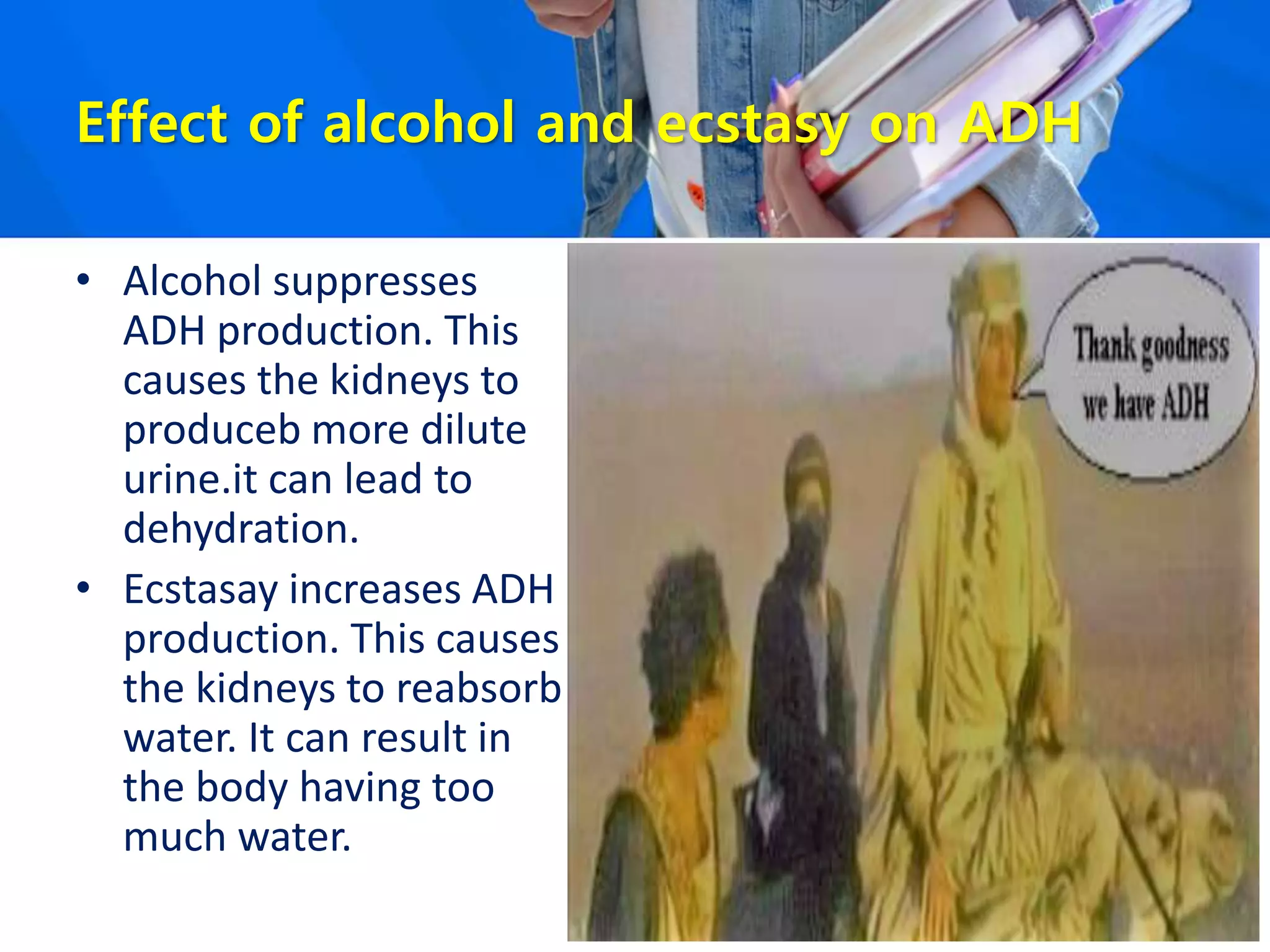
• Alcohol suppresses
ADH production. This
causes the kidneys to
produceb more dilute
urine.it can lead to
dehydration.
• Ecstasay increases ADH
production. This causes
the kidneys to reabsorb
water. It can result in
the body having too
much water.
Urine color
• Ranges from pale- yellow to
deep- amber color . This
coloration is due to a pigment
urochrome.
• The more water you drink,
more hydrated you are, and
lighter the pigment in your
urine.
• The more coloration means
,you are dehydrated ,and you
have taken less water.
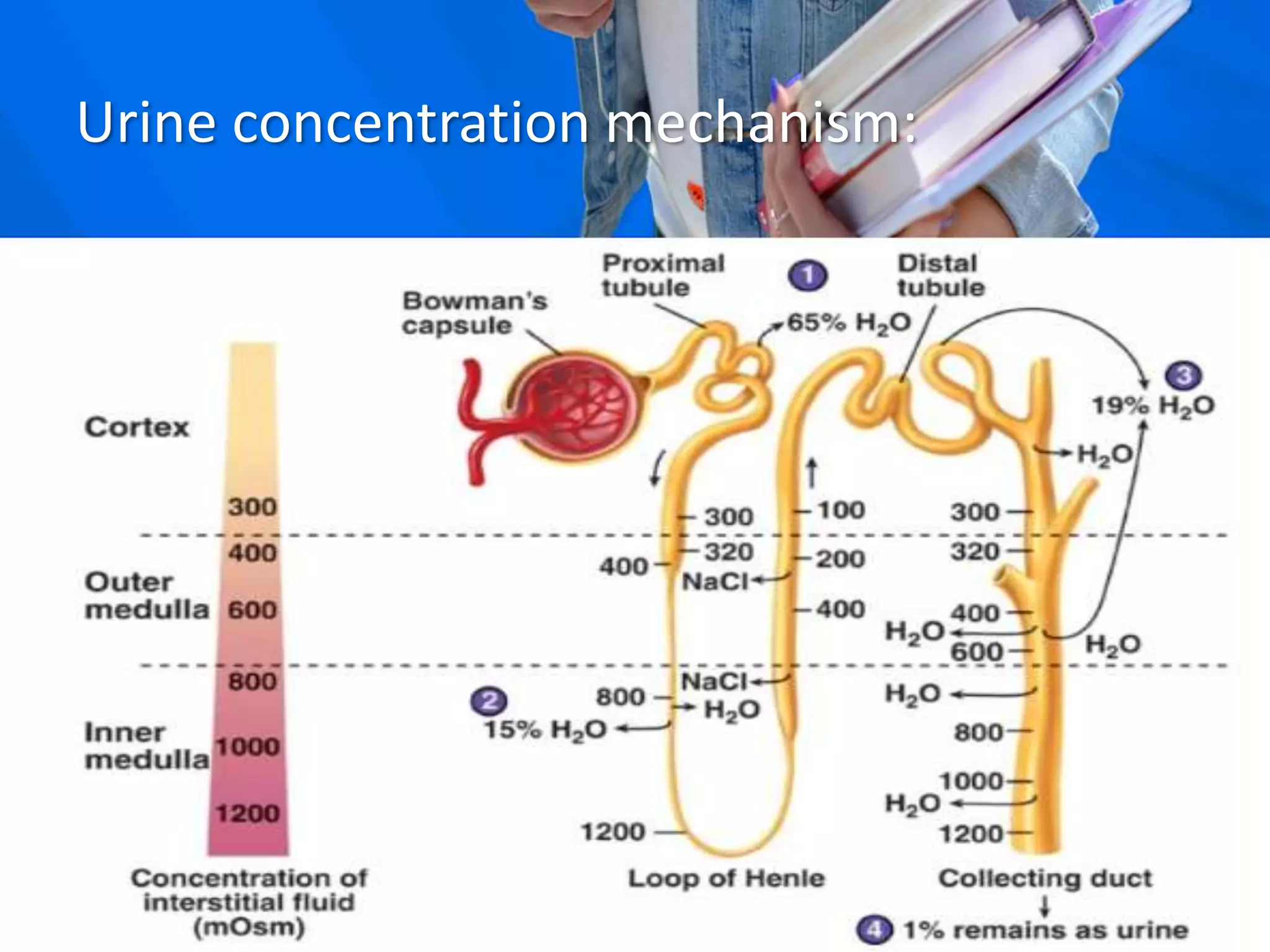
Urine concentration mechanism:
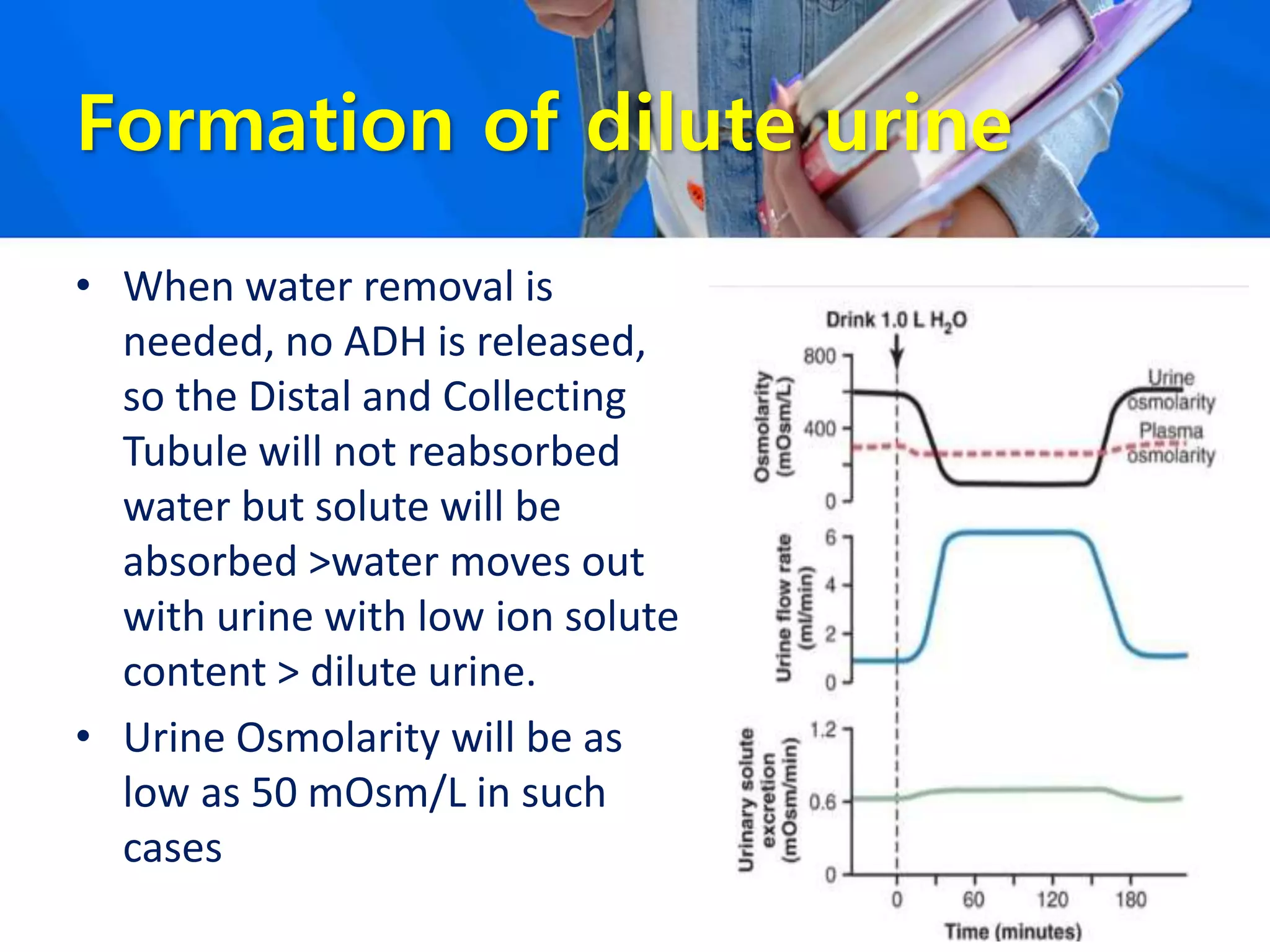
Formation of dilute urine
• When water removal is
needed, no ADH is released,
so the Distal and Collecting
Tubule will not reabsorbed
water but solute will be
absorbed >water moves out
with urine with low ion solute
content > dilute urine.
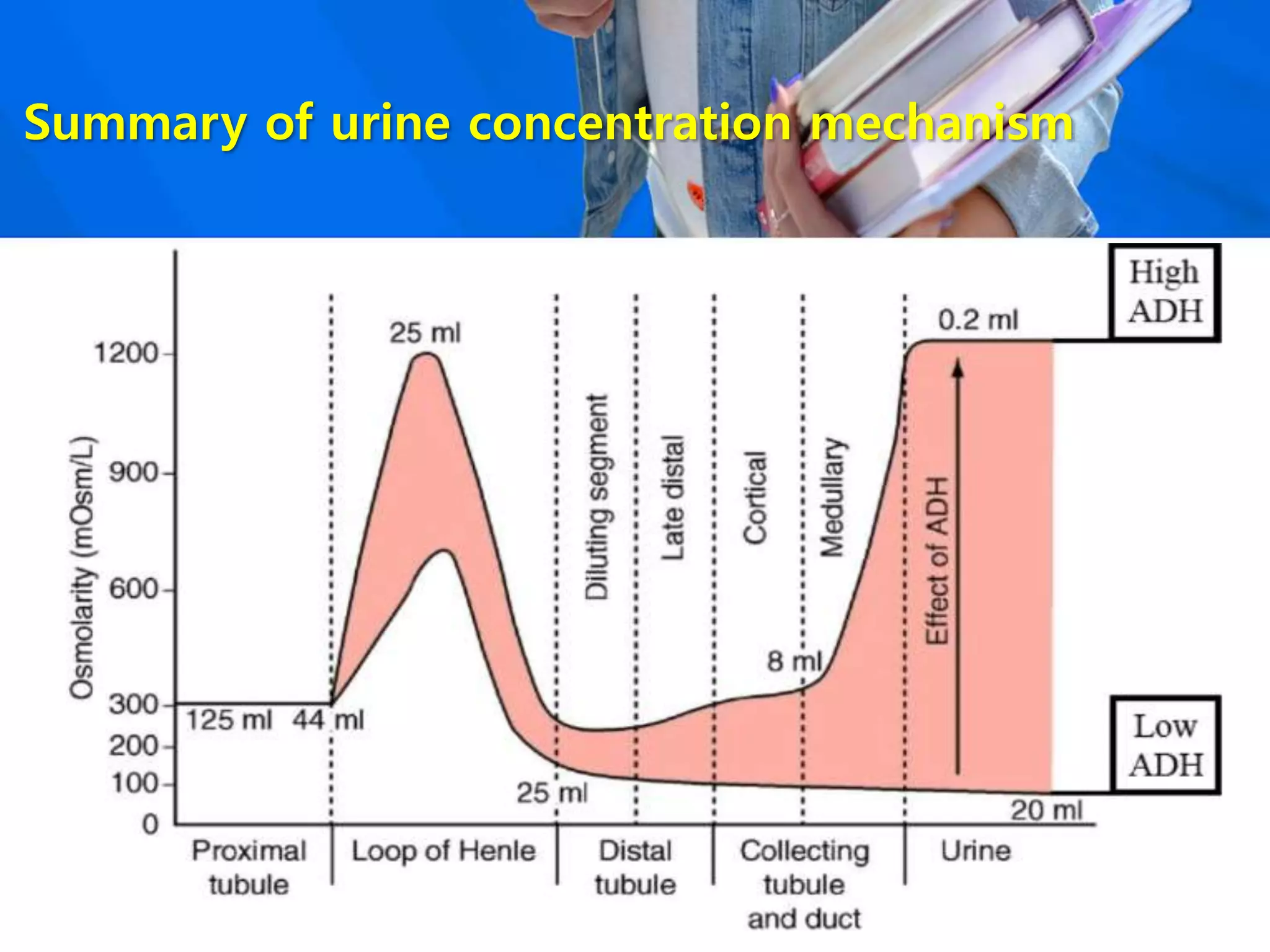
• Urine Osmolarity will be as
low as 50 mOsm/L in such
cases
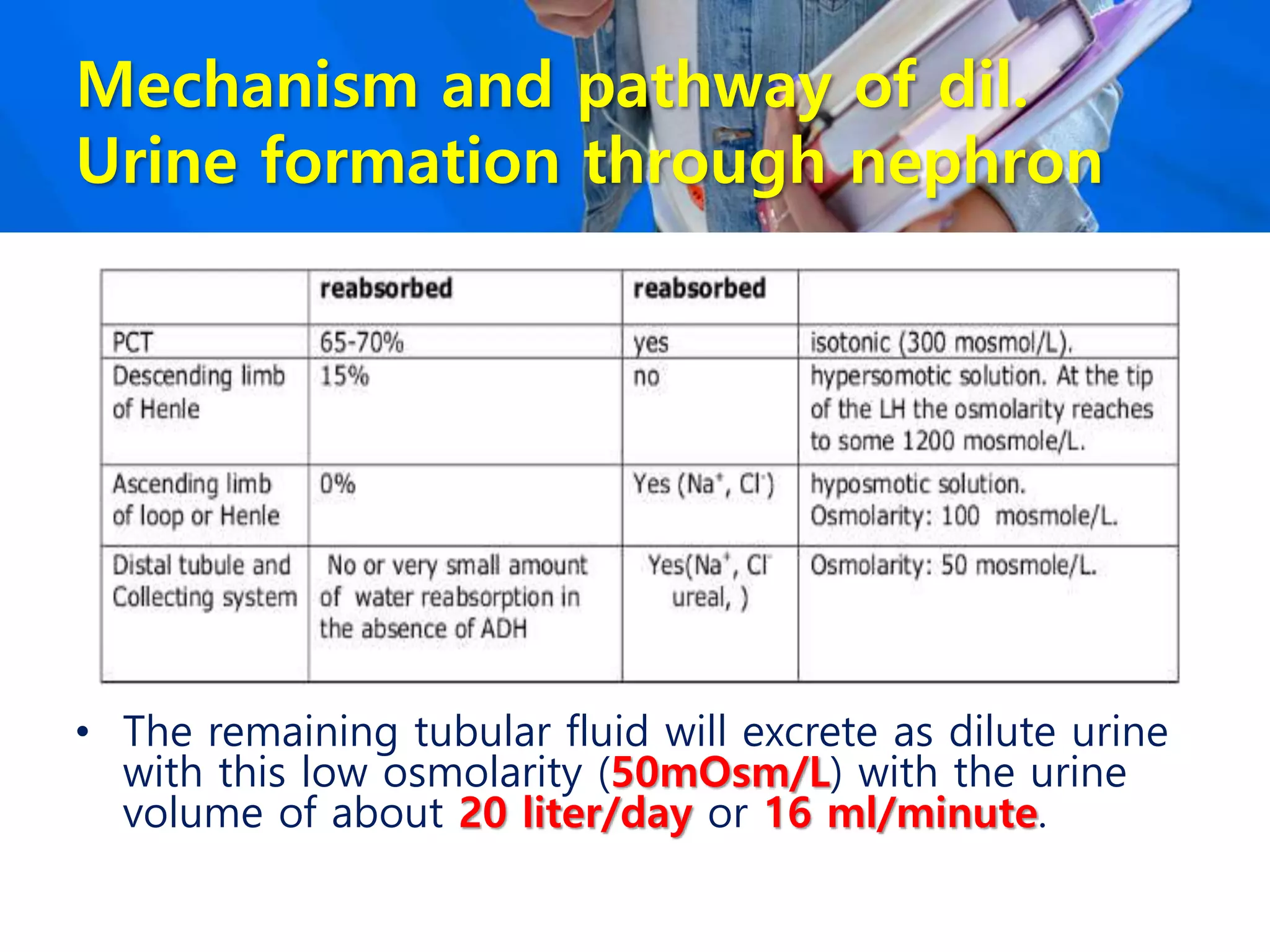
Mechanism and pathway of dil.
Urine formation through nephron
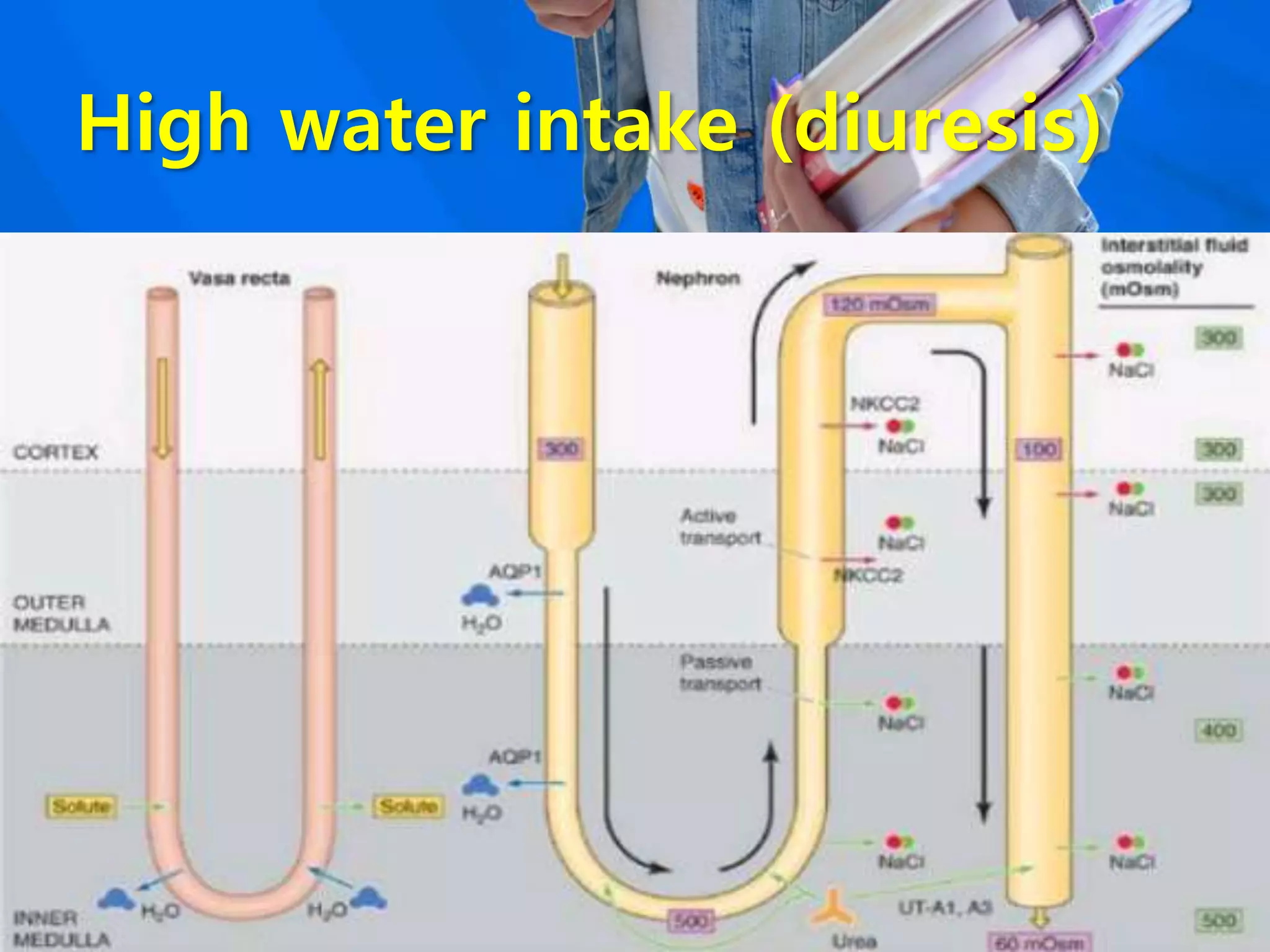
• The remaining tubular fluid will excrete as dilute urine
with this low osmolarity (50mOsm/L) with the urine
volume of about 20 liter/day or 16 ml/minute.
Dilute urine form
High water intake (diuresis)
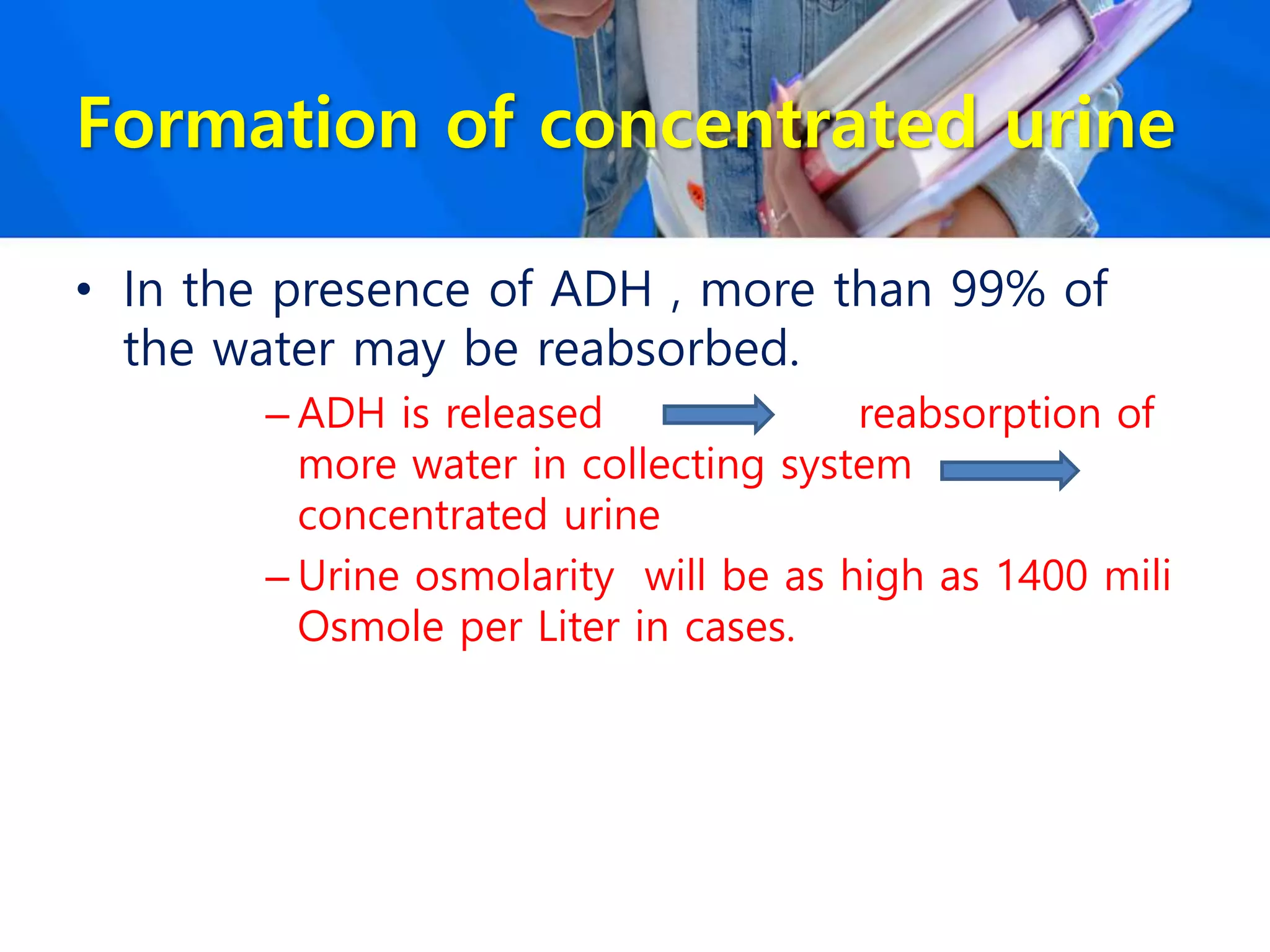
Formation of concentrated urine
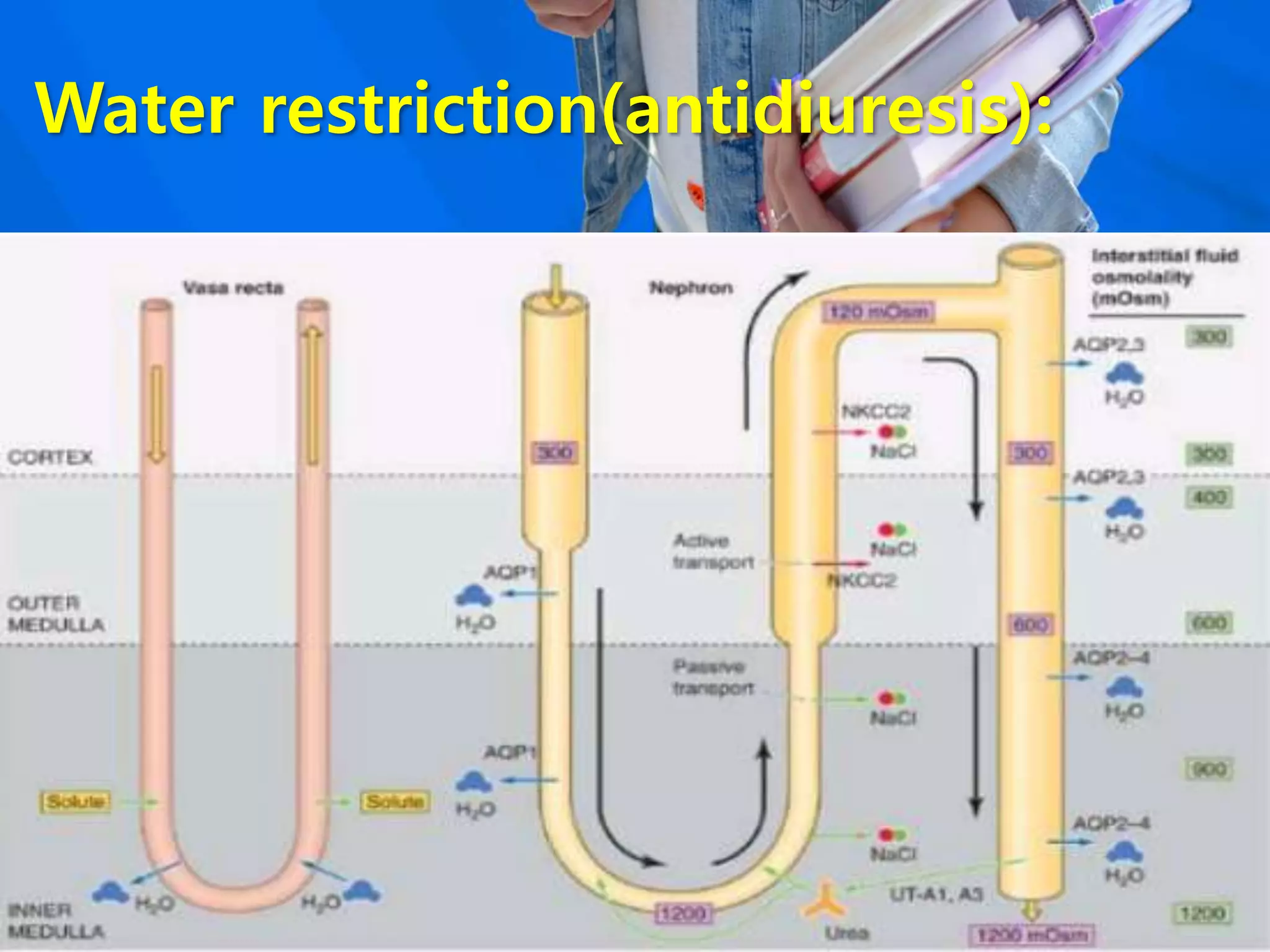
• In the presence of ADH , more than 99% of
the water may be reabsorbed.
– ADH is released reabsorption of
more water in collecting system
concentrated urine
– Urine osmolarity will be as high as 1400 mili
Osmole per Liter in cases.
Concentrated urine
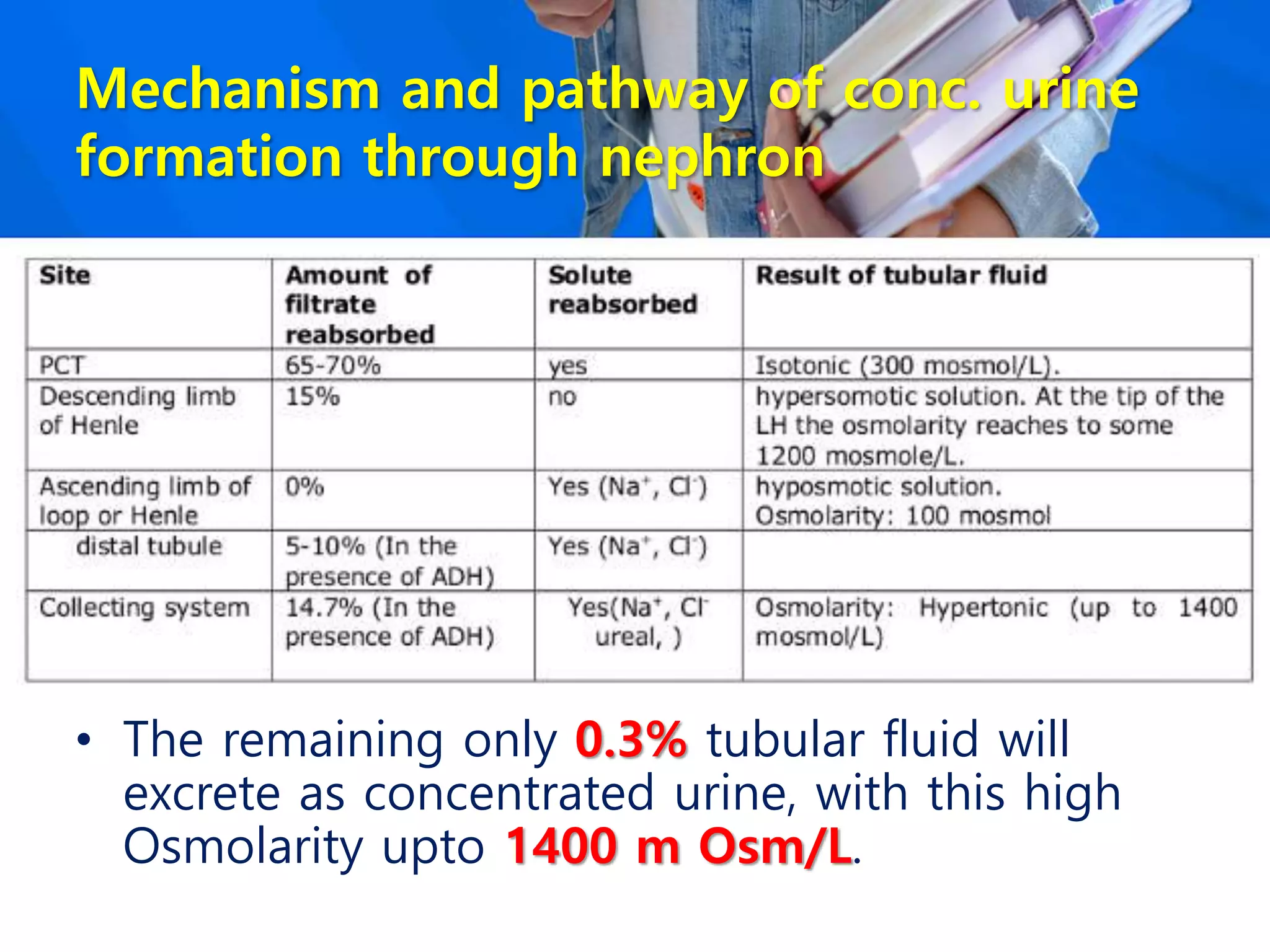
Mechanism and pathway of conc. urine
formation through nephron
• The remaining only 0.3% tubular fluid will
excrete as concentrated urine, with this high
Osmolarity upto 1400 m Osm/L.
Concentrated urine form
Water restriction(antidiuresis):
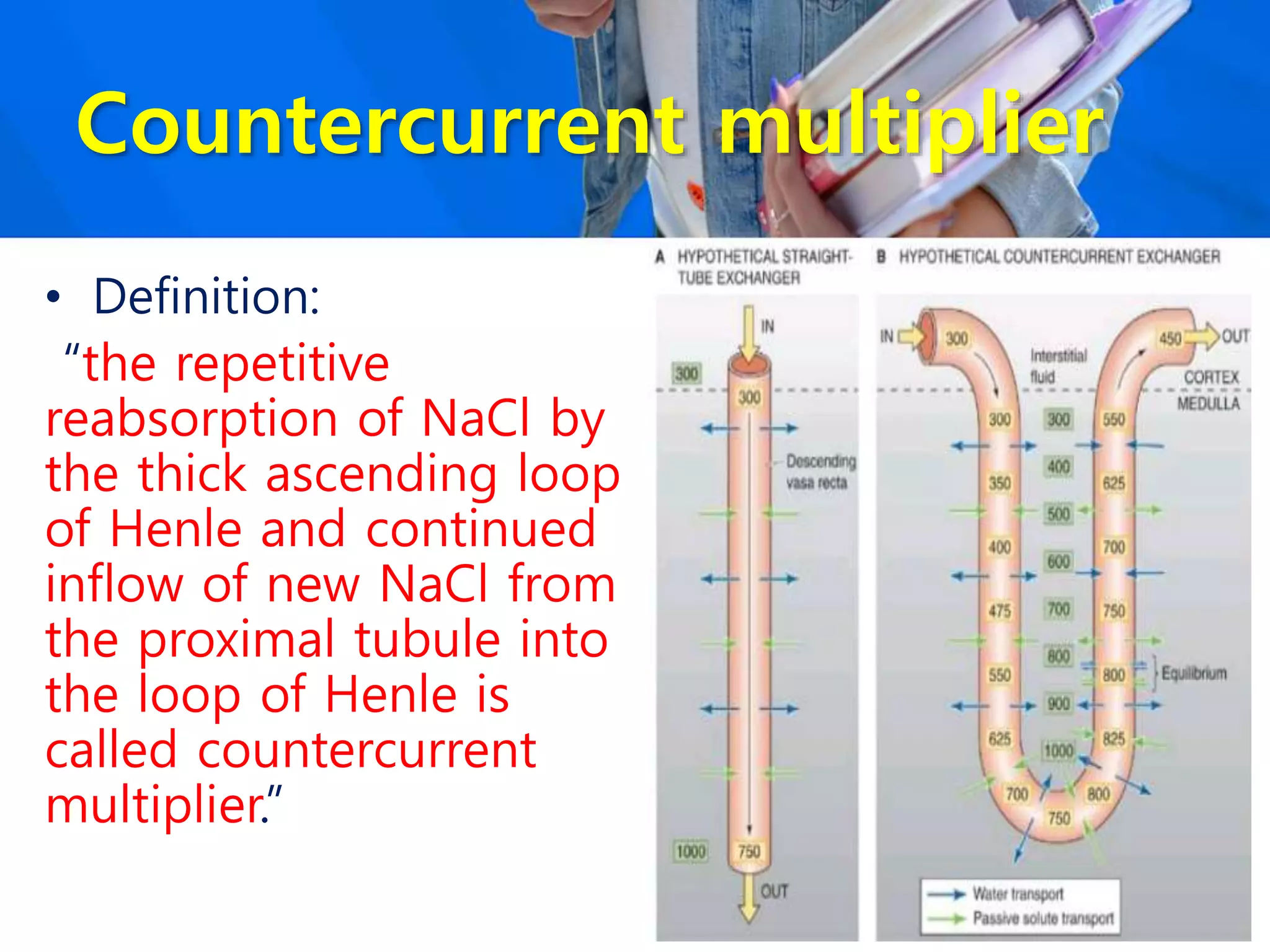
Countercurrent multiplier
• Definition:
“the repetitive
reabsorption of NaCl by
the thick ascending loop
of Henle and continued
inflow of new NaCl from
the proximal tubule into
the loop of Henle is
called countercurrent
multiplier.”
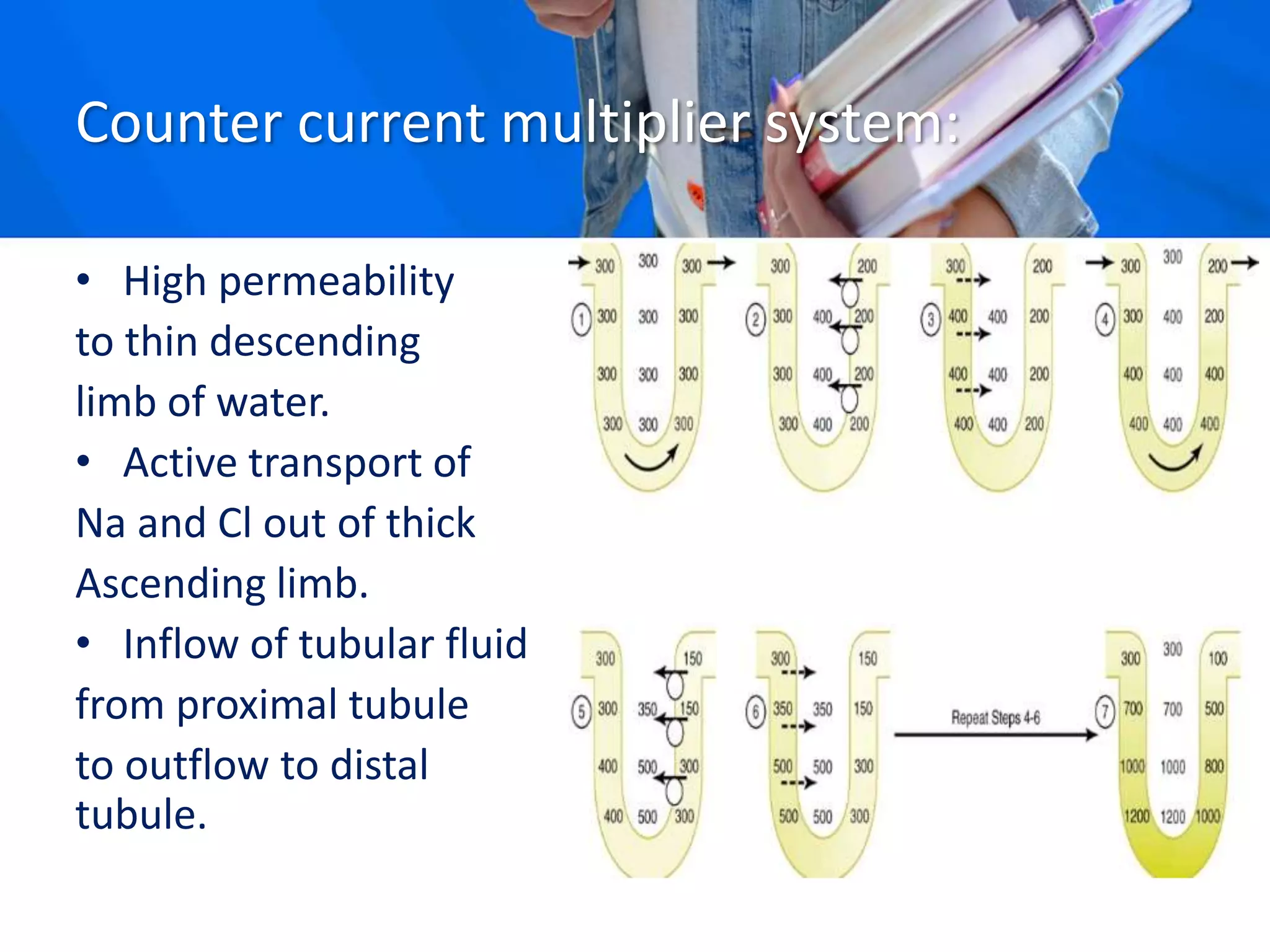
Counter current multiplier system:
• High permeability
to thin descending
limb of water.
• Active transport of
Na and Cl out of thick
Ascending limb.
• Inflow of tubular fluid
from proximal tubule
to outflow to distal
tubule.
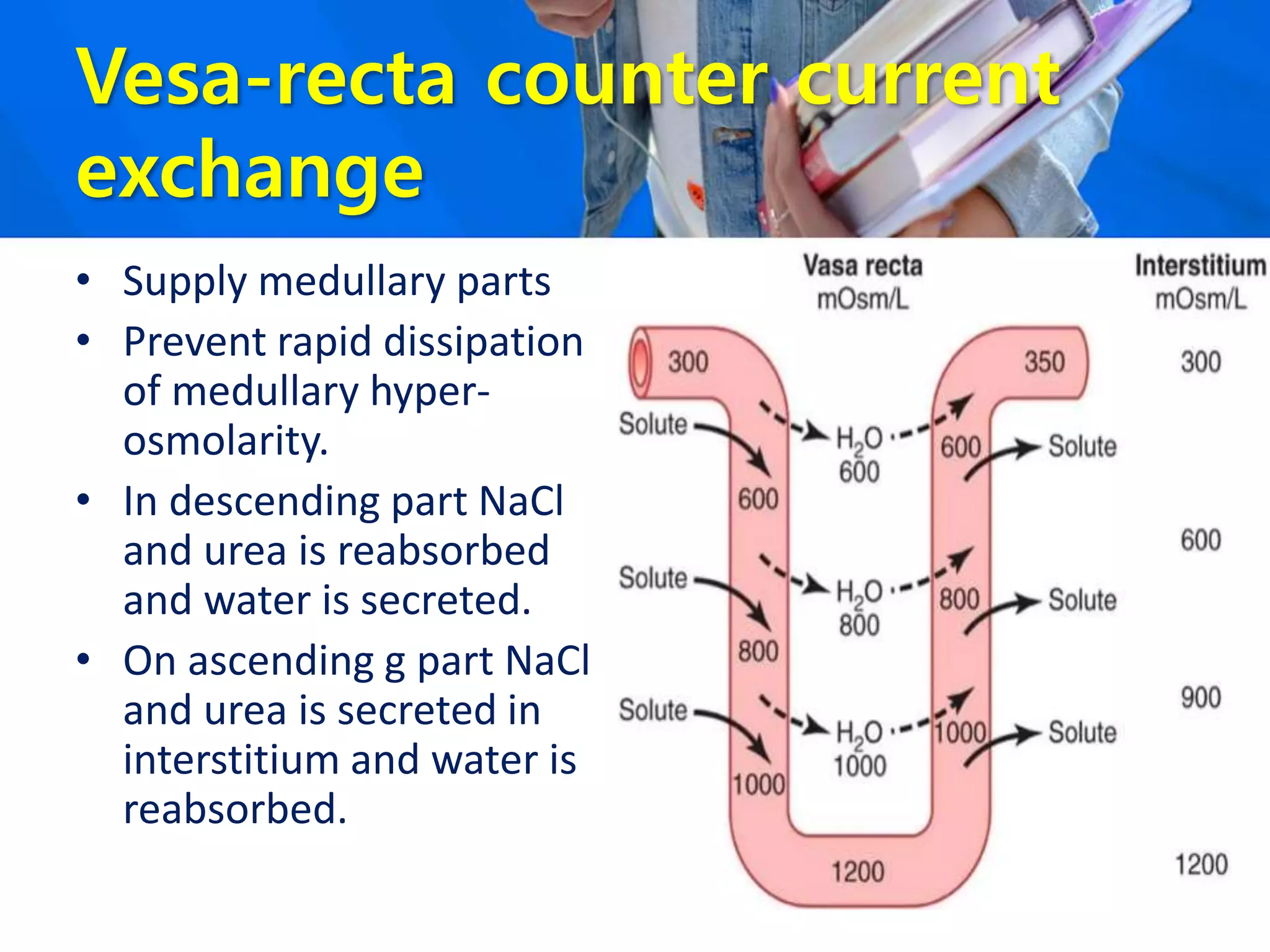
Vesa-recta counter current
exchange
• Supply medullary parts
• Prevent rapid dissipation
of medullary hyper-
osmolarity.
• In descending part NaCl
and urea is reabsorbed
and water is secreted.
• On ascending g part NaCl
and urea is secreted in
interstitium and water is
reabsorbed.
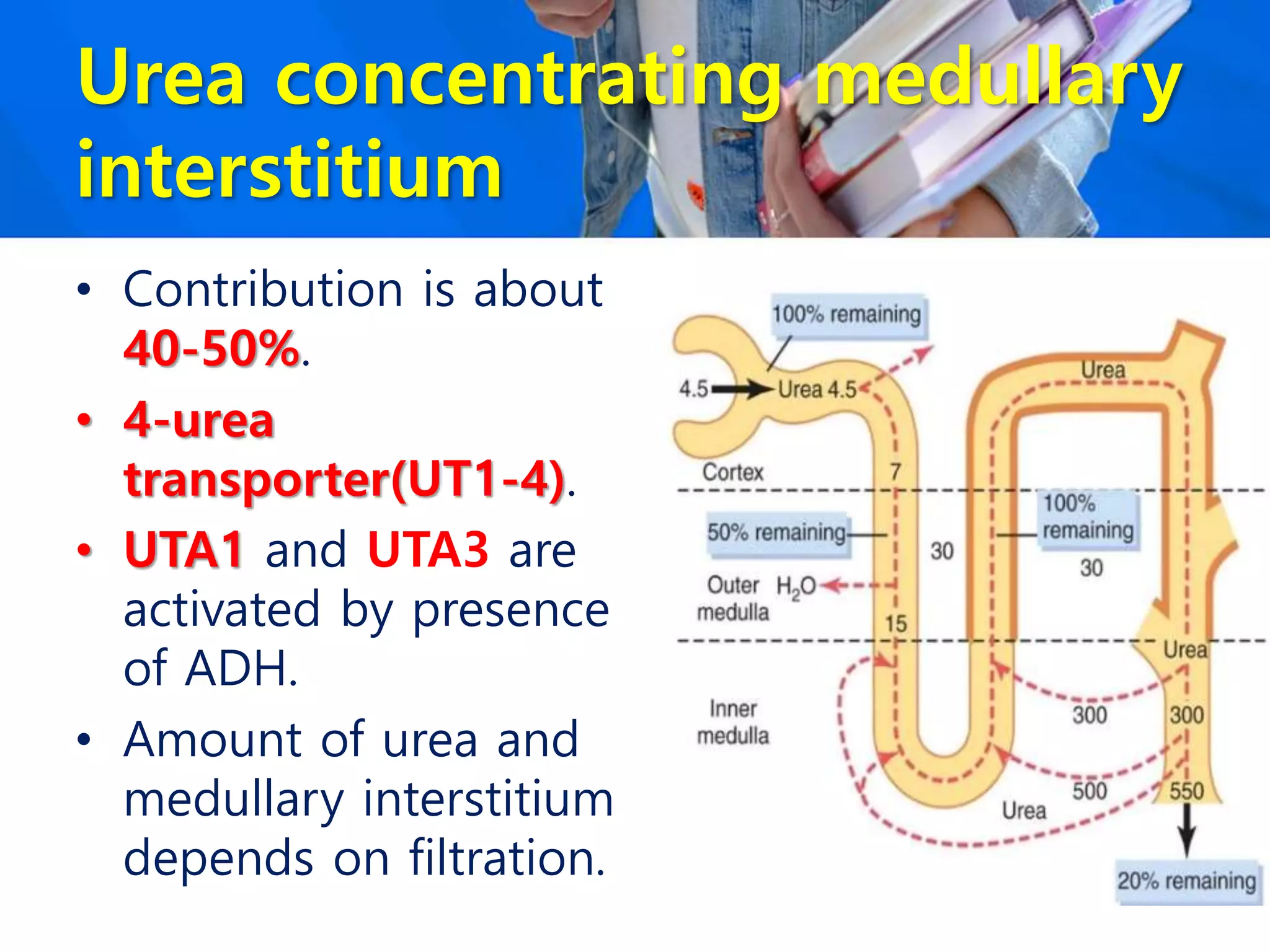
Urea concentrating medullary
interstitium
• Contribution is about
40-50%.
• 4-urea
transporter(UT1-4).
• UTA1 and UTA3 are
activated by presence
of ADH.
• Amount of urea and
medullary interstitium
depends on filtration.
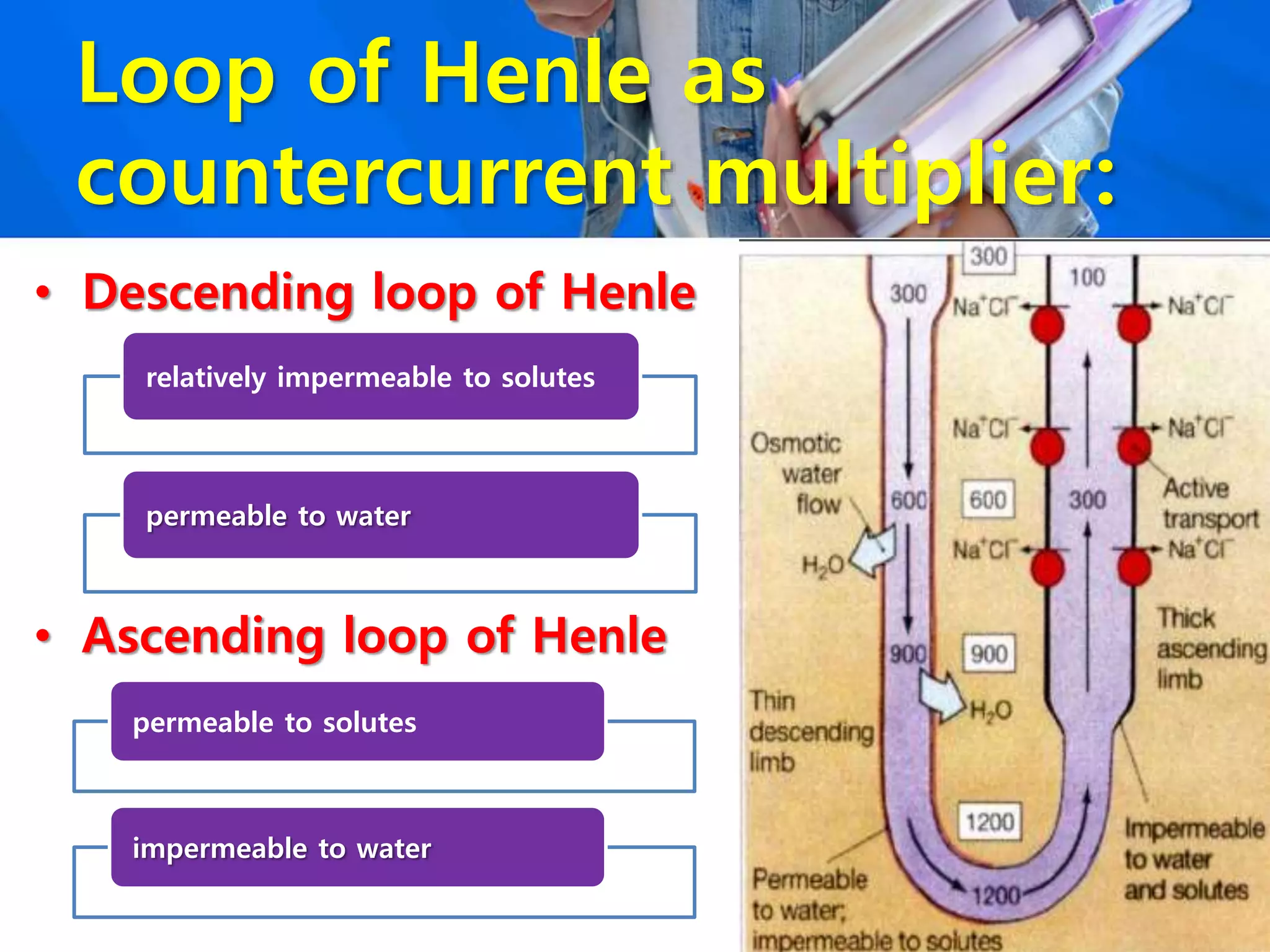
Loop of Henle as
countercurrent multiplier:
• Descending loop of Henle
• Ascending loop of Henle
relatively impermeable to solutes
permeable to water
permeable to solutes
impermeable to water
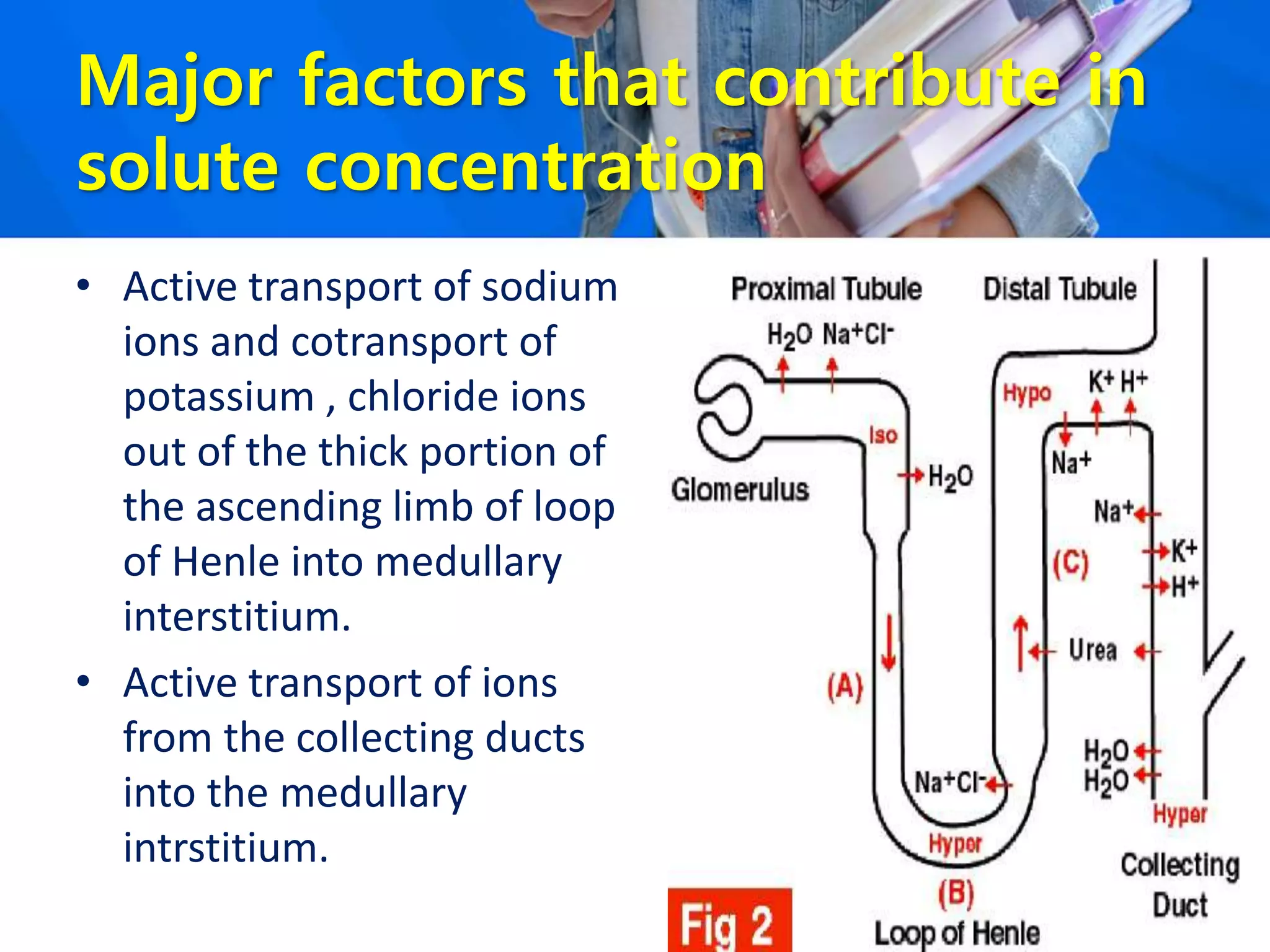
Major factors that contribute in
solute concentration
• Active transport of sodium
ions and cotransport of
potassium , chloride ions
out of the thick portion of
the ascending limb of loop
of Henle into medullary
interstitium.
• Active transport of ions
from the collecting ducts
into the medullary
intrstitium.
Diffusion
• Facilitated diffusion of large amounts of urea from
the inner medullary collecting ducts into the
medullary interstitium.
–Diffusion of only small amounts of
water from the medullary tubules
into the medullary interstitium ,far
less than the reabsorption of solutes
into the medullary interstitium.
• reference(GUYTON)
Obligatory urine volume:
• The obligatory urine volume is
the volume of urine that must
be excreted each day to rid the
body of waste products of
metabolism and ions that are
ingested.
Example
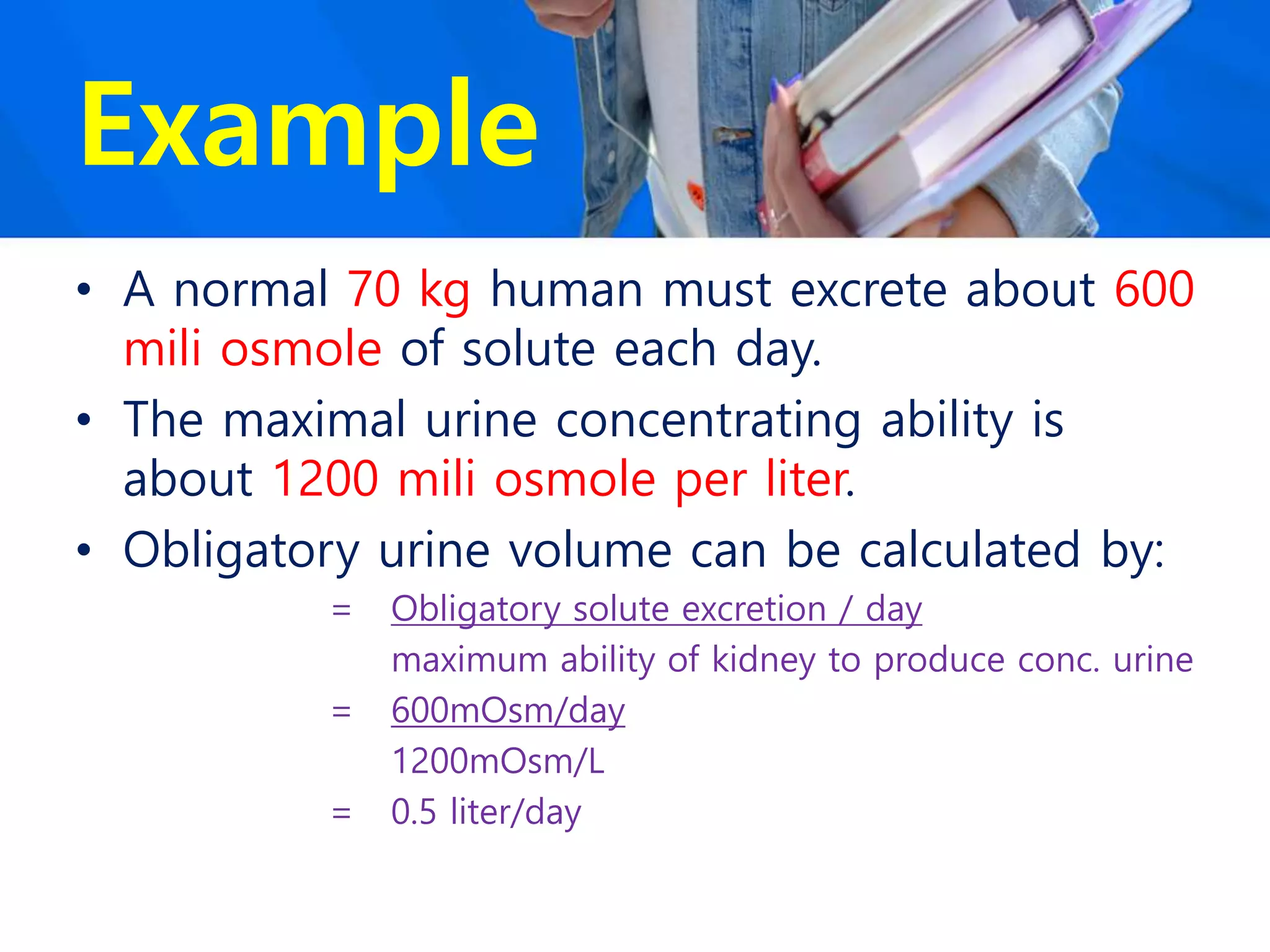
• A normal 70 kg human must excrete about 600
mili osmole of solute each day.
• The maximal urine concentrating ability is
about 1200 mili osmole per liter.
• Obligatory urine volume can be calculated by:
= Obligatory solute excretion / day
maximum ability of kidney to produce conc. urine
= 600mOsm/day
1200mOsm/L
= 0.5 liter/day
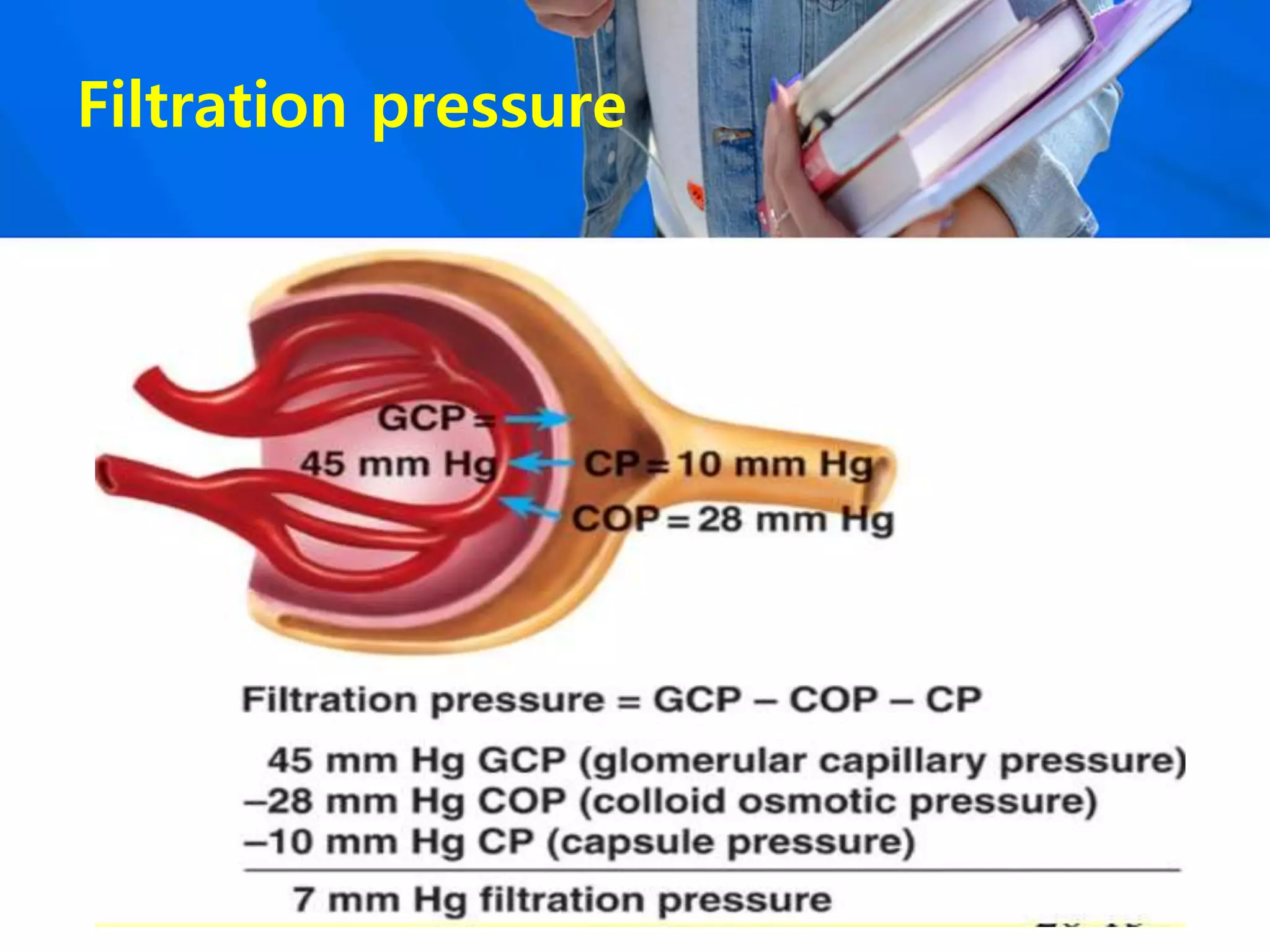
Filtration pressure
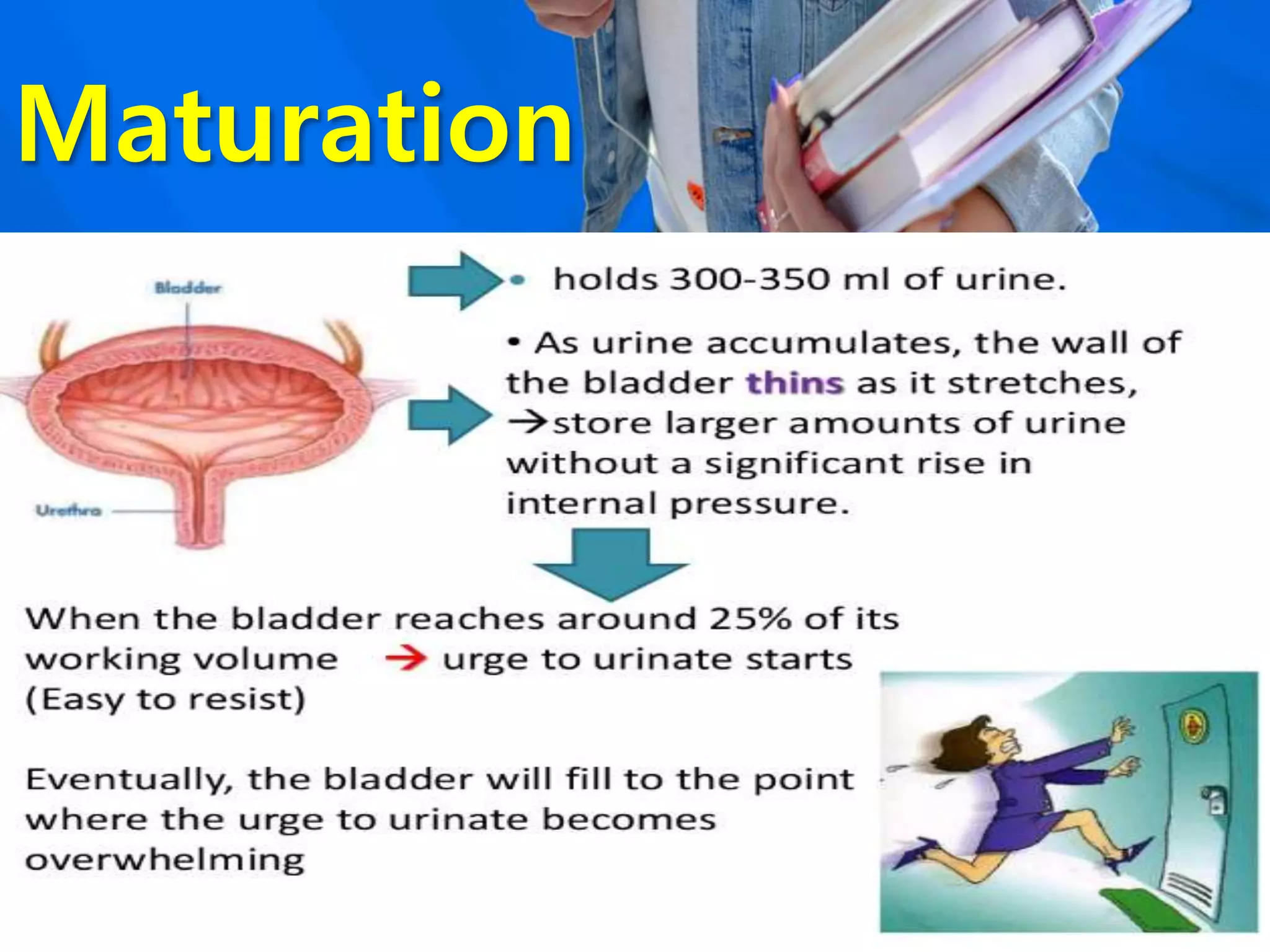
Maturation
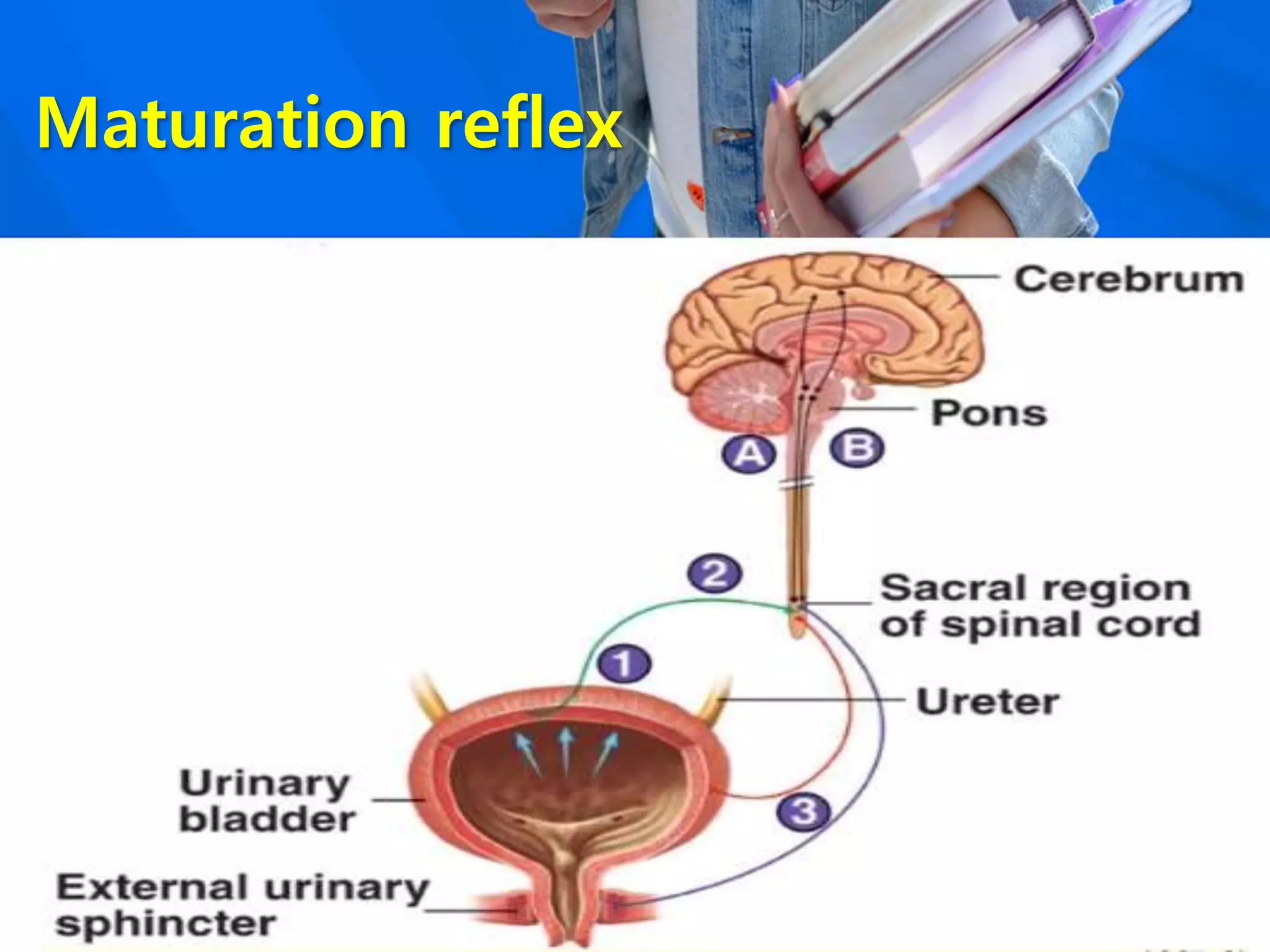
Maturation reflex
Summary of urine concentration mechanism
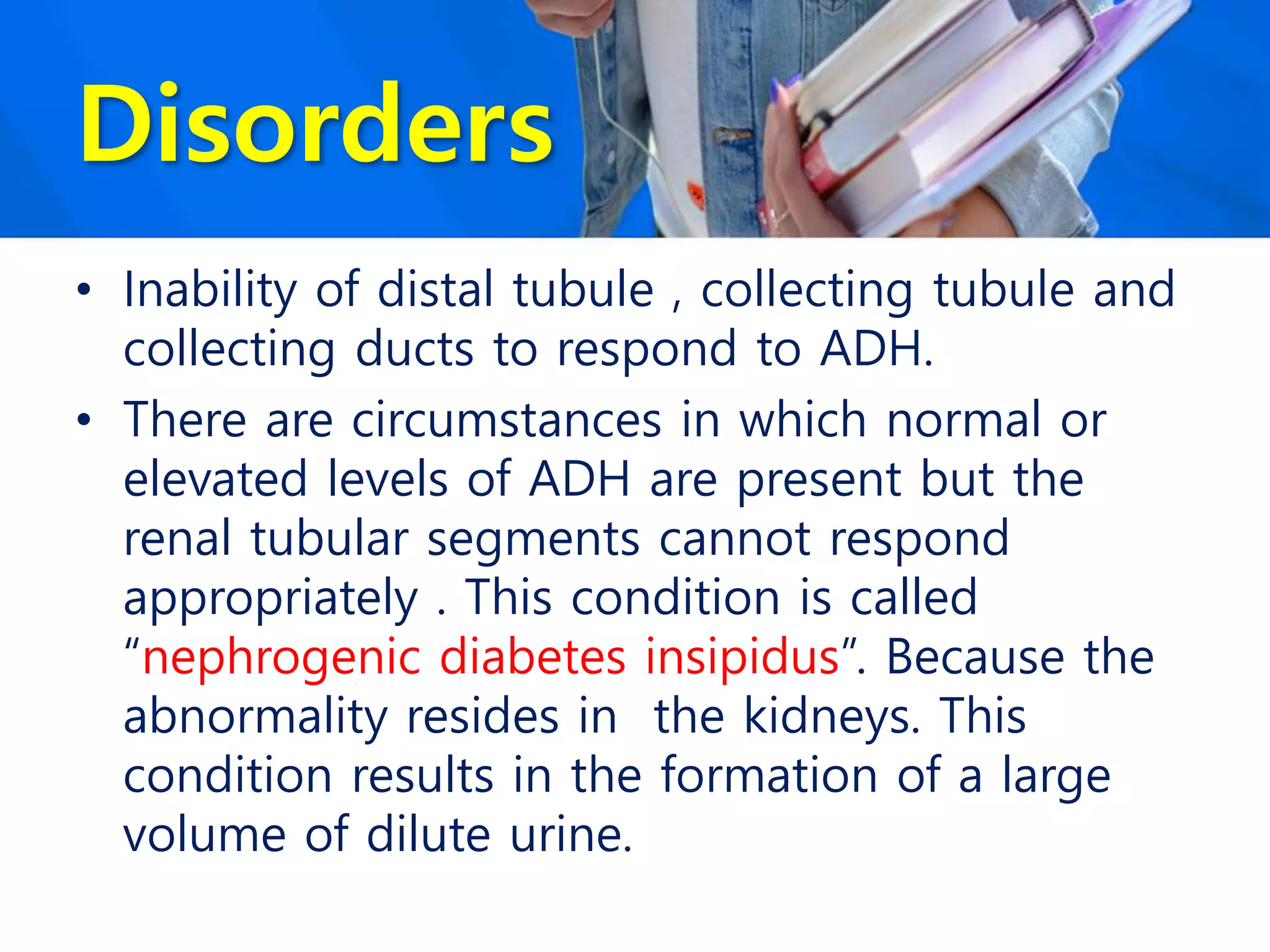
Disorders
• Inability of distal tubule , collecting tubule and
collecting ducts to respond to ADH.
• There are circumstances in which normal or
elevated levels of ADH are present but the
renal tubular segments cannot respond
appropriately . This condition is called
“nephrogenic diabetes insipidus”. Because the
abnormality resides in the kidneys. This
condition results in the formation of a large
volume of dilute urine.
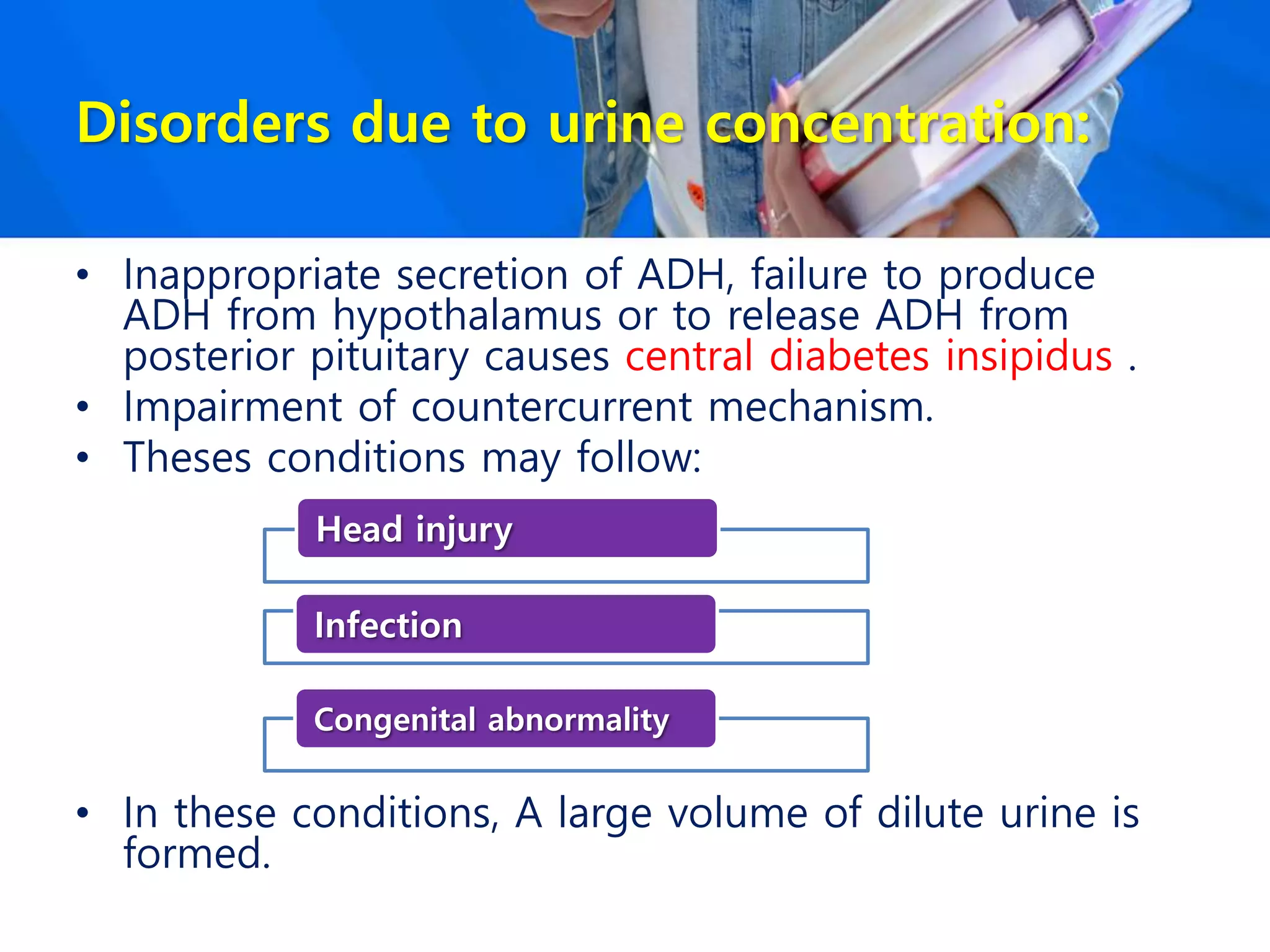
Disorders due to urine concentration:
• Inappropriate secretion of ADH, failure to produce
ADH from hypothalamus or to release ADH from
posterior pituitary causes central diabetes insipidus .
• Impairment of countercurrent mechanism.
• Theses conditions may follow:
• In these conditions, A large volume of dilute urine is
formed.
Head injury
Infection
Congenital abnormality
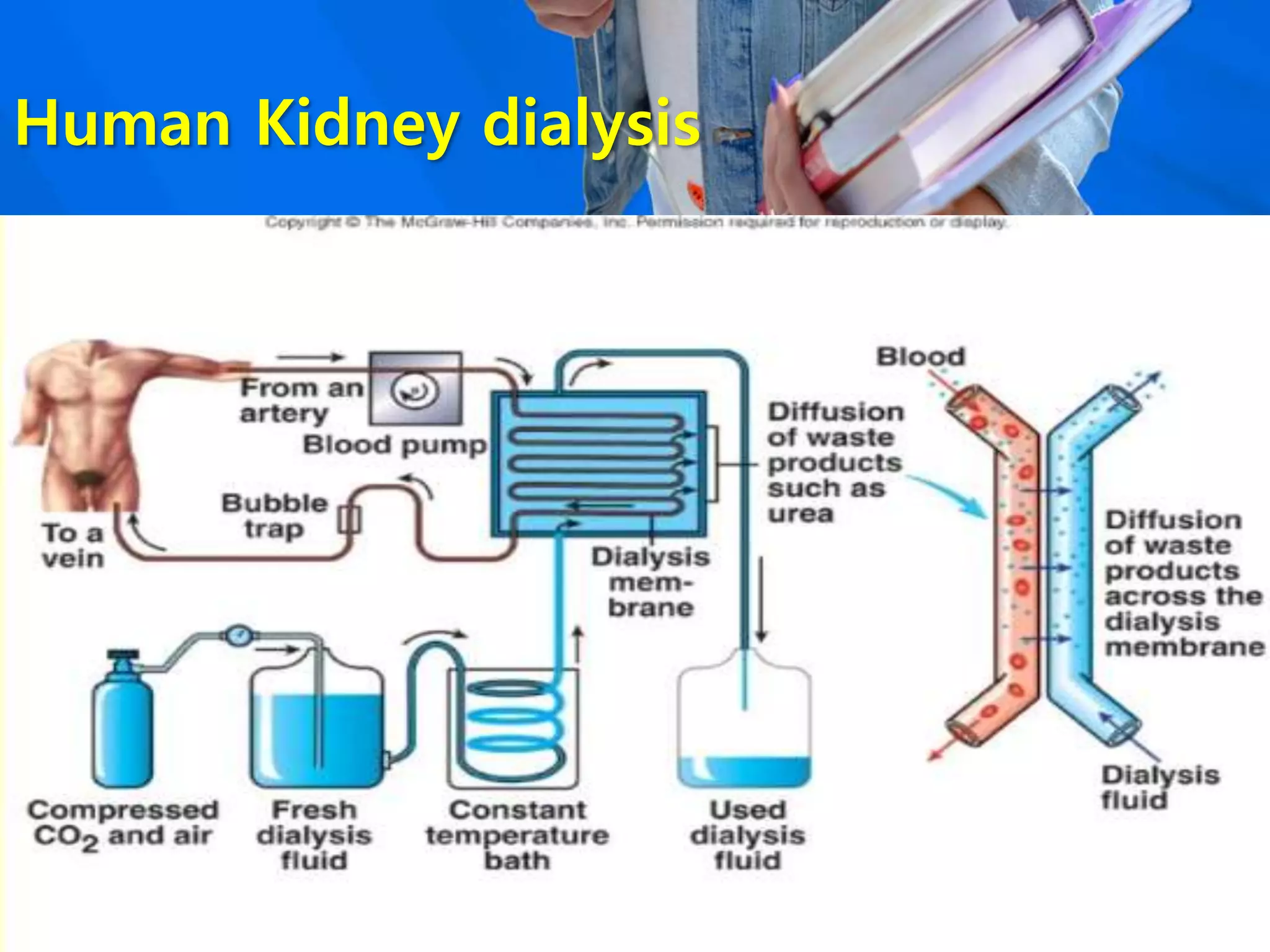
Human Kidney dialysis
Urinary system+ formation of concentrated urine

Urinary system+ formation of concentrated urine

  • 1.
  • 2.
    Contents • Urinary system •Urine formation • Urine concentration • Effects of hormone in urine concentration • diseases
  • 3.
  • 4.
    Urinary system Definition Responsible for thecreation, storage and elimination of urine Parts of urinary system Kidney Ureter Urinary Bladder Urethra
  • 5.
    Functions • Regulation ofthe volume of blood by excretion or conservation of water • Regulation of electrolyte by excretion or conservation of mineral. • Regulation of acid – base balance by excretion or conservation of ions.
  • 6.
    Nephron • Functional unitof kidney. • Each kidney form of one million nephron.
  • 7.
    Parts of Nephron Glomerulus Bowman’scapsule Proximal convoluted tubule Loop of Henle Distal convulated tubule Renal vein Renal artery Renal gland
  • 8.
  • 9.
    Urine formation The nitrogenouswaste excreted out from the body • Process: – Major three steps: Glomerular filtration Tubular reabsorption Tubular secretion
  • 10.
    Glomerular filterate • Beginningof the process. • A process by which the blood courses through the glomeruli , much of its fluid , containing both useful chemicals and dissolves waste materials,soaks out the blood through membranes where it is filtered and then flows into BOWMAN’S capsule.
  • 11.
    Tubular reabsorption • Amovement of substances out of the renal tubules back into the blood capillaries located around the tubules(peritubular capillaries).
  • 12.
  • 13.
    Tubular secretion: • Disposingof substances not already in the filterate(drugs). • Eliminating un-desireable substances that have been reabsorbed by passive processes(urea and uric acid). • Ridding the body from excess potassium ion. • Controlling pH.
  • 14.
    ADH Antidiuretic hormone ,alsoknown as arginine vasopressin, is a nine amino acid peptide secreted from the posterior pitutary.
  • 15.
  • 16.
    Physiological effects ofADH • Basic function is to conserve water by reducing the loss of water in urine. • A diuretics is an agent that increases the rate of urine formation. • Injection of small amount of antidiuretic hormone into a person results in the decrease formation of urine.
  • 17.
    Effect of ADHon nephron
  • 18.
    cont’ • The moreconcentrated plasma, the more ADH is released into the blood, the more concentrated urine is produced. • When the plasma is dilute, less ADH is released into the blood, the more water leave the kidney, producing more dilute urine. • This method of control is an example of negative feedback.
  • 19.
  • 20.
    Aldosterone effect ondistal tubule
  • 21.
    Effect of alcoholand ecstasy on ADH • Alcohol suppresses ADH production. This causes the kidneys to produceb more dilute urine.it can lead to dehydration. • Ecstasay increases ADH production. This causes the kidneys to reabsorb water. It can result in the body having too much water.
  • 22.
    Urine color • Rangesfrom pale- yellow to deep- amber color . This coloration is due to a pigment urochrome. • The more water you drink, more hydrated you are, and lighter the pigment in your urine. • The more coloration means ,you are dehydrated ,and you have taken less water.
  • 23.
  • 24.
    Formation of diluteurine • When water removal is needed, no ADH is released, so the Distal and Collecting Tubule will not reabsorbed water but solute will be absorbed >water moves out with urine with low ion solute content > dilute urine. • Urine Osmolarity will be as low as 50 mOsm/L in such cases
  • 25.
    Mechanism and pathwayof dil. Urine formation through nephron • The remaining tubular fluid will excrete as dilute urine with this low osmolarity (50mOsm/L) with the urine volume of about 20 liter/day or 16 ml/minute.
  • 26.
  • 27.
  • 28.
    Formation of concentratedurine • In the presence of ADH , more than 99% of the water may be reabsorbed. – ADH is released reabsorption of more water in collecting system concentrated urine – Urine osmolarity will be as high as 1400 mili Osmole per Liter in cases.
  • 29.
  • 30.
    Mechanism and pathwayof conc. urine formation through nephron • The remaining only 0.3% tubular fluid will excrete as concentrated urine, with this high Osmolarity upto 1400 m Osm/L.
  • 31.
  • 32.
  • 33.
    Countercurrent multiplier • Definition: “therepetitive reabsorption of NaCl by the thick ascending loop of Henle and continued inflow of new NaCl from the proximal tubule into the loop of Henle is called countercurrent multiplier.”
  • 34.
    Counter current multipliersystem: • High permeability to thin descending limb of water. • Active transport of Na and Cl out of thick Ascending limb. • Inflow of tubular fluid from proximal tubule to outflow to distal tubule.
  • 35.
    Vesa-recta counter current exchange •Supply medullary parts • Prevent rapid dissipation of medullary hyper- osmolarity. • In descending part NaCl and urea is reabsorbed and water is secreted. • On ascending g part NaCl and urea is secreted in interstitium and water is reabsorbed.
  • 36.
    Urea concentrating medullary interstitium •Contribution is about 40-50%. • 4-urea transporter(UT1-4). • UTA1 and UTA3 are activated by presence of ADH. • Amount of urea and medullary interstitium depends on filtration.
  • 37.
    Loop of Henleas countercurrent multiplier: • Descending loop of Henle • Ascending loop of Henle relatively impermeable to solutes permeable to water permeable to solutes impermeable to water
  • 38.
    Major factors thatcontribute in solute concentration • Active transport of sodium ions and cotransport of potassium , chloride ions out of the thick portion of the ascending limb of loop of Henle into medullary interstitium. • Active transport of ions from the collecting ducts into the medullary intrstitium.
  • 39.
    Diffusion • Facilitated diffusionof large amounts of urea from the inner medullary collecting ducts into the medullary interstitium. –Diffusion of only small amounts of water from the medullary tubules into the medullary interstitium ,far less than the reabsorption of solutes into the medullary interstitium. • reference(GUYTON)
  • 40.
    Obligatory urine volume: •The obligatory urine volume is the volume of urine that must be excreted each day to rid the body of waste products of metabolism and ions that are ingested.
  • 41.
    Example • A normal70 kg human must excrete about 600 mili osmole of solute each day. • The maximal urine concentrating ability is about 1200 mili osmole per liter. • Obligatory urine volume can be calculated by: = Obligatory solute excretion / day maximum ability of kidney to produce conc. urine = 600mOsm/day 1200mOsm/L = 0.5 liter/day
  • 42.
  • 43.
  • 44.
  • 45.
    Summary of urineconcentration mechanism
  • 46.
    Disorders • Inability ofdistal tubule , collecting tubule and collecting ducts to respond to ADH. • There are circumstances in which normal or elevated levels of ADH are present but the renal tubular segments cannot respond appropriately . This condition is called “nephrogenic diabetes insipidus”. Because the abnormality resides in the kidneys. This condition results in the formation of a large volume of dilute urine.
  • 47.
    Disorders due tourine concentration: • Inappropriate secretion of ADH, failure to produce ADH from hypothalamus or to release ADH from posterior pituitary causes central diabetes insipidus . • Impairment of countercurrent mechanism. • Theses conditions may follow: • In these conditions, A large volume of dilute urine is formed. Head injury Infection Congenital abnormality
  • 48.