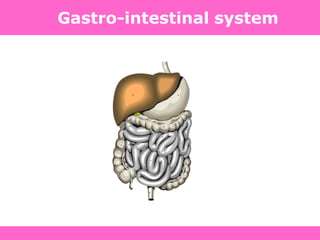
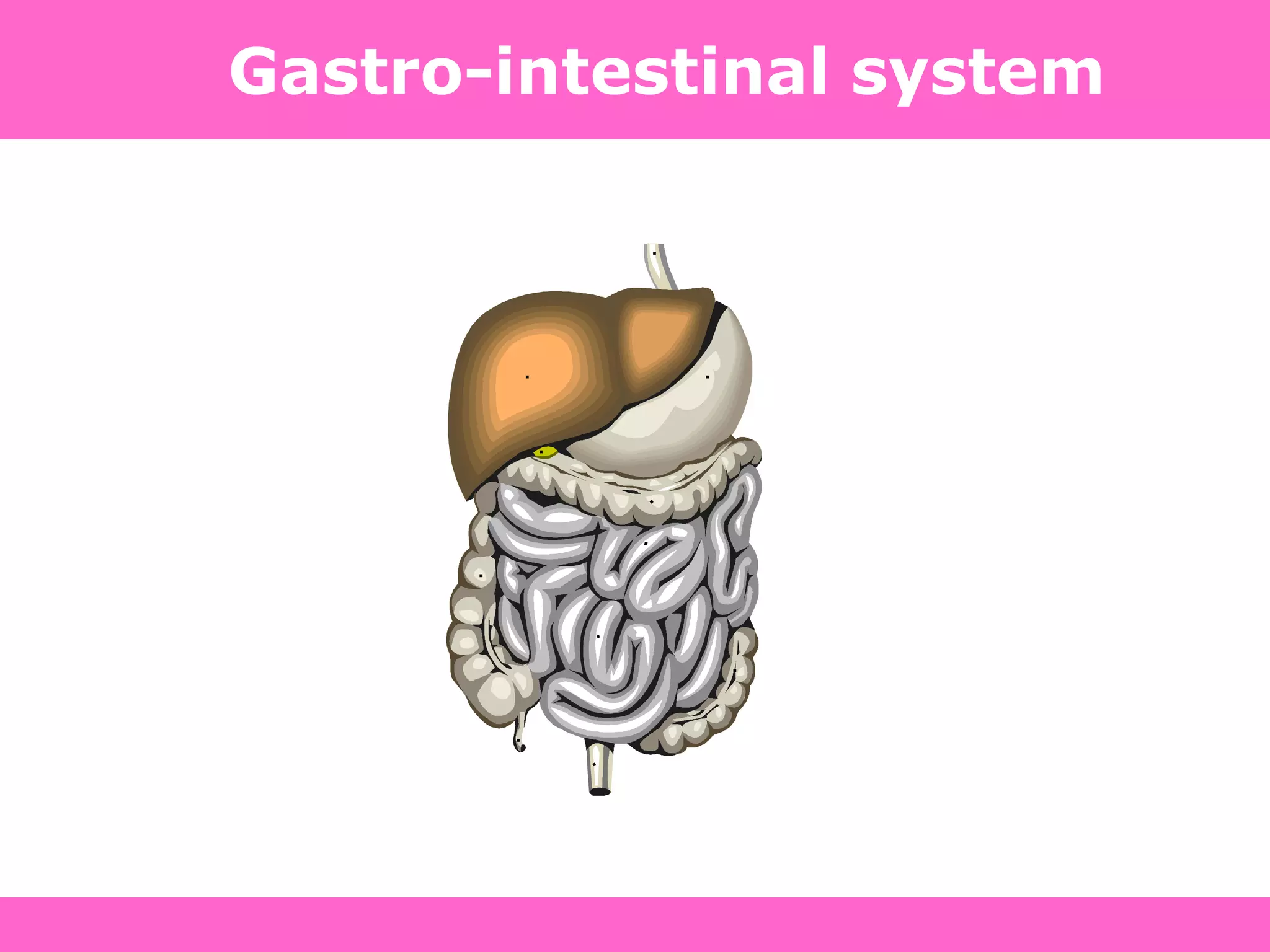
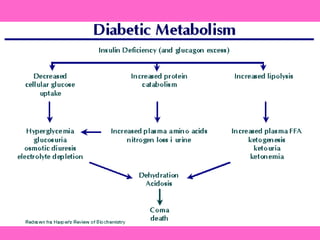
Gastro-intestinal system
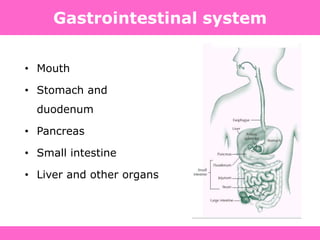
Gastrointestinal system
• Mouth
• Stomach and
duodenum
• Pancreas
• Small intestine
• Liver and other organs
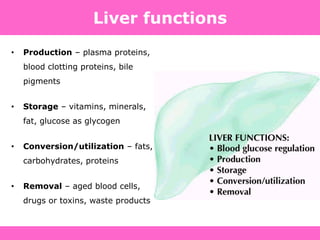
Liver functions
• Production – plasma proteins,
blood clotting proteins, bile
pigments
• Storage – vitamins, minerals,
fat, glucose as glycogen
• Conversion/utilization – fats,
carbohydrates, proteins
• Removal – aged blood cells,
drugs or toxins, waste products
Energy source for body
• Proteins: 10-12%
• Fats: 30%
• Carbohydrates: 60%
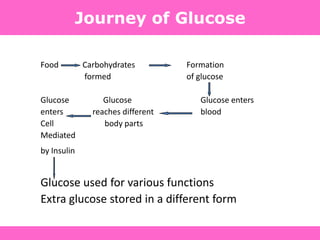
Journey of Glucose
Food Carbohydrates Formation
formed of glucose
Glucose Glucose Glucose enters
enters reaches different blood
Cell body parts
Mediated
by Insulin
Glucose used for various functions
Extra glucose stored in a different form
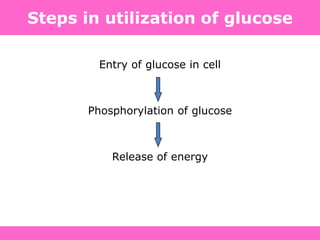
Steps in utilization of glucose
Entry of glucose in cell
Phosphorylation of glucose
Release of energy
• Facilitates the transport of glucose into muscle and adipose
cells
• Facilitates the conversion of glucose to glycogen for storage
in the liver and muscle.
• Decreases the breakdown and release of glucose from
glycogen by the liver
Insulin-Carbohydrate Metabolism
• Stimulates protein synthesis
• Inhibits protein breakdown; diminishes gluconeogenesis
Insulin - Protein Metabolism
• Stimulates lipogenesis- the transport of triglycerides to
adipose tissue
• Inhibits lipolysis – prevents excessive production of ketones
or ketoacidosis
Insulin - Fat Metabolism
Pancreas
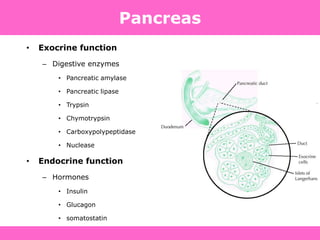
• Exocrine function
– Digestive enzymes
• Pancreatic amylase
• Pancreatic lipase
• Trypsin
• Chymotrypsin
• Carboxypolypeptidase
• Nuclease
• Endocrine function
– Hormones
• Insulin
• Glucagon
• somatostatin
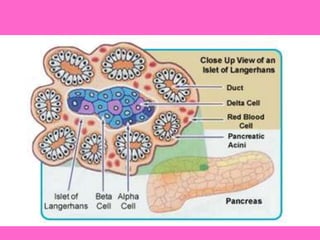
Endocrine function
• Hormones act on target tissues to exert its effect
• Produced by the islet of Langerhans – number of cells in each islet
vary from several hundred to millions
• Glucagon – alpha cells
– Secreted when blood glucose levels fall
• Insulin – beta cells
– Secreted when blood glucose levels rise
• Somatostatin – delta cells
– Secreted in response to any kind of food intake – suppresses both
insulin and glucagon and may extend the period of nutrient absorption
and utilization
What is insulin?
• A hormone
– (from Greek - "to set in motion") is a chemical messenger from
one cell (or group of cells) to another.
• Insulin is the protein hormone produced by cells in the
pancreas that regulate levels of glucose and regulate
metabolism in glucose, fats, and proteins.
• Insulin is composed of 51 amino acids.
• Amino acids are the basic structural building units of proteins
• Its formula is C254 H377 N65 O75 S6.
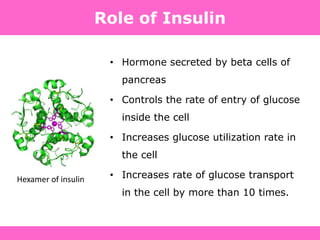
Role of Insulin
• Hormone secreted by beta cells of
pancreas
• Controls the rate of entry of glucose
inside the cell
• Increases glucose utilization rate in
the cell
• Increases rate of glucose transport
in the cell by more than 10 times.
Hexamer of insulin
Clickrole.wmv
Role of Insulin
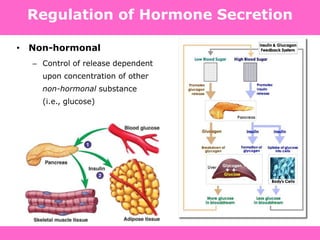
Regulation of Hormone Secretion
• Non-hormonal
– Control of release dependent
upon concentration of other
non-hormonal substance
(i.e., glucose)
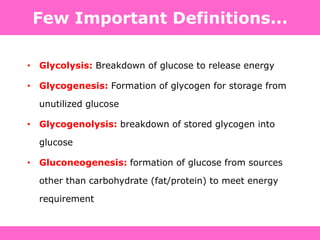
Few Important Definitions...
• Glycolysis: Breakdown of glucose to release energy
• Glycogenesis: Formation of glycogen for storage from
unutilized glucose
• Glycogenolysis: breakdown of stored glycogen into
glucose
• Gluconeogenesis: formation of glucose from sources
other than carbohydrate (fat/protein) to meet energy
requirement
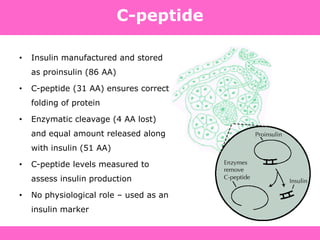
C-peptide
• Insulin manufactured and stored
as proinsulin (86 AA)
• C-peptide (31 AA) ensures correct
folding of protein
• Enzymatic cleavage (4 AA lost)
and equal amount released along
with insulin (51 AA)
• C-peptide levels measured to
assess insulin production
• No physiological role – used as an
insulin marker
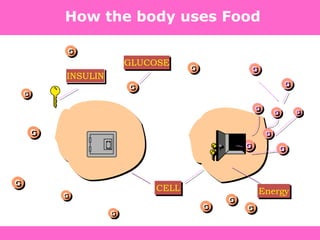
GLUCOSE
INSULIN
CELL Energy
How the body uses Food
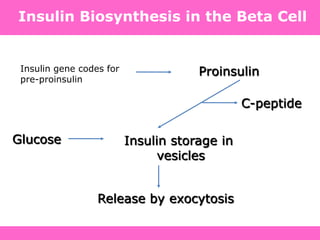
Insulin Biosynthesis in the Beta Cell
Insulin gene codes for
pre-proinsulin
Release by exocytosis
Proinsulin
C-peptide
Glucose Insulin storage in
vesicles
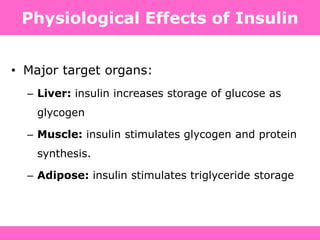
Physiological Effects of Insulin
• Major target organs:
– Liver: insulin increases storage of glucose as
glycogen
– Muscle: insulin stimulates glycogen and protein
synthesis.
– Adipose: insulin stimulates triglyceride storage
Date :12th Mar 09 Valid: 11th Mar 10
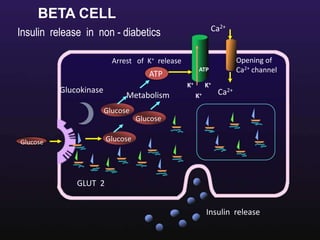
Arrest of K+ release
Ca2+
Opening of
Ca2+ channel
Ca2+
K+
K+ K+
ATP
Metabolism
Glucokinase
Glucose
Glucose
Glucose
GLUT 2
Insulin release
ATP
Glucose
Insulin release in non - diabetics
BETA CELL
Date :12th Mar 09 Valid: 11th Mar 10
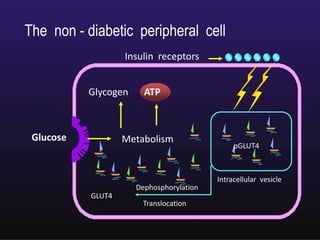
Insulin receptors
Glucose
Glycogen
Metabolism
GLUT4
Dephosphorylation
Translocation
Intracellular vesicle
pGLUT4
ATP
The non - diabetic peripheral cell
Insulin secretion
• Insulin secretion increases almost 10 folds within 5 to 10
minutes of food intake.
• Insulin secretion is stimulated by glucose
The Basal/Bolus Insulin Concept
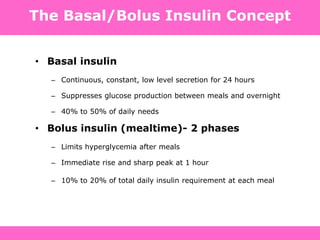
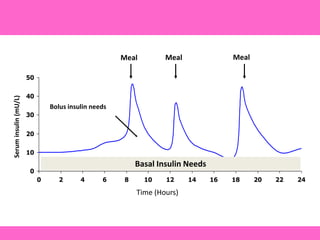
• Basal insulin
– Continuous, constant, low level secretion for 24 hours
– Suppresses glucose production between meals and overnight
– 40% to 50% of daily needs
• Bolus insulin (mealtime)- 2 phases
– Limits hyperglycemia after meals
– Immediate rise and sharp peak at 1 hour
– 10% to 20% of total daily insulin requirement at each meal
0
10
20
30
40
50
0 2 4 6 8 10 12 14 16 18 20 22 24
Time (Hours)
Meal Meal Meal
Basal Insulin Needs
Bolus insulin needs
Seruminsulin(mU/L)
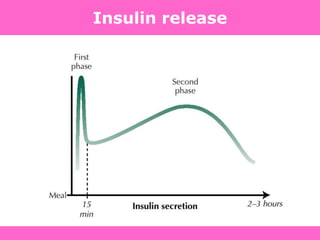
Phases of insulin release
• First phase
– Release starts as soon as food comes to the stomach
– Preformed stored insulin is released
– 10-fold increase in levels within 3-5 minutes

– Speeds up the use of glucose
– Within 5-10 minutes, insulin secretion decreases by half
• Second phase
– Rising glucose levels send signals to the beta cell nucleus
 DNA produces mRNA  mRNA produces more insulin
– Causes a less acute rise in insulin levels
– Reaches a plateau in 2-3 hours
Insulin release
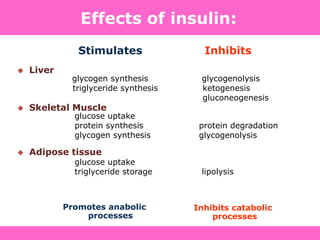
glycogen synthesis glycogenolysis
triglyceride synthesis ketogenesis
gluconeogenesis
glucose uptake
protein synthesis protein degradation
glycogen synthesis glycogenolysis
glucose uptake
triglyceride storage lipolysis
Stimulates Inhibits
 Liver
 Skeletal Muscle
 Adipose tissue
Promotes anabolic
processes
Inhibits catabolic
processes
Effects of insulin:
Glucose metabolism
&
Diabetes mellitus
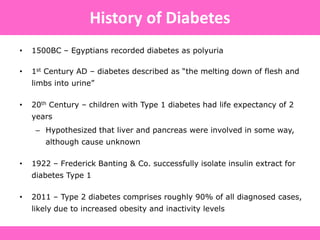
• 1500BC – Egyptians recorded diabetes as polyuria
• 1st Century AD – diabetes described as “the melting down of flesh and
limbs into urine”
• 20th Century – children with Type 1 diabetes had life expectancy of 2
years
– Hypothesized that liver and pancreas were involved in some way,
although cause unknown
• 1922 – Frederick Banting & Co. successfully isolate insulin extract for
diabetes Type 1
• 2011 – Type 2 diabetes comprises roughly 90% of all diagnosed cases,
likely due to increased obesity and inactivity levels
History of Diabetes
Diabetes Mellitus
Derived from Greek roots
dia – through
bainein – to go
To go through – meaning syphon
Mellitus – Latin „mel‟ for „honey‟
Diabetes Mellitus – Sweet syphon
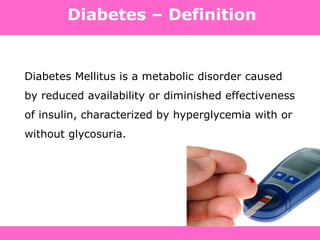
Diabetes – Definition
Diabetes Mellitus is a metabolic disorder caused
by reduced availability or diminished effectiveness
of insulin, characterized by hyperglycemia with or
without glycosuria.
Diabetes Mellitus
• Chronic medical condition
• Inability to properly utilize glucose
• Diabetes can cause acute medical emergencies
–Too much glucose (hyperglycemia)
–Too little glucose (hypoglycemia)
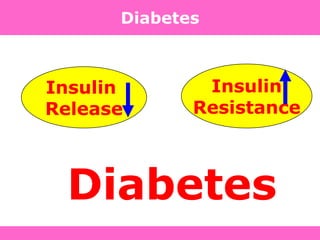
Diabetes
Insulin
Release
Insulin
Resistance
Diabetes
Diabetes Mellitus
Types of Diabetes
• Type 1 Diabetes
• Type 2 Diabetes
• Gestational Diabetes
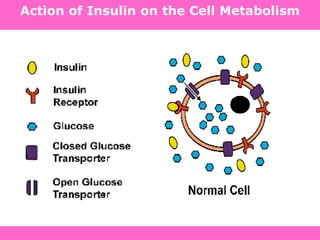
Action of Insulin on the Cell Metabolism
• Low or absent endogenous insulin
• Dependent on exogenous insulin for life
• Onset generally < 30 years
• 5-10% of cases of diabetes
• Onset sudden
– Symptoms: 3 P‟s: polyuria, polydypsia, polyphagia
Type I Diabetes
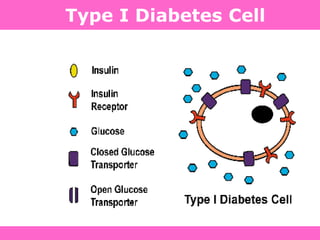
Type I Diabetes Cell
• Genetic component to disease
Type I Diabetes
• Insulin levels may be normal, elevated or depressed
– Characterized by insulin resistance,
– diminished tissue sensitivity to insulin,
– and impaired beta cell function (delayed or inadequate
insulin release)
• Often occurs >40 years
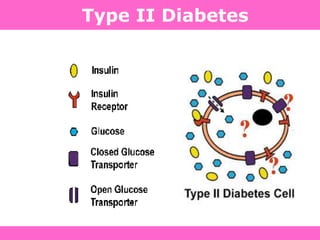
Type II Diabetes
Type II Diabetes
• Risk factors: family history, sedentary lifestyle, obesity and
aging
• Controlled by weight loss, oral hypoglycemic agents and or
insulin
Type II Diabetes
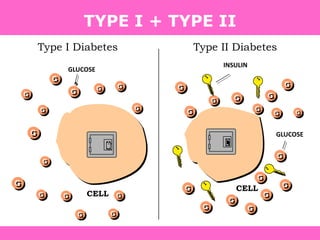
TYPE I + TYPE II
Type I Diabetes Type II Diabetes
GLUCOSE
GLUCOSE
INSULIN
CELL
CELL
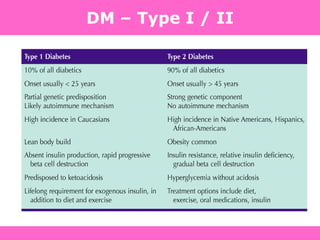
DM – Type I / II
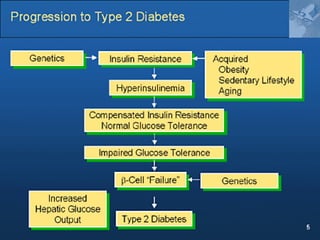
Pathogenesis of DM
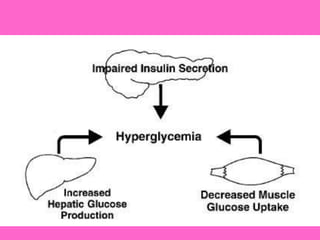
• Insulin resistance
• Impaired insulin secretion
• Excessive hepatic glucose production
Pathogenesis of DM (Contd.)
Insulin Resistance:
• Decreased ability of insulin to act effectively on
peripheral tissue
• This resistance is relative, since increased levels of
insulin will normalize the Pl. glucose level
Mechanism – exact not known
• Decrease in insulin receptors or post receptor
defect
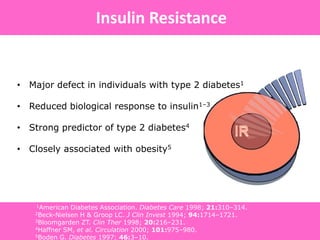
• Major defect in individuals with type 2 diabetes1
• Reduced biological response to insulin1–3
• Strong predictor of type 2 diabetes4
• Closely associated with obesity5
IR
1American Diabetes Association. Diabetes Care 1998; 21:310–314.
. J Clin Invest 1994; 94:1714–1721. 3Bloomgarden ZT. Clin Ther 1998; 20:216–231.
4Haffner SM, et al. Circulation 2000; 101:975–980. 5Boden G. Diabetes 1997; 46:3–10.
Insulin Resistance
1American Diabetes Association. Diabetes Care 1998; 21:310–314.
2Beck-Nielsen H & Groop LC. J Clin Invest 1994; 94:1714–1721.
3Bloomgarden ZT. Clin Ther 1998; 20:216–231.
4Haffner SM, et al. Circulation 2000; 101:975–980.
5Boden G. Diabetes 1997; 46:3–10.
Click
Insulin Resistance
Pathogenesis of DM (Contd.)
Impair insulin secretion
• Initially insulin secretion increase in response to
insulin resistance to maintain normal blood
glucose levels
• In later stage beta cell failure develops due to
lipo and glucotoxicity - low insulin levels
Pathogenesis of DM (Contd.)
Increased hepatic glucose production
• Liver maintain Plasma glucose level during fasting
state by glycogenolysis and gluconeogenesis (A.A.,
F.A., glycerol)
• In DM because of insulin resistance, insulin fails to
suppress gluconeogenesis which leads to increased
blood glucose levels.
Diagnosis of Diabetes
 Polyuria – Increased micturition
 Polydipsia – Increased thirst
 Polyphagia – Increased hunger
 Fatigue
 Skin infections
 Impotence
 Tingling, numbness
Diagnosis of diabetes
Symptoms + Elevated blood glucose level
OR
Elevated blood glucose levels on two occasions
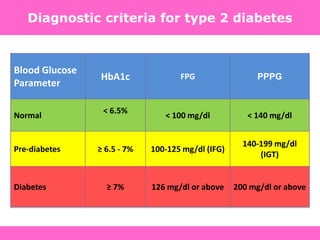
Diagnostic criteria for type 2 diabetes
Blood Glucose
Parameter
HbA1c FPG PPPG
Normal
< 6.5%
< 100 mg/dl < 140 mg/dl
Pre-diabetes ≥ 6.5 - 7% 100-125 mg/dl (IFG)
140-199 mg/dl
(IGT)
Diabetes ≥ 7% 126 mg/dl or above 200 mg/dl or above
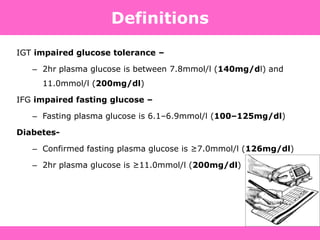
Definitions
IGT impaired glucose tolerance –
– 2hr plasma glucose is between 7.8mmol/l (140mg/dl) and
11.0mmol/l (200mg/dl)
IFG impaired fasting glucose –
– Fasting plasma glucose is 6.1–6.9mmol/l (100–125mg/dl)
Diabetes-
– Confirmed fasting plasma glucose is ≥7.0mmol/l (126mg/dl)
– 2hr plasma glucose is ≥11.0mmol/l (200mg/dl)
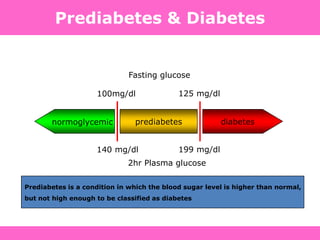
Prediabetes & Diabetes
diabetesprediabetesnormoglycemic
100mg/dl 125 mg/dl
140 mg/dl 199 mg/dl
Fasting glucose
2hr Plasma glucose
Prediabetes is a condition in which the blood sugar level is higher than normal,
but not high enough to be classified as diabetes
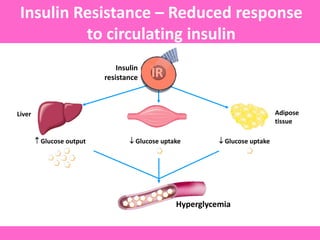
Insulin
resistance
 Glucose output  Glucose uptake  Glucose uptake
Hyperglycemia
Liver Muscle Adipose
tissue
IR
Insulin Resistance – Reduced response
to circulating insulin
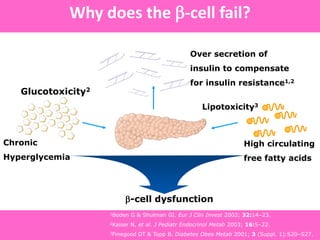
Chronic
Hyperglycemia
Over secretion of
insulin to compensate
for insulin resistance1,2
High circulating
free fatty acids
Glucotoxicity2
Pancreas
Lipotoxicity3
-cell dysfunction
. Eur J Clin Invest 2002; 32:14–23., 2Kaiser N, et al. J Pediatr Endocrinol Metab 2003; 16:5–
22.,3Finegood DT & Topp B. Diabetes Obes Metab 2001; 3 (Suppl. 1):S20–S27.
Why does the -cell fail?
1Boden G & Shulman GI. Eur J Clin Invest 2002; 32:14–23.
2Kaiser N, et al. J Pediatr Endocrinol Metab 2003; 16:5–22.
3Finegood DT & Topp B. Diabetes Obes Metab 2001; 3 (Suppl. 1):S20–S27.
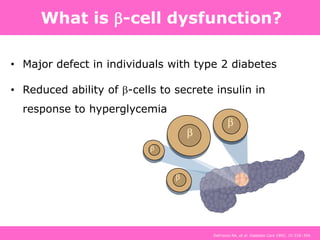
What is -cell dysfunction?
• Major defect in individuals with type 2 diabetes
• Reduced ability of -cells to secrete insulin in
response to hyperglycemia




DeFronzo RA, et al. Diabetes Care 1992; 15:318–354.
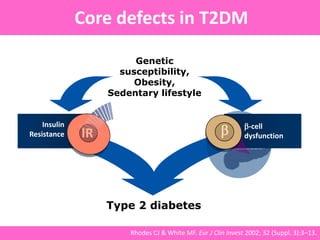
Insulin
Resistance
Genetic
susceptibility,
Obesity,
Sedentary lifestyle
Type 2 diabetes
IR
-cell
dysfunction
Core defects in T2DM
Rhodes CJ & White MF. Eur J Clin Invest 2002; 32 (Suppl. 3):3–13.
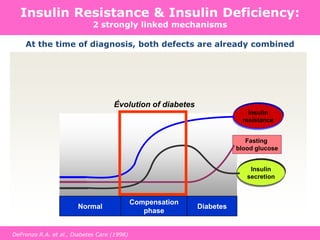
Évolution of diabetes
Normal
Compensation
phase
Diabetes
DeFronzo R.A. et al., Diabetes Care (1998)
Insulin Resistance & Insulin Deficiency:
2 strongly linked mechanisms
At the time of diagnosis, both defects are already combined
Insulin
resistance
Fasting
blood glucose
Insulin
secretion
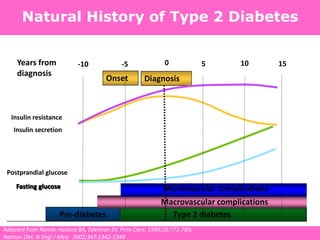
Type 2 diabetes
Years from
diagnosis
0 5-10 -5 10 15
Pre-diabetes
Onset Diagnosis
Insulin secretion
Insulin resistance
Postprandial glucose
Macrovascular complications
Adapted from Ramlo-Halsted BA, Edelman SV. Prim Care. 1999;26:771-789;
Nathan DM. N Engl J Med. 2002;347:1342-1349
Fasting glucose Microvascular complications
Natural History of Type 2 Diabetes
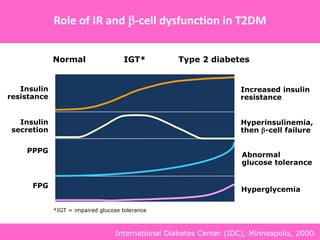
Abnormal
glucose tolerance
Hyperinsulinemia,
then -cell failure
Normal IGT* Type 2 diabetes
PPPG
Insulin
resistance
Increased insulin
resistance
FPG
Hyperglycemia
Insulin
secretion
*IGT = impaired glucose tolerance
Role of IR and -cell dysfunction in T2DM
International Diabetes Center (IDC), Minneapolis, 2000.
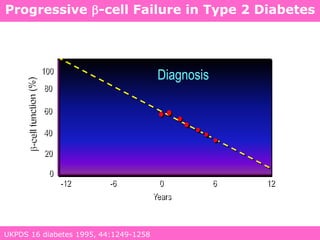
-12 -6 0 6 12
0
20
40
60
80
100
Years
Diagnosis
UKPDS 16 diabetes 1995, 44:1249-1258
Progressive -cell Failure in Type 2 Diabetes
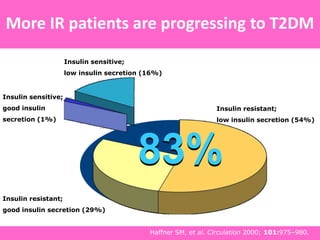
Insulin resistant;
low insulin secretion (54%)
Insulin resistant;
good insulin secretion (29%)
Insulin sensitive;
good insulin
secretion (1%)
Insulin sensitive;
low insulin secretion (16%)
83%
More IR patients are progressing to T2DM
Haffner SM, et al. Circulation 2000; 101:975–980.
Date :12th Mar 09 Valid: 11th Mar 10
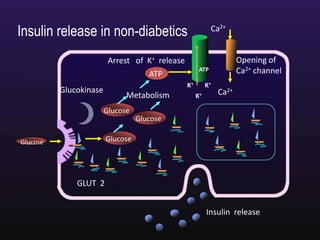
Arrest of K+ release
Ca2+
Opening of
Ca2+ channel
Ca2+
K+
K+ K+
ATP
Metabolism
Glucokinase
Glucose
Glucose
Glucose
GLUT 2
Insulin release
ATP
Glucose
Insulin release in non-diabetics
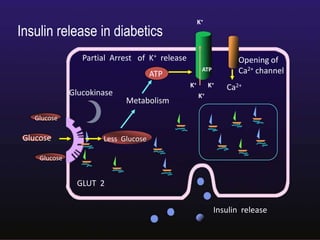
Date :12th Mar 09 Valid: 11th Mar 10
Partial Arrest of K+ release Opening of
Ca2+ channel
Ca2+
K+
K+ K+
ATP
Metabolism
Glucokinase
Less Glucose
GLUT 2
Insulin release
ATP
Glucose
Glucose
Glucose
Insulin release in diabetics
K+
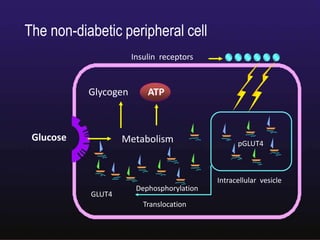
Date :12th Mar 09 Valid: 11th Mar 10
Insulin receptors
Glucose
Glycogen
Metabolism
GLUT4
Dephosphorylation
Translocation
Intracellular vesicle
pGLUT4
ATP
The non-diabetic peripheral cell
Date :12th Mar 09 Valid: 11th Mar 10
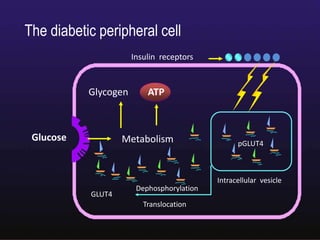
Insulin receptors
Glucose
Glycogen
Metabolism
GLUT4
Dephosphorylation
Translocation
Intracellular vesicle
pGLUT4
ATP
The diabetic peripheral cell
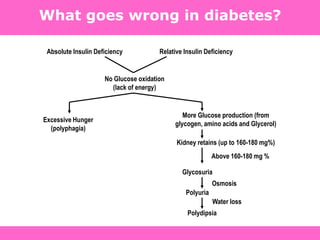
Absolute Insulin Deficiency Relative Insulin Deficiency
No Glucose oxidation
(lack of energy)
Excessive Hunger
(polyphagia)
More Glucose production (from
glycogen, amino acids and Glycerol)
Kidney retains (up to 160-180 mg%)
Above 160-180 mg %
Glycosuria
Polyuria
Osmosis
Water loss
Polydipsia
What goes wrong in diabetes?
Definition, Diagnosis and Classification of Diabetes Mellitus and its Complications. Department of Noncommunicable Disease Surveillance,
World Health Organization, Geneva 1999. Available at: http://www.diabetes.org.uk/infocentre/carerec/diagnosi.doc
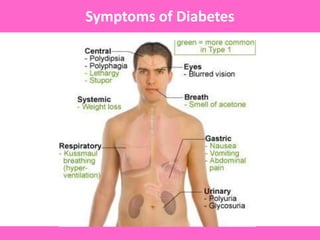
Symptoms of Diabetes
Definition, Diagnosis and Classification of Diabetes Mellitus and its Complications. Department of Noncommunicable Disease Surveillance,
World Health Organization, Geneva 1999. Available at: http://www.diabetes.org.uk/infocentre/carerec/diagnosi.doc
Diagnosis of Diabetes
 Polyuria – Increased micturition
 Polydipsia – Increased thirst
 Polyphagia – Increased hunger
 Fatigue
 Skin infections
 Impotence
 Tingling, numbness
Definition, Diagnosis and Classification of Diabetes Mellitus and its Complications. Department of Noncommunicable Disease Surveillance,
World Health Organization, Geneva 1999. Available at: http://www.diabetes.org.uk/infocentre/carerec/diagnosi.doc
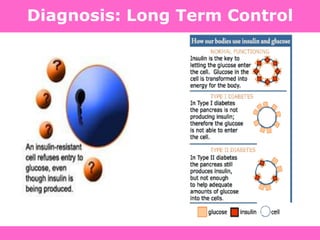
Diagnosis: Long Term Control
Definition, Diagnosis and Classification of Diabetes Mellitus and its Complications. Department of Noncommunicable Disease Surveillance,
World Health Organization, Geneva 1999. Available at: http://www.diabetes.org.uk/infocentre/carerec/diagnosi.doc
Glycated Hb (Hb A1c)
• Increased blood glucose level leads to an
increase in non enzymatic glycation of Hb.
• It reflects glycaemic control over past 2-3
months.
• Normal = < 6%
Definition, Diagnosis and Classification of Diabetes Mellitus and its Complications. Department of Noncommunicable Disease Surveillance,
World Health Organization, Geneva 1999. Available at: http://www.diabetes.org.uk/infocentre/carerec/diagnosi.doc
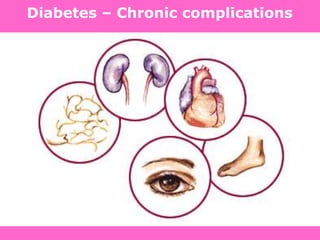
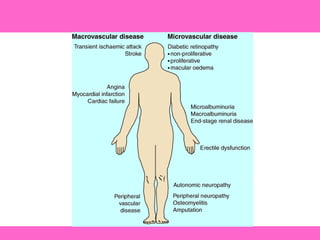
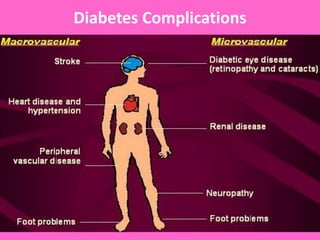
Chronic Complication of Diabetes Mellitus
Microvascular Macrovascular
Eye Disease
Retinopathy
(nonproliferative/proliferative)
Macular edema
Cataracts
Glaucoma
Neuropathy
Sensory ,motor & Autonomic
Nephropathy
Coronary artery disease
Peripheral vascular disease
Cerebrovascular disease
Other
Gastrointestinal
(gastroparesis, diarrhea)
Genitourinary
(uropathy/sexual
dysfunction)
Dermatologic
Definition, Diagnosis and Classification of Diabetes Mellitus and its Complications. Department of Noncommunicable Disease Surveillance,
World Health Organization, Geneva 1999. Available at: http://www.diabetes.org.uk/infocentre/carerec/diagnosi.doc
Diabetes – Chronic complications
Definition, Diagnosis and Classification of Diabetes Mellitus and its Complications. Department of Noncommunicable Disease Surveillance,
World Health Organization, Geneva 1999. Available at: http://www.diabetes.org.uk/infocentre/carerec/diagnosi.doc
Diabetes Complications
ClickMan.wmv
Diabetes Complications
DIABETIC
MICROVASCULAR
COMPLICATIONS
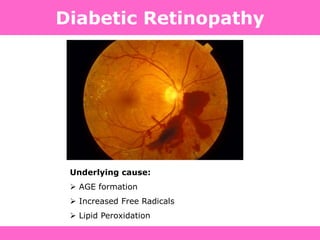
Underlying cause:
 AGE formation
 Increased Free Radicals
 Lipid Peroxidation
Diabetic Retinopathy
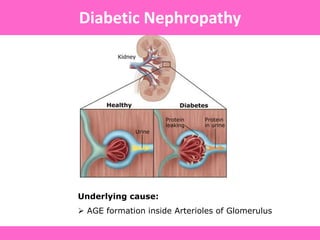
Underlying cause:
 AGE formation inside Arterioles of Glomerulus
Diabetic Nephropathy
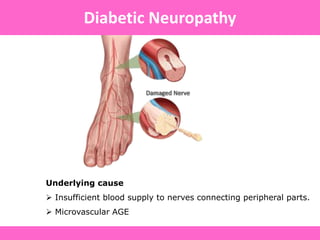
Underlying cause
 Insufficient blood supply to nerves connecting peripheral parts.
 Microvascular AGE
Diabetic Neuropathy
DIABETIC
MACROVASCULAR
COMPLICATIONS
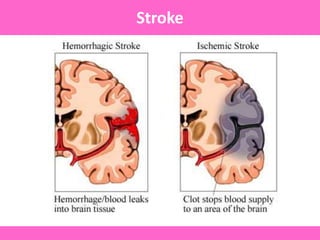
Stroke
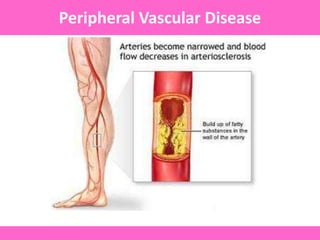
Peripheral Vascular Disease
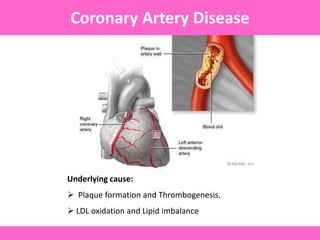
Underlying cause:
 Plaque formation and Thrombogenesis.
 LDL oxidation and Lipid imbalance
Coronary Artery Disease
Underlying cause:
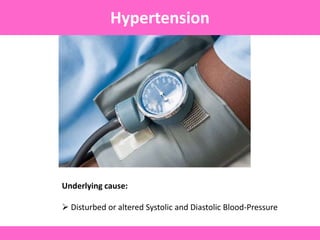
 Disturbed or altered Systolic and Diastolic Blood-Pressure
Hypertension
Bonora E, et al. Diabetes Care 2002; 25:1135–1141.
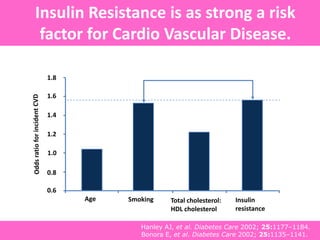
Insulin Resistance is as strong a risk
factor for Cardio Vascular Disease.
Hanley AJ, et al. Diabetes Care 2002; 25:1177–1184.
Bonora E, et al. Diabetes Care 2002; 25:1135–1141.
0.6
0.8
1.0
1.2
1.4
1.6
1.8
Age Smoking Total cholesterol:
HDL cholesterol
Insulin
resistance
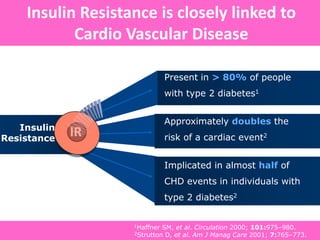
Present in > 80% of people
with type 2 diabetes1
Approximately doubles the
risk of a cardiac event2
Implicated in almost half of
CHD events in individuals with
type 2 diabetes2
Insulin
Resistance
IR
1Haffner SM, et al. Circulation 2000; 101:975–980.,2Strutton D, et al. Am J Man Care 2001; 7:765–773.
Insulin Resistance is closely linked to
Cardio Vascular Disease
1Haffner SM, et al. Circulation 2000; 101:975–980.
2Strutton D, et al. Am J Manag Care 2001; 7:765–773.
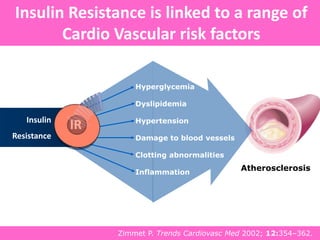
Atherosclerosis
Hyperglycemia
Dyslipidemia
Hypertension
Damage to blood vessels
Clotting abnormalities
Inflammation
Insulin
Resistance
IR
Insulin Resistance is linked to a range of
Cardio Vascular risk factors
Zimmet P. Trends Cardiovasc Med 2002; 12:354–362.
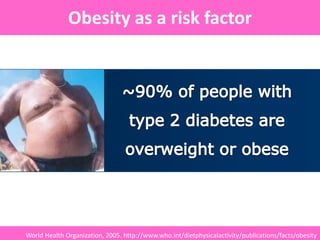
Obesity as a risk factor
World Health Organization, 2005. http://www.who.int/dietphysicalactivity/publications/facts/obesity
Definition, Diagnosis and Classification of Diabetes Mellitus and its Complications. Department of Noncommunicable Disease
Surveillance,
World Health Organization, Geneva 1999. Available at: http://www.diabetes.org.uk/infocentre/carerec/diagnosi.doc
Goals of Therapy
 TO MAINTAIN BLOOD GLUCOSE AT NEAR-NORMAL LEVELS
(70-120MG/DL)
 REDUCE THE RISK OF COMPLICATIONS
Definition, Diagnosis and Classification of Diabetes Mellitus and its Complications. Department of Noncommunicable Disease Surveillance,
World Health Organization, Geneva 1999. Available at: http://www.diabetes.org.uk/infocentre/carerec/diagnosi.doc
Management Strategies
SELF
MEDICATIONS
MONITORING
EDUCATION
Definition, Diagnosis and Classification of Diabetes Mellitus and its Complications. Department of Noncommunicable Disease Surveillance,
World Health Organization, Geneva 1999. Available at: http://www.diabetes.org.uk/infocentre/carerec/diagnosi.doc
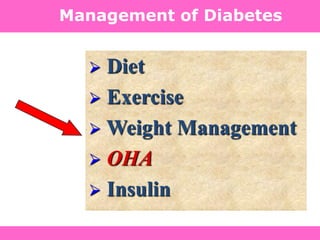
Management of Diabetes
 Diet
 Exercise
 Weight Management
 OHA
 Insulin
Definition, Diagnosis and Classification of Diabetes Mellitus and its Complications. Department of Noncommunicable Disease Surveillance,
World Health Organization, Geneva 1999. Available at: http://www.diabetes.org.uk/infocentre/carerec/diagnosi.doc
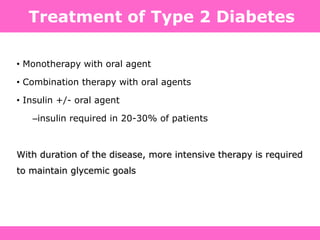
Treatment of Type 2 Diabetes
• Monotherapy with oral agent
• Combination therapy with oral agents
• Insulin +/- oral agent
–insulin required in 20-30% of patients
With duration of the disease, more intensive therapy is required
to maintain glycemic goals
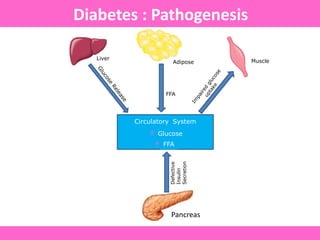
Diabetes : Pathogenesis
Circulatory System
Pancreas
Defective
Insulin
Secretion
FFA
Liver
Adipose Muscle
Circulatory System
Glucose
FFA
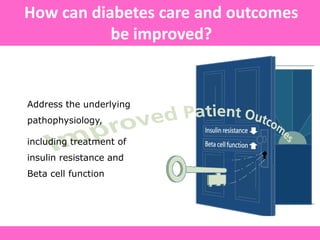
Address the underlying
pathophysiology,
including treatment of
insulin resistance and
Beta cell function
Del Prato S, et al. Int J Clin Pract 2005; 59:1345–1355.
How can diabetes care and outcomes
be improved?
• By 2030, India will become the Diabetic Capital of
the World
• DM is the leading cause of blindness, End Stage
Renal Disease and Amputations
• Over 60% of ESRD is due to Diabetes
• 70 % Diabetics die of – CHD, CVD
• Leading cause of non traumatic LL amputation
• So, screen all for Diabetes and for risk factors
India Diabetes Fast Facts
Diabetes Medications
• Biguanides Ex:Metformin
• Sulfonylureas Ex:Tolbutamide, Glipizide, Glimepiride
• Meglitinides Ex:Repaglinide, Nateglinide
• Alpha Glucosidase Inhibitors Ex:Acarbose, Miglitol, Voglibose
• Thiazolidinediones Ex:Pioglitazone
• DPP4 inhibitors Ex:Sitagliptin, Vildagliptin, Saxagliptin
• GLP-1 analogs Ex:Exanatide, Liraglutide
• Insulin
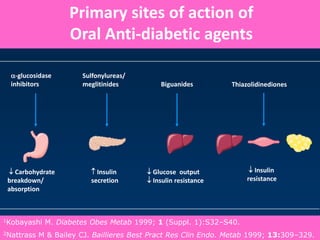
 Glucose output
 Insulin resistance
Biguanides
 Insulin
secretion
Sulfonylureas/
meglitinides
 Carbohydrate
breakdown/
absorption
-glucosidase
inhibitors
 Insulin
resistance
Thiazolidinediones
Primary sites of action of
Oral Anti-diabetic agents
1Kobayashi M. Diabetes Obes Metab 1999; 1 (Suppl. 1):S32–S40.
2Nattrass M & Bailey CJ. Baillieres Best Pract Res Clin Endo. Metab 1999; 13:309–329.
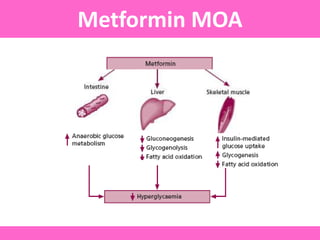
• Biguanides (Metformin) lowers the production of glucose
made in the liver
• Well accepted as the drug of first choice in Type II
• Major side effects are GI
• Lactic acidosis rare but serious side effect
Biguanides:(Glyciphage-Metformin)
Metformin MOA
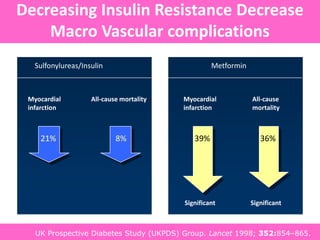
Myocardial
infarction
All-cause mortality
Sulfonylureas/Insulin
Myocardial
infarction
Significant
All-cause
mortality
Significant
Metformin
21% 8% 39% 36%
UK Prospective Diabetes Study (UKPDS) Group. Lancet 1998; 352:854–865.
Decreasing Insulin Resistance Decrease
Macro Vascular complications
UK Prospective Diabetes Study (UKPDS) Group. Lancet 1998; 352:854–865.
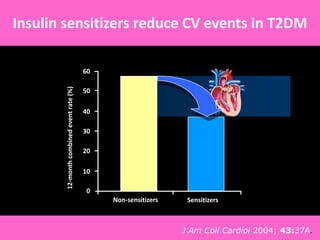
12-monthcombinedeventrate(%)
0
10
20
30
40
Non-sensitizers Sensitizers
50
60
Kao JA, et al. J Am Coll Cardiol 2004; 43:37A.
Insulin sensitizers reduce CV events in T2DM
J Am Coll Cardiol 2004; 43:37A.
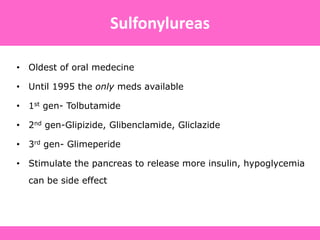
• Oldest of oral medecine
• Until 1995 the only meds available
• 1st gen- Tolbutamide
• 2nd gen-Glipizide, Glibenclamide, Gliclazide
• 3rd gen- Glimeperide
• Stimulate the pancreas to release more insulin, hypoglycemia
can be side effect
Sulfonylureas
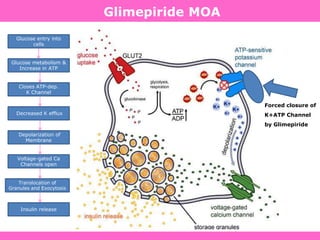
Glimepiride MOA
Forced closure of
K+ATP Channel
by Glimepiride
Glucose metabolism &
Increase in ATP
Decreased K efflux
Depolarization of
Membrane
Voltage-gated Ca
Channels open
Translocation of
Granules and Exocytosis
Insulin release
Glucose entry into
cells
Closes ATP-dep.
K Channel
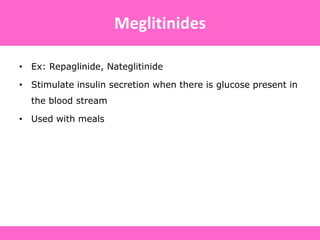
• Ex: Repaglinide, Nateglitinide
• Stimulate insulin secretion when there is glucose present in
the blood stream
• Used with meals
Meglitinides
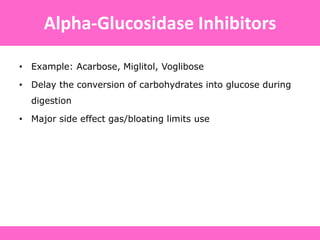
• Example: Acarbose, Miglitol, Voglibose
• Delay the conversion of carbohydrates into glucose during
digestion
• Major side effect gas/bloating limits use
Alpha-Glucosidase Inhibitors
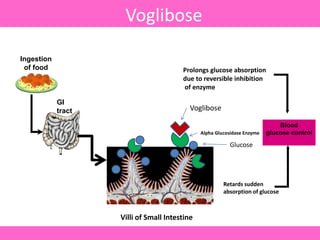
Blood
glucose control
GI
tract
Ingestion
of food
Villi of Small Intestine
Voglibose
Alpha Glucosidase Enzyme
Glucose
Prolongs glucose absorption
due to reversible inhibition
of enzyme
Retards sudden
absorption of glucose
Voglibose
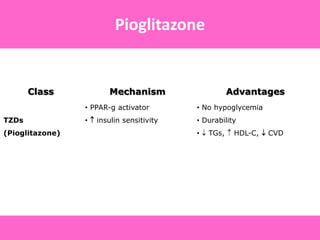
Class Mechanism Advantages
TZDs
(Pioglitazone)
• PPAR-g activator
•  insulin sensitivity
• No hypoglycemia
• Durability
•  TGs,  HDL-C,  CVD
Pioglitazone
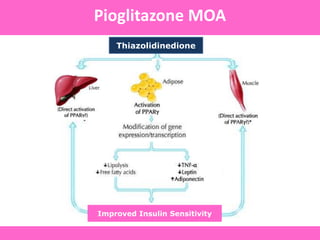
Pioglitazone MOA
Improved Insulin Sensitivity
Thiazolidinedione
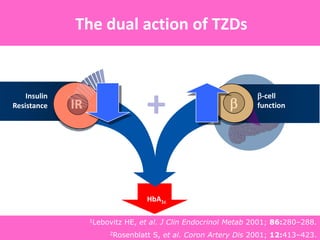
+
HbA1c
Insulin
Resistance IR
-cell
function
Lebovitz HE, et al. J Clin Endocrinol Metab 2001; 86:280–288.
The dual action of TZDs
1Lebovitz HE, et al. J Clin Endocrinol Metab 2001; 86:280–288.
2Rosenblatt S, et al. Coron Artery Dis 2001; 12:413–423.
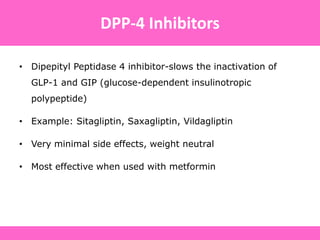
• Dipepityl Peptidase 4 inhibitor-slows the inactivation of
GLP-1 and GIP (glucose-dependent insulinotropic
polypeptide)
• Example: Sitagliptin, Saxagliptin, Vildagliptin
• Very minimal side effects, weight neutral
• Most effective when used with metformin
DPP-4 Inhibitors
• Exenatide-originally isolated from the saliva of Gila monster Lizard
• Shares several of the coregulatory effects of the incretin glucagon-
like peptide-1(GLP-1)
• Improves glucose dependent insulin secretion
• Restores first phase insulin response
• Suppresses inappropriate glucagon secretion
• Slows rate of gastric emptying
• Increases satiety
• BID injection, main side effect nausea/weight loss
Incretin Mimetics
• Rapid Acting
• Intermediate Acting
• Long Acting
• Premixed Insulin
Insulin
PG = plasma glucose Diabetes Care, Diabetologia. 19 April 2012
ANTI-HYPERGLYCEMIC THERAPY
Glycemic targets
- HbA1c < 7.0% (mean PG 150-160 mg/dl [8.3-8.9 mmol/l])
- Pre-prandial PG <130 mg/dl (7.2 mmol/l)
- Post-prandial PG <180 mg/dl (10.0 mmol/l)
- Individualization is key:
 Tighter targets (6.0 - 6.5%) - younger, healthier
 Looser targets (7.5 - 8.0%+) - older, comorbidities, hypoglycemia
prone, etc.
PG = plasma glucose Diabetes Care, Diabetologia. 19 April 2012
ADA-EASD Position Statement:
Management of Hyperglycemia in T2DM
Diabetes Care, Diabetologia., 19 April 2012 [Epub ahead of print]
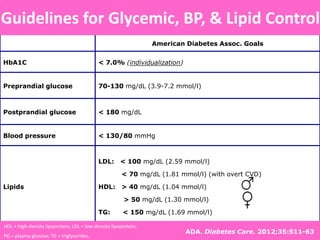
American Diabetes Assoc. Goals
HbA1C < 7.0% (individualization)
Preprandial glucose 70-130 mg/dL (3.9-7.2 mmol/l)
Postprandial glucose < 180 mg/dL
Blood pressure < 130/80 mmHg
Lipids
LDL: < 100 mg/dL (2.59 mmol/l)
< 70 mg/dL (1.81 mmol/l) (with overt CVD)
HDL: > 40 mg/dL (1.04 mmol/l)
> 50 mg/dL (1.30 mmol/l)
TG: < 150 mg/dL (1.69 mmol/l)
Guidelines for Glycemic, BP, & Lipid Control
ADA. Diabetes Care. 2012;35:S11-63
HDL = high-density lipoprotein; LDL = low-density lipoprotein;
PG = plasma glucose; TG = triglycerides.
Thank You
126
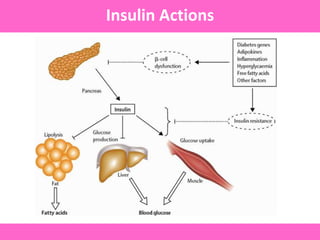
Figure – Normal insulin action pathway
Insulin Actions

4.diabetes basic

  • 1.
  • 2.
    Gastrointestinal system • Mouth •Stomach and duodenum • Pancreas • Small intestine • Liver and other organs
  • 3.
    Liver functions • Production– plasma proteins, blood clotting proteins, bile pigments • Storage – vitamins, minerals, fat, glucose as glycogen • Conversion/utilization – fats, carbohydrates, proteins • Removal – aged blood cells, drugs or toxins, waste products
  • 4.
    Energy source forbody • Proteins: 10-12% • Fats: 30% • Carbohydrates: 60%
  • 5.
    Journey of Glucose FoodCarbohydrates Formation formed of glucose Glucose Glucose Glucose enters enters reaches different blood Cell body parts Mediated by Insulin Glucose used for various functions Extra glucose stored in a different form
  • 6.
    Steps in utilizationof glucose Entry of glucose in cell Phosphorylation of glucose Release of energy
  • 7.
    • Facilitates thetransport of glucose into muscle and adipose cells • Facilitates the conversion of glucose to glycogen for storage in the liver and muscle. • Decreases the breakdown and release of glucose from glycogen by the liver Insulin-Carbohydrate Metabolism
  • 8.
    • Stimulates proteinsynthesis • Inhibits protein breakdown; diminishes gluconeogenesis Insulin - Protein Metabolism
  • 9.
    • Stimulates lipogenesis-the transport of triglycerides to adipose tissue • Inhibits lipolysis – prevents excessive production of ketones or ketoacidosis Insulin - Fat Metabolism
  • 10.
    Pancreas • Exocrine function –Digestive enzymes • Pancreatic amylase • Pancreatic lipase • Trypsin • Chymotrypsin • Carboxypolypeptidase • Nuclease • Endocrine function – Hormones • Insulin • Glucagon • somatostatin
  • 11.
    Endocrine function • Hormonesact on target tissues to exert its effect • Produced by the islet of Langerhans – number of cells in each islet vary from several hundred to millions • Glucagon – alpha cells – Secreted when blood glucose levels fall • Insulin – beta cells – Secreted when blood glucose levels rise • Somatostatin – delta cells – Secreted in response to any kind of food intake – suppresses both insulin and glucagon and may extend the period of nutrient absorption and utilization
  • 13.
    What is insulin? •A hormone – (from Greek - "to set in motion") is a chemical messenger from one cell (or group of cells) to another. • Insulin is the protein hormone produced by cells in the pancreas that regulate levels of glucose and regulate metabolism in glucose, fats, and proteins. • Insulin is composed of 51 amino acids. • Amino acids are the basic structural building units of proteins • Its formula is C254 H377 N65 O75 S6.
  • 14.
    Role of Insulin •Hormone secreted by beta cells of pancreas • Controls the rate of entry of glucose inside the cell • Increases glucose utilization rate in the cell • Increases rate of glucose transport in the cell by more than 10 times. Hexamer of insulin
  • 15.
  • 16.
    Regulation of HormoneSecretion • Non-hormonal – Control of release dependent upon concentration of other non-hormonal substance (i.e., glucose)
  • 17.
    Few Important Definitions... •Glycolysis: Breakdown of glucose to release energy • Glycogenesis: Formation of glycogen for storage from unutilized glucose • Glycogenolysis: breakdown of stored glycogen into glucose • Gluconeogenesis: formation of glucose from sources other than carbohydrate (fat/protein) to meet energy requirement
  • 18.
    C-peptide • Insulin manufacturedand stored as proinsulin (86 AA) • C-peptide (31 AA) ensures correct folding of protein • Enzymatic cleavage (4 AA lost) and equal amount released along with insulin (51 AA) • C-peptide levels measured to assess insulin production • No physiological role – used as an insulin marker
  • 19.
  • 20.
    Insulin Biosynthesis inthe Beta Cell Insulin gene codes for pre-proinsulin Release by exocytosis Proinsulin C-peptide Glucose Insulin storage in vesicles
  • 21.
    Physiological Effects ofInsulin • Major target organs: – Liver: insulin increases storage of glucose as glycogen – Muscle: insulin stimulates glycogen and protein synthesis. – Adipose: insulin stimulates triglyceride storage
  • 22.
    Date :12th Mar09 Valid: 11th Mar 10 Arrest of K+ release Ca2+ Opening of Ca2+ channel Ca2+ K+ K+ K+ ATP Metabolism Glucokinase Glucose Glucose Glucose GLUT 2 Insulin release ATP Glucose Insulin release in non - diabetics BETA CELL
  • 23.
    Date :12th Mar09 Valid: 11th Mar 10 Insulin receptors Glucose Glycogen Metabolism GLUT4 Dephosphorylation Translocation Intracellular vesicle pGLUT4 ATP The non - diabetic peripheral cell
  • 24.
    Insulin secretion • Insulinsecretion increases almost 10 folds within 5 to 10 minutes of food intake. • Insulin secretion is stimulated by glucose
  • 25.
    The Basal/Bolus InsulinConcept • Basal insulin – Continuous, constant, low level secretion for 24 hours – Suppresses glucose production between meals and overnight – 40% to 50% of daily needs • Bolus insulin (mealtime)- 2 phases – Limits hyperglycemia after meals – Immediate rise and sharp peak at 1 hour – 10% to 20% of total daily insulin requirement at each meal
  • 26.
    0 10 20 30 40 50 0 2 46 8 10 12 14 16 18 20 22 24 Time (Hours) Meal Meal Meal Basal Insulin Needs Bolus insulin needs Seruminsulin(mU/L)
  • 27.
    Phases of insulinrelease • First phase – Release starts as soon as food comes to the stomach – Preformed stored insulin is released – 10-fold increase in levels within 3-5 minutes – Speeds up the use of glucose – Within 5-10 minutes, insulin secretion decreases by half • Second phase – Rising glucose levels send signals to the beta cell nucleus  DNA produces mRNA  mRNA produces more insulin – Causes a less acute rise in insulin levels – Reaches a plateau in 2-3 hours
  • 28.
  • 29.
    glycogen synthesis glycogenolysis triglyceridesynthesis ketogenesis gluconeogenesis glucose uptake protein synthesis protein degradation glycogen synthesis glycogenolysis glucose uptake triglyceride storage lipolysis Stimulates Inhibits  Liver  Skeletal Muscle  Adipose tissue Promotes anabolic processes Inhibits catabolic processes Effects of insulin:
  • 30.
  • 31.
    • 1500BC –Egyptians recorded diabetes as polyuria • 1st Century AD – diabetes described as “the melting down of flesh and limbs into urine” • 20th Century – children with Type 1 diabetes had life expectancy of 2 years – Hypothesized that liver and pancreas were involved in some way, although cause unknown • 1922 – Frederick Banting & Co. successfully isolate insulin extract for diabetes Type 1 • 2011 – Type 2 diabetes comprises roughly 90% of all diagnosed cases, likely due to increased obesity and inactivity levels History of Diabetes
  • 32.
    Diabetes Mellitus Derived fromGreek roots dia – through bainein – to go To go through – meaning syphon Mellitus – Latin „mel‟ for „honey‟ Diabetes Mellitus – Sweet syphon
  • 33.
    Diabetes – Definition DiabetesMellitus is a metabolic disorder caused by reduced availability or diminished effectiveness of insulin, characterized by hyperglycemia with or without glycosuria.
  • 34.
    Diabetes Mellitus • Chronicmedical condition • Inability to properly utilize glucose • Diabetes can cause acute medical emergencies –Too much glucose (hyperglycemia) –Too little glucose (hypoglycemia)
  • 35.
  • 36.
    Diabetes Mellitus Types ofDiabetes • Type 1 Diabetes • Type 2 Diabetes • Gestational Diabetes
  • 37.
    Action of Insulinon the Cell Metabolism
  • 38.
    • Low orabsent endogenous insulin • Dependent on exogenous insulin for life • Onset generally < 30 years • 5-10% of cases of diabetes • Onset sudden – Symptoms: 3 P‟s: polyuria, polydypsia, polyphagia Type I Diabetes
  • 39.
  • 40.
    • Genetic componentto disease Type I Diabetes
  • 41.
    • Insulin levelsmay be normal, elevated or depressed – Characterized by insulin resistance, – diminished tissue sensitivity to insulin, – and impaired beta cell function (delayed or inadequate insulin release) • Often occurs >40 years Type II Diabetes
  • 42.
  • 43.
    • Risk factors:family history, sedentary lifestyle, obesity and aging • Controlled by weight loss, oral hypoglycemic agents and or insulin Type II Diabetes
  • 44.
    TYPE I +TYPE II Type I Diabetes Type II Diabetes GLUCOSE GLUCOSE INSULIN CELL CELL
  • 45.
  • 46.
    Pathogenesis of DM •Insulin resistance • Impaired insulin secretion • Excessive hepatic glucose production
  • 48.
    Pathogenesis of DM(Contd.) Insulin Resistance: • Decreased ability of insulin to act effectively on peripheral tissue • This resistance is relative, since increased levels of insulin will normalize the Pl. glucose level Mechanism – exact not known • Decrease in insulin receptors or post receptor defect
  • 49.
    • Major defectin individuals with type 2 diabetes1 • Reduced biological response to insulin1–3 • Strong predictor of type 2 diabetes4 • Closely associated with obesity5 IR 1American Diabetes Association. Diabetes Care 1998; 21:310–314. . J Clin Invest 1994; 94:1714–1721. 3Bloomgarden ZT. Clin Ther 1998; 20:216–231. 4Haffner SM, et al. Circulation 2000; 101:975–980. 5Boden G. Diabetes 1997; 46:3–10. Insulin Resistance 1American Diabetes Association. Diabetes Care 1998; 21:310–314. 2Beck-Nielsen H & Groop LC. J Clin Invest 1994; 94:1714–1721. 3Bloomgarden ZT. Clin Ther 1998; 20:216–231. 4Haffner SM, et al. Circulation 2000; 101:975–980. 5Boden G. Diabetes 1997; 46:3–10.
  • 50.
  • 51.
    Pathogenesis of DM(Contd.) Impair insulin secretion • Initially insulin secretion increase in response to insulin resistance to maintain normal blood glucose levels • In later stage beta cell failure develops due to lipo and glucotoxicity - low insulin levels
  • 52.
    Pathogenesis of DM(Contd.) Increased hepatic glucose production • Liver maintain Plasma glucose level during fasting state by glycogenolysis and gluconeogenesis (A.A., F.A., glycerol) • In DM because of insulin resistance, insulin fails to suppress gluconeogenesis which leads to increased blood glucose levels.
  • 53.
    Diagnosis of Diabetes Polyuria – Increased micturition  Polydipsia – Increased thirst  Polyphagia – Increased hunger  Fatigue  Skin infections  Impotence  Tingling, numbness
  • 54.
    Diagnosis of diabetes Symptoms+ Elevated blood glucose level OR Elevated blood glucose levels on two occasions
  • 55.
    Diagnostic criteria fortype 2 diabetes Blood Glucose Parameter HbA1c FPG PPPG Normal < 6.5% < 100 mg/dl < 140 mg/dl Pre-diabetes ≥ 6.5 - 7% 100-125 mg/dl (IFG) 140-199 mg/dl (IGT) Diabetes ≥ 7% 126 mg/dl or above 200 mg/dl or above
  • 56.
    Definitions IGT impaired glucosetolerance – – 2hr plasma glucose is between 7.8mmol/l (140mg/dl) and 11.0mmol/l (200mg/dl) IFG impaired fasting glucose – – Fasting plasma glucose is 6.1–6.9mmol/l (100–125mg/dl) Diabetes- – Confirmed fasting plasma glucose is ≥7.0mmol/l (126mg/dl) – 2hr plasma glucose is ≥11.0mmol/l (200mg/dl)
  • 57.
    Prediabetes & Diabetes diabetesprediabetesnormoglycemic 100mg/dl125 mg/dl 140 mg/dl 199 mg/dl Fasting glucose 2hr Plasma glucose Prediabetes is a condition in which the blood sugar level is higher than normal, but not high enough to be classified as diabetes
  • 58.
    Insulin resistance  Glucose output Glucose uptake  Glucose uptake Hyperglycemia Liver Muscle Adipose tissue IR Insulin Resistance – Reduced response to circulating insulin
  • 59.
    Chronic Hyperglycemia Over secretion of insulinto compensate for insulin resistance1,2 High circulating free fatty acids Glucotoxicity2 Pancreas Lipotoxicity3 -cell dysfunction . Eur J Clin Invest 2002; 32:14–23., 2Kaiser N, et al. J Pediatr Endocrinol Metab 2003; 16:5– 22.,3Finegood DT & Topp B. Diabetes Obes Metab 2001; 3 (Suppl. 1):S20–S27. Why does the -cell fail? 1Boden G & Shulman GI. Eur J Clin Invest 2002; 32:14–23. 2Kaiser N, et al. J Pediatr Endocrinol Metab 2003; 16:5–22. 3Finegood DT & Topp B. Diabetes Obes Metab 2001; 3 (Suppl. 1):S20–S27.
  • 60.
    What is -celldysfunction? • Major defect in individuals with type 2 diabetes • Reduced ability of -cells to secrete insulin in response to hyperglycemia     DeFronzo RA, et al. Diabetes Care 1992; 15:318–354.
  • 61.
    Insulin Resistance Genetic susceptibility, Obesity, Sedentary lifestyle Type 2diabetes IR -cell dysfunction Core defects in T2DM Rhodes CJ & White MF. Eur J Clin Invest 2002; 32 (Suppl. 3):3–13.
  • 63.
    Évolution of diabetes Normal Compensation phase Diabetes DeFronzoR.A. et al., Diabetes Care (1998) Insulin Resistance & Insulin Deficiency: 2 strongly linked mechanisms At the time of diagnosis, both defects are already combined Insulin resistance Fasting blood glucose Insulin secretion
  • 64.
    Type 2 diabetes Yearsfrom diagnosis 0 5-10 -5 10 15 Pre-diabetes Onset Diagnosis Insulin secretion Insulin resistance Postprandial glucose Macrovascular complications Adapted from Ramlo-Halsted BA, Edelman SV. Prim Care. 1999;26:771-789; Nathan DM. N Engl J Med. 2002;347:1342-1349 Fasting glucose Microvascular complications Natural History of Type 2 Diabetes
  • 65.
    Abnormal glucose tolerance Hyperinsulinemia, then -cellfailure Normal IGT* Type 2 diabetes PPPG Insulin resistance Increased insulin resistance FPG Hyperglycemia Insulin secretion *IGT = impaired glucose tolerance Role of IR and -cell dysfunction in T2DM International Diabetes Center (IDC), Minneapolis, 2000.
  • 66.
    -12 -6 06 12 0 20 40 60 80 100 Years Diagnosis UKPDS 16 diabetes 1995, 44:1249-1258 Progressive -cell Failure in Type 2 Diabetes
  • 67.
    Insulin resistant; low insulinsecretion (54%) Insulin resistant; good insulin secretion (29%) Insulin sensitive; good insulin secretion (1%) Insulin sensitive; low insulin secretion (16%) 83% More IR patients are progressing to T2DM Haffner SM, et al. Circulation 2000; 101:975–980.
  • 68.
    Date :12th Mar09 Valid: 11th Mar 10 Arrest of K+ release Ca2+ Opening of Ca2+ channel Ca2+ K+ K+ K+ ATP Metabolism Glucokinase Glucose Glucose Glucose GLUT 2 Insulin release ATP Glucose Insulin release in non-diabetics
  • 69.
    Date :12th Mar09 Valid: 11th Mar 10 Partial Arrest of K+ release Opening of Ca2+ channel Ca2+ K+ K+ K+ ATP Metabolism Glucokinase Less Glucose GLUT 2 Insulin release ATP Glucose Glucose Glucose Insulin release in diabetics K+
  • 70.
    Date :12th Mar09 Valid: 11th Mar 10 Insulin receptors Glucose Glycogen Metabolism GLUT4 Dephosphorylation Translocation Intracellular vesicle pGLUT4 ATP The non-diabetic peripheral cell
  • 71.
    Date :12th Mar09 Valid: 11th Mar 10 Insulin receptors Glucose Glycogen Metabolism GLUT4 Dephosphorylation Translocation Intracellular vesicle pGLUT4 ATP The diabetic peripheral cell
  • 73.
    Absolute Insulin DeficiencyRelative Insulin Deficiency No Glucose oxidation (lack of energy) Excessive Hunger (polyphagia) More Glucose production (from glycogen, amino acids and Glycerol) Kidney retains (up to 160-180 mg%) Above 160-180 mg % Glycosuria Polyuria Osmosis Water loss Polydipsia What goes wrong in diabetes?
  • 74.
    Definition, Diagnosis andClassification of Diabetes Mellitus and its Complications. Department of Noncommunicable Disease Surveillance, World Health Organization, Geneva 1999. Available at: http://www.diabetes.org.uk/infocentre/carerec/diagnosi.doc Symptoms of Diabetes
  • 75.
    Definition, Diagnosis andClassification of Diabetes Mellitus and its Complications. Department of Noncommunicable Disease Surveillance, World Health Organization, Geneva 1999. Available at: http://www.diabetes.org.uk/infocentre/carerec/diagnosi.doc Diagnosis of Diabetes  Polyuria – Increased micturition  Polydipsia – Increased thirst  Polyphagia – Increased hunger  Fatigue  Skin infections  Impotence  Tingling, numbness
  • 76.
    Definition, Diagnosis andClassification of Diabetes Mellitus and its Complications. Department of Noncommunicable Disease Surveillance, World Health Organization, Geneva 1999. Available at: http://www.diabetes.org.uk/infocentre/carerec/diagnosi.doc Diagnosis: Long Term Control
  • 77.
    Definition, Diagnosis andClassification of Diabetes Mellitus and its Complications. Department of Noncommunicable Disease Surveillance, World Health Organization, Geneva 1999. Available at: http://www.diabetes.org.uk/infocentre/carerec/diagnosi.doc Glycated Hb (Hb A1c) • Increased blood glucose level leads to an increase in non enzymatic glycation of Hb. • It reflects glycaemic control over past 2-3 months. • Normal = < 6%
  • 78.
    Definition, Diagnosis andClassification of Diabetes Mellitus and its Complications. Department of Noncommunicable Disease Surveillance, World Health Organization, Geneva 1999. Available at: http://www.diabetes.org.uk/infocentre/carerec/diagnosi.doc Chronic Complication of Diabetes Mellitus Microvascular Macrovascular Eye Disease Retinopathy (nonproliferative/proliferative) Macular edema Cataracts Glaucoma Neuropathy Sensory ,motor & Autonomic Nephropathy Coronary artery disease Peripheral vascular disease Cerebrovascular disease Other Gastrointestinal (gastroparesis, diarrhea) Genitourinary (uropathy/sexual dysfunction) Dermatologic
  • 79.
    Definition, Diagnosis andClassification of Diabetes Mellitus and its Complications. Department of Noncommunicable Disease Surveillance, World Health Organization, Geneva 1999. Available at: http://www.diabetes.org.uk/infocentre/carerec/diagnosi.doc Diabetes – Chronic complications
  • 80.
    Definition, Diagnosis andClassification of Diabetes Mellitus and its Complications. Department of Noncommunicable Disease Surveillance, World Health Organization, Geneva 1999. Available at: http://www.diabetes.org.uk/infocentre/carerec/diagnosi.doc
  • 81.
  • 82.
  • 83.
  • 84.
    Underlying cause:  AGEformation  Increased Free Radicals  Lipid Peroxidation Diabetic Retinopathy
  • 85.
    Underlying cause:  AGEformation inside Arterioles of Glomerulus Diabetic Nephropathy
  • 86.
    Underlying cause  Insufficientblood supply to nerves connecting peripheral parts.  Microvascular AGE Diabetic Neuropathy
  • 87.
  • 88.
  • 89.
  • 90.
    Underlying cause:  Plaqueformation and Thrombogenesis.  LDL oxidation and Lipid imbalance Coronary Artery Disease
  • 91.
    Underlying cause:  Disturbedor altered Systolic and Diastolic Blood-Pressure Hypertension
  • 92.
    Bonora E, etal. Diabetes Care 2002; 25:1135–1141. Insulin Resistance is as strong a risk factor for Cardio Vascular Disease. Hanley AJ, et al. Diabetes Care 2002; 25:1177–1184. Bonora E, et al. Diabetes Care 2002; 25:1135–1141. 0.6 0.8 1.0 1.2 1.4 1.6 1.8 Age Smoking Total cholesterol: HDL cholesterol Insulin resistance
  • 93.
    Present in >80% of people with type 2 diabetes1 Approximately doubles the risk of a cardiac event2 Implicated in almost half of CHD events in individuals with type 2 diabetes2 Insulin Resistance IR 1Haffner SM, et al. Circulation 2000; 101:975–980.,2Strutton D, et al. Am J Man Care 2001; 7:765–773. Insulin Resistance is closely linked to Cardio Vascular Disease 1Haffner SM, et al. Circulation 2000; 101:975–980. 2Strutton D, et al. Am J Manag Care 2001; 7:765–773.
  • 94.
    Atherosclerosis Hyperglycemia Dyslipidemia Hypertension Damage to bloodvessels Clotting abnormalities Inflammation Insulin Resistance IR Insulin Resistance is linked to a range of Cardio Vascular risk factors Zimmet P. Trends Cardiovasc Med 2002; 12:354–362.
  • 95.
    Obesity as arisk factor World Health Organization, 2005. http://www.who.int/dietphysicalactivity/publications/facts/obesity
  • 96.
    Definition, Diagnosis andClassification of Diabetes Mellitus and its Complications. Department of Noncommunicable Disease Surveillance, World Health Organization, Geneva 1999. Available at: http://www.diabetes.org.uk/infocentre/carerec/diagnosi.doc Goals of Therapy  TO MAINTAIN BLOOD GLUCOSE AT NEAR-NORMAL LEVELS (70-120MG/DL)  REDUCE THE RISK OF COMPLICATIONS
  • 97.
    Definition, Diagnosis andClassification of Diabetes Mellitus and its Complications. Department of Noncommunicable Disease Surveillance, World Health Organization, Geneva 1999. Available at: http://www.diabetes.org.uk/infocentre/carerec/diagnosi.doc Management Strategies SELF MEDICATIONS MONITORING EDUCATION
  • 98.
    Definition, Diagnosis andClassification of Diabetes Mellitus and its Complications. Department of Noncommunicable Disease Surveillance, World Health Organization, Geneva 1999. Available at: http://www.diabetes.org.uk/infocentre/carerec/diagnosi.doc Management of Diabetes  Diet  Exercise  Weight Management  OHA  Insulin
  • 99.
    Definition, Diagnosis andClassification of Diabetes Mellitus and its Complications. Department of Noncommunicable Disease Surveillance, World Health Organization, Geneva 1999. Available at: http://www.diabetes.org.uk/infocentre/carerec/diagnosi.doc Treatment of Type 2 Diabetes • Monotherapy with oral agent • Combination therapy with oral agents • Insulin +/- oral agent –insulin required in 20-30% of patients With duration of the disease, more intensive therapy is required to maintain glycemic goals
  • 100.
    Diabetes : Pathogenesis CirculatorySystem Pancreas Defective Insulin Secretion FFA Liver Adipose Muscle Circulatory System Glucose FFA
  • 101.
    Address the underlying pathophysiology, includingtreatment of insulin resistance and Beta cell function Del Prato S, et al. Int J Clin Pract 2005; 59:1345–1355. How can diabetes care and outcomes be improved?
  • 102.
    • By 2030,India will become the Diabetic Capital of the World • DM is the leading cause of blindness, End Stage Renal Disease and Amputations • Over 60% of ESRD is due to Diabetes • 70 % Diabetics die of – CHD, CVD • Leading cause of non traumatic LL amputation • So, screen all for Diabetes and for risk factors India Diabetes Fast Facts
  • 103.
    Diabetes Medications • BiguanidesEx:Metformin • Sulfonylureas Ex:Tolbutamide, Glipizide, Glimepiride • Meglitinides Ex:Repaglinide, Nateglinide • Alpha Glucosidase Inhibitors Ex:Acarbose, Miglitol, Voglibose • Thiazolidinediones Ex:Pioglitazone • DPP4 inhibitors Ex:Sitagliptin, Vildagliptin, Saxagliptin • GLP-1 analogs Ex:Exanatide, Liraglutide • Insulin
  • 104.
     Glucose output Insulin resistance Biguanides  Insulin secretion Sulfonylureas/ meglitinides  Carbohydrate breakdown/ absorption -glucosidase inhibitors  Insulin resistance Thiazolidinediones Primary sites of action of Oral Anti-diabetic agents 1Kobayashi M. Diabetes Obes Metab 1999; 1 (Suppl. 1):S32–S40. 2Nattrass M & Bailey CJ. Baillieres Best Pract Res Clin Endo. Metab 1999; 13:309–329.
  • 105.
    • Biguanides (Metformin)lowers the production of glucose made in the liver • Well accepted as the drug of first choice in Type II • Major side effects are GI • Lactic acidosis rare but serious side effect Biguanides:(Glyciphage-Metformin)
  • 106.
  • 107.
    Myocardial infarction All-cause mortality Sulfonylureas/Insulin Myocardial infarction Significant All-cause mortality Significant Metformin 21% 8%39% 36% UK Prospective Diabetes Study (UKPDS) Group. Lancet 1998; 352:854–865. Decreasing Insulin Resistance Decrease Macro Vascular complications UK Prospective Diabetes Study (UKPDS) Group. Lancet 1998; 352:854–865.
  • 108.
    12-monthcombinedeventrate(%) 0 10 20 30 40 Non-sensitizers Sensitizers 50 60 Kao JA,et al. J Am Coll Cardiol 2004; 43:37A. Insulin sensitizers reduce CV events in T2DM J Am Coll Cardiol 2004; 43:37A.
  • 109.
    • Oldest oforal medecine • Until 1995 the only meds available • 1st gen- Tolbutamide • 2nd gen-Glipizide, Glibenclamide, Gliclazide • 3rd gen- Glimeperide • Stimulate the pancreas to release more insulin, hypoglycemia can be side effect Sulfonylureas
  • 110.
    Glimepiride MOA Forced closureof K+ATP Channel by Glimepiride Glucose metabolism & Increase in ATP Decreased K efflux Depolarization of Membrane Voltage-gated Ca Channels open Translocation of Granules and Exocytosis Insulin release Glucose entry into cells Closes ATP-dep. K Channel
  • 111.
    • Ex: Repaglinide,Nateglitinide • Stimulate insulin secretion when there is glucose present in the blood stream • Used with meals Meglitinides
  • 112.
    • Example: Acarbose,Miglitol, Voglibose • Delay the conversion of carbohydrates into glucose during digestion • Major side effect gas/bloating limits use Alpha-Glucosidase Inhibitors
  • 113.
    Blood glucose control GI tract Ingestion of food Villiof Small Intestine Voglibose Alpha Glucosidase Enzyme Glucose Prolongs glucose absorption due to reversible inhibition of enzyme Retards sudden absorption of glucose Voglibose
  • 114.
    Class Mechanism Advantages TZDs (Pioglitazone) •PPAR-g activator •  insulin sensitivity • No hypoglycemia • Durability •  TGs,  HDL-C,  CVD Pioglitazone
  • 115.
    Pioglitazone MOA Improved InsulinSensitivity Thiazolidinedione
  • 116.
    + HbA1c Insulin Resistance IR -cell function Lebovitz HE,et al. J Clin Endocrinol Metab 2001; 86:280–288. The dual action of TZDs 1Lebovitz HE, et al. J Clin Endocrinol Metab 2001; 86:280–288. 2Rosenblatt S, et al. Coron Artery Dis 2001; 12:413–423.
  • 117.
    • Dipepityl Peptidase4 inhibitor-slows the inactivation of GLP-1 and GIP (glucose-dependent insulinotropic polypeptide) • Example: Sitagliptin, Saxagliptin, Vildagliptin • Very minimal side effects, weight neutral • Most effective when used with metformin DPP-4 Inhibitors
  • 118.
    • Exenatide-originally isolatedfrom the saliva of Gila monster Lizard • Shares several of the coregulatory effects of the incretin glucagon- like peptide-1(GLP-1) • Improves glucose dependent insulin secretion • Restores first phase insulin response • Suppresses inappropriate glucagon secretion • Slows rate of gastric emptying • Increases satiety • BID injection, main side effect nausea/weight loss Incretin Mimetics
  • 119.
    • Rapid Acting •Intermediate Acting • Long Acting • Premixed Insulin Insulin
  • 120.
    PG = plasmaglucose Diabetes Care, Diabetologia. 19 April 2012
  • 121.
    ANTI-HYPERGLYCEMIC THERAPY Glycemic targets -HbA1c < 7.0% (mean PG 150-160 mg/dl [8.3-8.9 mmol/l]) - Pre-prandial PG <130 mg/dl (7.2 mmol/l) - Post-prandial PG <180 mg/dl (10.0 mmol/l) - Individualization is key:  Tighter targets (6.0 - 6.5%) - younger, healthier  Looser targets (7.5 - 8.0%+) - older, comorbidities, hypoglycemia prone, etc. PG = plasma glucose Diabetes Care, Diabetologia. 19 April 2012 ADA-EASD Position Statement: Management of Hyperglycemia in T2DM
  • 122.
    Diabetes Care, Diabetologia.,19 April 2012 [Epub ahead of print]
  • 123.
    American Diabetes Assoc.Goals HbA1C < 7.0% (individualization) Preprandial glucose 70-130 mg/dL (3.9-7.2 mmol/l) Postprandial glucose < 180 mg/dL Blood pressure < 130/80 mmHg Lipids LDL: < 100 mg/dL (2.59 mmol/l) < 70 mg/dL (1.81 mmol/l) (with overt CVD) HDL: > 40 mg/dL (1.04 mmol/l) > 50 mg/dL (1.30 mmol/l) TG: < 150 mg/dL (1.69 mmol/l) Guidelines for Glycemic, BP, & Lipid Control ADA. Diabetes Care. 2012;35:S11-63 HDL = high-density lipoprotein; LDL = low-density lipoprotein; PG = plasma glucose; TG = triglycerides.
  • 124.
  • 125.
    126 Figure – Normalinsulin action pathway Insulin Actions

Editor's Notes

  • #124 Ultimately, more intensive insulin regimens may be required (see Figure 3.)Dashed arrow line on the left-hand side of the figure denotes the option of a more rapid progression from a 2-drug combination directly to multiple daily insulin doses, in those patients with severe hyperglycaemia (e.g. HbA1c ≥10.0-12.0%). Consider beginning with insulin if patient presents with severe hyperglycemia (≥300-350 mg/dl [≥16.7-19.4 mmol/l]; HbA1c ≥10.0-12.0%) with or without catabolic features (weight loss, ketosis, etc).