1
Spectrophotometric Instruments
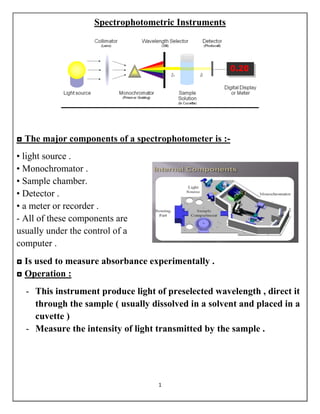
◘ The major components of a spectrophotometer is :-
• light source .
• Monochromator .
• Sample chamber.
• Detector .
• a meter or recorder .
- All of these components are
usually under the control of a
computer .
◘ Is used to measure absorbance experimentally .
◘ Operation :
- This instrument produce light of preselected wavelength , direct it
through the sample ( usually dissolved in a solvent and placed in a
cuvette )
- Measure the intensity of light transmitted by the sample .
2
◘ components of a spectrophotometer:
1-Light source :
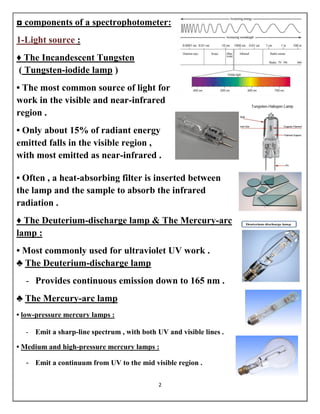
♦ The Incandescent Tungsten
( Tungsten-iodide lamp )
• The most common source of light for
work in the visible and near-infrared
region .
• Only about 15% of radiant energy
emitted falls in the visible region ,
with most emitted as near-infrared .
• Often , a heat-absorbing filter is inserted between
the lamp and the sample to absorb the infrared
radiation .
♦ The Deuterium-discharge lamp & The Mercury-arc
lamp :
• Most commonly used for ultraviolet UV work .
♣ The Deuterium-discharge lamp
- Provides continuous emission down to 165 nm .
♣ The Mercury-arc lamp
• low-pressure mercury lamps :
- Emit a sharp-line spectrum , with both UV and visible lines .
• Medium and high-pressure mercury lamps :
- Emit a continuum from UV to the mid visible region .
3
♦ The most important factors for a light source are :
• Range ( spectral distribution within the range ) .
• The source of radiant production .
• Stability of the radiant energy .
• Temperature .
2-Monochromator :-
• Lamps produce continuous emission of all wavelengths within their
energy .
• Therefore , a spectrophotometer must have an optical system to select
monochromatic light ( light of a specific wavelength ) which is the
function of a monochromator .
• Monochromator select monochromatic light from polychromatic light
- monochromatic light : one wavelength ( narrow band ) , laterally (
one color )
- polychromatic light : many wavelengths ( wide band ) , laterally (
many color )
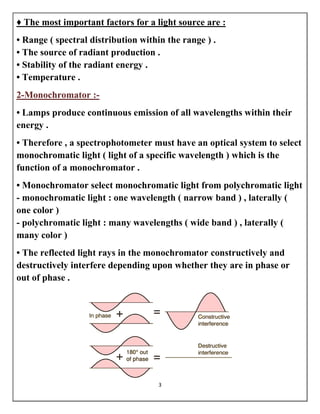
• The reflected light rays in the monochromator constructively and
destructively interfere depending upon whether they are in phase or
out of phase .
4
• The degree of wavelength isolation is a function of :-
- the type of device used .
- the width of entrance and exit slits .
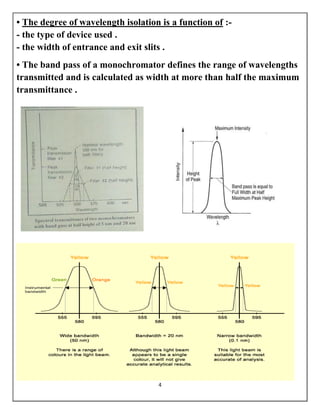
• The band pass of a monochromator defines the range of wavelengths
transmitted and is calculated as width at more than half the maximum
transmittance .
5
◘ Monochromator types :
1- Colored-glass Filters :
• The least expensive .
• Usually pass a relatively band of radiant energy .
• have a low transmittance of the selected wavelength .
• Although not precise , they are simple , inexpensive , and useful .
2- Interference Filters :
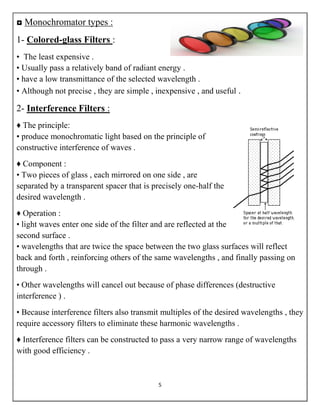
♦ The principle:
• produce monochromatic light based on the principle of
constructive interference of waves .
♦ Component :
• Two pieces of glass , each mirrored on one side , are
separated by a transparent spacer that is precisely one-half the
desired wavelength .
♦ Operation :
• light waves enter one side of the filter and are reflected at the
second surface .
• wavelengths that are twice the space between the two glass surfaces will reflect
back and forth , reinforcing others of the same wavelengths , and finally passing on
through .
• Other wavelengths will cancel out because of phase differences (destructive
interference ) .
• Because interference filters also transmit multiples of the desired wavelengths , they
require accessory filters to eliminate these harmonic wavelengths .
♦ Interference filters can be constructed to pass a very narrow range of wavelengths
with good efficiency .
6
3- The Prism :
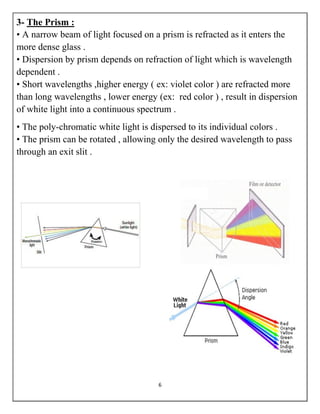
• A narrow beam of light focused on a prism is refracted as it enters the
more dense glass .
• Dispersion by prism depends on refraction of light which is wavelength
dependent .
• Short wavelengths ,higher energy ( ex: violet color ) are refracted more
than long wavelengths , lower energy (ex: red color ) , result in dispersion
of white light into a continuous spectrum .
• The poly-chromatic white light is dispersed to its individual colors .
• The prism can be rotated , allowing only the desired wavelength to pass
through an exit slit .
7
4- Diffraction Gratings :
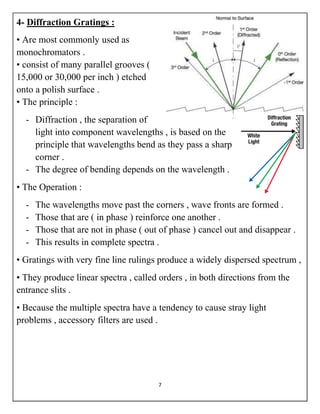
• Are most commonly used as
monochromators .
• consist of many parallel grooves (
15,000 or 30,000 per inch ) etched
onto a polish surface .
• The principle :
- Diffraction , the separation of
light into component wavelengths , is based on the
principle that wavelengths bend as they pass a sharp
corner .
- The degree of bending depends on the wavelength .
• The Operation :
- The wavelengths move past the corners , wave fronts are formed .
- Those that are ( in phase ) reinforce one another .
- Those that are not in phase ( out of phase ) cancel out and disappear .
- This results in complete spectra .
• Gratings with very fine line rulings produce a widely dispersed spectrum ,
• They produce linear spectra , called orders , in both directions from the
entrance slits .
• Because the multiple spectra have a tendency to cause stray light
problems , accessory filters are used .
8
5- Sample Chamber & ( sample cell ) :
♦ sample cell or cuvette may be rounded or square
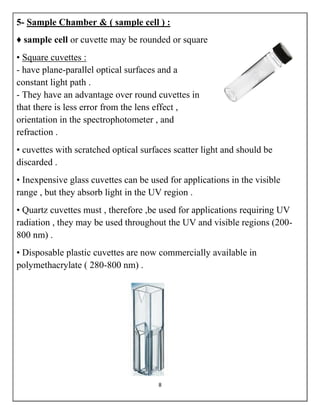
• Square cuvettes :
- have plane-parallel optical surfaces and a
constant light path .
- They have an advantage over round cuvettes in
that there is less error from the lens effect ,
orientation in the spectrophotometer , and
refraction .
• cuvettes with scratched optical surfaces scatter light and should be
discarded .
• Inexpensive glass cuvettes can be used for applications in the visible
range , but they absorb light in the UV region .
• Quartz cuvettes must , therefore ,be used for applications requiring UV
radiation , they may be used throughout the UV and visible regions (200-
800 nm) .
• Disposable plastic cuvettes are now commercially available in
polymethacrylate ( 280-800 nm) .
9
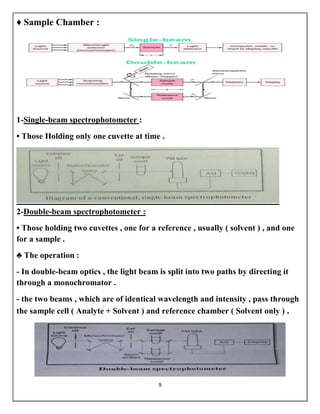
♦ Sample Chamber :
1-Single-beam spectrophotometer :
• Those Holding only one cuvette at time .
2-Double-beam spectrophotometer :
• Those holding two cuvettes , one for a reference , usually ( solvent ) , and one
for a sample .
♣ The operation :
- In double-beam optics , the light beam is split into two paths by directing it
through a monochromator .
- the two beams , which are of identical wavelength and intensity , pass through
the sample cell ( Analyte + Solvent ) and reference chamber ( Solvent only ) .

Spectrophotometric Instruments

  • 1.
    1 Spectrophotometric Instruments ◘ Themajor components of a spectrophotometer is :- • light source . • Monochromator . • Sample chamber. • Detector . • a meter or recorder . - All of these components are usually under the control of a computer . ◘ Is used to measure absorbance experimentally . ◘ Operation : - This instrument produce light of preselected wavelength , direct it through the sample ( usually dissolved in a solvent and placed in a cuvette ) - Measure the intensity of light transmitted by the sample .
  • 2.
    2 ◘ components ofa spectrophotometer: 1-Light source : ♦ The Incandescent Tungsten ( Tungsten-iodide lamp ) • The most common source of light for work in the visible and near-infrared region . • Only about 15% of radiant energy emitted falls in the visible region , with most emitted as near-infrared . • Often , a heat-absorbing filter is inserted between the lamp and the sample to absorb the infrared radiation . ♦ The Deuterium-discharge lamp & The Mercury-arc lamp : • Most commonly used for ultraviolet UV work . ♣ The Deuterium-discharge lamp - Provides continuous emission down to 165 nm . ♣ The Mercury-arc lamp • low-pressure mercury lamps : - Emit a sharp-line spectrum , with both UV and visible lines . • Medium and high-pressure mercury lamps : - Emit a continuum from UV to the mid visible region .
  • 3.
    3 ♦ The mostimportant factors for a light source are : • Range ( spectral distribution within the range ) . • The source of radiant production . • Stability of the radiant energy . • Temperature . 2-Monochromator :- • Lamps produce continuous emission of all wavelengths within their energy . • Therefore , a spectrophotometer must have an optical system to select monochromatic light ( light of a specific wavelength ) which is the function of a monochromator . • Monochromator select monochromatic light from polychromatic light - monochromatic light : one wavelength ( narrow band ) , laterally ( one color ) - polychromatic light : many wavelengths ( wide band ) , laterally ( many color ) • The reflected light rays in the monochromator constructively and destructively interfere depending upon whether they are in phase or out of phase .
  • 4.
    4 • The degreeof wavelength isolation is a function of :- - the type of device used . - the width of entrance and exit slits . • The band pass of a monochromator defines the range of wavelengths transmitted and is calculated as width at more than half the maximum transmittance .
  • 5.
    5 ◘ Monochromator types: 1- Colored-glass Filters : • The least expensive . • Usually pass a relatively band of radiant energy . • have a low transmittance of the selected wavelength . • Although not precise , they are simple , inexpensive , and useful . 2- Interference Filters : ♦ The principle: • produce monochromatic light based on the principle of constructive interference of waves . ♦ Component : • Two pieces of glass , each mirrored on one side , are separated by a transparent spacer that is precisely one-half the desired wavelength . ♦ Operation : • light waves enter one side of the filter and are reflected at the second surface . • wavelengths that are twice the space between the two glass surfaces will reflect back and forth , reinforcing others of the same wavelengths , and finally passing on through . • Other wavelengths will cancel out because of phase differences (destructive interference ) . • Because interference filters also transmit multiples of the desired wavelengths , they require accessory filters to eliminate these harmonic wavelengths . ♦ Interference filters can be constructed to pass a very narrow range of wavelengths with good efficiency .
  • 6.
    6 3- The Prism: • A narrow beam of light focused on a prism is refracted as it enters the more dense glass . • Dispersion by prism depends on refraction of light which is wavelength dependent . • Short wavelengths ,higher energy ( ex: violet color ) are refracted more than long wavelengths , lower energy (ex: red color ) , result in dispersion of white light into a continuous spectrum . • The poly-chromatic white light is dispersed to its individual colors . • The prism can be rotated , allowing only the desired wavelength to pass through an exit slit .
  • 7.
    7 4- Diffraction Gratings: • Are most commonly used as monochromators . • consist of many parallel grooves ( 15,000 or 30,000 per inch ) etched onto a polish surface . • The principle : - Diffraction , the separation of light into component wavelengths , is based on the principle that wavelengths bend as they pass a sharp corner . - The degree of bending depends on the wavelength . • The Operation : - The wavelengths move past the corners , wave fronts are formed . - Those that are ( in phase ) reinforce one another . - Those that are not in phase ( out of phase ) cancel out and disappear . - This results in complete spectra . • Gratings with very fine line rulings produce a widely dispersed spectrum , • They produce linear spectra , called orders , in both directions from the entrance slits . • Because the multiple spectra have a tendency to cause stray light problems , accessory filters are used .
  • 8.
    8 5- Sample Chamber& ( sample cell ) : ♦ sample cell or cuvette may be rounded or square • Square cuvettes : - have plane-parallel optical surfaces and a constant light path . - They have an advantage over round cuvettes in that there is less error from the lens effect , orientation in the spectrophotometer , and refraction . • cuvettes with scratched optical surfaces scatter light and should be discarded . • Inexpensive glass cuvettes can be used for applications in the visible range , but they absorb light in the UV region . • Quartz cuvettes must , therefore ,be used for applications requiring UV radiation , they may be used throughout the UV and visible regions (200- 800 nm) . • Disposable plastic cuvettes are now commercially available in polymethacrylate ( 280-800 nm) .
  • 9.
    9 ♦ Sample Chamber: 1-Single-beam spectrophotometer : • Those Holding only one cuvette at time . 2-Double-beam spectrophotometer : • Those holding two cuvettes , one for a reference , usually ( solvent ) , and one for a sample . ♣ The operation : - In double-beam optics , the light beam is split into two paths by directing it through a monochromator . - the two beams , which are of identical wavelength and intensity , pass through the sample cell ( Analyte + Solvent ) and reference chamber ( Solvent only ) .