1
2- Labeled antibody techniques :
• Several types of immunological tests used labeled antibodies in the test design .
• Molecules ( labels ) such as dyes or enzymes are conjugated ( attached ) to the Fc
portion of the antibodies .
• Attaching these labels to the immunoglobulins does not interfere with the
immunoglobulins’ ability to bind to antigens
• Labeled antibody techniques are among the
more sensitive immunoassays available.
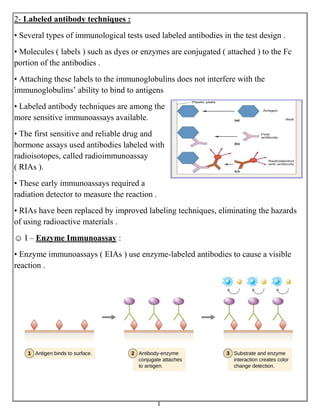
• The first sensitive and reliable drug and
hormone assays used antibodies labeled with
radioisotopes, called radioimmunoassay
( RIAs ).
• These early immunoassays required a
radiation detector to measure the reaction .
• RIAs have been replaced by improved labeling techniques, eliminating the hazards
of using radioactive materials .
☺ I – Enzyme Immunoassay :
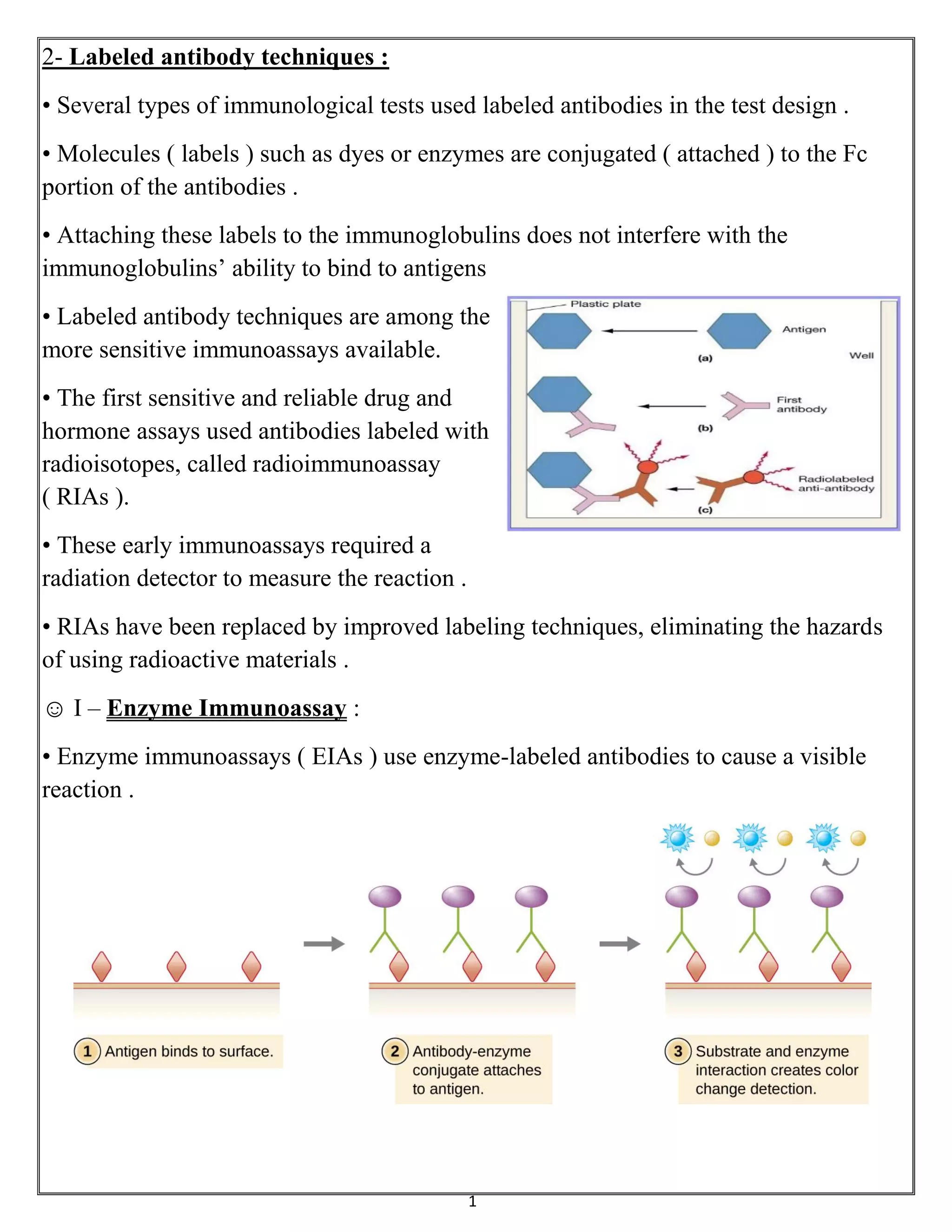
• Enzyme immunoassays ( EIAs ) use enzyme-labeled antibodies to cause a visible
reaction .
2
• The tests can be design to detect either antibody or antigen, such as viral antigen, in
a patient specimen .
• Enzyme Linked Immunosorbent Assay ( ELISA ) is a type of EIA .
• It is a very sensitive immunochemical technique used to access the presence and
quantification of specific protein ( antigen or antibody ) in a given sample .
• It is also called solid-phase enzyme immunoassay as it employs an enzyme linked
antigen or antibody as a marker for the detection of a specific protein .
• An enzyme conjugated with an antibody reacts with a colorless substrate to generate
a colored reaction product .
• A number of enzymes have been employed for ELISA, including alkaline
phosphatase ( ALP ) and horseradish peroxidase ( HRP ) .
• The enzyme activity may be monitored directly by measuring the product formed or
by measuring the effect of the product on a coupled reaction .
• Depending on the substrate used, the product can be photometric, fluorometric, or
chemiluminescent .
• For example, a typical photometric reaction using HRP-labeled Ab ( Ab-HRP ) and
the substrate ( a peroxide ) generate the product ( oxygen ) .
• The oxygen can then oxidize a reduced chromogen ( reduced
orthophenylenediamine [ OPD ] ) to produce a colored compound ( oxidized OPD ),
which is measured using a photometer .
Ab-HRP + peroxidase Ab = HRP + O2
O2 + reduced OPD Oxidized OPD + H2o
3
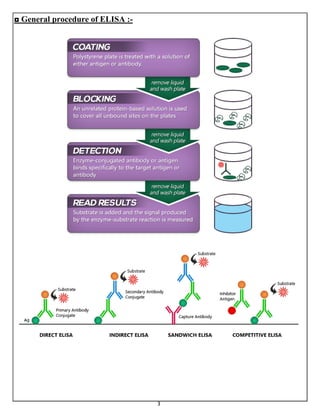
◘ General procedure of ELISA :-
4
◘ Types of ELISA :-
- A number of variations of ELISA have been developed, allowing qualitative
detection or quantitative measurement of either antigen or antibody .
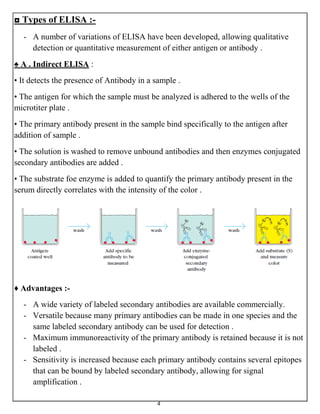
♠ A . Indirect ELISA :
• It detects the presence of Antibody in a sample .
• The antigen for which the sample must be analyzed is adhered to the wells of the
microtiter plate .
• The primary antibody present in the sample bind specifically to the antigen after
addition of sample .
• The solution is washed to remove unbound antibodies and then enzymes conjugated
secondary antibodies are added .
• The substrate foe enzyme is added to quantify the primary antibody present in the
serum directly correlates with the intensity of the color .
♦ Advantages :-
- A wide variety of labeled secondary antibodies are available commercially.
- Versatile because many primary antibodies can be made in one species and the
same labeled secondary antibody can be used for detection .
- Maximum immunoreactivity of the primary antibody is retained because it is not
labeled .
- Sensitivity is increased because each primary antibody contains several epitopes
that can be bound by labeled secondary antibody, allowing for signal
amplification .
5
♦ Dis-advantages :
- Cross-reactivity might occur with the secondary antibody, resulting in non-
specific signal .
- An extra incubation step is required in the procedure .
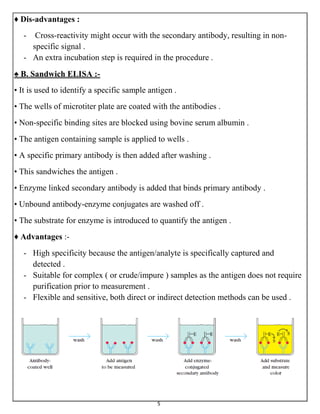
♠ B. Sandwich ELISA :-
• It is used to identify a specific sample antigen .
• The wells of microtiter plate are coated with the antibodies .
• Non-specific binding sites are blocked using bovine serum albumin .
• The antigen containing sample is applied to wells .
• A specific primary antibody is then added after washing .
• This sandwiches the antigen .
• Enzyme linked secondary antibody is added that binds primary antibody .
• Unbound antibody-enzyme conjugates are washed off .
• The substrate for enzyme is introduced to quantify the antigen .
♦ Advantages :-
- High specificity because the antigen/analyte is specifically captured and
detected .
- Suitable for complex ( or crude/impure ) samples as the antigen does not require
purification prior to measurement .
- Flexible and sensitive, both direct or indirect detection methods can be used .
6
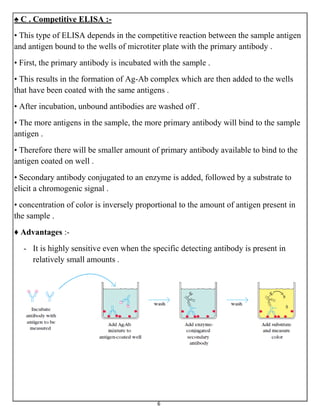
♠ C . Competitive ELISA :-
• This type of ELISA depends in the competitive reaction between the sample antigen
and antigen bound to the wells of microtiter plate with the primary antibody .
• First, the primary antibody is incubated with the sample .
• This results in the formation of Ag-Ab complex which are then added to the wells
that have been coated with the same antigens .
• After incubation, unbound antibodies are washed off .
• The more antigens in the sample, the more primary antibody will bind to the sample
antigen .
• Therefore there will be smaller amount of primary antibody available to bind to the
antigen coated on well .
• Secondary antibody conjugated to an enzyme is added, followed by a substrate to
elicit a chromogenic signal .
• concentration of color is inversely proportional to the amount of antigen present in
the sample .
♦ Advantages :-
- It is highly sensitive even when the specific detecting antibody is present in
relatively small amounts .

Labeled antibody techniques , ELISA

  • 1.
    1 2- Labeled antibodytechniques : • Several types of immunological tests used labeled antibodies in the test design . • Molecules ( labels ) such as dyes or enzymes are conjugated ( attached ) to the Fc portion of the antibodies . • Attaching these labels to the immunoglobulins does not interfere with the immunoglobulins’ ability to bind to antigens • Labeled antibody techniques are among the more sensitive immunoassays available. • The first sensitive and reliable drug and hormone assays used antibodies labeled with radioisotopes, called radioimmunoassay ( RIAs ). • These early immunoassays required a radiation detector to measure the reaction . • RIAs have been replaced by improved labeling techniques, eliminating the hazards of using radioactive materials . ☺ I – Enzyme Immunoassay : • Enzyme immunoassays ( EIAs ) use enzyme-labeled antibodies to cause a visible reaction .
  • 2.
    2 • The testscan be design to detect either antibody or antigen, such as viral antigen, in a patient specimen . • Enzyme Linked Immunosorbent Assay ( ELISA ) is a type of EIA . • It is a very sensitive immunochemical technique used to access the presence and quantification of specific protein ( antigen or antibody ) in a given sample . • It is also called solid-phase enzyme immunoassay as it employs an enzyme linked antigen or antibody as a marker for the detection of a specific protein . • An enzyme conjugated with an antibody reacts with a colorless substrate to generate a colored reaction product . • A number of enzymes have been employed for ELISA, including alkaline phosphatase ( ALP ) and horseradish peroxidase ( HRP ) . • The enzyme activity may be monitored directly by measuring the product formed or by measuring the effect of the product on a coupled reaction . • Depending on the substrate used, the product can be photometric, fluorometric, or chemiluminescent . • For example, a typical photometric reaction using HRP-labeled Ab ( Ab-HRP ) and the substrate ( a peroxide ) generate the product ( oxygen ) . • The oxygen can then oxidize a reduced chromogen ( reduced orthophenylenediamine [ OPD ] ) to produce a colored compound ( oxidized OPD ), which is measured using a photometer . Ab-HRP + peroxidase Ab = HRP + O2 O2 + reduced OPD Oxidized OPD + H2o
  • 3.
  • 4.
    4 ◘ Types ofELISA :- - A number of variations of ELISA have been developed, allowing qualitative detection or quantitative measurement of either antigen or antibody . ♠ A . Indirect ELISA : • It detects the presence of Antibody in a sample . • The antigen for which the sample must be analyzed is adhered to the wells of the microtiter plate . • The primary antibody present in the sample bind specifically to the antigen after addition of sample . • The solution is washed to remove unbound antibodies and then enzymes conjugated secondary antibodies are added . • The substrate foe enzyme is added to quantify the primary antibody present in the serum directly correlates with the intensity of the color . ♦ Advantages :- - A wide variety of labeled secondary antibodies are available commercially. - Versatile because many primary antibodies can be made in one species and the same labeled secondary antibody can be used for detection . - Maximum immunoreactivity of the primary antibody is retained because it is not labeled . - Sensitivity is increased because each primary antibody contains several epitopes that can be bound by labeled secondary antibody, allowing for signal amplification .
  • 5.
    5 ♦ Dis-advantages : -Cross-reactivity might occur with the secondary antibody, resulting in non- specific signal . - An extra incubation step is required in the procedure . ♠ B. Sandwich ELISA :- • It is used to identify a specific sample antigen . • The wells of microtiter plate are coated with the antibodies . • Non-specific binding sites are blocked using bovine serum albumin . • The antigen containing sample is applied to wells . • A specific primary antibody is then added after washing . • This sandwiches the antigen . • Enzyme linked secondary antibody is added that binds primary antibody . • Unbound antibody-enzyme conjugates are washed off . • The substrate for enzyme is introduced to quantify the antigen . ♦ Advantages :- - High specificity because the antigen/analyte is specifically captured and detected . - Suitable for complex ( or crude/impure ) samples as the antigen does not require purification prior to measurement . - Flexible and sensitive, both direct or indirect detection methods can be used .
  • 6.
    6 ♠ C .Competitive ELISA :- • This type of ELISA depends in the competitive reaction between the sample antigen and antigen bound to the wells of microtiter plate with the primary antibody . • First, the primary antibody is incubated with the sample . • This results in the formation of Ag-Ab complex which are then added to the wells that have been coated with the same antigens . • After incubation, unbound antibodies are washed off . • The more antigens in the sample, the more primary antibody will bind to the sample antigen . • Therefore there will be smaller amount of primary antibody available to bind to the antigen coated on well . • Secondary antibody conjugated to an enzyme is added, followed by a substrate to elicit a chromogenic signal . • concentration of color is inversely proportional to the amount of antigen present in the sample . ♦ Advantages :- - It is highly sensitive even when the specific detecting antibody is present in relatively small amounts .